
Judge, 1924-06-07 · page 20 of 37
Judge — June 7, 1924 — page 20: what you’re looking at
What you’re looking at
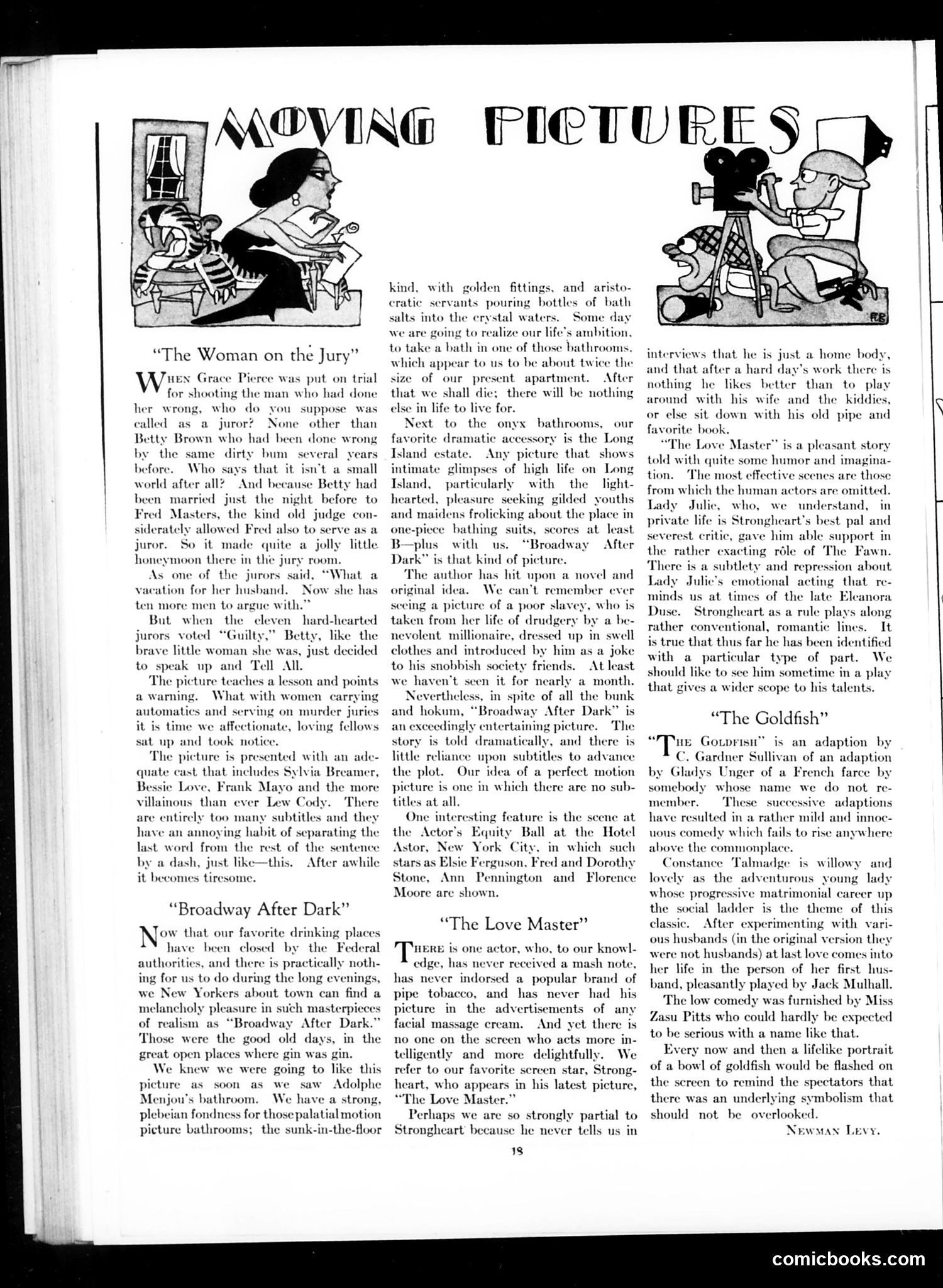
This page reviews three silent films, reflecting 1920s attitudes about women, Prohibition, and entertainment. **"The Woman on the Jury"** satirizes women's recent right to serve on juries. The plot—a woman juror who wrongly shot the defendant votes "guilty" anyway—mocks the notion that women jurors might be emotional or biased. The joke hinges on the absurd coincidence that another juror is her new husband, making the jury room a "honeymoon." **"Broadway After Dark"** celebrates luxurious bathrooms and wealthy Long Island lifestyles—escapist fantasy during Prohibition's restrictions on drinking establishments. The reviewer notes the novel plot of a poor servant girl elevated by a millionaire. **"The Love Master"** praises an unnamed male star (likely Strongheart, mentioned in text) for never seeking publicity through endorsements or fan mail—contrasting with typical celebrity behavior. The reviews showcase Judge's satirical tone while revealing period anxieties about women's expanded roles and nostalgia for pre-Prohibition pleasures.
📄 Transcribed text from this page (OCR, searchable)
Machine-transcribed from the original scan — historical spelling and the odd misread are preserved.
“The Woman on the Jury” Wies Grace Pieree was put on trial for shooting the man who had done do called as a juror? her wrong, who do you suppose was None other than Betty Brown who had been done wrong by the same dirty bum. seve Who says that it isn’t a sm after all? “And because Betty had been married just the night before to Fred Masters, the kind old judge con- siderately allowed Fred also to serv juror. So it made qui before. world asa a jolly little honeymoon there in the jury room. As one of the jurors said, “What a tion for her husband. Now she has ten more men to argue with.” But when the eleven hard-hearted jurors voted “Guilty,” Betty, like the brave little woman she was, just decided to speak up and Tell All. The picture teaches a lesson and points a warning. What with women carrying automatics and serving on murder juries it is time we affectionate, loving fellows took notice. The picture is presented with an ade- quate cast that includes Sylvia Breamer, Bessie Love, Frank Mayo and the more villainous than ever Lew Cody. There are entirely too many subtitles and they have an annoying habit of separating the last word from the rest of the sentence by a dash, just like—this. After awhile it becomes tiresome. sat up and “Broadway After Dark” Jow that our favorite drinking places have been closed by the Federal authorities, and there is practically noth- ing for us to do during the long evenings, we New Yorkers about town can find a alism as “Broadway After Dark.” Those were the good old days, in the great open places where gin was gin. We knew we were going to like this picture as soon as we saw Adolphe Menjou’s bathroom. We have plebeian fondness for thosepalatial motion picture bathrooms; the sunk-in-the-floor 1 strong, kind, with golden fittings, and aristo- cratic servants pouring bottles of in salts into the erystal waters. Some day we are going to realize our life’s ambition, to take a bath in one of those bathrooms. which appear to us to be about twice the size of our present apartment. After that we shall die; there will be nothing else in life to live for. Next to the onyx favorite dramatic ac Island intimate bathrooms, our ssory is the Long Any picture that shows of high life on Long Island, with the light- hearted, pleasure seeking gilded youths and maidens frolicking about the place in t least After one-piece bathing suits, score: B—plus with us. ‘Broadway Dark” is that kind of picture. The author has hit upon a novel and original idea. We can’t remember ever secing a picture of a poor slavey, who is taken from her life of drudgery by a be- nevolent. millionaire, dressed up in swell clothes and introduced by him as a joke to his snobbish society friends. At least we haven't seen it for nearly a month. Nevertheless, in spite of all the bunk and hokum, y After Dark” is an exceedingly entertaining picture. The story is told dramatically, and there is little reliance upon subtitles to advance the plot. Our idea of a perfect motion picture is one in which there are no sub- titles at all. One interesting feature is the scene at the Actor’s Equity Ball at the Hotel Astor, New York City, in which such stars as Elsie Ferguson, Fred and Dorothy Stone, Ann Pennington and Florence Moore are shown. “The Love Master” Te is one actor, who, to our knowl- edge, has never received a mash note, has never indorsed a popular brand of pipe tobacco, and has never had_ his picture in the advertisements of any facial massage cream. And yet there is no one on the screen who acts more in- telligently and more delightfully. We refer to our favorite screen star, Strong- heart, who appears in his latest picture, “The Love Master.” Perhaps we are so strongly partial to Strongheart because he never tells us in Broadw is interviews that he is just a home body, and that after a hard day’s work there is nothing he likes better than to play around with his wife and the kiddies, or else sit down with his old pipe and favorite book “The Love Master” is a pleasant story told with quite some humor and imagina- tion. The most effective s from which the human actors are omitted. Lady Julie, who, we understand, in private life is Strongheart’s best pal and severest critic, gave him able support in the rather exacting role of The There is a subtlety and repression about Lady Julie’s emotional acting that re- minds us at times of the late Eleanora Duse. Strongheart as a rule plays along rather conventional, romantic lines. It is true that thus far he has been identified with a particular type of part. We should like to see him sometime in a p! that gives a wider scope to his talents. “The Goldfish” we Gouprisn” is an adaption by rdner Sullivan of an adaption lys Unger of a French farce by somebody whose name we do not re- nes are those ‘awn. member. ‘These successive adaptions have resulted in a rather mild and innoc- uous comedy which fails to rise anywhere above the commonplace. Constance ‘Talmadge is willowy and lovely as the adventurous young lady whose progressiv matrimonial career up the social ladder is the theme of this classic. After experimenting with vari- ous husbands (in the original version they were not husbands) at last love comes into her life in the person of her first. hus- band, pleasantly played by Jack Mulhall. The low comedy was furnished by Miss Zasu Pitts who could hardly be expected to be serious with a name like that. Every now and then a lifelike portrait of a bowl of goldfish would be flashed on the screen to remind the spectators that there wi smbolism that ked. Newaay Levy. an underlying not should be overl comicbooks.com