
Judge, 1924-06-07 · page 25 of 37
Judge — June 7, 1924 — page 25: what you’re looking at
What you’re looking at
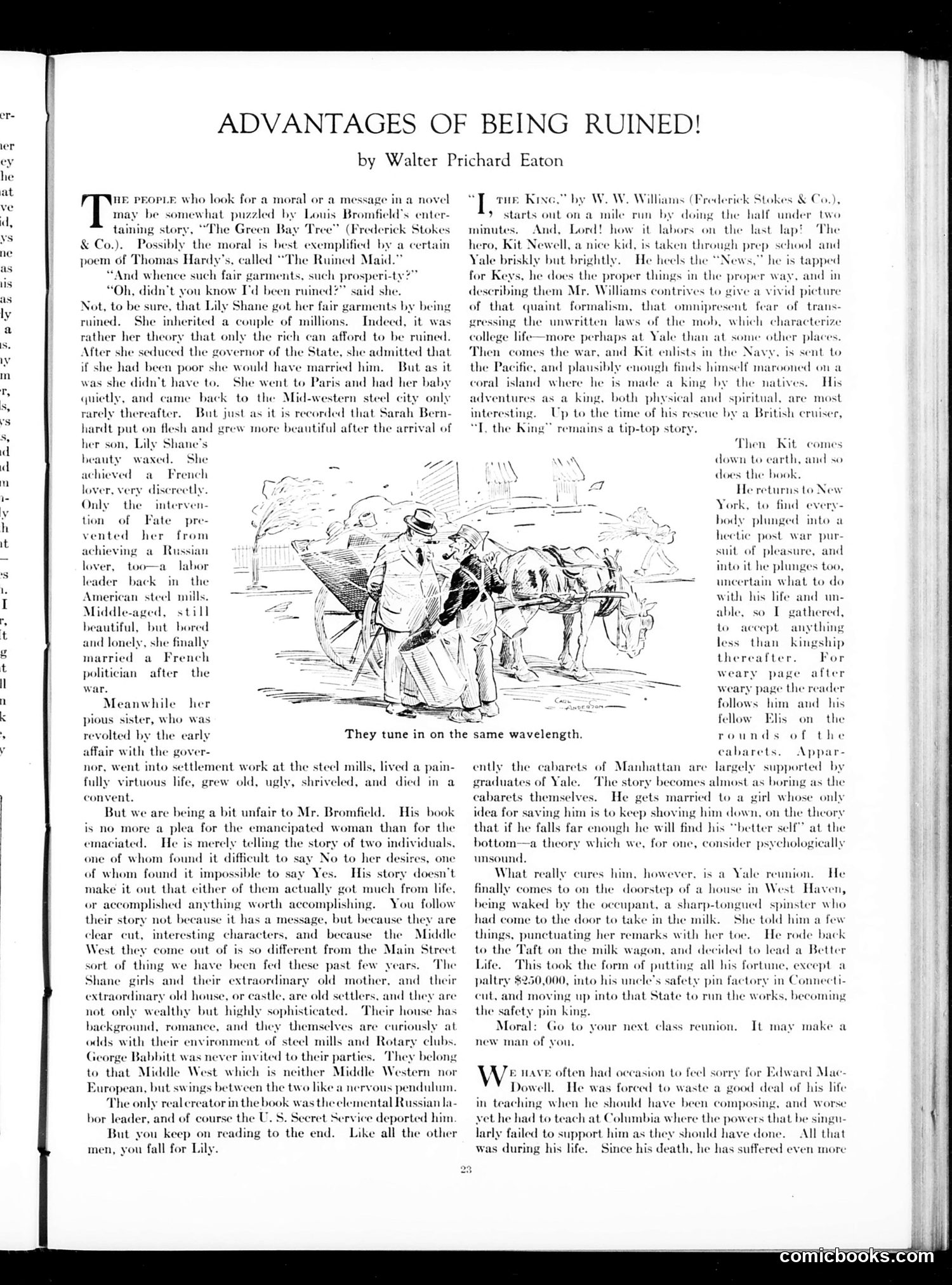
This page contains a literary review essay by Walter Prichard Eaton discussing Louis Bromfield's novel *The Green Bay Tree*. The illustration depicts characters "tuning in on the same wavelength"—a metaphor for connection. The satire concerns **class and morality in 1920s America**. Eaton reviews Bromfield's story of Lily Shane, a wealthy woman who bears an illegitimate child with a Russian labor leader (later deported by the U.S. Secret Service). The ironic "advantage" of being "ruined" (sexually compromised) is that wealth shields her from real consequences—she can afford Paris, discretion, and eventual respectability through marriage to a politician. The contrast is her pious sister, who lives virtuously among steel mill workers but grows "old, ugly, shriveled." The satire critiques how **money, not morality, determines a woman's fate**, and how the wealthy operate by different rules than working-class people. Eaton notes the book doesn't moralize; it simply shows two outcomes determined by class position, not character.
📄 Transcribed text from this page (OCR, searchable)
Machine-transcribed from the original scan — historical spelling and the odd misread are preserved.
ADVANTAGES OF BEING RUINED! by Walter Prichard Eaton HE PEOPLE who look for a moral or a message in a novel y be somewhat puzzled by Louis Bromfield’s enter- ning story, “The Green Bay Tree” (Frederick Stokes & Co); Possibly the moral’ is best: exemplified by a certain poem of Thomas Hardy’s, called “The Ruined Maid.” “And whence such fair garments, such prosperi “Oh, didn’t you know I'd been ruined?” said she. Not, to be sure, that Lily Shane got her fair garments by being ruined. She inherited a couple of millions. rather her theory that only the rich \fter she seduced the governor of the Indeed, it was 1 afford to be ruined. f ate, she admitted that if she had been poor she would have married him. But as it was she didn’t have to. She went to Paris and had her baby quietly, and came back to the Mid-western steel city only rarely thereafter. But just as it is recorded that Sarah Bern- hardt put on flesh and grew more beautiful after the arrival of Lily She wane ne’s She French lover, very discreetly. Only the | interven- tion of Fate vented her her son, beauty achieved a from achieving a Russian lover, labor leader back in the American steel mills. Middle-aged, still beautiful, but | and lonely, she fir too—a French the married a politician after war. Meanwhile pious sister, who was her revolted by the early affair with the gover- nor, went into settlement work at the steel mills, lived a pain- fully virtuous life, grew old, ugly, shriveled, and died in a convent. His book is no more a plea for the emancipated woman than for the emaciated. He is merely telling the story of two individuals, one of whom found it difficult to say No to her desires, one of whom found it impossible to say Yes. His story doesn’t make it out that cither of them actually got much from life, or accomplished anything worth You follow their story not because it has a message, but because they are clear cut, interesting characters, and because the Middle West they come out of is so different from the Main Street sort of thing we have been fed these past few years. The Shane girls and their extraordinary old mother, and. their extraordinary old house, or castle, are old settlers, and they are not only wealthy but highly sophisticated. Their house has background, romance, and they themselves are curiously at odds with their environment of steel mills and Rotary clubs. George Babbitt was never invited to their parties. They belong to that Middle West which is neither Middle Western nor Euroy But we are being a bit unfair to Mr. Bromfield. complishing. an, but swings between the two like a nervous pendulum. ‘The only real creator inthe book was the elemental Russian la- bor leader, and of course the U.S. Secret Service deported him But you keep on reading to the end. Like all the other men, you fall for Lily. They tune in on the same wavelength. “T THR Kine.” by W. W. Williams (Frederick Stokes & Co.), 9 starts out ona iile run by doing the half under two minutes. And, Lord! how it labors on the last lap! The hero, Kit Newell, a nice kid, is taken through prep school and Yale briskly but brightly. He heels the “News,” he is tapped for Keys, he does the proper things in the proper way, and in describing them Mr. Williams contrives to give a vivid picture of that quaint formalism, that omnipresent fear of trans- gressing the unwritten laws of the mob, which ¢ college life—more perhaps at Yale than at some ot Then comes the war, and Kit enlists in the > rracte| places. s sent to the Pacific, and plausibly enough finds himself marooned on a coral island where he is made a king by the natives. His adventures as a king, both physical and spiritual, are most interesting. Up to the time of his rescue by a British cruiser, “I. the King™ remains a tip-top story. Then Kit down to earth, and so comes does the book. He returns to New York, to find every- body plunged into a heetic post. war pur- suit of pleasure, and into it he plunges too, uncertain what to do with his life and un- able, gathered, to accept than thereafter. weary anything kingship page after weary page the reader follows him and. his fellow Elis on the rounds of the Appar- largely supported by urets. ently the cabarets of Manhattan are graduates of Yale. The story becomes almost as boring as the cabarets themselves. He gets married to a girl whose only idea for saving him is to keep shoving him down, on the theory that if he falls far enough he will find his “better self” at the bottom—a theory which we, for one, consider psychologically unsound, What really cures him, however, is a Yale reunion. He finally comes to on the doorstep of a house in West Haven, being waked by the occupant, a sharp-tongued spinster who had come to the door to take in the milk. She told him a few things, punctuating her remarks with her toe. He rode back to the Taft on the milk wagon, and decided to lead a Better Life. This took the form of putting all his fortune, except a paltry $250,000, into his uncle's safety pin factory in Connecti- cut, and moving up into that State to run the works, becoming the safety pin king. Moral: Go to your next class reunion. new man of you. Tt may make W: HAVE often had occasion to feel sorry for Edward Mac- Dowell. He was forced to waste a good deal of his life in teaching when he should have been composing, and worse yet he had to teach at Columbia where the powers that be singu- larly failed to support him as they should have done. All that was during his life. Since his death, he has suffered even more