
A complete issue · 36 pages · 1924
Judge — April 12, 1924
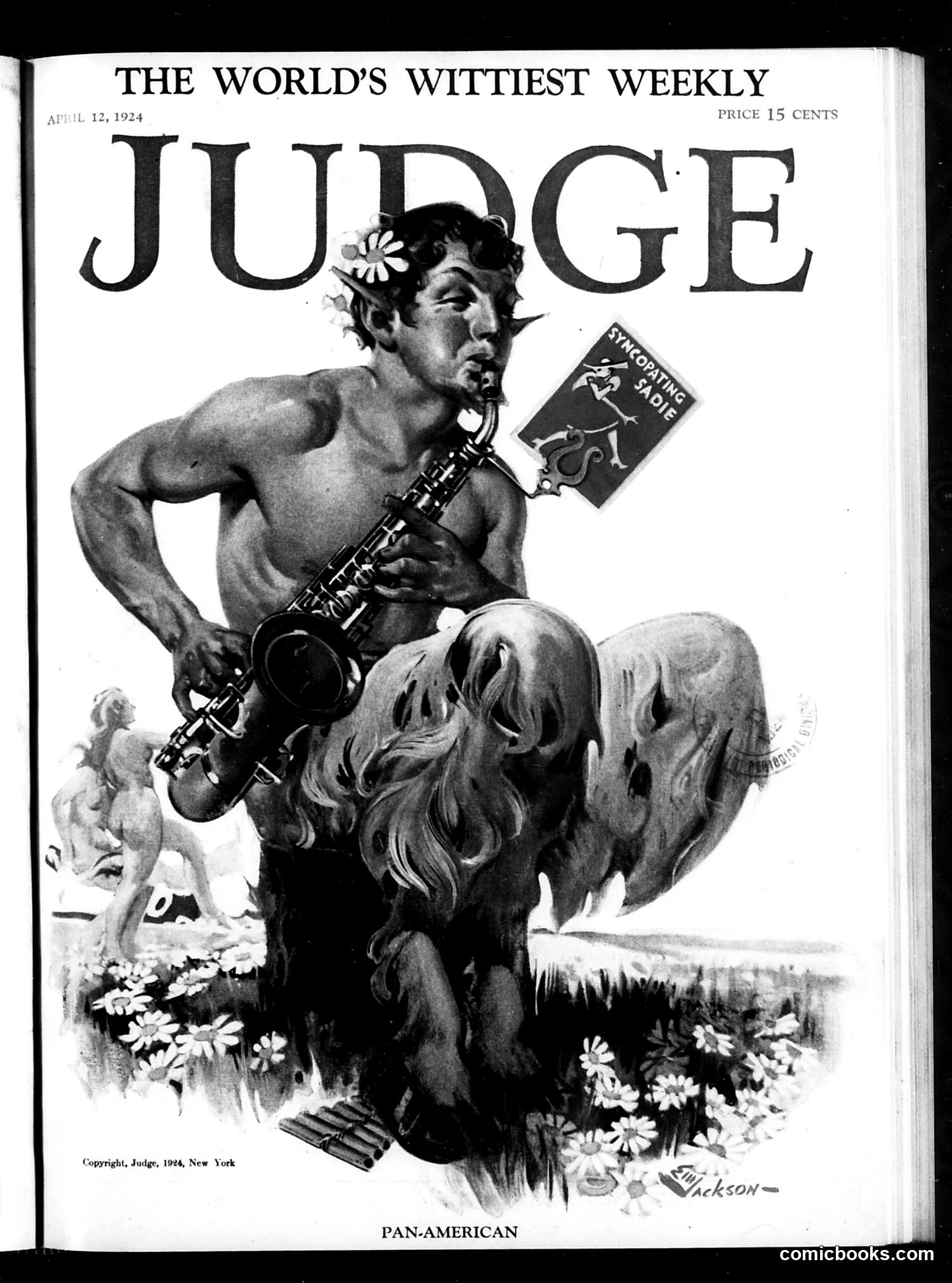
This satirical cover depicts a cherub or cupid figure playing a saxophone labeled "Syncopating Radio," holding sheet music titled "Syncopating Radio." The cherub is surrounded by flowers and pastoral imagery, with what appears to be a woman or feminine figure below. The satire targets **radio's emerging popularity and the "syncopation" of jazz music** becoming mainstream through broadcast. The cupid imagery suggests radio's power to spread romantic sentiments—or cultural influence—across America. The "Pan-American" label indicates concern about this cultural phenomenon spreading internationally. This likely reflects 1920s anxiety about jazz, radio technology, and rapid cultural change during the Jazz Age, when both were controversial new influences on American society.
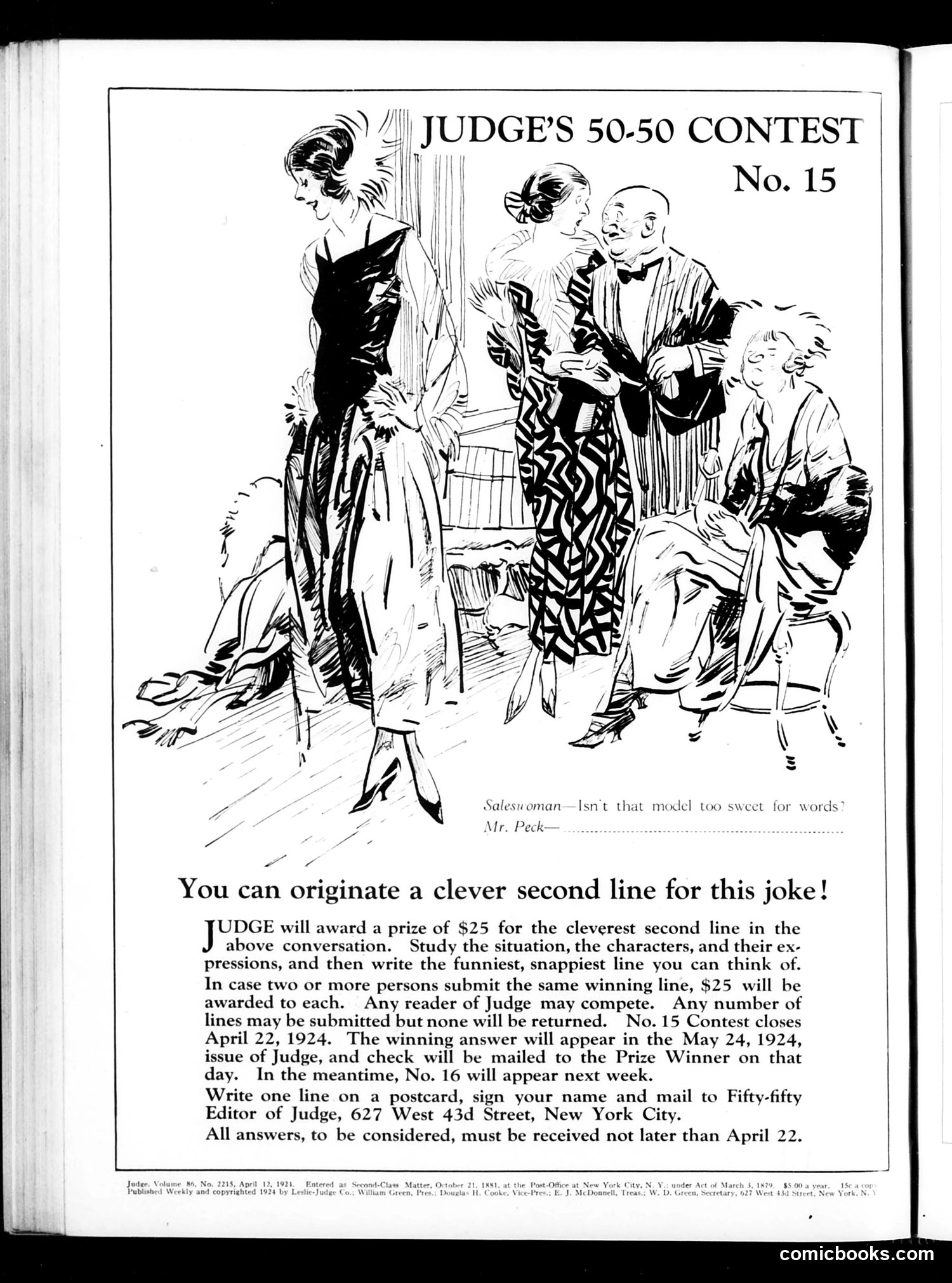
This is a "Judge's 50-50 Contest" — a humor competition inviting readers to complete a joke. The cartoon shows a fashionable saleswoman displaying a model to a well-dressed man (identified as "Mr. Peck") and his family. The saleswoman's opening line is: "Isn't that model too sweet for words?" The joke appears to play on 1920s gender dynamics and consumerism. A "model" likely refers to both a fashion model and possibly a car model (automobiles were heavily marketed during this era). The humor hinges on Mr. Peck's response to the saleswoman's flirtation or sales pitch. Readers were invited to submit clever second lines, with a $25 prize for the wittiest response, due April 22, 1924.
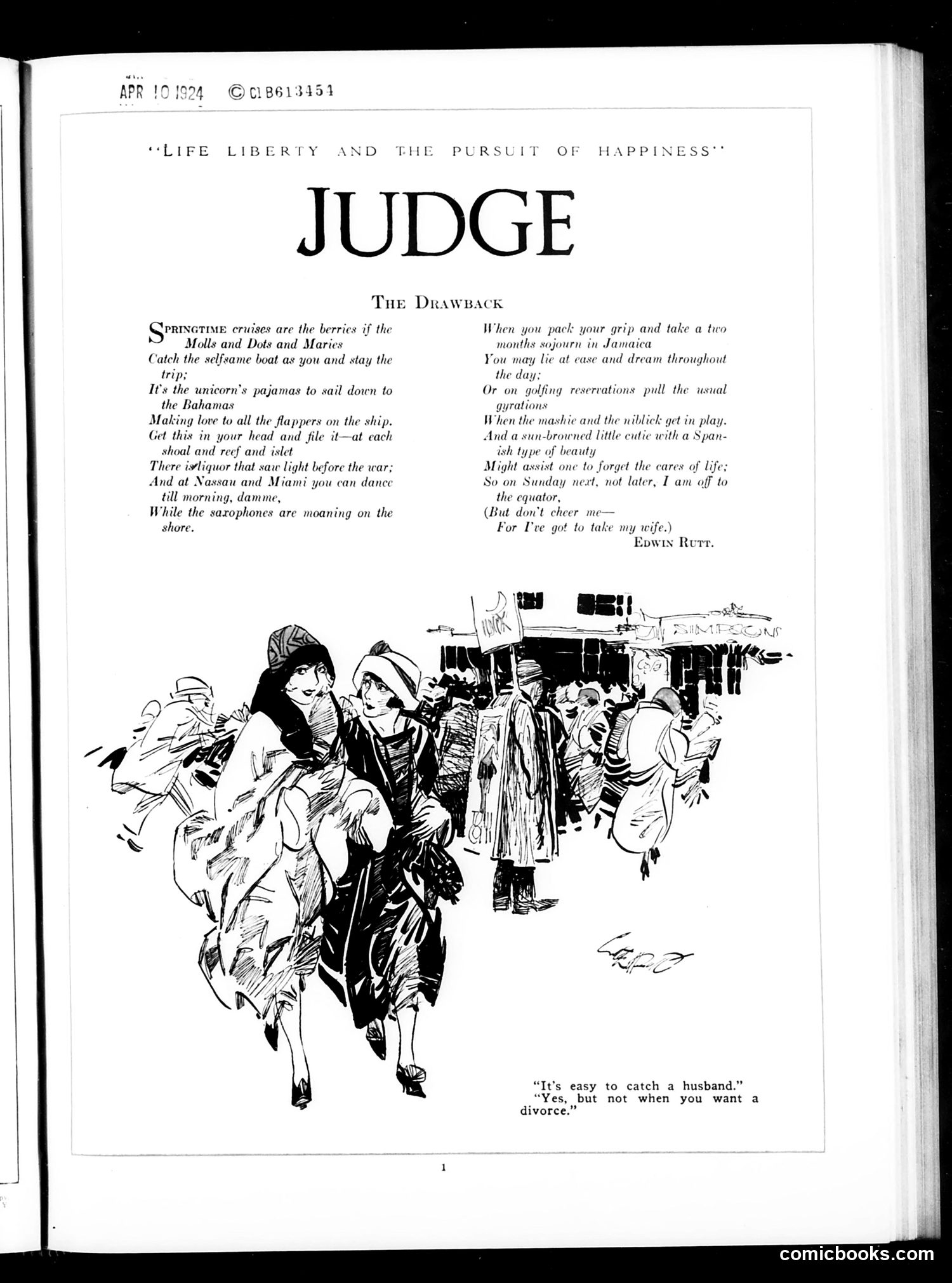
This is a satirical commentary on leisure and marriage from what appears to be the 1920s (given the date "APR 19 1924" and fashion styles). **The Main Cartoon ("The Drawback"):** The illustration shows two women departing on a springtime cruise vacation—a popular leisure activity for the wealthy during this era. The poem by Edwin Rutt celebrates carefree travel: Caribbean cruises, dancing, romantic encounters. **The Joke (bottom caption):** The punchline reads: *"It's easy to catch a husband. Yes, but not when you want a divorce."* This reflects contemporary concerns about marriage dissolution and women's legal rights. It satirizes the contradiction that while courtship was simple, obtaining a divorce—even when desired—remained legally difficult and socially stigmatized in the 1920s. The humor targets restrictive divorce laws while acknowledging women's growing independence and desire for travel.
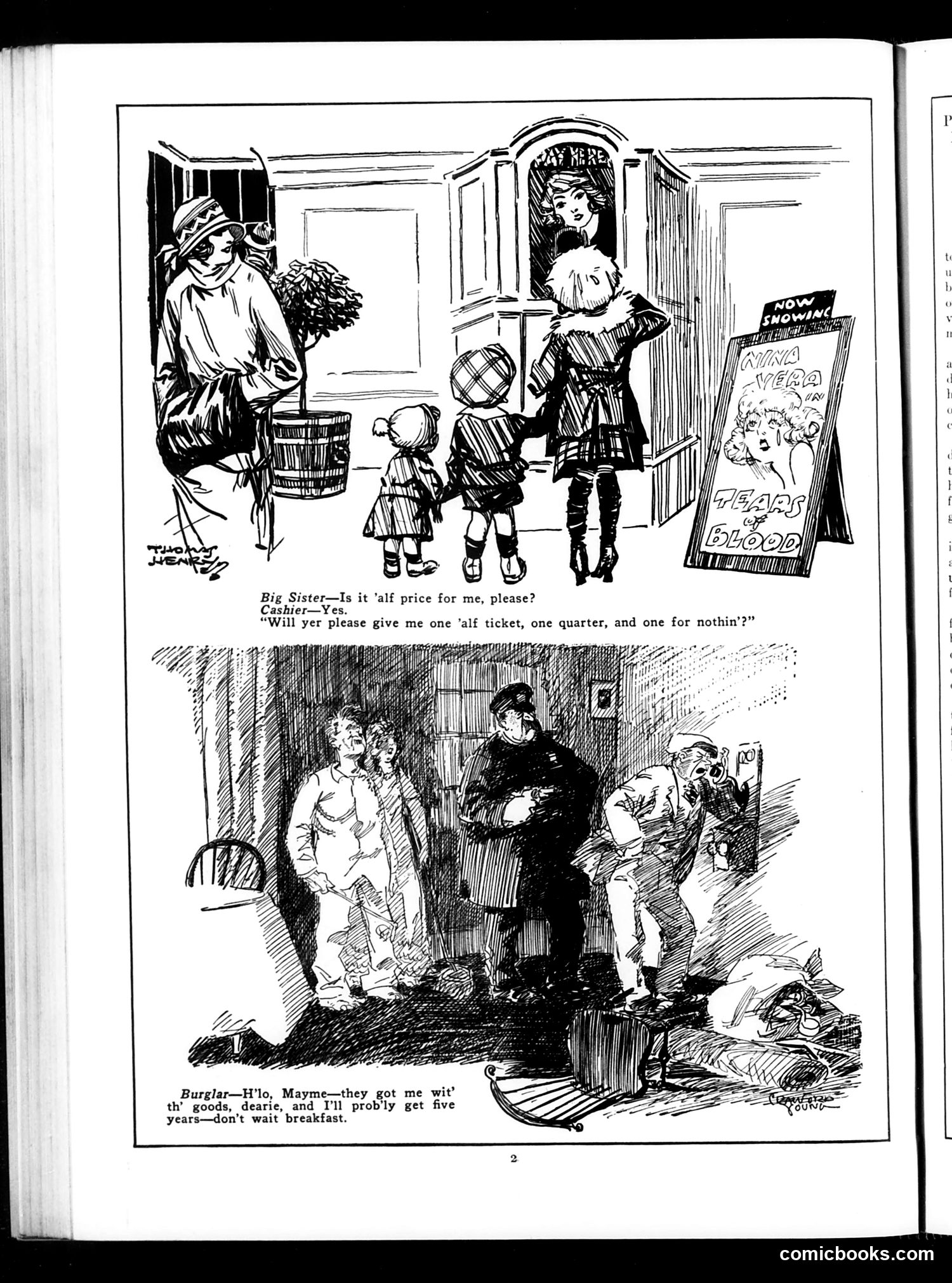
This page contains two satirical cartoons about poverty and crime, likely from the early 20th century. **Top cartoon**: A child negotiates movie ticket prices with a cashier, asking for "one 'alf ticket, one quarter, and one for nothin'?" — demonstrating how poor families stretched meager resources to afford entertainment. **Bottom cartoon**: A burglar boasts to his accomplice about stealing goods, expecting five years imprisonment but claiming he won't "wait breakfast" — dark humor about the inevitability of arrest and incarceration for criminals in desperate circumstances. Both cartoons satirize urban poverty: the first shows children's resourcefulness in accessing culture, the second depicts crime as a predictable consequence of destitution. The humor relies on working-class dialect and the grim acceptance of poverty's cycle.
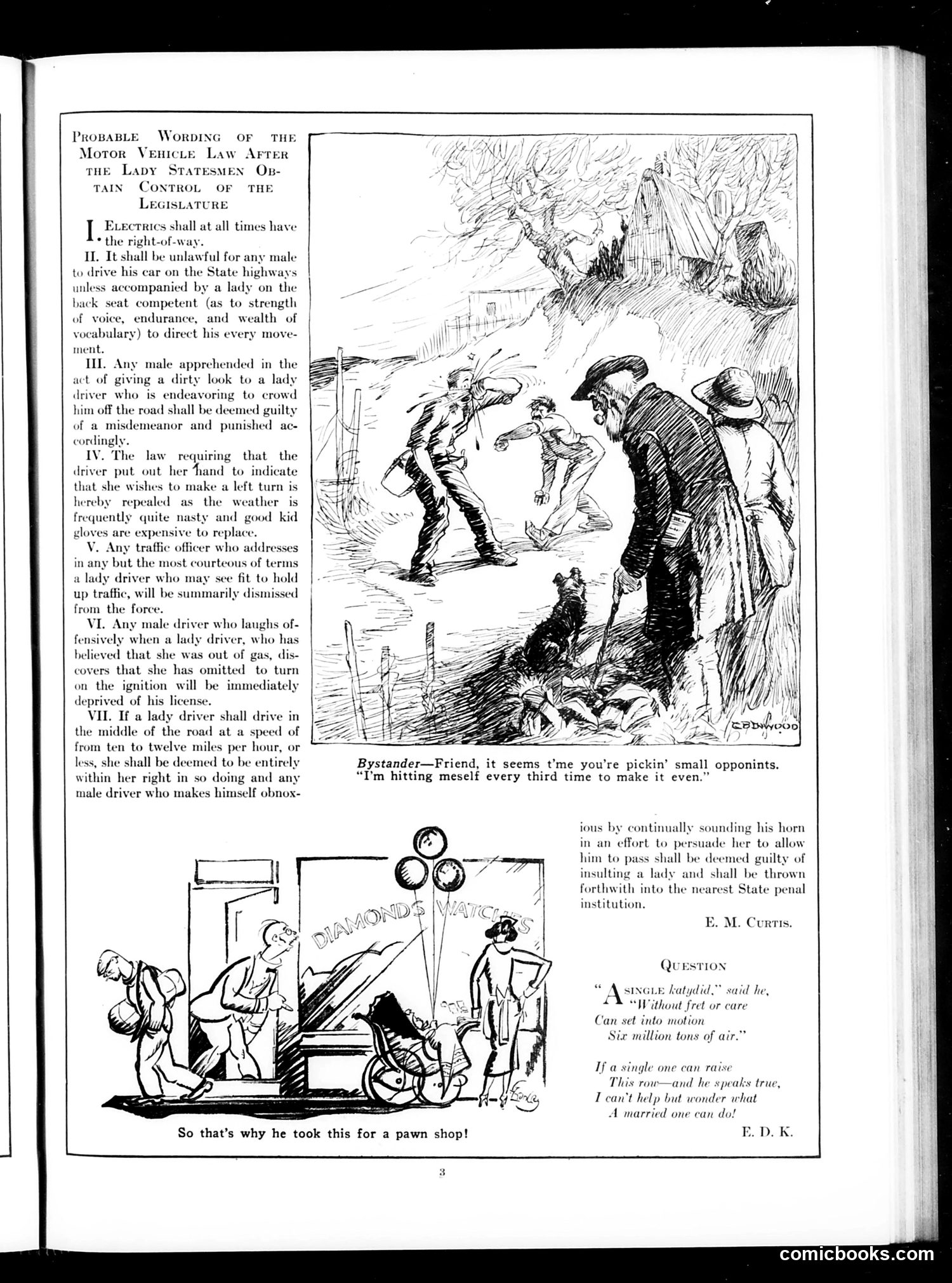
This page satirizes early automotive culture and gender dynamics. The top section presents mock "legislation" requiring women to accompany male drivers—a humorous response to real anxieties about women's increasing independence and automobile ownership in the early 1900s. The upper cartoon depicts a driving mishap where a woman appears to be winning a game or competition, with the caption commenting on "picking small opponents." The lower cartoon shows a pawn shop scene where a man has apparently pawned items, with the joke suggesting he's mismanaging finances or possessions—possibly a commentary on male irresponsibility contrasted with the "lady statesmen" legislation above. The included poem questions women's capabilities using sarcastic language, reflecting period attitudes about gender roles and capabilities, presented as satire of those very attitudes.
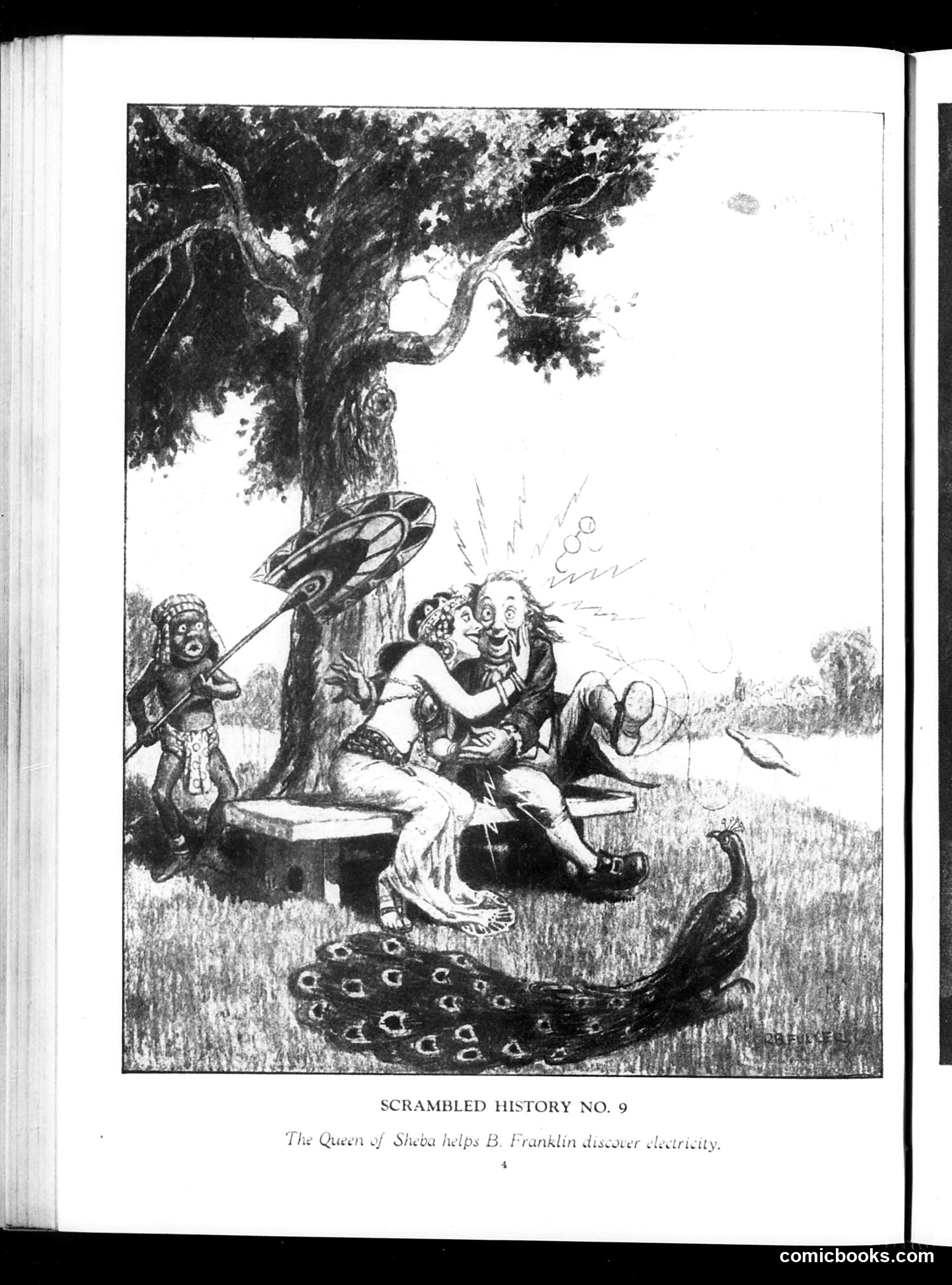
This is a satirical cartoon from Judge magazine titled "The Queen of Sheba helps B. Franklin discover electricity." The image depicts a comical alternate history scenario combining two historical figures impossibly: Benjamin Franklin (the American Founding Father associated with electricity experiments) and the biblical Queen of Sheba (ancient ruler of a Middle Eastern kingdom). The cartoon appears to be part of a "Scrambled History" series that humorously reimagines historical events by placing anachronistic or incongruous figures together. The elaborate costumes, exaggerated expressions, and absurdist composition signal this is meant as whimsical nonsense rather than serious commentary—satirizing perhaps the arbitrary nature of historical narratives or simply providing light comedic entertainment through visual absurdity.
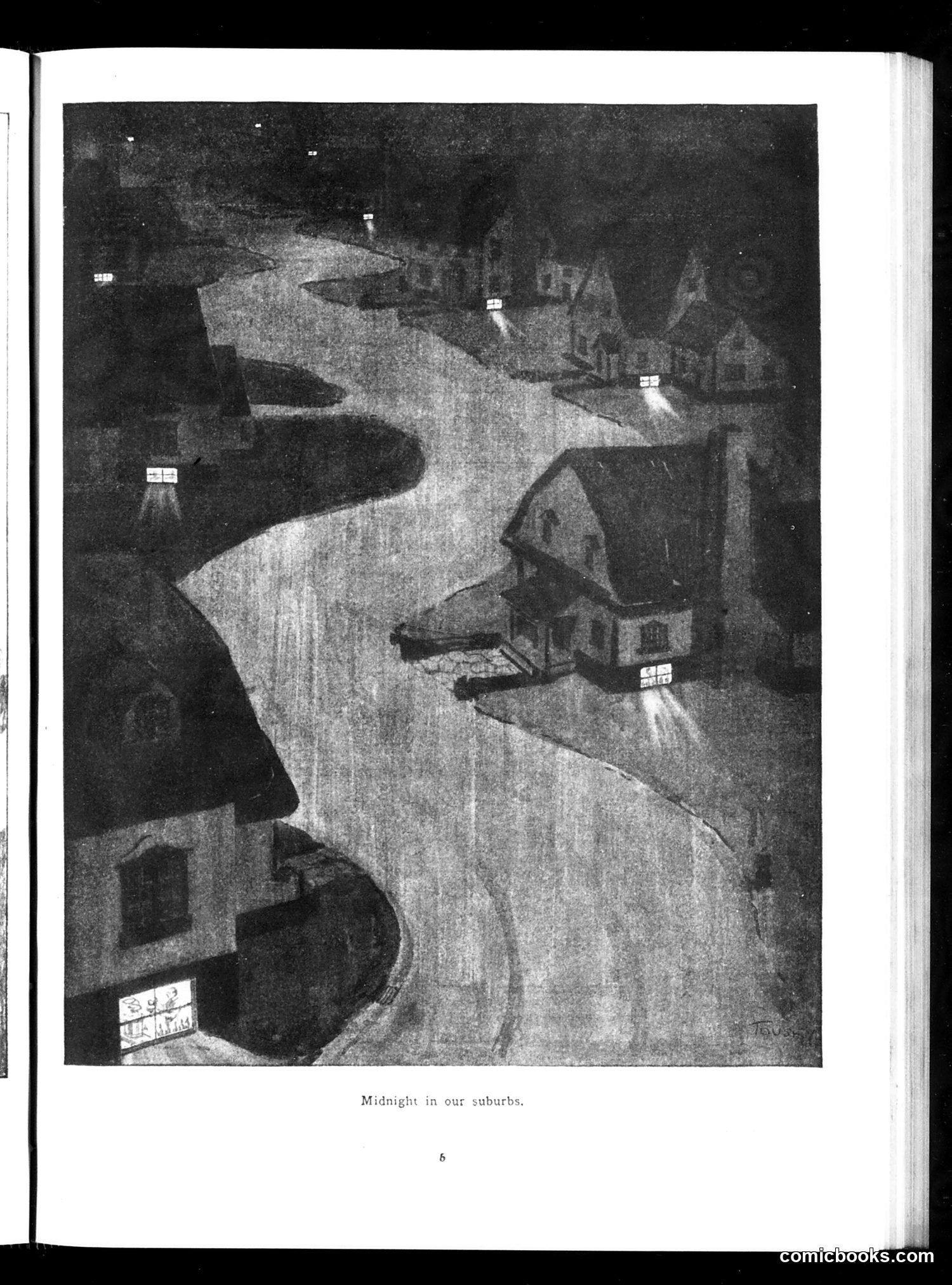
This page from *Judge* magazine shows a nighttime suburban street scene with illuminated windows in houses. The caption "Midnight in our suburbs" suggests social satire about suburban life and behavior. The image appears to be a commentary on suburban domesticity after dark—possibly satirizing what occurs behind closed doors in respectable neighborhoods at night. The stark black-and-white nighttime imagery, combined with *Judge*'s satirical orientation, suggests the cartoonist is making a pointed observation about the gap between suburban propriety and private conduct, or perhaps commenting on suburban monotony, vice, or social hypocrisy hidden by darkness. Without clearer details or additional context about the publication date, the specific satirical target remains somewhat unclear, though the ironic tone is evident.
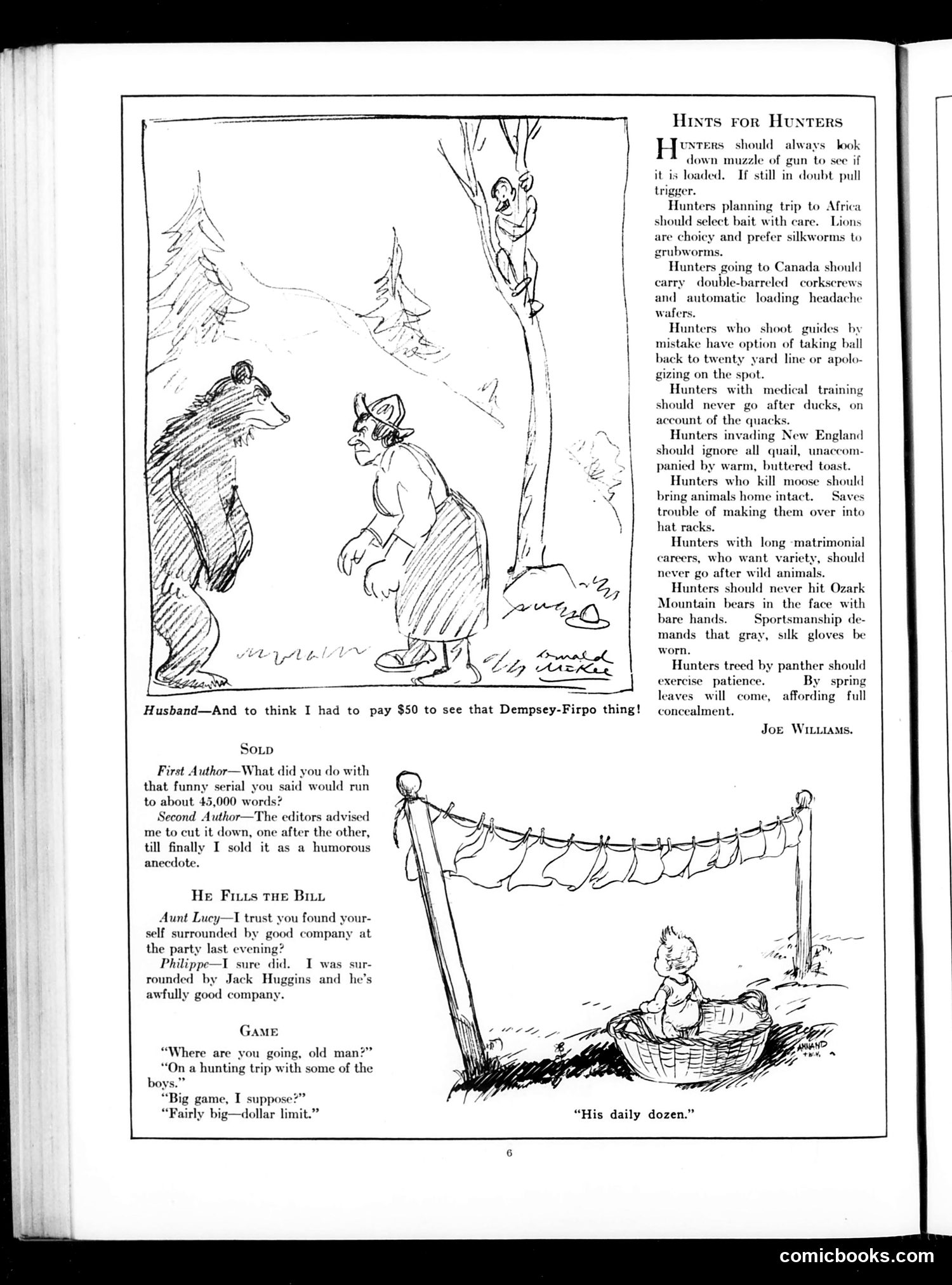
This page contains satirical hunting advice and humorous anecdotes from *Judge* magazine. **"Hints for Hunters"** (by Joe Williams) is absurdist satire mocking incompetent hunters through deliberately ridiculous advice—check if your gun is loaded by looking down the barrel, use corkscrews in Canada, wear silk gloves when fighting bears. The humor lies in presenting dangerous stupidity as practical tips. **"Sold"** jokes about editorial rejection—a 45,000-word serial gets repeatedly cut until it becomes a brief anecdote, satirizing how magazines butcher writers' work. **"He Fills the Bill"** is mild social comedy about finding good company at parties. **"Game"** puns on the word "game"—a man going hunting with a "dollar limit" (modest budget) rather than pursuing actual big game. The top cartoon shows two anthropomorphic animal hunters (unclear which species), likely illustrating the hunting theme. The bottom cartoon shows clothesline laundry labeled "His daily dozen"—a reference to the popular 1920s fitness routine of twelve daily exercises.
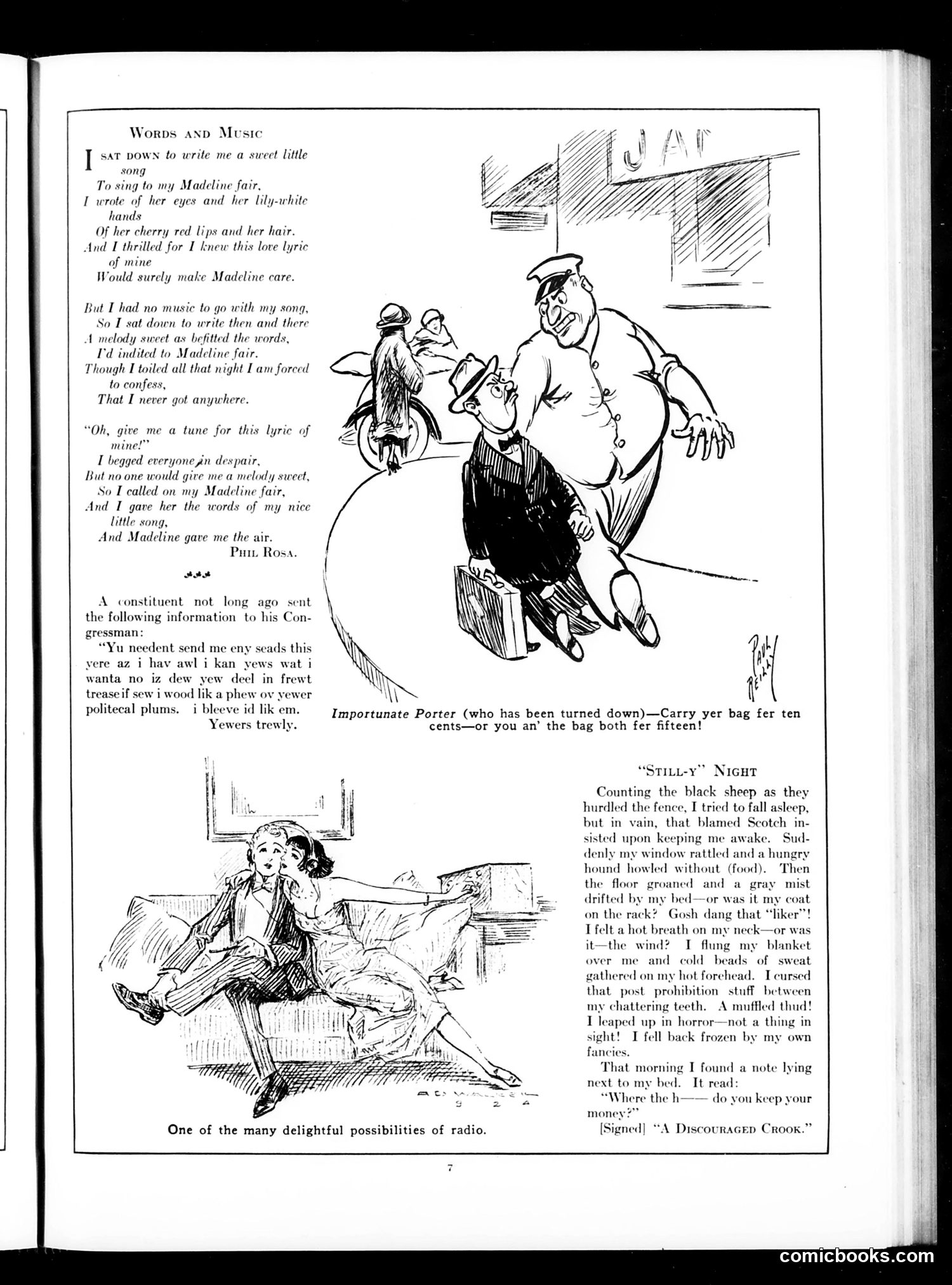
This page contains three satirical pieces typical of early 20th-century American humor: **"Words and Music"** (top): A poem mocking unsuccessful romance. A man writes heartfelt lyrics for "Madeline fair" but cannot compose music. When he finally asks Madeline herself for help, she simply "gave me the air"—a dismissive rejection. The satire targets romantic pretension and the gap between artistic ambition and actual talent. **Porter cartoon** (middle): Shows a shabby porter pestering a well-dressed man about carrying his bag, arguing for inflated wages ("ten cents—or you an' the bag both fer fifteen!"). This satirizes aggressive street hustlers or panhandlers. **"Still-y Night"** (bottom): A humorous account of insomnia, where the narrator attributes supernatural disturbances (ghostly breath, mysterious sounds) to post-Prohibition alcohol consumption rather than genuine paranormal activity. The final note asking "Where the h—— do you keep your money?" suggests a burglar, implying his drunken fears were partly justified—satirizing both prohibition-era drinking and paranoia.
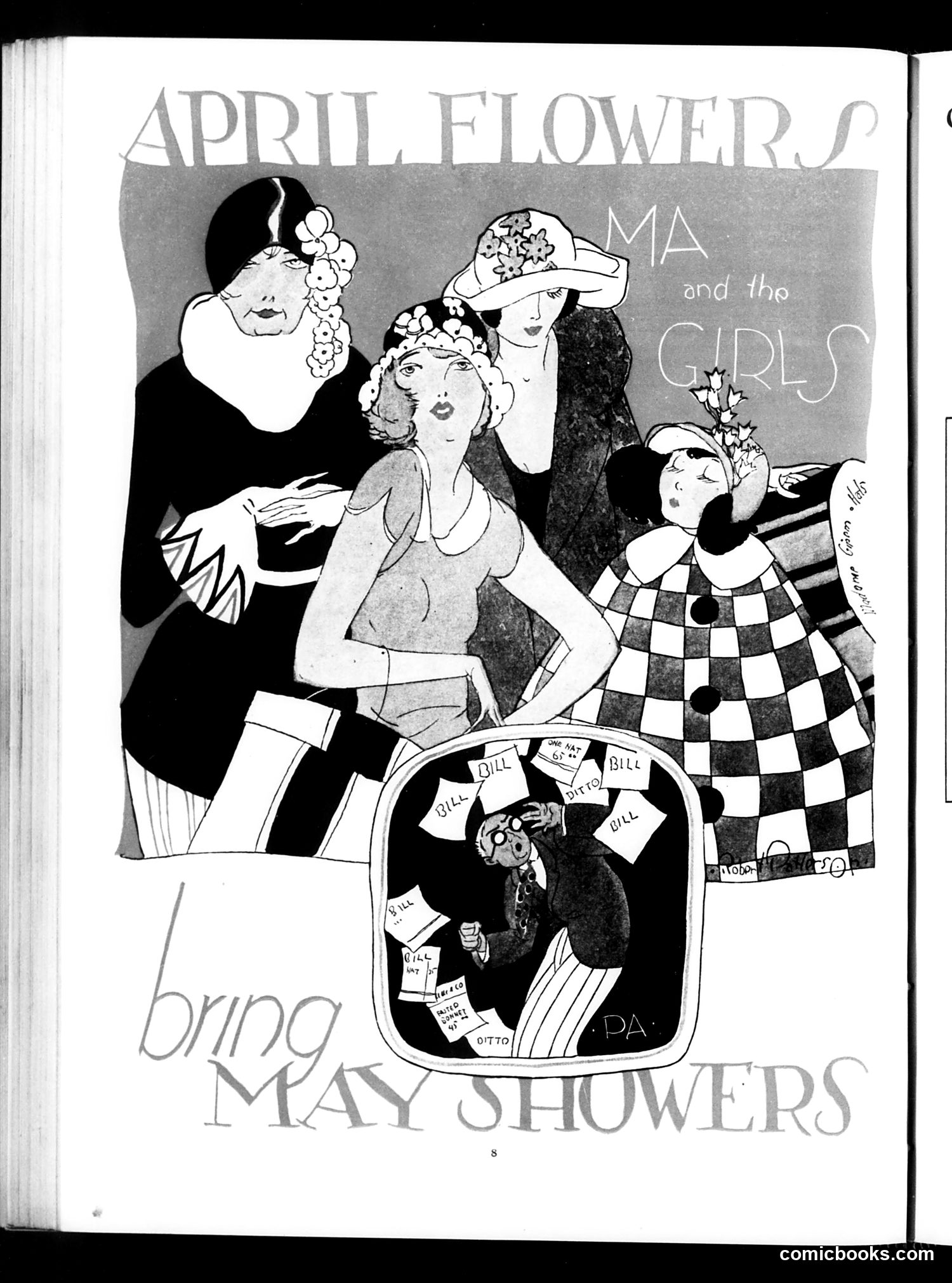
This is a satirical advertisement from *Judge* magazine titled "April Flowers: Ma and the Girls Bring May Showers." The illustration depicts a mother figure with three young women adorned with flowers in their hair, accompanied by a small character (possibly a cherub or child) surrounded by bills and debts marked "BILL" and "OTTO." The satire targets household spending and debt accumulation. The "April flowers" of spring fashion and beauty products lead to the "May showers" of bills—suggesting that women's seasonal shopping and adornment create financial obligations. The figure buried in papers labeled with debts represents the economic consequences of domestic spending habits, a common theme in early 20th-century satirical commentary on consumer culture and family finances.
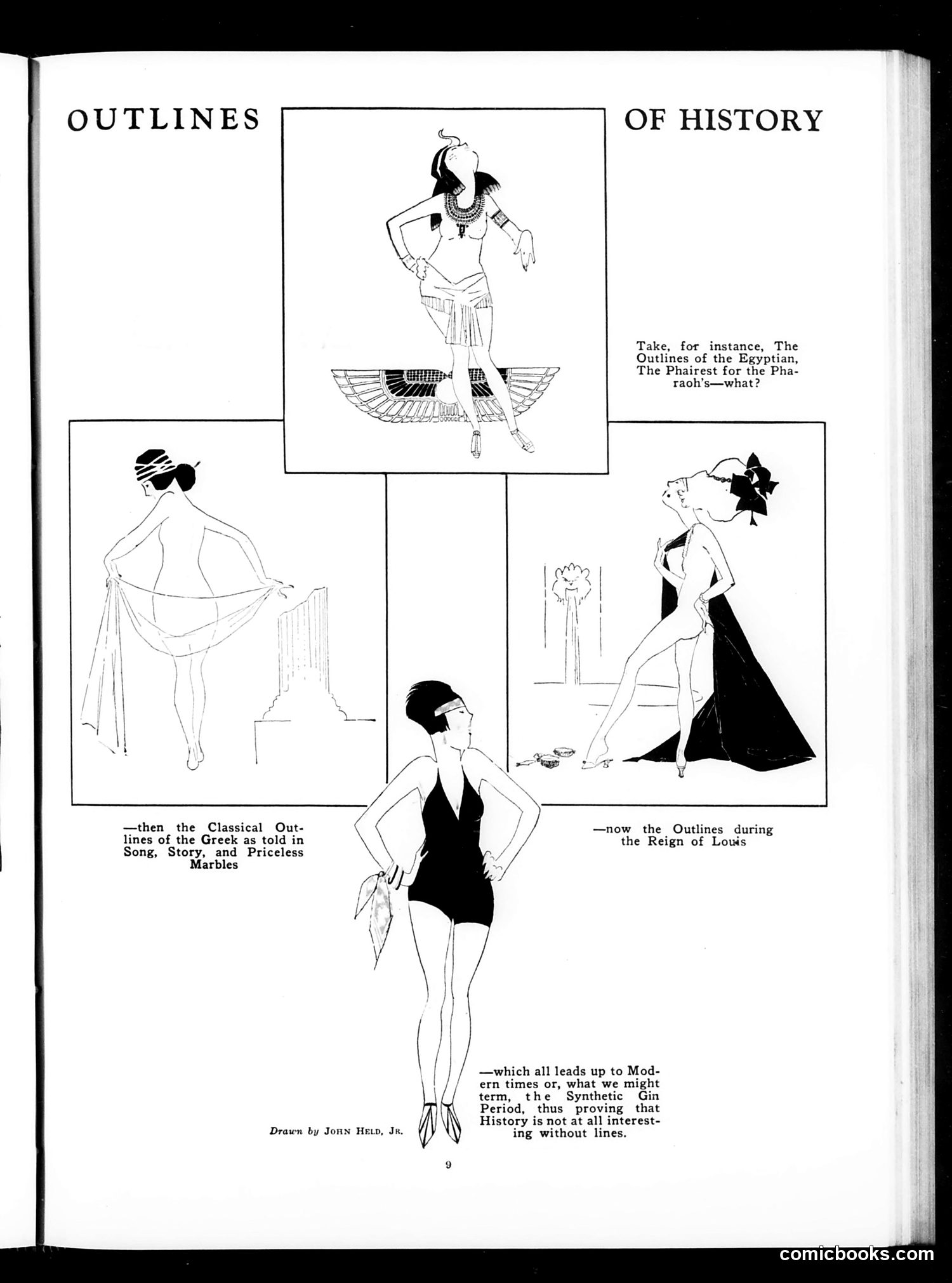
This is a visual pun about female fashion silhouettes across historical periods. The cartoon compares the "outlines" (body shapes) created by women's clothing in different eras: Egyptian, Greek, and French (Louis XVI period), leading to "modern times" or the "Synthetic Gin Period." The joke conflates historical "outlines" (as in textbooks) with the literal body contours produced by each era's fashion. The final figure, representing modern times, is drawn in the 1920s flapper style—slim, straight, and lacking curves—which the cartoonist satirically calls the "Synthetic Gin Period," linking the austere silhouette to Prohibition-era drinking. The satire mocks both women's fashion's constant transformation and the notion that history can be meaningfully reduced to simple visual outlines. The title suggests history books are as trivial and subject to arbitrary change as hemlines. Drawn by John Held Jr., a famous Jazz Age illustrator.
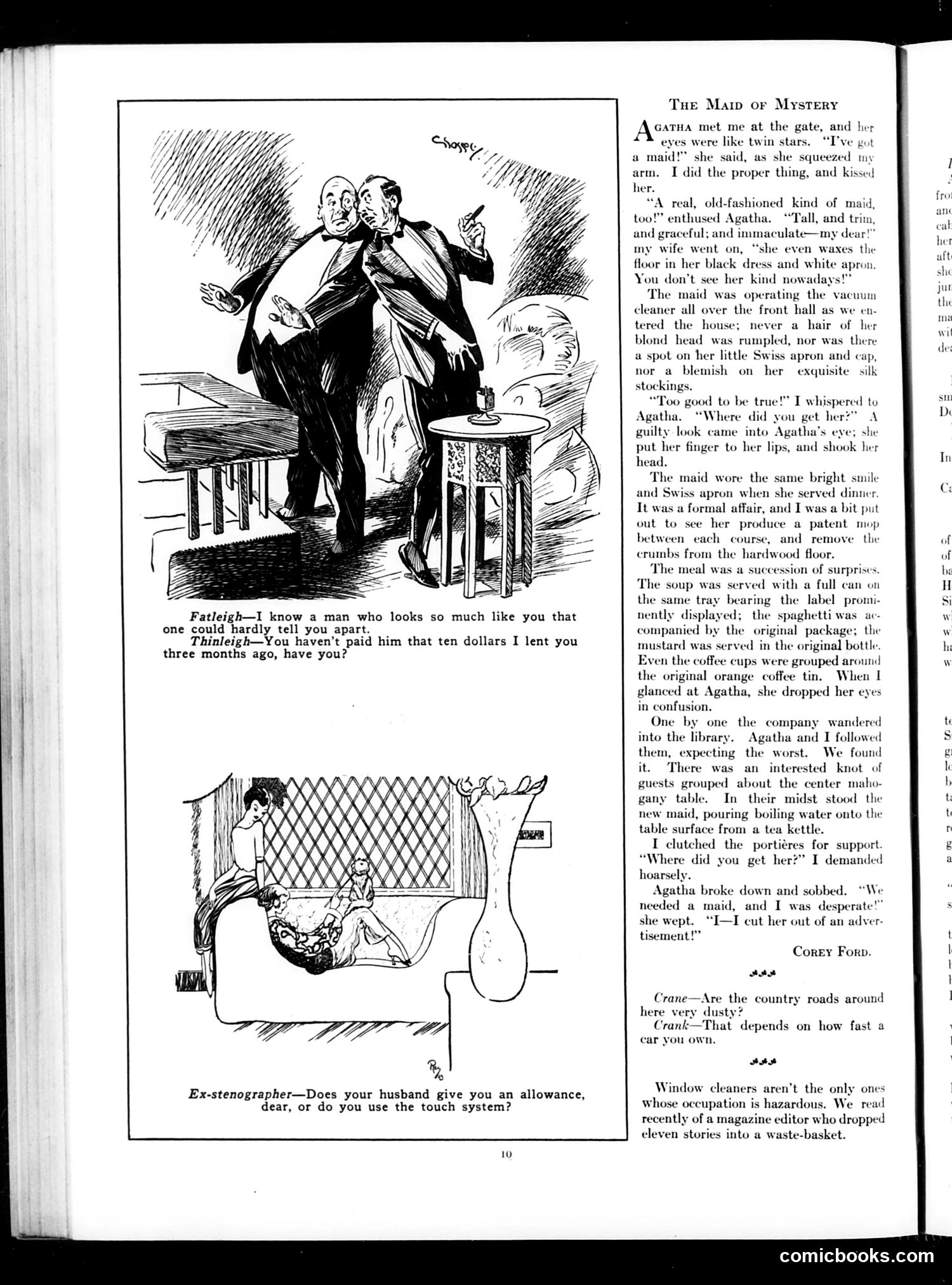
This page contains a humorous short story with two accompanying jokes. The main narrative satirizes the advertising industry and consumer culture of the early 20th century. **The Story**: A husband discovers his wife's "perfect" maid is literally cut out from a magazine advertisement. The joke escalates through absurd details—the maid uses a vacuum cleaner while serving dinner, presents soup in its original can, spaghetti in its package, and mustard in its bottle. The satire mocks both deceptive advertising (which promised impossible perfection) and wives who desperately pursue idealized domesticity through consumer products. **The Jokes Below**: 1. A debt-collection joke about resemblance 2. A comment on hazardous occupations, with a cynical jab at magazine editors The piece reflects period anxieties about advertising's manipulative power and the growing consumer culture's influence on domestic expectations.
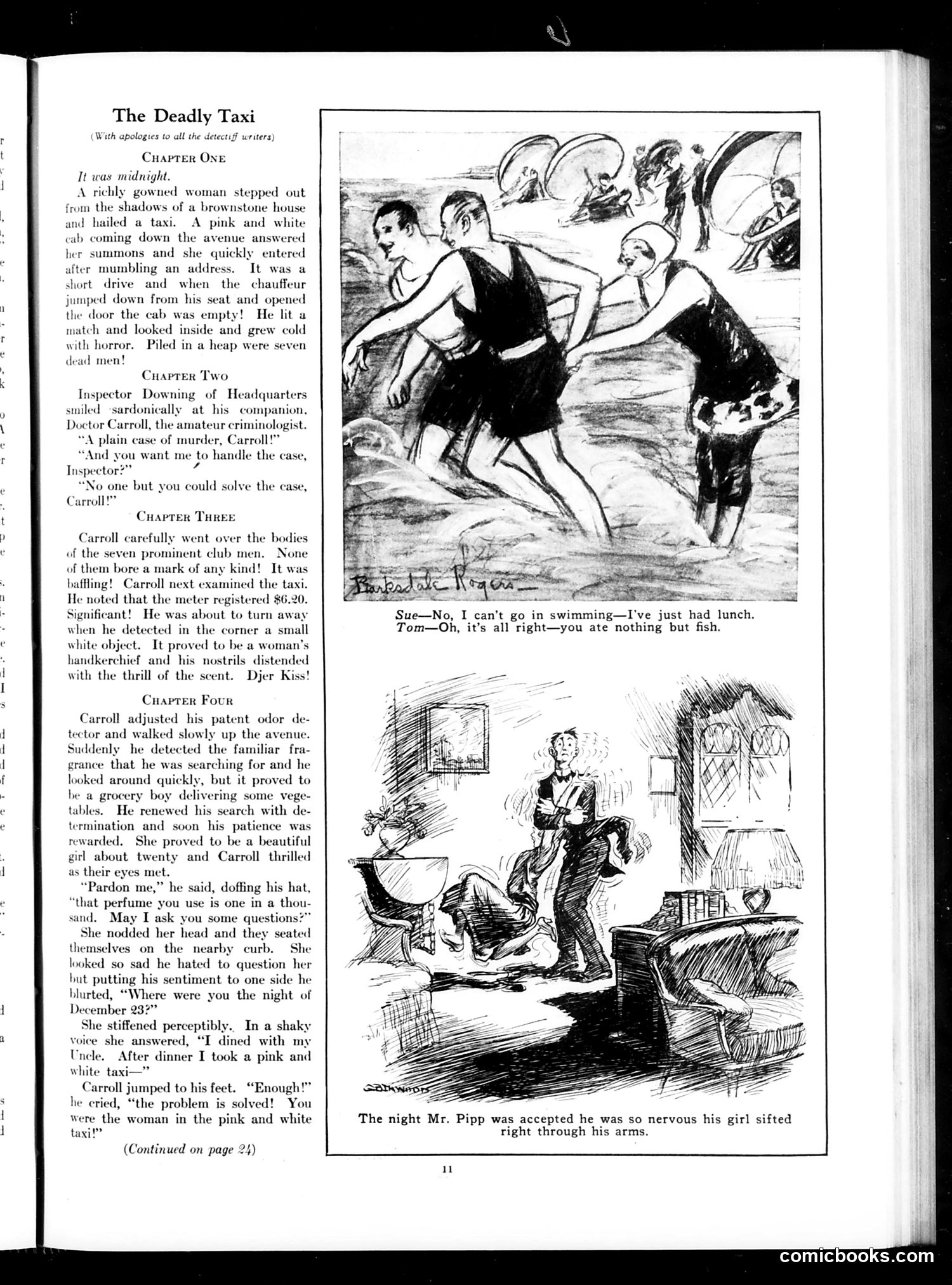
This page satirizes the popular mystery/detective story genre that flourished in early 20th-century pulp magazines. Judge magazine is mocking the absurd logic and overwrought conventions of these tales. The story follows amateur criminologist "Doctor Carroll" solving a bizarre murder: seven dead men found in an empty taxi. Carroll's deductions are ridiculously shallow—he traces a murderer by perfume scent alone (Djer Kiss brand), finds a woman wearing that exact perfume, and immediately declares the "case solved" based on her admission she once rode in a pink taxi. The satire is that he's made no actual logical connection; her presence in *a* pink taxi on a different date proves nothing about the seven deaths. The accompanying illustrations and brief jokes (about swimming after lunch, nervousness) are typical Judge filler content. The overall point: detective fiction of the era relied on implausible leaps of logic and coincidence rather than genuine investigation—a clever skewering of a popular literary form.
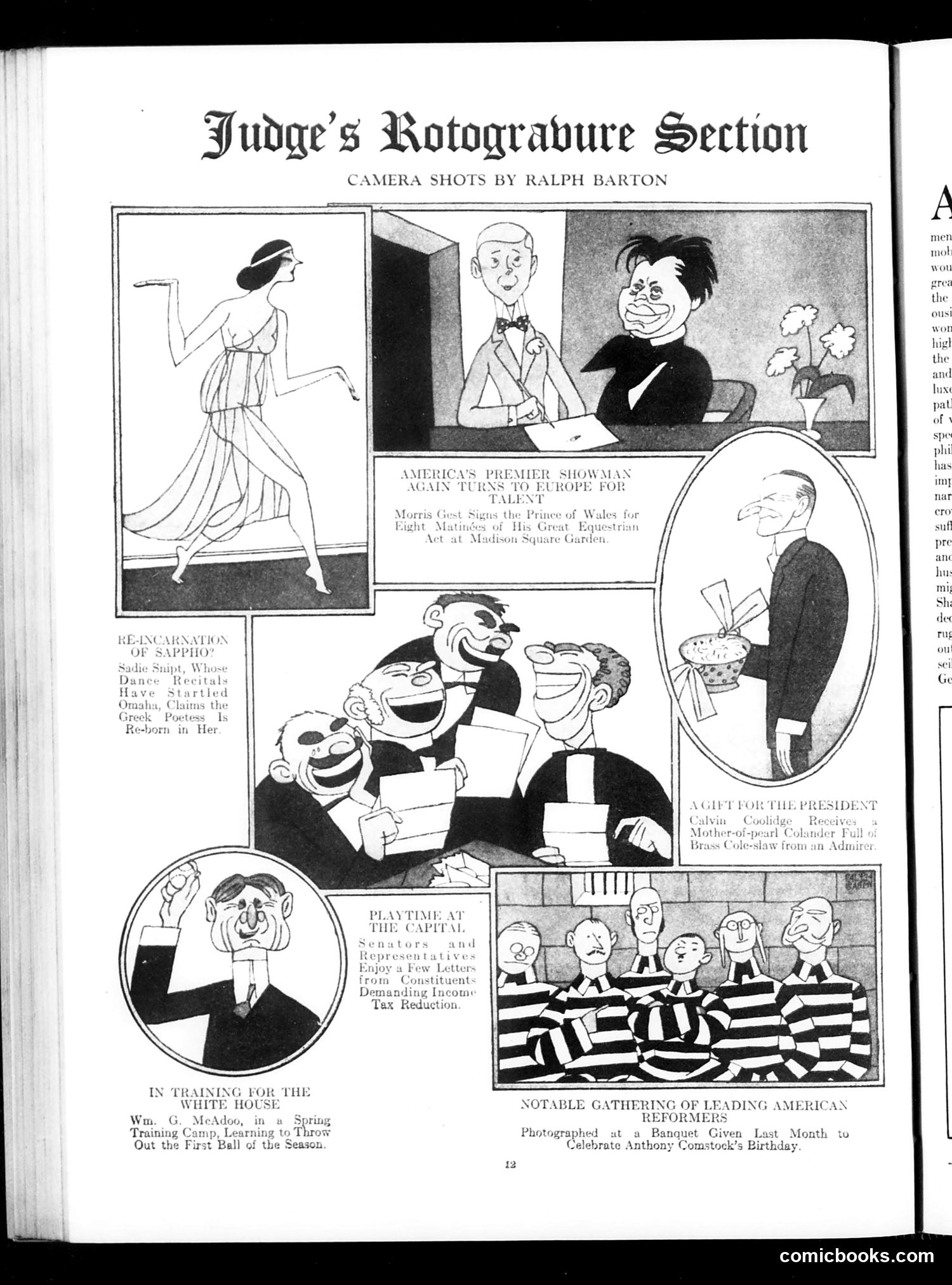
This is a satirical photo-essay page from Judge magazine featuring caricatured commentary on contemporary American figures and politics (likely early 1920s, based on Calvin Coolidge reference). The cartoons mock: 1. **A showman** (appears to be Morris Gest) importing European talent for Madison Square Garden productions—satirizing American reliance on foreign entertainment. 2. **President Calvin Coolidge** receiving a "Mother-of-pearl Colander" as a gift—mocking his frugality and austere public image. 3. **Congressional figures** at the Capitol engaged in "playtime" while discussing tax reduction—suggesting politicians prioritize leisure over serious governance. 4. **"White House Training"** shows a boxer learning to throw his first ball—unclear if this references a specific athlete or satirizes White House social activities. 5. **A gathering of "Leading American Reformers"** dressed in striped prison uniforms—darkly satirizing reform movements as themselves morally compromised. The overall tone ridicules political hypocrisy and American celebrity culture.
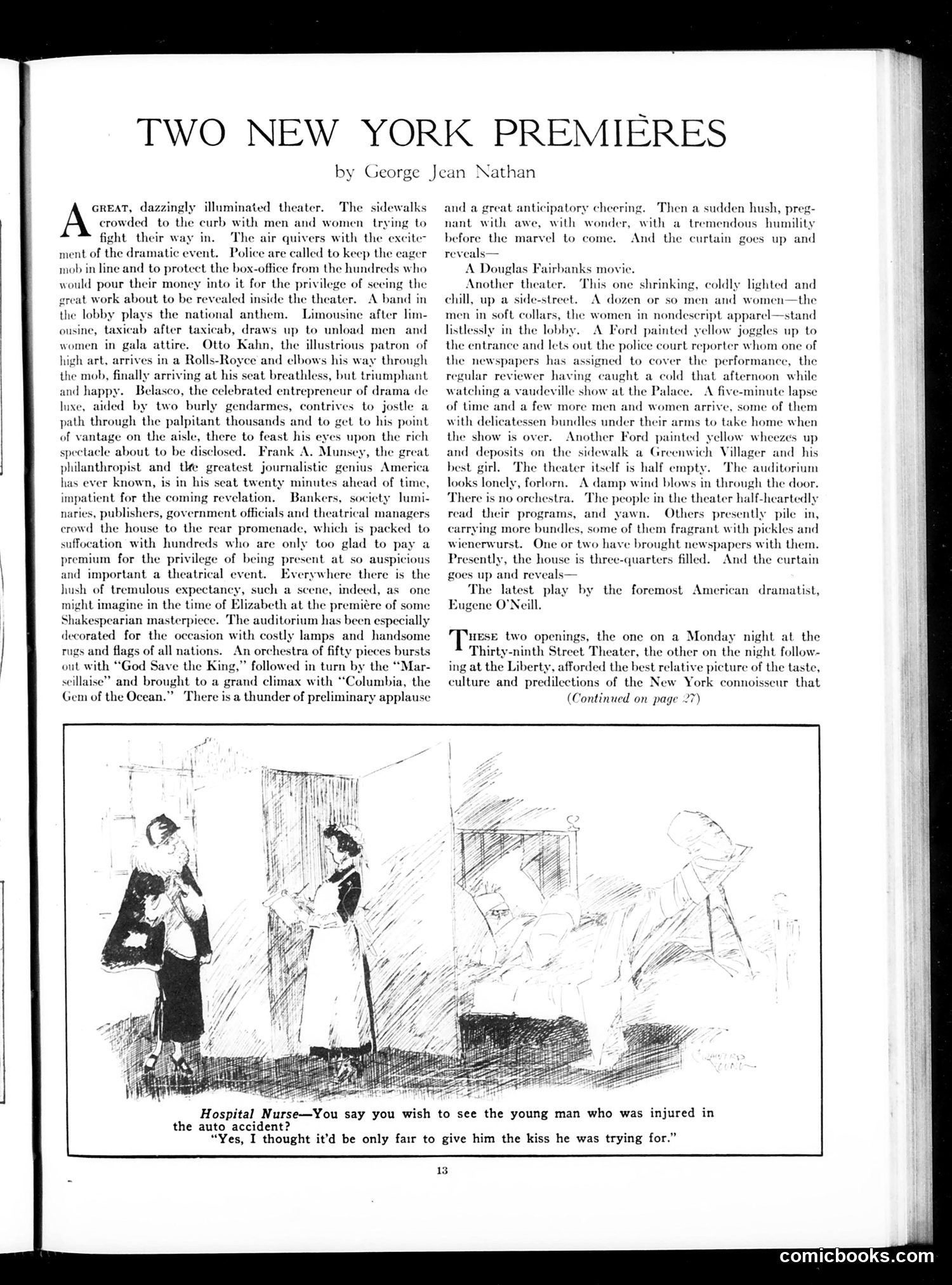
This article by George Jean Nathan contrasts two New York theater premieres through exaggerated description. The first depicts a lavish, heavily-promoted Douglas Fairbanks movie premiere—packed with society elites (Otto Kahn, David Belasco, Frank Munsey), police crowd control, limousines, orchestras playing patriotic anthems, and decorative excess. The atmosphere is reverential, compared to Shakespeare's debut. The accompanying cartoon shows a hospital nurse offering a flirtatious "fair" kiss to an injured auto-accident victim—a dated joke playing on romantic opportunism and casual morality. The second premiere describes Eugene O'Neill's latest play: sparse audience, no orchestra, cold theater, attendees carrying delicatessen bundles and newspapers, half-empty house, indifference. **The satire's point**: Nathan mocks how commercial spectacle and celebrity draw massive crowds to mediocre entertainment (a Fairbanks movie), while serious American dramatic art (O'Neill) receives minimal attention and respect. He's critiquing American popular taste and theater culture's priorities.
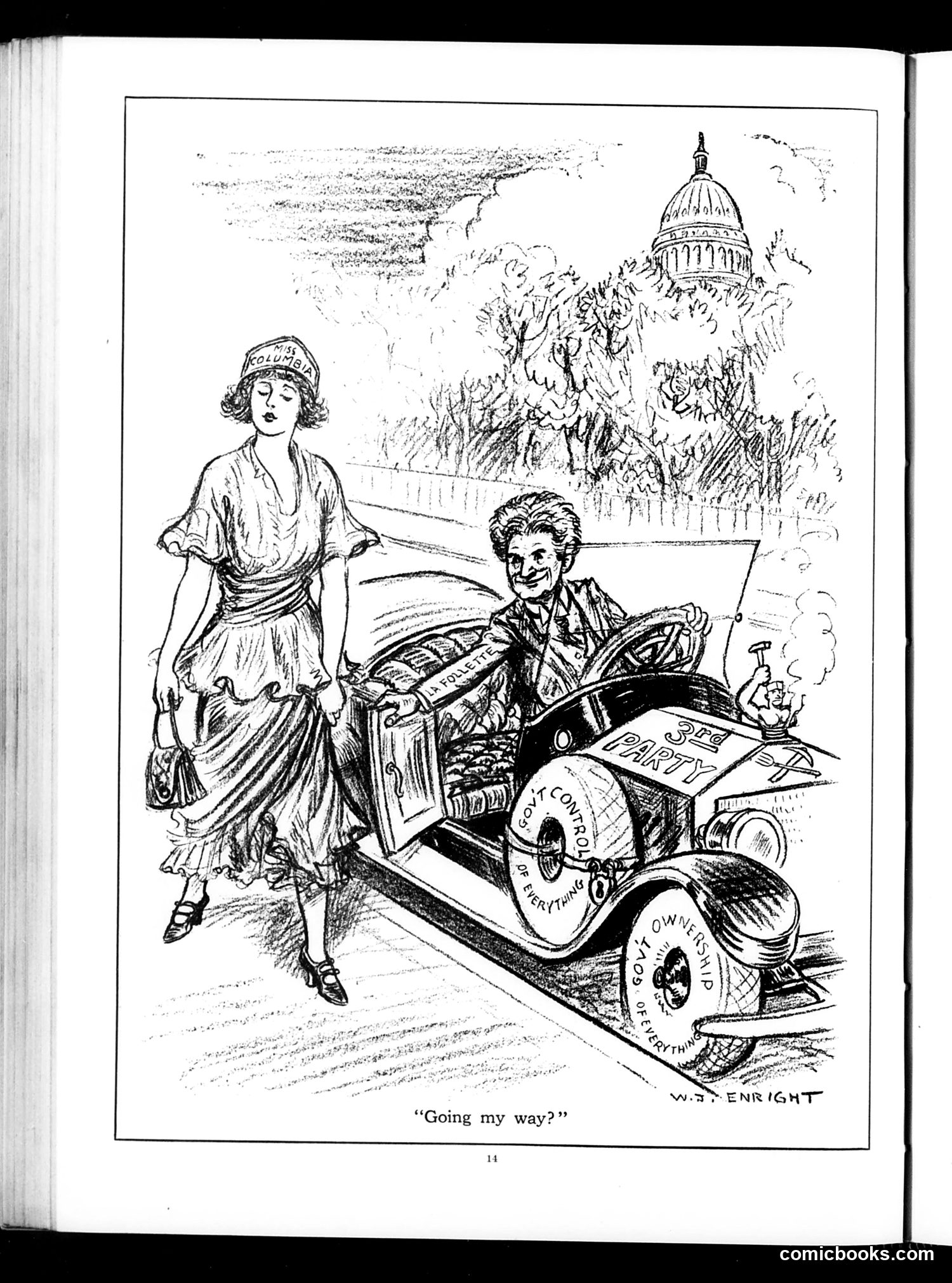
This cartoon depicts a woman in 1920s attire encountering a man driving an elaborate vehicle labeled with text referencing "Government," "Party," and other political inscriptions. The Capitol Building is visible in the background, establishing a Washington D.C. setting. The caption "Going my way?" suggests the woman is asking the driver for direction or passage. The cartoon appears to satirize government control or the political establishment's influence over ordinary citizens—the woman seemingly must defer to or follow the government's chosen path rather than her own. The style and imagery suggest this dates to the 1920s-1930s era, likely commenting on government overreach or the dominance of political machinery in American life. Without clearer text on the vehicle's labels, the specific political target remains somewhat unclear.
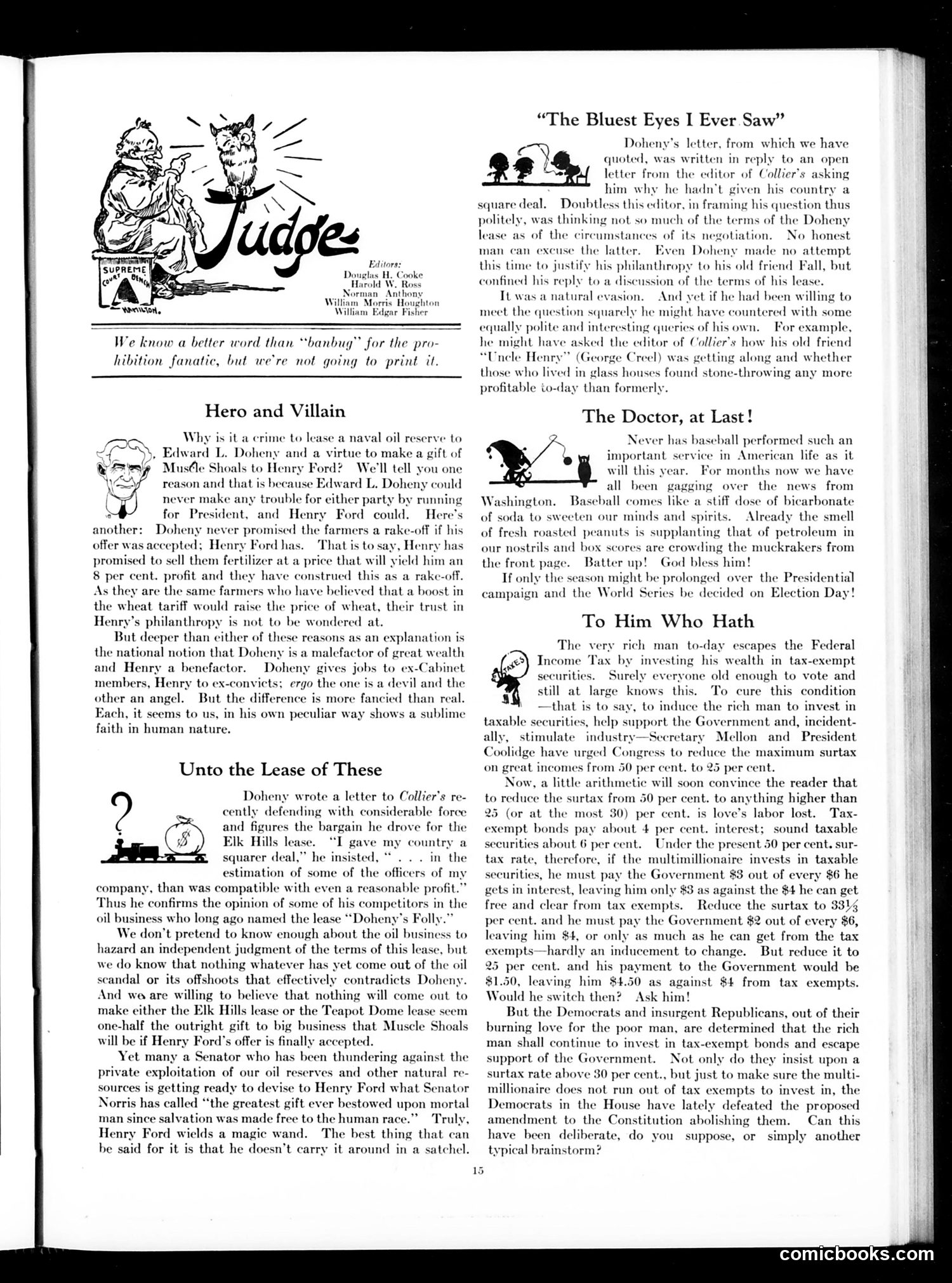
This page satirizes a political scandal involving oil leases during the Harding administration (likely 1921-1923). The main targets are **Edward Doheny** and **Henry Ford**. **The Central Comparison ("Hero and Villain"):** Judge mocks the public's selective moral outrage. Doheny leased naval oil reserves (Elk Hills) under questionable circumstances, while Ford was offered the Muscle Shoals facility—yet politicians attack Doheny while praising Ford's "philanthropy." Judge suggests this inconsistency stems from fear: Doheny poses no political threat, while Ford might run for president. **The Irony:** Both men represent similar business ethics wrapped in different public images. Doheny "gives" to ex-convicts (implying corruption), Ford to farmers (appearing philanthropic), yet both demonstrate questionable "faith in human nature." **"The Bluest Eyes":** References Doheny's letter defending the lease deal. Judge criticizes Collier's editor for focusing on lease *terms* rather than the corrupt *negotiations*—implying collusion with Secretary Fall (hinted at in scandal context). The satire's core: public morality is shaped by political convenience, not principle.
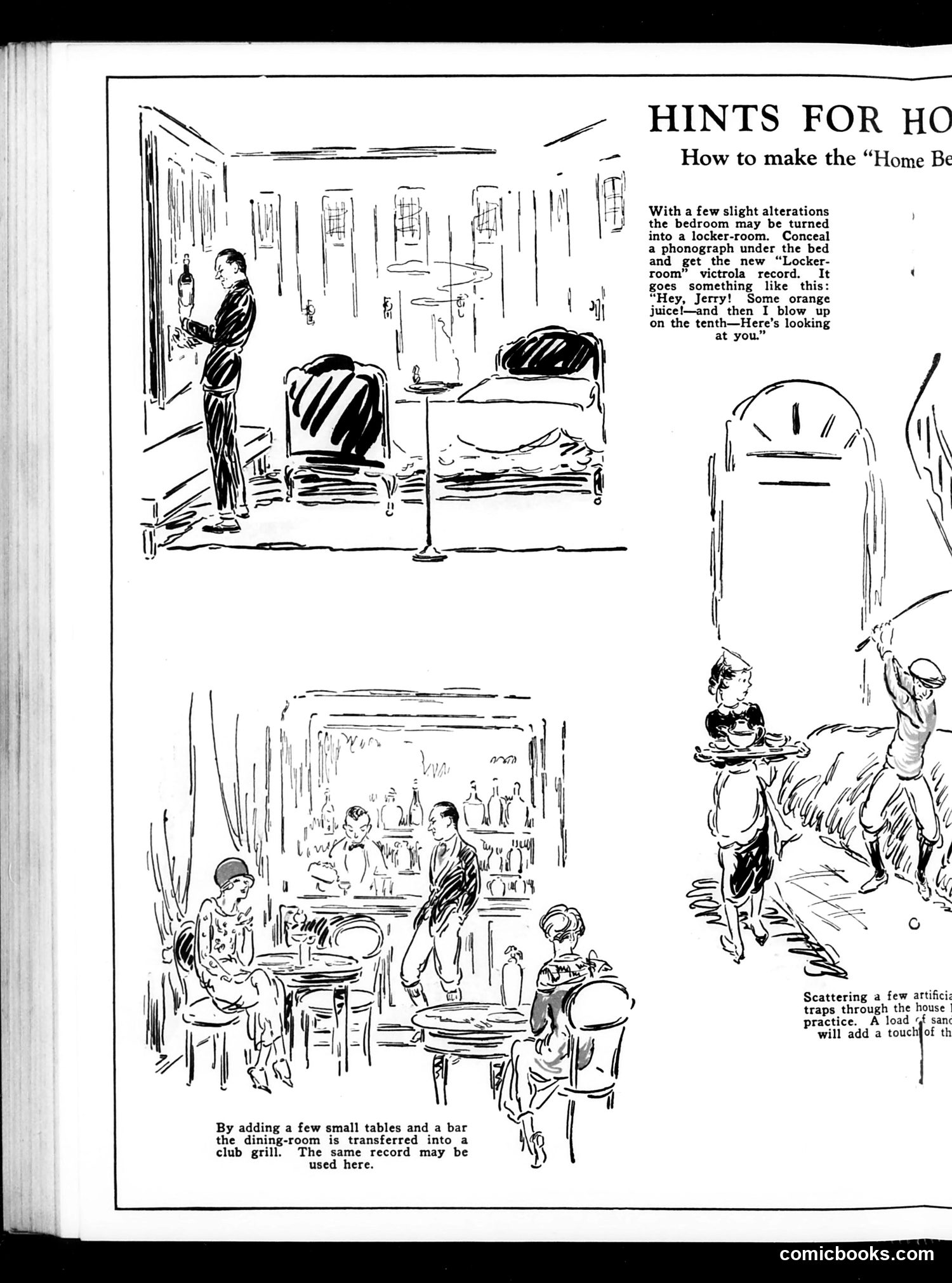
This page from *Judge* offers practical humor about transforming home spaces using Victrola records (early phonographs). The title "Hints for Home" appears incomplete in the OCR. The three illustrated scenarios show how the same record can create different atmospheres: 1. **Top**: A bedroom becomes a "locker-room" with sports banter ("Hey, Jerry! Some orange juice—and then I blow up on the tenth"). 2. **Middle**: A dining room transforms into a "club grill" with small tables and a bar, maintaining the same record. 3. **Right**: An outdoor scene with riding/hunting activities. The satire targets affluent domestic life in what appears to be the 1920s-30s, mocking how wealthy homeowners could create fashionable recreational spaces through minimal alterations and clever use of recorded music. It's gentle satirical commentary on consumerism and the desire to recreate exclusive club experiences at home.
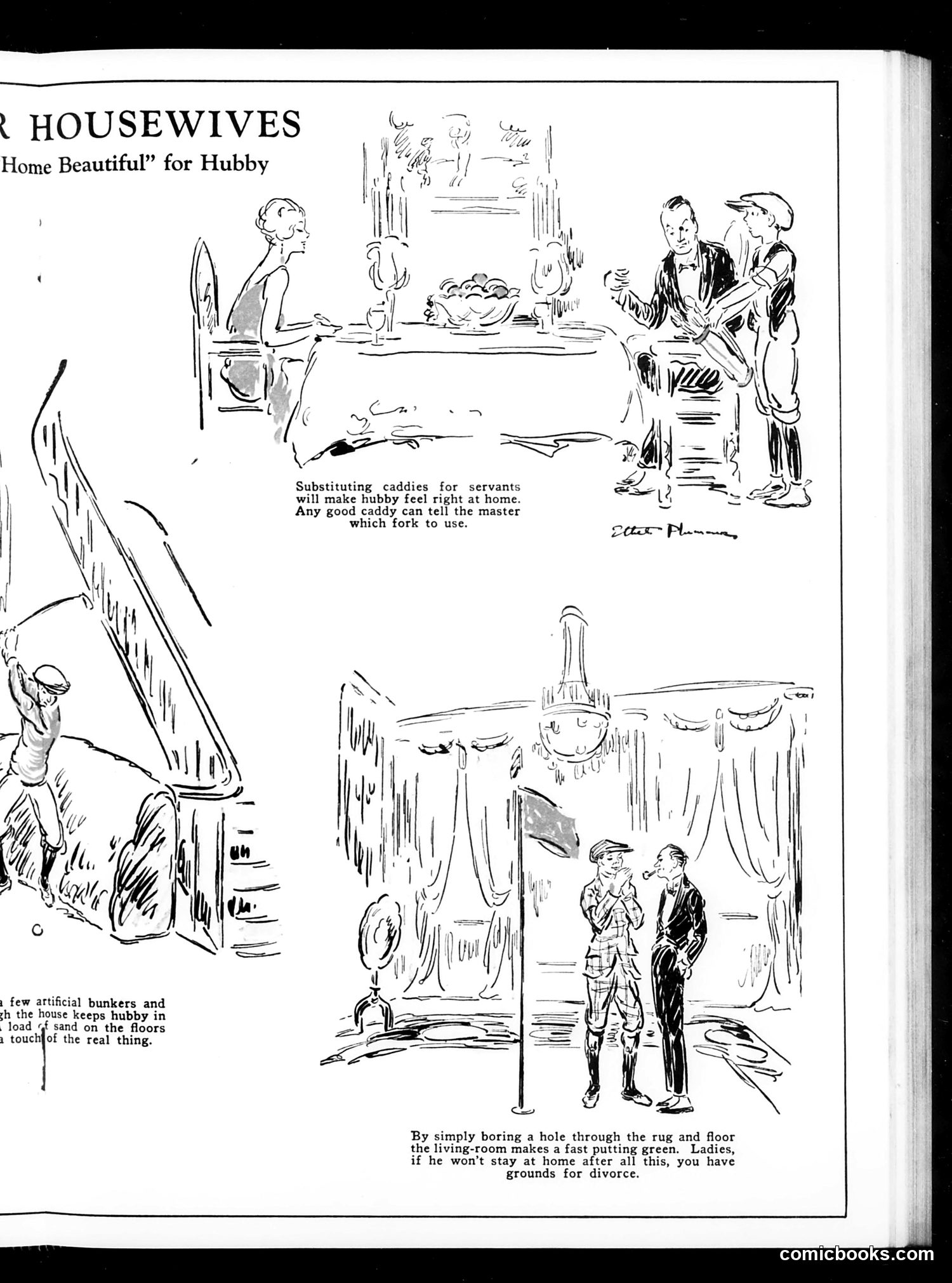
This page presents humorous advice to housewives on keeping husbands content at home. The cartoons illustrate three domestic scenarios: 1. **Top panel**: A wife hosting dinner while substituting caddies (golf equipment carriers) for servants—the joke being that if she can't afford servants, golf equipment will somehow make the husband feel "at home." 2. **Left panel**: References creating artificial bunkers and sand on floors to simulate golf conditions indoors. 3. **Bottom panel**: Shows converting the living room into a putting green by boring a hole through the rug and floor, with the caption suggesting this gives grounds for divorce if the husband still won't stay home. The satire targets both wives' domestic duties and the era's obsession with golf among wealthy men. It's gentle mockery of gender roles and male leisure priorities in what appears to be early 20th-century America.
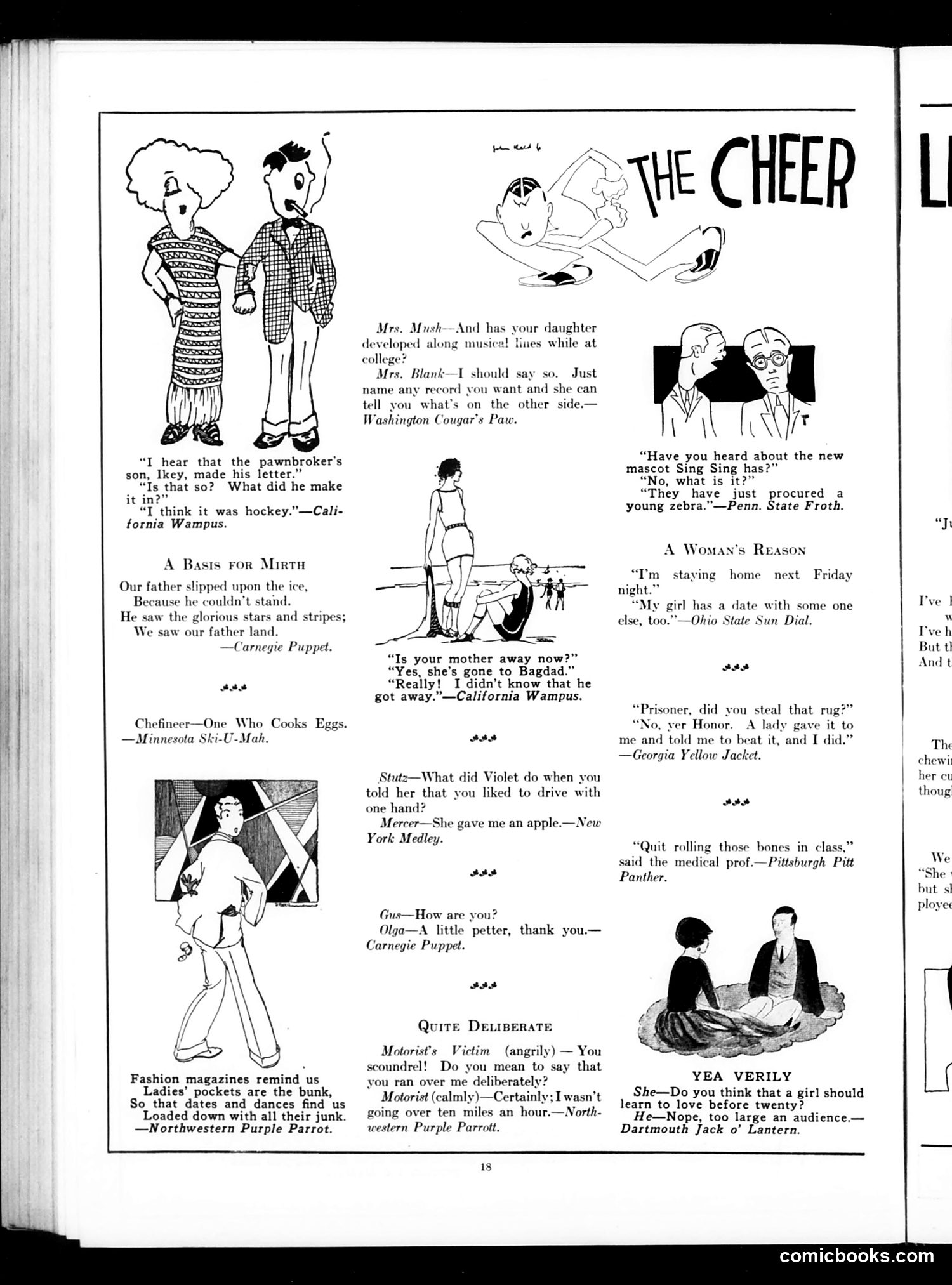
This page collects humorous one-liners and jokes from various college humor magazines (Carnegie Puppet, California Wampus, etc.), typical of Judge's "cheer" sections. The humor targets early 20th-century social concerns: young women's education and dating (the college girl who can name record B-sides), automobile safety (the motorist hitting a pedestrian), fashion practicality (women's pockets being inadequate), and contemporary references like Sing Sing prison (the zebra mascot joke) and Bagdad (likely a topical reference to Middle Eastern conflicts). Several jokes employ ethnic stereotyping common to the era—"Ikey" the pawnbroker's son, the motorist/pedestrian joke's casual callousness. The tone assumes a college-educated, urban male readership amused by courtship mishaps, automobile culture, and gentle mockery of women's liberation and fashion trends. The cartoons reinforce these themes visually with period-appropriate illustrations of flappers and young couples.
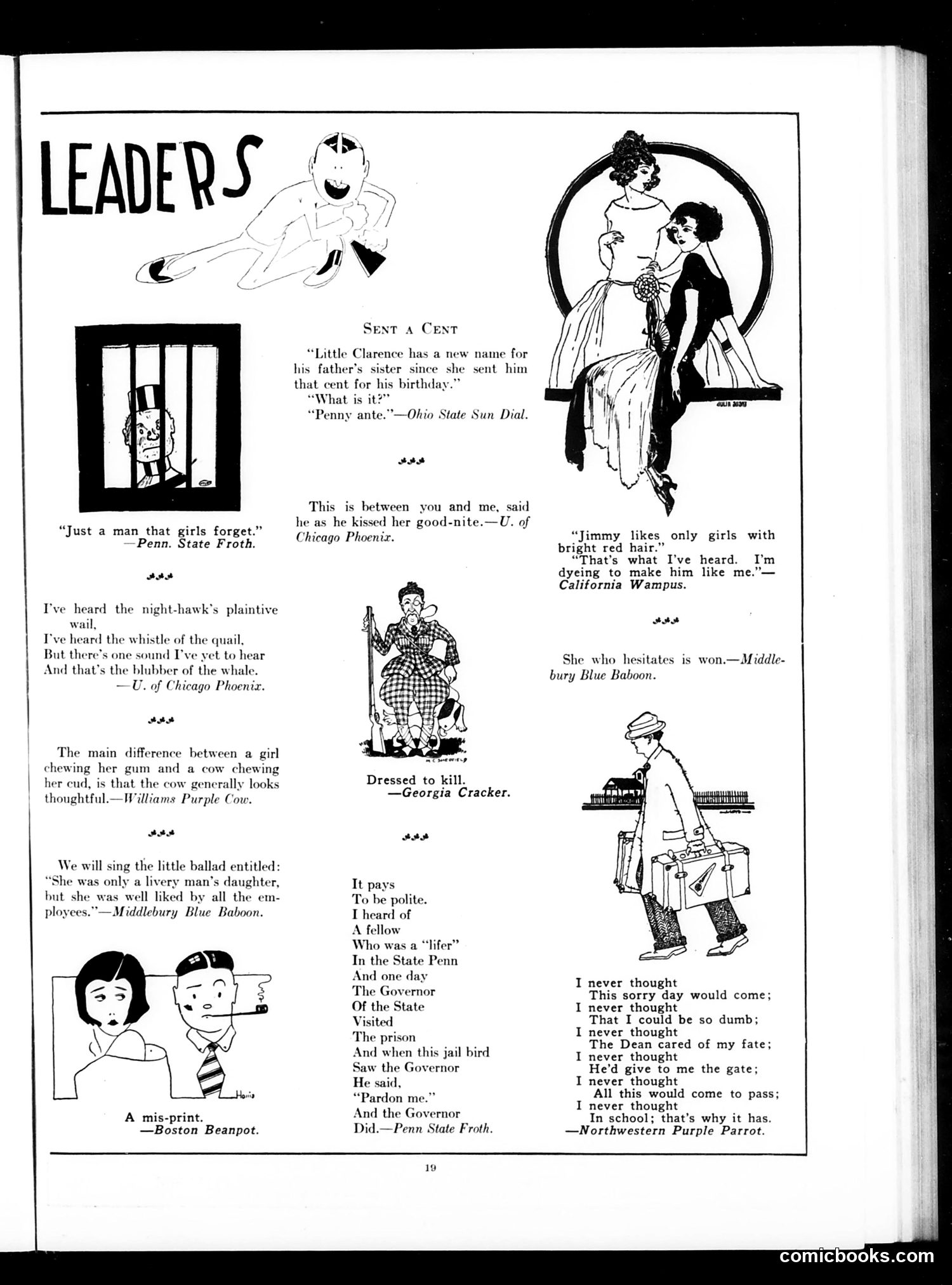
This page collects humorous one-liners and short jokes sourced from college newspapers and humor magazines of the era. The content reflects early 20th-century collegiate humor: mild puns, gentle social observations, and predictable setups. Key jokes include wordplay ("Penny ante" as a pun on "pennies" and the card game term), observational humor about gender differences (girls chewing gum vs. cows chewing cud), and anecdotes about politeness and consequences. The "lifer" story uses irony—a prisoner's simple politeness ("Pardon me") literally gets him pardoned by the visiting Governor. The illustrations are simple line drawings accompanying the humor. No specific political figures or events appear targeted; instead, the satire is gentle and universal, mocking human nature rather than current affairs. The repeated "never thought" poem is self-deprecating humor about a student's poor academic performance. This represents Judge's "lighter" content—reprinting campus humor rather than hard political commentary.
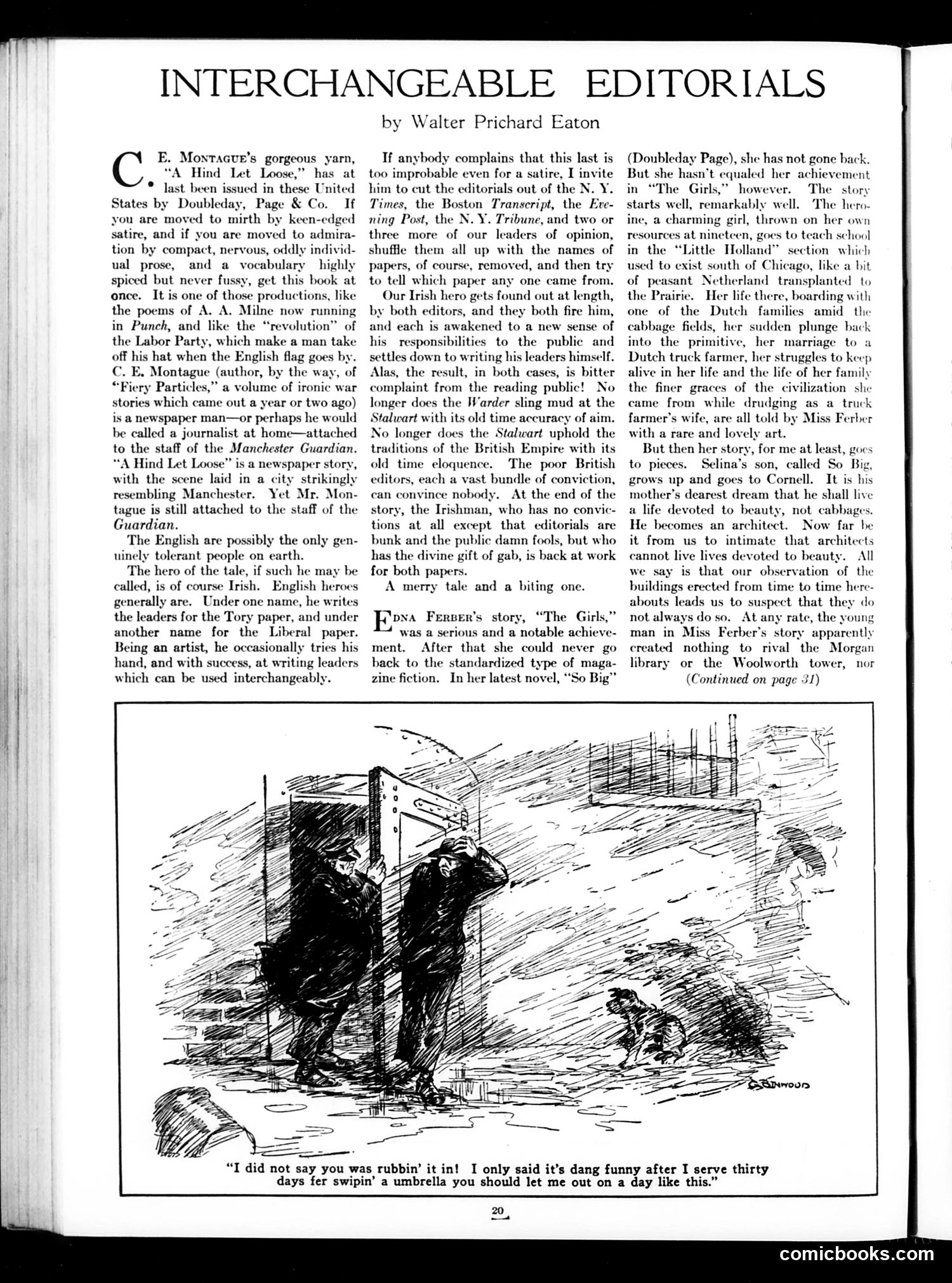
This page contains two distinct pieces. The main text is a book review by Walter Prichard Eaton praising C.E. Montague's novel *"A Hind Let Loose,"* which satirizes British journalism. The novel's central joke: an Irish character writes editorials for both Tory and Liberal newspapers using interchangeable arguments—so similar that readers cannot distinguish them. Eaton extends this satire to American papers (New York *Times*, *Tribune*, *Evening Post*), suggesting American editorial writing is equally indistinguishable and formulaic. The cartoon below depicts a police officer confronting what appears to be a vagrant or street person. The caption shows the officer denying the person had complained about being "robbed," only that it was "funny" to be let out of jail after serving time for umbrella-theft, especially on nice weather days. The cartoon's humor relies on the character's verbal confusion—likely deliberate malapropism or dialect humor typical of early 20th-century American comedy.
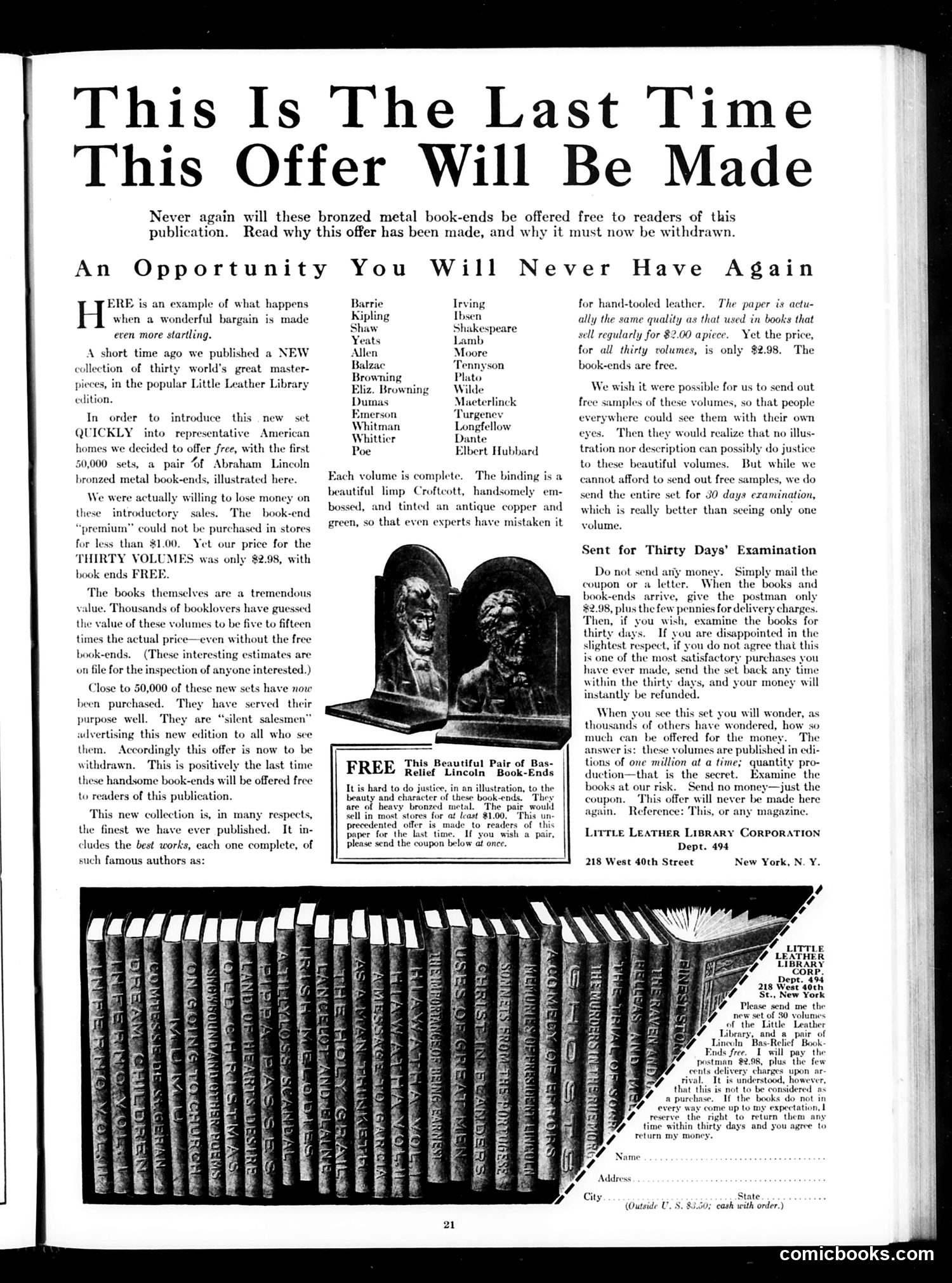
This is primarily a **book advertisement**, not a political cartoon. The page promotes Judge magazine's "Little Leather Library" collection—thirty classic literary works (Shakespeare, Dante, Poe, etc.) priced at $2.98 per set. The advertisement's appeal relies on **manufactured scarcity and urgency**: it claims this is the "last time" the offer (which includes free bronze Abraham Lincoln bookends worth $1.00) will be made. The publisher states they've already sold 50,000 sets and are now withdrawing the promotion. The **marketing pitch** emphasizes value: the books themselves are said to be worth $2.00 each elsewhere, yet customers get all thirty volumes plus premium bookends for just $2.98. The advertisement uses testimonial tactics, claiming thousands of book-lovers have praised the collection. This reflects early-20th-century **direct-mail marketing strategy**—creating artificial deadlines and "loss-leader" premiums to drive bulk sales. The Lincoln bookends appear chosen to appeal to patriotic American sensibilities of the era.
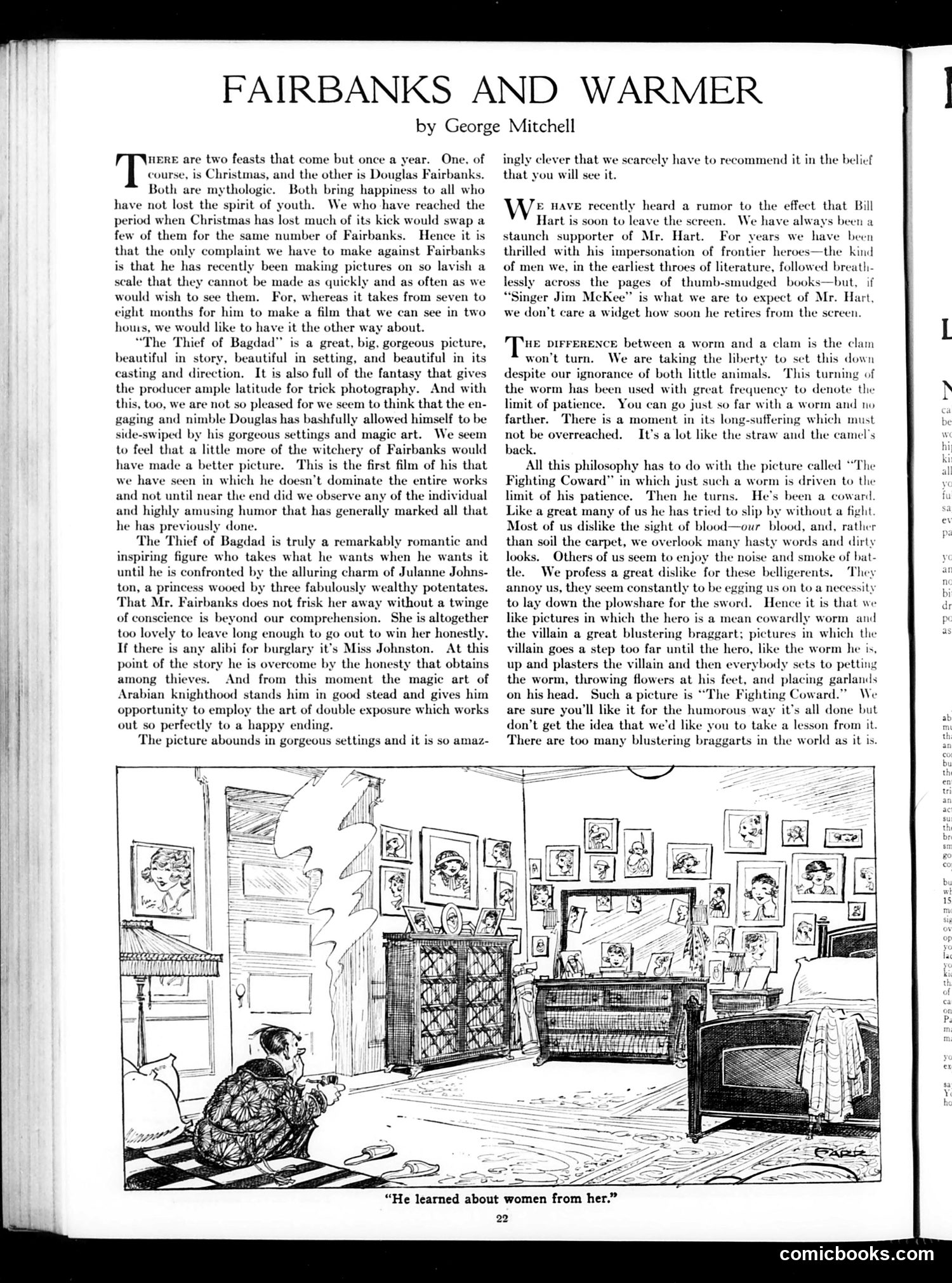
This is a film-criticism column by George Mitchell praising Douglas Fairbanks's movie production. The piece compares two popular film stars: Fairbanks, whose lavish productions are so time-consuming that admirers wish he made them more frequently, and Bill Hart, a Western/frontier actor whose star is apparently fading. The column's humor lies in mock-philosophical tangents. Mitchell digresses into musings about worms versus clams (noting worms "turn" when pushed too far—a metaphor for patience breaking) to frame discussion of "The Fighting Coward," another film examining cowardice and masculine honor. The cartoon illustrates a scene from one of these films, showing a figure in an ornate interior surrounded by artwork—likely depicting the opulent fantasy settings Fairbanks's productions were known for. The satire gently critiques how Fairbanks's elaborate sets sometimes overshadow his performance, while celebrating both actors as providers of escapist entertainment for audiences nostalgic about youth and adventure.
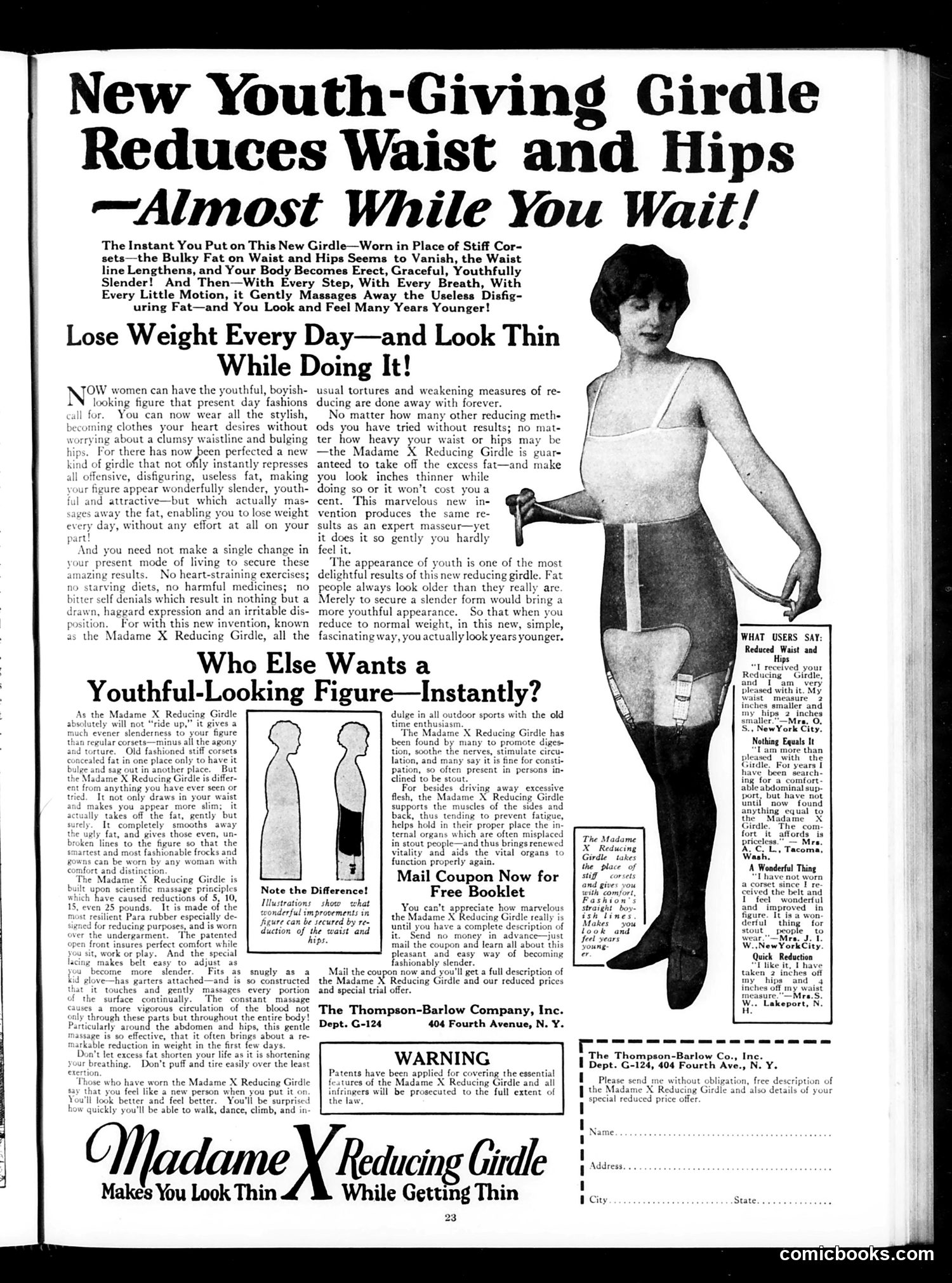
This page is primarily a **commercial advertisement**, not satire or political commentary. It promotes the "Madame X Reducing Girdle," a women's undergarment claiming to reduce waist and hip size through gentle massage while worn. The ad targets early 20th-century anxieties about female body shape, promoting an ideal of a "youthful, boyish-looking figure" aligned with contemporary fashion. Key selling points include: - **Instant slimming** without diet or exercise - Claims of continuous fat-reduction through passive massage - Promises of appearing "many years younger" - Testimonials in a sidebar box praising results The language reflects period attitudes: weight loss equated with youth and beauty; fashion-driven body standards; and the marketing of dubious medical claims (the "scientific massage principles" claim lacks substance). While Judge was a satirical magazine, **this particular page appears to be paid advertising rather than editorial satire**—though modern readers might find the exaggerated promises themselves darkly humorous.
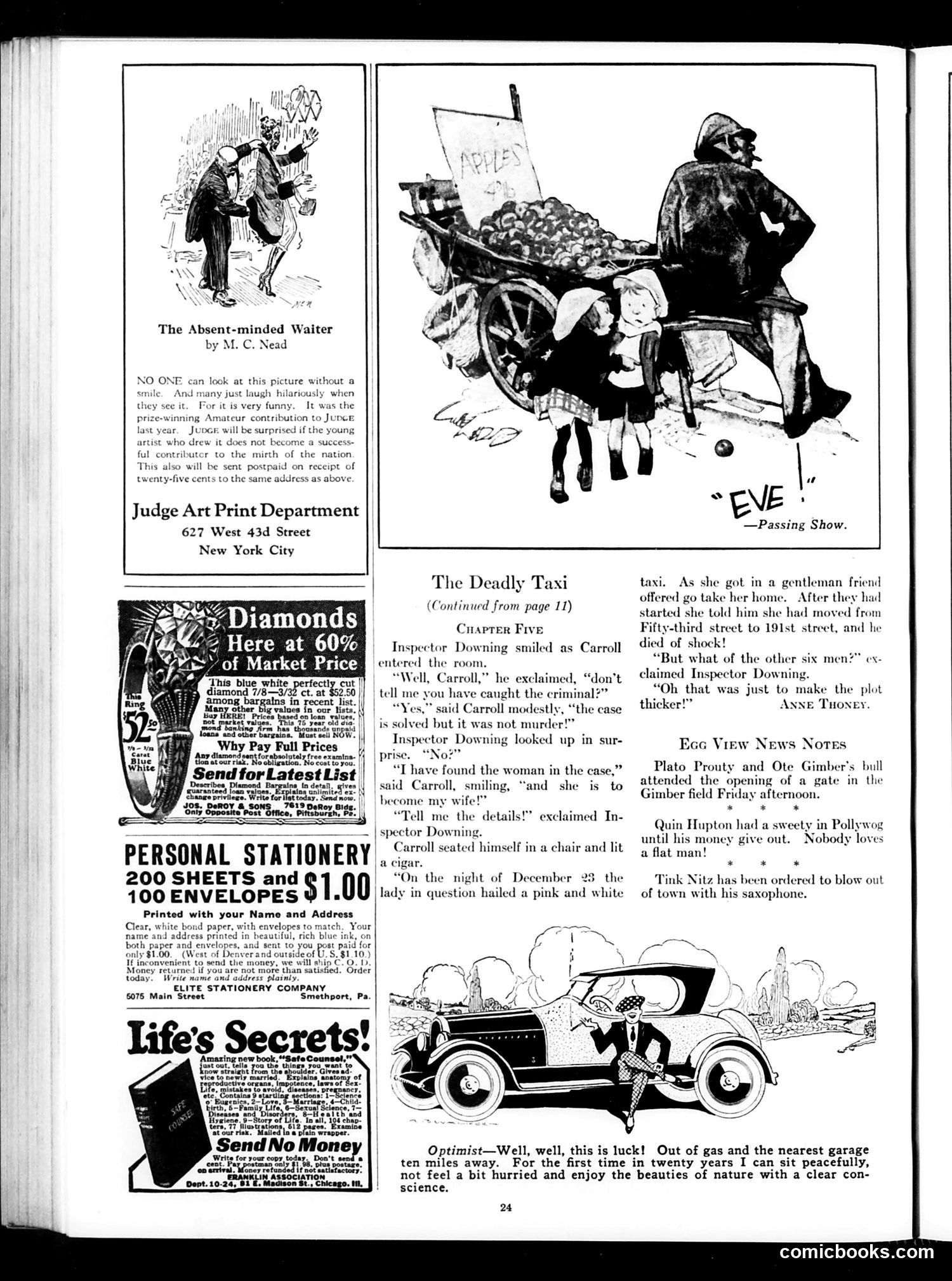
**Top Left:** M.C. Nead's cartoon shows a waiter in comedic disarray—apparently colliding with or dropping items. The accompanying text emphasizes this is a prize-winning amateur contribution that makes viewers smile through physical humor. Judge is promoting it as a postcard available for 25 cents, positioning this as lighthearted entertainment. **Top Right:** "Eve—Passing Show" depicts a street vendor with an apple cart labeled "APPLES," watched by a woman. The reference is biblical—Eve and the apple from Genesis—playing on the serpent's temptation. It's a visual pun on original sin, rendered as a modern street-scene encounter. **Main Content:** The serialized story "The Deadly Taxi" continues, featuring Inspector Downing and detective Carroll solving a mystery. The humor derives from Carroll's anticlimax: the "murder" is actually solved by identifying a woman who became his fiancée after moving from 53rd to 191st Street—her relocation itself shocking the gentleman accompanying her. The page is primarily entertainment-focused advertising mixed with light satirical fiction rather than political commentary.
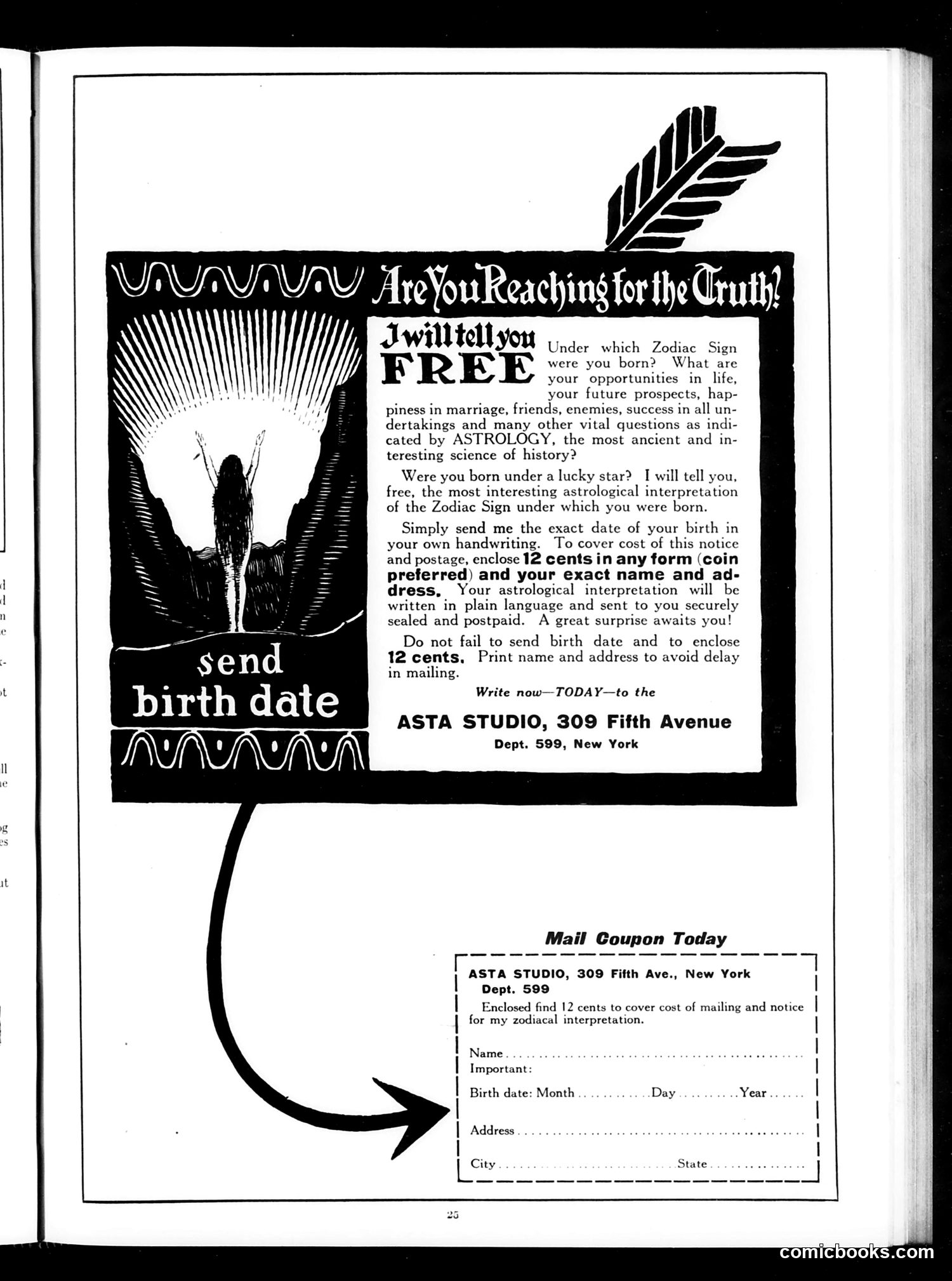
This page is **primarily a mail-order advertisement**, not political satire. It advertises the "Asta Studio" offering free astrological readings—zodiac sign interpretations claiming to reveal life prospects, marriage happiness, success, and destiny. The visual presents a mystical figure (likely meant to evoke an astrologer or fortune-teller) with outstretched arms and wings, surrounded by decorative mystical imagery. The headline "Are You Reaching for the Truth?" frames astrology as revealing hidden knowledge. This appears in **Judge**, a satirical magazine, likely *as satire itself*—mocking Americans' gullibility toward pseudoscience and mail-order schemes. For 12 cents (significant money then), readers would mail their birth dates to receive vague astrological "interpretations." The irony is subtle: Judge prints this dubious advertisement, inviting readers to participate in what the magazine's audience would recognize as charlatanism. It's satirizing both the scammers offering such services and the people desperate enough to pay for them.
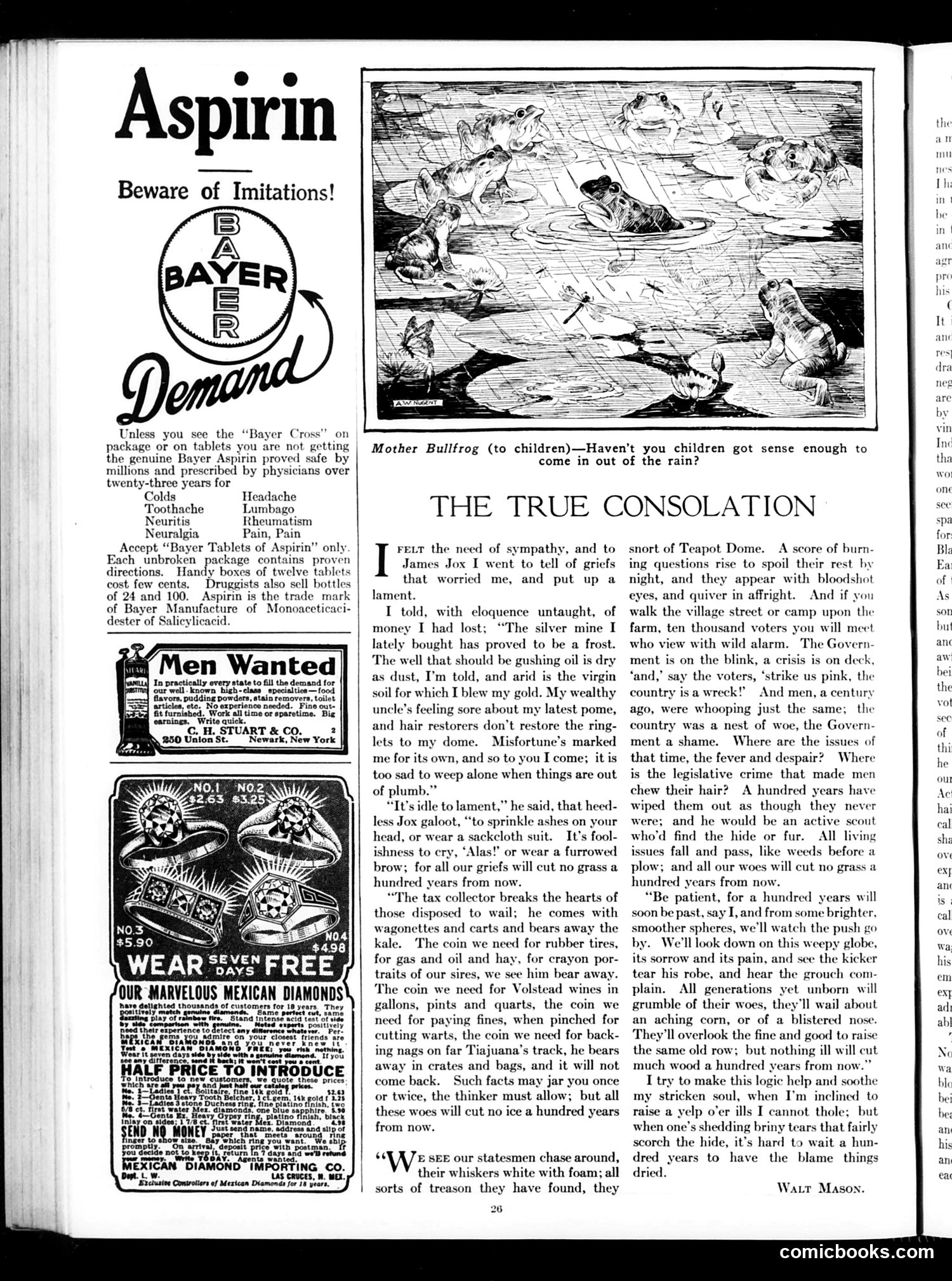
This page features a humorous essay-poem by Walt Mason about historical perspective as comfort during troubled times. The protagonist, James Jox, complains to a philosophical friend about financial losses and personal misfortunes. The friend offers consolation by pointing out that contemporary anxieties—tax collection, Prohibition-era wine shortages, and political scandals involving "Teapot Dome" (the 1921-1923 corruption scandal)—will seem insignificant in a hundred years, just as past crises have faded. The cartoon at top shows Mother Bullfrog scolding her children for not coming inside during rain, a visual pun on the phrase "sense enough to come in out of the rain." The page also contains period advertisements for Bayer Aspirin (emphasizing the trademark "Bayer Cross" to distinguish genuine product from imitators), employment opportunities, and Mexican diamonds—typical of Judge's commercial content.
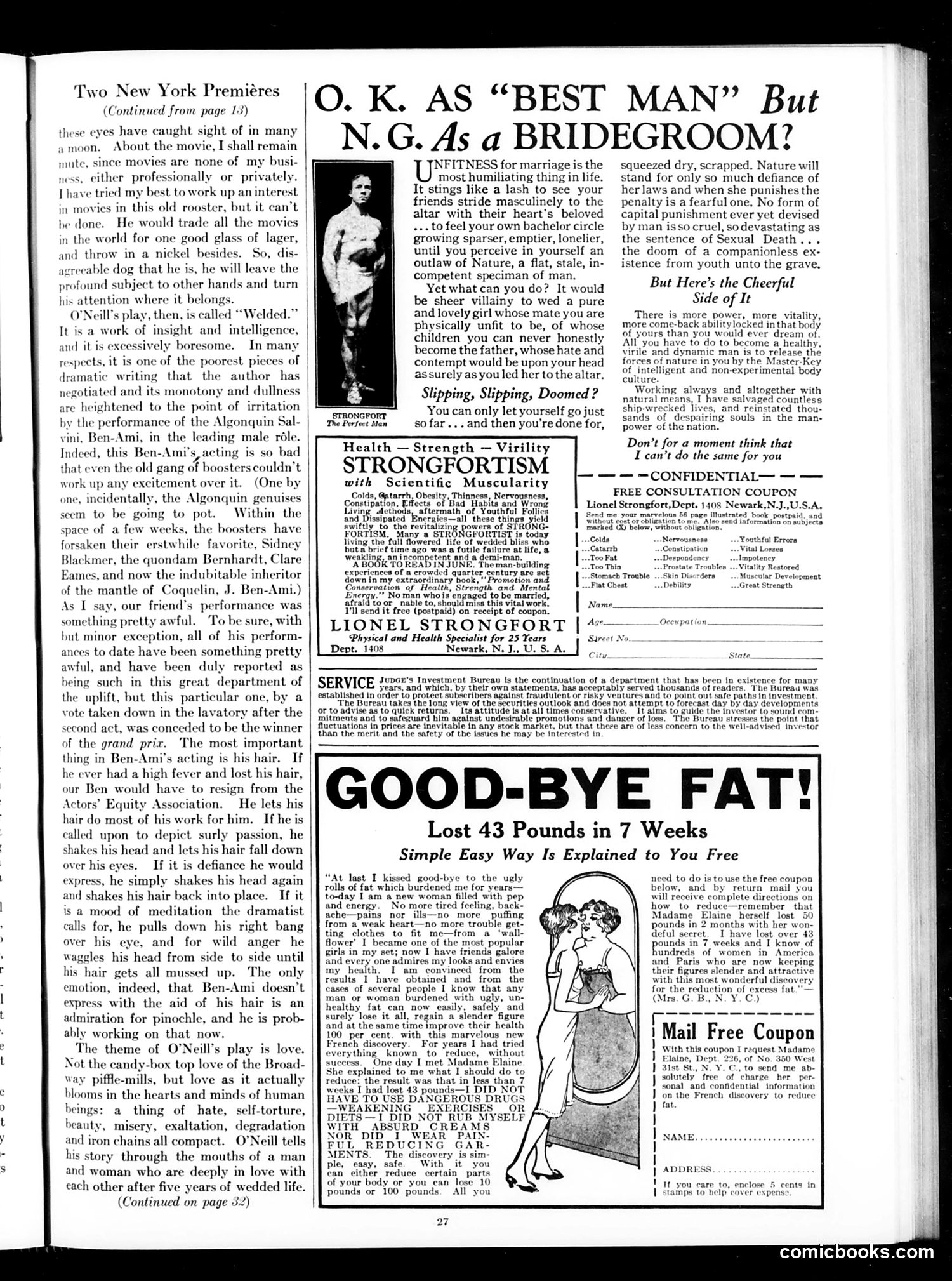
This page contains theatrical criticism and advertisements typical of Judge's satirical content. The main article critiques Eugene O'Neill's play "Welded" and actor Jacob Ben-Ami's performance, mocking his reliance on hair movements to convey emotion rather than genuine acting skill. The critic dismissively suggests Ben-Ami would need to resign from the Actors' Equity Association if he lost his hair. The right column features an article titled "O.K. AS 'BEST MAN' But N.G. As a BRIDEGROOM?" addressing the social shame of bachelorhood—describing unmarried men as "outlaws of Nature" facing "Sexual Death." This reflects early 20th-century anxieties about masculinity and marriage. Below are advertisements for health products and a weight-loss scheme ("Good-Bye Fat!"), common in period magazines. The page exemplifies Judge's mix of theatrical satire, social commentary, and commercial appeals to middle-class readers.
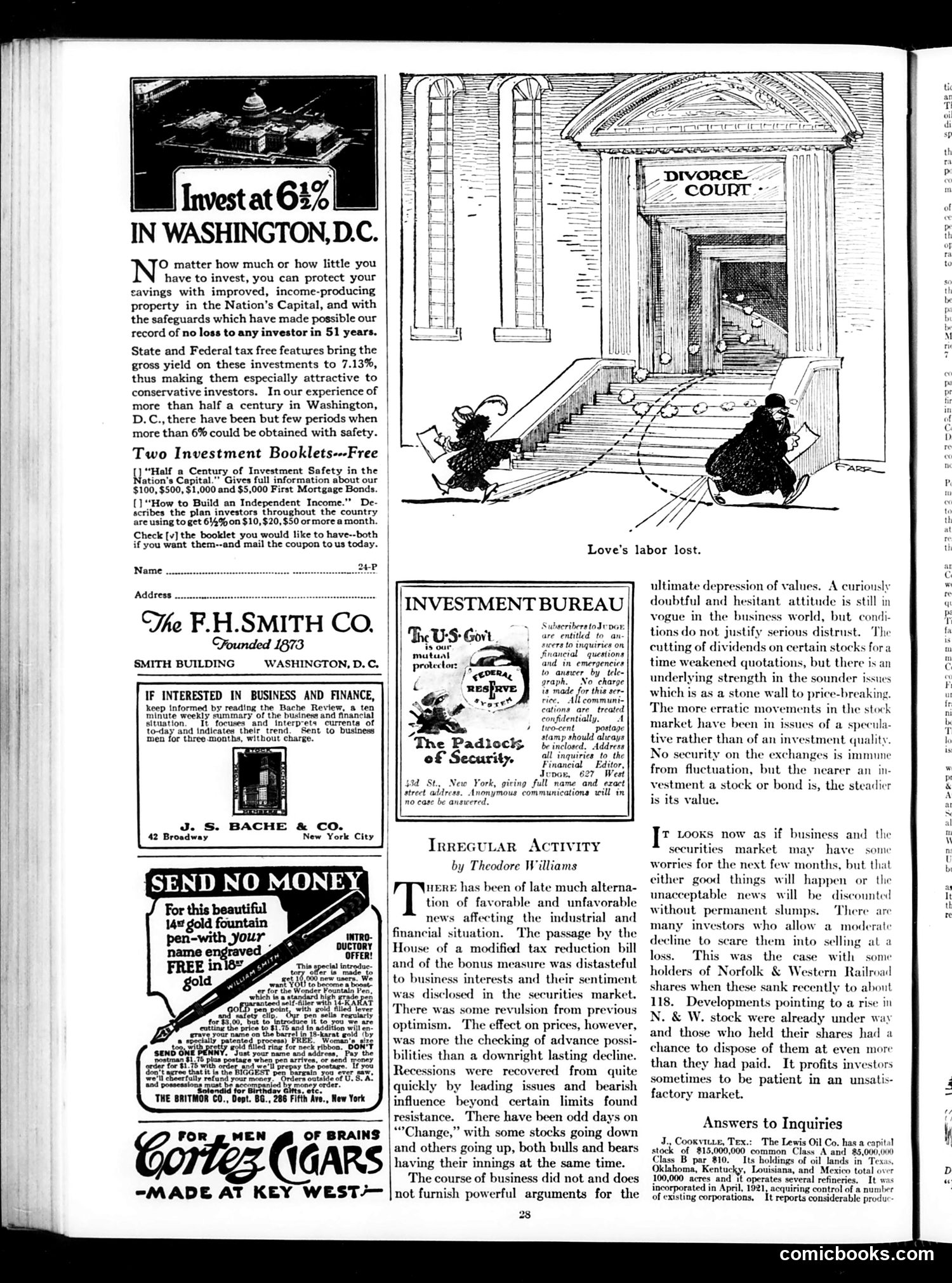
This page is primarily **advertisements and financial content** rather than political satire. However, the cartoon titled "Love's labor lost" depicts a couple on the steps of a "Divorce Court," with the man appearing distressed or dejected—the woman having apparently left him. The caption's meaning is straightforward: romantic relationships, like financial investments, can result in total loss. The cartoon functions as dark humor alongside the page's investment and financial advice content. It plays on shared anxieties about financial security and loss—themes central to the surrounding advertisements promoting safe investments and bonds. The "joke" is cynical: just as business ventures fail, so do marriages, leaving one impoverished (emotionally and perhaps financially). The cartoon requires no specific historical reference beyond understanding 1920s-era attitudes toward divorce as a social/financial catastrophe.
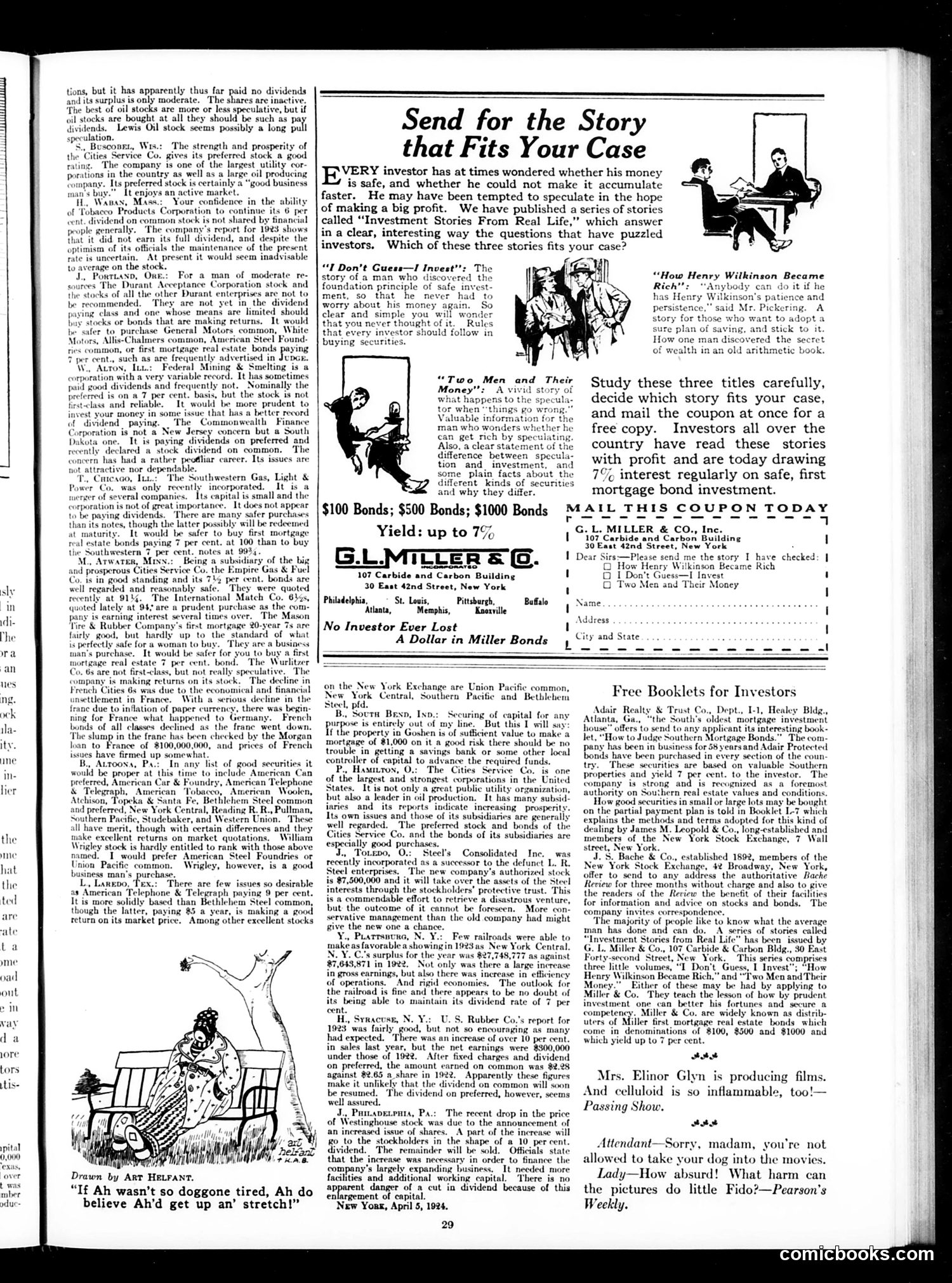
This page is primarily **financial advice and advertising**, not political satire. It features: **Main Content:** - A section titled "Send for the Story that Fits Your Case" offering three investment booklets from G.L. Miller & Co. (a bonds and securities firm) - Three story titles: "A Fool' Guest—I Invest," "Two Men and Their Money," and "How Henry Wilkinson Became Rich" - Detailed financial advice columns answering reader questions about stocks and bonds **The Cartoon:** A small illustration by Art Helfant at bottom left shows a tired, lazy farmer saying "If Ah wasn't so doggone tired, Ah do believe Ah'd get up an' stretch!" This is a **rural/stereotypical characterization** poking gentle fun at rural Americans' perceived laziness—a common satirical trope of the era. **Context:** This page reflects 1920s investor concerns about stock safety and dividends. The advertisement targets middle-class savers worried about protecting their money, offering educational stories as marketing tools.
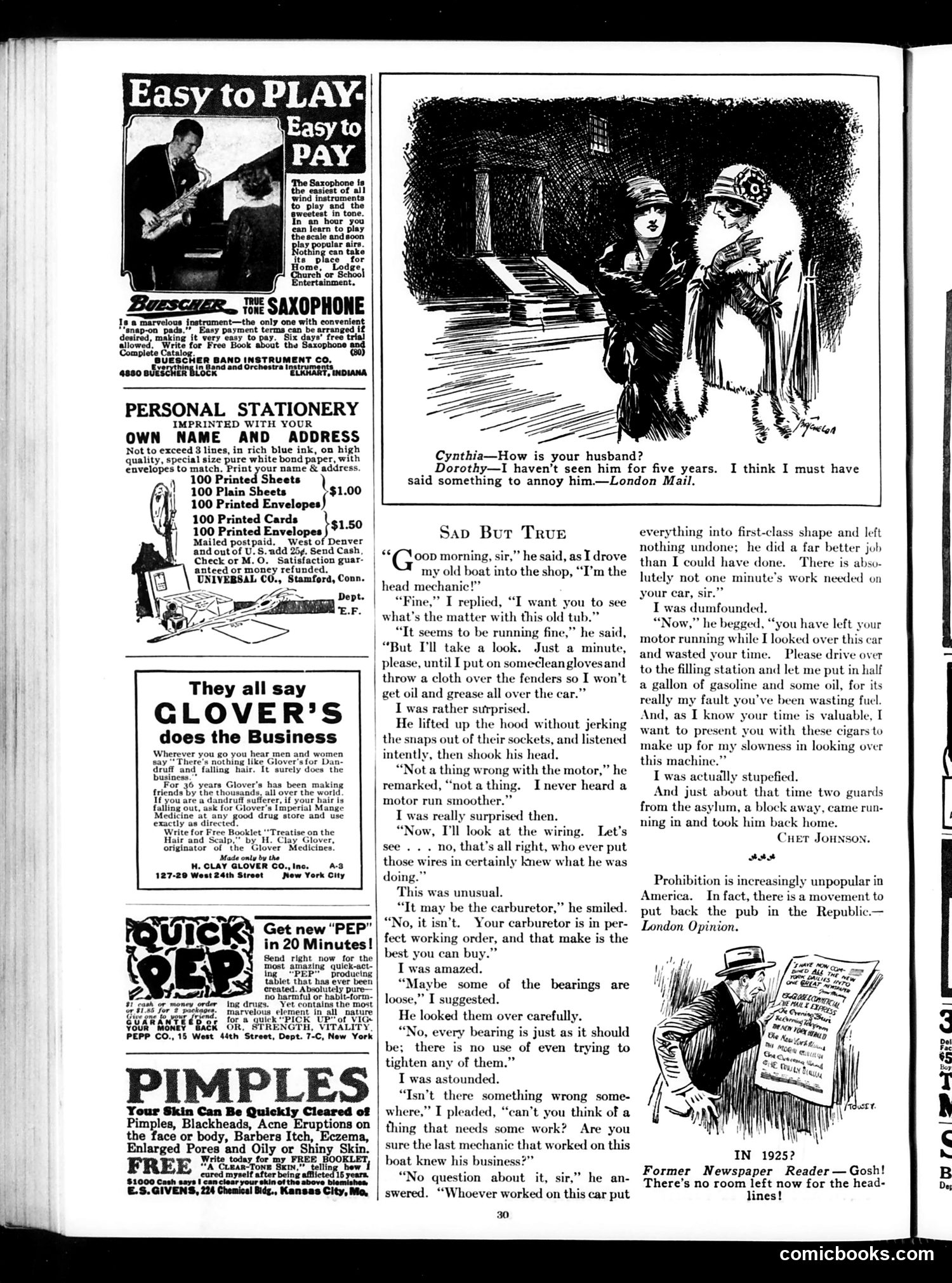
This page is primarily **advertising** mixed with a short humorous story. The main content is "Sad But True," a joke about a car owner's pleasant surprise at an honest mechanic—a figure seemingly so rare it's newsworthy. The satire works on **irony**: the narrator expects problems and repairs (the normal mechanic experience), but instead finds a mechanic who is scrupulously honest, careful with the vehicle, and admits nothing needs fixing. The joke's punchline relies on readers recognizing that *honest mechanics were apparently uncommon enough to be remarkable*, making the narrator's amazement at finding one the actual humor. The surrounding advertisements (saxophone lessons, personal stationery, hair products, skin treatments) reflect early 20th-century consumer culture. The cartoon above the story depicts two women discussing a missing husband—a light domestic joke unrelated to the main text. The page reflects period attitudes: surprise at professional integrity, gender humor, and faith in advertised remedies for common ailments.
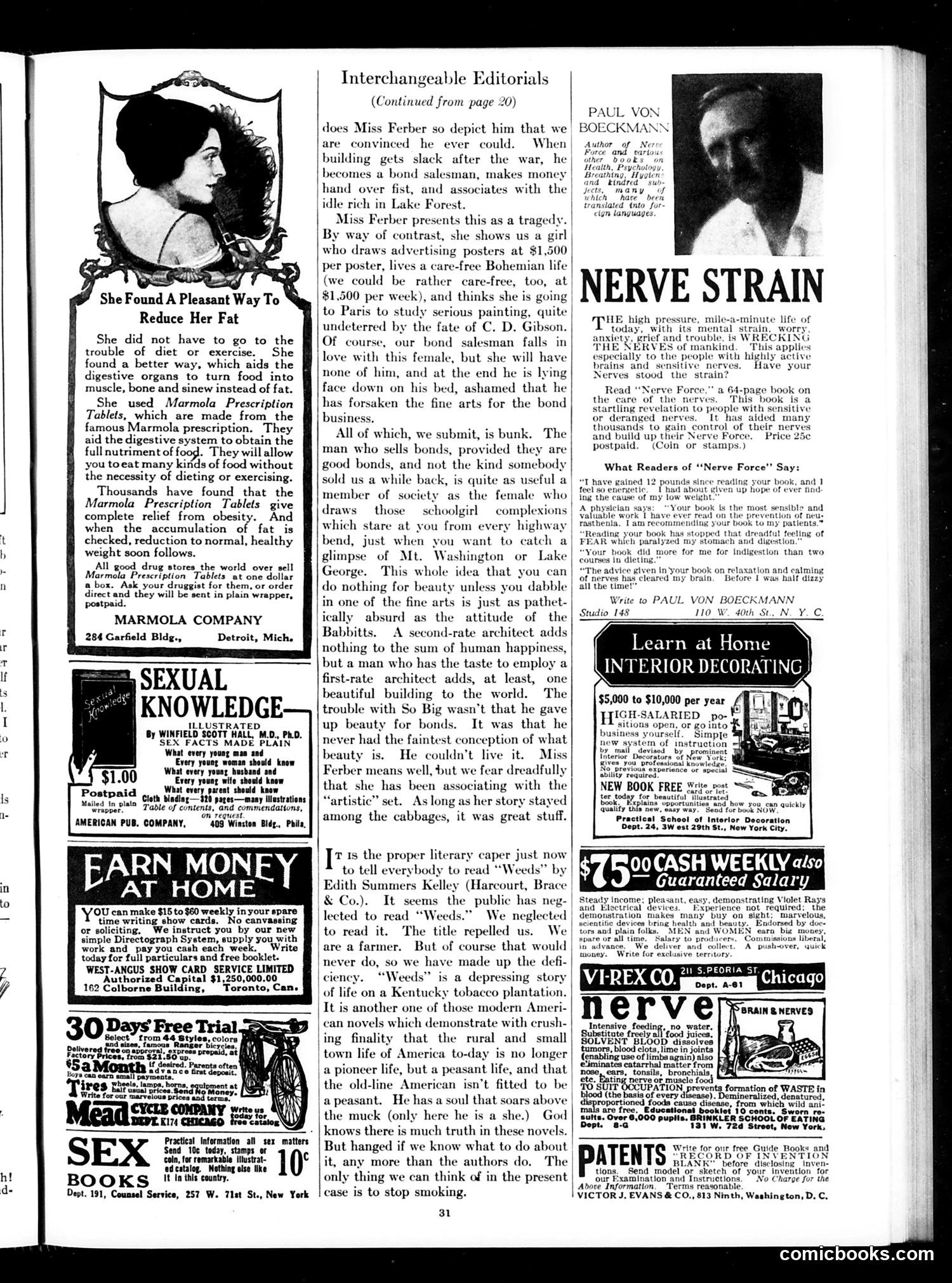
This editorial reviews Edith Ferber's novel *So Big*, criticizing her moral framework. The piece argues Ferber presents a false choice between artistic aspiration and commercial success. The editor disputes Ferber's apparent message: that a man who abandons "fine arts" for bond sales represents tragedy. The critic contends that useful work—selling quality bonds—contributes meaningfully to society, just as a second-rate artist does not. The satire targets romantic notions that commercial work is inherently shameful compared to creative pursuits. The editor suggests the protagonist's real problem wasn't choosing bonds over beauty, but rather lacking genuine aesthetic sensibility from the start. The piece mocks what it sees as Ferber's sentimental, impractical valorization of Bohemian poverty and artistic struggle over respectable middle-class enterprise.
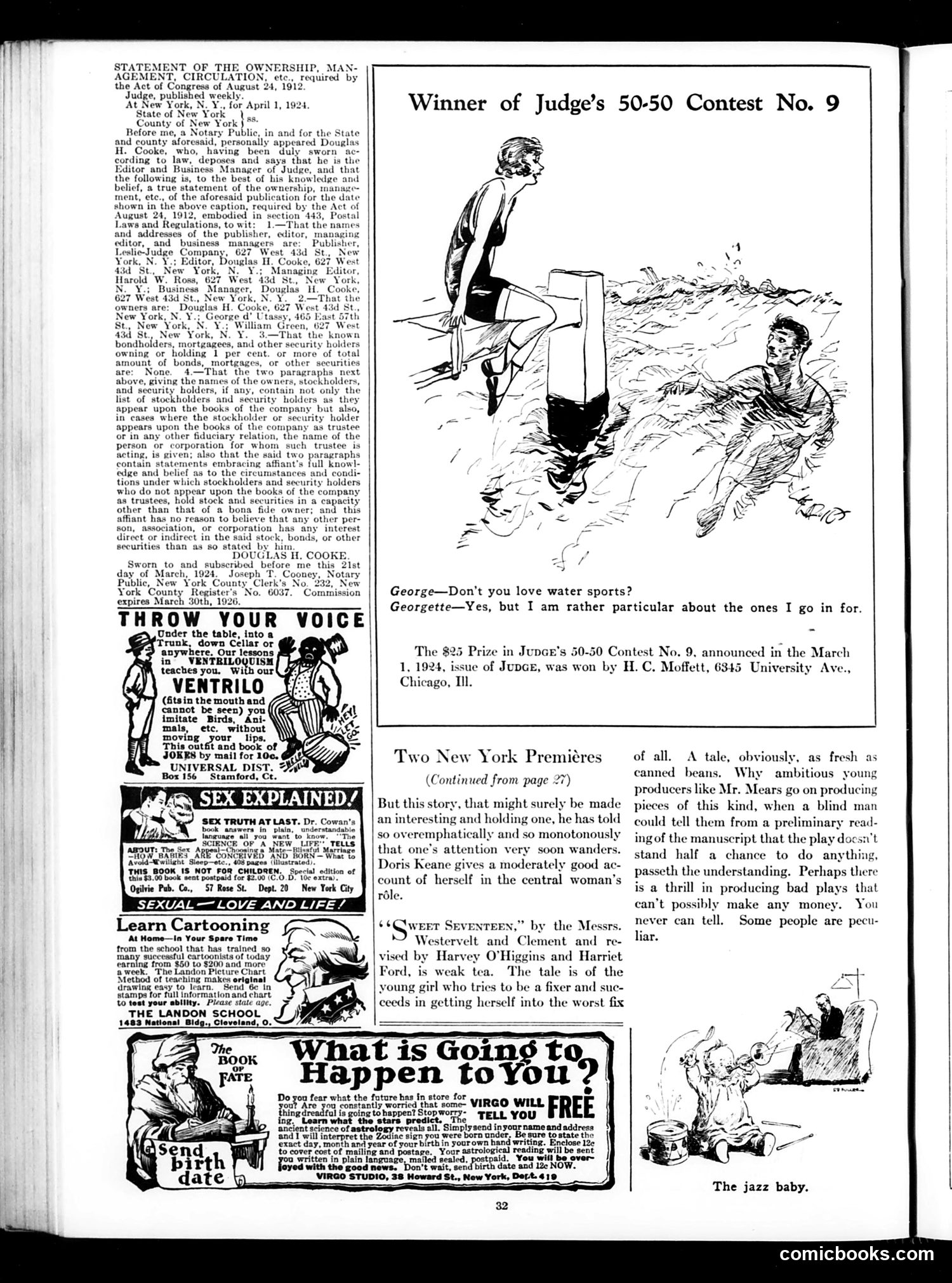
The main image shows the "Winner of Judge's 50-50 Contest No. 9"—a cartoon depicting two figures at a beach. One (labeled "George") sits contentedly while another (presumably "Georgette") appears to be launching herself or falling backward. The accompanying dialogue joke is the humor: George claims to love water sports but is "particular" about which ones he goes in for—implying he prefers passive observation to active participation, contrasting with Georgette's apparent energetic involvement. The page is primarily composed of **vintage advertisements and magazine publication notices** (ownership statements required by law). Other visible ads promote ventriloquism lessons, books on "sex explained," cartooning courses, and fortune-telling services—typical early 1920s periodical fare appealing to readers seeking self-improvement or entertainment. The satirical magazine *Judge* was using this contest to engage readers while filling space with advertisements and reprinted theater reviews.
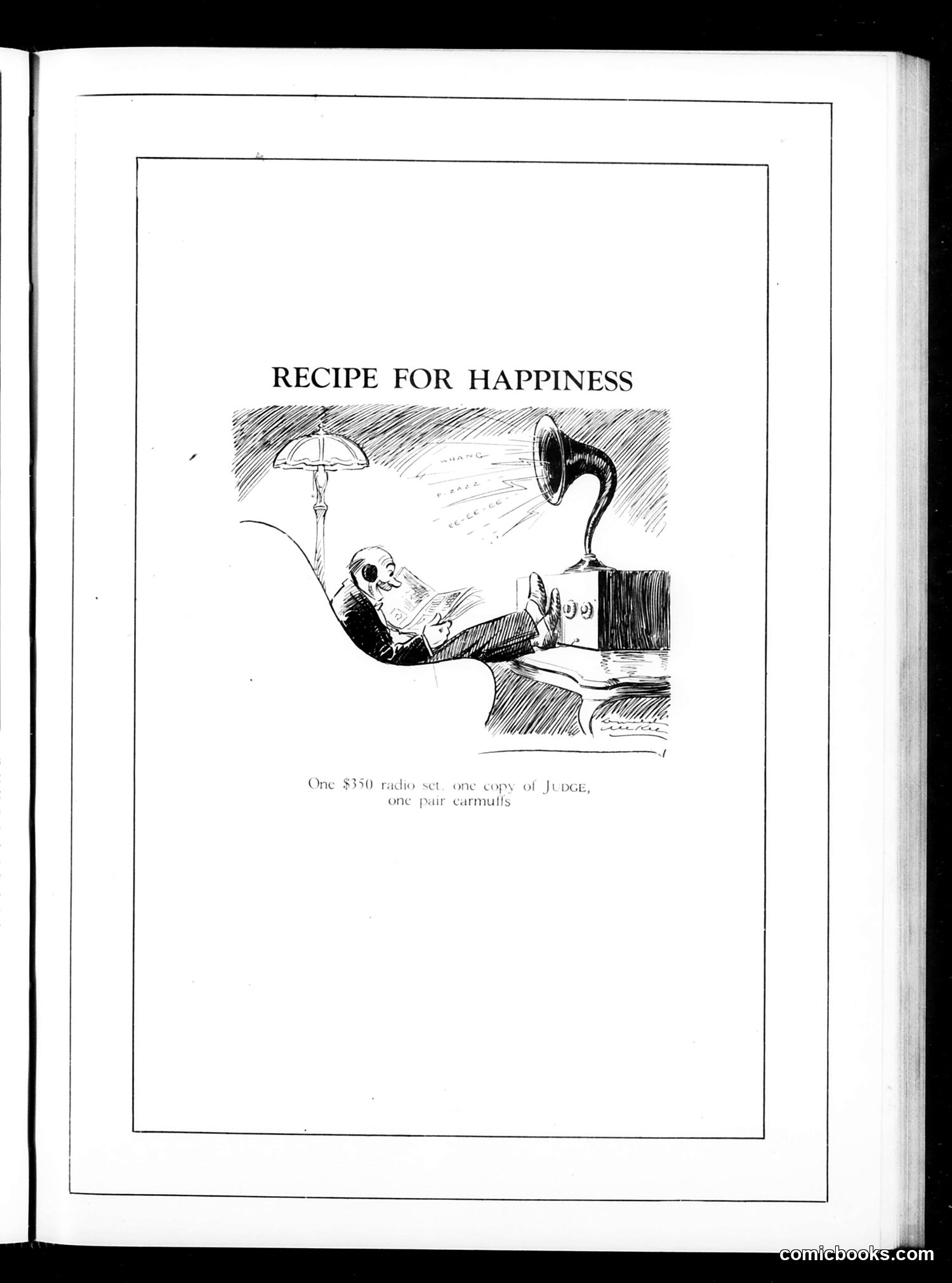
This satirical cartoon depicts a man in formal attire relaxing in a reclined position, holding an umbrella for shade while listening to music from a gramophone. The illustration humorously presents a "recipe" for contentment. The caption specifies the ingredients: "One $350 radio set, one copy of JUDGE, one pair earmuffs." The satire mocks consumer culture and leisure pursuits of the era—suggesting that happiness can be purchased through modern technology (radio) and entertainment (the Judge magazine itself). The earmuffs detail adds ironic commentary, implying one needs protection from the outside world to enjoy these pleasures. This represents early-20th-century anxieties about materialism and the commodification of happiness through mass-produced goods.
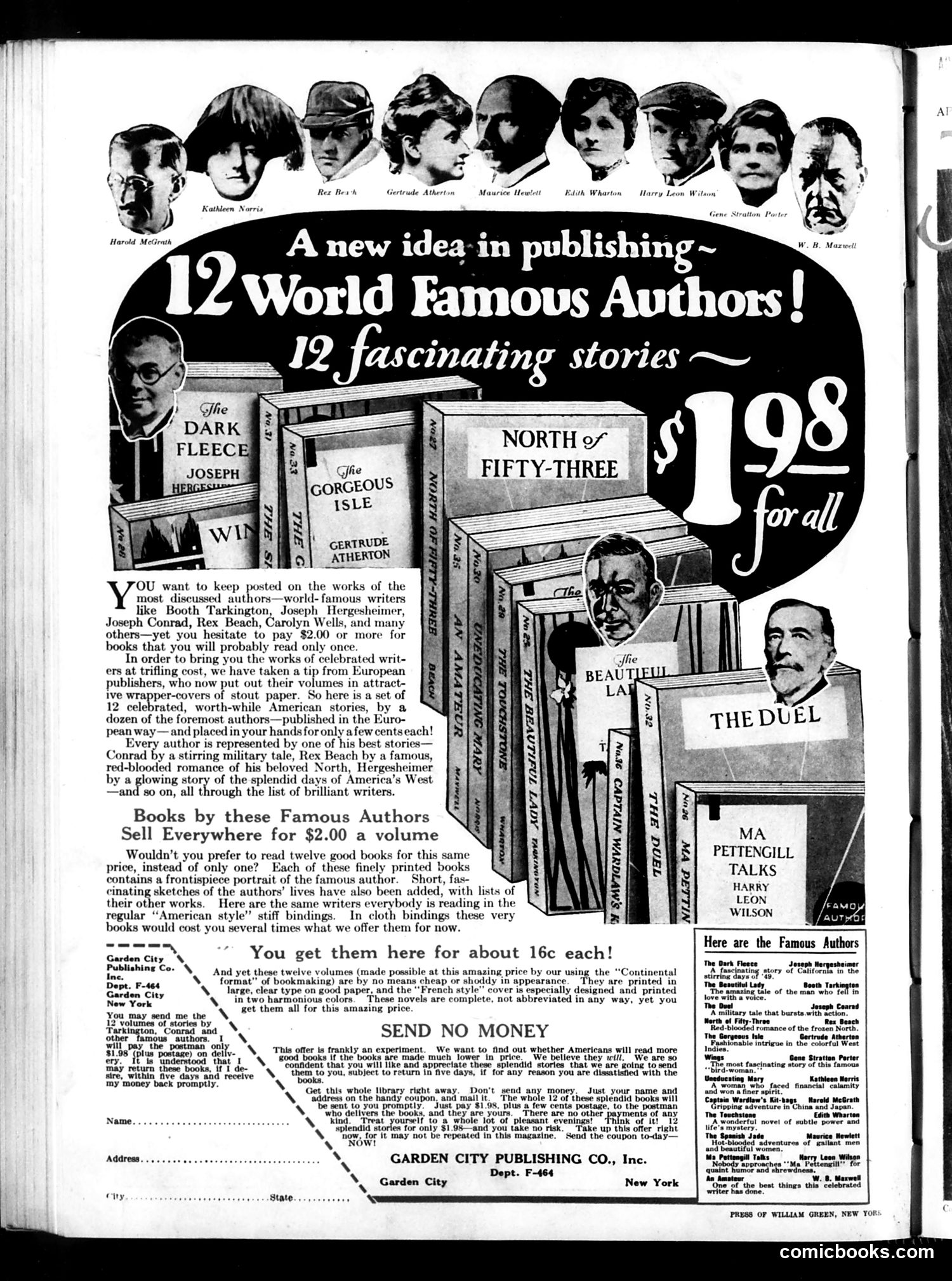
This is **primarily a book advertisement**, not a political cartoon. It promotes a new publishing format from Garden City Publishing Co. **The "New Idea":** European publishers were selling popular novels in cheap paper wrappers instead of expensive hardcovers. This American company is offering 12 famous authors' works—including Joseph Conrad, Rex Beach, and Booth Tarkington—for about 16 cents each, totaling $1.98, instead of $2 per volume. **The Sales Pitch:** The ad emphasizes affordability without sacrificing quality: books are printed in large type on good paper with author portraits and biographical sketches. Readers get "the same writers everybody is reading" at a fraction of the cost. **Historical Context:** This reflects early-20th-century concerns about making literature accessible to ordinary Americans. The "Continental format" language suggests positioning European sophistication as an economic advantage rather than a luxury. **The Marketing Hook:** "Send no money"—pay the postman upon delivery, with a five-day return guarantee. The page's top shows headshots of the featured authors as celebrities.