
Judge, 1924-04-12 · page 22 of 36
Judge — April 12, 1924 — page 22: what you’re looking at
What you’re looking at
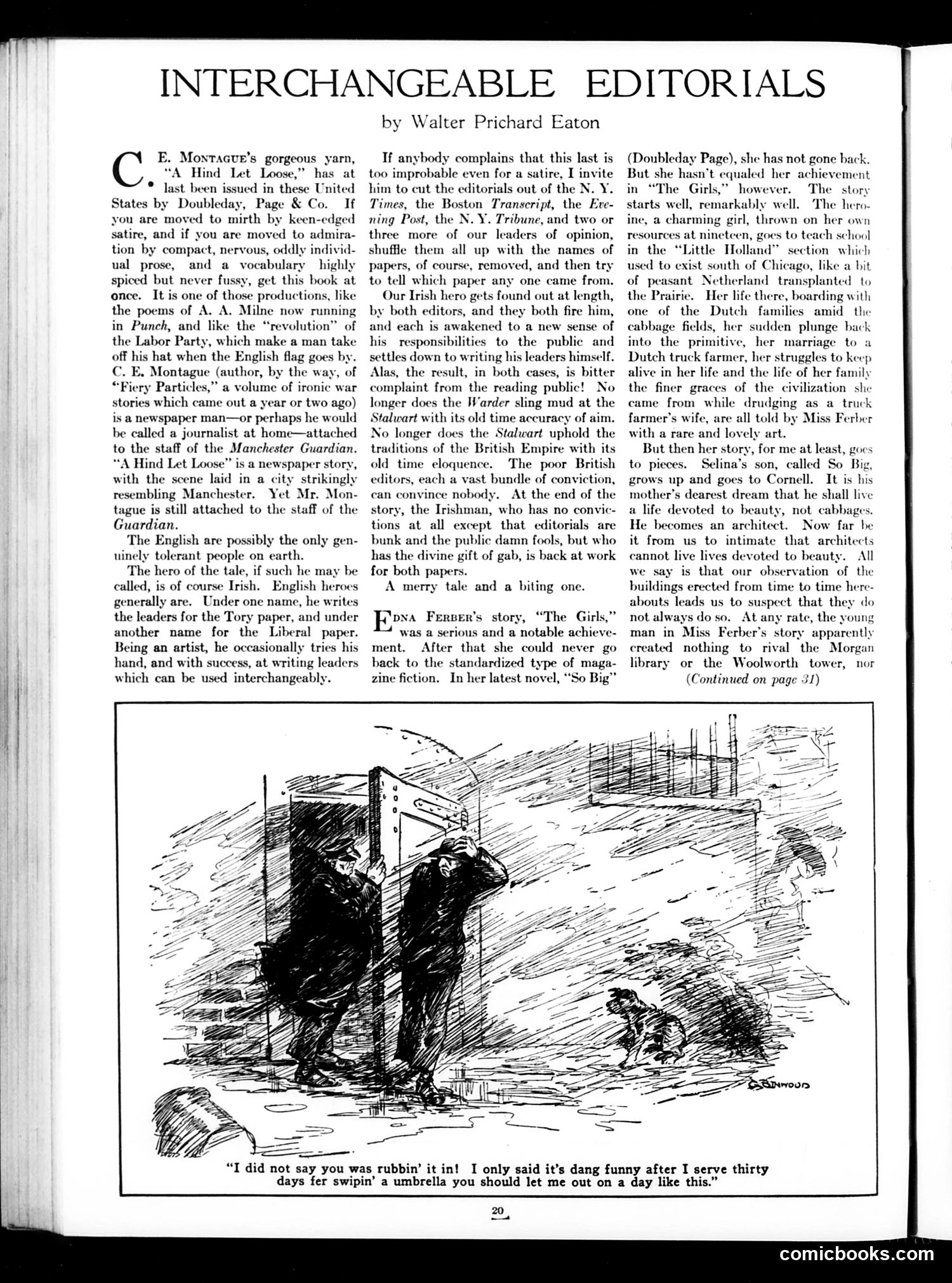
This page contains two distinct pieces. The main text is a book review by Walter Prichard Eaton praising C.E. Montague's novel *"A Hind Let Loose,"* which satirizes British journalism. The novel's central joke: an Irish character writes editorials for both Tory and Liberal newspapers using interchangeable arguments—so similar that readers cannot distinguish them. Eaton extends this satire to American papers (New York *Times*, *Tribune*, *Evening Post*), suggesting American editorial writing is equally indistinguishable and formulaic. The cartoon below depicts a police officer confronting what appears to be a vagrant or street person. The caption shows the officer denying the person had complained about being "robbed," only that it was "funny" to be let out of jail after serving time for umbrella-theft, especially on nice weather days. The cartoon's humor relies on the character's verbal confusion—likely deliberate malapropism or dialect humor typical of early 20th-century American comedy.
📄 Transcribed text from this page (OCR, searchable)
Machine-transcribed from the original scan — historical spelling and the odd misread are preserved.
MontaGue’s gorgeous yarn, ‘A Hind Let Loose,” at * last been issued in these United States by Doubleday, Page & Co. If you are moved to mirth by keen-edged satire, and if you are moved to adm tion by compact, nervous, oddly individ- ual prose, and a vocabulary highly spiced but never fussy, get this book at once. It is one of those productions, like the poems of A. A. Milne now running in Punch, and like the “revolution” of the Labor Party, which make a man take off his hat when the English flag goes by. C. E. Montague (author, by the way, of “Fiery Particles,” a volume of ironic war stories which came out a year or two ago) is a newspaper man—or perhaps he would be called a journalist at home—attached to the staff of the Manchester Guardian. “A Hind Let Loose” is a ne with the scene laid in a city strikingly resembling Manchester. Yet Mr. Mon- tague is still attached to the staff of the Guardian. The English are possibly the only gen- uinely tolerant people on earth. The hero of the tale, if such he may be called, is of course Irish. English heroes generally are. Under one name, he writes the leaders for the Tory paper, and under another name for the Liberal paper. Being an artist, he occasionally tries his hand, and with success, at writing leaders which can be used interchangeably. “I did not say you was rubbin’ it in! INTERCHANGEABLE EDITORIALS by Walter Prichard Eaton If anybody complains that this last is too improbable even for a satire, I invite him to cut the editorials out of the N. Y. Times, the Boston Transcript, the Eve- ning Post, the N. Y. Tribune, and two or three more of our leaders of opinion, shuffle them all up with the names of papers, of course, removed, and then try to tell which paper any one came from. Our Irish hero gets found out at length, by both editors, and they both fire him, and each is awakened to a new sense of his responsibilities to the public and settles down to writing his leaders himself. Alas, the result, in both cases, is bitter complaint from the reading public! No longer does the Warder sling mud at the Stalwart with its old time accuracy of aim. No longer does the Stalwart uphold the traditions of the British Empire with its old time eloquence. The poor British editors, each a vast bundle of conviction can convince nobody. At the end of the story, the Irishman, who has no convic- tions at all except that editorials are bunk and the public damn fools, but who has the divine gift of gab, is back at work for both papers. A merry tale and a biting one. pNA Ferser’s story, “The Girls,” was a serious and a notable achiev ment. After that she could never go back to the standardized type of maga- zine fiction. In her latest novel, “So Big” wa I only said it’s dang funny after I serve thirty days fer swipin’ a umbrella you should let me out on a day like this.” (Doubleday Page), she has not gone back. But she hasn't equaled her achievement in “The Girls,” however. The story starts well, remarkably well. The hero- ine, a charming girl, thrown on her own resources at nineteen, goes to teach school in the “Little Holland” section which used to exist south of Chicago, like a bit of peasant Netherland transplanted to the Prairie. Her life there, boarding with one of the Dutch families amid the cabbage fields, her sudden plunge back into the primitive, her marriage to a Dutch truck farmer, her struggles to keep alive in her life and the life of her family the finer graces of the civilization she came from while drudging as a truck farmer’s wife, are all told by Miss Ferber with a rare and lovely art. But then her story, for me at least, goes to pieces. Selina’s son, called So Big, grows up and goes to Cornell. It is his mother’s dearest dream that he shall live a life devoted to beauty, not cabbages. He becomes an architect. Now far be it from us to intimate that architects cannot live lives devoted to beauty. All we say is that our observation of the buildings erected from time to time here- abouts leads us to suspect that they do not always do so. any rate, the young man in Miss Ferber’s story apparently created nothing to rival the Morg: library or the Woolworth tower, nor (Continued on page 31) comicbooks.com