
Judge, 1924-04-12 · page 17 of 36
Judge — April 12, 1924 — page 17: what you’re looking at
What you’re looking at
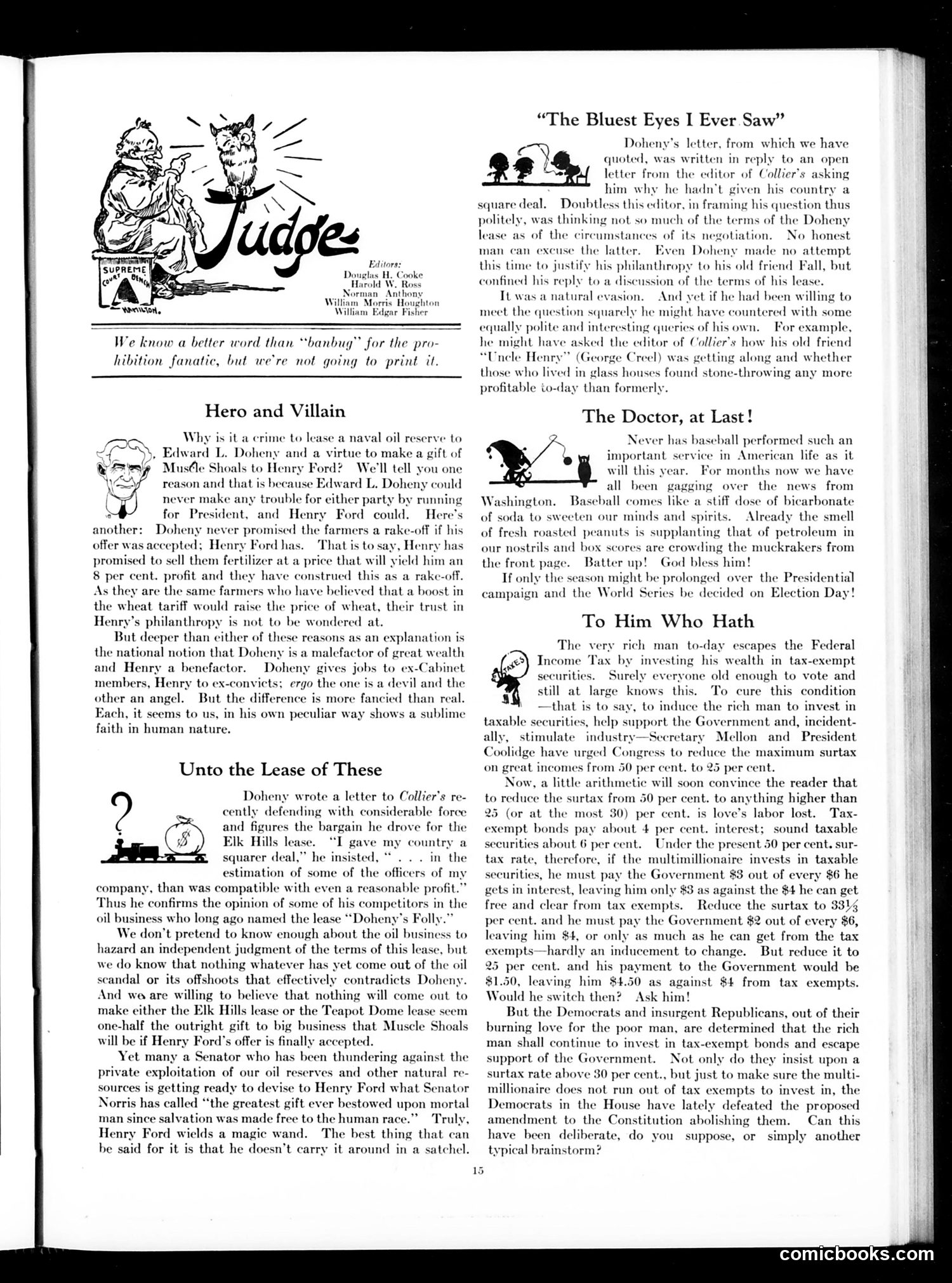
This page satirizes a political scandal involving oil leases during the Harding administration (likely 1921-1923). The main targets are **Edward Doheny** and **Henry Ford**. **The Central Comparison ("Hero and Villain"):** Judge mocks the public's selective moral outrage. Doheny leased naval oil reserves (Elk Hills) under questionable circumstances, while Ford was offered the Muscle Shoals facility—yet politicians attack Doheny while praising Ford's "philanthropy." Judge suggests this inconsistency stems from fear: Doheny poses no political threat, while Ford might run for president. **The Irony:** Both men represent similar business ethics wrapped in different public images. Doheny "gives" to ex-convicts (implying corruption), Ford to farmers (appearing philanthropic), yet both demonstrate questionable "faith in human nature." **"The Bluest Eyes":** References Doheny's letter defending the lease deal. Judge criticizes Collier's editor for focusing on lease *terms* rather than the corrupt *negotiations*—implying collusion with Secretary Fall (hinted at in scandal context). The satire's core: public morality is shaped by political convenience, not principle.
📄 Transcribed text from this page (OCR, searchable)
Machine-transcribed from the original scan — historical spelling and the odd misread are preserved.
William Morris Houghton William Edgar Fisher We know a better word than “banbug” for the pro- hibition fanatic, but we're not going to print it. Hero and Villain a Why is it a crime to lease a naval oil reserve to <~{~ SS, Edward L. Doheny and a virtue to make a gift of & Py Mus@le Shoals to Henry Ford? We'll tell you one WWF reason and that is because Edward L. Doheny could never make any trouble for either party by running for President, and Henry Ford could. Here's Doheny never promised the farmers a rake-off if his offer was accepted; Henry Ford has. That is to say, Henry has promised to sell them fertilizer at a price that will yield him an 8 per cent. profit and they have construed this as a rake-off. As they are the same farmers who have believed that a boost in the wheat tariff would raise the price of wheat, their trust in Henry’s philanthropy is not to be wondered at. But deeper than either of these reasons the national notion that Doheny is a male and Henry a benefactor. another: as an explanation is Doheny gives j members, Henry to ex-convicts; ergo the one is a devil and the other an angel. But the difference is more fancied than real. Each, it seems to us, in his own peculiar way shows a sublime faith in human nature. Unto the Lease of These Doheny wrote a letter to Collier's re- cently defending with considerable force and figures the bargain he drove for the Elk Hills leas I gave my country a squarer deal,” he insisted, * estimation of some of the officers of my company, than was compatible with even a reasonable profit.” Thus he confirms the opinion of some of his competitors in the oil business who long ago named the lease “Doheny’s Folly.” We don’t pretend to know enough about the oil business to rd an independent judgment of the terms of this lease, but we do know that nothing whatever has yet come out of the oil scandal or its offshoots that effectively contradicts Doheny. And we are willing to believe that nothing will come out to make either the Elk Hills lease or the Teapot Dome lease seem one-half the outright gift to big business that Muscle § will be if Henry Ford’s offer is finally accepted. Yet many a Senator who been thundering against the private exploitation of our oil reserves and other natural re- sources is getting ready to devise to Henry Ford what Senator Norris has called “the greatest gift ever bestowed upon mortal man since salvation was made free to the human race.” Truly, Henry Ford wields a magic id. The best thing that can be said for it is tha ‘arry it around in a satchel. . in the hoals he doesn’t 15 “The Bluest Eyes I Ever Saw” Doheny’s letter, from which we have quoted, was written in reply to an open letter from the editor of Collier's asking him why he hadn't given his country a Doubtless this editor, in framing his question thus politely, was thinking not so much of the terms of the Doheny lease as of the circumstances of its negotiation. No honest man can excuse the latter. Even Doheny made no attempt this time to justify his philanthropy to his old friend Fall, but confined his reply to square deal. a discussion of the terms of his lease. asion. And yet if he had been willing to y he might have countered with some equally polite and interesting queries of his own. he might hav “Uncle Henry It was a natural ¢ meet the question squi For example, asked the editor of Collier's how his old friend George Creel) was getting along and whether those who lived in glass houses found stone-throwing any more profitable to-day than formerly. The Doctor, at Last! Never has baseball performed such an important service in American life as it will this year. For months now we have all gging over the news from Baseball comes like a stiff dose of bicarbonate of soda to sweeten our minds and spirits. Already the smell of fresh roasted peanuts is supplanting that of petroleum in our nostrils and box scores are crowding the muckrakers from the front page. Batter up! God bless him! If only the season might be prolonged over the Presidenti campaign and the World Series be decided on Election Da. To Him Who Hath The very rich man to-day escapes the Federal Income Tax by investing his wealth in tax-exempt securities. Surely everyone old enough to vote and still at large knows this. To cure this condition —that is to say, to induce the rich man to invest in taxable securities, help support the Government and, incident- ally, stimulate industry—Secretary Mellon and President Coolidge have urged Congress to reduce the maximum surtax on gre rom 50 per cent. to 25 per cent. ow, a little arithmetic will soon convince the reader that to reduce the surtax from 50 per cent. to anything higher than 25 (or at the most 30) per cent. is love’s labor lost. Tax- exempt bonds pay about 4 per cent. interest; sound taxable securities about 6 per cent. been Washington. > (.s* 4 t incon! Under the present 50 per cent. sur- tax rate, therefore, if the multimillionaire invests in taxable securities, he must pay the Government $3 out of every $6 he gets in interest, leaving him only $3 as against the $4 he can get free and clear from tax exempts. Reduce the surtax to 3314 per cent. and he must pay the Government $2 out of eve ving him $4, or only as much as he can get from the tax exempts—hardly an inducement to change. But reduce it to 25 per cent. and his payment to the Government would be $1.50, leaving him $4.50 as against $4 from tax exempts. Would he switch then? Ask him! But the Democrats and insurgent Republicans, out of their burning love for the poor man, are determined that the rich man shall continue to invest in tax-exempt bonds and escape support of the Government. Not only do they insist upon a surtax rate above 30 per cent., but just to make sure the multi- millionaire does not run out of tax exempts to invest in, the Democrats in the House have lately defeated the proposed amendment to the Constitution abolishing them. Can this have been deliberate, do you suppose, or simply another typical brainstorm? comicbooks.com