
Judge, 1924-04-12 · page 24 of 36
Judge — April 12, 1924 — page 24: what you’re looking at
What you’re looking at
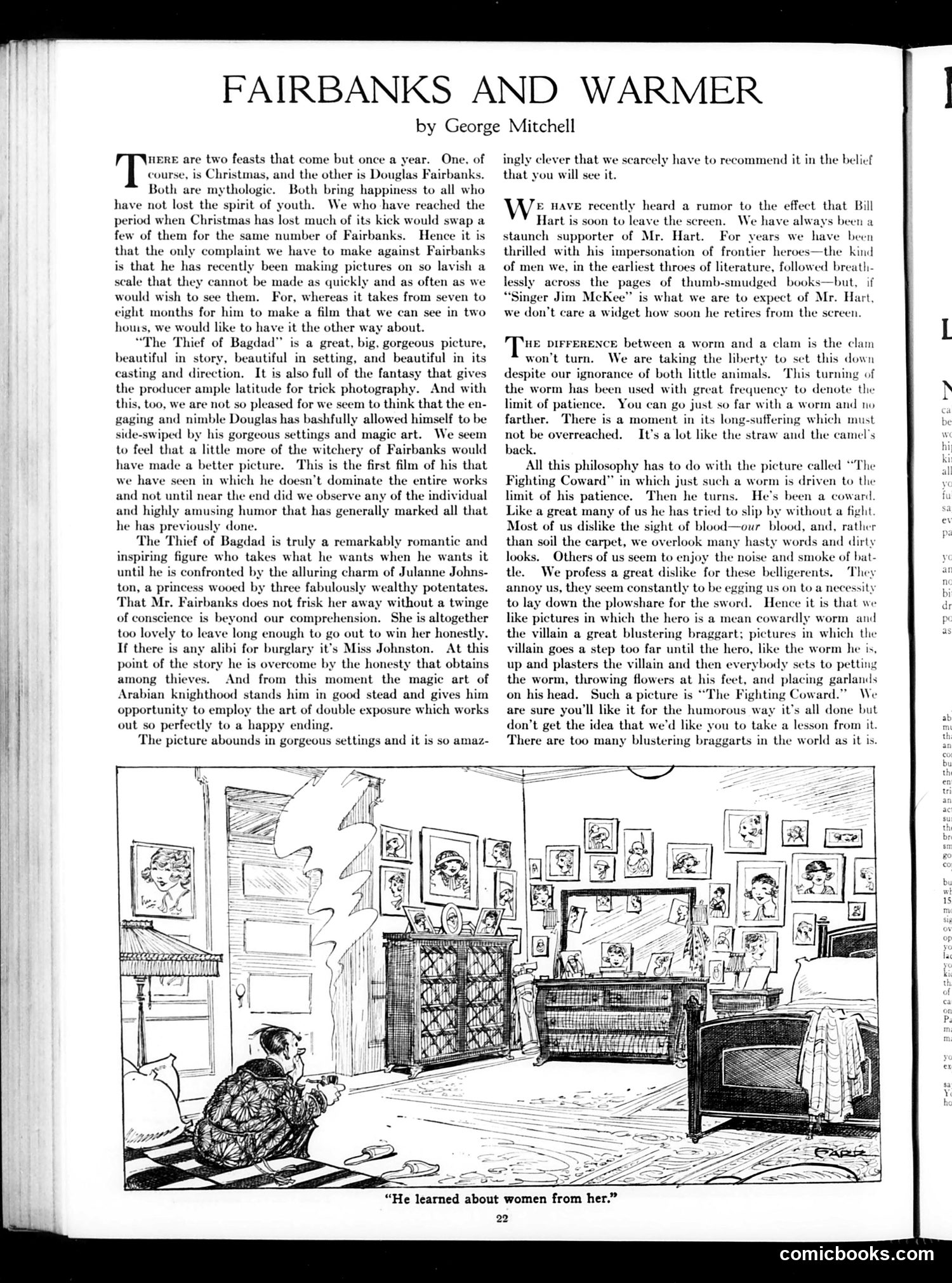
This is a film-criticism column by George Mitchell praising Douglas Fairbanks's movie production. The piece compares two popular film stars: Fairbanks, whose lavish productions are so time-consuming that admirers wish he made them more frequently, and Bill Hart, a Western/frontier actor whose star is apparently fading. The column's humor lies in mock-philosophical tangents. Mitchell digresses into musings about worms versus clams (noting worms "turn" when pushed too far—a metaphor for patience breaking) to frame discussion of "The Fighting Coward," another film examining cowardice and masculine honor. The cartoon illustrates a scene from one of these films, showing a figure in an ornate interior surrounded by artwork—likely depicting the opulent fantasy settings Fairbanks's productions were known for. The satire gently critiques how Fairbanks's elaborate sets sometimes overshadow his performance, while celebrating both actors as providers of escapist entertainment for audiences nostalgic about youth and adventure.
📄 Transcribed text from this page (OCR, searchable)
Machine-transcribed from the original scan — historical spelling and the odd misread are preserved.
FAIRBANKS AND WARMER by George Mitchell HERE are two feasts that come but once a year. One, of I course, is Christmas, and the other is Douglas Fairbanks. Both are mythologic. Both bring happiness to all who have not lost the spirit of youth. We who have reached the period when Christmas has lost much of its kick would swap a few of them for the same number of Fairbanks. Hence it is that the only complaint we have to make against Fairbanks is that he has recently been making pictures on so lavish a scale that they cannot be made as quickly and as often as we would wish to see them. For, whereas it takes from seven to eight months for him to make a film that we can see in two hours, we would like to have it the other way about. “The Thief of Bagdad” is a great, big, gorgeous picture, beautiful in story, beautiful in setting, and beautiful in i sting and direction. It is also full of the fantasy that gives ingly clever that we scarcely have to recommend it in the belief that you will see it. W: HAVE recently heard a rumor to the effect that Bill Hart is soon to leave the screen. We have always been a staunch supporter of Mr. Hart. For years we have been thrilled with his impersonation of frontier heroes—the kind of men we, in the earliest throes of literature, followed breath- ly across the pages of thumb-smudged books—but, if ger Jim McKee what we are to expect of Mr. Hart, don’t care a widget how soon he retires from the screen. Te DIFFERENCE between a worm and a clam is the clam won't turn, We are taking the liberty to set this down despite our ignorance of both little animals. This turning of producer ample latitude for trick photography. And with the worm has been used with great frequency to denote the N too, we are not so pleased for we seem to think that the en- limit of patience. You can go just so far with a worm and no S gaging and nimble Douglas has bashfully allowed himself tobe farther. There is a moment in its long-suffering which must be side-swiped by his gorgeous settings and magic art. We seem not be overreached. It’s a lot like the straw and the camel's i to feel that a little more of the witchery of Fairbanks would have made a better picture. This is the first film of his that we have seen in which he doesn’t dominate the entire works and not until near the end did we observe any of the individual and highly amusing humor that has generally marked all that he has previously done. The Thief of Bagdad is truly a remarkably romantic and inspiring figure who takes what he wants when he wants it until he is confronted by the alluring charm of Julanne Johns- ton, a princess wooed by three fabulously wealthy potentates. That Mr. Fairbanks does not frisk her away without a twinge of conscience is beyond our comprehension. She is altogether too lovely to leave long enough to go out to win her honestly. back. All this philosophy has to do with the picture called “The Fighting Coward” in which just such a worm is driven to the limit of his patience. Then he turns. He's been a coward. Like a great many of us he has tried to slip by without a fight Most of us dislike the sight of blood—our blood, and, rather than soil the carpet, we overlook many hasty words and dirty looks. Others of us seem to enjoy the noise and smoke of bat- tle. We profess a great dislike for these belligerents. They annoy us, they seem constantly to be egging us on to a necessity to lay down the plowshare for the sword. Hence it is that we like pictures in which the hero is a mean cowardly worm and the villain a great blustering braggart; pictures in which the If there is any alibi for burglary it’s Miss Johnston. At this villain goes a step too far until the hero, like the worm he is, } point of the story he is overcome by the honesty that obtains — up and plasters the villain and then everybody sets to petting +i among thie And from this moment the magic art of | the worm, throwing flowers at his feet, and placing garlands | Arabian knighthood stands him in good stead and gives him on his head. Such a picture is “The Fighting Coward.” We i opportunity to employ the art of double exposure which works are sure you'll like it for the humorous way it’s all done but a | out so perfectly to a happy ending. don’t get the idea that we'd like you to take a lesson from it. a . The picture abounds in gorgeous settings and it isso amaz- ‘There are too many blustering braggarts in the world as it is. th bu | th e “He learned about women from her.” 22 comicbooks.com