
A complete issue · 36 pages · 1924
Judge — March 8, 1924
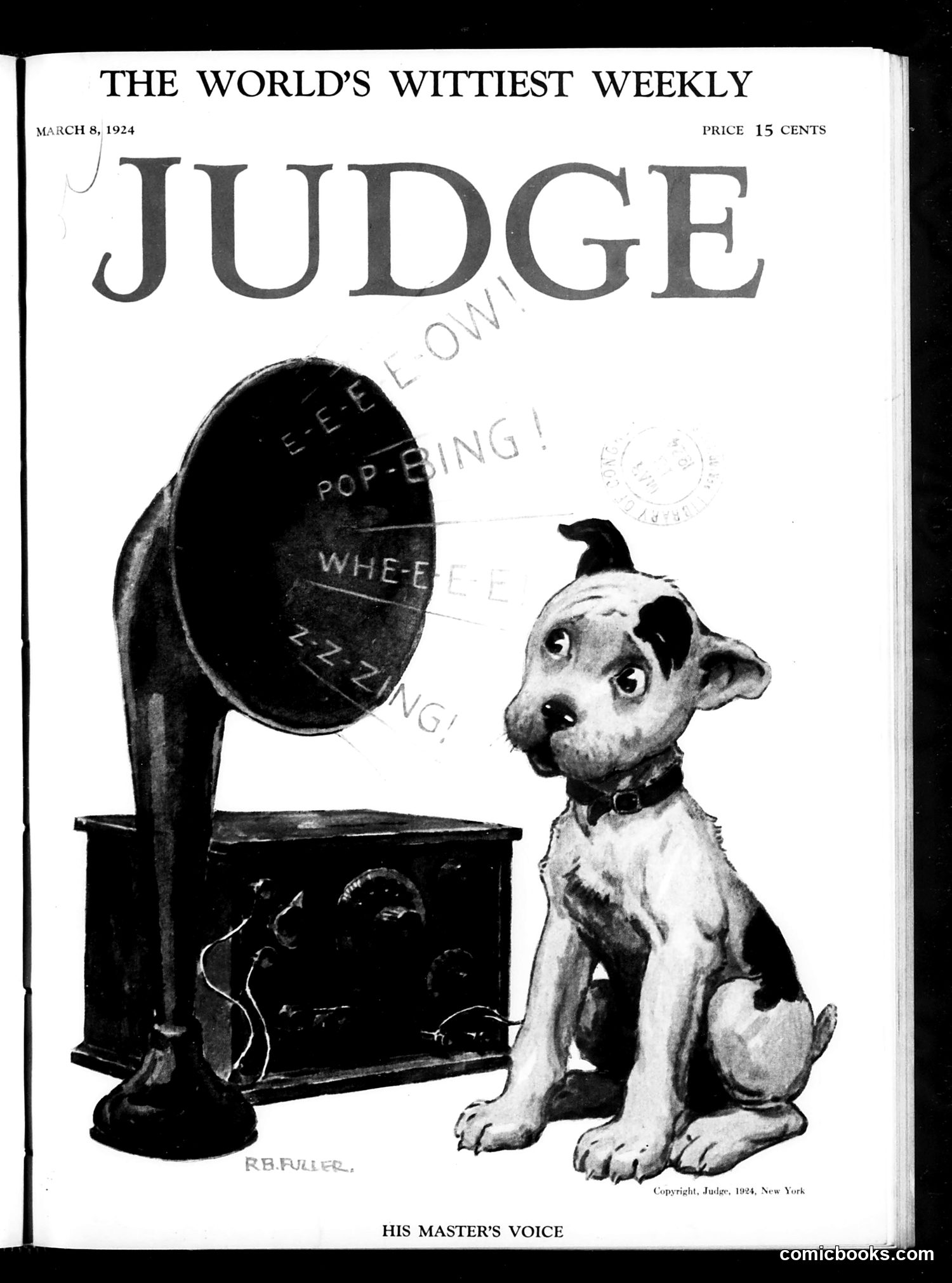
This is a visual pun on the famous "His Master's Voice" trademark—originally depicting a dog listening to a phonograph, used by the Victor Talking Machine Company. Here, the dog hears various sounds from the speaker ("E-E-E-E LOW! POP-BING! WHEE! ZZZZZ ING!")—likely representing confusing or nonsensical political rhetoric or noise from public figures. The cartoon satirizes how people uncritically accept whatever they hear from authority figures or media, much like the obedient dog in the original trademark. By 1924, this would likely mock contemporary political speech or propaganda—the dog represents the gullible public faithfully absorbing whatever "masters" broadcast to them, regardless of actual sense or truth.
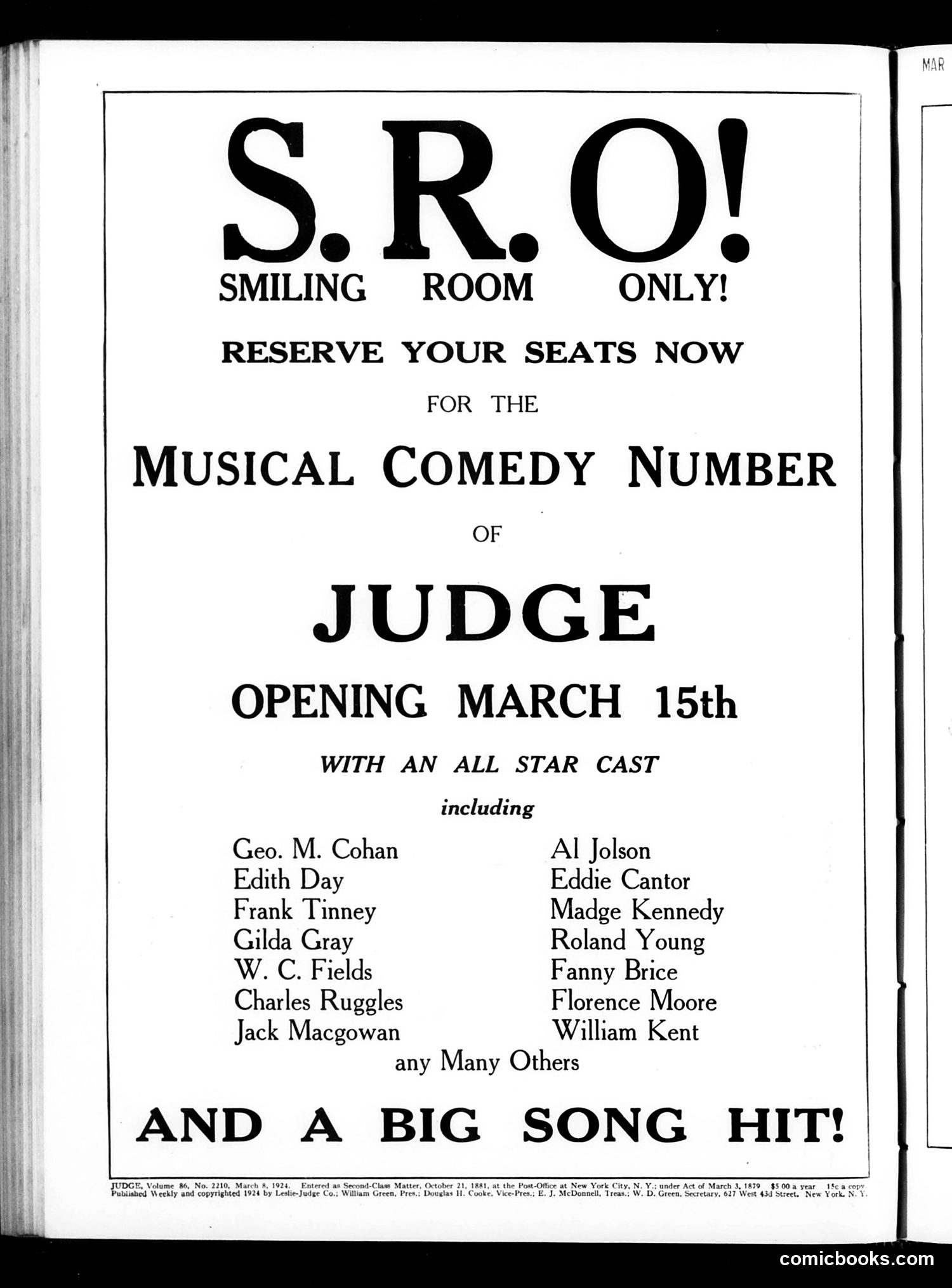
This page is primarily **advertising, not satire or political commentary**. It's a promotional advertisement for a theatrical production—specifically a musical comedy called "Judge" opening March 15th at what appears to be the Smiling Room Only venue. The "S.R.O." acronym (Standing Room Only) is a theater industry term indicating the show is expected to sell out, so audiences should reserve seats in advance. The advertisement lists an impressive ensemble cast including notable vaudeville and silent-era performers like W.C. Fields, Eddie Cantor, and others, promoting it as featuring "an all star cast" and "a big song hit." This is essentially a vintage entertainment industry advertisement with no political message or satirical content.
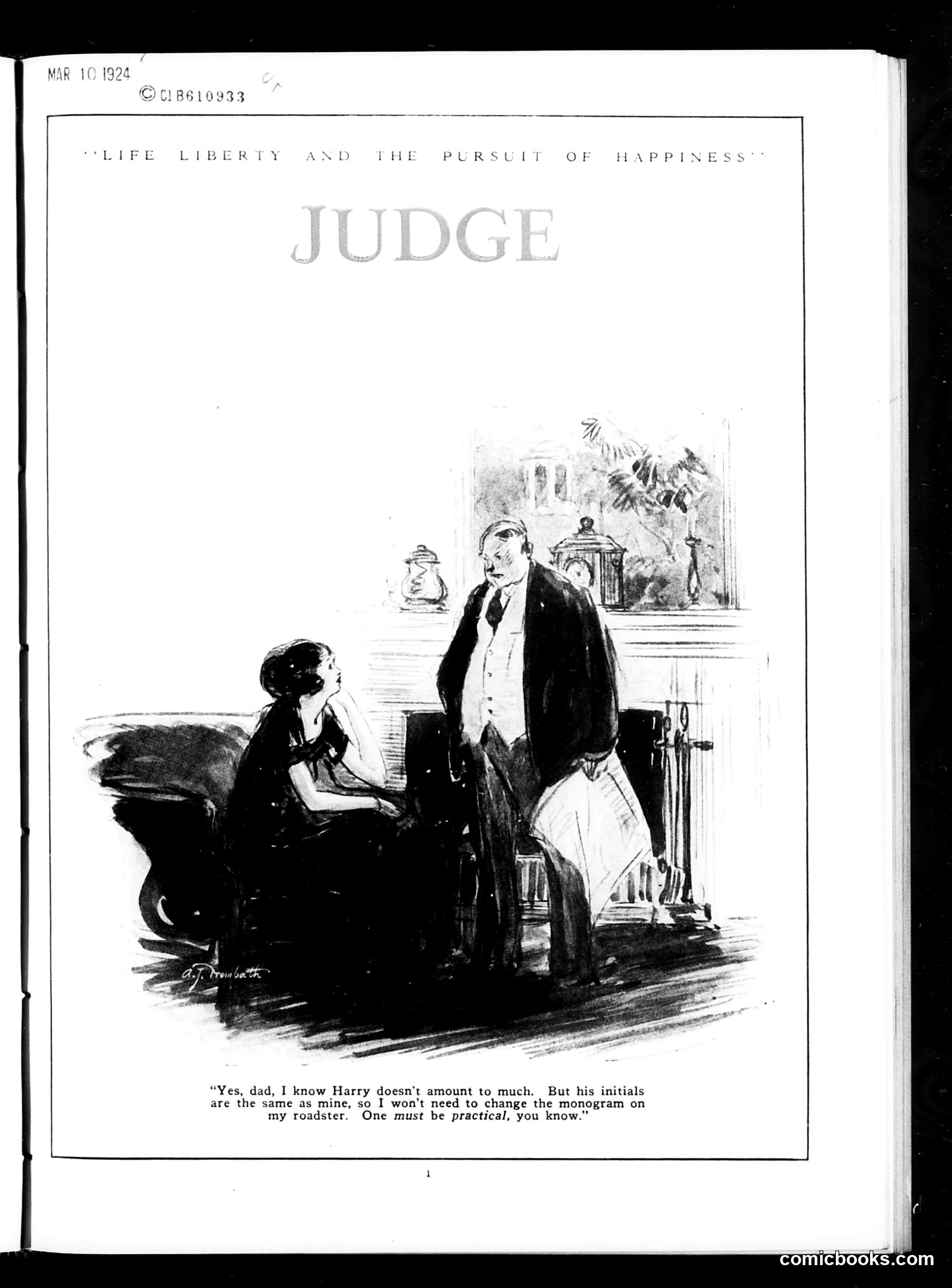
**Date:** March 10, 1924 **Scene:** A domestic interior showing a man standing while a woman sits, with a child visible in background. **The Joke:** The woman is reassuring her husband ("dad") that while a person named Harry "doesn't amount to much," she won't need to change the monogram on her roadster when she marries him. She emphasizes one "must be practical, you know." **Meaning:** This satirizes 1920s materialism and shallow values among the wealthy or aspirational classes. The humor targets women's focus on practical financial concerns (keeping an expensive car) over genuine romantic compatibility when choosing a husband. It reflects Jazz Age anxieties about changing gender roles and mercenary attitudes toward marriage—mocking both the woman's candor and society's acceptance of such transactional thinking.
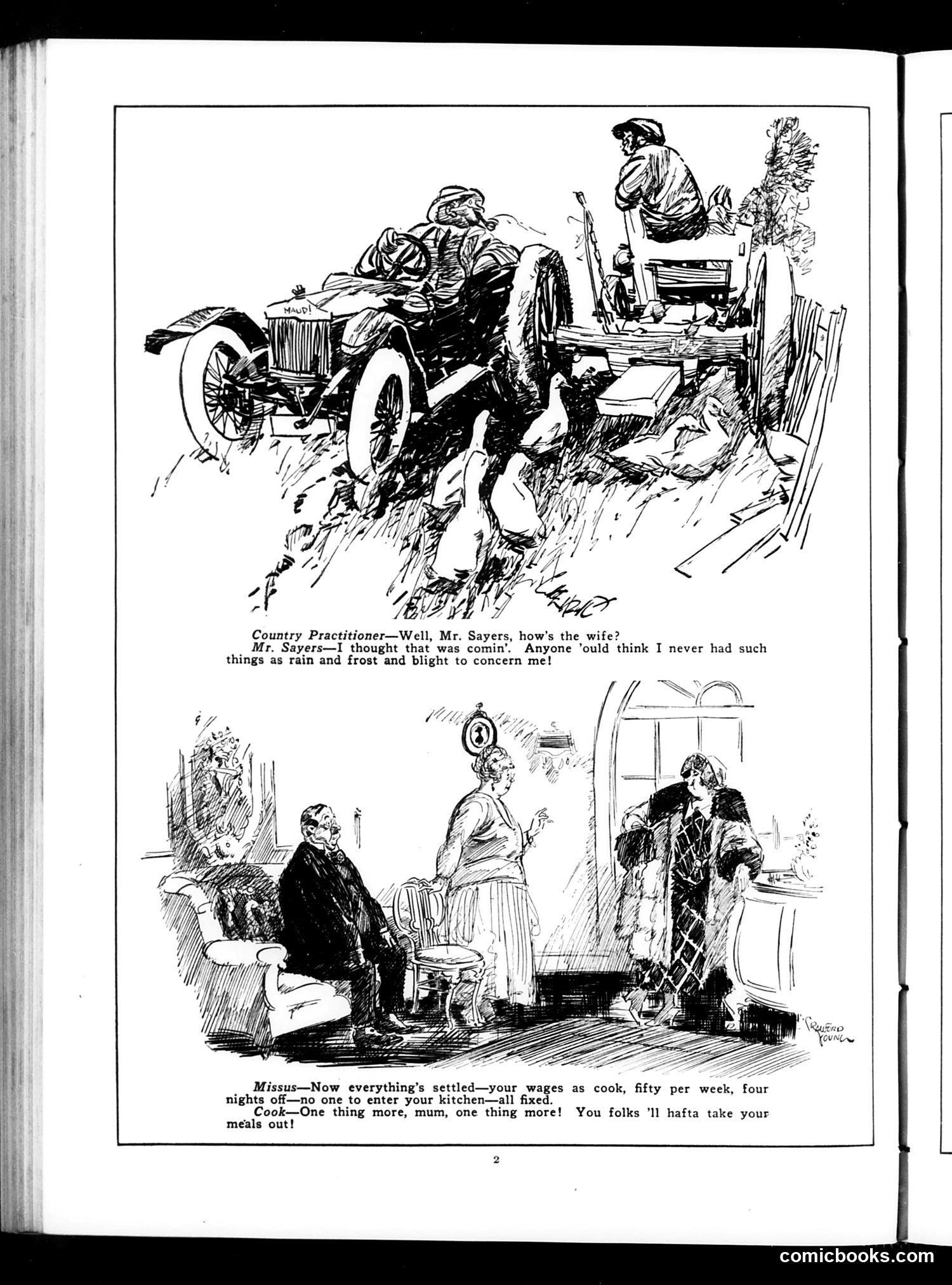
This page contains two separate comic scenes satirizing rural and domestic life in early 20th-century America. **Top scene:** A country practitioner (doctor) visits a farm family's home via automobile, greeting the housewife. Mr. Sayers jokes that he thought his wife's concerns about "rain and frost and blight" were trivial—implying he now realizes medical visits are necessary emergencies. **Bottom scene:** A "Missus" (likely a servant or cook applicant) negotiates employment terms with a wealthy household. The humor centers on her demanding specific wages, limited hours, kitchen privacy, and—most importantly—"no one to enter your kitchen" and that "folks 'll hafta take your meals out!" The satire critiques both servant labor demands and the growing assertiveness of working-class women negotiating better conditions in the early automotive age.
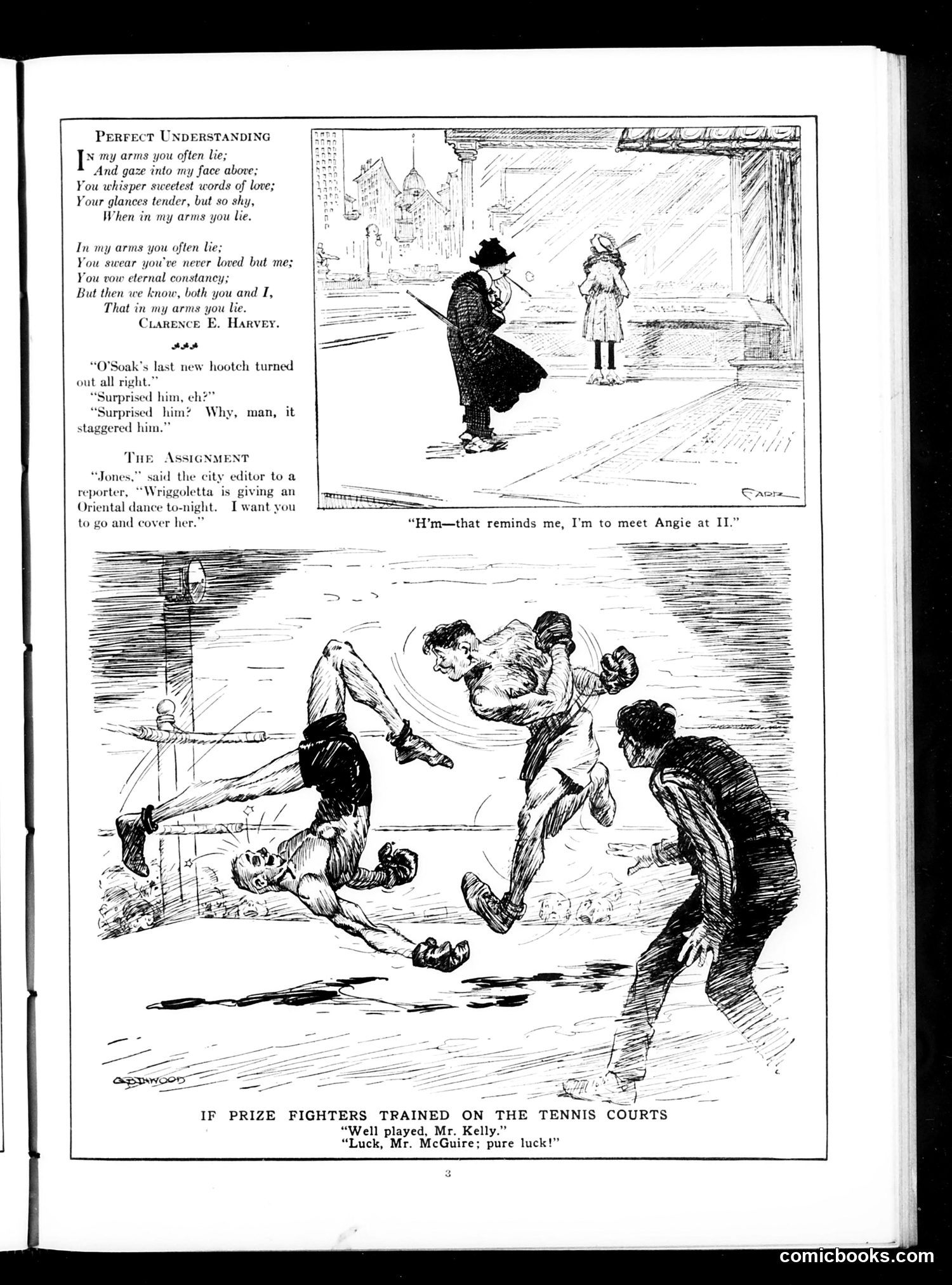
This page contains two distinct pieces: **Top section:** A poem titled "Perfect Understanding" by Clarence E. Harvey, followed by brief prose about "Soak's" new "hootel" and an assignment for a city editor to cover an Oriental dance performance. **Bottom cartoon:** Titled "If Prize Fighters Trained on the Tennis Courts," it depicts men engaged in exaggerated, violent physical combat on what appears to be a tennis court. The humor relies on juxtaposing refined, genteel tennis—a sport associated with upper-class recreation—with brutal prize-fighting violence. The caption quotes suggest spectators commenting on the "luck" involved, sarcastically treating the violent scene as if it were legitimate athletic training. The satire mocks either boxing culture or possibly the contrast between civilized sporting pretense and underlying aggression.
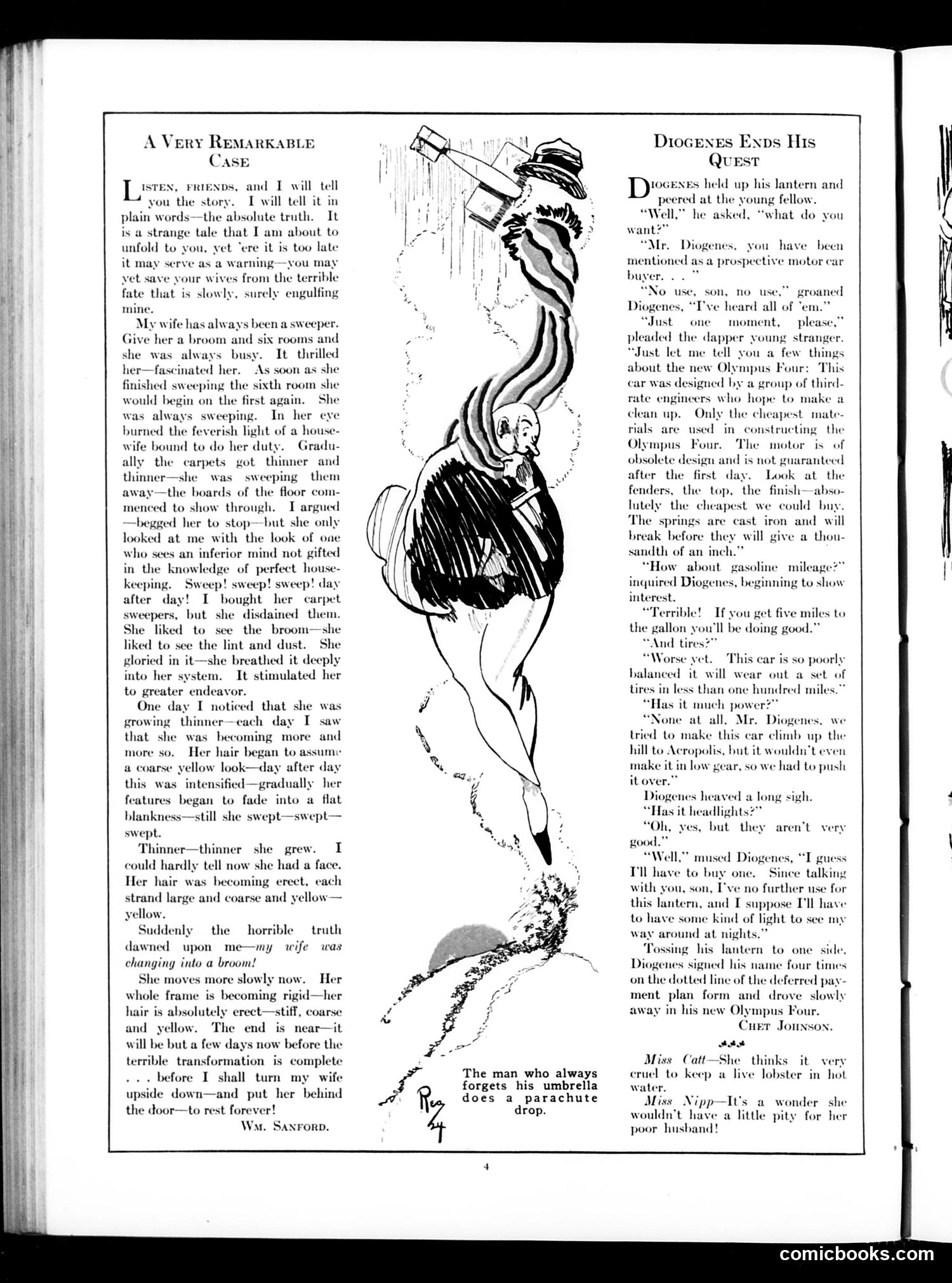
This page contains two separate pieces: **"A Very Remarkable Case"** (left): A humorous domestic story by Wm. Sanford about a wife who gradually transforms into a broom through obsessive housekeeping. The narrative satirizes extreme domesticity and women's roles, suggesting that total devotion to household duties dehumanizes women—literally turning one into her tools of labor. **"Diogenes Ends His Quest"** (right): A dialogue where Diogenes (the ancient Greek philosopher famous for seeking an honest man) interviews a young automobile salesman about the new Olympus Four car. The satire targets consumer capitalism and corporate deception: even Diogenes, history's ultimate cynic, finds the car industry's dishonest marketing practices noteworthy—suggesting early 1900s auto manufacturers were notorious for misleading claims about performance and durability.
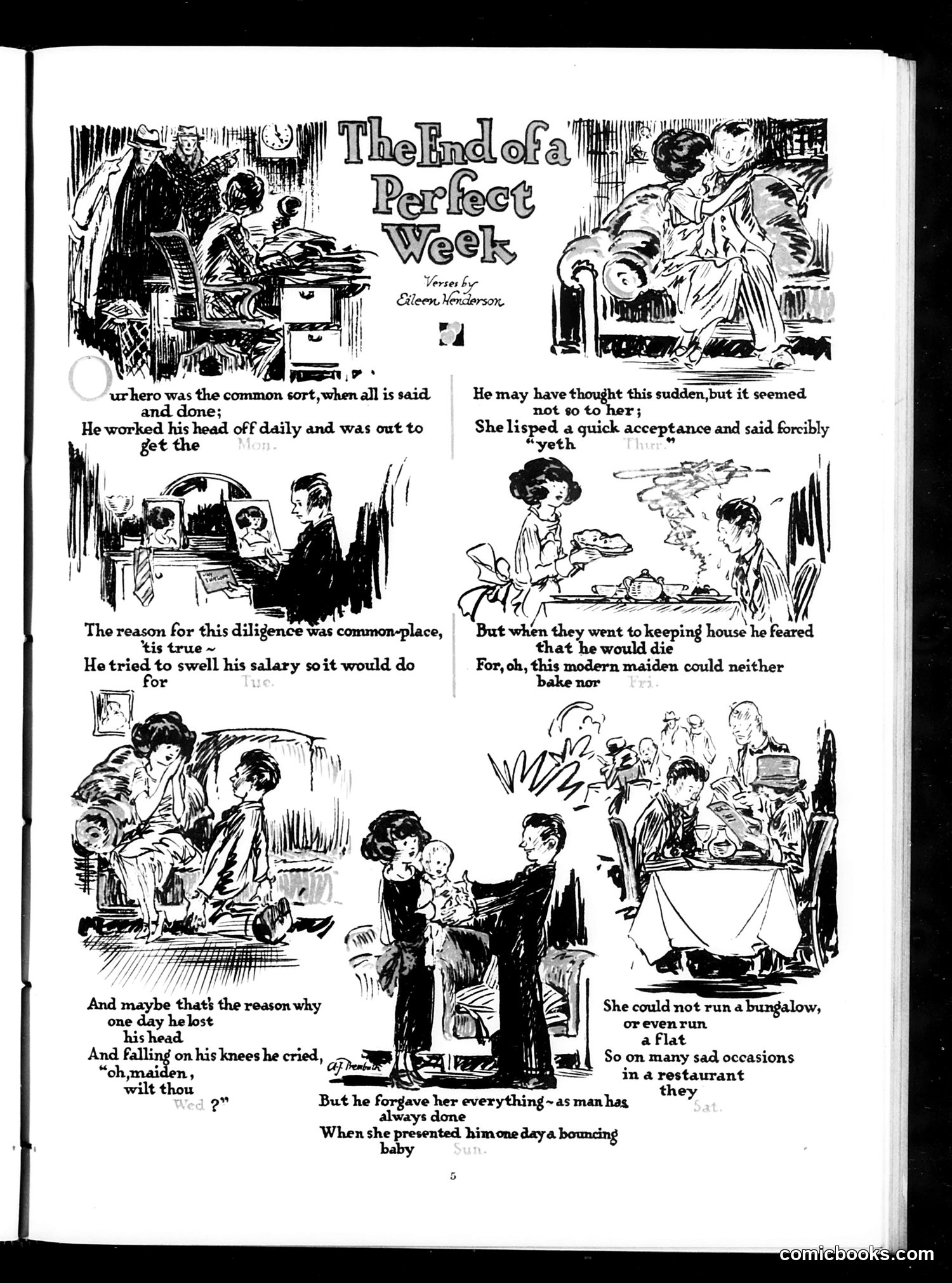
This satirical poem by Eileen Henderson mocks the romantic idealization of marriage through a working-class love story. The "hero" is an ordinary laborer who diligently saves his salary to marry. He impulsively proposes, and the woman quickly accepts. However, the satire reveals the harsh reality: once married, she cannot manage a household—cannot bake or cook—forcing them to frequent restaurants for meals, a significant financial drain. The man, despite his misgivings about losing his independence and financial security, forgives her "as man has always done," accepting his domesticated fate. The illustrations depict the couple's decline from romantic courtship to the mundane struggles of married life. The cartoon critiques both women's alleged domestic incompetence and men's resigned acceptance of marriage's financial and personal costs. It reflects early 20th-century anxieties about changing gender roles and modern women's rejection of traditional household duties.
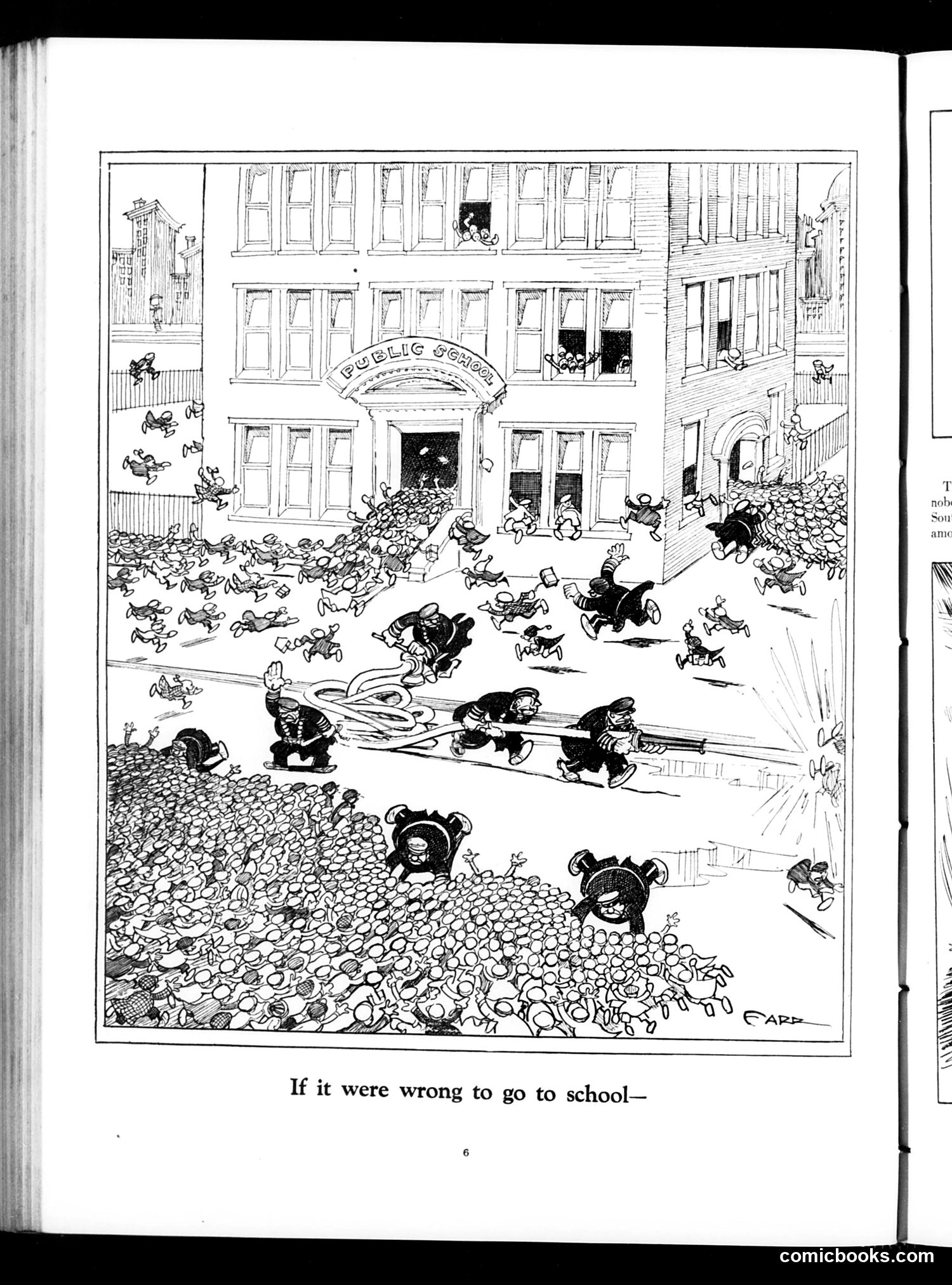
This satirical cartoon depicts a massive crowd of children flooding out of a Public School building in chaotic disorder. The image shows what appears to be hundreds of tiny figures swarming the street and schoolyard, with some adults (likely police or officials) attempting to manage the scene using what look like fire hoses. The caption's conditional phrasing—"If it were wrong to go to school"—suggests ironic commentary on compulsory education debates. The cartoon satirizes either: opposition to mandatory schooling laws, or anxieties about mass public education enrollment. The overwhelming crowd visualizes the sheer scale of children affected by education policy, mocking those who might oppose universal school attendance as naive about the practical chaos it would prevent. The artist is signed "BARR."
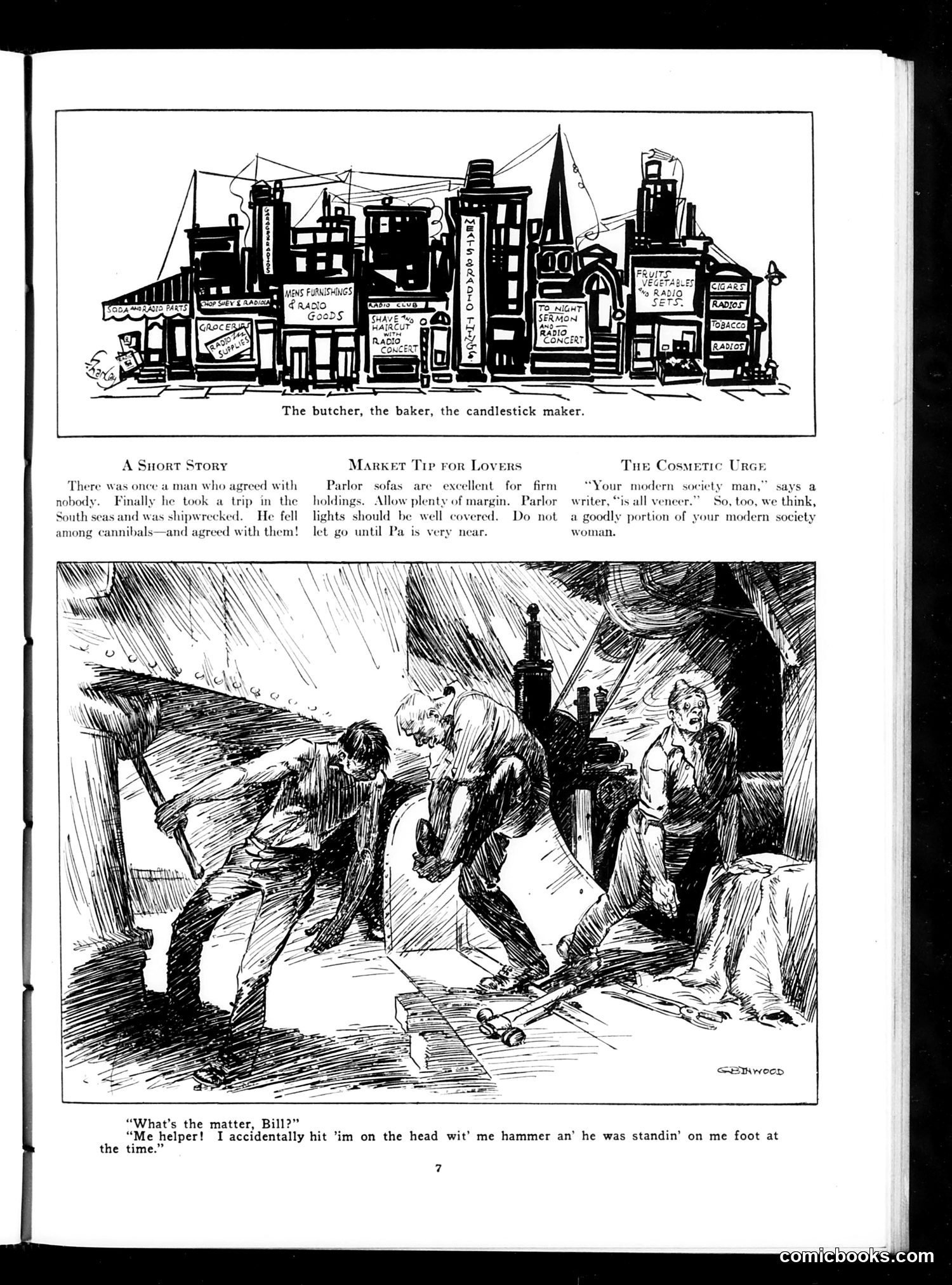
This page contains three brief satirical pieces typical of early 20th-century humor: **Top illustration** depicts a stylized cityscape labeled "The butcher, the baker, the candlestick maker"—referencing the nursery rhyme, likely commenting on urban commercial life. **Three short humor columns** below mock contemporary social types: 1. *"A Short Story"* satirizes an agreeable but spineless man who accepts any viewpoint, even adopting cannibals' perspectives when shipwrecked. 2. *"Market Tip for Lovers"* offers tongue-in-cheek furniture advice about parlor sofas and lighting, with suggestive innuendo about "Pa." 3. *"The Cosmetic Urge"* critiques "modern society" as superficially veneered—both men and women prioritize appearances over substance. **Bottom cartoon** depicts working-class men in what appears to be a construction accident, with one explaining he accidentally struck his helper while standing on his foot. The joke relies on the worker's matter-of-fact acceptance of workplace mishaps. The overall page satirizes urban society, consumer culture, and working-class life through gentle mockery.
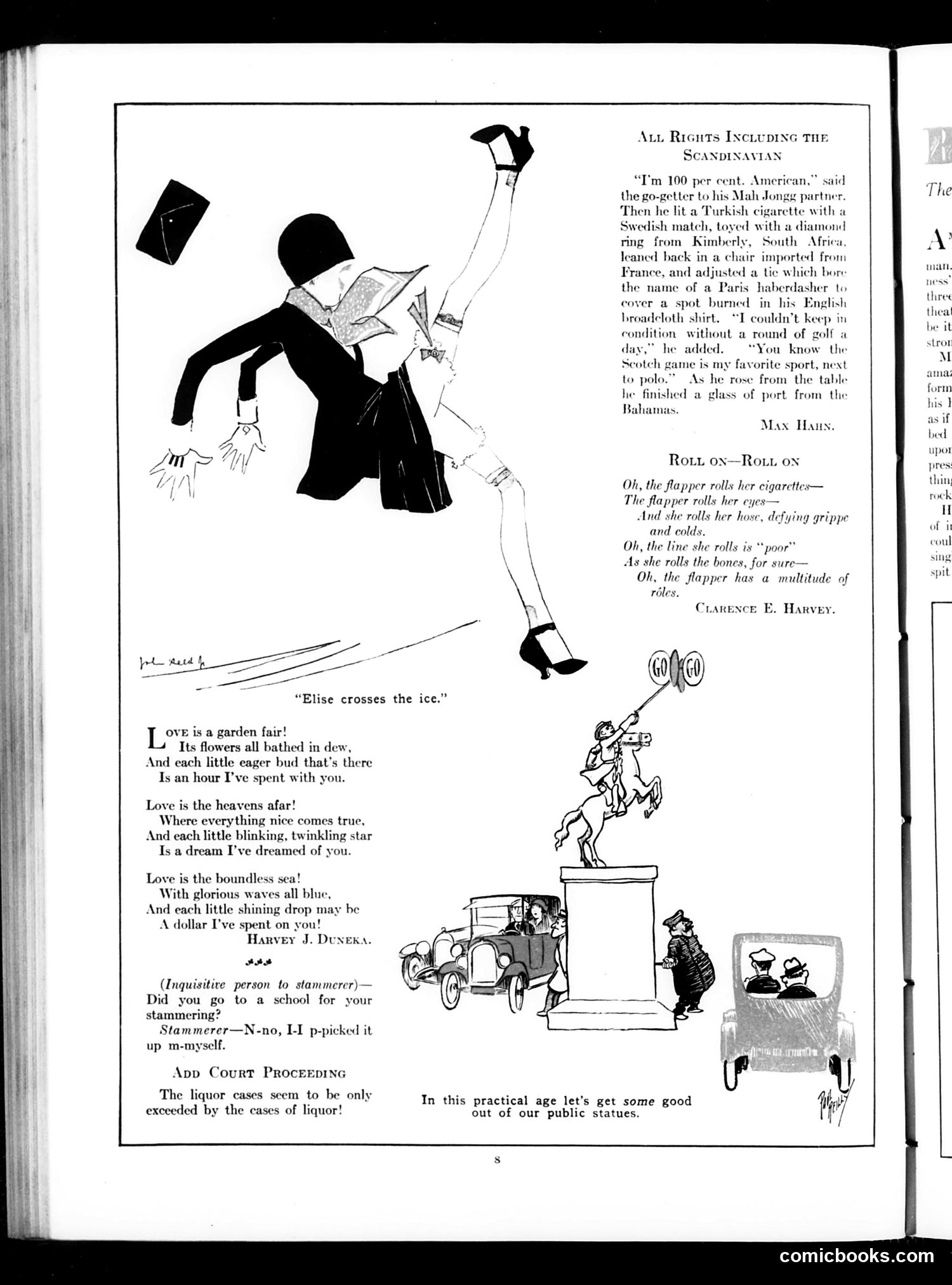
This page satirizes American identity and consumption habits circa 1920s-1930s. **Main Cartoon (Top):** "Elise crosses the ice" depicts a fashionable woman ice-skating while juggling various imported goods—illustrating the contradiction in the accompanying text about a self-proclaimed "100 per cent. American" businessman who actually surrounds himself entirely with foreign products: Turkish cigarettes, Swedish matches, South African diamonds, French furniture and accessories, English broadcloth, Scottish golf, and Bahamian port wine. The satire mocks performative patriotism masking cosmopolitan consumption. **Other Content:** Includes a poem about love, a joke about stammering, commentary on court cases involving liquor (likely referencing Prohibition-era enforcement), and a poem titled "Roll On—Roll On" about a flapper's habits. A small cartoon suggests repurposing public statues for practical modern use. The page reflects Jazz Age anxieties about immigrant influence and commercialism undermining authentic American identity.
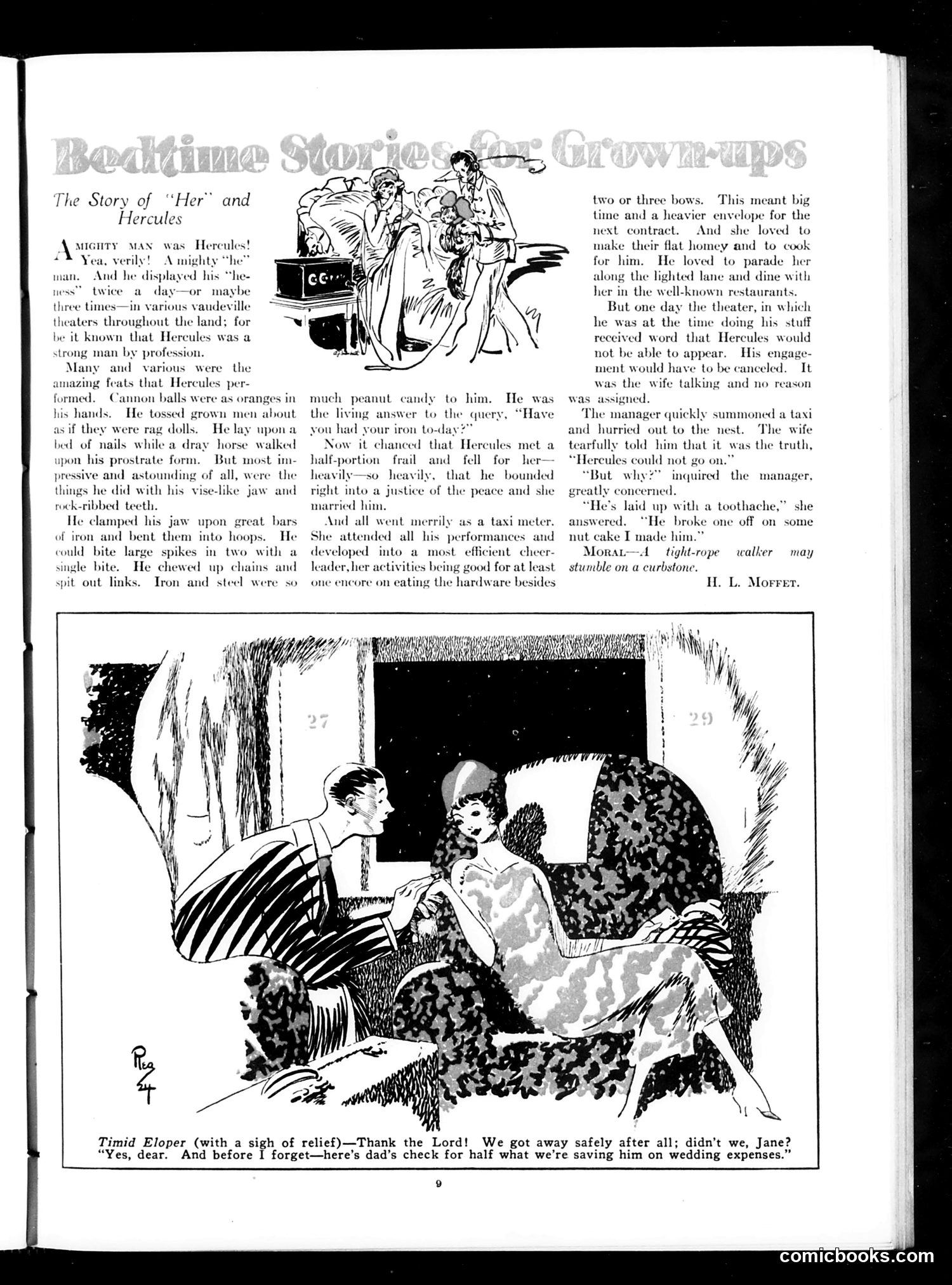
This is a humorous short story with accompanying cartoon, not political satire. It mocks the contradiction between male strength and domestic vulnerability. **The Plot:** A vaudeville "strong man" performer (Hercules) who bends iron bars and performs superhuman feats falls for and marries a woman. She becomes his enthusiastic supporter and manager. However, when a performance is canceled, the manager discovers the mighty Hercules cannot appear because he has a toothache—caused by biting into his wife's homemade nut cake. **The Joke:** The satire targets both genders—the supposedly invincible man undone by domestic life and his wife's cooking, while the wife's well-intentioned but damaging baking represents the hazards of home life. The cartoon below shows an elopement couple joking about saving money by avoiding wedding expenses. The "moral" mocks tightrope walkers stumbling on curbstones—small obstacles felling the skilled.
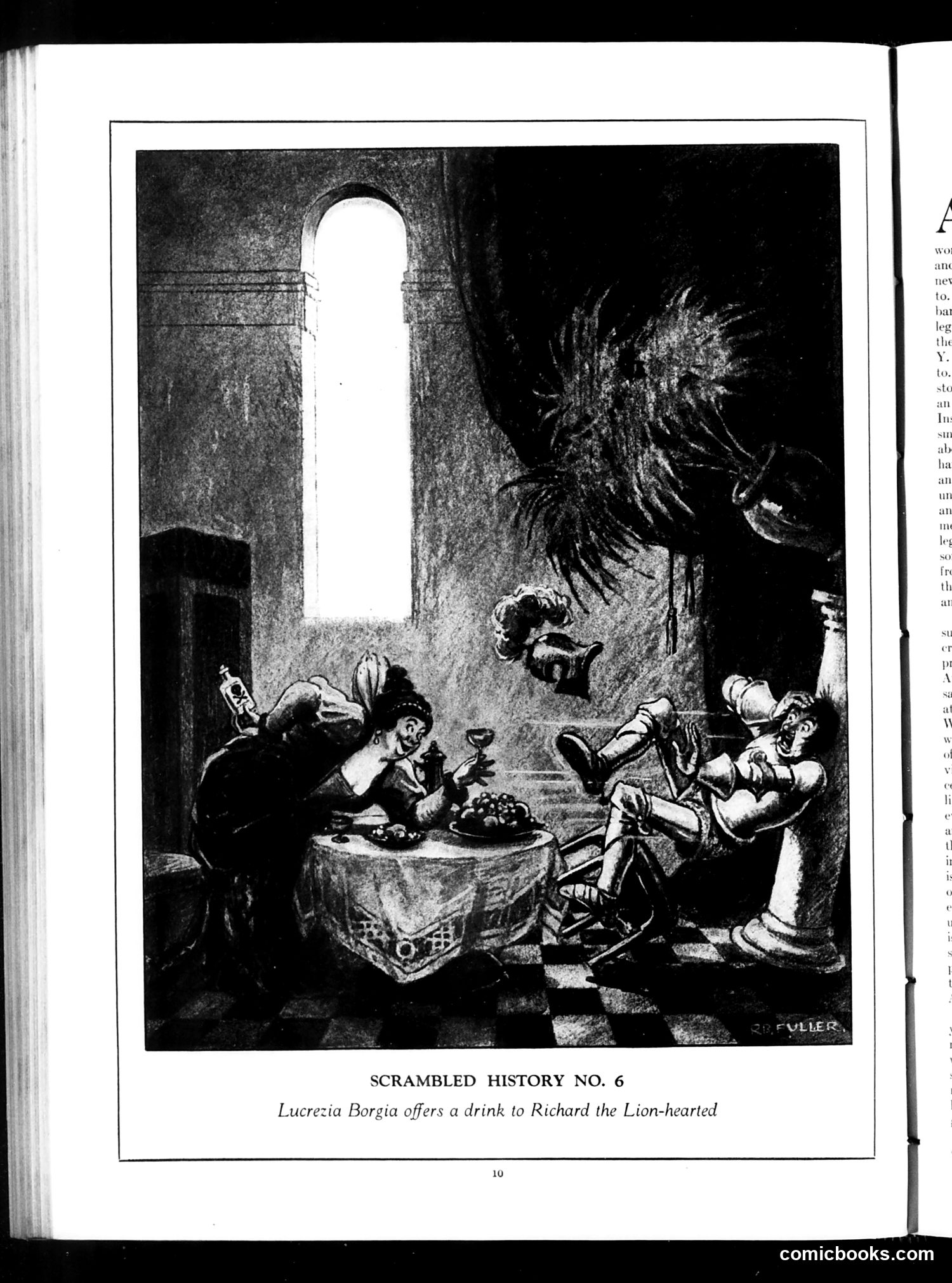
This is a humorous historical mash-up titled "Scrambled History No. 6." The cartoon depicts two historically unrelated figures meeting impossibly: **Lucrezia Borgia** (Italian Renaissance noblewoman, infamous for alleged poisonings) and **Richard the Lion-Hearted** (English king from the Crusades era, centuries earlier). The joke plays on Borgia's legendary reputation for poisoning enemies. She's offering Richard a drink—a darkly comedic visual pun suggesting she's about to poison him using her notorious methods. The satire works by combining historical figures from completely different time periods and regions, creating an absurd scenario that emphasizes Borgia's fearsome reputation even in anachronistic contexts. The series title "Scrambled History" indicates Judge magazine used this format to create intentionally scrambled, humorous historical scenarios for entertainment.
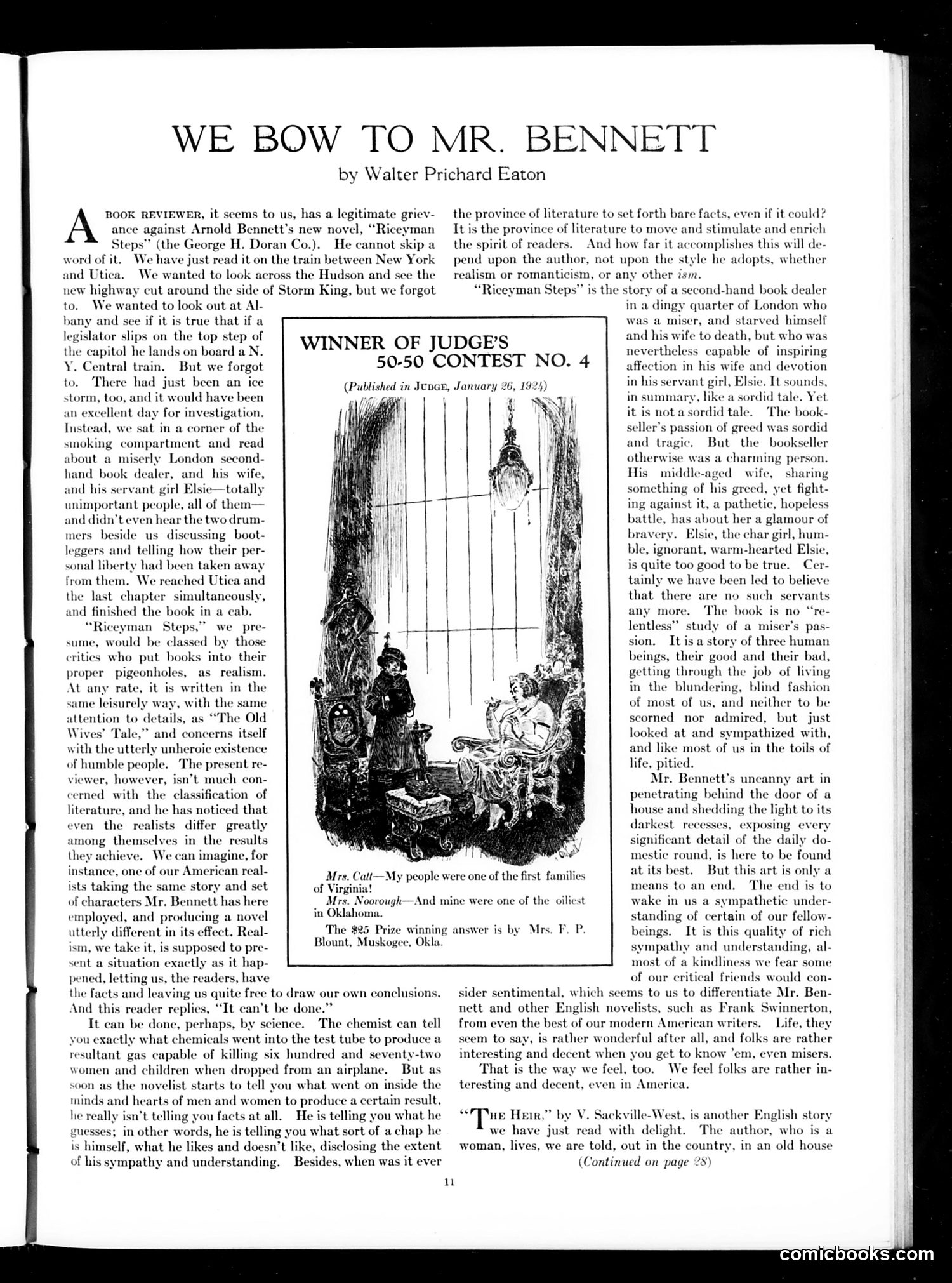
This page contains a literary review essay by Walter Prichard Eaton praising Arnold Bennett's novel *Riceyman Steps*. The review defends Bennett against critics who object that his detailed, realistic writing style forces readers to engage with mundane details about ordinary, unimportant people—a second-hand book dealer, his wife, and their servant in a dingy London neighborhood. The embedded cartoon is a "50-50 Contest" winner: a joke about social pretension. A woman named Catt boasts her family were "one of the first families of Virginia" (implying colonial aristocracy). Her companion Foxborough responds her relatives were "one of the oiliest in Oklahoma"—a crude pun equating old money with oil wealth, suggesting new money is just as base as old, and both equally absurd. The review's broader point: realistic literature's value lies not in factual accuracy but in moving readers' emotions and deepening understanding of human nature.
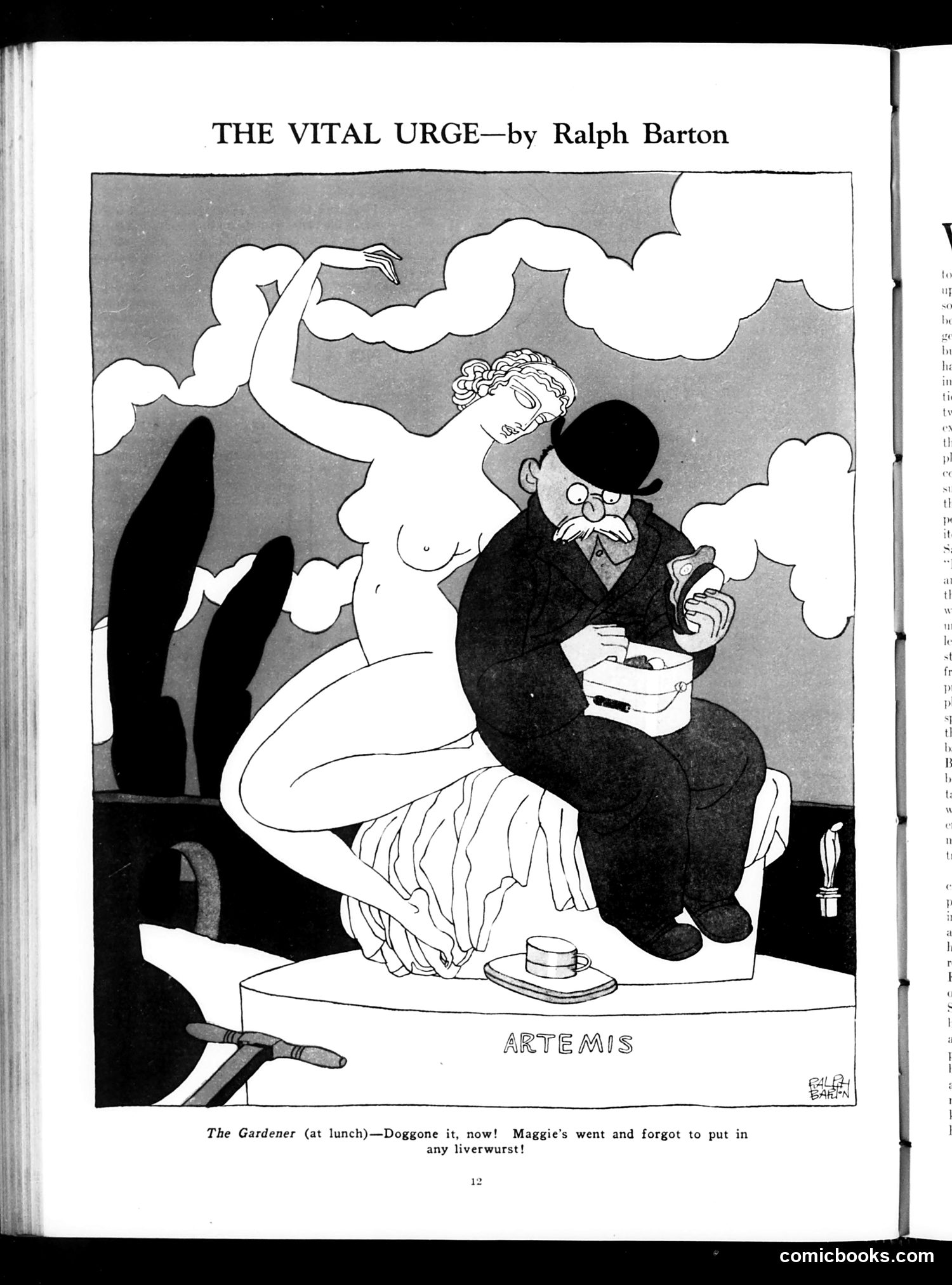
This cartoon satirizes male infidelity and distraction. A well-dressed man in a bowler hat sits with a nude female figure (labeled "Artemis," suggesting classical beauty or desire) draped across his lap. Rather than attending to her, he's absorbed in eating lunch from a box, appearing indifferent to her seductive pose and advances. The caption reads: "The Gardener (at lunch)—Doggone it, now! Maggie's went and forgot to put in any liverwurst!" The joke mocks masculine priorities: even faced with romantic temptation, the man prioritizes food—specifically a missing liverwurst sandwich that his wife Maggie forgot to pack. This reflects early 20th-century humor about domestic life, male appetites (both literal and figurative), and marriage's mundane realities undermining romance and passion.
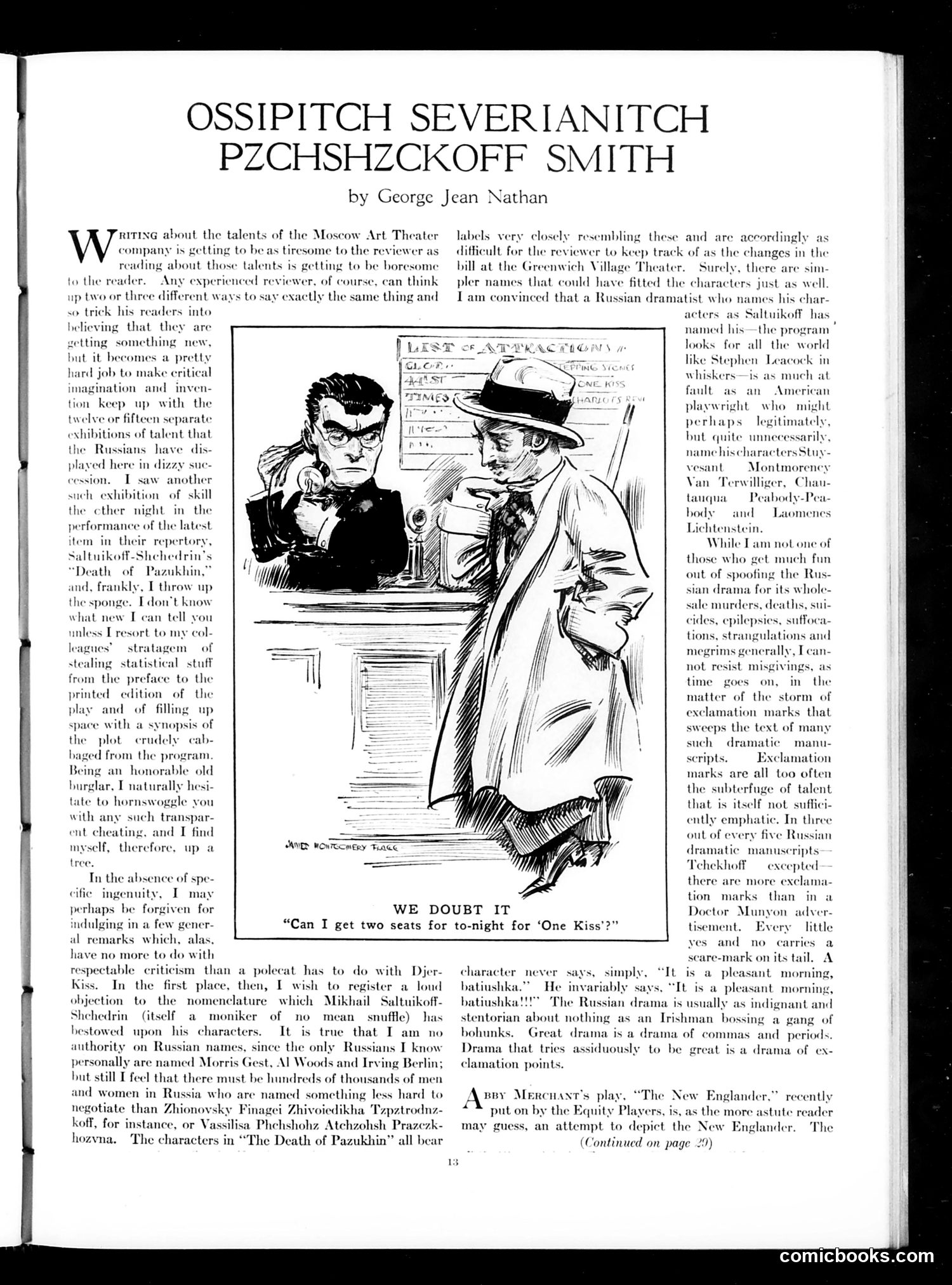
This is a theater review by George Jean Nathan criticizing the Moscow Art Theater company's production of "The Death of Pazukhin" by Mikhail Saltuikoff-Shchedrin. **The main satire:** Nathan mocks the impossibly difficult Russian character names (like "Ossipitch Severianitch Pzchshzckoff Smith" in the title) as deliberately obscure—comparing them to American playwright Stephen Leacock. He jokes that such names make the program look unreadable. **Secondary complaints:** - Russian drama relies too heavily on extreme content (murders, suicides, epilepsy) for effect - Overuse of exclamation marks substitutes for genuine dramatic talent - Characters speak melodramatically ("batiushka!!!") rather than naturally **The cartoon** shows two Russian characters discussing theater tickets, reinforcing the article's point about how impenetrable Russian drama feels to American audiences. Nathan's critique essentially argues that Russian theatrical conventions, while technically skilled, rely on artificial difficulty and overwrought emotion rather than subtle craft—a complaint about substance masked by style.
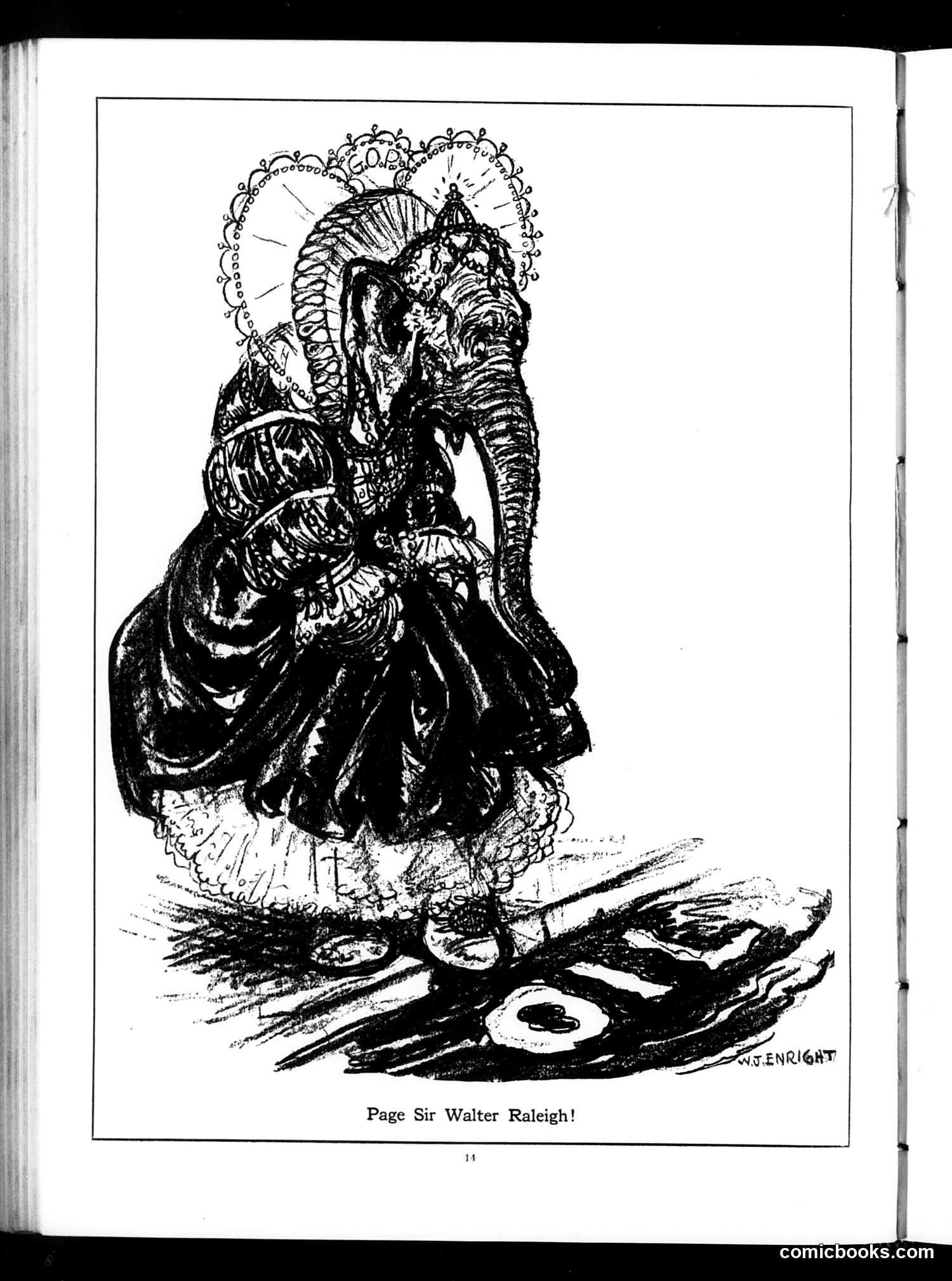
This is a satirical illustration by W.T. Enright showing a figure dressed in elaborate Elizabethan-era costume—complete with ornate ruff collar, jeweled clothing, and a feathered headdress—riding an elephant. The figure is labeled "Page Sir Walter Raleigh!" The satire appears to mock someone of the era (likely a political figure or public personality) by depicting them in ridiculously ostentatious dress and positioning, suggesting pomposity or grandiose self-importance. The elephant adds to the absurdity. The reference to Raleigh—the famous Elizabethan explorer and courtier—implies the subject is affecting historical pretension or affected nobility. Without the magazine's date and context, the specific target remains unclear, but the mockery of vanity and pretension is evident.
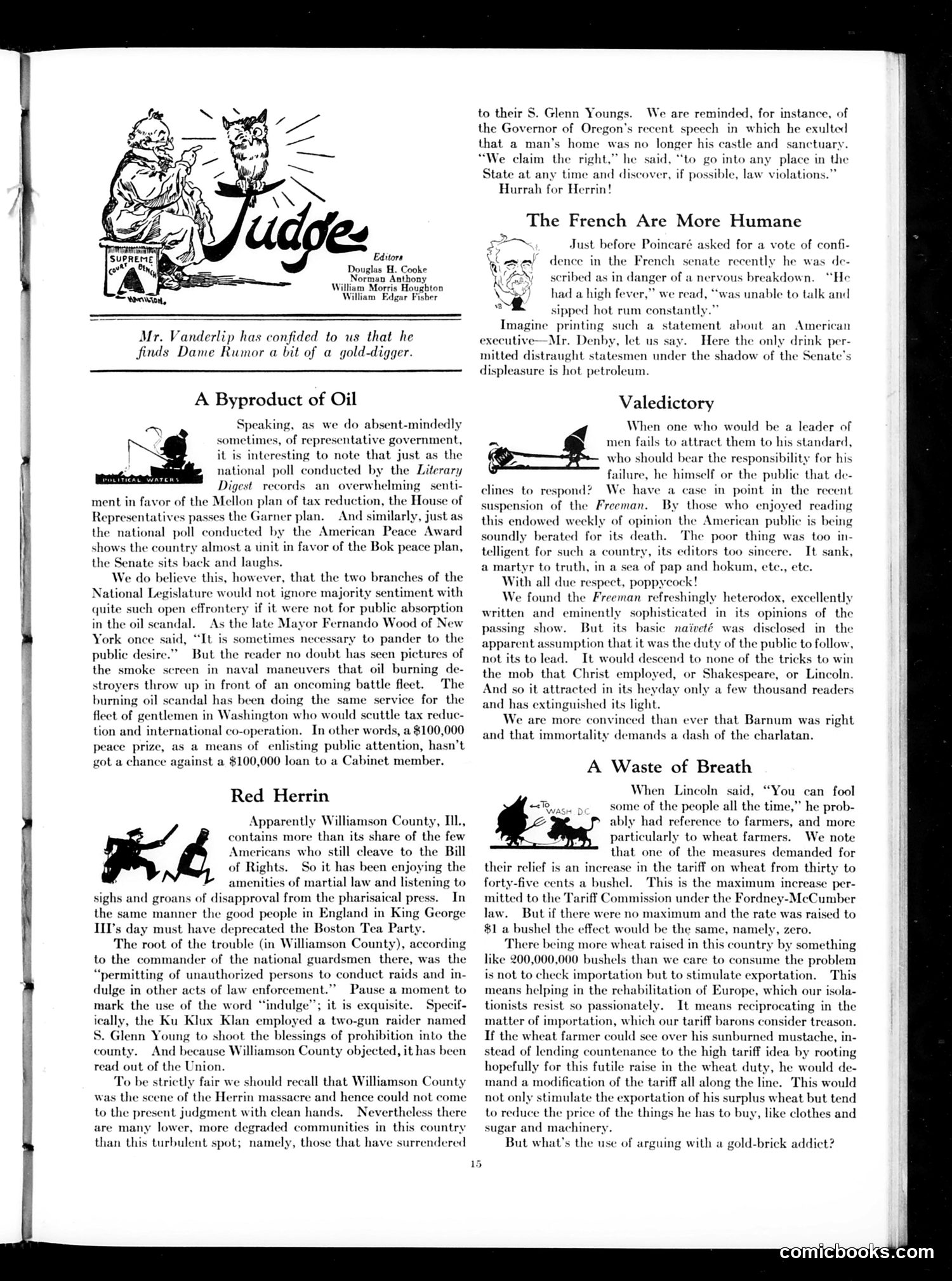
This page contains several editorial cartoons critiquing American politics and social issues circa the early 1920s. **"A Byproduct of Oil"** references the Teapot Dome scandal, arguing that the public's absorption with oil-industry corruption allows Congress to ignore voter preferences on tax policy and peace initiatives—much like a warship's smoke screen masks its movements. **"Red Herrin"** addresses martial law in Williamson County, Illinois, imposed by national guardsmen under S. Glenn Young (a Prohibition enforcer). The piece defends the county's resistance to unauthorized law enforcement, comparing it to colonial opposition to King George III, while acknowledging the region's troubled past (the Herrin massacre). **"The French Are More Humane"** sarcastically compares treatment of distressed leaders: French officials are permitted warm beverages during stress, while American executives facing Senate pressure are offered only "hot petroleum"—likely referencing Secretary of the Navy Denby's involvement in Teapot Dome. The cartoons mock government corruption, abuse of martial law, and hypocrisy in political accountability.
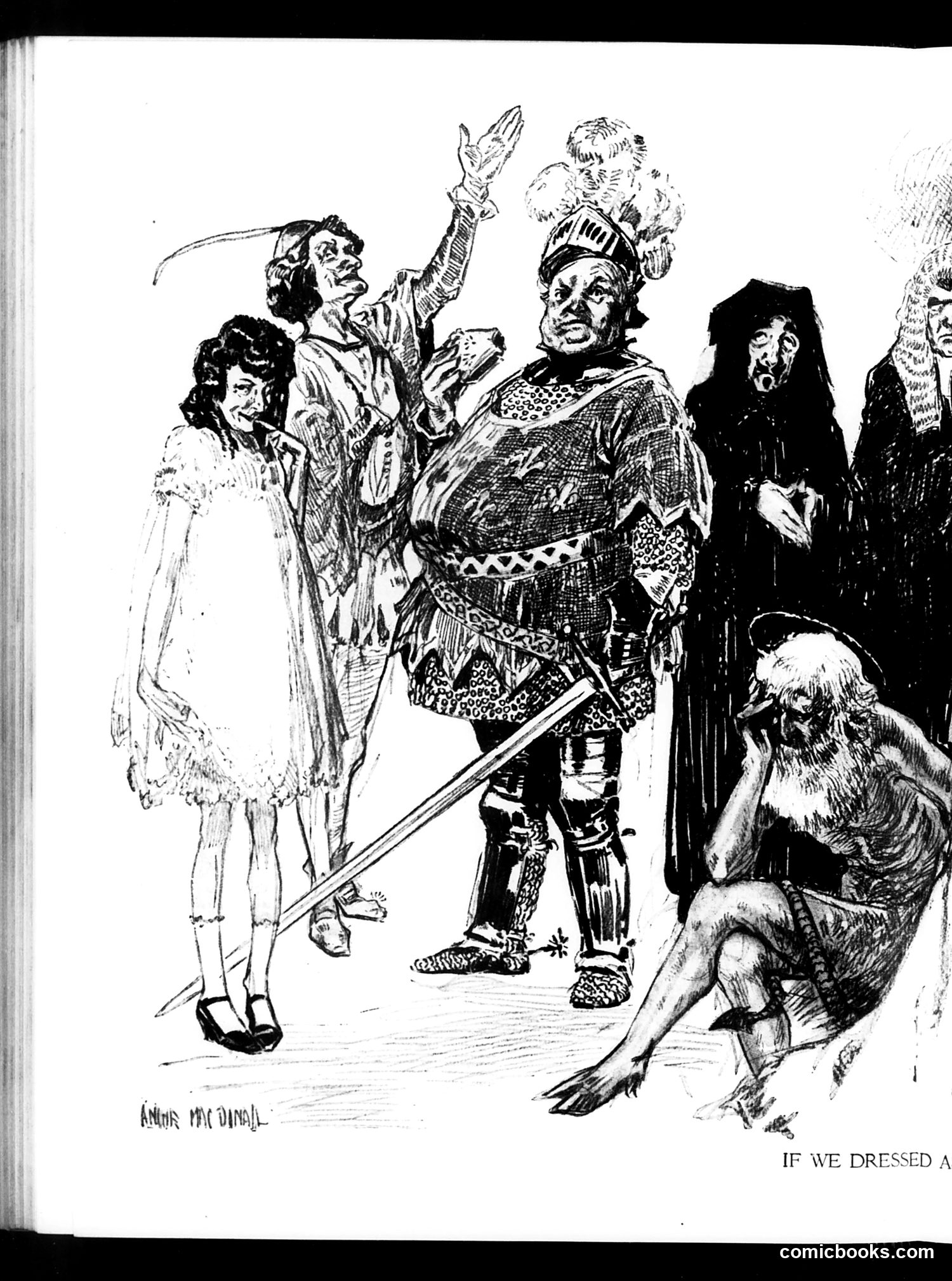
This page shows a satirical cartoon from *Judge* magazine depicting a scene titled "IF WE DRESSED A..." (the full caption is cut off). The illustration portrays several figures in period costume—including what appears to be a medieval or Renaissance warrior in ornate armor with a sword, attendants, and other characters in various states of dress and undress. The artist's signature reads "Annis MC Dana" (or similar). Without the complete caption, the specific satirical target is unclear, but the composition suggests social commentary about costume, class, or perhaps political figures dressed in historical garb for ironic effect. The drawing style and composition are typical of early-to-mid 20th century American editorial cartooning. The precise meaning requires the complete title to interpret accurately.
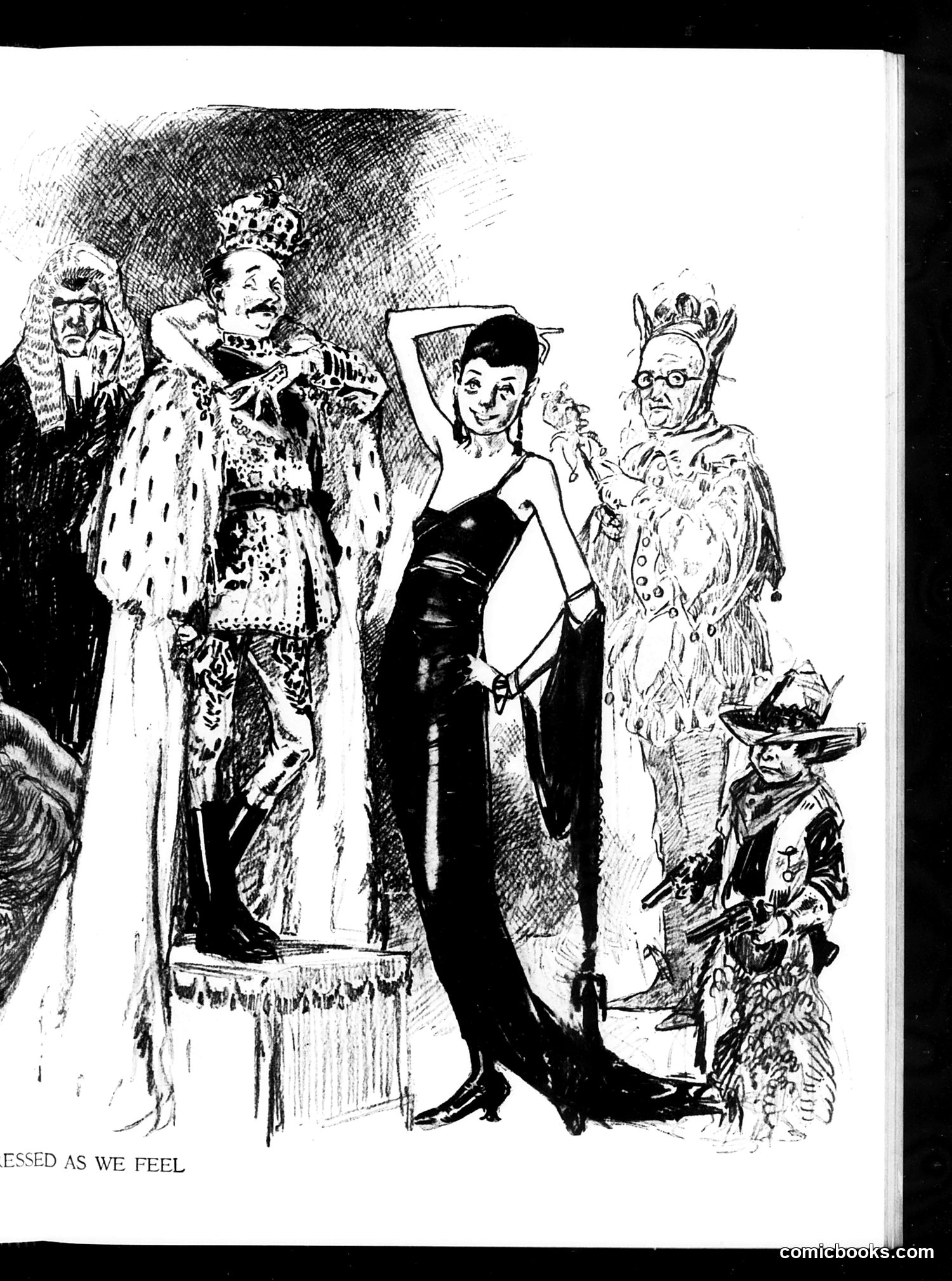
This appears to be a satirical illustration from *Judge* magazine showing a woman in elegant evening attire being presented to or surrounded by royalty and nobility. The visible figures include a crowned monarch (center-left), a bespectacled crowned figure (right), and what appears to be additional royal or aristocratic characters, some in ornate dress with fur trim. The partial caption reads "ESSED AS WE FEEL," likely part of a longer phrase about "dressed" or fashion. The satire likely mocks either: - American social pretension and class aspirations during the Gilded Age - Women adopting European aristocratic fashions or mannerisms - The fascination with royal pageantry among American society figures Without the complete caption or publication date, the specific target remains unclear, though the imagery suggests commentary on American attitudes toward European nobility and fashionable display.
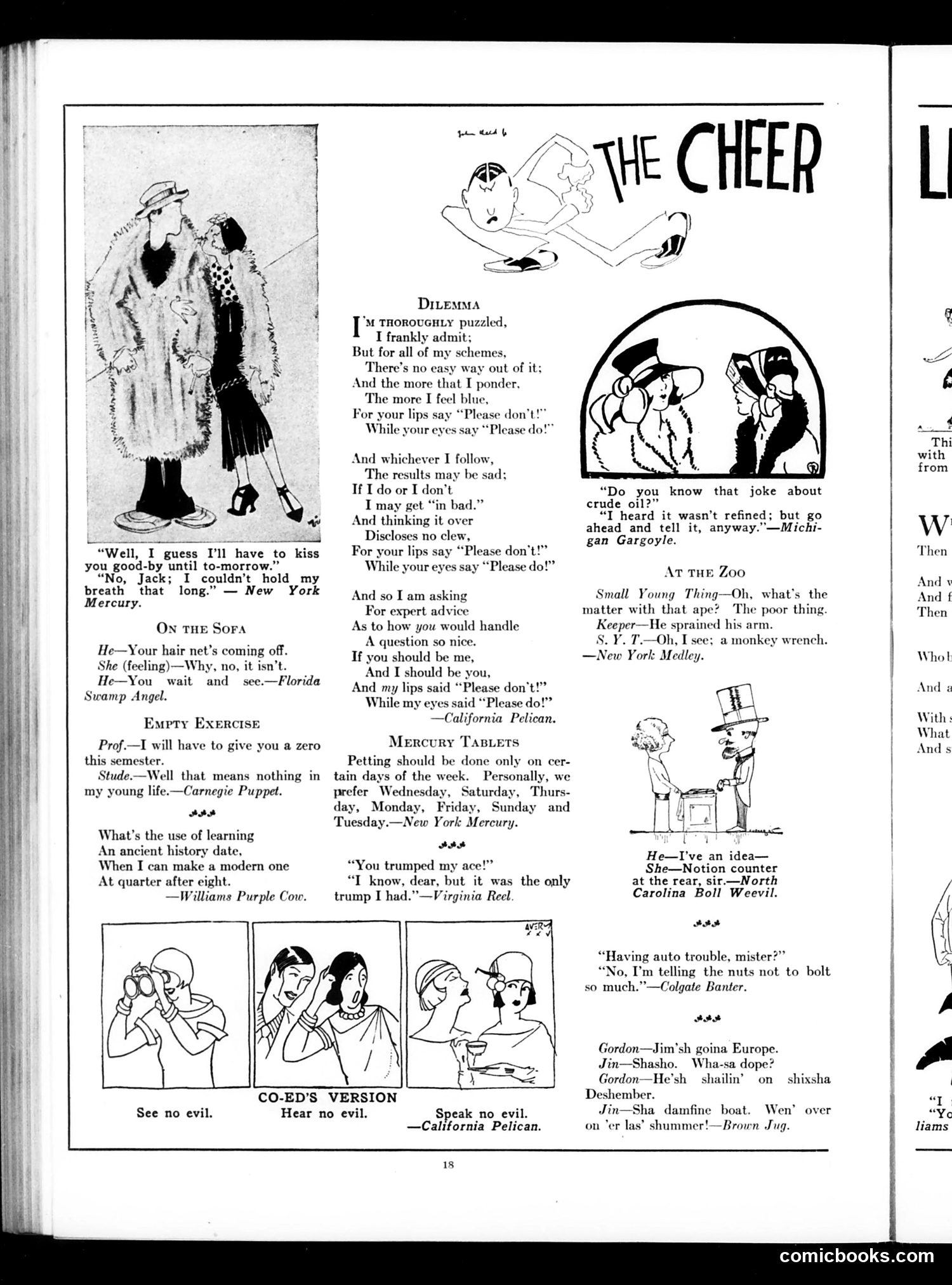
This page collects brief humorous quips and cartoons typical of early 20th-century satirical magazines. The main feature, "The Cheer," uses a common romantic scenario: a young woman sends mixed signals—her lips say "Please don't!" while her eyes say "Please do!"—creating the "dilemma" of how to interpret contradictory body language during courtship. The joke satirizes the dating conventions and romantic confusion of the era. The surrounding items mock college life, academic pretense, and linguistic absurdities. References include a "Carnegie Puppet" (satirizing Andrew Carnegie's philanthropy), and various college publications like the *California Pelican* and *Michigan Gargoyle*. The "Mercury Tablets" joke about petting schedules mocks dating advice columns. The "Co-ed's Version" cartoon uses the "see no evil" proverb to joke about young women ignoring impropriety. Overall, the page reflects Jazz Age social anxieties about changing gender roles and courtship norms.
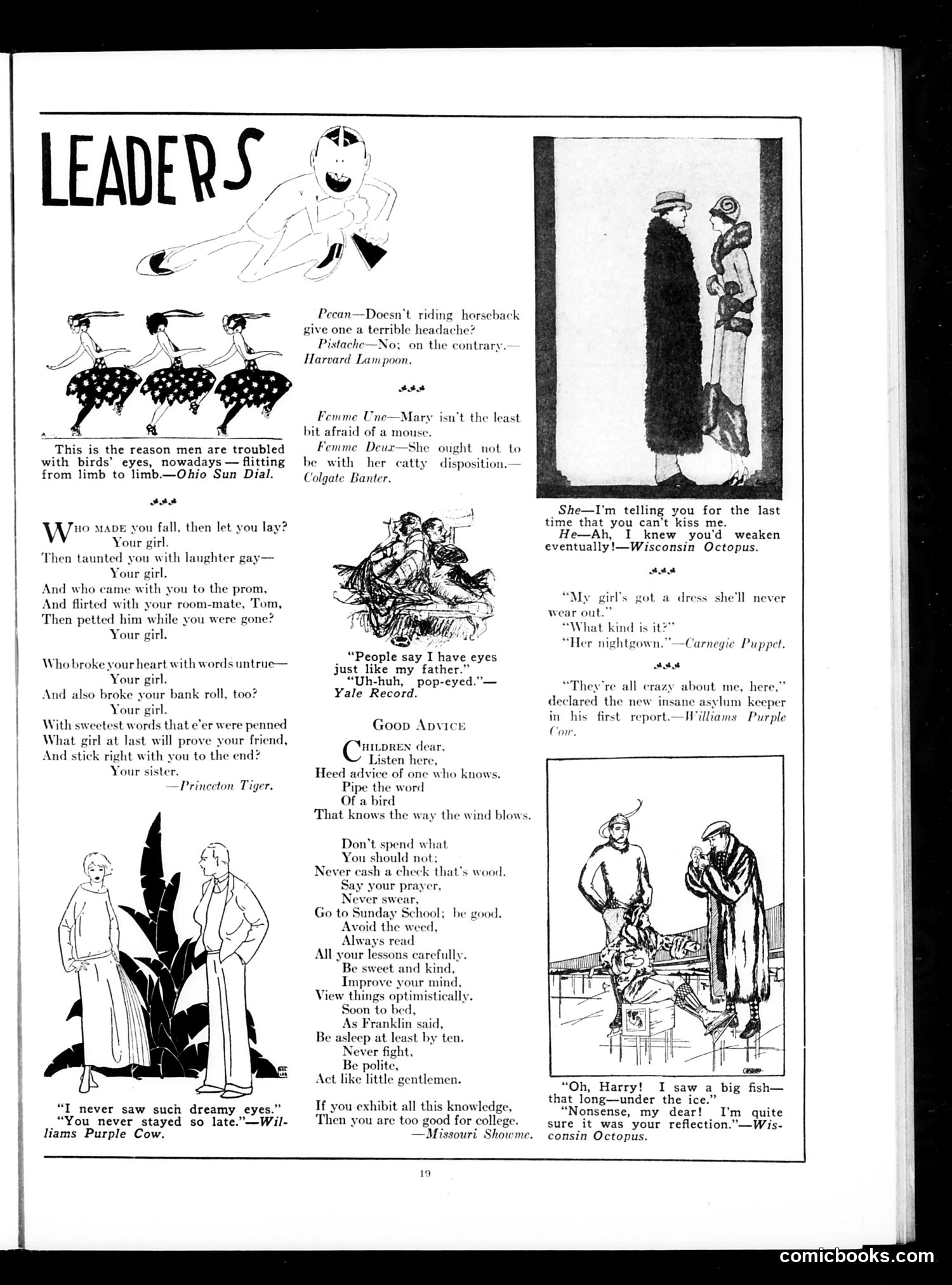
This page from *Judge* magazine collects humor from various college publications (Princeton Tiger, Harvard Lampoon, Yale Record, etc.). The content satirizes early 20th-century dating and social customs: **"Leaders"** section mocks fickle girlfriends who flirt, manipulate, and waste men's money—contrasting with loyal sisters. This reflects anxieties about women's independence and changing courtship norms. **"Good Advice"** is ironic verse parodying stern parental guidance (frugality, obedience, early bedtime). The punchline suggests following such advice makes one "too good for college"—satire on generational rebellion. Other brief jokes target social pretension (horseback riding causing headaches) and dating dynamics (a woman claiming she won't kiss a man, then "weakening"). The overall tone reflects college-magazine humor from an era when young men worried about female agency while maintaining paternalistic attitudes. The satire is gentle, aimed at college readers recognizing themselves in these scenarios.
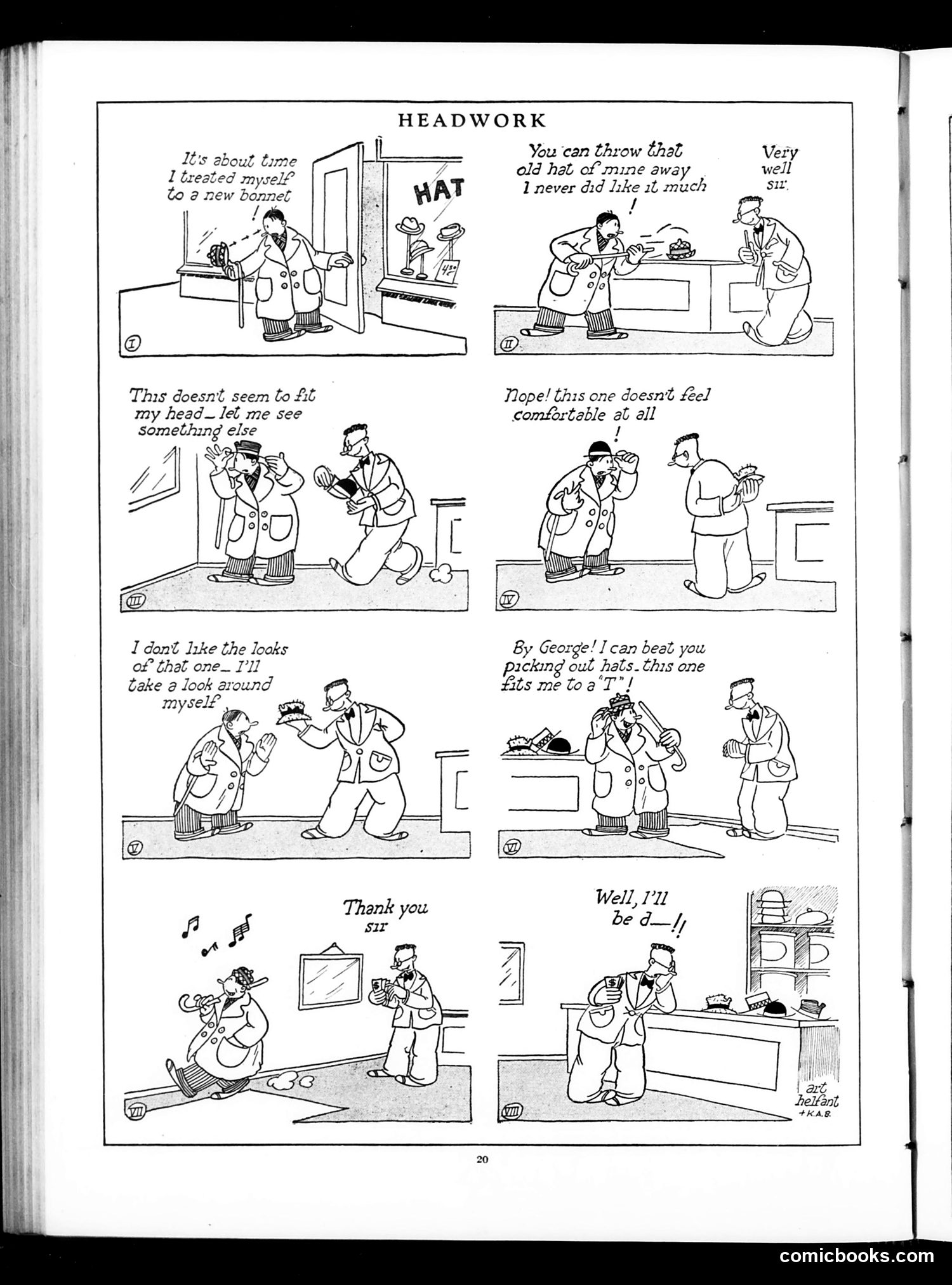
This comic depicts a man shopping for hats with a male salesman. The sequence shows the customer rejecting multiple hats as uncomfortable or unflattering, each time asking to "see something else." The humor relies on a visual pun: "headwork" suggests intellectual effort, but the comic literally shows a man doing *head work*—trying on hats. The satire appears to target either the frustrations of men's fashion shopping or, more likely, the pretension of haberdashery sales clerks who claim superior expertise ("By George! I can beat you picking out hats"). The final panels show the customer finally satisfied with a hat that "fits me to a T," suggesting that comfort and proper fit matter more than the salesman's confident recommendations. The comic is straightforward physical comedy with mild social commentary about retail interactions and masculine vanity around hat fashion—a significant status symbol in early 20th-century America.
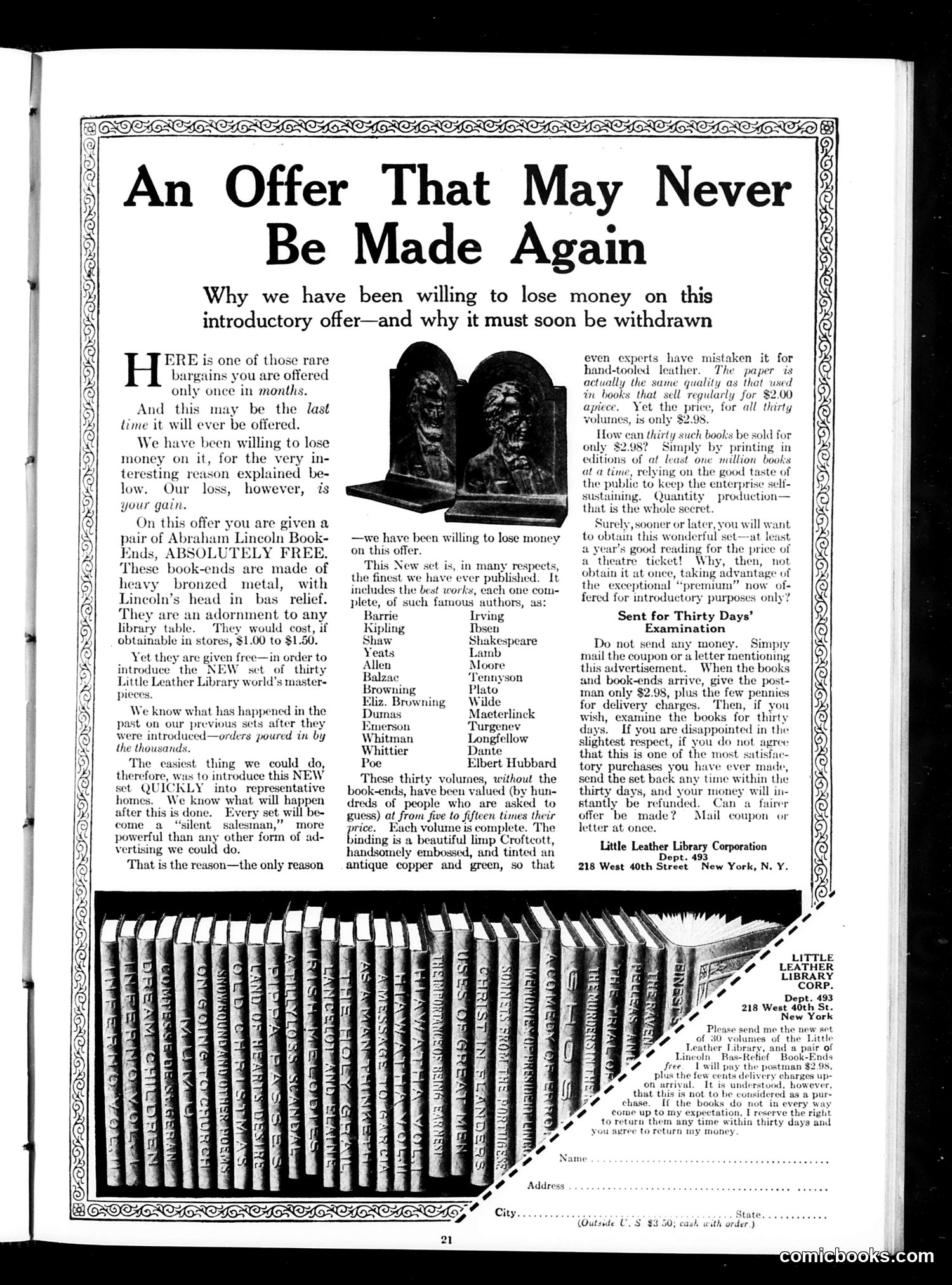
This page is primarily a **book club advertisement**, not political satire or cartoon content. The Little Leather Library Corporation promotes a 30-volume classic literature set with free Abraham Lincoln bronze bookends. The "offer" pitch explains their loss-leader strategy: they deliberately subsidize the introductory promotion to generate word-of-mouth marketing ("silent salesman") and establish rapid market penetration. The appeal targets middle-class readers by offering canonical literature (Shakespeare, Tennyson, Whitman, etc.) at $2.98 for thirty volumes—positioned as extraordinarily cheap compared to regular $2.00-per-volume books. The Lincoln bookends serve as both incentive and cultural marker, associating the product with American heritage and educated taste. The advertisement emphasizes the "beautiful" binding mimicking "hand-tooled leather" despite mass production—a key selling point for aspirational readers. This reflects early 20th-century marketing psychology: democratizing "high culture" through affordable serialization and premium giveaways.
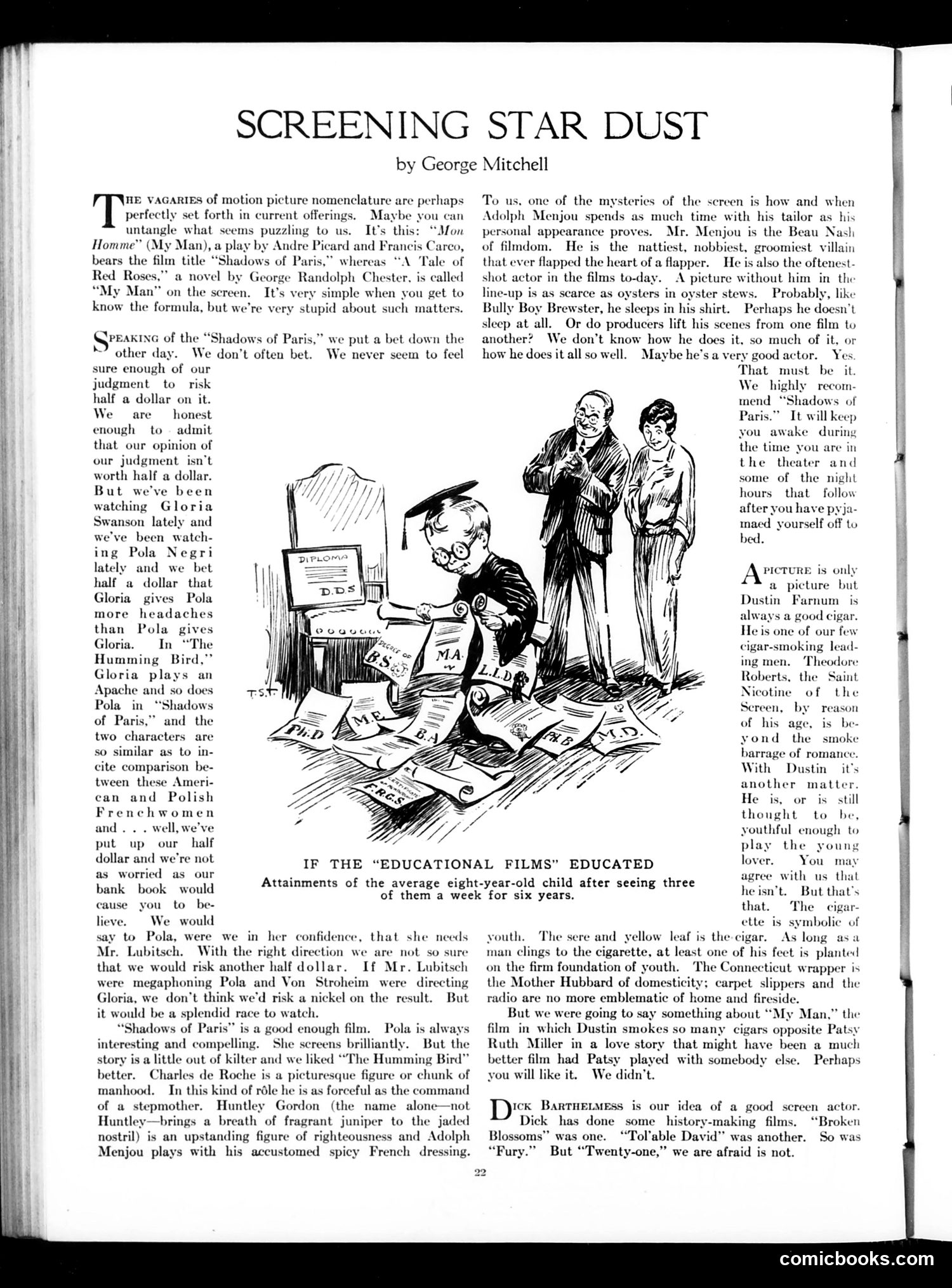
This is a film criticism column by George Mitchell reviewing current movies, primarily "Shadows of Paris" starring Polish actress Pola Negri. The central joke concerns Hollywood's confusing practice of using different titles for stage plays versus their film adaptations—one play becomes "Shadows of Paris" onscreen while another becomes "My Man," creating nomenclature chaos. The cartoon illustrates a bewildered figure buried under film reels and title cards, symbolizing this confusion. Mitchell's main commentary compares Negri unfavorably to American actress Gloria Swanson, betting "half a dollar" that Swanson gives Negri more professional headaches than vice versa. He praises Adolph Menjou's perpetual impeccable grooming and questions how he maintains such consistent elegance across multiple films. The "Educational Films" caption sardonically suggests children gain minimal learning from such movies.
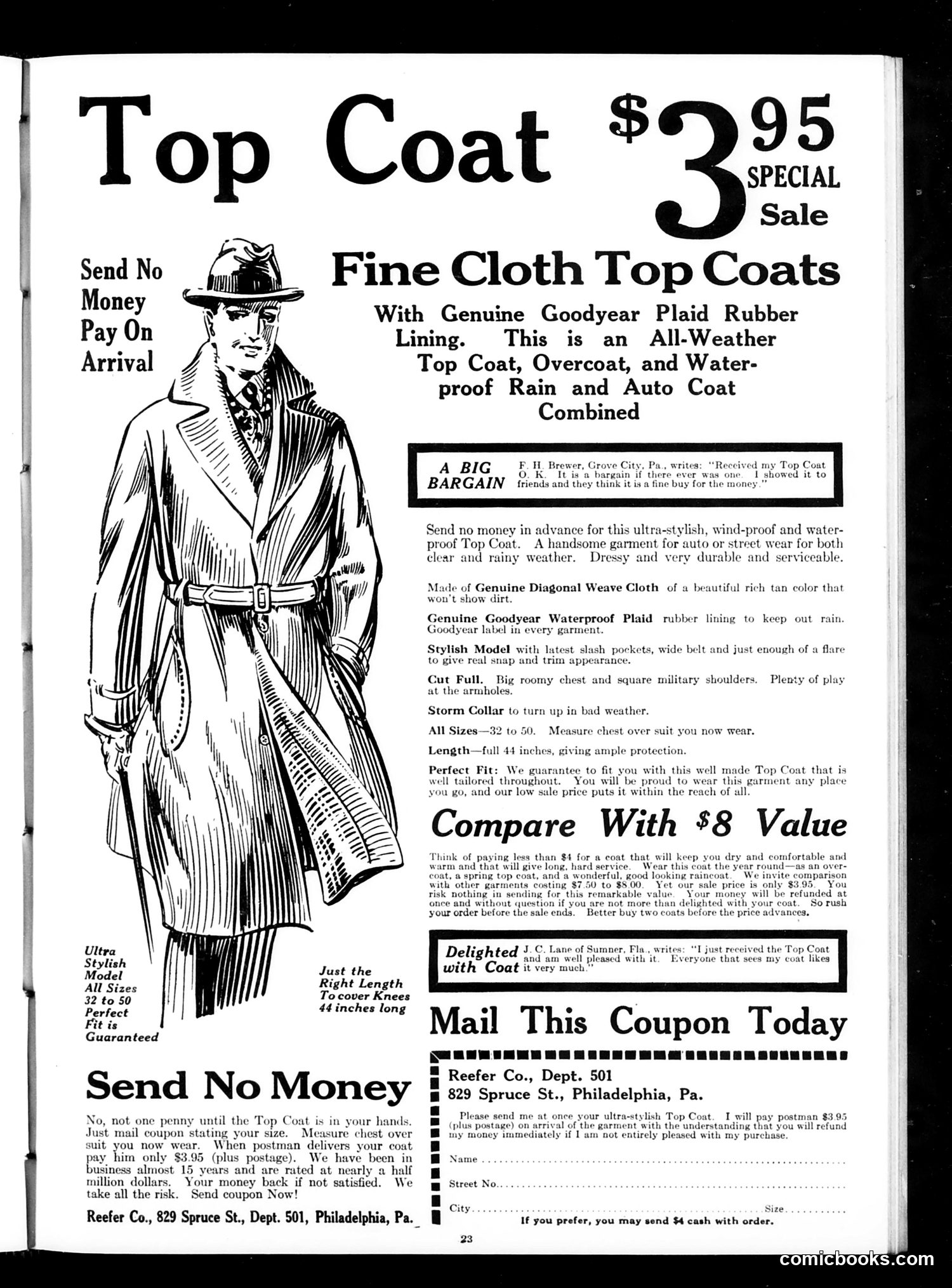
This is primarily a **mail-order advertisement**, not satirical content. It occupies the entire page with minimal editorial material. The ad promotes a "Top Coat" for $3.95 (plus postage) from Reefer Co. in Philadelphia, using the classic early 20th-century mail-order sales pitch: "Send No Money, Pay On Arrival." The illustration shows a stylishly dressed man in a long overcoat with a fedora—typical 1920s menswear. The marketing emphasizes features modern readers would recognize: waterproof lining (Goodyear brand), versatility ("All-Weather"), durability, and affordability ("Compare With $8 Value"). A customer testimonial ("Big Bargain") adds social proof. The "risk-free" guarantee—money back if unsatisfied—was a novelty in mail-order retail, distinguishing this company from competitors. The page reflects an era when catalog shopping was dominant and payment-on-delivery was standard practice for building consumer trust in distant purchases.
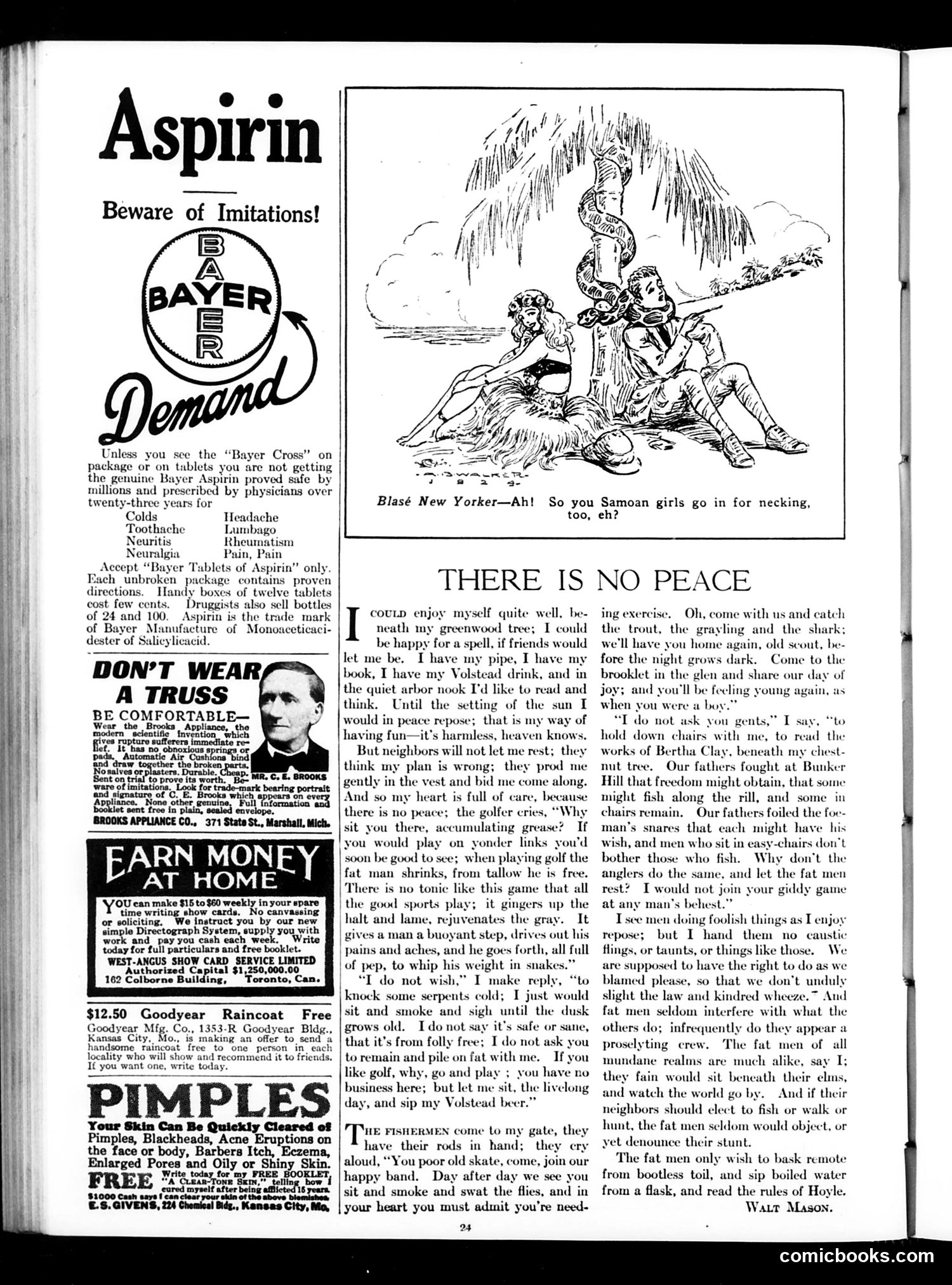
This page contains mostly **advertisements** (for Aspirin, trusses, raincoats, and acne treatments) alongside a humorous short story called "There Is No Peace." The main cartoon/illustration shows a "Blasé New Yorker" relaxing under a willow tree with his pipe and "Volstead drink" (referencing Prohibition-era illegal alcohol). The caption jokes: "Ah! So you Samoan girls go in for necking, too, eh?" The accompanying story satirizes **1920s health-and-fitness culture**. The protagonist simply wants peace and quiet, but his neighbors constantly pester him to exercise—playing golf, fishing, and other vigorous activities—claiming these pursuits are healthful and rejuvenating. He resists, preferring his sedentary lifestyle with his pipe and illegal liquor. The satire mocks the era's obsession with strenuous recreation as a moral good, contrasting it with the protagonist's desire for simple leisure. The "no peace" theme reflects broader social pressure to conform to modern ideals of health and activity.
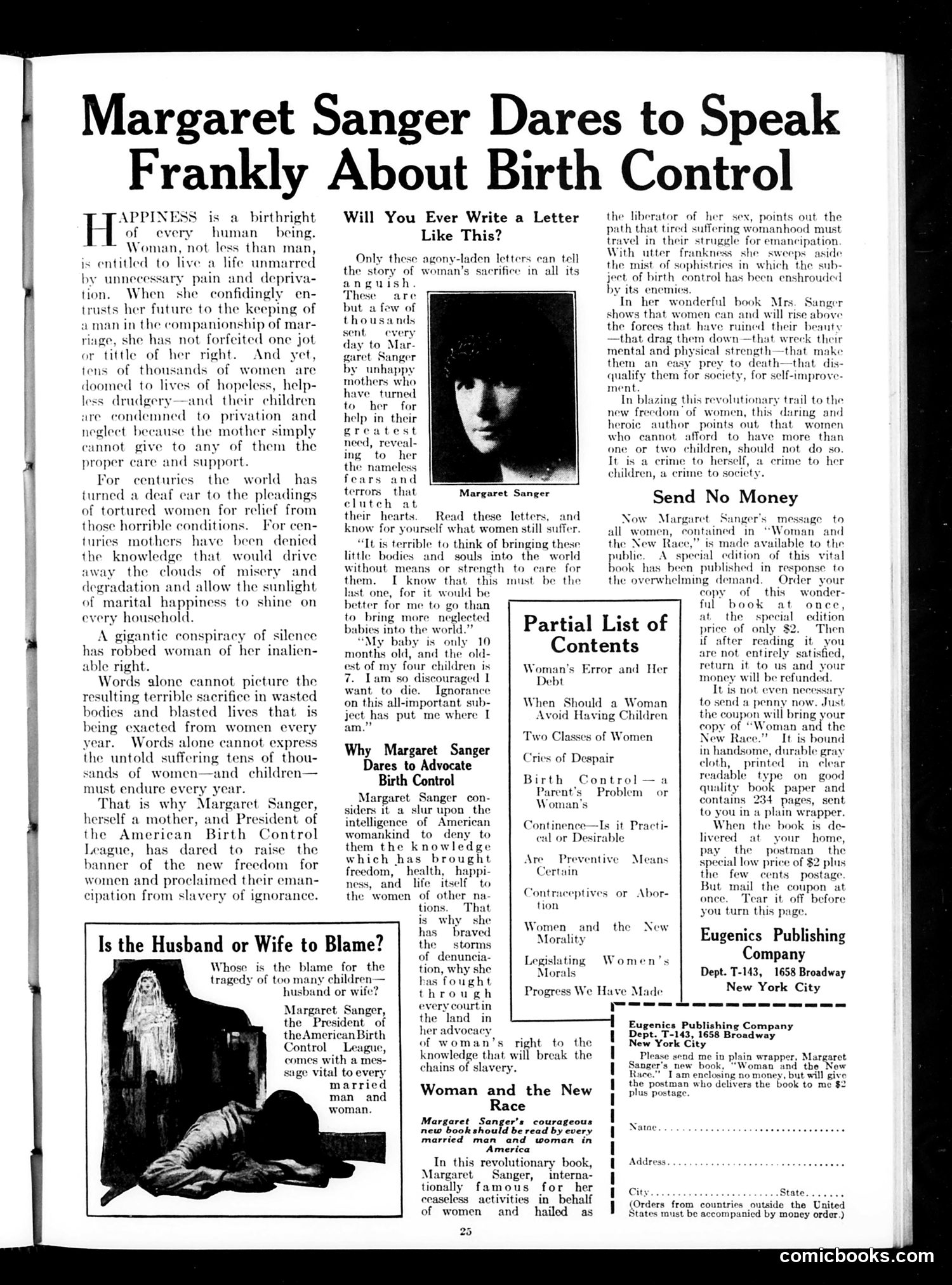
This page promotes Margaret Sanger's birth control advocacy through testimonial letters and her book "Woman and the New Race." The dramatic illustration shows a suffering mother with children, visually reinforcing the text's argument about women's hardship from uncontrolled pregnancies. The satire is subtle: Judge magazine presents this earnestly rather than mockingly. The page frames birth control as liberation from "slavery of ignorance"—a radical position in the early 20th century. Sanger is portrayed as heroic, having "braved the storms of denunciation" and fought through courts for women's right to contraceptive knowledge. The quoted letters from desperate mothers establish emotional urgency. By pairing women's suffering with Sanger's advocacy, the page argues that denying contraception information is itself immoral—turning conventional morality arguments on their head. The content table mentions "Is the Husband or Wife to Blame?" and debates about preventive methods, indicating the book addresses reproductive responsibility directly.
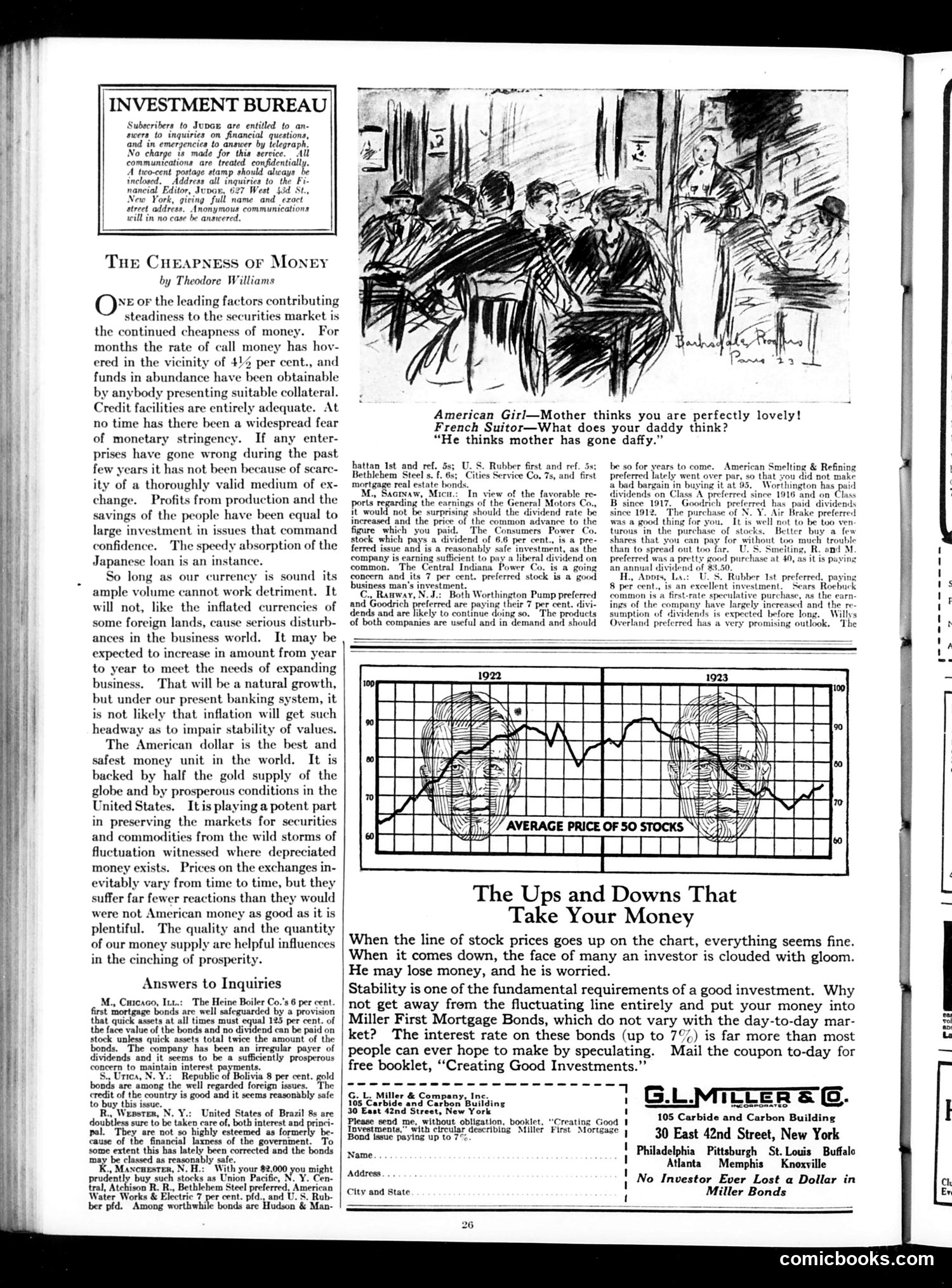
This page is primarily **financial/investment content** rather than political satire. The main feature is Theodore Williams's essay "The Cheapness of Money," discussing stable currency and bond markets circa 1922-1923. The small **cartoon sketch** in the upper right shows what appears to be a social scene with well-dressed figures. The visible caption reads: "American Girl—Mother thinks you are perfectly lovely! French Suitor—What does your daddy think? 'He thinks mother has gone daffy.'" This is a **light romantic/social satire**: a young American woman is praised by her mother but her father disapproves of her French suitor—likely playing on period anxieties about foreign romantic interests and generational attitudes toward courtship. The "daffy" comment suggests the father finds the whole situation absurd or worrying. The page also includes Judge's **Investment Bureau**—a reader advice column offering financial guidance on bonds and stocks, reflecting this magazine's dual role as both satirical humor publication and financial information source for middle-class investors in the early 1920s.
This page is **primarily advertising**, not satirical content. It features investment and financial service ads typical of early 1920s publications. The main advertisements promote: 1. **E.H. Smith Co.** (Washington, D.C.) — offering "First Mortgage" bonds yielding 6½% or 7% returns, emphasizing safety and a "money-back guarantee" 2. **Adair Realty & Trust Co.** — Southern real estate bonds claiming "no loss to any investor in 51 years" 3. **James M. Leroid & Co.** — stock exchange partial-payment purchasing The page also includes earnest financial advice columns addressing investor queries about various corporate bonds and stocks (Nipissing Mining, Benefi Loan Society, etc.). **Context for modern readers:** This represents the pre-1929 investment landscape when bonds were marketed heavily as "safe" alternatives to stocks, before the market crash exposed the risks these companies downplayed. The repeated emphasis on guarantees and safety reflects investor anxiety during economically uncertain times.
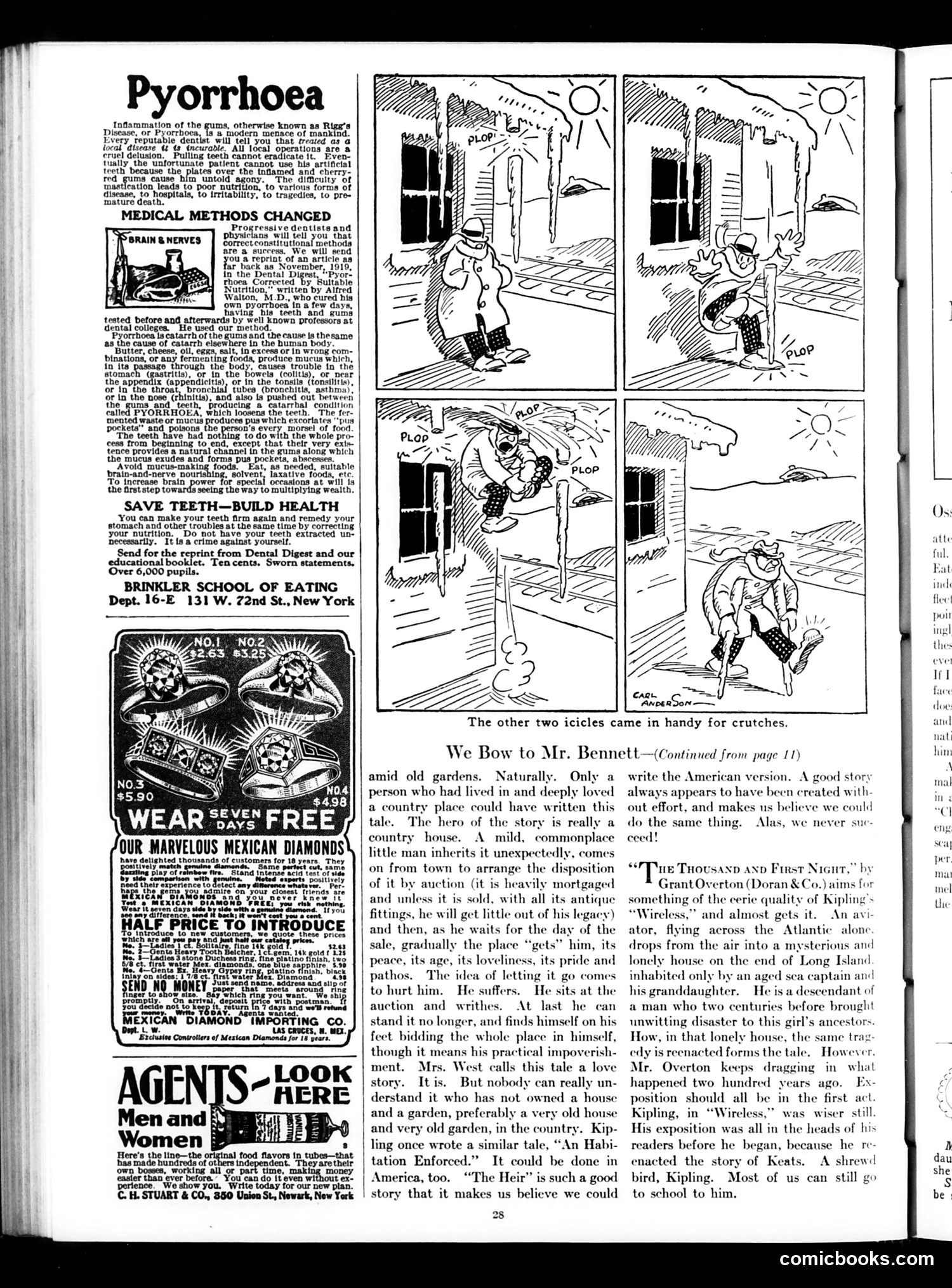
This page combines health education with period advertising. The main content addresses pyorrhea (gum disease), presenting it as a constitutional/nutritional problem rather than a dental one. The text argues that proper eating habits—avoiding mucus-forming foods and consuming "brain-and-nerve nourishing" foods—can cure the condition without tooth extraction. This reflects early 20th-century alternative health theory, before modern understanding of bacterial infection. The comic strip (upper right) humorously depicts someone suffering from pyorrhea, shown losing teeth and mobility—visual exaggeration of the disease's effects described in the text. The page also contains period advertisements: a "Brinkler School of Eating" promoting nutritional education, Mexican diamond sales, and food-flavoring tubes. These ads, typical of Judge magazine, target readers seeking health solutions and business opportunities. The adjacent text discusses a literary story about inherited countryside property, representing the magazine's mix of satire, fiction, and commercial content.
This page is primarily **advertising and theatrical promotion** rather than political satire. The main content advertises Irving Berlin's song "Lazy" from an upcoming musical comedy called *Judge* (opening March 15), inviting readers to "join in the chorus." Below this is a theater review of *"Children of the Moon,"* a New England-set play by Miss Merchant, performed by the Equity Players. The critic argues the play poorly represents actual New Englanders, caricaturing them as melodramatic or morally questionable rather than authentically depicting the region's character. A separate brief review critiques Robert Presnell's *"Saturday Night"* at the Cherry Lane Theater as derivative O. Henry adaptation without merit. The right column contains product advertisements: Gibson banjos/mandolins, diamond rings, and Piso's cough syrup—typical period advertisements. The two small cartoon figures at bottom appear to be a humorous marriage-proposal joke (millionaire/suitor), unrelated to the page's main content.
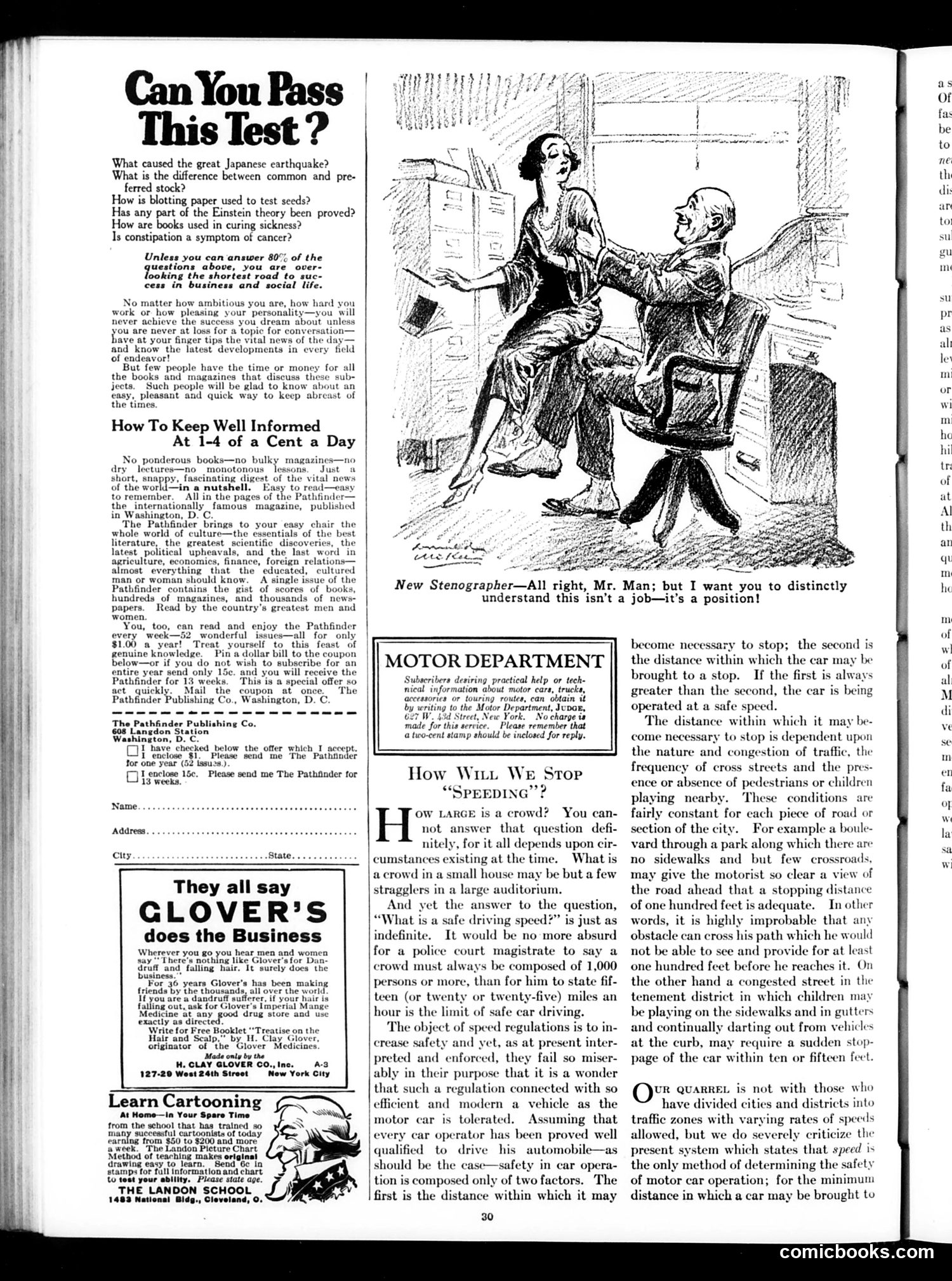
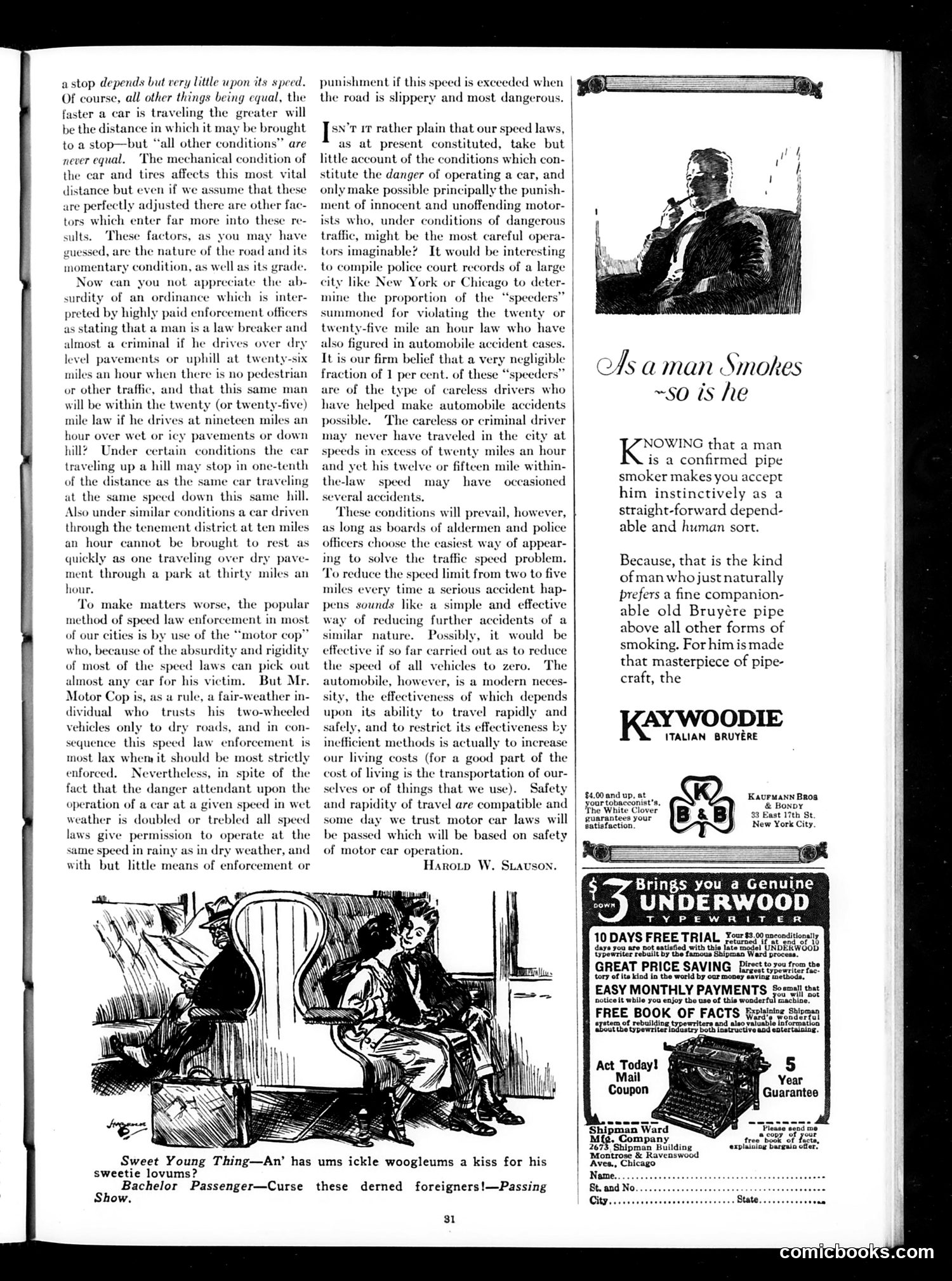
This page primarily contains a serious **editorial essay on automobile speed laws** by Harold W. Slauson, not satire. The author argues that rigid speed limit enforcement is counterproductive and unjust. **The argument:** Speed laws fail to account for road conditions (wet vs. dry, uphill vs. downhill, traffic density). Consequently, careful drivers on safe roads get ticketed while truly reckless drivers—who cause actual accidents—often escape notice because police ("motor cops") selectively enforce laws only on dry roads under good conditions. **The satire lies in the critique:** The piece mocks the absurdity of treating a driver going 26 mph on a dry, empty road as a "criminal" while allowing 25 mph on icy, treacherous conditions. It also satirizes police for their convenient bias: enforcing laws when conditions are safest, avoiding enforcement when danger is greatest. **The cartoon below** depicts a flirtatious couple in a car—illustrating frivolous motoring rather than serious traffic safety. The page reflects early 20th-century debates over emerging automobile regulation.
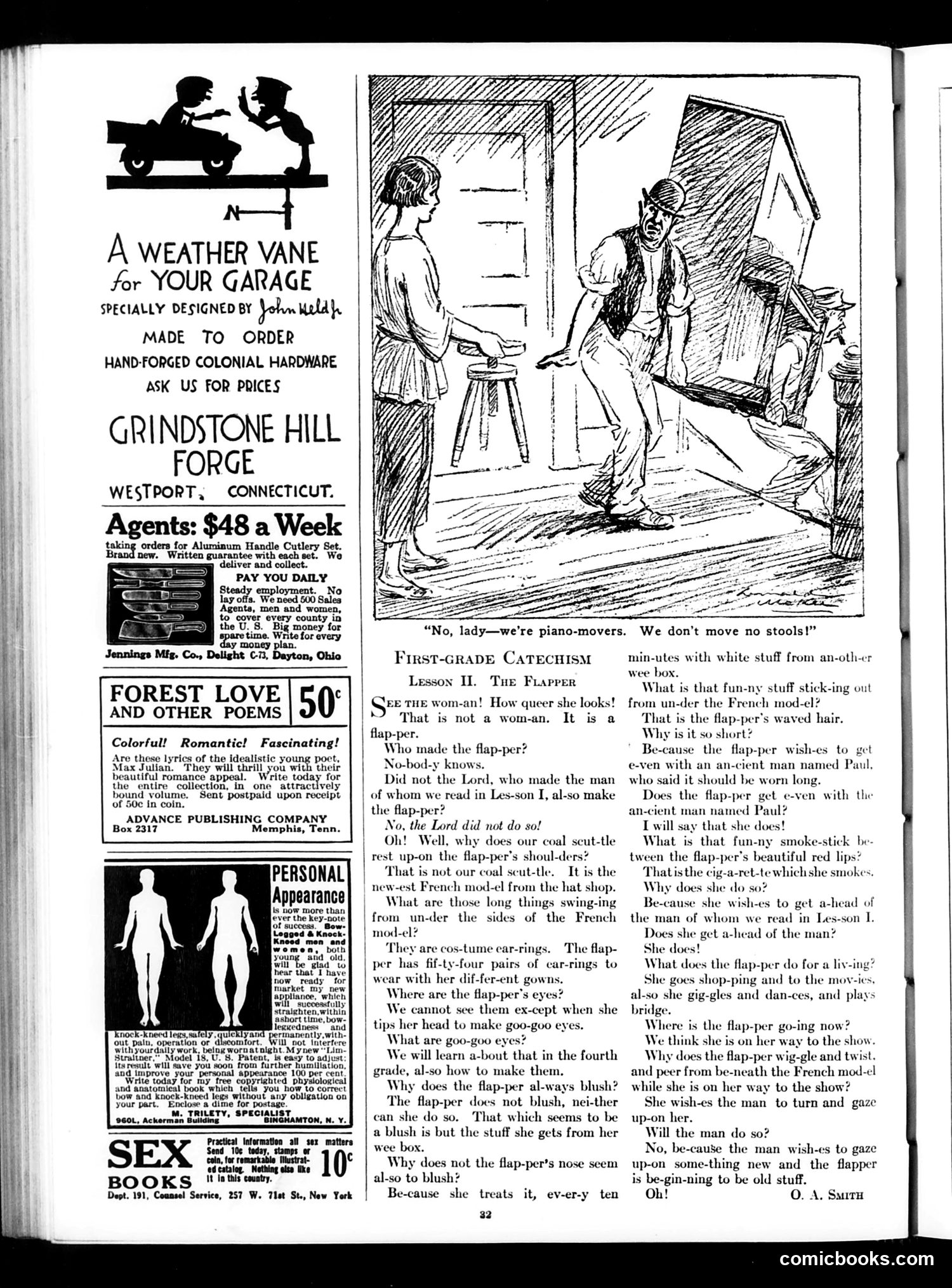
This page is primarily **advertising and satirical content** from Judge magazine. The main cartoon shows two moving men telling a woman they won't move stools—a visual pun on "piano-movers" (the men) versus actual furniture movers. The centerpiece is **"First-Grade Catechism: Lesson II. The Flapper,"** a mock-educational satire mocking 1920s "flapper" women—young women who rebelled against Victorian norms by wearing shorter skirts, heavy makeup, cigarettes, and ear-rings. The text ridicules their appearance and behavior through exaggerated Q&A format, treating flappers as inexplicable creatures worthy of study. The satire reflects **generational anxiety**: older moralists (represented by "an ancient man named Paul") disapproved of flappers' independence, makeup, smoking, and dating freedoms. The humor relies on exaggeration and condescension toward modern women's autonomy and self-presentation. The page also advertises weather vanes, cutlery sets, sales positions, and poetry collections—typical Judge magazine fare.
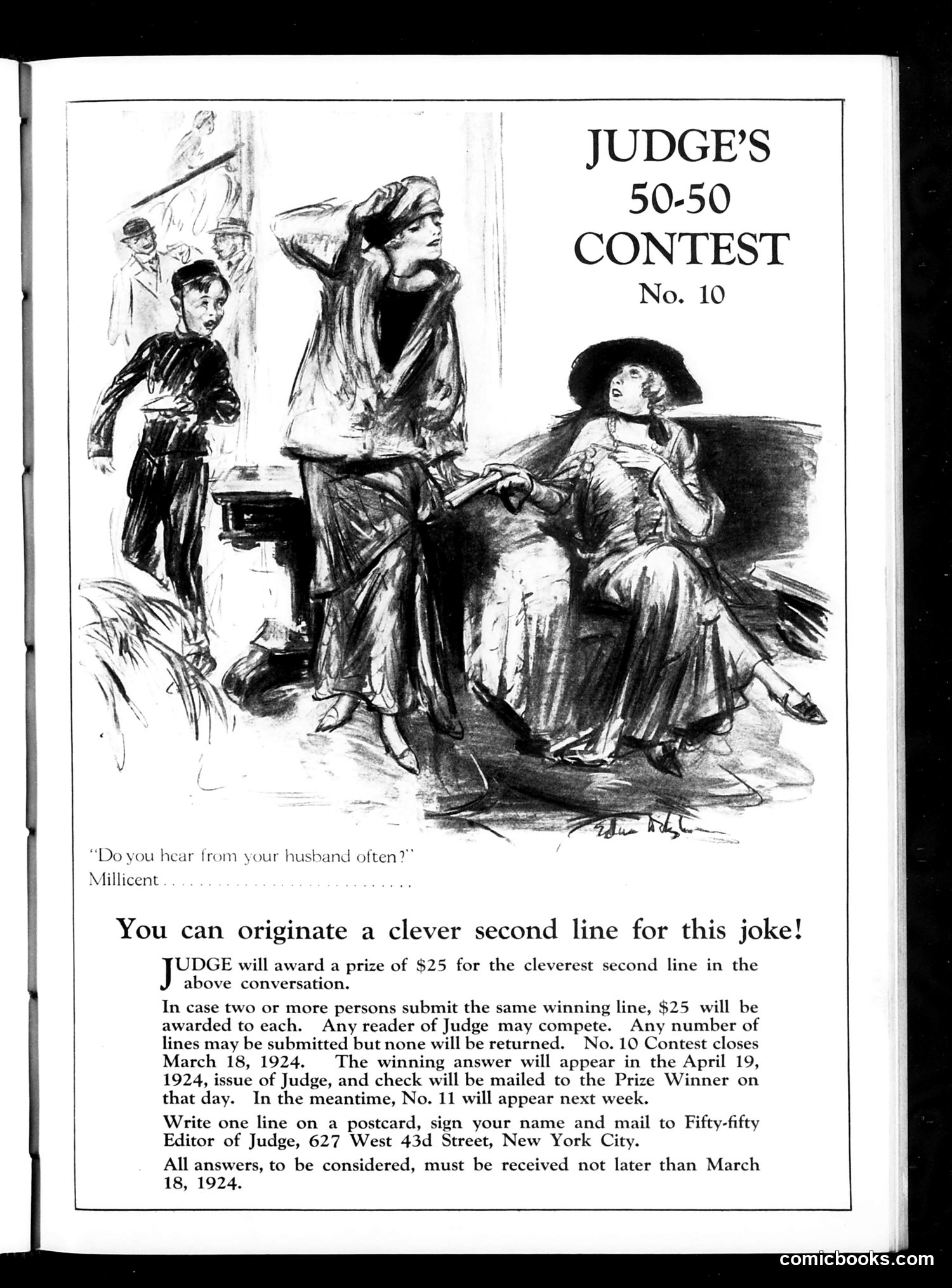
This page presents a reader-participation contest from *Judge* magazine. The cartoon shows a woman (Millicent) asking another woman, "Do you hear from your husband often?" — a setup line implying marital separation or neglect, likely a common domestic complaint of the era. Readers were invited to submit the cleverest *second line* of dialogue to complete the joke, competing for a $25 prize. The contest closed March 18, 1924, with winners announced in the April 19 issue. This represents early interactive humor journalism — *Judge* crowdsourced punchlines from its audience. The joke's premise assumes readers would find humor in the implication of an inattentive or absent husband, reflecting 1920s domestic anxieties. The format was apparently popular enough to run multiple contests in succession (this was "No. 10").
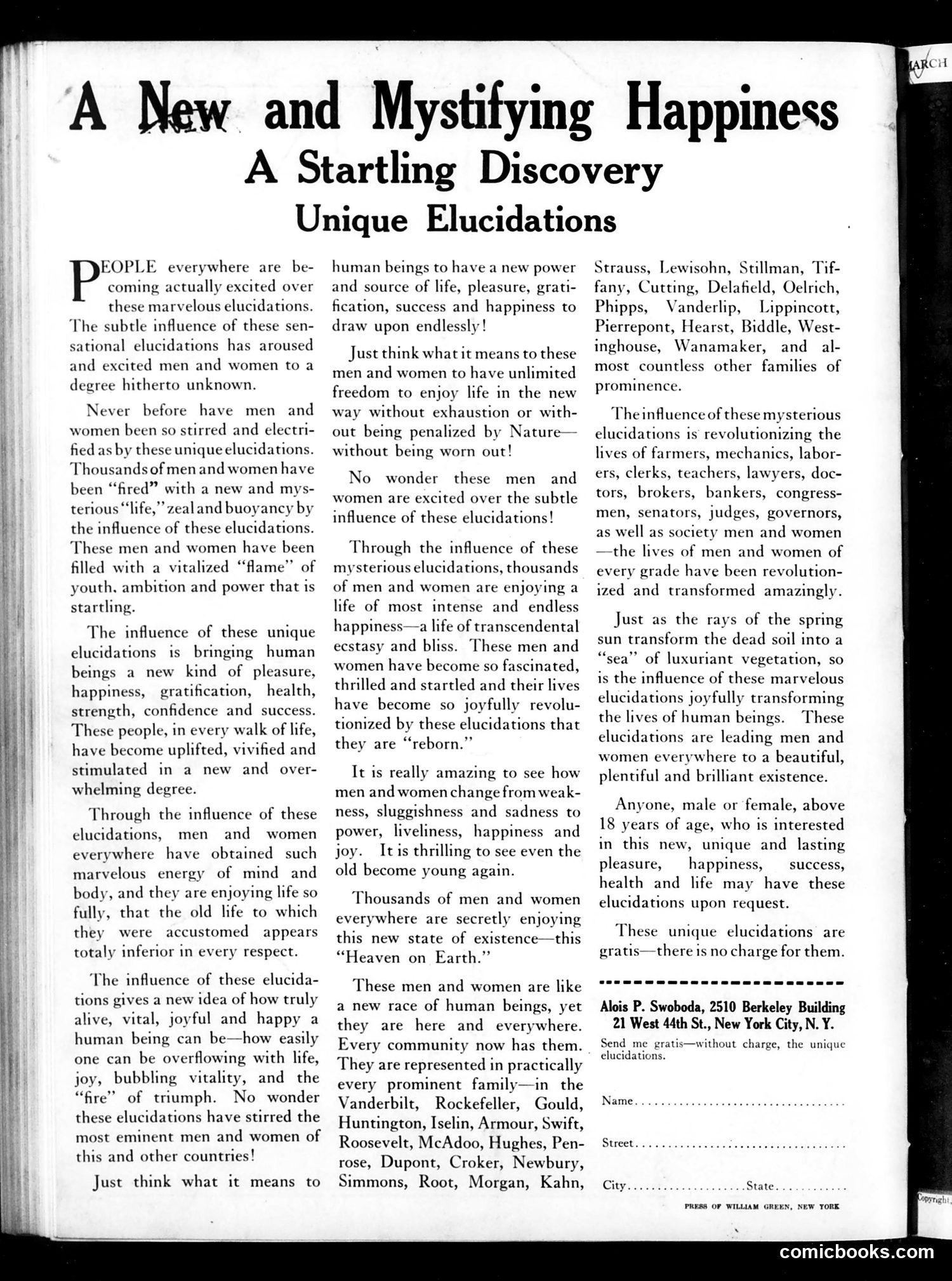
This appears to be a satirical advertisement rather than a traditional political cartoon. Judge magazine is mocking pseudo-scientific self-help or wellness schemes (possibly referring to a specific fad of the era, though the exact "elucidations" referenced remain unclear). The satire works through deliberate vagueness: the text endlessly repeats that these mysterious "elucidations" transform people from weak and sad to powerful and joyful, yet never explains what they actually *are*. The humor lies in this empty hype—the breathless marketing language promising unlimited happiness without effort or "Nature's penalty." The list of famous wealthy families (Vanderbilt, Rockefeller, Carnegie-adjacent names) suggests satire of how the affluent fell for such schemes, or how such promises particularly appeal to the privileged. The closing coupon invites readers to request these undefined "elucidations" gratis, completing the joke: Judge is mocking how such vague wellness claims circulated as mail-order promotions to the gullible.