
Judge, 1924-03-08 · page 17 of 36
Judge — March 8, 1924 — page 17: what you’re looking at
What you’re looking at
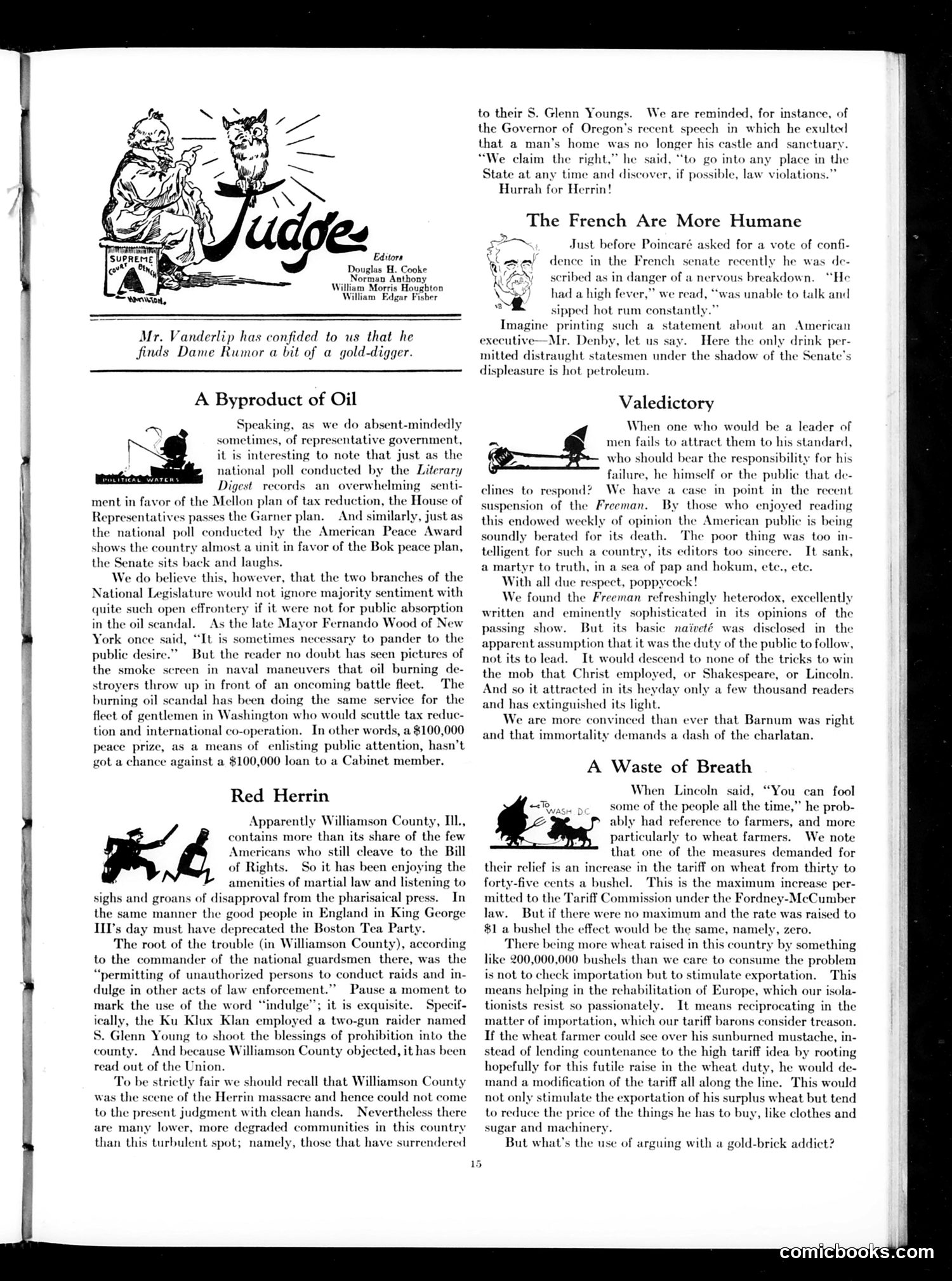
This page contains several editorial cartoons critiquing American politics and social issues circa the early 1920s. **"A Byproduct of Oil"** references the Teapot Dome scandal, arguing that the public's absorption with oil-industry corruption allows Congress to ignore voter preferences on tax policy and peace initiatives—much like a warship's smoke screen masks its movements. **"Red Herrin"** addresses martial law in Williamson County, Illinois, imposed by national guardsmen under S. Glenn Young (a Prohibition enforcer). The piece defends the county's resistance to unauthorized law enforcement, comparing it to colonial opposition to King George III, while acknowledging the region's troubled past (the Herrin massacre). **"The French Are More Humane"** sarcastically compares treatment of distressed leaders: French officials are permitted warm beverages during stress, while American executives facing Senate pressure are offered only "hot petroleum"—likely referencing Secretary of the Navy Denby's involvement in Teapot Dome. The cartoons mock government corruption, abuse of martial law, and hypocrisy in political accountability.
📄 Transcribed text from this page (OCR, searchable)
Machine-transcribed from the original scan — historical spelling and the odd misread are preserved.
Edvtore Douglas H. Cooke Norman Anthony William Mon ‘lliam Mr. Vanderlip has confided to us that he finds Dame Rumor a bit of a gold-digger. A Byproduct of Oil > Speaking, as we do absent-mindedly sometimes, of representative government, it is interesting to note that just as the national poll conducted by the Literary Digest records an overwhelming senti- ment in favor of the Mellon plan of tax reduction, the House of Representatives passes the Garner plan. And similarly, just as the national poll conducted by the American Peace Award shows the country almost a unit in favor of the Bok peace plan, the Senate sits back and laughs. We do believe this, however, that the two branches of the National Legislature would not ignore majority sentiment with quite such open effrontery if it were not for public absorption in the oil scandal. As the late Mayor Fernando Wood of New York once said, “It is sometimes necessary to pander to the public desire.” But the reader no doubt has seen pictures of the smoke screen in naval maneuvers that oil burning de- stroyers throw up in front of an oncoming battle fleet. The burning oil scandal has been doing the same service for the fleet of gentlemen in Washington who would scuttle tax reduc- tion and international co-operation. In other words, a $100,000 peace prize, a means of enlisting public attention, hasn't got a chance against a $100,000 loan to a Cabinet member. Red Herrin Apparently Williamson County, IIL, contains more than its share of the few Americans who still cleave to the Bill of Rights. So it has been enjoying the amenities of martial law and listening to sighs and groans of disapproval from the pharisaical press. In the same manner the good people in England in King George III’s day must have deprecated the Boston Tea Party. The root of the trouble (in Williamson County), according to the commander of the national guardsmen there, was the “permitting of unauthorized persons to conduct raids and in- dulge in other acts of law enforcement.” Pause a moment to mark the use of the word “indulge”; it is exquisite. Specif- ically, the Ku Klux Klan employed a two-gun raider named S. Glenn Young to shoot the blessings of prohibition into the county. And because Williamson County objected, it has been read out of the Union. To be strictly fair we should recall that Williamson County was the scene of the Herrin massacre and hence could not come to the present judgment with clean hands. are many lower, Nevertheless there more degraded communities in this country than this turbulent spot; namely, those that have surrendered to their S. Glenn Youngs. We are reminded, for instance, of the Governor of Oregon's recent speech in which he exulted that a man’s home was no longer his castle and sanctuary. “We claim the right,” he said, “to go into any place in the State at any time and discover, if possible, law violations.” Hurrah for Herrin! The French Are More Humane Se Just before Poincaré asked for a vote of confi- dence in the French senate recently he was de- “He was unable to talk and scribed as in danger of a nervous breakdown. 1, had a high fever,” we ree sipped hot rum constantl. Imagine printing such a statement about an American executive—Mr. Denby, let us say. Here the only drink per- mitted distraught statesmen under the shadow of the Senate's displeasure is hot petroleum. Valedictory When one who would be a leader of ~ men fails to attract them to his standard, who should bear the responsibility for his failure, he himself or the public that de- clines to respond? We have a suspension of the Freeman. By those who enjoyed reading this endowed weekly of opinion the American public is being soundly berated for its death. The poor thing was too in- telligent for such a country, its editors too sincere. It sank, a martyr to truth, in a sea of pap and hokum, etc., etc. With all due respect, poppycock! We found the Freeman refreshingly heterodox, excellently written and eminently sophisticated in its opinions of the passing show. But naiveté was disclosed in the apparent assumption that it was the duty of the public to follow, not its to lea It would descend to none of the tricks to win the mob that Christ employed, or Shakespeare, or Lincoln. And so it attracted in its heyday only a few thousand readers and has extinguished its light. We are more convinced than ever that Barnum was right and that immortality demands a dash of the charlatan. A Waste of Breath When Lincoln said, “You can fool some of the people all the time,” he prob- ably had reference to farmers, and more particularly to wheat farmers. We note that one of the measures demanded for their relief is an inerease in the tariff on wheat from thirty to forty-five cents a bushel. ase in point in the recent its basic This is the maximum increase per- y-McCumber But if there were no maximum and the rate was $1 a bushel the effect would be the same, namely, zero. There being more wheat raised in this country by something like 200,000,000 bushels than we care to consume the problem is not to check importation but to stimulate exportation. This means helping in the rehabilitation of Europe, which our isola- tionists resist so passionately. It means reciprocating in the matter of importation, which our tariff barons consider treason. If the wheat farmer could see over his sunburned mustache, in- stead of lending countenance to the high tariff idea by rooting hopefully for this futile raise in the wheat duty, he would de- mand a modification of the tariff all along the line. This would not only stimulate the exportation of his surplus wheat but tend to reduce the price of the things he has to buy sugar and machinery. But what's the use of arguing with a gold-brick addict? mitted to the Tariff Commission under the Fordne; law. ‘aised to like clothes and