
Judge, 1924-03-08 · page 33 of 36
Judge — March 8, 1924 — page 33: what you’re looking at
What you’re looking at
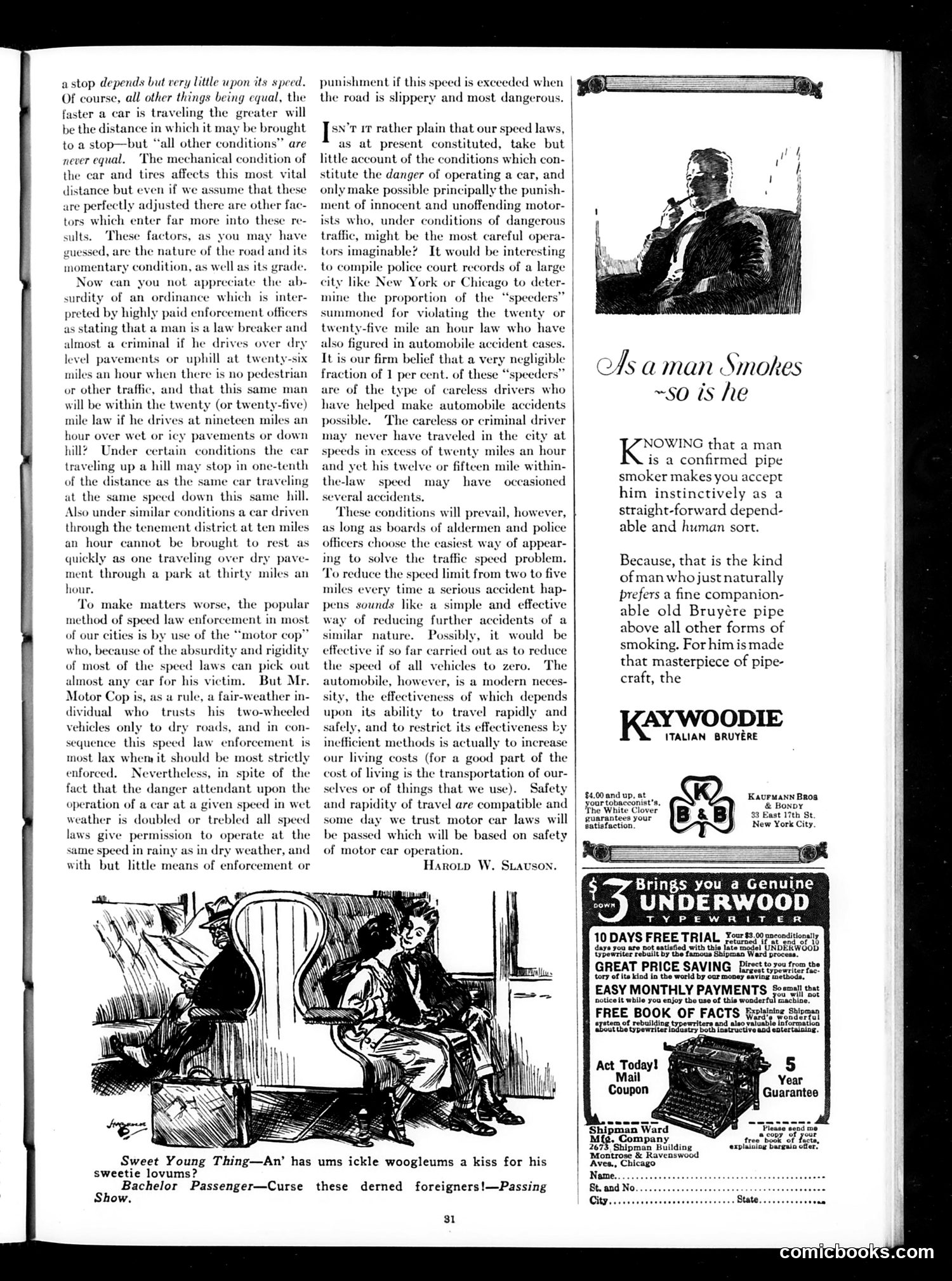
This page primarily contains a serious **editorial essay on automobile speed laws** by Harold W. Slauson, not satire. The author argues that rigid speed limit enforcement is counterproductive and unjust. **The argument:** Speed laws fail to account for road conditions (wet vs. dry, uphill vs. downhill, traffic density). Consequently, careful drivers on safe roads get ticketed while truly reckless drivers—who cause actual accidents—often escape notice because police ("motor cops") selectively enforce laws only on dry roads under good conditions. **The satire lies in the critique:** The piece mocks the absurdity of treating a driver going 26 mph on a dry, empty road as a "criminal" while allowing 25 mph on icy, treacherous conditions. It also satirizes police for their convenient bias: enforcing laws when conditions are safest, avoiding enforcement when danger is greatest. **The cartoon below** depicts a flirtatious couple in a car—illustrating frivolous motoring rather than serious traffic safety. The page reflects early 20th-century debates over emerging automobile regulation.
📄 Transcribed text from this page (OCR, searchable)
Machine-transcribed from the original scan — historical spelling and the odd misread are preserved.
astop depends but very little upon its speed. Of course, all other things being equal, the faster a car is traveling the greater will be the distance in which it may be brought to a stop—but “all other conditions” are never equal. ‘The me condition of the car and tires affects this most vital distance but even if we assume that these are perfectly adjusted there are other fac- tors which enter far more into these ri These factors, as you may have re the nature of the road and its momentary condition, as well as its grade. Now can you not appreciate the surdity of an ordinance which is inter- preted by highly paid enforcement officers as stating that a man is a law breaker and almost a criminal if he drives over dry level pavements or uphill at twenty-six miles an hour when there is no pedest or other traffic, and that this same man will be within the twenty (or twenty-five) mile law if he drives at nineteen miles an hour over wet or icy pavements or down hill? Under certain conditions the traveling up a hill may stop in one-tenth of the distance as the same car traveling at the same speed down this same hill. Also under similar conditions a car driven through the tenement district at ten miles an hour cannot be brought to rest as quickly as one traveling over dry pave- ment through a park at thirty miles an hour. sults. guessed, b- car To make matters worse, the popular method of speed law enforcement in most of our cities is by use of the “motor cop” who, because of the absurdity and rigidity of most of the speed laws can pick out almost any car for his victim. But Mr. Motor Cop is, as a rule, a fair-weather in- dividual who trusts his two-wheeled vehicles only to dry roads, and in con- sequence this speed law enforcement is most lax whem it should be most strictly enforced. Nevertheless, in spite of the fact that the danger attendant upon the operation of a car at a given speed in wet weather is doubled or trebled all speed laws give permission to operate at the same speed in rainy as in dry weather, and with but little means of enforcement or Sweet Young Thing—An’ has sweetie lovums? Bachelor Passenger—Curse Show. punishment if this speed is exceeded when the road is slippery and most dangerous. ’y rr rather plain that our speed laws, as at present constituted, take but | little account of the conditions which con- stitute the danger of operating a car, and only make possible principally the punish- ment of innocent and unoffending motor- ists who, under conditions of dangerous traffic, might be the most careful opera- tors imaginable? It would be interesting to compile police court records of a large city like New York or Chi to deter- mine the proportion of the ‘speeders” summoned for violating the twenty or twenty-five mile an hour law who hav also figured in automobile accident cases. It is our firm belief that a very negligible fraction of 1 per cent. of these “s are of the type of careless drivers who have helped make automobile accidents possible. may spec peeders” ‘The careless or criminal driver never have traveled in the city at s in excess of twenty miles an hour and yet his twelve or fifteen mile within- the-law several accidents. speed may have occasioned ‘These conditions will prevail, however, as long as boards of aldermer officers choose the easiest way of appear- ing to solve the traffic speed problem. ‘To reduce the speed limit from two to five miles every time a serious accident hap- pens sounds like a simple and effective way of reducing further accidents of a similar nature. Possibly, it would be effective if so far carried out as to reduce the speed of all vehicles to zero. The automobile, however, is a modern neces- sity, the eff ss of which depends upon its ability to travel rapidly and safely, and to restrict its effectiven inefficient methods is actually to increase our living costs (for a good part of the cost of living is the transportation of our- selves or of things that we use). Safety and rapidity of travel are compatible some day we trust motor car laws be passed which will be based on safety of motor car operation. Harotp W. Stavson. and police iven ums ickle woogleums a kiss for his these derned foreigners!—Passing 31 As aman Smokes ~so is he NOWING that a man is a confirmed pipe smoker makes you accept him instinctively as a straight-forward depend- able and human sort. Because, that is the kind of man who just naturally prefers a fine companion- able old Bruyére pipe above all other forms of smoking. For him is made that masterpiece of pipe- craft, the “AY WOODIE ITALIAN BRUYERE $4.00 and up, at your tobacconist’s, Phe White Clover guarantees your Satisfaction. KAUPMANN Bros jONDY 83 East 17th St New York City Brings you a Genuine UNDERWOOD TYPEWRITER 10 DAYS FREE TRIAL 22183, pnconditionally returned if daza.zou are pot eatifed with tle inte ogdel UNDERWOOD ish typewniter Febuilt by the famous Ship pubes geapenee GREAT PRICE SAVING largest‘typewrlier fac: tory of ite kind in the world by our money a' - EASY MONTHLY PAYMENTS yosngies ‘ot notice it while you enjoy the use of this wonderful machine FREE BOOK OF FACTS fyatsiee, Shinnen tem of rebuilding typewriters and also valuable Information ibe typeweiter indostry bots Lostructvesnd eatertalsing. Act Today! Mail Coupon Shipman Ward Mi ym pan; 267: ‘Shipman Building ‘Montrose & Ravenswood Aves, Chicago