
Judge, 1924-03-08 · page 13 of 36
Judge — March 8, 1924 — page 13: what you’re looking at
What you’re looking at
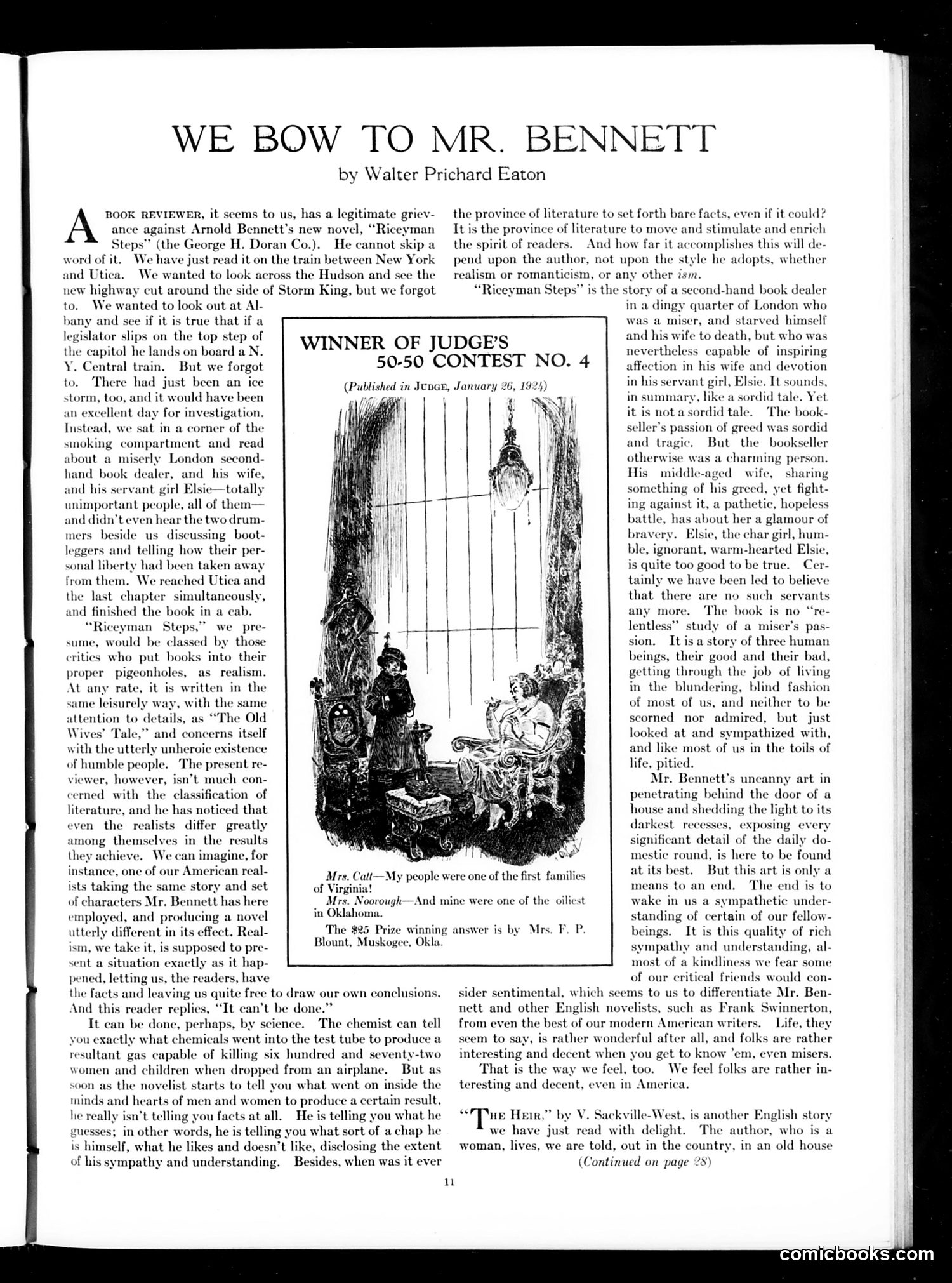
This page contains a literary review essay by Walter Prichard Eaton praising Arnold Bennett's novel *Riceyman Steps*. The review defends Bennett against critics who object that his detailed, realistic writing style forces readers to engage with mundane details about ordinary, unimportant people—a second-hand book dealer, his wife, and their servant in a dingy London neighborhood. The embedded cartoon is a "50-50 Contest" winner: a joke about social pretension. A woman named Catt boasts her family were "one of the first families of Virginia" (implying colonial aristocracy). Her companion Foxborough responds her relatives were "one of the oiliest in Oklahoma"—a crude pun equating old money with oil wealth, suggesting new money is just as base as old, and both equally absurd. The review's broader point: realistic literature's value lies not in factual accuracy but in moving readers' emotions and deepening understanding of human nature.
📄 Transcribed text from this page (OCR, searchable)
Machine-transcribed from the original scan — historical spelling and the odd misread are preserved.
WE BOW TO MR. BENNETT by Walter Prichard Eaton BOOK REVIEWER, it seems to us, has a legitimate griev- A ance against Arnold Bennett's new novel, “Riceyman Steps” (the George H. Doran Co.). He cannot skip a word of it. We have just read it on the train between New York and Utica. We wanted to look across the Hudson and see the new highway cut around the side of Storm King, but we forgot to. We wanted to look out at Al- bany and see if it is true that if a legislator slips on the top step of the capitol he lands on board a N. Y. Central train. But we forgot There had just been an ice storm, too, and it would have been an excellent day for investigation. Instead, we sat in a corner of the smoking compartment and read about a miserly London second- hand book dealer, and his wife, and his servant girl Elsie—totally unimportant people, all of then— and didn’t even hear the two drum- mers beside us discussing boot- leggers and telling how their per- sonal liberty had been taken away from them. We reached Utica and the last chapter simultaneously, and finished the book in a cab. “Riceyman Steps,” we pre- to. sume, would be classed by those crities who put books into their proper pigeonholes, as realism. At any rate, it is written in the same leisurely way, with the same attention to details, as “The Old Wives’ Tale,” and concerns itself with the utterly unheroie existence of humble people. The present re- viewer, however, isn’t much con- cerned with the classification of literature, and he has noticed that even the realists differ greatly among themselves in the results they achieve. We can imagine, for instance, one of our American real- ists taking the same story and set of characters Mr. Bennett has here employed, and producing a novel utterly different in its effect. Real- ism, we take it, is supposed to pre- sent a situation exactly as it hap- pened, letting us, the readers, have the facts and leaving us quite free to draw our own conclusions. And this reader replies, “It can’t be done.” It can be done, perhaps, t i The chemist can tell actly what chemicals went into the test tube to produce a it gas capable of killing six hundred and seventy-two women and children when dropped from an airplane. But as soon as the novelist starts to tell you what went on inside the minds and hearts of men and women to produce a certain result, he really isn’t telling you facts at all. He is telling j guesses; in other words, he is telling you what sort of a chap he is himself, what he likes and doesn’t like, disclosing the of his sympathy and understanding. Besides, when was it ever nce. WINNER OF JUDGE’S 50-50 CONTEST NO. 4 (Published in JevGe, Mrs. Catt—My people were one of the first families of Virginia! ‘oovough—And mine were one of the oiliest in Oklahoma. The $25 Prize winning « Blount, Muskogee, Okla. lL the province of literature to set forth bare facts, even if it could? It is the province of literature to move and stimulate and enrich the spirit of readers. And how far it accomplishes this will de- pend upon the author, not upon the style he adopts, whether m or romanticism, or any other ism. “Riceyman Steps” is the story of a second-hand book dealer in a dingy quarter of London who was a miser, and starved himself and his wife to death, but who was. nevertheless capable of inspiring affection in his wife and devotion in his servant girl, Elsie. It sounds, in summary, like a sordid tale. Yet it is not a sordid tale. The book- seller's passion of greed was sordid and tragic. But the bookseller otherwise was a charming person. His middle-aged wife, sharing something of his greed, yet fight- ing against it, a pathetic, hopeless battle, has about her a glamour of bra’ Elsie, the char girl, hum- ble, ignorant, warm-hearted Elsie, is quite too good to be true. Cer- tainly we have been led to believe that there are no such servants any more. The book is no “re- lentless” study of a miser’s pas- sion. It is a story of three human beings, their good and their bad, getting through the job of living in the blundering, blind fashion of most of us, and neither to be scorned nor admired, but just looked at and sympathized with, and like most of us in the toils of life, pitied. Mr. Bennett's uncanny art in penetrating behind the door of a house and shedding the light to its darkest recesses, exposing every significant detail of the daily do- mestic round, is here to be found at its best. But this art is only a means to an end. The end is to wake in us a sympathetic under- standing of certain of our fellow- beings. It is this quality of rich sympathy and understanding, al- most of a kindliness we fear some of our critical friends would con- sider sentimental, which seems to us to differentiate Mr. Ben- nett and other English novelists, such as Frank Swinnerton, from even the best of our modern American writers. Life, they seem to say, is rather wonderful after all, and folks are rather interesting and decent when you get to know ‘em, even misers, That is the way we feel, too. We feel folks are rather in- teresting and decent, even in America. January 26, 1924) answer is by Mrs. F. P. “One Herr,” by Sackville-West, is another English story we have just read with delight. The author, who is a woman, lives, we are told, out in the country, in an old house (Continued on page 28)