
A complete issue · 36 pages · 1923
Judge — November 3, 1923
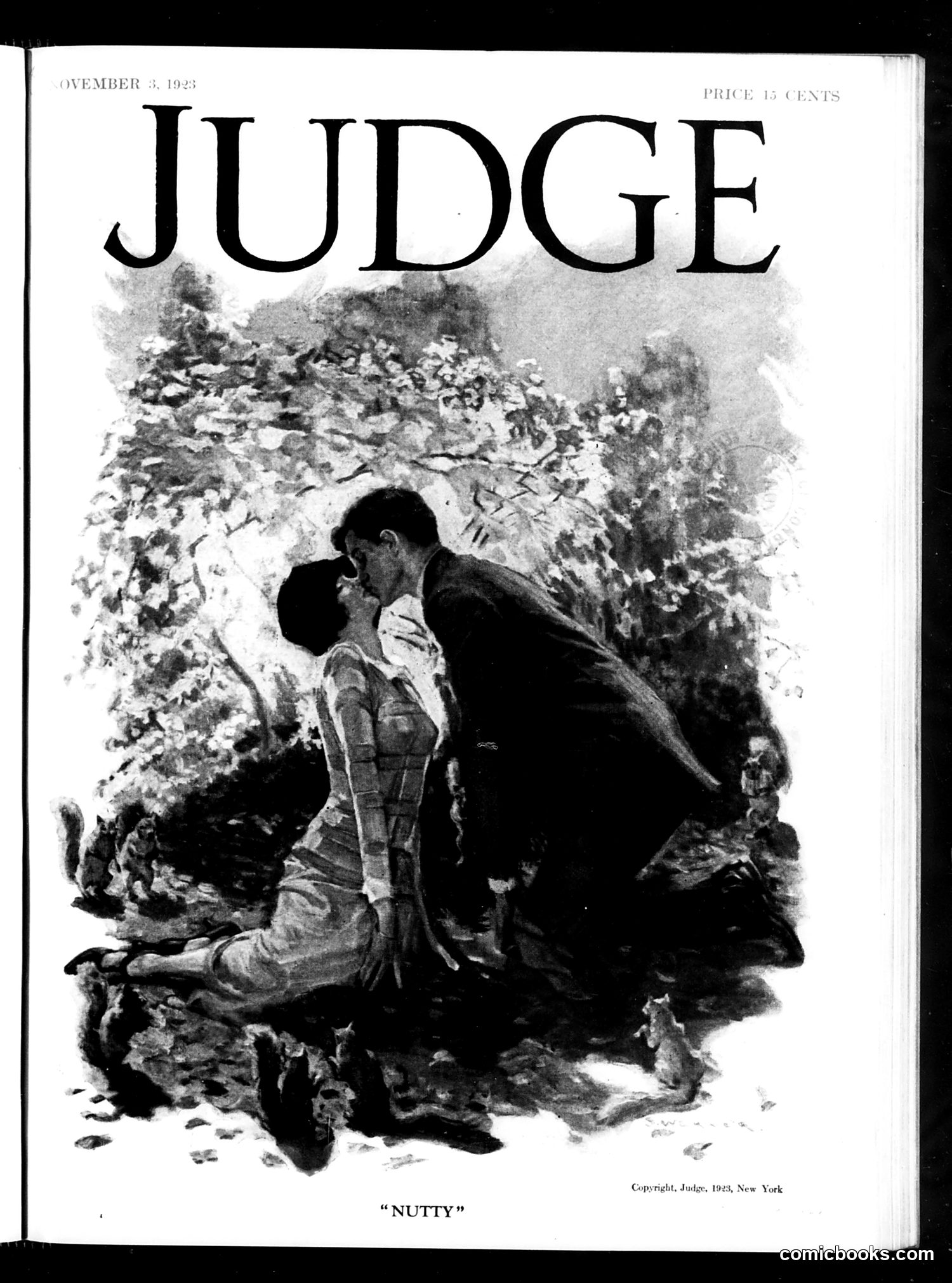
This cover illustration, titled "Nutty," depicts a romantic scene between a man and woman nestled against foliage. The image appears to be a straightforward romantic illustration rather than political satire—characteristic of Judge's lifestyle and humor content from the 1920s. The title "Nutty" likely refers to the couple's romantic behavior or state of being "in love" using period slang. The composition emphasizes intimacy and nature, popular themes in early 1920s mass-market magazines. Without additional text or captions visible on this particular page, the specific satirical or social commentary—if present—remains unclear. This appears to be primarily decorative cover art rather than pointed political commentary.
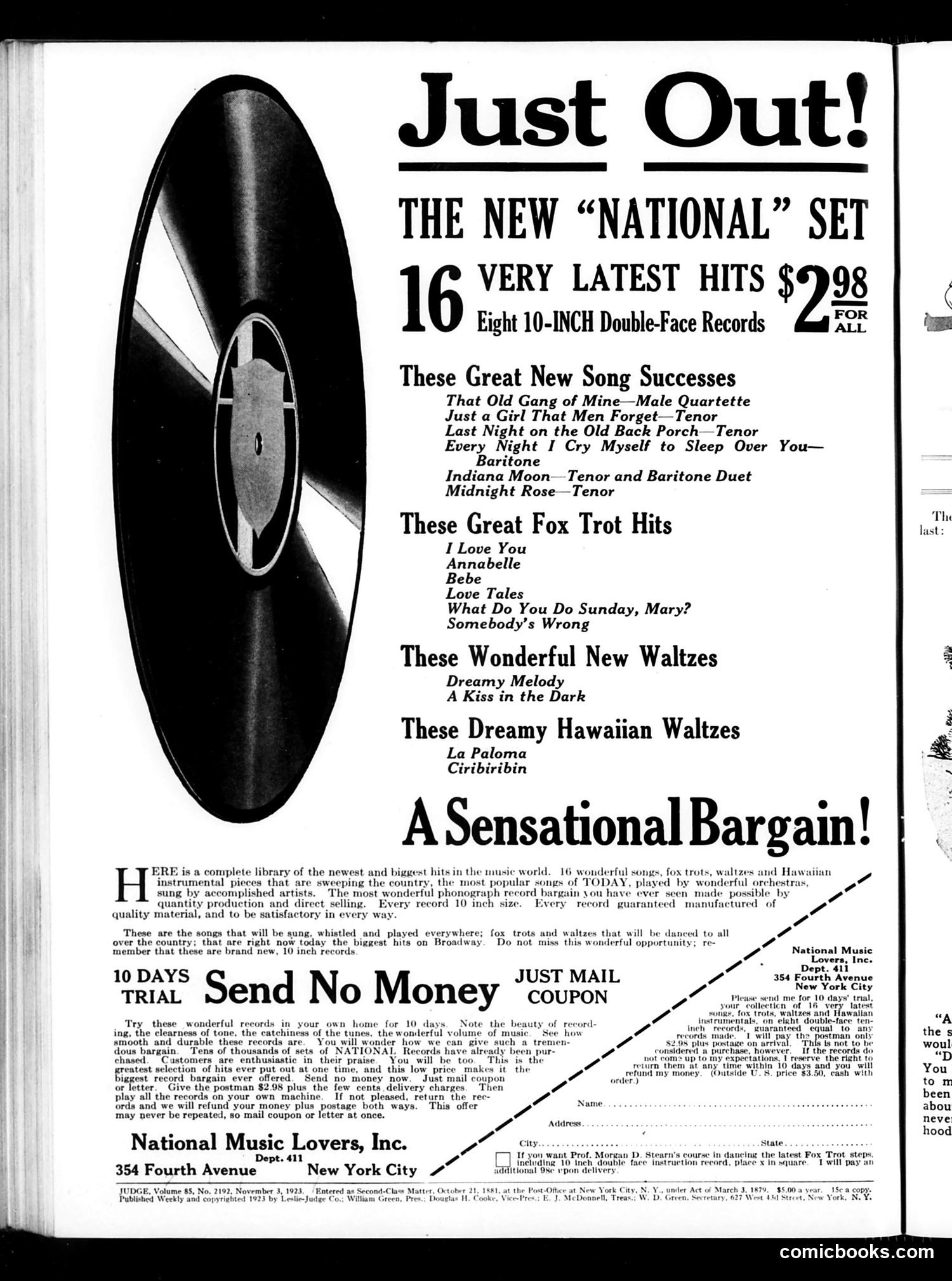
This page is **not a cartoon or satirical article**—it's a **record advertisement** from National Music Lovers, Inc. (dated November 2, 1921, based on the visible Judge masthead). The ad promotes a "National" brand record set: 16 ten-inch double-sided records for $2.98, featuring popular songs of the era—fox trots, waltzes, and Hawaiian waltzes. Songs listed include "That Old Gang of Mine" and "Annabelle." The large image on the left shows a gramophone record. The advertisement emphasizes affordability ("A Sensational Bargain!") and offers a 10-day trial period with a mail coupon. This is a straightforward commercial advertisement, not satirical content, placed within Judge magazine's pages.
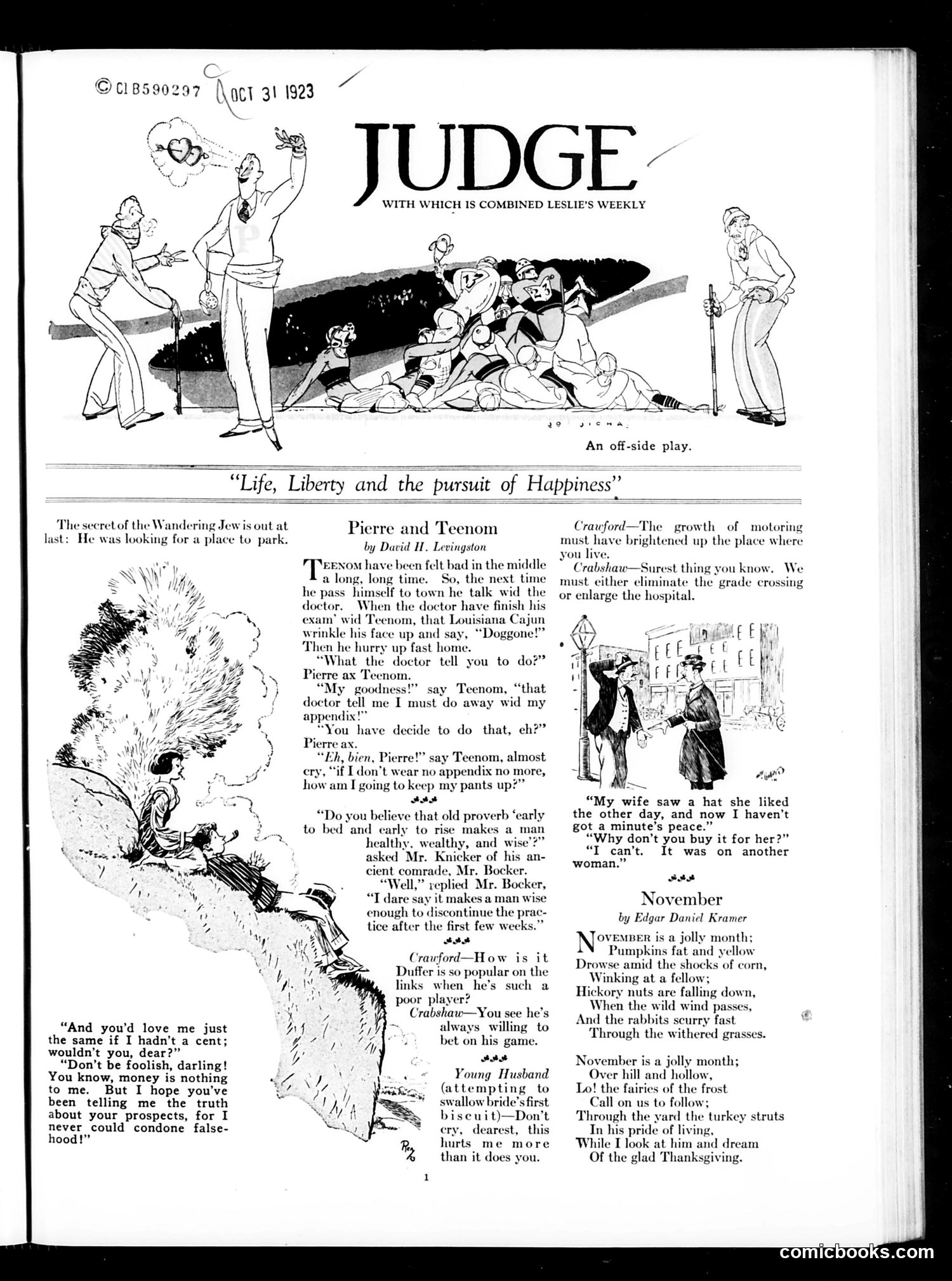
This page contains humor pieces rather than political cartoons. The main content includes: **"Pierre and Teenom"** by David H. Lexington—a brief comedic dialogue about a man named Pierre who's been ordered by his doctor to remove his appendix. The humor revolves around Pierre's concern that without his appendix, he won't know how to keep his pants up. This plays on outdated folk beliefs about the appendix's function. **"Young Husband"** section—a short poem mocking a newly married man upset that his wife won't stop swallowing her biscuit while he's speaking, finding her action more hurtful than her words. **"November"** poem by Edgar Possum Kenner—seasonal verse about autumn imagery. The cartoons are largely illustrative accompaniment to these humorous pieces rather than topical satire.
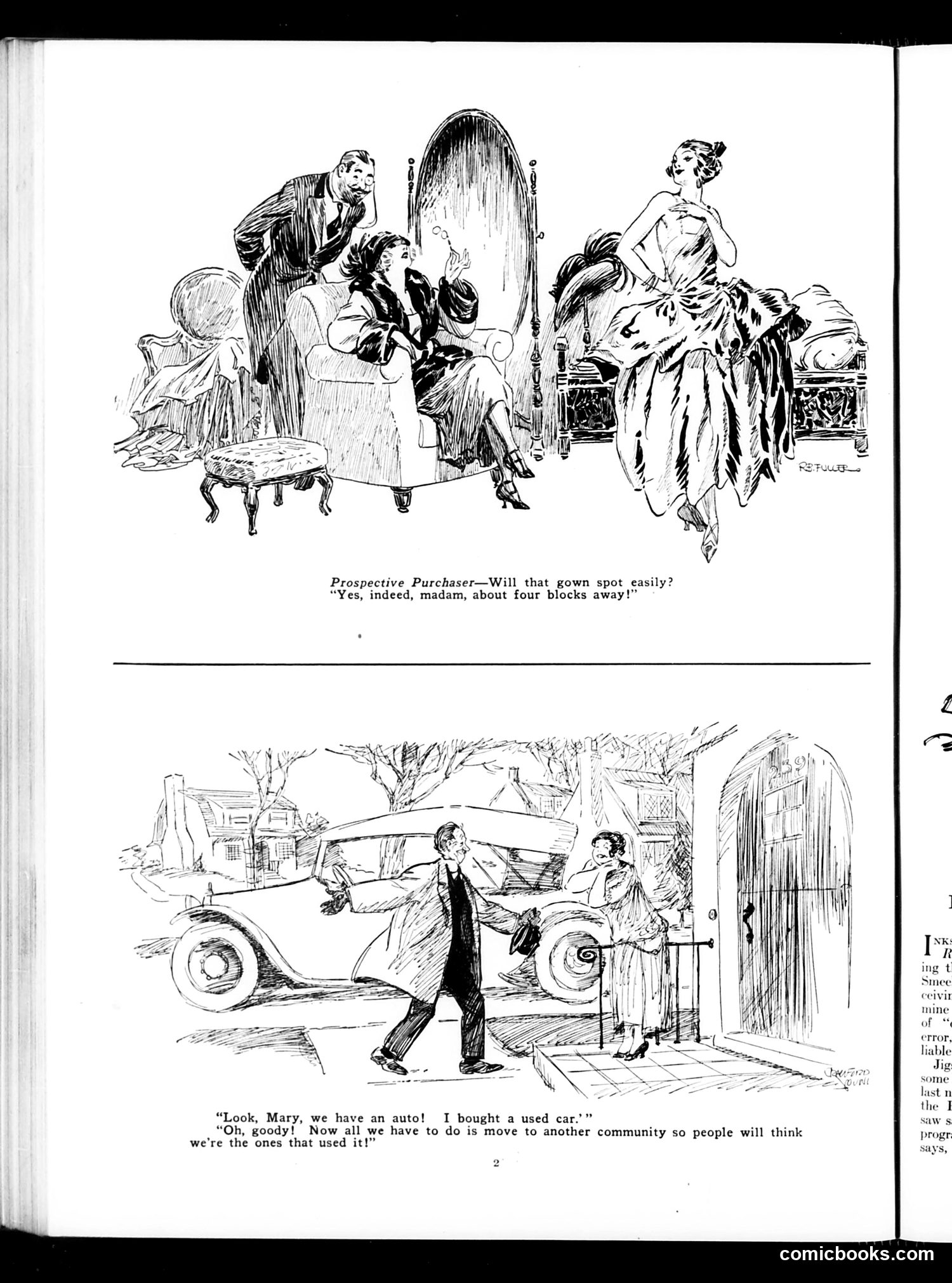
This page contains two separate satirical cartoons about consumer behavior and social pretense. **Top cartoon**: A woman shopping for a dress examines her reflection in a mirror while a salesman assures her the garment will hide a stain "about four blocks away"—meaning it will only be noticeable from a distance. The joke mocks both deceptive sales tactics and women's vanity about appearance. **Bottom cartoon**: A man proudly shows his wife a used car, claiming they must move to another community so neighbors won't realize they bought secondhand. The satire targets nouveau riche anxiety about social status and the American obsession with appearing prosperous, suggesting that buying used goods was considered socially shameful among aspirational middle-class families. Both cartoons critique consumer culture and status-consciousness in early 20th-century America.
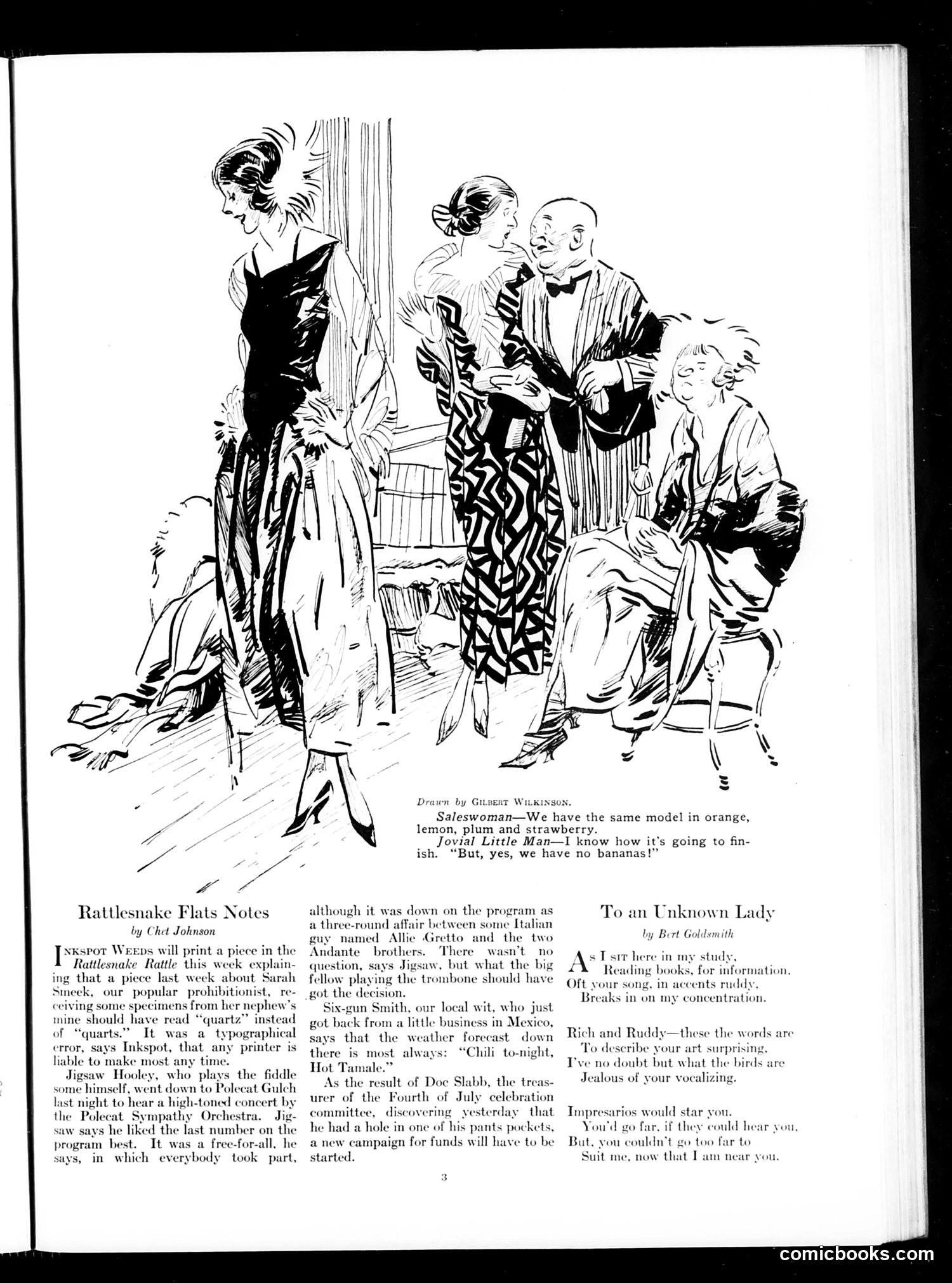
The main cartoon, drawn by Gilbert Wilkinson, depicts a social scene where a saleswoman shows fabric samples to four customers. The joke—"We have the same model in orange, lemon, plum and strawberry"—plays on fruit-colored fashion trends of the era, with the punchline being a man's exasperated response: "But yes, we have no bananas!" This references the popular 1923 novelty song "Yes! We Have No Bananas," which became a cultural catchphrase. The humor derives from the absurdity of describing serious fashion fabrics using fruit names, then invoking the song's famous line about banana shortages—conflating fashion commerce with grocery availability for comic effect. The page also contains poetry and other brief satirical pieces typical of Judge's miscellaneous content.
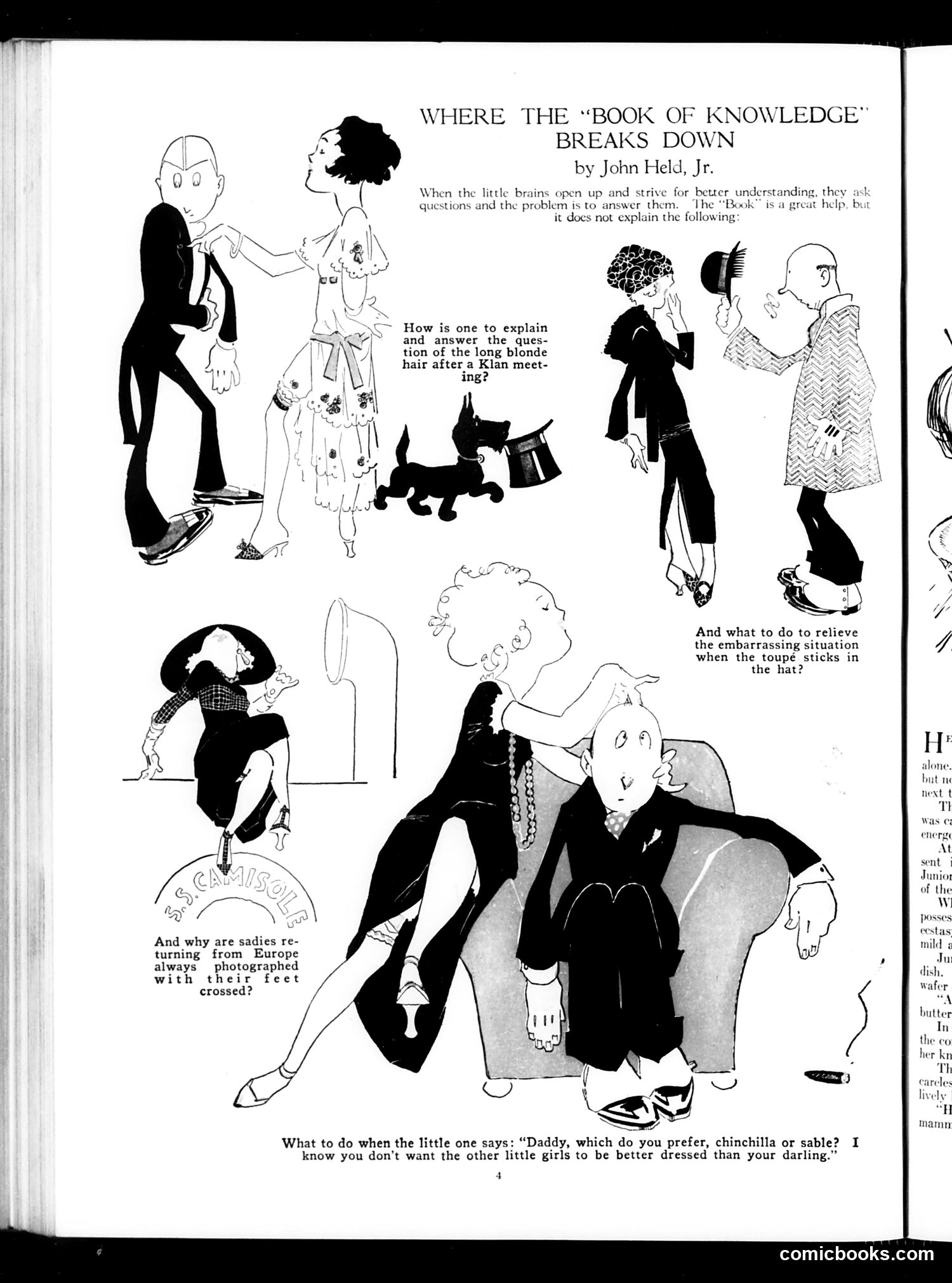
This satirical page titled "Where the 'Book of Knowledge' Breaks Down" by John Held, Jr. mocks the limitations of encyclopedic knowledge when addressing awkward social situations. The cartoons depict humorous scenarios where factual information proves useless: - Explaining a child's appearance after a KKK meeting - A stuck hat embarrassment - European women photographed with crossed legs (likely referencing fashion photography conventions) - A father's dilemma when a daughter compares him unfavorably to other girls' fathers regarding dress (chinchilla vs. sable furs) The satire criticizes how the "Book of Knowledge"—representing rational, factual authority—cannot resolve delicate social, racial, or familial embarrassments. Held suggests that real-world etiquette and emotional intelligence surpass mere information.
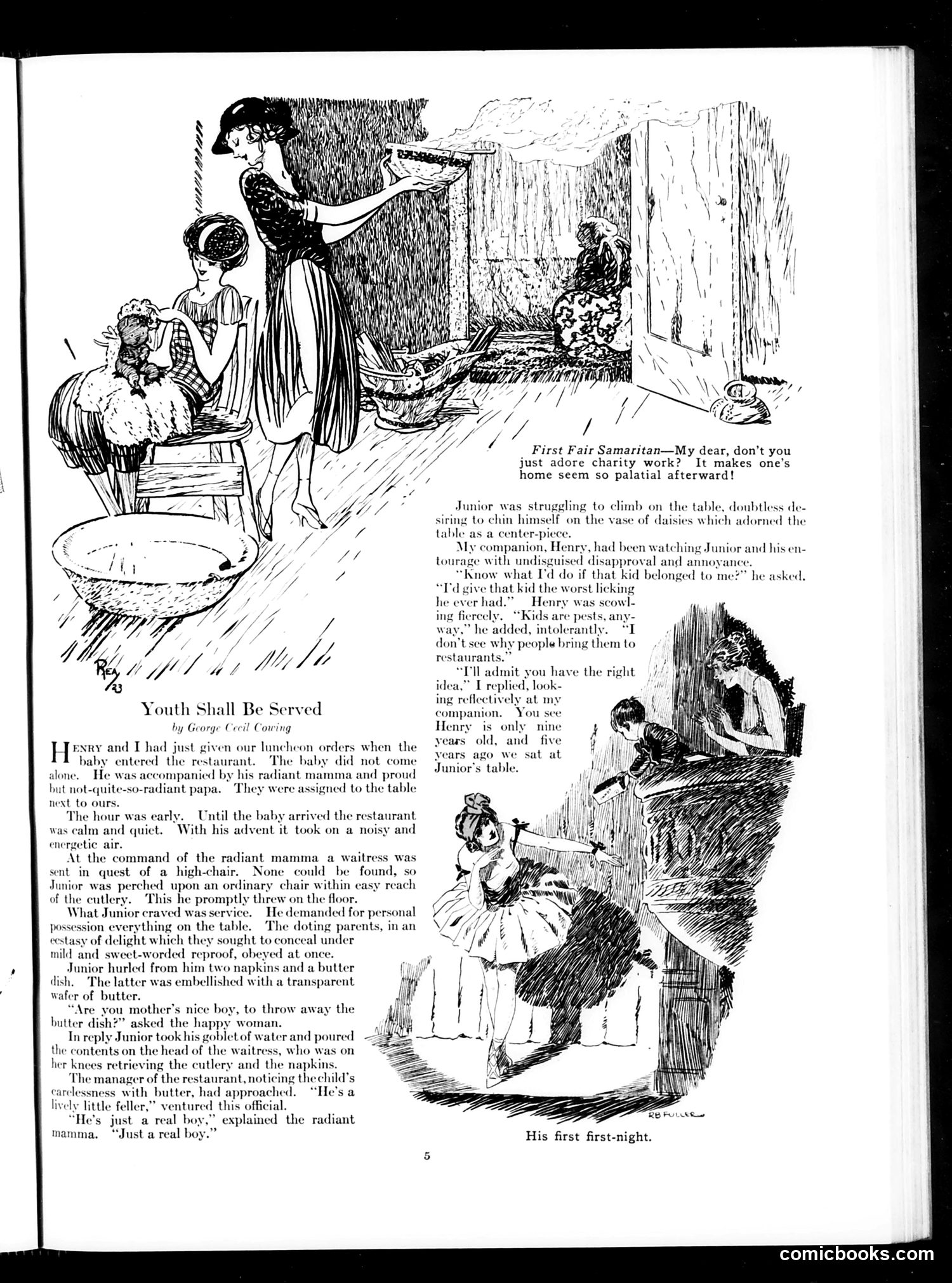
This satirical story mocks wealthy women's performative charity work. The narrator dines with "Henry," who witnesses a toddler ("Junior") behaving destructively at an adjacent table—throwing cutlery, napkins, and water on a waitress. Henry, observing the child's chaos, remarks he'd discipline such behavior harshly. The punchline reveals Henry is now only nine years old, and five years earlier *he* sat at that same table exhibiting identical misbehavior. The satire targets two groups: wealthy mothers who indulge their children's rudeness while claiming "charity work" makes them feel virtuous and morally superior ("so palatial afterward"), and society's hypocritical tolerance of spoiled children among the elite. The irony is that Henry, the voice of moral judgment, was once the disruptive "real boy" he now condemns—exposing the arbitrary standards applied to childhood misbehavior.
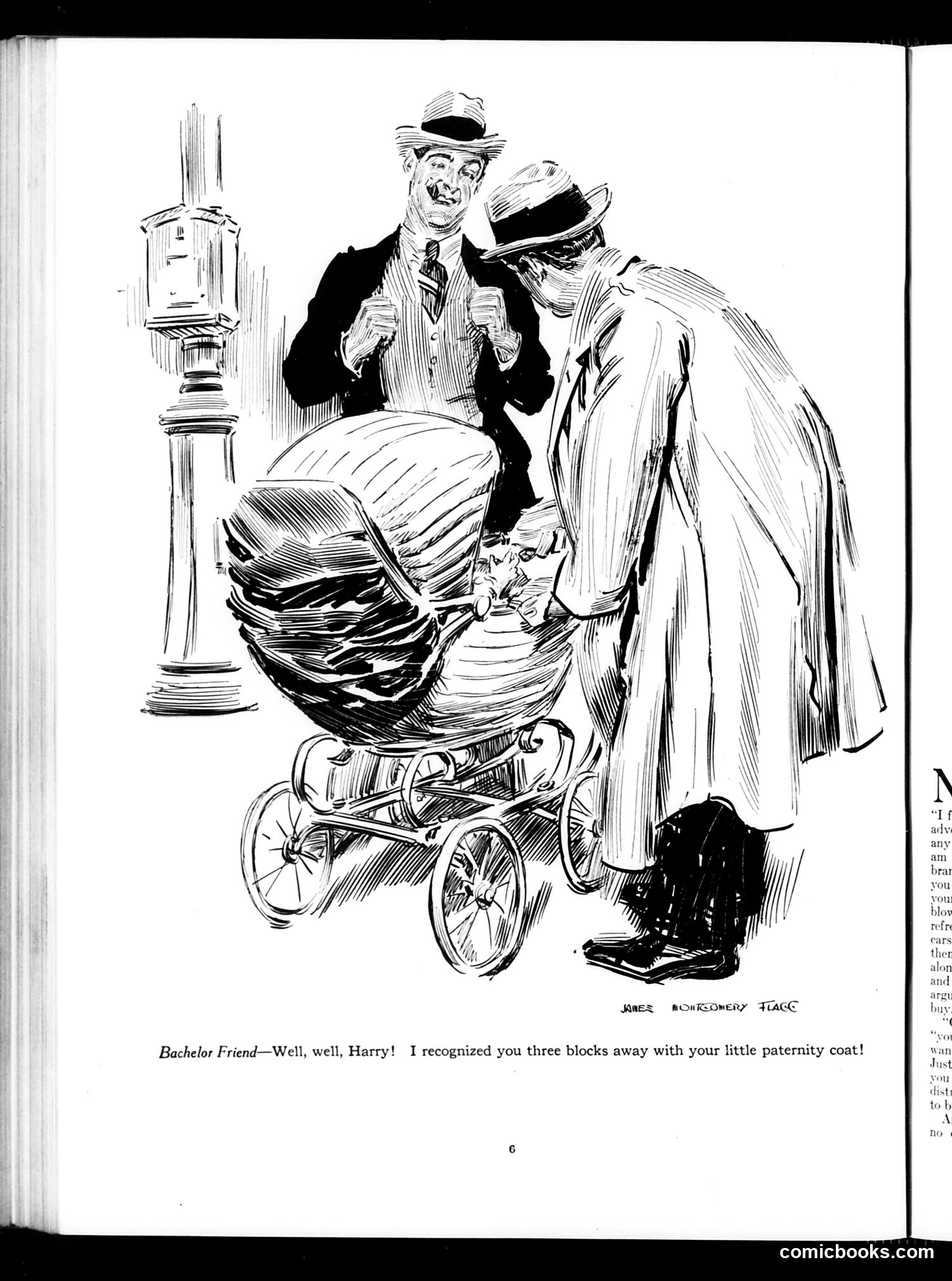
This is a single-panel cartoon from *Judge* magazine mocking a man pushing a baby carriage. Two well-dressed men encounter each other on the street; one teases the other ("Harry") about his "paternity coat"—apparently a distinctive garment associated with new fathers. The satire targets the social awkwardness and masculinity anxieties surrounding fatherhood in the era when this was published. The joke suggests that becoming a father makes a man visibly recognizable by his clothing and behavior (pushing a baby carriage), turning him into an object of gentle ridicule among bachelor friends. The term "paternity coat" implies fatherhood has become a defining public identity, something his friends can spot from blocks away—a humorous commentary on how dramatically a man's social status and appearance changes once he becomes a father.
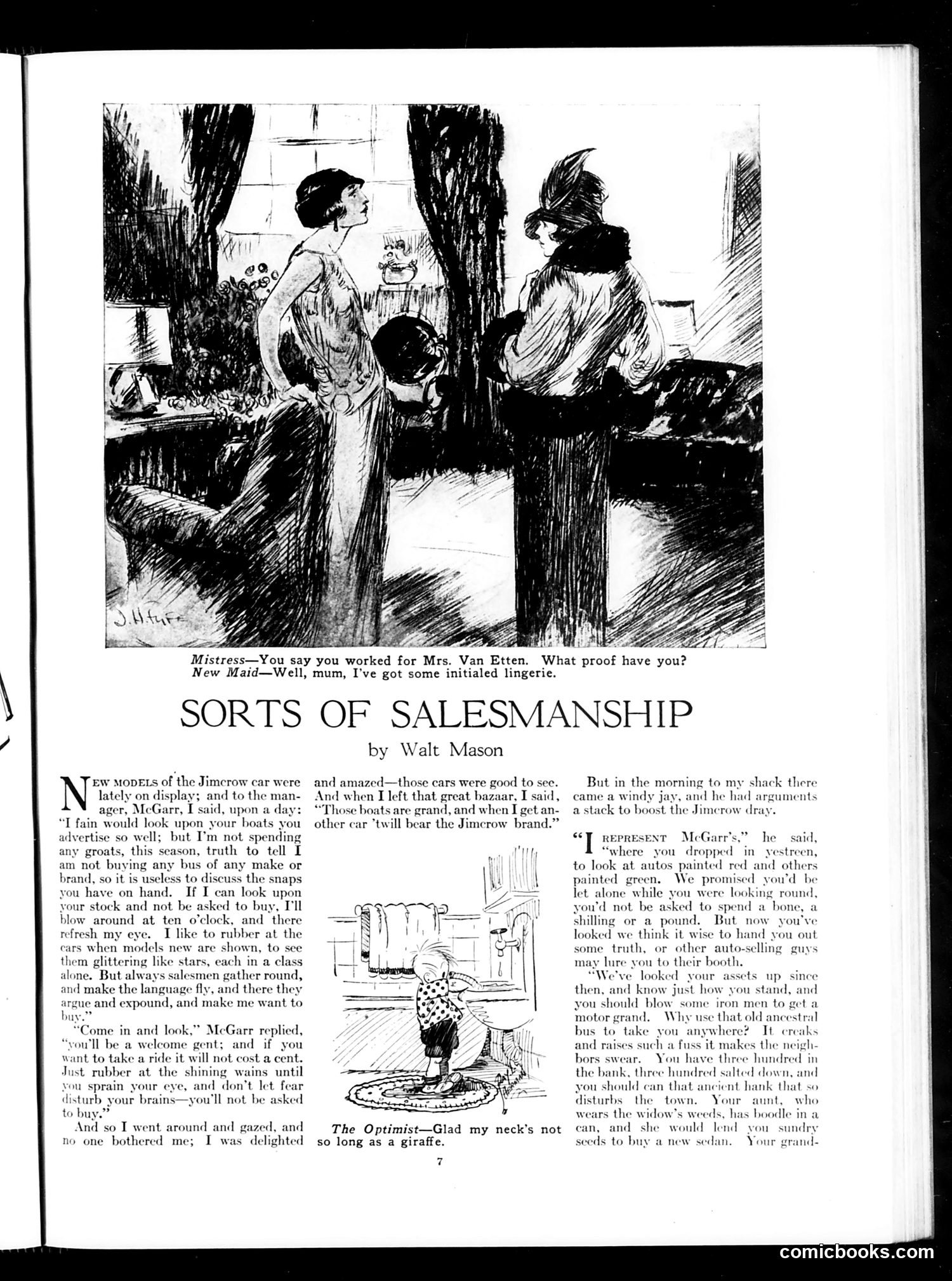
This page contains two pieces of satirical content about salesmanship and deception: **Top cartoon:** A joke about a new maid claiming work experience. When asked for proof she worked for "Mrs. Van Etten," she claims to have "initialed lingerie"—implying she stole from her employer rather than legitimately working there. The satire mocks both dishonest servants and gullible employers. **"Sorts of Salesmanship" story by Walt Mason:** Contrasts two sales approaches for Jimcrow automobiles. A non-pushy salesman lets customers browse without pressure; the customer leaves impressed but unbothered. Later, an aggressive salesman visits the customer's home, using personal financial details and family pressure ("Your aunt...has boodle") to manipulate him into buying. The satire criticizes aggressive, manipulative sales tactics that exploit people's vulnerabilities and finances—a contrast with ethical "soft-sell" approaches. The "Jimcrow" brand name is simply the car model (not the segregation laws, which came later).
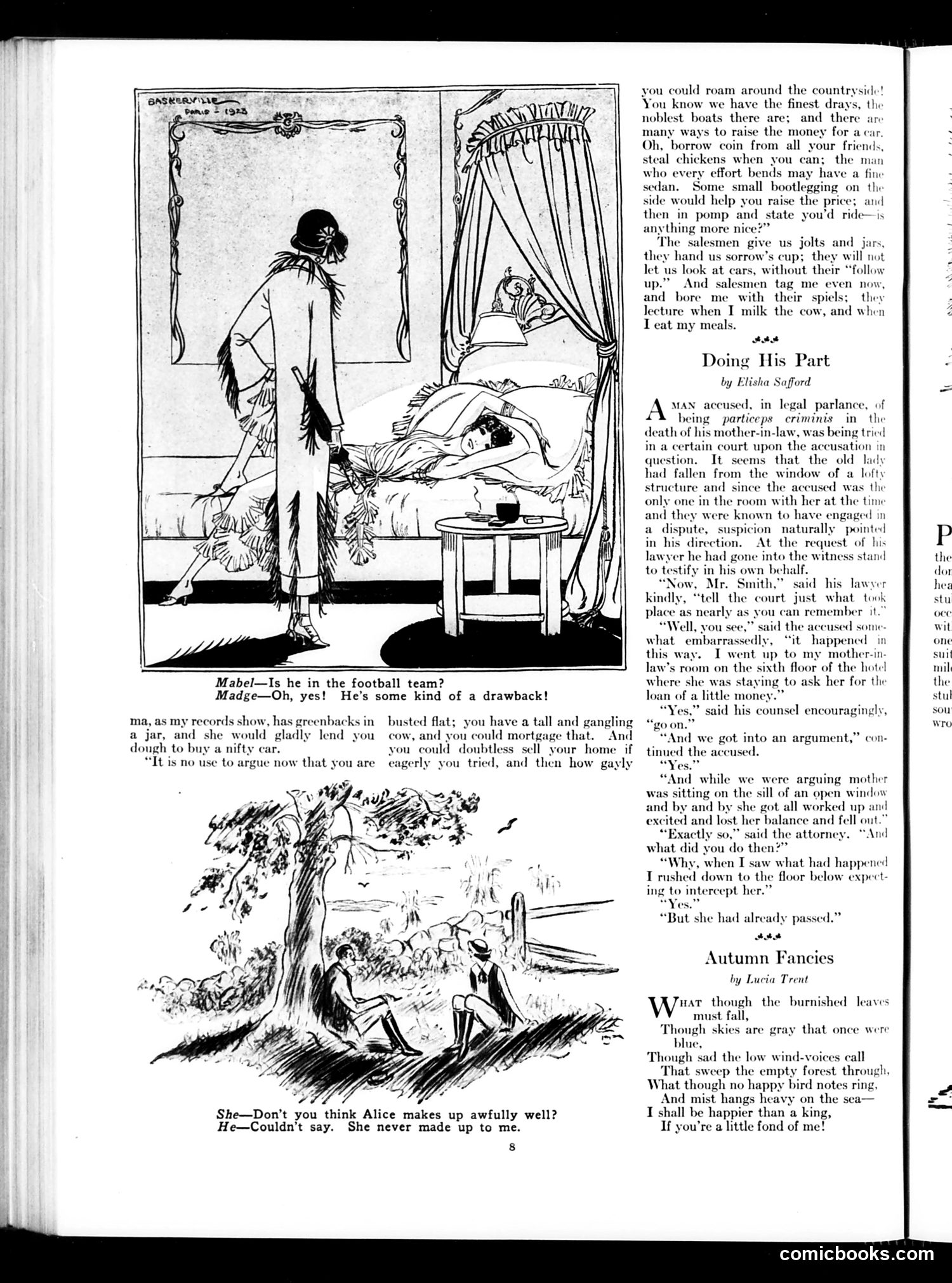
This page contains three distinct pieces: **Top cartoon**: A domestic humor exchange about a woman's appearance. The joke plays on the phrase "make up"—she asks if her friend Alice applies cosmetics well; he misunderstands, implying Alice never "made up" (reconciled) with him personally. Simple wordplay humor. **Middle section ("Doing His Part")**: A dark courtroom satire about a man accused of killing his mother-in-law. His testimony describes them arguing by an open window when she "lost her balance and fell out." The dark comedy lies in his implausibly convenient explanation—he rushes downstairs expecting to catch her, but she's already deceased. The satire mocks both incompetent criminal defense and the absurdity of obvious guilt presented as accident. **Bottom**: "Autumn Fancies," a sentimental poem about romantic devotion despite seasonal melancholy, unrelated to the satire above. The page reflects Judge's mix of social humor, legal satire, and romantic verse typical of early 20th-century American magazines.
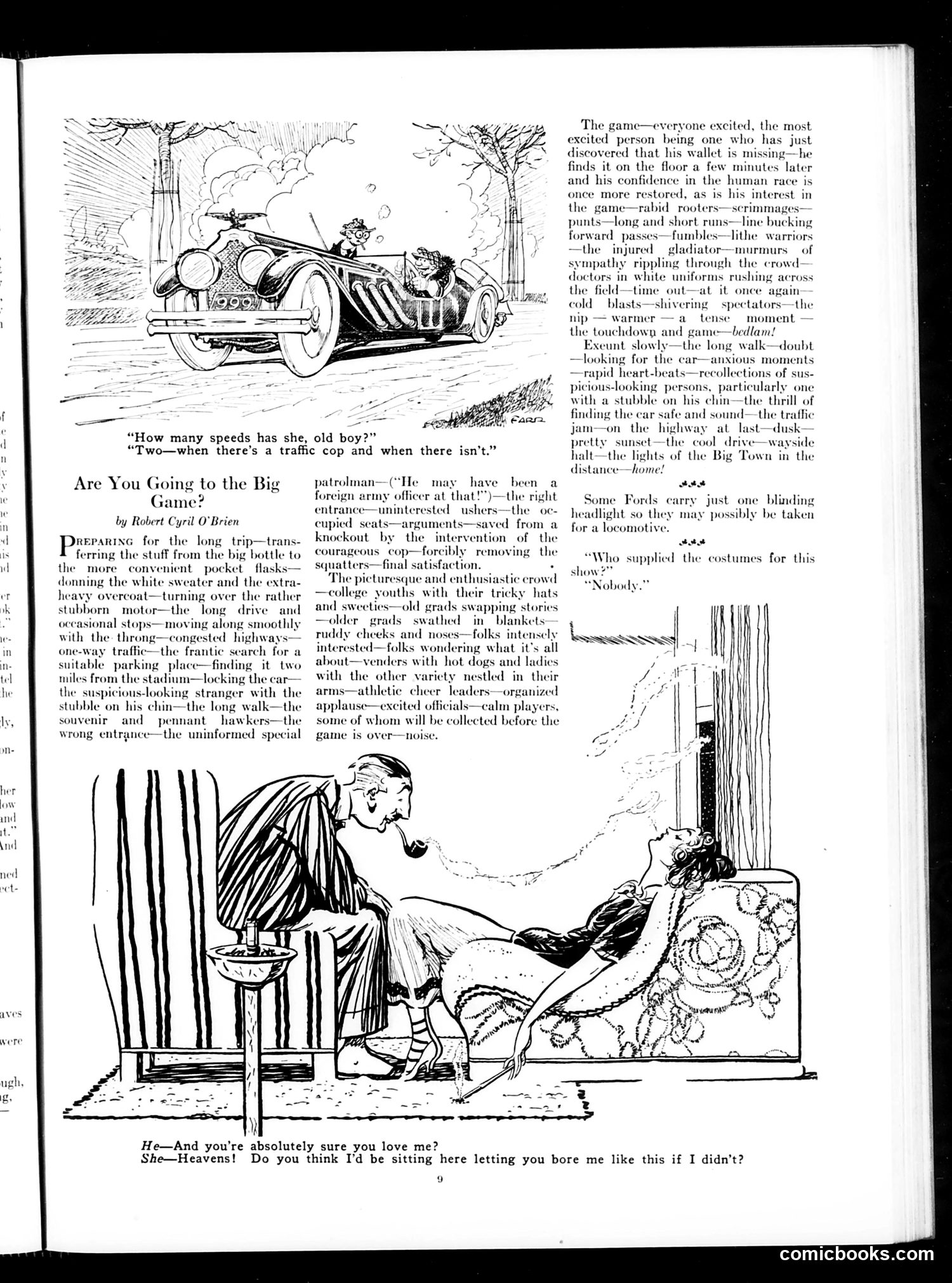
This page contains two distinct pieces of early 20th-century American humor: **Top cartoon**: A joke about automobile speeds and traffic enforcement. The caption "Two—when there's a traffic cop and when there isn't" satirizes how drivers behave differently under police scrutiny versus when unsupervised. This reflects the era's tension between new traffic regulations and driver behavior, suggesting widespread speeding and disregard for laws. **Main article/story**: "Are You Going to the Big Game?" by Robert Cyril O'Brien humorously catalogs the experiences of attending a college football game—from preparation through departure. It's a stream-of-consciousness piece capturing the era's football culture: prohibition-era flask-carrying, crowded stadiums, spectator rowdiness, vendor activity, and traffic chaos afterward. **Bottom cartoon**: A domestic scene where a woman sarcastically suggests she'd leave her boyfriend if he didn't bore her into submission—commentary on marriage tedium and female entrapment in relationships. The page reflects 1920s social concerns: automobile culture, Prohibition, college sports enthusiasm, and gender dynamics in marriage.
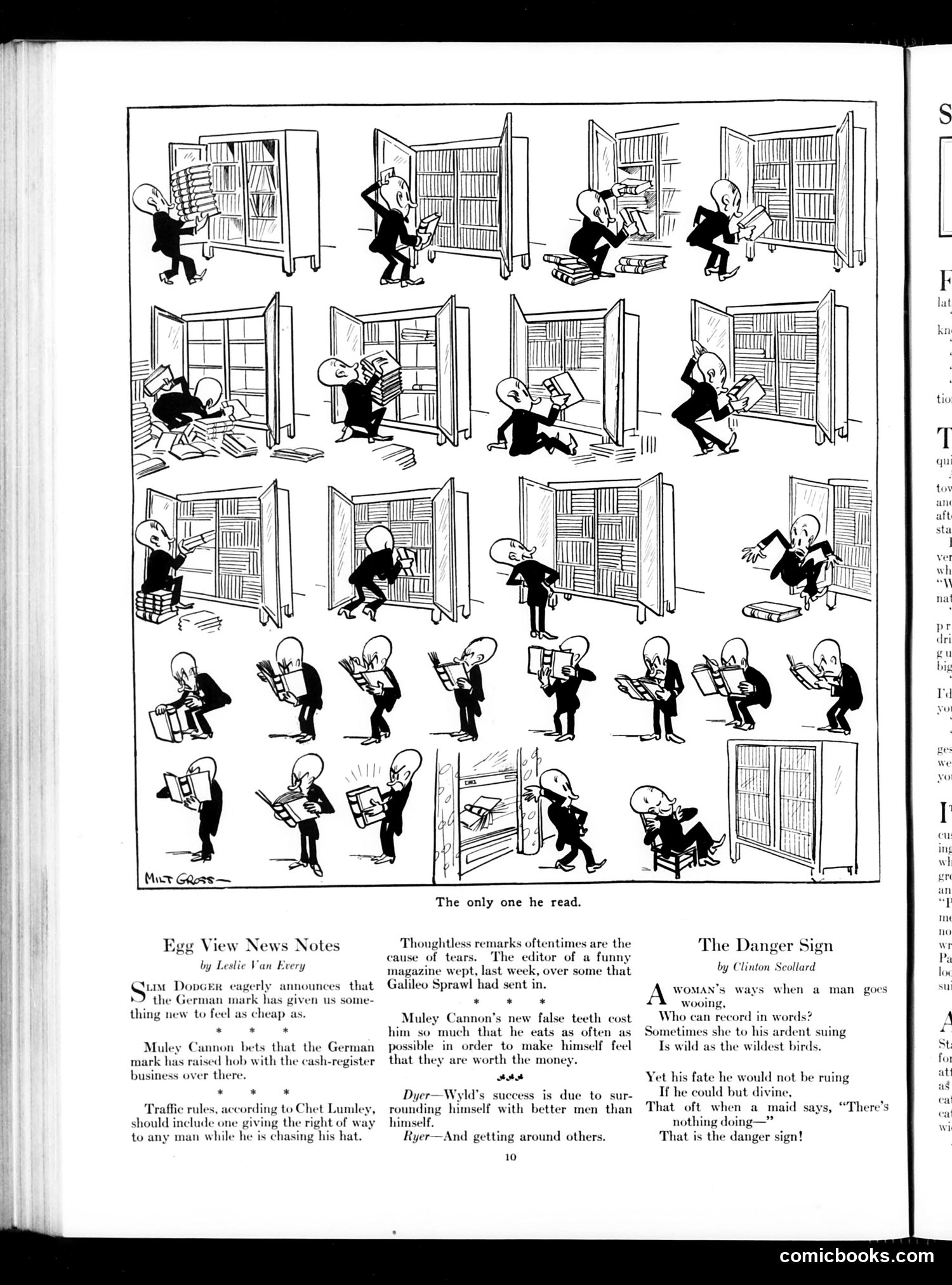
The main cartoon by Milt Gross (signed lower left) depicts a man repeatedly interacting with a bookcase in increasingly frantic ways—opening it, taking books out, throwing them around, and finally appearing distressed. The caption "The only one he read" is the joke's punchline. **The satire:** This mocks someone (likely a specific public figure, though unclear who) for illiteracy or minimal reading habits. Despite having access to an entire library, he only managed to read one book—suggesting either profound ignorance or disinterest in learning. Below are three short humor columns with mild satirical jabs: one about German currency inflation (a post-WWI reference), another mocking someone's cheap false teeth, and observations about traffic etiquette and workplace dynamics. The page ends with a poem about romantic rejection, where a woman's "nothing doing" response signals danger/heartbreak for an admirer. This reflects Judge magazine's typical approach: topical satire mixed with genteel humor about social pretension and romantic misadventure.
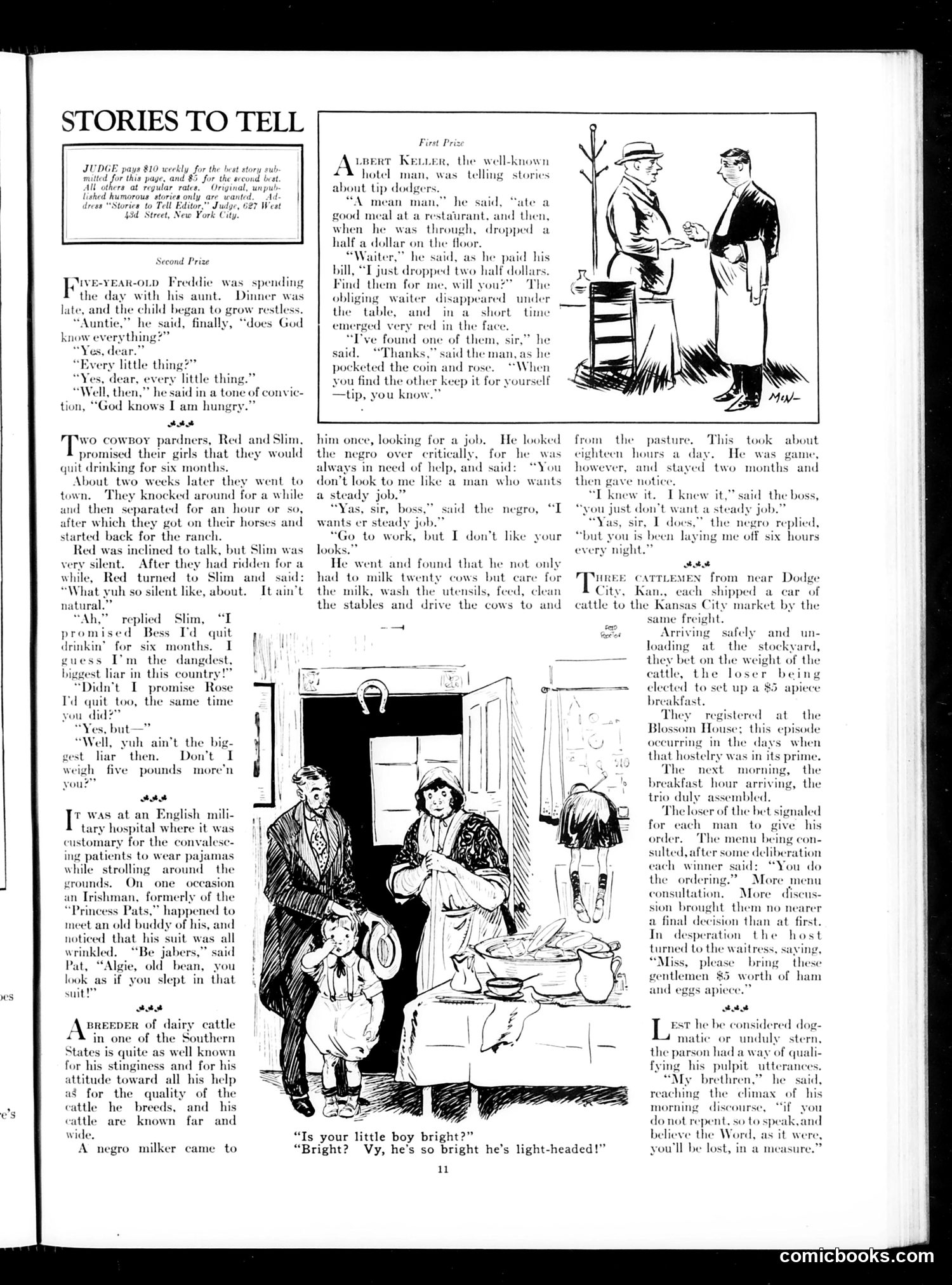
This is a humor column featuring several short anecdotal stories common to early 20th-century American magazines. The content reflects period attitudes and stereotypes: **"Tip Dodgers" (First Prize):** A cynical tale mocking stingy diners who con waiters into searching for nonexistent dropped coins, keeping any found money as fake "tips." **"The Cowboys":** Two ranch hands break sobriety pledges to their girlfriends, then lie about it—the humor derives from masculine frontier culture where drinking is normalized and dishonesty to romantic partners is treated as inevitable. **"The Stingy Cattle Breeder":** Depicts a Southern employer working a Black worker exhaustively (18-hour days) while denying him steady employment—framed as humorous rather than exploitative. This reflects the magazine's casual acceptance of racial labor discrimination. **"The Hospital Patient":** An Irish soldier's wrinkled pajamas joke plays on ethnic stereotypes about carelessness. The stories reveal period publication standards: racial stereotyping, gender role assumptions, and workplace exploitation treated as entertainment rather than social critique.
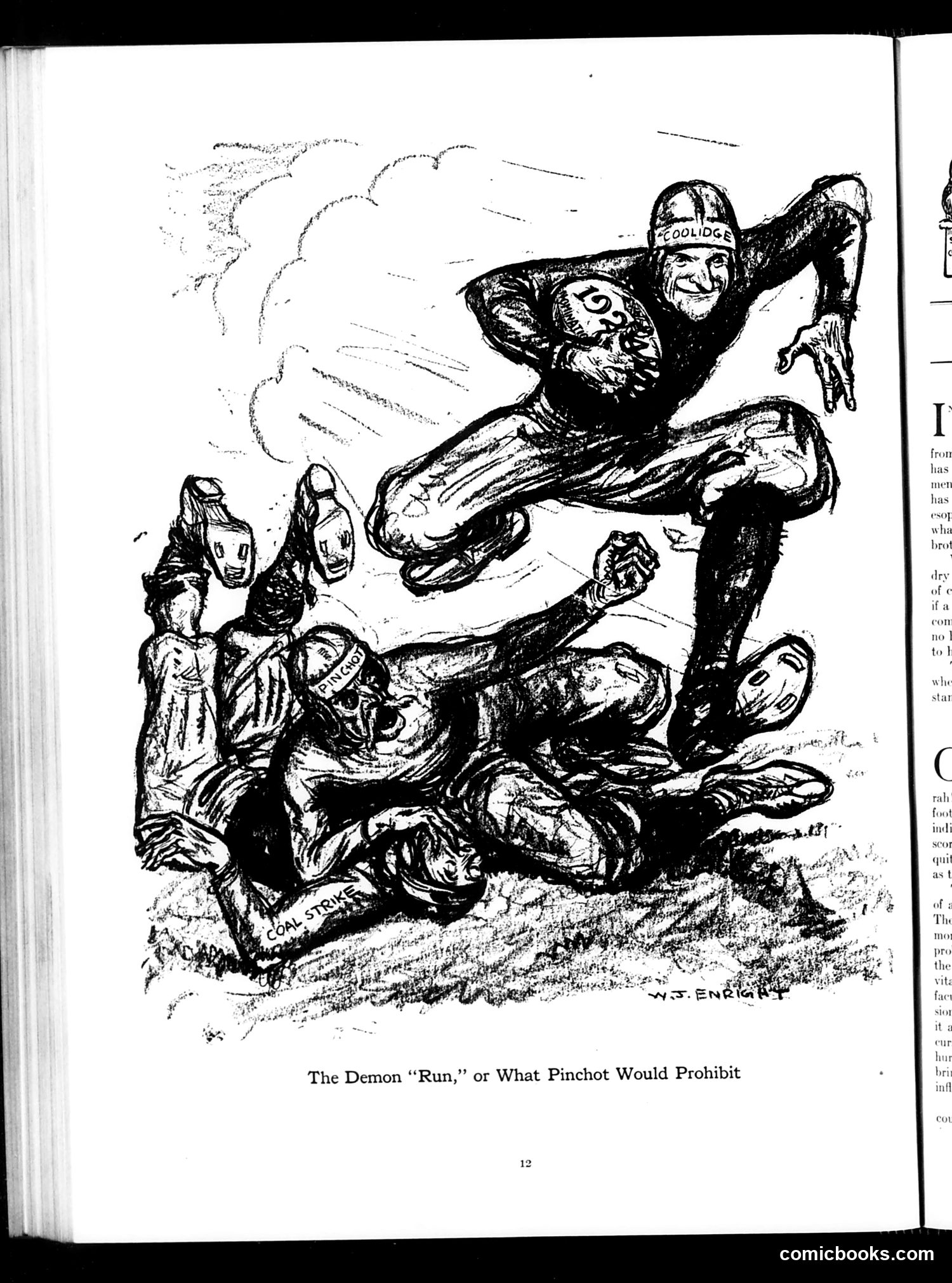
This political cartoon satirizes the concept of "run"—apparently referring to illegal alcohol distribution. A gleeful figure labeled "Coolidge" (President Calvin Coolidge) leaps joyfully above a pile of fallen figures labeled "Coal Strikes," suggesting he's escaping or triumphing over labor unrest. The cartoon's title references Gifford Pinchot, likely a political figure advocating prohibition or reform. The satire appears to critique either Coolidge's handling of labor issues or the gap between prohibition enforcement and actual practices. The demon "Run" suggests alcohol remains a persistent social problem despite prohibition efforts. The cartoon mocks the disconnect between what politicians claim they'll eliminate and what actually persists in society.
This page contains three editorial pieces satirizing American politics and social issues circa the Prohibition era. **"Boom-erang"** attacks Governor Gifford Pinchot of Pennsylvania for publicly criticizing President Coolidge's enforcement efforts while failing to enforce Prohibition in his own state. The satire suggests Pinchot is hypocritical—raising coal prices allegedly to fund bootleggers while preaching dry virtue. **"The Game of Games"** praises college football's growth as beneficial to American character, arguing it instills "self-control, courage and good sportsmanship" despite concerns about professionalism corrupting academic institutions. **"A Possible Solution"** satirizes Prohibition's failure through a divorce case where a woman blames her husband's drinking. The piece mockingly suggests both spouses getting drunk together might reconcile them—implying Prohibition doesn't work and highlighting the absurdity of alcohol laws. The Judge mascot cartoon (top left) reinforces the satirical tone. These pieces reflect 1920s skepticism toward Prohibition enforcement while celebrating football's role in American society.
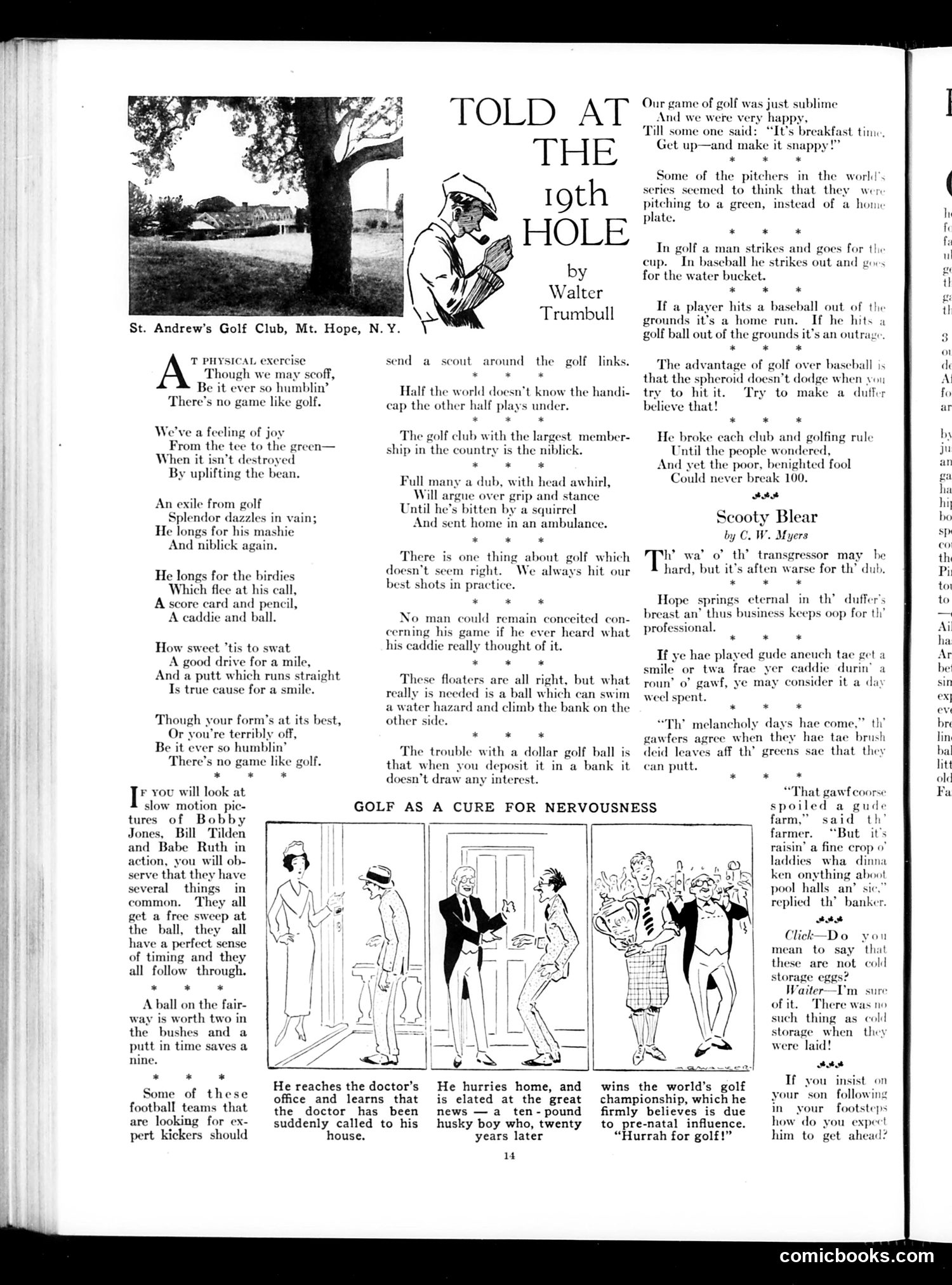
This page from Judge magazine presents golf-related humor typical of early 20th-century American satire. The main content includes: **"Told at the 19th Hole"** — A poem by Walter Trumbull comparing golf to baseball, using the contrast to satirize both sports. The jokes mock golfers' obsession with the game (preferring it to breakfast), baseball pitchers who can't distinguish a baseball diamond from a golf green, and the general absurdity of golf's rules and equipment. **"Scooty Bear"** — A short comic piece mocking "duffers" (poor golfers) and their perpetual optimism despite incompetence. **"Golf as a Cure for Nervousness"** — A cartoon strip showing a nervous man prescribed golf by his doctor, eventually winning a golf championship. The satire suggests golf's psychological grip transcends logic. The overall theme ridicules golf's irrational appeal: grown men obsess over the sport despite repeated failure, broken equipment, and embarrassment. The satire reflects 1920s American attitudes toward the newly popularized game as an upper-class leisure pursuit worthy of gentle mockery.
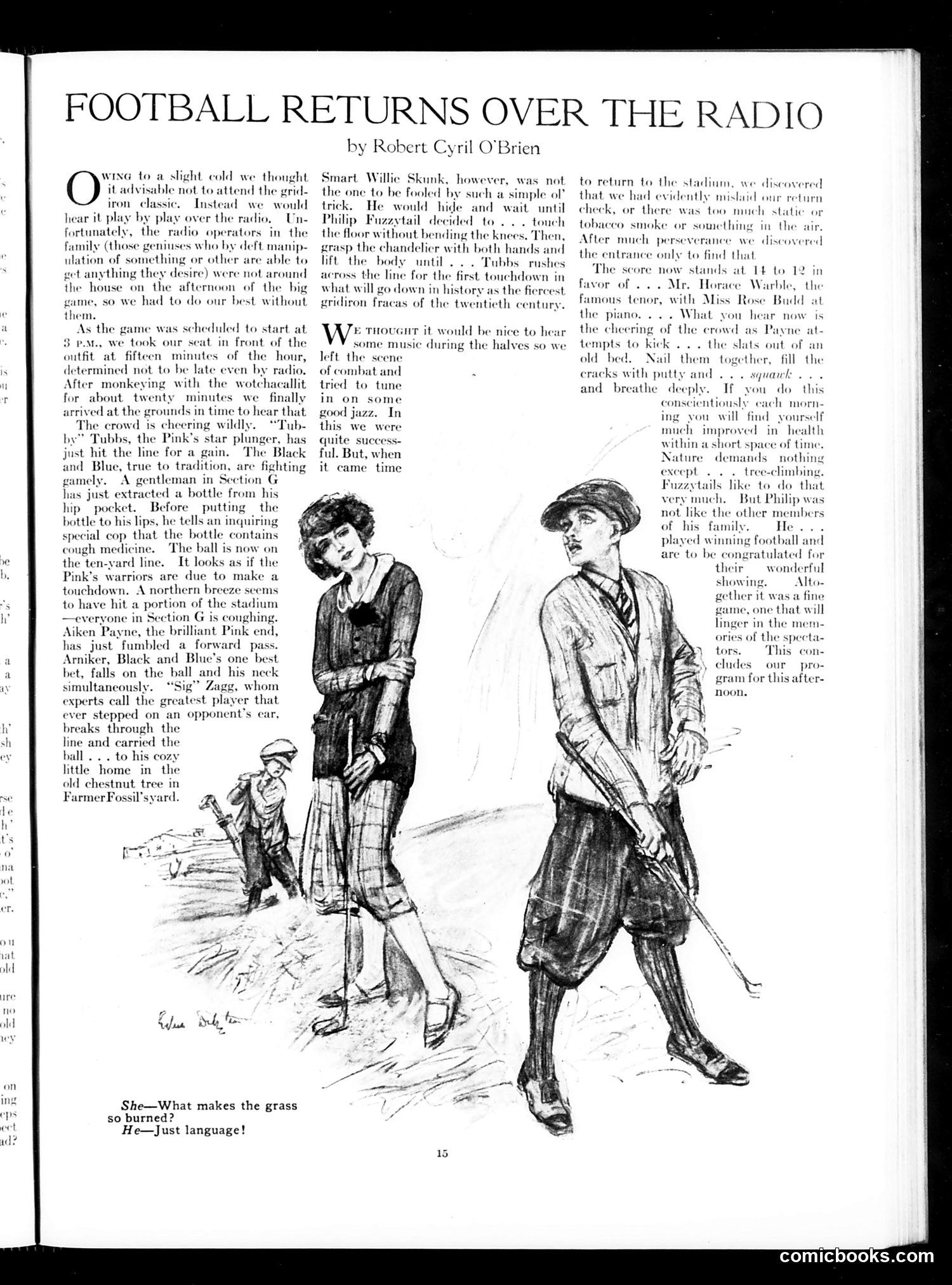
This humorous piece satirizes the early radio era's unreliable technology and the absurdity of experiencing a live football game secondhand through broadcasts. The author attempts to follow a game by radio instead of attending in person, but encounters typical 1920s radio problems: difficulty tuning in, static, and loss of signal. The satire mocks radio's limitations—listeners miss crucial moments, mishear details, and the broadcast becomes garbled nonsense (descriptions devolve into surreal non-sequiturs about animals and household objects). The final joke shows the irony: they lose their return ticket to the stadium and accidentally tune into a tenor's concert instead of the second half. The bottom cartoon jokes about burned grass from heated "language"—suggesting fans' profane outbursts at the game. Overall, the piece gently ridicules both unreliable radio technology and fans' desperation to follow sports remotely rather than attend in person.
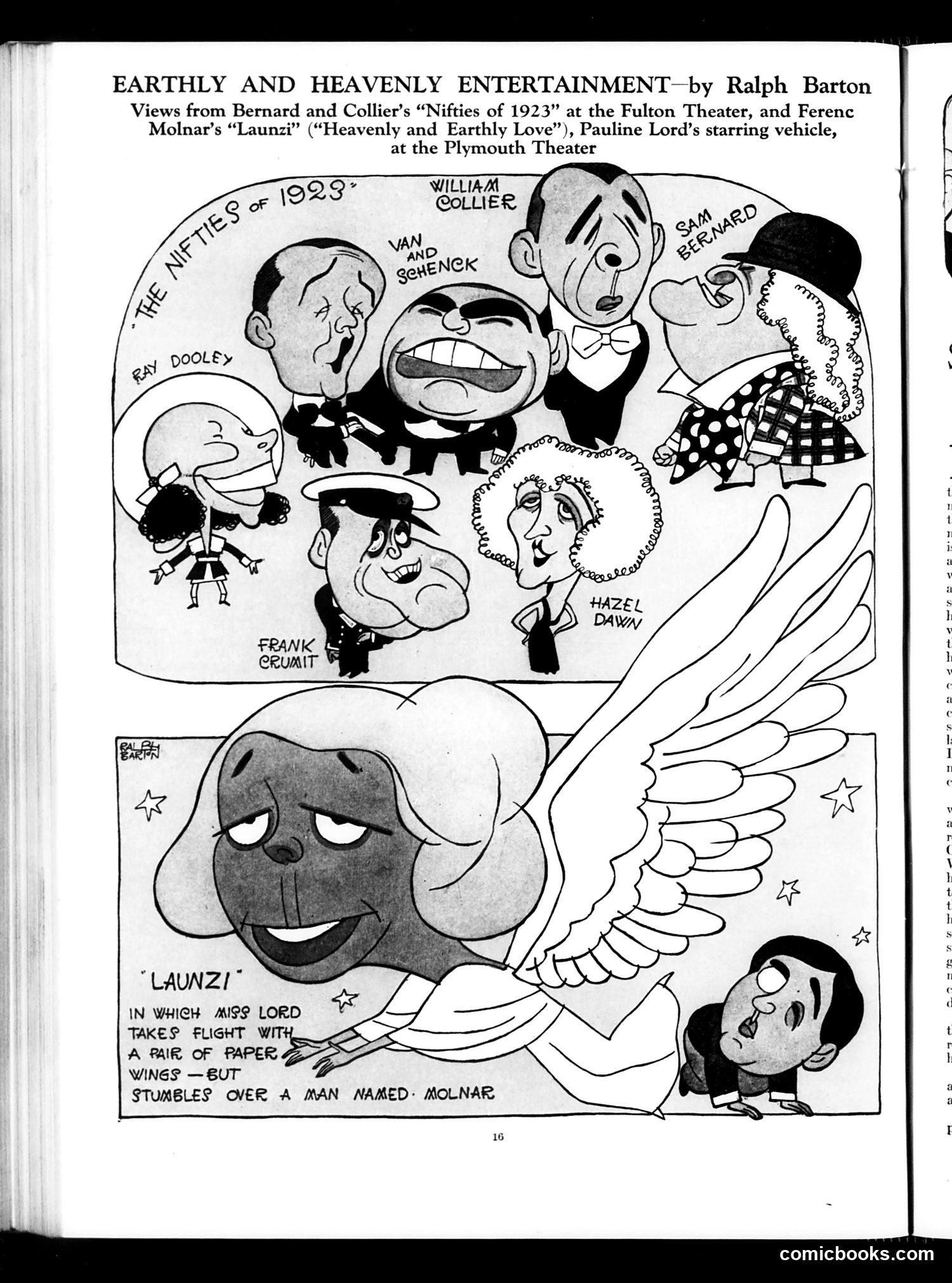
Ralph Barton's cartoon reviews two 1923 Broadway productions. The top panel caricatures performers from "Nifties of 1923" at the Fulton Theater, identifying William Collier, Van Genneck, Frank Crumit, Ray Dooley, Sam Bernard, and Hazel Dawn—popular vaudeville and musical theater stars of the era. The bottom panel illustrates Ferenc Molnar's play "Launzi" (subtitled "Heavenly and Earthly Love"), starring Pauline Lord. The joke depicts Miss Lord as an angel with paper wings attempting flight but stumbling over a man named Molnar—likely a pun on the playwright's name and the production's literal plot about heavenly matters meeting earthly mishaps. The cartoon serves as entertainment news, using exaggerated caricature to humorously report on current theatrical attractions for Judge magazine's readers.
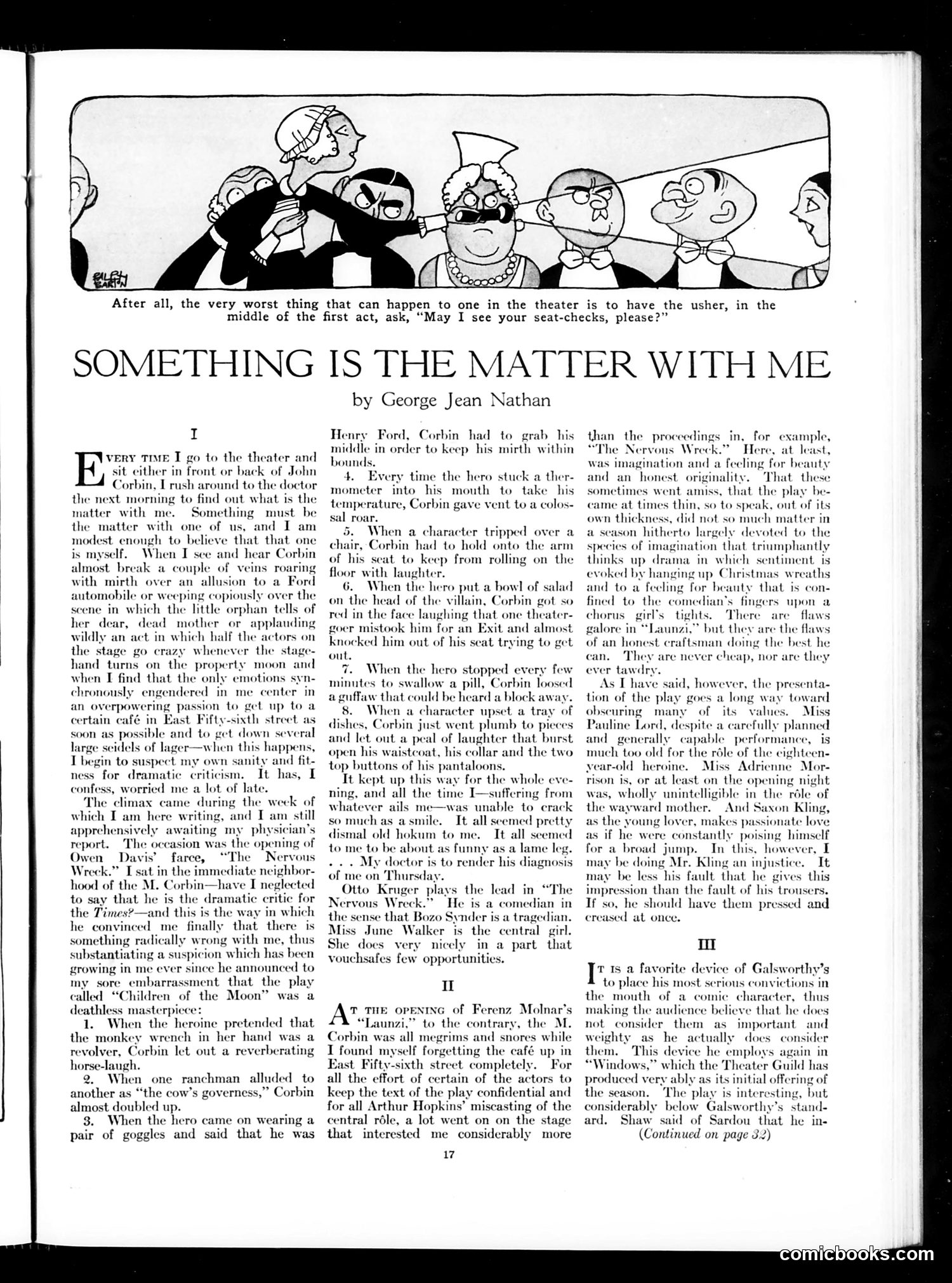
The cartoon depicts theater patrons and an usher. The joke targets the universal annoyance of having one's seat checked mid-performance—the worst possible theater interruption. The article by George Jean Nathan is a theatrical review criticizing fellow critic M. Corbin's excessive laughter during Owen Davis' farce "The Nervous Wreck." Nathan contrasts his own inability to find humor in the play's slapstick gags (Ford automobiles, thermometers, salad bowls on villains' heads) with Corbin's uncontrollable hilarity at every pratfall and sight gag. Nathan uses this disparity to question his own critical judgment, sarcastically suggesting he needs a doctor's diagnosis to understand why he finds such broad comedy tedious while Corbin finds it hilarious. The satire targets both lowbrow theatrical tastes and the pretensions of dramatic critics—implying either Corbin lacks discernment or Nathan is too highbrow to appreciate popular entertainment.
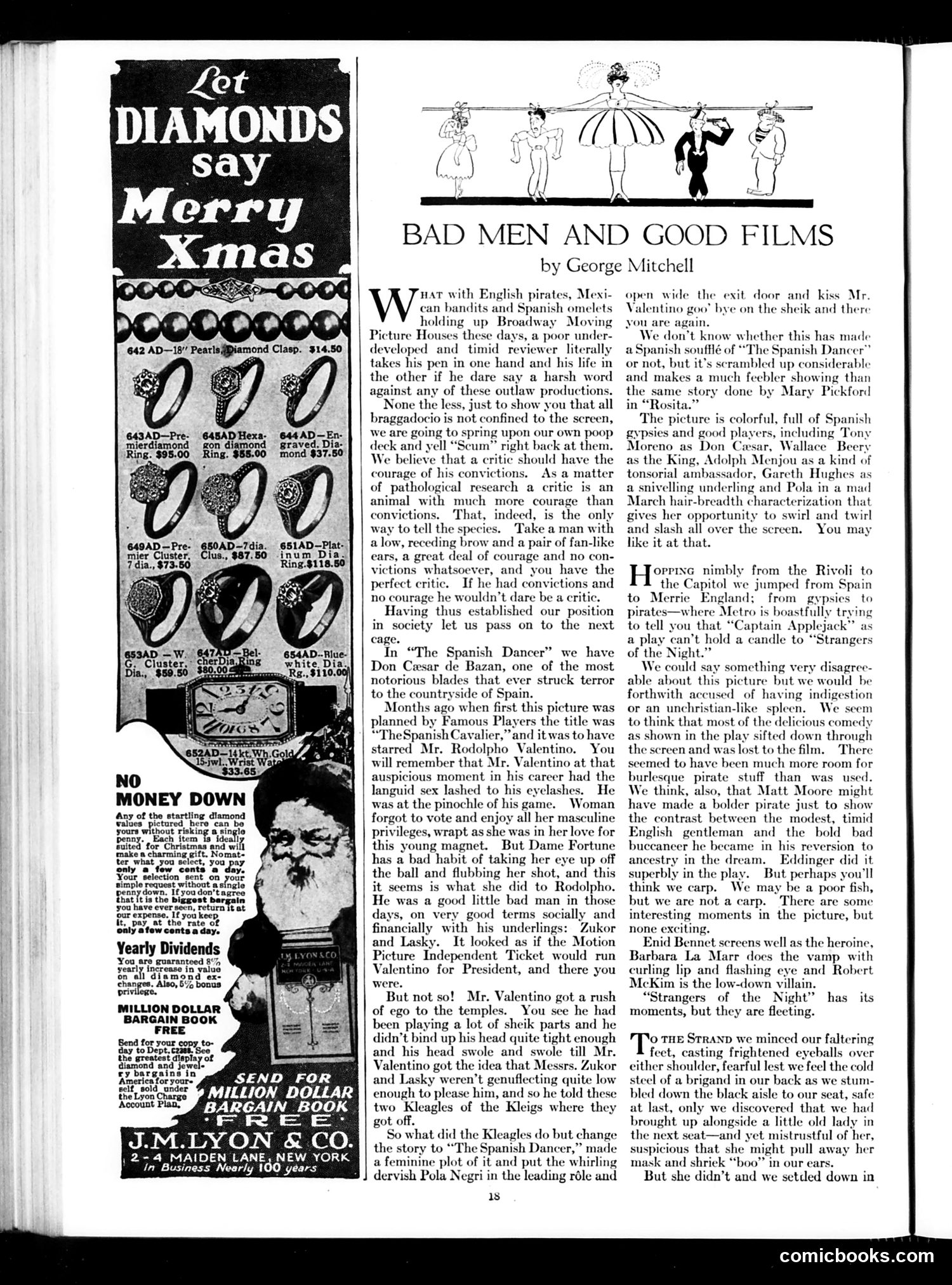
This page features George Mitchell's film critique of "The Spanish Dancer" alongside a diamond advertisement. **The Article's Context:** Mitchell defends film critics against complaints from those working in cinema—comparing the critic's task to facing "English pirates, Mexican bandits and Spanish omelets holding up Broadway Moving Picture Houses." He establishes his credibility to critique harshly. **The "Spanish Dancer" Discussion:** The review discusses how the film originally starred Rudolph Valentino as "Don Cesar de Bazan" but was restructured when Valentino's ego became problematic. Mitchell sarcastically describes Valentino at his peak, when "woman forgot to vote" to worship him, but notes his ego led him to dispute Zukor and Lasky's (studio heads') authority. The studios retaliated by replacing him with Pola Negri and refocusing the plot as feminine. **The Satire:** Mitchell mocks Valentino's inflated self-importance ("his head swole and swole") and the studio system's petty power struggles, suggesting the film suffered from these behind-scenes conflicts rather than artistic merit.
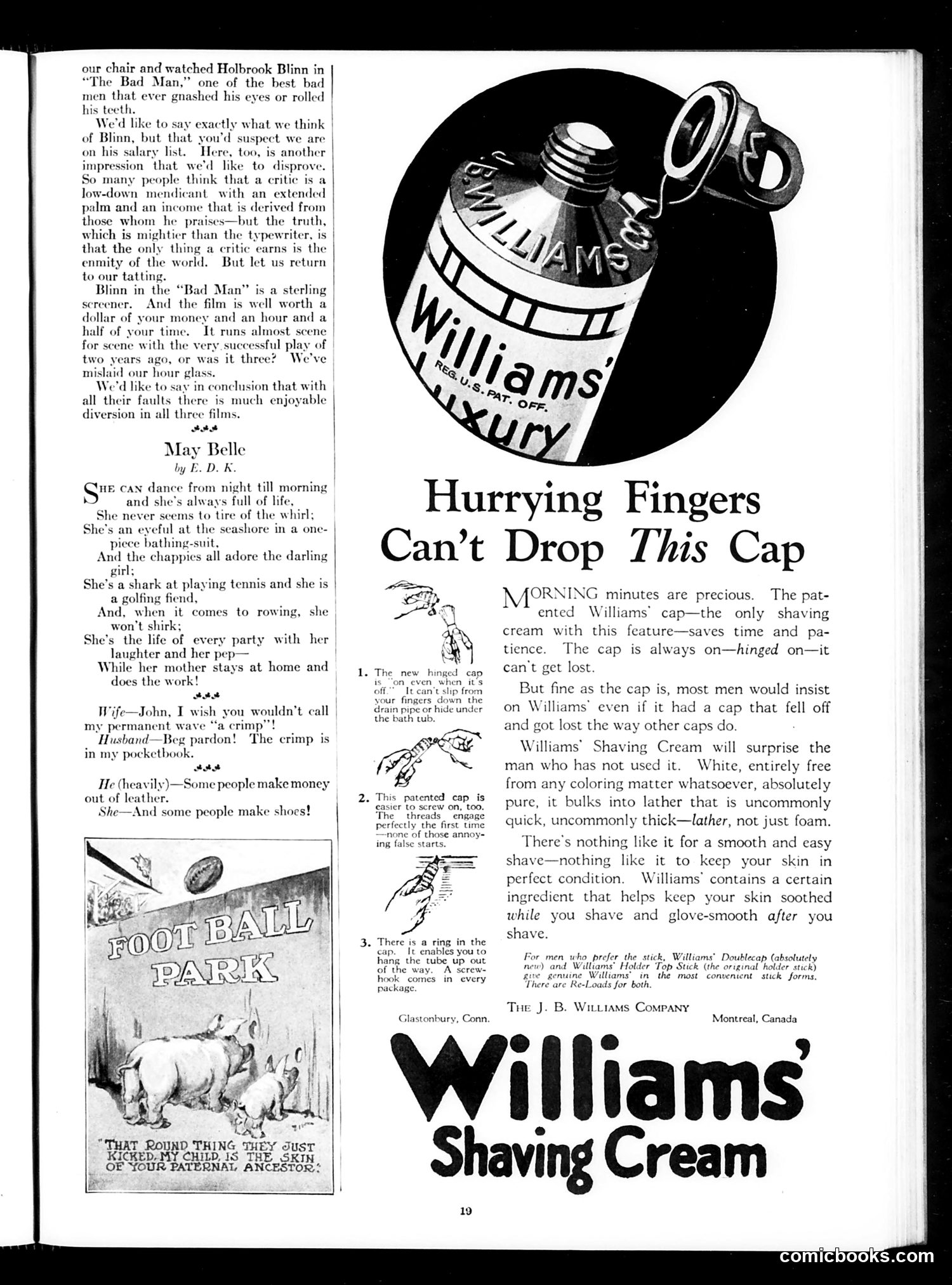
This page contains mixed content: **film criticism, humor pieces, and advertising**. The top section reviews actor Holbrook Blinn in the film "The Bad Man," praising his performance while humorously disclaiming any bias. The critic defends the profession against the stereotype that critics accept bribes—asserting they earn only "enmity of the world." Below are three brief humor pieces: "May Belle" (a poem about an active young woman whose mother does the housework), and two short jokes about marriage and class differences (a wife correcting her husband's crude language; a husband joking that his "crimp" refers to his empty wallet). The dominant element is a **Williams' Shaving Cream advertisement** featuring a hinged cap design. The ad emphasizes convenience—the cap stays attached and won't get lost. It highlights the product's lather quality and skin-soothing properties, marketing to men's grooming standards of the era. The page reflects early 20th-century concerns: gender roles, consumer convenience innovations, and film as popular entertainment.
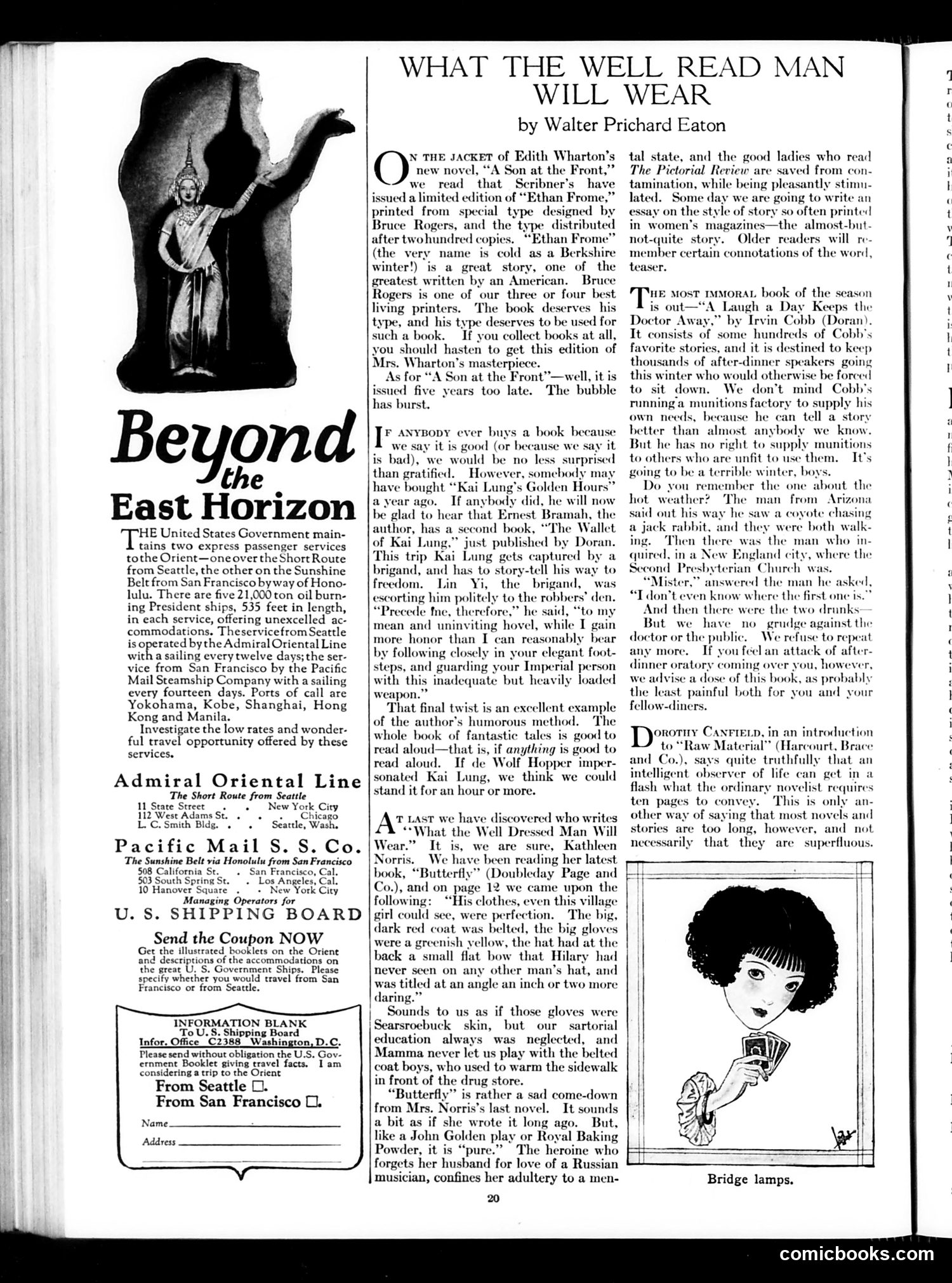
This page is primarily book reviews and shipping advertisements, with a small illustration of a fashionable woman holding cards (labeled "Bridge lamps") in the right margin. The main satirical article by Walter Prichard Eaton reviews recent novels, including works by Edith Wharton and Ernest Bramah. Eaton mocks Kathleen Norris's novel *Butterfly*, suggesting she plagiarized or borrowed her description of a well-dressed man's clothing from fashion writing—the joke being that Norris, known for domestic fiction, apparently couldn't even invent original clothing descriptions. The title "What the Well Dressed Man Will Wear" sarcastically attributes this phrase to Norris as though she were a fashion columnist rather than a novelist. The humor relies on readers recognizing Norris as a popular women's author whose work was considered derivative or formulaic.
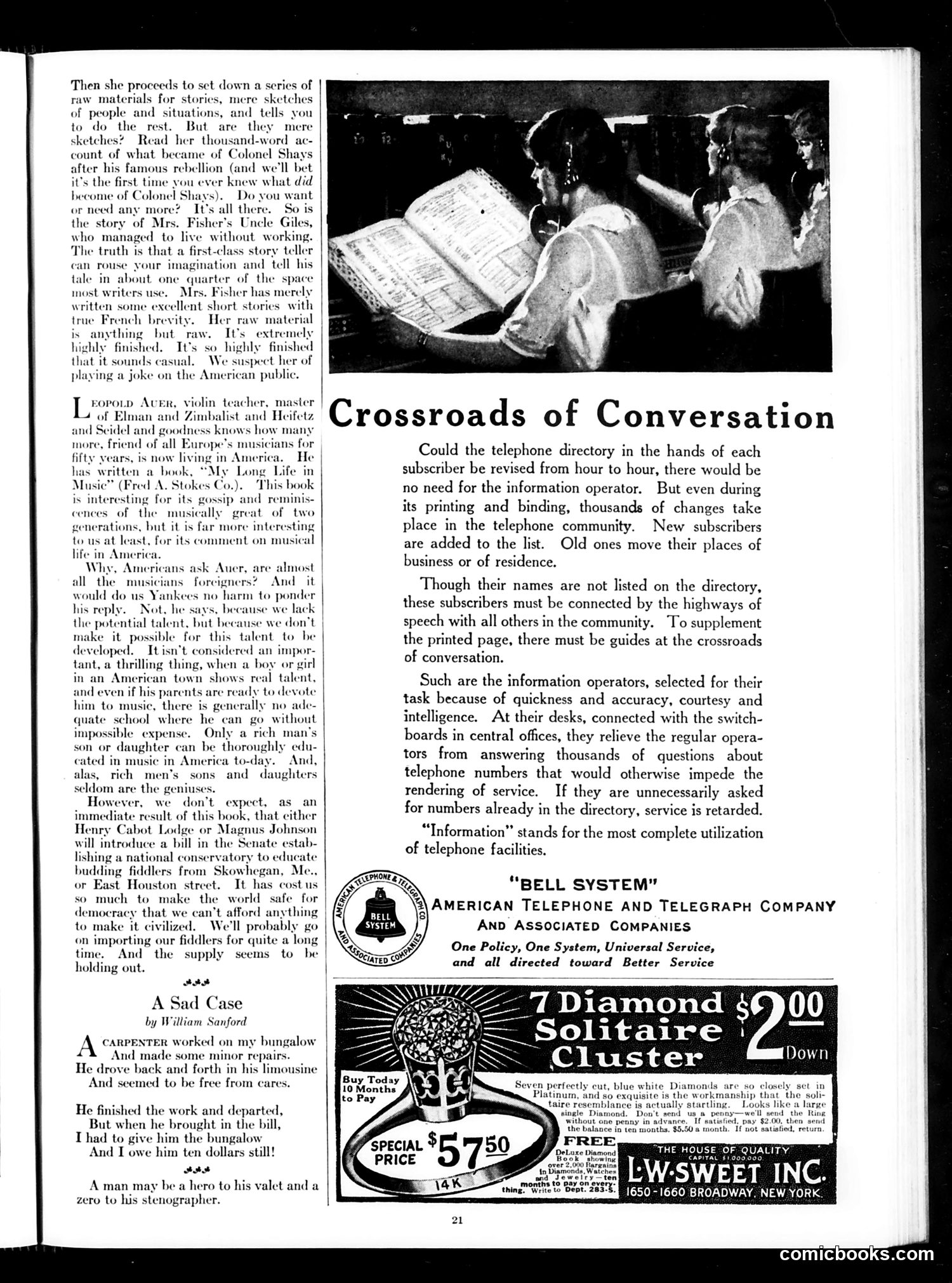
This page contains literary criticism and humorous content rather than political cartoons. The main pieces discuss: **Literary Reviews**: Critiques of Mrs. Fisher's short story collections and Leopold Auer's autobiography "My Long Life in Music." The reviewer praises Fisher's economical storytelling while noting Auer's observations about why America lacks homegrown musical talent—wealthy patrons don't support young American musicians adequately. **"A Sad Case" Poem**: A humorous verse about economic role-reversal: a carpenter performs minor repairs on a bungalow but demands such an exorbitant fee that the homeowner must surrender the entire property and still owes money. **Bell System Advertisement**: Frames telephone information operators as necessary "guides at the crossroads of conversation," justifying their role in a rapidly changing subscriber base. The page's satire targets class disparities and economic absurdity rather than specific politicians. The carpenter poem exemplifies post-WWI anxieties about shifting wealth and worker leverage, while the Auer review critiques American cultural neglect of domestic talent.
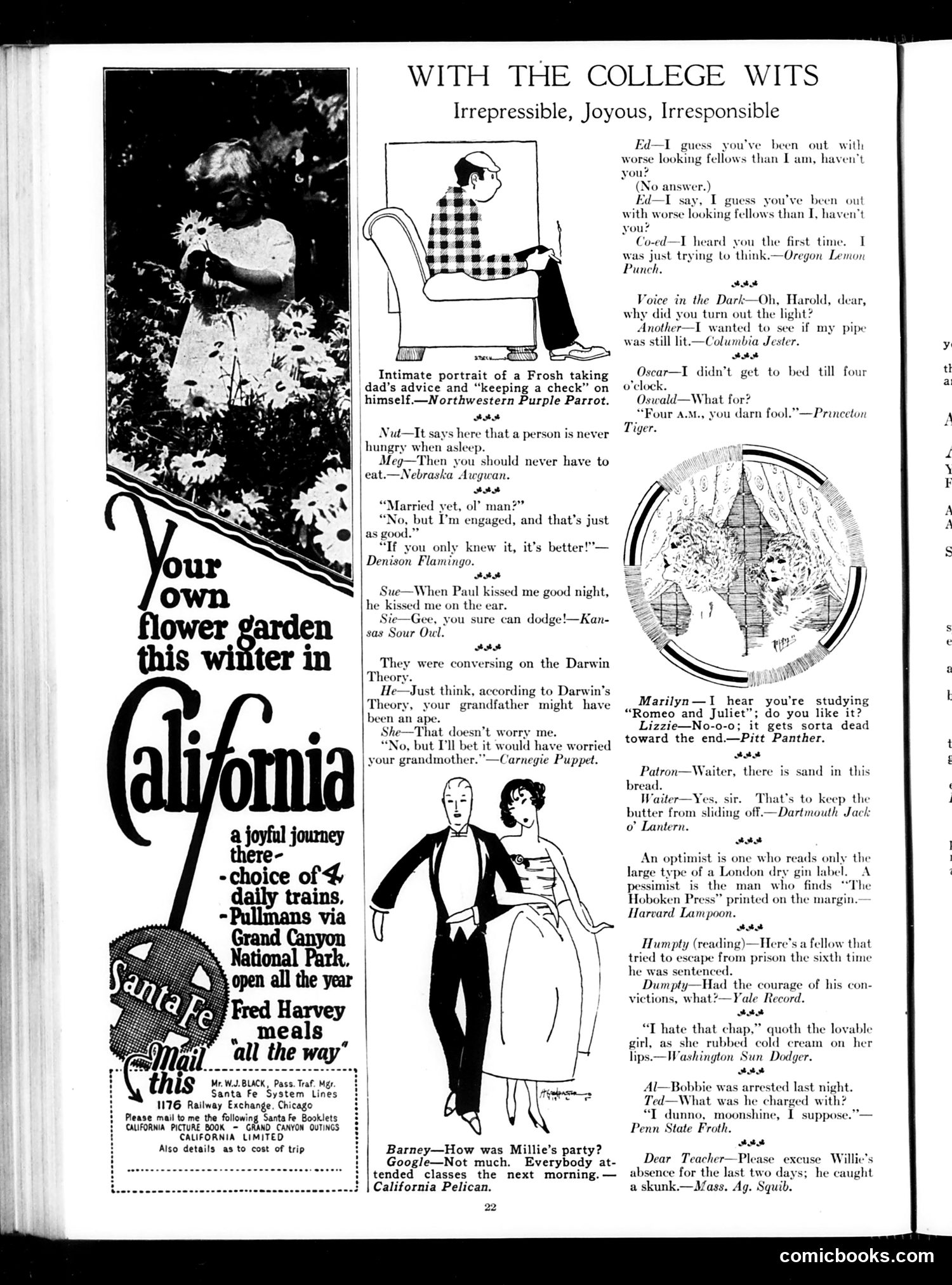
This page collects humorous one-liners and short jokes sourced from college newspaper humor columns—a common Judge feature. The jokes target typical 1920s college experiences: dating, social awkwardness, and student life. The humor relies on: - **Flirtation and courtship**: A co-ed ignoring a suitor's repeated compliment; kissing scenes; engagement versus marriage debates - **Student stereotypes**: The naive "Frosh" (freshman), party-goers skipping classes - **Generational jibes**: Darwin Theory jokes mocking students' pseudo-intellectual pretensions - **Mild social transgression**: References to moonshine (Prohibition-era alcohol), late nights, skunk-catching pranks The cartoons show conventional 1920s dating scenarios and a formal couple. These jokes assume readers will recognize college life as innocuously rebellious—students concerned with romance, avoiding responsibility, and making clever quips. The satire targets college youth's self-importance rather than serious social issues, positioning them as endearingly foolish rather than genuinely transgressive.
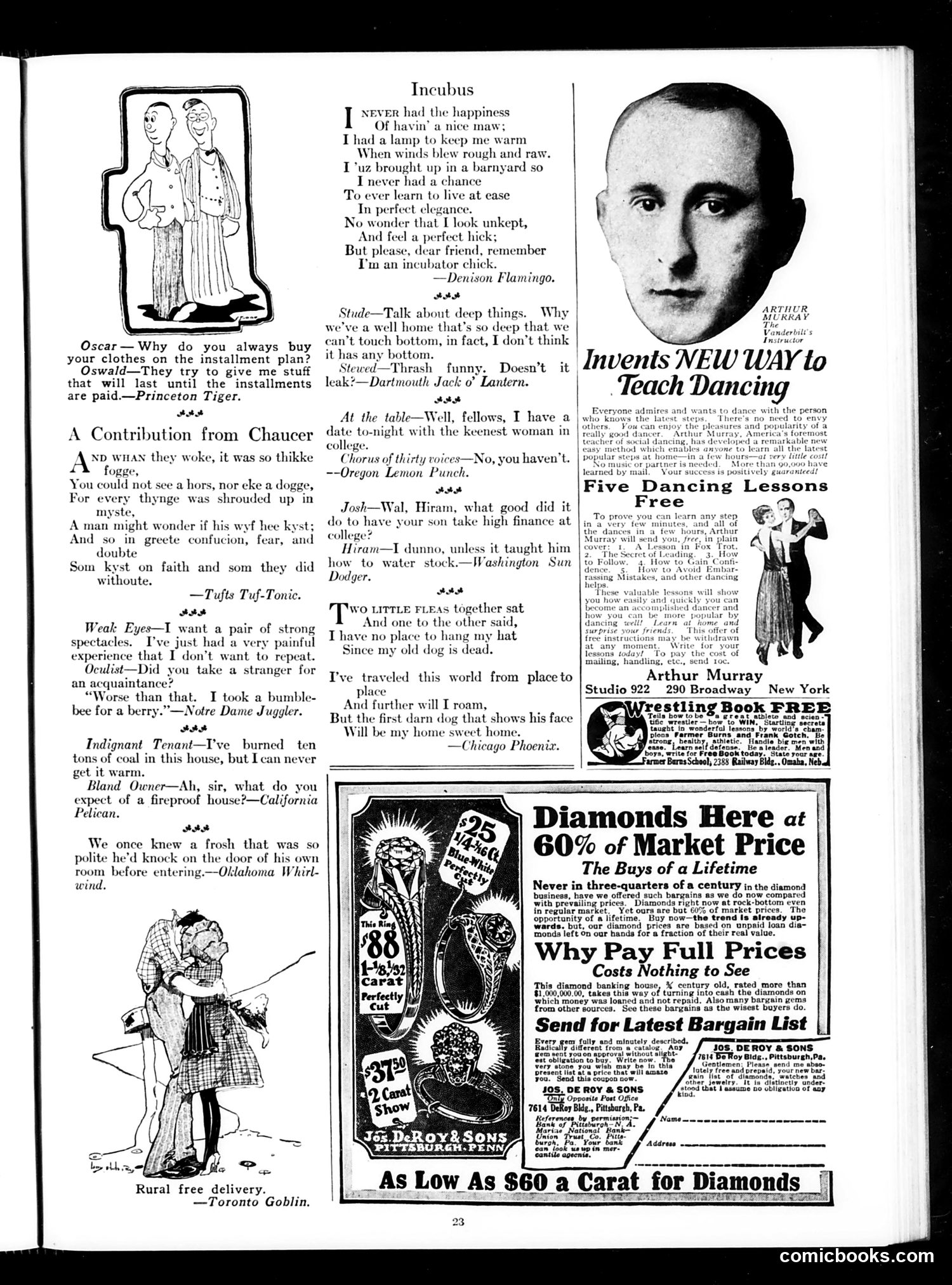
This page from *Judge* magazine contains mostly **humor reprints from college publications** (Princeton Tiger, Tufts, Notre Dame, etc.) and **advertisements**, rather than original political cartoons. The jokes reflect early 20th-century college humor: installment-plan clothing, a poem about an "incubator chick" (a motherless bird), puns about deep wells and fireproof houses. The Chaucer parody satirizes old English poetry conventions. **The main visual cartoon** (bottom left) shows a woman with a fishing rod—labeled "Rural free delivery"—humorously depicting mail delivery service reaching remote rural areas, a relatively new government program at the time. **The advertisements** include Arthur Murray dance lessons and a prominent diamond dealer claiming 60% discounts—likely targeting postwar consumers seeking luxury goods. The page reflects *Judge's* role as a general-interest satirical magazine mixing student humor reprints with commercial advertisements for affluent readers.
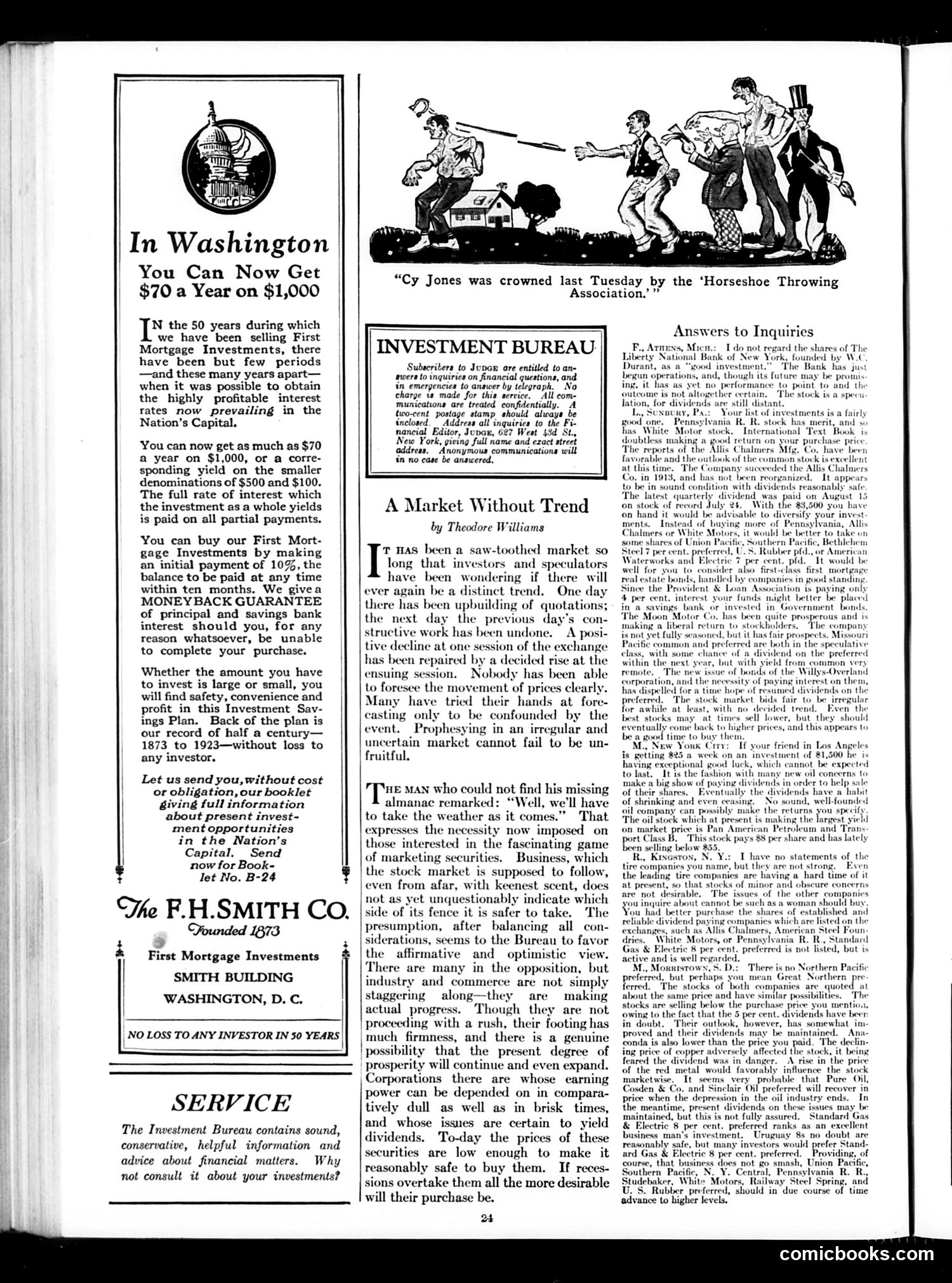
This Judge magazine page combines financial advertising with period humor and investment advice. **The Main Cartoon:** The caption "Cy Jones was crowned last Tuesday by the 'Horseshoe Throwing Association'" accompanies an illustration of men in suits attacking someone with a horseshoe. This is a visual pun: "horseshoe" suggests bad luck, so being "crowned" with one humorously means being struck on the head—satirizing how foolish or unlucky the average person becomes when investing. **The Context:** The 1920s were marked by stock market volatility and widespread speculation. Judge satirizes this by juxtaposing the cartoon (mocking investors' poor judgment) with serious investment advertisements and articles offering financial advice. **The Irony:** While F.H. Smith Co. promises "NO LOSS TO ANY INVESTOR IN 50 YEARS" and Theodore Williams counsels cautious optimism about market trends, the cartoon mockingly suggests ordinary people making investment decisions are essentially getting beaten by chance—a sharp critique of 1920s speculation mania.
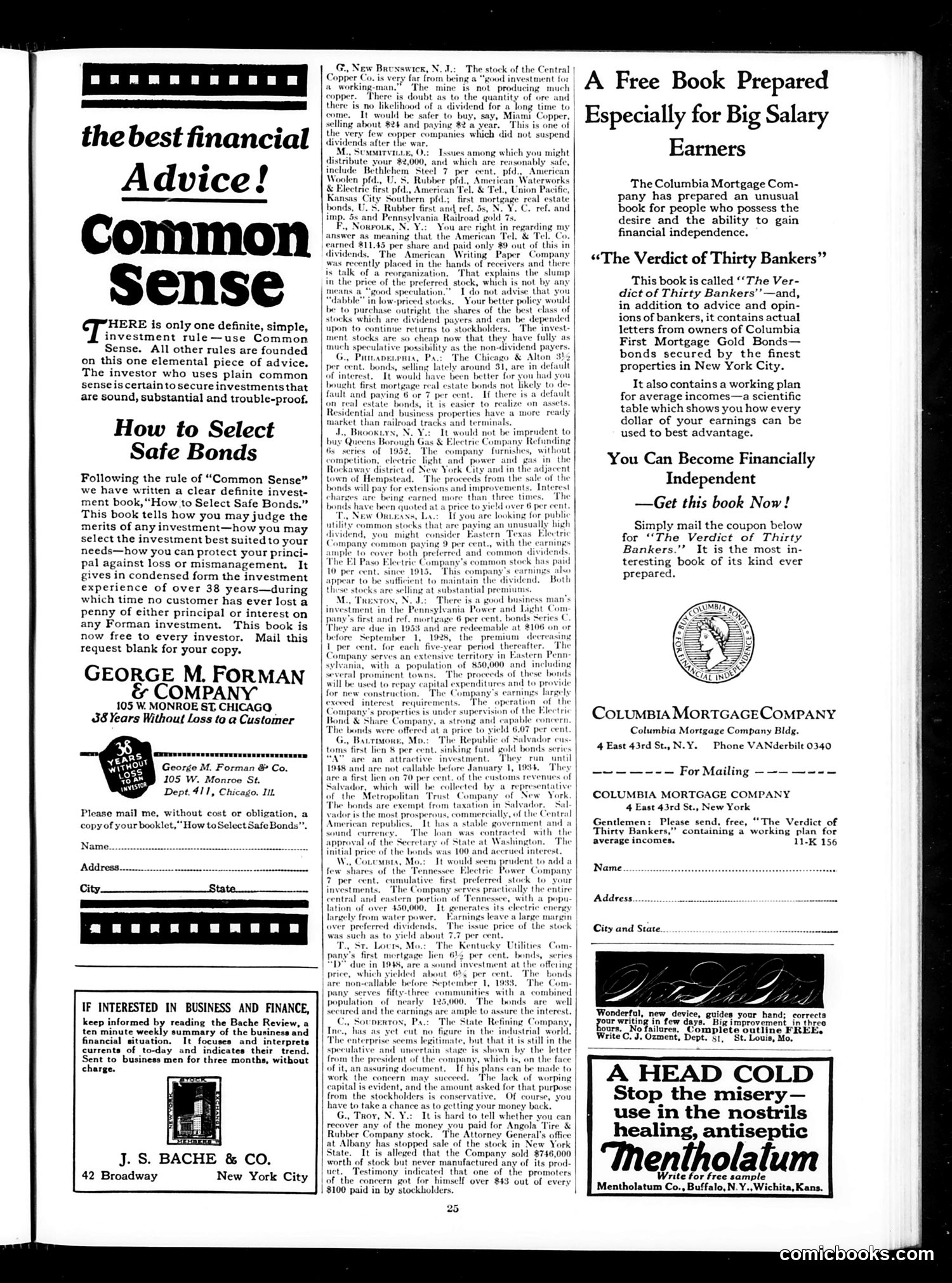
This page is primarily **financial advertising and advice**, not political satire. It consists of: **Main Content:** Investment guidance columns offering stock and bond recommendations. The advice emphasizes "Common Sense" investing in safe, dividend-paying securities rather than speculative stocks. Specific recommendations include Bethlehem Steel bonds, Miami Copper stock, and utility company securities. **Advertisers:** - George M. Forman & Company (investment firm offering a free book on selecting safe bonds) - J.S. Bache & Co. (brokerage house) - Columbia Mortgage Company (promoting financial independence) - Mentholatum (cold remedy) **Historical Context:** This appears to be from the 1920s or early 1930s, when such investment advice pages were common in magazines. The emphasis on "no customer has ever lost a penny" and repeated warnings against speculation suggests this was written during or after the 1929 stock market crash. There are no political cartoons or satirical illustrations on this page—it's a straightforward financial advice and advertising section.
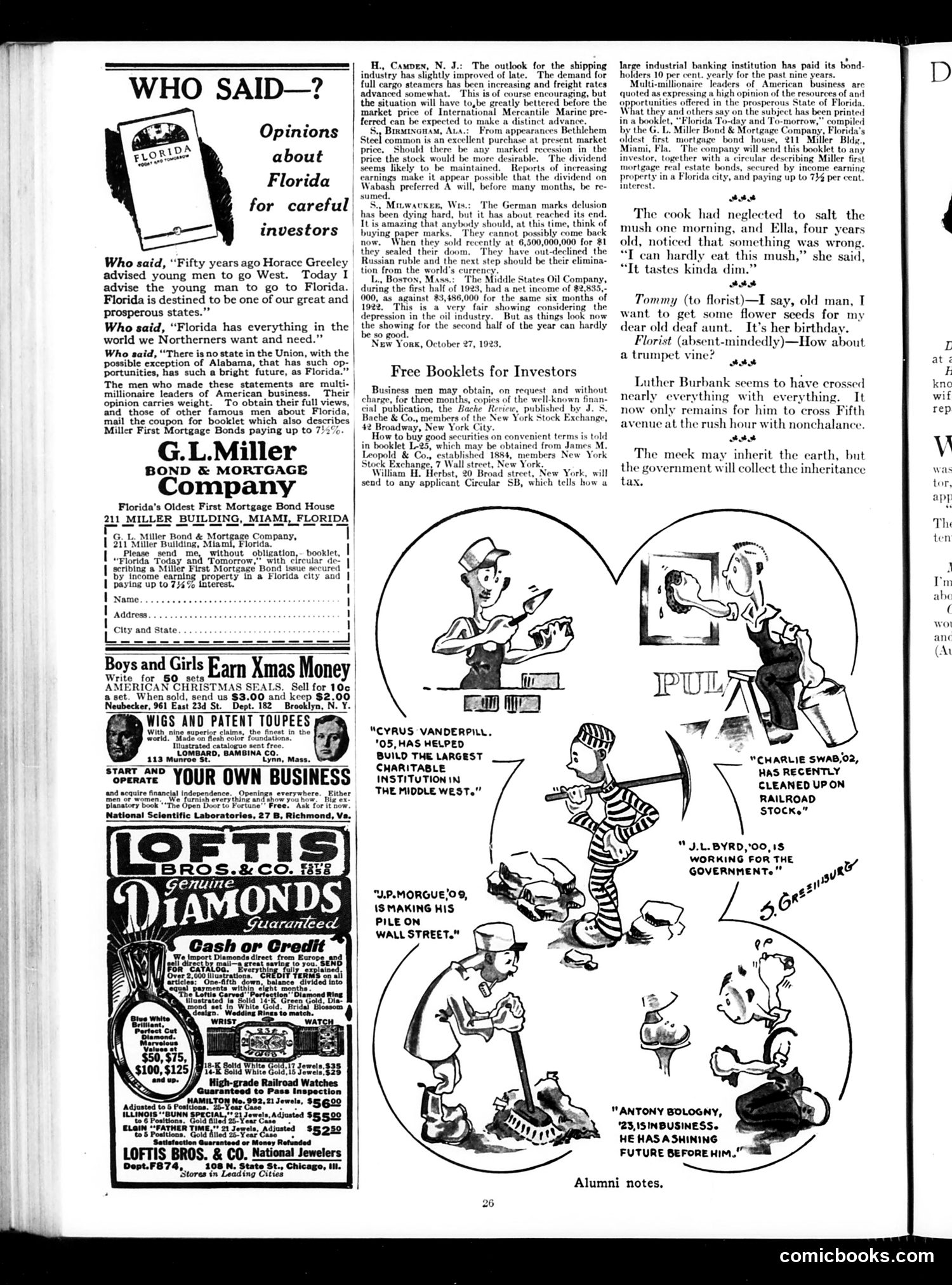
This page is primarily an **advertisement for Miller Bond & Mortgage Company**, a Florida real estate investment firm. The top section quotes prominent American businessmen praising Florida's economic potential and future prosperity—echoing the famous Horace Greeley quote "Go West, young man" but redirected to Florida. The cartoon at bottom-right, titled "Alumni notes," contains satirical vignettes mocking various figures' business ventures: Cyrus Vanderbilt with charity work, Charlie Swab with railroad stock, J.L. Byrd with government work, D. Morgueo making Wall Street investments, and Antony Bology in unspecified business. These appear to be **humorous jabs at recognizable contemporary businessmen** and their dubious financial schemes. The satire suggests skepticism about Florida investment hype and the reliability of wealthy figures endorsing speculative bonds—likely reflecting post-1920s concerns about investment fraud before the 1929 crash.
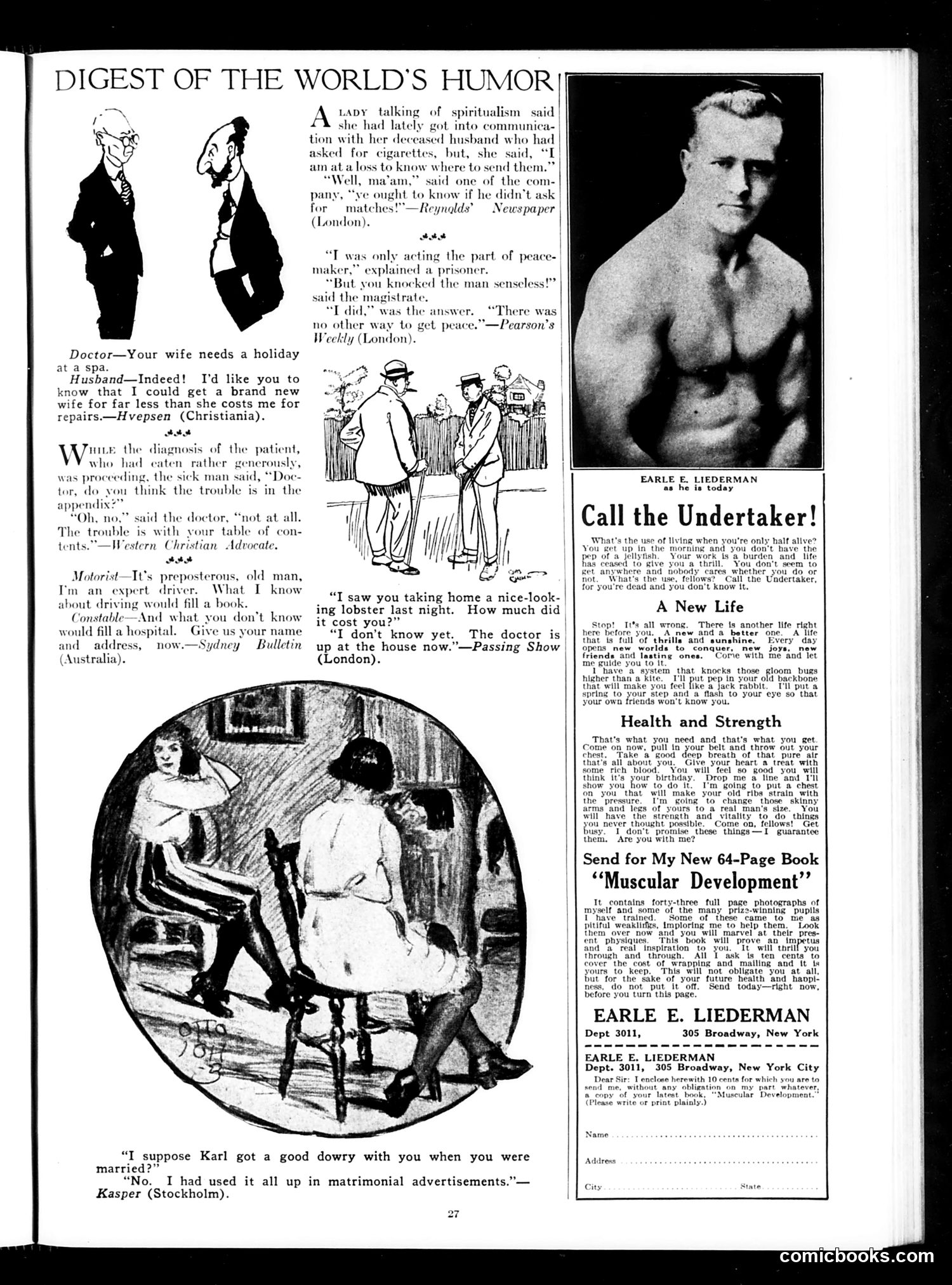
This page from *Judge* magazine contains two distinct sections: **Left side—"Digest of the World's Humor":** A collection of short jokes translated from international newspapers, representing early 20th-century humor. Topics include marital discord (husbands complaining about wives' expenses), spiritualism (a period fad), traffic enforcement, and workplace mishaps. The humor relies on wordplay and domestic cynicism typical of the era. **Right side—Advertisement:** Earle E. Liederman's bodybuilding promotion, featuring his photograph and "Call the Undertaker!" headline. This is vintage mail-order fitness marketing, targeting men perceived as weak or listless with promises of strength, vitality, and social confidence. The tone is aggressive ("Stop! It's all wrong") and the appeal emphasizes masculine transformation. The stark juxtaposition—lighthearted married-couple jokes beside a serious bodybuilding pitch—reflects how *Judge* mixed humor with advertising revenue, a common magazine practice of the period.
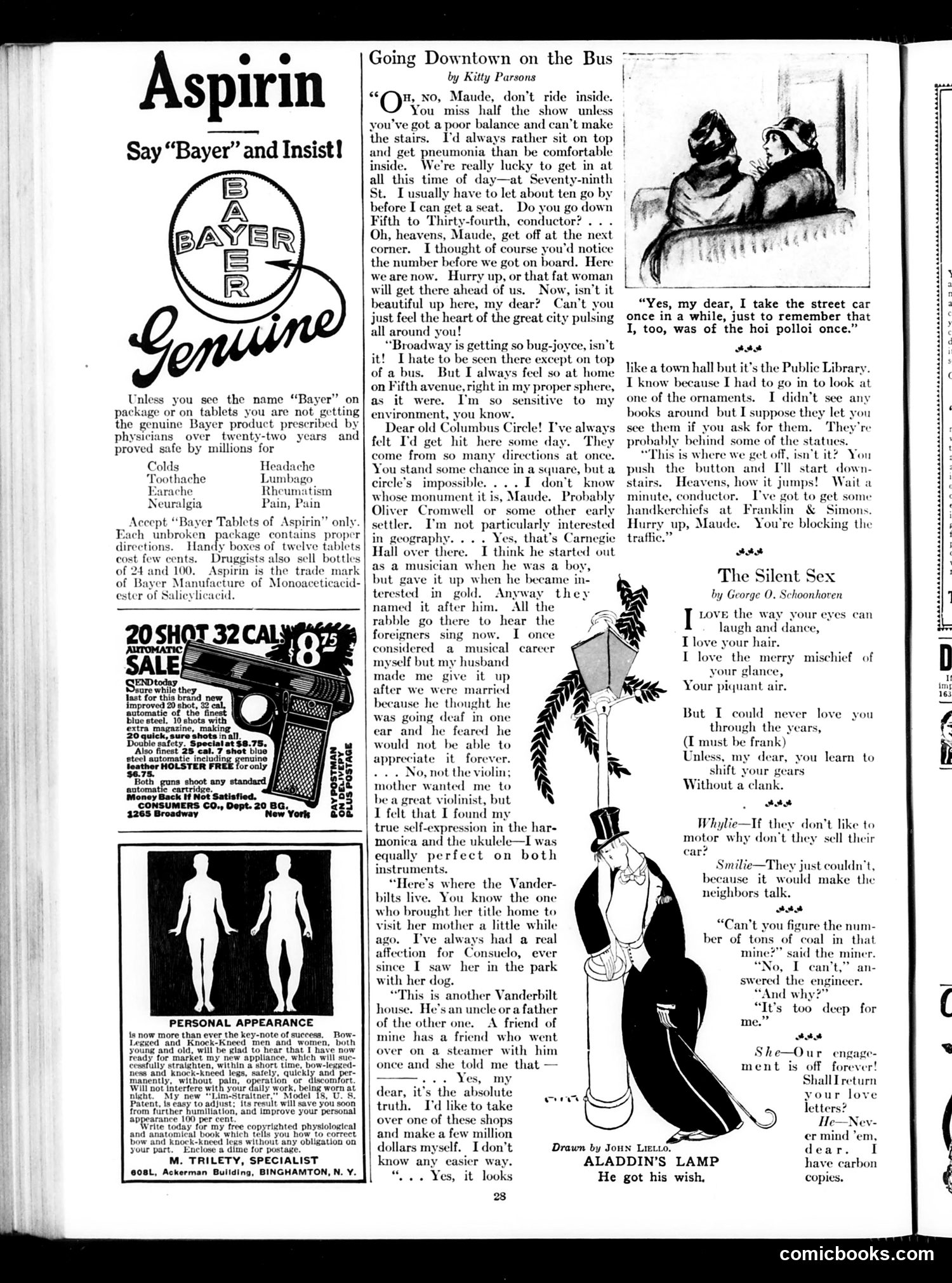
This page contains three distinct elements: a Bayer Aspirin advertisement emphasizing brand authenticity (responding to post-WWI generic aspirin competition after Bayer lost its trademark), a personal appearance/body correction advertisement, and a satirical humor column titled "Going Downtown on the Bus" by Kitty Parsons. The main satire mocks a pretentious upper-class woman (Maude) who affects sophistication while riding New York City buses. She claims to prefer rooftop seating for experiencing "the great city pulsing," yet reveals her snobbery through name-dropping (Vanderbilts, Carnegie Hall), false erudition (confusing monuments), and contradictions (claiming sensitivity while dismissing "foreigners" and "rabble"). The humor lies in exposing her performative intellectualism and social climbing—she's actually just a snob romanticizing poverty-adjacent experiences.
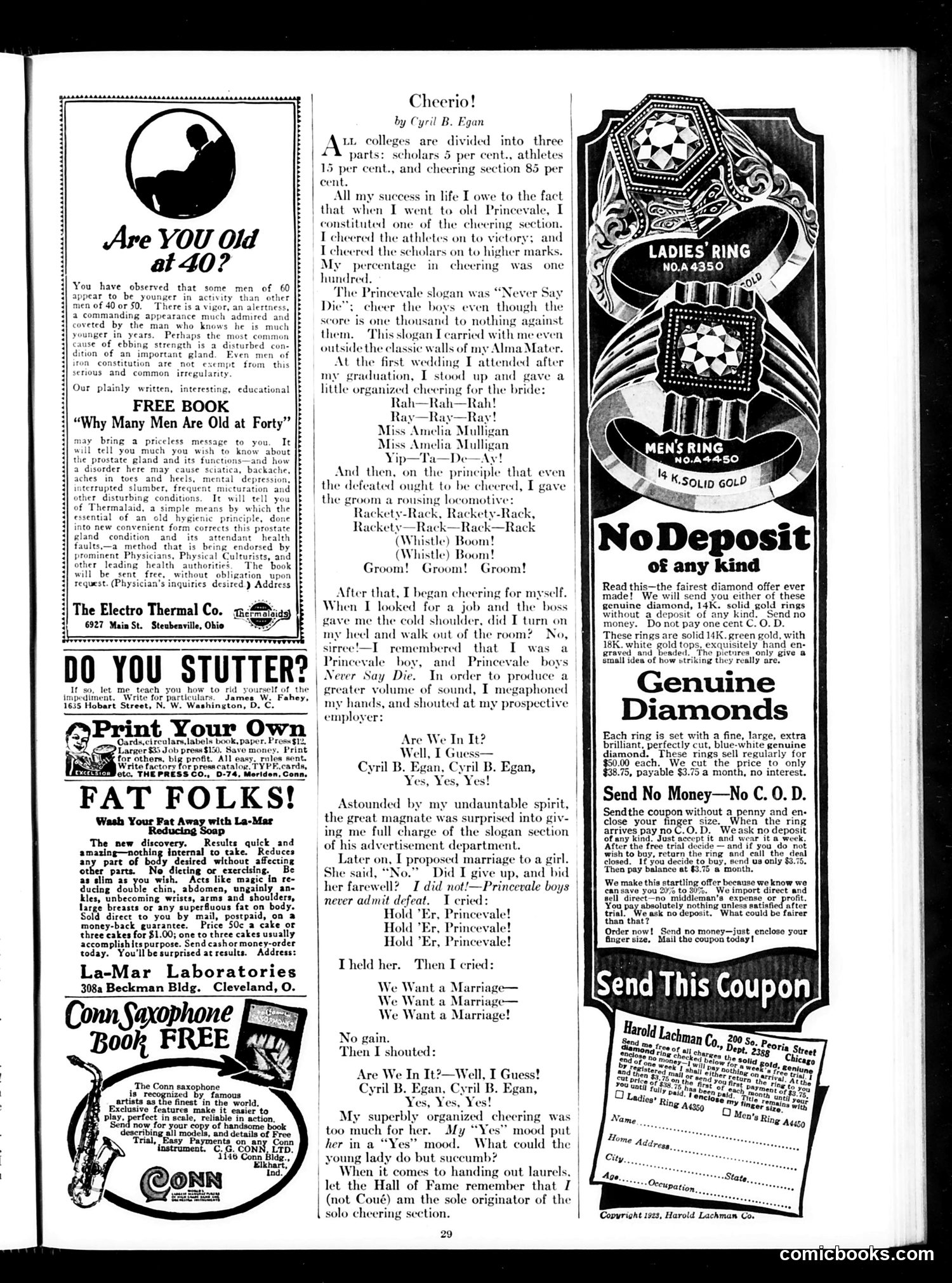
This page features a humorous essay by Cyril B. Egan mocking college culture and enthusiastic school spirit. The piece satirizes how colleges prioritize athletics and cheerleading (85% of student body) over actual scholarship (5%), presenting this hierarchy as absurd yet accepted. The narrator claims his entire success stems from being part of the "cheering section" at "Princevale" college. He then describes carrying this excessive enthusiasm into adult life—literally cheering at a wedding for both bride and groom with locomotive cheers ("Rackety-Rack"), and attempting to self-cheer when facing professional rejection. The satire targets both the superficiality of college priorities and American optimism culture—the idea that relentless positive thinking and "Never Say Die" enthusiasm can substitute for actual competence. The joke is that someone would apply school cheerleading mentality to serious life situations (job hunting, marriage), revealing how empty such enthusiasm can be. The surrounding advertisements (for prostate treatments, weight loss, stuttering cures) ironically reinforce the era's obsession with self-improvement through dubious means.
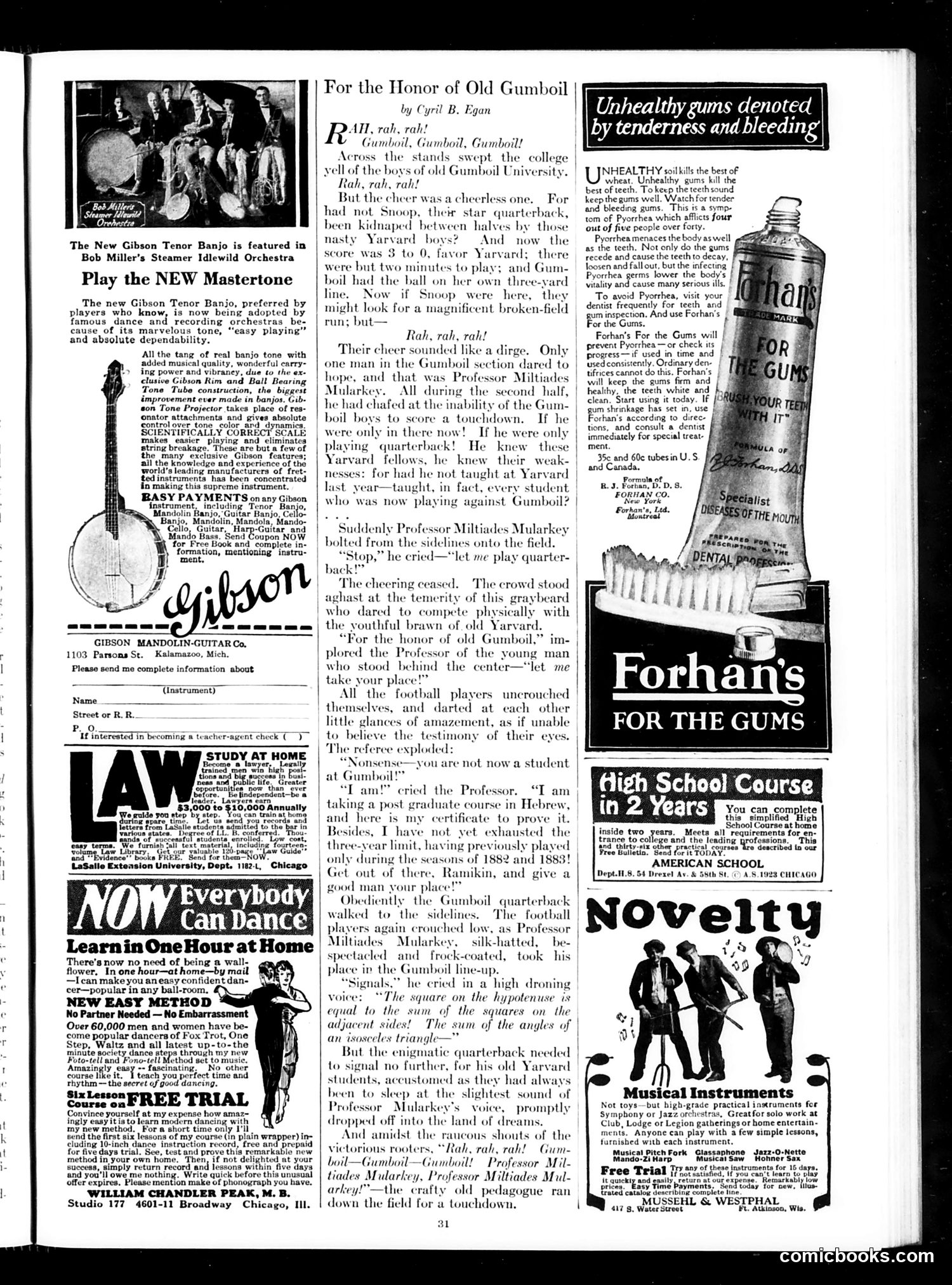
This page contains a serialized sports fiction story satirizing college football rivalry and academic pretension. The narrative concerns a fictional football game between "Gumboil University" and "Yarvard" (clearly Harvard, written phonetically for comic effect). The plot involves Gumboil's star quarterback being "kidnapped" by Harvard supporters between halves, forcing the team to play without their best player. An elderly Professor Mularkey, who once played quarterback, watches helplessly from the stands as Gumboil loses 3-0 with only two minutes remaining. The satire targets the overwrought emotions surrounding college football, the absurdity of academic rivalry, and the romanticization of athletic glory. The exaggerated cheers ("Rah, rah, rah!") and melodramatic narrative style mock the intense school spirit of the era. The page is primarily advertising, featuring Gibson banjos, dance instruction courses, and legal correspondence training programs.
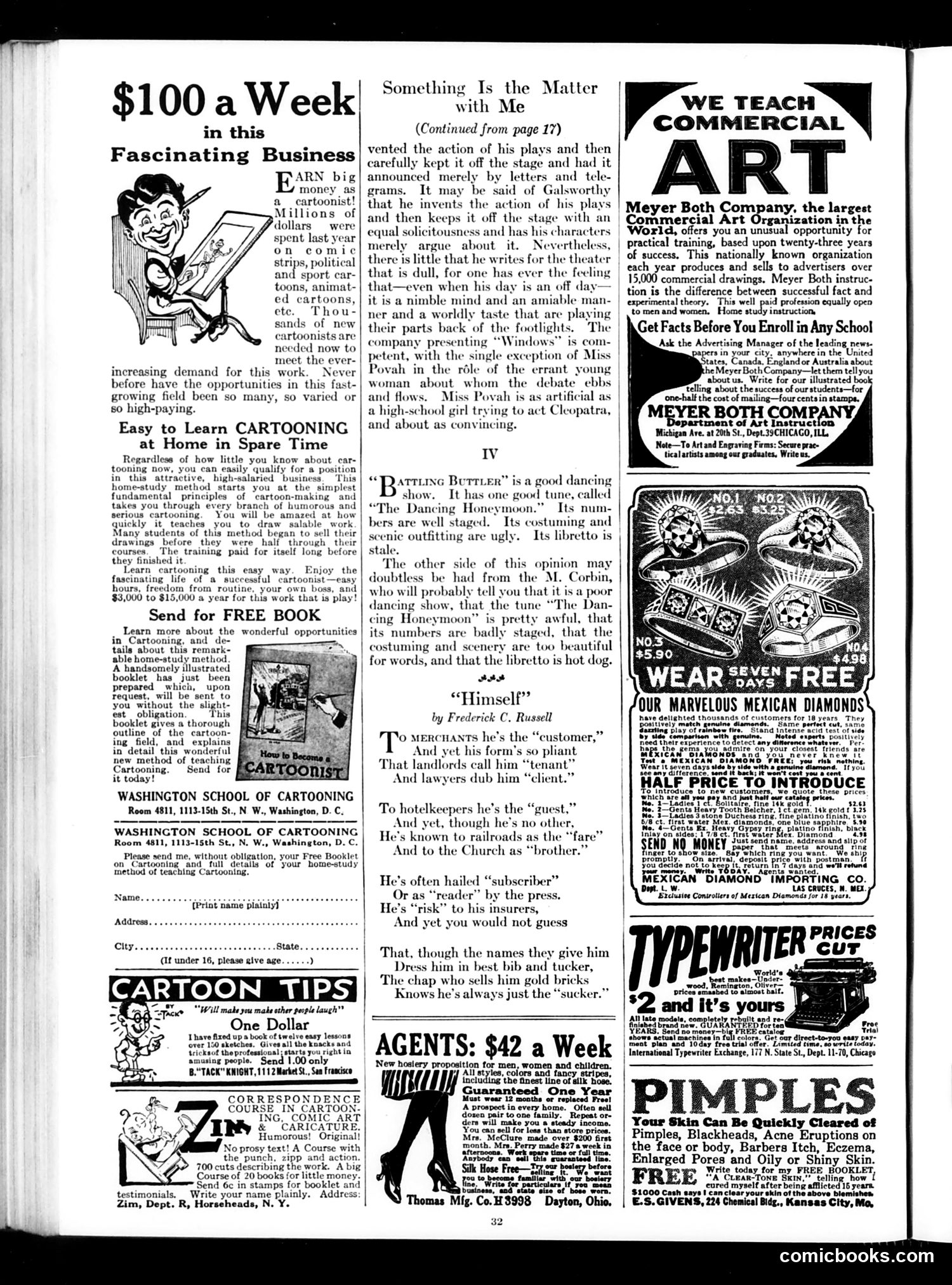
This page is primarily **advertising and promotional content** rather than political satire. The main elements are: **Central Content:** Multiple ads recruiting cartoonists for correspondence courses and home study programs, promising "$100 a Week" and "$3,000 to $15,000 a year." These target aspiring artists with promises of easy income from cartooning work. **Literary Content:** A continuation of a theater review titled "Something Is the Matter with Me," discussing playwright John Galsworthy's dramaturgy and critiques of current theatrical productions like "Windows" and "Battling Butler." **Sidebar Advertisements:** Including commercial art instruction from Meyer Both Company, Mexican diamonds, typewriter sales, pimple treatments, and other consumer goods. **"Cartoon Tips"** box offering instructional guides for aspiring cartoonists. The page reflects early 20th-century American publishing—mixing legitimate cultural criticism with aggressive advertising exploiting readers' desires for income and self-improvement.
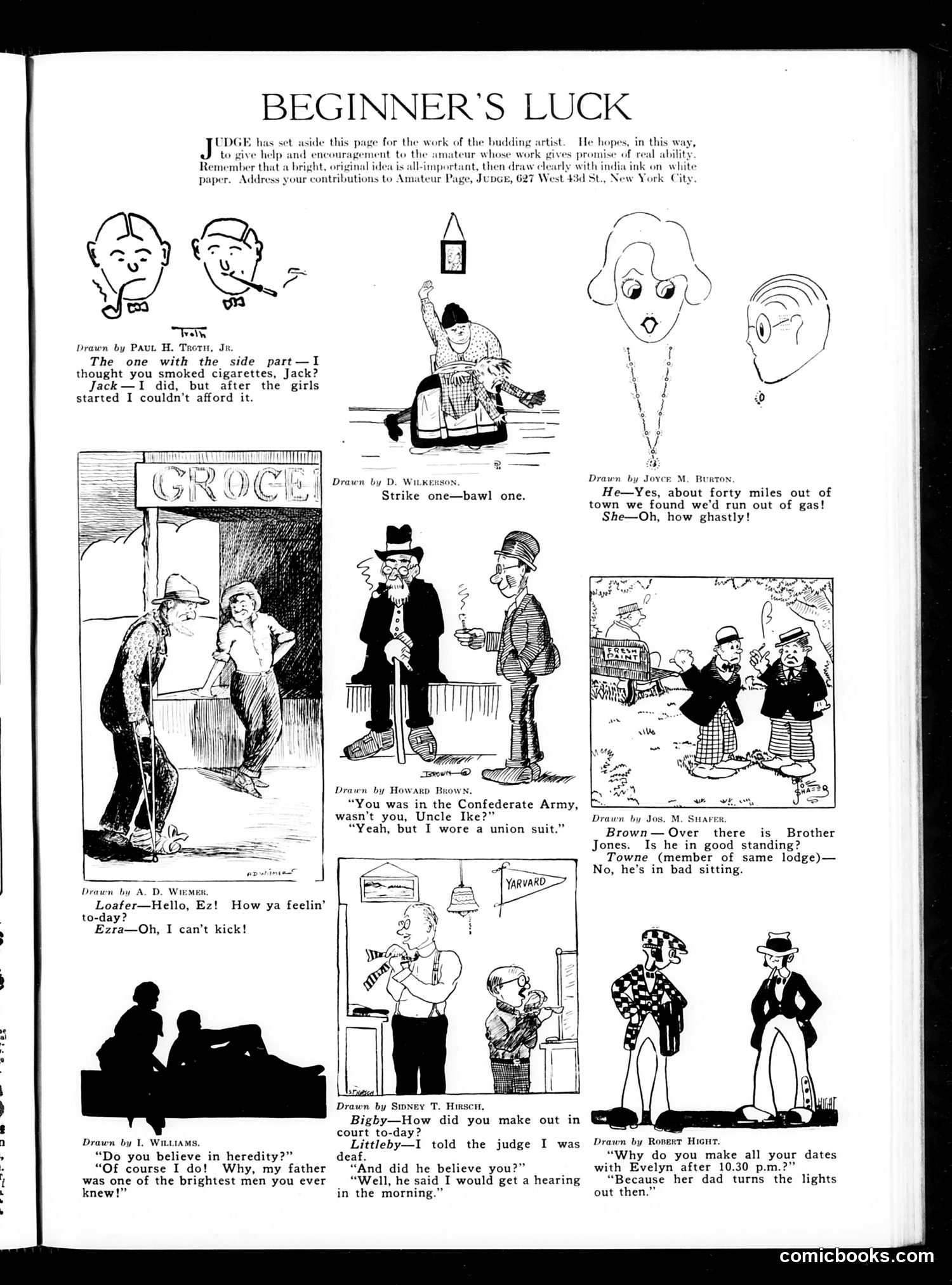
This page showcases amateur cartoonists' work for Judge's budding artist section. The humor relies on everyday social situations and wordplay: **Key comics include:** - A joke about a young man quitting cigarettes because dating is expensive - A couple running out of gas on a rural drive (the woman's horror at this mishap) - A Civil War veteran's pun: wearing a "union suit" (long underwear) rather than fighting for the Union - A lodge member in "bad sitting" (poor standing) rather than "good standing" - A courtroom defendant claiming deafness, expecting sympathy but receiving only a hearing scheduled for morning - A man scheduling dates after 10:30 p.m. because the girl's father turns off the lights then The satire targets dating etiquette, economic constraints of courtship, and the gap between clever excuses and actual justice. These are gentle, domestic humor pieces typical of early 20th-century American magazines.
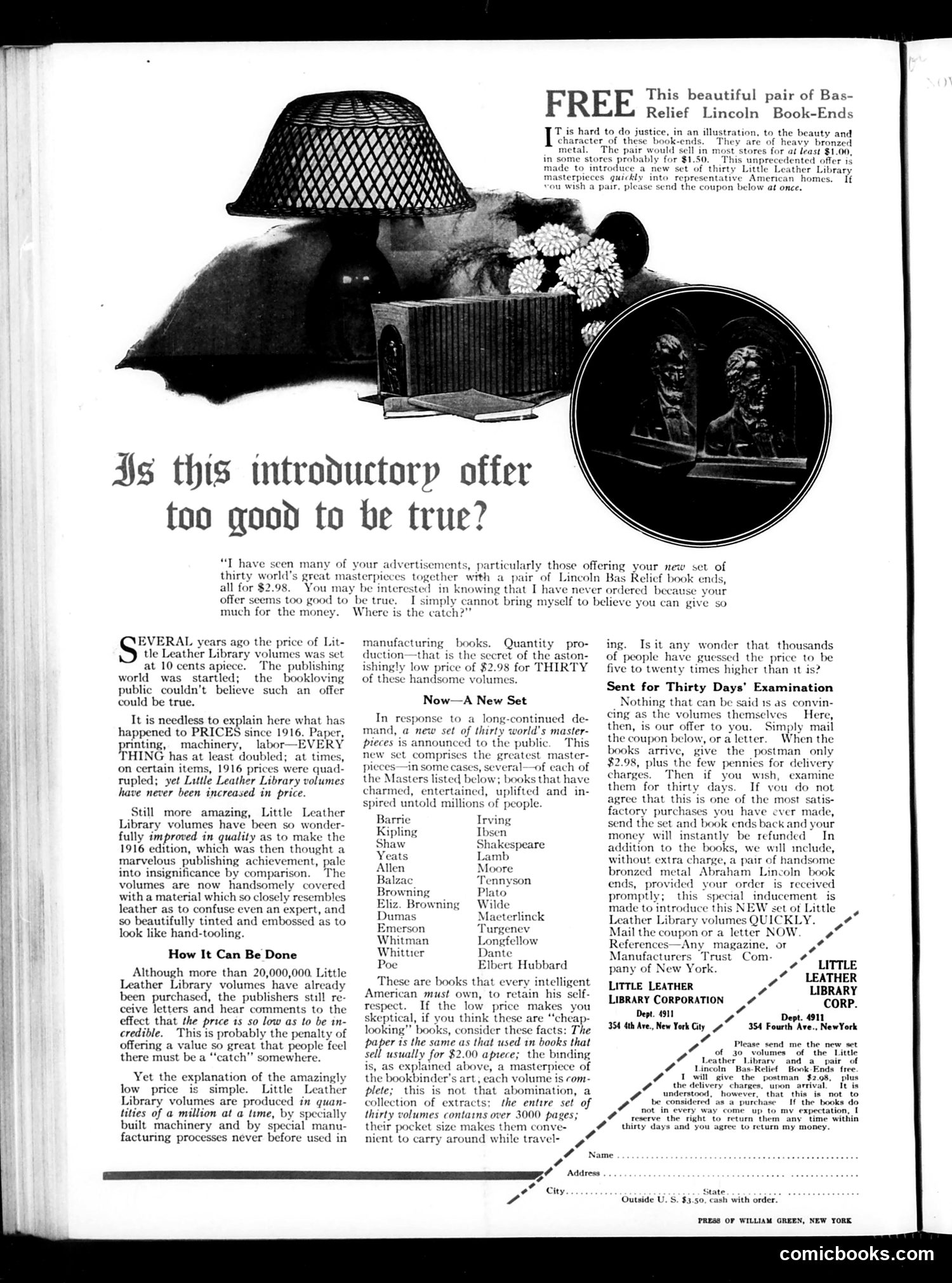
This is primarily a **mail-order advertisement** for inexpensive classic books, not political satire. The page promotes a "Little Leather Library" set of 30 masterpieces—works by Shakespeare, Dante, Browning, and others—available for $2.98, with free bronzed Lincoln bookends as an incentive. The "joke" addresses reader skepticism: "Is this introductory offer too good to be true?" The text explains the business model: mass production using modern manufacturing allows low prices despite inflation since 1916, when these volumes originally cost 10 cents each. The company emphasizes quality improvements and offers a 30-day examination period. **The satire is gentle**: the page mocks consumer doubt about "too good to be true" deals while genuinely defending their offer's legitimacy through manufacturing economics. This reflects early 20th-century American entrepreneurship and the democratization of literature through mass production.