
Judge, 1923-11-03 · page 19 of 36
Judge — November 3, 1923 — page 19: what you’re looking at
What you’re looking at
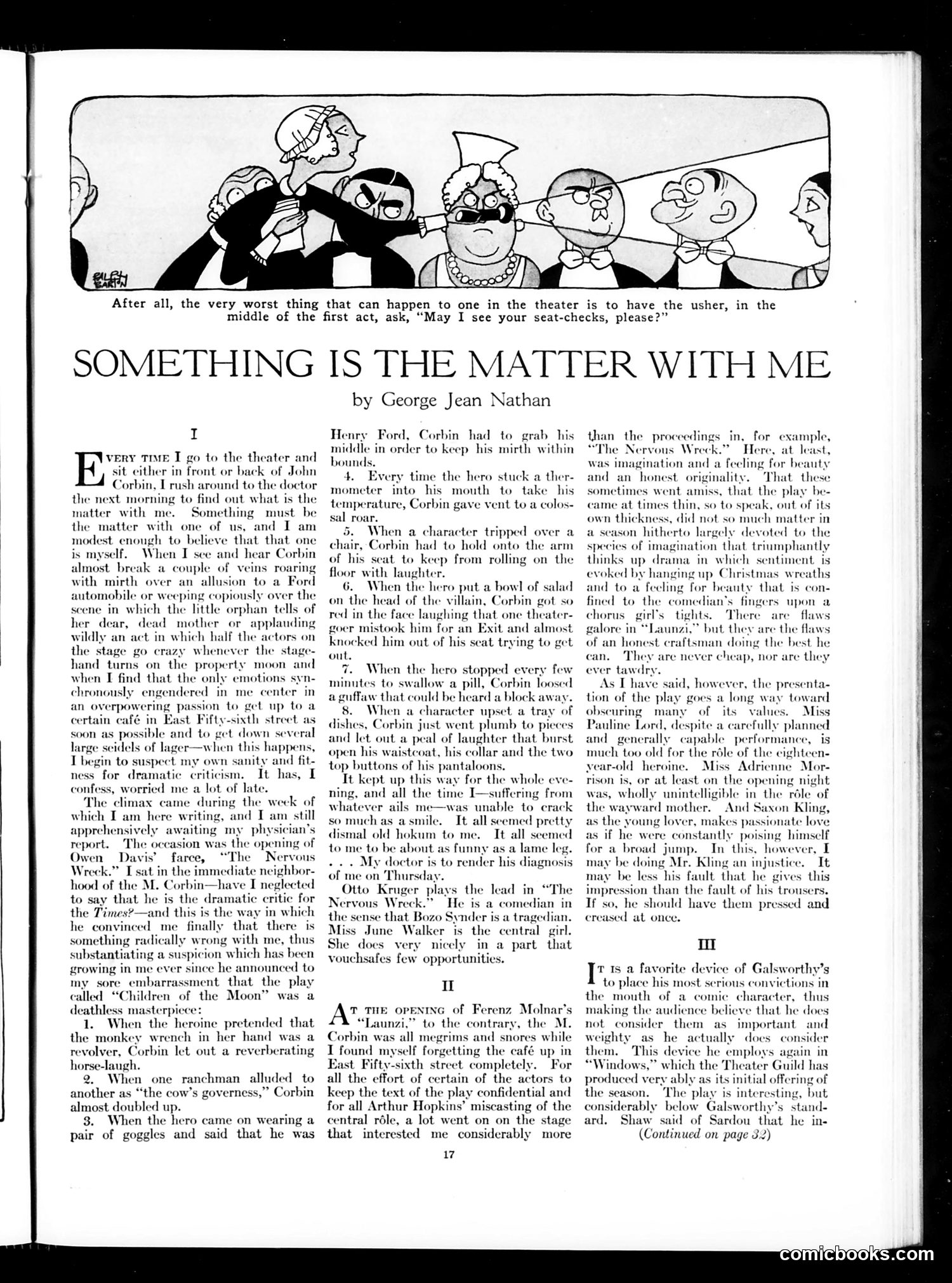
The cartoon depicts theater patrons and an usher. The joke targets the universal annoyance of having one's seat checked mid-performance—the worst possible theater interruption. The article by George Jean Nathan is a theatrical review criticizing fellow critic M. Corbin's excessive laughter during Owen Davis' farce "The Nervous Wreck." Nathan contrasts his own inability to find humor in the play's slapstick gags (Ford automobiles, thermometers, salad bowls on villains' heads) with Corbin's uncontrollable hilarity at every pratfall and sight gag. Nathan uses this disparity to question his own critical judgment, sarcastically suggesting he needs a doctor's diagnosis to understand why he finds such broad comedy tedious while Corbin finds it hilarious. The satire targets both lowbrow theatrical tastes and the pretensions of dramatic critics—implying either Corbin lacks discernment or Nathan is too highbrow to appreciate popular entertainment.
📄 Transcribed text from this page (OCR, searchable)
Machine-transcribed from the original scan — historical spelling and the odd misread are preserved.
After all, the very worst thing that can happen to one in the theater is to have the usher, in the middle of the first act, ask, “May I see your seat-checks, please?” SOMETHING IS THE MATTER WITH ME by George Jean Nathan I VERY TIME I go to the theater and E sit cither in front or back of John Corbin, I rush around to the doctor the next morning to find out what is the matter with me. Something must be the matter with one of us, and I am modest enough to believe that that one is myself. When I see and hear Corbin almost break a couple of veins roaring with mirth over an allusion to a Ford automobile or weeping copiously over the scene in which the little orphan tells of her dear, dead mother or applauding wildly an act in which half the actors on the stage go crazy whenever the stage- hand turns on the property moon and when I find that the only emotions syn- chronously engendered in me center in an overpowering passion to get up to a certain café in t Fifty-sixth street as soon as possible and to get down several cidels of lager—when this happens, gin to suspect my own sanity and fit- ness for dramatic criticism. It has, I confess, worried me a lot of late. The climax came during the week of which I am here writing, and T am still apprehensively awaiting my physician’s report. The occasion was the opening of Owen Davis’ farce, he Nervous Wreck.” [sat in the immediate neighbor- hood of the M. Corbin—have I neglected to say that he is the dramatic critic for the Time und this is the yin which he convinced me finally that there is something radically wrong with me, thus substantiating a suspicion which has been growing in me ever since he announced to my sore embarrassment that the play called “Children of the Moon” was a deathless masterpiece: 1. When the heroine pretended that the monkey wrench in her hand was a revolver, Corbin let out a reverberating one ranchman alluded to another as “the cow’s governess,” Corbin almost doubled up. 3. When the hero came on wearing a pair of goggles and said that he was Henry Ford, Corbin had to grab his middle in order to keep his mirth within bounds. 4. Every time the hero stuck a ther- mometer into his mouth to take his temperature, Corbin gave vent to a colos- roar. When a character tripped over a r, Corbin had to hold onto the arm of his seat to keep from rolling on the floor with laughter. 6. When the hero put a bowl of salad on the head of the villain, Corbin got so red in the face laughing that one theater- goer mistook him for an Exit and almost knocked him out of his seat trying to get out. 7. When the hero stopped every few minutes to swallow a pill, Corbin loose a guffaw that could be heard a block awa 8. When a character upset a tray of dishes, Corbin just went plumb to pieces and let out a peal of laughter that burst. open his waistcoat, his collar and the two top buttons of his pantaloons. It kept up this way for the whole eve- ning, and all the time I—suffering from whatever ails me—was unable to crac so muchas asmile. It all seemed pretty dismal old hokum to me. It all seemed to me to be about as funny as a lame le « . » My doctor is to render his diagnosis of me on Thursday. Otto Kruger plays the lead in “The Nervous Wreck.” He is a comedian in the sense that Bozo Synder is a tragedian. Miss June Walker is the central girl. She does very nicely in a part that vouchsafes few opportunities. I T THE op 3 of Ferenz Molnar’s “Launzi,” to the contrary, the M. Corbin was all megrims and snores while I found myself forgetting the café up in East Fifty-sixth street completely. For all the effort of certain of the actors to keep the text of the play confidential and for all Arthur Hopkins’ miscasting of the central réle, a lot went on on the stage that interested me considerably more 17 than the proceedings in, for example, “The Nervous Wreck.” Here, at least, was imagination and a feeling for beauty and an honest originality. That these sometimes went amiss, that the play be- came at times thin, so to speak, out of its own thickness, did not so much matter in a season hitherto largely devoted to the species of imagination that triumphantly thinks up drama in which sentiment is evoked by hanging up Christmas wreaths and to a feeling for beauty that is con- fined to the comedian’s fingers upon a chorus tig’ There are flaws galore in “Launzi,”” but they are the flaws of an honest craftsman doing the best he can. ‘They are never cheap, nor are they d, however, the presenta tion of the play goes a long way toward obscuring many of its) values. Miss Pauline Lord, despite a carefully planned and generally capable performance, is much too old for the réle of the cighteen- year-old heroine. Miss Adrienne Mor- rison is, or at least on the opening night was, wholly unintelligible in the réle of the wayward mother. And Saxon Kling, as the young lover, makes passionate love as if he were constantly poising himsel for a broad jump. In this, however, I may be doing Mr. Kling an injustice. It may be less his fault that he gives this impression than the fault of his trousers. Tf so, he should have them pressed and creased at once. mm T Is a favorite device of Galsworthy’s to place his most scrious convictions in the mouth of a comic character, thus making the audience believe that he does not consider. them as important and weighty as he actually does consider them. This device he employs again in “Windows, i r Guild has produced very ably as its initial offering of the season. ‘The play is interesting, but considerably below Galsworthy’s stand- ard. Shaw said of Sardou that he (Continued on page 3:2)