
Judge, 1923-11-03 · page 7 of 36
Judge — November 3, 1923 — page 7: what you’re looking at
What you’re looking at
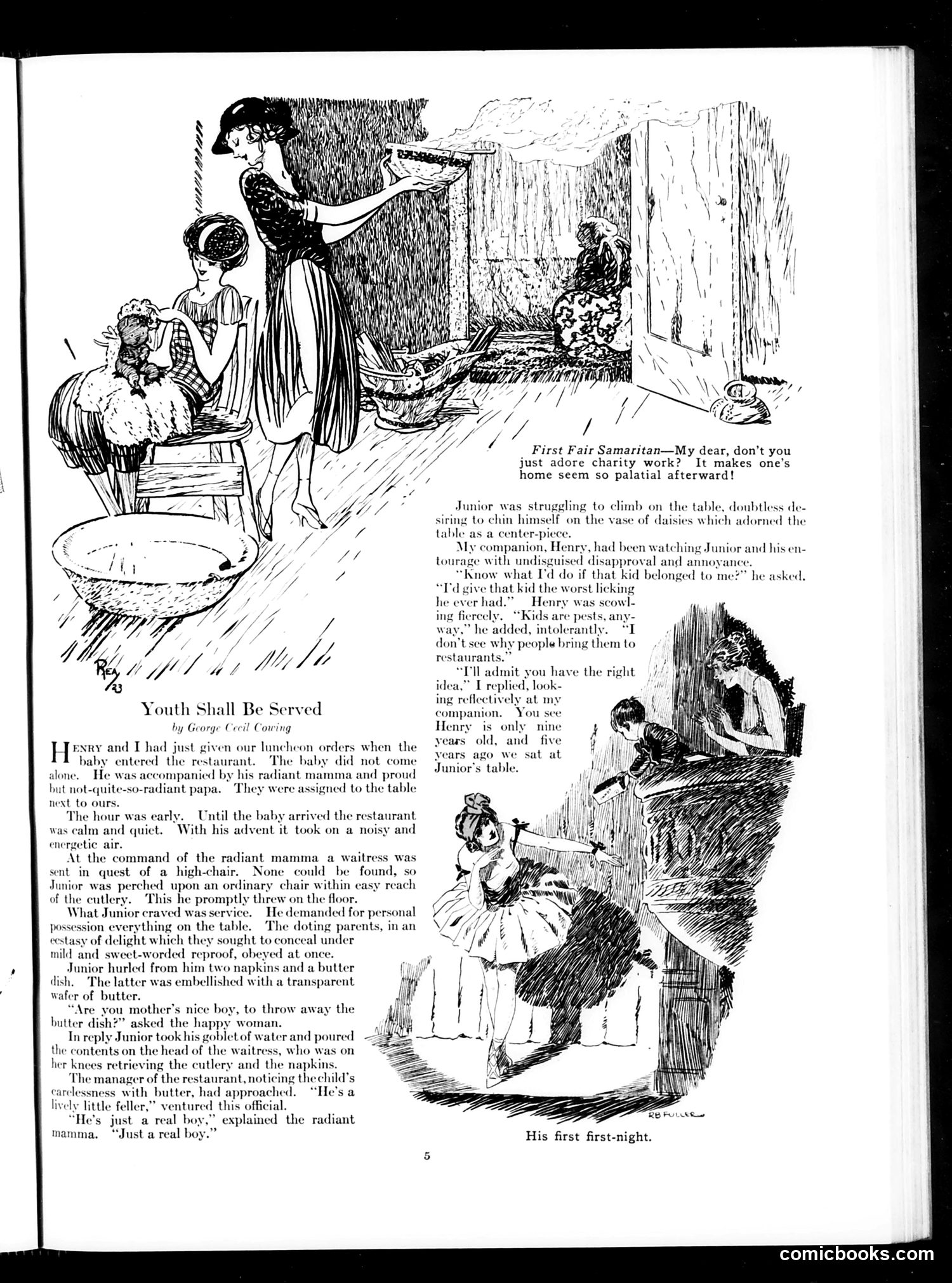
This satirical story mocks wealthy women's performative charity work. The narrator dines with "Henry," who witnesses a toddler ("Junior") behaving destructively at an adjacent table—throwing cutlery, napkins, and water on a waitress. Henry, observing the child's chaos, remarks he'd discipline such behavior harshly. The punchline reveals Henry is now only nine years old, and five years earlier *he* sat at that same table exhibiting identical misbehavior. The satire targets two groups: wealthy mothers who indulge their children's rudeness while claiming "charity work" makes them feel virtuous and morally superior ("so palatial afterward"), and society's hypocritical tolerance of spoiled children among the elite. The irony is that Henry, the voice of moral judgment, was once the disruptive "real boy" he now condemns—exposing the arbitrary standards applied to childhood misbehavior.
📄 Transcribed text from this page (OCR, searchable)
Machine-transcribed from the original scan — historical spelling and the odd misread are preserved.
it f _ First Fair Samaritan—My dear, don’t you just adore charity work? It makes one’s home seem so palatial afterward! Junior was struggling to climb on the table, doubtless de- siring to chin himself on the vase of daisies which adorned the table as a center-piece My companion, Henry, had been watching Junior and his en- ge with undisguised disapproval and annoy Know what I'd do if that kid belonged to n “T'd give that kid the worst licking d.” Henry was scowl- “Kids are pests, any- ded, intolerantly. “I » why people bring them to nts.” Il admit you have the right I replied, look- > . > ing reflectively a Youth Shall Be Served companion: You by George Cecil Cowing Henry is only n rears old, and five years ago we sat at Junior's table. H enry and I had just given our luncheon orders when the baby entered the restaurant. The baby did not come alone. He was accompanied by his nt mamma and proud but not-quite-so-radiant papa. They were assigned to the table next to ours. The hour was early. Until the baby arrived the restaurant was calm and quiet. With his advent it took on a noisy and energetic air. At the command of the radiant mamma a waitress was sent in quest of a high-chair. None could be found, so Junior was perched upon an ordinary chair within easy reach of the cutlery. This he promptly threw on the floor. What Junior craved was service. He demanded for personal possession everything on the table. The doting parents, in an y of delight which they sought to conceal under mild and sweet-worded reproof, obeyed at once. Junior hurled from him two napkins and a butter The latter was embellished with a transparent of butter. re you mother’s nice boy, to throw away the butter d asked the happy woman. In reply Junior took his goblet of wa the contents on the head of the waitres her knees retrieving the cutlery and the nap! . The manager of the restaurant, noticing the child’s carelessness with butter, had approached. “He's a lively little feller,” ventured this official. “He's just a real boy,” explained the radiant mamma, “Just a real b His first first-night. comicbooks.com