
A complete issue · 36 pages · 1923
Judge — October 6, 1923
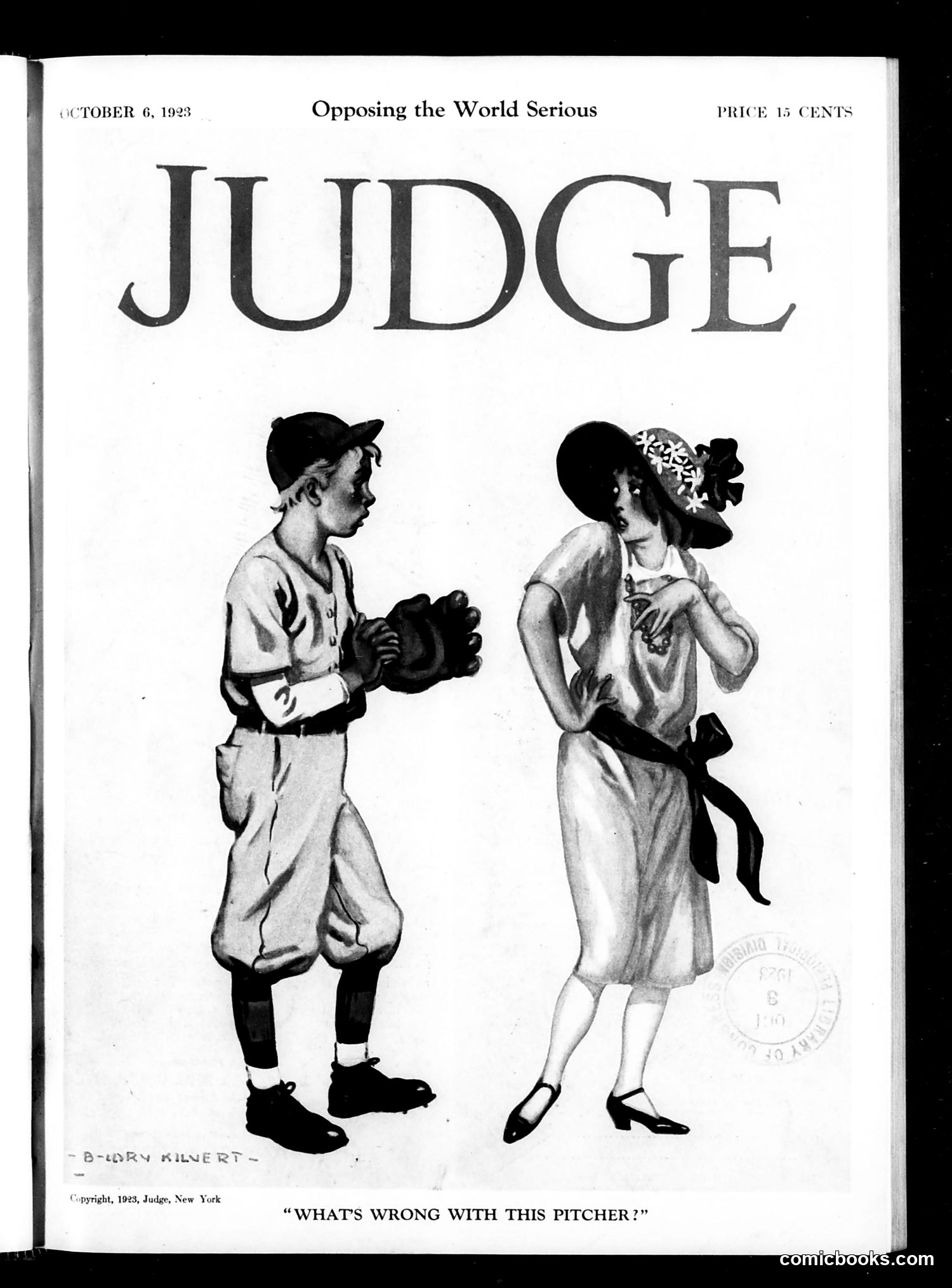
This Judge magazine cover from October 6, 1923, depicts a baseball player (left, in uniform with glove) confronting a woman (right, in fashionable 1920s dress with hat and bow). The caption reads "WHAT'S WRONG WITH THIS PITCHER?" The satire appears to critique gender roles and changing social norms of the 1920s. The "pitcher" (baseball player) is being questioned, likely because he's interacting with or distracted by a stylishly dressed woman—suggesting that modern women's fashion and social prominence are "distracting" from traditional masculine pursuits like baseball. The cartoon reflects anxieties of the era about women's increasing independence and visibility during the Jazz Age, positioning this as somehow problematic to male-dominated sports culture.
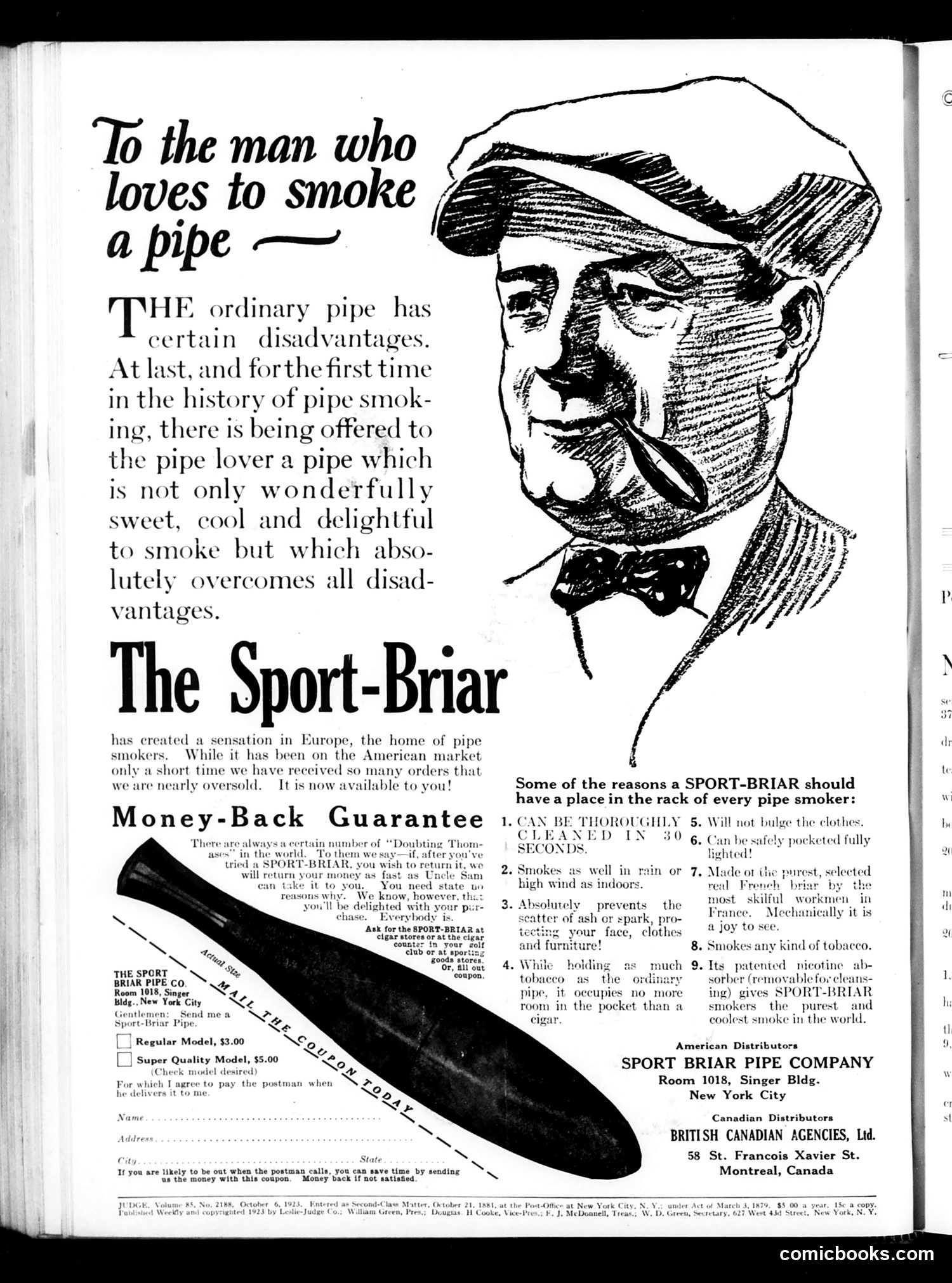
This page is **primarily advertising**, not political satire. It promotes the "Sport-Briar" pipe, a smoking accessory marketed to pipe enthusiasts. The illustrated gentleman with the pipe and jaunty hat is a **generic "pipe lover" character**—not a political figure or caricature. He represents the idealized male consumer of the era. The "joke" or selling point is that this particular pipe supposedly overcomes common complaints about pipe smoking: it keeps clothes clean, works in wind and rain, prevents ash scatter, and holds more tobacco than ordinary pipes while taking up less pocket space. The money-back guarantee and ordering form indicate this is a direct-mail advertisement from the Sport-Briar Pipe Company (New York) and British Canadian Agencies (Montreal). There is **no political or social satire** here—just early 20th-century consumer marketing.
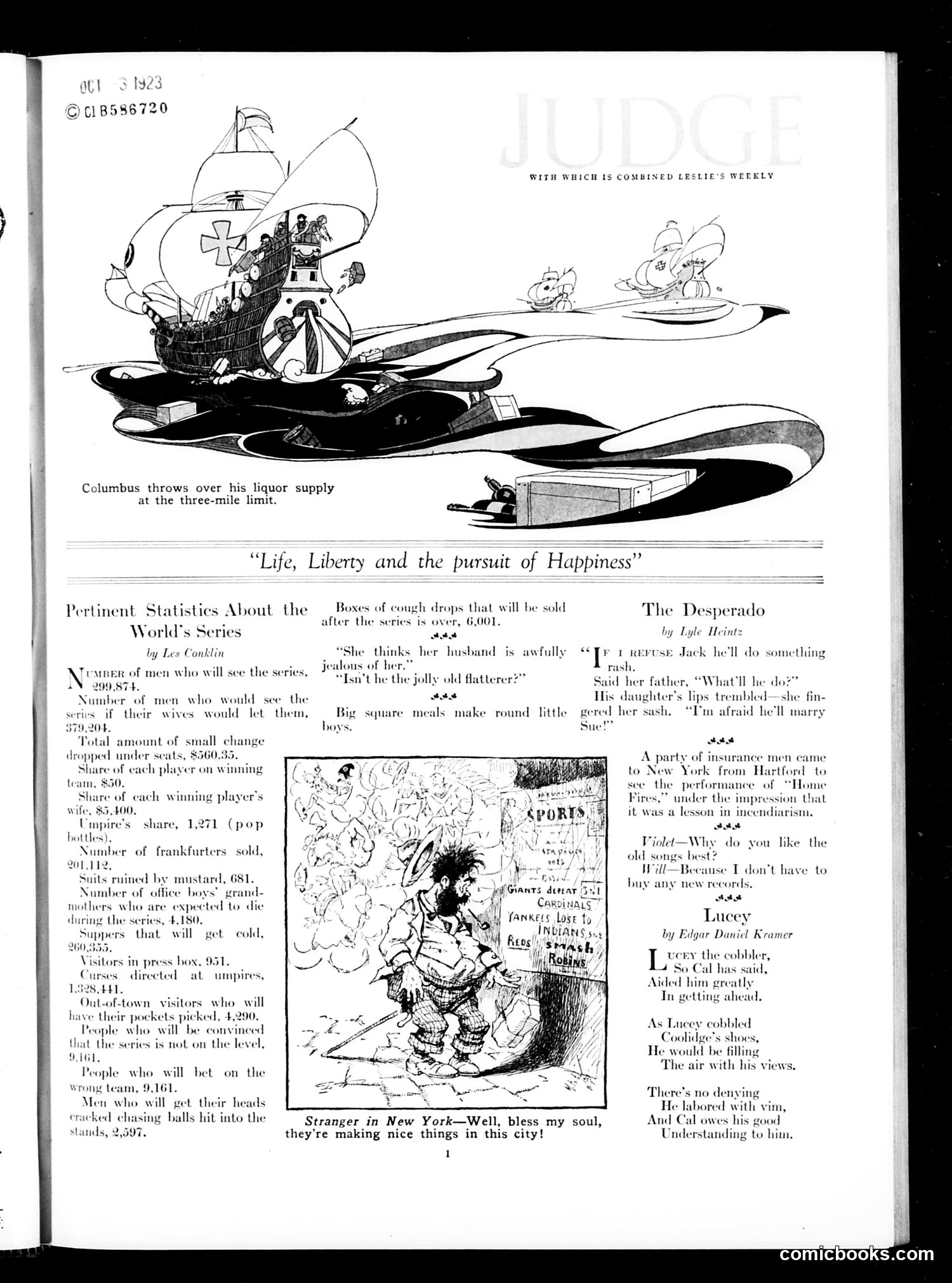
The main cartoon depicts **Columbus throwing his liquor supply overboard at the three-mile limit**—a reference to Prohibition enforcement. The three-mile limit was the boundary beyond which U.S. law couldn't reach, making it a haven for smugglers. Columbus, historically associated with voyages and discovery, becomes a vehicle for satirizing how people evaded alcohol restrictions by traveling beyond legal jurisdiction. The accompanying text includes humor about World Series statistics, insurance claims, and a story titled "The Desperado" about marital discord. The central cartoon labeled "Stranger in New York" satirizes urban life and social behavior, though specific details are unclear from the image quality. The satire primarily targets **Prohibition-era smuggling and the absurdity of enforcement**, using Columbus as an ironic historical figure.
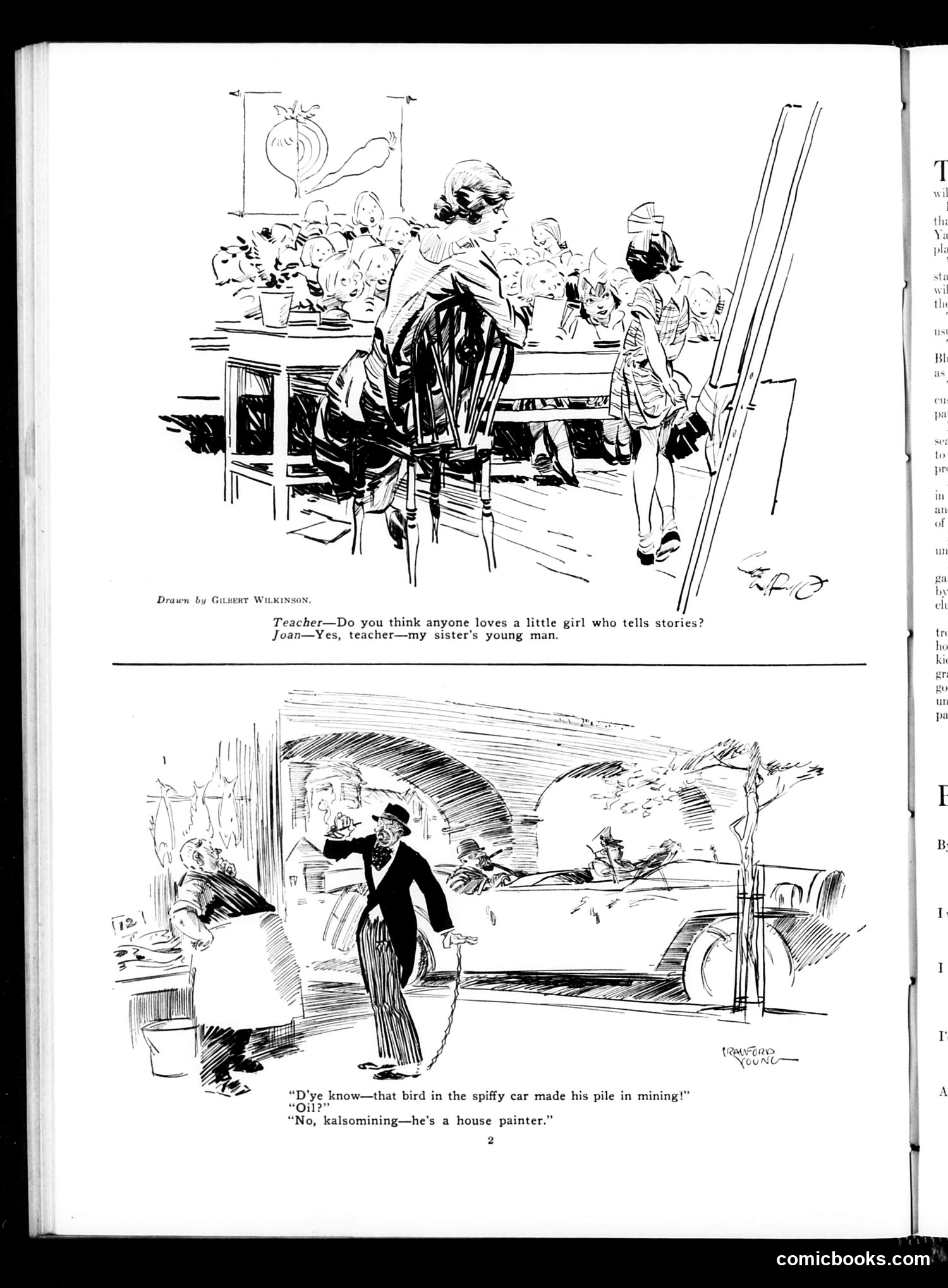
This page contains two cartoon jokes drawn by different artists (Gilbert Wilkinson and Edmund Vence). **Top cartoon:** A schoolteacher asks a student named Joan if anyone loves "a little girl who tells stories." Joan responds that her sister's young man does—a joke implying the sister is a liar or exaggerates, making her unattractive except to this particular suitor. **Bottom cartoon:** Two men discuss a bird in a "spiffy car" who made "his pile in mining." One clarifies it's actually "kalsomining" (whitewashing/painting walls)—a pun suggesting this person made money through house painting rather than the more prestigious mining industry. Both cartoons rely on wordplay and social commentary typical of early 20th-century humor magazines, using mild mockery of ordinary professions and character flaws.
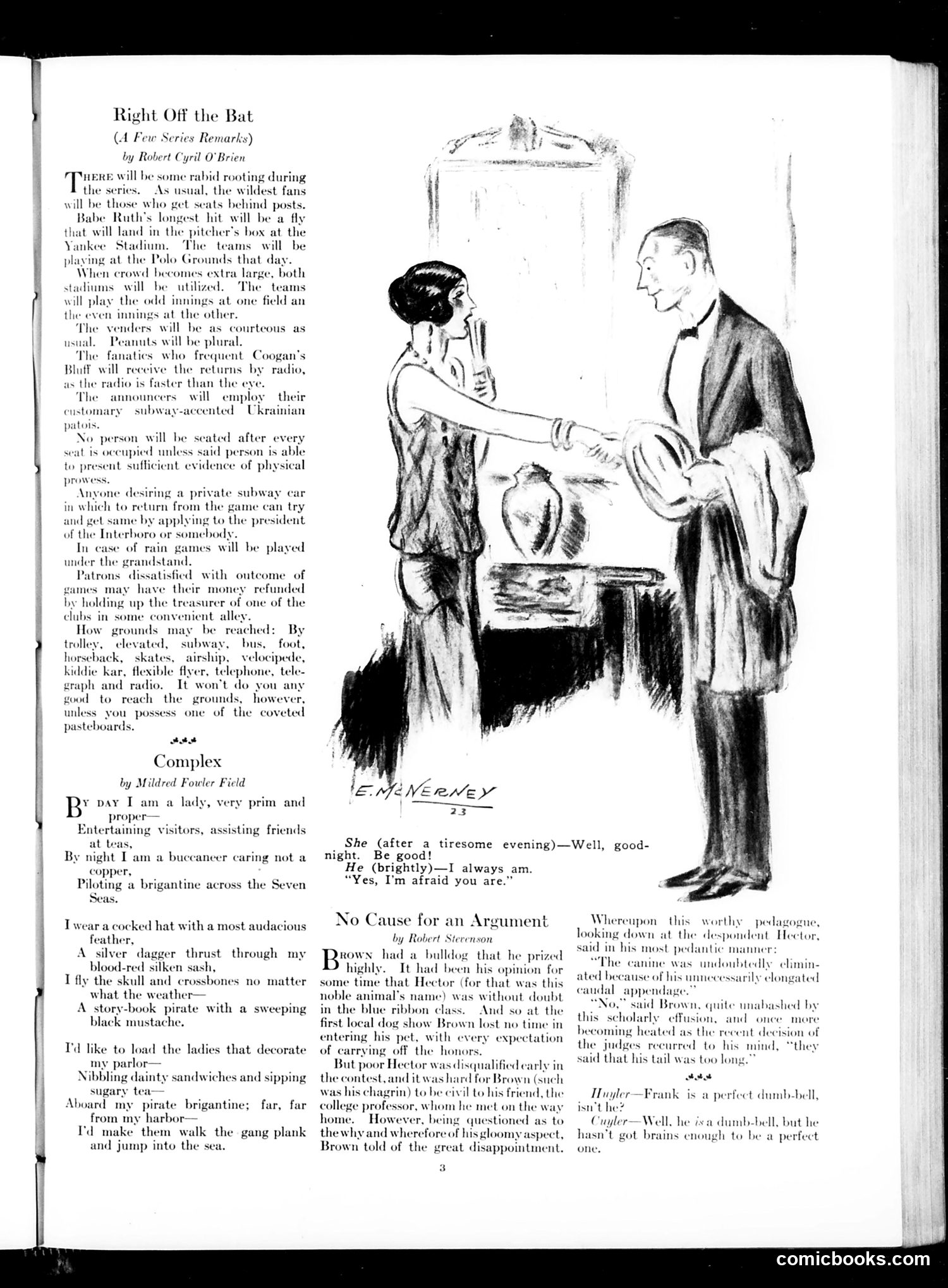
The main cartoon, titled "Complex" by Mildred Foster Field, depicts a domestic scene between a man and woman after an evening out. The woman says "Well, good-night. Be good!" and the man responds "I always am" and "Yes, I'm afraid you are." This is a light marital satire playing on gender dynamics and relationship expectations of the era. The joke appears to rest on the man's resigned acceptance of his domesticated state—his wife doubts his ability to misbehave, suggesting he's become predictably proper and dull in marriage. The page also contains humorous short pieces about varied social situations, including references to baseball (Babe Ruth) and shipboard adventures, typical of Judge's satirical social commentary style.
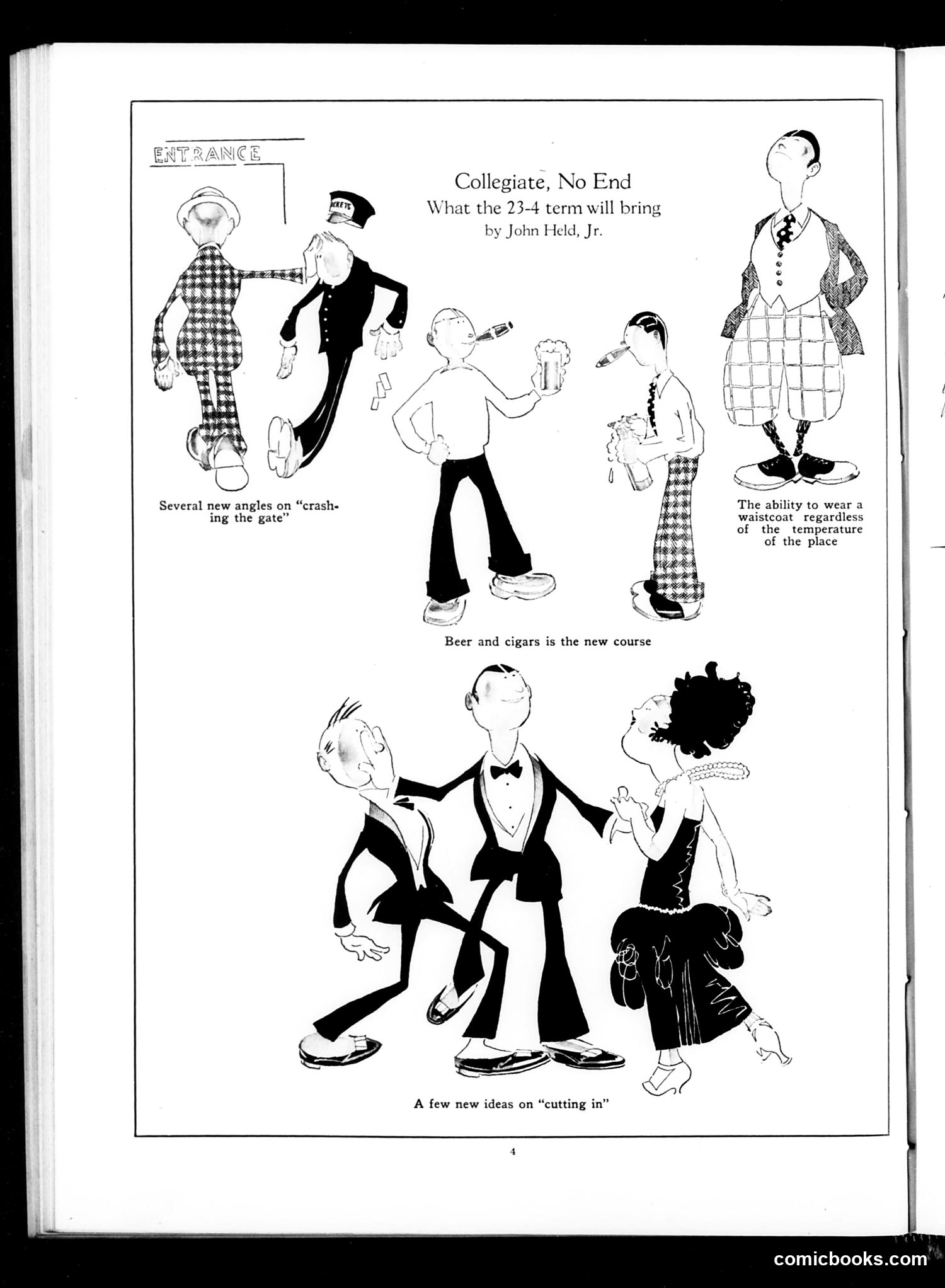
This satirical piece by John Held Jr. mocks college life during the 1923-24 academic term. The cartoon depicts exaggerated student behaviors and fashion trends: **Key satirical points:** - "Crashing the gate" (unauthorized party attendance) shown as a skill students develop - "Beer and cigars is the new course" — mocking Prohibition-era student drinking despite the law - "The ability to wear a waistcoat regardless of temperature" — critiquing fashionable but impractical clothing choices - "Cutting in" — social dancing etiquette where students interrupt couples The satire targets collegiate excess, rule-breaking, and frivolous fashion during the Jazz Age. Held Jr. was famous for depicting flappers and young people's modern, rebellious behavior. The drawings exaggerate physical proportions in his characteristic style to emphasize the absurdity of student culture.
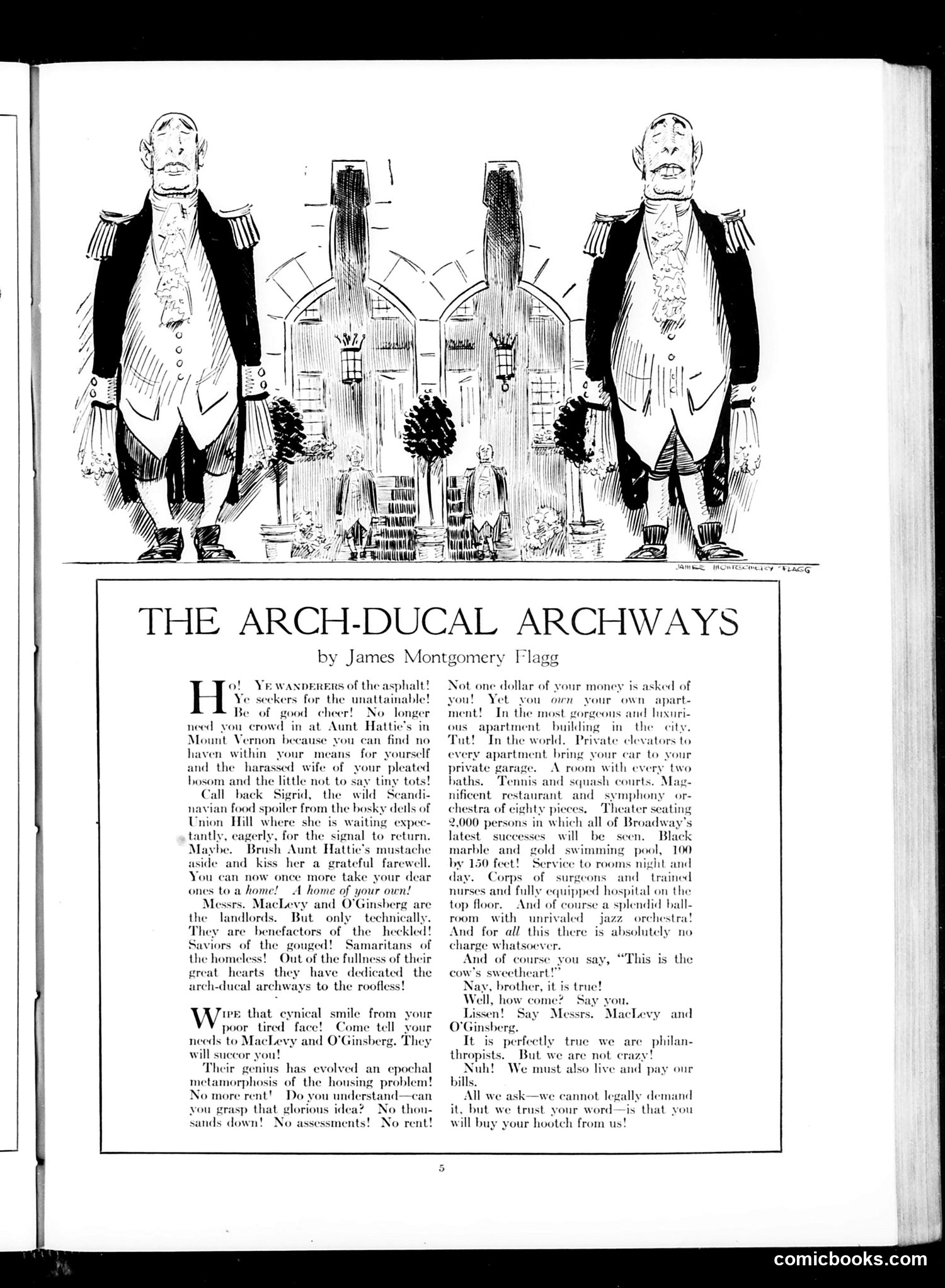
This 1920s satire by James Montgomery Flagg mocks a housing scheme promising free luxury apartments. Two portly, mustachioed landlords (Messrs. MacLevy and O'Ginsberg—likely Jewish surnames, reflecting period stereotyping) pitch an implausibly lavish building with private elevators, swimming pools, orchestras, and hospitals—all supposedly free. The joke's payoff: residents pay nothing in rent or assessments, but must purchase their alcohol exclusively from the landlords. This satirizes Prohibition-era bootlegging schemes where speakeasy operators or liquor suppliers leveraged housing access to monopolize alcohol sales. The "philanthropists" claim they "must also live and pay our bills"—meaning through forced liquor purchases. The cartoon critiques both the housing crisis afflicting working-class families and opportunistic exploitation by those claiming to solve it through seemingly generous but actually predatory schemes.
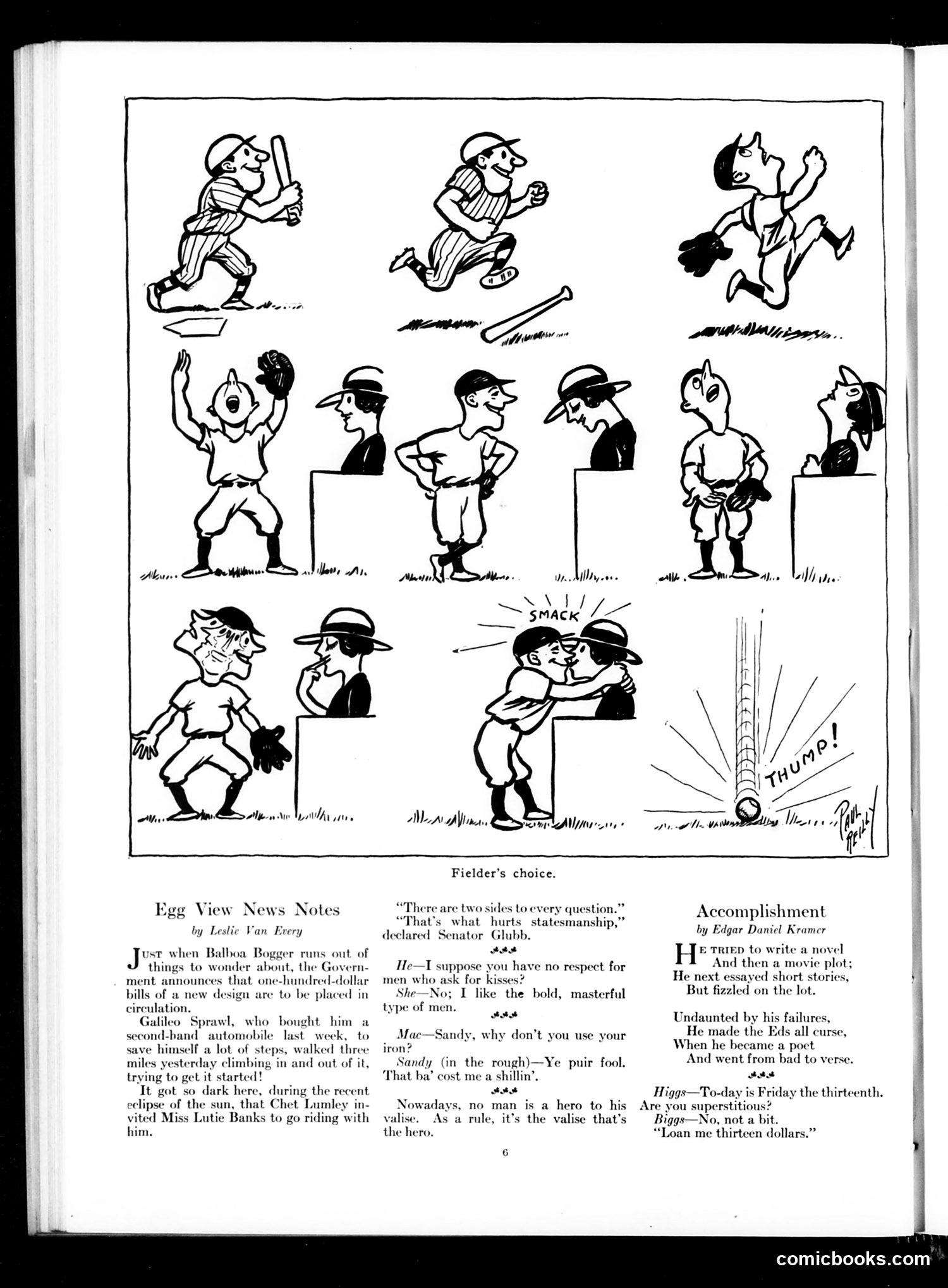
This page collects three separate humor pieces typical of Judge's satirical approach: **Main Cartoon ("Fielder's Choice")**: A visual gag sequence depicting baseball-related scenarios. "Fielder's choice" is a baseball term, and the cartoon plays on double meanings and physical comedy common to the era's sports humor. **"Egg View News Notes"** (by Leslie Van Every): Gossipy social commentary in short anecdotes—a new currency design announcement, a man struggling with a secondhand car, and a romantic eclipse reference. These mock small-town American life and social pretension. **"Accomplishment"** (by Edgar Daniel Kramer): A short poem mocking a failed poet—someone who aspired to write novels and screenplays but ultimately produced mediocre verse. The page satirizes American consumer culture, romantic conventions, and social aspiration through lightweight humor. The dialogue snippets offer quick jabs at pretension (the "bold, masterful" type, the golf player's excuses). Overall, this represents Judge's formula: mixing visual gags, gossip-column satire, and light verse to entertain middle-class readers with observations about their own society.
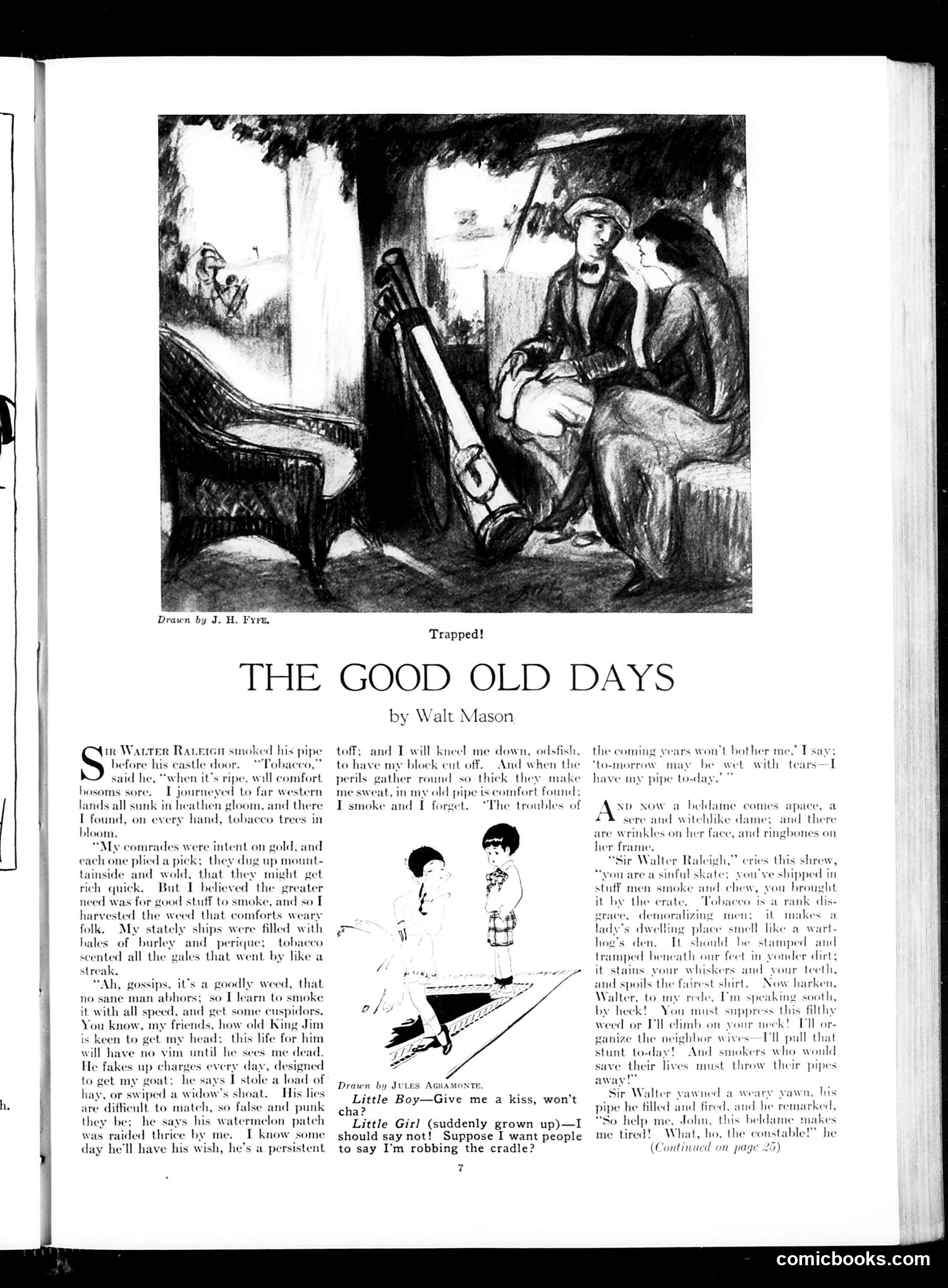
This satirical story mocks anti-tobacco crusaders by contrasting Sir Walter Raleigh's nostalgic romance with smoking against a modern scold's moral outrage. **The Setup:** An elderly Raleigh fondly recalls tobacco's comforts—how it sustained him during adventures and helps him endure his enemies' false accusations. Smoking, he claims, lets him forget his troubles. **The Satire:** A stern woman (representing contemporary anti-smoking reformers) denounces him as a "sinful skate," ranting that tobacco is a "rank disgrace" that stains teeth, pollutes homes, and "demoralizes men." She demands he suppress this "filthy weed." **The Joke:** Raleigh simply yawns, smokes on undisturbed, and dismissively calls for the constable—suggesting that such reformers are tiresome busybodies easily ignored. The humor lies in mocking the era's growing temperance and moral-reform movements by having their target remain completely unbothered by their sanctimonious complaints.
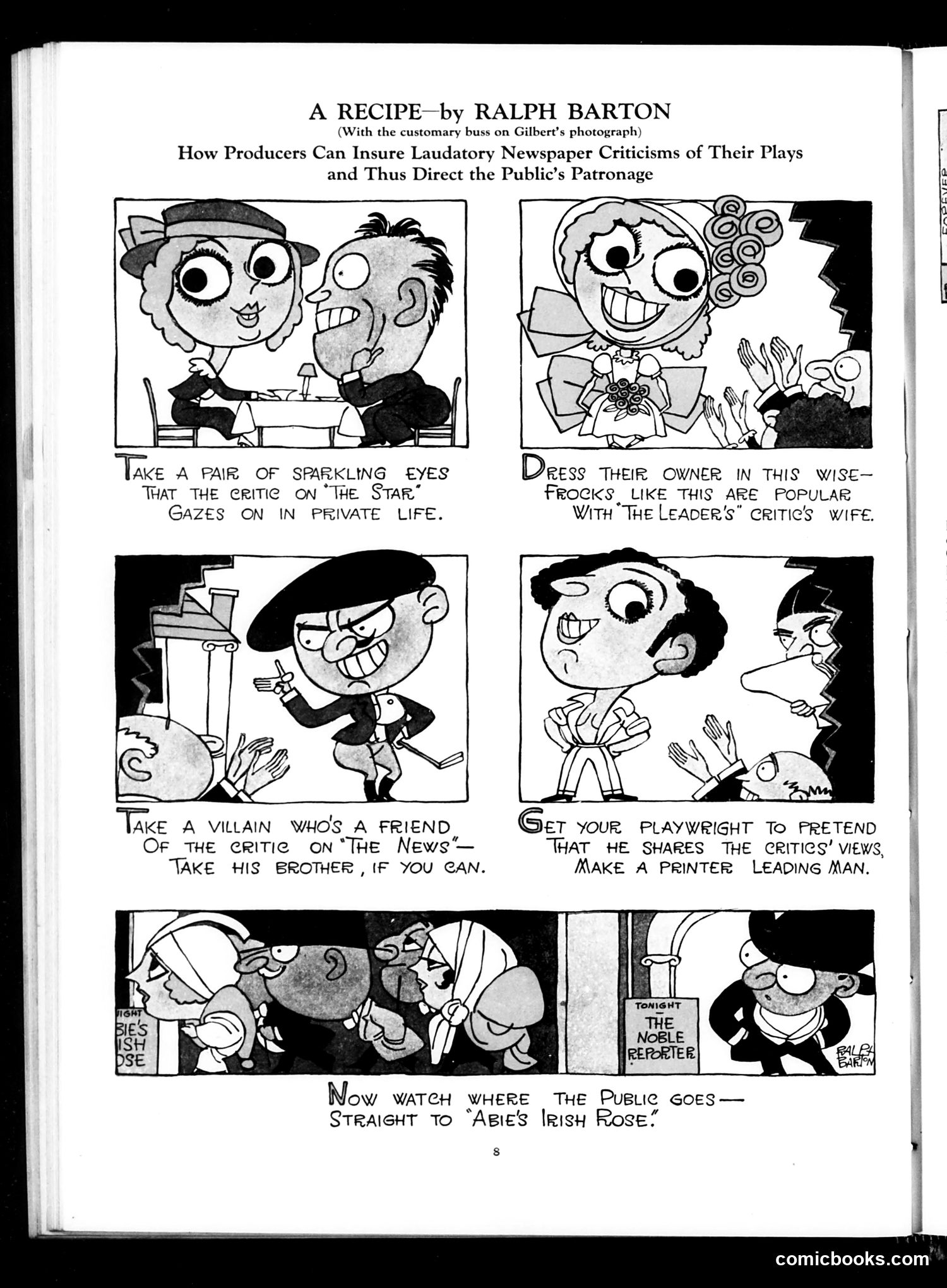
This comic by celebrated cartoonist Ralph Barton satirizes how theatrical producers manipulate newspaper critics to secure positive reviews. The "recipe" outlines corrupt tactics: 1. **Seduce the critic** by flattering his vanity and courting his wife with fashionable gifts 2. **Befriend influential critics** and their associates (even their brothers) at major papers like "The Star" and "The News" 3. **Plant sympathetic voices** by having the playwright pretend to share the critic's views and inserting a printer as the leading man to control press coverage 4. **Exploit the result**: audiences follow critics' recommendations, filling seats at shows like "Abie's Irish Rose" (a popular contemporary play) The satire exposes the incestuous relationship between Broadway producers, theater critics, and newspapers—showing how critical acclaim can be manufactured through personal manipulation rather than artistic merit. Barton's exaggerated caricatures and cynical tone mock both the corruptibility of critics and producers' willingness to exploit it.
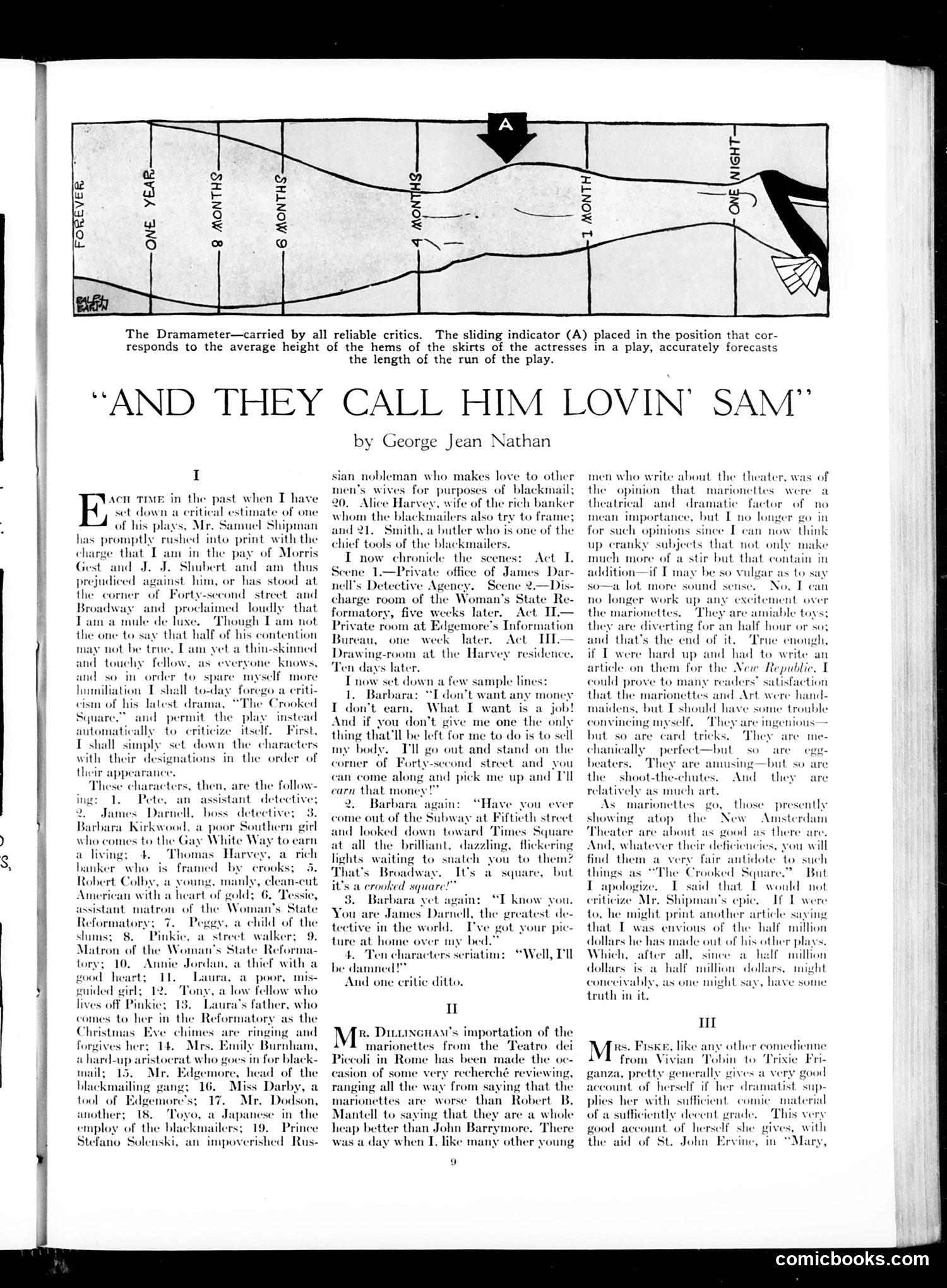
The cartoon at the top depicts "The Dramameter"—a fictional measuring tool that critics supposedly use to forecast how long a theatrical production will run. The joke: the indicator (marked "A") measures the average *hemline height* of actresses' skirts. Lower hemlines = longer runs. This is satire on 1920s theater criticism and social attitudes. The implication is that plays succeed based on leg exposure rather than artistic merit—mocking both the superficiality of Broadway audiences and the shallow criticism that enabled it. The diagram's pseudo-scientific presentation amplifies the absurdity. The accompanying article by George Jean Nathan is a theater review of "The Crooked Square," notable mainly for listing the cast and plot summary rather than offering judgment—apparently Nathan's self-protective response to prior accusations of bias from playwright Samuel Shipman. The satire targets theatrical pretension and the frivolous standards governing Broadway success.
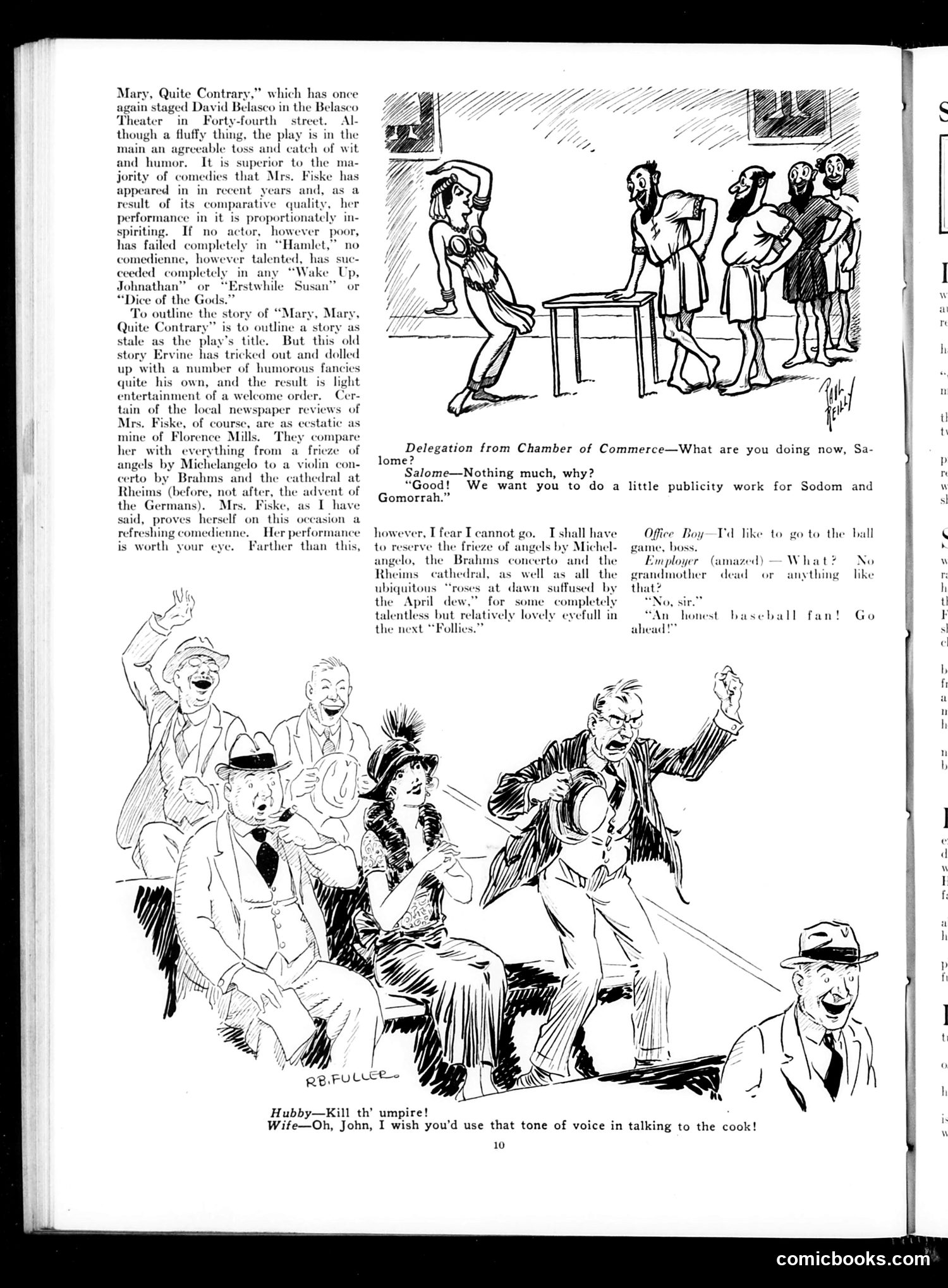
This page contains theater criticism and two separate satirical cartoons: **Top Cartoon**: A "Delegation from Chamber of Commerce" approaches a woman named Salome, asking her to do "publicity work for Sodom and Gomorrah." This satirizes the biblical account of Sodom and Gomorrah (cities destroyed for depravity) by treating them as places needing modern promotional marketing—absurdist humor mocking both excessive civic boosterism and moral hypocrisy. **Bottom Cartoon**: A husband enthusiastically shouts "Kill th' umpire!" at a baseball game, but his wife criticizes his aggressive tone, saying she wishes he'd use it with the cook instead. This jokes about masculine behavior—men are passionate and commanding at sports but passive or polite at home, inverting expected domestic hierarchies. The page's text reviews Mrs. Fiske's performance in the play "Mary, Mary, Quite Contrary," praising her comic talent despite the stale plot.
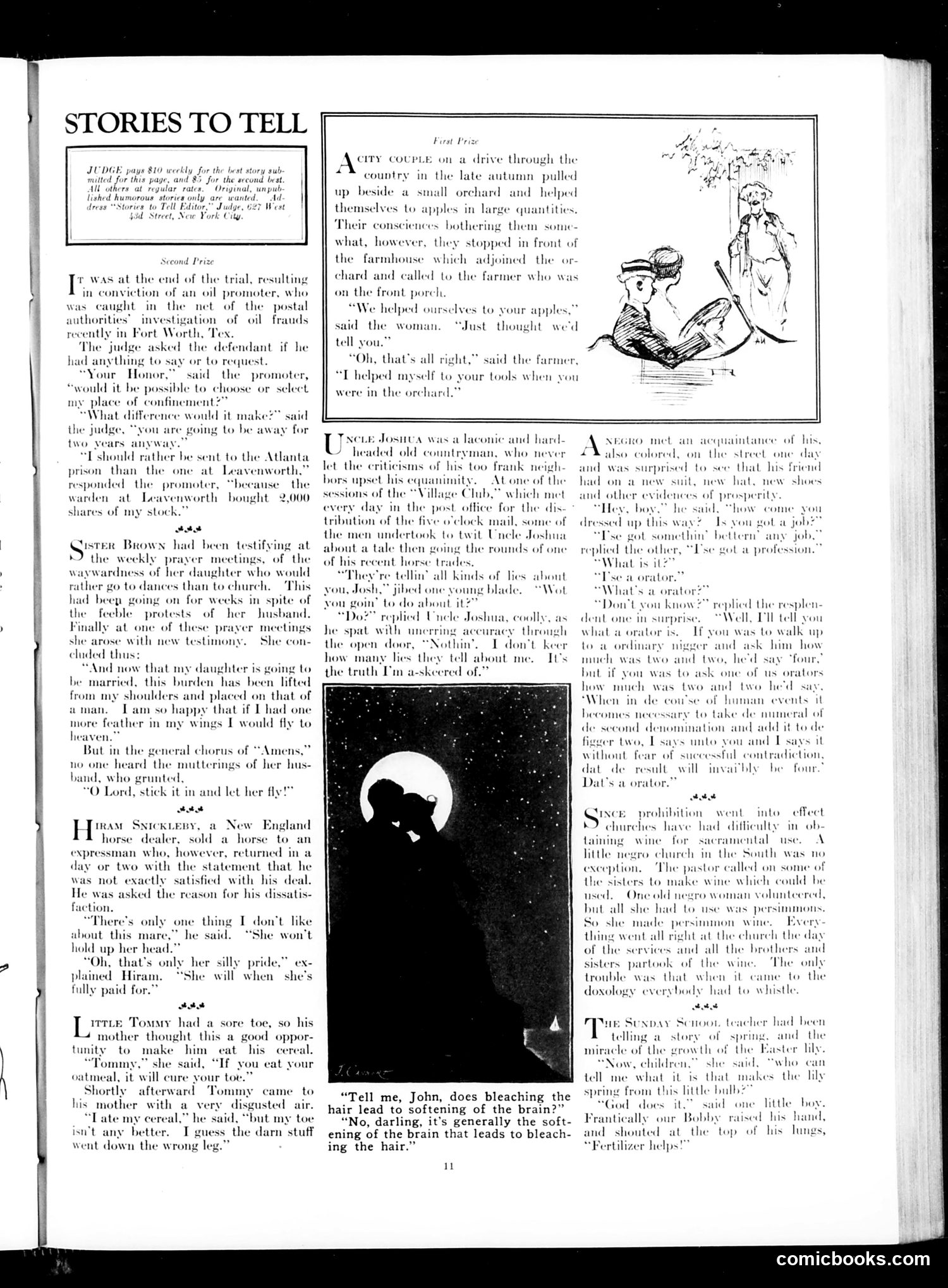
This page from *Judge* magazine contains several short humorous stories rather than political cartoons. The content reflects early 20th-century American social attitudes: **Key Stories:** 1. **Oil Fraud Joke**: Satirizes oil-promotion schemes and prison corruption—a promoter prefers Atlanta prison because the Leavenworth warden bought his stock, suggesting wealthy criminals could leverage connections. 2. **Sister Brown**: Mocks women's prayer meetings and marital dynamics, with crude humor about a husband's reaction to his daughter's marriage. 3. **Horse Trading**: Plays on rural deception—a horse dealer's mare won't hold her head up until fully paid for (pride metaphor). 4. **Tommy's Oatmeal**: Innocent children's humor about misunderstanding medicine. 5. **Apple Thieves**: Urban couple steals orchard apples; farmer admits he stole their tools—mutual transgression played for laughs. 6. **Uncle Joshua**: Depicts rural dialect humor about a man's indifference to gossip. The content reflects period attitudes toward rural vs. urban stereotypes, class differences, and gender roles, with relatively gentle satire compared to *Judge's* political content.
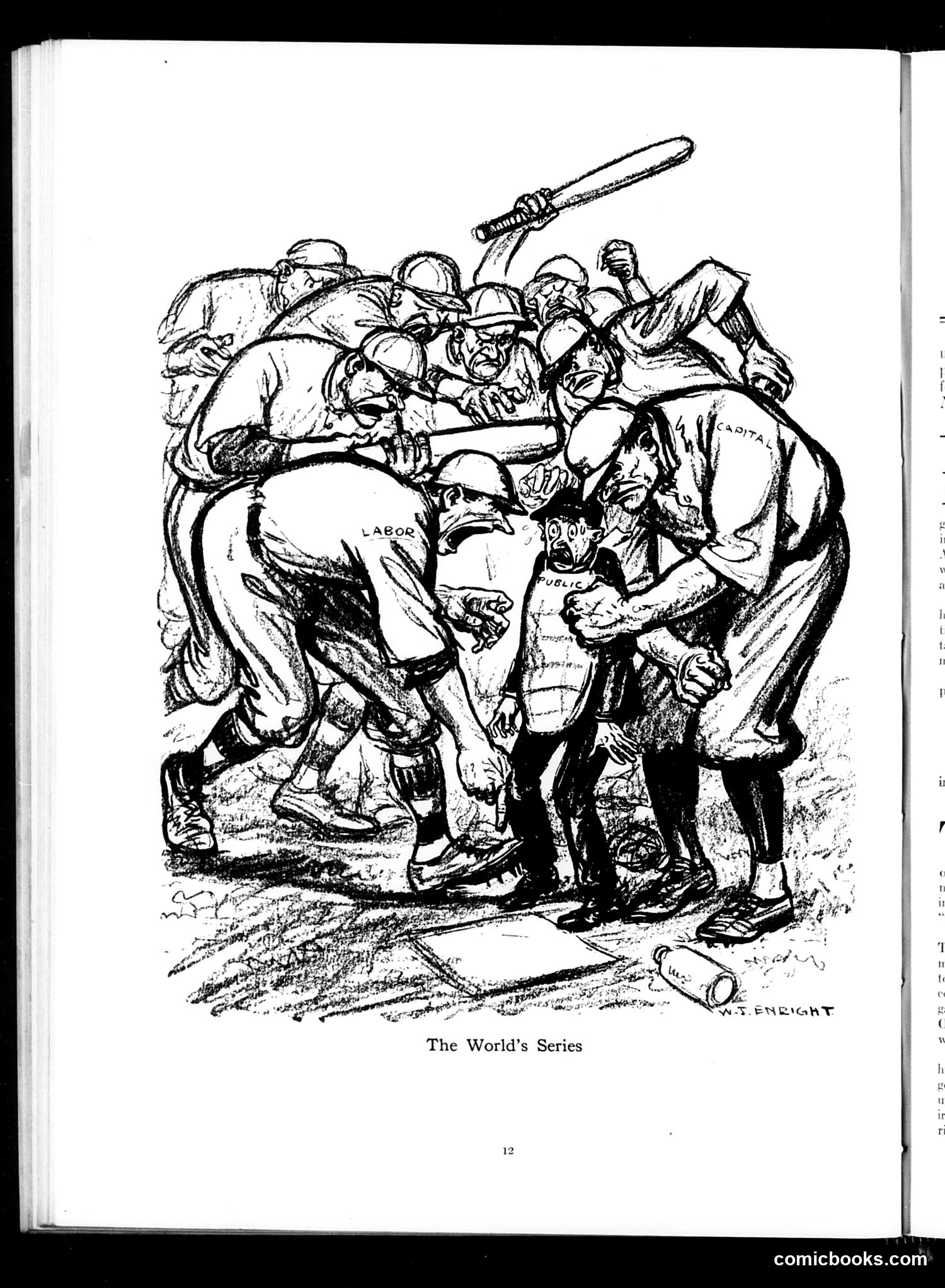
This political cartoon by W.S. Enright depicts a violent confrontation labeled "The World's Series"—a satirical reference to baseball's World Series championship. The central figure, labeled "PUBLIC," is being attacked by a mob of men labeled "LABOR" and "CAPITAL," who are literally beating him with a baseball bat. The cartoon satirizes labor-capital disputes of the early 20th century, suggesting both sides exploit and harm ordinary citizens during their conflicts. The "World's Series" pun contrasts genteel baseball competition with brutal economic conflict. The public stands defenseless in the center while powerful interests battle, indifferent to civilian suffering. This reflects Judge magazine's critique of labor unrest and industrial violence affecting working Americans.
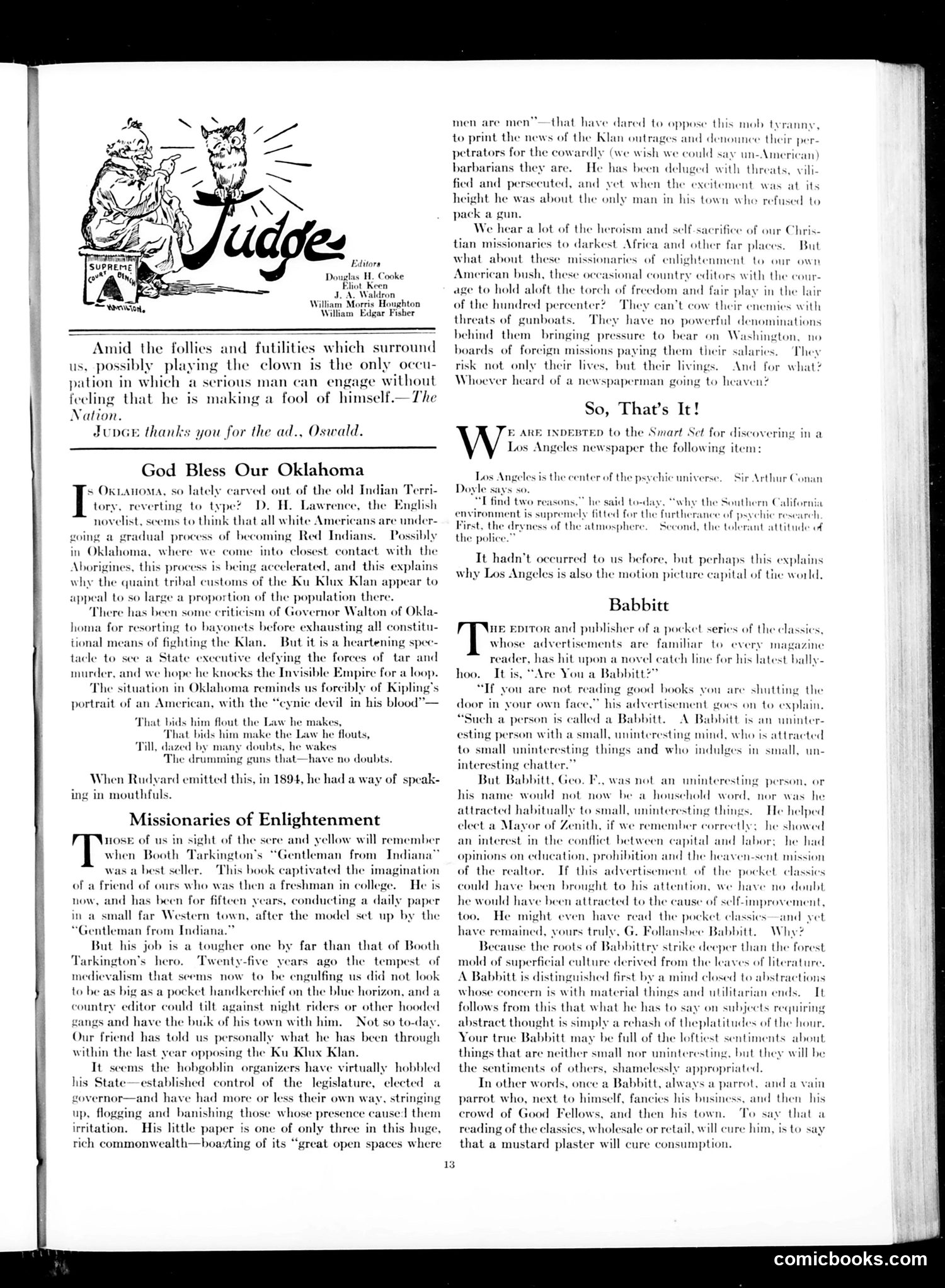
This page critiques the Ku Klux Klan's control over Oklahoma. The top cartoon depicts "Judge" (the magazine's mascot) confronting a demonic figure labeled "The Klan," symbolizing the organization as evil. The main editorial praises Governor Walton for using military force against the Klan's violence, comparing the situation to Kipling's 1894 poem about lawlessness. It notes Oklahoma's concerning reversion to "tribal customs" and mob rule. The "Missionaries of Enlightenment" section praises small-town newspaper editors courageously opposing Klan tyranny despite threats and violence. The author contrasts these editors' bravery unfavorably with Christian missionaries, arguing these American journalists are equally heroic for defending "freedom and fair play" against "mob tyranny" in their own country. The satire's point: Judge champions the editors as unsung heroes resisting organized intimidation, implying mainstream America should recognize their sacrifice as comparable to celebrated missionary work abroad.
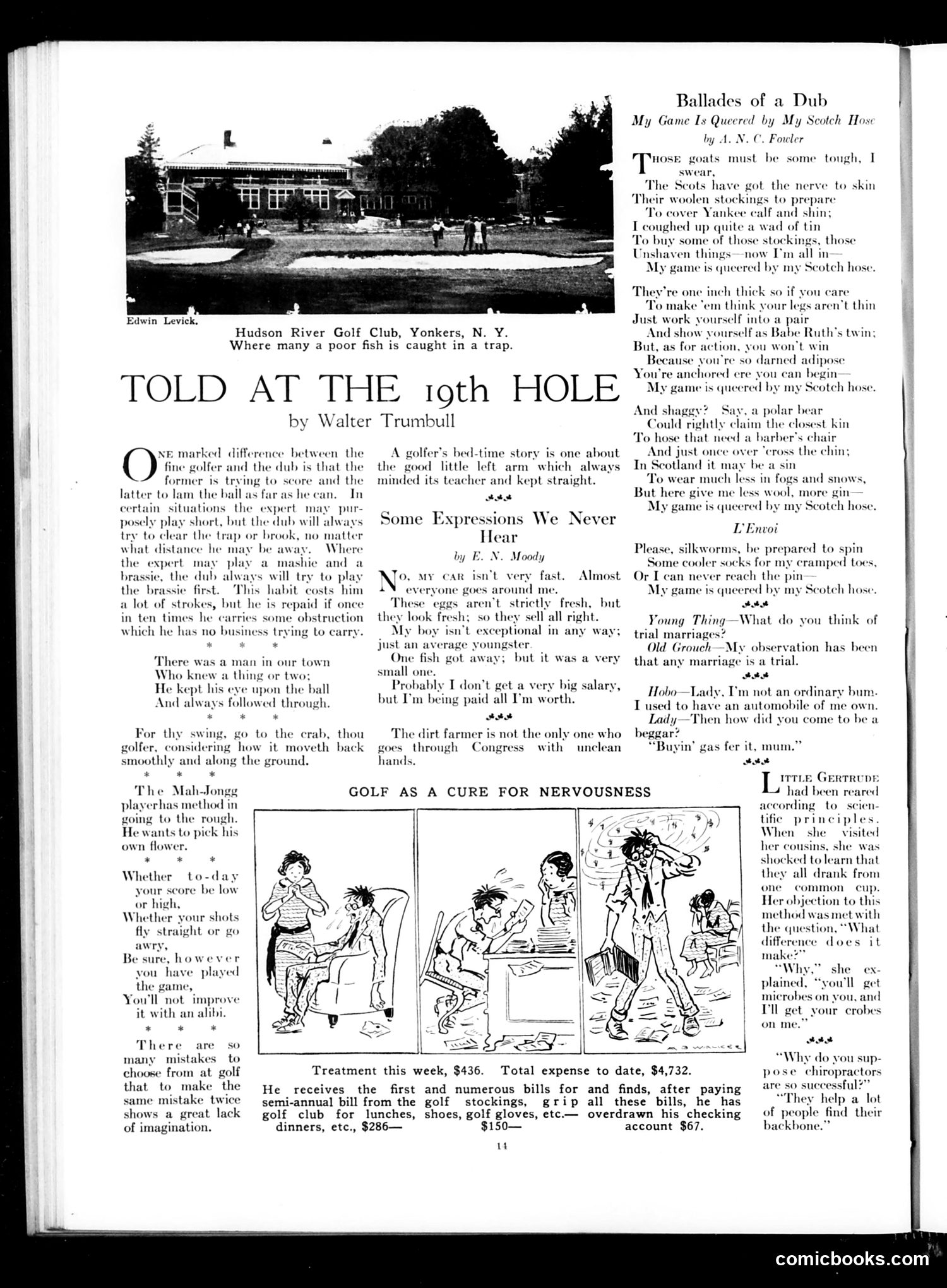
This page from *Judge* magazine contains golf humor and social commentary typical of early 20th-century American satire. **Main Content:** 1. **"Told at the 19th Hole"** — A short story contrasting skilled golfers with amateur "dubs," using golf as metaphor for life discipline. The expert plays strategically; the dub recklessly attempts impossible shots. 2. **"Some Expressions We Never Hear"** — Social satire listing things people won't admit: cars aren't fast, eggs aren't fresh, workers aren't overpaid. The farmer reference likely critiques Congressional corruption. 3. **"Golf as a Cure for Nervousness"** — Comic strip showing golf's therapeutic effects on anxious people. 4. **"Ballades of a Dub"** — Humorous poem mocking uncomfortable Scottish golf stockings that ruin the wearer's game—absurdist complaint about imported fashion. 5. **"Little Gertrude"** — Brief satire on germ-theory obsession: a scientifically-reared child horrified by sharing communal cups, representing anxieties about modern hygiene consciousness. The overall tone mocks both pretentious golf culture and emerging modern anxieties about health and status.
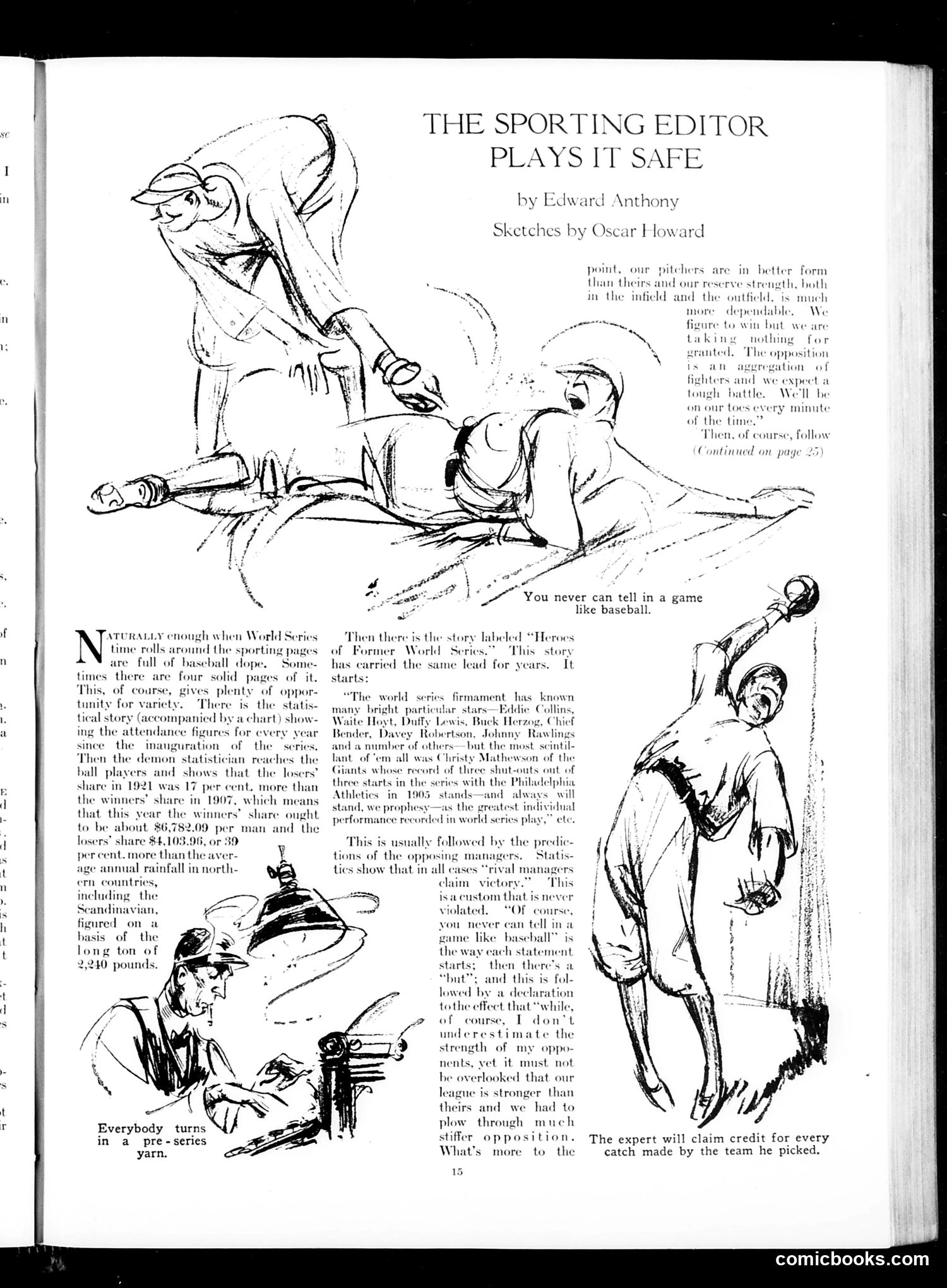
This satirical piece by Edward Anthony mocks the predictable clichés of baseball journalism during World Series season. The cartoons illustrate the absurdity of sports writers' pre-game predictions and analysis. The humor targets how sporting editors and managers make contradictory claims: they simultaneously claim their team is superior while insisting "you never can tell in a game like baseball"—hedging their bets to avoid being wrong. The text lampoons the repetitive formulas: citing historical "heroes" (like Christy Mathewson), padding stories with meaningless statistics, and printing opposing managers' identical declarations that they're stronger but respectfully acknowledge opponents. The sketch showing a figure taking notes represents the sports expert, while the baseball players illustrate the subject matter. The satire's point: sports journalism relies on safe, non-committal language that allows writers to claim credit for correct predictions while deflecting blame for incorrect ones—"play[ing] it safe" through verbal gymnastics rather than genuine analysis.
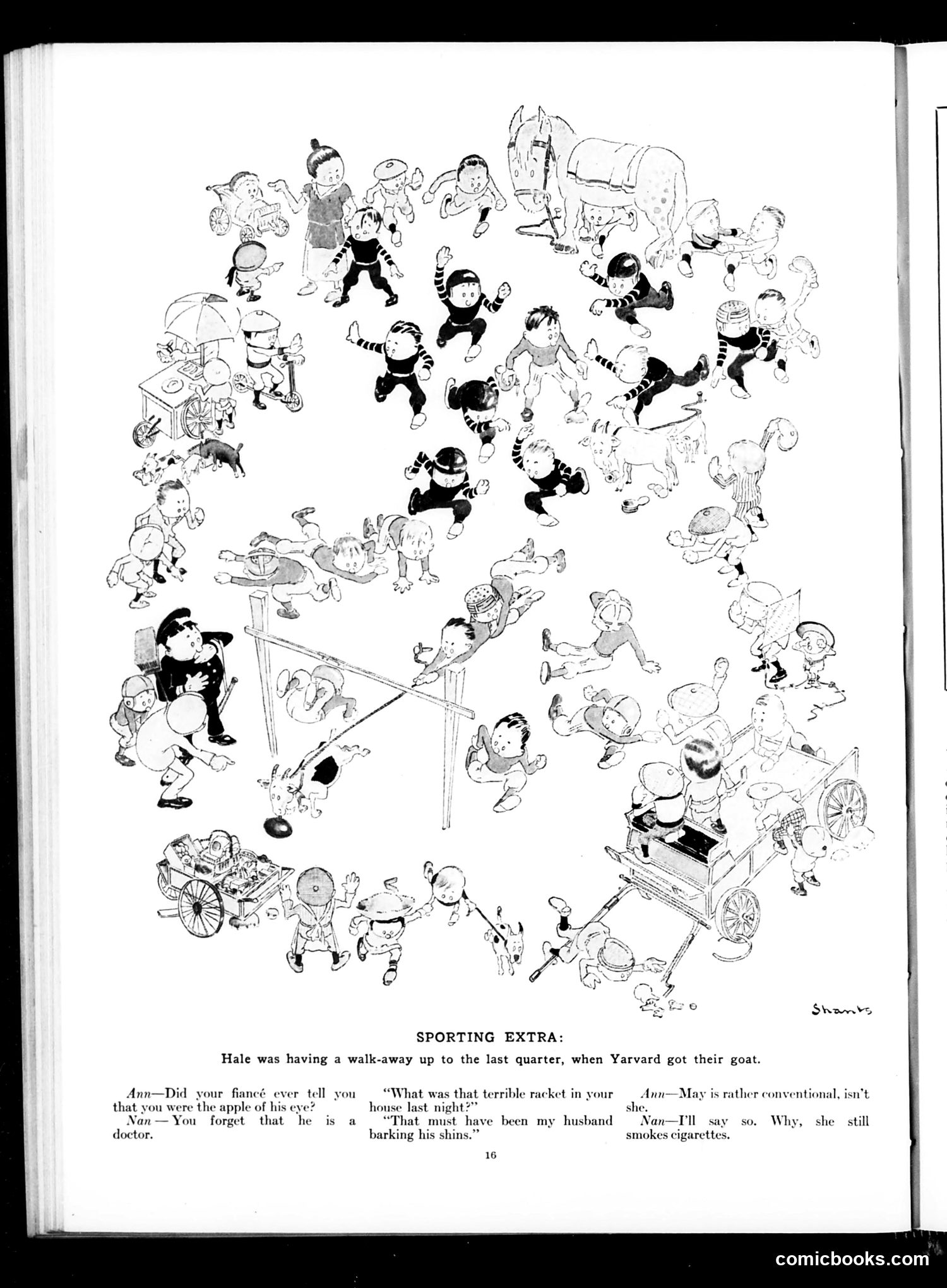
This page contains a humorous illustrated scene of a chaotic children's sporting event or playground, titled "Sporting Extra," referencing a football game between Hale and Harvard where "Hale was having a walk-away up to the last quarter, when Yarvard got their goal." Below the illustration are three separate joke exchanges between female characters (Ann and Nan): 1. A play on the phrase "apple of his eye"—the fiancé is a doctor, so he likely meant she's the "apple" anatomically. 2. A joke about a husband making noise at night ("barking his shins"—presumably stumbling painfully in the dark). 3. Social commentary: May is "conventional" because she still smokes cigarettes—implying that smoking was becoming unfashionable or that conventionality was shifting regarding women's habits. The satire appears gentle, targeting romantic misunderstandings and evolving social norms around women's behavior in the early 20th century. The specific date and artist signature ("Shanus") are visible but the historical context remains unclear from the page alone.
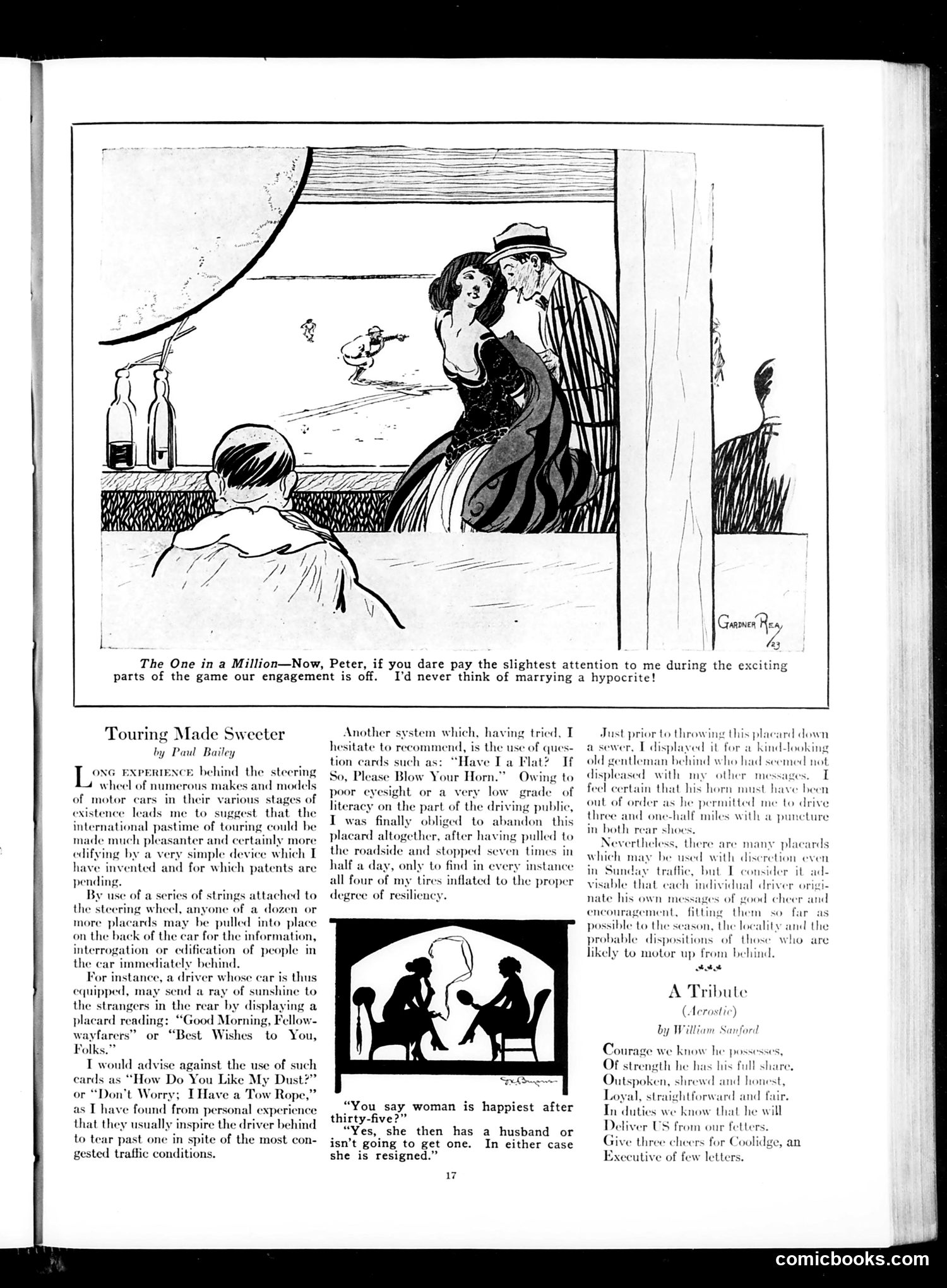
**The Cartoon:** A man in a car ignores his fiancée at a baseball game, focusing instead on the game. She threatens to break their engagement if he continues paying attention to the game rather than her. The joke is that he's a "hypocrite"—presumably for claiming to value her while neglecting her. **Social Context:** This reflects early 20th-century dating anxieties and gender expectations. The cartoon satirizes men's divided attention between romantic obligations and leisure pursuits (baseball), presenting the woman as rightfully demanding exclusive attention during "exciting parts" of courtship. **The Surrounding Articles:** "Touring Made Sweeter" humorously describes a driver's invention: placards displayed on car backs to communicate with following drivers. The satire mocks both the inventor's idea and drivers' poor attention—demonstrated when his "flat tire" message gets ignored seven times. **"A Tribute":** An acrostic poem praising Coolidge, suggesting this is from the Calvin Coolidge era (1920s).
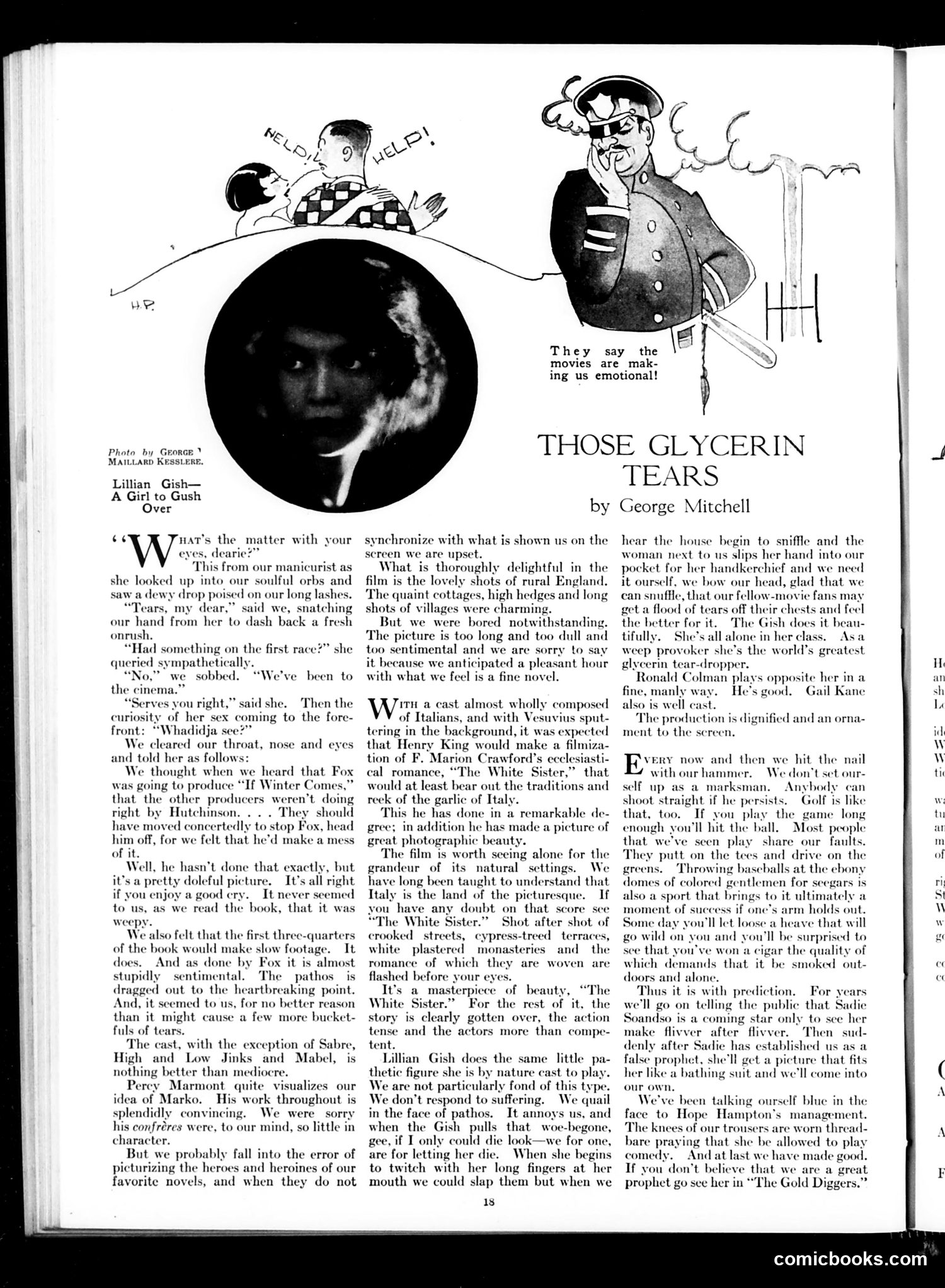
This is a film review by George Mitchell satirizing early cinema's emotional manipulation. The cartoons mock the "weepy" filmmaking trend of the era. The **left cartoon** shows a couple on a hill labeled "A Girl to Gush Over," referencing actress **Lillian Gish**, whose photograph appears below. The reviewer admits crying at "If Winter Comes" (a Fox film), then discusses the film's excessive sentimentality. The **right cartoon** depicts a melodramatic figure ("Those Glycerin Tears"), mocking actors who deploy fake tears as a cheap emotional device. Mitchell criticizes how studios deliberately drag out pathos to manipulate audiences into crying—the "glycerin tears" being literal stage tears used to trick viewers. He praises the cinematography and settings of films like "The White Sister" but resents Gish's perpetually suffering characters, sarcastically noting that audiences reward this emotional exploitation. The review's headline mocks this trend: "They say the movies are making us emotional!"
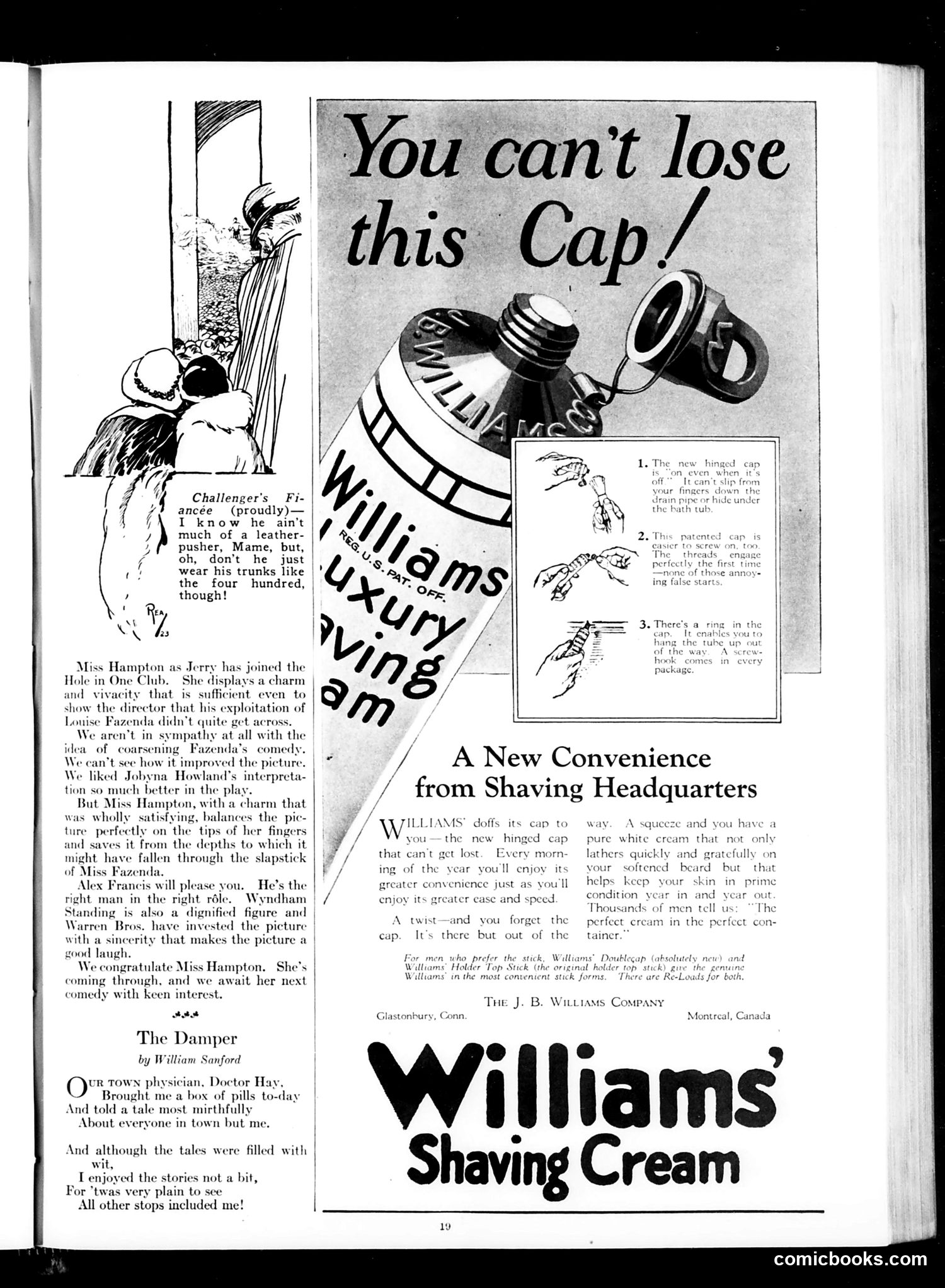
This page contains primarily **advertising** rather than political satire. The main content is a full-page Williams Shaving Cream advertisement featuring a novelty "hinged cap" that supposedly can't get lost—the cap stays tethered to the bottle. The page includes brief **entertainment commentary**: reviews of film performances by Miss Hampton and actress Louise Fazenda, praising Hampton's comedic charm and vivacity. There's mild criticism of how director exploitation affected Fazenda's comedy style compared to stage actress Jobyna Howland's interpretation. A short poem, "The Damper" by William Sanford, describes a doctor sharing gossip about townspeople—humorously noting that despite the stories being witty, they conspicuously excluded the narrator himself. The cartoons are minimal—just small illustrations supporting the ad copy and one sketch regarding a boxing "challenger's fiancée." Overall, this is a typical Judge magazine page mixing light entertainment coverage with product advertising, lacking significant political or social satire.
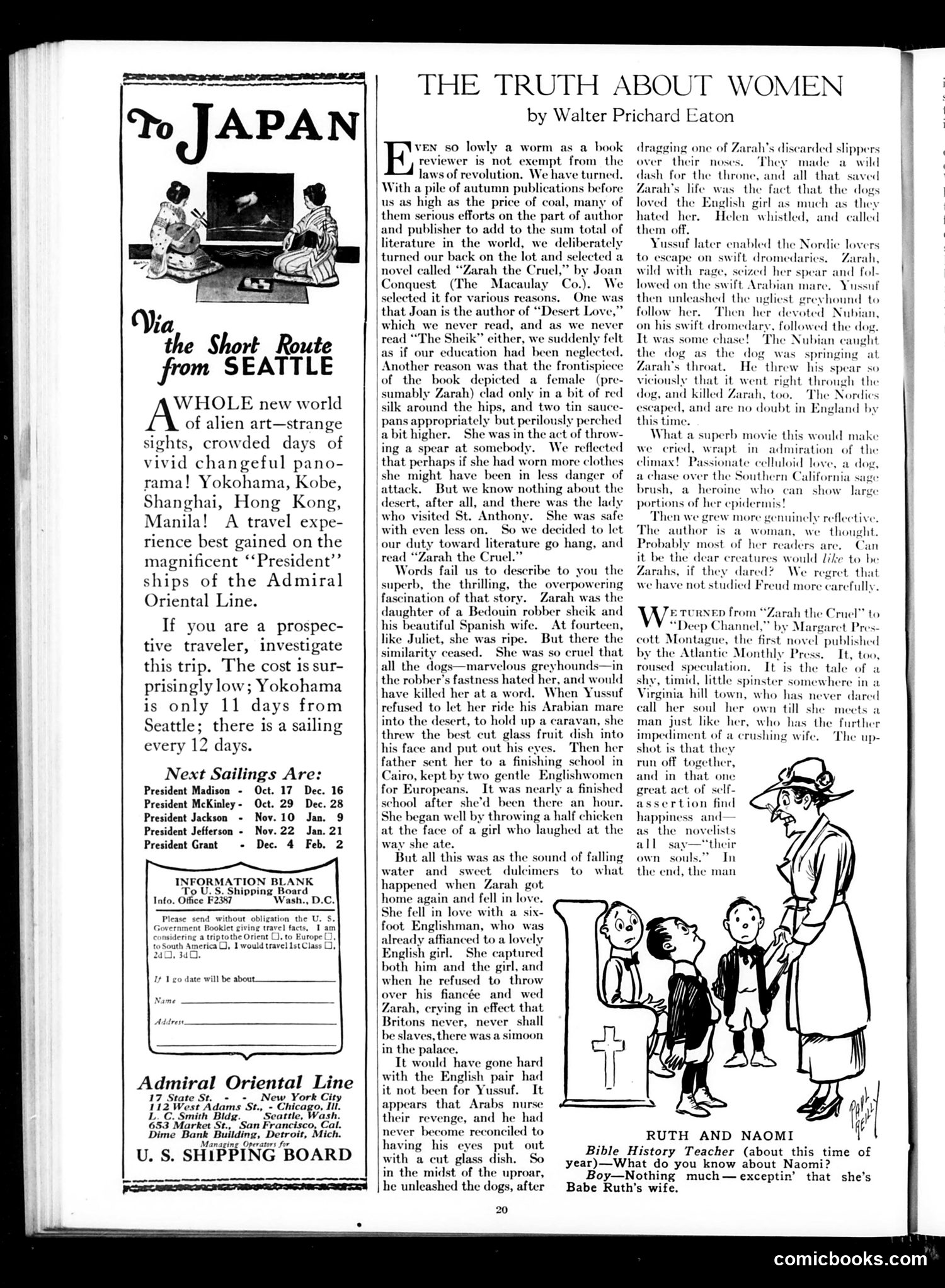
This page combines a shipping advertisement (left) with a book review (right) of *Zarah the Cruel* by Joan Conquest. The review uses mock-serious tone to lampoon both the novel and contemporary attitudes toward women. The satire targets the melodramatic "exotic adventure" genre popular at the time. "Zarah" is a deliberately absurd female character—a scantily-clad, violent Bedouin girl who throws dishes, attacks fellow students, and seduces men with reckless abandon. The reviewer feigns breathless admiration while describing increasingly ridiculous plot points (a spear-throwing woman in minimal clothing; a finishing school nearly destroyed in an hour). The title "The Truth About Women" is ironic: the review suggests such pulp fiction represents how society views women—as either exotic, dangerous, or morally corrupt. The magazine mocks both the book's lurid sensationalism and the male readership's appetite for such stereotypical portrayals.
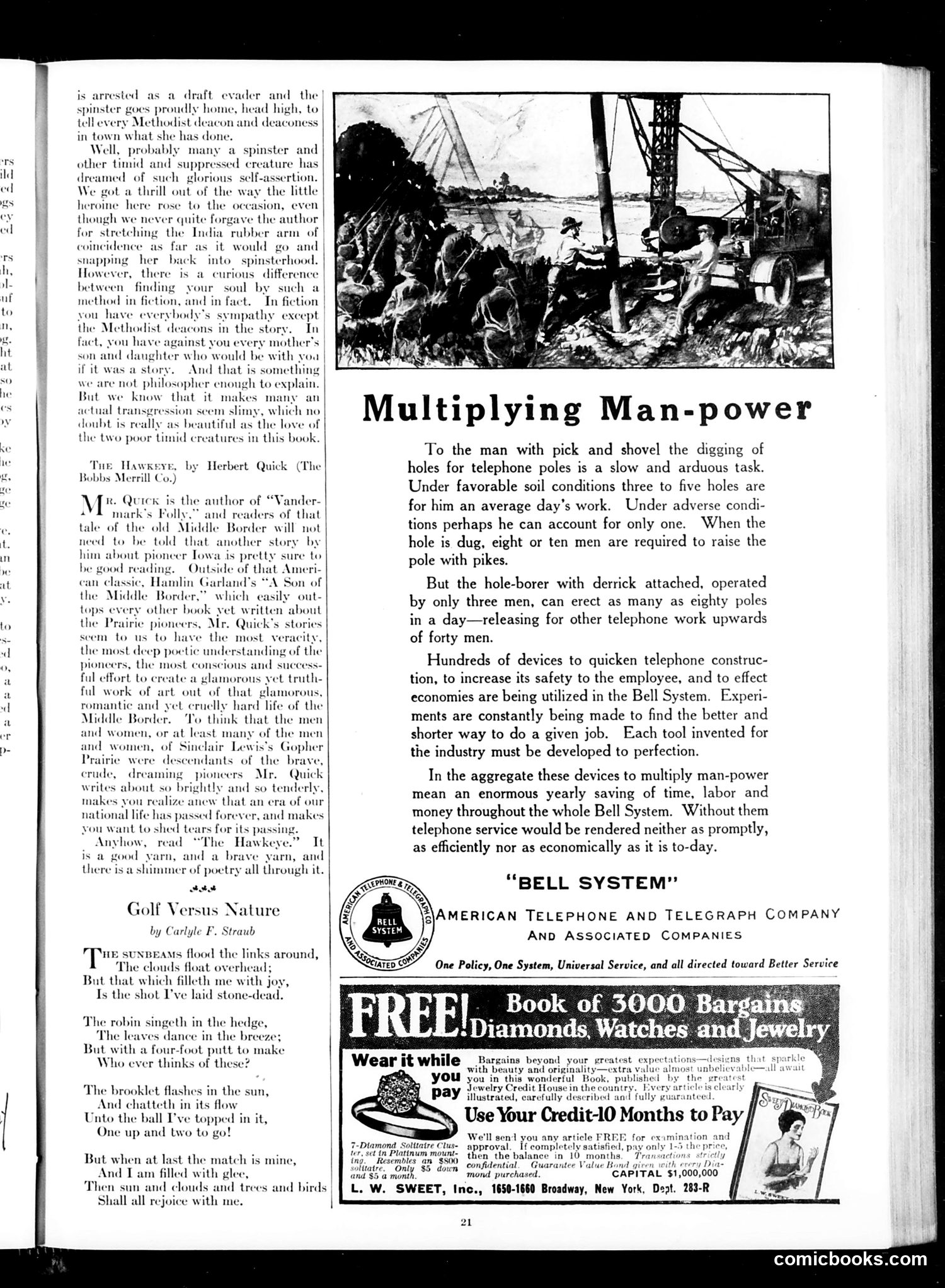
This page contains book reviews and advertisements rather than political cartoons. The main content includes reviews of novels by Herbert Quick and Carlyle F. Straub, discussing pioneer life in the American Midwest and a humorous poem about golf prioritizing sport over nature's beauty. The prominent advertisement is a **Bell System telephone company piece** promoting labor-saving innovations. It illustrates how mechanical devices (specifically a hole-borer with derrick) allow three workers to accomplish what previously required many more men—erecting eighty telephone poles daily instead of a few. This is presented as progressive: efficient, economical, and releasing workers for other tasks. This reflects early-20th-century American optimism about technology improving industrial productivity and worker welfare, though modern readers might question whether "releasing" workers meant redeployment or job loss.
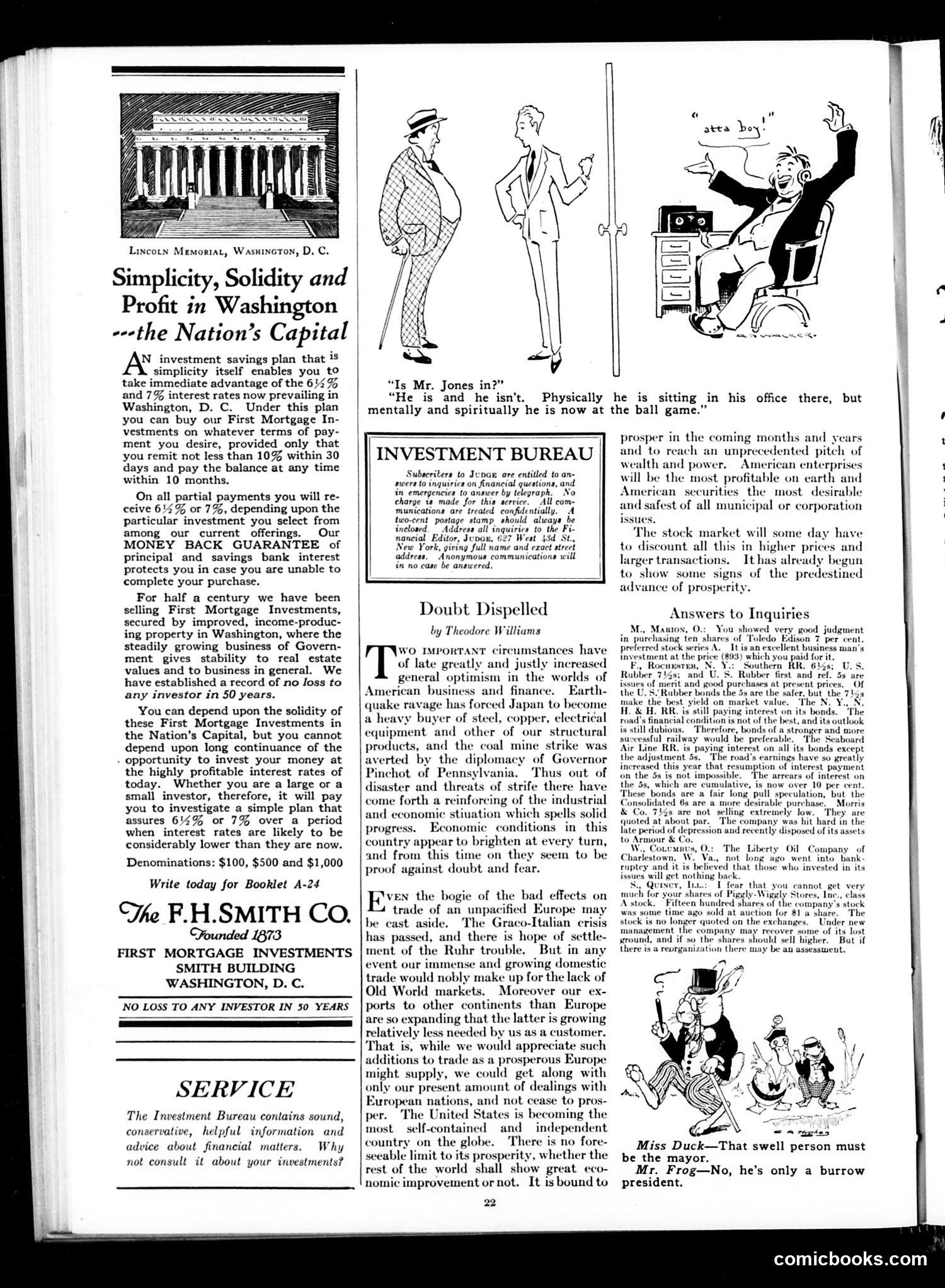
This page contains primarily **financial advertising** for the F.H. Smith Company's mortgage investments in Washington, D.C., alongside a serious financial article titled "Doubt Dispelled" by Theodore Williams. The small cartoon at top right is a humorous office scene: when asked "Is Mr. Jones in?", the reply is "He is and he isn't"—he's physically present at his desk but mentally absent, "at the ball game." This is a common workplace joke about distracted employees. The "Investment Bureau" box offers financial advice services to magazine readers. The main article discusses post-WWI economic optimism: Japan's earthquake damage has created demand for American steel and copper; a coal miners' strike was averted; and domestic trade is strong enough to offset weakness in European markets. The piece argues America's economic independence and self-sufficiency make it "proof against doubt and fear." The page reflects 1920s-era American confidence in industrial prosperity and financial markets—before the 1929 crash would prove such optimism premature.
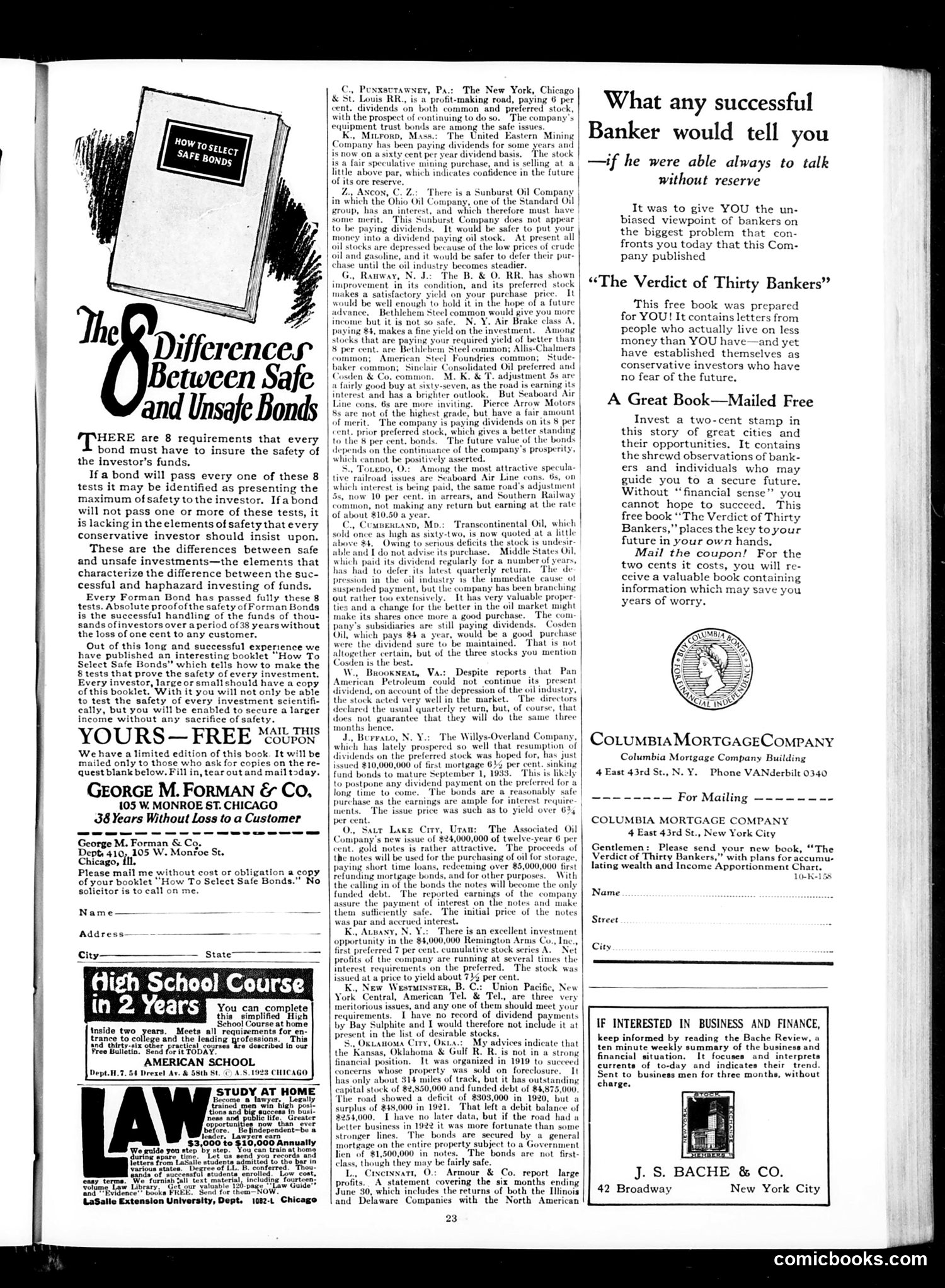
This page is primarily **financial advertising**, not political satire. The main content promotes George M. Forman & Co.'s investment advisory services, specifically a free booklet titled "How To Select Safe Bonds." **The Context:** The piece addresses investor anxiety during an economically uncertain period (likely 1920s-1930s based on references to oil industry depression and railroad stocks). It presents "8 requirements" for safe bond investments—essentially claiming that Forman & Co. has a scientific method to protect investors' money. **The Message:** Rather than satire, this is earnest financial marketing. The company emphasizes its 38-year track record without customer losses. The adjacent advice column (responding to reader questions about specific stocks and bonds) serves to demonstrate expertise while subtly promoting conservative investing through their firm. **For Modern Readers:** This reflects an era before SEC regulations and standardized financial disclosures—when individual brokerages competed by claiming proprietary safety-testing methods. The tone assumes investors needed education on distinguishing reliable from risky investments.
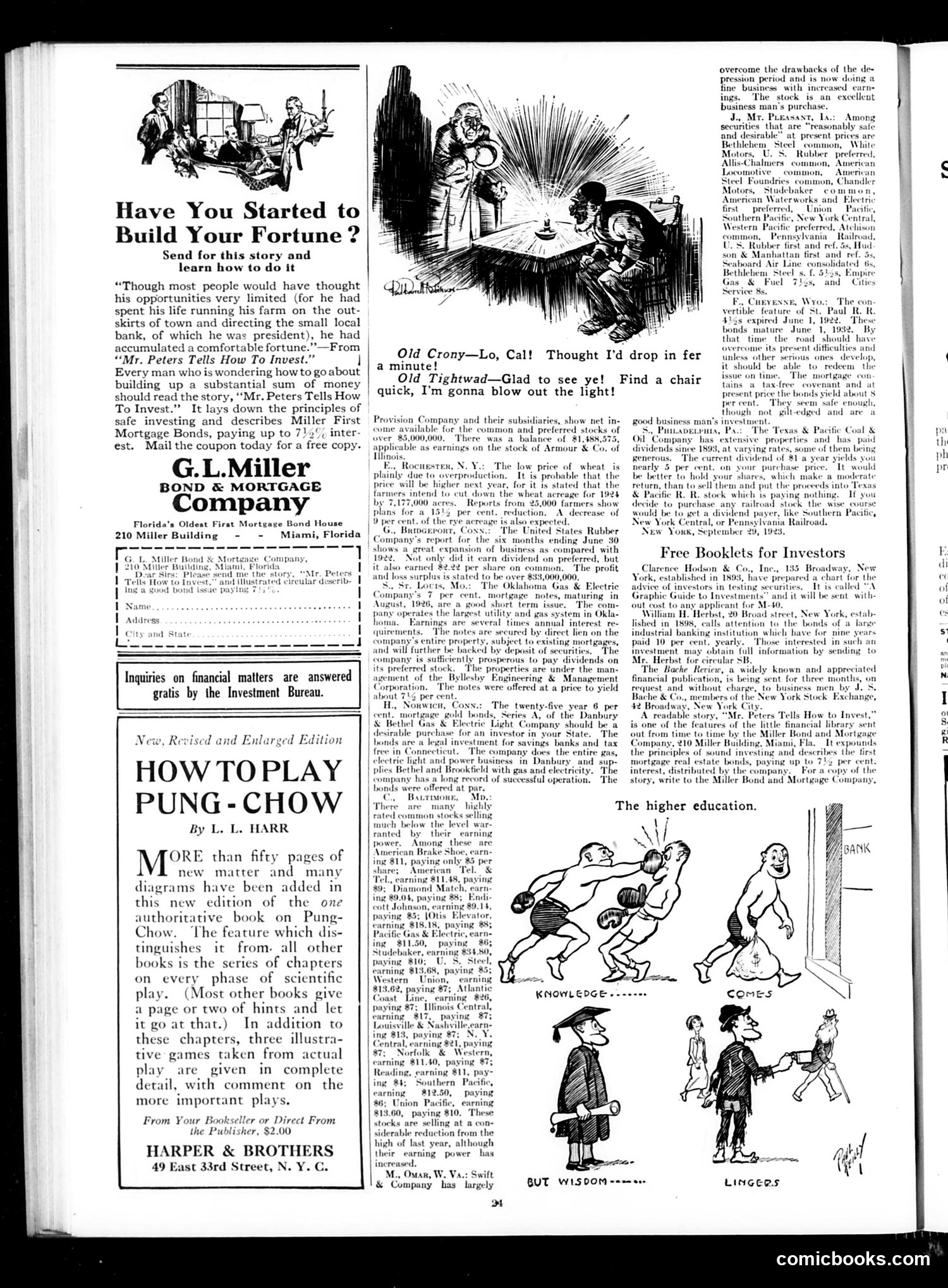
This page is primarily **advertising and financial advice**, not political satire. The main content includes: **"Have You Started to Build Your Fortune?"** – An advertisement for G.L. Miller Bond & Mortgage Company (Miami, Florida), promoting investment advice through a story called "Mr. Peters Tells How To Invest." **The small cartoon** ("Old Crony") shows two men greeting each other casually—one arriving unexpectedly at the other's home. It's mild domestic humor with no political content. **Financial advice columns** answer reader questions about stocks, bonds, and investments (wheat prices, railroad stocks, electric companies, rubber stocks). **"How to Play Pung-Chow"** advertises a book on the game by L.I. Harr, published by Harper & Brothers. **The "higher education" cartoon** uses simple stick-figure drawings to humorously illustrate concepts (Knowledge, Comics, Gut Wisdom, Lingers). The page reflects the 1920s investment boom era but contains no meaningful political satire or social commentary—it's essentially a financial services and book advertising section.
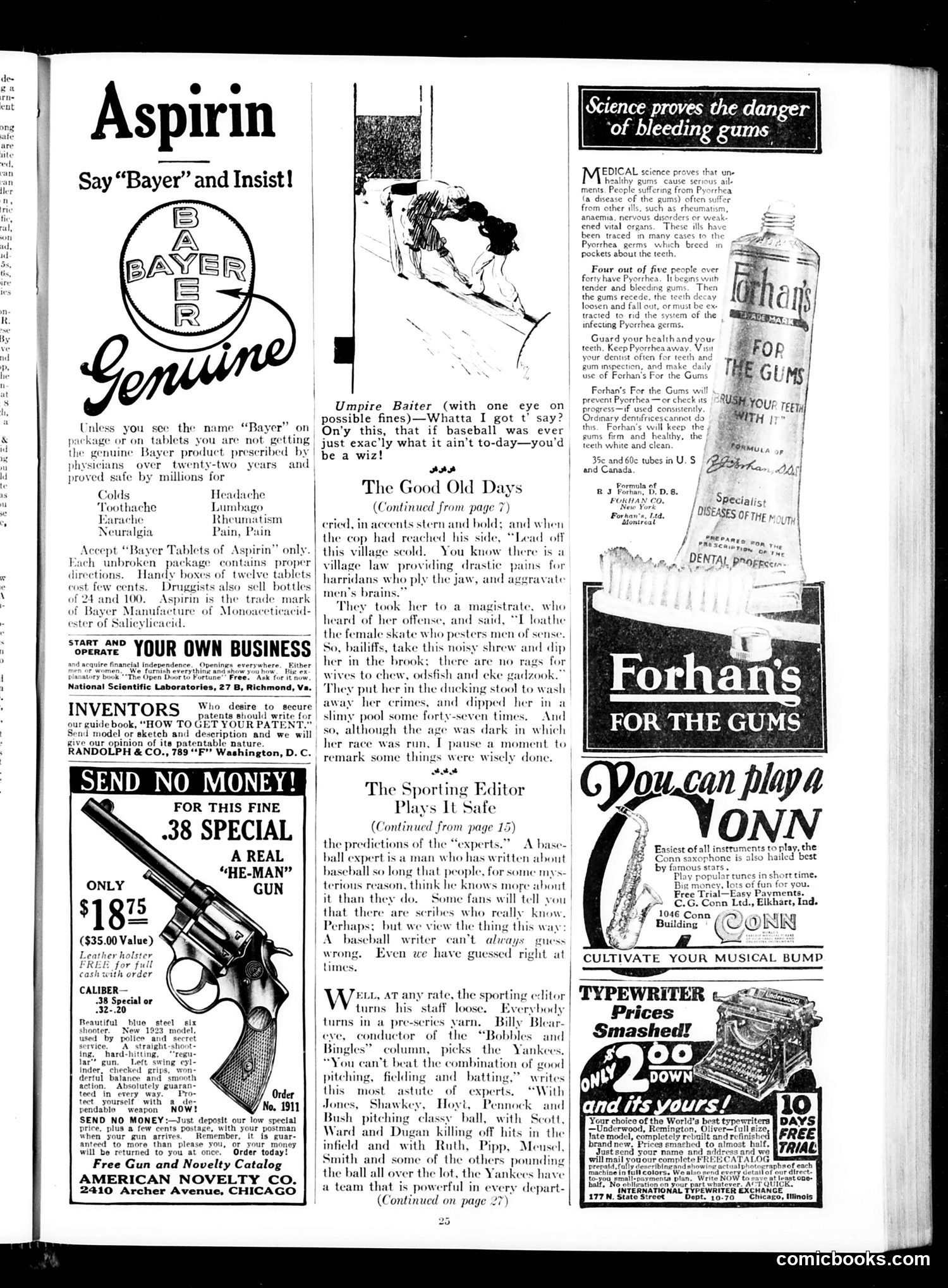
This page is primarily **advertisements and serialized fiction** rather than political cartoons. The notable satirical content appears in "The Sporting Editor Plays It Safe"—a piece mocking baseball writers' predictability. The unnamed editor is depicted as playing it safe by predicting the Yankees will win, since they have strong pitching and hitting. The satire suggests sports experts make obvious predictions that can't be wrong, rather than offering genuine insight. "The Good Old Days" is a humorous historical fiction piece about a woman in medieval times who is dunked repeatedly (via ducking stool punishment) for being a "scold"—social commentary through comic exaggeration about past treatment of outspoken women. The page is dominated by period advertisements for Bayer Aspirin, revolvers, Forhan's gum treatment, and typewriters—typical early 1920s consumer products. The "Umpire Baiter" cartoon is a brief joke about a baseball umpire making compliments to avoid fines.
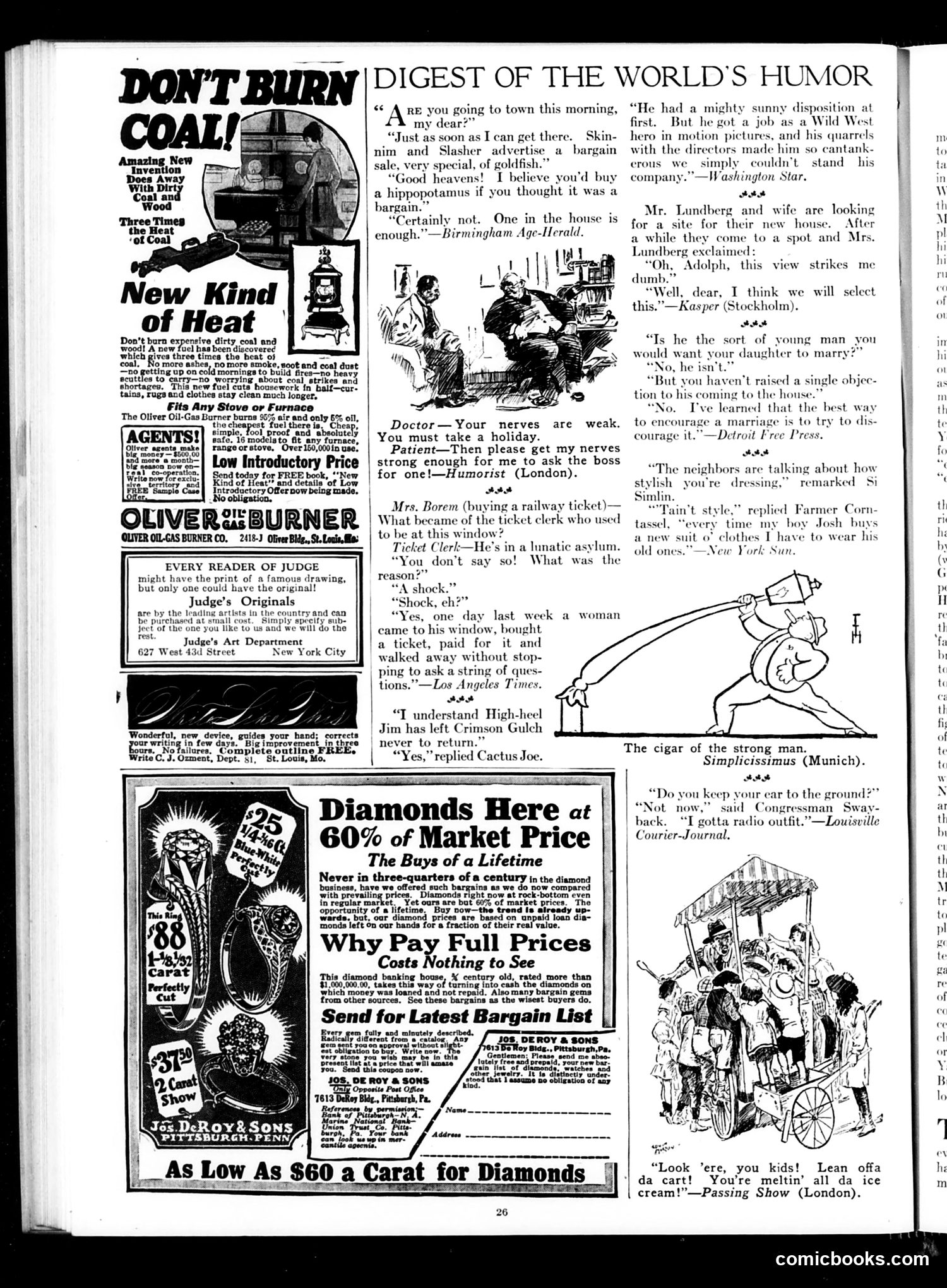
This is a mixed-content page from *Judge* magazine combining humor, advertisements, and satirical cartoons. **The Humor Section** ("Digest of the World's Humor") consists of brief, internationally sourced jokes poking fun at everyday situations: a wife obsessed with bargain shopping (goldfish, hippopotamus), a patient too anxious to request vacation time, a railway clerk driven mad by a woman's unusual courtesy (leaving without asking questions), and a couple's disagreement over house-hunting. **The Advertisements** dominate the page, promoting an oil-gas burner heating system, diamond investments at "60% market price," and Judge magazine's original artwork reproductions—typical early 20th-century consumer pitches emphasizing convenience, bargains, and status. **The Cartoons** (small illustrations accompanying jokes) use simple line drawings to visualize punchlines, including one of a man fishing, another of an ice-cream vendor with children. The page's overall point reflects *Judge's* satirical stance: gentle mockery of middle-class anxieties about shopping, work, marriage, and technology, wrapped around commercial appeals to that same audience.
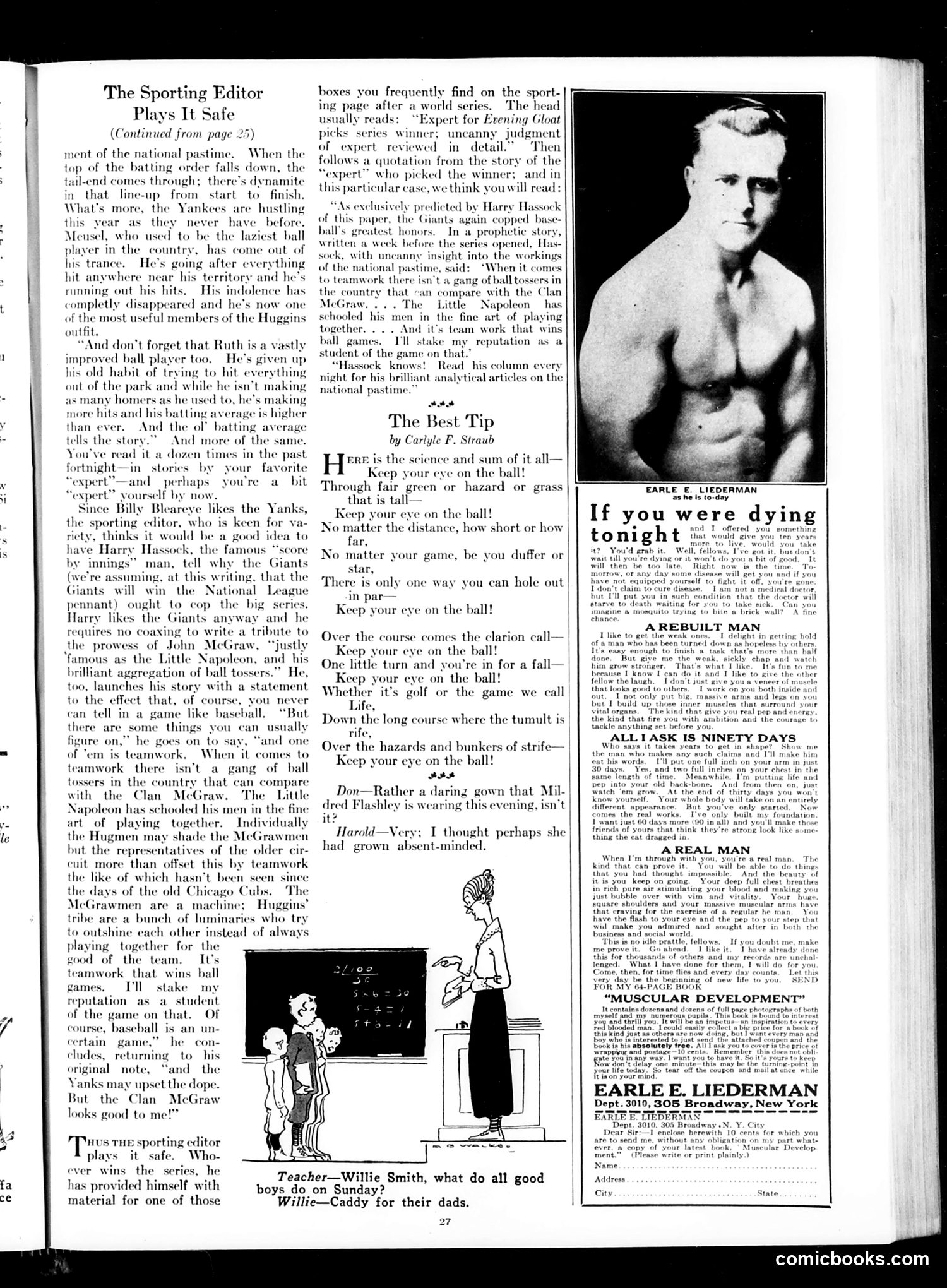
This page satirizes sports journalism's tendency to hedge bets and claim prescience after the fact. The "Sporting Editor Plays It Safe" article mocks how sportswriters provide contradictory predictions about the Yankees versus Giants (likely the 1921 World Series), then selectively quote whichever prediction proved correct in post-game "expert analysis" boxes. The joke: whether the Giants or Yankees win, the editor has already published arguments supporting that outcome—both the argument that Ruth and the Yankees are improving, and the argument that McGraw's Giants have superior teamwork. After the series ends, whichever prediction matches the actual result gets republished as proof of the writer's "uncanny judgment," while the opposite prediction is conveniently forgotten. It's satire about confirmation bias and the self-serving nature of sports commentary—the editor "plays it safe" by covering all bases, then takes credit for accuracy.
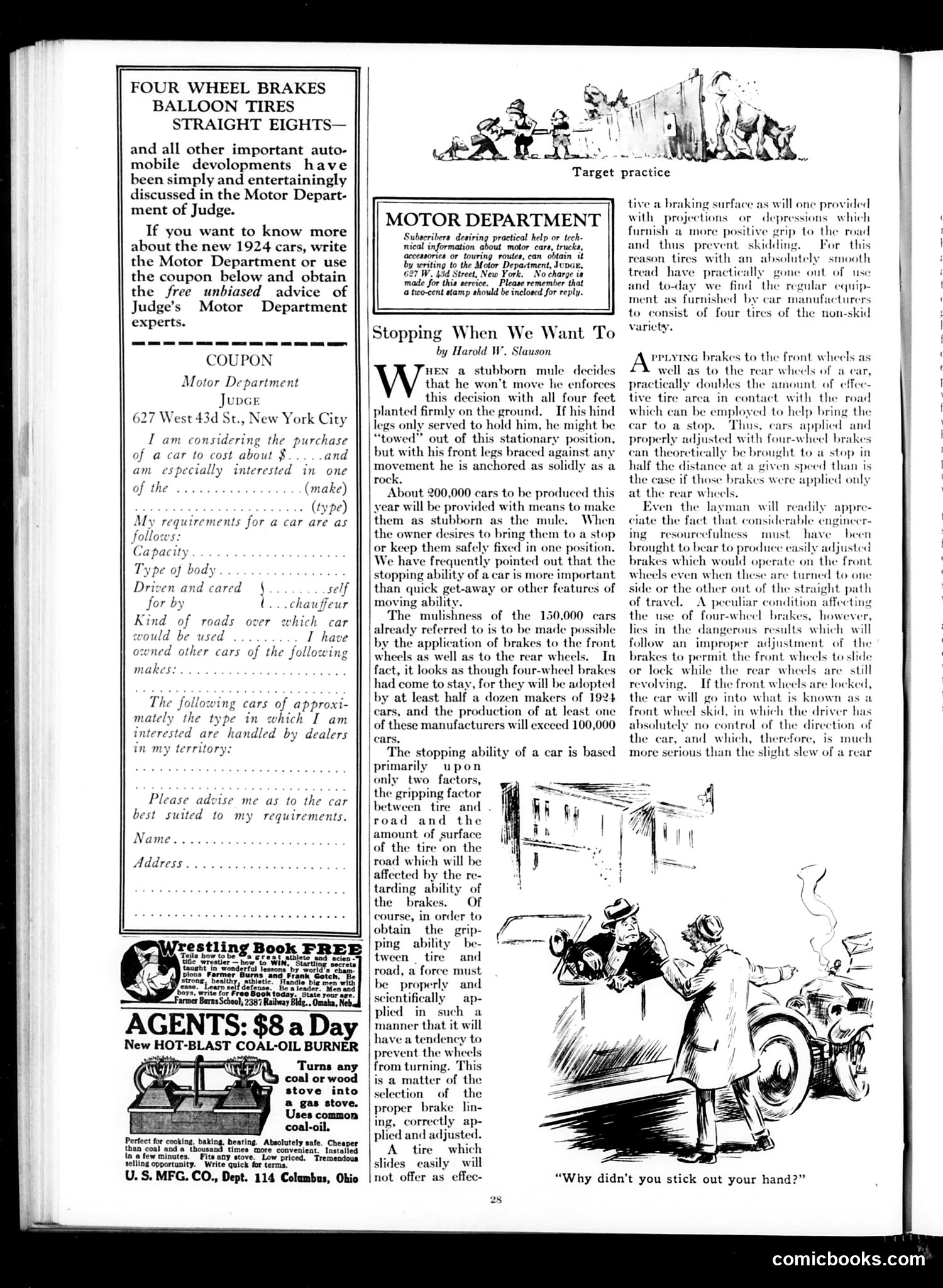
This page primarily contains **automobile advertising and technical content** rather than political satire. The main feature is "Stopping When We Want To," a technical article by Harold W. Slauson discussing four-wheel brakes—an emerging automotive technology circa 1924. The article compares a car's braking ability to a stubborn mule: just as a mule uses all four legs to resist movement, cars equipped with four-wheel brakes (not just rear brakes) can stop more effectively. The author argues this stopping ability matters more than acceleration or other features. The cartoon at bottom right shows a driver asking "Why didn't you stick out your hand?" —apparently depicting a traffic accident or near-miss, likely illustrating why reliable brakes matter for safety. The page also includes a coupon for Judge's Motor Department offering free automotive advice, plus advertisements for unrelated products (wrestling book, coal-oil stove). This is primarily **technical/commercial content** rather than satirical commentary.
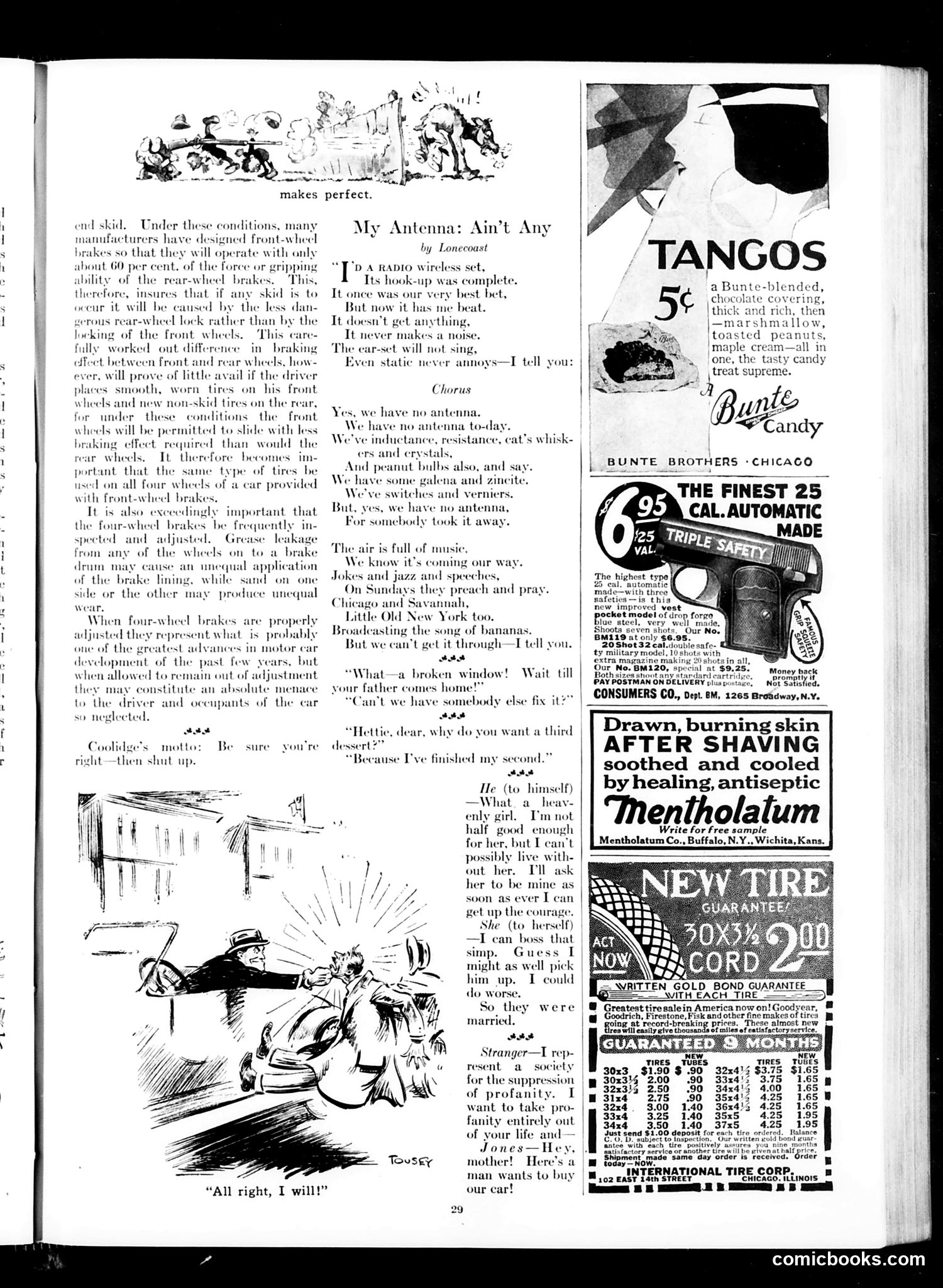
This page features a humorous song-poem by "Lonecoast" about early radio ownership. The joke is straightforward: a family has purchased a complete radio wireless set with all the technical components (inductance, resistance, galena crystals, switches), yet someone has stolen the antenna—the one essential piece needed to actually receive broadcasts. The satire targets two things: the novelty and expense of early radio technology (owners proudly listing all components they possess) and the frustration of modern inconvenience (a thief stealing the antenna renders the entire investment useless). The repeated chorus "Yes, we have no antenna" is a play on a then-popular song catchphrase. The accompanying cartoon and dialogue snippets (unrelated domestic humor about broken windows and marriage) fill the page's remaining space alongside period advertisements for Bunte candy, automobile tires, and Mentholatum.
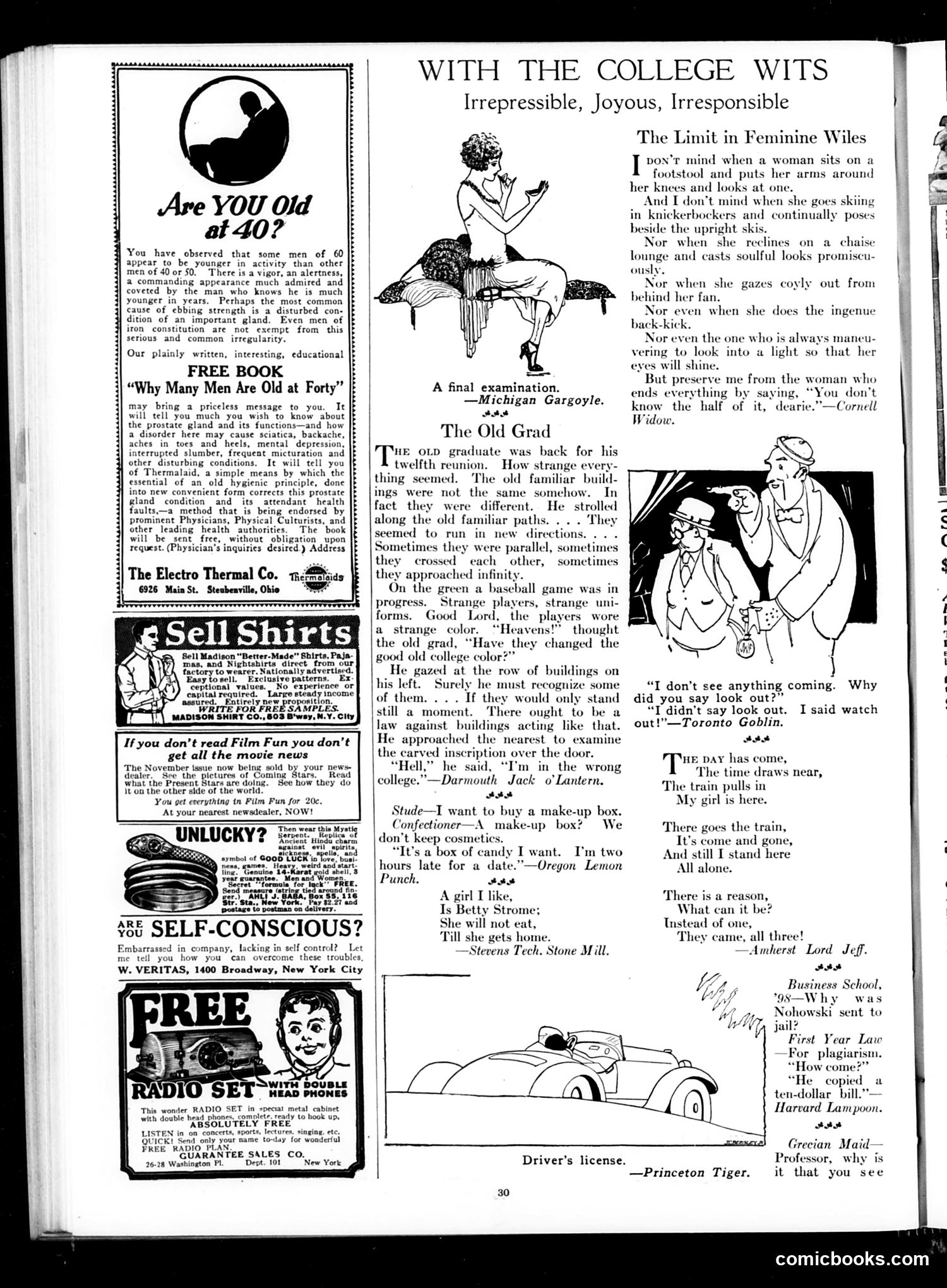
This page contains primarily **advertising and humorous college-themed content** rather than political satire. **Main advertisements:** - A medical ad for "Thermalaid," promoting a free book about prostate gland dysfunction in aging men—reflecting early-20th-century anxieties about male virility and vitality - Radio set giveaway and shirt-selling opportunities **"College Wits" section** presents light humor from college magazines: - "The Old Grad" satirizes alumni reunion disorientation—buildings seem unrecognizable, campus has changed - Brief jokes about college dating and romance - Gentle mockery of student culture **Cartoons** include a woman in flapper-style pose and a couple in a car, reflecting 1920s college social life. The page reflects **1920s concerns**: male aging/health anxiety, youth culture, dating customs, and nostalgic alumni returning to changed campuses. The tone is lighthearted rather than politically charged—typical of Judge's mix of satire, advertising, and collegiate humor targeting educated, middle-class readers.
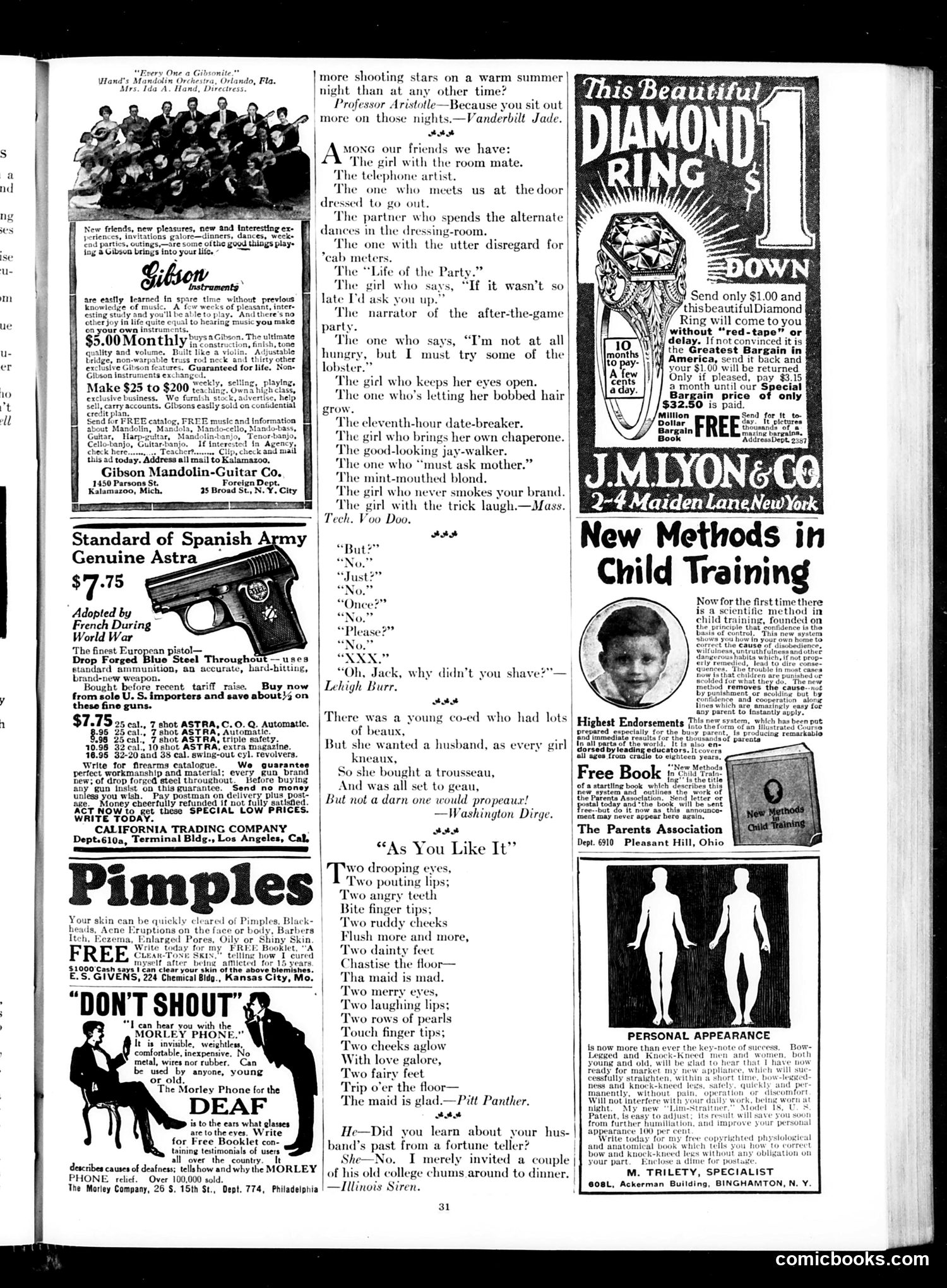
This page from *Judge* is primarily **advertising** rather than political satire. The ads include Gibson mandolins, Spanish army pistols, "child training" methods, and skin treatments for acne. The only editorial content is a lighthearted **social commentary list** ("Among our friends we have") describing stereotypical female party-goers of the era—the girl who asks last-minute dates, the one who brings her own chaperone, the girl who tries everything at dinner. This reflects 1920s anxieties about changing female behavior and dating customs. A brief humorous poem describes a college woman with many suitors who wants marriage but can't find a willing partner—satirizing the mismatch between female ambition and male reluctance to commit. The references are period-specific (bobbed hair, parties, chaperones) and reveal social anxieties about flapper culture and courtship norms, but lack the pointed political bite typical of *Judge's* best work.
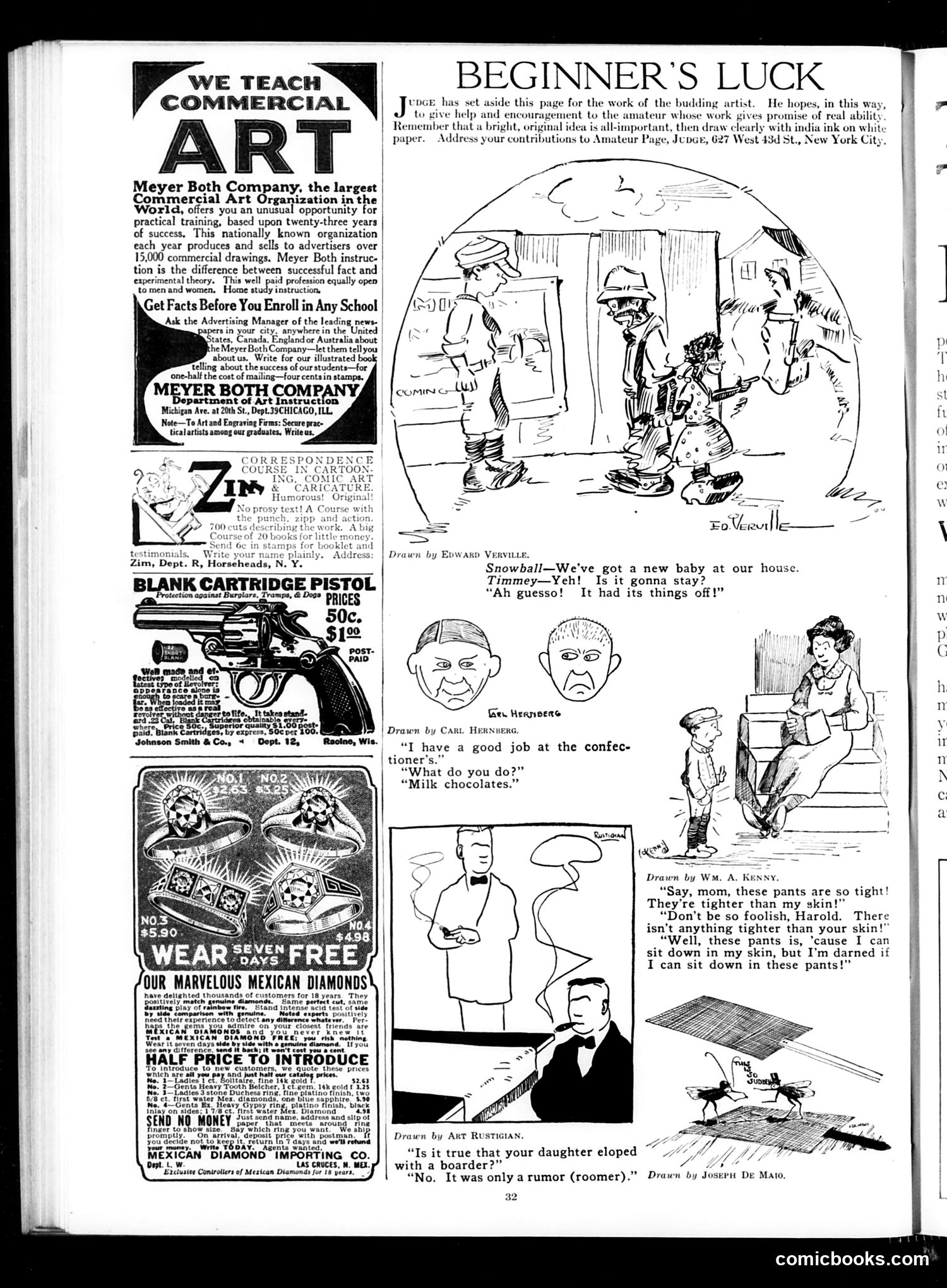
This page showcases Judge's section for amateur cartoonists, featuring simple jokes drawn by contributors. The cartoons rely on wordplay and domestic humor typical of early 20th-century comedy: 1. **Snowball/Timmy**: A child asks if a newborn baby will stay, joking it "had its things off"—likely referring to hospital gear. 2. **Confectioner's job**: A pun on "milk chocolates"—the worker literally milks chocolates rather than making them. 3. **Tight pants**: A child complains pants are tighter than skin; his mother logically responds nothing's tighter than skin, but he retorts he can sit down in his skin but not the pants—absurdist logic humor. 4. **Daughter/boarder**: A pun on "rumor" versus "roomer" (a boarder who rents a room). The page also contains advertisements for art schools and commercial art instruction, reflecting Judge's dual purpose as both humor magazine and venue for aspiring artists.
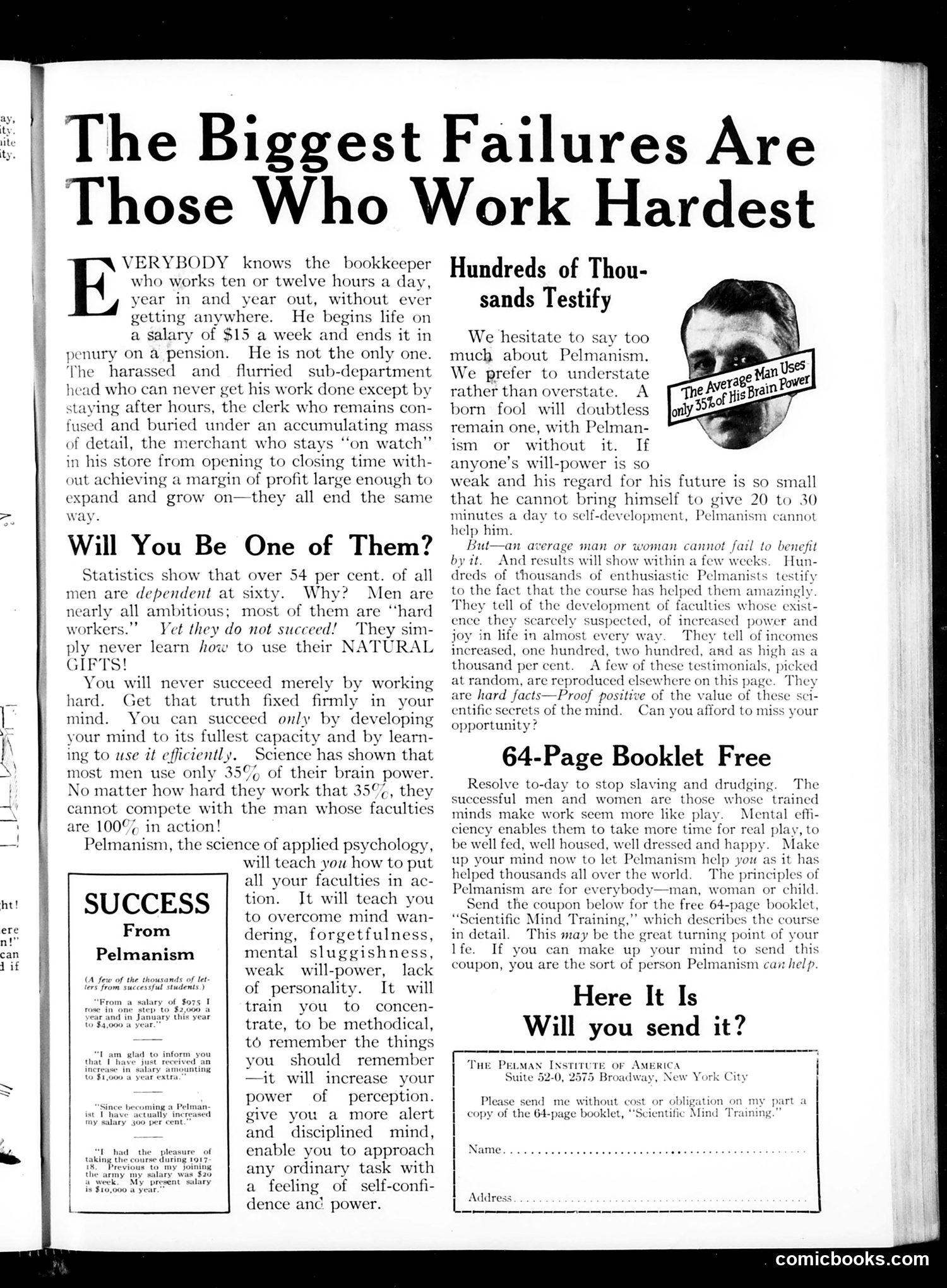
This page is primarily an advertisement for "Pelmanism," a self-help course claiming to teach "applied psychology" and mental efficiency. The satirical headline contradicts the era's work-ethic gospel: hard work alone guarantees failure without mental training. The piece targets early 20th-century anxieties about economic mobility. It depicts cautionary figures—undercompensated bookkeepers, overworked merchants, harassed clerks—stuck in poverty despite decades of labor. The solution: Pelmanism promises to unlock untapped "brain power" (claiming most people use only 35% of their mental capacity). The portrait shows "The Average Man Uses Only 35% of His Brain Power"—a pseudoscientific claim typical of period self-improvement rhetoric. Testimonials claim income increases of 100-1000%, targeting desperate workers seeking escape from drudgery. This reflects genuine Progressive-era skepticism about industrial labor's soul-crushing effects, repackaged as a commercial product promising middle-class success through mental discipline rather than unionization or systemic change.
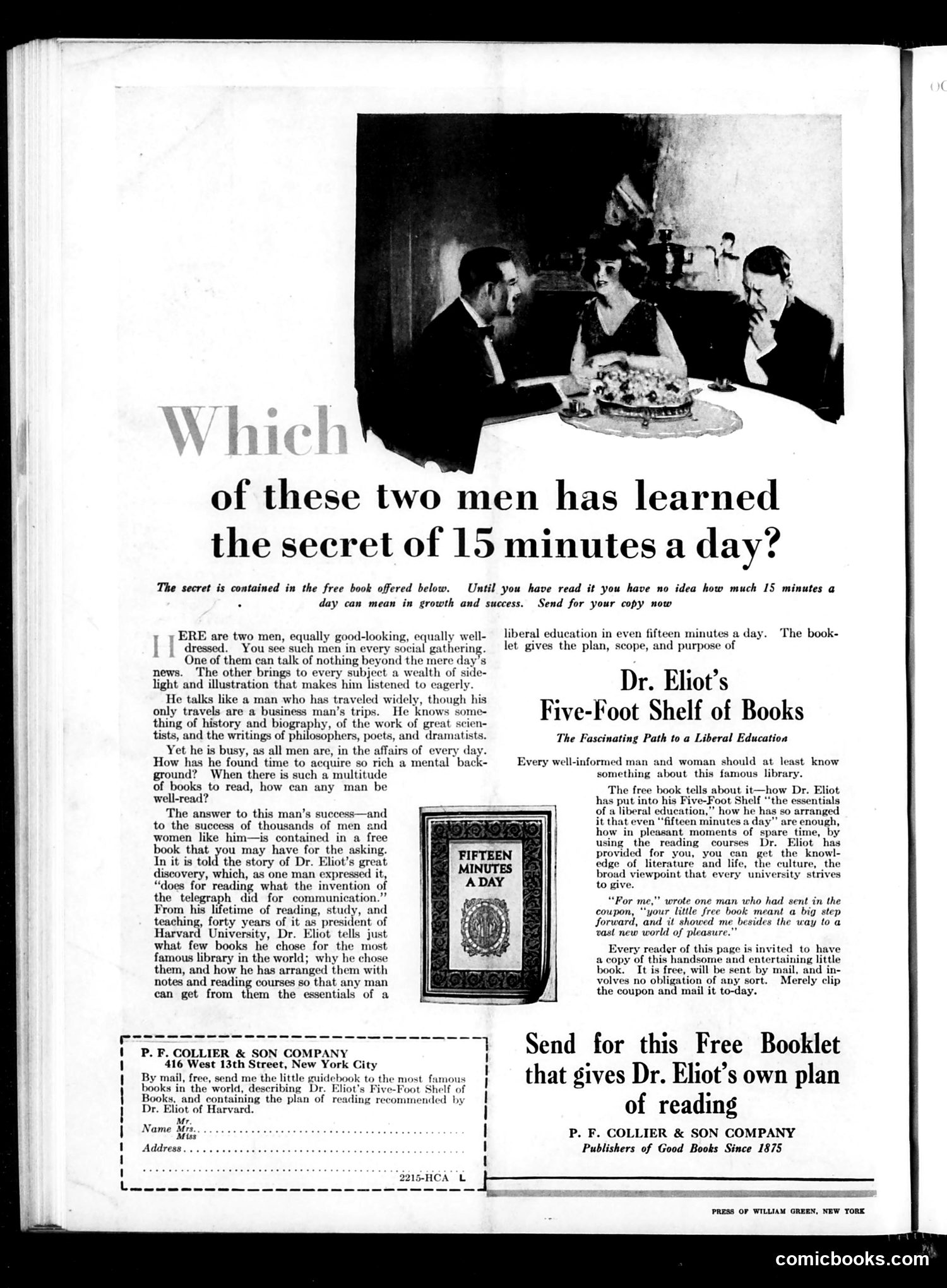
This page is **primarily an advertisement**, not a satirical cartoon. It promotes Dr. Charles W. Eliot's "Five-Foot Shelf of Books"—a famous curated library collection published by P.F. Collier & Son. The advertisement uses a simple visual comparison: two equally well-dressed men, where one appears knowledgeable and well-read while the other is limited to daily news. The implication is that the reader could become the more cultured man by using Eliot's reading plan—spending just "15 minutes a day." Dr. Eliot (1834-1926) was Harvard University's renowned president, giving his endorsement weight. The ad promises that anyone can gain a "liberal education" through this curated reading system, positioning self-improvement through books as accessible to busy businessmen. The appeal is fundamentally about aspiration and social mobility—suggesting that reading the "right" books could elevate one's social standing and intellectual credibility, a common marketing angle of the era.