
Judge, 1923-10-06 · page 30 of 36
Judge — October 6, 1923 — page 30: what you’re looking at
What you’re looking at
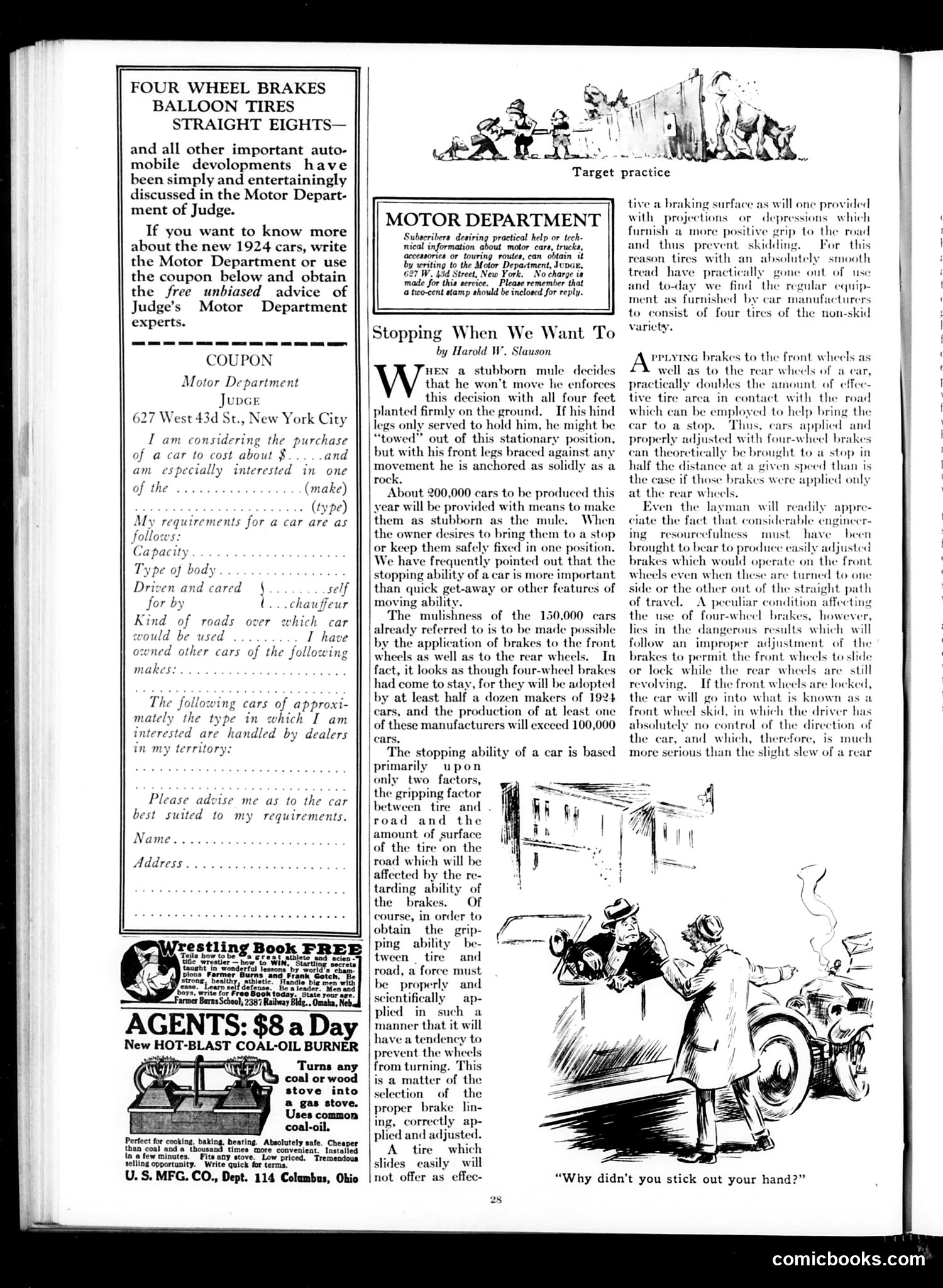
This page primarily contains **automobile advertising and technical content** rather than political satire. The main feature is "Stopping When We Want To," a technical article by Harold W. Slauson discussing four-wheel brakes—an emerging automotive technology circa 1924. The article compares a car's braking ability to a stubborn mule: just as a mule uses all four legs to resist movement, cars equipped with four-wheel brakes (not just rear brakes) can stop more effectively. The author argues this stopping ability matters more than acceleration or other features. The cartoon at bottom right shows a driver asking "Why didn't you stick out your hand?" —apparently depicting a traffic accident or near-miss, likely illustrating why reliable brakes matter for safety. The page also includes a coupon for Judge's Motor Department offering free automotive advice, plus advertisements for unrelated products (wrestling book, coal-oil stove). This is primarily **technical/commercial content** rather than satirical commentary.
📄 Transcribed text from this page (OCR, searchable)
Machine-transcribed from the original scan — historical spelling and the odd misread are preserved.
FOUR WHEEL BRAKES BALLOON TIRES STRAIGHT EIGHTS— and all other important auto- mobile devolopments have been simply and entertainingly discussed in the Motor Depart- ment of Judge. If you want to know more about the new 1924 cars, write the Motor Department or use the coupon below and obtain the free unbiased advice of Judge’s Motor Department experts. COUPON Motor Department JupcE 627 West 43d St., New York City I am considering the purchase of acar to cost about $ and am especially interested in one of the (make) . (type) My re quire ments for a car are as follows: Capacity Type of body Driven and cared § for by & Kind of roads which car would be used . I have owned other cars of the following self chauffeur over makes: . The following cars of approxi- mately the type in which I am interested are handled by dealers in my territory: Please advise me as to the car best suited to my i requirements. Name Address restling ook F: FREE ‘Talla bow to be atbleto and careitog AGENTS: $8 a Day New HOT-BLAST COAL-OIL ee stove into a gas stove. Uses common -oil. Perfect for cooking. baking, heating. Absolutel; {hen coat and e thousand times more convenient tneatied ‘a few minutes. Fits any stove, riced. Tremendous selling opportunity. Write quick for terms. ver U.S. MFG. CO., Dept. 114 Columbus, Ohio J only Target practice MOTOR DEPARTMENT Subscribere desiring practical help or teck- nical information about motor cara, trucks, accessories or touring routes, can obtain it by writing to the Motor Department, Juae, 627 W, 43d Street, New York. No charge is made for this service. Please remember that 4@ two-cent stamp should be inclosed for reply. Stopping When We Want To by Harold W’. Slauson HEN a stubborn mule decides that he won't move he enforces this decision with all four feet planted firmly on the ground. — If his hind legs only served to hold him, he might be “towed” out of this stationary position, but with his front legs braced against any movement he is anchored as solidly as a rock. About 200,000 cars to be produced this year will be provided with means to make them as stubborn as the mule. When the owner desires to bring them to a stop or keep them safely fixed in one position. We have frequently pointed out that the stopping ability of a car is more important than quick get-away or other features of moving ability. The mulishness of the 150,000 cars already referred to is to be made possible by the application of brakes to the front wheels as well as to the rear wheels. In fact, it look: though four-wheel brakes had come to stay, for they will be adopted |by at least half a dozen makers of 192+ cars, and the production of at least one | of these manufacturers will exceed 100,000 cars. The stopping ability of a car is based primarily upon two factors, the gripping factor between tire and . road and the amount of surface of the tire on the road which will affected by the re- tarding ability of the brakes. Of course, in order to obtain the grip- ping ability — be- |tween tire and | road, a force must be properly and scientifically _ ap- plied in such a manner that it will have a tendency to prevent the wh from turning. This is a matter of the selection of — the proper brake lin- ing, correc plied and adj A tire which slides easily will not offer as effec- tive a braking surface as will one provided with projections or depressions which furnish a more positive grip to the road and thus prevent skidding. For this ason_ tires with an absolutely smooth tread have practically out of use and to-day we find the regular equip- ment as furnished by car manufacturers: to consist of four tires of the non-skid variety. gone pey1NG brakes to the front wheels as Il as to the rear wheels of a car, practically doubles the amount of effec tive tire area in contact with the road which can be employed to help bring the car to a stop. Thus, cars applied and properly adjusted with four-wheel brakes can theoretically be brought to a stop in half the distance at a given speed than is the case if those brakes were applied only at the rear wheels. Even the layman will readily ciate the fact that considerable engincer- ing resourcefulness must ce been brought to bear to produce easily adjusted brakes which would operate on the front wheels even when these are turned to one side or the other out of the s of travel. A peculiar condition : the use of four-wheel brakes, however, lies in the dangerous results which will follow an improper adjustment of the brakes to permit the front wheels to slide or lock while the rear wheels are: still revolving. If the front wheels are locked, the car will go into what is known as a front wheel skid, in which the driver has: absolutely no control of the direction of the car, and which, therefore, is much more serious than the slight slew of a rear appre- comicbooks.com