
Judge, 1923-10-06 · page 11 of 36
Judge — October 6, 1923 — page 11: what you’re looking at
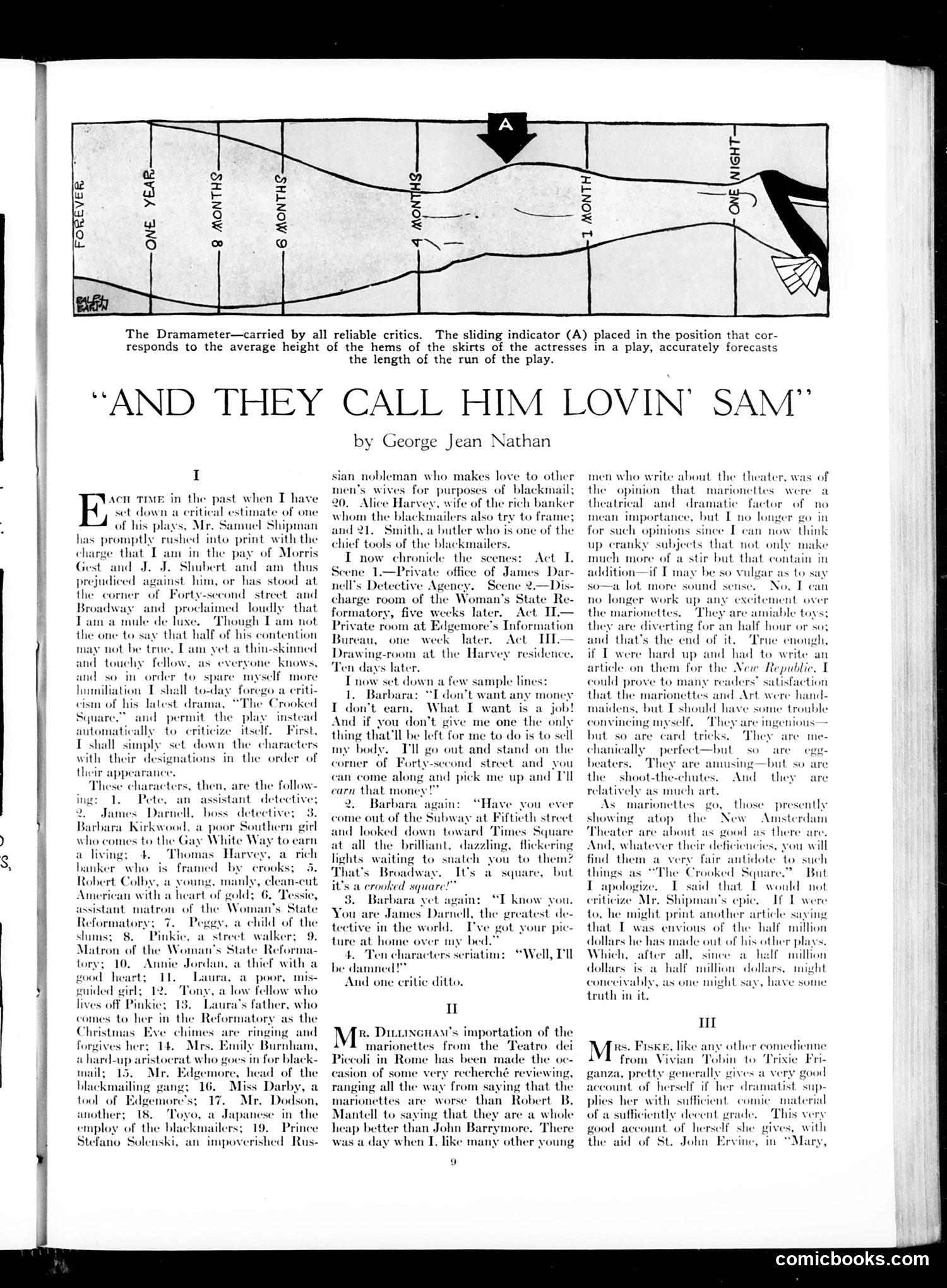
What you’re looking at
The cartoon at the top depicts "The Dramameter"—a fictional measuring tool that critics supposedly use to forecast how long a theatrical production will run. The joke: the indicator (marked "A") measures the average *hemline height* of actresses' skirts. Lower hemlines = longer runs. This is satire on 1920s theater criticism and social attitudes. The implication is that plays succeed based on leg exposure rather than artistic merit—mocking both the superficiality of Broadway audiences and the shallow criticism that enabled it. The diagram's pseudo-scientific presentation amplifies the absurdity. The accompanying article by George Jean Nathan is a theater review of "The Crooked Square," notable mainly for listing the cast and plot summary rather than offering judgment—apparently Nathan's self-protective response to prior accusations of bias from playwright Samuel Shipman. The satire targets theatrical pretension and the frivolous standards governing Broadway success.
📄 Transcribed text from this page (OCR, searchable)
Machine-transcribed from the original scan — historical spelling and the odd misread are preserved.
{ | | | 3 The Dramameter—carried by all reliable critics. the length of the run of the play. , The sliding indicator (A) placed in the position that cor- responds to the average height of the hems of the skirts of the actresses in a play, accurately forecasts “AND THEY CALL HIM LOVIN’ SAM” I ach TIME in the past when T have set down a crit stimate of one of his plays, Mr. Samuel Shipman has promptly rushed into print with the + that Tam in the pay of Morris Gest and Shubert and am_ thus udiced against him, or has stood at the corner of Forty-second street. and Broadway and proclaimed loudly that Tama mule de luxe. Though I am not the one to say that half of his contention may not be true, Lam yet a thin-skinned and touchy fellow, as everyone knows, and so in order to spare myself more humiliation I shall to-day forego a criti- cism of his latest drama, “The Crooked Squar permit the play instead automatically to criticize itself. First, I shall simply set down the characters with their designations in the order of their app These characters, then, are the follow- Pete, an assistant detectives Darnell, boss detective; & poor Southern git and rance, + who is framed Robert Colby, a youn an with a heart « it matron of the Vs St Reformatory; 7. Peggy, a child of the slums: strect walker; 9. n’s State Reforma- thief with a : a. a poor, mis- ‘Tony, low fellow who 3. Lau Reformat chimes are ringing and Mrs. Emily Burnham, ut who goes in for black- Edgemore, head of the Miss Darby, a Mr. Dodson, by . ‘Tessie, 10. tory lives off | Pink comes to her in the Che tmas Eve es her; 14 ristoc Mr. mail; 15. blackmailing gang; 16, tool of Edgemore’s; 17. another; 18. Toyo, a » in the employ of the blackmailers; 19. Prince Stefano Solenski, an impoverished Rus- by George Jean Nathan sian nobleman who makes love to other men’s wives for purposes of blackmail; 20. Alice Harvey, wife of the rich banker whom the blackinailers also try to frame; and 21. Smith, a butler who is one of the chief tools of the blackmailers. I now chronicle the scenes: Act I. Scene 1.—Private office of James Dar- nell’s Detective Agency. Scene .—Dis- charge room of the Woman's State Re- formatory, five weeks later. Act IL— Private room at Edgemore’s Information Bureau, one week later. Act TL— Drawing-room at the Harvey residence. Ten days later. T now set down : few sample lines: 1. Barbara: “I don’t want any money T don’t earn, What I want is a job! And if you don’t give me one the only thing that'll be left for me to do is to sell my body. T'll go out and stand on the corner of Forty-second street and) you can come along and pick me up and I'll carn that money 2. Barbara’ “Have you ever come out of the Subway at Fiftieth street id looked down toward ‘Times suas at all the brilliant, dazzling, flicke lights waiting to snatch you to them? That's Broadway. It's a square, but it’s a crooked square! 3. Barbara yet You are James | tective in the world. T° ture at home over my bed.” $. Ten characters seriatim: be damned!” And one critic ditto. “I know you. tint “Well, Pil IL M« Dituincuam’s importation of the 4 marionettes from the Teatro dei Piccoli in Rome has been made the oc- casion of some very recherché reviewing, ranging all the way from saying that the nettes are worse than Robert B. Mantell to saying that they are a whole » better than John Barrymore. There was a day when I, like many other young men who write about the theater, was of the opinion that) marionettes were a theatrical and dramatic factor of no mean importance, but L no longer go in for such opinions since I can now think up cranky subjects that not only make much more of a stir but that contain in addition—if I may be so vulgar as to say so—a lot more sound sense. » T can no longer work up any excitement over the marionettes. They are amiable toys; they are diverting for an half hour or soy and that’s the end of it. True enough, if I were hard up and had to write an article on them for the New Republic, 1 could prove to many readers’ satisfaction that the marionettes and Art were hand- maidens, but I should have some trouble convincing myself, The ingeni but so are card tricks. They chanically — perfeet—but so. heaters. Y Dut so are they are re amusing the —shoot-the-chutes. And relatively as much art. As marionettes go, those presently showin top) the New Amsterdam re about as good as there are. tever their iciencies, you will a very fi such things as “The But I apolo I said that LT would not criticize Mr. Shipman’s epic. If 1 were to, he might print another article saying that I was envious of the half million dollars he has made out of his other plays. Which, after all, since a half million dollars is a half million dollars, might conceivably, as one might say, truth in it. have some Il rs. Fiske, like any other come 4 from Vivian Tobin to ‘Trixie ganza, pretty generally gives a ve account of herself if her dramatist: sup- plies her with sufficient’ comic material of a sufficiently decent grade. ‘This very good nt of herself she gives, with the aid of St. John Ervine, in “Mary, ienne comicbooks.com