
Judge, 1923-10-06 · page 15 of 36
Judge — October 6, 1923 — page 15: what you’re looking at
What you’re looking at
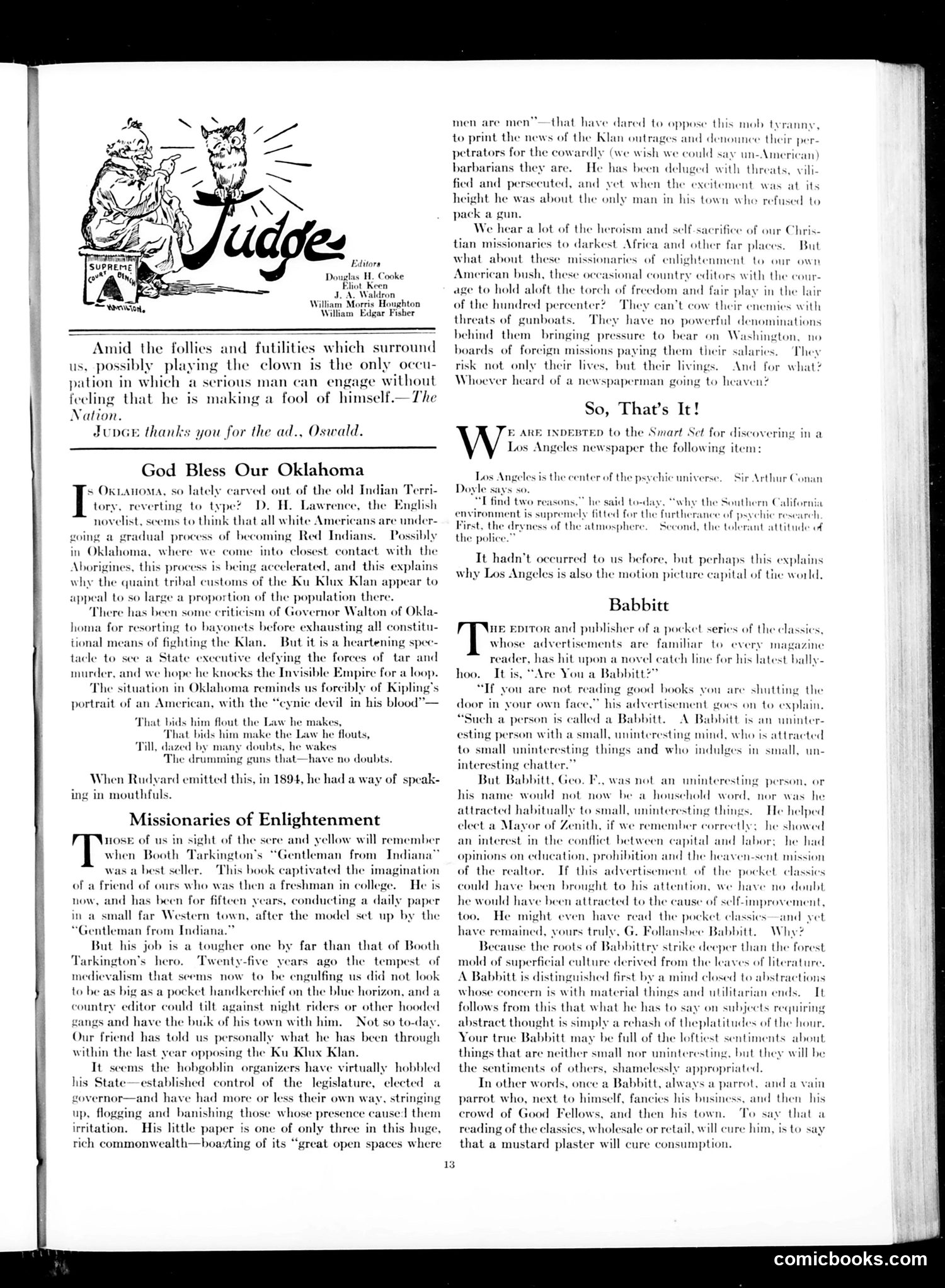
This page critiques the Ku Klux Klan's control over Oklahoma. The top cartoon depicts "Judge" (the magazine's mascot) confronting a demonic figure labeled "The Klan," symbolizing the organization as evil. The main editorial praises Governor Walton for using military force against the Klan's violence, comparing the situation to Kipling's 1894 poem about lawlessness. It notes Oklahoma's concerning reversion to "tribal customs" and mob rule. The "Missionaries of Enlightenment" section praises small-town newspaper editors courageously opposing Klan tyranny despite threats and violence. The author contrasts these editors' bravery unfavorably with Christian missionaries, arguing these American journalists are equally heroic for defending "freedom and fair play" against "mob tyranny" in their own country. The satire's point: Judge champions the editors as unsung heroes resisting organized intimidation, implying mainstream America should recognize their sacrifice as comparable to celebrated missionary work abroad.
📄 Transcribed text from this page (OCR, searchable)
Machine-transcribed from the original scan — historical spelling and the odd misread are preserved.
Editors Douglas H, Cooke Bliot Keen A. Waldron Morris Houghton Waiter, Wi Edgar Fisher id futilities which surround us, possibly playing the clown is the only occu- pation in which ious man can engage without fecling that he is making a fool of himself.—The Nation. JupGe thanks you for the ad., Oswald. Amid the follies : Se God Bless Our Oklahoma s OkLanoMa, so lately carved out of the old Indian Terri- tory, reverting to type? D. H. Lawrence, the English novelist, scoms to think that all white Americans are under- going a gradual process of becoming Red Indians. Possibly in Oklahoma, where we come into closest contact with the \bori; cing slerated, and this explains why the quaint tribal customs of the Ku Klux Klan appear to appeal to so lar; nes, this process is -a proportion of the population there. 1 some criticism of Governor Walton of Okla- homa for resorting to bayonets before exhausting all constitu- tional means of fighting the Klan. tacle to see a State executive dei ‘There has be But it is a heartening spec- ing the forces of tar and 1d we hope he knocks the Invisible Empire for a loop. ition in Oklahoma reminds us foreibly of Kipling’s an American, with the “cynic devil in his blood”— ‘That bids him flout the Law he makes, ut bids him make the Law he flouts, Till, dazed by many doubts, he wakes: The drumming guns that—have no doubts. When Rudyard emitted this, in 1894, he had a way of speak- ing in mouthfuls. murder The sit portrait o Missionaries of Enlightenment HOSE of us in sight of the sere and yellow will remember when Booth Tarkington's “Gentleman from Indiana” was a best seller. This book captivated the imagination a friend of ours who was then a freshman in colle; He is now, and has been for fifteen years, conducting a daily: paper in a small far Western town, after the model set up by the “Gentleman from Indiana.” But his job is a tougher one by far than that of Booth Tarkington's hero. Twenty-five y medievalism that seems now to ars ago the tempest of © engulfing us did not look to be as big as a pocket handkerchief on the blue horizon, and a country editor could tilt ag inst night riders or other hooded Not so to-day. been through of his town with him, Our friend has told us personally what he hi within the last year opposing the Ku Klux K It seems the hobgoblin organizers have virtually hobbled his State—established control of the legislatu governor—and have had more or less their own v up, flogging and banishing those whose presence ¢ irritation. His little paper is one of only three in th rich commonwealth—boasting of its gangs and have the buk elected a . stringing used them huge, “great open spaces where men are men”—that have dared to oppose this mob tyranny, to print the news of the Klan outrages and denounce their per- petrators for the cowardly (we wish we could say un-American) barbarians they are. He has been deluged with threats, vili- fied and persecuted, and yet when the excitement was at its height he was about the only man in his town whe refused to pack a gun. We hear a lot of the heroism and self-sacrifice our Chris- tian missionaries to darkest Africa and other far places. But what about these missionaries of enlightenment American bush, these occasional country editors with the eour- to our own age to hold aloft the torch of freedom and fair play in the lair of the hundred percenter? threats of gunboats. behind them They can’t cow their enemies with They have no powerful denominations bringing pressure to bear on Washington, no boards of foreign missions paying them the risk not only their lives, but their livings. alaries They And for what? Whoever heard of a newspaperman going to heaven: So, That’s It! ARE INDEBTED to the Smart Set for discovering in a Los Angeles newspaper the following item: Los Angeles is the center of the psychic universe. Doyle says so. “T find two reasons,” he said te environment is supremely fitted for First, the dryness of the atmosphere the police.” Sir Arthur Conan lay, “why the Southern California he furtherance of psychic research Second, the tolerant attitude of It hadn't occurred to us before, but perhaps this explains why Los Angeles is also the motion picture capital of tie world, Babbitt HE Epitor and publisher o whose pocket series of the classics, uniliar to eve atch line for hi Ivertisements are reader, has hit upon a novel It is, “Are You a Babbitt?” “If you are not re door in yom test bally- hoo. ding good books you are shutting the yur own, his advertisement goes on to explain. led a Babbitt. A Babbitt is an uninter- esting person with a small, uninteresting mind, who is attracted to small uninteresting things and who indulges in small, un- interesting chatter. “Such a person is But Babbitt, Geo. F., was not_an uninteresting person, or his name would not now be a houschold word, nor was he attracted habitually to small, uninteresting things. He helped clect a Mayor of Zenith, if we remember correctly: he showed an interest in the conflict between capital and labor; he had opinions on education, prohibition and the heaven-sent mission of the realtor. could hie If this advertisement of the pocket classies e been brought to his attention, we have no doubt he would have been attracted to the ¢ too. He might even have re have rer use of self-improvement, the pocket classics » Follansbee Babbitt. rt mold of superficial culture derived from the leaves of literature. A Babbitt is distinguished first by a mind closed to abstractions whose concern is with material things and utilitarian ends. It follows from this that what he has to say on subjects requiring abstract thought is simply a rehash of theplatitudes of the hour. Your true Babbitt may be full of the loftiest sentiments about things that are neither small nor uninterestin and yet Why? an the forest ined, yours truly. Because the roots of Babbittry strike deep i. but they will be the sentiments of others, shamelessly appropi In other words, once a Babbitt, always a p: parrot who, next to himself, fancies his business, crowd of Good Fellows, and then his town. ada vain nd then his To say that a reading of the classics, wholesale or retail, will cure him, is to that a mustard plaster will cure consumption. . comicbooks.com