
A complete issue · 36 pages · 1923
Judge — August 18, 1923
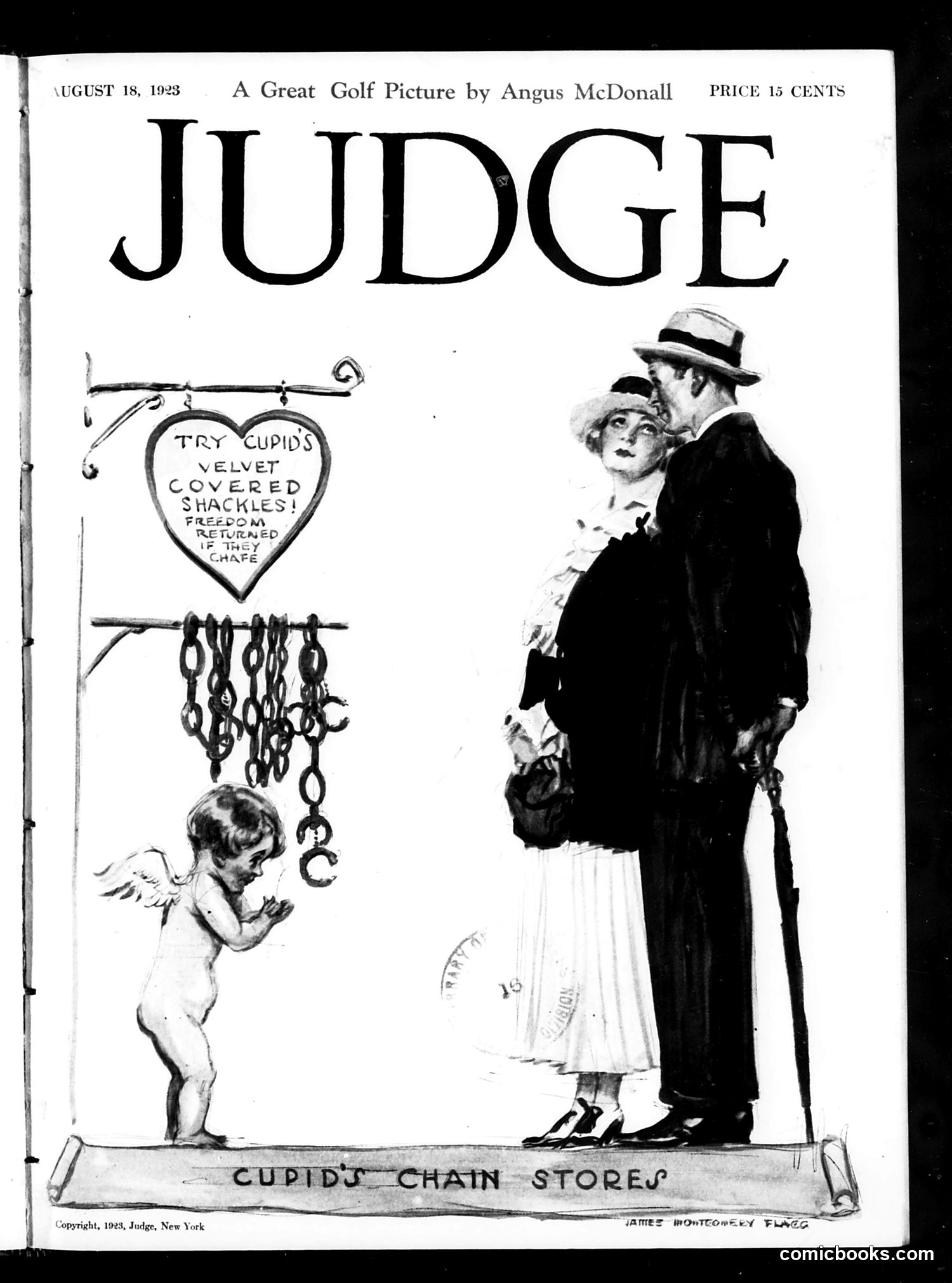
This is a satirical advertisement for Cupid's Chain Stores, a jewelry retailer. The cartoon plays on traditional courtship imagery: Cupid (the winged cherub) dangles shackles and chains from a heart-shaped sign advertising "velvet covered shackles" with the promise "freedom returned if they chafe." The joke targets marriage as a loss of freedom—humorously depicting it as bondage. The well-dressed couple observing this display represent potential customers (engaged or married couples). The satire suggests that marriage, despite its romantic associations, actually constrains personal liberty, a sentiment common in 1920s humor. The "chain stores" pun is intentional: Cupid binds people together just as retail chains bind consumers to shopping. The advertisement format itself is satirical, selling the idea of marital constraint as a consumer product.
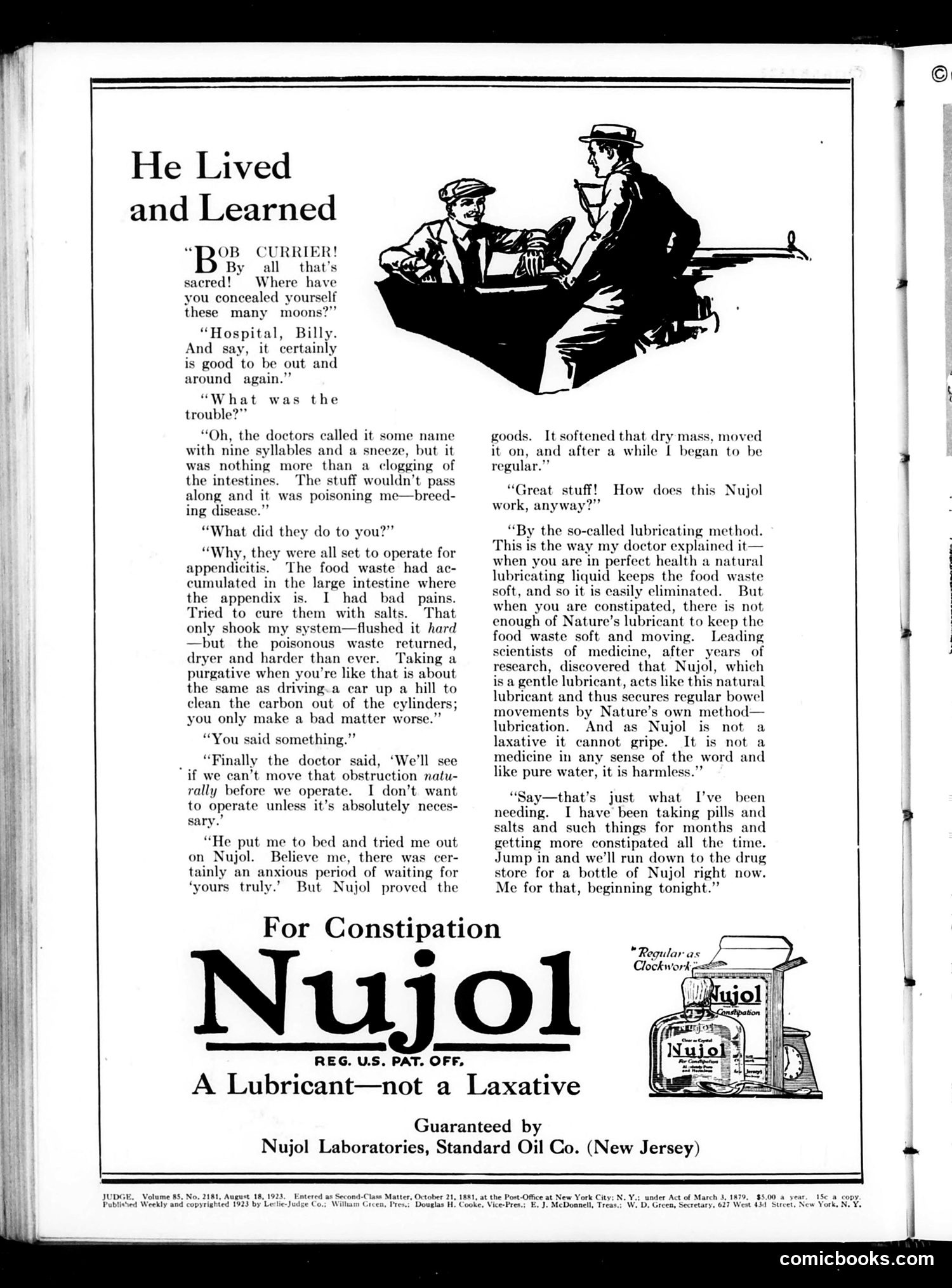
This page is primarily a **product advertisement** for Nujol, a mineral oil laxative, rather than political satire. The narrative ("He Lived and Learned") features a character named Bob Currier recounting his experience with constipation and intestinal blockage. He describes failed home remedies (salts) before a doctor recommended Nujol, which he credits with resolving his condition. The advertisement emphasizes Nujol's distinction as "a lubricant—not a laxative," arguing it works naturally by mimicking the body's own digestive processes rather than forcefully purging the system. The illustration shows two men in conversation, likely representing the patient and doctor, though neither appears to be a recognizable public figure or political caricature. This is straightforward commercial messaging disguised as personal testimonial—a common advertising strategy of the 1920s era.
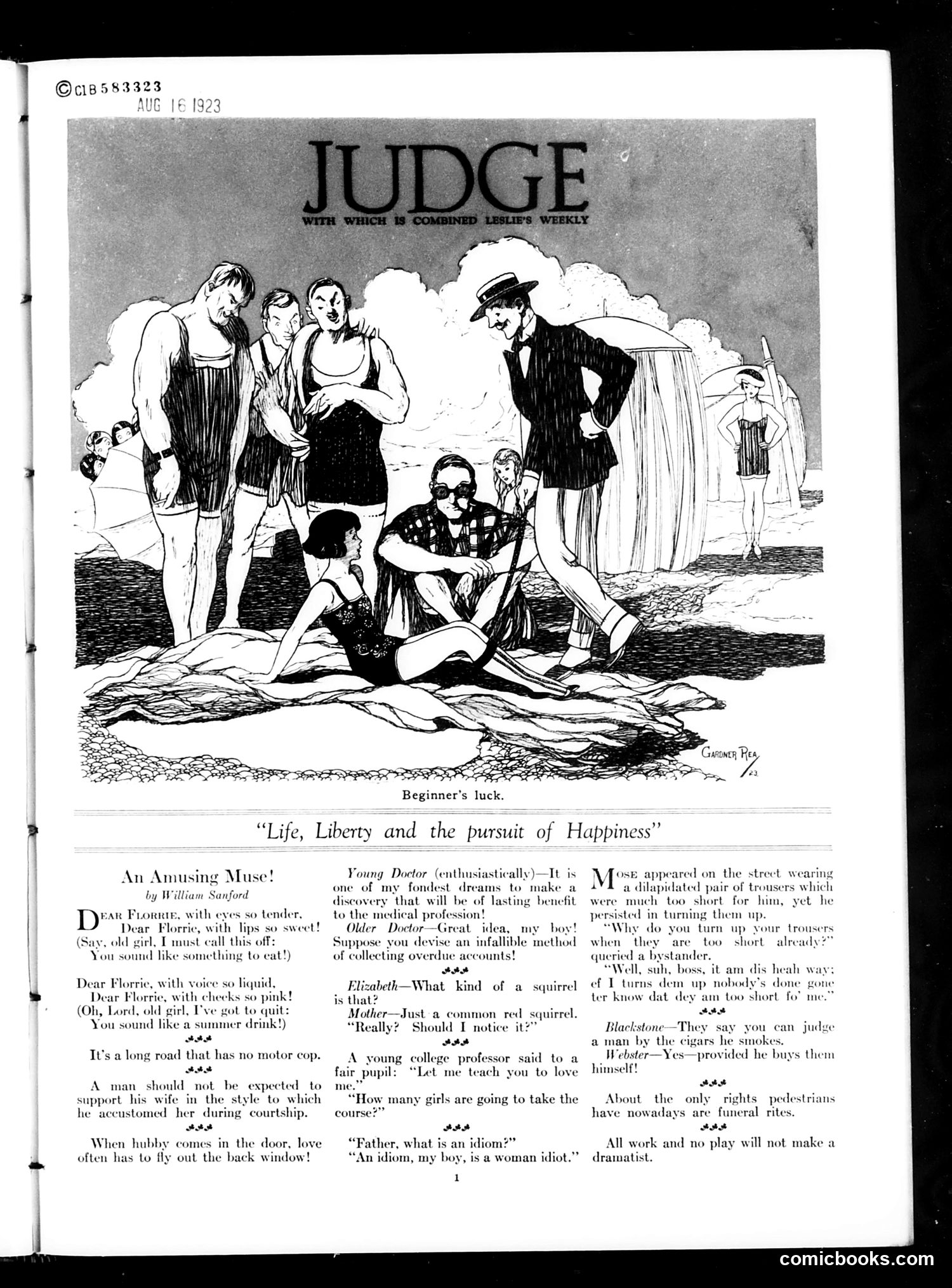
This satirical cartoon depicts a beach scene titled "Beginner's Luck," illustrating various social commentary through humorous vignettes. The main scene shows a poorly dressed man fishing while well-dressed beachgoers surround him—apparently he's had unexpected success despite his shabby appearance and lack of proper equipment ("no motor cop"). The accompanying text jokes feature domestic humor and social observations typical of early 20th-century American satire. References mock professional pretension ("Young Doctor"), gender roles ("a woman idiot"), and middle-class anxieties about maintaining social appearances and financial obligations. The overall theme—"Life, Liberty and the pursuit of Happiness"—ironically contrasts the founding ideal with everyday struggles of ordinary Americans navigating courtship, marriage, and economic survival.
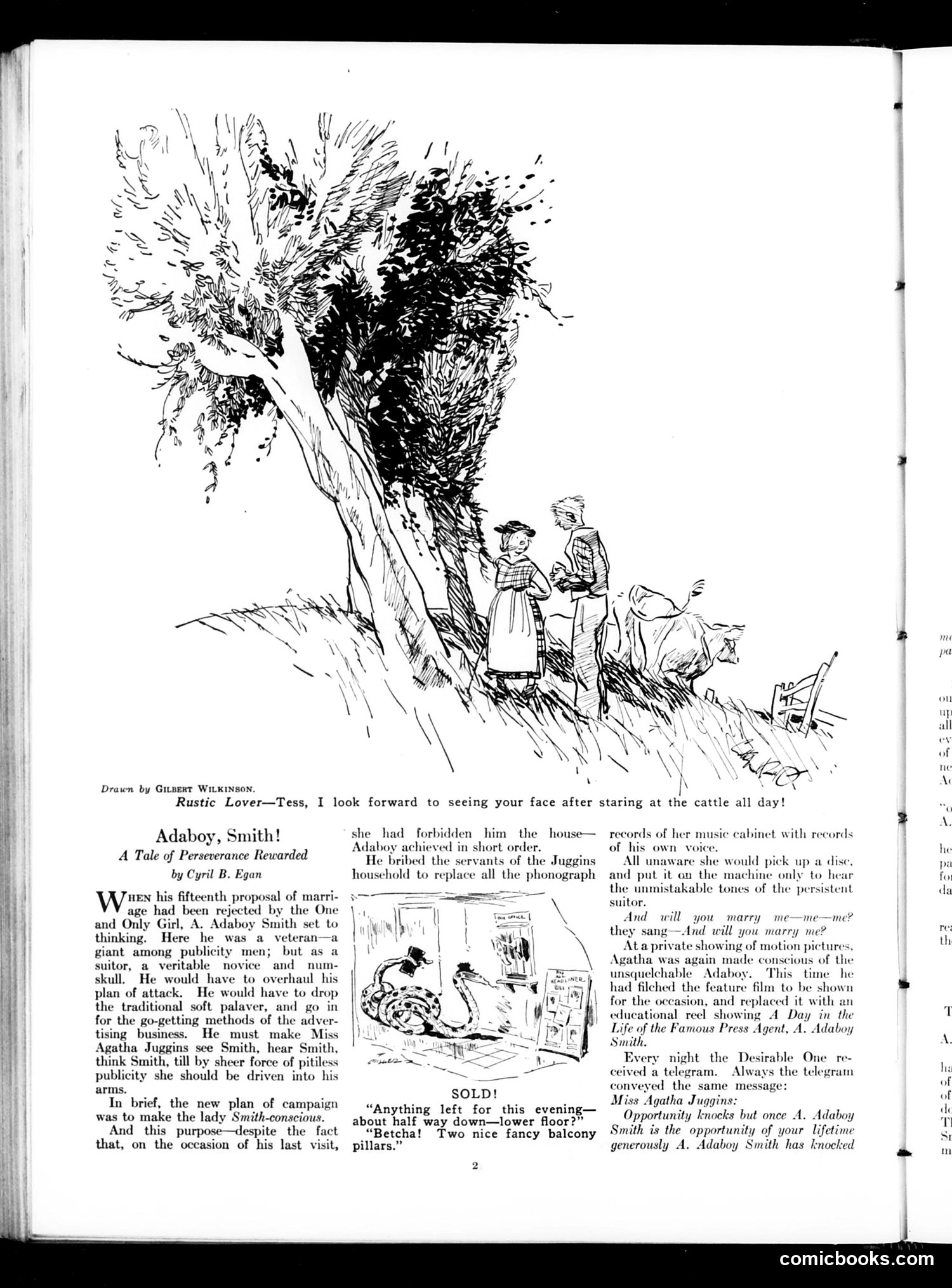
This page contains a short story titled "Adalboy, Smith! A Tale of Perseverance Rewarded" by Cyril B. Egan, illustrated by Gilbert Wilkinson. The narrative satirizes persistent courtship and marriage proposals. A man named A. Adalboy Smith has made fifteen marriage proposals to a woman named Miss Agatha Higgins. Rather than pursue normal courting, he devises a publicity campaign featuring phonograph recordings and feature films showing "A Day in the Life of the Famous Press Agent A. Adalboy Smith"—essentially using media manipulation to win her affection. The story mocks both relentless, publicity-obsessed suitors and the emerging advertising culture's intrusion into personal relationships. The joke suggests that modern marketing techniques have replaced traditional romance.
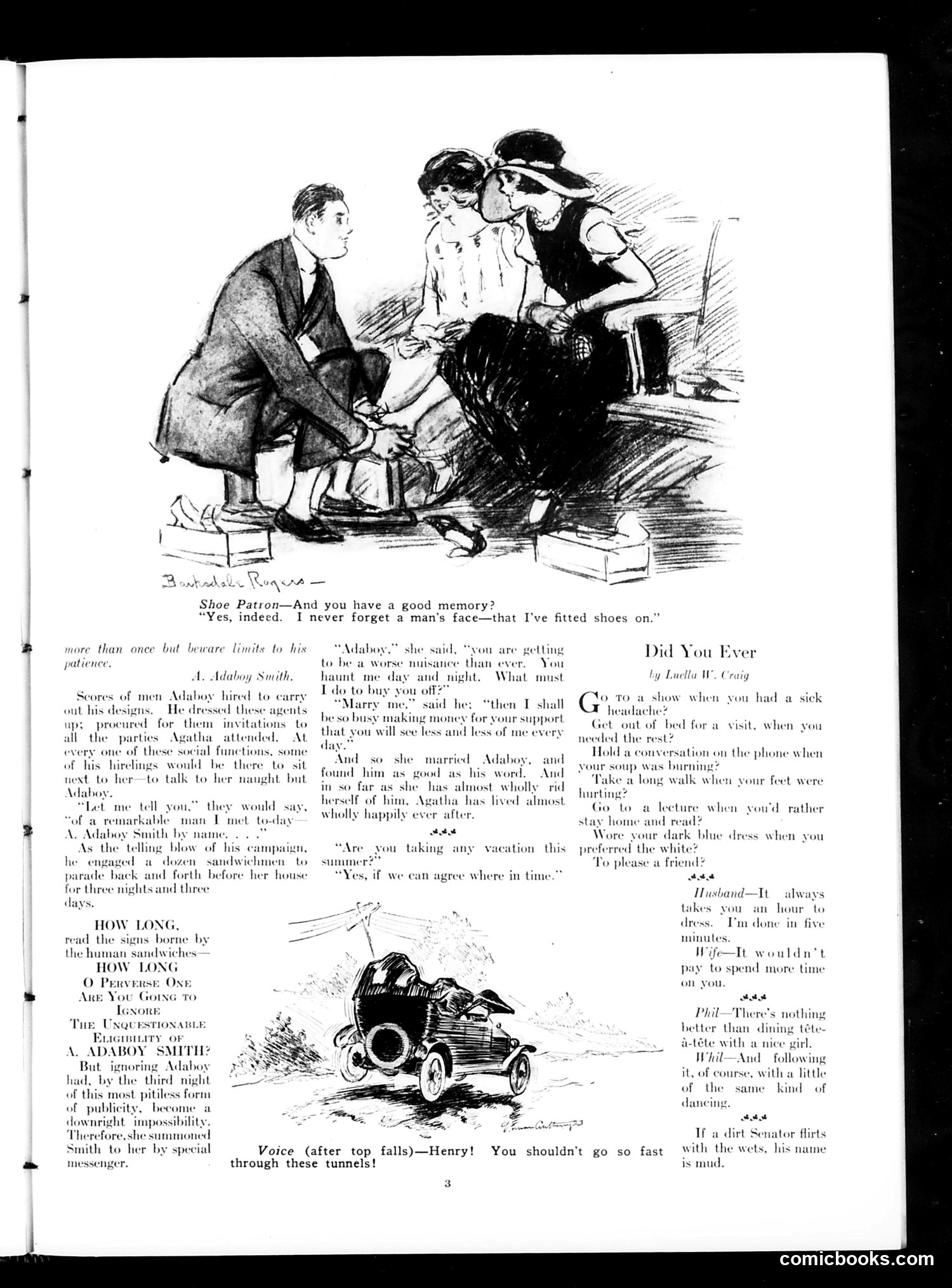
The top cartoon depicts a shoe salesman fitting shoes on a child while conversing with two women (likely the child's parents or guardians). The caption reads: "Shoe Patron—And you have a good memory? 'Yes, indeed. I never forget a man's face—that I've fitted shoes on.'" This is a gentle humor piece about the shoe salesman's profession: he claims to remember customers by their feet rather than faces. It's a straightforward occupational joke with no political content—simply playing on the idea that a shoe salesman would be more familiar with customers' feet than their facial features. The surrounding text includes unrelated short stories and humorous dialogue snippets typical of Judge's miscellaneous content sections.
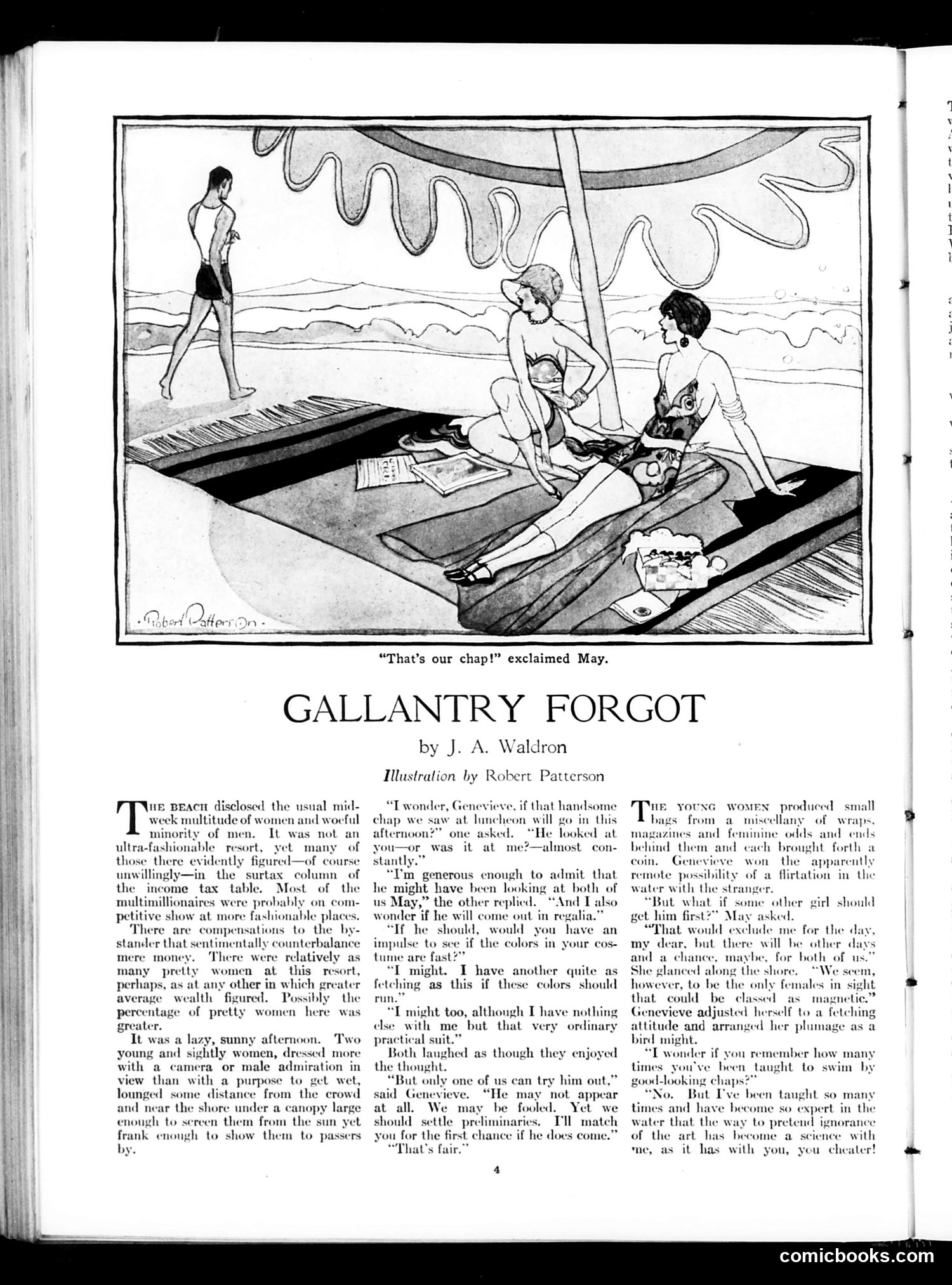
This is a short story illustration rather than political satire. The narrative, by J.A. Waldron with illustrations by Robert Patterson, depicts young women at a beach resort lounging under a canopy. The story's humor centers on **social expectations of courtship and feminine modesty** in what appears to be the 1920s era. The women discuss whether a "handsome chap" they noticed will approach them, with concerns about propriety—one character worries another girl might "get him first," while another frets about appearing too forward. The title "Gallantry Forgot" suggests the joke: despite being at a fashionable resort full of eligible men, none actually court them. The satire targets both the women's preoccupation with romantic conquest and the supposed decline of gentlemanly attention.
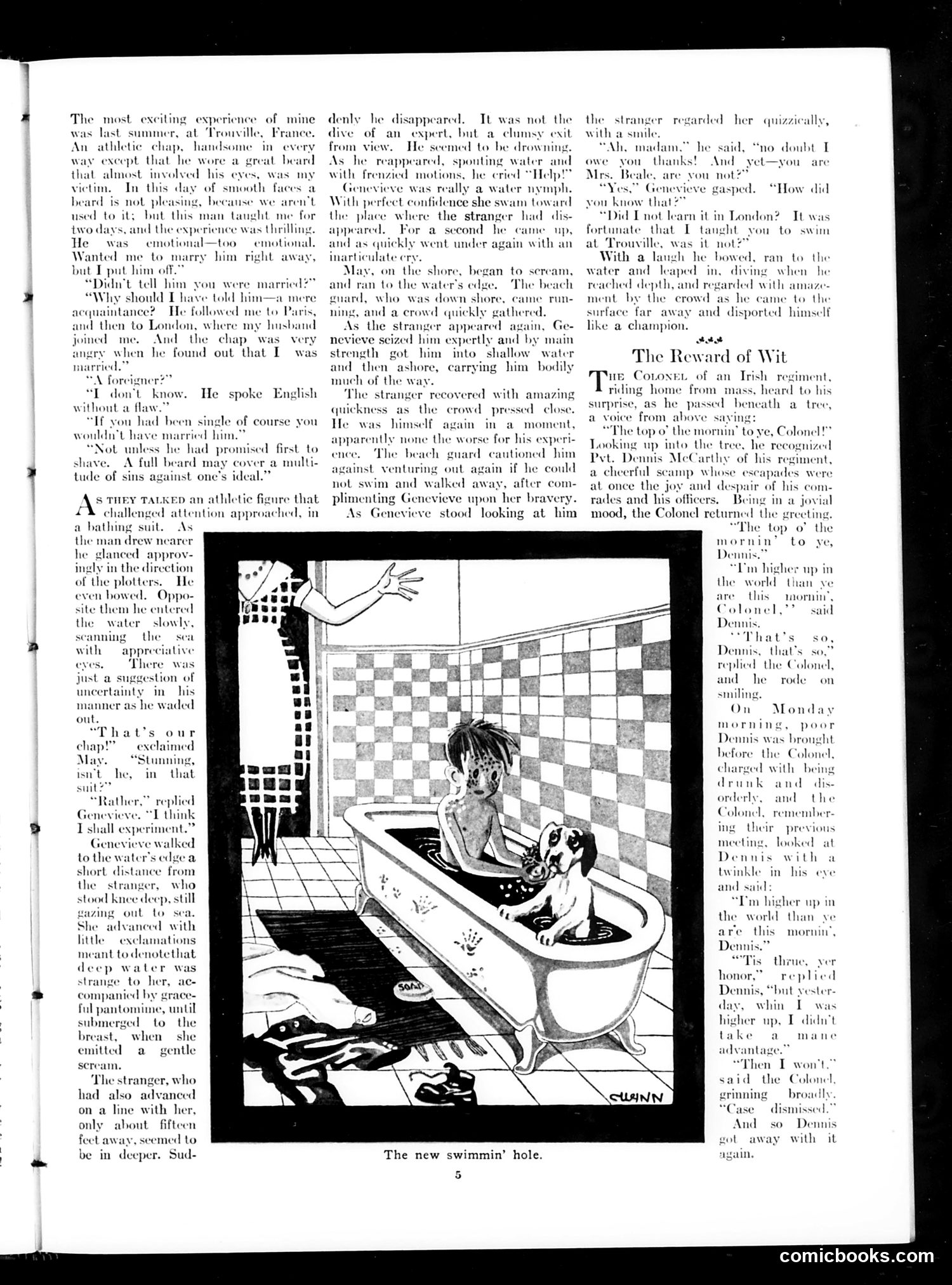
This page contains two satirical stories illustrating contrasting outcomes of cleverness. **"The new swimmin' hole"** (illustrated): A woman named Genevieve rescues a bearded stranger from drowning at a French beach. He recovers suspiciously quickly and, revealed to be a charlatan who faked drowning, dives athletically away—having exploited her heroism. The joke: she was duped by his deception despite her genuine bravery. **"The Reward of Wit"** (text story): An Irish soldier, Pvt. Dennis McCarthy, greets his Colonel from a tree with the phrase "Top o' the mornin' to ye, Colonel!" The Colonel, despite McCarthy's frequent pranks and mischief, finds this particular wit charming enough to overlook past transgressions. Both stories explore how cleverness—whether deceptive or charmingly impudent—can manipulate authority figures or the well-intentioned. The magazine celebrates quick wit as a social survival tool.
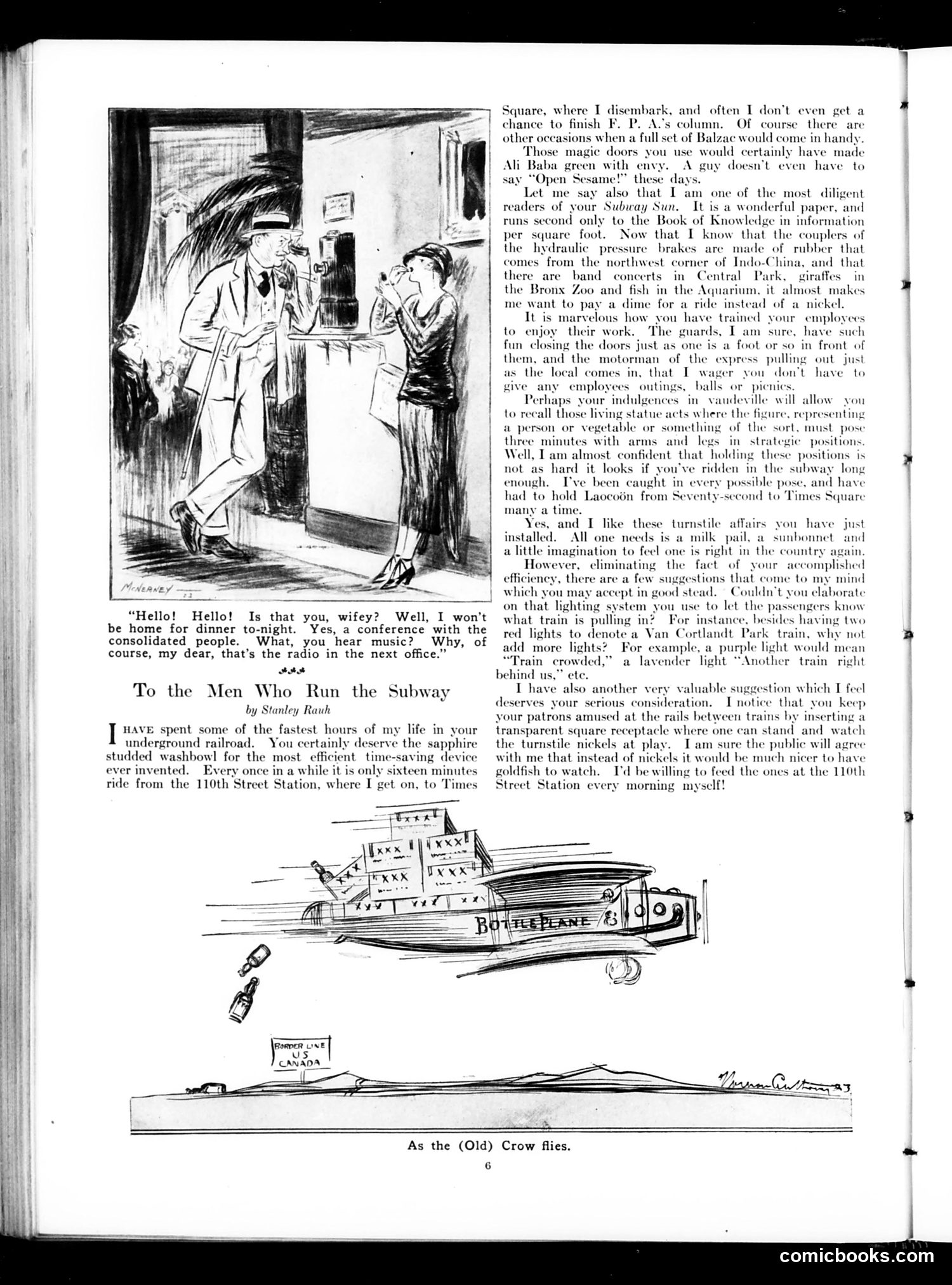
This is satirical praise of New York City's subway system—ostensibly thanking operators while actually mocking their service through heavy sarcasm. **The humor targets:** - **Unreliable travel times**: Rauk sarcastically celebrates that rides sometimes take only 16 minutes, implying they're usually much longer - **Dangerous door-closing**: He "praises" guards who slam doors on passengers' bodies - **Poor employee conditions**: He mocks that staff seem so satisfied they need no company outings—implying they're overworked and miserable - **Cramped conditions**: References to "living statue" poses describe passengers forced into contorted positions by crowding - **The "Subway Sun"**: The system's in-house publication gets mock-praise for trivial content (facts about rubber sourcing, zoo fish) The accompanying cartoon depicts a man telling his wife he'll miss dinner due to a "conference"—the music from "the next office" suggests he's actually at a bar or entertainment venue, playing on contemporary themes of workplace deception.
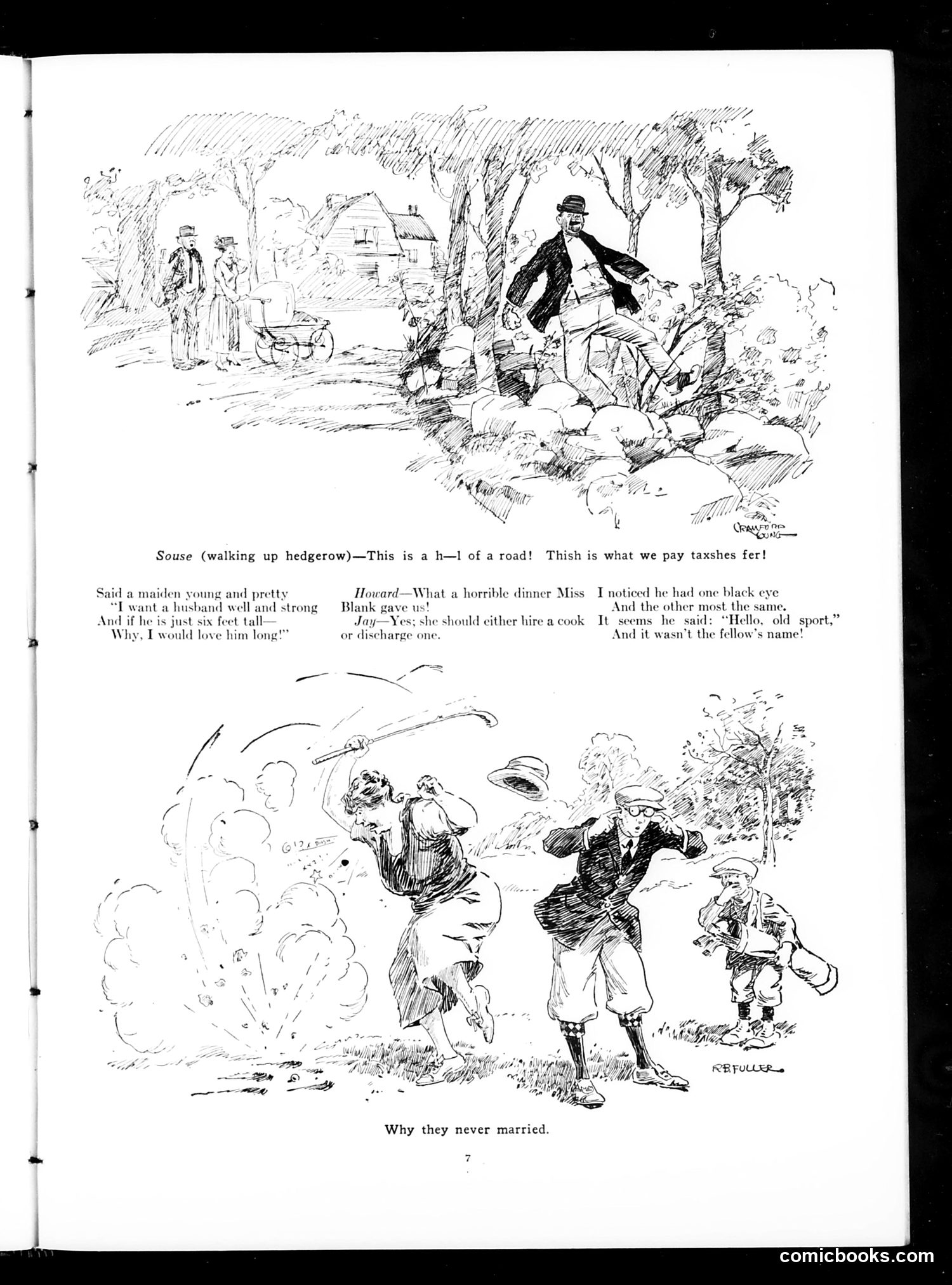
This page contains two separate satirical cartoons: **Top cartoon**: A drunk man (Souse) stumbles up a country lane, complaining that the poor road quality is what taxpayers' money funds. It's social satire on government waste and incompetent public works—a common complaint in early 20th-century America. **Bottom cartoon ("Why they never married")**: Two women discuss a potential suitor. One notes he has two black eyes and greets people with "Hello, old sport"—but crucially, it "wasn't the fellow's name." The joke appears to be that he's so drunk or disoriented he doesn't even know people's actual names, making him an unsuitable husband. The casual violence (black eyes, explosions in background) suggests brawling behavior, reinforcing he's an undesirable match. Both cartoons use alcohol-related humor to mock masculine incompetence and poor judgment—reflecting early 1900s anxieties about drinking culture's social consequences.
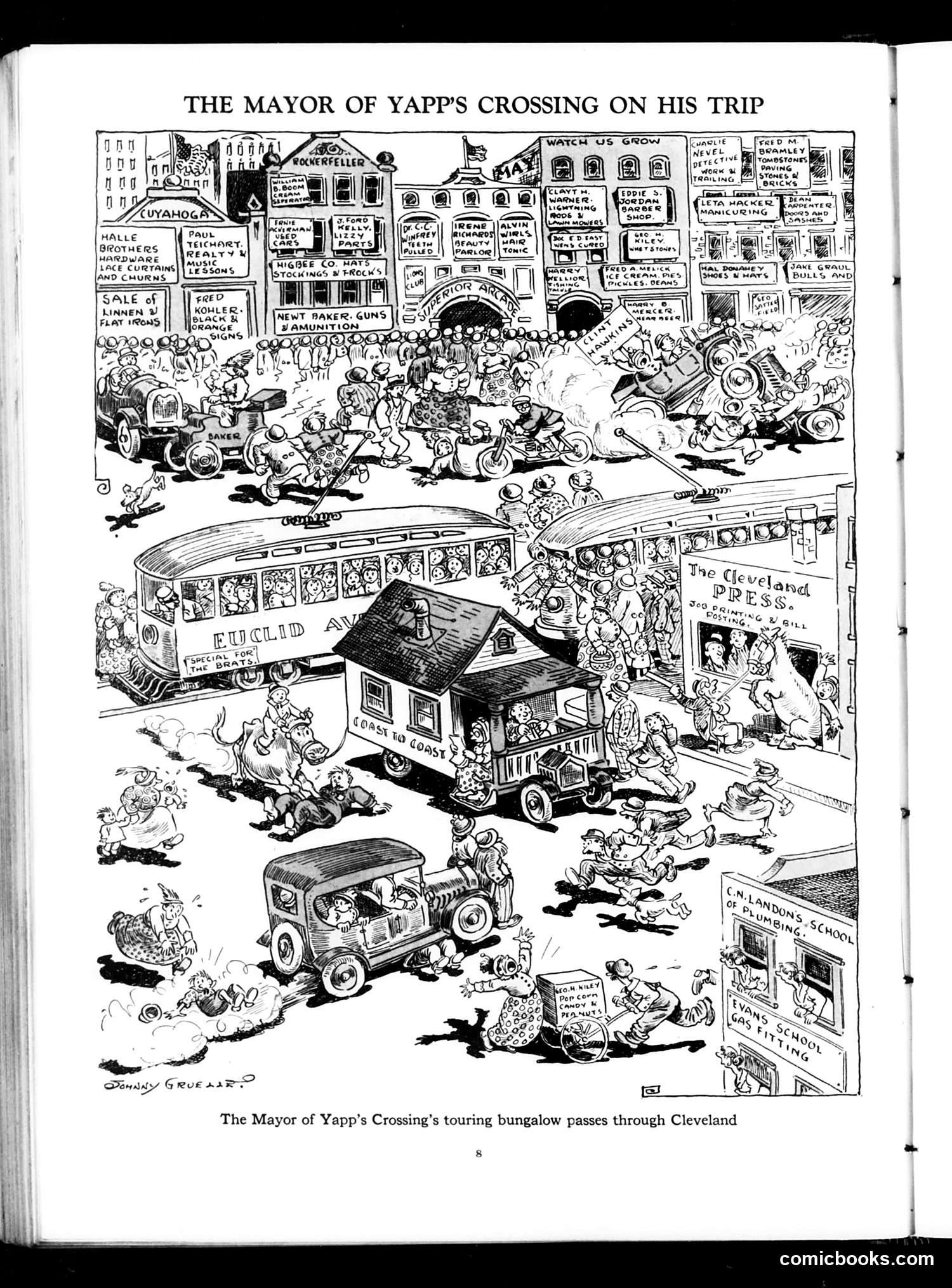
This satirical cartoon depicts a chaotic scene of a traveling bungalow (a mobile house) passing through Cleveland, causing mayhem. The joke centers on a small-town mayor from the fictional "Yapp's Crossing" touring through a major city with his makeshift traveling home, disrupting urban life. The satire targets rural pretension and small-town pride—the mayor's modest mobile dwelling is treated as a grand touring vehicle, yet it causes accidents, traffic jams, and general disorder among city residents and vehicles. Store signs and storefronts in the background suggest commercialism trying to capitalize on the "event." The humor lies in the contrast between the mayor's apparent self-importance and the actual chaos his presence creates. It mocks both rural provincialism and the absurdity of treating a traveling bungalow as a significant attraction. The densely packed crowd of onlookers, overturned vehicles, and general pandemonium underscore how ridiculous and disruptive the entire situation is.
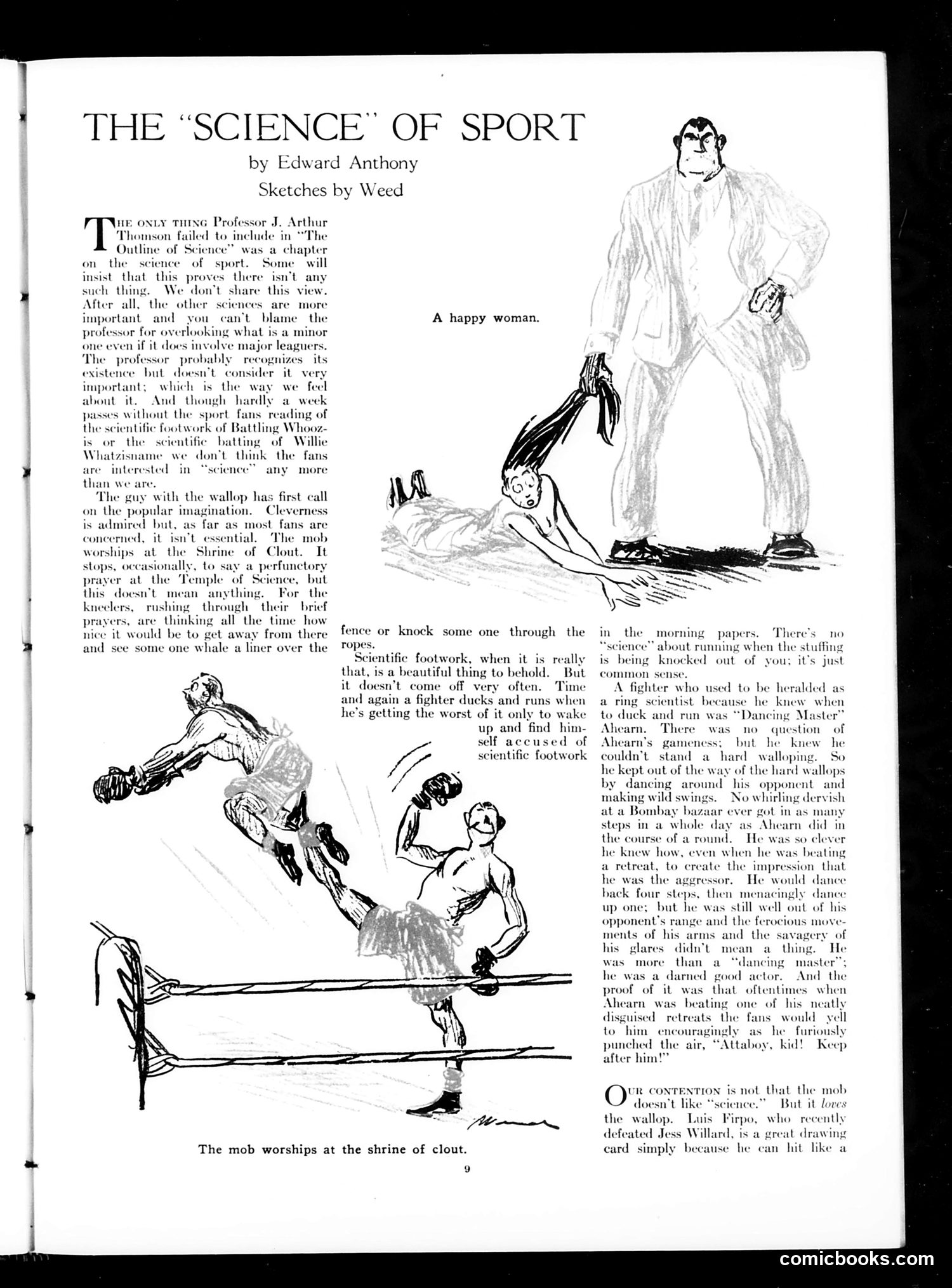
This satirical article mocks the public's preference for brute force over strategy in boxing and athletics. The author argues that while sports commentators praise "scientific" technique—clever footwork, strategic fighting—audiences actually worship raw power ("the wallop"). The cartoons illustrate this disconnect: sketches show boxers in various fighting poses, with captions like "The mob worships at the shrine of clout" (clout = a heavy punch). The article uses "Dancing Master" Ahearn as a case study—a boxer praised as "scientific" for dodging punches, but who was really just running away while acting aggressive. Fans cheered his theatrical movements even though he wasn't landing solid blows. The satire's point: the public doesn't genuinely care about tactical excellence; they want to see someone "whale a liner over the fence" or get knocked through the ropes. Strategic fighting is merely packaged theatrically to satisfy spectators' real appetite for violence. Science is the excuse; spectacle is the desire.
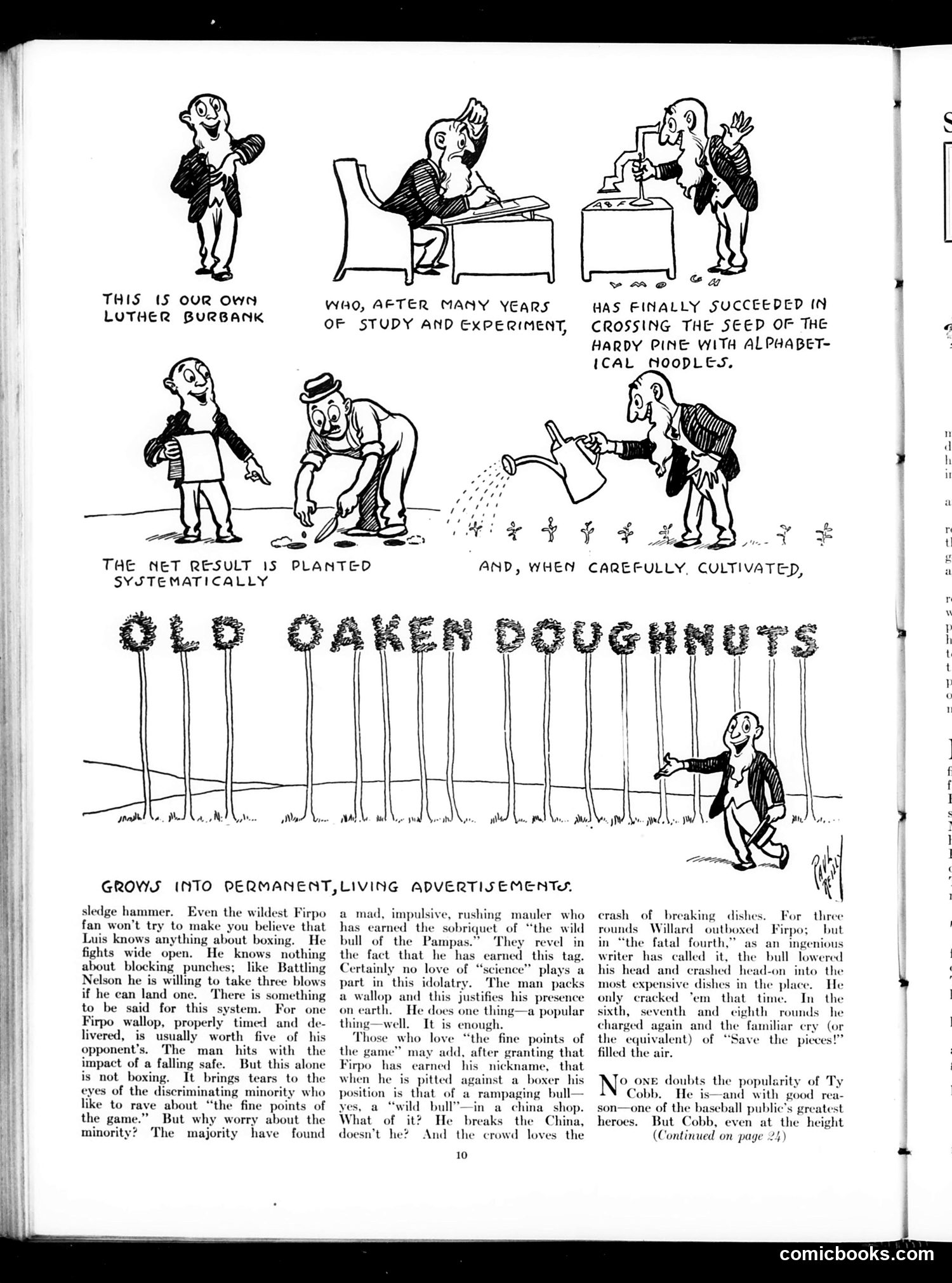
This is a satirical cartoon about **Luther Burbank**, the famous plant scientist. The joke imagines Burbank crossing a hardy pine tree with "alphabetical noodles" to create living plants that spell out words—essentially nature-based advertisements. The satire targets **commercial overreach**: it mocks how even scientific achievement gets exploited for advertising purposes. By the 1910s-20s (when this appeared in *Judge*), aggressive advertising was increasingly visible and intrusive in American life, so the idea of plants literally growing into permanent ads is absurdist commentary on commercialism's creeping expansion into every domain. The accompanying text discusses boxing figures (Luis Firpo, Ty Cobb) in unrelated sports commentary—typical *Judge* magazine format mixing cartoon satire with sports gossip. The cartoon's humor relies on readers knowing Burbank was a genuine, respected agricultural innovator whose real work was being playfully perverted into a consumerist fantasy.
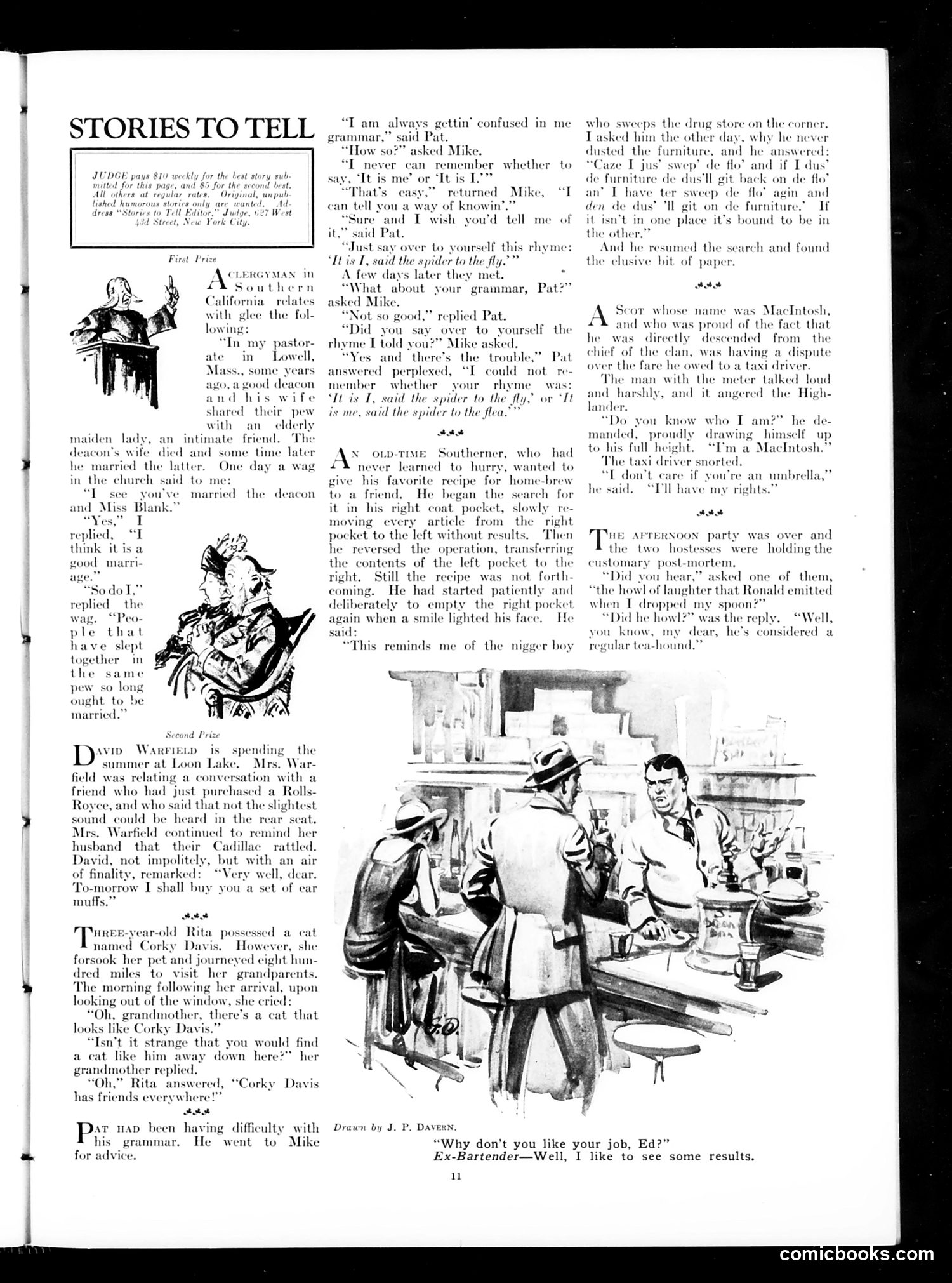
This page contains five humorous anecdotes typical of Judge magazine's "Stories to Tell" humor section—short jokes submitted by readers for payment. The stories rely on wordplay and social observation rather than political satire. Key examples: 1. **Grammar confusion**: A man misremembers the rhyme "It is I, said the spider to the fly" as "It is me, said the spider to the flea"—humor from mishearing advice. 2. **The car rattle joke**: A husband's dry response to his wife complaining their Cadillac rattles (unlike a Rolls-Royce) is to buy her "a set of ear muffs"—deadpan humor about marriage dynamics. 3. **The lost recipe**: A Southerner searching his pockets for a homebrew recipe, unable to find it because items keep moving between pockets—absurdist logic humor. 4. **The highlander dispute**: A Scottish man (MacIntosh, proud of his clan ancestry) argues with a taxi driver, who replies he doesn't care if the man is "an umbrella"—wordplay on the umbrella brand MacIntosh. The cartoon illustration shows men in a kitchen or bar setting, likely accompanying one of these tales. These reflect early 20th-century American domestic humor with class and ethnic undertones common to the era.
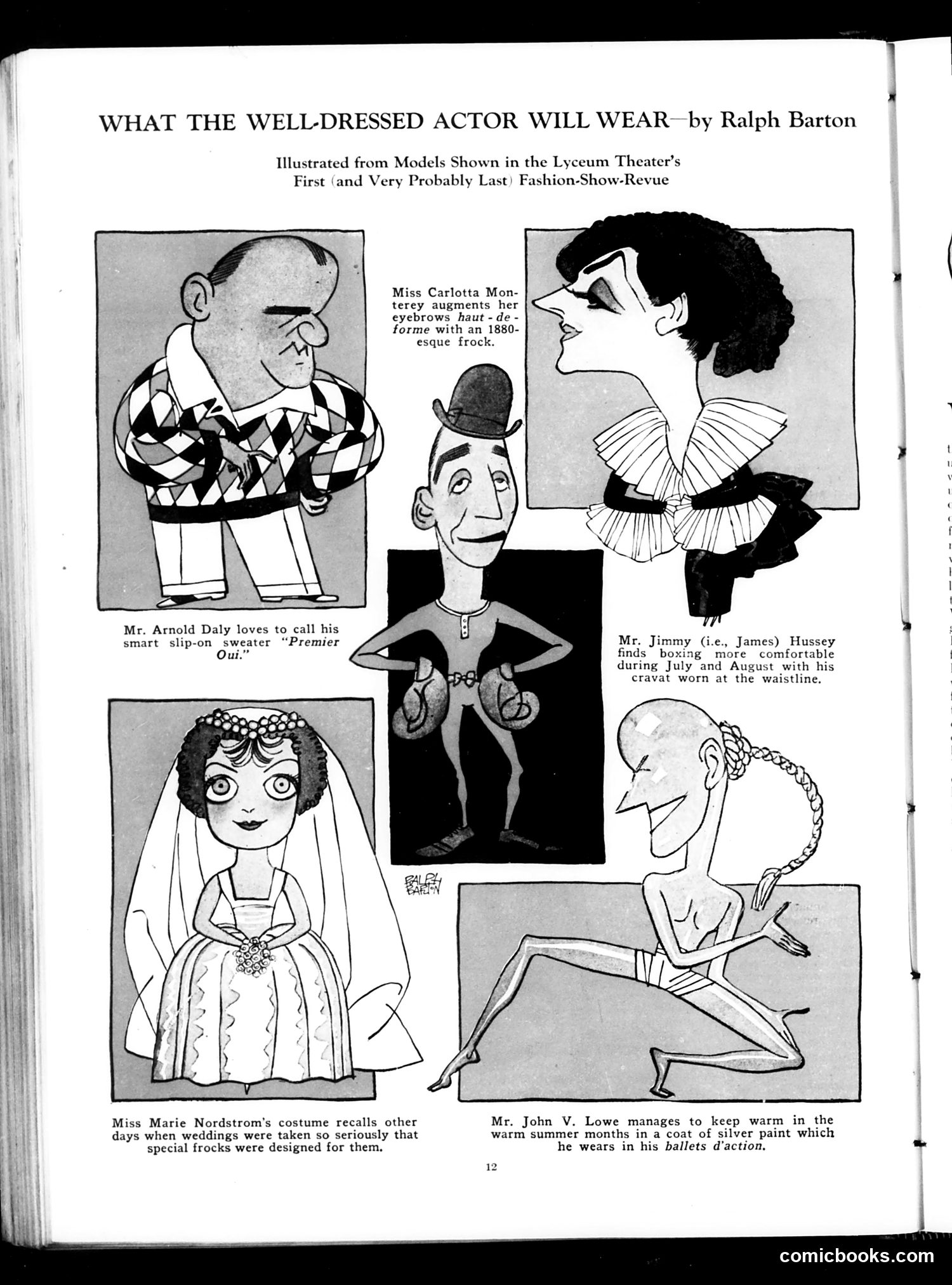
This is a satirical fashion commentary by Ralph Barton on actors' clothing choices, illustrated through caricatured portraits of five named performers from the Lyceum Theater's fashion-show revue. The humor targets actors' peculiar or affected wardrobe decisions. Examples include: Arnold Daly's pretentious naming of his sweater "Premier Oui"; James Hussey wearing a cravat at his waistline for boxing comfort in summer; Marie Nordstrom choosing an elaborate 1880s-style wedding dress for everyday wear; John V. Lowe coating himself in silver paint to stay warm rather than wearing normal clothing; and Carlotta Monterey's exaggerated 1880s eyebrows and hairstyle. The joke mocks both theatrical vanity and the impracticality of stage fashion choices. The subtitle's parenthetical remark—"First (and Very Probably Last)"—suggests the revue itself was a failure, adding meta-commentary about the event itself.
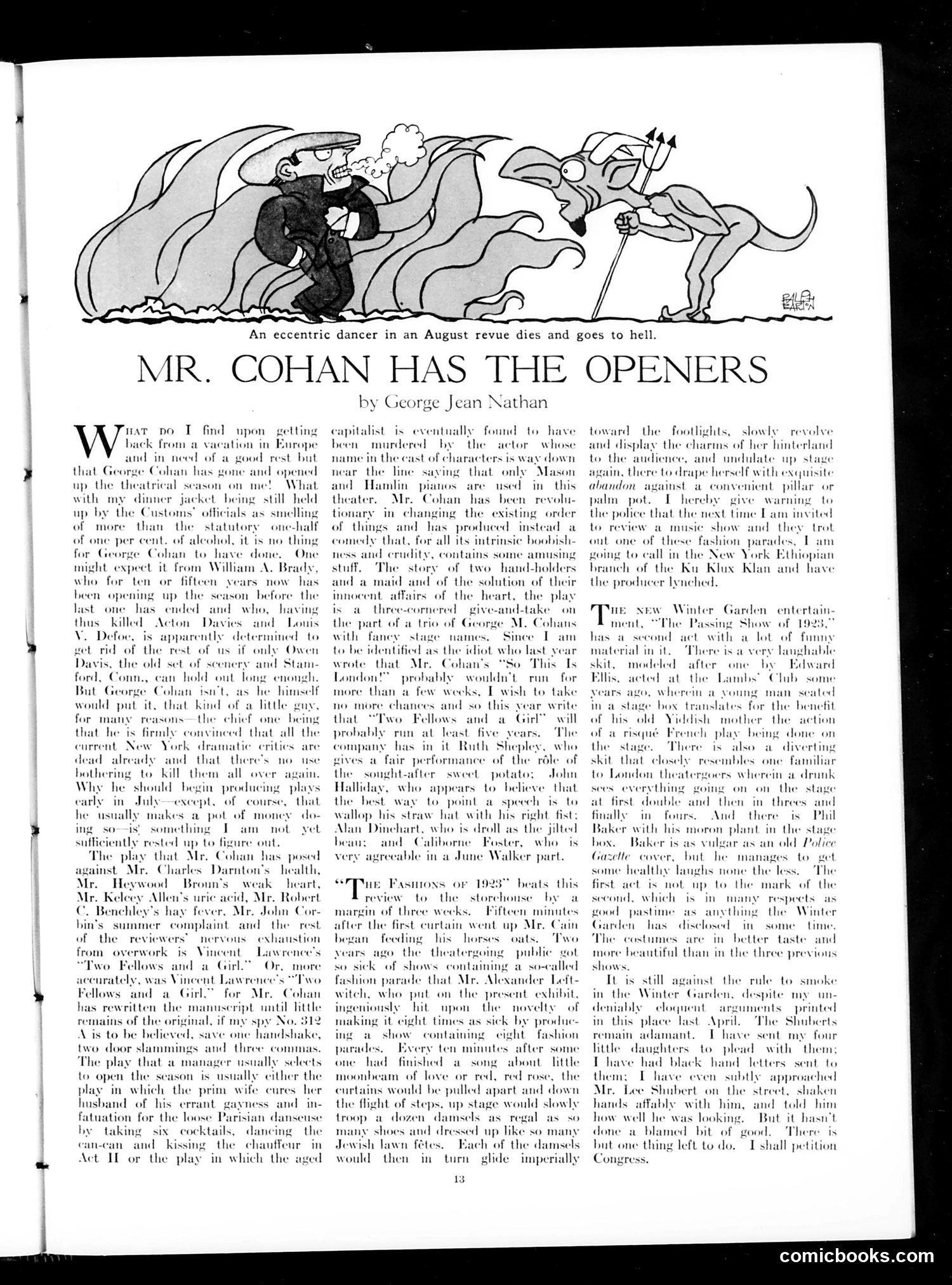
This is a theater review by George Jean Nathan of George M. Cohan's new play "Two Fellows and a Girl," opening the 1923 theatrical season. **The cartoon** at top depicts an "eccentric dancer in an August revue dies and goes to hell"—a visual joke about theatrical fashion shows of the era, which apparently featured absurd, hellish imagery. **The satire's targets:** Nathan mocks Cohan for opening a play in early July rather than waiting for the proper season—a practice that exhausts theater critics (the review jokingly imagines it killing them). He also ridicules the play itself: a simple romantic comedy about "two hand-holders and a maid," suggesting Cohan rewrote Vincent Lawrence's original manuscript so heavily that little remained except "one handshake, two door slammings and three commas." **The context:** Nathan's acid tone—calling the plot "boobish" yet predicting it will run five years because Cohan "usually makes a pot of money"—captures the critic's exasperation with commercial theater prioritizing profit over artistic merit. The review exemplifies Judge's satirical attack on Broadway excess.
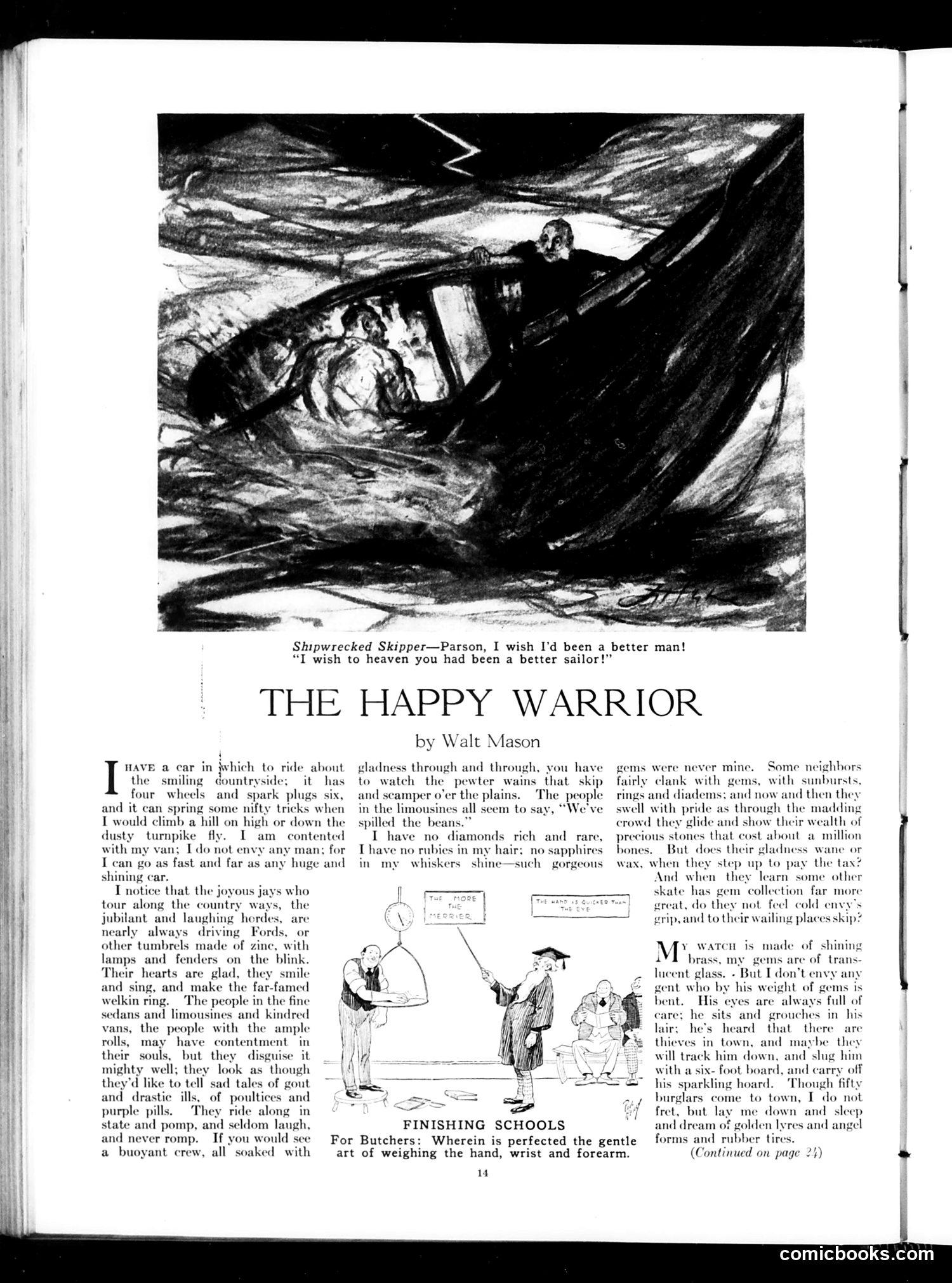
This is a satirical poem celebrating modest contentment over wealth and status. The accompanying cartoon shows a shipwrecked skipper telling a parson he wishes he'd been "a better man," to which the parson replies he wishes the skipper had been "a better sailor"—a joke about priorities: practical competence matters more than moral self-recrimination. The poem contrasts wealthy people in fancy cars and loaded with jewels—who appear miserable, worried about thieves, and burdened by their possessions—with ordinary working people in modest Fords who are genuinely happy and carefree. Mason argues that material wealth breeds anxiety and pretense rather than joy. The "finishing schools" caption appears unrelated, likely advertising. The satire targets the Gilded Age obsession with conspicuous consumption as hollow and spiritually empty.
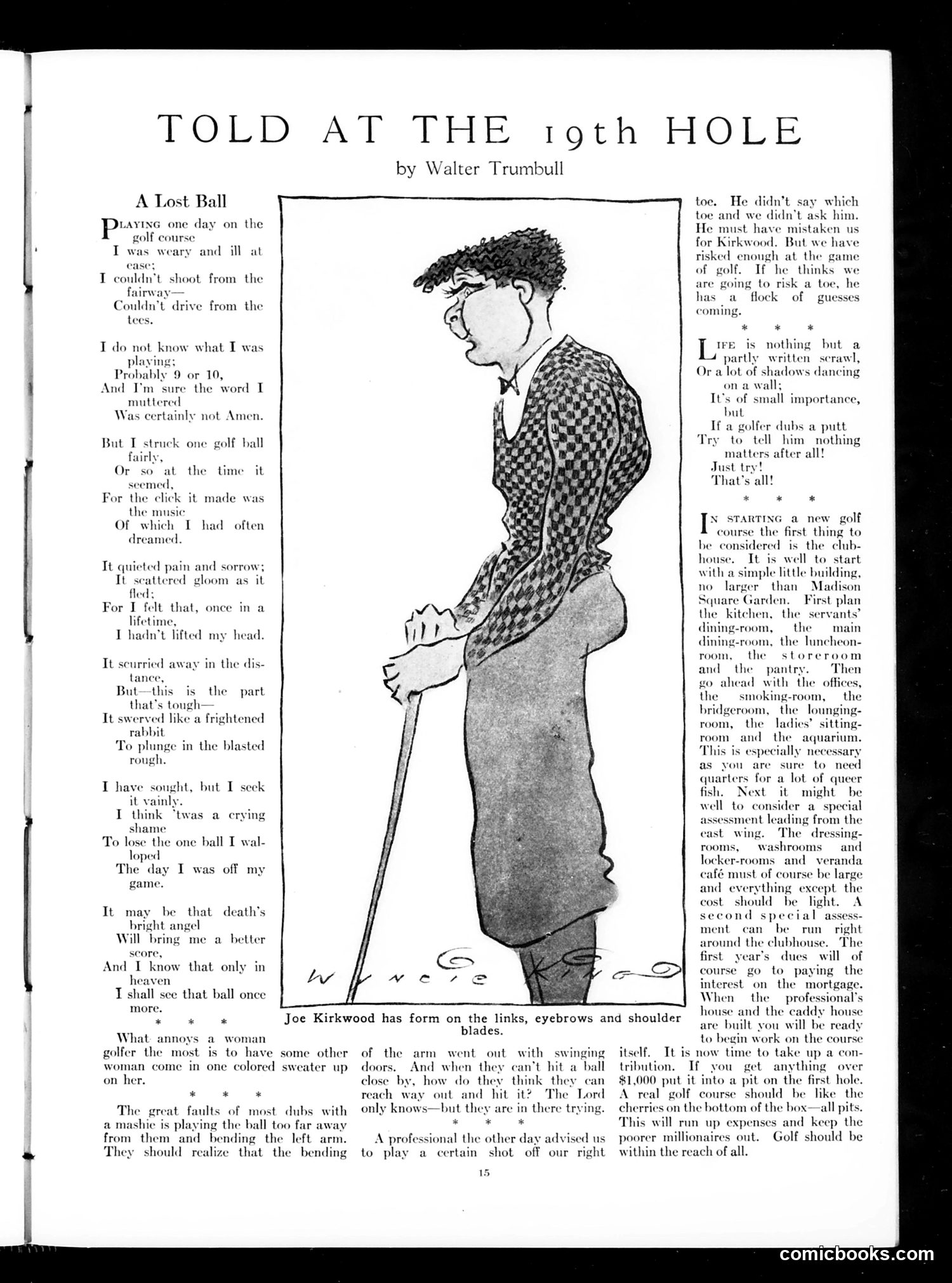
This is a humorous golf-themed piece by Walter Trumbull comprising several satirical golf anecdotes and commentary. The central cartoon depicts **Joe Kirkwood**, a famous golfer of the era, known for his distinctive physical features (eyebrows, shoulders, blades). The main poem recounts a frustrated golfer's one perfect shot that disappears into the rough—a relatable human moment undercut by cosmic irony. The surrounding brief jokes mock golf culture: women golfers competing over appearance; poor technique among amateur players ("dubs"); and absurdly inflated clubhouse expectations for wealthy golfers. The longest section savagely satirizes newly-built golf courses catering to the wealthy, suggesting their palatial clubhouses rival Madison Square Garden while actual course construction is neglected—represented as deliberately pit-filled. The satire critiques the sport's exclusivity and how membership fees fund debt rather than actual golfing amenities, keeping the sport accessible only to the wealthy.
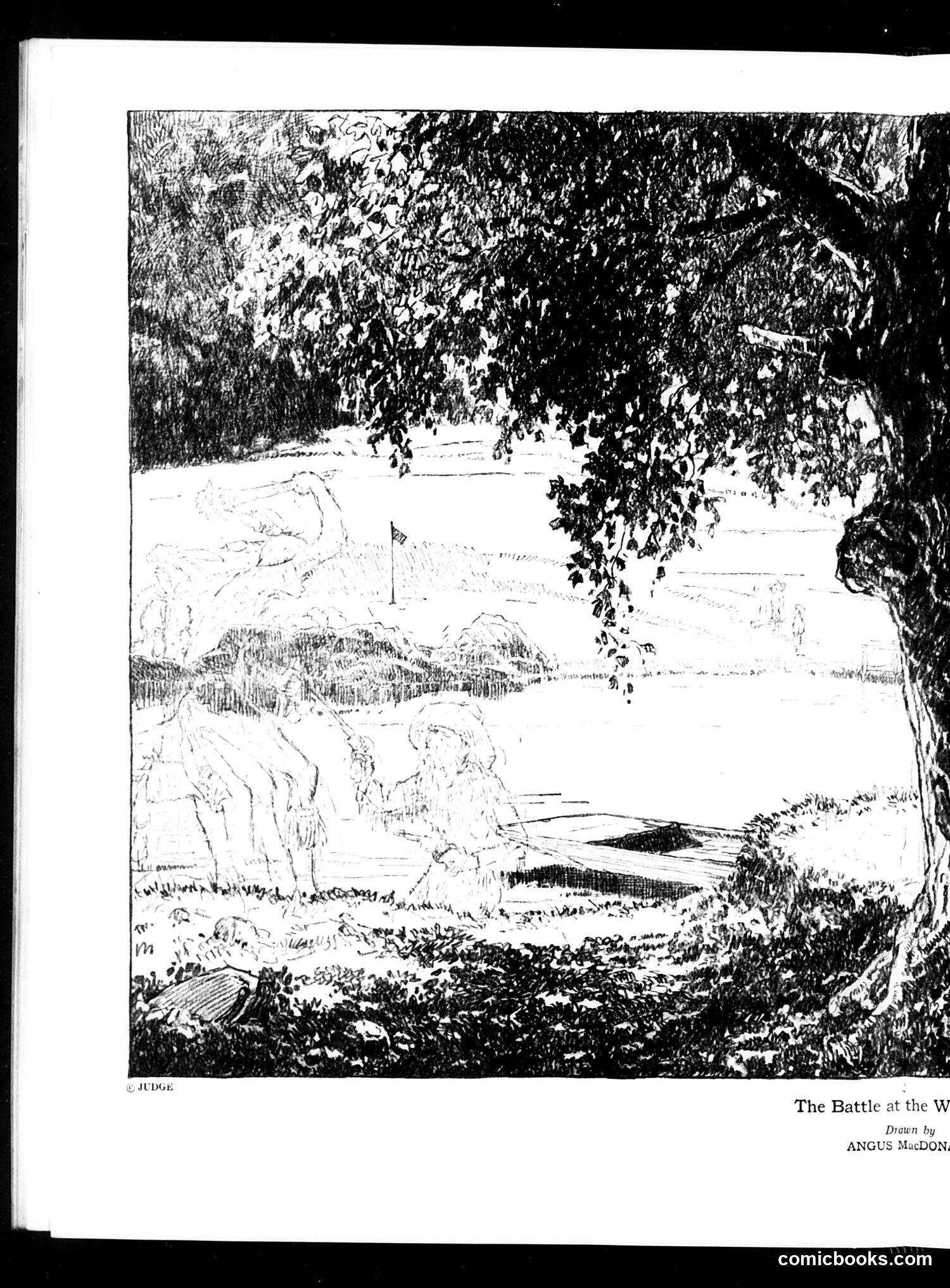
This page contains an illustration titled "The Battle at the W" drawn by Angus MacDonald for *Judge* magazine. The image shows a landscape scene viewed from under tree branches, featuring a body of water, distant shoreline, trees, and what appears to be a flag in the middle distance. The title is incomplete ("The Battle at the W"), making it difficult to identify the specific historical or political event being referenced. Without the full title or additional context, I cannot definitively determine which battle or satirical subject this cartoon addresses. The artistic style and composition suggest it may be referencing a contemporary military or political event from *Judge*'s publication period, but identifying the specific reference would require speculation unsupported by visible text.
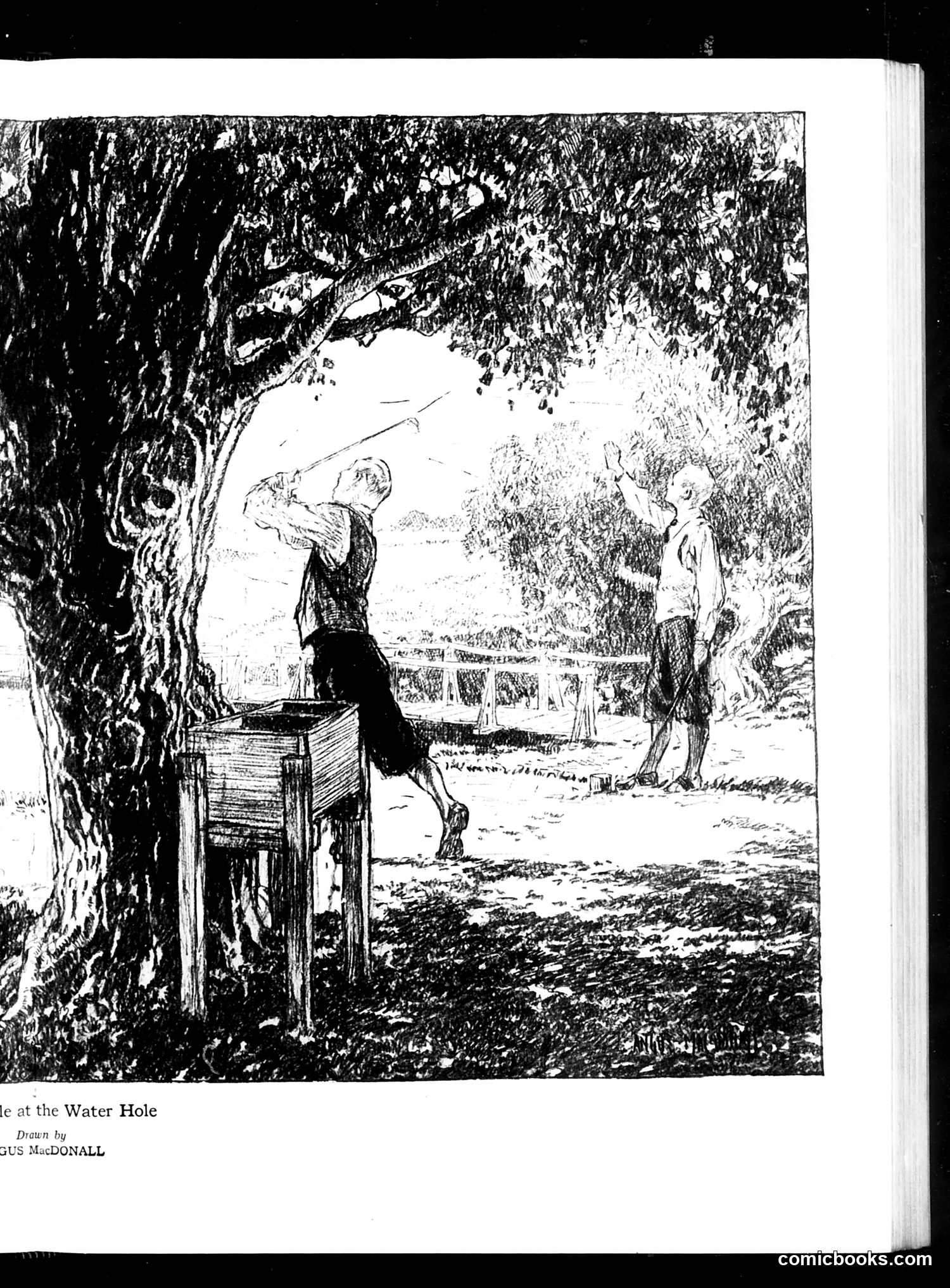
This illustration by Gus MacDonall depicts a scene at a watering hole, showing a man in formal attire (vest and jacket) reaching upward while standing on what appears to be a wooden platform or bench. Another figure stands to the right near a tree. The composition suggests a moment of leisure or recreation in a natural setting. Without additional context from Judge magazine's specific issue, the exact satirical point remains unclear. It could reference social class contrasts, leisure activities, or contemporary events. The formal clothing contrasts with the rural setting, which may be the intended humor. The title and visible elements suggest this is likely social satire typical of Judge's style, but the specific political or cultural reference requires the original publication date and accompanying text to interpret accurately.
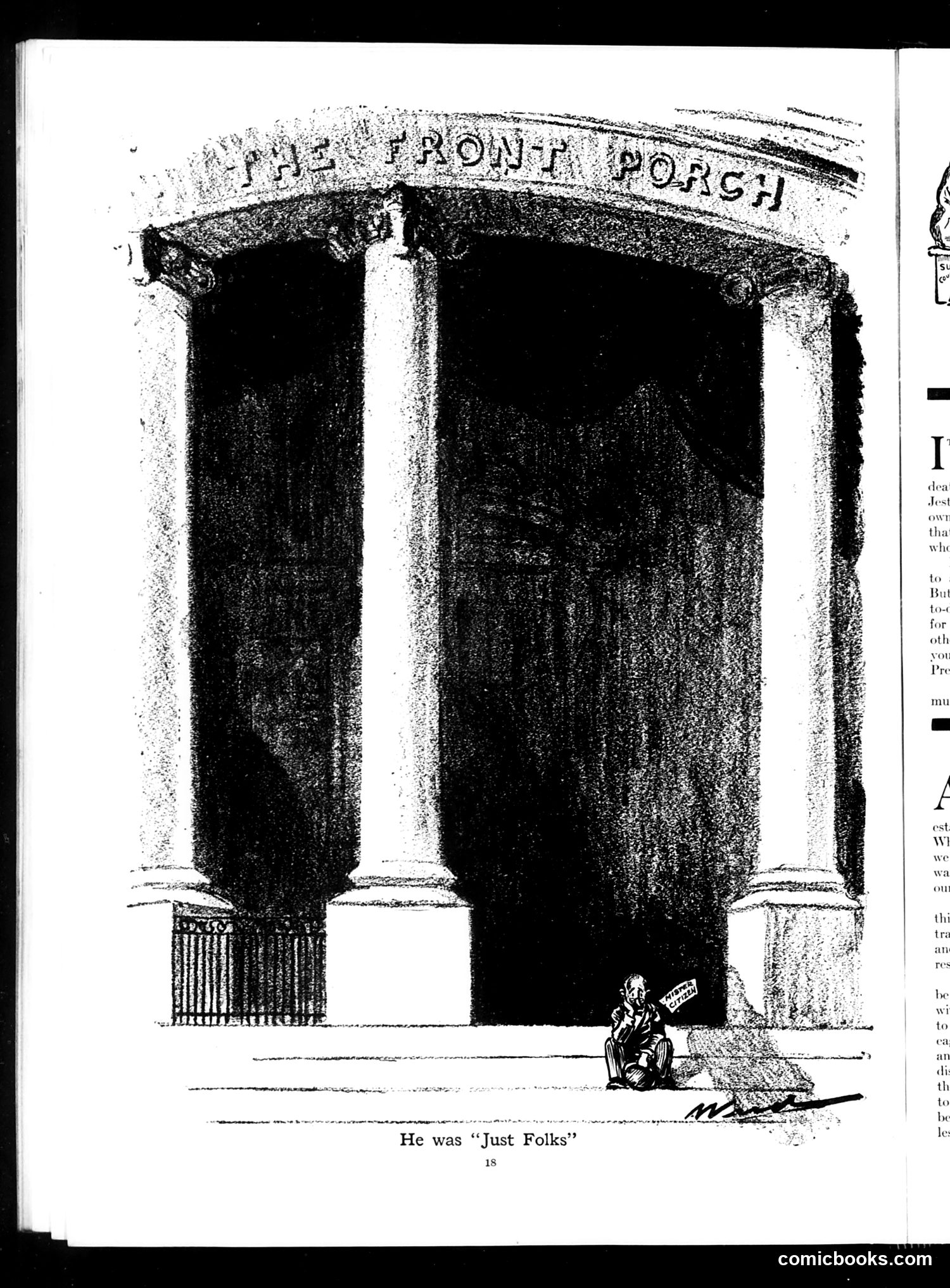
This political cartoon depicts "The Front Porch" with massive classical columns framing an entrance. A small, humble figure sits at the base—dwarfed by the imposing architecture. The caption reads "He was 'Just Folks.'" The satire appears to target a political figure who styled himself as an ordinary person ("just folks") while actually wielding or occupying positions of grand power and authority. The contrast between the tiny human figure and the monumental, formal columns suggests hypocrisy: the person claimed populist, everyday appeal but was associated with significant institutional power or pretense. Without visible identification of the specific figure, this likely critiques early 20th-century American political messaging about populism versus actual power structures. Judge magazine frequently mocked politicians' contradictory self-presentation.
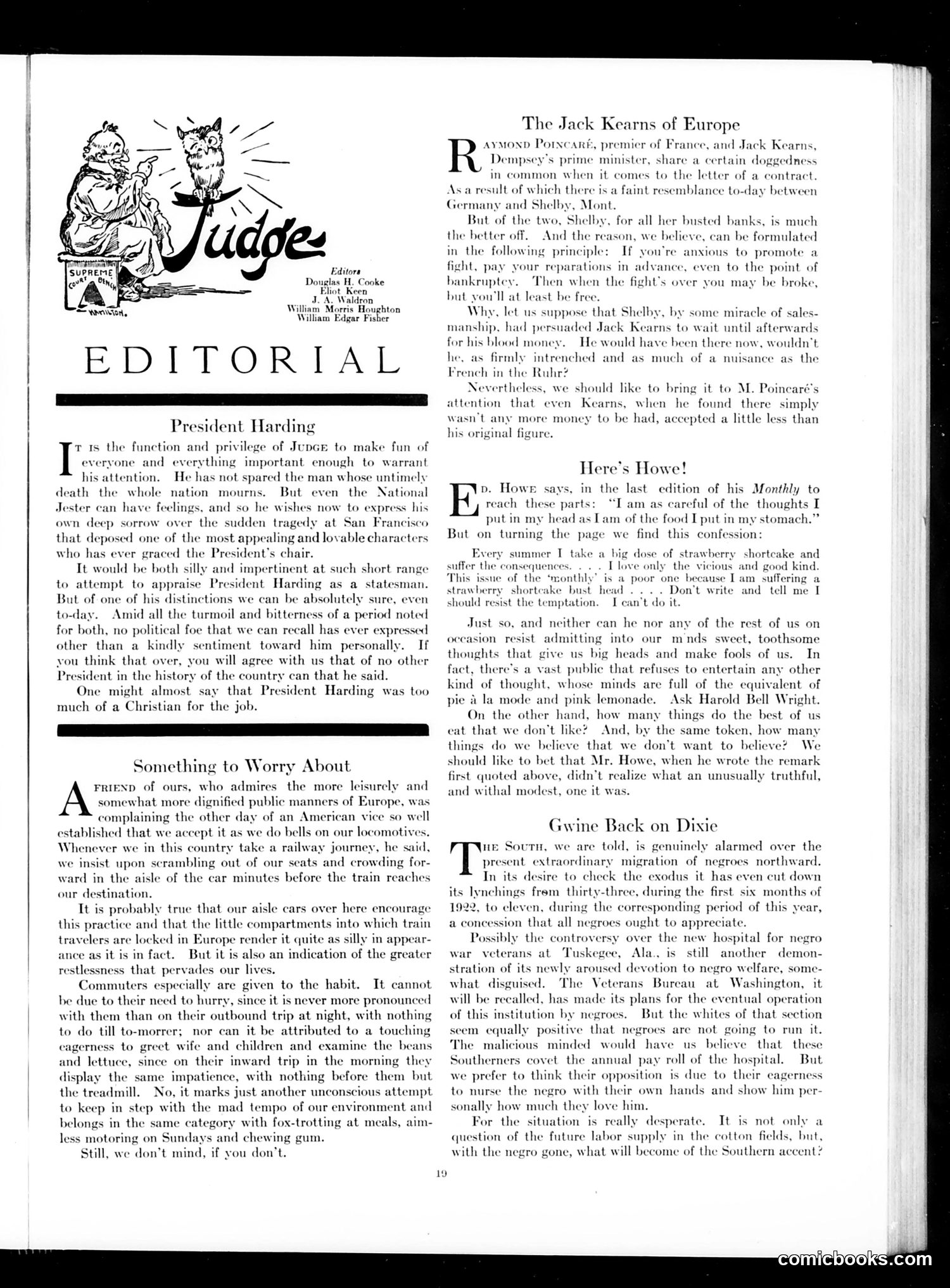
This page contains editorials mourning President Warren G. Harding's recent death, comparing his unexpected passing to a national tragedy. The opening cartoon shows "Judge" (the magazine's mascot jester figure) expressing sorrow. The main editorial praises Harding as unusually likable, noting that even political opponents felt genuine affection for him personally—a rare distinction for a president. It suggests he was "too much of a Christian for the job," implying his personal decency conflicted with political necessities. A second piece satirizes American impatience (scrambling off trains before they stop), contrasting European restraint with American restlessness and frenetic modern life. The final article compares French Premier Raymond Poincaré to boxing promoter Jack Kearns, using the Dempsey-Shelby fight as an extended metaphor for post-WWI reparations disputes. The satire suggests that unlike Poincaré's aggressive demands on Germany, Kearns eventually accepted reasonable settlement when funds dried up—implying France should similarly adjust expectations.
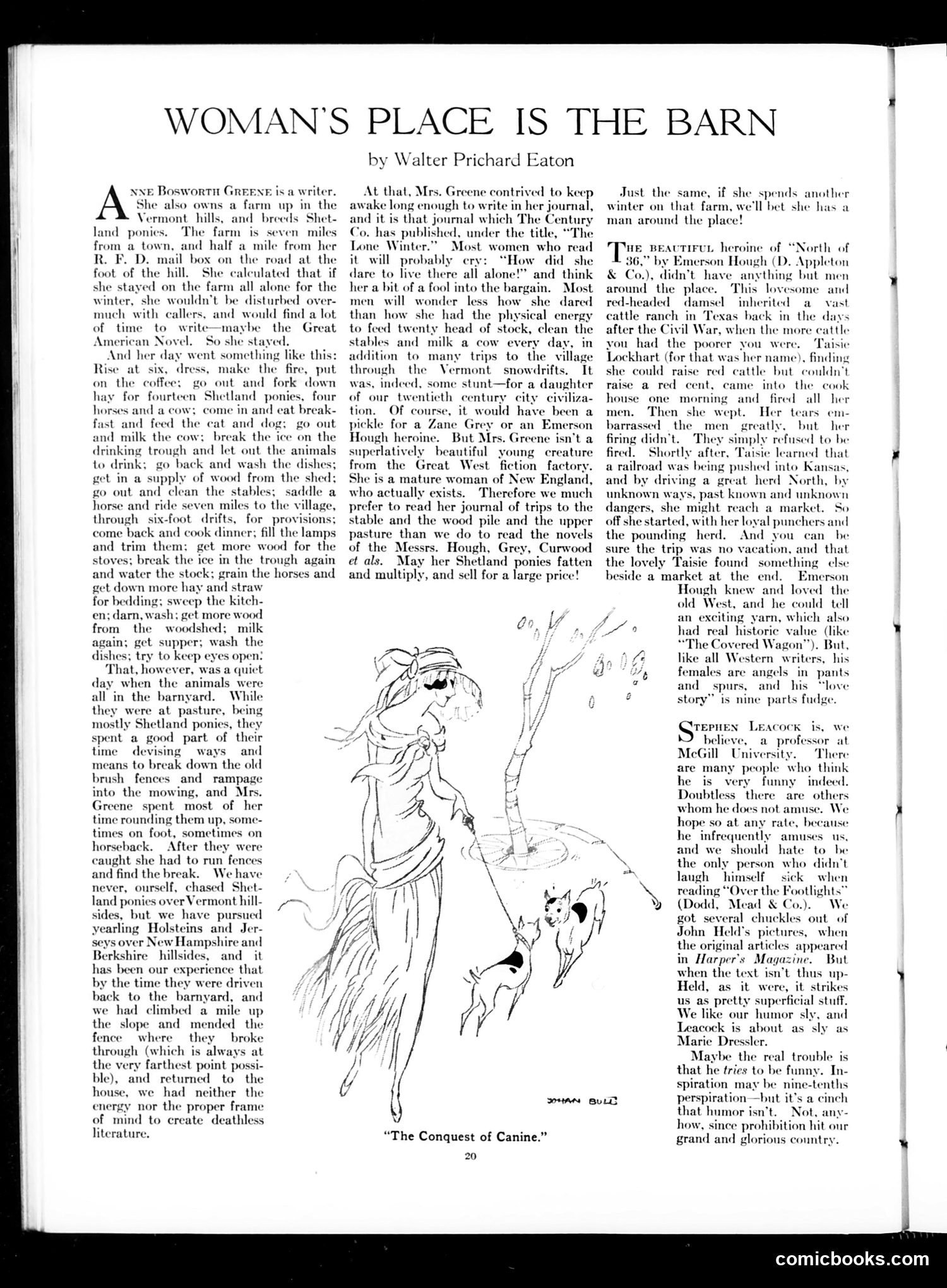
This article by Walter Prichard Eaton satirizes both frontier romanticism and the actual hardships of rural women's labor. **The Subject:** Anne Bosworth Greene, a real writer who owned a Vermont farm and published a journal titled "The Lone Winter" documenting her solitary winter managing livestock and household duties. **The Satire:** Eaton mocks two targets simultaneously: (1) popular Western fiction depicting idealized female pioneers (referencing Zane Grey and Emerson Hough), and (2) the impractical notion that a woman could sustainably manage such physical labor alone. His detailed catalog of her daily chores—rising at six, feeding fourteen ponies, breaking ice, riding seven miles through drifts—emphasizes the exhausting reality versus romantic fiction. **The Joke's Point:** The closing line ("we'll bet she has a man around the place!") undercuts any admiration, suggesting that despite Greene's demonstrated capability, women inevitably need male support for such work—a backhanded commentary on contemporary gender assumptions. The accompanying sketch titled "The Conquest of Canine" remains unclear without additional context.
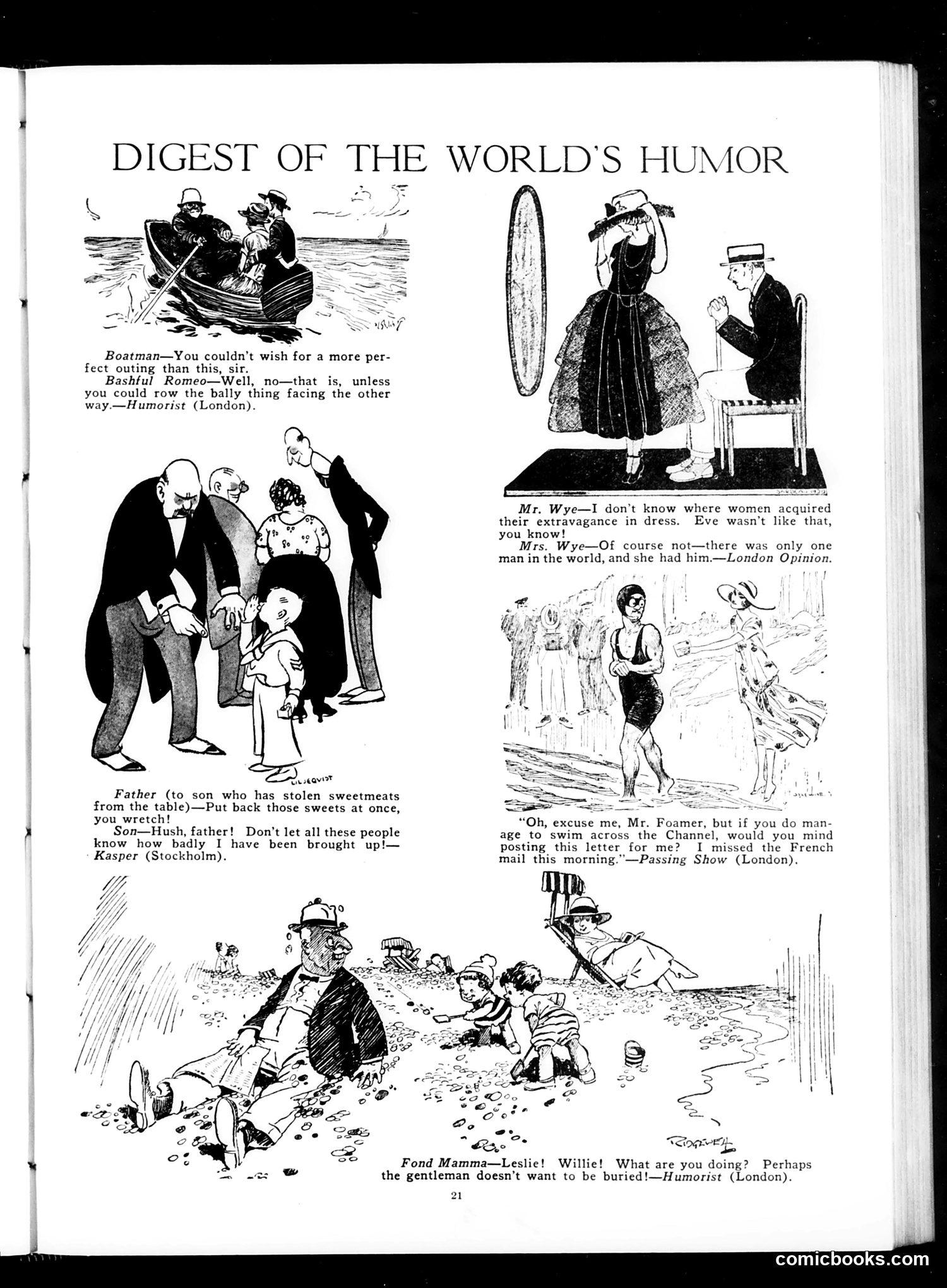
This page collects brief satirical jokes from various international humor publications (London, Stockholm, etc.), presented as single-panel cartoons with captions. The humor targets social conventions and human nature: 1. **Boatman/Romeo**: A shy man on a romantic boat ride wants to face away from his companion—mocking male bashfulness in courtship. 2. **Mr. & Mrs. Wye**: A domestic debate about women's fashion extravagance, with Mrs. Wye's retort that Eve had monopoly on the only man—satirizing both consumerism and gender relations. 3. **Father & Son**: A child caught stealing treats tries silencing his father by threatening to reveal poor parenting—dark humor about childhood manipulation. 4. **Channel Swimmer**: Someone attempts the famous English Channel crossing; a bystander absurdly asks him to mail a letter mid-swim, mocking both the ambitious feat and casual rudeness. 5. **Beach Scene**: Children bury a man in sand; mother jokes he doesn't want to be buried—gentle family comedy. The page exemplifies early-20th-century international middle-class humor emphasizing propriety, romance, and domestic situations.
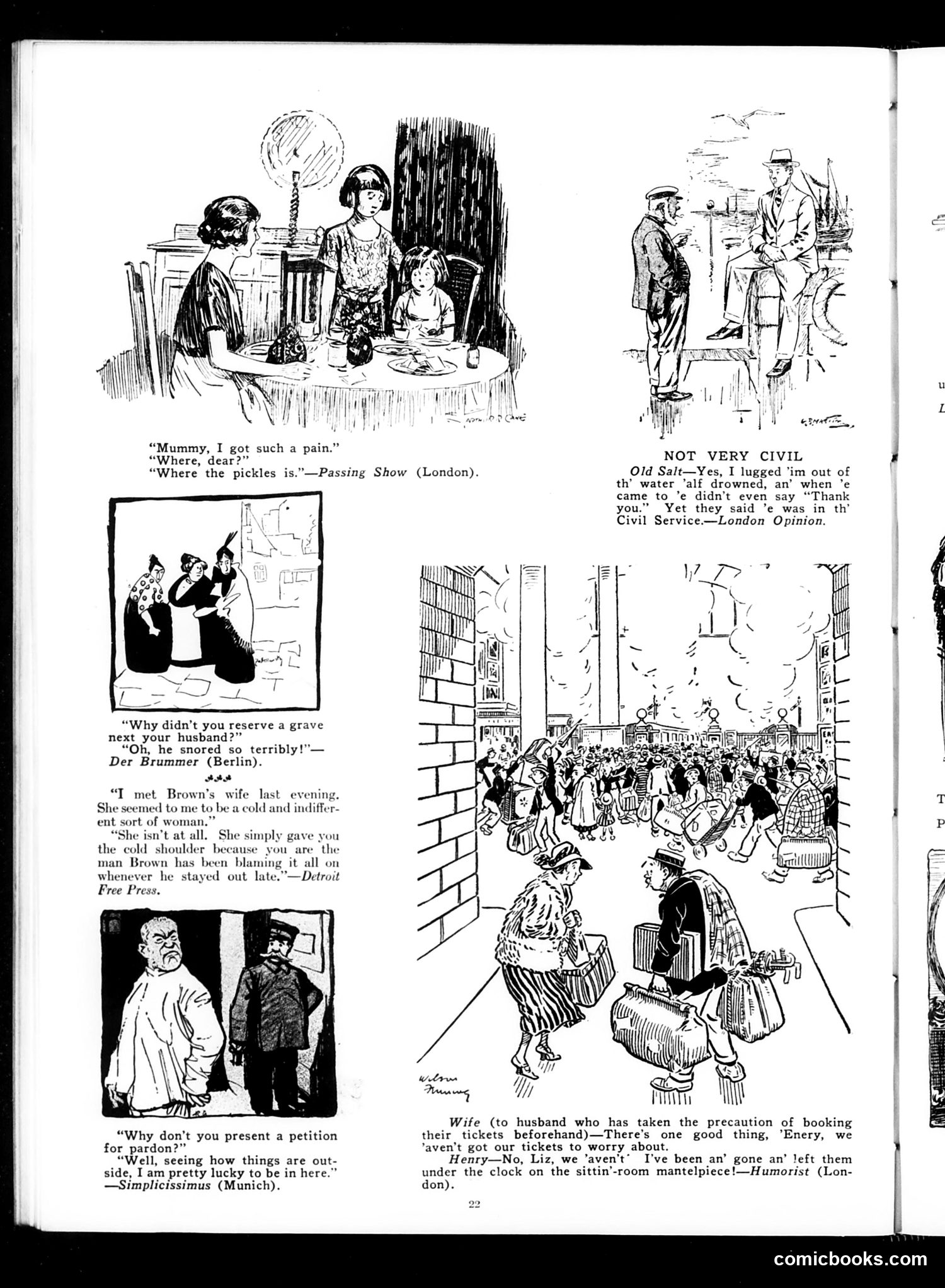
This page collects satirical vignettes from international publications, showcasing humor about marriage, bureaucracy, and social manners across different cultures. **Key jokes:** - **"Not Very Civil"**: Mocks the British Civil Service—a man rescued from drowning shows no gratitude, supposedly typical of government workers' poor manners. - **Marriage complaints**: Multiple cartoons depict wives' grievances. One woman reserves a grave away from her snoring husband; another gives a husband the "cold shoulder" because he blamed her for his late nights out. - **Absent-mindedness**: The final cartoon shows a couple who carefully booked theatre tickets in advance, only for the husband to leave them on the mantelpiece—a domestic comedy of errors. The satire targets stuffy institutions (Civil Service), marital discord, and everyday human foolishness rather than specific political figures. These appear reprinted from German and British satirical magazines, reflecting early 20th-century Anglo-European humor conventions.
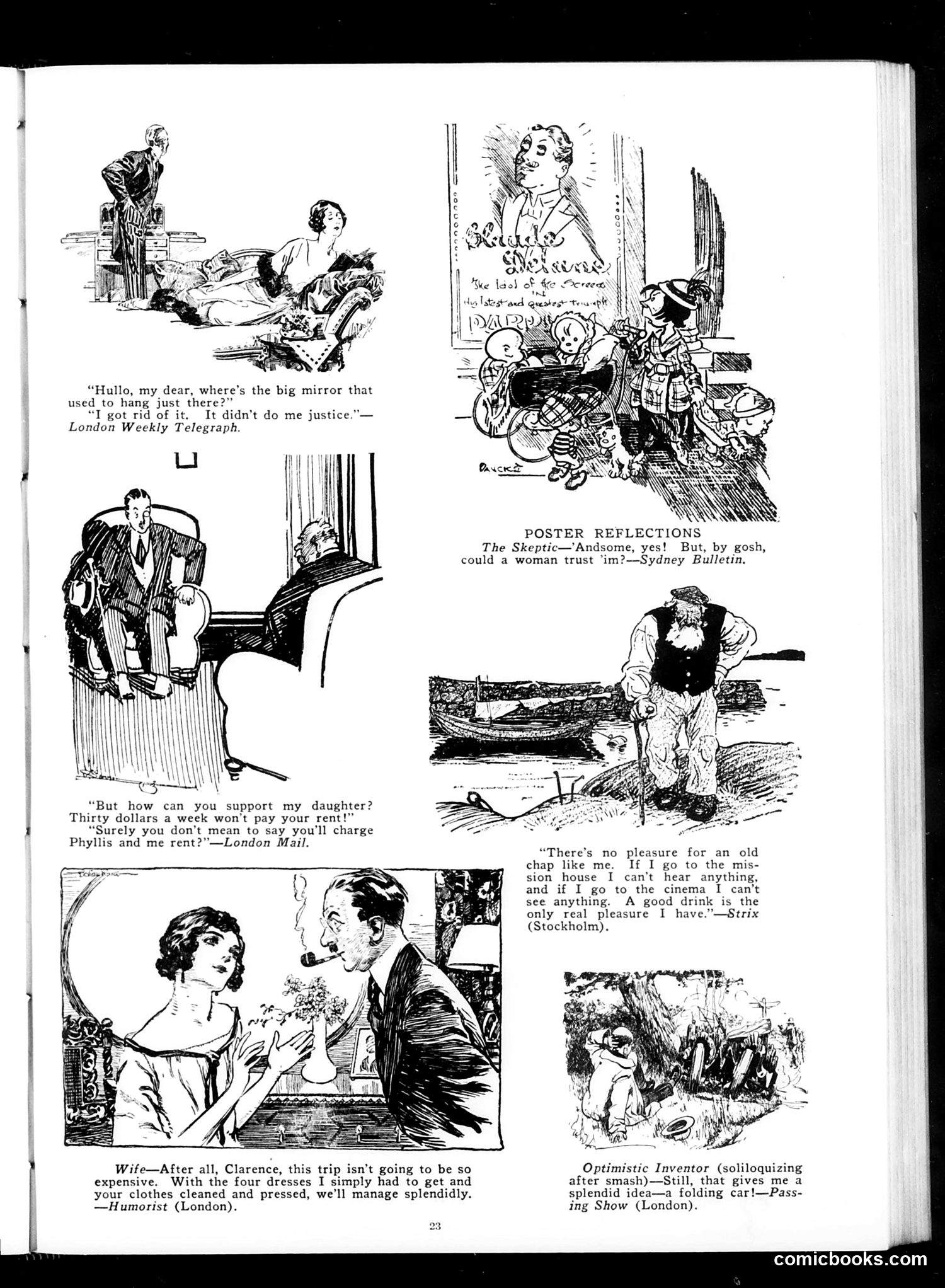
This page collects brief satirical cartoons and jokes from various international publications, all addressing early-20th-century domestic and social anxieties. The cartoons mock: 1. **Female vanity/aging**: A woman discards a mirror because it doesn't flatter her appearance. 2. **Courtship skepticism**: A man's attractiveness is questioned—"could a woman trust him?" 3. **Economic hardship**: A suitor earning $30/week cannot afford both supporting a daughter AND paying rent, highlighting working-class financial strain. 4. **Old age dissatisfaction**: An elderly man finds no pleasure in wholesome activities (missions, cinema) and relies solely on alcohol. 5. **Marital financial management**: A wife justifies expensive clothing purchases as necessary, while her husband accepts the expense—satirizing female spending and male resignation. 6. **Optimistic foolishness**: An inventor, after a crash, sees opportunity in a "folding car"—mocking misplaced optimism. The recurring themes reflect anxieties about courtship, marriage economics, aging, and class mobility in the early 1900s.
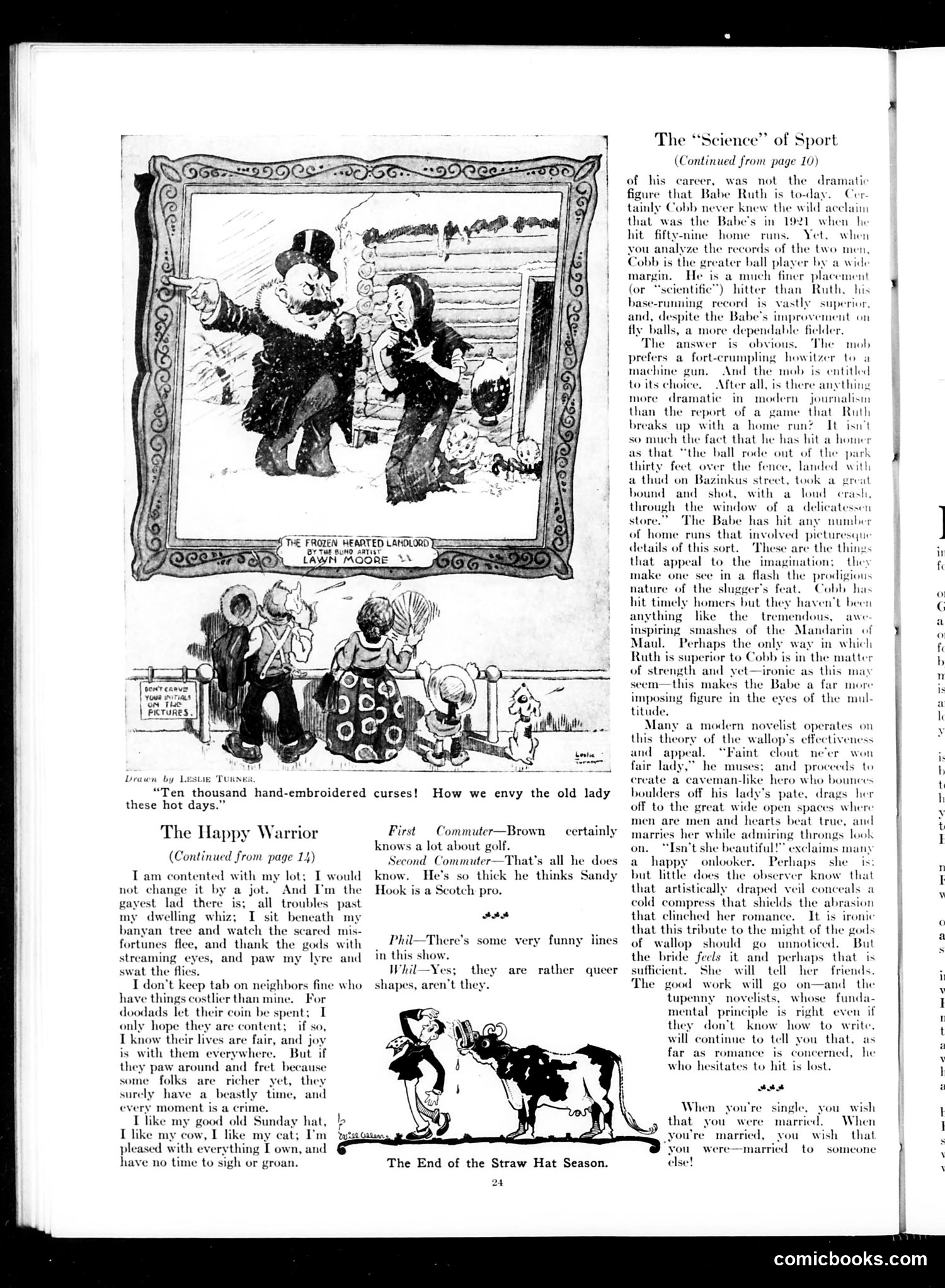
This Judge magazine page contains three distinct pieces: **"The Happy Warrior"** is a philosophical poem celebrating contentment and simple living—a satirical jab at materialism and social climbing. The speaker boasts of finding joy in modest possessions (hat, cow, cat) rather than envying neighbors' wealth. **"The End of the Straw Hat Season"** is a brief comic dialogue where two commuters discuss golf. One insults another's intelligence by suggesting he thinks "Sandy Hook is a Scotch pro"—a pun playing on Sandy Hook (a geographic location) versus an actual golf professional named Sandy Hook. **"The 'Science' of Sport"** compares baseball players Ty Cobb and Babe Ruth, arguing Cobb was technically superior but Ruth more dramatically appealing to crowds. The author critiques how modern audiences and novelists prefer flashy, violent spectacle over subtle skill—using the Ruth/Cobb debate as a metaphor for broader cultural degradation toward sensationalism over substance.
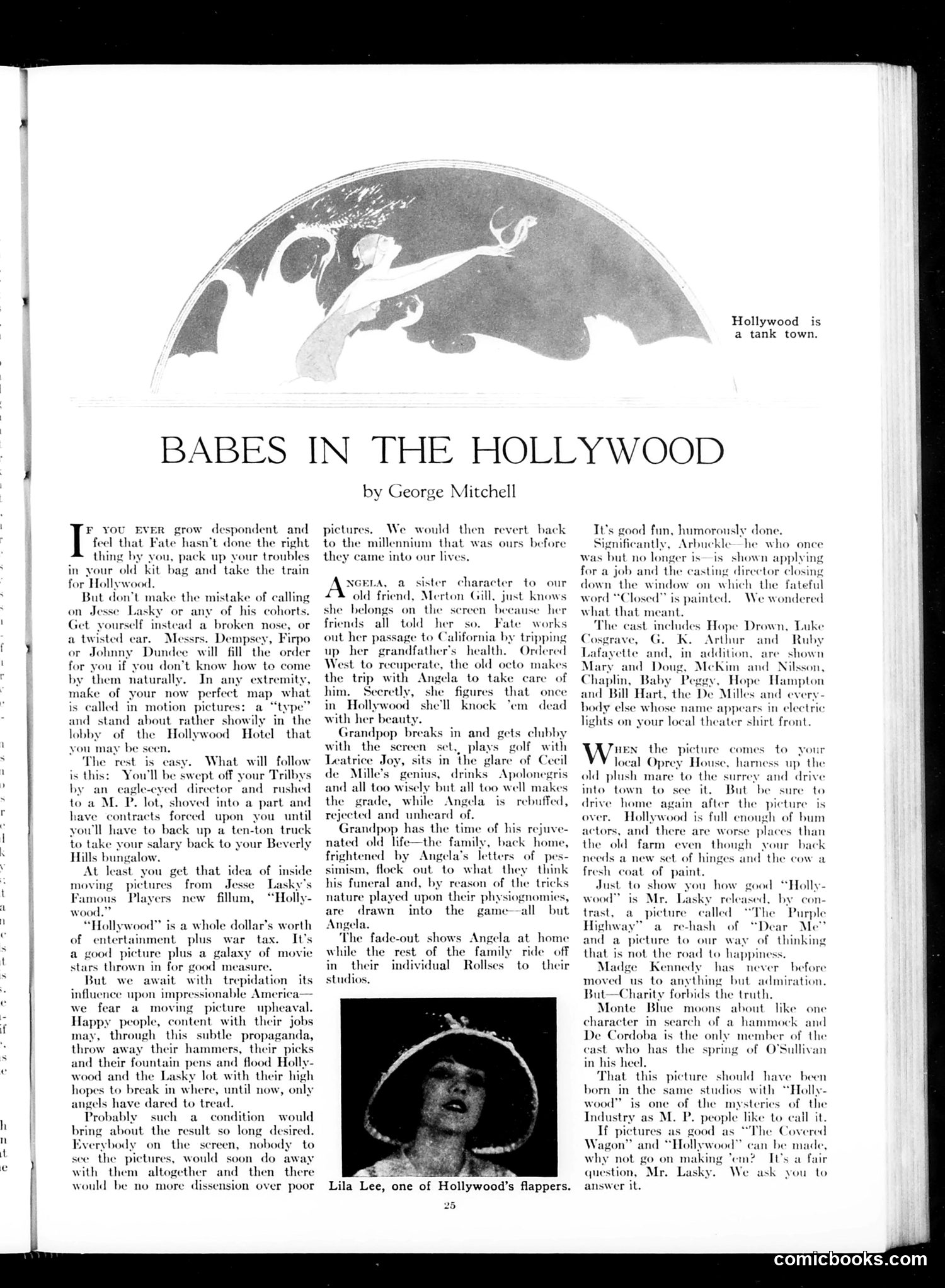
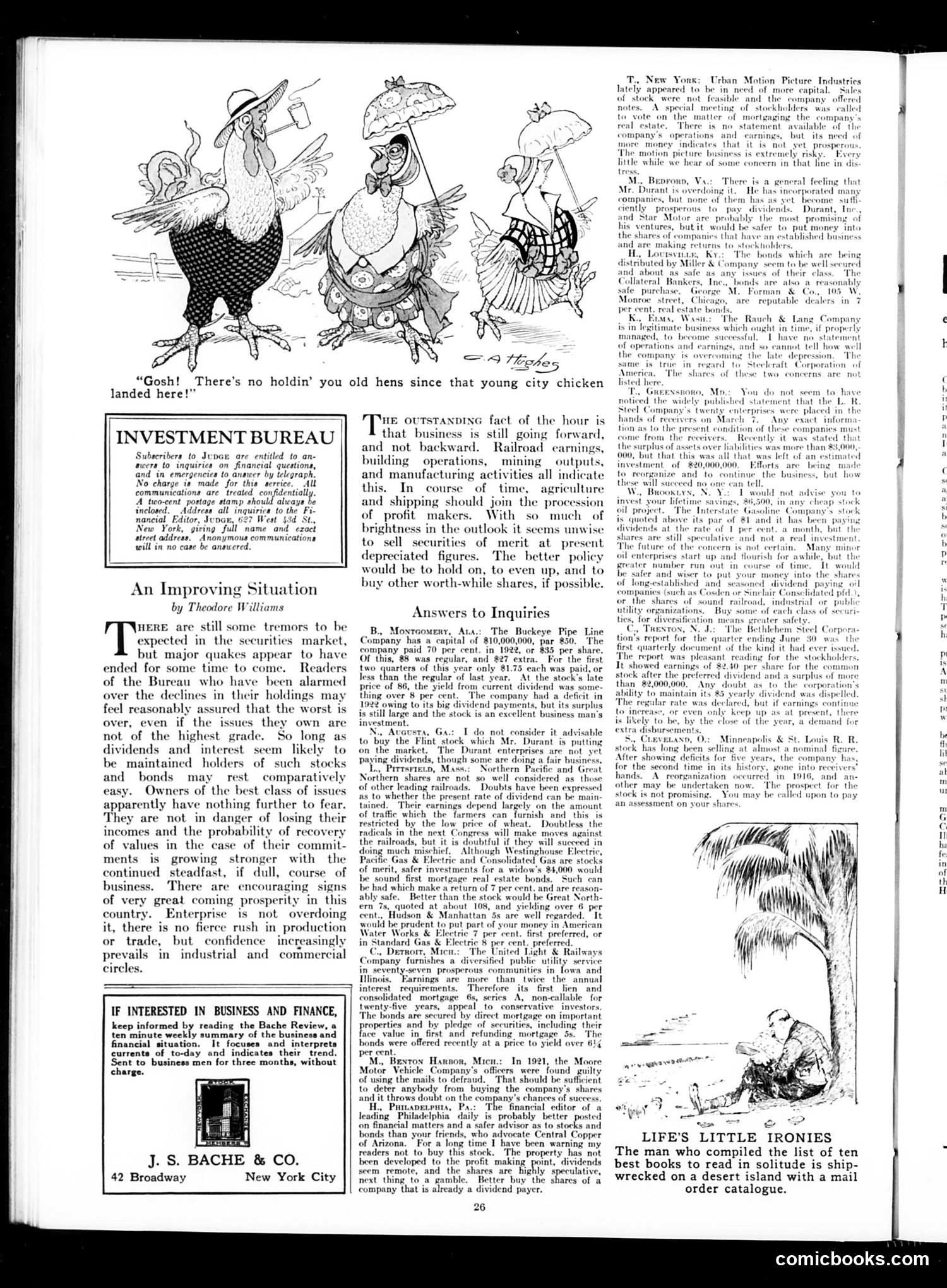
The top cartoon shows three anthropomorphic chickens in human dress caught in a rainstorm. The caption reads: "Gosh! There's no holdin' you old hens since that young city chicken landed here!" **The satire**: This is a play on the rural/urban divide common in early 20th-century American humor. The "city chicken" represents urban sophistication corrupting simple rural life. The hens (representing rural folk) have become restless and uncontrollable after exposure to city ways—a commentary on how urbanization and modern culture were disrupting traditional agrarian society. The rest of the page contains the magazine's "Investment Bureau" advice column, where editors answer reader questions about stocks and bonds. This was educational financial journalism mixed with ads from investment firms like J.S. Bache & Co. **Context**: Judge was a satirical magazine that combined political/social humor with serious financial advice—reflecting how early 20th-century publications blended entertainment, commentary, and practical information for middle-class readers interested in investing.
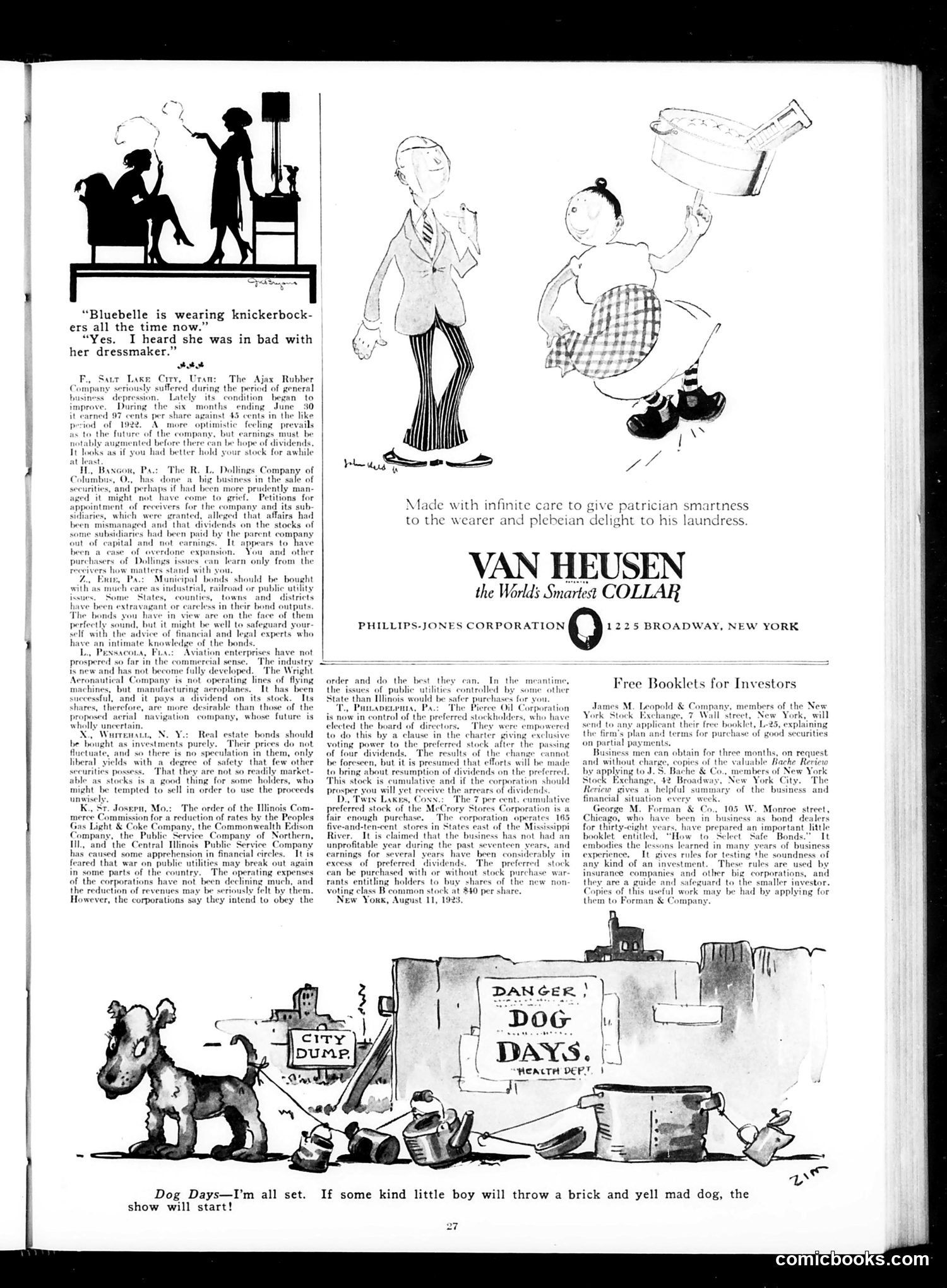
This page contains two main satirical cartoons: **Top cartoon:** A joke about women's fashion and social consequences. "Bluebelle" wears knickerbockers (loose pants) and has allegedly angered her dressmaker by doing so—suggesting the dressmaker lost business because Bluebelle stopped purchasing traditional dresses. The satire mocks how fashion choices could damage professional relationships. **Bottom cartoon:** Titled "Dog Days," it depicts a staged theatrical scene where someone plans to incite chaos by throwing a brick at a dog while yelling "mad dog" to trigger a public panic. The joke satirizes how easily crowds can be manipulated into hysteria through rumor and minor provocations. The remainder of the page consists of financial advice columns addressing investment questions about various companies (Ajax Rubber, Wright Aeronautical, etc.) and municipal bonds—typical Judge magazine content mixing humor with business commentary. The Van Heusen collar advertisement is standard period advertising.
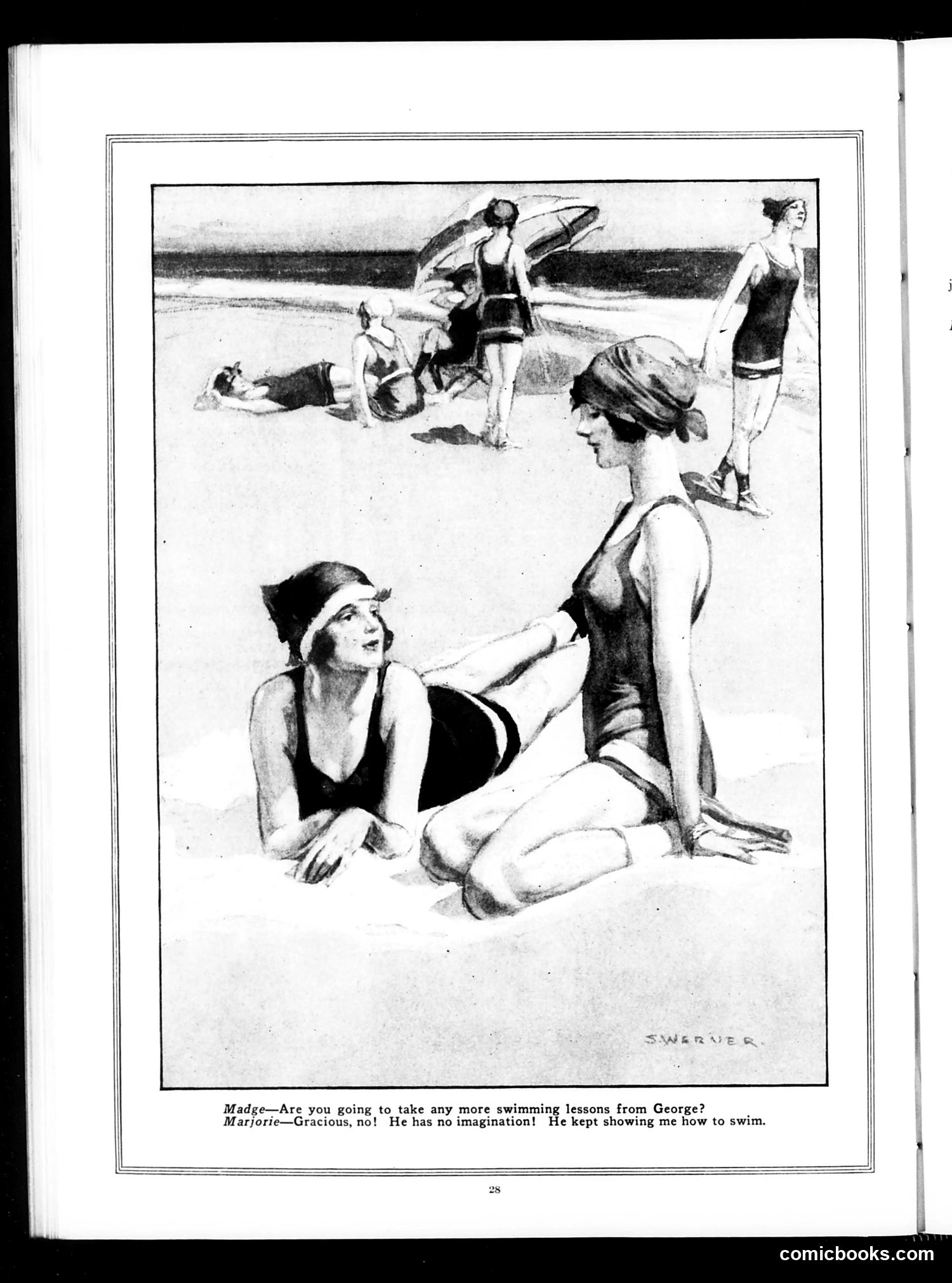
This is a single-panel beach humor cartoon satirizing incompetent or overly literal instruction. Two women in 1920s bathing suits discuss swimming lessons from someone named George. The joke relies on a double meaning: Marjorie complains George "has no imagination" because he actually *taught her to swim* rather than using the lessons as a pretext for flirtation or physical closeness. The cartoon satirizes both the obliviousness of a male instructor who takes his job literally rather than exploiting the situation for romantic attention, and perhaps the social expectation that men would use such opportunities to advance personal interests rather than provide genuine instruction. The artist is Swartek (visible signature). The humor reflects 1920s attitudes about gender dynamics and courtship rituals.
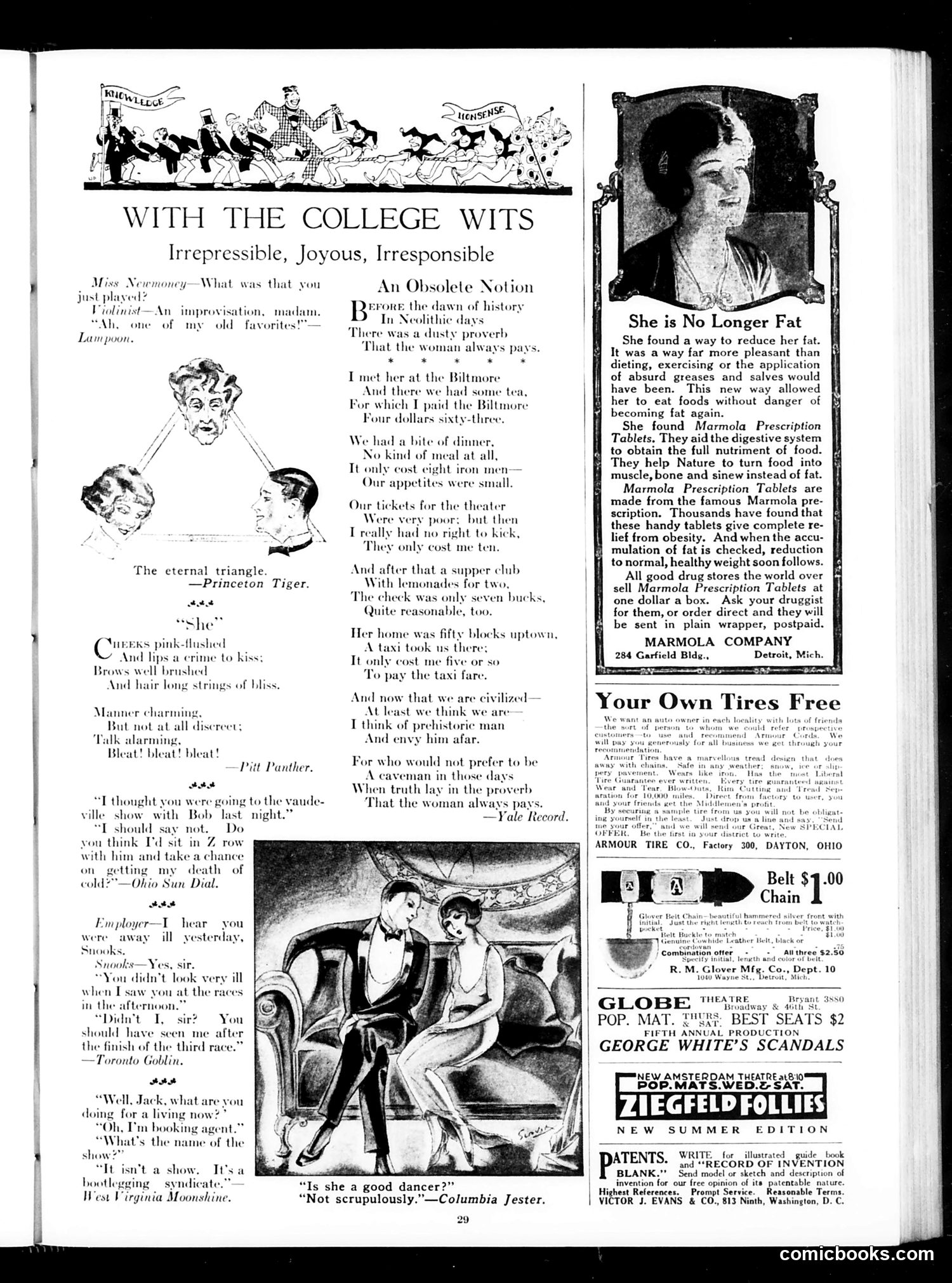
This page collects humorous short jokes and poems from college humor magazines (Princeton Tiger, Pitt Panther, Yale Record, etc.), a common Judge feature. The satire targets early 1920s social pretensions and gender dynamics. **Key content:** The main poem mocks the "obsolete notion" that women pay on dates. A man recounts an expensive evening (tea, dinner, theater, supper club, taxi) entirely at his expense, then laments that modern courtship contradicts the supposed proverb that "the woman always pays"—sardonically suggesting men now bear all costs. Short jokes jab at college types: a fake musician claiming improvisations, a malingering employee caught at the races, a bootlegger posing as a talent agent, and awkward dating scenarios. **Context for modern readers:** This reflects post-WWI anxiety about changing gender roles and dating customs. The humor assumes readers recognize the tension between traditional expectations (women's financial dependence) and emerging modern dating where men still paid, yet women gained more independence and social freedom. The surrounding advertisements (diet pills, tires, theater tickets) were typical Judge fare.
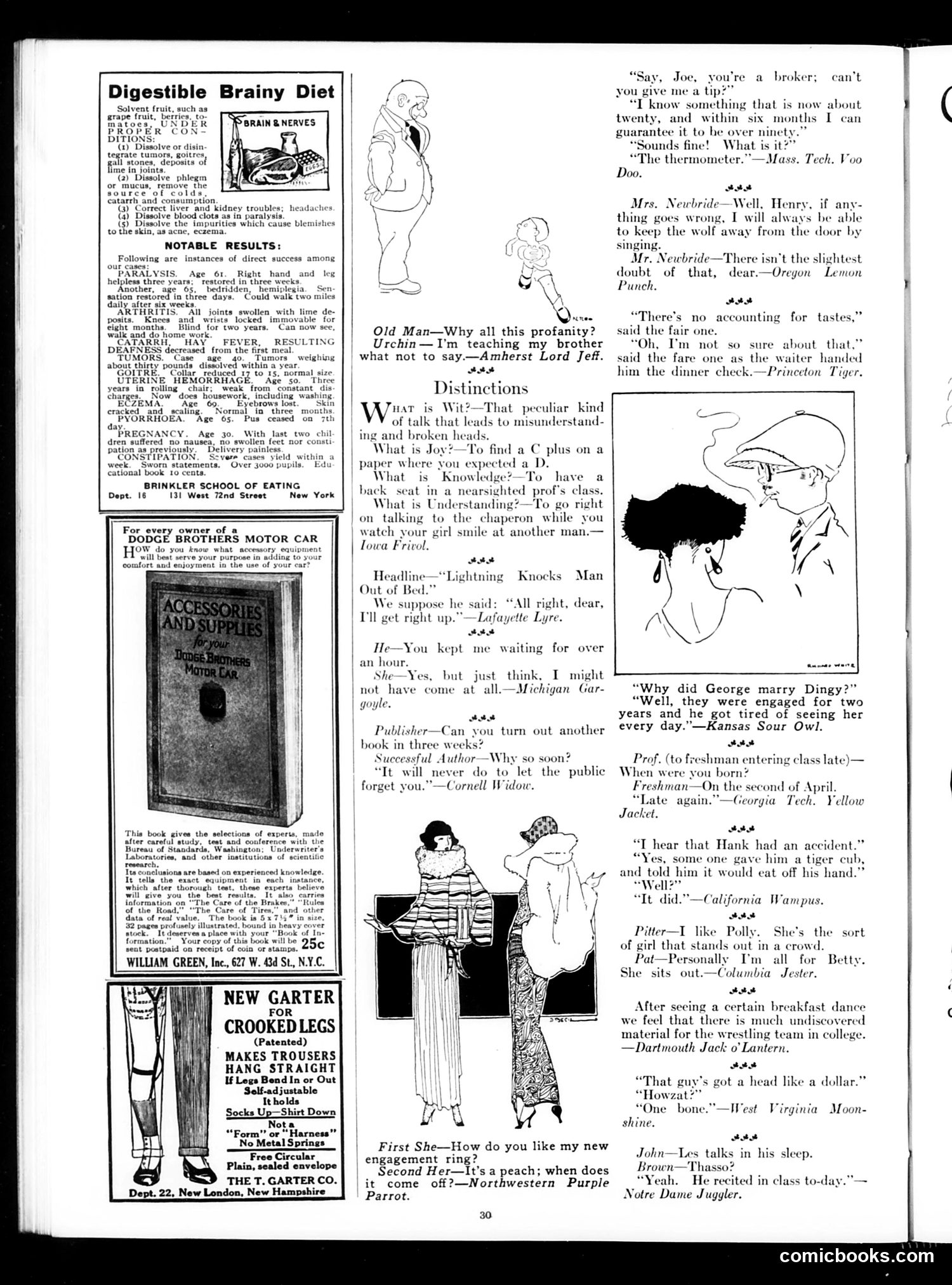
This page is primarily **advertisements and humor columns** rather than political cartoons. The content includes: **Main Elements:** - Advertisement for "Digestible Brainy Diet" (health remedy claiming to cure paralysis, arthritis, cataracts, etc.) - Advertisement for Dodge Brothers Motor Cars - Advertisement for a "New Garter for Crooked Legs" (corrective hosiery) - Multiple short humor items titled "Distinctions" and miscellaneous jokes **The Humor:** The jokes target early 20th-century social situations—a woman threatening to support her husband through singing, a broker's financial tip (a thermometer will "go up"), references to college life and engagements. The "Distinctions" section satirizes academic pretension by defining concepts like "Wit," "Joy," and "Knowledge" through absurd undergraduate experiences. **Notable:** The page reflects period concerns (health fads, women's roles, courtship) but contains no identifiable political figures or major satirical targets. It's representative of Judge's lighter miscellaneous content rather than its more pointed editorial work.
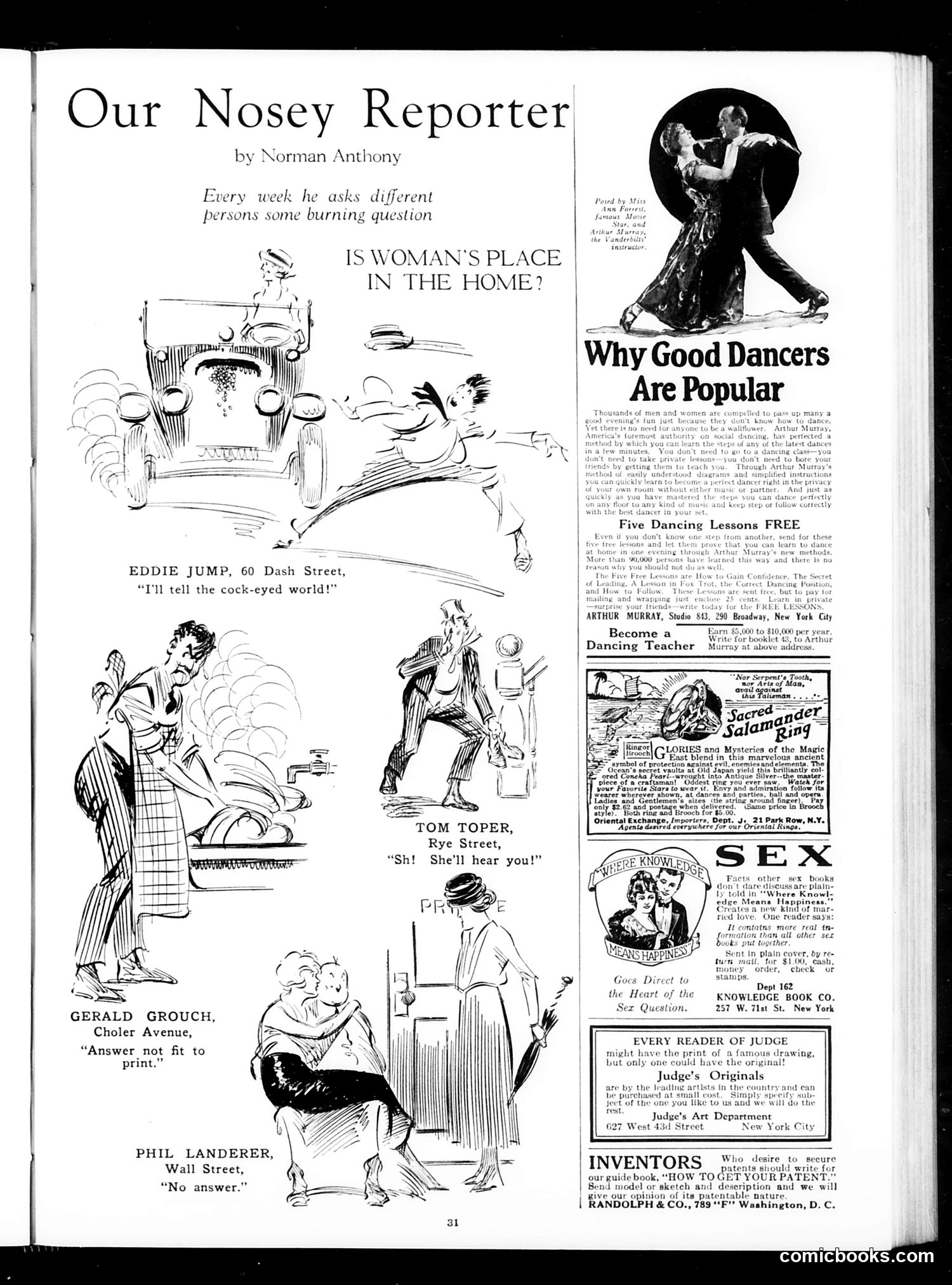
This satirical column by Norman Anthony poses a contemporary social question—"Is woman's place in the home?"—to various New York characters, capturing their frank responses. The cartoon mocks both the question itself and society's attitudes toward women's roles in the 1920s. The respondents include working professionals (Eddie Jump, Tom Toper, Gerald Grouch, Phil Landerer), each with characteristically cynical or evasive answers. Gerald Grouch refuses to answer because his response is "not fit to print," suggesting the question provokes crude commentary. Tom Toper advises secrecy ("Sh! She'll hear you!"), implying wives shouldn't know men's true opinions. The satire targets male attitudes as much as the question itself—these men represent various urban types whose responses range from blustering to cowardly, revealing contemporary gender tensions during a period when women's social roles were rapidly changing. The right side of the page contains unrelated advertisements, typical of Judge's format.
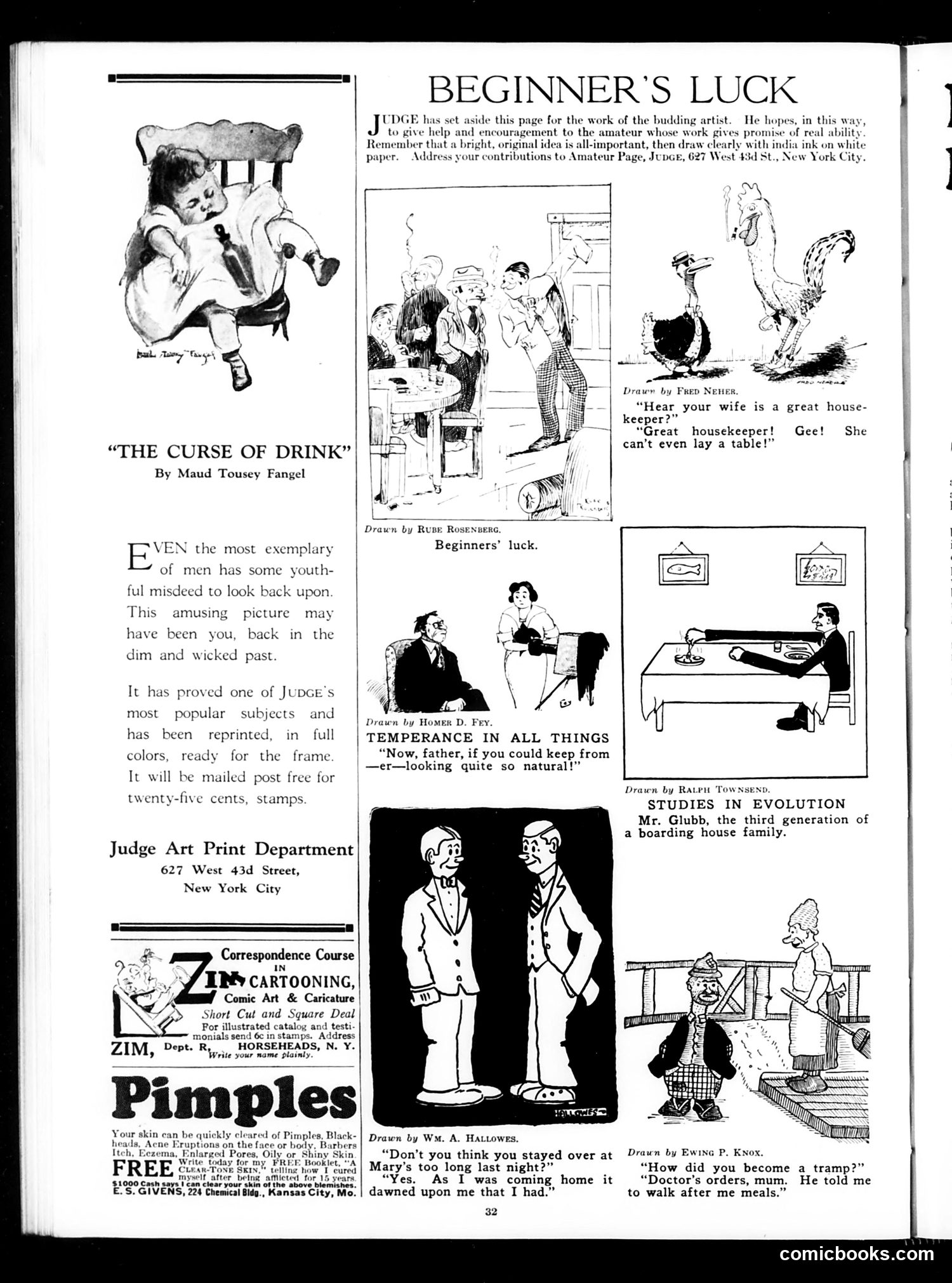
This page showcases amateur cartoonists' work submitted to *Judge*'s "Beginner's Luck" section, a dedicated space for budding artists. The cartoons employ simple domestic humor common to early 20th-century American comedy: - **"Hear your wife is a great housekeeper?"** plays on the ironic gap between reputation and reality. - **"Temperance in All Things"** references the Prohibition era's temperance movement, with dark humor about a drinker's guilty appearance. - **"Studies in Evolution"** tracks generational decline in a boarding house family. - **"Don't you think you stayed over at Mary's?"** uses a pun ("dawned upon me") for mild romantic scandal. - **"How did you become a tramp?"** relies on wordplay between medical advice and vagrancy. The page also advertises a correspondence course in cartooning and pimple cream—typical *Judge* magazine content mixing editorial cartoons with ads and reader submissions.
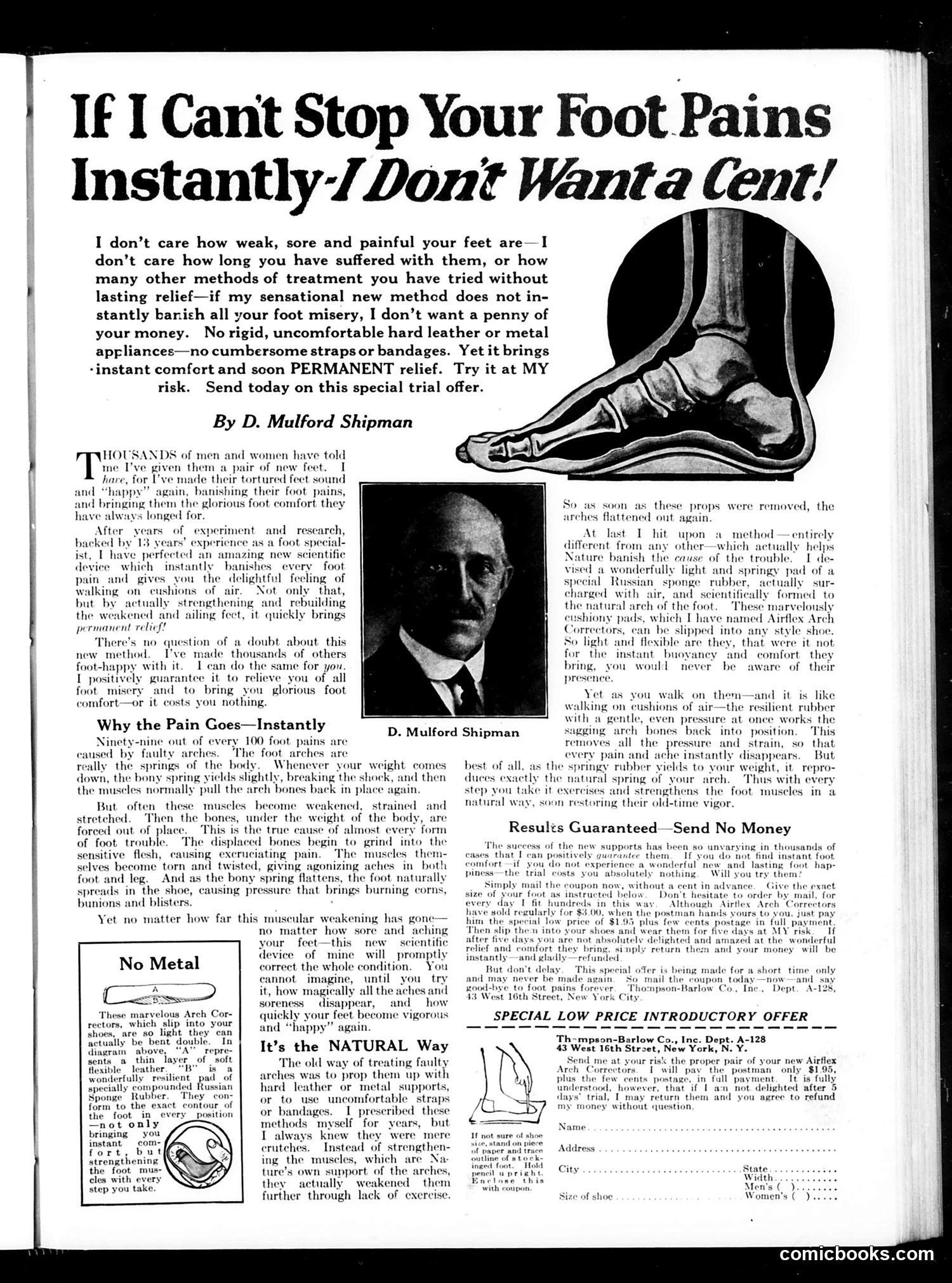
This page is **primarily a full-page advertisement**, not satirical content. It promotes "Airflex Arch Correctors"—orthopedic foot supports—by D. Mulford Shipman, presented as a foot specialist. The ad uses aggressive marketing tactics common to early 20th-century patent medicine advertising: bold guarantees ("I Don't Want a Cent!"), testimonials from "thousands," and pseudo-scientific explanations of foot pain caused by weak arches. Shipman positions his device as superior to existing rigid supports, claiming it naturally strengthens feet through springy rubber pads. The portrait and prominent byline create false authority. The anatomical foot diagram lends pseudo-credibility. For modern readers: this exemplifies how unregulated medical product advertising once worked—bold claims, money-back guarantees, and invented expertise to sell remedies. The "natural way" framing mirrors contemporary wellness marketing language.
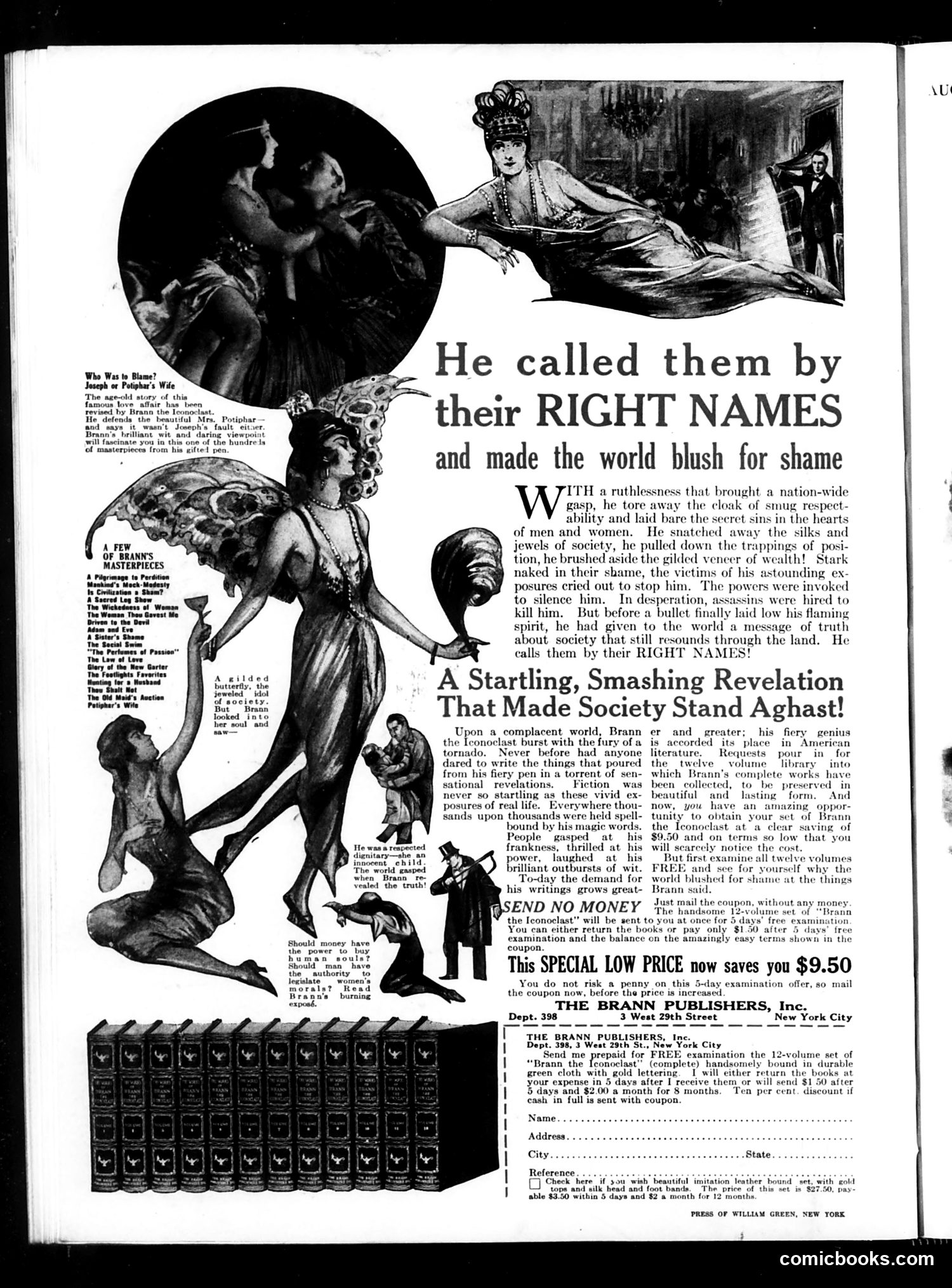
This is primarily **advertising**, not satire. The page promotes a 12-volume collection of writings by **William Brann "the Iconoclast,"** a real Texas journalist and social critic known for exposing hypocrisy in late 19th-century society. The ad copy uses dramatic language—describing Brann as someone who "called them by their RIGHT NAMES" and made powerful people uncomfortable—to position his work as fearless social commentary. The imagery shows wealthy, respectable figures stripped of their dignity, suggesting Brann's writings revealed hidden scandals and moral failings among the elite. The phrase "made the world blush for shame" emphasizes his reputation for public exposés. The ad appeals to readers' desire to access this supposedly dangerous, scandalous material at a bargain price ($9.50 savings), with a risk-free trial offer. This reflects early 20th-century marketing tactics: packaging controversial journalism as transgressive and thrilling to drive sales.