
Judge, 1923-08-18 · page 21 of 36
Judge — August 18, 1923 — page 21: what you’re looking at
What you’re looking at
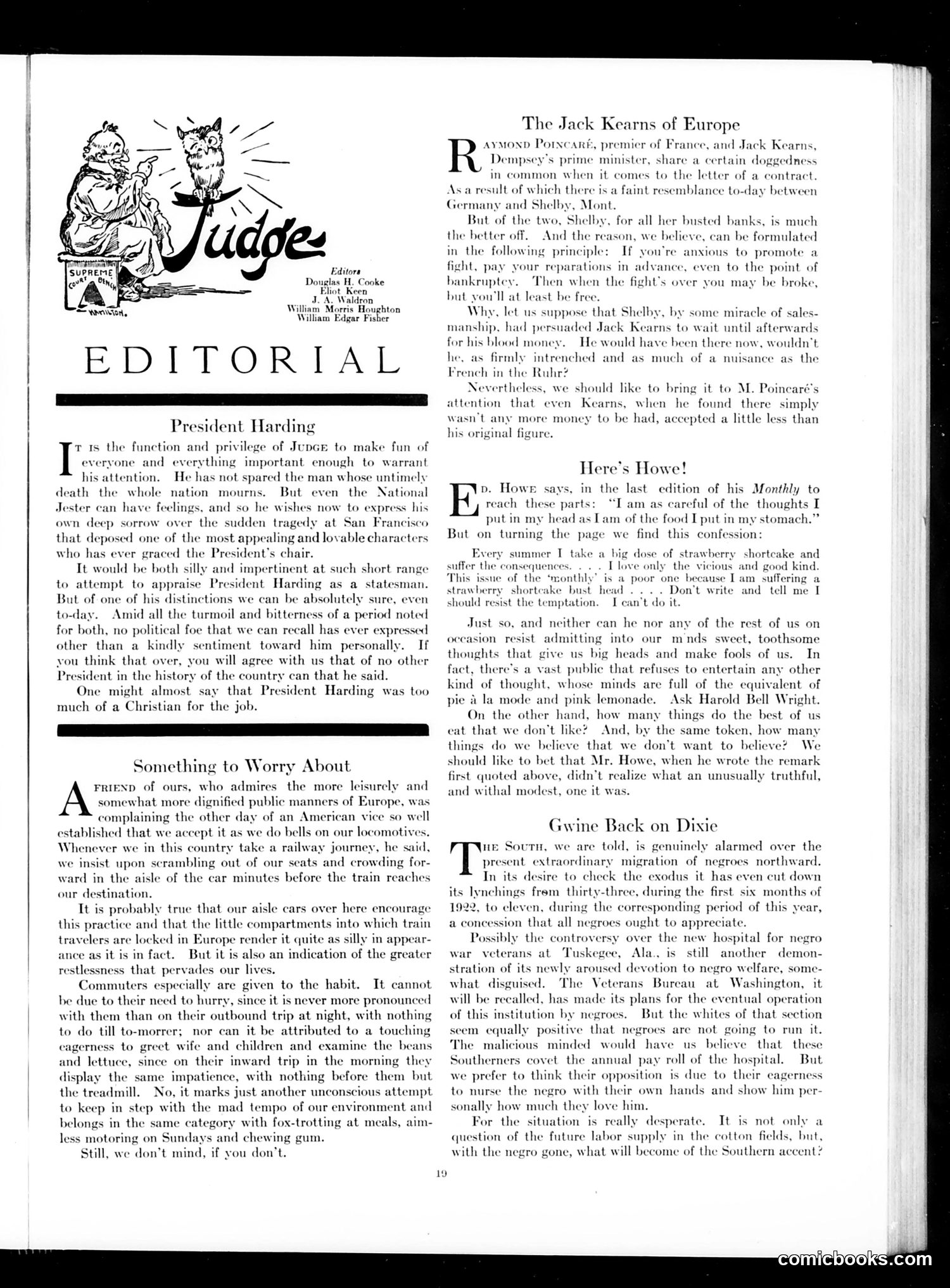
This page contains editorials mourning President Warren G. Harding's recent death, comparing his unexpected passing to a national tragedy. The opening cartoon shows "Judge" (the magazine's mascot jester figure) expressing sorrow. The main editorial praises Harding as unusually likable, noting that even political opponents felt genuine affection for him personally—a rare distinction for a president. It suggests he was "too much of a Christian for the job," implying his personal decency conflicted with political necessities. A second piece satirizes American impatience (scrambling off trains before they stop), contrasting European restraint with American restlessness and frenetic modern life. The final article compares French Premier Raymond Poincaré to boxing promoter Jack Kearns, using the Dempsey-Shelby fight as an extended metaphor for post-WWI reparations disputes. The satire suggests that unlike Poincaré's aggressive demands on Germany, Kearns eventually accepted reasonable settlement when funds dried up—implying France should similarly adjust expectations.
📄 Transcribed text from this page (OCR, searchable)
Machine-transcribed from the original scan — historical spelling and the odd misread are preserved.
des Douglas H, Cooke Eliot Keen J. A. Waldron William Morris Houghton William Edgar Fisher EDITORIAL = ion, President Harding tT 1s the function and privilege of JupGE to make fun of I everyone and everything important enough to warrant his attention. death the Jester can have own déep’ sorrow over the sudden tragedy. at San He has not spared the man whose untimely nation But even the National lings, and so he wishes now to express his who mourns. neisco that deposed one of the most appealing and lovable characters who has ever graced the President's ch It would be both silly and impertinent at such short range to attempt to appraise President Harding as a statesman. But of one of his distinctions we can be absolutely sure, even Amid all the turmoil and bitterness of to-day. period noted for both, no political foe that we can recall has ever expressed other than a kindly sentiment toward him personally. If you think that over, you will agree with us that of no other President in the history of the country can that he said. One might almost say that President Harding was too much of a Christian for the job. Something to Worry About FRIEND of ours, who admires the more leisurely and somewhat more dignified public manners of Europe, was complaining the other day of an American vice so well established that we accept it as we do bells on our locomotives. Whenever we in this country take a railway journey, he said, we insist upon scrambling out of our seats and crowding for- ward in the aisle of the car minutes before the train reaches our destination. It is probably true that our aisle cars over here encourage this practice and that the little compartments into which train travelers are locked in Europe render it quite as silly in appear ance it is in fact. But it is also an indication of the greater restlessness that pervades our lives. Commuters especially are given to the habit. Tt cannot he due to their need to hurry, since it is never more pronounced with them than on their outbound trip at night, with nothing to do till to-morrer; nor can it be attributed to a touching « nd children and examine the beans nd lettuce, since on their inward trip in the morning they display the same impatience, with nothing before them but the treadmill. No, it marks just another unconscious attempt to keep in step with the mad tempo of our environment and gerness to greet wife belongs in the same category with fox-trotting at meals, aim- less motoring on Sundays and chewing gum. Still, we don’t mind, if you don’t. The Jack Kearns of Europe ayaonp Porxcaré, premier of France, and Jack Kearns, R Dempsey’s prime minister, share a certain doggedness in common when it comes to the letter of a contract. Asa result of which there is a Germany and Shelby, Mont. But of the two, Shelby, for all her busted banks, is much the better off. And the reason, we believe, can be formulated in the following principle: nt resemblance to-day between If you're anxious to promote a fight, pay your reparations in advance, even to the point of bankruptey. Then when the fight’s over you may be broke, but you'll at least be free. Why, let us suppose that Shelby, by some miracle of sales- manship, had persuaded Jack K for his blood money. He would intrenched and Ruhr? Nevertheless, we should like to bring it to M. Poincaré’s attention that even Kearns, when he found there simply wasn't any more money to be had, accepted a little less than ginal figure. ns to wait until afterwards re been there now, wouldn't he. as. firmly as much of a nuisance as the French in the his o Her . in the last edition of his Monthly to parts: “Tam as careful of the thoughts I put in my head as Lam of the food I put in my stomach.” But on turning the page we find this confession: s Howe! pb. Howe s: reach thes Every summer I take a big dose of strawberry shortcake and suffer the consequences I love only the vicious and good kind This issue of the ‘monthly’ is a poor one because Iam suffering a strawberry shorteake bust head - Don’t write and tell me I should resist the temptation. I can’t do it. Just so, and neither can he nor any of the rest of us on oceasion resist admitting into our m‘nds sweet, toothsome thoughts that give us big heads and make fools of us. In fact, there’s a vast public that refuses to entertain any other kind of thought, whose minds are full of the equivalent of pie a la mode and pink lemonade. Ask Harold Bell Wright. On the other hand, how things do the best of us eat that we don't like? And, by the same token, how many things do we believe that we don’t want to belie We should like to bet that Mr. Howe, when he wrote the remark first quoted above, didn’t realize what an unusually truthful, and withal modest, one it was. many Gwine Back on Dixie we are told, is genuinely alarmed over the I present extraordinary migration of negroes northward. In its desire to check the exodus it has even cut down its Iynchings frem thirty-three, during the first six months of 1 a concession that all negroes ought to appreciate. . to cleven, during the corresponding period of this year, Possibly the controversy over the new hospital for negro war Tus Ala., is still another demon- stration of its newly aroused devotion to negro welfare, some- The Veterans Bureau at Washington, it will be recalled, has made its plans for the eventual operation of this institution by negroes. But the whites of that section seem equally positive that negroes are not going to run it. The minded would have that Southerners covet the annual pay roll of the hospital. we prefer to think their opposition is due to their ¢ veterans at gce, what disguised. these But srness: malicious believe us to nurse the negro with their own hands and show him per- sonally how much they love him. For the situation is really desperate. It is not only a question of the future labor supply in the cotton fields, but, with the negro gone, what will become of the Southern accent?