
Judge, 1923-08-18 · page 22 of 36
Judge — August 18, 1923 — page 22: what you’re looking at
What you’re looking at
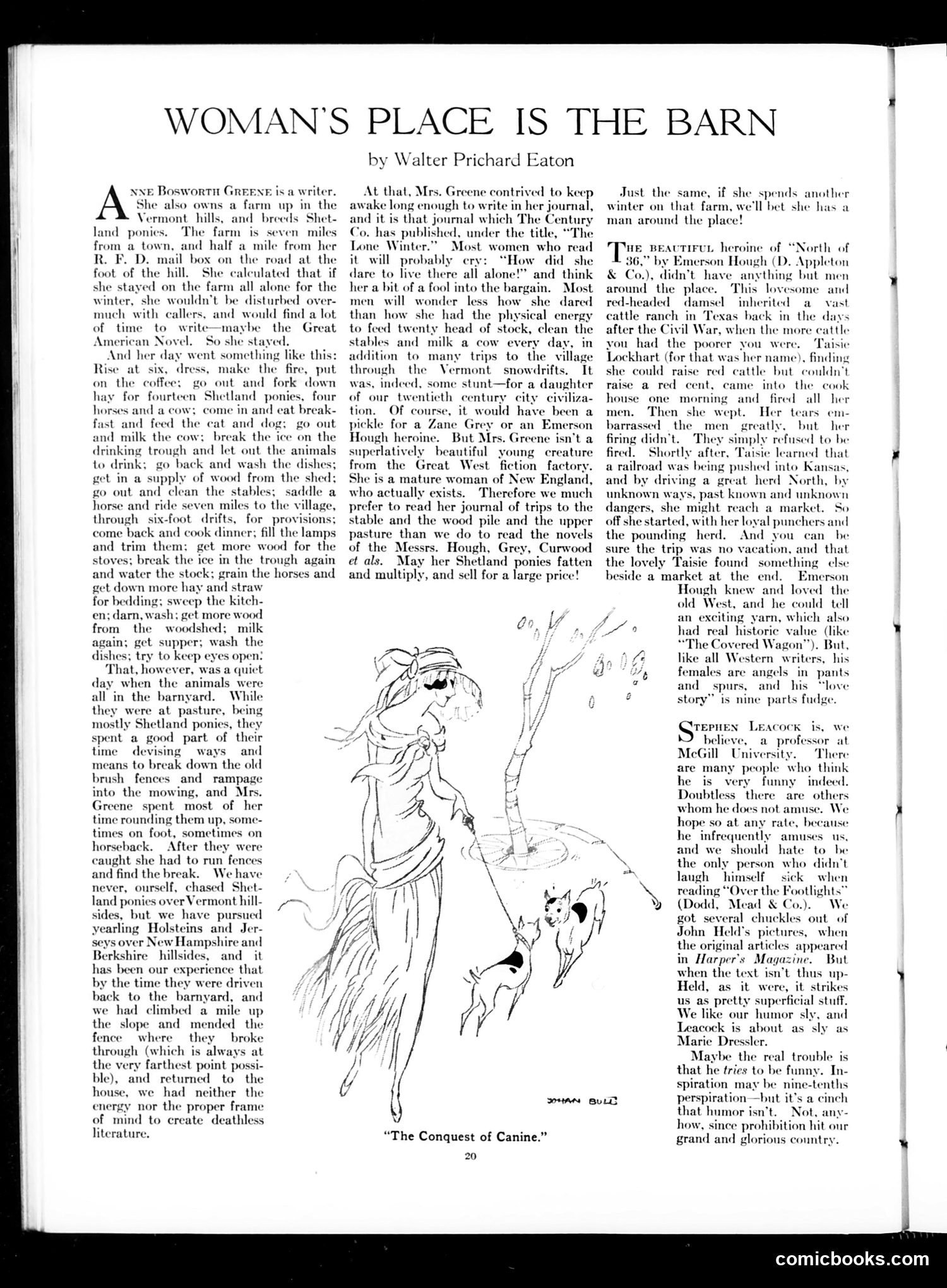
This article by Walter Prichard Eaton satirizes both frontier romanticism and the actual hardships of rural women's labor. **The Subject:** Anne Bosworth Greene, a real writer who owned a Vermont farm and published a journal titled "The Lone Winter" documenting her solitary winter managing livestock and household duties. **The Satire:** Eaton mocks two targets simultaneously: (1) popular Western fiction depicting idealized female pioneers (referencing Zane Grey and Emerson Hough), and (2) the impractical notion that a woman could sustainably manage such physical labor alone. His detailed catalog of her daily chores—rising at six, feeding fourteen ponies, breaking ice, riding seven miles through drifts—emphasizes the exhausting reality versus romantic fiction. **The Joke's Point:** The closing line ("we'll bet she has a man around the place!") undercuts any admiration, suggesting that despite Greene's demonstrated capability, women inevitably need male support for such work—a backhanded commentary on contemporary gender assumptions. The accompanying sketch titled "The Conquest of Canine" remains unclear without additional context.
📄 Transcribed text from this page (OCR, searchable)
Machine-transcribed from the original scan — historical spelling and the odd misread are preserved.
NNE Boswortu GreeNe is a writer. She also owns a farm up in the Vermont hills, and breeds Shet- land ponies. The farm is seven miles from a town, and half a mile from her R. F. D. mail box on the road at the foot of the hill. She calculated that if she stayed on the farm all alone for the winter, she wouldn't be disturbed over- much with callers, and would find a lot of time to write—maybe the Great American Novel. So she stayed. And her day went something like this: Rise at six, dress, make the fire, put on the coffee; go out and fork down hay for fourteen Shctland ponies, four horses and a cow; come in and eat break- fast and feed the cat and d go out and milk the cow; break the ice on the drinking trough and let out the animals to drink; go back and wash the dishes get in a supply of wood from the shed: go out and clean the stables; saddle a horse and ride seven miles to the village, through six-foot drifts, for provisions; come back and cook dinner; fill the lamps and trim them: get more wood for the stoves; break the ice in the trough again and water the stock; grain the horses and get down more hay and straw for bedding: sweep the kitch- en; darn, wash; get more wood from the woodshed; milk again; get supper; wash the . try to keep t, however, v day when the animals were all in the barnyard. While at pasture, being Shetland ponies, they spent a good part of their time devising ways and means to break down the old brush fences and rampage into the mowing, and Mrs. Greene spent most of her time rounding them up, some- times on foot, sometimes on horseback. After they were caught she had to run fences and find the break. We have never, ourself, chased Shet- land ponies over Vermont hill- sides, but we have pursued yearling Holsteins and Jer- seys over New Hampshire and Berkshire hillsides, and_ it has been our experience that by the time they were driven ack to the barnyard, and we had climbed a mile up the slope and mended the fence where they — broke through (which is always at the very farthest point possi- ble), and returned to the house, we had neither the energy nor the proper frame of mind to create deathless literature. WOMAN'S PLACE IS THE BARN by Walter Prichard Eaton At that, Mrs. Greene contrived to keep awake long enough to write in her journal, and it is that journal which The Century Co. has published, under the title, “The Lone Winter.” Most women who read it will probably ery: “How did— she dare to live there all alone!” and think her a bit of a fool into the bargain. Most men will wonder less how she dared than how she had the physical energy to feed twenty head of stock, clean the stables and milk a cow every day, in addition to many trips to the village through the Vermont snowdrifts. It was, indeed, some stunt—for a daughter of our twentieth century city civiliza- tion. Of course, it would have been a pickle for a Zane Grey or an Emerson Hough heroine. But Mrs. Greene isn’t a superlatively beautiful, young creature from the Great West fiction factory. She is a mature woman of New England, who actually exists. Therefore we much prefer to read her journal of trips to the stable and the wood pile and the upper pasture than we do to read the novels of the Messrs. Hough, Grey, Curwood et als. May her Shetland ponies fatten and multiply, and sell for a large price! “The Conquest of Canine.” 20 SHAN BULLE Just the same, if she spends another winter on that farm, we'll bet she has a man around the place! T E BEAUTIFUL heroine of “North of ” by Emerson Hough (D. Appleton & Co.), didn’t have anything but men around the place. This lovesome and red-headed damsel inherited a vast cattle ranch in Texas back in the days after the Civil War, when the more cattle you had the poorer you were, sie Lockhart (for that was her name), finding she could raise red cattle but’ couldn't raise a red cent, came into the house one morning and_ fired all 7 men. Then she wept. Her tears em- barrassed the men greatly, but her firing didn’t. They simply refused to be fired. Shortly sr, Taisie learned that a railroad was being pushed into Kansas, and by driving a great herd North, by unknown ways, past known and unknown dangers, she might reach a market. So off she started, with her loyal punchers and the pounding herd. And you can sure the trip was no vacation, and that the lovely Taisie found something else beside a market at the end. Emerson Hough knew and loved the old West, and he could tell an exciting yarn, which also had real historic 1e (like “The Covered Wa ). But, like all Western writers, his females are angels in pants and spurs, and his “love a story” is nine parts fudge. Leacock is, we Sm belic a_ professor at I McGill University. ‘There are many people who think he is very funny indeed. Doubtless ‘there are others whom he does not amuse. We hope so at any rate, because he infrequently amuses us, and we should hate to be . the only person who didn’t “ laugh himself sick _ when Ss reading “Over the Footlights” Y (Dodd, Mead & Co.). We got several chuckles out. of John Held’s pictures, when the original articles appeared in Harper's Mage But when the text isn’t thus up- Held, as it were, it strikes us as pretty superficial stuff. We like our humor sly, and Leacock is about as ‘sly as Marie Dressler. Maybe the real trouble is that he fries to be funny. spiration may be nine-t perspiration—but it’s that humor isn’t. ne. cinch Not, any- how, since prohibition hit our grand and glorious country. comicbooks.com