
A complete issue · 36 pages · 1923
Judge — June 9, 1923
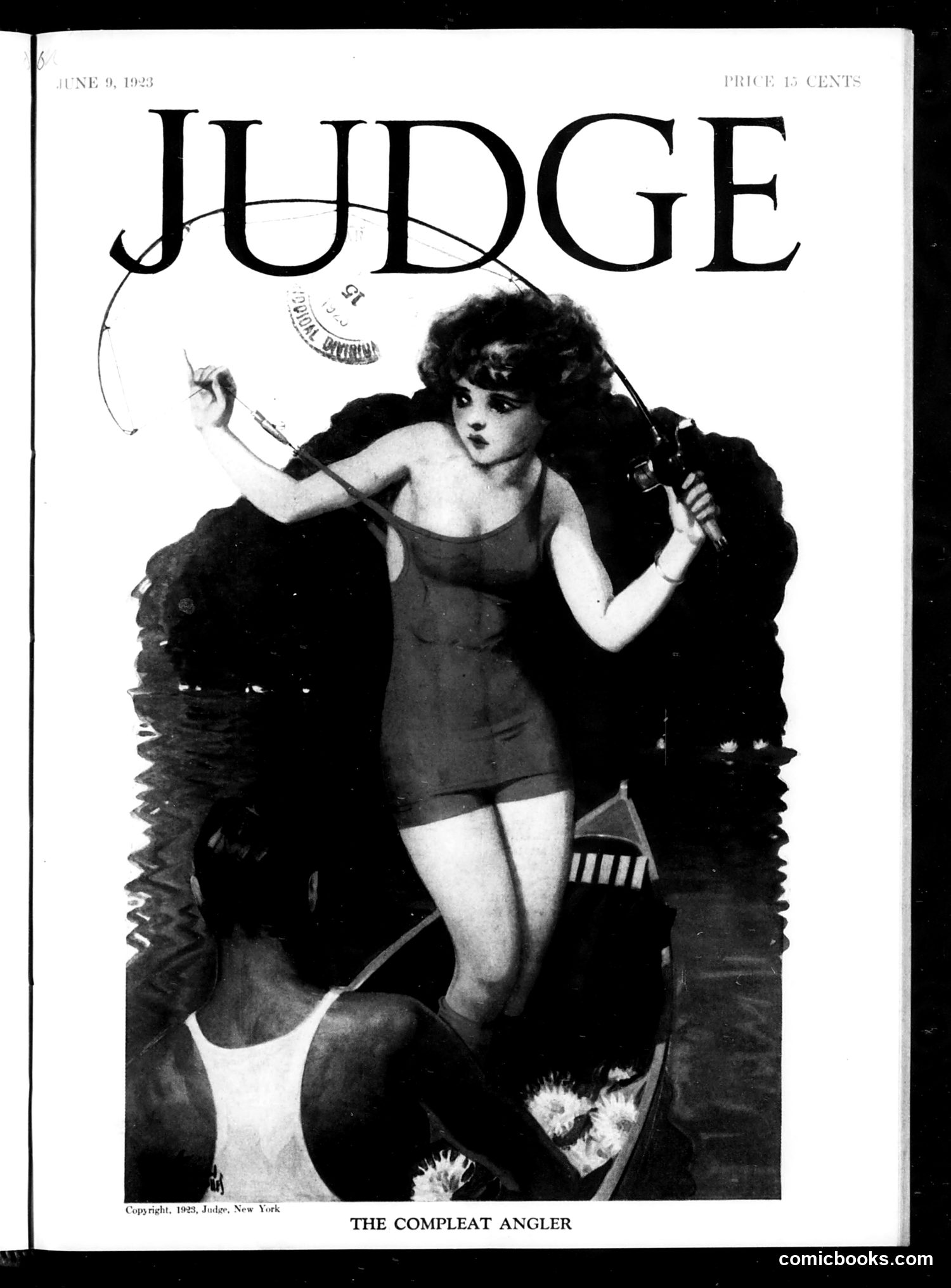
This cover illustrates the phrase "compleat angler" (a play on Izaak Walton's famous 1653 fishing manual). The image shows a woman in 1920s attire—short hair, swimsuit, and jacket—fishing with a rod and reel. She's positioned amid what appears to be a male figure being "caught" like a fish, suggesting she's engaged in romantic or matrimonial "fishing." The satire addresses changing gender dynamics of the Jazz Age. Women had recently gained voting rights (1920) and were adopting more independent, assertive roles. The joke implies women are now the active pursuers in courtship rather than passive targets—they've become the "anglers" catching men. The title's literary reference adds intellectual humor to this commentary on modern dating and women's newfound social freedom.
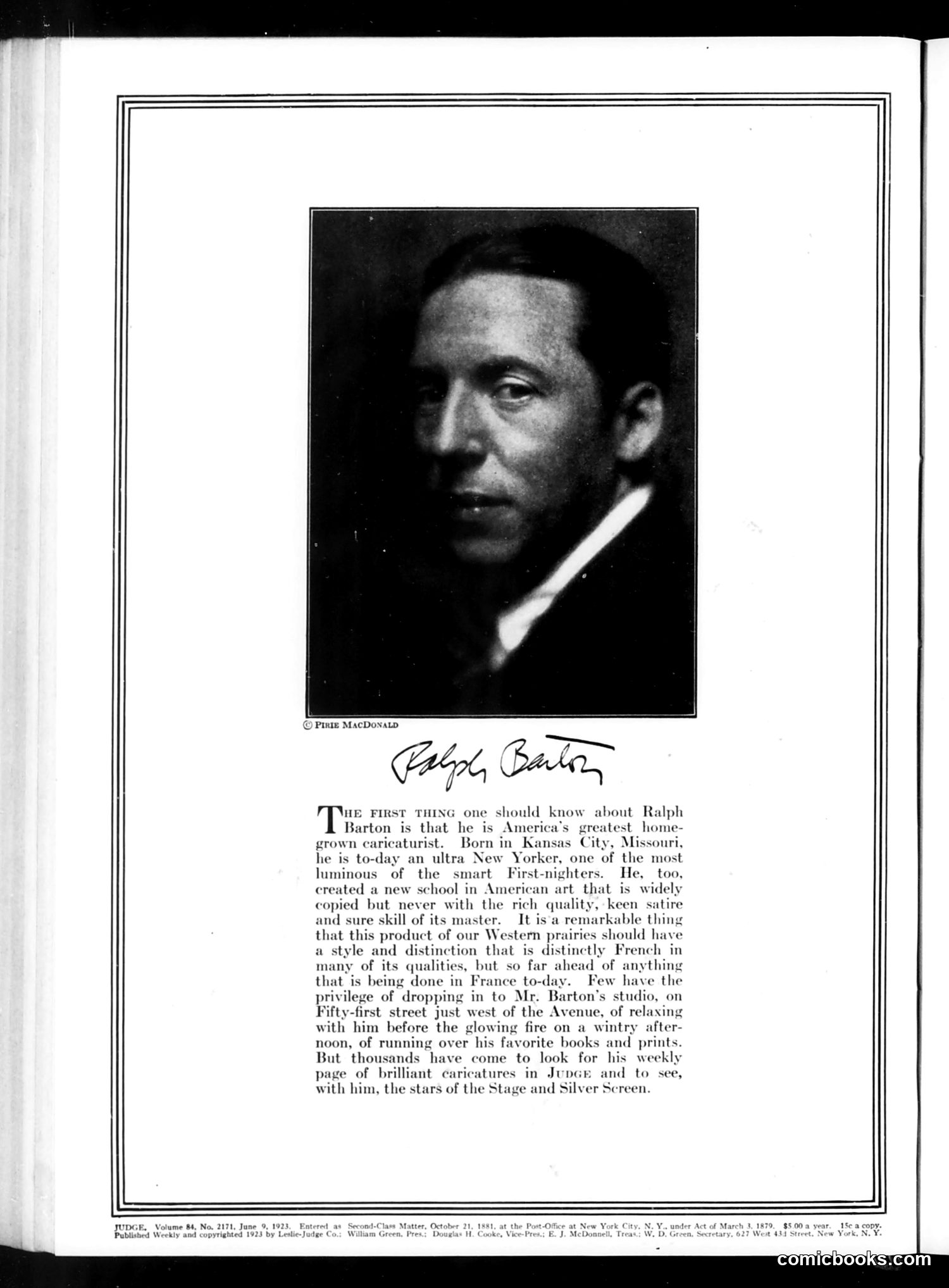
This is a biographical profile of Ralph Barton, identified as "America's greatest home-grown caricaturist." The text emphasizes his significance as a satirical artist who created a distinctly American style of social commentary art, influenced by but superior to French caricature traditions. Key points: Barton was born in Kansas City, Missouri, and became a prominent New York-based artist known for weekly satirical illustrations in *Judge* magazine and depictions of theatrical and film celebrities. The profile celebrates his studio on 51st Street as a gathering place for cultural figures and notes his popularity for creating "brilliant caricatures" of stage and screen stars. This appears to be a professional tribute to Barton's career and artistic influence during the early 1920s.
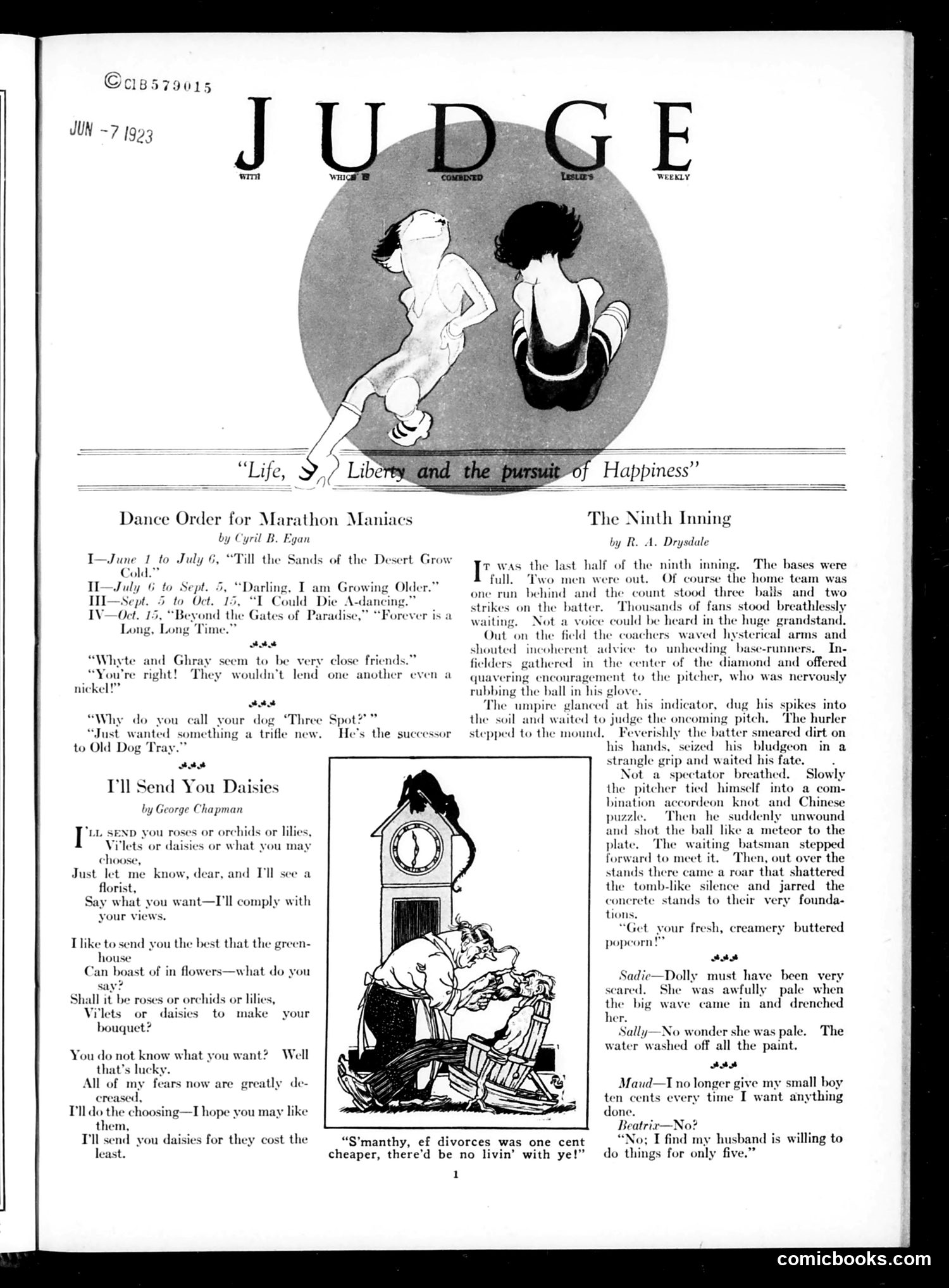
This page features humor and satirical commentary typical of 1920s Judge magazine. **The main cartoon** depicts a couple in a passionate embrace with the caption "Smarthy, ef divorces was one cent cheaper, there'd be no livin' with ye!" The joke satirizes the ease and frequency of divorce in the 1920s, suggesting that cheaply available divorces made relationships disposable and made spouses insufferably confident they could leave. **The other content** includes light humor pieces like "Dance Order for Marathon Maniacs" (referencing the 1920s dance craze) and "I'll Send You Daisies" (a humorous poem about flower delivery). **"The Ninth Inning"** is a baseball story by R.A. Dryedale. The page overall reflects post-WWI American social attitudes about marriage, consumerism, and popular entertainment during the Jazz Age.
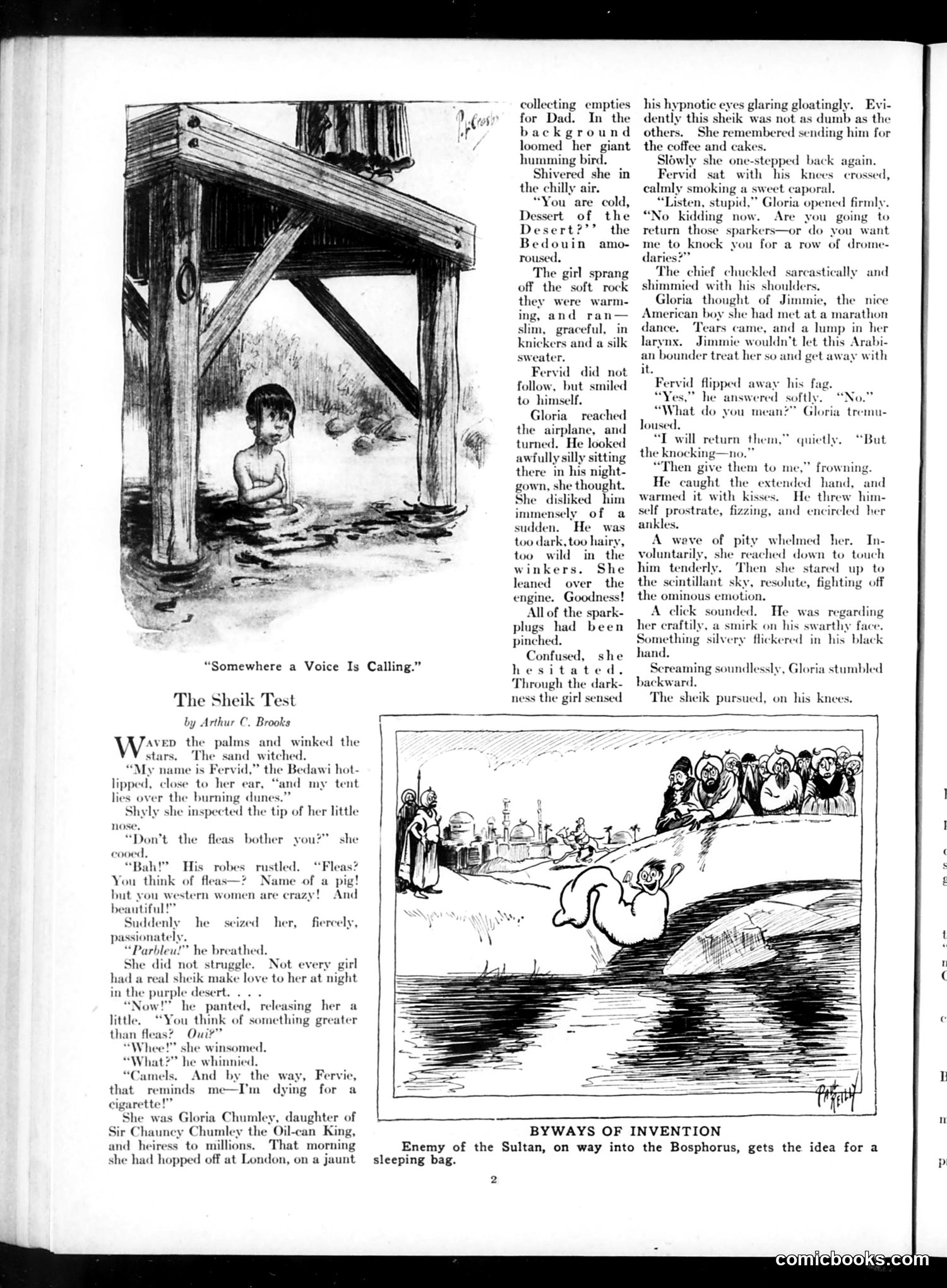
This page contains **"The Sheik Test,"** a short story by Arthur C. Brooks about a romantic encounter in the desert, illustrated with period sketches. The lower cartoon, titled **"Byways of Invention,"** depicts a figure labeled "Enemy of the Sultan, on way into the Bosphorus" getting the idea for a sleeping bag from observing what appears to be a camel or large animal in water near a city (likely Constantinople/Istanbul). The joke appears to reference **contemporary fascination with "sheik" culture**—likely the 1921 Rudolph Valentino film craze—while the invention cartoon satirizes how practical ideas can emerge from unexpected observations, using the Ottoman Empire setting as exotic backdrop typical of 1920s popular entertainment.
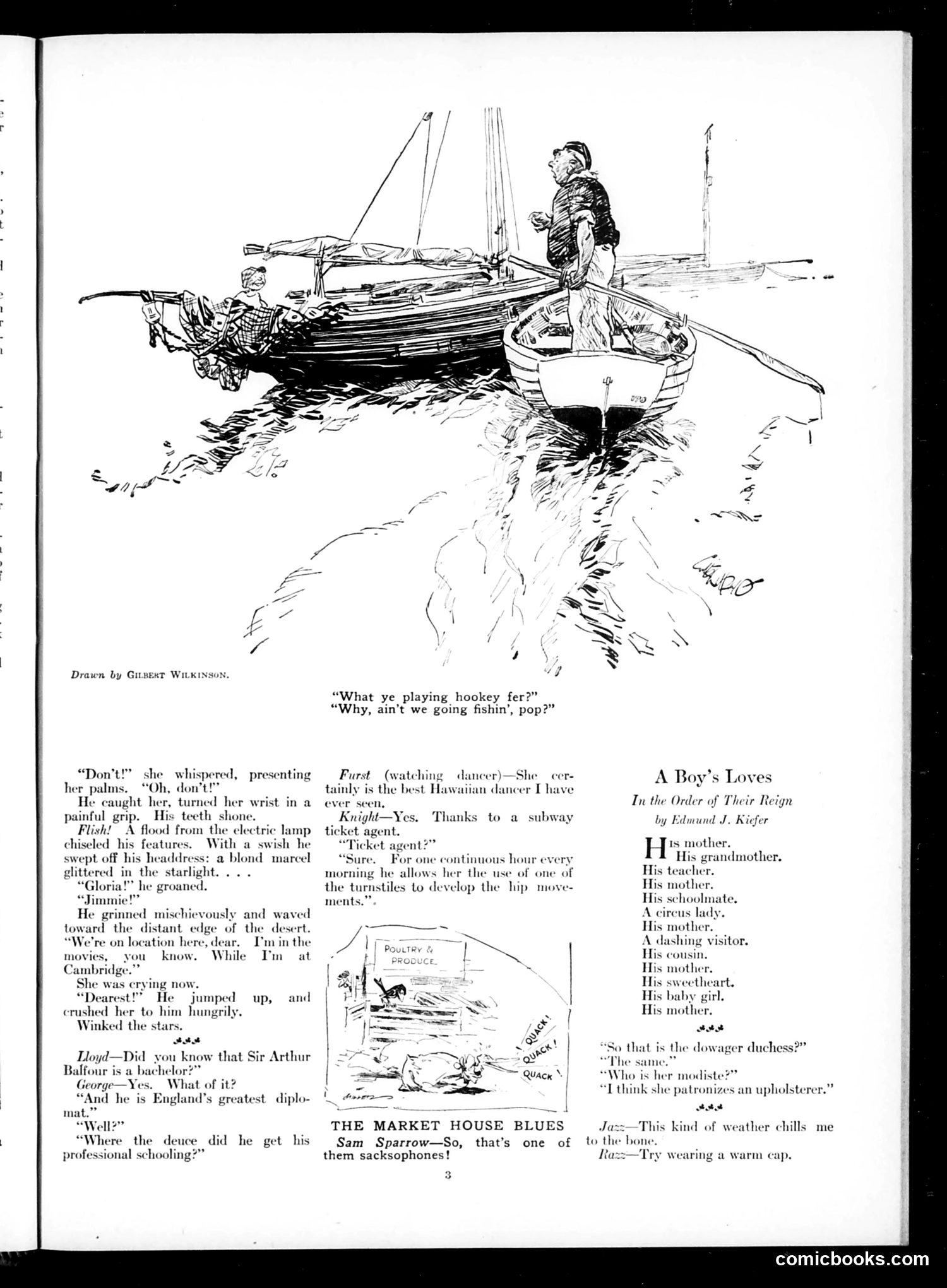
The top illustration by Gilbert Wilkinson depicts two men at a beach with beached boats, discussing whether to play hockey or go fishing. This appears to be a simple leisure-time humor piece rather than political satire. The right column contains "A Boy's Loves: In the Order of Their Reign" by Edmund J. Kiefer—a humorous list ranking the various females in a boy's life (mother, grandmother, teacher, sweetheart, etc.), presented as a mock-serious hierarchy. This is domestic comedy about shifting childhood affections. The bottom section includes brief comedic dialogues about Sir Arthur Balfour (a British political figure) and "The Market House Blues" about someone named Sam Sparrow complaining about high produce prices—likely Depression-era economic satire on inflation or food costs.
This satirical essay mocks the early psychoanalytic movement's tendency to attribute all human behavior—particularly moral failings—to sexual repression. Roche presents absurd scenarios: a baby's preference for blondes becomes a Freudian case study; a father's neglect is excused by psychoanalytic theory; a child's desire to commit arson is supposedly a harmless psychological expression. The satire's central argument: psychoanalysis provides convenient pseudo-scientific excuses for bad behavior, replacing personal responsibility with therapeutic jargon. By suggesting that dangerous acts like arson become acceptable under psychoanalytic interpretation, Roche critiques how the new "science" could rationalize away genuine moral accountability—a common anxiety about Freudian psychology in 1920s popular culture.
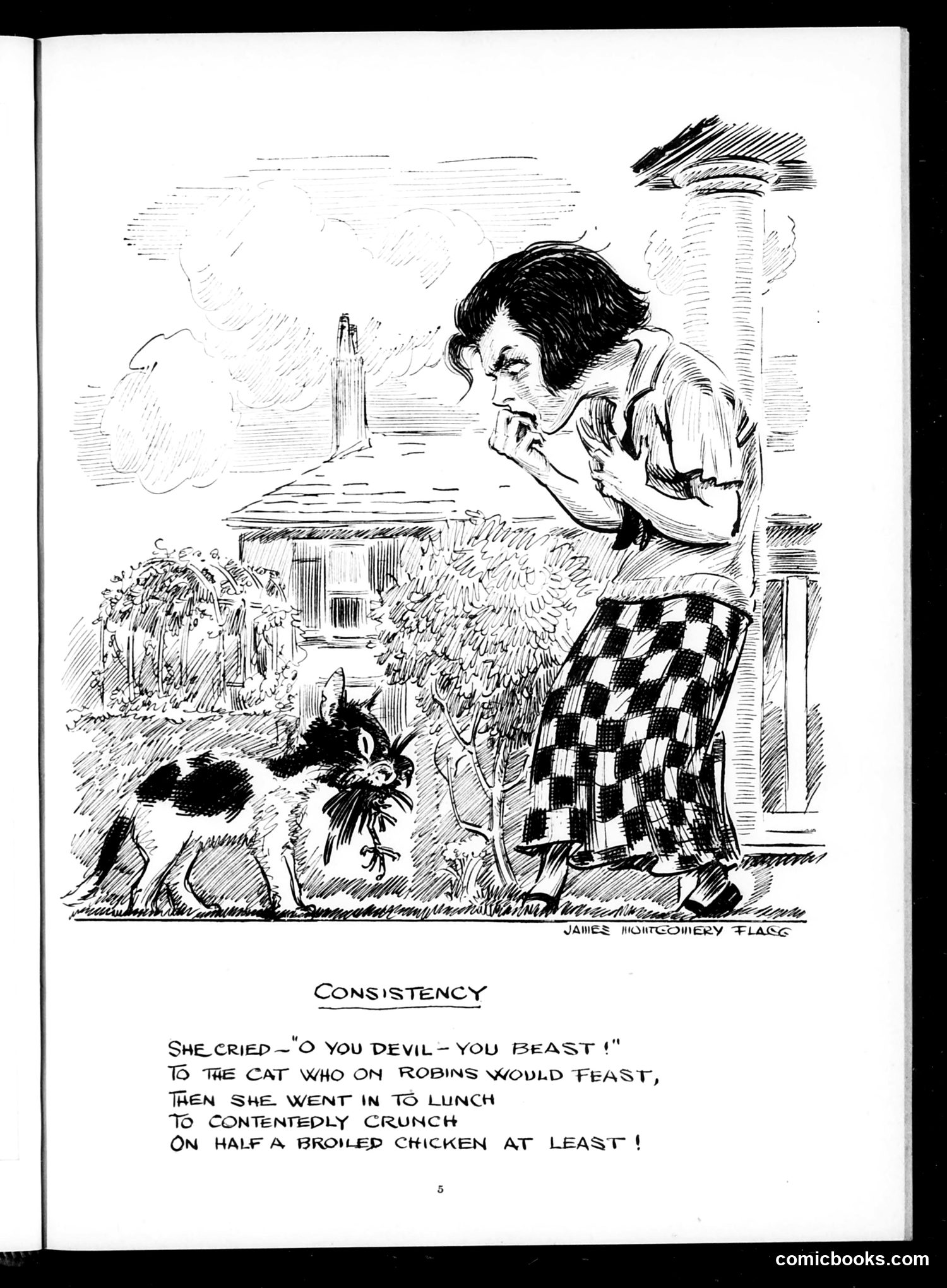
This is a satirical cartoon titled "Consistency" by James Montgomery Flagg. It mocks hypocrisy through a woman who scolds her cat for hunting robins, calling it a "devil" and "beast"—then immediately goes inside to eat broiled chicken for lunch. The joke exposes the contradiction in her moral outrage: she condemns the cat's predatory behavior while engaging in the same act herself (consuming meat). The limerick format emphasizes the absurdity of this inconsistency. This type of satire was common in early 20th-century Judge magazine, targeting social hypocrisy and double standards. The cartoon likely appealed to readers aware of emerging vegetarian or animal-welfare arguments of the era, though its primary humor comes from pointing out everyday human contradictions rather than making a specific political statement.
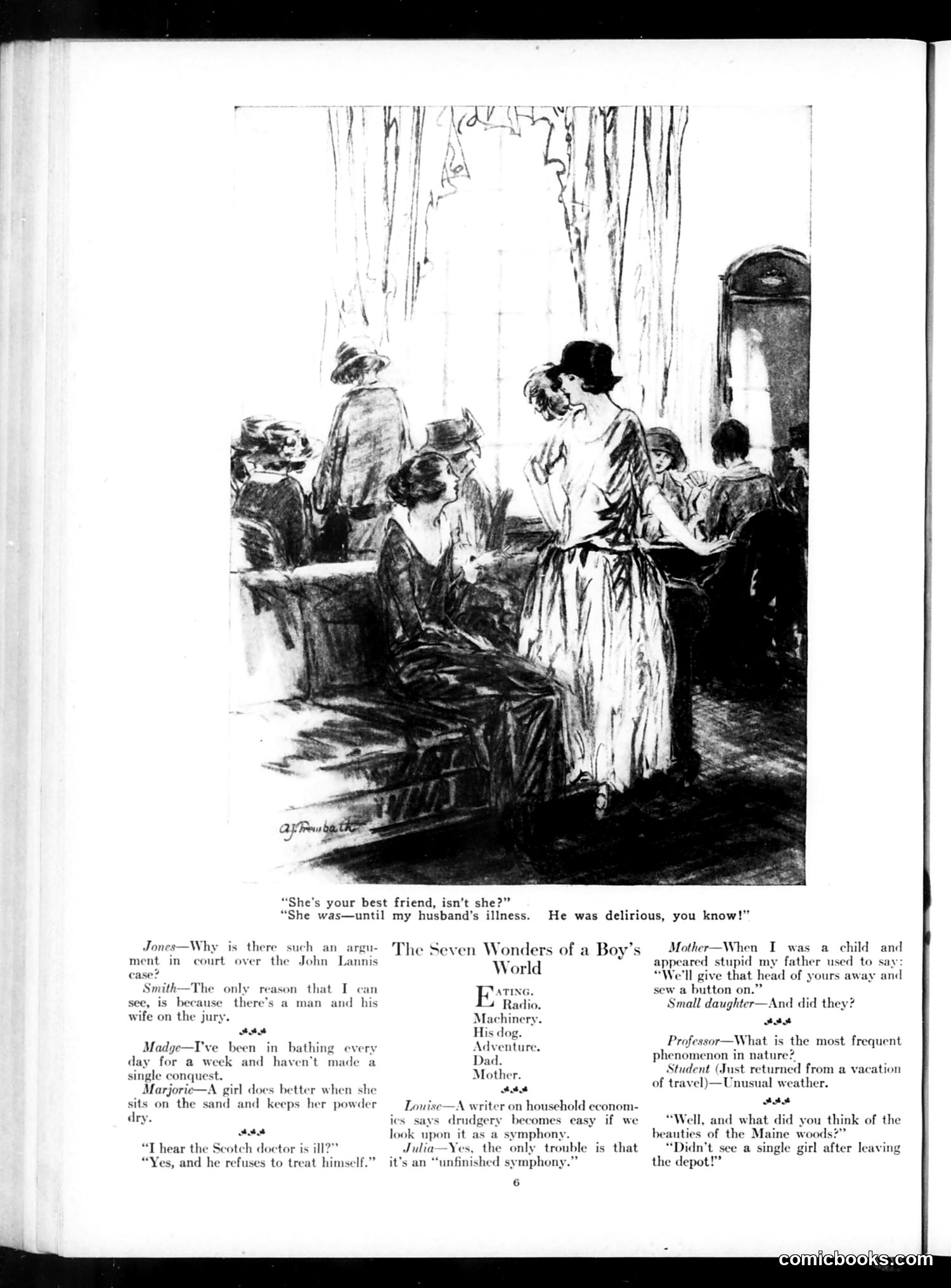
This page contains multiple short humor pieces typical of early 20th-century satirical magazines, rather than a single cartoon. The jokes target domestic life and social conventions: a wife's fairweather friendship that evaporates during her husband's illness; marital discord on juries; women's dating rituals; and a Scottish doctor's supposed penny-pinching (refusing to pay for his own treatment—a stereotypical ethnic jab). "The Seven Wonders of a Boy's World" humorously lists what boys find important: modern technology (radio, machinery), pets, adventure, and parents—with "Mother" listed last, perhaps mocking maternal pride. Other jokes mock household drudgery, unusual weather, and men's complete indifference to natural scenery when women aren't present. The opening sketch depicts a social gathering where gossip about marital trouble circulates. The satire is gentle, targeting human nature's pettiness and gender stereotypes rather than politics.
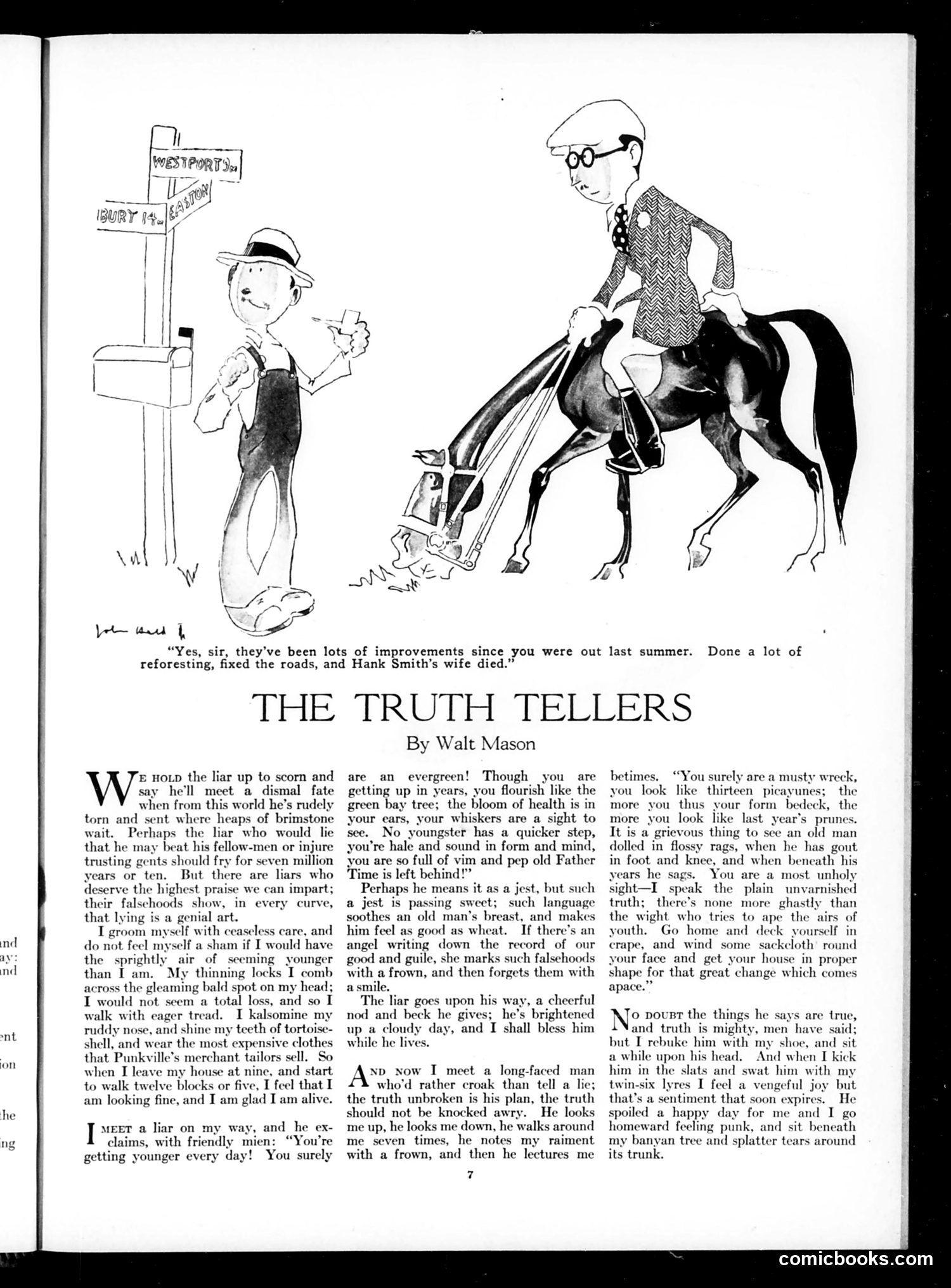
This page presents a poem satirizing different types of liars and truth-tellers. The cartoon at top illustrates the opening scenario: a man on horseback greets a pedestrian with exaggerated compliments about his youthful appearance and vigor, claiming local improvements (reforesting, road repairs) while casually mentioning someone's death. Mason's poem contrasts two figures: the *pleasant liar* who flatters the aging narrator, making him feel good despite obvious physical decline, and the *brutal truth-teller* who harshly catalogs the man's deterioration (calling him a "musty wreck," comparing him unfavorably to "last year's prunes"). The satire's point: while both are dishonest, the cheerful liar provides genuine comfort and brightens spirits, whereas the harsh truth-teller, despite claiming moral superiority, accomplishes only cruelty. The narrator actually beats this sanctimonious truth-teller in response. The piece mocks sanctimoniousness and celebrates white lies as socially generous, contrasting with punishing honesty delivered without kindness.
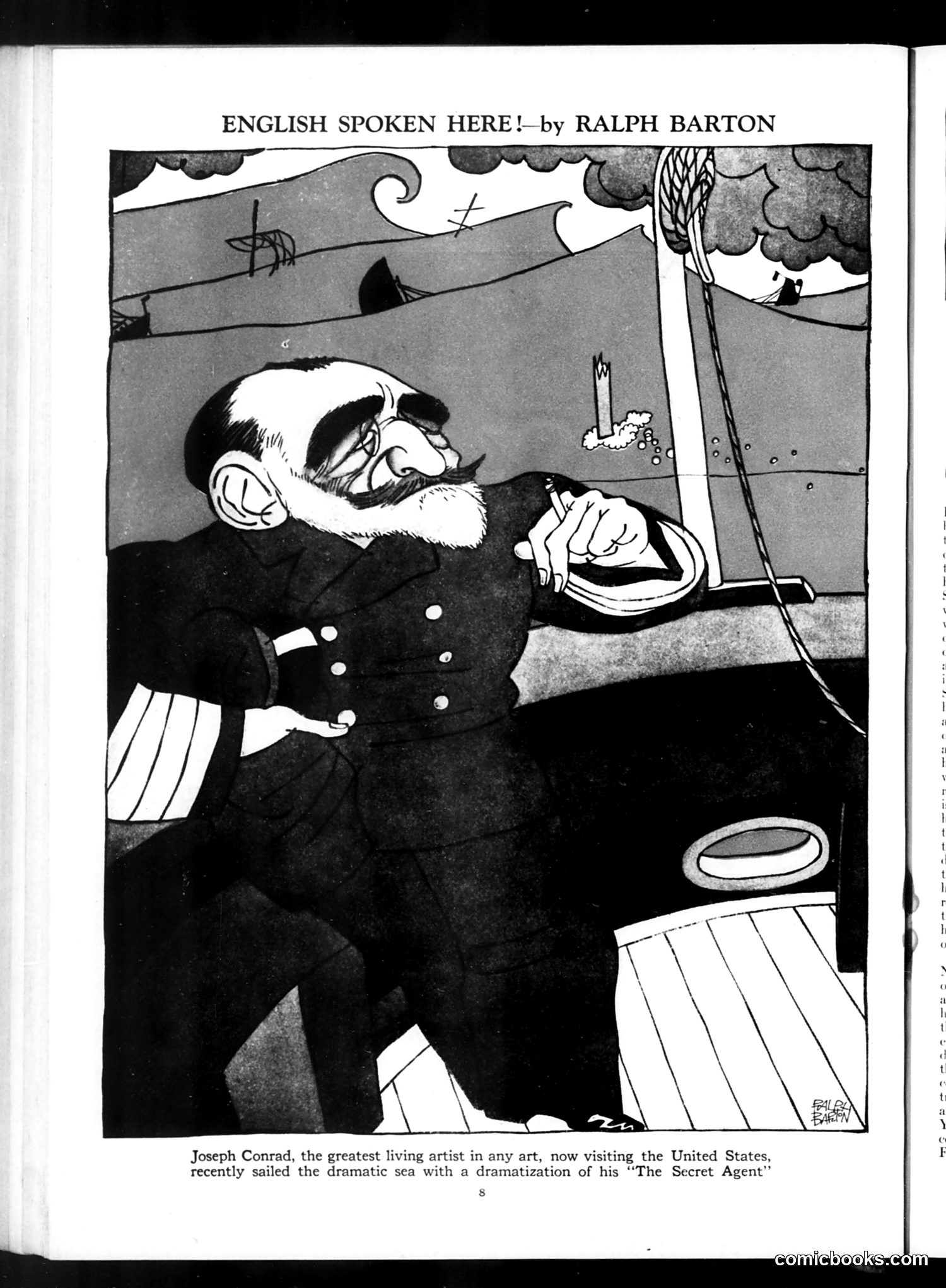
This cartoon satirizes **Joseph Conrad**, the famous Polish-born novelist who was visiting America. The caricature exaggerates Conrad's facial features—particularly his prominent nose and beard—in a style typical of early 20th-century satirical art. The joke hinges on Conrad's **thick accent and difficulty with English**, despite being celebrated as a great artist. The title "English Spoken Here!" is ironic: the cartoon suggests that even in America, one might struggle to understand Conrad's speech. The naval setting references his recent dramatization of his novel "The Secret Agent." The satire gently mocks the contrast between Conrad's literary genius and his accessibility to English-speaking audiences.
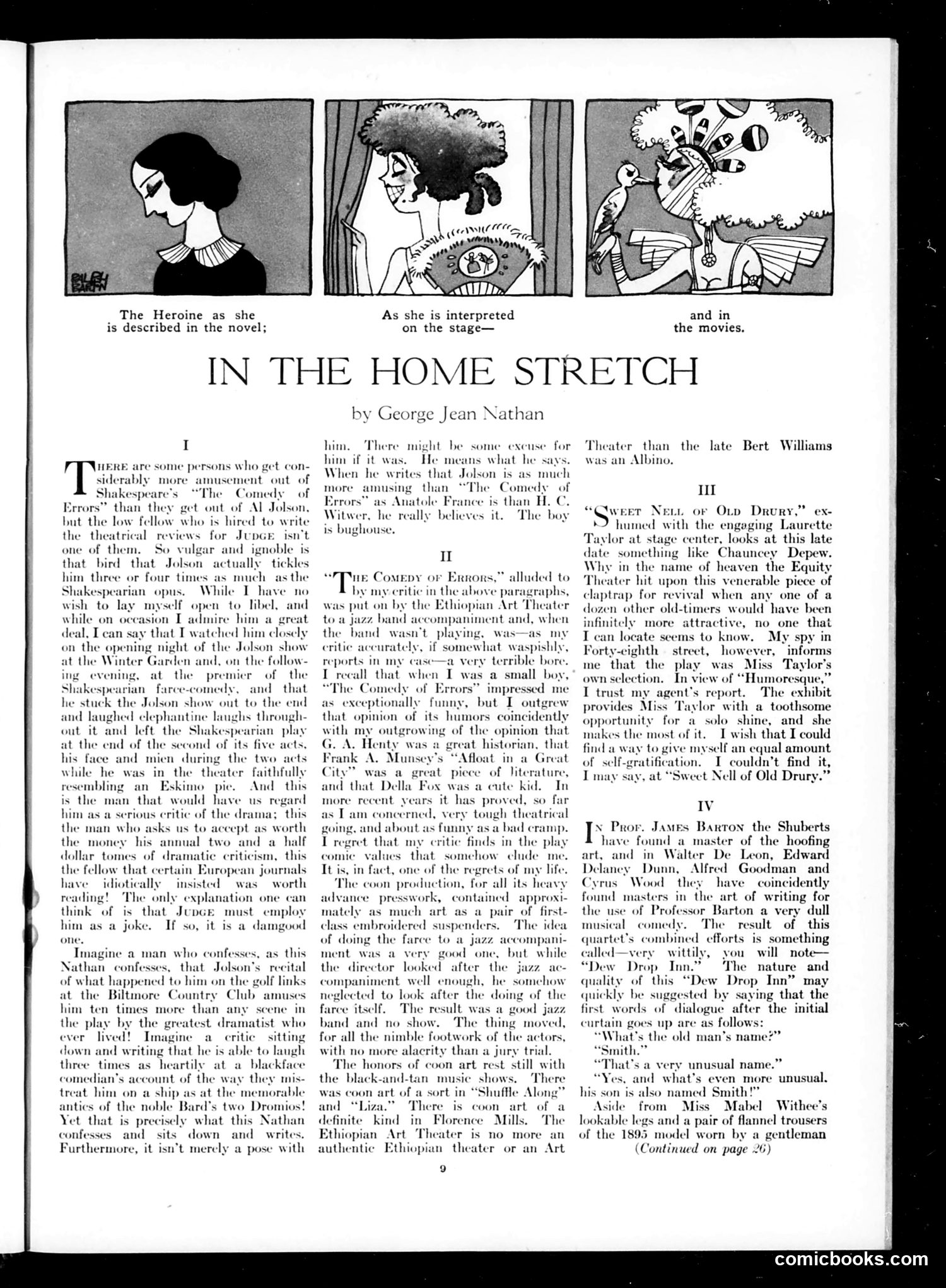
This article by George Jean Nathan is a theatrical critique disguised as self-mockery. Nathan admits he finds Al Jolson's vaudeville performances far more entertaining than Shakespeare's "Comedy of Errors"—a confession meant to satirize his own questionable critical judgment. The three panels at top show a literary heroine's character degradation: from novel description (elegant, understated) through stage interpretation (exaggerated) to film adaptation (absurdly overwrought). This visualizes Nathan's larger point about how entertainment media distort and sensationalize source material. Nathan's humor relies on his candid admission that a blackface comedian's golf-club anecdote amuses him more than Shakespeare—presenting this as ridiculous evidence that either he lacks taste or his profession is a joke. He also critiques the "Ethiopian Art Theater's" all-jazz production of "Comedy of Errors" as technically competent but artistically hollow, with good musicianship masking poor theatrical direction. The satire targets both lowbrow entertainment preferences and the theatrical establishment's pretensions.
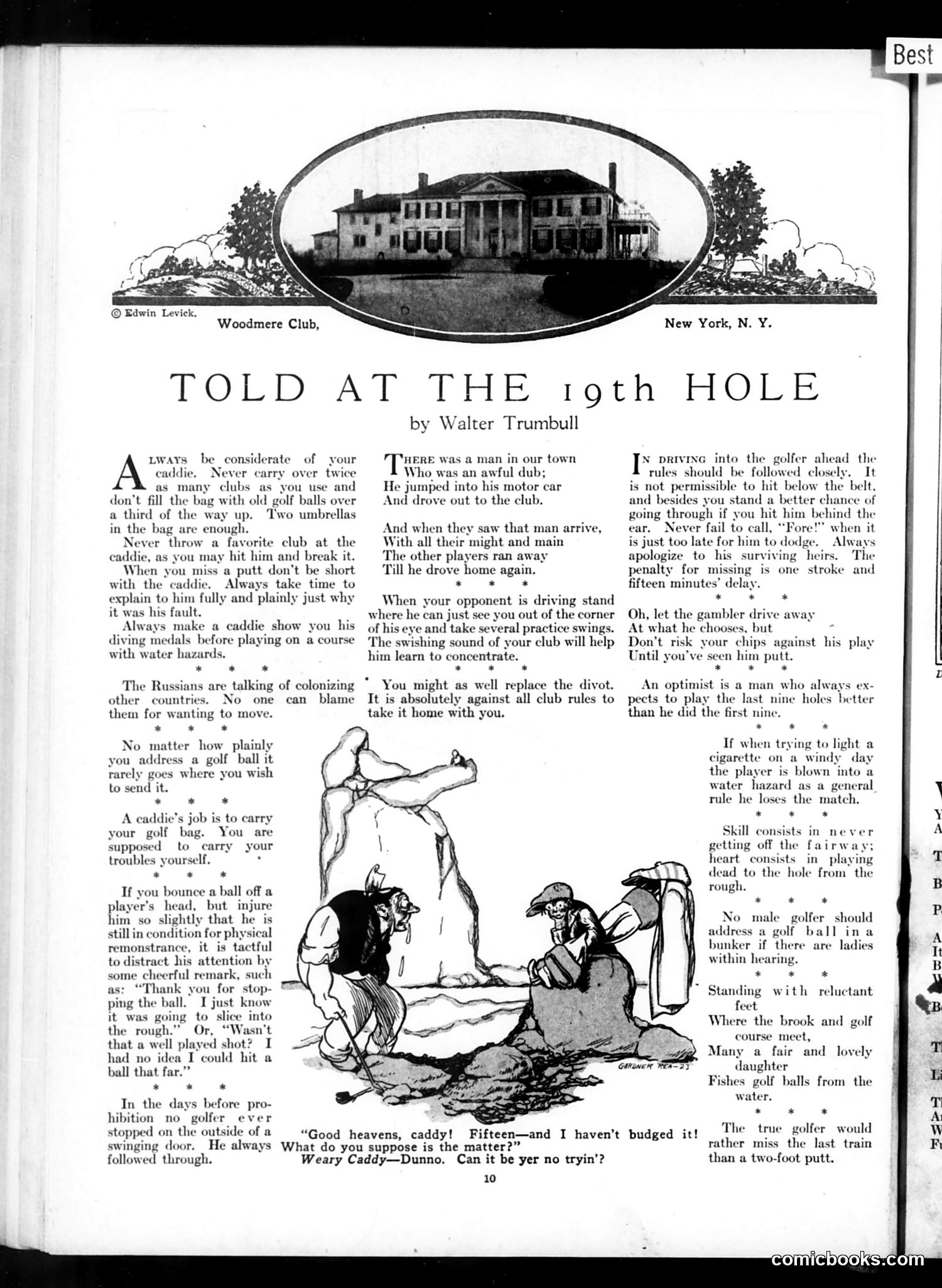
This page from *Judge* magazine presents golfing humor and etiquette advice, centered on the Woodmere Club in New York. The main article consists of witty observations about golf behavior and club rules, presented as aphorisms and short anecdotes. The cartoon shows a caddie and golfer at a water hazard, with the weary caddie responding to complaints about a poor shot. The humor hinges on the caddie's implied suggestion that the golfer himself—not the caddie—is responsible for the failure. The accompanying text satirizes golfer behavior: poor sportsmanship toward caddies, dangerous play (hitting balls at other players), cheating (removing divots), and various etiquette violations. The piece gently mocks both amateur golfers' incompetence and their self-deluding excuses. References to "prohibition" and pre-prohibition golf culture date this to the 1920s-30s era. The humor assumes a genteel, country-club audience familiar with golf's formal conventions.
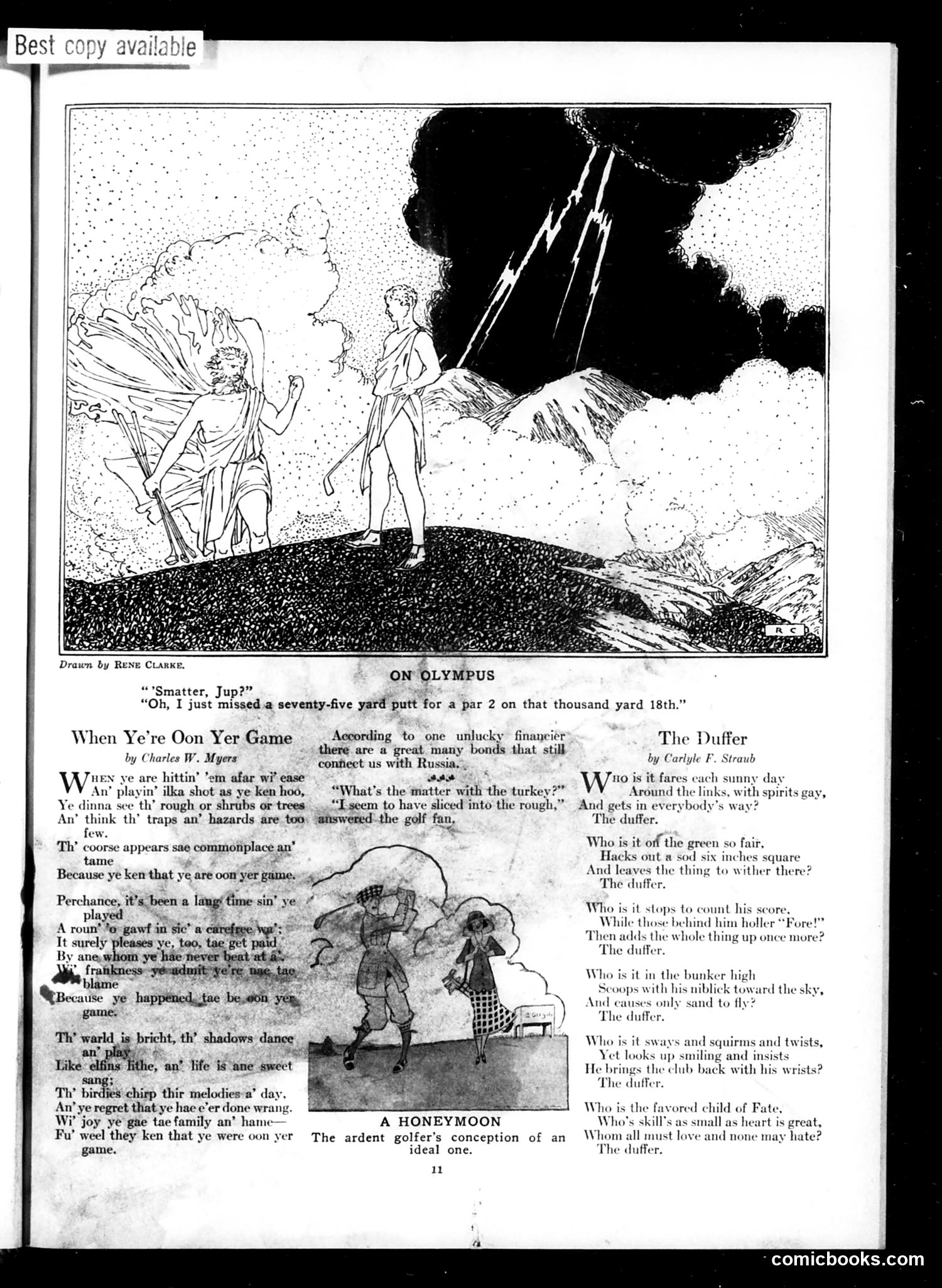
This page from *Judge* magazine focuses on golf humor across three pieces: **"On Olympus" (top cartoon):** Jupiter complains to another classical deity about missing a golf putt. The joke plays on the incongruity of immortal gods obsessing over modern golf—treating the trivial sport with mock-dramatic seriousness. **"When Ye're Oon Yer Game" (left, Scottish dialect poem):** A sentimental piece about the joy of playing golf well—when everything clicks, life feels perfect and one goes home happy. **"A Honeymoon" (center caption):** A golf-themed illustration suggesting a golfer's ideal honeymoon involves golfing rather than romantic activities. **"The Duffer" (right, verse):** A lighthearted catalog of the incompetent golfer's characteristic flaws—poor technique, slow play, self-deception about ability—yet notes paradoxically that the duffer remains lovable. The page collectively satirizes golf culture's grip on early 20th-century American society, poking fun at both obsessive players and amusingly hapless ones.
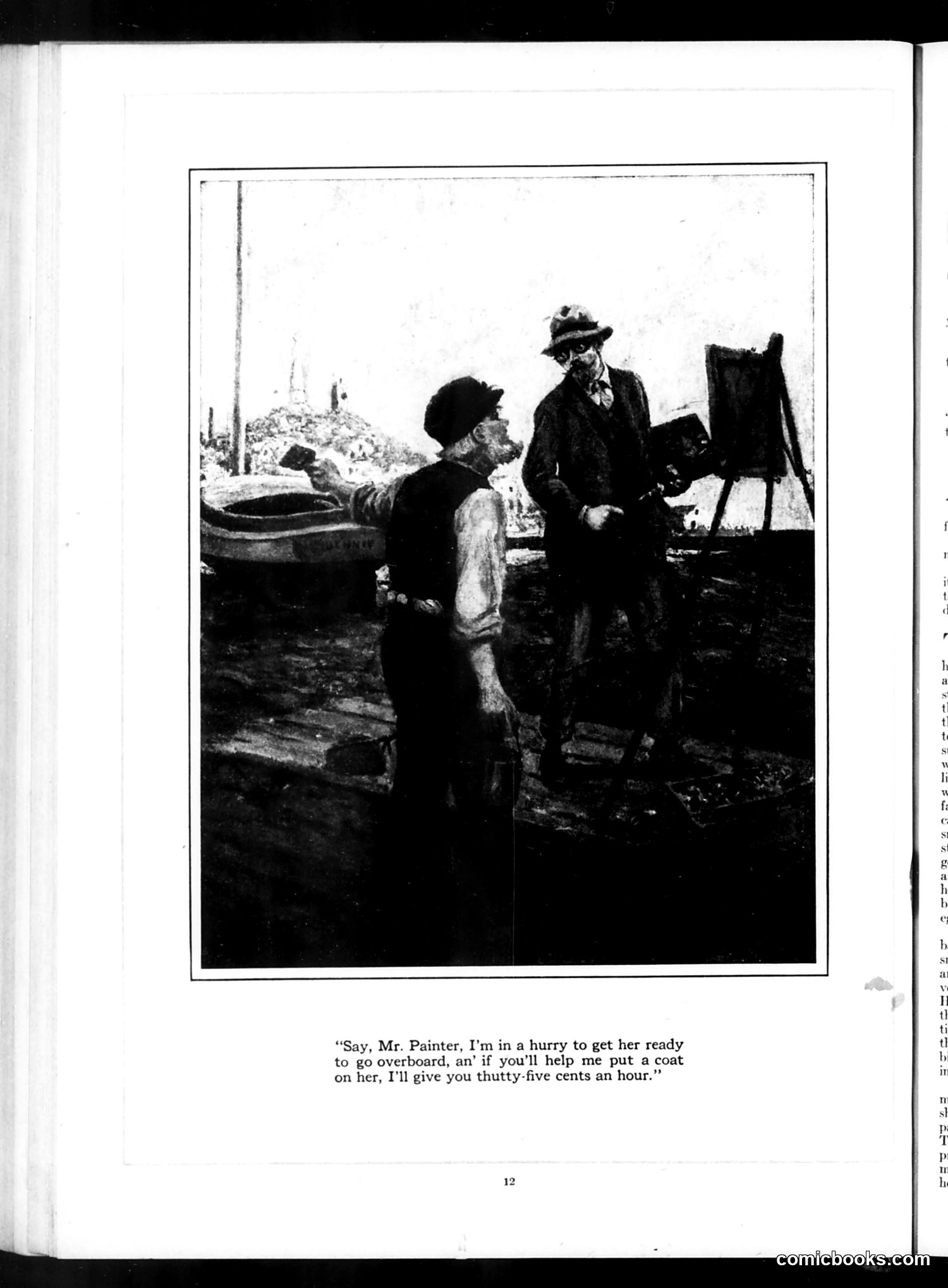
This appears to be a nautical scene depicting two working-class men (identifiable by their period clothing and dialect in the caption) discussing preparation of a ship. The man on the left, likely a shipyard worker, is asking a painter for help applying a coat (of paint) to "her"—the ship—in exchange for wages of thirty-five cents per hour. The humor and social satire likely rest on: the casual, transactional nature of labor; the extremely low wage being offered; and possibly the dehumanizing reference to the ship as "her" requiring urgent cosmetic preparation before being sent "overboard" (launched or scrapped). The crude dialect and working-class characters suggest Judge magazine's satirical commentary on labor conditions or industrial practices of the era, though the specific historical context remains unclear without additional publication details.
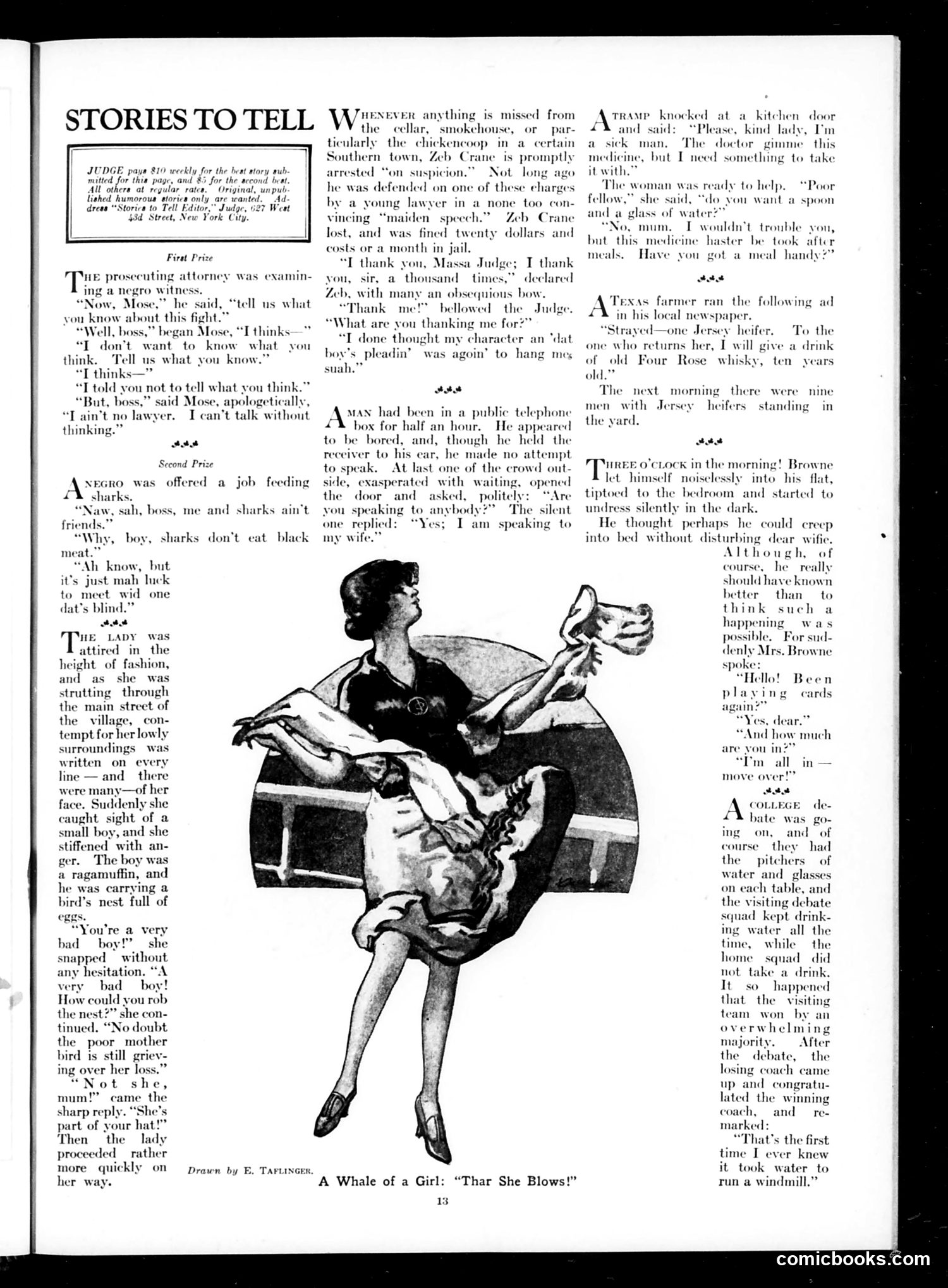
This page contains three separately-framed humorous stories competing for prize money, plus an illustration titled "A Whale of a Girl: 'Thar She Blows!'" The stories employ racial stereotypes common to early-20th-century American humor: 1. **First Prize**: A Black witness cannot testify without "thinking," creating circular logic that mocks both the character and the legal system's treatment of Black people. 2. **Second Prize**: A Black man refuses a dangerous job feeding sharks, citing bad luck about meeting a blind shark—absurdist humor playing on stereotypes. 3. Other stories ridicule class pretension (a fashionable woman discovers bird feathers in her hat come from a nest the boy robbed), marital dynamics, and rural dialect humor. The **central illustration** depicts a woman in fashionable dress holding playing cards—the caption "That She Blows!" is a *Moby Dick* reference suggesting the woman is enormous or inflated. It's a body-shaming joke about women's fashion. The page reflects Judge's satirical approach: mocking racial groups, women, rural people, and working-class figures—representative of mainstream turn-of-century American humor that's now recognized as deeply offensive.
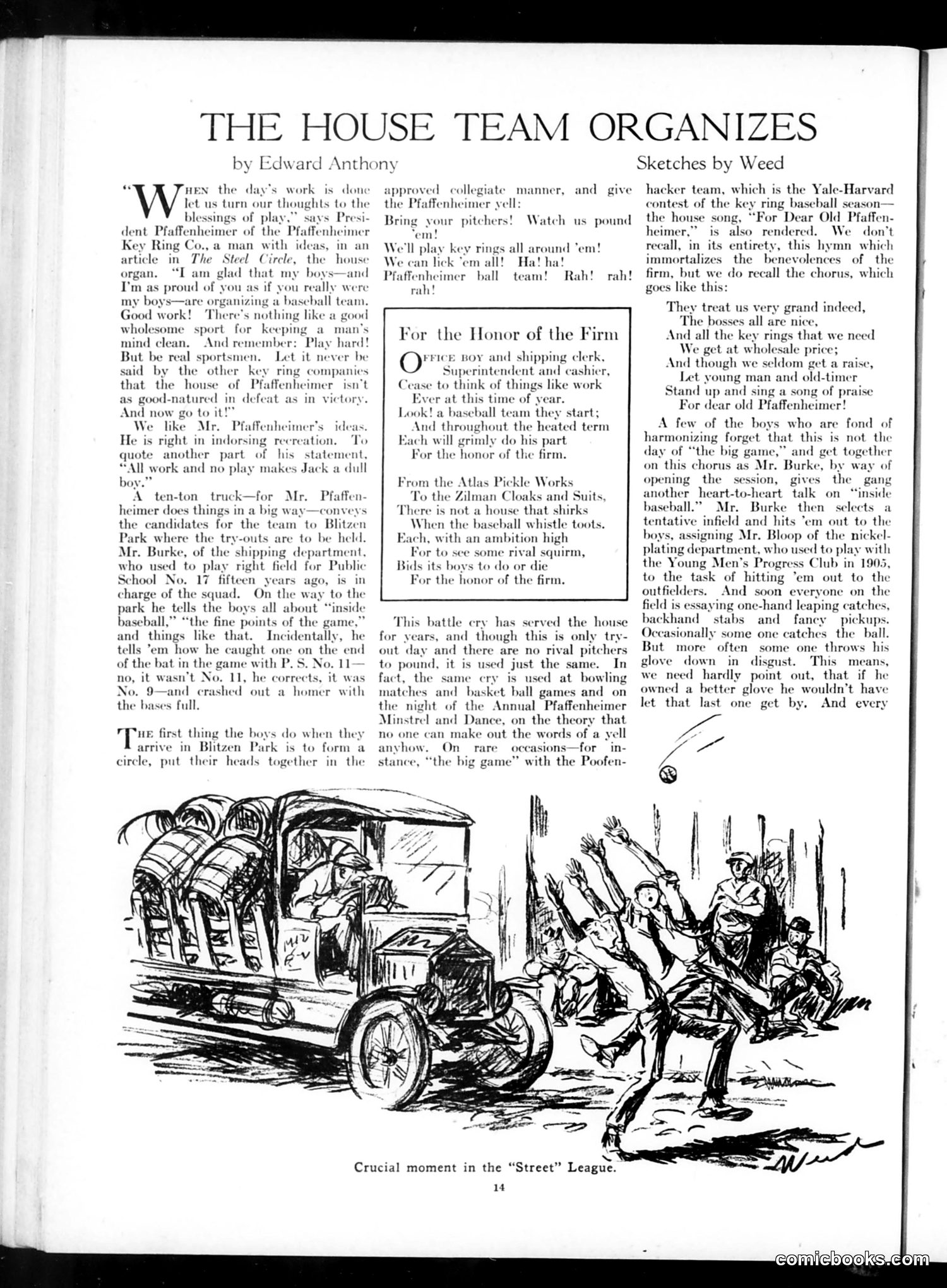
This satirical piece mocks corporate paternalism and team-building exercises in early 20th-century business culture. The humor centers on **President Pfaffenheimer** of a key ring manufacturing company organizing a baseball team ostensibly to build character and morale among employees. The satire targets the gap between management rhetoric ("Play hard!" "good wholesome sport") and workplace reality—employees are expected to perform athletic enthusiasm "for the honor of the firm" rather than genuine recreation. The cartoon below illustrates this absurdity: a crowded truck transporting office workers (a price boy, shipping clerk, superintendent, cashier) to a baseball game, suggesting the forced, regimented nature of this "voluntary" activity. The company song reinforces the satire: workers celebrate getting "key rings that we need / We get at wholesale price"—minimal compensation disguised as benevolence. The identical team yell used at all company events (baseball, bowling, dances, minstrels) suggests hollow corporate ritual rather than authentic team spirit. The piece critiques how employers weaponize leisure and camaraderie to maintain worker loyalty and control.
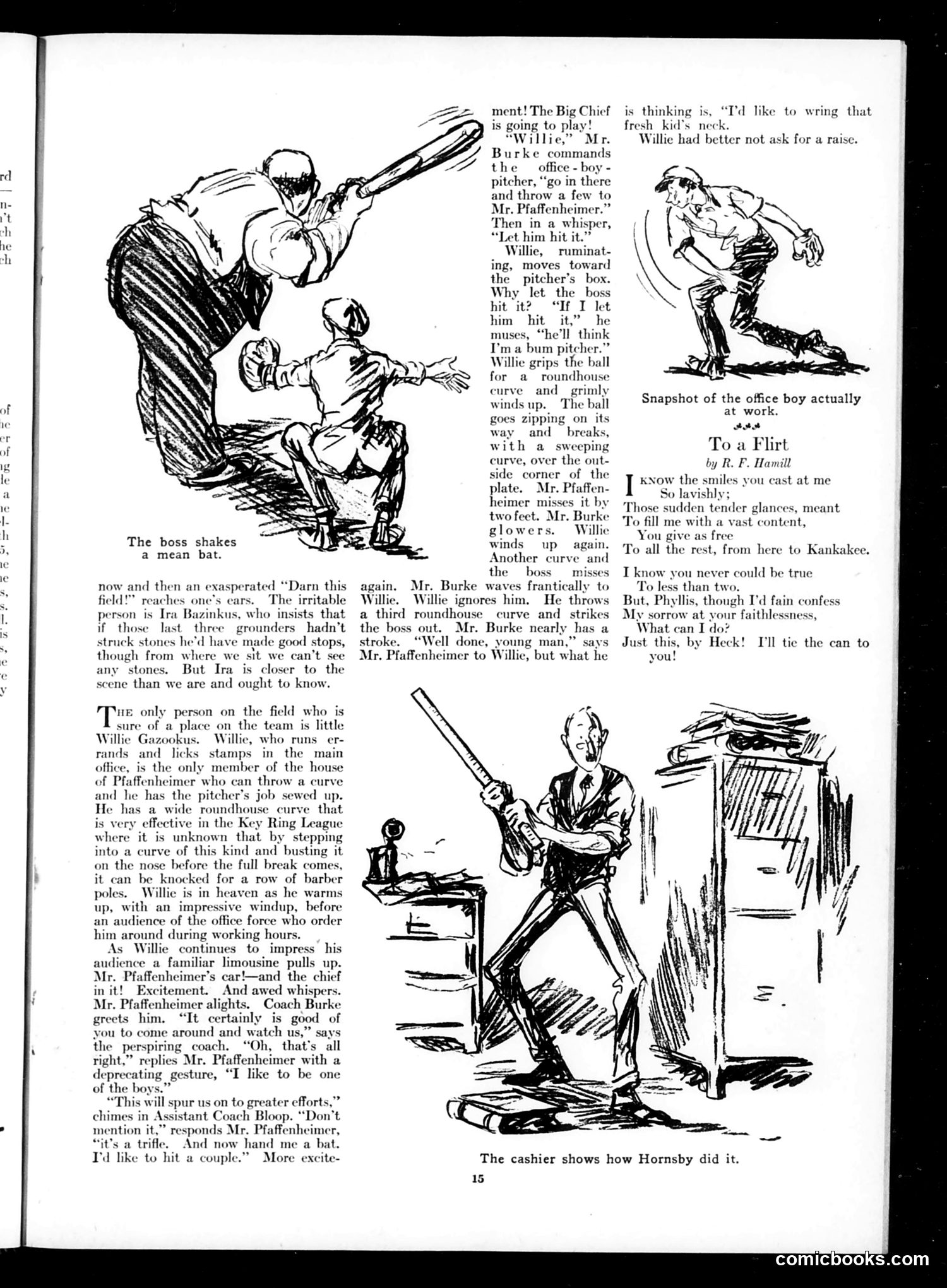
This page satirizes workplace hierarchy and class dynamics through office baseball. **The Setup:** Mr. Pfaffenheimer, the wealthy company owner ("The Big Chief"), arrives at an office baseball game and asks to bat. His subordinates—Coach Burke and young office boy Willie—are put in an awkward position. **The Joke:** Willie, the office-boy pitcher, throws professional-quality curves that strike out his boss, ignoring Burke's whispered instruction to "let him hit it." Willie reasons that if he throws easy pitches, the boss will think he's incompetent. **The Satire:** The cartoon mocks both the pretense of bosses wanting to "be one of the boys" and employees' impossible dilemma—they cannot genuinely compete with their superiors without appearing insubordinate. Pfaffenheimer thinks Willie's honesty is insolence ("I'd like to wring that fresh kid's neck"), implying that workplace deference requires allowing superiors to win, regardless of merit. The secondary content includes a romantic poem and an unexplained reference to "Hornsby" (likely baseball player Rogers Hornsby).
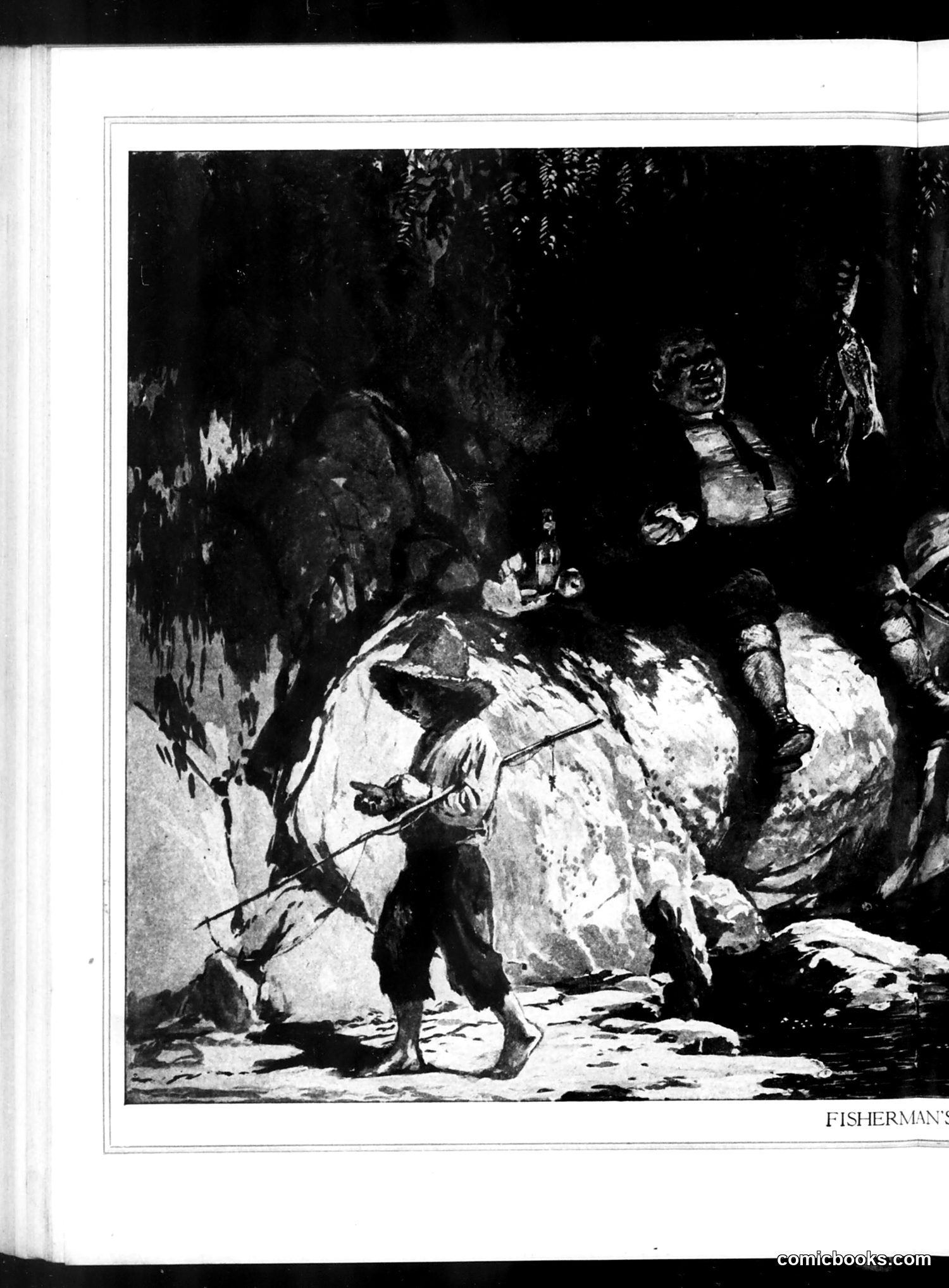
The OCR text is too corrupted to read. However, the black-and-white illustration shows what appears to be a dramatic scene in a cave or rocky grotto with dramatic lighting. A figure in light clothing stands centrally, appearing to interact with or react to darker shadowed forms above and around them. The style and composition suggest this may be illustrating a literary scene or mythological reference—possibly related to a classic tale involving caves or supernatural encounters. The partial text visible at the bottom edge reads "FISHERMAN'S" (cut off), suggesting this might be part of a larger narrative or story illustration rather than a political cartoon. Without legible text, I cannot identify specific historical figures, events, or the intended satirical message.
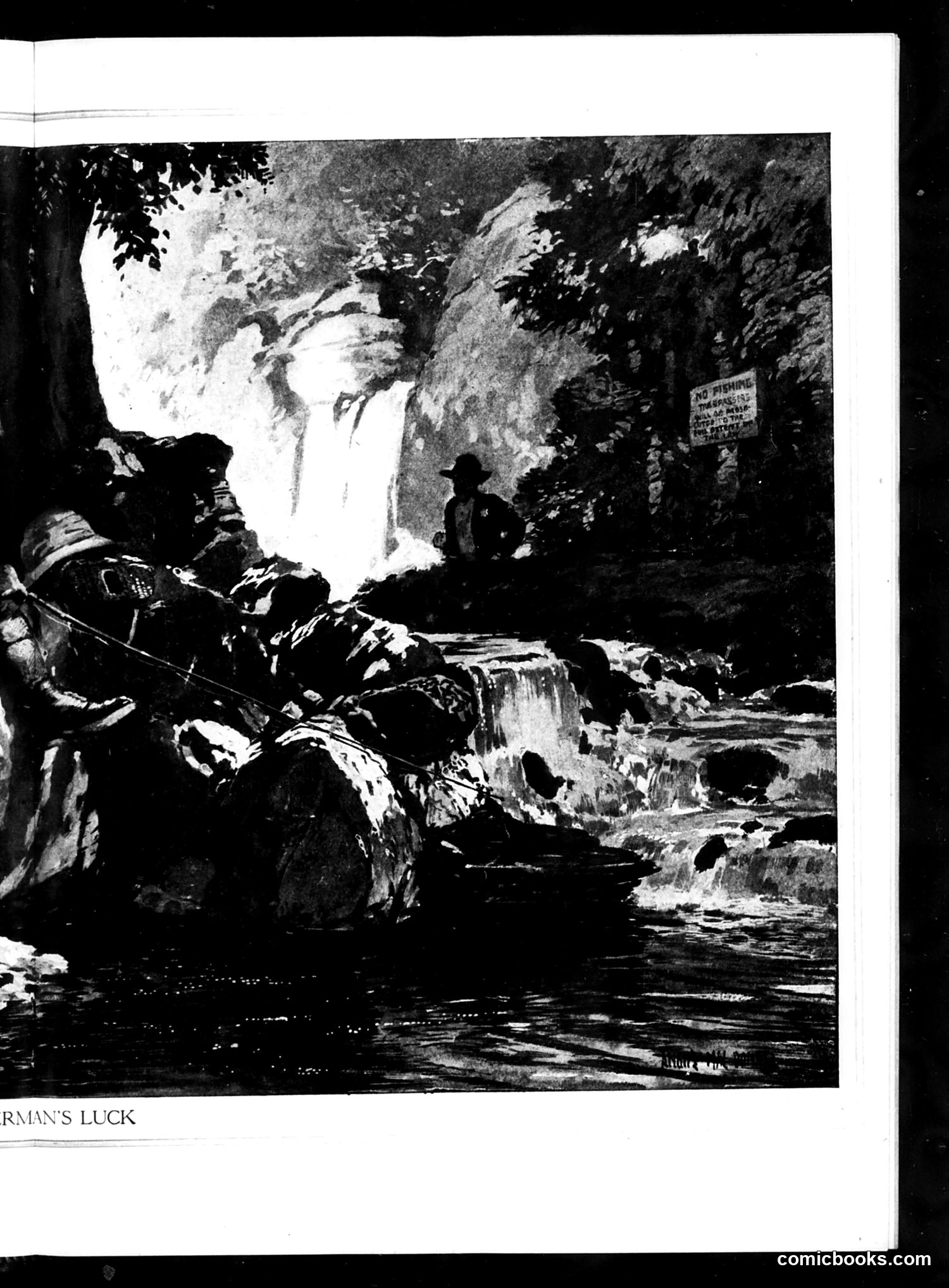
This appears to be a page from *Judge* magazine showing a black and white photograph or illustration labeled "RMAN'S LUCK" (likely "HERMAN'S LUCK" with the beginning cut off). The image depicts a dramatic waterfall scene with a silhouetted figure standing near the falls, fallen logs in the foreground, and a "No Trespassing" sign visible on the rocky cliff. The composition suggests a dangerous or precarious situation. Without additional context or caption text visible on the page, I cannot definitively identify who "Herman" is or what specific political or social satire this references. The scene could represent a commentary on industrial logging, environmental danger, or personal misfortune, but the exact satirical point remains unclear from the image alone.
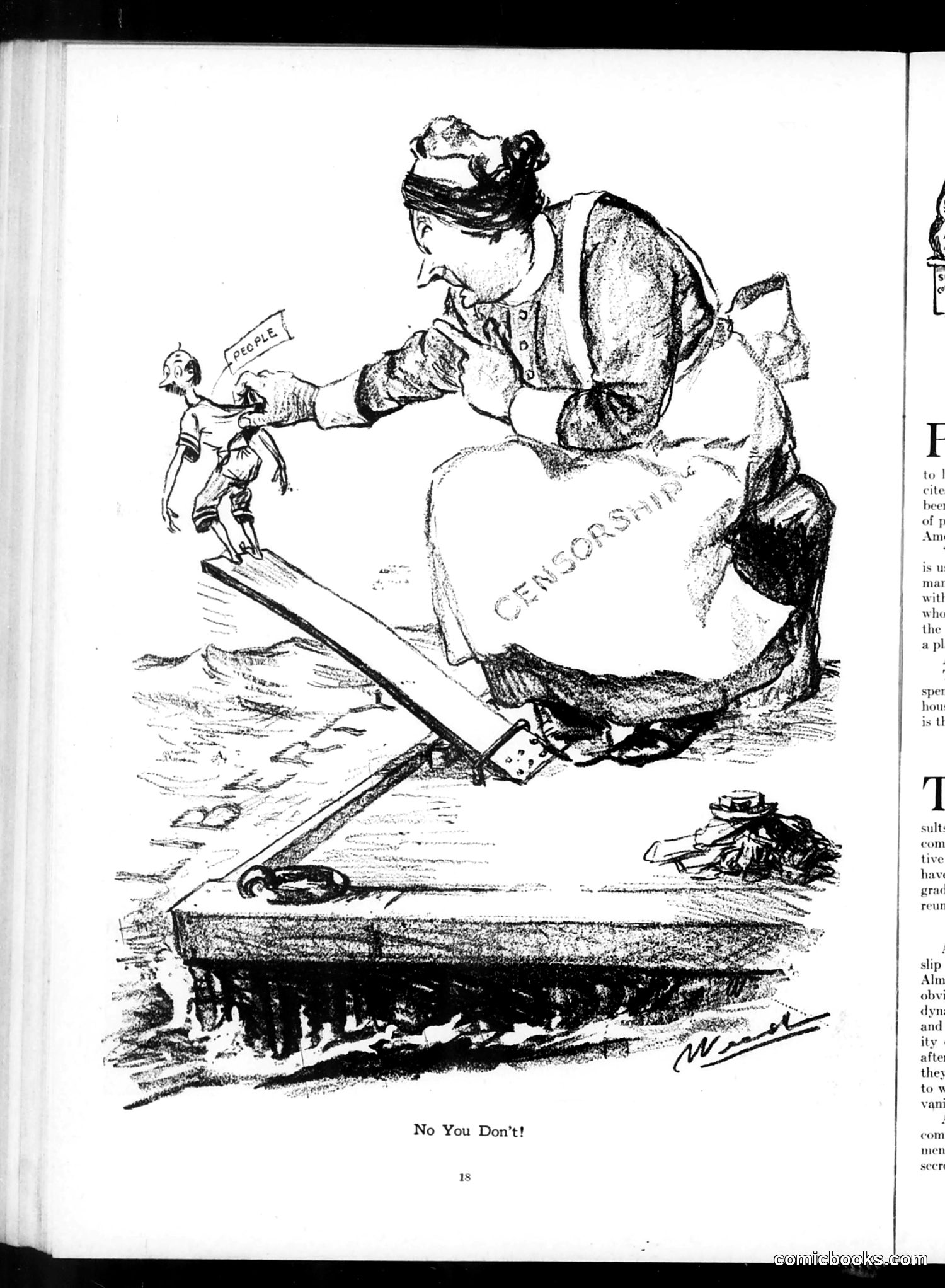
This cartoon depicts a large figure labeled "CENSORSHIP" sitting on a seesaw/plank, holding a small puppet-like figure labeled "PEOPLE" on a string. The figure appears to be controlling or manipulating the smaller "People" character. The satire criticizes governmental or institutional censorship as a form of puppet control—suggesting that censorship restricts free speech and democratic participation by treating citizens as manipulated marionettes rather than autonomous agents. The cartoon's title "No You Don't!" appears to be a defiant response to censorship attempts. This reflects early 20th-century progressive concerns about press freedom and government overreach. Judge magazine frequently satirized such power imbalances. The specific historical context (war period, specific censorship laws) remains unclear without additional publication details, but the core message opposes censorship as anti-democratic.
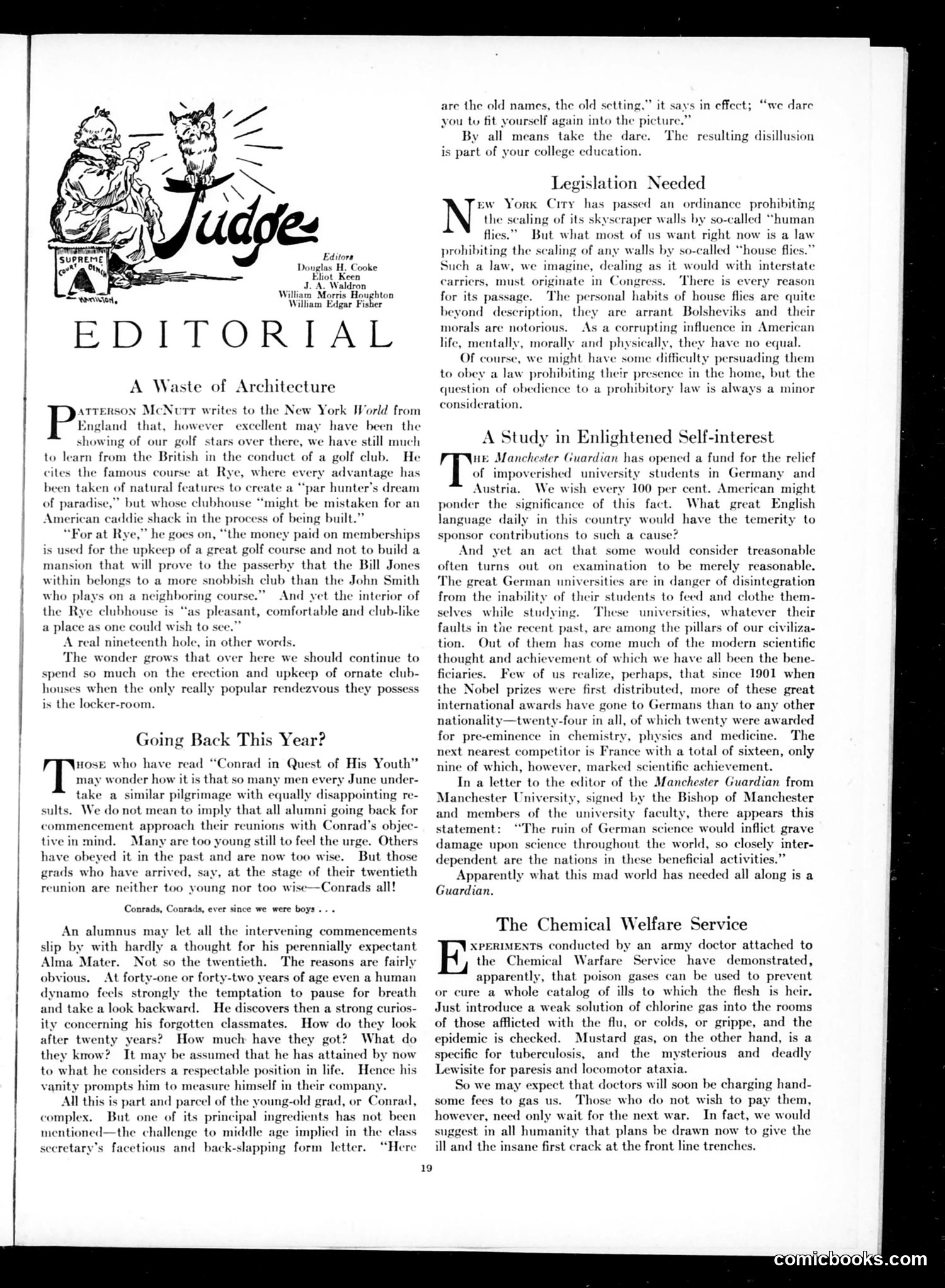
The masthead cartoon depicts an owl labeled "Judge" addressing a cat, establishing the magazine's editorial voice. The owl—a traditional symbol of wisdom—presents itself as the authoritative commentator on social issues. The editorials that follow satirize various American preoccupations: **"A Waste of Architecture"** mocks wealthy American golf clubs for spending lavishly on ornate clubhouses while British clubs (like Rye) invest in actual course quality. The satire targets American conspicuous consumption and status-seeking. **"Going Back This Year?"** humorously examines college alumni reunions, particularly the 20-year milestone. It gently ridicules the "Conrad complex"—the midlife impulse to revisit youth and measure oneself against former classmates, asking "How much have they got?" **"Legislation Needed"** uses comedic exaggeration to satirize New York City's problem with people scaling skyscrapers (likely referring to daredevil stunt-climbers of the era). The absurd proposal to legislate against "house flies" committing this act mocks bureaucratic solutions to social problems. The overall tone is witty social commentary on American vanity, materialism, and institutional absurdity.
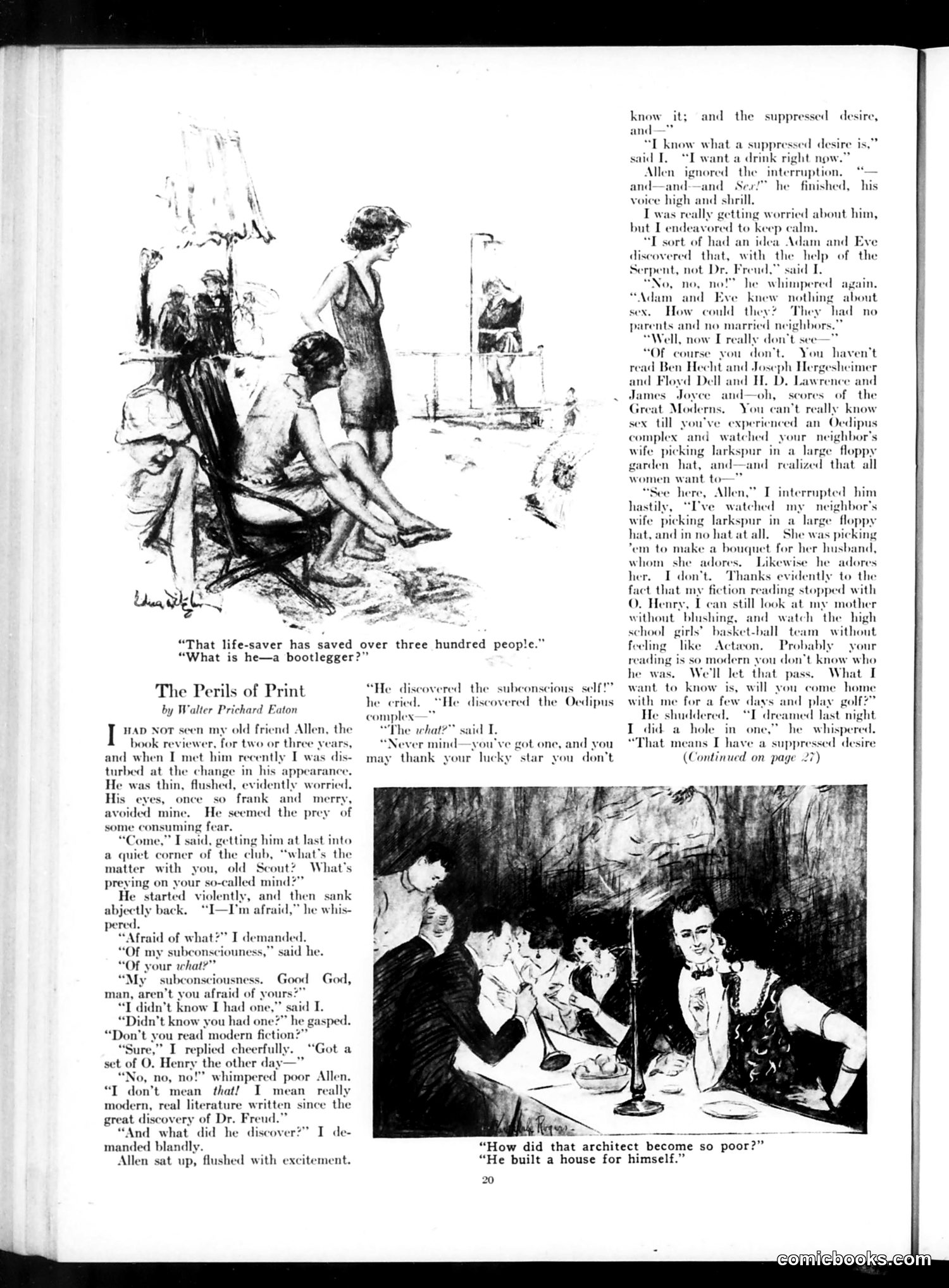
This 1920s piece by Walter Prichard Eaton mocks the cultural obsession with Freud's newly popular psychological theories. The narrator's friend Allen has become neurotic after immersing himself in modern literature influenced by psychoanalysis—works by Joyce, Lawrence, and Dell that explored subconscious desire and the Oedipus complex. The satire targets how intellectuals weaponized Freudian concepts to read hidden sexual meaning into everyday life. Allen now sees psychological pathology everywhere: a neighbor picking flowers becomes evidence of repressed desire; innocent activities require psychiatric interpretation. The narrator, who still enjoys O. Henry stories without psychological anxiety, represents common sense overwhelmed by trendy intellectual jargon. The opening caption about a "life-saver" bootlegger references Prohibition-era bootleggers as cultural heroes—another jab at modern society's topsy-turvy values. The joke: pseudo-intellectual overanalysis has made Allen miserable, while ignorance keeps others happy.
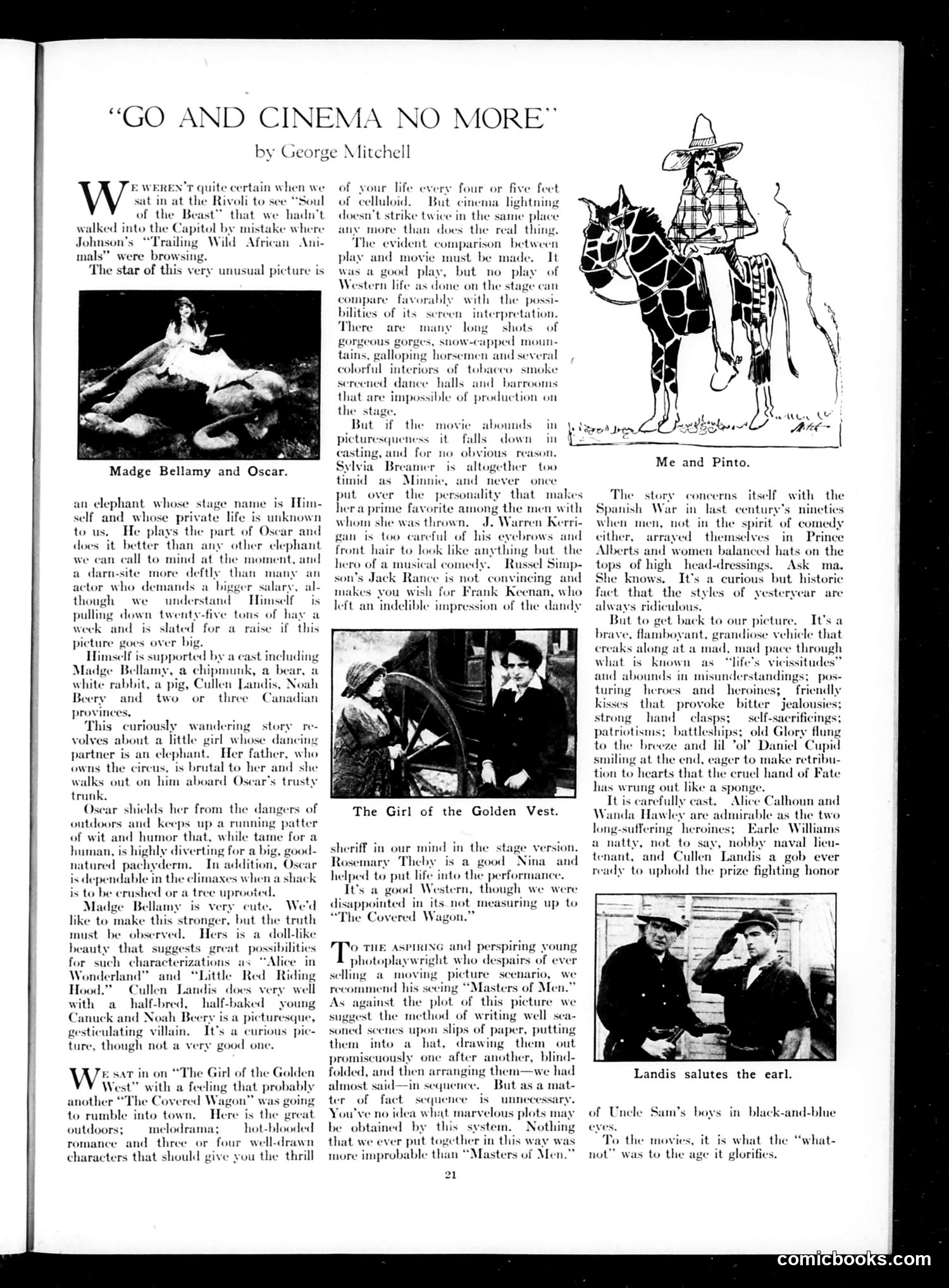
This page reviews three films from the silent era. The main critique concerns the contrast between stage and screen storytelling. **"Soul of the Beast"** stars actress Madge Bellamy alongside Oscar, an elephant playing a character named "Himself." The reviewer mocks the film's zoo-like quality, sardonically praising the elephant's performance while noting the absurdity of a circus melodrama. **"The Girl of the Golden West"** compares unfavorably to the stage play. The critic praises the film's visual spectacle—landscapes, action sequences impossible on stage—but attacks the casting choices. Sylvia Breamer as Minnie and J. Warren Kerrigan are criticized as insufficiently convincing, with Kerrigan too concerned with his appearance. The cartoonish illustration titled "Me and Pinto" appears to mock Western film conventions. The satire targets cinema's growing pains: critics felt movies relied on spectacle over nuanced performance, and that stage actors couldn't translate their craft to screen. This reflects 1920s debates about whether cinema was legitimate drama or mere novelty entertainment.
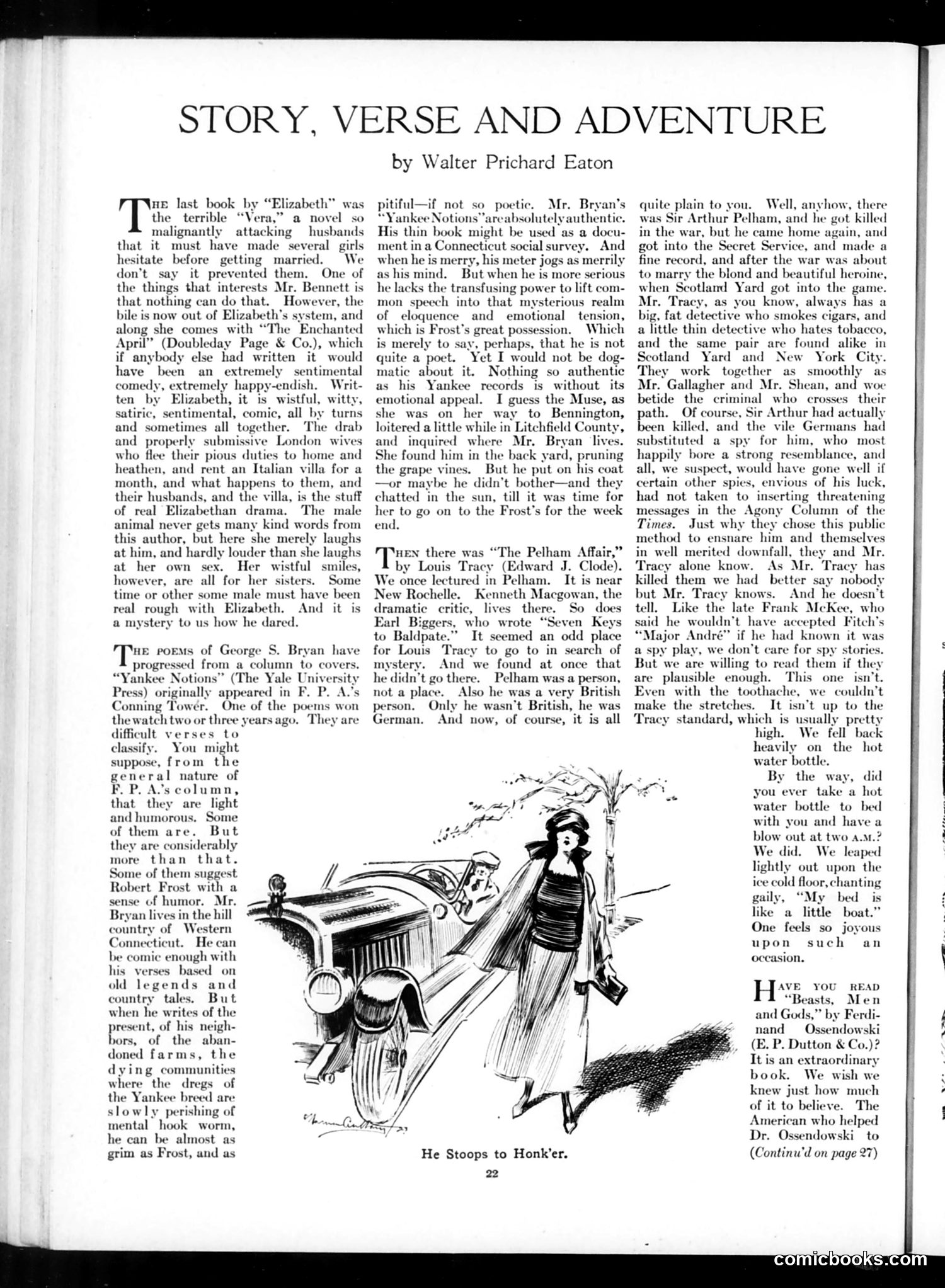
This is a literary review column by Walter Prichard Eaton discussing three books. The main illustration shows a man in period dress stopping his car to greet a woman—likely depicting a scene from "The Enchanted April." **Key content:** The reviews discuss "Elizabeth" (a pseudonymous female author) whose novel attacks husbands so viciously that Eaton jokes it might discourage marriage. Her new work, "The Enchanted April," features submissive London wives who escape to an Italian villa. George S. Bryan's poetry collection "Yankee Notions" receives measured praise—competent but lacking Robert Frost's transcendent power, though his depictions of declining Connecticut rural communities show authentic emotional appeal. Louis Tracy's mystery "The Pelham Affair" confuses readers by using a person's name (a German, not British) as its title rather than a place. The tone is sophisticated literary criticism mixed with gentle humor typical of Judge's educated readership—poking fun at both authors and readers' expectations of literature and marriage.
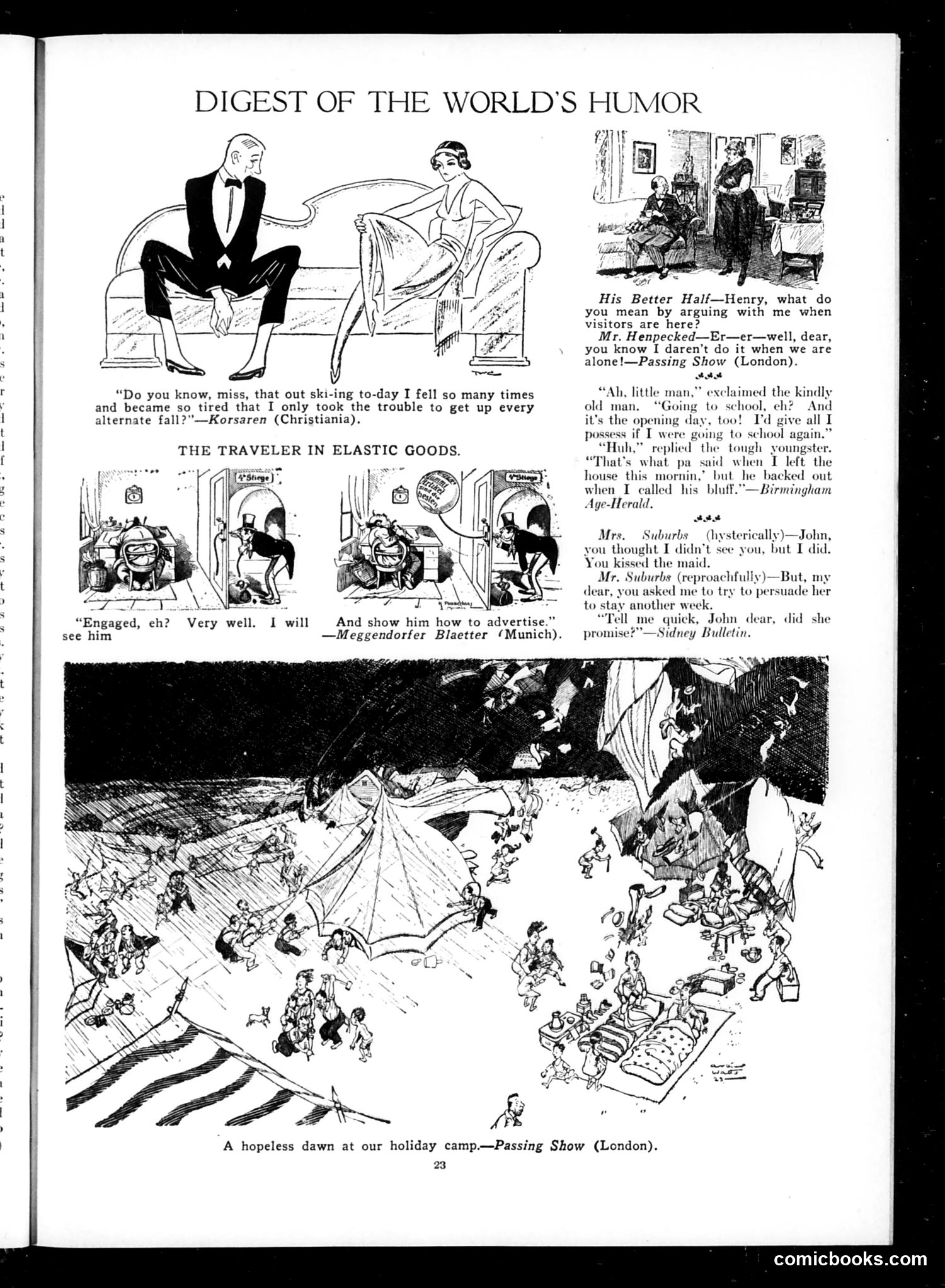
This page collects humorous cartoons and jokes from international publications (Korsaren, Meggendorfer Blaetter, Passing Show, Birmingham Age-Herald, Sidney Bulletin), representing early-20th-century satirical humor. The jokes target domestic life and social conventions: a man defending his ski-fall exhaustion; a traveling salesman ("elastic goods") promising to coach an engaged man in advertising; a henpecked husband admitting he only argues with his wife when alone; a schoolboy cynically comparing his father's regret about school to his own; a suburban husband caught kissing the maid, with his wife unable to distinguish whether he did it reluctantly or willingly; and a chaotic holiday camp scene. The satire centers on **marital dynamics** (nagging wives, powerless husbands) and **masculine performance** — the gap between men's public and private behavior. These reflect period anxieties about gender roles and domesticity. The "elastic goods" salesman's boast about teaching advertising suggests commercial culture's growing influence on behavior itself.
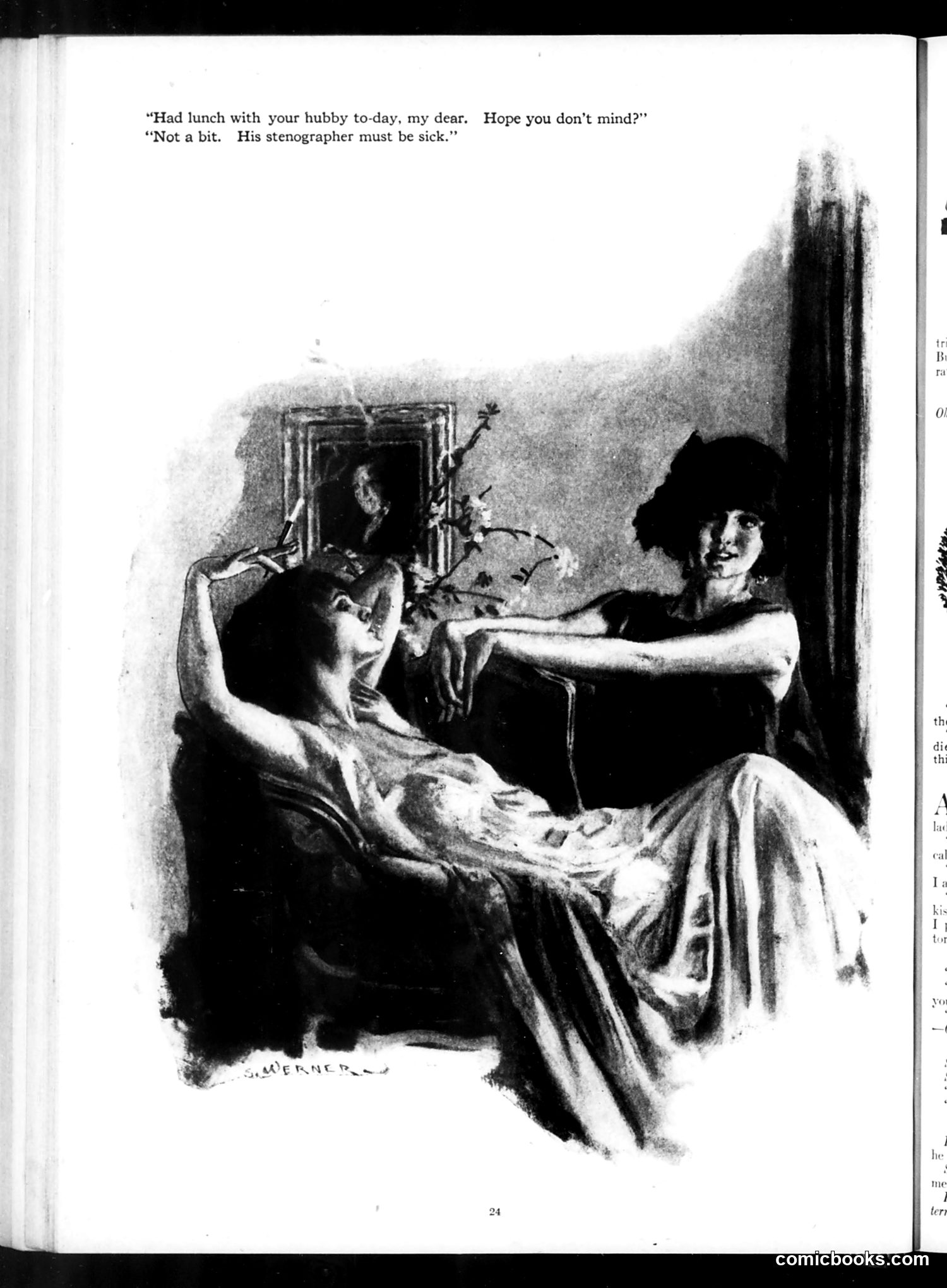
This cartoon satirizes workplace infidelity and the domestic anxieties it created. A woman visits another woman at home, casually mentioning she had lunch with "your hubby." The visited woman responds dismissively: "Not a bit. His stenographer must be sick." The joke operates on the assumption that the husband regularly lunches with his stenographer (a female office worker), implying an affair or romantic entanglement. The wife's quip suggests this is such a routine occurrence that his absence from the office to lunch with *another* woman only happens when his usual companion (the stenographer) is unavailable. The cartoon reflects early 20th-century anxieties about office dynamics, women in the workplace, and marital fidelity—presenting infidelity as an accepted, almost comedic aspect of business life rather than genuine scandal.
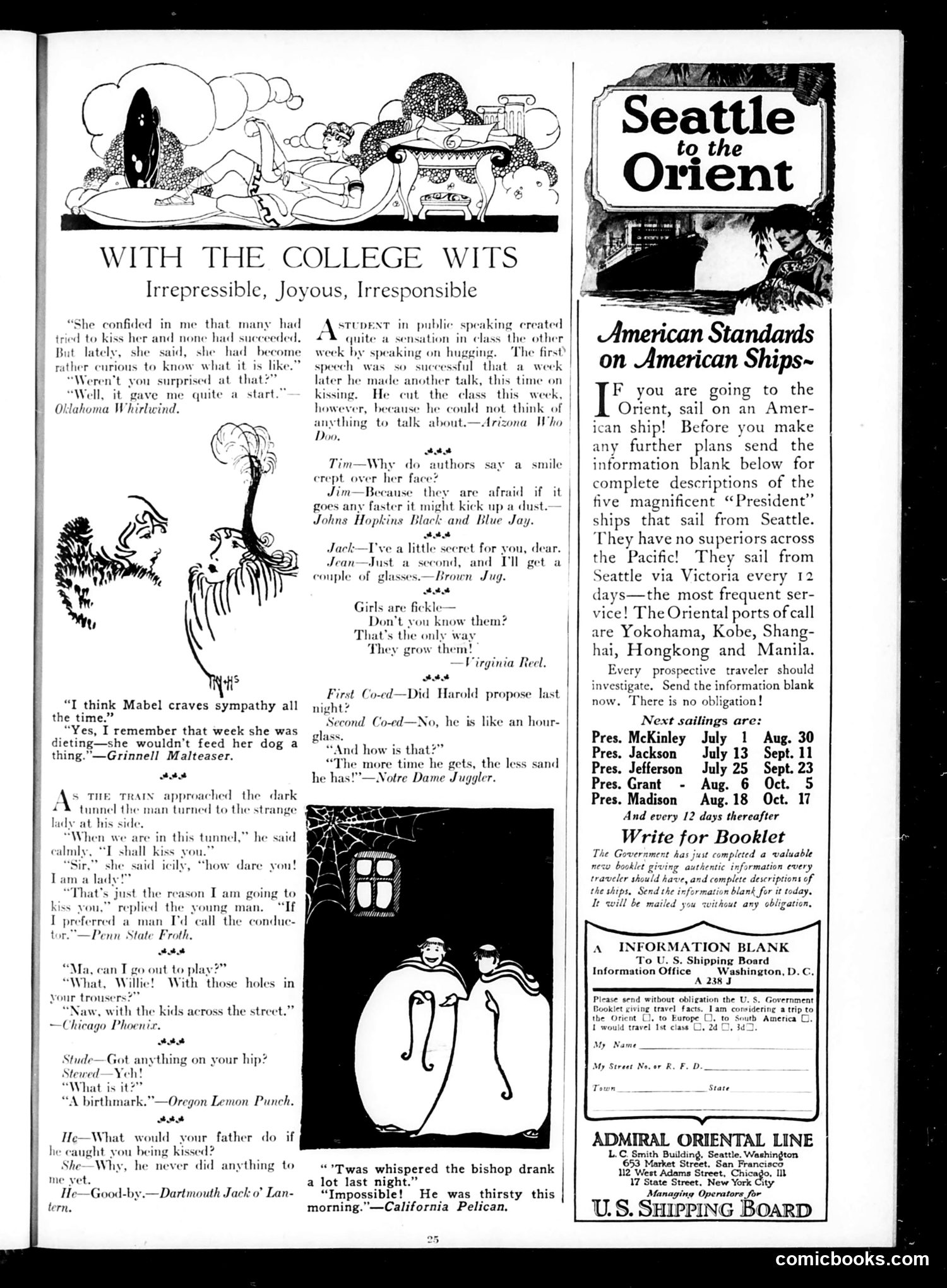
This page from *Judge* magazine contains two main elements: **"With the College Wits"** (left side) is a humor column featuring short, risqué jokes about college students, primarily focused on kissing, romance, and flirtation. The jokes play on predictable punchlines—a student gives speeches on hugging, then kissing, then skips class because he's run out of topics; a man threatens to kiss a woman in a tunnel; a girl won't feed her dog during a diet. These reflect 1920s college culture and attitudes toward courtship and dating. **"Seattle to the Orient"** (right side) is a shipping advertisement promoting five steamships ("President" class vessels) operated by the U.S. Shipping Board for passenger travel to Asian ports. It encourages Americans to choose American ships over competitors, listing ports like Yokohama and Hong Kong, and provides an information blank for interested travelers. The page reflects post-WWI American commerce and leisure culture—ships were primary transportation for both business and tourism to Asia during this era.
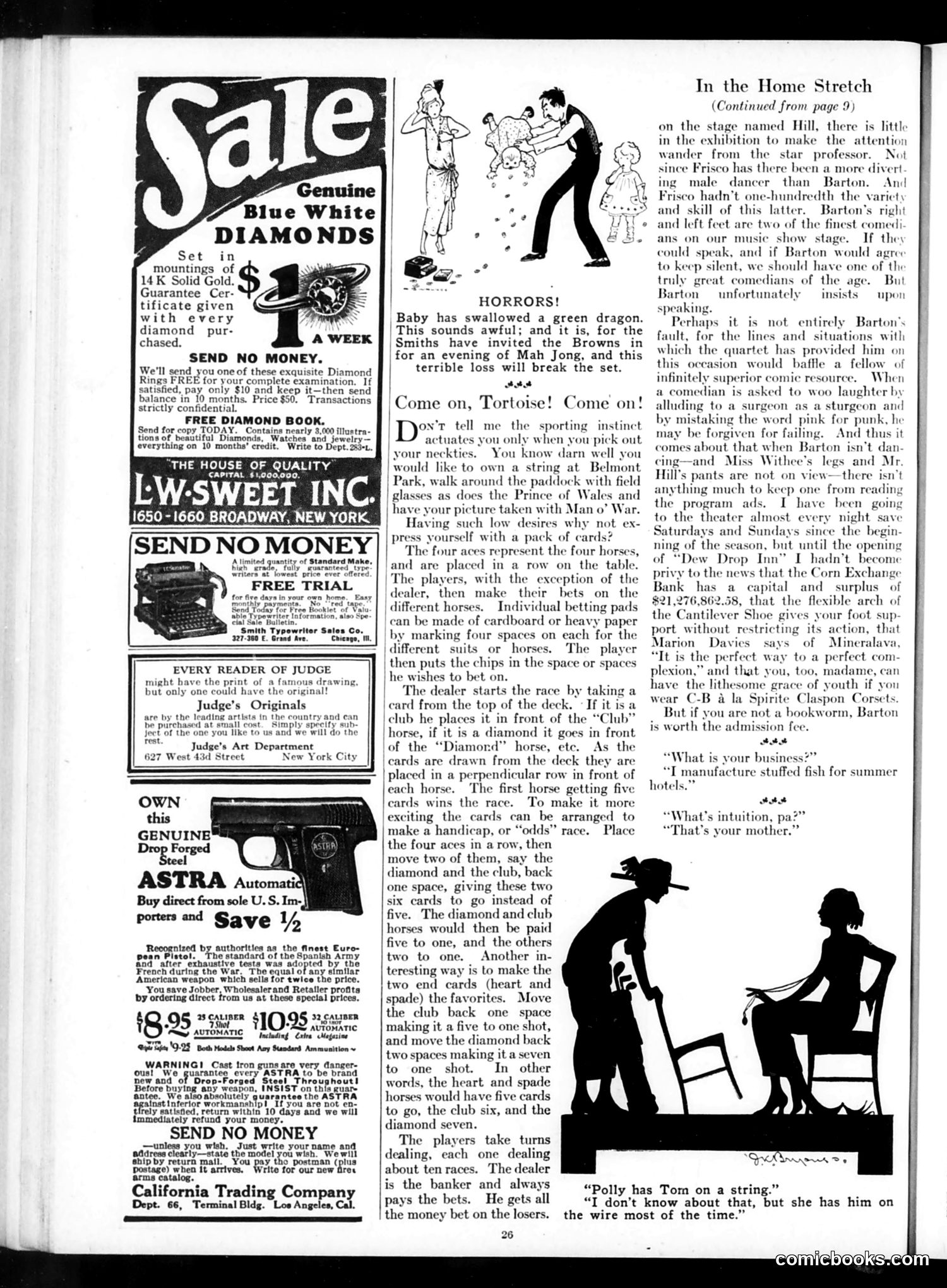
This page is primarily **advertising**, with one small cartoon. The main cartoon titled "Horrors!" satirizes upper-middle-class anxieties. It depicts a couple distressed because their baby swallowed a "green dragon" (likely a game piece), which will disrupt their Mah Jong evening with guests—the Smiths and Browns. The joke mocks the era's preoccupation with fashionable leisure activities (Mah Jong was a 1920s fad) and the trivialization of actual child endangerment into mere social inconvenience. The page's advertisements promote diamonds, an Astra automatic pistol, and Judge's original artwork prints. A lengthy article about card games (horse-racing betting games) completes the content. The cartoon reflects Jazz Age satirical humor: poking fun at bourgeois materialism and the anxiety that social embarrassment poses greater concern than genuine crises.
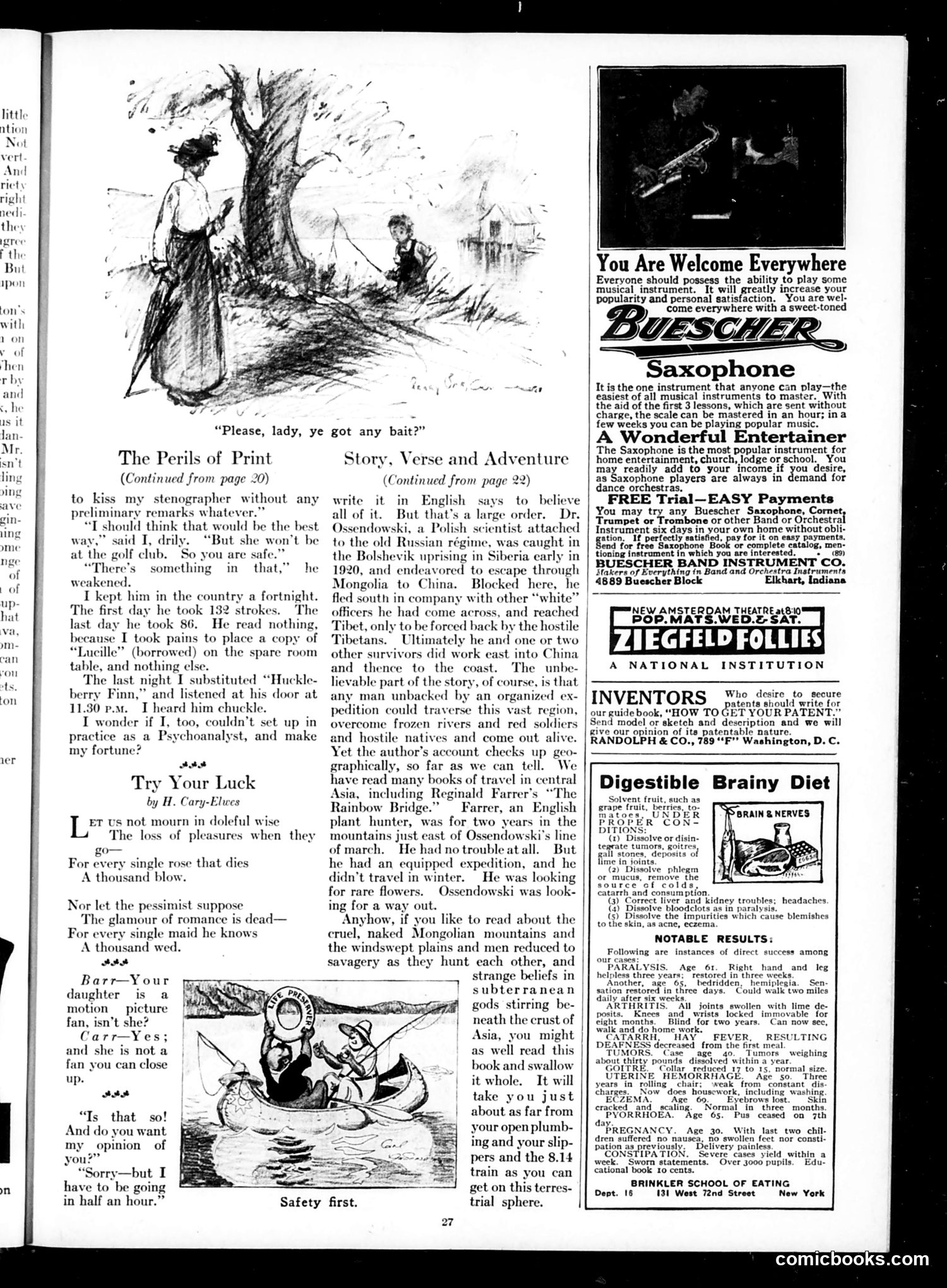
This page from *Judge* contains multiple satirical pieces. The main cartoon shows a woman fishing by a tree while a man approaches asking "Please, lady, ye got any bait?"—a play on the double meaning of "bait" as fishing lure and romantic enticement, typical of era humor about courtship. "The Perils of Print" (continuing from an earlier section) satirizes how reading material affects behavior—the narrator describes keeping a man in the country and strategically controlling what he reads, substituting *Huckleberry Finn* for dull poetry to improve his mood. This mocks contemporary anxieties about literature's psychological influence. The page also includes light verse, a dialogue joke about a movie-fan daughter, and extensive advertising for Buescher saxophones and other products—common in *Judge's* mixed editorial-advertising format. The ads reflect 1920s consumer culture and aspirational messaging about self-improvement and social acceptance through purchasing.
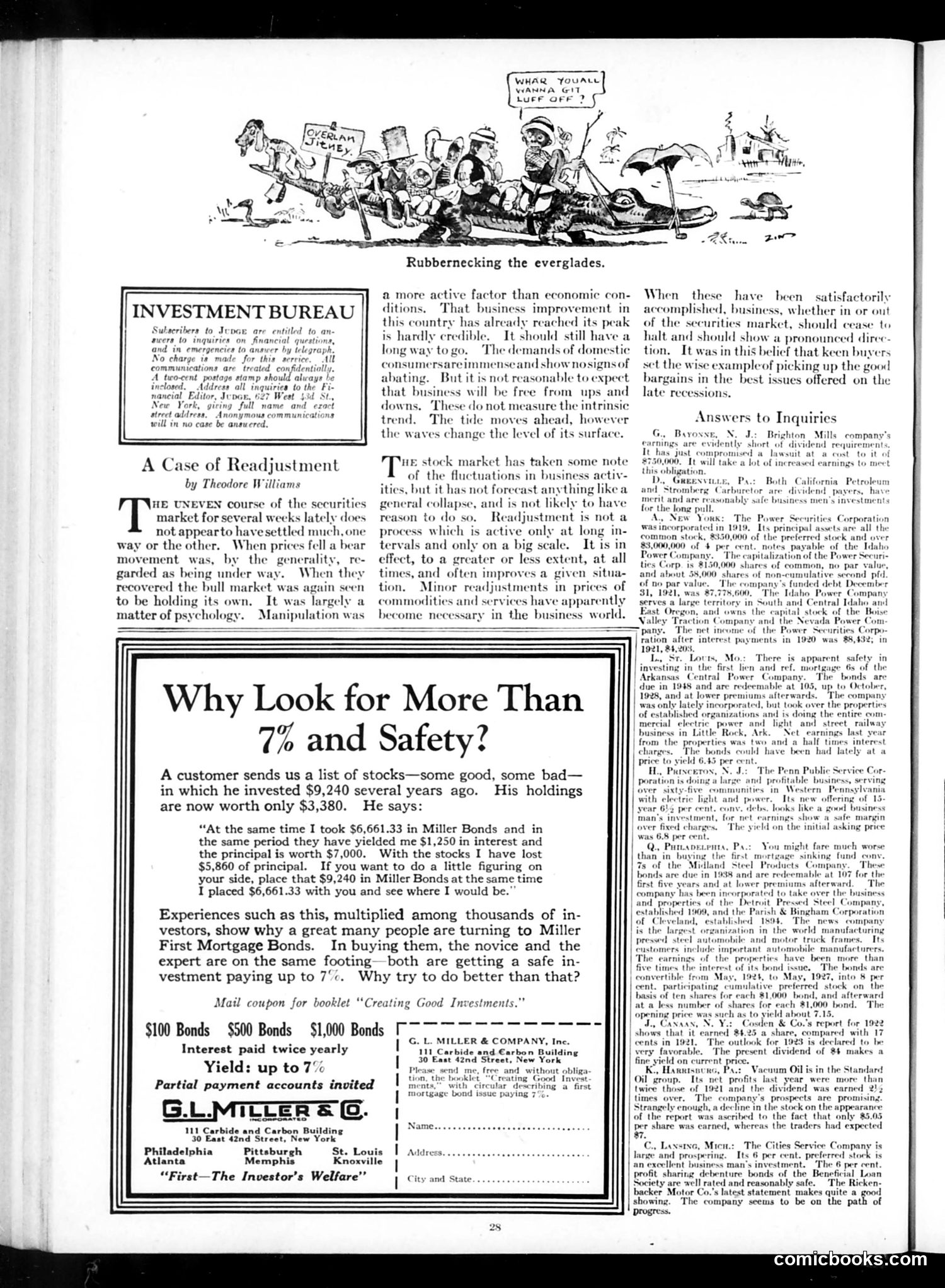
**The Cartoon:** "Rubbernecking the everglades" depicts tourists in a crowded boat viewing Florida's swamps. One figure exclaims "When you all wanna git buff off?" The satire targets wealthy northerners flocking to Florida during the 1920s land boom—treating natural scenery as a commodity while appearing foolish and undignified in their enthusiasm. **The Advertisements & Articles:** The page is dominated by investment content: G.L. Miller & Company promotes bonds yielding "up to 7%" as safer than stocks, illustrated by a customer anecdote comparing stock losses ($9,240 down to $3,380) versus bond gains. This reflects post-1920s crash skepticism about equities. Theodore Williams's article discusses market "readjustment"—psychological factors affecting securities prices beyond economic fundamentals. **Context:** This reflects Depression-era anxiety about investment safety and the shift from speculative stocks toward conservative bonds. The Florida tourism satire captures period excess before economic collapse.
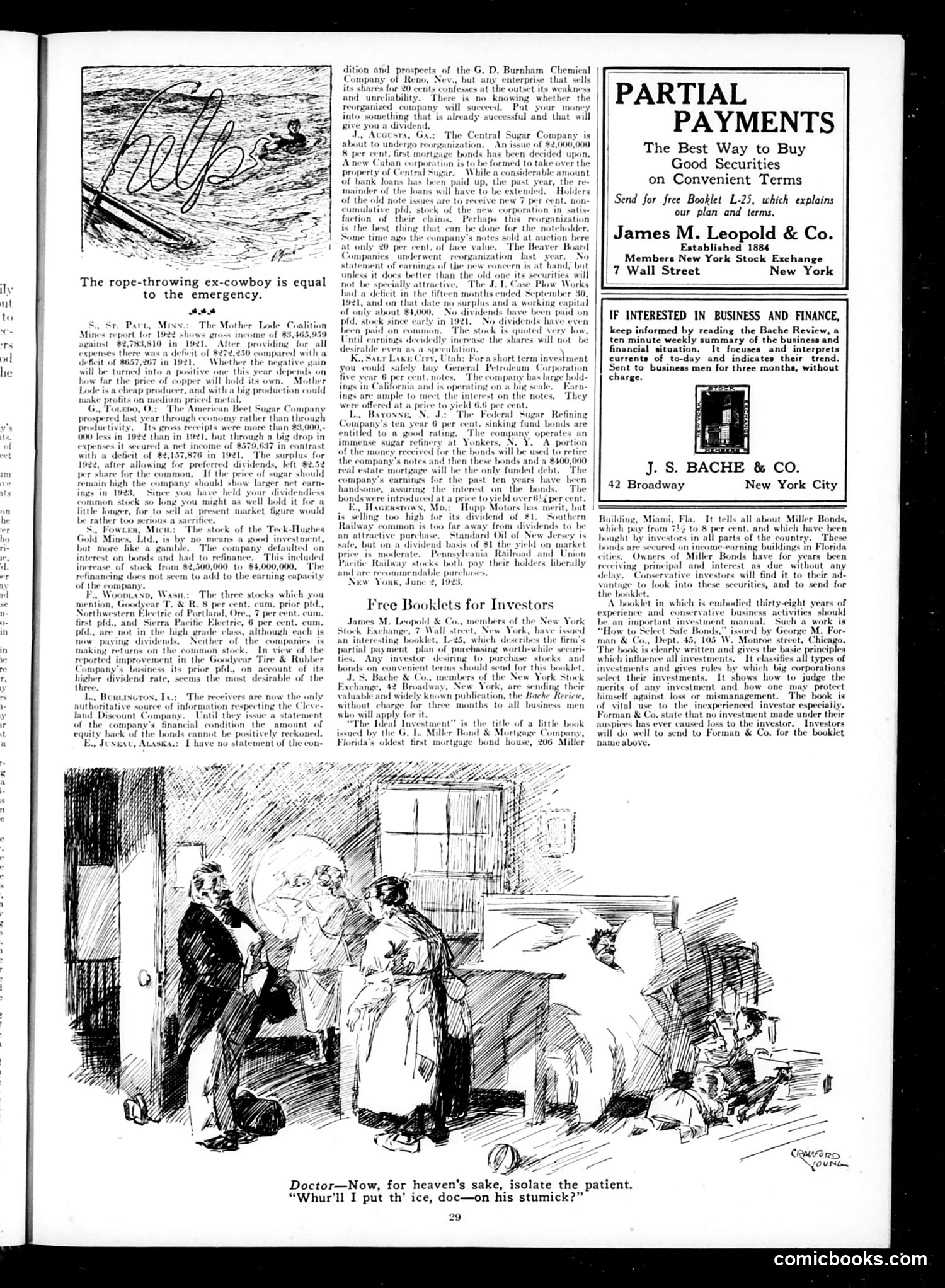
This page is primarily **advertising and financial advice** rather than political satire. The single cartoon at the bottom depicts a humorous domestic scene: a doctor arrives at a patient's bedside while family members crowd the room. The doctor instructs them to "isolate the patient" and asks where to put ice, then quips about putting it "on his stomach"—a joke about treating illness with ice packs, a common early 20th-century medical practice. The bulk of the page consists of **investment advice columns** and advertisements for financial services (James M. Leopold & Co., J.S. Bache & Co.) offering stock tips, bond purchases, and booklets on investing. References include railroad stocks, sugar refineries, and oil companies—typical investment vehicles of the 1920s era when this magazine was published (dated June 2, 1923). There is **no political satire** on this page. It represents Judge's dual function as both humor magazine and business publication for affluent readers.
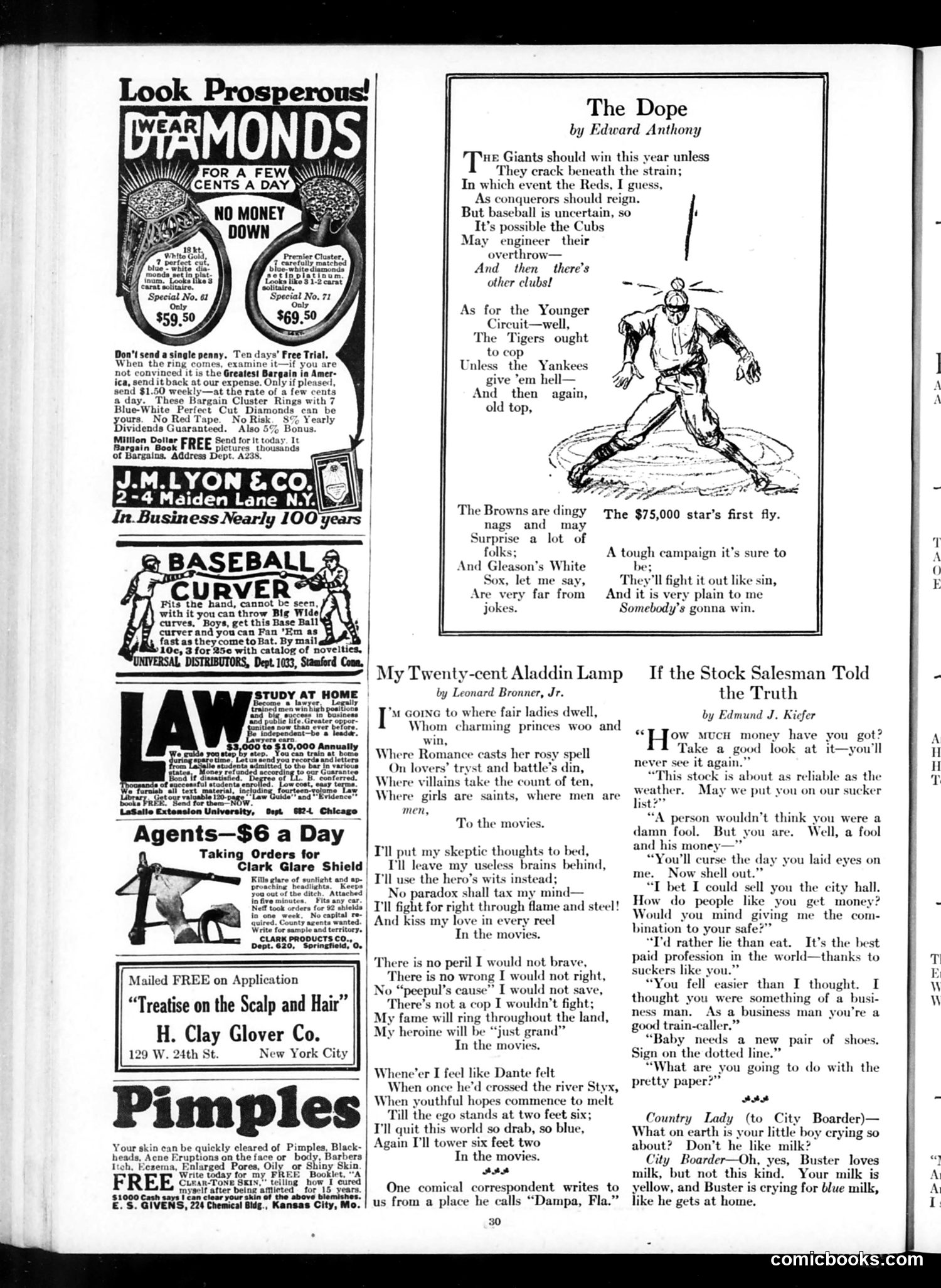
This poem by Edward Anthony humorously predicts the 1920 baseball season, expressing uncertainty about every team's chances. The illustration shows a baseball player mid-stride. Anthony lists the major contenders—the Giants, Reds, Cubs, Tigers, Yankees, Browns, and White Sox—but qualifies each prediction with doubt. The joke is that despite his pontificating tone, he essentially admits *anybody* could win: the Giants might "crack," the Cubs might "engineer their overthrow," the Yankees might "give 'em hell," and so forth. The accompanying satire pieces mock easy confidence in unstable situations. "My Twenty-cent Aladdin Lamp" romanticizes movie fantasies as escapism from real life's disappointments, while "If the Stock Salesman Told the Truth" lampoons sales deception by imagining a broker candidly admitting his stock is unreliable and customers are "damn fools." Together, these pieces satirize how Americans embrace comforting illusions—whether sports predictions, movie dreams, or financial schemes—rather than face uncomfortable truths.
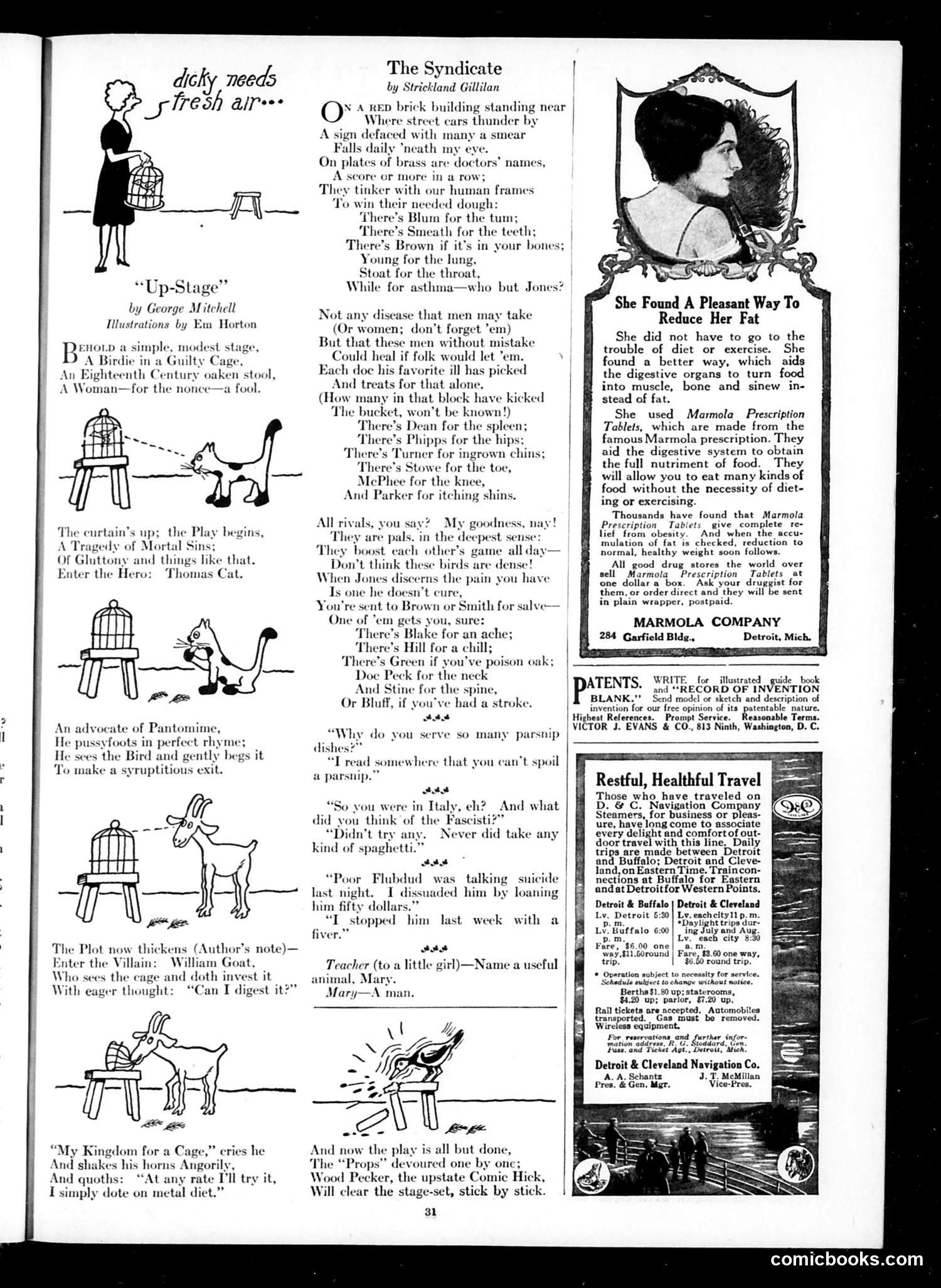
This poem satirizes medical corruption in early 20th-century America. The "syndicate" refers to a suspected collusion among doctors sharing a building: each specializes in different ailments (Dean for spleen, Phipps for hips, etc.), and rather than competing, they secretly refer patients to one another in a coordinated scheme to ensure steady income. The satire's point: these physicians aren't primarily healing patients but extracting money ("win their needed dough"). The poem notes darkly that no one knows how many patients have "kicked the bucket"—suggesting the doctors' care is ineffective or indifferent. The joke is that patients believe they're receiving specialized care when actually they're being passed around a closed network of physicians padding each other's pockets. This reflects genuine Progressive Era anxieties about medical monopolies and fee-for-service incentives conflicting with patient welfare.
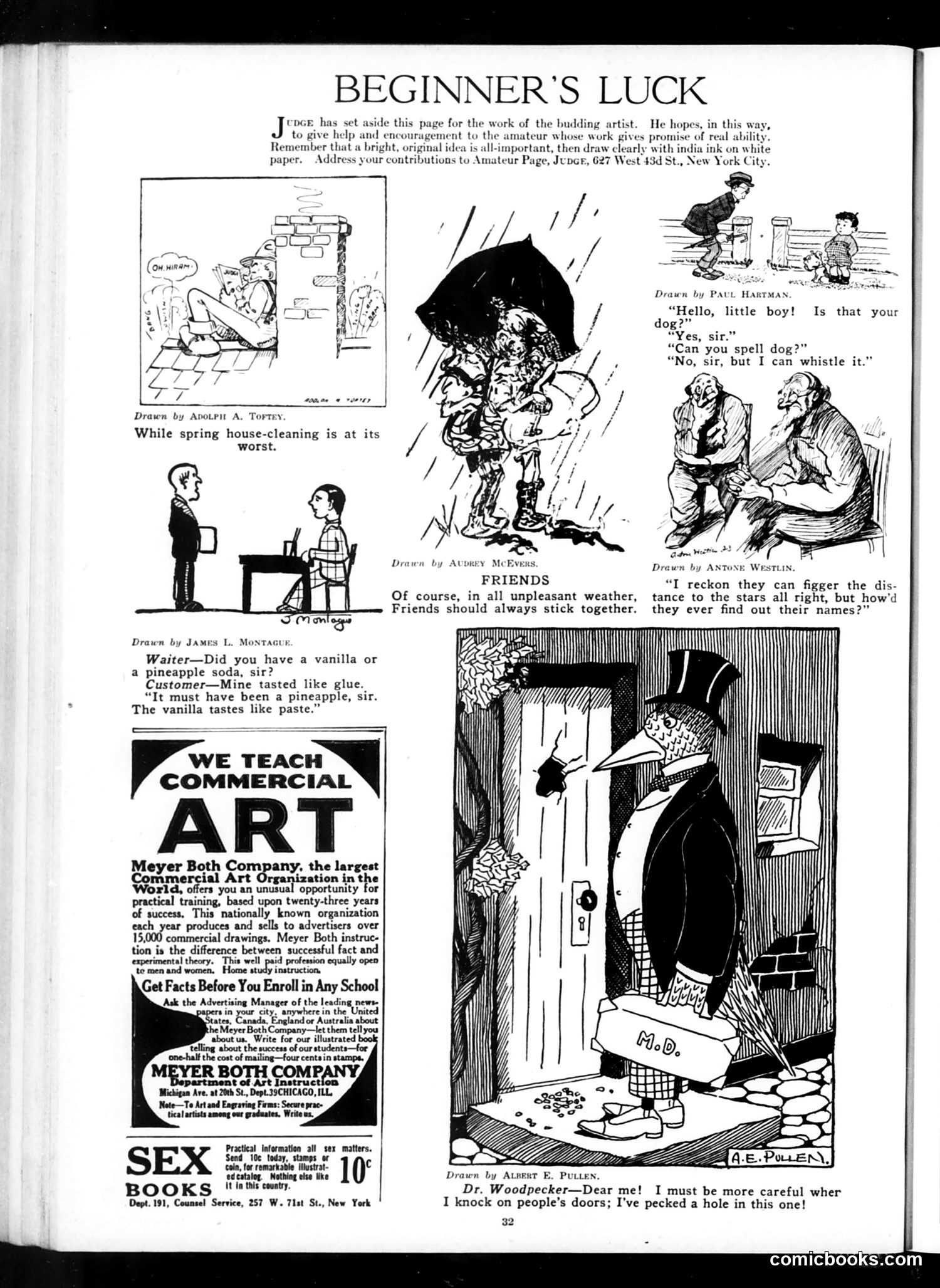
This page showcases amateur cartoons submitted to *Judge* magazine's contributor section. The humor relies on simple, visual punchlines: **The cartoons:** - A boy claims he can "whistle" the spelling of "dog" (wordplay on the sound) - A waiter confuses vanilla and pineapple sodas by taste, humorously suggesting they taste like glue and paste - Two figures discuss astronomers knowing star distances but not names (absurdist logic) - Dr. Woodpecker apologizes for pecking a hole in a door—treating the bird's natural behavior as a social gaffe These are gentle, wholesome jokes typical of early 20th-century family humor. The page also includes advertising for commercial art training and sex education books, suggesting *Judge* mixed editorial content with revenue-generating ads. The framing message encourages amateur artists to submit "bright, original ideas" drawn clearly with ink—essentially a call for reader contributions to fill editorial space.
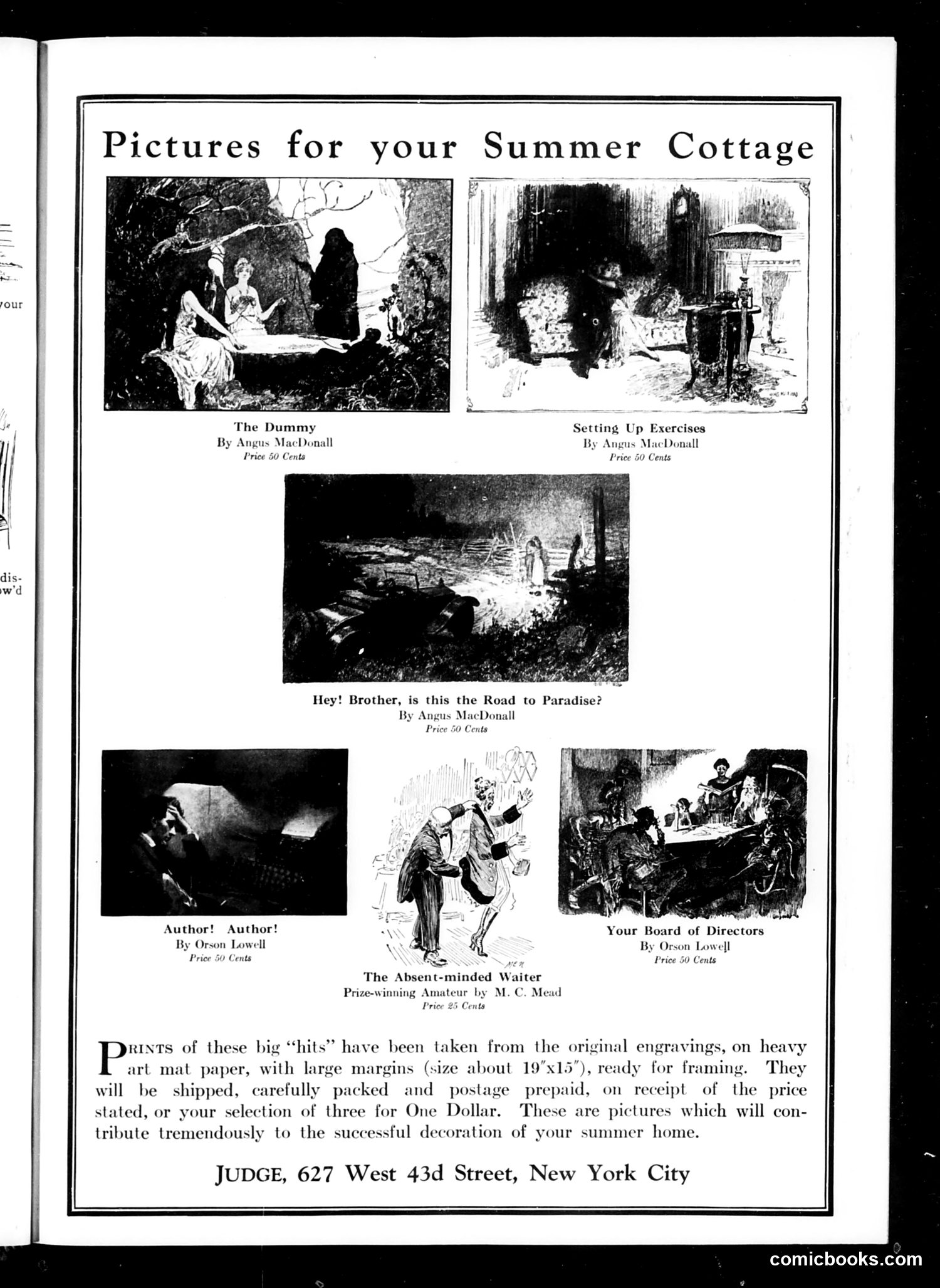
This page advertises humorous engravings for sale—primarily a commercial listing rather than political satire. Judge offered six comedic illustration prints by artists including Angus MacDonall, Orson Lowell, and M.C. Mead, priced at 25-50 cents each, or three for one dollar. The titles suggest genteel domestic humor typical of early 20th-century magazines: "The Dummy," "Setting Up Exercises," "Hey! Brother, is this the Road to Paradise?" "Author! Author!" "The Absent-minded Waiter," and "Your Board of Directors." These appear to mock everyday social situations—vanity, incompetence, distraction—rather than target specific political figures or events. The prints were marketed as decoration for summer homes, printed on heavy art paper with large margins (approximately 19"x15") ready for framing. The advertisement emphasizes quality and careful packaging, positioning these as affordable art for middle-class vacation properties.
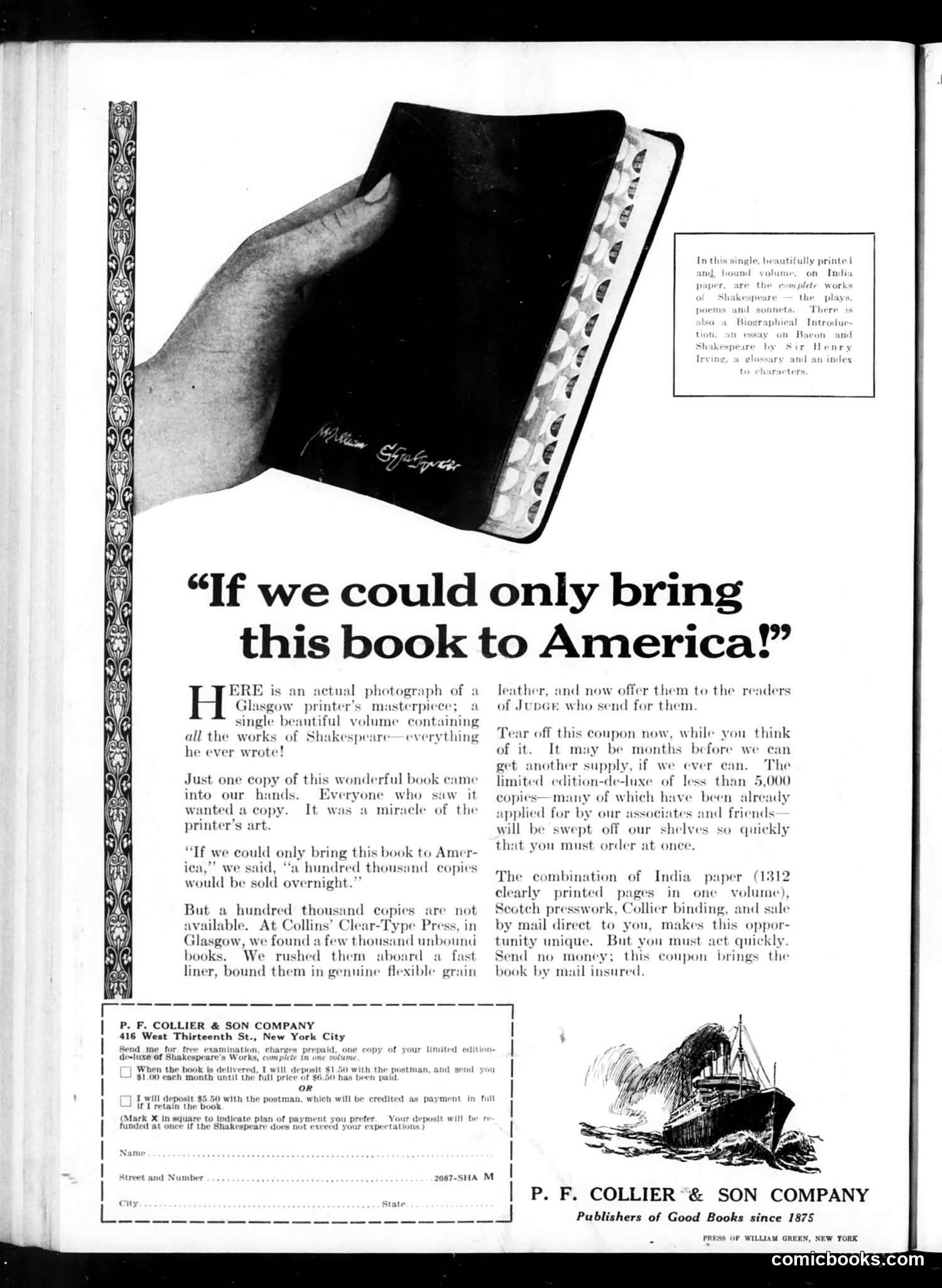
This is **not a cartoon or satire**, but rather a full-page **advertisement** for a luxury edition of Shakespeare's complete works, published by P.F. Collier & Son Company. The ad uses aspirational marketing language ("If we could only bring this book to America!") to create artificial scarcity and urgency around a leather-bound edition printed on India paper in Glasgow. The hand holding the book in the photograph is meant to convey prestige and desirability. The pitch targets Judge's educated, affluent readership by emphasizing the book's production quality (Scottish presswork, Collier binding) and exclusivity (limited edition of fewer than 5,000 copies). The coupon mechanism—requiring no upfront payment—was a common direct-mail sales tactic of the era. This represents early-20th-century consumer advertising that conflates cultural refinement with book ownership and uses scarcity claims to drive immediate purchasing decisions.