
Judge, 1923-06-09 · page 21 of 36
Judge — June 9, 1923 — page 21: what you’re looking at
What you’re looking at
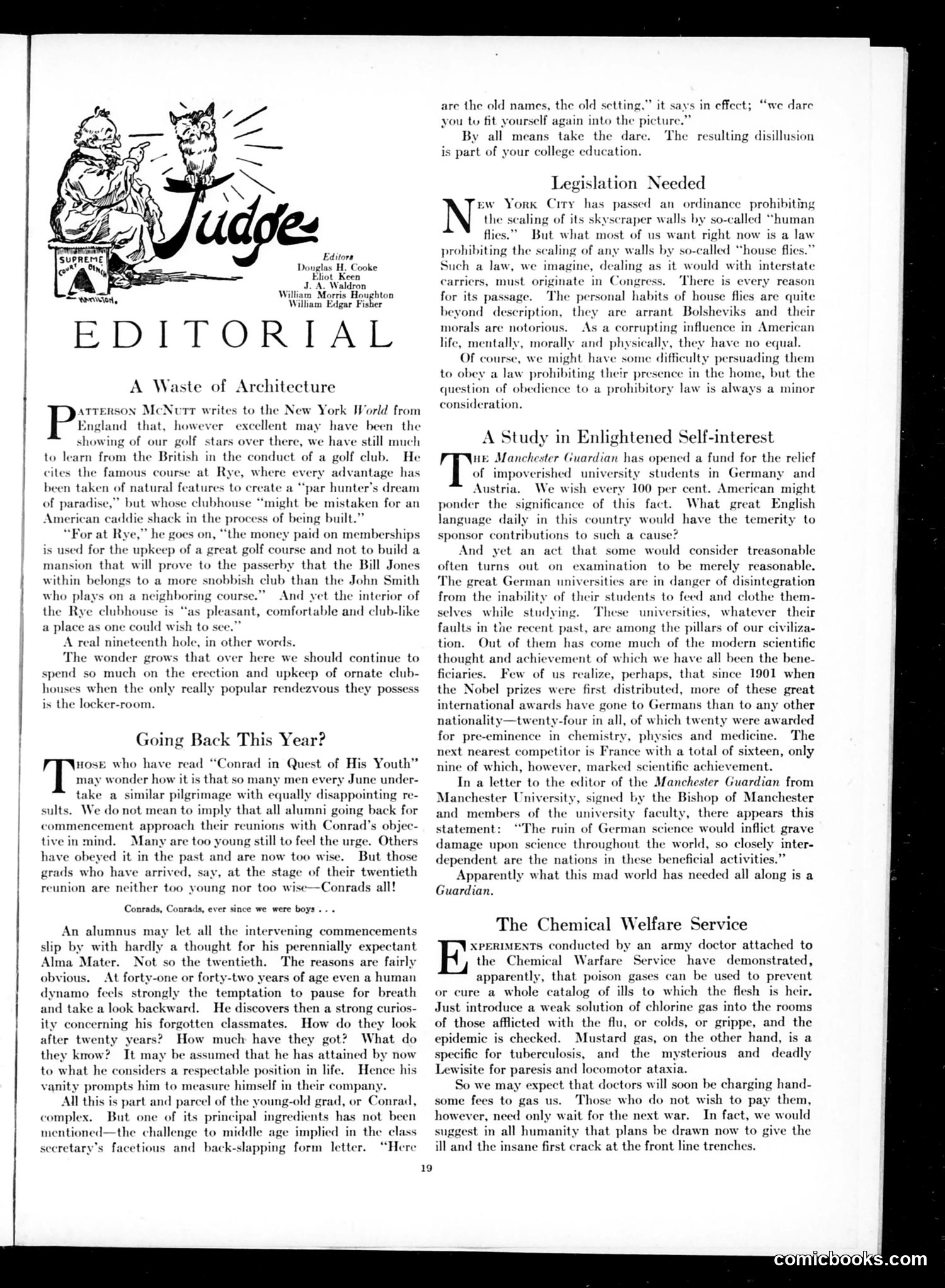
The masthead cartoon depicts an owl labeled "Judge" addressing a cat, establishing the magazine's editorial voice. The owl—a traditional symbol of wisdom—presents itself as the authoritative commentator on social issues. The editorials that follow satirize various American preoccupations: **"A Waste of Architecture"** mocks wealthy American golf clubs for spending lavishly on ornate clubhouses while British clubs (like Rye) invest in actual course quality. The satire targets American conspicuous consumption and status-seeking. **"Going Back This Year?"** humorously examines college alumni reunions, particularly the 20-year milestone. It gently ridicules the "Conrad complex"—the midlife impulse to revisit youth and measure oneself against former classmates, asking "How much have they got?" **"Legislation Needed"** uses comedic exaggeration to satirize New York City's problem with people scaling skyscrapers (likely referring to daredevil stunt-climbers of the era). The absurd proposal to legislate against "house flies" committing this act mocks bureaucratic solutions to social problems. The overall tone is witty social commentary on American vanity, materialism, and institutional absurdity.
📄 Transcribed text from this page (OCR, searchable)
Machine-transcribed from the original scan — historical spelling and the odd misread are preserved.
de Eliot, Keen J. A, Waldron William Morris Houghton William Edgar Fisher EDITORIAL AW. ste of Architecture aTTERSON McNutt writes to the New York World from England that, excellent’ may the showing of our golf stars over there, we have still much to learn from the British in the conduct of a golf club. He ut Rye, where every advantage | been taken of natural f “par hunter's dream of paradise,” but whose clubhouse “might be mistaken for an American caddie shack in the process of being built.” “For at Rye, “the money paid on memberships is used for the upkeep of a great golf course and not to build a mansion that will prove to the passerby that the Bill Jones within belongs to a more snobbish club than the John Smith who plays on a neighboring course.” And yet the interior of the Rye “as pleasant, comfortable and club-like a place as one could wish to sé A real nineteenth hole, in other words. The wonder grows that over here we should continue to ‘tion and upkeep of ornate club- however have been cites the famous cours’ atures to create a clubhouse is ‘at spend so much on the er houses when the only really popular rendezvous they possess is the locker-room. Going Back This Year? nose who have read “Conrad in Quest of His Youth” I may wonder how it is that so many men every June under- take a similar pilgrimage with equally disappointing re- We do not mean to imply that all alumni going back for commencement approach their reunions with Conrad’s objec- tive in mind. Many are too young still to feel the urge. Others have obeyed it in the past and are now too wise. But those at the stage of their twentieth -Conrads all! sults. grads who have arrived, reunion are neither too young nor too wise Conrads, Conrads, ever since we were boys... An alumnus may let all the intervening commencements slip by with hardly a thought for his perennially expectant Alma Mater. Not so the twentieth. The reasons are fairly obvious. At forty-one or forty-two years of age even a human dynamo feels strongly the temptation to pause for breath and take a look backward. He discovers then a strong curios- ity concerning his forgotten classmates. How do they look after twenty years? How much have they got? What do they know? It may be assumed that he has attained by now to what he considers a re Hence his vanity prompts him to measure himself in their company. ‘All this is part and parcel of the young-old grad, or Conrad, complex. But one of its principal ingredients has not been mentioned—the challenge to middle age implied in the class ious and back-slapping form letter. “Here pectable position in life. seeretary’s fi are the old names, the old setting,” it says in effect; “we dare you to fit yourself again into the picture By all means take the dare. The is part of your college education. resulting disillusion Legislation Needed York Crry has passed an ordinance prohibiting caling of its skyscraper walls by so-called “human But what most of us want right now is a law “house flic prohibiting the scaling of any walls by so-called * Such a law, we imagine, dealing as it would with inter carriers, must. originate There is & The personal habits of house fic they are arrant Bolsheviks As a corrupting influence in they have no equal. ate y reason we in Congress. are quite and_ their for its passage. beyond description, morals are notorious. American life, mentally, morally and physically, Of course, we might have some difficulty persuading them to obey a law prohibiting their presence in the home, but the question of obedience to a prohibitory law is always a minor consideration. A Study in Enlightened Self-interest HE Manchester Guardian has opened a fund for the relief | of impoverished university students in Germany and We wish every 100 per cent. American might ponder the significance of this fact. What great English language daily in this country would have the temerity to sponsor contributions to such a caus And yet an act that would consider treasonable often turns out examination to be merely reasonable. The great German universities are in danger of disintegration from the inability of their students to feed and clothe them- selves while studying. These universities, whatever their faults in the recent past, are among the pillars of our ci tion. Out of them has come much of the modern scientific thought and achievement of which we have all been the bene- ficiaries. Few of us realize, perhaps, that since 1901 when the Nobel prizes were first distributed, more of these great international awards have gone to Germans than to any other ty-four in all, of which twenty were awarded for pre-eminence in chemistry, physics and medicine. The next nearest competitor is France with a total of sixteen, only nine of which, however, marked scientific achievement. In a letter to the editor of the Manchester Guardian from Manchester University, signed by the Bishop of Manchester and members of the university faculty, there appears this statement: “The ruin of German science would inflict grave damage upon science throughout the world, so closely inter dependent are the nations in these beneficial activitie: Apparently what this mad world has needed all along is a Guardian. Austria some on nationality—twe The Chemical Welfare Service army doctor attached to have demonstrated, an be used to prevent -ondueted by an the Chemical Warfare Ser apparently, that poison ge or cure a whole catalog of ills to which the flesh is heir. Just introduce a weak solution of chlorine gas into the rooms of those afflicted with the flu, or colds, or grippe, and the epidemic is checked. Mustard gas, on the other hand, specific for tuberculosis, and the and deadly Lewisite for paresis and locomotor ataxia. So we may expect that doctors will soon be charging hand- some fees to gas us. Those who do not wish to pay them, however, need only wait for the next war. In fact, we would suggest in all humanity that plans be drawn now to give the ill and the insane first crack at the front line trenches. XPERIMENT! ses ¢ is mysterious