
Judge, 1923-06-09 · page 11 of 36
Judge — June 9, 1923 — page 11: what you’re looking at
What you’re looking at
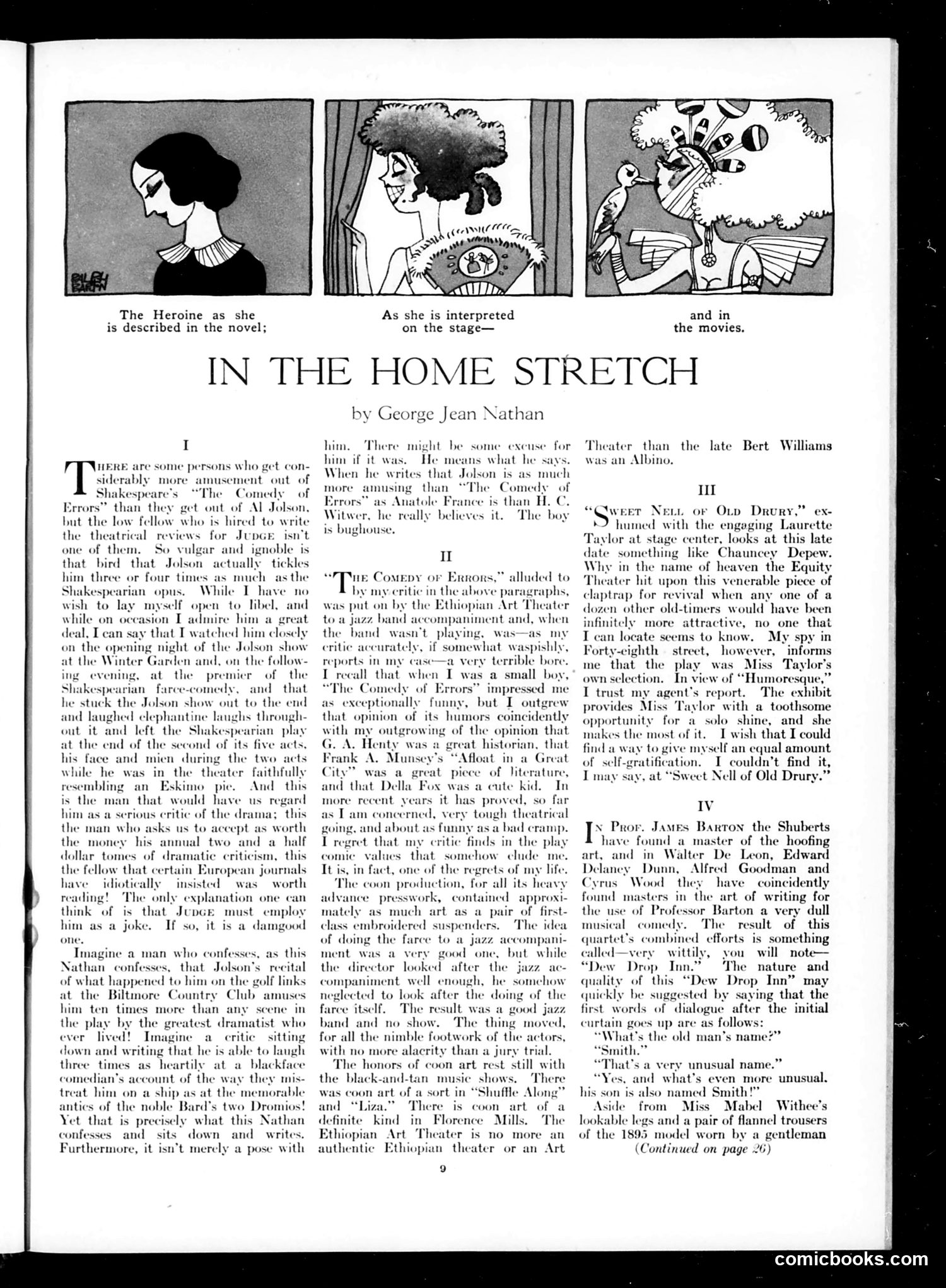
This article by George Jean Nathan is a theatrical critique disguised as self-mockery. Nathan admits he finds Al Jolson's vaudeville performances far more entertaining than Shakespeare's "Comedy of Errors"—a confession meant to satirize his own questionable critical judgment. The three panels at top show a literary heroine's character degradation: from novel description (elegant, understated) through stage interpretation (exaggerated) to film adaptation (absurdly overwrought). This visualizes Nathan's larger point about how entertainment media distort and sensationalize source material. Nathan's humor relies on his candid admission that a blackface comedian's golf-club anecdote amuses him more than Shakespeare—presenting this as ridiculous evidence that either he lacks taste or his profession is a joke. He also critiques the "Ethiopian Art Theater's" all-jazz production of "Comedy of Errors" as technically competent but artistically hollow, with good musicianship masking poor theatrical direction. The satire targets both lowbrow entertainment preferences and the theatrical establishment's pretensions.
📄 Transcribed text from this page (OCR, searchable)
Machine-transcribed from the original scan — historical spelling and the odd misread are preserved.
The Heroine as she is described in the novel; Ae CA, Ao spyatiae As she is interpreted on the stage— the movies. IN THE HOME STRETCH by George Jean Nathan I HERE are some persons who get con- siderably more amusement out of Shakespeare’s “The Comedy — of Errors” than they get out of Al Jolson, but the low fellow who is hired to write the theatrical reviews for JupGE_ isn't one of them. So vu ind ignoble is that bird that Jolson actually tickles him three or four times as much as the Shakes n opus. While Thi wish to myself open to. libe while on occasion [admire him a great deal, I ean say that I watched him closely on the opening night of the Jolson show at the Winter Garden and, on the follow- ing evening, at the premier of the Shakespearian farce-comedy, and that he stuck the Jolson show out to the end and laughed clephantine laughs through- out it and left the Shakespearian. play at the end of the second of its five acts, his face and mien during the two a while he was in the theater faithfully resembling an Eskimo pie. And. this is the man that would have us regard 1 serious critic of the drama; this the man who asks us to accept as worth » money his annual two and a half ur tomes of dramatic criticism, this fellow that certain European journals have idiotically — insisted worth reading! The only explanation one can think of is that’ JupcGe must employ him as a joke. If so, it is a damgood one. Imagine a man who confesses, as this Nathan confesses, that Jolson’s recital of what happened to him on the golf links at the Biltmore Country Club amuses him ten times more than any scene in the play by the greatest dramatist. who li ! Imagine a critic sitting down and writing that he is able to laugh three times as heartily at a blackface comedian’s account of the way they mis- treat him on a ship as at the memorable antics of the noble Bard's two Dromios! Yet that is precisely what this Nathan confesses and sits down and writes. Furthermore, it isn’t merely a pose with was him. There might) be excuse for him if it was. He means what he says. When he writes that Jolson is as much nusing than “The Comedy of Errors” as Anatole France is than H. C. Witwer, he really believes it. The boy is bughouse. more II “Tue Comepy or Errors,” alluded to by my eritic in the above paragraphs, was put on by the Ethiopian Art Theater to a jazz band accompaniment and, when the band wasn’t playing, was—as my critic accurately, if somewhat waspishly, sports in my case—a very terrible bore. when IT was a small boy, rors” impressed me | funny, but I outgrew that opinion of its humors coincidently with my outgrowing of the opinion that G. A. Henty was a great historian, that Frank A. Munsey’s “Afloat in a Great City” was a great picee of literature, and that Della Fox was a cute kid. In more recent years it has proved, so far as Tam concerned, very tough theatrical going, and about as adc I regret that my critic finds in the play values th somehow elude im f the regrets of my life. The coon production, for all its heavy advance presswork, contained approxi- mately as much art as a pair of first- class embroidered suspenders. The idea of doing the farce to a jazz accompani- ment was a very good one, but while the director looked after the jazz ac- companiment well enough, he somehow neglected to look after the doing of the farce itself. The result was a good jazz band and no show. The thing moved, for all the nimble footwork of the actors, with no more alacrity than a jury trial. The honors of coon art rest still with the black-and-tan music shows. There was coon art of a sort in “Shuffle Along” and “Liz, There art of a definite kind in Florence Mills. The Ethiopian Art ‘Theater is no more an authentic Ethiopian theater or an Art comic 9 Theater than the late Bert Williams was an Albino. il “Qweer Nett or Orp Drury,” ex- ‘J humed with the engaging Laurette Taylor at stage center, looks at this late date something like Chauncey Depew. Why in the name of heaven the Equity Theater hit upon this venerable piece of claptrap for revival when any one of a dozen other old-timers would have been infinitely more attractive, no one that T can locate seems to know. My spy in Forty-eighth street, however, | informs me that the play was Miss Taylor's own selection. In v of “Humore: Vg I trust my agent's report. The provides Miss Taylor with a tooths opportunity for a solo shine, and she makes the most of it. I wish that I could find a way to give myself an equal amount gratification. I couldn't find it, at “Sweet Nell of Old Drury.” of se T may IV N Prov. James Barton the Shuberts have found a master of the hoofing art, and in Walter De Leon, Edward Delancey Dunn, Alfred Goodman and Cyrus Wood they have coincidently found masters in the art of writing for the use of Professor Barton a very dull musical comedy. The result of this quartet’s combined efforts is something called—very wittily, you will note— “Dew Drop Inn.’ The nature and quality of this “Dew Drop Inn” may quickly be suggested by saying that the first words of dialogue after the initial curtain goes up are as follow What's the old man’s nam nith.” That's a very unusual name.” “Yes, and what’s even more unusual, his son is also named Smith!” Aside from Miss Mabel Withee’s lookable legs and a pair of flannel trousers of the 1895 model worn by a gentleman (Continued on page 26) comicbooks.com