
Judge, 1923-06-09 · page 23 of 36
Judge — June 9, 1923 — page 23: what you’re looking at
What you’re looking at
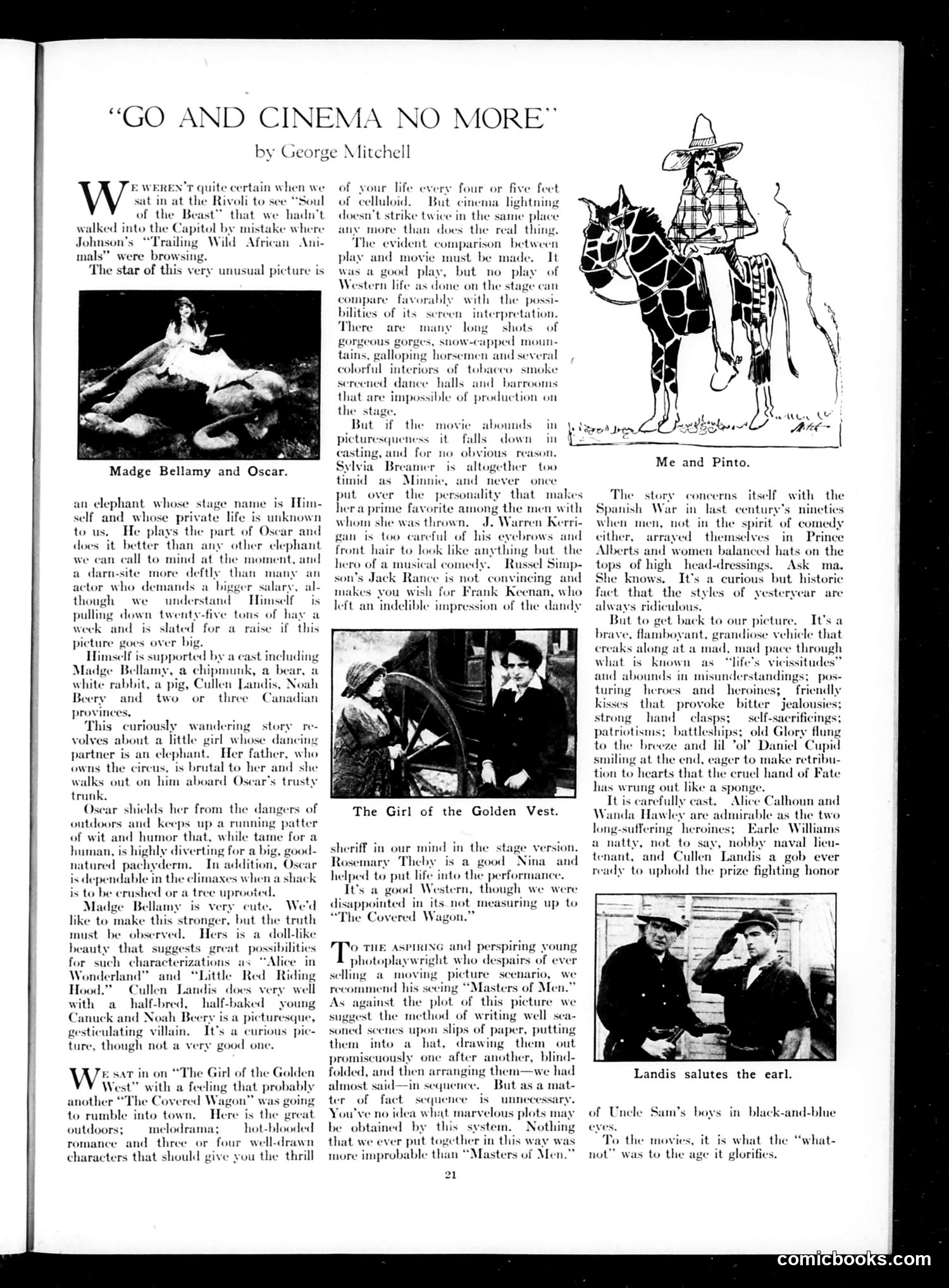
This page reviews three films from the silent era. The main critique concerns the contrast between stage and screen storytelling. **"Soul of the Beast"** stars actress Madge Bellamy alongside Oscar, an elephant playing a character named "Himself." The reviewer mocks the film's zoo-like quality, sardonically praising the elephant's performance while noting the absurdity of a circus melodrama. **"The Girl of the Golden West"** compares unfavorably to the stage play. The critic praises the film's visual spectacle—landscapes, action sequences impossible on stage—but attacks the casting choices. Sylvia Breamer as Minnie and J. Warren Kerrigan are criticized as insufficiently convincing, with Kerrigan too concerned with his appearance. The cartoonish illustration titled "Me and Pinto" appears to mock Western film conventions. The satire targets cinema's growing pains: critics felt movies relied on spectacle over nuanced performance, and that stage actors couldn't translate their craft to screen. This reflects 1920s debates about whether cinema was legitimate drama or mere novelty entertainment.
📄 Transcribed text from this page (OCR, searchable)
Machine-transcribed from the original scan — historical spelling and the odd misread are preserved.
“GO AND CINEMA 1! JO MORE” by George Mitchell E WEREN'T quite certain when we sat in at the Rivoli to see “Soul f the Beast” that we hadn't walked into the Capitol by mistake where Johnson's “Trailing Wild African Ani- mals” were browsing. ‘The star of this very unusual picture is Madge Bellamy and Oscar. an elephant whose stage name is Him- self and whose private life is unknown tous. He plays the part of Oscar and does it better than any other clephant we can call to mind at the moment, and arn-site more deftly than many an actor who demands a bigger salary, al- though understand Himself — is pulling down twent tons of hay a week and is slated for a if this picture goes over big. Himself is supported by a cast including Madge Bellamy, a chipmunk, a be: white rabbit, a pig, Cullen Landis, and two or three Canadian we raise This curiously wandering story re- volves about a little girl whose dancing partner is an clephant. Her father, who owns the circus, is brutal to her and she walks out on him aboard Osear’s trusty trunk. Oscar shields her from the dangers of outdoors and keeps up a running patter of wit and humor that, while tame for a human, is highly diverting for a big, good- natured pachyderm. In addition, Oscar is dependable in the climaxes when a shack is to be crushed or a tree uprooted. Madge Bellamy is very cute. We'd like to make this stronger, but the truth must be observed. Hers is a doll-like beauty that suggests great possibilities racteri ig, as “Alice in a and Jittle Red Riding Hood.” Cullen Landis does very well with a half-bred, half-baked young Canuck and Noah Beery is a picturesque, gesticulating villain, It's a curious pic- ture, though not a very good one. Wonde E sav in on “The Girl of the Golden West” with a feeling that probably another “The Covered W ” wa i to rumble into town. Here outdoors; melodrama; —_ hot-blooded romance and three or four well-drawn characters that should give you the thrill of your life every four or five feet of celluloid. But cinema lightning doesn’t strike twice in the same place any more than does the real thing. The evident comparison between play and movie must be made. It was a good play, but no play of Western life as done on the stage can compare favorably with t bilities of its screen interpretation. There are many long shots of gorgeous gorges, snow-capped moun- tains, galloping horsemen and several colorful interiors of tobacco” smoke sereened dance halls and barrooms that impossible of production on the stage. But if the movie abounds in picturesqueness it falls down in casting, and for no obvious reason. Sylvia’ Breamer is altogether too timid as Minnie, and never once put over the personality that makes hera prime favorite among the men with whom she was thrown, rren Kerri- gan is too careful of his eyebrows and front hair to look like anything but the hero of a musical comedy. Russel Simp- son’s Jack Rance is not convincing and makes you wish for Frank Keenan, who left an indelible impression of the dandy The Girl of the Golden Vest. sheriff in our mind in the stage version. 1 Rosemary Theby is a good Nina and helped to put life into the performance. It’s a good Western, though we were disappointed in its not measuring up to “The Covered Wagon.” T° THE ASPIRING and perspiring young photoplaywright who despairs of ever selling a moving picture Ay recommend his secing ‘Masters of } ainst the plot of this picture we t the method of writing well sea- enes upon slips of paper, putting into a hat, drawing them out after another, blind- ranging them—we had But mat- sequence is unne y You've no idea what marvelous plots may be obtained by this system. Nothing that we ever put together in this way was more improbable than “Masters of Men.” them promiscuously 0 folded, and then i almost said—in sequence. ter of t 21 Me and Pinto. The story concerns itself with the Spanish War in last century’s nineties when men, not in the spirit’ of comedy either, arrayed themselves in Prince Alberts and women balanced hats on the tops of high head-dressings. Ask ma. She knows. It’s a curious but historic fact that the styles of yesteryear are always ridiculous. But to get back to our picture. It’s a brave, flamboyant, hicle that creaks along at a mad, mad e through what is known as “life’s vicissitudes” and abounds in misunderstandings; pos- turing heroes and heroines; friendly kisses that provoke bitter jealousic strong hand clasps; self-sacrificings: patriotisms; battleships; old Glory flung to the breeze and lil ‘ol’ Daniel Cupid smiling at the end, eager to make retribu- tion to hearts that the cruel hand of Fate has wrung out like a spong It is carefully cast. Alice Calhoun and Wanda Hawley are admirable as the two long-suffering heroines; Earle Williams a natty, not to say, nobby naval lieu- tenant, and Cullen ndis a gob ever ready to uphold the prize fighting honor Landis salutes the earl. of Unele Sam’s boys in black-and-blue eyes. To the movies, it is what the “what- not” was to the age it glorifies.