
Judge, 1923-06-09 · page 24 of 36
Judge — June 9, 1923 — page 24: what you’re looking at
What you’re looking at
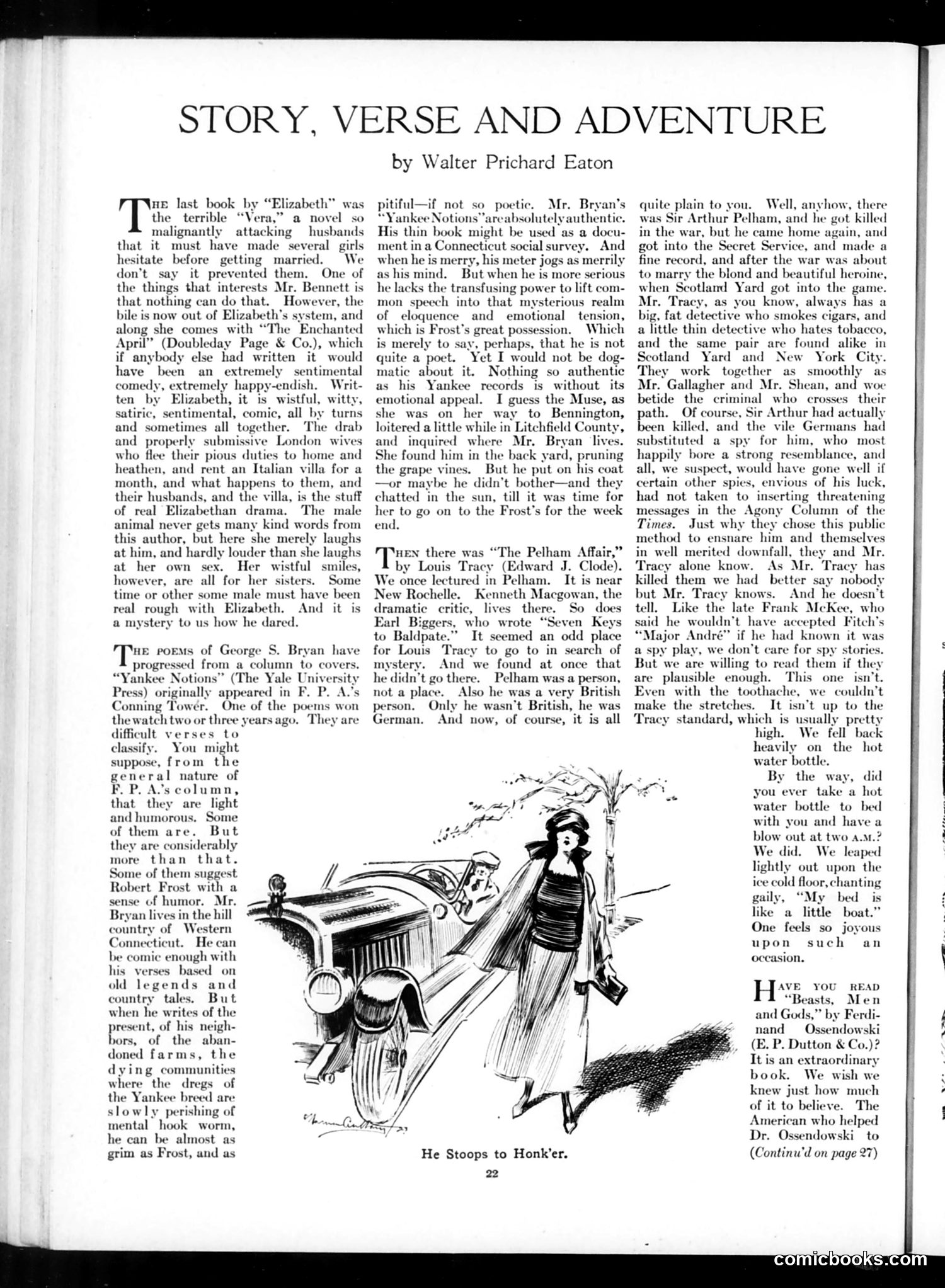
This is a literary review column by Walter Prichard Eaton discussing three books. The main illustration shows a man in period dress stopping his car to greet a woman—likely depicting a scene from "The Enchanted April." **Key content:** The reviews discuss "Elizabeth" (a pseudonymous female author) whose novel attacks husbands so viciously that Eaton jokes it might discourage marriage. Her new work, "The Enchanted April," features submissive London wives who escape to an Italian villa. George S. Bryan's poetry collection "Yankee Notions" receives measured praise—competent but lacking Robert Frost's transcendent power, though his depictions of declining Connecticut rural communities show authentic emotional appeal. Louis Tracy's mystery "The Pelham Affair" confuses readers by using a person's name (a German, not British) as its title rather than a place. The tone is sophisticated literary criticism mixed with gentle humor typical of Judge's educated readership—poking fun at both authors and readers' expectations of literature and marriage.
📄 Transcribed text from this page (OCR, searchable)
Machine-transcribed from the original scan — historical spelling and the odd misread are preserved.
HE last book by “Elizabeth” was the terrible “Ve a novel so malignantly attacking husbands that it must have made ral girls hesitate before getting married. We don’t say it prevented them. One of the things that interests Mr. Bennett is that nothing can do that. However, the bile is now out of Elizabeth's system, and along she comes with “The Enchanted April” (Doubleday Page & Co.), which if anybody else had written it would have been an extremely sentimental comedy, extremely happy-endish. Writ- ten by Elizabeth, it is wistful, witty, satiric, sentimental, comic, all by turns and sometimes all together. The drab and properly submissive London wives who flee their pious duties to home and heathen, and rent an Italian villa for a month, and what happens to them, and their husbands, and the villa, is the stuff of real Elizabethan drama. The male animal never gets many kind words from this author, but here she merely laughs at him, and hardly louder than she laughs at her own sex. Her wistful smiles, however, are all for her sisters. Some time or other some » must have been real rough with eth, And it is a mystery to us how he dared. T= poems of George S. Bryan have progressed from a column to covers. “Yankee Notions” (The Yale Universi Press) originally appeared in F. P. / Conning Towér. One of the poems won the watch two or three years ago. They are difficult verses to classify. You might suppose, from the general nature of F. P. A’s column, that they are light and humorous. Some of them are. But they are considerably more than that. Some of them suggest Robert Frost with a sense of humor. Mr. Bryan lives in the hill country of Western Connecticut. He can be comic enough with his verses based on old legends and country tal But when he writes of the present, of his neigh- bors, of the aban- doned farms, the dying communities where the dregs of the Yankee br slowly per ng of mental hook worm, he can be almost as grim as Frost, and as STORY, VERSE AND ADVENTURE by Walter Prichard Eaton poetic. Mr. Bryan's reabsolutely authentic. His thin book mike be used as a docu- ment in a Connecticut social surv And when he is merry, his meter jogs as merrily as his mind. But when he is more serious he lacks the transfusing power to lift com- mon speech into that mysterious realm of eloquence and emotional tension, which is Frost's great possession. Which is merely to say, perhaps, that he is not q a poet. Yet I would not be dog- matic about it. Nothing so authentic as his Yankee records is without its emotional appeal. I guess the Muse, as she was on her way to Bennington, loitered a little while in Litchfield County, and inquired where Mr. Bryan lives. She found him in the back yard, pruning the grape vines. But he put on his coat —or maybe he didn’t bother—and they chatted in the sun, till it was time for her to go on to the Frost's for the week end. pitiful—if not so “The Pelham Affair, by Louis Tr: (Edward J. Clode We once lectured in Pelham. It is near New Rochelle. Kenneth Macgowan, the dramatic cr lives there. So does Earl Biggers, who wrote “Seven Keys to Baldpate.” It seemed an odd place for Louis Tracy to go to in search of mystery. And we found at once that he didn’t go there. Pelham was a person, not a place. Also he was a very British person. Only he wasn’t British, he was German. And now, of course, it is all HEN there w: He Stoops to Honk’er. 22 quite plain to 5 Well, anyhow, tl was Sir Arthur Pelham, and he got kill > home in the war, but he car got into the Secret Ser nd made a fine record, and after the war was about to marry the blond and beautiful heroine, when Scotland Yard got into the game. Mr. Tracy, as you know, always has a big, fat detective who smokes cigars, and a little thin detective who hates tobacco, and the same pair are found alike in Scotland Yard and New York City. They work together as smoothly as Mr. Gallagher and Mr. Shean, and woe betide the criminal who crosses their path. Of course, Sir Arthur had actually been killed, and the vile Germans had substituted a spy for him, who most happily bore a strong resembl. and all, we suspect, would have gone well if tain other spies, envious of his luck, 1 not taken to inserting threatening ages in the Agony Column of the Times. Just why they chose this public method to ensnare him and the in well merited downfall, the Tracy alone know. As Mr. Tracy has killed them we had better say nobody but Mr. Tracy knov And he doesn’t tell. Like the late Frank McKee, who 1 he wouldn't have accepted Fitch's Major André” if he had known it was a spy play, we don't care for spy stories. But we are willing to read them if they are plausible enough. This one isn’t. Even with the toothache, we couldn't make the stretches. It isn’t up to the Tracy standard, which is usually pretty high. We fell back heavily on the hot water bottle. By the way, did you ever take a hot water bottle to bed with you and have a blow out at two a.m.? We did. We leaped lightly out upon the ic cold floor, ¢ ting >» “My bed is like a little boat.” One feels so joyous upon such an occasion. He YOU READ “Beasts, Me and Gods,” by Ferdi- nand — Ossendowski (E. P. Dutton & Co.)? It is an extraordinary book. We wish we knew just how much of it to believe. The American who helped Dr. Ossendowski to (Continu’d on page 27)