
A complete issue · 36 pages · 1923
Judge — June 2, 1923
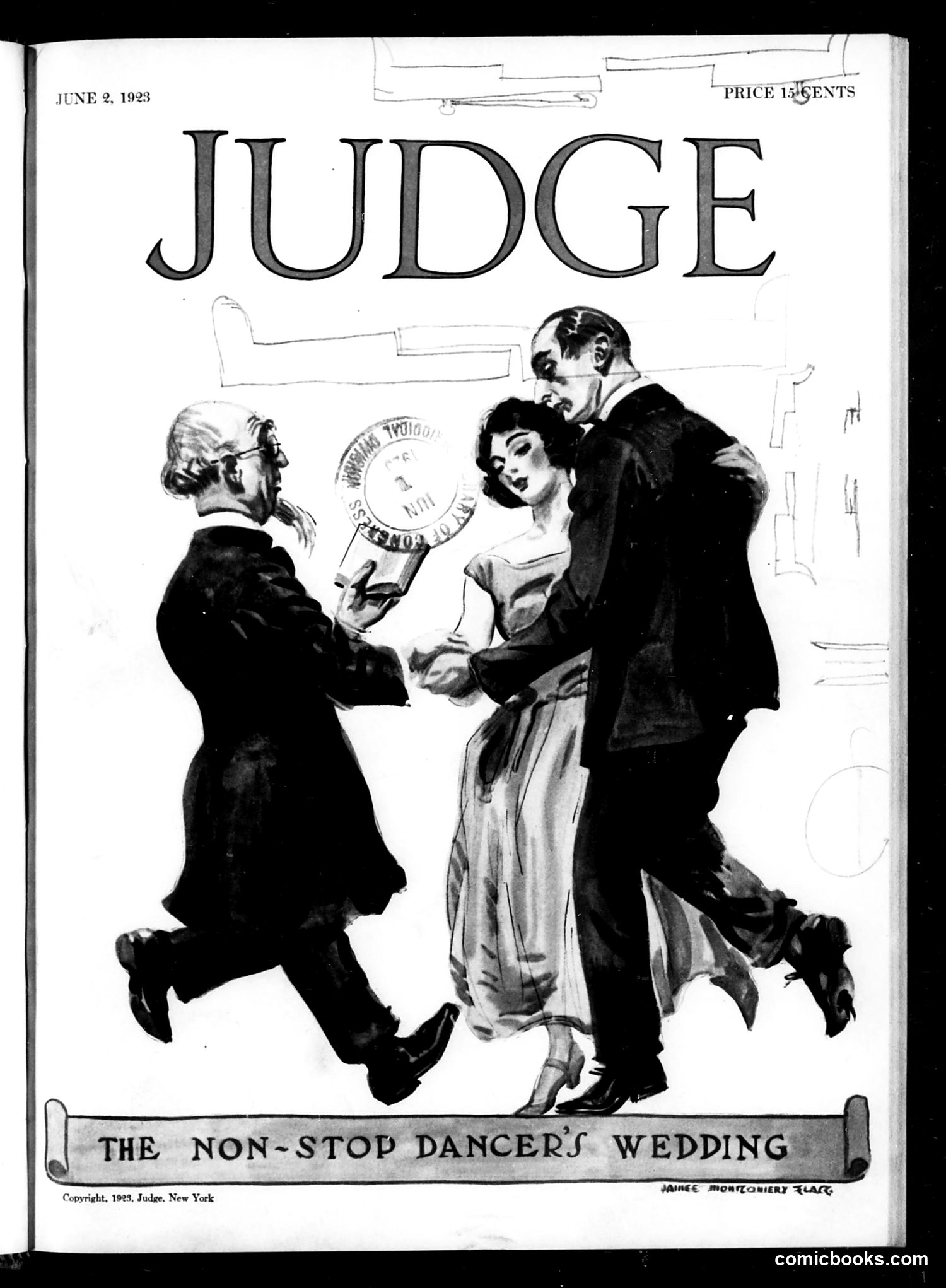
This Judge magazine cover from June 2, 1923 satirizes the "marathon dancing" craze of the 1920s—endurance dance competitions where contestants danced continuously for days or weeks, collapsing from exhaustion only when they could no longer continue. The cartoon depicts a wedding ceremony where the bride and groom cannot stop dancing, even during their own marriage vows. Two officials (likely a judge and clergy member) attempt to conduct the ceremony while the couple keeps dancing, suggesting the fad has become so consuming it has infiltrated even sacred social institutions. The satire mocks both the dancers' obsessive participation in dangerous fads and 1920s youth culture's reckless abandon during the Jazz Age.
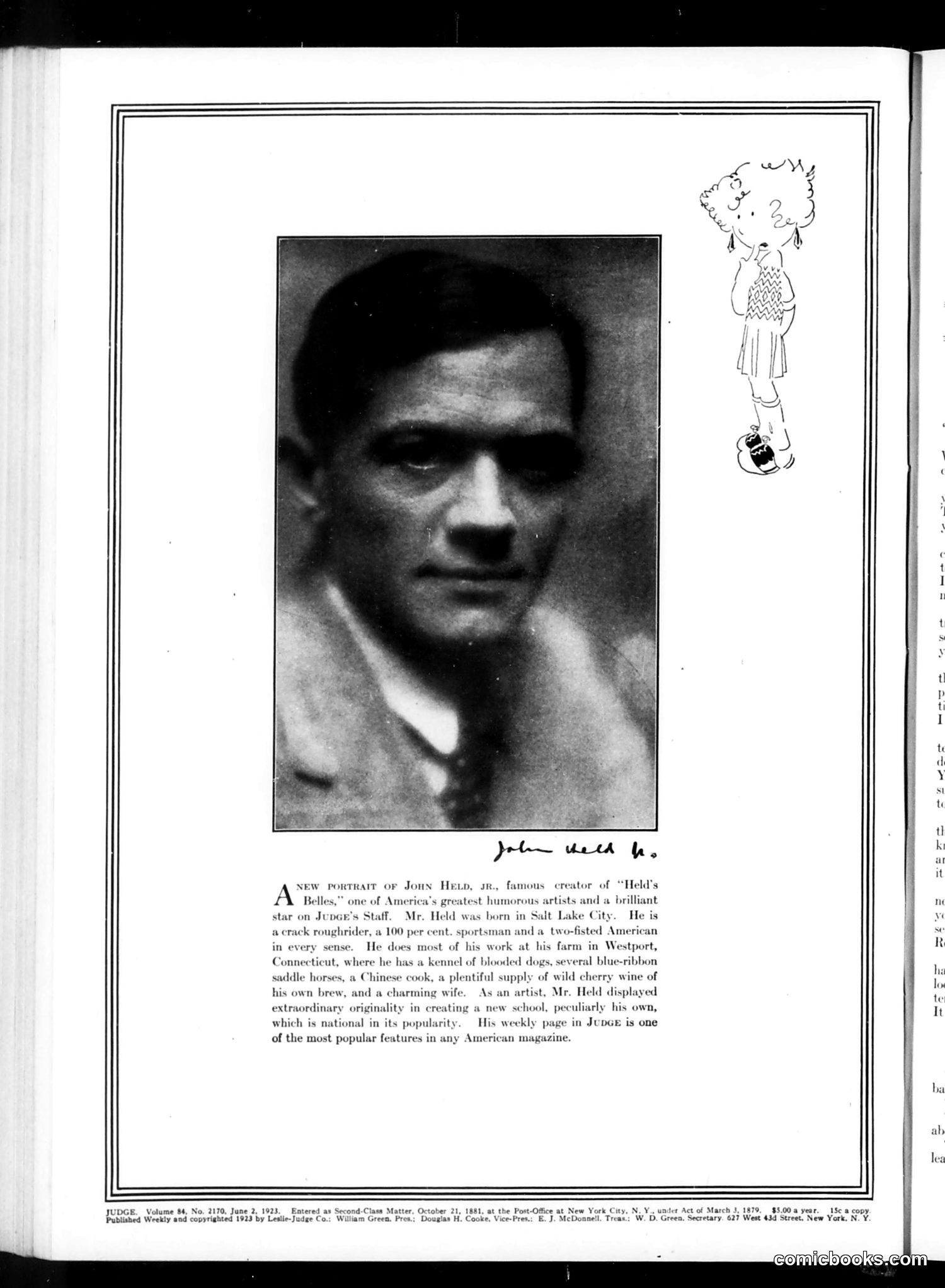
This page features a portrait and biographical note about **John Held Jr.**, famous creator of "Held's Belles"—cartoons appearing in *Judge* magazine. The text describes him as "one of America's greatest humorous artists" and notes his rural Connecticut farm lifestyle, sporting interests, and artistic innovations. The small cartoon on the right shows Held's signature style: a flapper figure with characteristic 1920s features (bobbed hair, short dress, cloche hat). This illustrates his most famous contribution to American visual culture—defining the visual aesthetic of the Jazz Age flapper. The page is essentially a **profile/advertisement** celebrating Held's work and popularity, not political satire. It demonstrates how *Judge* promoted its star contributors during the 1920s.
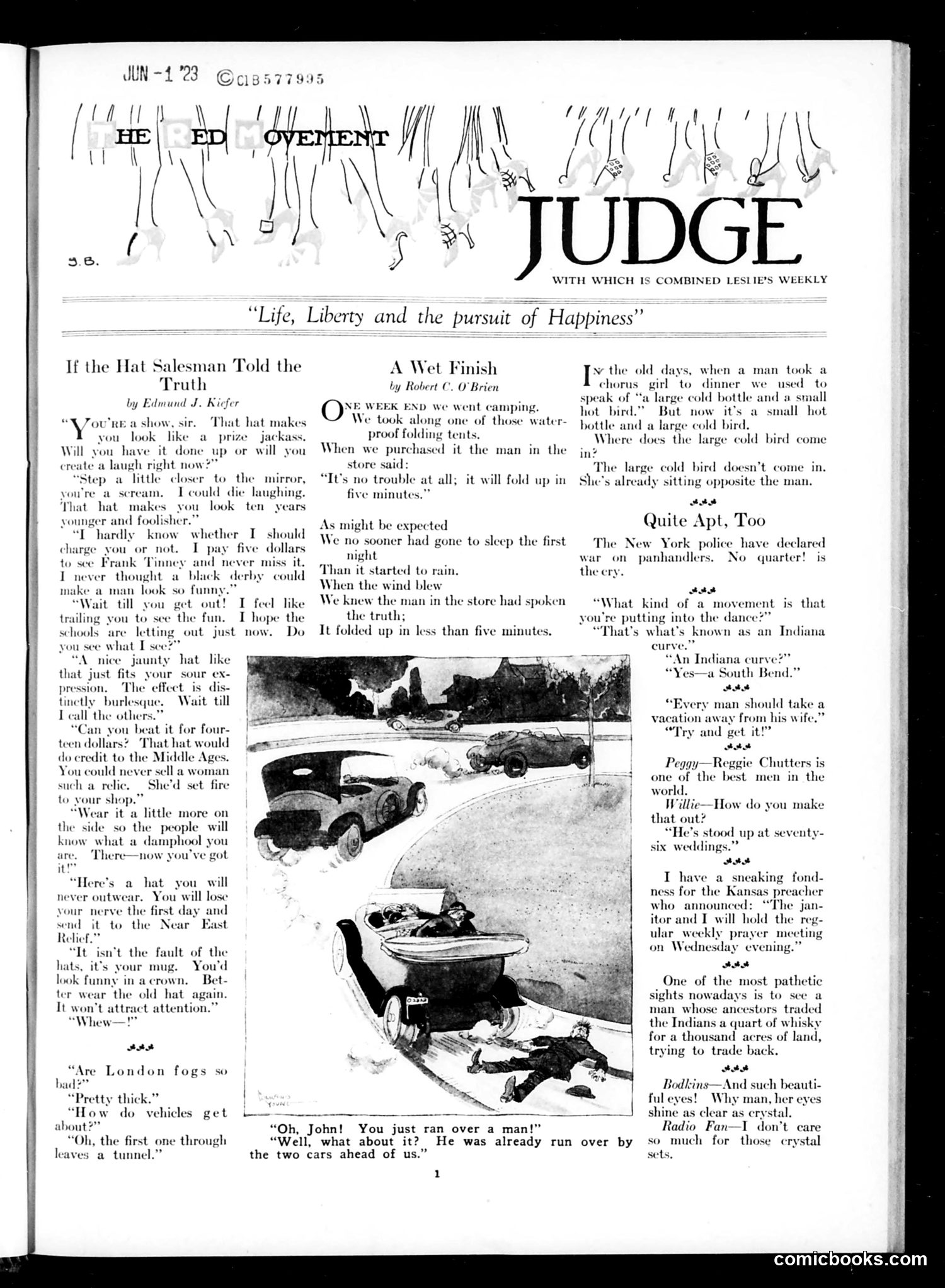
The central cartoon depicts a multi-car accident on a beach or sandy road. The caption reads: "Oh, John! You just ran over a man!" with the response "Well, what about it? He was already run over by the two cars ahead of us." This satirizes the dangerous, reckless driving conditions of the early 1920s automobile era. The joke's dark humor reflects public anxiety about automobiles as relatively new, unregulated vehicles driven without modern safety standards. The casual dismissal of hitting a pedestrian suggests both driver carelessness and society's shock at how casually traffic fatalities were treated. The surrounding text pieces are brief humor columns typical of Judge's satirical format, including jokes about camping, dance terminology, and marriage—unrelated to the cartoon's traffic safety commentary.
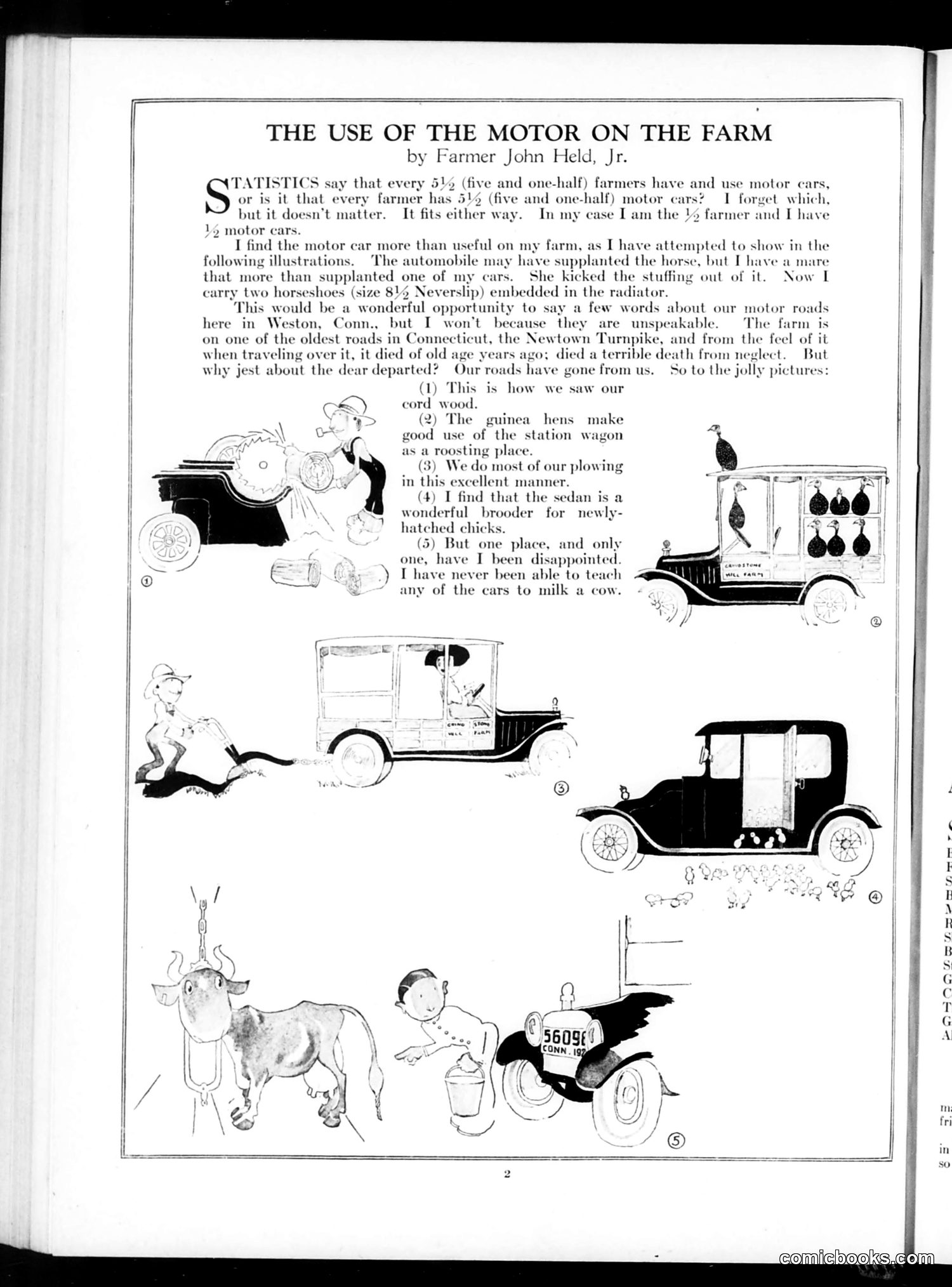
This satirical piece by Farmer John Held, Jr. humorously catalogs farming applications for automobiles. The six numbered illustrations show: (1) A car loaded with cord wood (2) Guinea hens roosting in a car serving as a mobile coop (3) A car used for plowing (4) A sedan as a brooder for chicks (5) A car failing at milking a cow (6) An auto replacing horse-drawn transport The satire mocks farmers' over-adoption of automobiles for unsuitable rural tasks. The text admits the car has "supplemented the horse, but I have a mare that more than supplemented one of my cars"—suggesting automobiles aren't the universal farm solution they're marketed as. The humor lies in the absurdity of motorized solutions to traditional agricultural work, poking fun at both agricultural modernization and automobile industry enthusiasm.
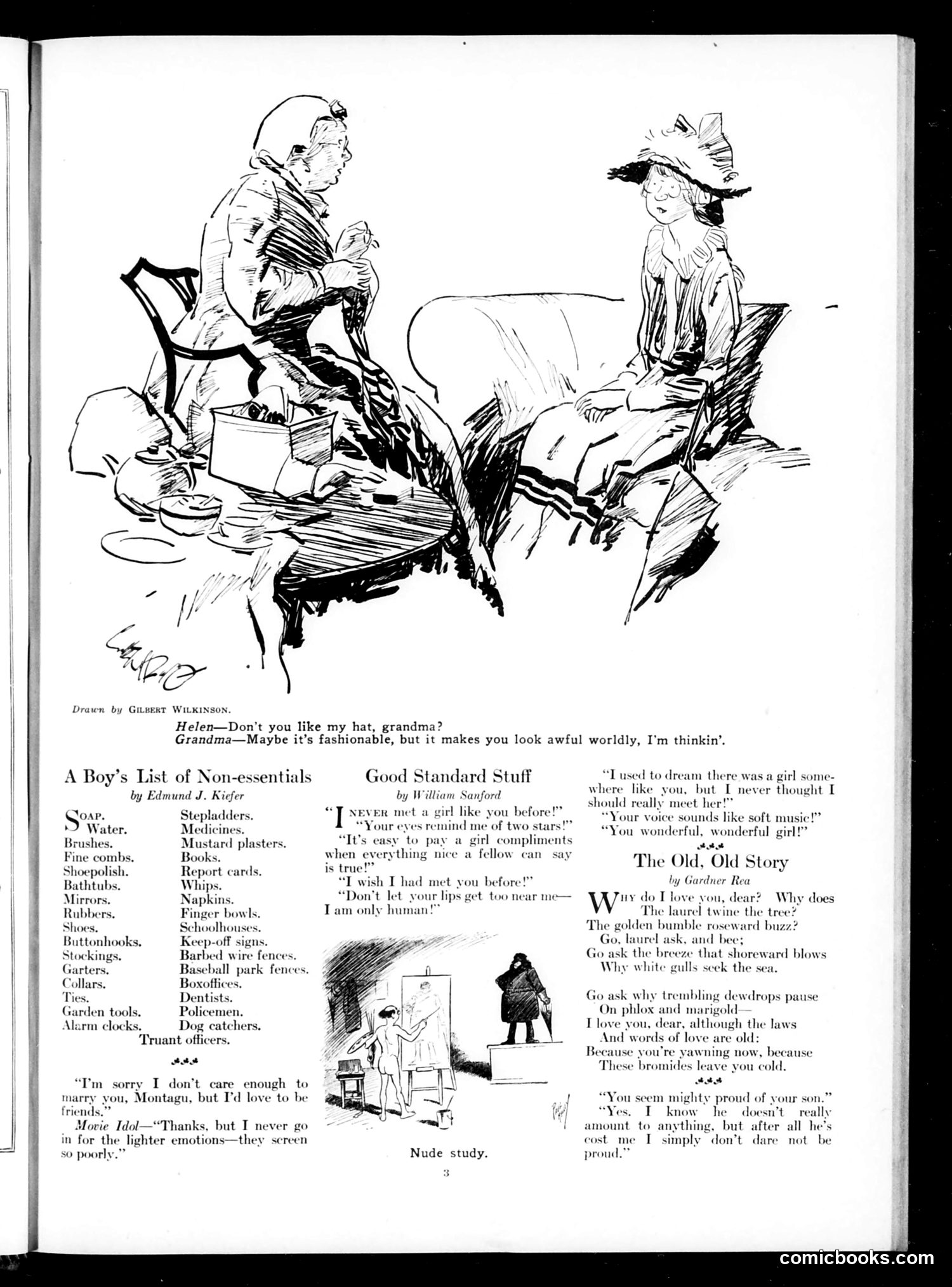
The top illustration by Gilbert Wilkinson depicts a domestic scene where a young girl (Helen) asks her grandmother about her hat's fashionability. The grandmother's response—that while fashionable, it makes her "look awful worldly"—satirizes generational tension over women's changing fashion standards in the early 20th century. "Worldly" carried moral disapproval, suggesting concern that modern fashions made women appear less demure or proper. The page primarily contains literary content: "A Boy's List of Non-essentials" humorously catalogs items deemed unnecessary (soap, water, brushes), poems like "Good Standard Stuff" and "The Old, Old Story," and a small illustration labeled "Nude study." This appears to be a typical Judge magazine page mixing visual humor with poetry and short prose.
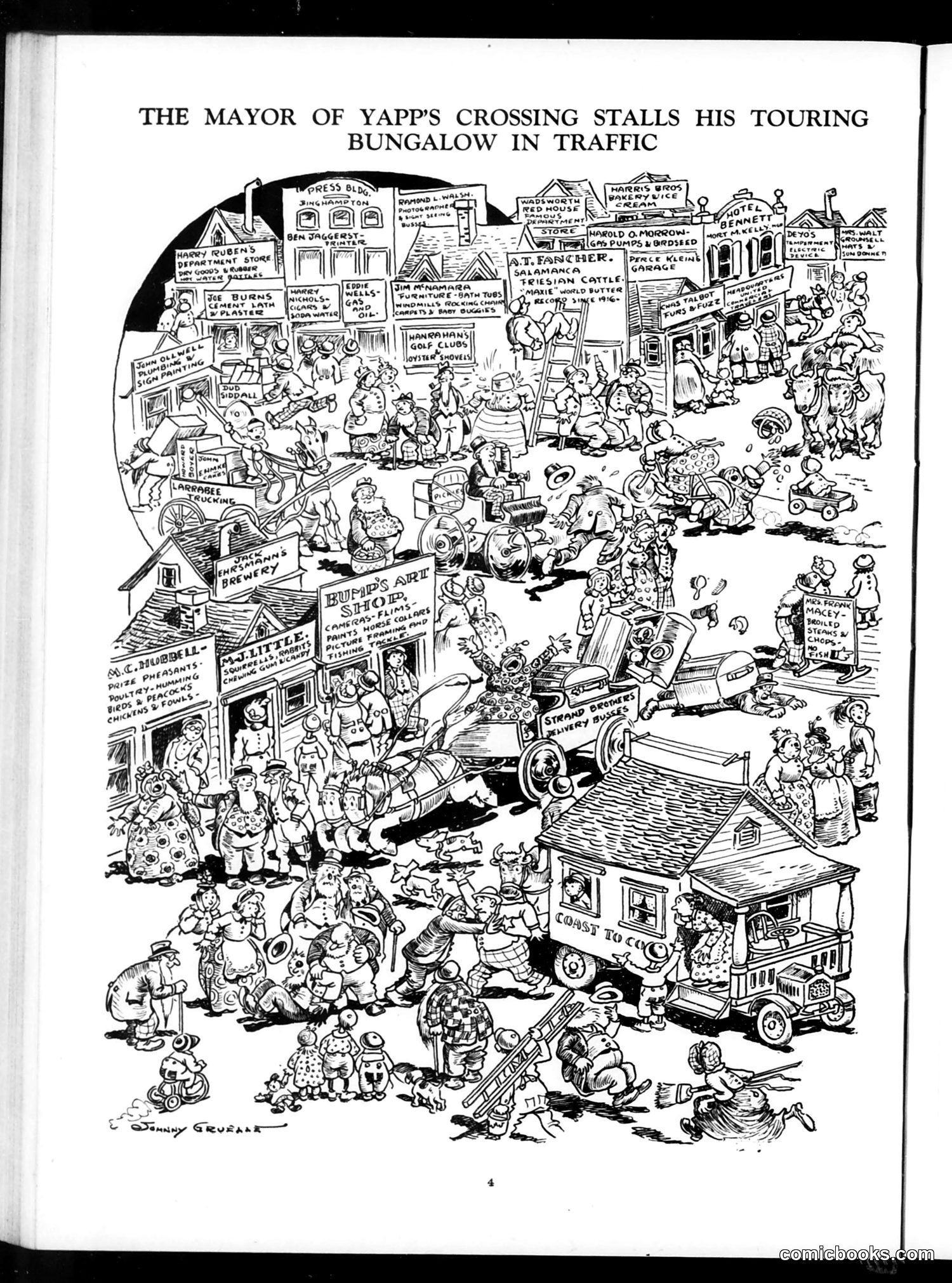
This is a satirical illustration depicting a chaotic traffic jam centered on a stalled touring bungalow—an early automobile-based mobile home. The cartoon mocks the emerging automotive culture of the early 20th century, showing how this newfangled vehicle has created massive congestion in what appears to be a small town or commercial district. The numerous labeled storefronts and businesses visible suggest the disruption extends across the entire community. The dense crowd of pedestrians, bicycles, and vehicles illustrates the collision between old and new transportation methods. The satire targets both the impracticality of early motor-homes and the traffic chaos automobiles were introducing to American towns during this period of rapid motorization.
This is a satirical piece mocking an unnamed presidential candidate's campaign tactics and philosophy. The humor operates on several levels: **The Campaign Strategy**: The candidate suggests shooting people at a rally to generate "pep"—he indiscriminately kills a banker, radical, League of Nations supporter/opponent, prohibitionist, bootlegger, Sunday school superintendent, and vice trust head. His wife coins the slogan "He plays no favorites," satirizing politicians' attempts to appear balanced. **Foreign Policy Absurdity**: When asked about a European revolution, the candidate promises to kill two American ministers for every foreign minister killed—using "logical argument" as justification. This mocks the era's crude geopolitical posturing. **Nepotism**: He casually admits his brother-in-law will be Treasury Secretary, declaring it a "business administration." The satire targets early-20th-century American political cynicism: campaign emptiness, violent extremism across ideologies, and corrupt cronyism presented without irony as competence.
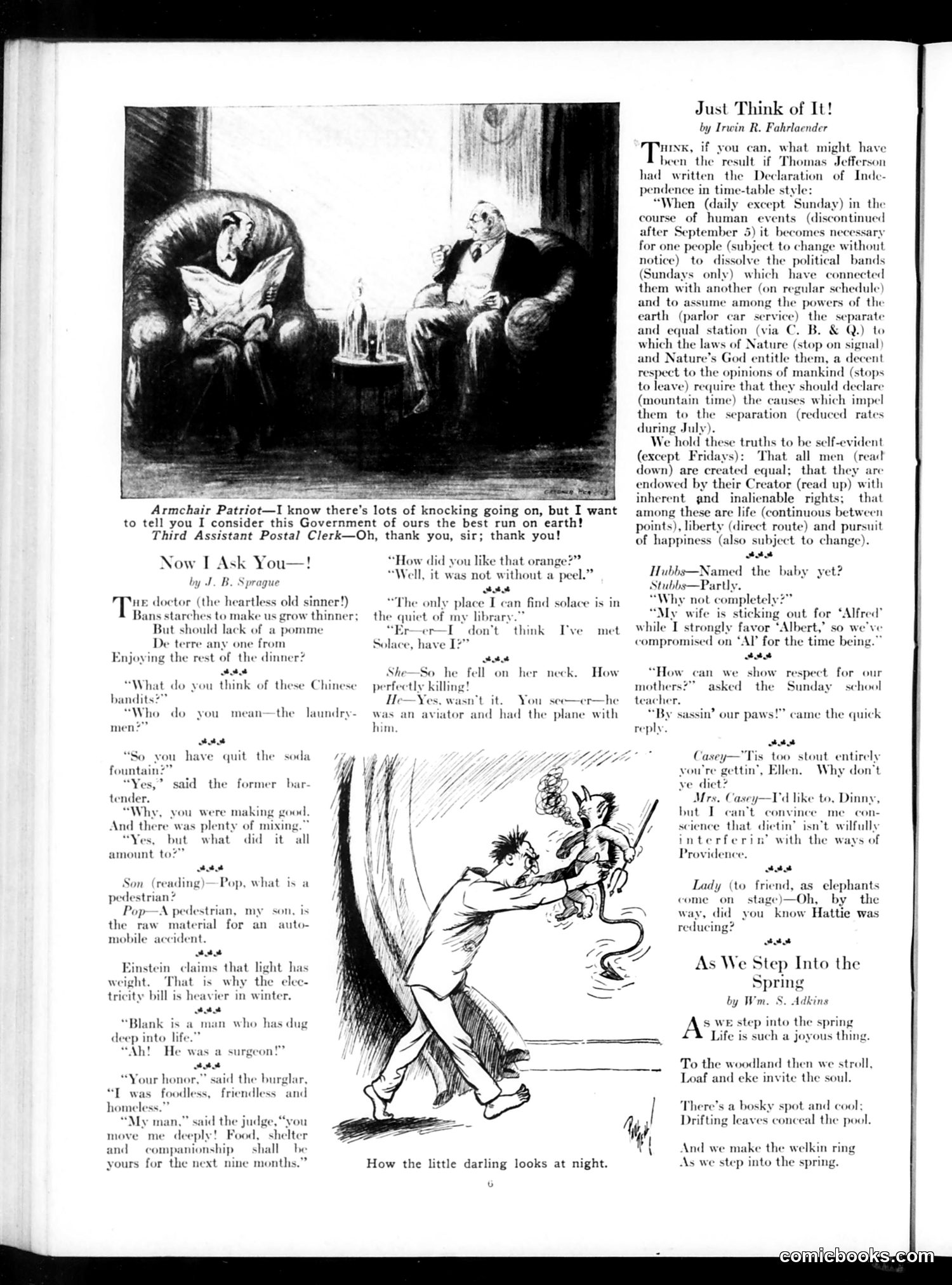
The page contains satirical humor and light social commentary typical of early 20th-century Judge magazine. The top cartoon, "Armchair Patriot," satirizes empty patriotism: a comfortable, well-dressed man boasts to a lowly postal clerk about America's government being "the best run on earth"—the joke being his smug confidence despite holding no real power or responsibility. "Now I Ask You—!" presents disconnected jokes mocking contemporary issues: a doctor restricting starches (health fads), confusion between Chinese immigrants and laundry workers (xenophobic humor), automobile accidents ("pedestrian" as "raw material"), and petty crime. These represent common subjects of period satire. "Just Think of It!" parodies Thomas Jefferson's Declaration of Independence reimagined as railroad timetable language—poking fun at both bureaucratic jargon and the commodification of American ideals through modern transportation advertising. The remaining sections offer domestic humor: marital compromises on baby names, dieting wives, and a spring poetry piece—light fare reflecting middle-class concerns rather than sharp political critique.
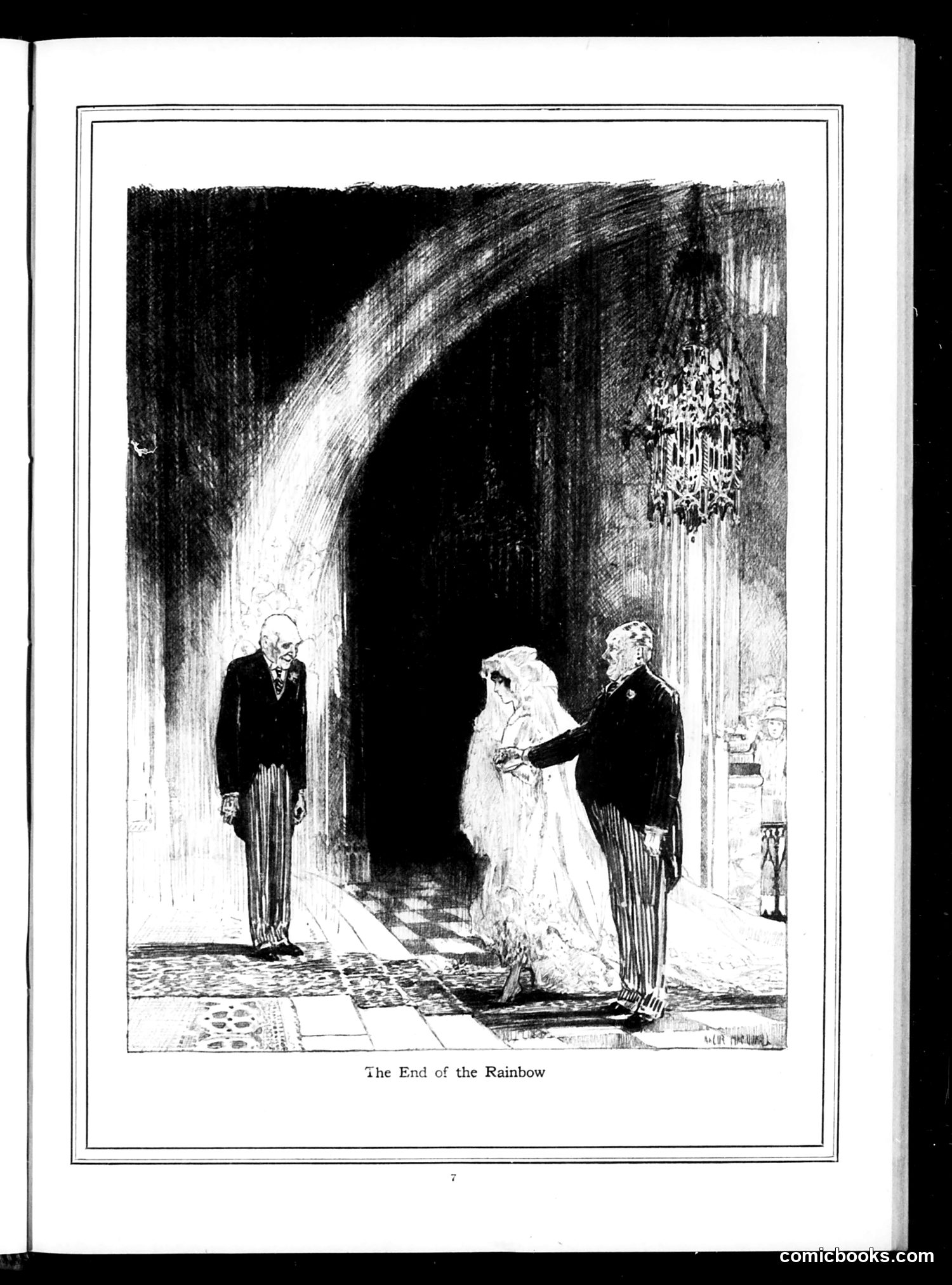
This satirical illustration depicts a wedding scene in what appears to be a grand interior with arched doorways. A bride in white stands between two older gentlemen in formal attire—one on each side appears to be presenting or discussing the bride as if she were a commodity or prize to be won. The title "The End of the Rainbow" suggests disillusionment with marriage, playing on the folk saying that finding a pot of gold at a rainbow's end represents achieving an impossible dream. Here, the "rainbow's end" reveals not treasure but marriage itself—depicted cynically as a transaction between men rather than a romantic union. The cartoon satirizes marriage as a mercenary arrangement controlled by men, mocking both the institution and societal expectations around matrimony in the era Judge magazine served.
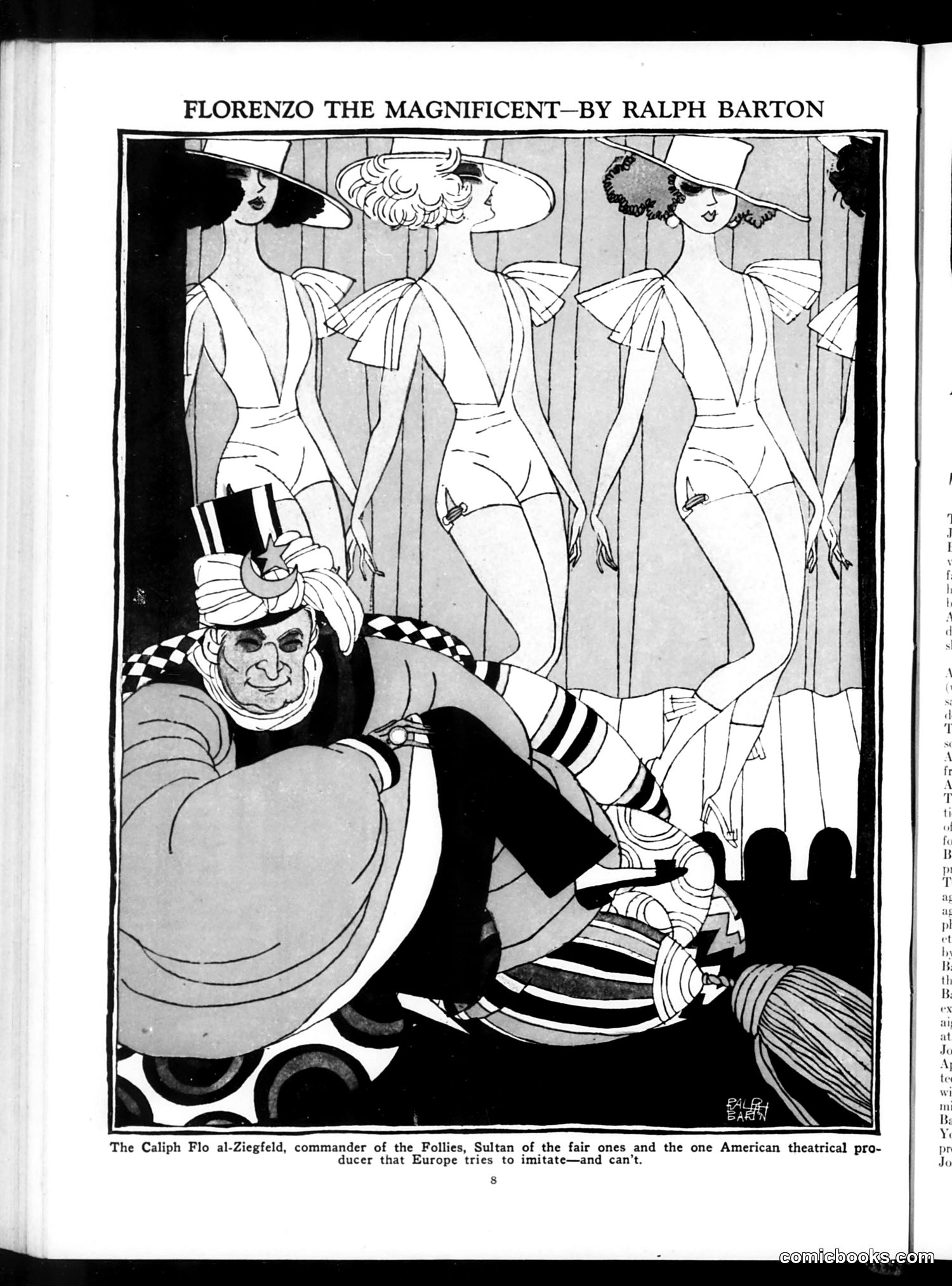
This illustration from Judge magazine depicts a theatrical impresario character named "The Caliph Flo al-Ziegfeld" - a satirical reference to **Florenz Ziegfeld**, the famous Broadway producer known for his elaborate "Follies" revues. The cartoon mocks Ziegfeld's showmanship through exaggeration: he's portrayed as an orientalist potentate with oversized features, surrounded by scantily-clad chorus girls in elaborate costumes and headdresses. The satire suggests Ziegfeld positioned himself as an exotic theatrical sultan commanding beautiful performers, while the caption critiques American theatrical production as merely imitating European spectacle without originality—a commentary on Jazz Age Broadway's commercial excess and cultural pretension.
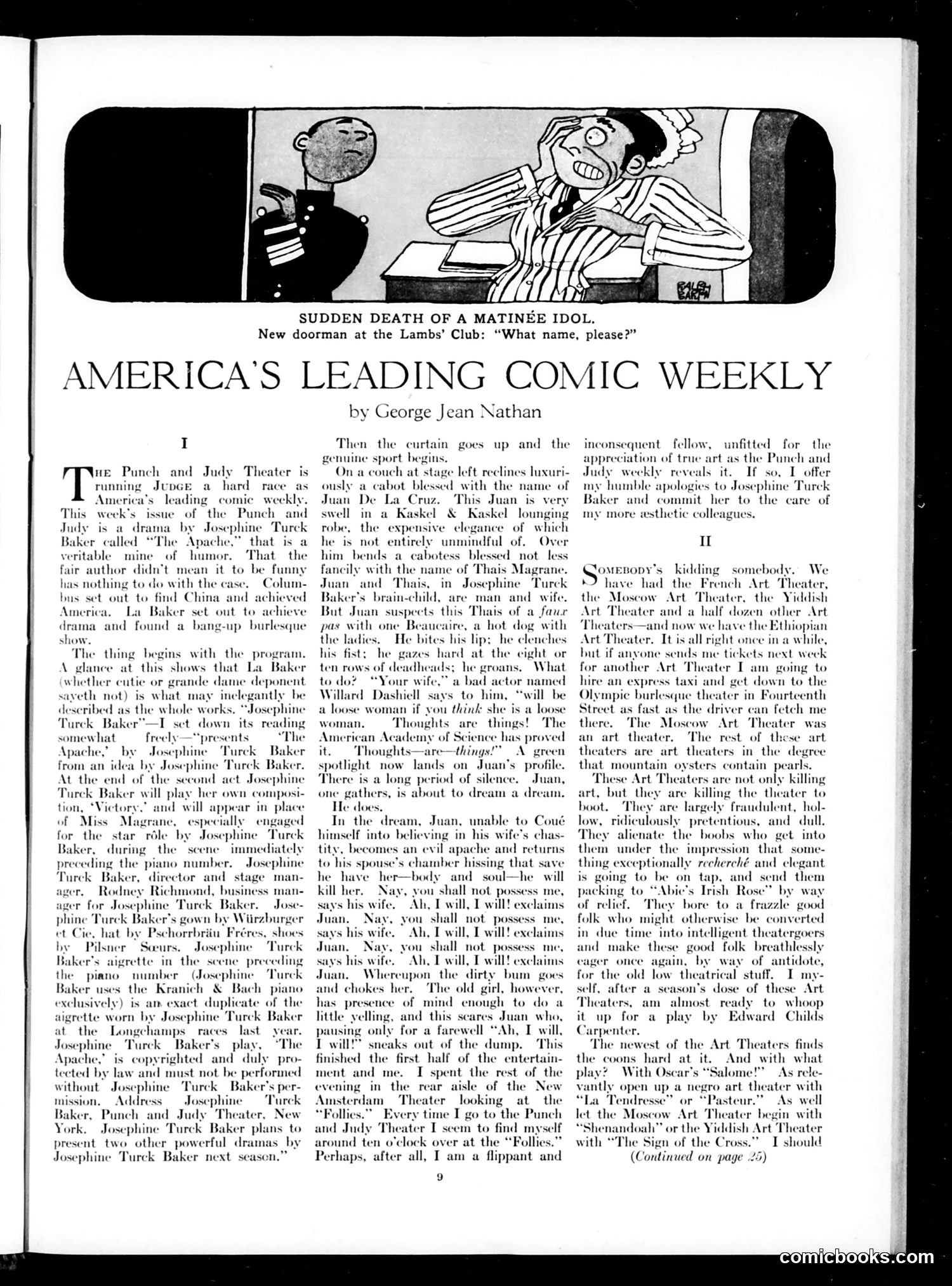
This cartoon satirizes **Josephine Turck Baker**, a dancer/performer of the 1920s, mocking her theatrical ambitions. The joke depicts a pompous military officer (likely representing a theatrical impresario or producer) asking the doorman at the Lambs' Club (a famous actors' club) to identify an unnamed corpse—suggesting Baker's dramatic debut was so bad it "killed" the audience or the theater itself. The accompanying article by George Jean Nathan viciously reviews Baker's play "The Apache," attacking both her acting and the production's narcissistic credits (listing her name repeatedly as writer, director, star, and composer). Nathan ridicules her overwrought performance and melodramatic plot about jealousy and violence. The satire emphasizes Judge magazine's contempt for Baker's pretensions to serious drama while highlighting the period's dismissive attitudes toward women performers attempting to control their own theatrical work.
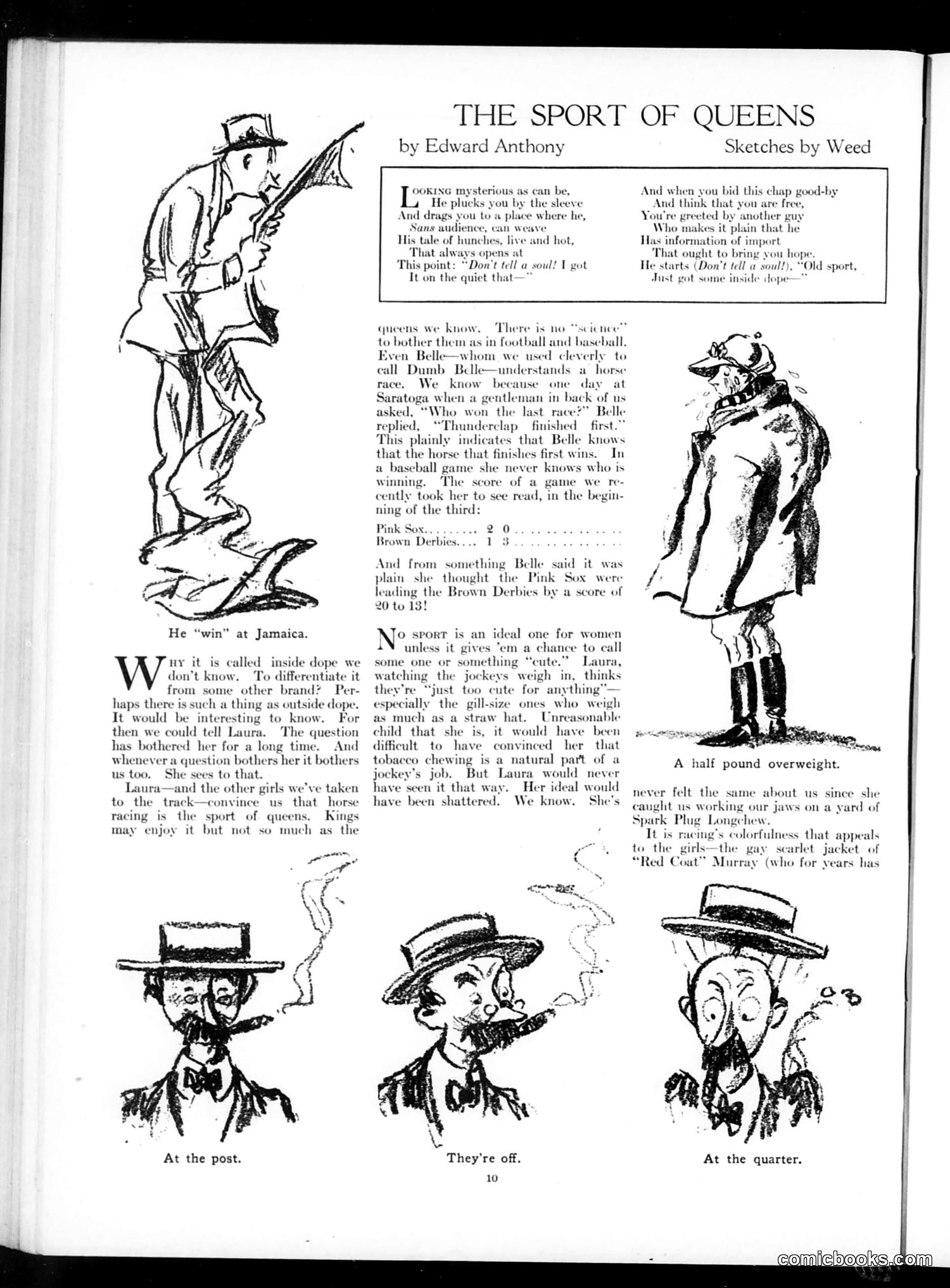
This article satirizes women's enthusiasm for horse racing, contrasting their emotional, aesthetic engagement with men's more analytical approach. The author follows several women ("Laura," "Belle," and others) to the racetrack, mocking their understanding of the sport. The satire centers on female irrationality: Belle demonstrates she grasps only that the first horse wins (not understanding game strategy like baseball), while Laura finds jockeys "too cute" and is scandalized by tobacco-chewing—valuing appearance over athletic reality. The three sketched figures at bottom ("At the post," "They're off," "At the quarter") appear to be racing officials or bettors, their expressions conveying the progression of a race. The core joke is that women enjoy racing not for its sport but for visual spectacle—colorful jackets, small attractive jockeys—and the social experience of being at the track. The piece gently ridicules feminine superficiality while acknowledging women's genuine interest in the sport, typical of 1910s-era gender commentary in *Judge*.
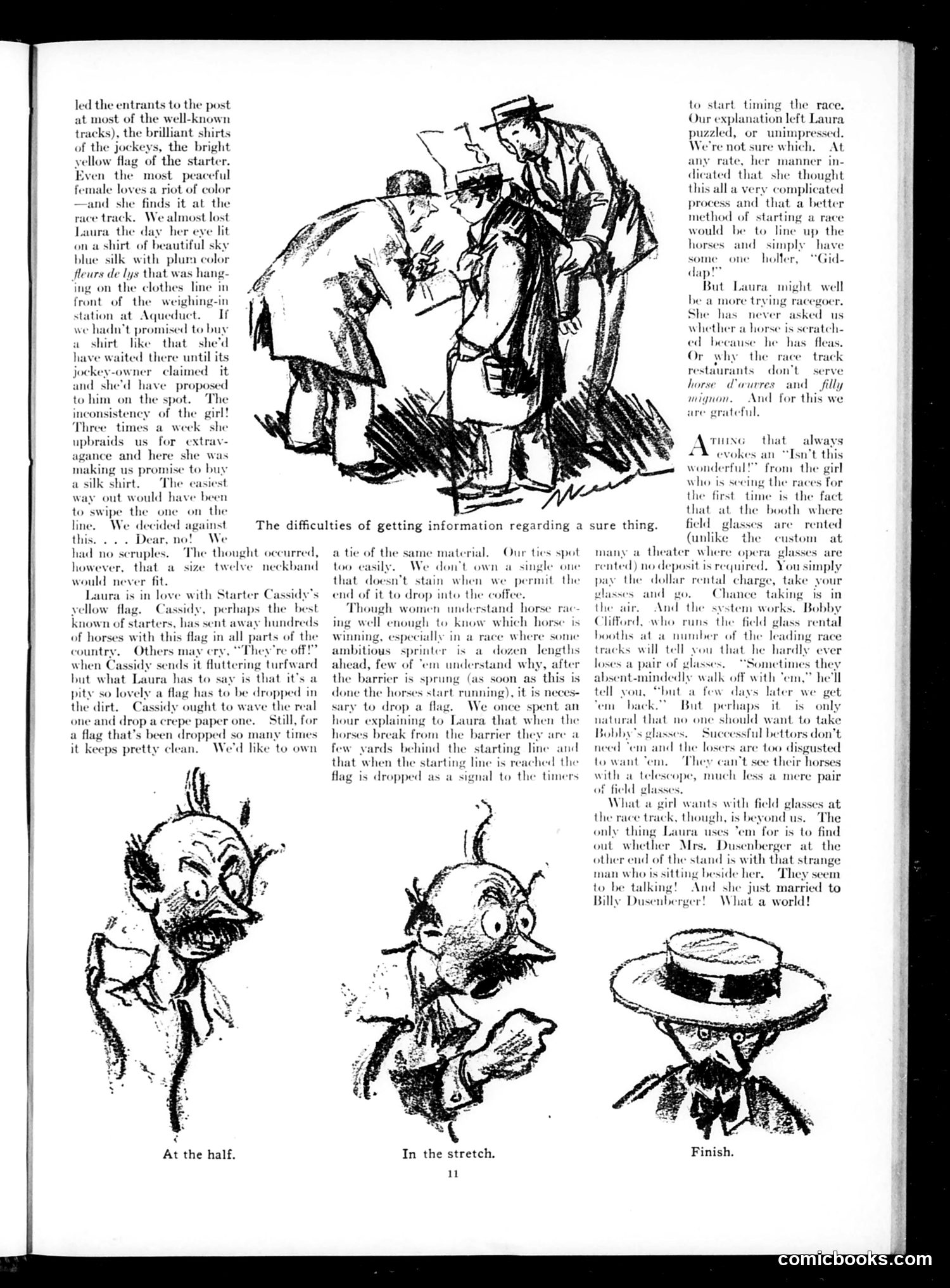
This page satirizes women's perspective on horse racing, particularly through the character Laura. The central joke is that while Laura loves the *aesthetic* elements of racing—jockeys' colorful shirts, the starter's yellow flag—she remains bewildered by its practical mechanics and rules. The humor stems from gender stereotypes of the era: Laura falls in love with Starter Cassidy's yellow flag (wanting to preserve it rather than see it dropped in dirt), questions illogical details (why drop a flag to signal timers?), and asks absurd questions (whether horses are scratched due to fleas, why track restaurants don't serve "filly mignon"). The cartoons at bottom ("At the half," "In the stretch," "Finish") appear to show comic facial expressions, likely illustrating reactions to racing outcomes. The satire gently mocks both female racegoers' naïveté about racing and the condescending male attitude toward women's participation in the sport.
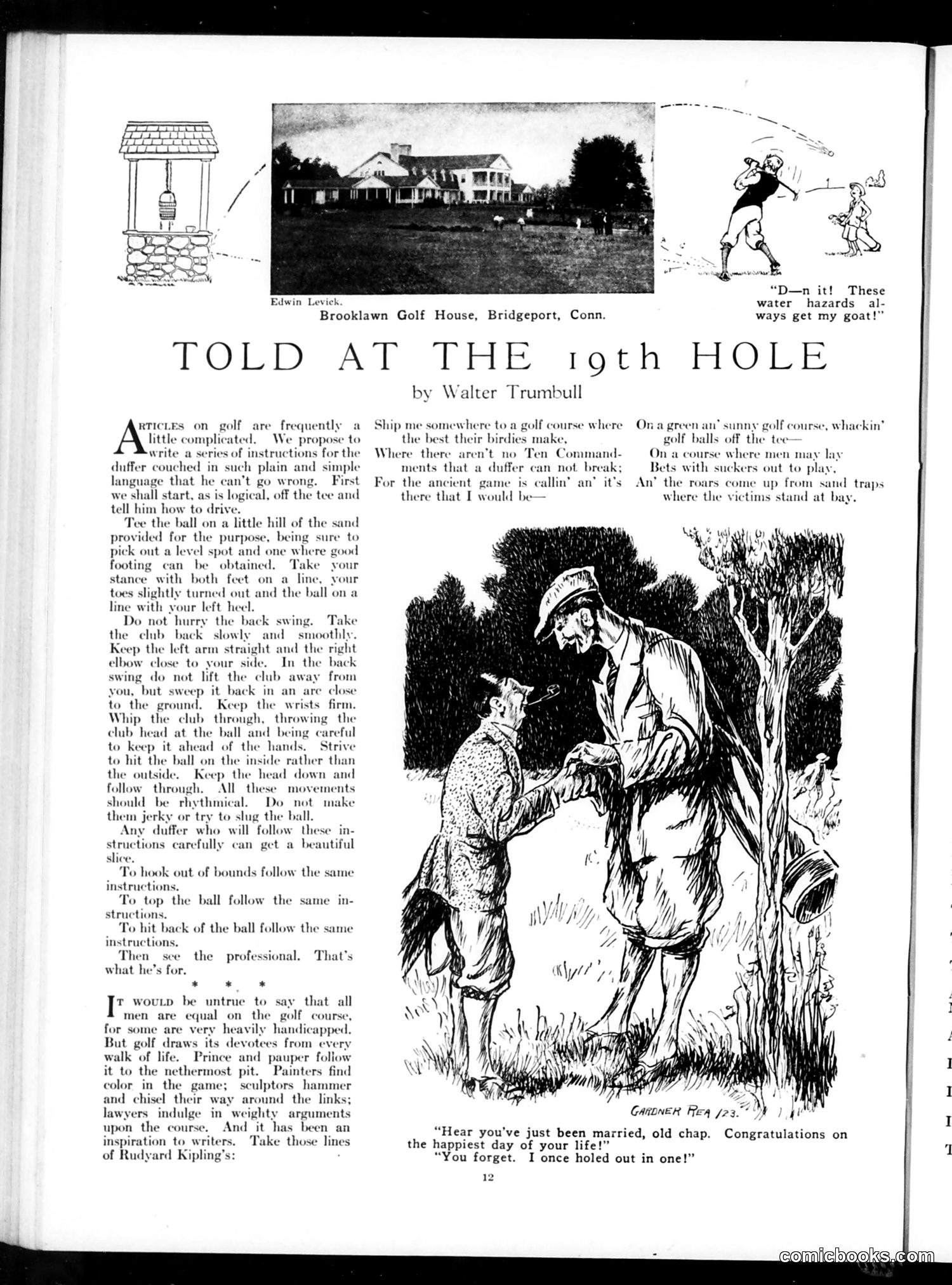
This is a humorous instructional article about golf by Walter Trumbull, accompanied by satirical cartoons and verse. The main satire operates on multiple levels: **The Instructions Satire**: The article purports to teach golf fundamentals in "plain and simple language," but the advice is deliberately circular and absurd—instructions for achieving a "beautiful slice" (a bad shot) or hooking "out of bounds." This mocks both overly complicated golf instruction manuals and the duffer's inevitable failure regardless of technique. **The Verse Parody**: A mock-Kipling poem mimics the adventurous, romantic tone of Rudyard Kipling's work, but applies it absurdly to golf—treating the game with mock-epic seriousness, as if it were adventure on distant lands. **The Bottom Cartoon**: Shows a newly married man told his wedding was "the happiest day of your life," but he corrects this—claiming his hole-in-one was superior. This satirizes golfers' obsessive priorities and the humorous inversion of normal values (marriage vs. golf achievement). The overall message: golfers are comically obsessed, their game is absurdly difficult, and instruction is futile.
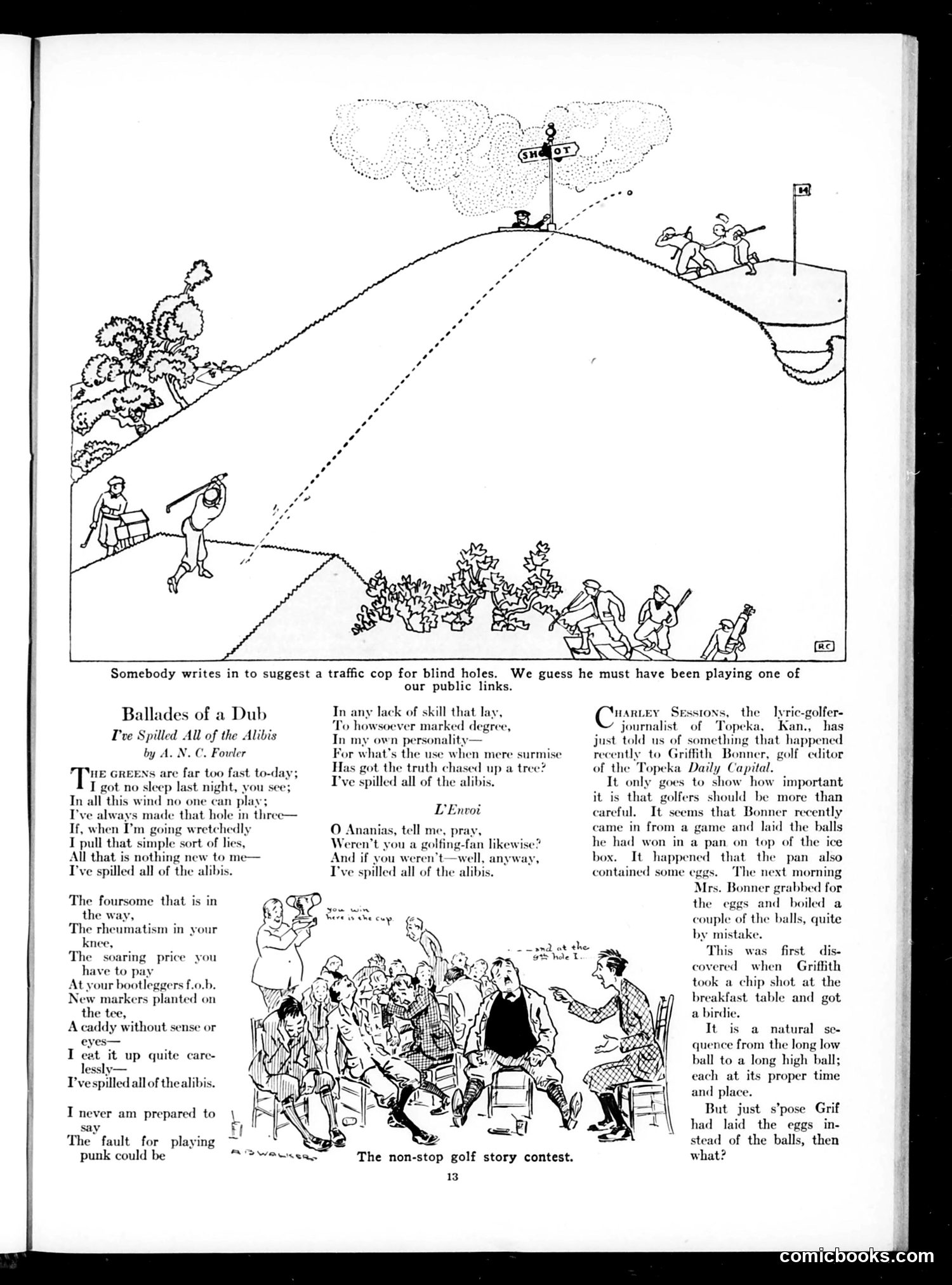
This Judge magazine page satirizes golfers' excuses. The poem "Ballades of a Dub" mocks players who blame external factors—poor greens, wind, caddies, bootleg equipment prices—rather than admitting lack of skill. The repeated refrain "I've spilled all of the alibis" suggests the speaker has exhausted every possible excuse. The accompanying cartoon shows a golf story contest, likely playing on the popularity of golf anecdotes in the era. The sidebar story about Griffith Bonner (a real Topeka newspaper golf columnist) humorously illustrates the absurdity of golf obsession: Bonner boiled golf balls instead of eggs because he'd carelessly stored his winnings in a kitchen pan. The final rhetorical question—"what if he'd boiled the eggs instead?"—extends the joke, suggesting such accidents are inevitable given golfers' single-minded preoccupation with the sport. The satire targets both golfer culture and American society's apparent golf mania during this period.
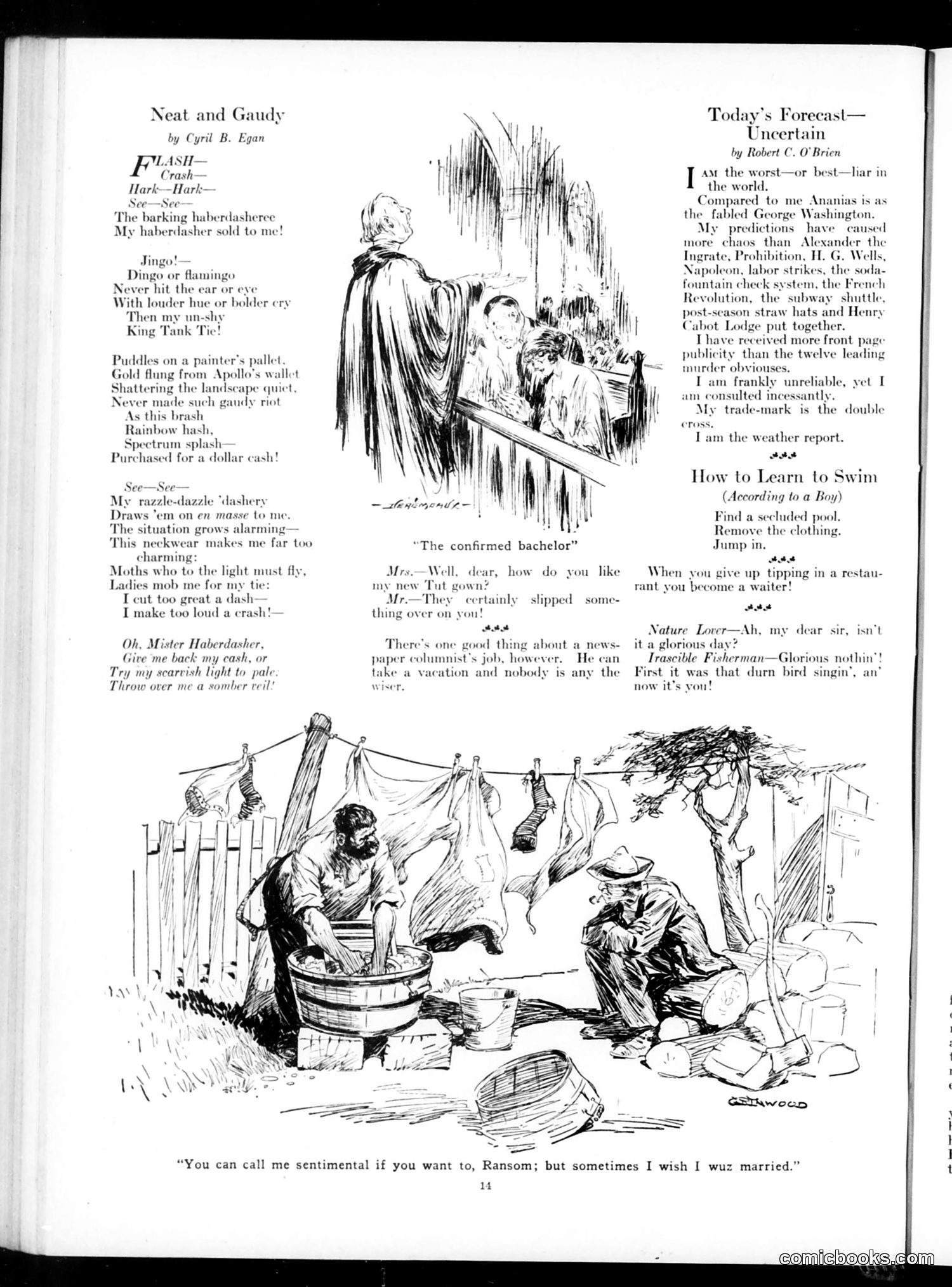
**"Neat and Gaudy"** (poem by Cyril B. Egan): Satirizes ostentatious consumerism, specifically a man who purchases a garishly colorful necktie for a dollar. The poem mocks how this "razzle-dazzle" accessory attracts excessive attention from women ("Ladies mob me"), turning the wearer into an unwilling spectacle. The satire targets both the tackiness of cheap, loud fashion and the vanity of displaying wealth through bold purchases. **"The Confirmed Bachelor"** (cartoon): A wife comments on her new dress styled like King Tut's fashion. The husband's response—"they certainly slipped something over on you"—is a double entendre suggesting she was tricked or overcharged. The joke satirizes both marital dynamics and perhaps 1920s fashion trends imitating Egyptian styles (reflecting post-Tutankhamun discovery popularity). **"Today's Forecast—Uncertain"** (by Robert C. O'Brien): A self-aware parody where a weather forecaster confesses to being chronically inaccurate and unreliable, yet consulted constantly. The humor comes from honest admission of professional incompetence—a mild jab at meteorology's predictability failures.
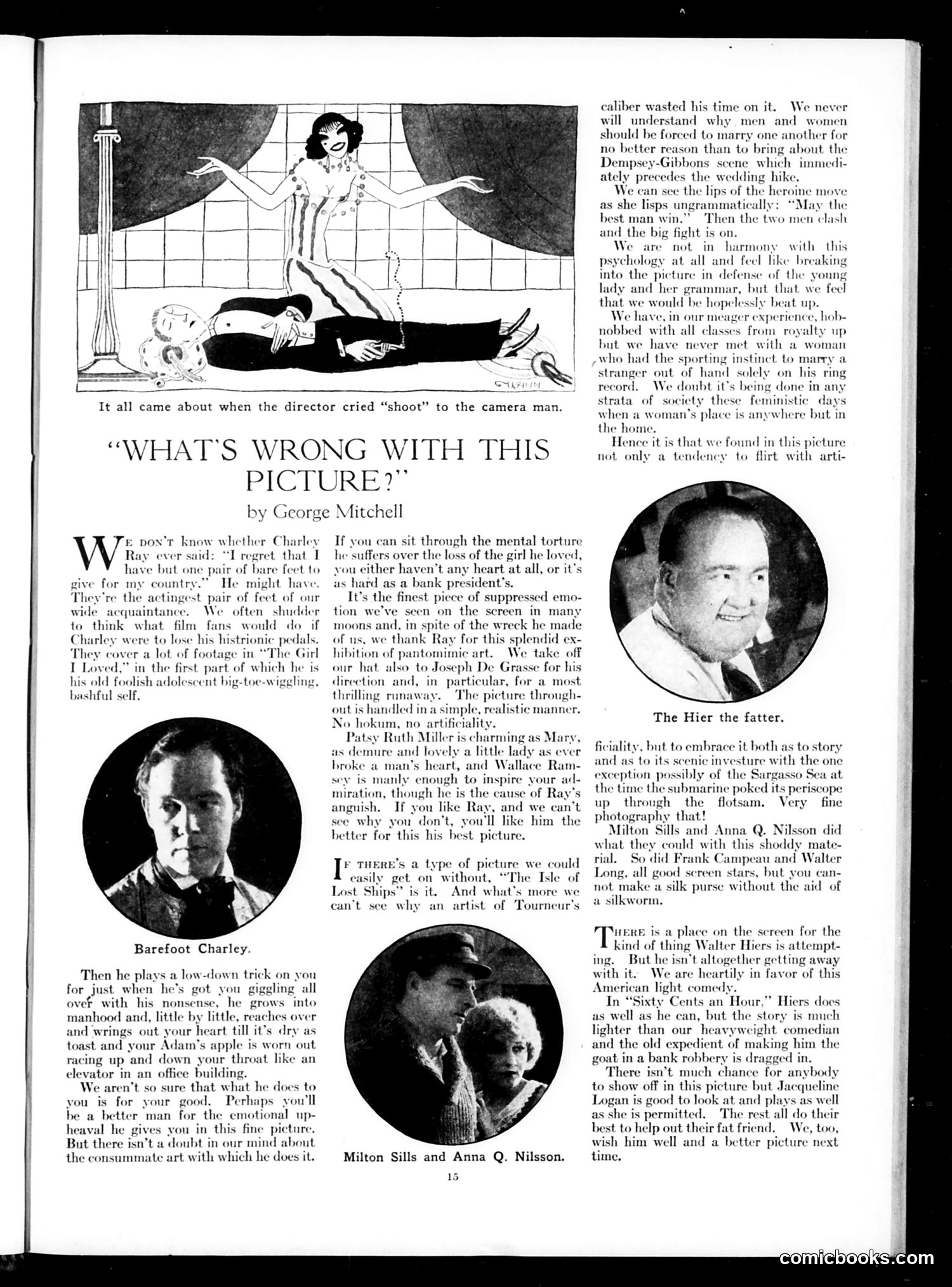
This page reviews three silent films. The main critique concerns "The Isle of Lost Ships," which the author attacks for its implausible plot device: a woman agrees to marry whichever of two men wins a fight between them—presented as romantic rather than absurd. The satirical point targets both the film's logic and contemporary "feminist days" attitudes about women's roles. The author sarcastically questions why any woman would marry a stranger based solely on "his ring record" (boxing credentials), suggesting this violates both common sense and propriety. He criticizes the filmmakers for endorsing this psychology, though he acknowledges the actors (Milton Sills, Anna Q. Nilsson, Frank Campeau, Walter Long) did their best with poor material. By contrast, "The Girl I Loved" with Charley Ray receives high praise for authentic emotional depth and pantomime work. The page also includes headshots of the actors discussed, typical of entertainment journalism from this era.
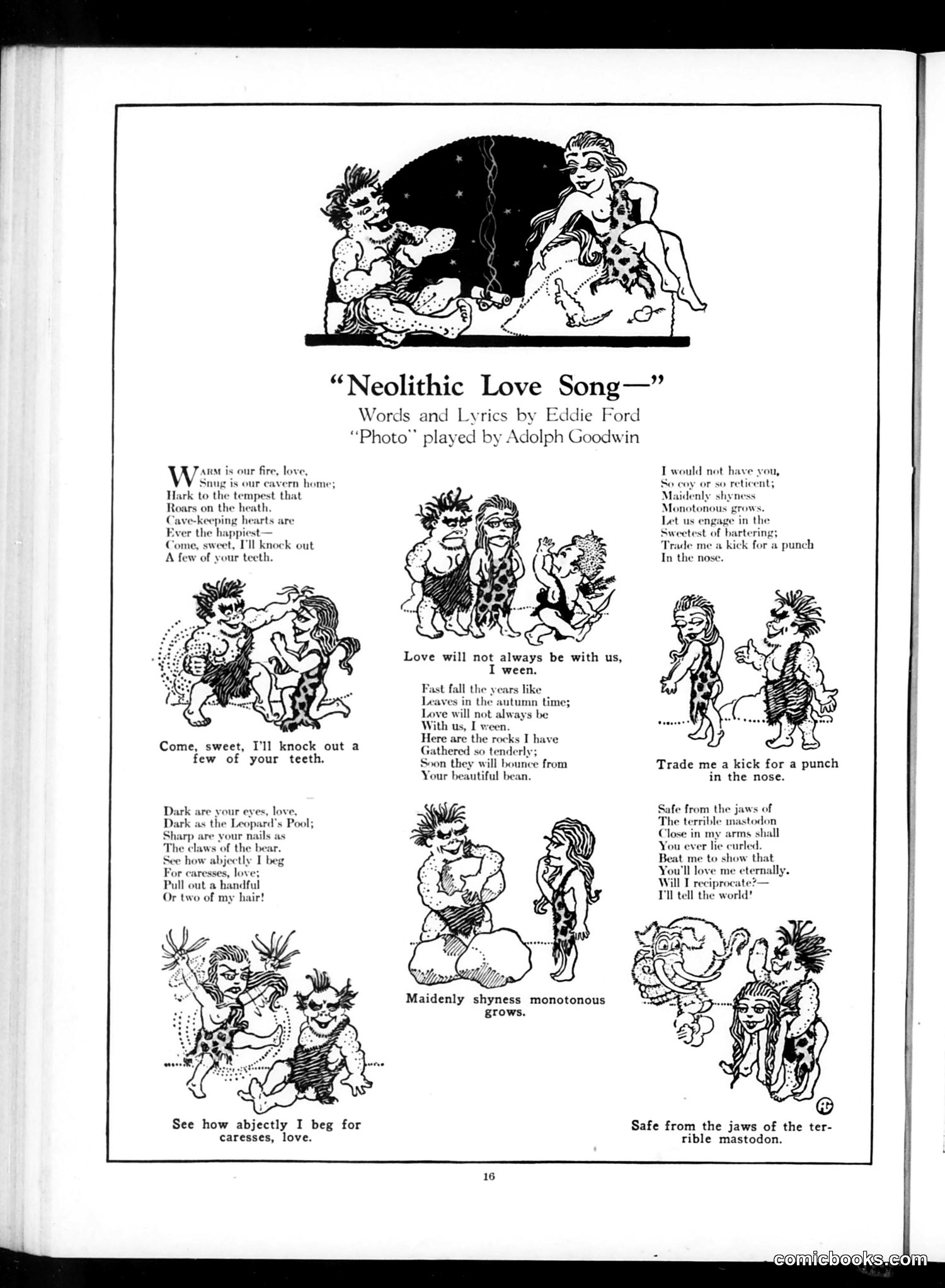
This is a humorous parody of romantic love songs, recast as a "primitive" courtship between cavemen and cavewomen. The satire mocks the overwrought sentimentality of contemporary popular love ballads by literalizing them in a prehistoric setting. The joke operates on several levels: romantic clichés ("dark eyes," "sharp nails," "caresses") become violent and crude when attributed to stone-age figures. Lines like "I'll knock out a few of your teeth" and "trade me a kick for a punch in the nose" absurdly substitute brutality for tenderness. The woman's "maidenly shyness" becoming "monotonous" suggests tedium with affected feminine modesty. By setting this in the Neolithic period, the cartoon implies that such saccharine love songs are primitive and unsophisticated—that modern audiences are being entertained by essentially caveman-level sentimentality. The illustrations of crude, violent "lovers" reinforce this mockery of popular romantic culture.
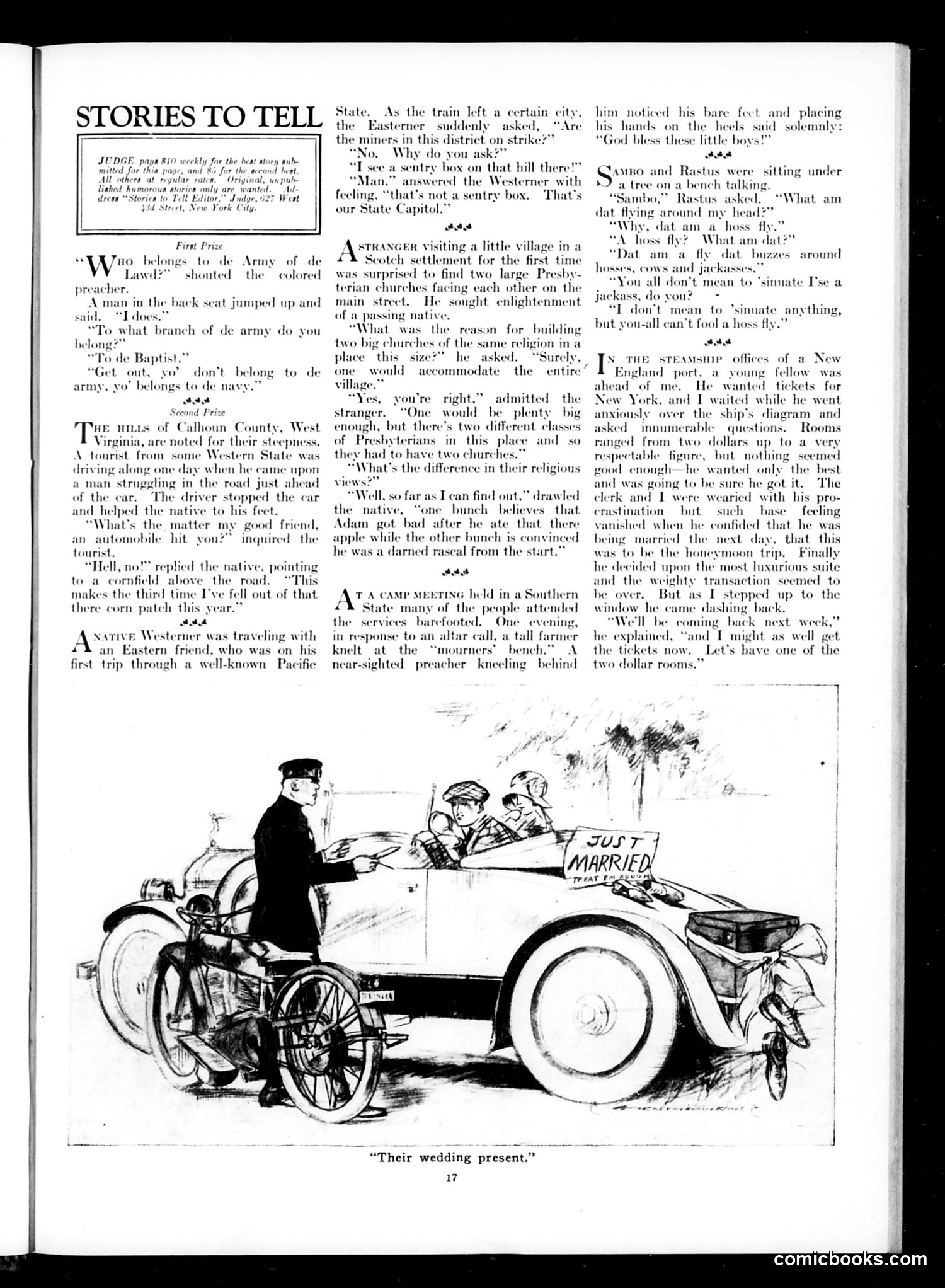
This page collects brief humorous anecdotes typical of early 20th-century American humor magazines. The jokes rely on ethnic and regional stereotypes common to the era: **Main cartoon** ("Their wedding present"): Shows a man on a motorcycle presenting a newlywed couple in a car with the motorcycle as a gift—the humor lies in the contrast between the modest motorcycle and the expectation of an expensive wedding present. **Text stories** include dialect humor based on African American vernacular ("de Baptist" instead of "the Baptist"), rural Southern ignorance (a man repeatedly falling into a cornfield), Scottish thrift and religious pedantry, and the confusion of a bride-groom mistaking a preacher's blessing directed at barefoot worshippers as blessing "boys." The final anecdote plays on a newlywed's obsessive honeymoon planning. These represent period-typical satirical humor targeting perceived character flaws of specific groups—now recognized as relying on offensive stereotypes rather than genuine wit.
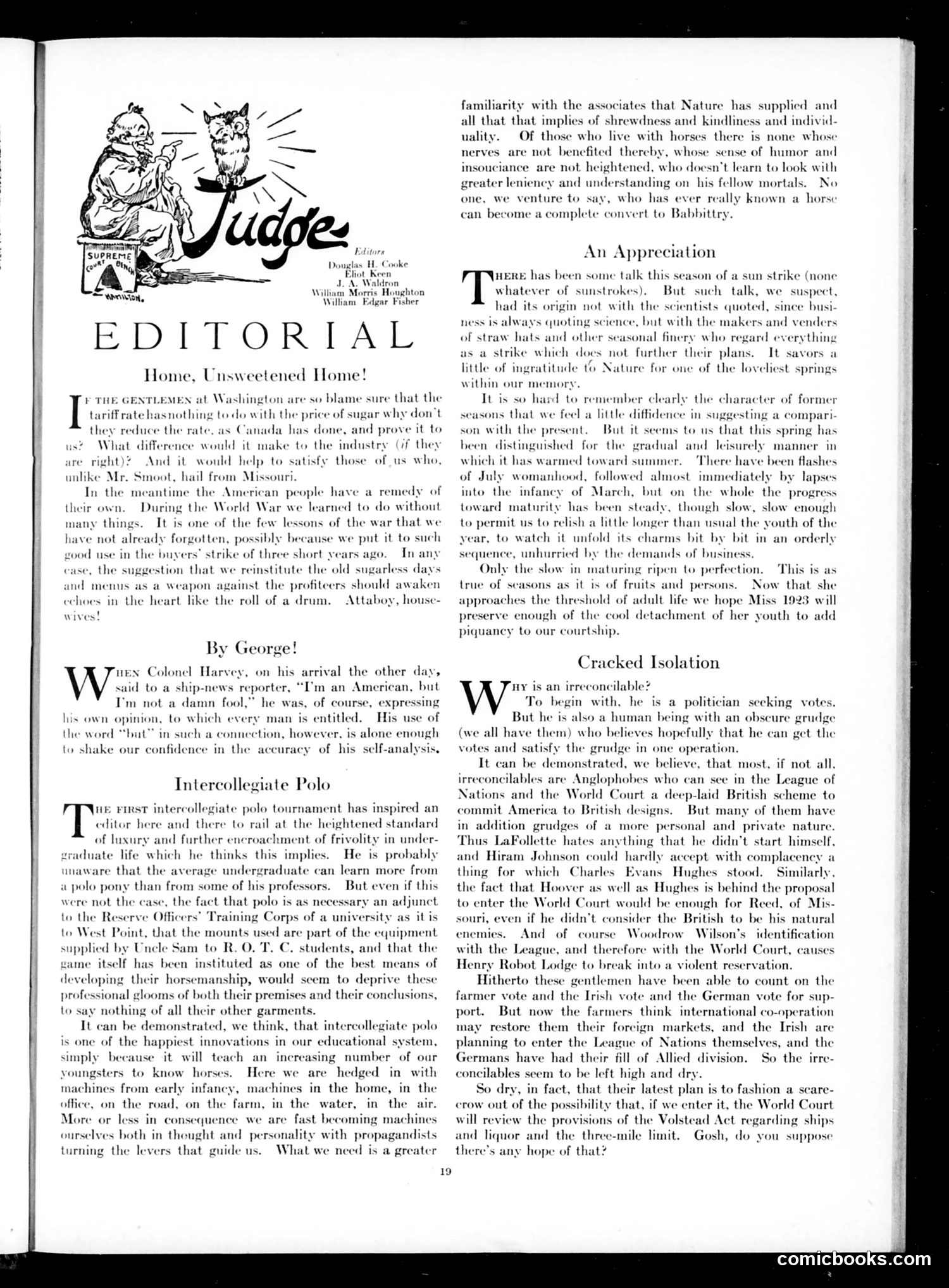
This editorial page from Judge contains four short pieces satirizing American politics and society circa the early 1920s. The **"Home, Unsweetened Home"** editorial attacks Republican Senator Reed Smoot's tariff policies protecting sugar interests, suggesting citizens reinstitute WWI-era sugar rationing to pressure profiteers—ironic advocacy for voluntary hardship. **"By George"** mocks Colonel George Harvey's self-description as "an American, but I'm not a damn fool"—the "but" revealing contradiction in his patriotic claim. **"Intercollegiate Polo"** defends new college polo programs (funded by military R.O.T.C. training) against critics who call them frivolous luxuries. The writer argues polo teaches horsemanship and character—fighting the mechanization and conformity ("Babbittry") threatening American youth. **"Cracked Isolation"** argues American isolationism is untenable; various U.S. figures' contradictory positions on the League of Nations demonstrate America cannot escape international entanglement. The illustrated "Judge" masthead shows the magazine's satirical mascot character.
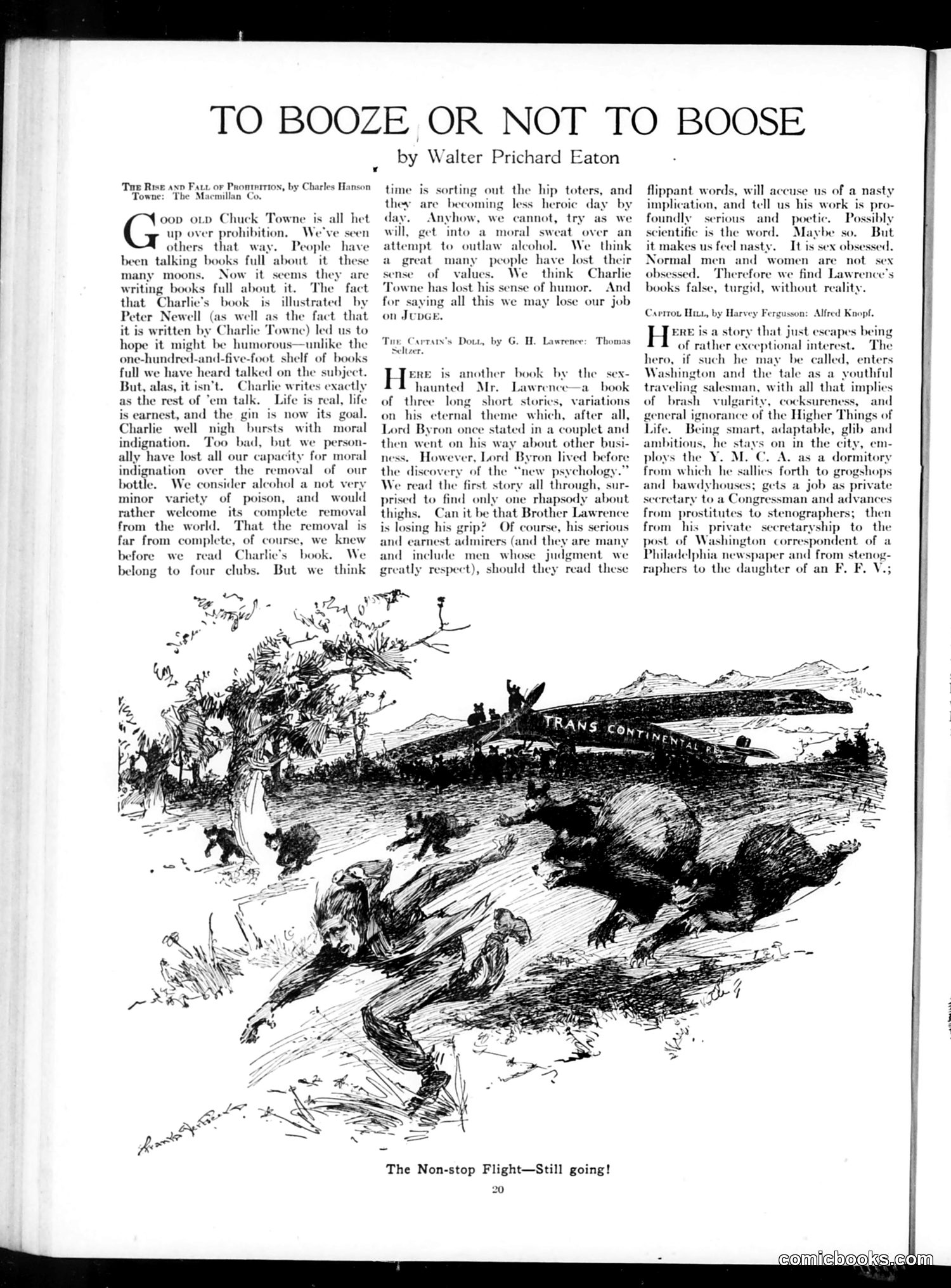
This page discusses Prohibition-era literature. The main article reviews Charles Hanson Towne's "The Rise and Fall of Prohibition," arguing that while Prohibition has caused people to lose their sense of humor and values, the book itself fails to be humorous despite its satirical subject matter. The illustration, captioned "The Non-stop Flight—Still going!", depicts a Trans-Continental train with figures appearing to flee or scatter in panic across the landscape. This likely satirizes the widespread evasion of Prohibition laws—the "non-stop flight" refers to people's desperate attempts to escape or circumvent alcohol restrictions through any means possible. The secondary reviews mention D.H. Lawrence's sexually explicit writings, critiquing their pretension to seriousness while actually being obsessed and vulgar. The overall tone suggests Judge magazine's skepticism about both Prohibition's effectiveness and the moral certainty of those promoting it.
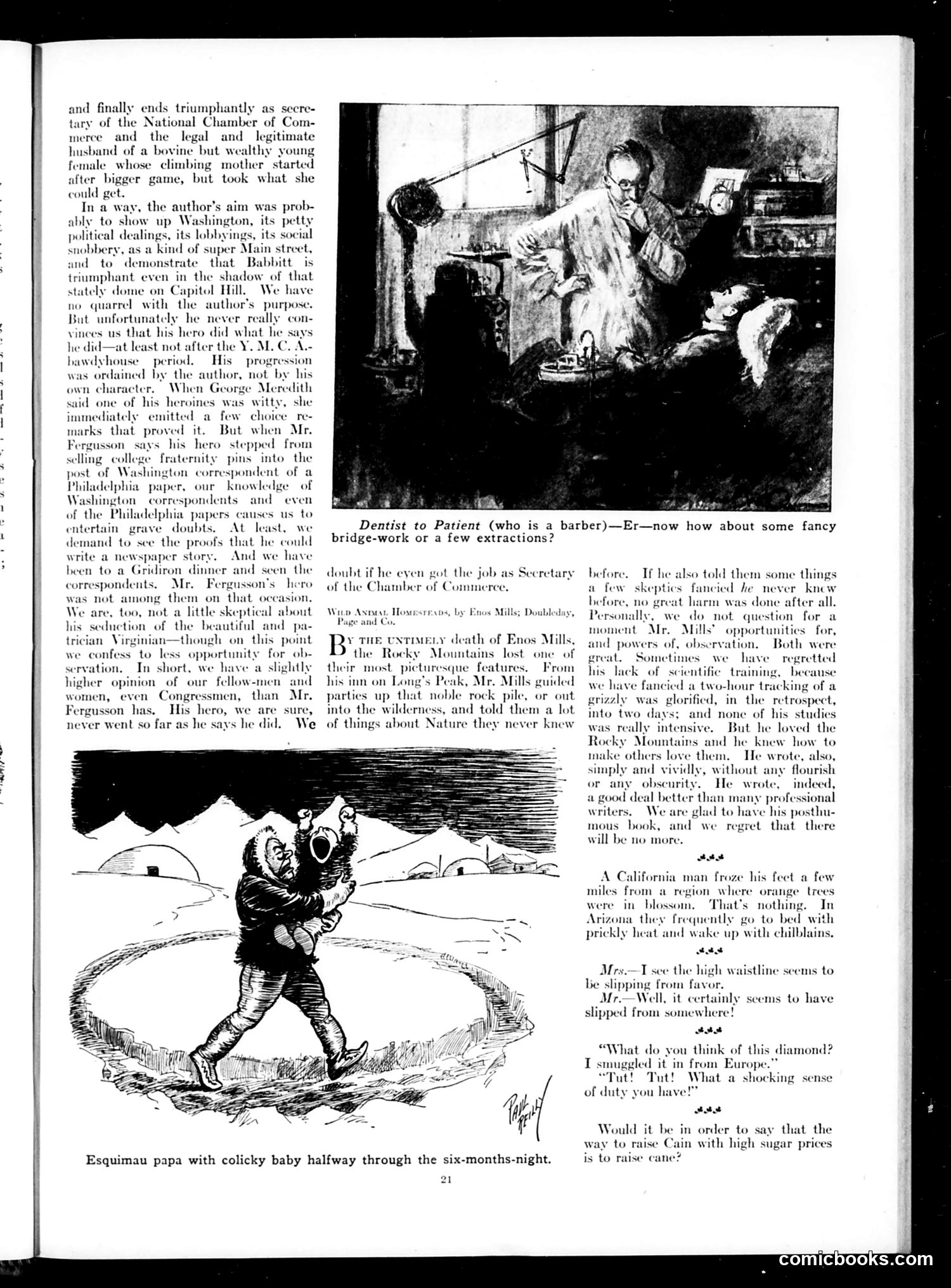
This page contains literary criticism and several unrelated satirical items typical of Judge's format. The main text reviews a novel (likely "The Conquered," though the title is partially cut off) about an ambitious man who climbs Washington's social ladder, eventually becoming a Chamber of Commerce secretary. The critic skewers the author for unconvincingly portraying his protagonist's rise—particularly doubting he could transition from selling fraternity pins to becoming a newspaper correspondent or seducing a patrician woman. The reviewer suggests the author has an overly cynical view of American society and politics. The **cartoon** depicts an Esquimau (Inuit) father carrying a colicky baby through the six-month Arctic night—a joke about enduring hardship. Additional brief humorous items satirize: a dentist's sales pitch to a barber-patient, California's extreme weather swings, fashion trends (slipping waistlines), and a man smuggling diamonds from Europe—each mocking contemporary social behaviors or absurdities. The tone is lighthearted social commentary typical of early 20th-century satirical magazines.
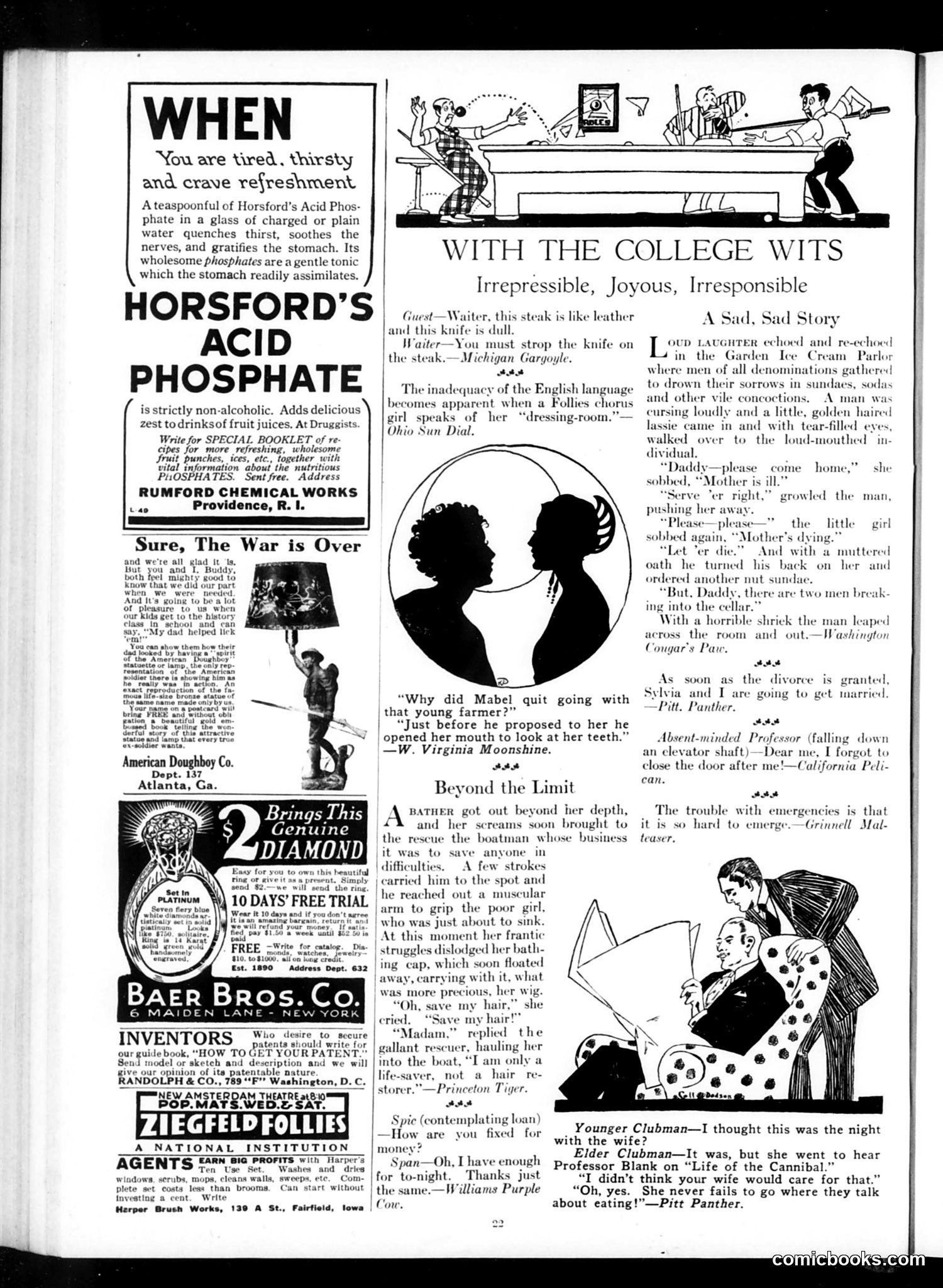
This page is primarily **advertisements and humor columns** from *Judge* magazine. The satirical content appears in the right half under "WITH THE COLLEGE WITS." **The humor** consists of brief, disconnected jokes typical of college comedy magazines—quick punchlines about student life, relationships, and social awkwardness. Examples include: - A waiter joke about a tough steak requiring knife-sharpening - A story where a man drowns his sorrows over a failed relationship, only to be interrupted by his daughter reporting his house is being robbed—he flees in panic, suggesting his possessions matter more than his child's welfare (the "sad" joke) - Various quips about divorce, absent-minded professors, and romantic mishaps **The left side** features period product advertisements (Horsford's Acid Phosphate tonic, diamond rings, doughboy products, patent services) typical of *Judge*'s commercial content. The humor reflects early 20th-century college culture and domestic comedy conventions that relied on exaggeration and unexpected reversals rather than political satire.
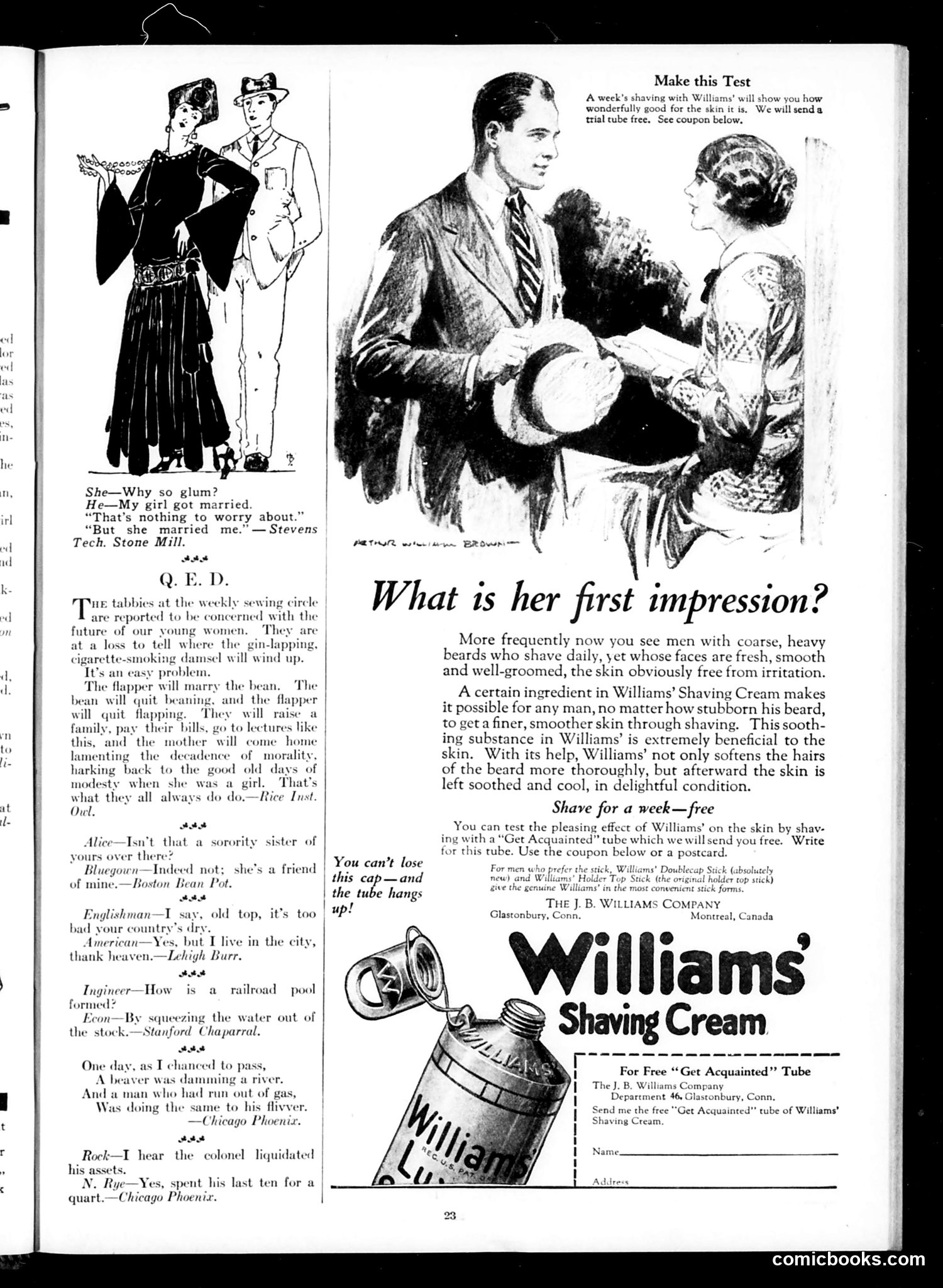
This page contains mostly **advertising and jokes**, not political satire. The main content is a **Williams' Shaving Cream advertisement** occupying roughly half the page. The advertisement features a sketch titled "What is her first impression?" showing a man and woman, emphasizing that daily shaving with Williams' cream produces a smooth, fresh appearance attractive to women. The ad claims the product's soothing ingredient benefits even stubborn beards and irritated skin. It offers a free trial tube via coupon. The surrounding content consists of brief **humorous anecdotes** on various topics—marriage ("My girl got married... But she married me"), college social life, Prohibition-era drinking jokes ("I live in the city, thank heaven"), and financial collapse ("spent his last ten for a quart"). These are generic jokes typical of 1920s humor magazines, with no identifiable political figures or specific social commentary beyond gentle mockery of contemporary customs and situations.
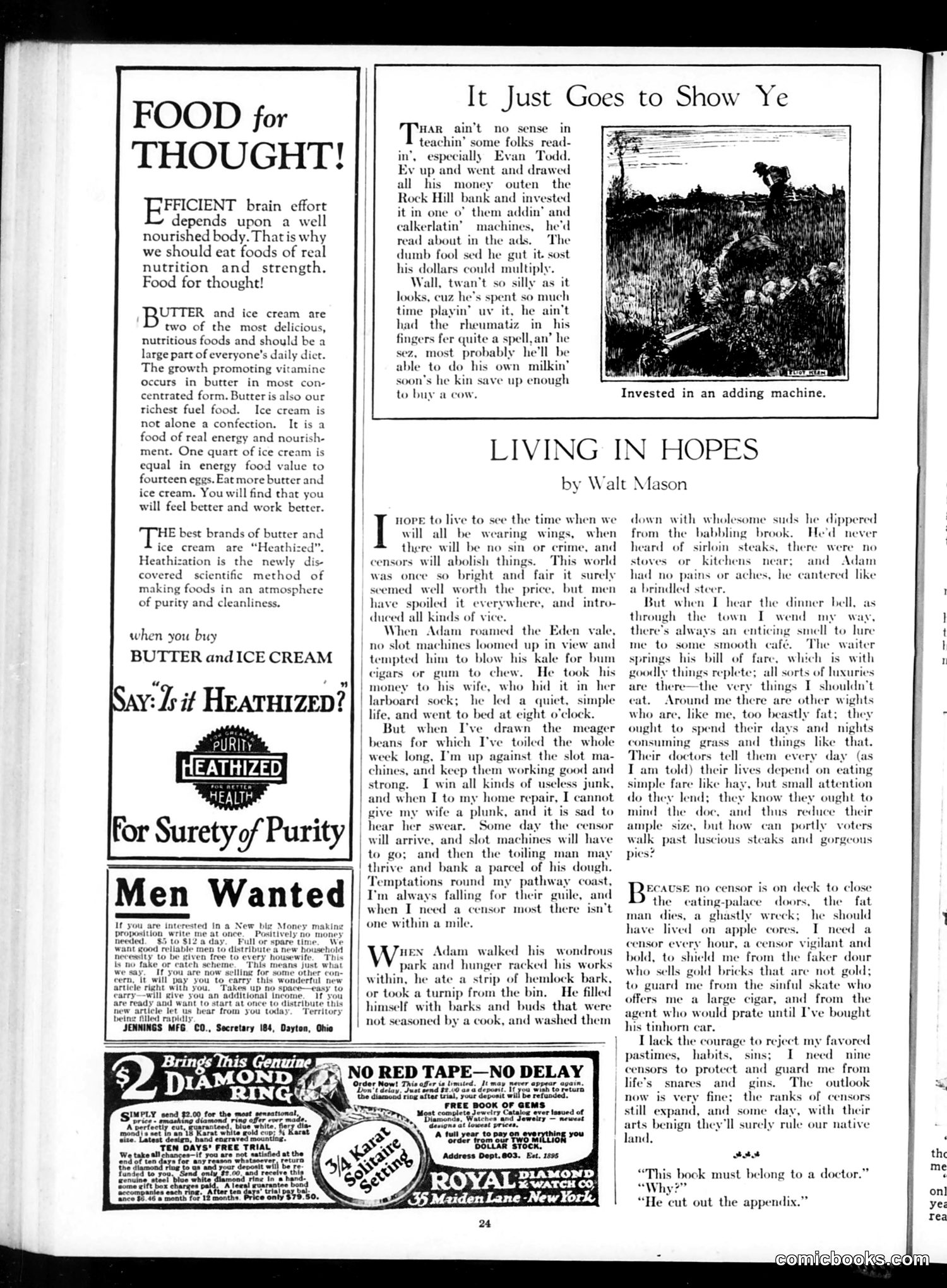
This page contains **primarily advertisements and light satirical content**, not political cartoons in the traditional sense. **"Food for Thought"** is a straightforward advertorial promoting butter and ice cream as nutritious foods, specifically endorsing the "Heathized" brand's purported purity standards—reflecting early 20th-century marketing of processed foods as scientifically superior. **"It Just Goes to Show Ye"** is a rural dialect anecdote mocking a foolish farmer (Evan Todd) who withdraws his savings to buy an adding machine after reading advertisements, believing it will multiply his money. The joke satirizes both rural gullibility and overhyped advertising claims. **"Living in Hopes"** by Walt Mason is a nostalgic poem contrasting Adam's simple Eden with modern temptations: slot machines, censorship debates, and consumer culture. It reflects anxiety about industrialization and moral decline—common themes in 1910s-1920s American periodicals. The remaining content consists of various product advertisements (watches, rings, jewelry).
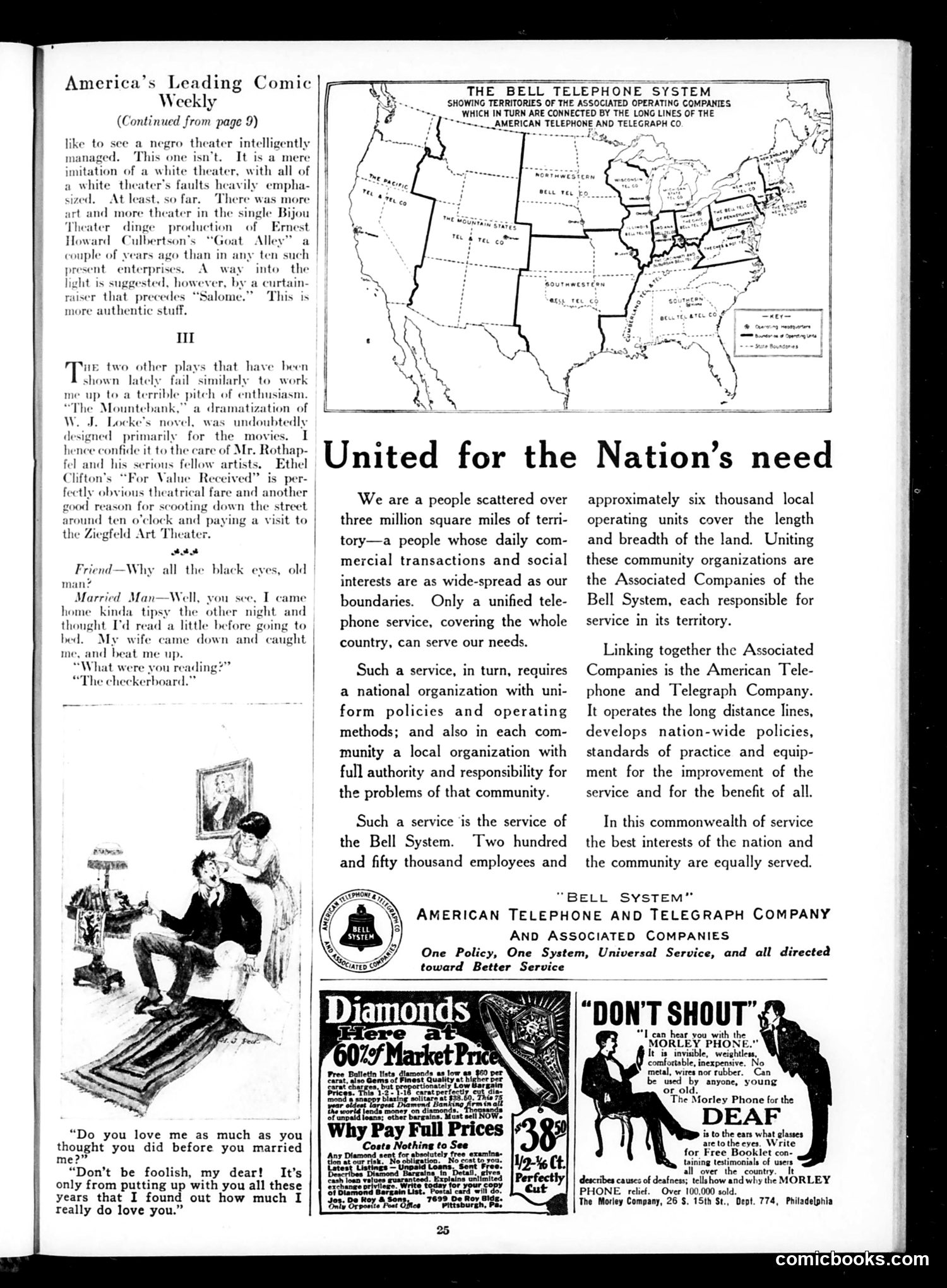
This page mixes theatrical criticism with period advertisements. The top section reviews recent Broadway plays, critiquing their artistic merit—notably dismissing a Black theater production as merely imitating white theater without authenticity. The humor strips feature domestic jokes typical of the era: a husband with black eyes beaten by his wife after she catches him reading in bed (the "checkerboard" punchline plays on her assumption of infidelity), and a married man's quip about discovering his love through years of enduring his wife. The large advertisement promotes the Bell Telephone System as unifying the nation, presenting it as essential infrastructure connecting 250,000 employees across territories. Lower advertisements sell diamonds at discounted prices and promote the "Morley Phone"—a device marketed to deaf users, claiming to enable hearing without shouting. This reflects early 20th-century attitudes toward disability while advertising emerging assistive technology. The page represents Judge's blend of social commentary, domestic humor reflecting marital anxieties, and corporate messaging framed as public service.
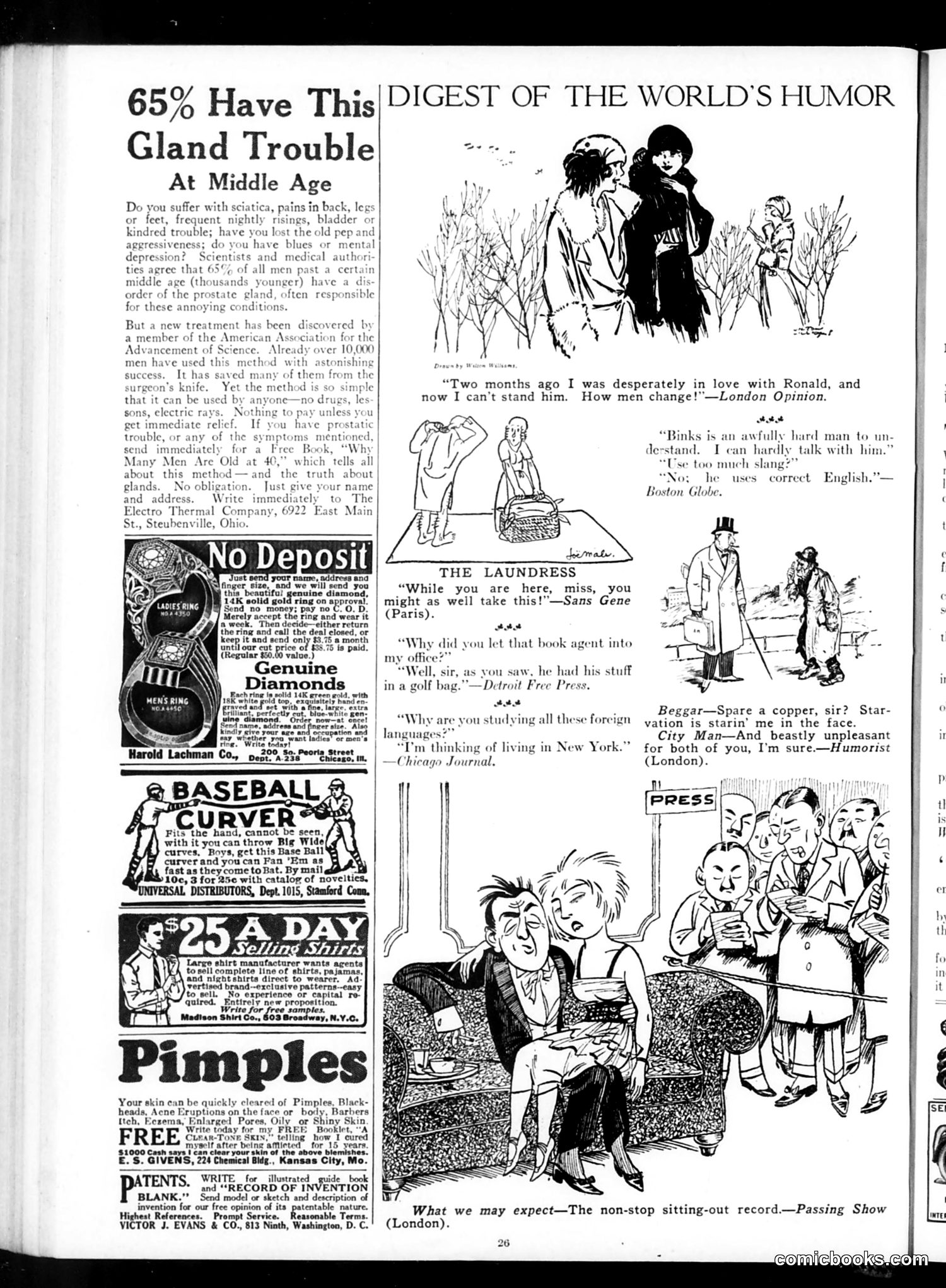
This page from *Judge* magazine collects international humorous anecdotes—a common feature in early-20th-century satirical publications. The cartoons illustrate brief jokes sourced from newspapers across America and Europe. The humor reflects period social preoccupations: **romantic fickleness** (a woman's changing feelings toward her suitor), **class dynamics** (a beggar's awkward interaction with a wealthy man), **marital communication struggles** (wives complaining about husbands' incomprehensibility or excessive slang), and **social pretension** (a laundress's familiarity; a book agent's persistence). The final cartoon depicts a "sitting-out record"—young couples monopolizing public spaces (parks, social venues) for extended courting sessions, apparently a contemporary phenomenon drawing bemused commentary. The page is primarily advertising, with these brief jokes occupying roughly one-third of the space. The cartoons feature exaggerated facial features typical of the era's illustration style, emphasizing character types rather than specific individuals.
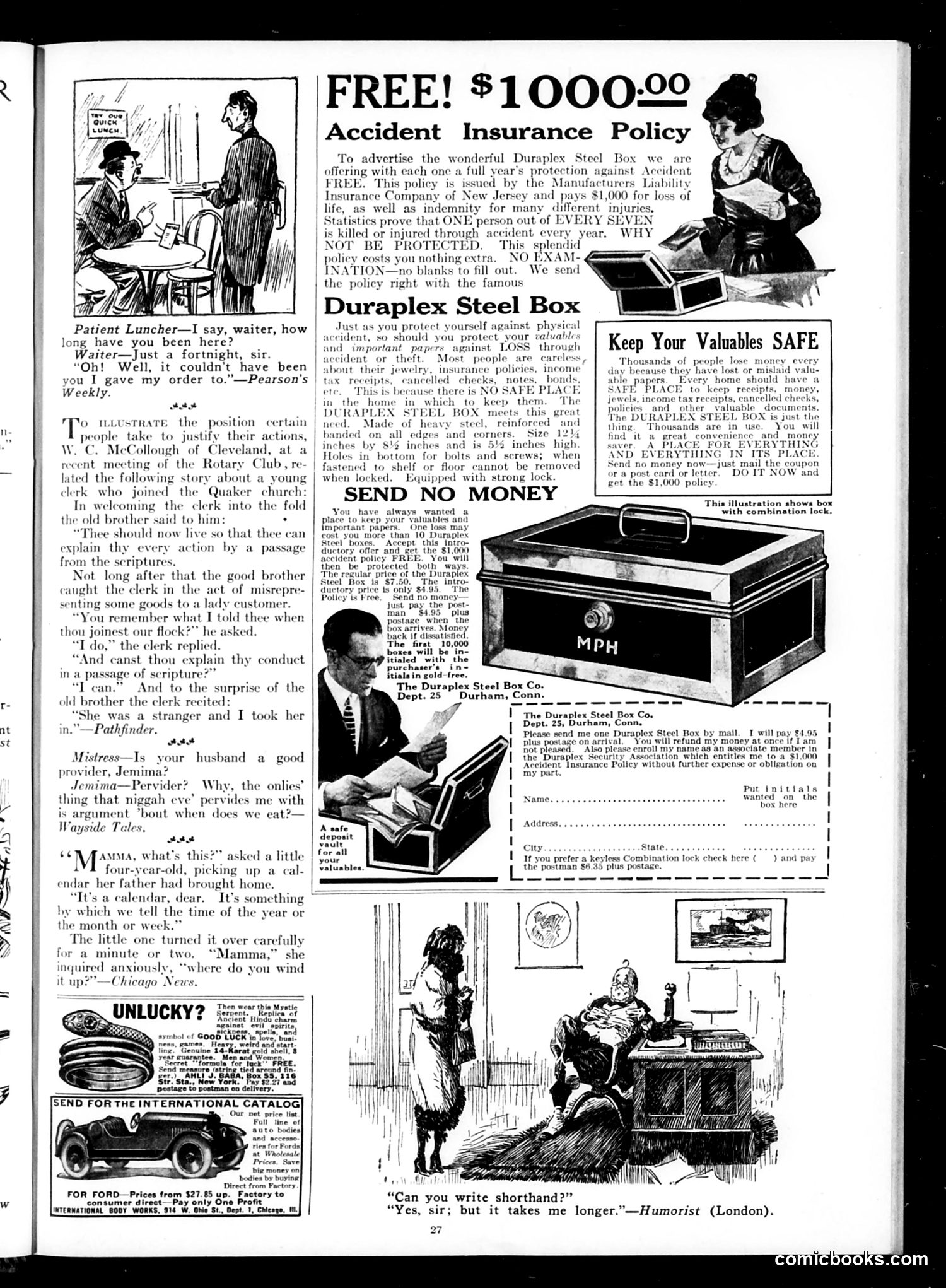
This page is primarily **advertising**, not political satire. The dominant content is a Duraplex Steel Box advertisement offering a free $1,000 accident insurance policy as a promotional gimmick. The scattered jokes and anecdotes are period filler: - **"Patient Luncher"**: A waiter joke about poor service. - **Church clerk story**: Moral humor about a hypocrite who quotes scripture to justify dishonest business practices. - **"Mistress/Jemima" exchange**: Contains a racial slur and stereotypical dialect; reflects the casual racism of the era. - **Calendar joke**: A child's innocent misunderstanding. **Historical context**: The insurance offer was meant to boost sales of home safes—a practical concern for middle-class homeowners protecting valuables, documents, and jewelry before modern banking safety deposit boxes were universal. The satirical magazine *Judge* used such advertisements alongside humor content. Nothing here comments on politics or contemporary events; it's essentially a vintage classified ad section padded with light comedy.
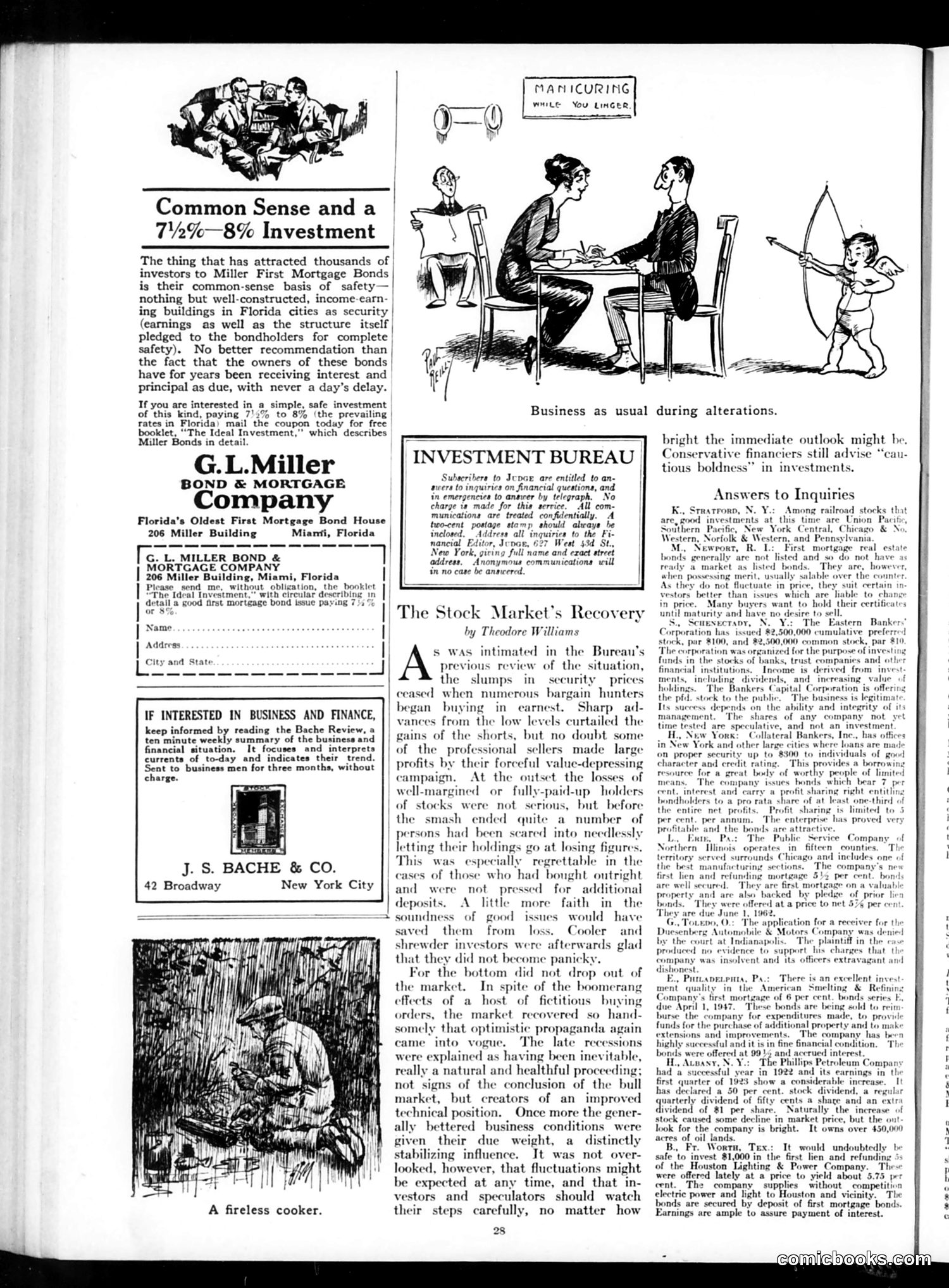
This page is primarily **advertising and financial content**, not political satire. The cartoons are minor decorative elements. The two small cartoon vignettes at top right—showing manicuring "while you linger" and "business as usual during alterations"—are **light humor about commercial services**, not satire. They illustrate that salons/businesses continue operating during renovations. The main content consists of: - **Bond investment ads** (G.L. Miller, Bache Review) promoting Florida real estate bonds as safe investments at 7.5%-8% returns - A financial article by Theodore Williams discussing **stock market recovery** from recent "slumps," arguing that panic-selling was regrettable and markets are stabilizing - An advice column addressing investment inquiries The **historical context**: This appears to be from the 1920s (pre-1929 crash), when Florida land speculation was booming and stock market enthusiasm was high. The tone is reassuring investors that market volatility is normal and recoverable—ironically prescient given the imminent Great Depression.
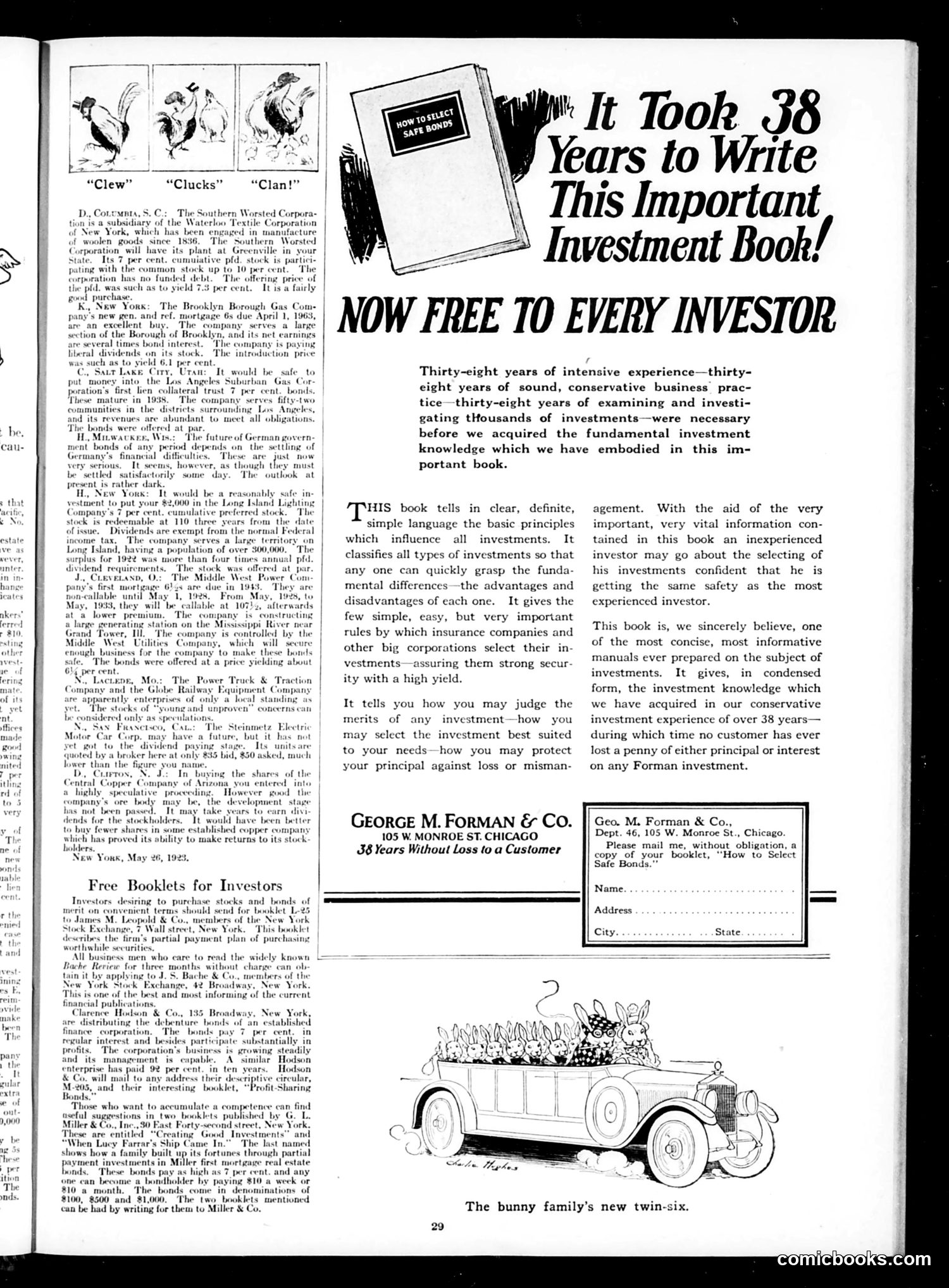
This page is primarily **investment advertising**, not political satire. The three small chicken sketches labeled "Clew," "Clucks," and "Clan!" at the top are decorative illustrations accompanying stock listings for textile and utility companies. The main content is a promotional advertisement by **George M. Forman & Co.**, a brokerage firm claiming 38 years of conservative investment experience. They're offering a free investment guide to potential investors, emphasizing safe, sound financial practices. The bottom illustration shows a humorous cartoon of a car overflowing with rabbits (a "bunny family's new twin-six"), likely a playful reference to prolific reproduction—perhaps subtly suggesting investment growth or multiplication of capital, though this connection is unclear. The page reflects the 1920s investment culture: optimistic about corporate bonds and stocks, promoting financial education to everyday investors, and mixing serious financial advice with light humor.
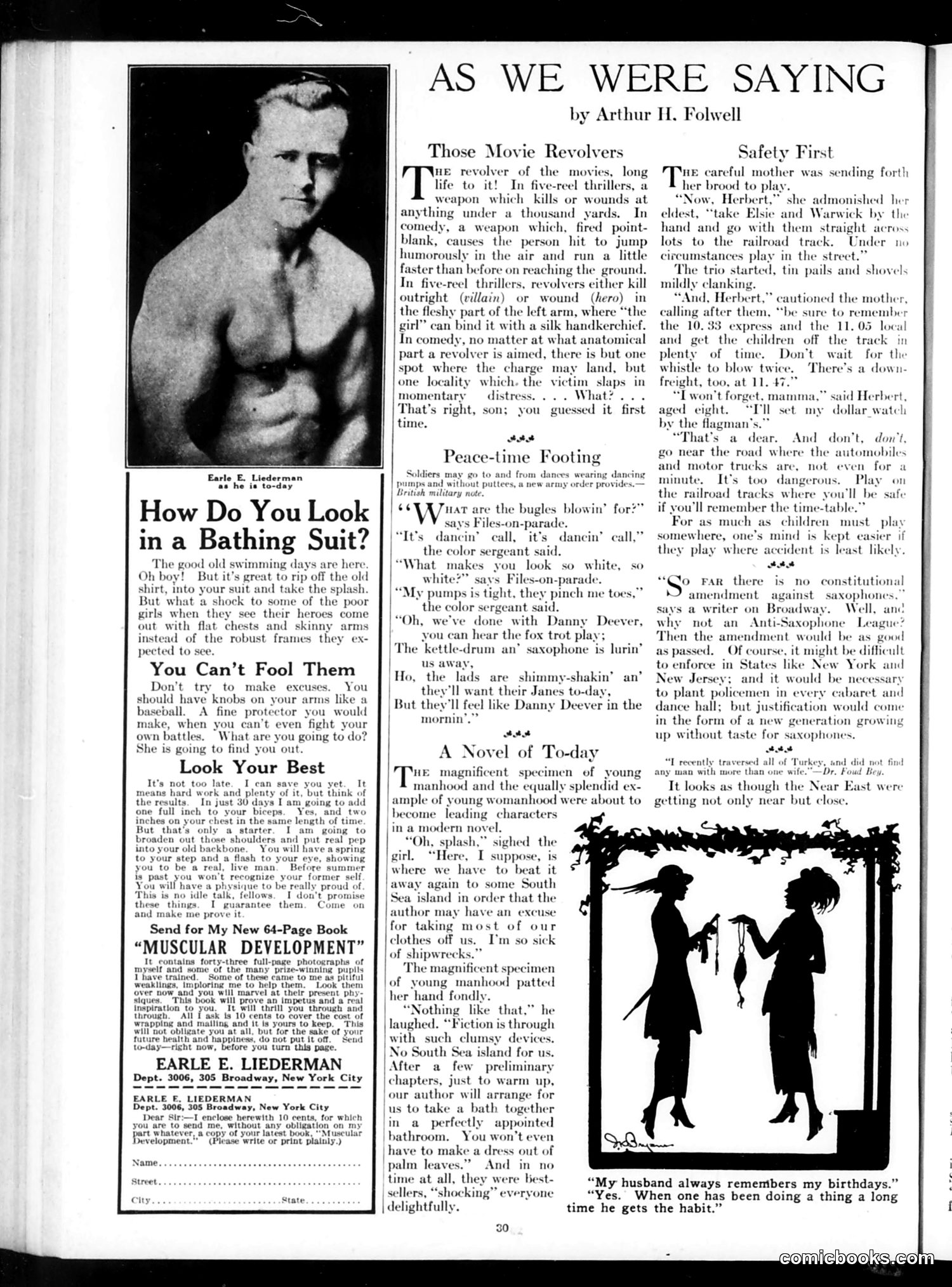
This page from the satirical magazine **Judge** contains several distinct pieces mocking early 20th-century culture: **"Those Movie Revolvers"** satirizes action films' absurd physics—revolvers that kill at "anything under a thousand yards" yet in comedies always hit the same spot (the character's rear end when they're slapped). **"Peace-time Footing"** references the popular WWI song "Danny Deever" by Kipling, joking that soldiers dancing the fox trot and shimmy with women will "feel like Danny Deever in the mornin'"—a hangover reference. **"A Novel of To-day"** mocks contemporary fiction's tired tropes: a young couple cynically expects their romance story requires stripping them of clothes via shipwreck, but the author promises modern realism—they'll simply bathe together instead. The satire targets both predictable plotting and the era's fascination with barely-clothed characters. The silhouette illustration of two figures reinforces this "modern" bathing scenario the satirist finds amusing.
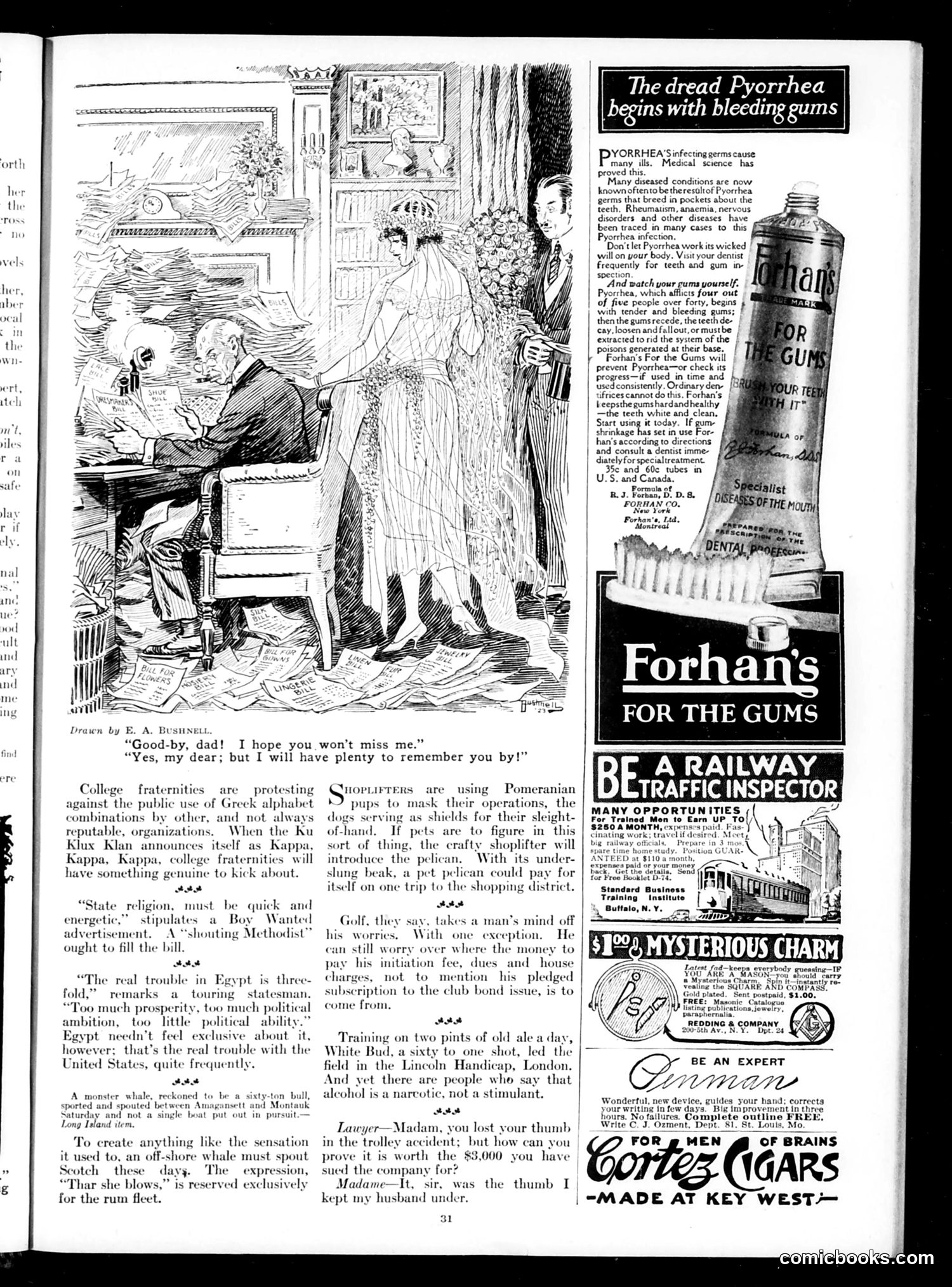
The main cartoon depicts a father and daughter saying goodbye. The daughter, apparently leaving for college, assures her father he won't miss her—but he responds he'll "have plenty to remember you by," suggesting financial burden (likely tuition costs and her absence's emotional toll). The cartoon satirizes the economic strain of supporting a college-age child, a relatable concern for middle-class readers of this era. Below the cartoon are typical Judge-style commentary snippets mocking various social issues: college fraternities (particularly the Ku Klux Klan adopting Greek letters), Egyptian politics, Prohibition-era smuggling ("rum fleet"), and the emerging problem of shoplifters using small dogs as concealment. The right side contains period advertisements for dental products (Forhan's), railway work, charm amulets, and cigars—typical commercial content from early 20th-century magazines. The overall tone combines gentle humor about universal frustrations with sharper jabs at contemporary scandals and absurdities.
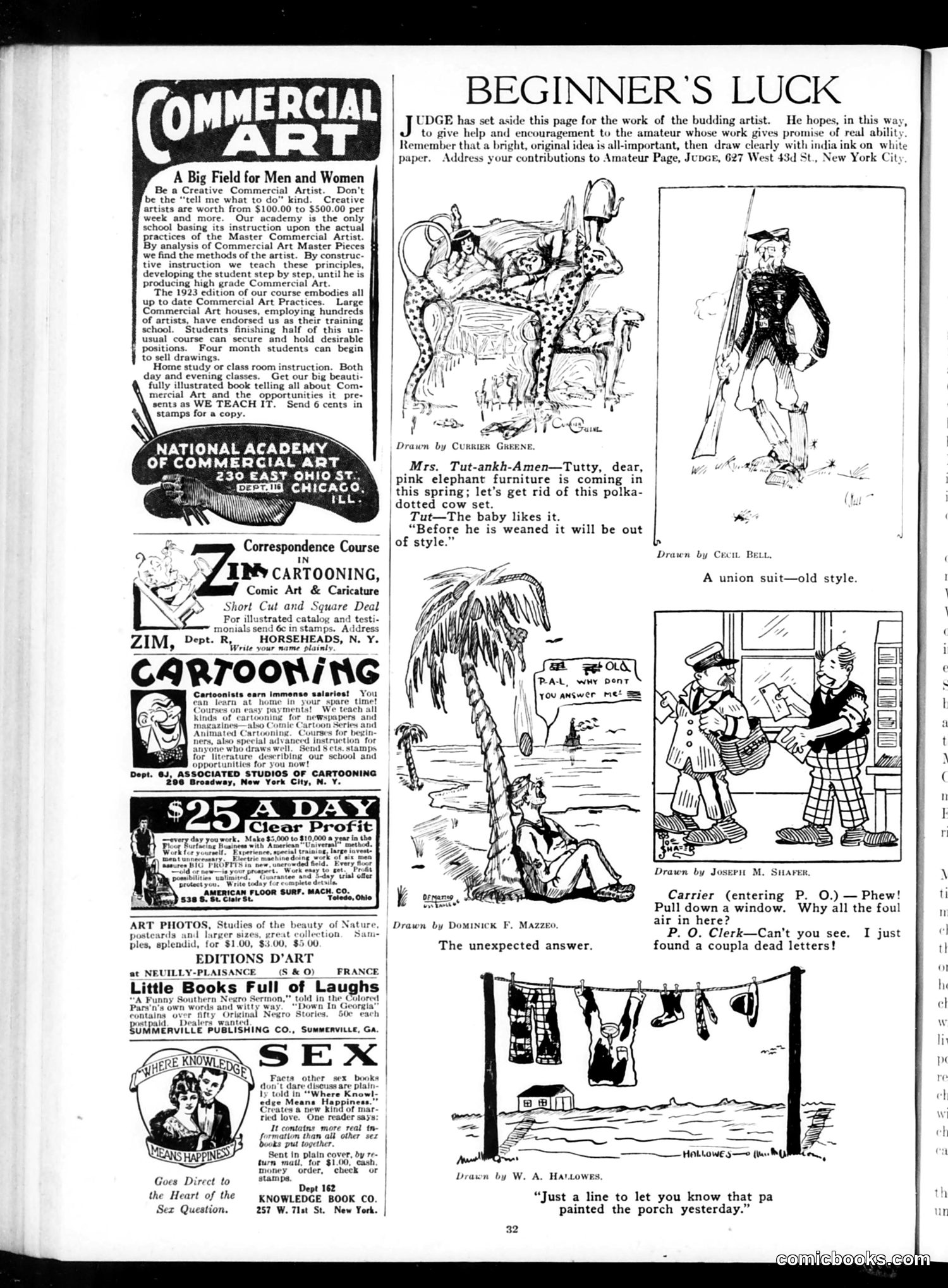
This page from Judge (appears to be circa 1923, based on internal references) is primarily **advertising and a reader-submission section** rather than satirical editorial content. The "Beginner's Luck" section solicits amateur cartoons from readers, displaying submitted work with humorous captions. The cartoons themselves are light domestic humor with no political content—jokes about baby furniture trends, postal workers, and home maintenance. The advertisements promote commercial art training schools, cartooning correspondence courses, and mail-order books on "sex" (likely relationship/marriage advice literature of the era). **The only satire** appears subtle: the "Tut-ankh-Amen" cartoon references King Tutankhamun's tomb discovery (1922), making a topical joke about Egyptian artifacts becoming fashionable—a comment on American commercialism and trend-chasing rather than political critique. The page reflects Judge's function as both satirical magazine and practical industry publication serving aspiring artists.
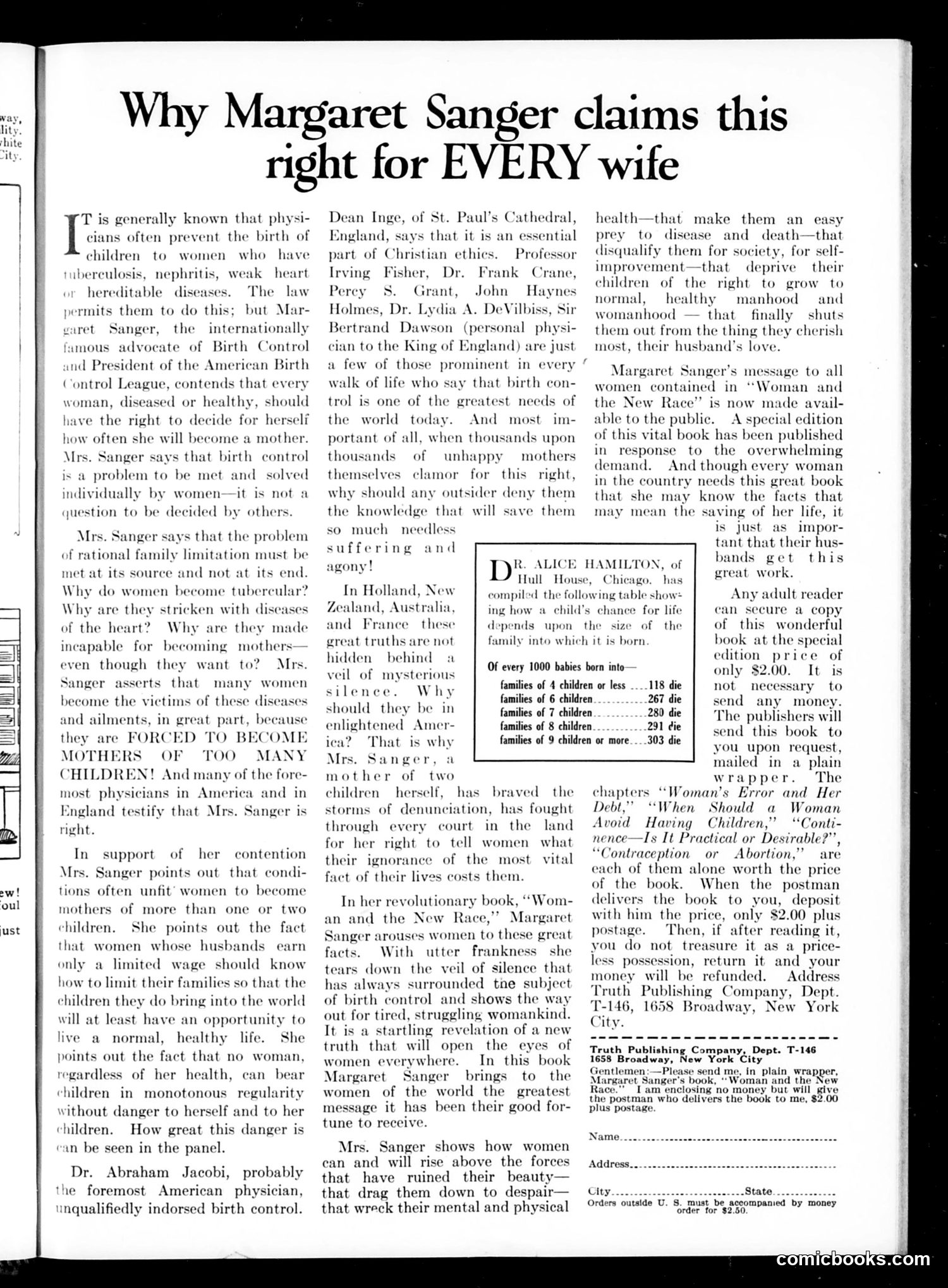
This is primarily **advocacy advertising**, not satire. The page promotes Margaret Sanger's birth control movement and her book "Woman and the New Race." **Key figures mentioned:** - **Margaret Sanger**: birth control activist being championed - **Dr. Abraham Jacobi**: prominent American physician cited as endorsing birth control - **Dean Inge** and other clergy/doctors: authorities cited supporting Sanger's position **The argument presented:** Sanger claims women—particularly those with hereditary diseases, tuberculosis, or weak health—should have the right to limit pregnancies to protect their health and give existing children better lives. The page argues that repeated pregnancies harm women's bodies and that poverty-stricken large families perpetuate suffering. **Social context:** This represents the early 1920s birth control movement, which was highly controversial. The ad frames Sanger's activism as supported by respected medical and religious authorities, legitimizing a cause that many considered radical or immoral at the time. The page is marketing Sanger's book directly to readers, offering a $2 special edition.
This is **not a political cartoon** but rather an **advertorial** — a hybrid of advertisement and editorial content masquerading as health journalism. The page promotes Eugene Christian, a "food scientist" and early 20th-century diet guru who claimed stomach acidity could be cured in 48 hours through proper food combinations. The text presents Christian's credentials and testimonials (claiming he'd helped 25,000 people) to establish authority. **The appeal**: Rather than neutralizing acid with antacids (which Christian argues creates dependency), he advocated "eating correctly" — a common theme in early health-food movements. The piece exploits contemporary anxiety about digestive health and positions Christian's lessons as scientific solutions. **The satire context**: Judge magazine published such content to mock contemporary health fads and gullible consumers willing to pay $1.17 for Christian's 24-lesson course. The earnest pseudoscience reflects actual 1920s-era wellness marketing that modern readers would recognize as quackery. This represents how magazines monetized reader anxiety about health.