
Judge, 1923-06-02 · page 4 of 36
Judge — June 2, 1923 — page 4: what you’re looking at
What you’re looking at
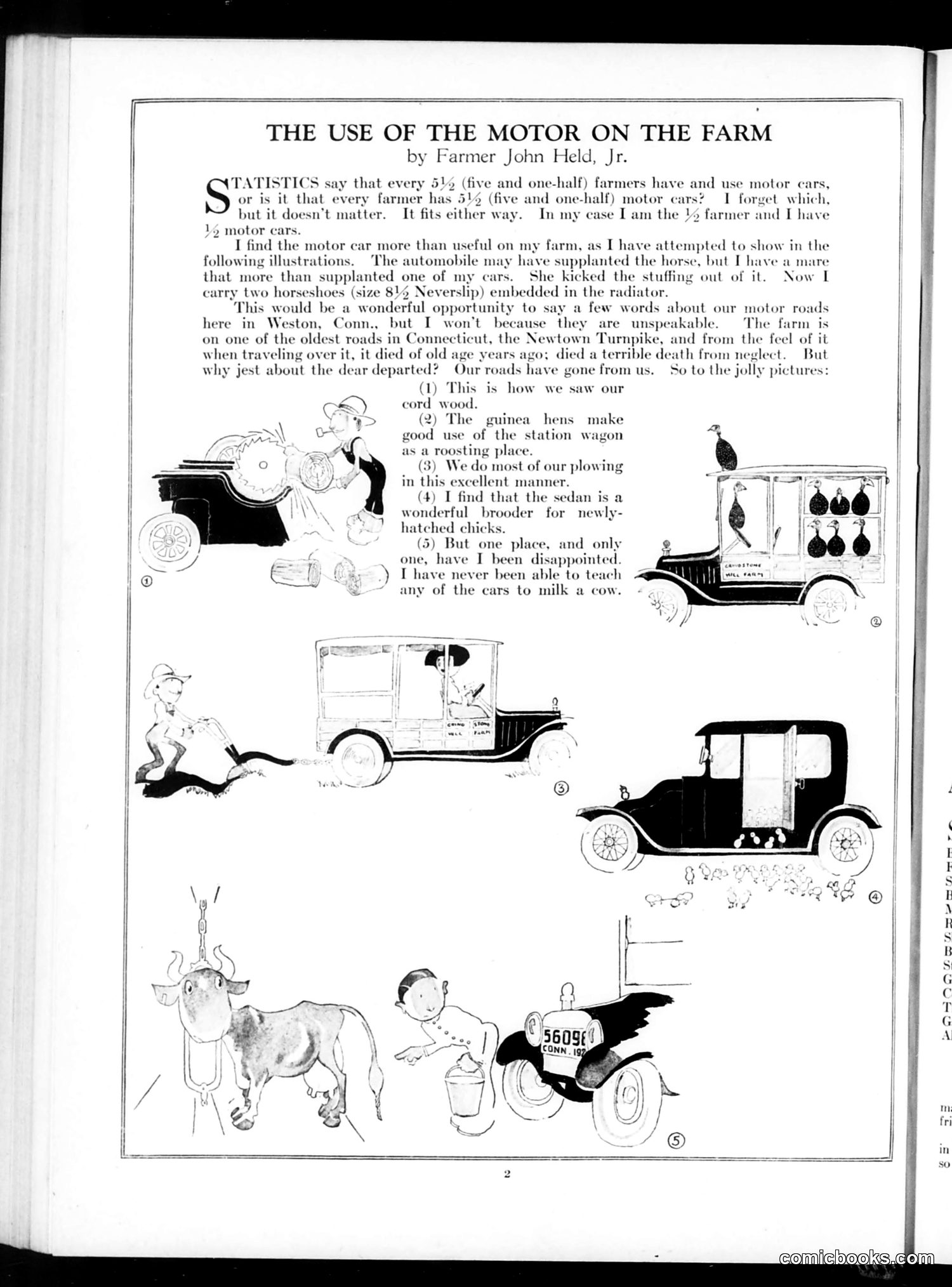
This satirical piece by Farmer John Held, Jr. humorously catalogs farming applications for automobiles. The six numbered illustrations show: (1) A car loaded with cord wood (2) Guinea hens roosting in a car serving as a mobile coop (3) A car used for plowing (4) A sedan as a brooder for chicks (5) A car failing at milking a cow (6) An auto replacing horse-drawn transport The satire mocks farmers' over-adoption of automobiles for unsuitable rural tasks. The text admits the car has "supplemented the horse, but I have a mare that more than supplemented one of my cars"—suggesting automobiles aren't the universal farm solution they're marketed as. The humor lies in the absurdity of motorized solutions to traditional agricultural work, poking fun at both agricultural modernization and automobile industry enthusiasm.
📄 Transcribed text from this page (OCR, searchable)
Machine-transcribed from the original scan — historical spelling and the odd misread are preserved.
THE USE OF THE MOTOR ON THE FARM by Farmer John Held, Jr. and use motor cars, ts? IT forget: which, farmer and [ have TISTICS say that every 5! (five and one-half) farmers have S or is it that every farmer has 5! (five and one-half) motor ¢: but it doesn’t matter. It fits either way. In my case I am the 19 14 motor cars. I find the motor car more than useful on my farm, as I have attempted to show in the following illustrations. The automobile may have supplanted the horse, but [I have a mare that more than supplanted one of my cars. She kicked the stuffing out of it. Now I carry two horseshoes (size 814 Neverslip) embedded in the radiator. This would be a wonderful opportunity to say a few words about our motor roads here in Weston, Conn., but I won't because they are unspeakable. The f i on one of the oldest roads in Connecticut, the Newtown Turnpike, and from the f when traveling over it, it died of old age y ied a terrible death from neglect. But why jest about the dear departed? Our roads have gone from us. So to the jolly pictures: AUS ALO; (1) This is how we saw our cord wood. (2) The guinea hens make good use of the station wagon as a roosting place. (3) We do most of our plowing in this excellent manner. (4) I find that the sedan is a ¢“@ =wonderful brooder for newly- hatched chicks. (5) But one place, and only one, have I been disappointed ) I have never been able to teach any of the cars to milk a cow. See