
A complete issue · 36 pages · 1923
Judge — May 12, 1923
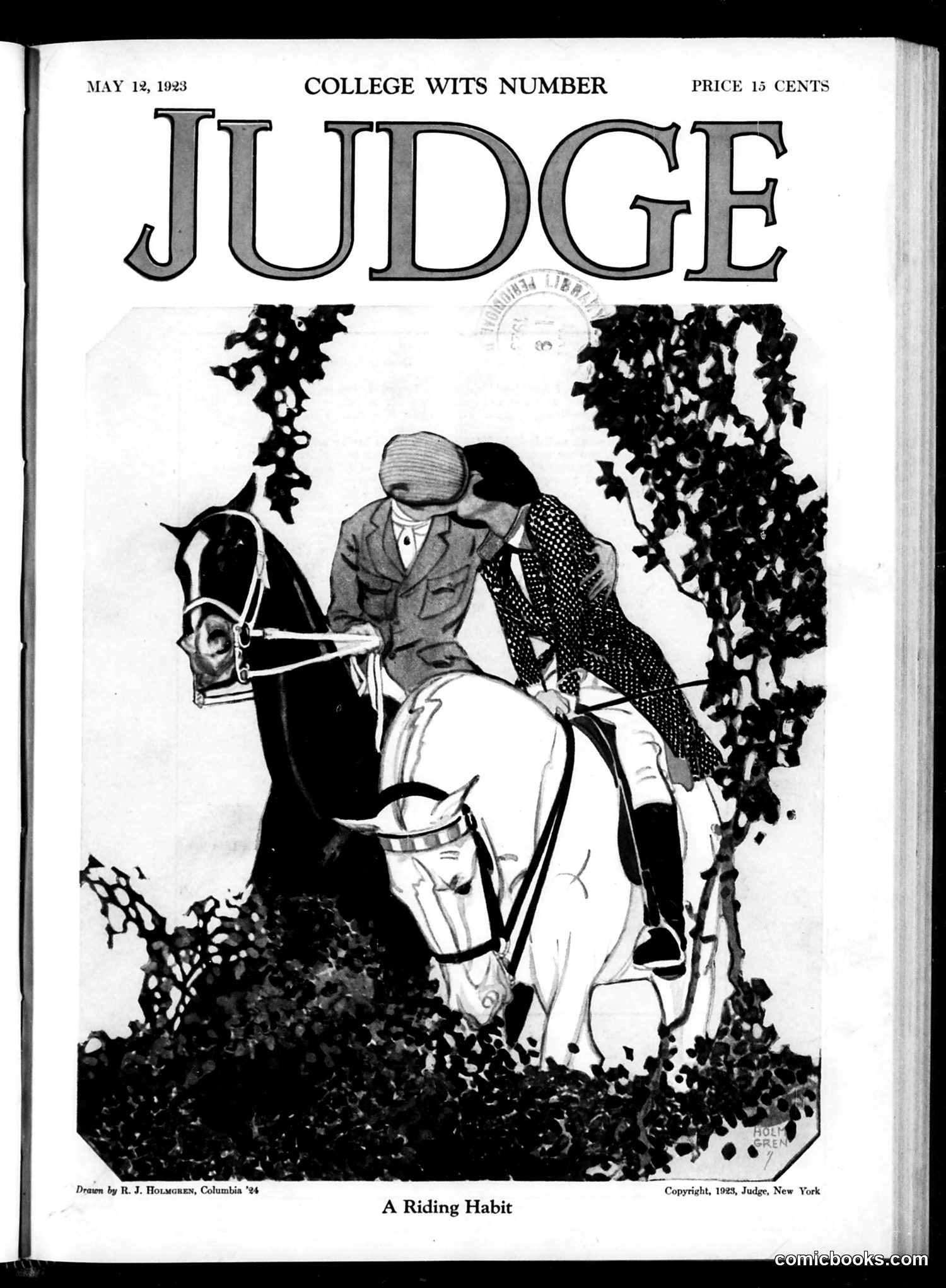
This illustration by H.J. Holmberg depicts two figures on horseback, framed by ivy vines. The title "A Riding Habit" is a visual pun—likely commentary on fashionable women's riding attire of the 1920s era. The cartoon appears to satirize either: - The popularity and expense of equestrian fashion among wealthy women - Social pretension surrounding horseback riding as an elite pastime - Possibly dating or courtship rituals among the upper classes The artistic style and composition suggest Judge's typical approach: gentle mockery of contemporary social customs and class behaviors. Without additional context about current events of May 1923, the specific targets remain somewhat unclear, though the focus on fashionable dress and leisure activities is characteristic of Judge's social satire.
This page presents a letter supposedly from **Arthur Somers Roche**, positioned as a "new great American humorist and philosopher" that Judge claims to have discovered. The letter is a mock-serious character sketch where Roche absurdly catalogs his personal qualities—claiming simultaneous contradictions (anti-foreigner yet descended from Irish/French immigrants, against the Klan but seemingly approving of their goals, morally upright while admitting past infidelities). The satire targets **pretentious self-promotion** and **American hypocrisy**. By having Roche boastfully list his contradictions without irony, Judge ridicules the tendency of public figures to present sanitized, contradictory personas. The Klan reference dates this to the 1920s resurgence period, making the casual mention darkly comic commentary on mainstream attitudes toward extremism.
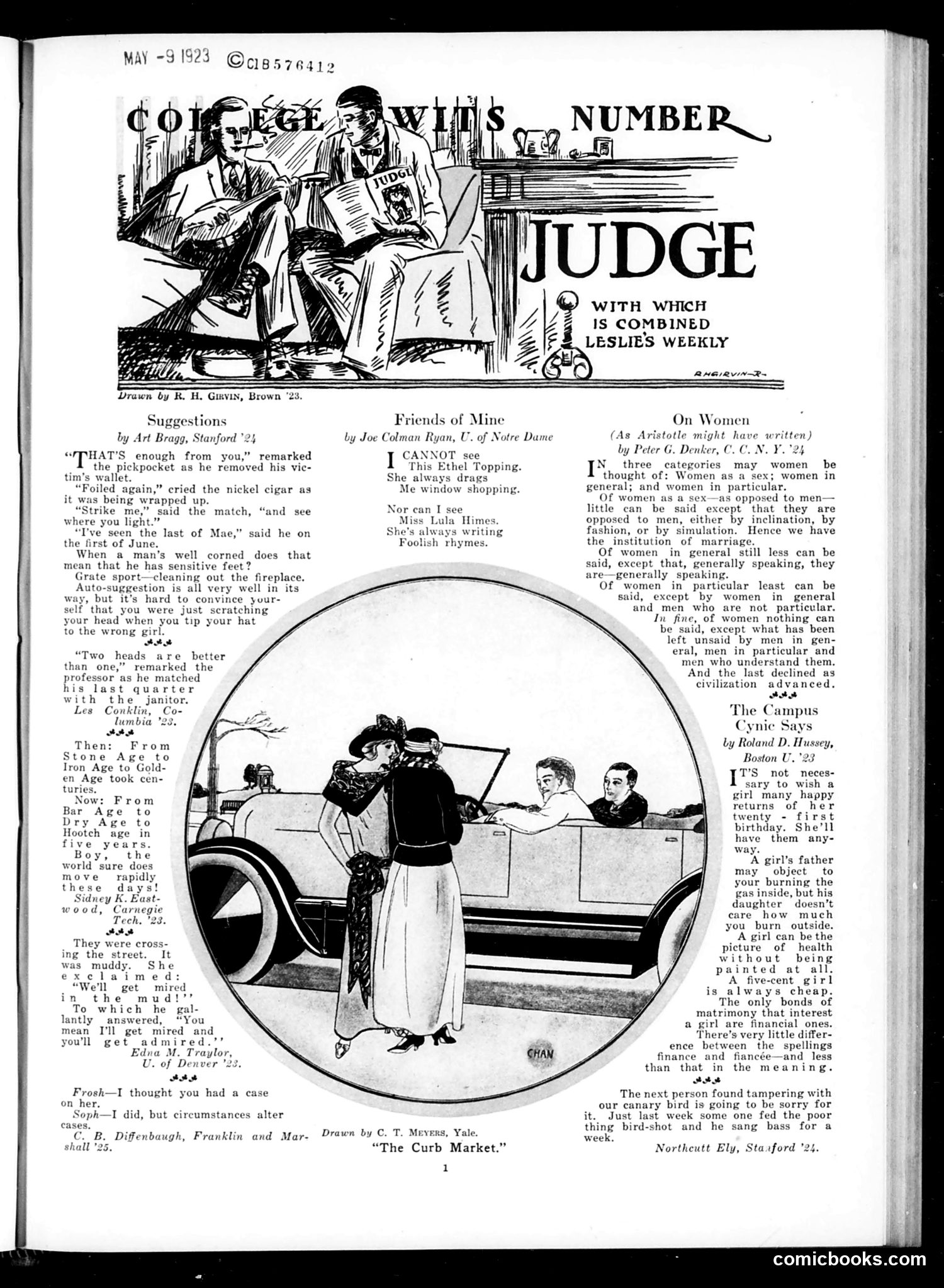
This page contains humor pieces and illustrations rather than political cartoons. The main cartoon, "The Curb Market" by C.T. Meyses, depicts a woman street vendor selling goods from a car—likely referencing the informal markets and street commerce that existed during the early 1920s. The text includes humorous anecdotes about college life, courtship, and social observations. Pieces like "On Women" and "The Campus Cynic Says" offer satirical commentary on dating customs, marriage, and female behavior typical of 1920s collegiate humor. The overall tone is lighthearted social satire about modern manners and youth culture rather than serious political commentary. The magazine targets educated, college-educated readers with witty observations about contemporary social conventions.
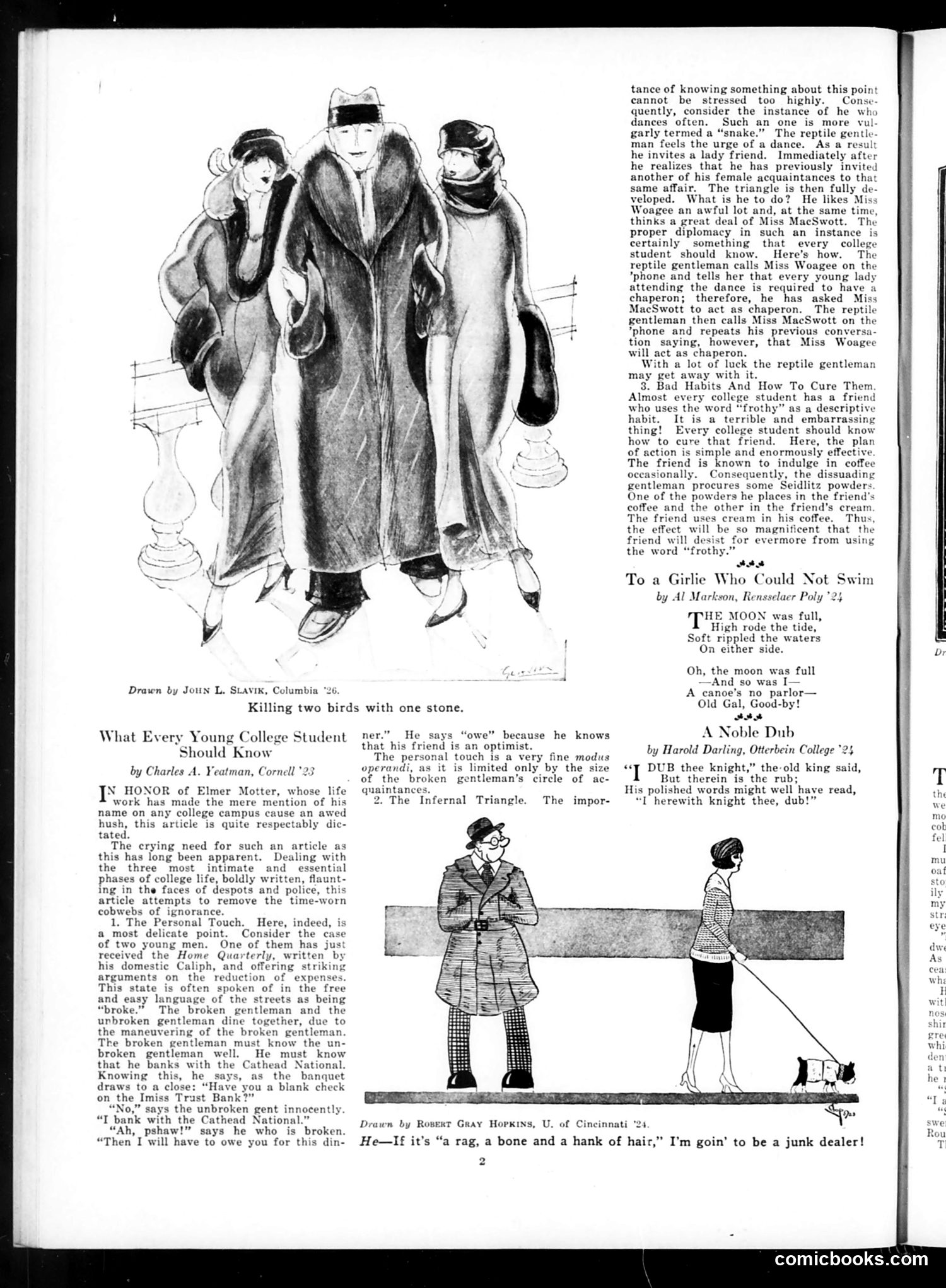
This page contains three humor pieces aimed at college students circa 1923-1925. The top cartoon "Killing two birds with one stone" (drawn by John L. Slavik, Columbia '26) depicts three women in coats carrying handbags, illustrating an article about proper social etiquette. The piece explains how a college gentleman should handle a romantic triangle—specifically, how to ask a female acquaintance to serve as chaperone when attending a dance with a woman he prefers. The lower cartoon by Robert Gray Hopkins shows a man in a coat and cap. Its caption—"If it's 'a rag, a bone and a hank of hair,' I'm goin' to be a junk dealer!"—makes a crude joke about feminine appearance, reflecting period attitudes toward women. The pieces satirize college social conventions and dating protocols of the Jazz Age era.
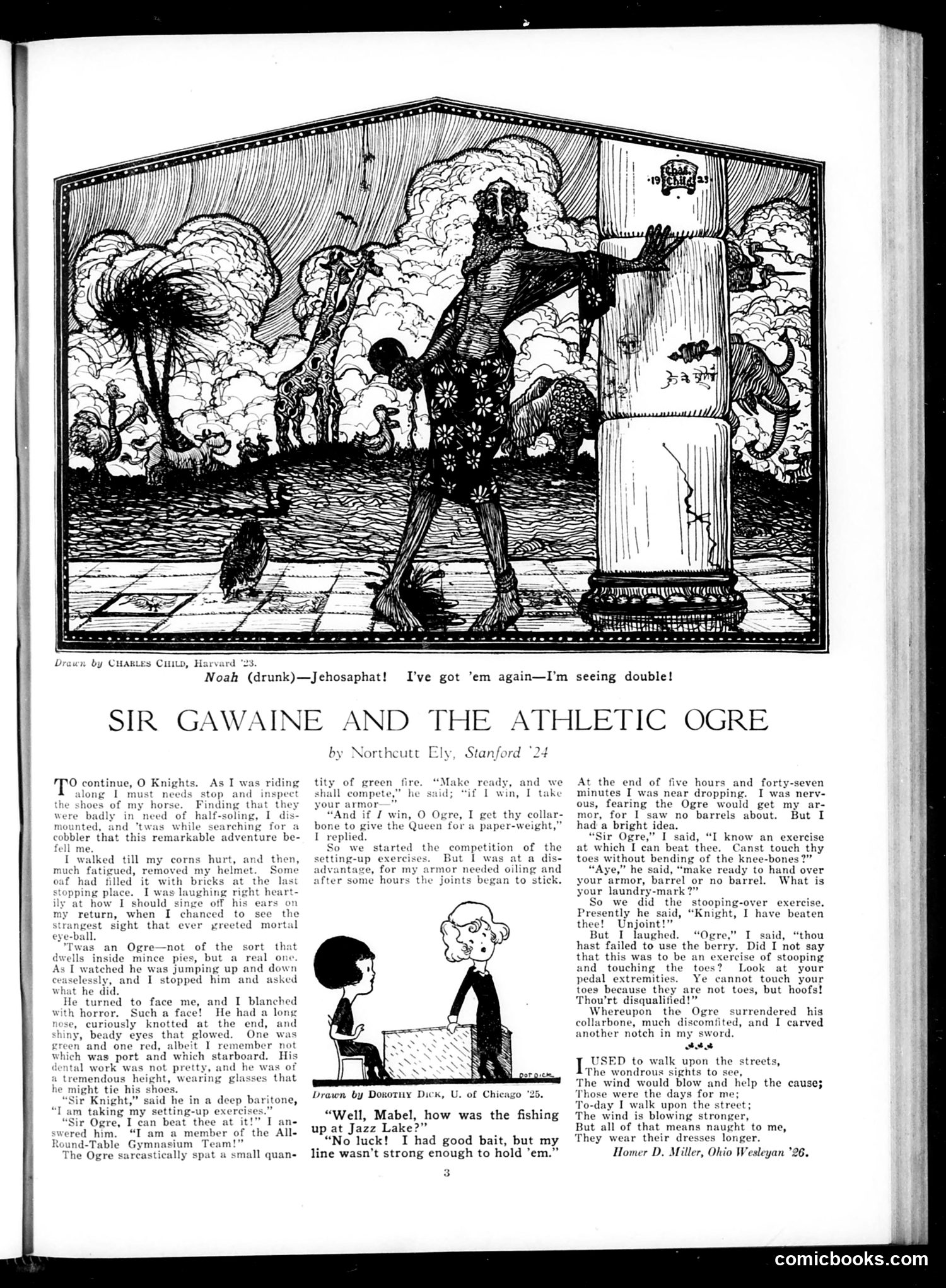
**Top Cartoon: "Noah (drunk)—Jehosaphat! I've got 'em again—I'm seeing double!"** This depicts a biblical Noah figure intoxicated and seeing double vision of an "Athletic Ogre"—a muscular, grotesque creature. The satire appears to mock someone's athletic prowess or physical appearance through the lens of drunken perception. The biblical reference suggests moral commentary on excessive drinking or delusion. **Bottom Cartoon: "Well, Mabel, how was the fishing up at Jazz Lake?" / "No luck! I had good bait, but my line wasn't strong enough to hold 'em."** This fishing dialogue is a double entendre—the "fishing" and "line" reference likely allude to romantic or social pursuits during the Jazz Age, with the woman's response humorously suggesting her failed romantic endeavors were beyond her capacity to manage.
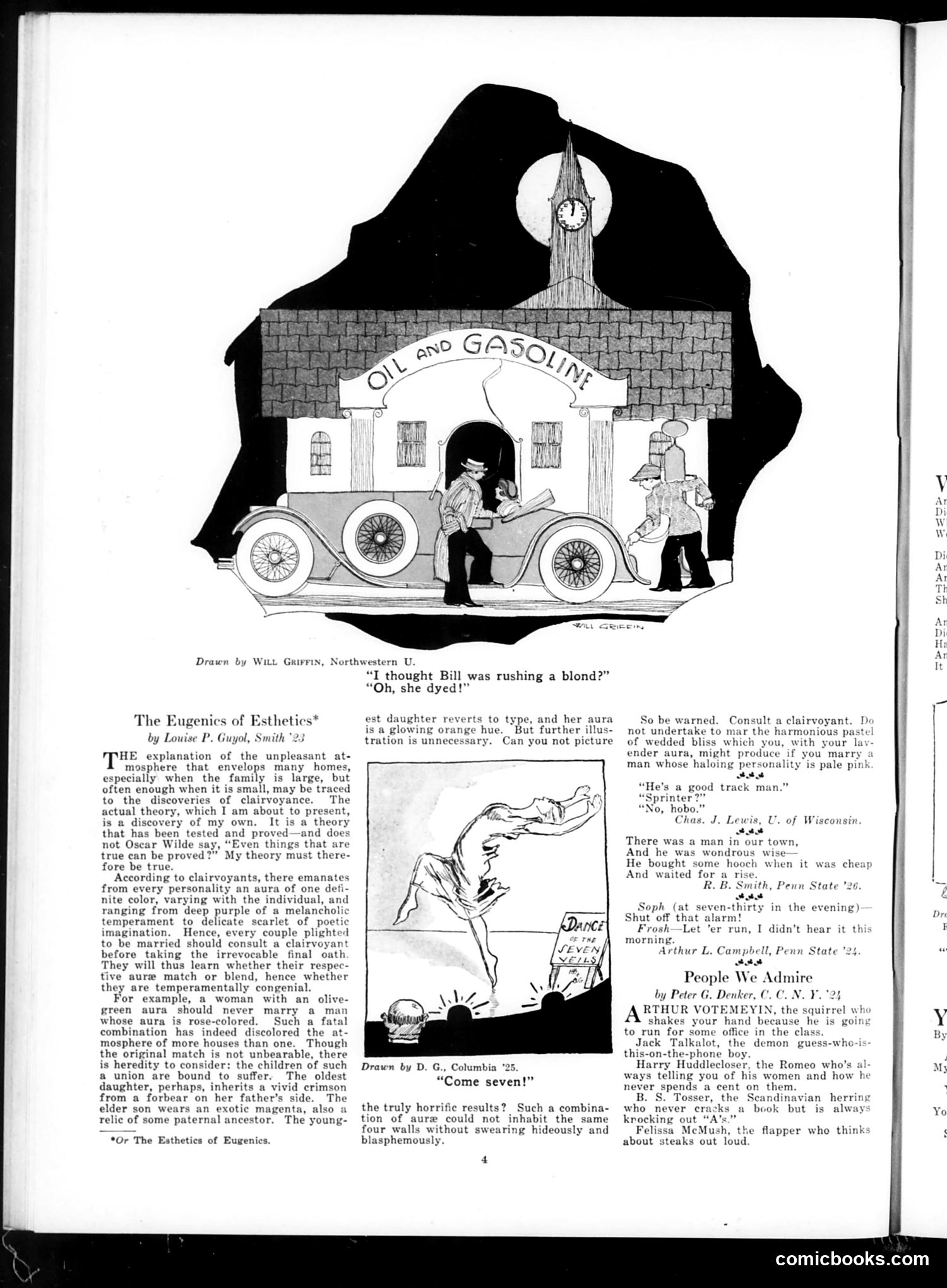
**Top Cartoon**: Drawn by Will Griffin, this depicts an "Oil and Gasoline" station (early automobile fuel stop). The caption reads: "I thought Bill was rushing a blond?" "Oh, she dyed!" This is a visual pun playing on "blond" (hair color) versus "dyed" (what happens when someone passes away). The joke relies on misheard dialogue—the speaker misunderstood "dyed" as "blonde," creating a dark humor setup about an automobile accident or death, likely satirizing the dangers of reckless driving ("rushing"). **Lower Content**: "The Eugenics of Esthetics" is a satirical essay criticizing eugenics pseudoscience, using marriage compatibility and aura colors as absurd examples. The accompanying illustration appears to mock fortune-telling and clairvoyance fraud. The page blends automotive-age humor with critique of pseudoscientific fads popular in the early 20th century.
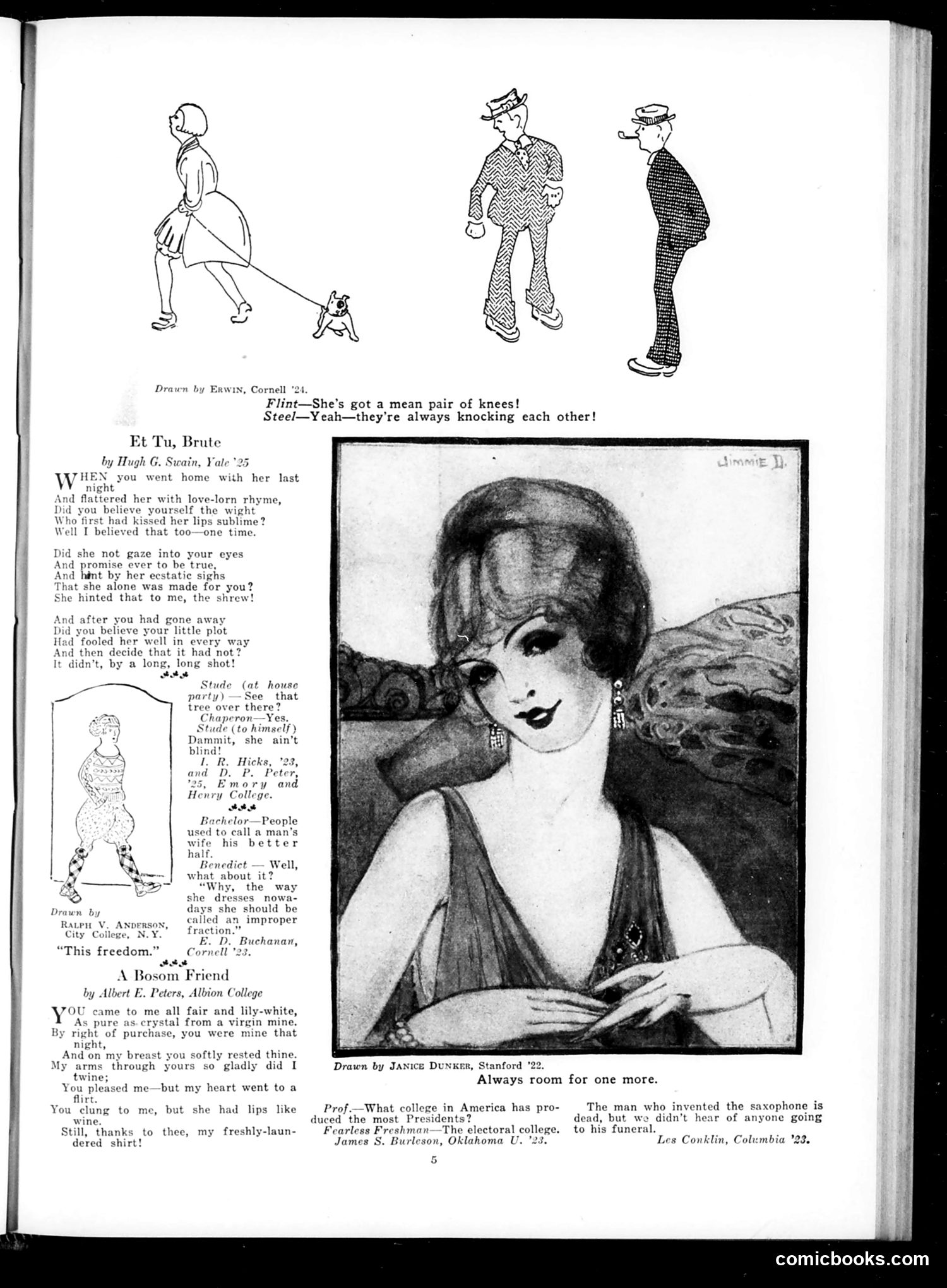
This 1920s college humor page satirizes romantic duplicity and changing social mores. The top cartoon mocks women's increased physical freedom—"Flint" and "Steel" are apparently women whose knees visibly knock together, referencing the scandalous shortening of women's skirts in this era. The joke treats visible female legs as inherently comedic and transgressive. "Et Tu, Brute" is a poem about male romantic betrayal: a man discovers his girlfriend made identical romantic promises to multiple suitors, establishing herself as a serial deceiver. The humor relies on inverting expected gender roles—typically men were satirized as unfaithful; here the woman is the faithless party. The subsidiary jokes reinforce this theme: a student awkwardly tries to seduce a chaperon; a "Benedict" (married man) criticizes his wife's modern, revealing clothing; and "A Bosom Friend" describes another woman who claimed exclusive devotion while clearly flirting elsewhere. The satire targets both the "New Woman" of the 1920s—sexually liberated, physically visible, independent—and male naïveté in believing romantic promises. The overall message mocks modern courtship's dishonesty.
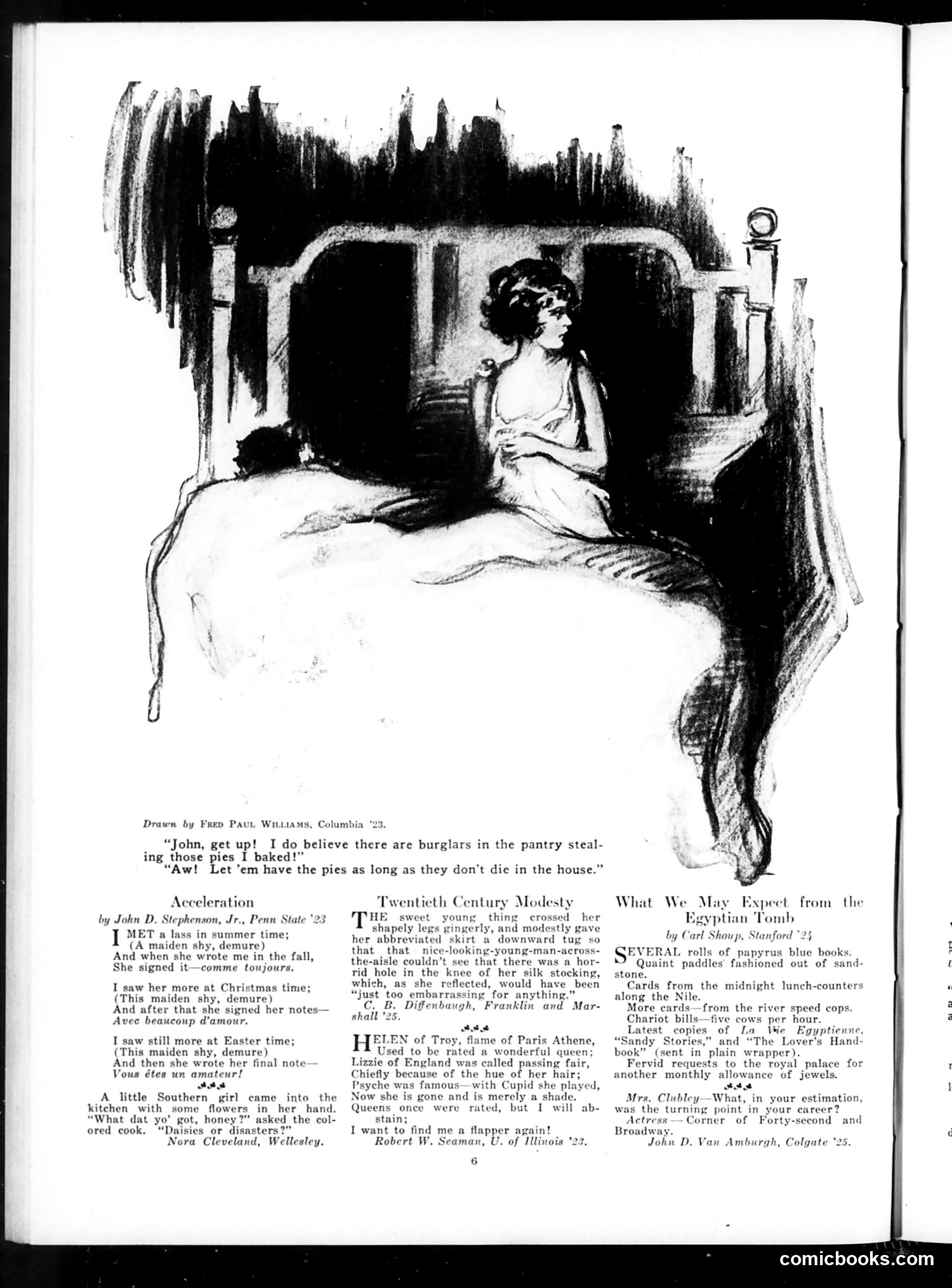
This page from *Judge* contains several brief humorous pieces typical of 1920s college humor magazines: **Main Cartoon** (top): A domestic scene where a husband, awakened by his wife about burglars stealing pies from the pantry, dismissively tells her to let them have the pies—as long as the thieves don't die in the house. The humor derives from the husband's indifference and dark comedy about the (presumably inedible) quality of his wife's baking. **The Poems/Verses Below** are student-authored light satire on modern social trends: - "Acceleration" humorously tracks a shy maiden's increasing romantic boldness through correspondence (progressing from French formality to direct proposals) - "Twentieth Century Modesty" mocks modern girls who worry about silk stocking holes while crossing legs immodestly - References to "flappers" and "Egyptian Tombs" reflect 1920s popular culture The overall tone is gentle collegiate satire about courtship, domestic life, and contemporary fashion—typical of *Judge*'s humor aimed at educated young readers.
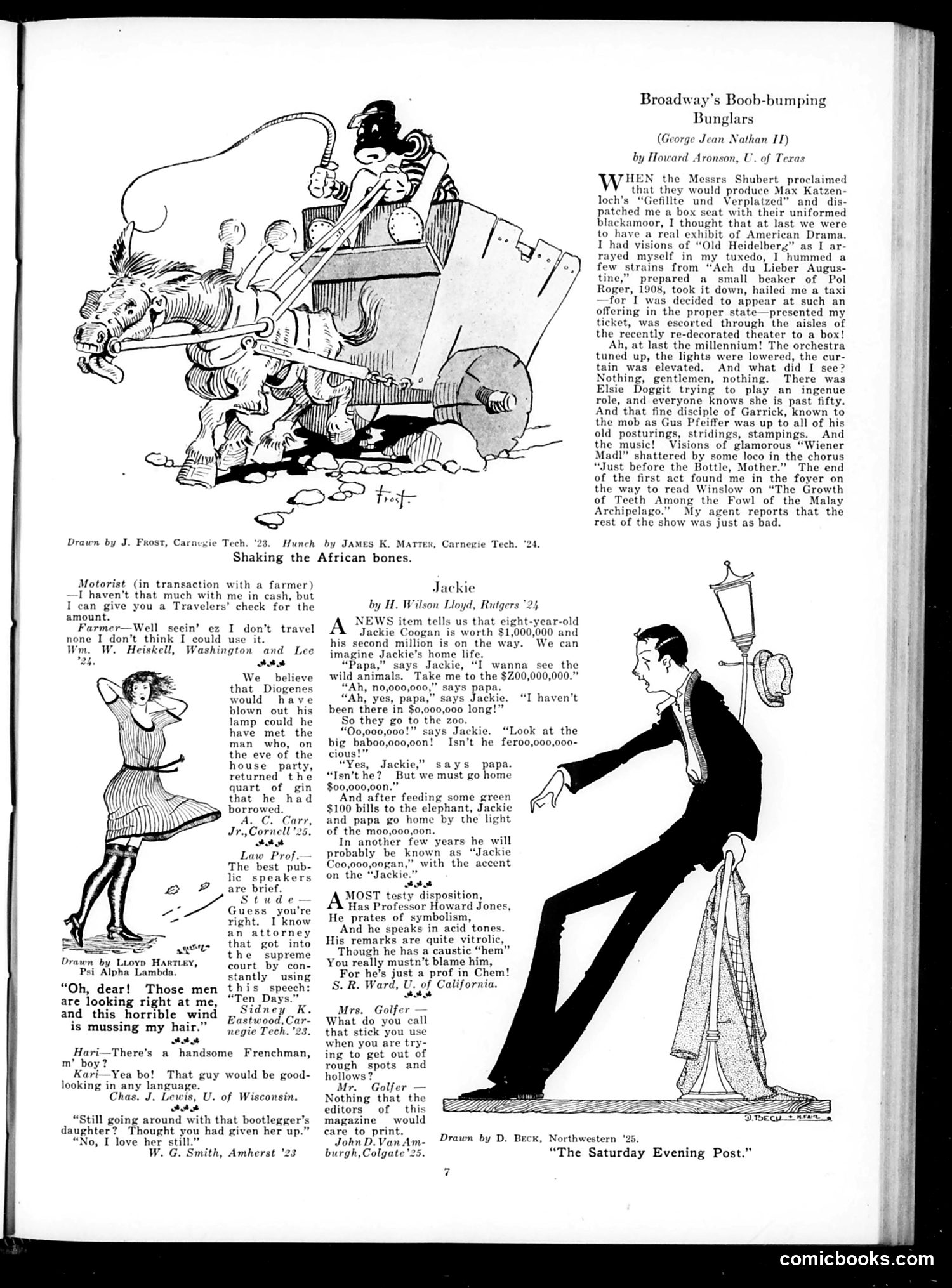
This Judge magazine page (circa 1924) contains several satirical pieces mocking American culture and institutions: **"Broadway's Boob-bumping Bunglars"** (top left): A theater critic ridicules the Shubert brothers' production of a play. The satire attacks both pretentious theater-going (the narrator dresses in a tuxedo to appear cultured) and poor Broadway productions—featuring aging actress Elsie Doggit playing ingénues and hammy actor Gus Pfeiffer. The joke: despite anticipating "real American Drama," the show delivers nothing but mediocrity. **"Jackie"** (center): Satirizes wealth obsession during the Jazz Age. An eight-year-old's conversation with his father revolves entirely around dollar amounts ($1,000,000, $200,000,000), reducing all experience—zoo animals, meals—to monetary value. The humor mocks both nouveau riche excess and children corrupted by materialism. **Other brief pieces** mock professorial pretension, motorists using traveler's checks, and golf etiquette—typical middle-class foibles. The cartoons use exaggerated illustrations to emphasize absurdity.
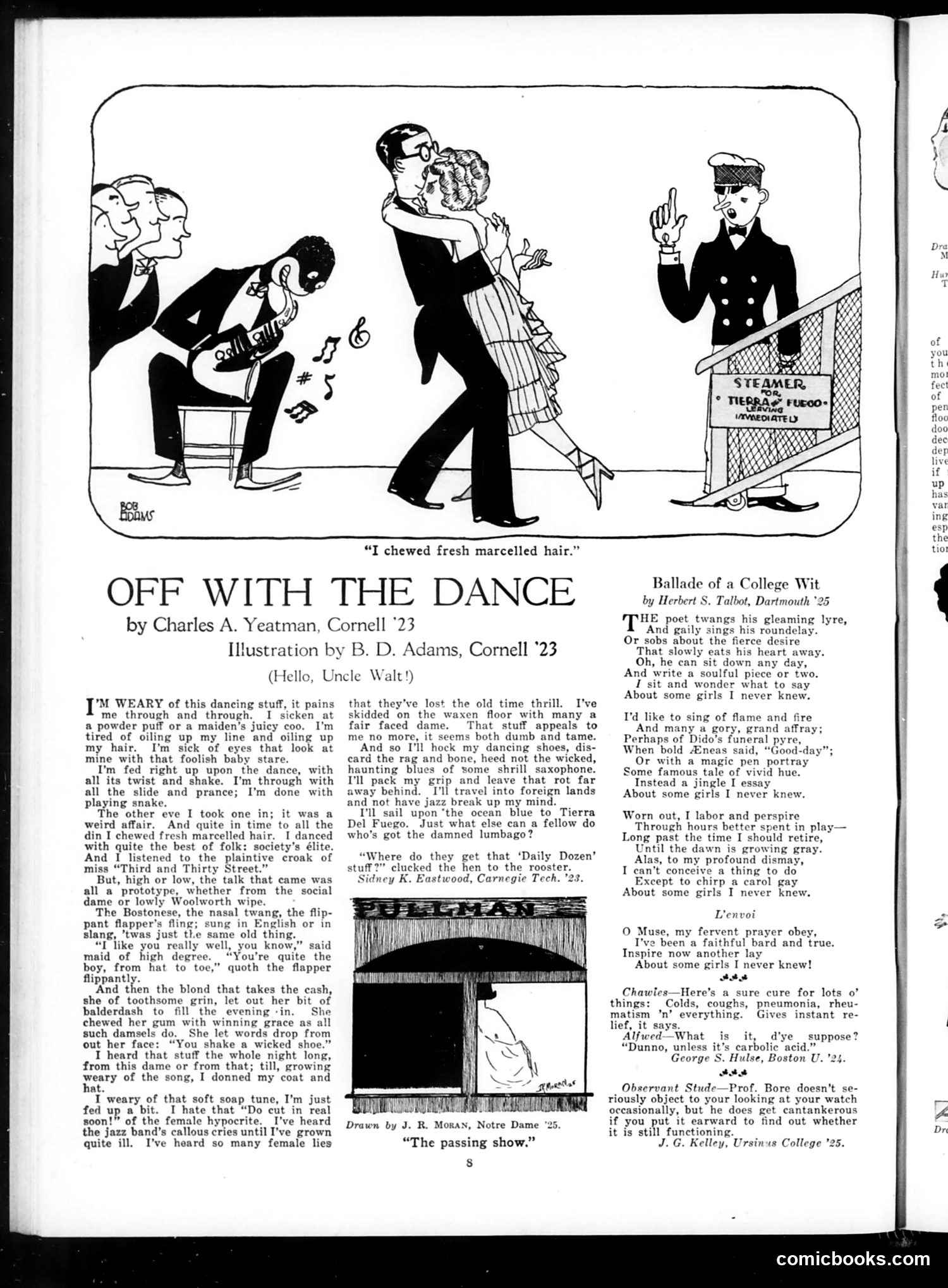
This 1923 college humor piece mocks the exhaustion of participating in modern dance culture. The author (a Cornell student) complains about the repetitive, superficial nature of jazz-age socializing: the "waxen floor," flapper clichés ("You shake a wicked shoe"), and mechanical small talk. The illustration shows various male figures in formal wear at social events—one playing an instrument, one dancing, one departing by ship—depicting the relentless social circuit the narrator wants to escape. The satire targets not women specifically but the *artificiality* of contemporary courtship rituals and the exhausting performance required of young men navigating 1920s social expectations. His exasperated conclusion—retiring to Tierra del Fuego because of "lumbago" (back pain)—is absurdist humor. The page also includes poetry and unrelated humor items typical of Judge magazine's college-focused content from this era.
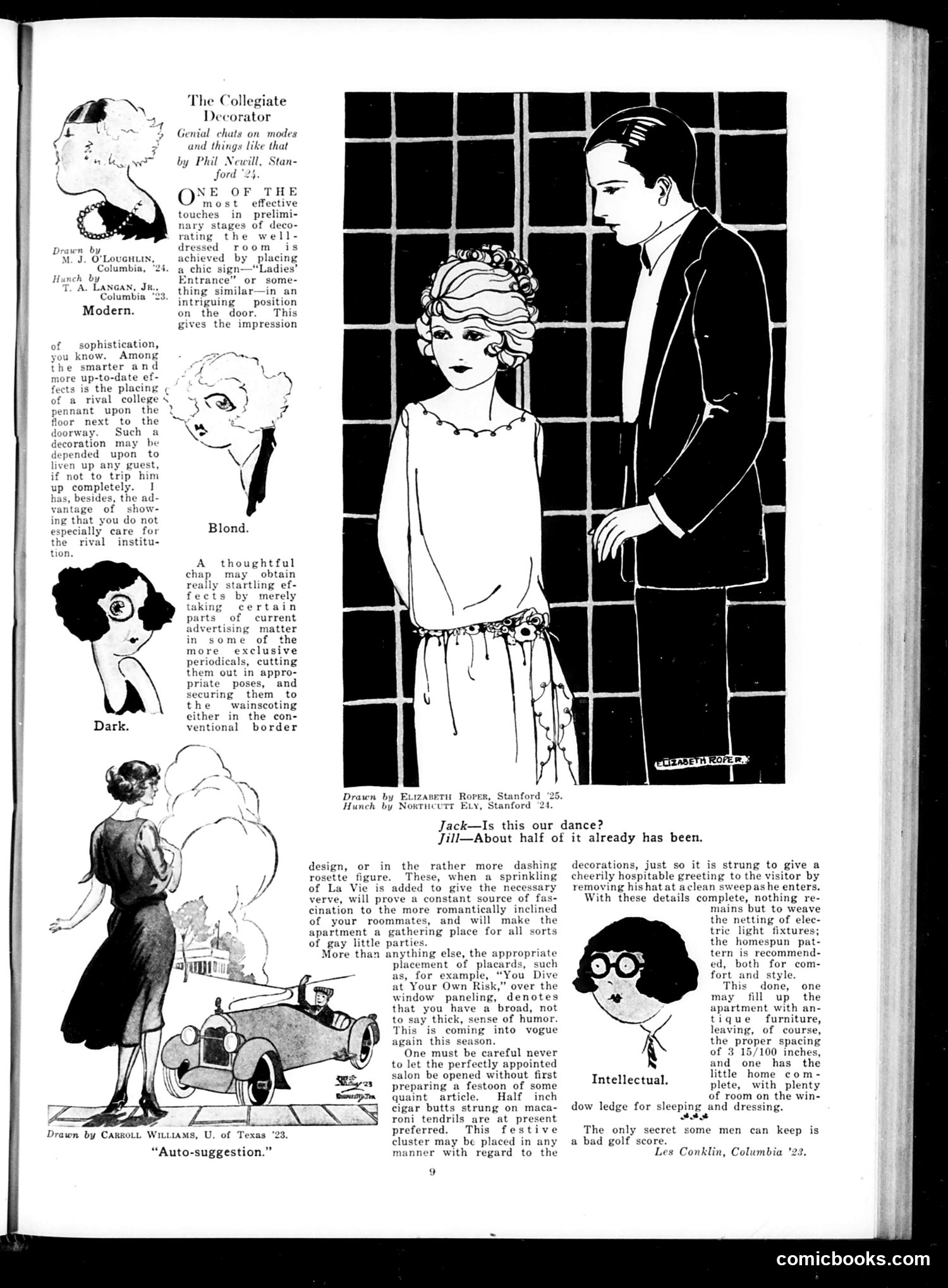
This page satirizes 1920s college culture and the pretensions of young decorators furnishing dormitory rooms. The main article, by Phil Newill of Stanford '25, offers tongue-in-cheek advice on room decoration—placing rival college pennants on floors to trip guests, cutting out advertisements from magazines like *La Vie*, and arranging cigar butts as "festive clusters." The accompanying illustrations show stereotyped female "types" (Blond, Dark, Intellectual) and a humorous dialogue where a couple discusses their dance's duration. The "Auto-suggestion" cartoon depicts a woman proudly displaying her toy automobile. The satire targets collegiate affectation and pretense: students mimicking sophisticated European aesthetics while their efforts remain laughably amateur. References to *La Vie* (a French fashion/lifestyle magazine) underscore the aspirational, vaguely Continental posturing typical of 1920s college social life. The overall tone mocks youthful attempts at bohemian sophistication.
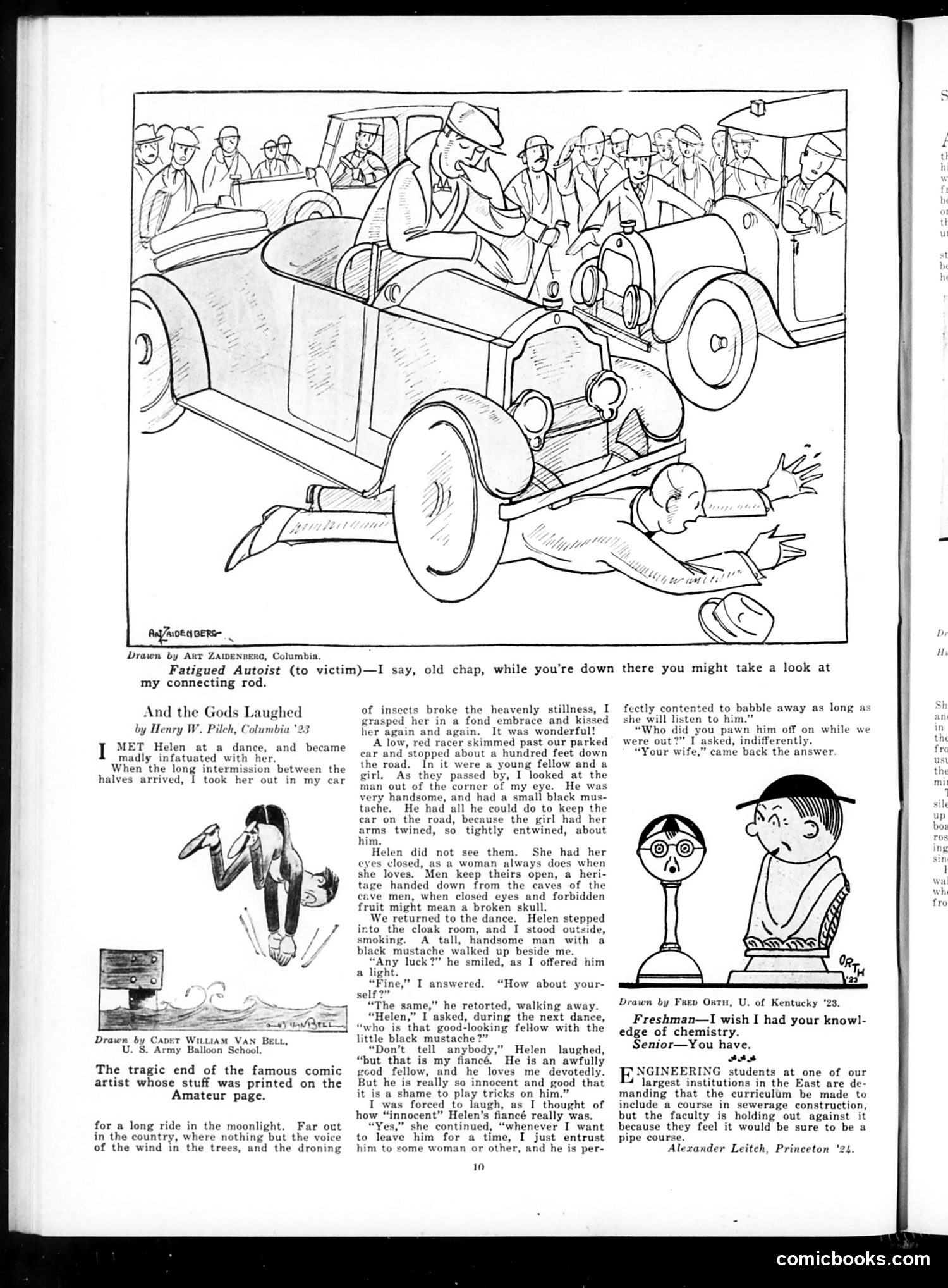
This page contains three distinct satirical pieces targeting early 1920s social attitudes: ## "Fatigued Autoist" (top) A cartoon mocking a car accident victim being run over. The humor—darkly cynical by modern standards—plays on the era's cavalier attitude toward automobile safety and pedestrian casualties. ## "And the Gods Laughed" A story about a man who kisses his date Helen in a parked car, only to discover she's engaged. The twist: when he asks who she "pawned off" during their romantic interlude, she replies "Your wife"—implying his own spouse was similarly distracted. The satire critiques both casual infidelity among the era's youth and the double standards around gender and romance. ## "Freshman/Senior Chemistry Joke" A brief pun: a freshman envies the senior's chemistry knowledge; the senior replies the freshman already possesses it (implying sewerage construction is inherently a "pipe course"—a play on words). These pieces reflect 1920s collegiate humor: cynical about modern courtship customs, dismissive of safety concerns, and reliant on wordplay and sexual innuendo acceptable in that era's "sophisticated" magazines.
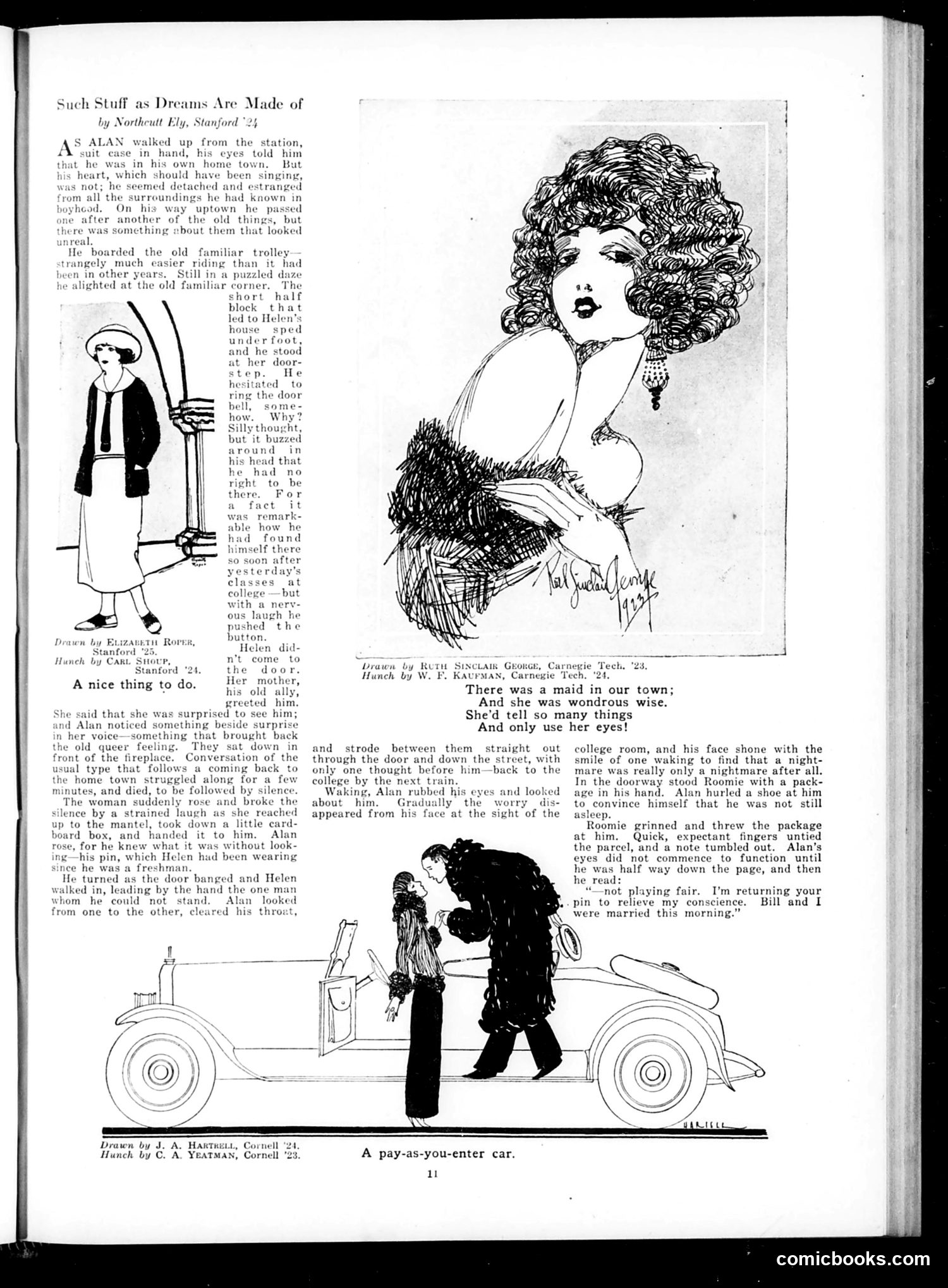
This is a short story with illustrations about a young man named Alan returning to his hometown and visiting his old flame Helen. The narrative reveals his visit was actually a dream—he falls asleep in his college dorm room. The satire targets romantic nostalgia and youthful delusion. Alan romanticizes his hometown and Helen until reality intrudes: Helen has married someone else (Bill) and is returning his old pin, asking him to stop pining for her. The story mocks the protagonist's inability to accept that his past is gone and people move on. The accompanying illustrations show period details (early 1920s automobiles, fashion) and include a "pay-as-you-enter car" cartoon—likely a separate joke about modern transportation technology. The overall message: dwelling on past romance is foolish; life progresses whether you accept it or not.
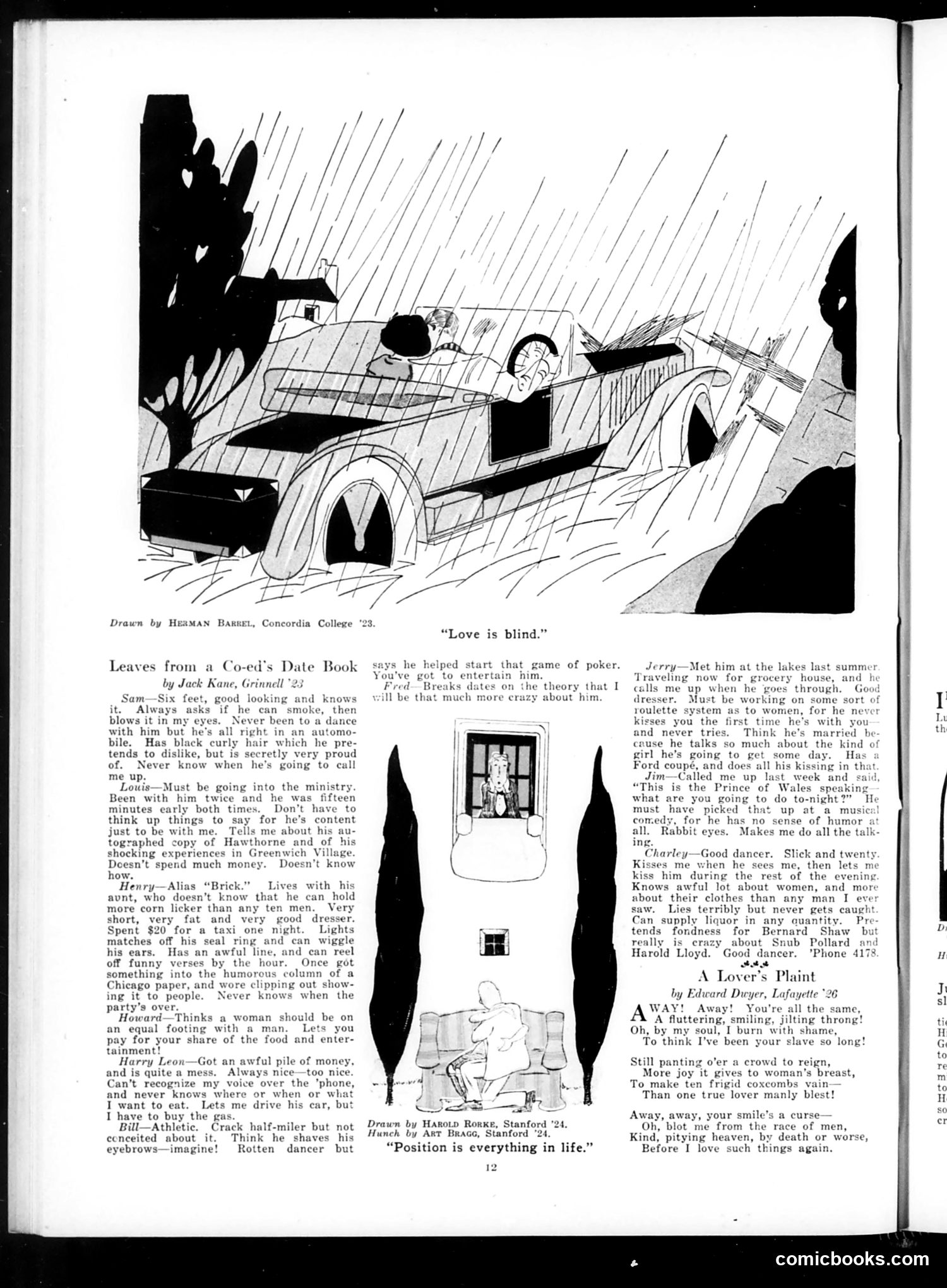
This page satirizes 1920s college dating culture through a co-ed's frank catalogue of her various male suitors. Each entry—Sam, Louis, Henry, Howard, Harry Leon, Bill, Jerry, Jim, and Charley—represents a male stereotype or type, with the woman rating them on appearance, behavior, spending habits, and romantic reliability. The satire targets both genders: male vanity (the narcissistic dressers, the show-offs), male cheapness and unreliability, and female manipulation (deliberately making suitors jealous, exploiting their spending). The accompanying poem "A Lover's Plaint" reinforces this cynicism, depicting romantic relationships as games where women enjoy "jilting" suitors. The humor derives from the co-ed's matter-of-fact, almost clinical assessment of dating as transactional. This reflects 1920s anxiety about changing courtship norms, women's new independence, and the perceived cynicism of post-WWI youth culture.
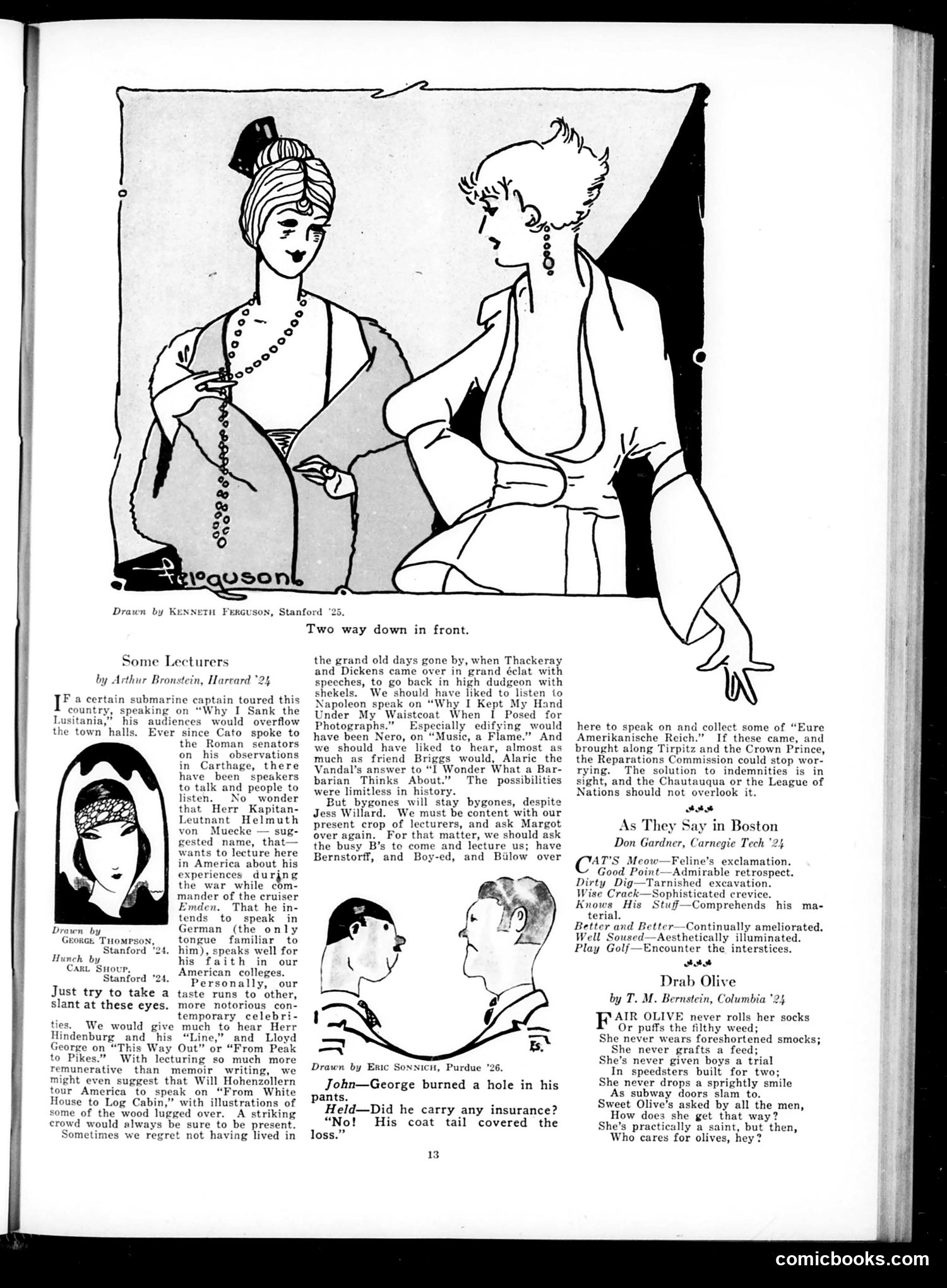
This 1924 *Judge* magazine page satirizes post-WWI lecture circuits. The main article mocks a German U-boat captain (von Muecke) wanting to lecture in America about sinking the Lusitania. The author sarcastically suggests inviting other prominent WWI figures—Kaiser Wilhelm, Hindenburg, Lloyd George, even the enemy admirals Tirpitz and Bernstorff—to speak on their wartime actions. The satire targets American fascination with celebrity lecturers while critiquing the absurdity of giving platforms to enemy war figures so soon after the war's end (it ended 1918). It's darkly humorous: why would Americans want to hear from those responsible for deaths? The page also includes unrelated humorous sketches and a poem about "Drab Olive," a boring woman, using period slang. **Context**: Post-WWI America was ambivalent about Germans; the Lusitania sinking (1915) killed many Americans and fueled anti-German sentiment. Inviting such speakers would be controversial.
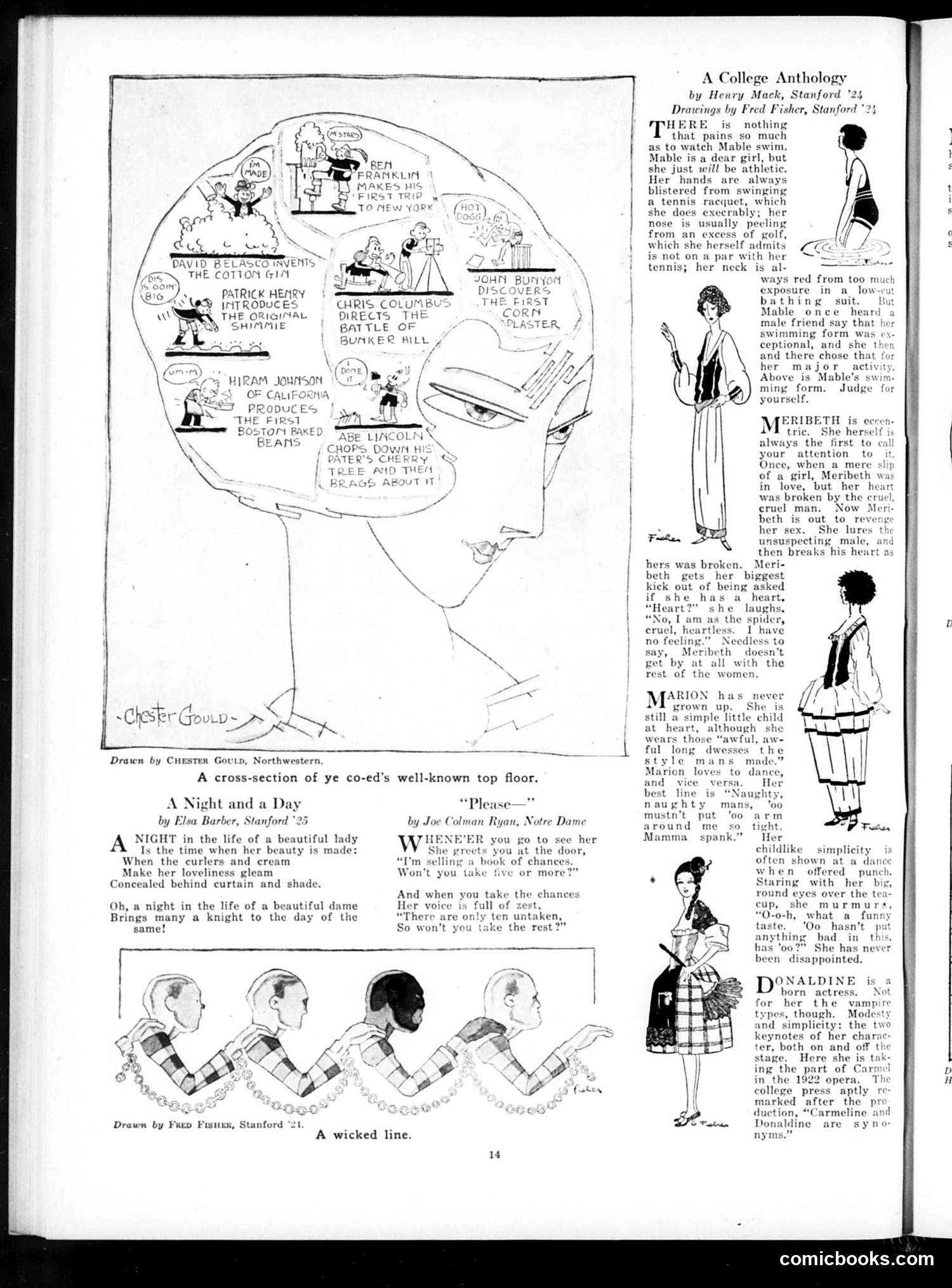
This page from Judge magazine presents satirical sketches of female college types circa 1924. The left side features a humorous "phrenology" head diagram (a pseudo-scientific head map) humorously attributing discoveries to various historical figures, likely mocking pseudo-intellectual college pretensions. The right column contains character sketches of recognizable "co-ed" archetypes: Mable (the athletically-obsessed swimmer), Meribeth (the revenge-seeking heartbreaker who manipulates men), Marion (the perpetually childlike dancer), and Donaldine (the modest actress). The bottom includes poetry and illustrations about college social life—a woman's nightly beauty routine ("A Night and a Day") and a suggestive quatrain about seduction ("A wicked line"). The overall satire gently mocks 1920s college women as vain, manipulative, or stereotypically flighty, reflecting era-typical gender attitudes while presenting these female students as notable enough subjects for extended commentary.
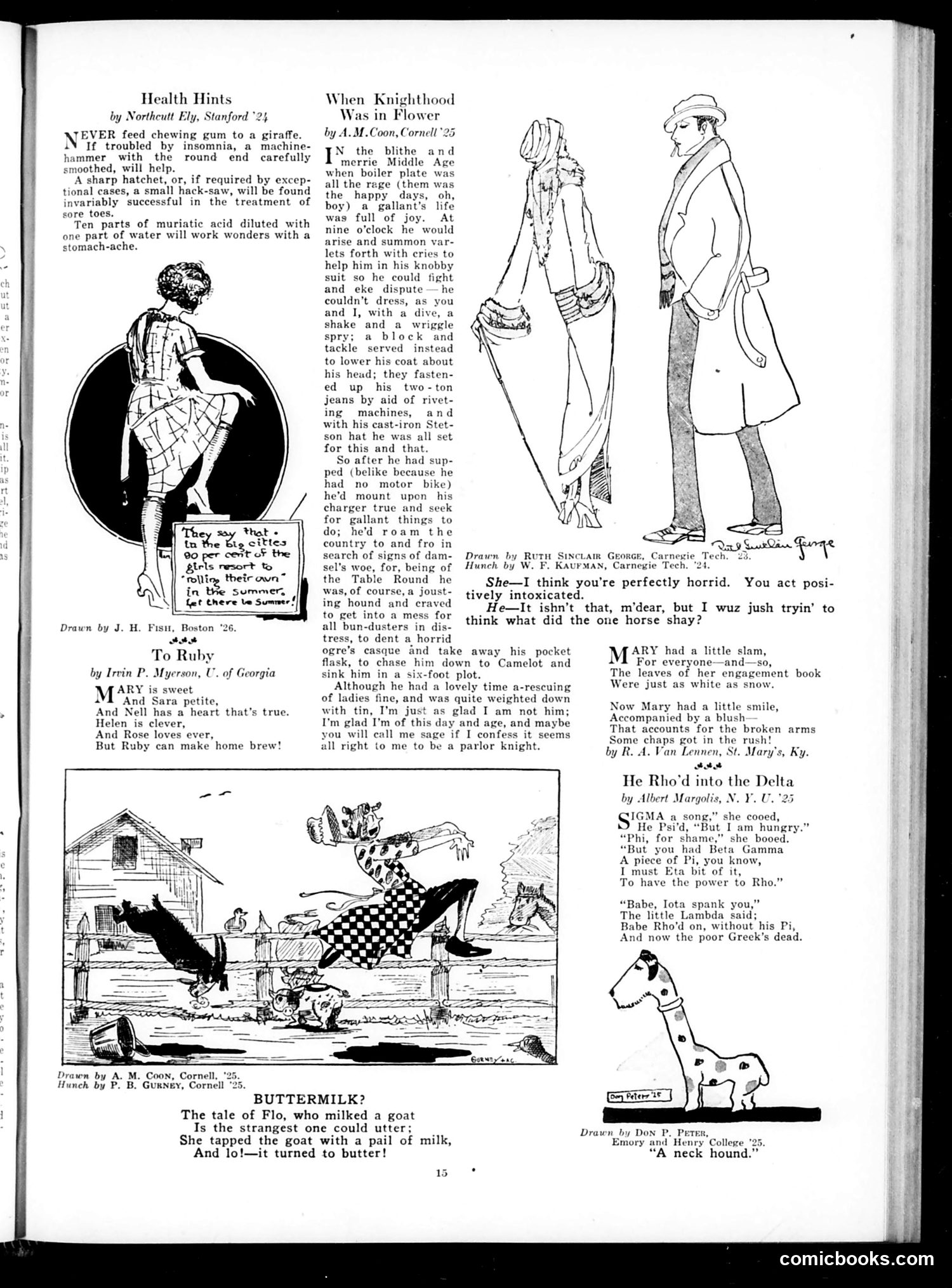
This page from Judge (circa 1924-1926) contains several light humor pieces typical of college-era satirical magazines: **"Health Hints"** parodies absurd medical advice through obvious exaggeration—suggesting muriatic acid for stomachaches or hack-saws for sore toes—mocking outdated or dangerous folk remedies. **"To Ruby"** is a short poem praising women's qualities, with the punchline that Ruby's appeal lies in her ability to make illegal homemade alcohol during Prohibition—a timely reference to the era's alcohol ban (1920-1933). **"When Knighthood Was in Flower"** humorously compares medieval knights' cumbersome armor and chivalric obligations unfavorably to modern life, suggesting the speaker prefers contemporary times despite their less romantic nature. **"Buttermilk?"** and the Greek letter pun piece are simple wordplay jokes. Overall, the page reflects 1920s college humor: Prohibition references, light romanticism, and gentle mockery of past eras and outdated practices.
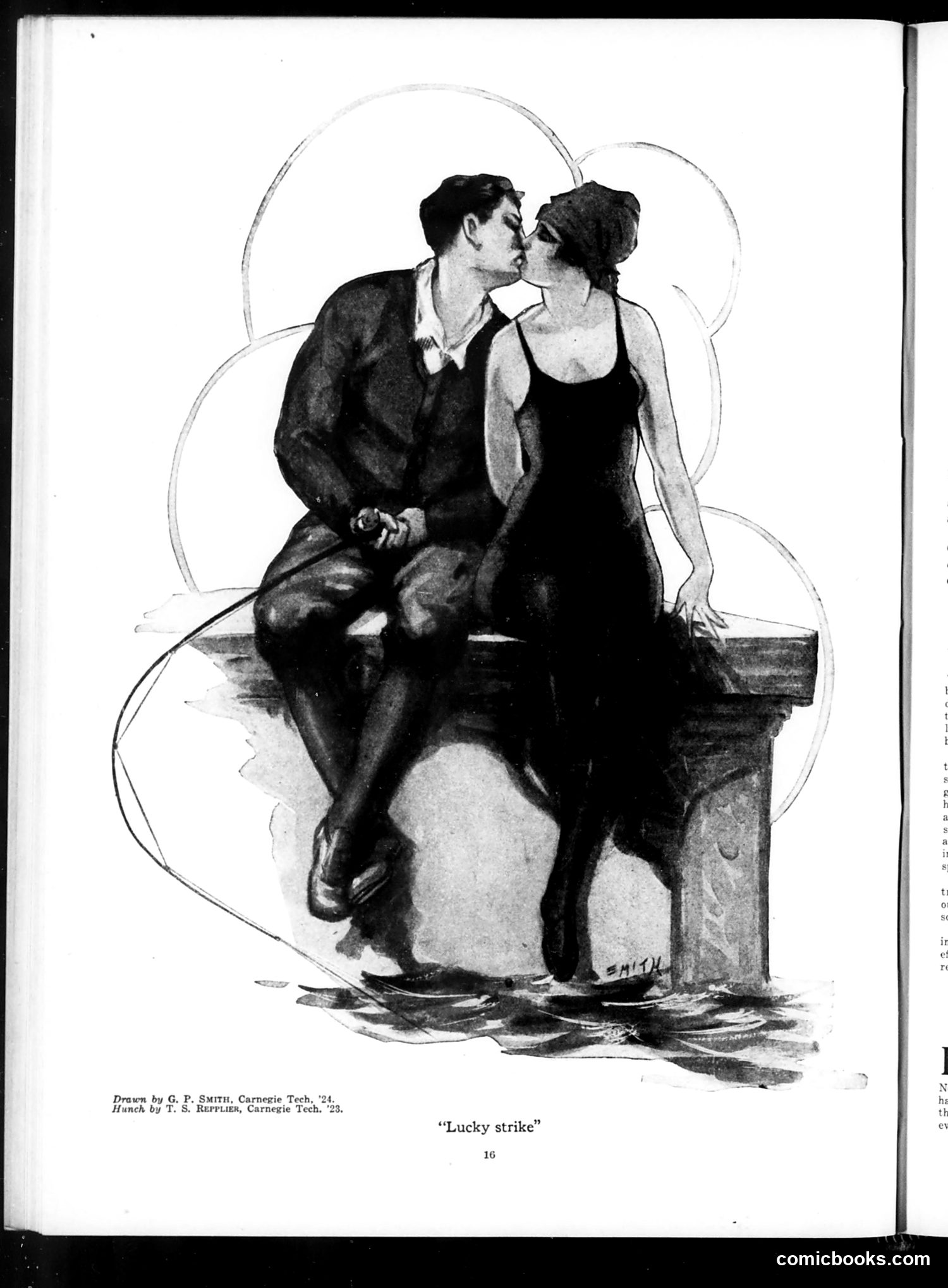
This is a romantic illustration titled "Lucky Strike," depicting a couple kissing on what appears to be a bench or log, with decorative circular shapes (possibly bubbles or clouds) in the background. The drawing was created by G. P. Smith and T. S. Rerpuigger, both from Carnegie Tech, circa the 1920s. The title "Lucky Strike" is a pun referencing the cigarette brand, suggesting the couple's romantic encounter is fortunate or serendipitous. The cartoon plays on the double meaning—a "lucky strike" as both a favorable chance occurrence and the cigarette product name. This type of advertising-adjacent humor was common in Judge magazine, blending commercial references with romantic or humorous scenarios for reader entertainment.
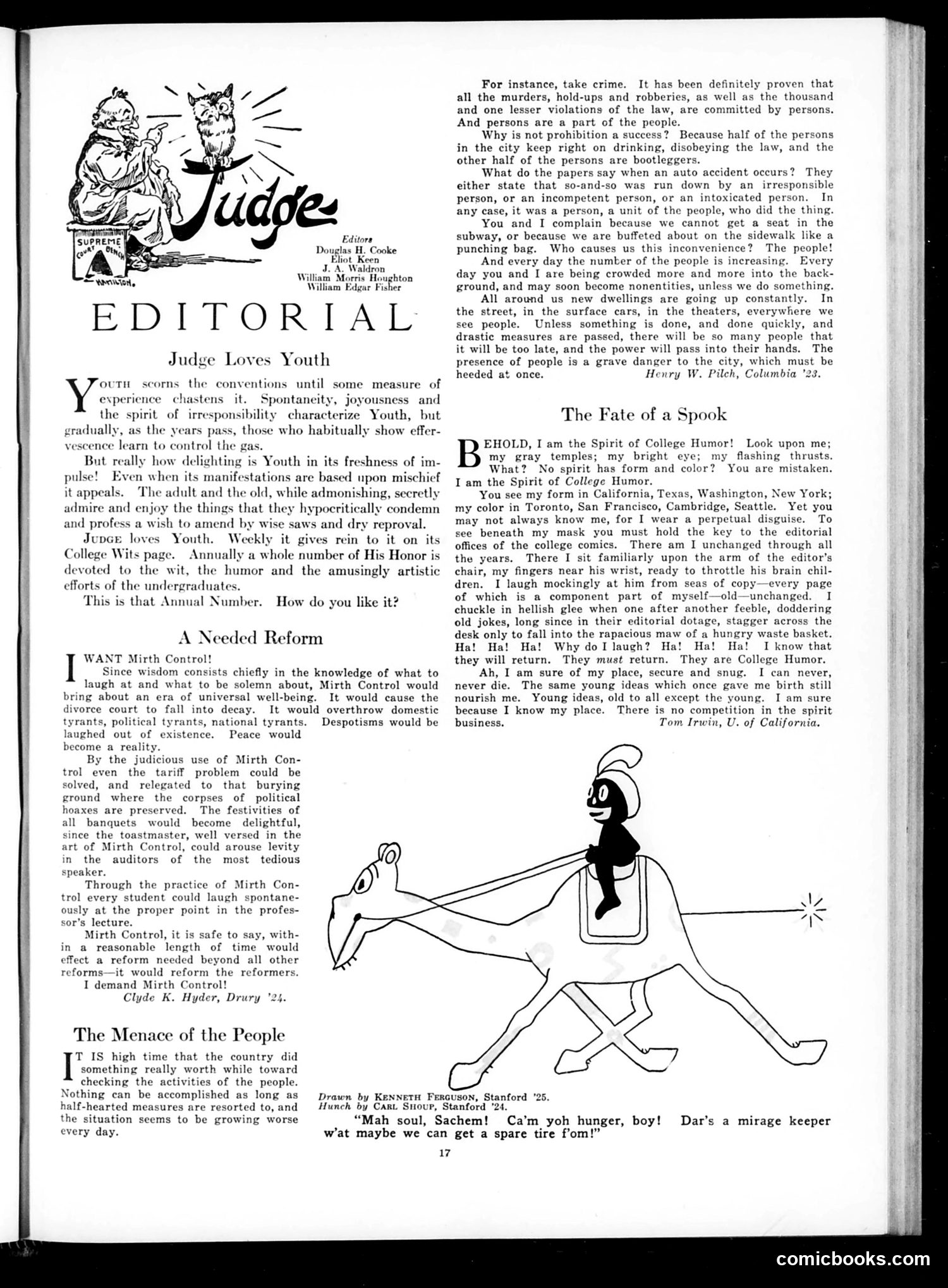
This editorial page from Judge satirizes social anxieties of 1920s America through mock-serious arguments. **"Judge Loves Youth"** celebrates undergraduate humor and irreverence—standard college magazine fare praising youthful spontaneity. **"A Needed Reform"** humorously proposes "Mirth Control" as a solution to national problems (tariffs, domestic strife, boring speeches). The satire mocks reform movements of the era by suggesting that if people could just laugh at the right moments, social and political problems would vanish—obviously absurd. **"The Menace of the People"** is the sharpest satire: it deadpan argues that all societal ills stem from "the people" themselves—crime, prohibition violations, traffic accidents, subway crowding. The author facetiously blames population growth and urban density on "persons" (people), satirizing anxiety about urbanization and mass society that characterized 1920s America. The accompanying cartoon shows a figure chasing a genie-like creature escaping from a bottle, illustrating themes of uncontrollable forces or wishes gone wrong.
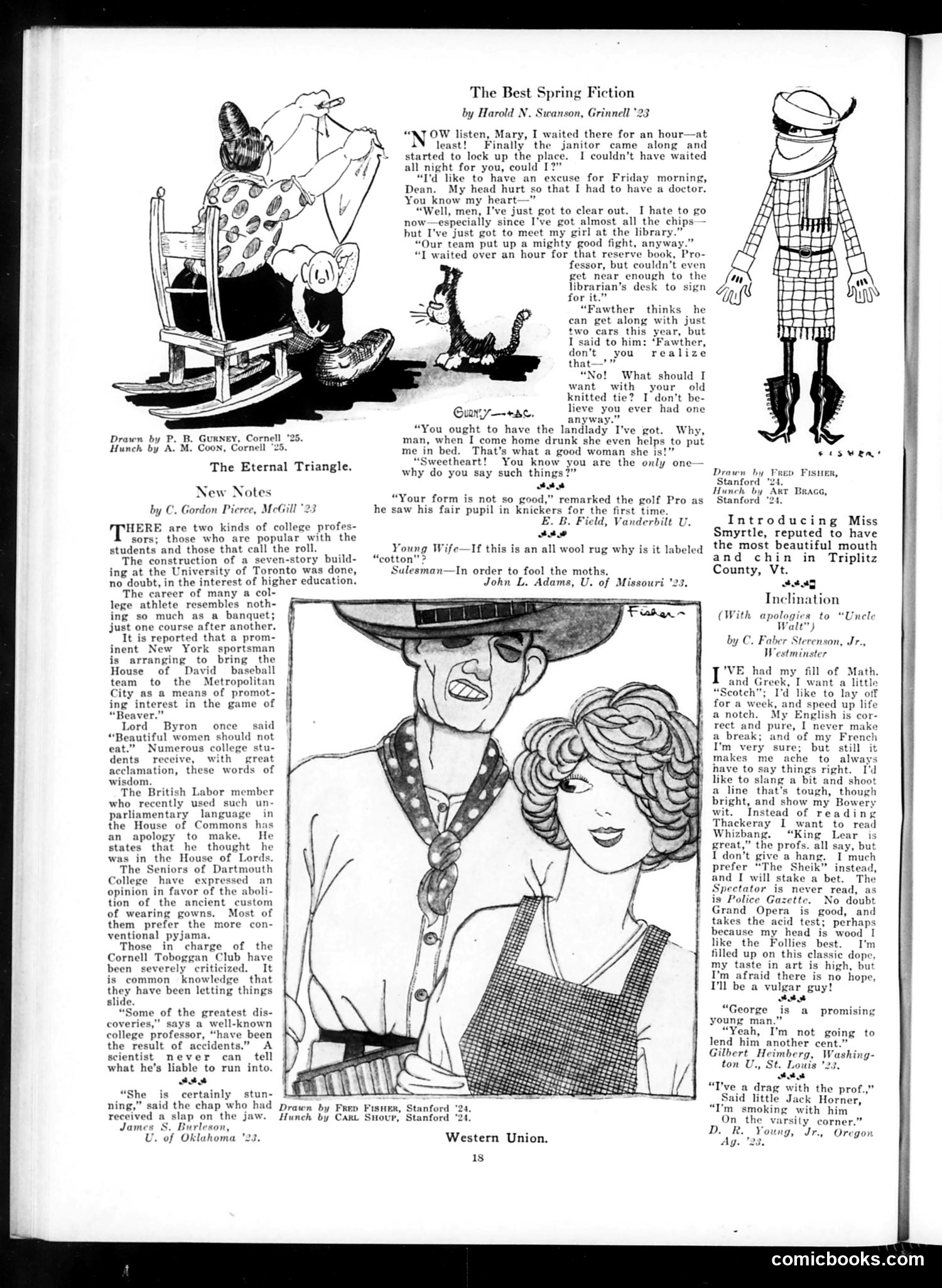
This page from Judge contains several humorous sketches satirizing college life and social conventions of the 1920s. **"The Eternal Triangle"** depicts a rocking chair scene illustrating the cliché romantic drama—a man making excuses to leave his girlfriend to meet another woman at the library. The humor mocks the predictability of this tired romantic scenario. **"Introducing Miss Smyrtle"** is a beauty pageant-style feature, with a caricatured woman's face highlighting exaggerated feminine features. This lampoons the era's obsession with cataloging and rating women's beauty. **"Inclination"** features an apology to Walt Whitman, where a college student expresses frustration with academic requirements (Math, Greek, English, French) while wanting to speak colloquially and rebel against proper standards. It satirizes the tension between formal education and youthful desire for freedom. **"New Notes"** contains short observational humor about professors, college athletes, and institutional absurdities—typical Judge fare mocking academia and social pretension of the era. The drawings employ exaggerated caricature common to 1920s satirical magazines.
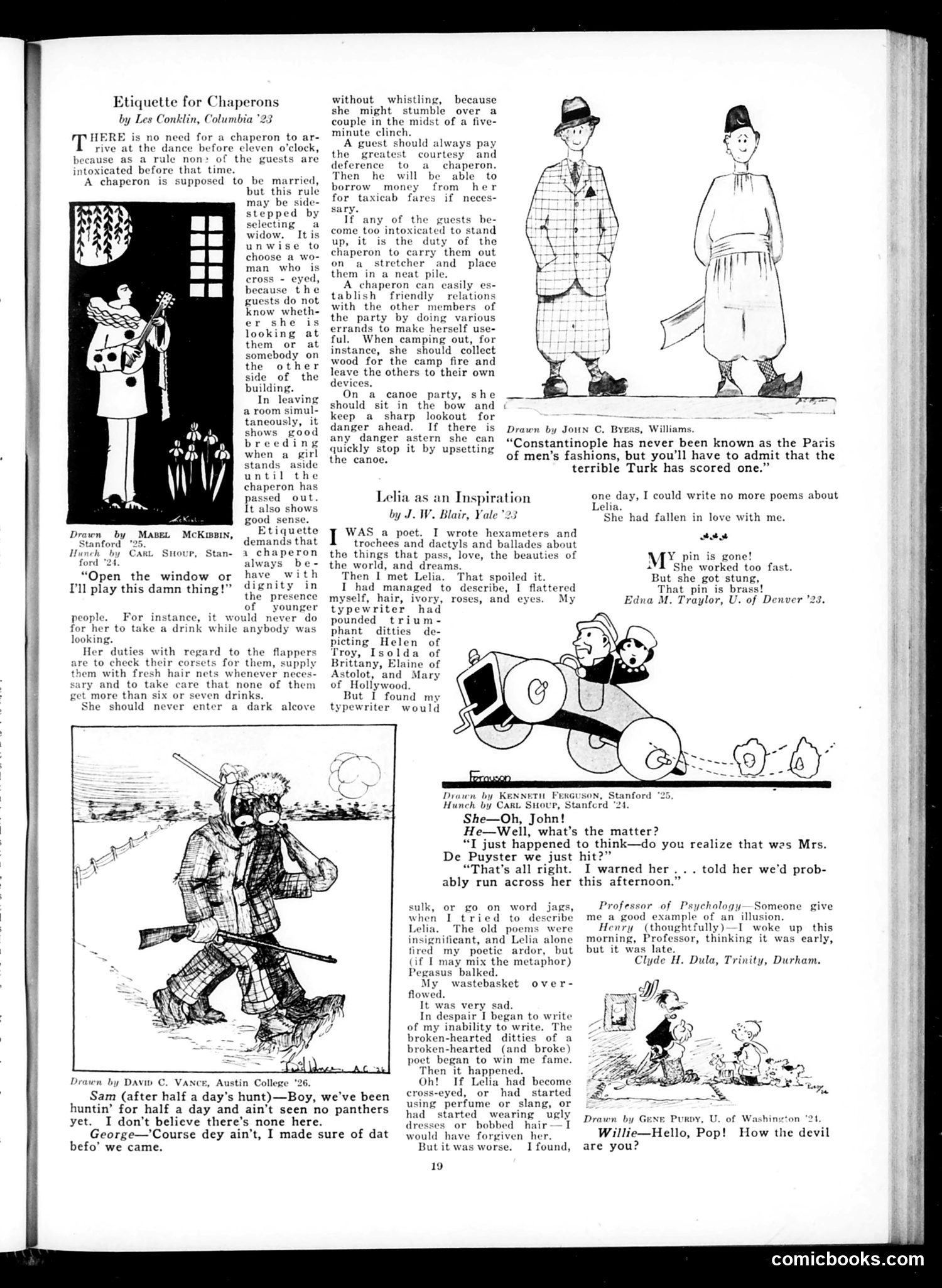
This 1923 *Judge* magazine page satirizes social etiquette and dating customs of the Jazz Age. **"Etiquette for Chaperons"** mocks the role of older women supervising young couples at social events—a now-obsolete practice. The humor targets how ineffectual chaperons were: arriving late (after drinking had begun), getting intoxicated themselves, and failing to prevent "petting" (making out). References to "clinches," "stretchers," and canoe parties allude to unsupervised romantic encounters chaperons were supposed to prevent. **"Lelia as an Inspiration"** is a lighthearted romance story about a poet whose creative output stops when he falls in love with a woman named Lelia. The irony: his typewriter "balked" when faced with describing real love rather than literary fantasies. The scattered humor vignettes throughout mock modern courtship, including a joke about hitting a wealthy socialite (Mrs. De Puyster) with a car and warning her she'd "probably run across her this afternoon." All material reflects 1920s anxieties about changing moral standards, flapper culture, and the declining authority of Victorian supervision.
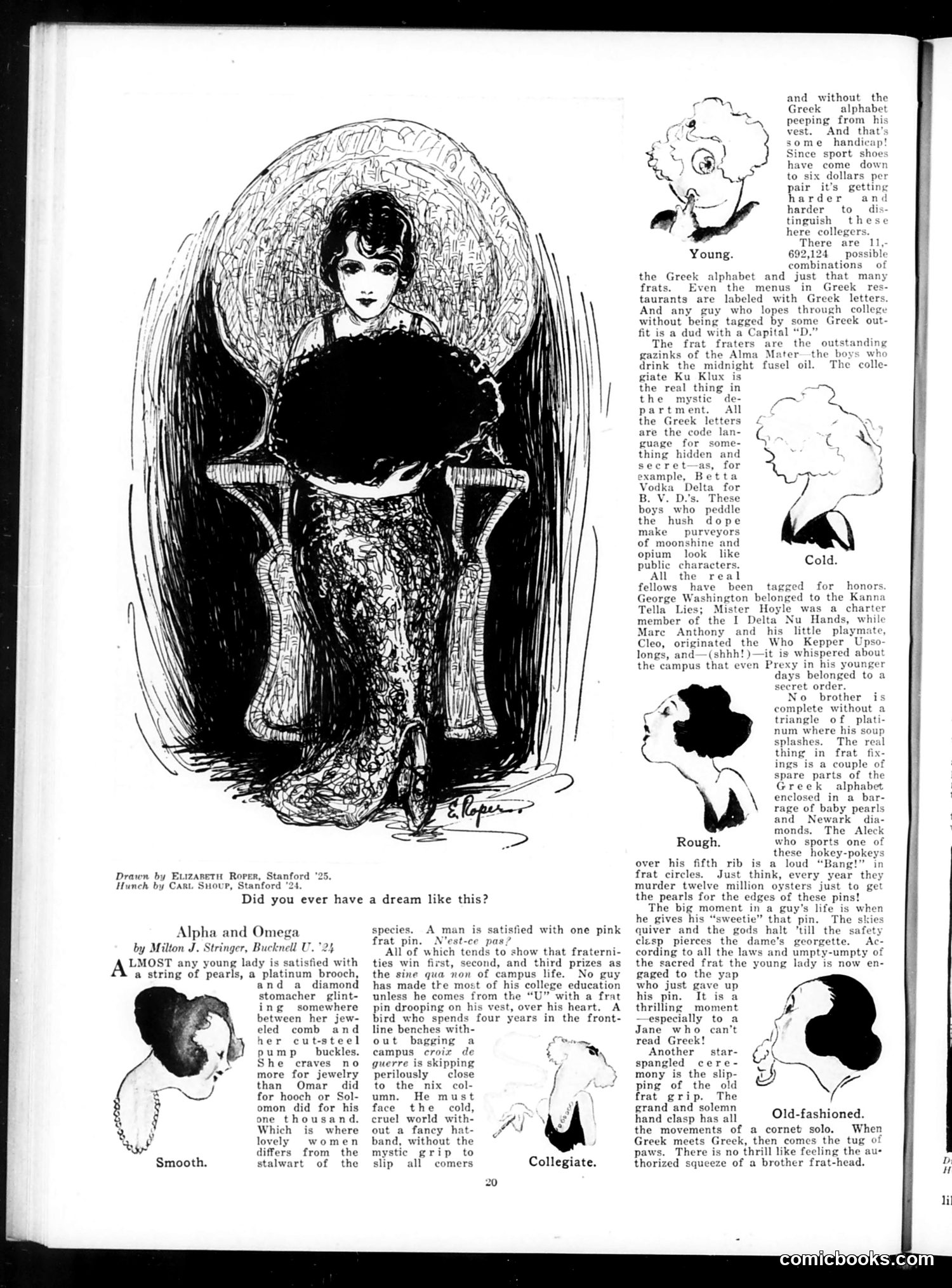
This 1924 college humor piece satirizes fraternity culture and the obsession with Greek letters and fraternity pins among college students. **The Main Satire:** The article mocks how fraternity membership has become the measure of a successful college education. Young men believe they must join a fraternity ("frat") and earn its pin to be respectable; those without one face the world as "duds." Simultaneously, young women are portrayed as obsessed with jewelry and fraternity pins as status symbols—receiving a fraternity pin from a boyfriend is treated as a major life event ("the skies quiver and the gods halt"). **The Illustrations:** Small profile sketches labeled "Smooth," "Cold," "Rough," "Collegiate," and "Old-fashioned" appear to show different college personality types, likely mocking how fraternity life supposedly categorizes students. **The Point:** This is gentle satire of how superficial and status-obsessed college culture has become—where Greek letters, secret handshakes, and jewelry matter more than actual education. The piece ridicules both the fraternity system's self-importance and young women's materialism.
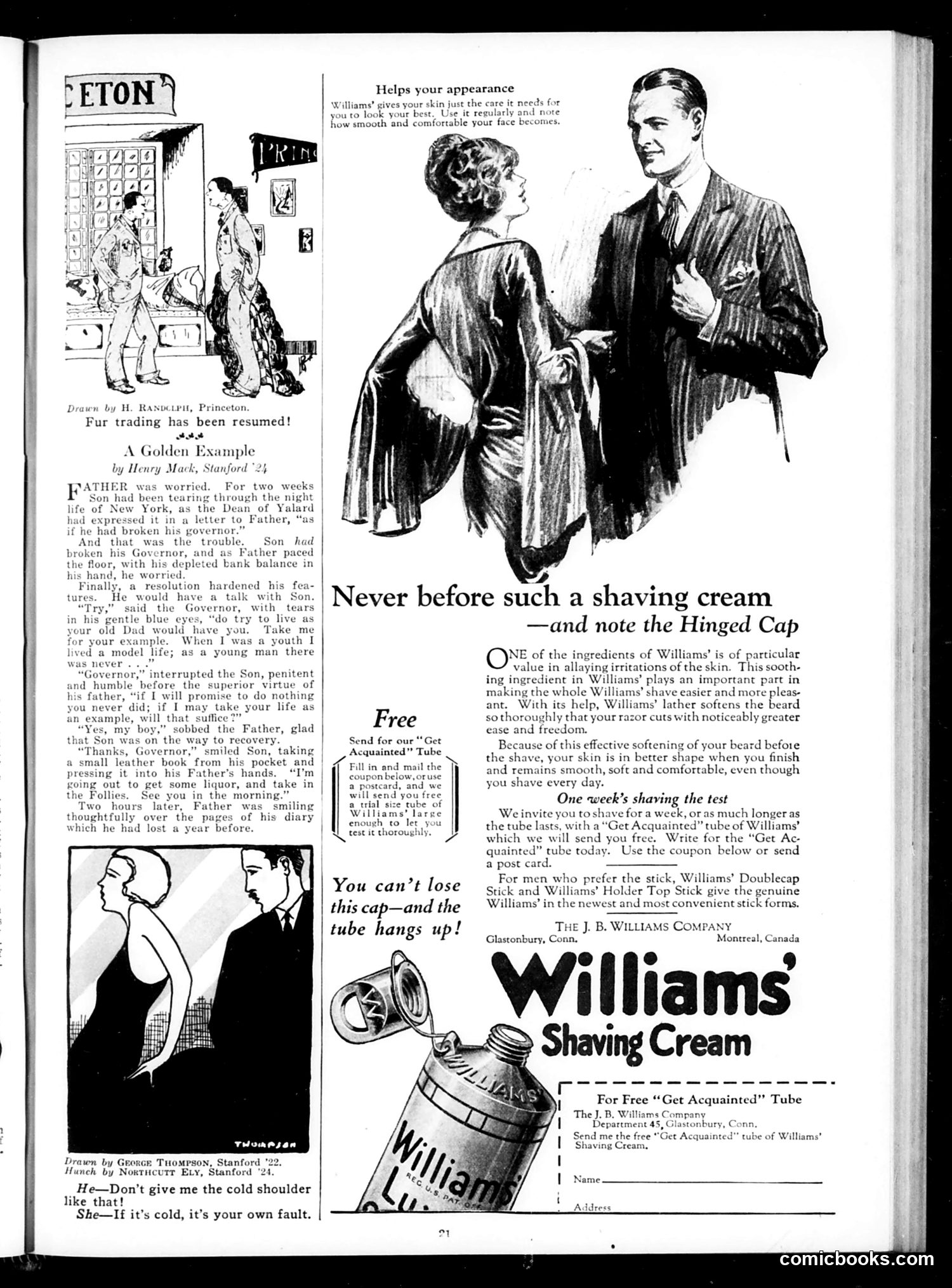
This page mixes satirical content with advertising. The left side features "A Golden Example," a short story about a father warning his son against breaking his "Governor" (likely a financial/moral restraint). The son has squandered money and broken his allowance limits. The father's gentle moral lesson—"live a model life"—is undercut by the son's immediate plan to visit liquor dens and the Follies (burlesque theaters), suggesting the younger generation ignores paternal advice. The humor comes from this generational disconnect and hypocrisy. Below is a two-panel cartoon about romance: a man complains to a woman about receiving the "cold shoulder," and she retorts it's his own fault for allowing things to grow cold. The page's substantial portion is dominated by a **Williams' Shaving Cream advertisement** featuring testimonials about the product's "hinged cap" design and skin-softening properties—typical early 20th-century marketing emphasizing product innovation and masculine grooming.
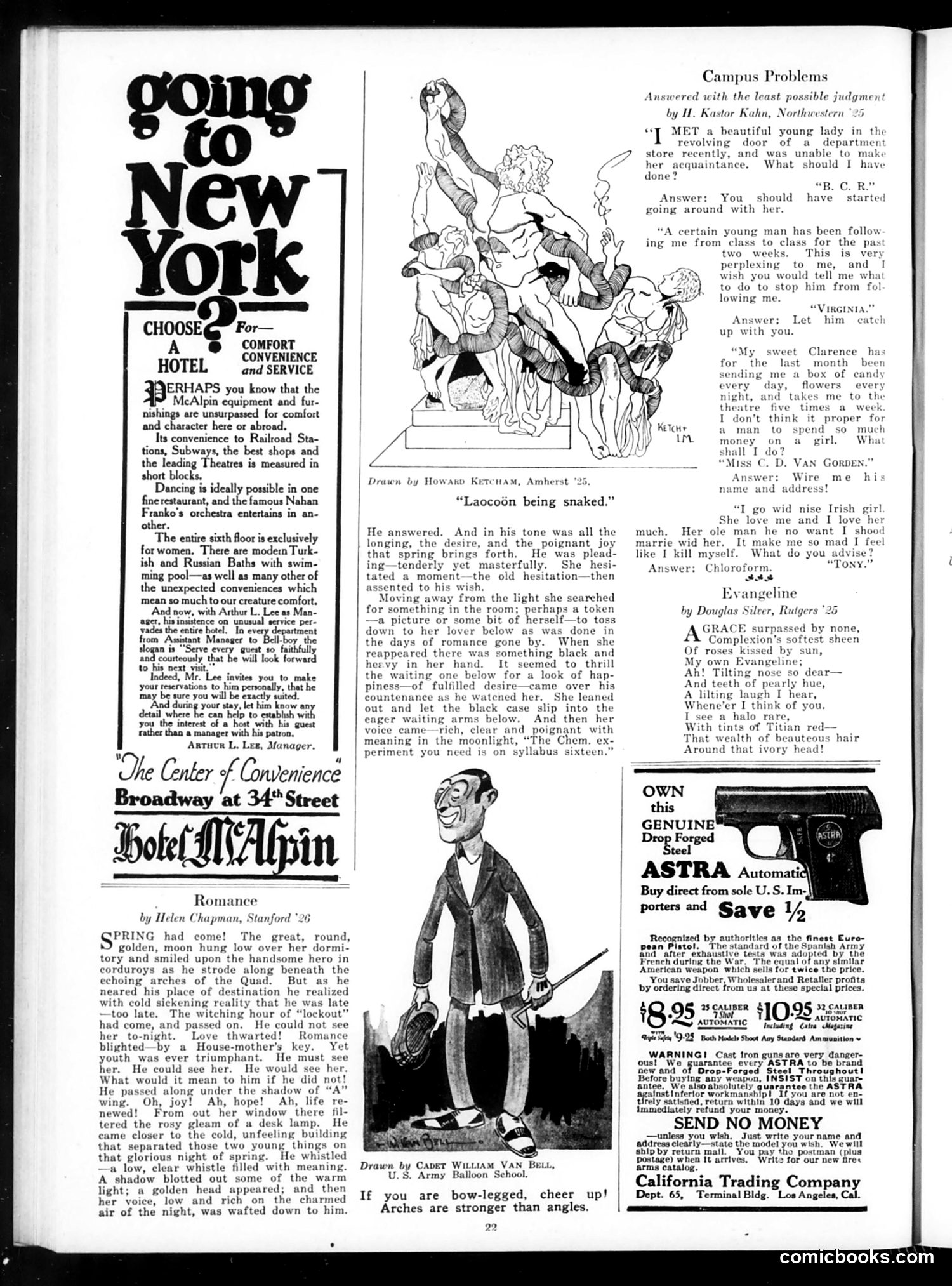
This page mixes advertisements with satirical fiction and humor typical of 1920s Judge magazine. **The Main Cartoon:** "Lacooön being snaked" depicts a romantic college scene. A young man courts a woman from beneath her dorm window at night—a common trope in period romance literature. The satire's twist: when she drops something to him, it's a chemistry textbook, and her whispered message isn't a love confession but homework help ("The Chem. experiment you need is on syllabus sixteen"). The joke mocks sentimental romantic fiction by deflating expectations—replacing moonlit passion with academic obligation. The title references Lacooön, the Trojan priest "snaked" (trapped) by serpents, suggesting the young man is similarly ensnared, though by mundane reality rather than fate. **Context:** This reflects 1920s college life, when strict dormitory rules ("lockout" hours) governed student behavior, and co-education was relatively new. The humor relies on the contrast between literary romance and practical campus reality. The page also includes hotel and firearm advertisements typical of period magazines.
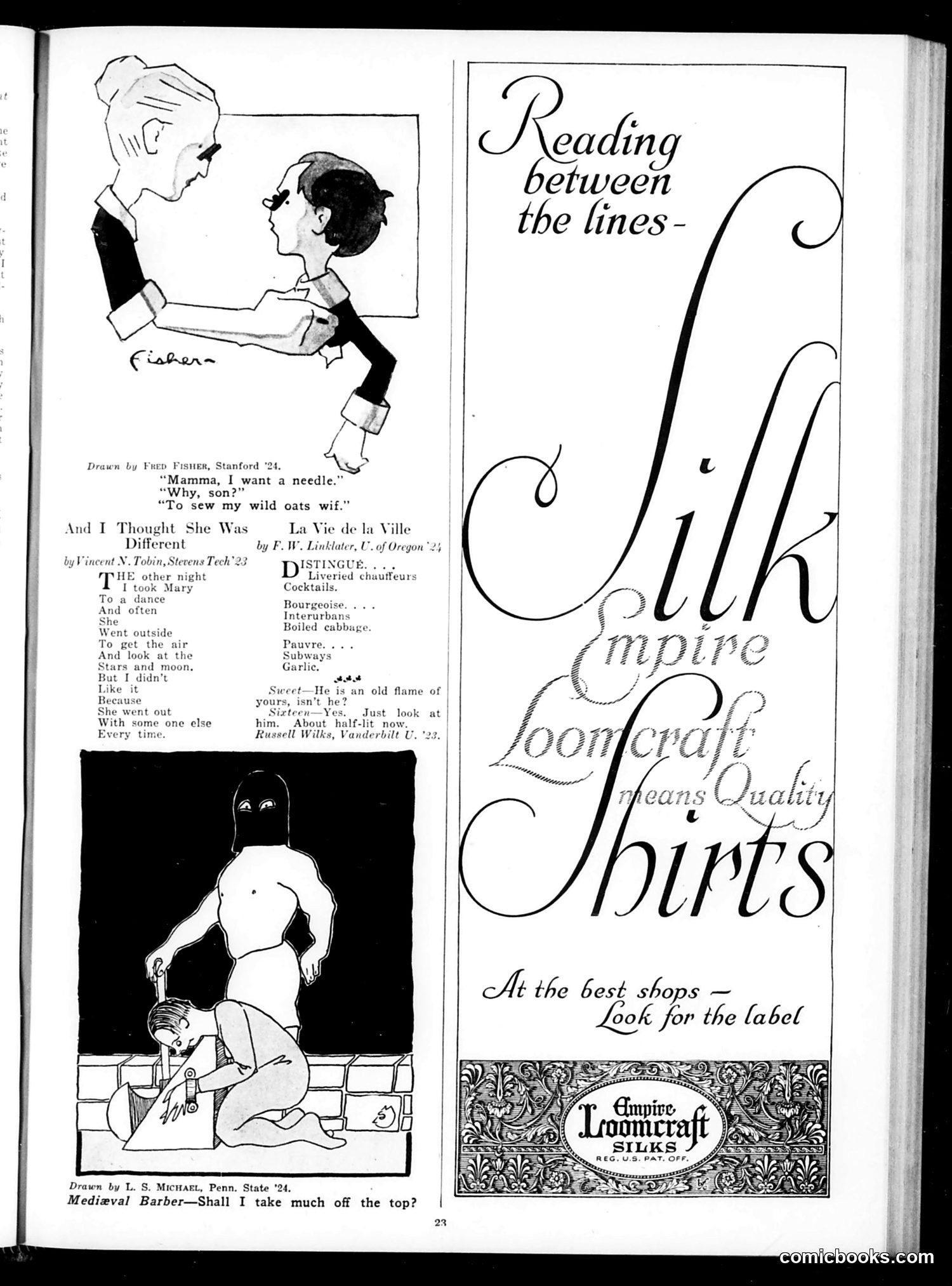
This page from *Judge* magazine contains student humor and advertising, likely from the early 1920s. **Top cartoon**: A young man asks his mother for a needle "to sew my wild oats wif" (a play on the phrase "sowing wild oats," meaning youthful misbehavior). The joke relies on the double meaning—literal sewing versus the idiom. **Poetry section**: Student-written verses on romantic and social themes typical of college publications. **Bottom cartoon**: Titled "Medieval Barber," it shows a barber about to cut a customer's hair with the question "Shall I take much off the top?" The humor appears to reference either barbering techniques or possibly contemporary discussions about men's hairstyles, though the specific reference is unclear without more context. **Right page**: A full-page advertisement for Empire Loomcraft Silks, emphasizing quality construction and encouraging consumers to look for the brand label—standard marketing rhetoric of the era. The page reflects 1920s college culture and period advertising conventions.
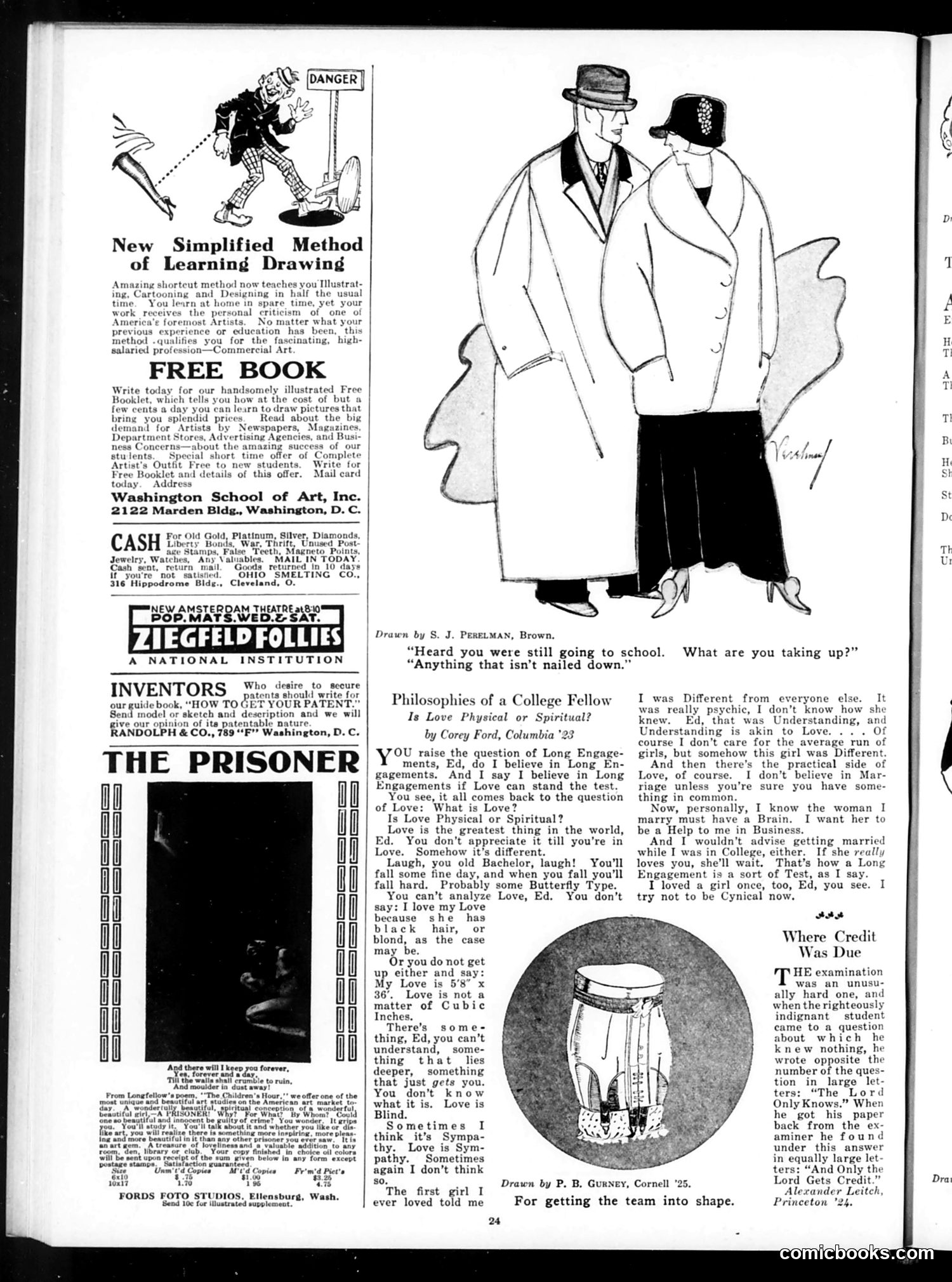
This page is primarily **advertising and miscellaneous content** rather than political satire. The main cartoon (top right, by S.J. Perelman) shows a well-dressed couple, with the caption about a student "still going to school" and being asked "What are you taking up?" — a light domestic joke about a young person's ambiguous educational/romantic status. Below that is a **humorous essay** titled "Philosophies of a College Fellow" by Corey Ford, a contemporary humorist, offering tongue-in-cheek observations about college romance. It's self-consciously cynical undergraduate philosophy rather than political commentary. The page is otherwise filled with **period advertisements**: a drawing school, precious metals buyer, patent service, and a theater promotion. There is no identifiable political satire on this page. The humor is social/generational (college life, romance) rather than political. This appears to be a standard issue of Judge circa early 1920s, mixing ads with light social humor.
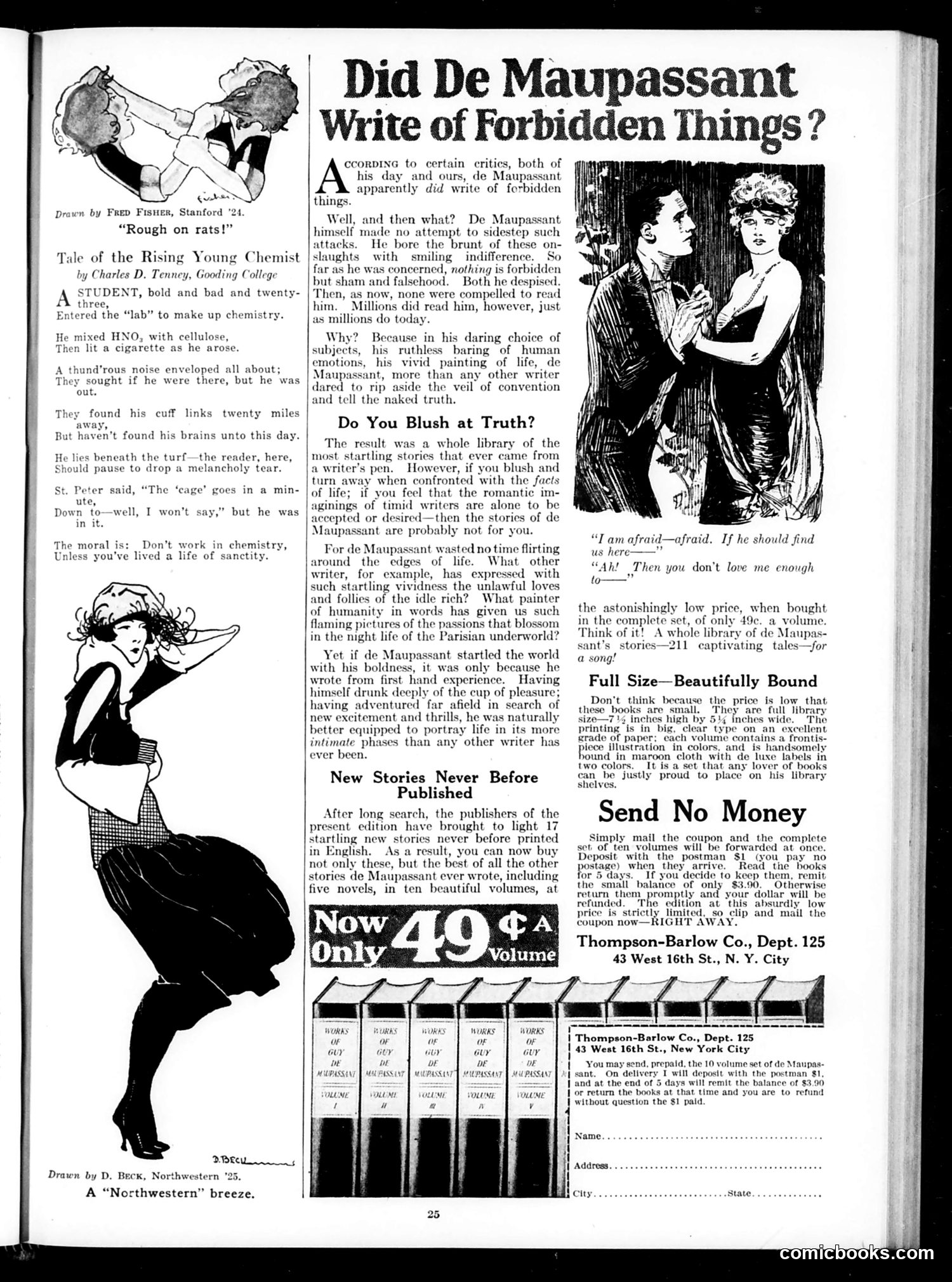
This page contains two distinct sections: **Left side:** Two humorous poems with illustrations about foolish behavior—a chemistry student who dies mixing dangerous chemicals, and a "Northwestern breeze" (unclear reference). The jokes mock carelessness and youthful stupidity. The cartoons are crude character sketches by Fred Fisher and D. Beck. **Right side:** An advertisement and editorial promoting a 10-volume complete works of Guy de Maupassant at 49¢ per volume. The text defends Maupassant against critics who labeled his writing "forbidden" or immoral, arguing that he wrote truthfully about human experience and society's "idle rich" without prudish romanticizing. The ad emphasizes the books' quality binding and low price while inviting readers to order without prepayment. The page reflects early 20th-century anxieties about literature deemed sexually or morally explicit, positioning Maupassant's realism as honest rather than scandalous.
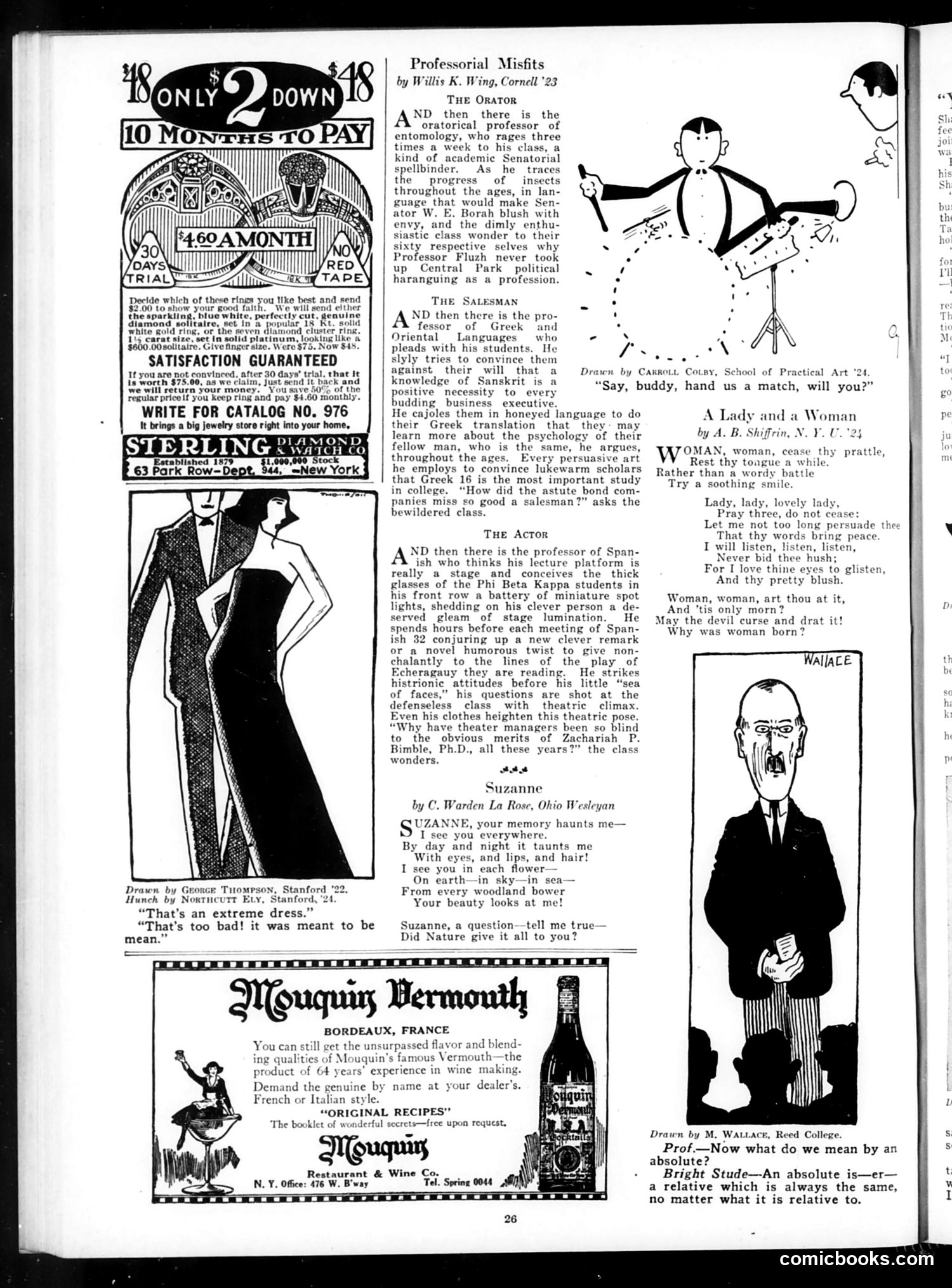
This page lampoons college professors who excel in their subjects but are socially or theatrically awkward misfits. The article describes three types: 1. **The Orator** — An entomology professor who lectures with such dramatic, Senate-floor eloquence about insects that students wonder why he didn't become a politician instead. 2. **The Salesman** — A Greek and Oriental languages professor who uses manipulative sales tactics and honeyed persuasion to convince students that Sanskrit and Greek are essential, prompting the question: why didn't theater managers recruit such a skilled con artist? 3. **The Actor** — A Spanish professor who treats his classroom as a theatrical stage, rehearsing witty remarks, striking dramatic poses, and using spotlighting effects for self-aggrandizement, leading students to wonder why theater managers ignored his "obvious merits." The satire's point: brilliant academics often lack self-awareness about their social performance, turning classrooms into unintentional comedy through misplaced theatrical ambition or sales-pitch desperation. The humor derives from the gap between their intellectual credentials and their comical professional personas.
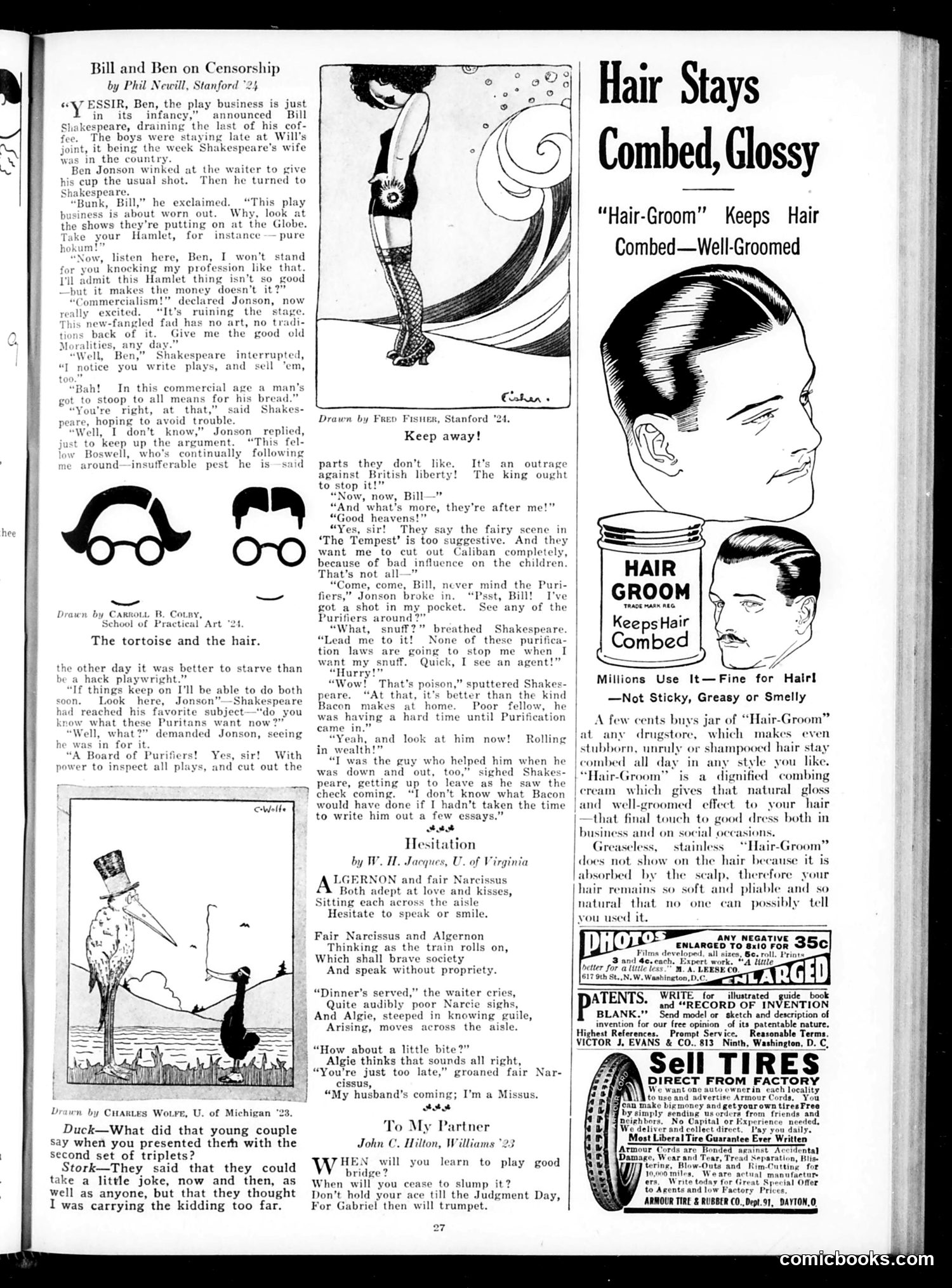
**Main Article: "Bill and Ben on Censorship"** This satirical dialogue features William Shakespeare and Ben Jonson discussing theatrical censorship. Shakespeare complains that Puritan activists want to censor plays—cutting "The Tempest" entirely and removing "suggestive" content from "Calibau" [sic], claiming bad moral influence on children. They demand a "Board of Purifiers" to inspect all plays. Jonson responds by mocking the Puritans' hypocrisy, suggesting they're insufferable busybodies attacking artistic liberty. The satire critiques early 20th-century American censorship movements (likely post-WWI era) by projecting contemporary Puritan moral panic onto Elizabethan England—implying such censorious attitudes are historically absurd and artistically destructive. **Supporting Cartoons:** Minor comics about eyeglasses and a stork joke appear alongside. **Advertisements:** The page includes ads for "Hair-Groom" product and tire sales—typical of the era.
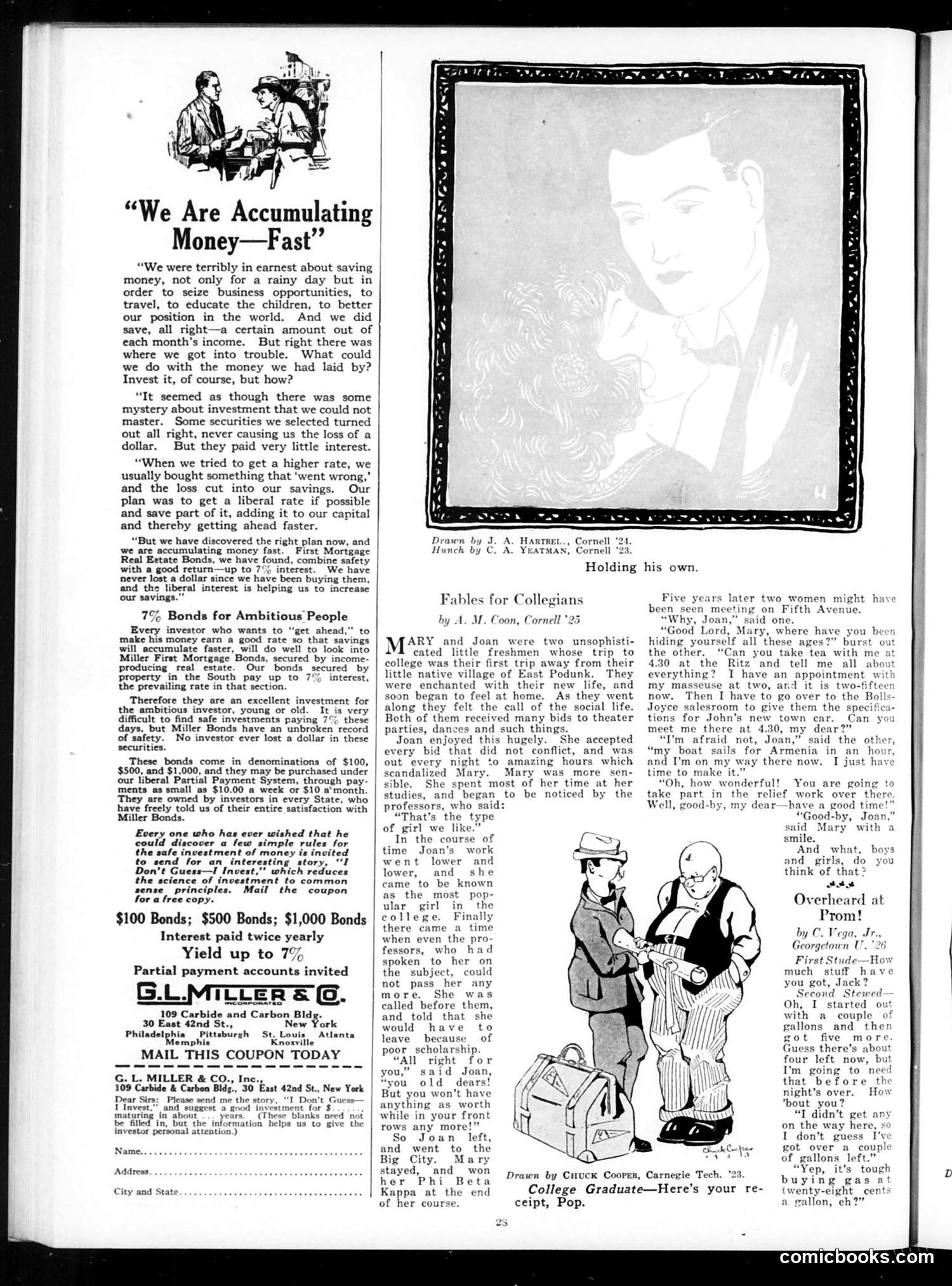
This page primarily contains **financial advertising** for G.L. Miller & Co.'s real estate bonds, disguised as editorial content. The testimonial "We Are Accumulating Money—Fast" presents a narrative about middle-class savers discovering safe investment returns (7% interest) through First Mortgage Real Estate Bonds—a contemporary investment vehicle appealing to ambitious, cautious investors. The cartoons below address **college life themes**: "Holding his own" depicts a young man's portrait; "Overheard at Prom" shows a graduate discussing post-college finances with humor about buying gasoline. The "Fables for Collegians" story satirizes a female student (Joan) who prioritizes social popularity over academics, eventually facing expulsion—a cautionary tale about misplaced priorities reflecting 1920s attitudes toward women's education and behavior. The page reflects Jazz Age anxieties about saving, investing, and proper conduct.
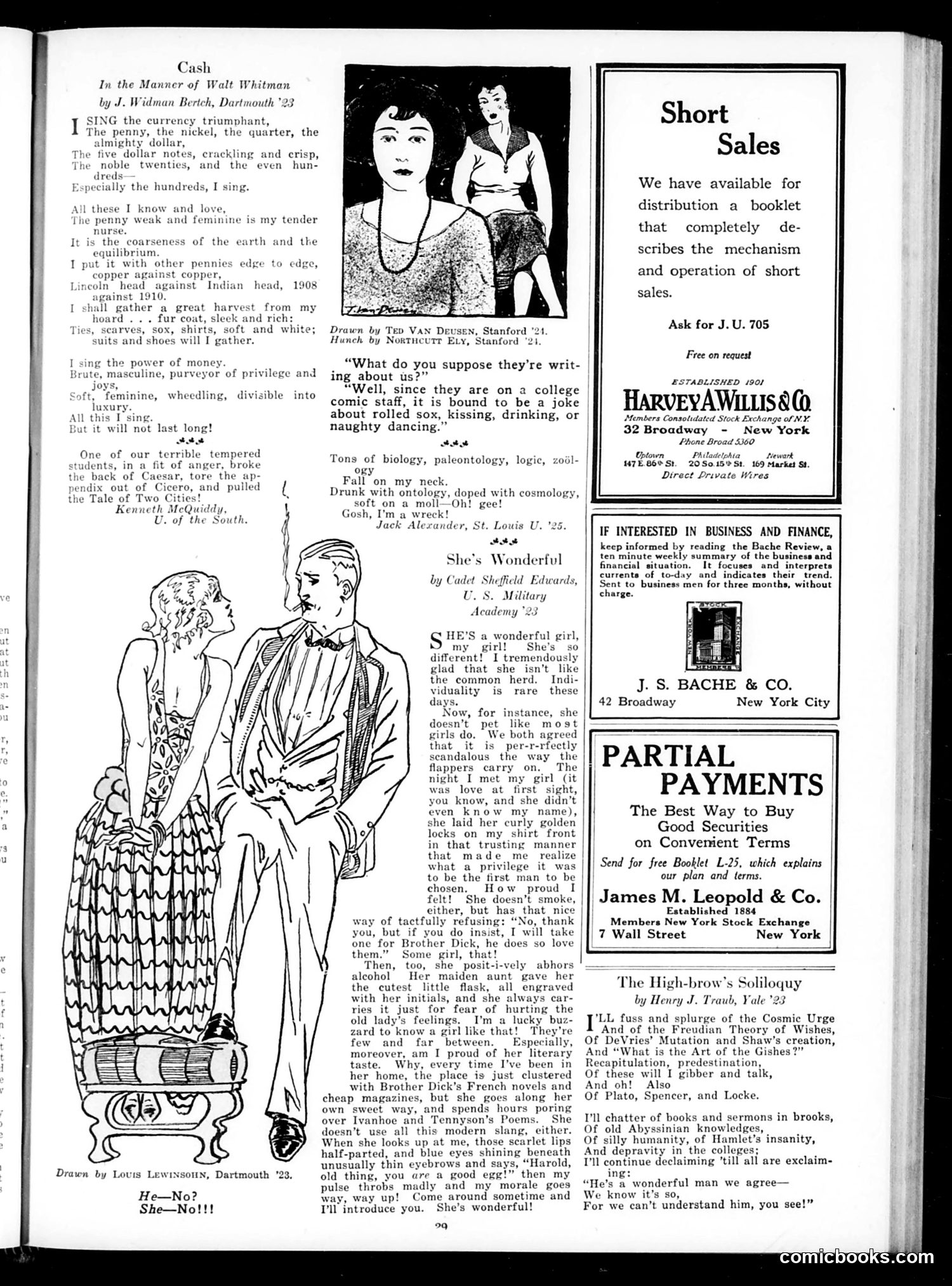
This page from Judge magazine (circa 1924, based on bylines) contains three student-written pieces satirizing contemporary college life and attitudes: **"Cash"** parodies Walt Whitman's grandiose style by applying it to money—treating dollars with the same reverence Whitman gave America. The joke mocks both Whitman's flowery excess and student materialism. **"He—No? She—No!!!"** depicts a couple, likely discussing gossip about themselves in college publications. The humor relies on the predictable nature of college magazine content: jokes about necking, drinking, and "naughty dancing." **"She's Wonderful"** satirizes a young man's contradictory descriptions of his girlfriend. He praises her for being unique and avoiding "flapper" behavior (the era's term for modern, liberated women), yet his examples reveal she actually conforms to flapper stereotypes—she pets, drinks from a flask, reads cheap magazines. The satire targets male obliviousness and the gap between what men claim to want in women versus what they actually pursue. The page also includes period advertisements for financial services and stock exchanges, typical of Judge's business-focused readership.
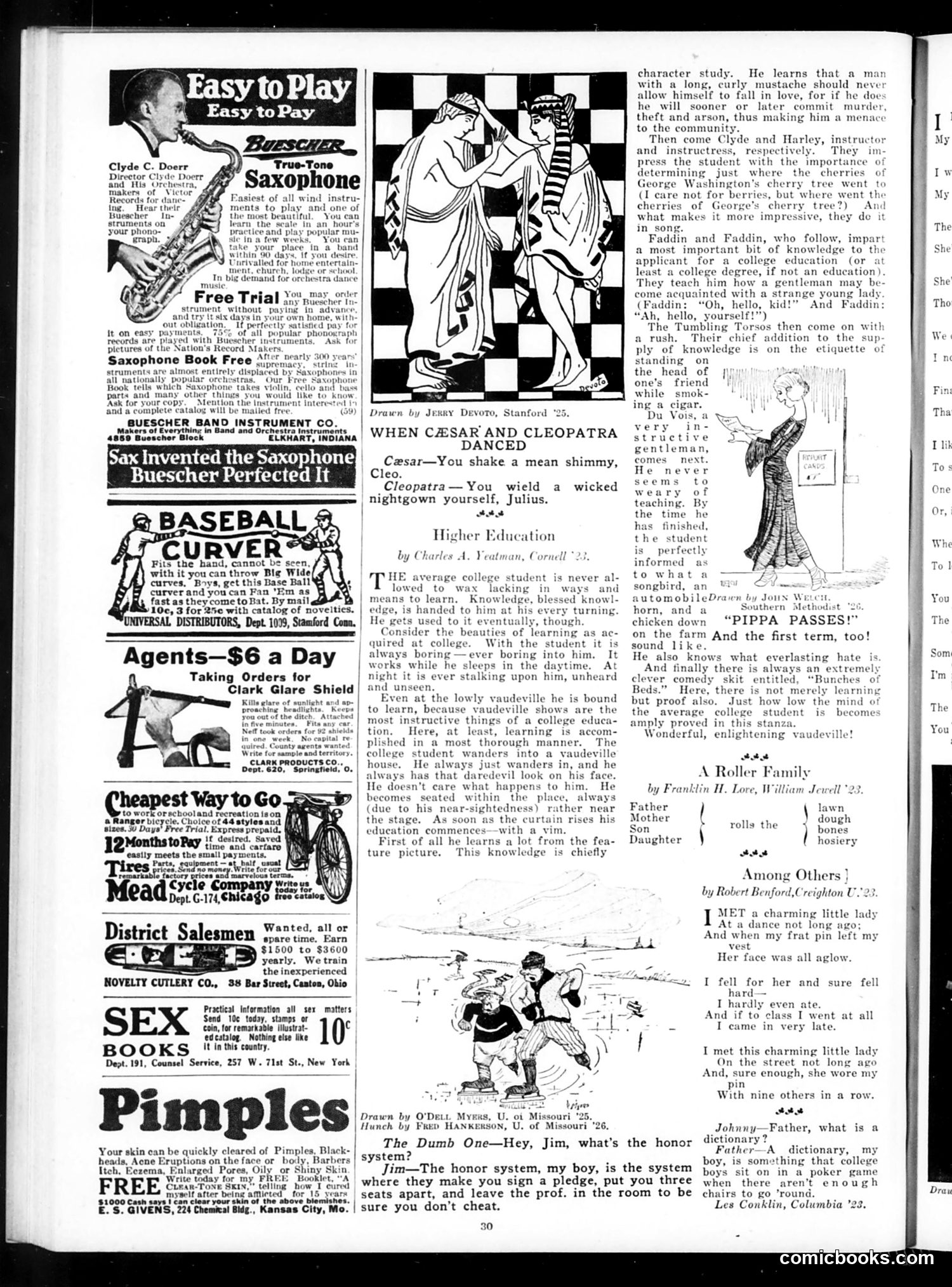
This cartoon satirizes a contemporary theatrical production (likely Shaw's play) by having the historical figures speak in 1920s slang. Caesar compliments Cleopatra's "shimmy" (a popular Jazz Age dance), and she praises his "nightgown"—a crude joke reducing the serious drama to modern vaudeville entertainment. The humor mocks both the play's pretensions and contemporary audiences' inability to appreciate classical material without lowbrow comedy. The page also includes satirical commentary on college education, arguing that students learn more from vaudeville shows than from formal instruction—a jab at the superficiality and passivity of higher education. The "honor system" joke at bottom ridicules the hypocrisy of trusting students not to cheat while leaving them unsupervised. The rest of the page consists primarily of period advertisements for saxophones, bicycles, and patent medicines.
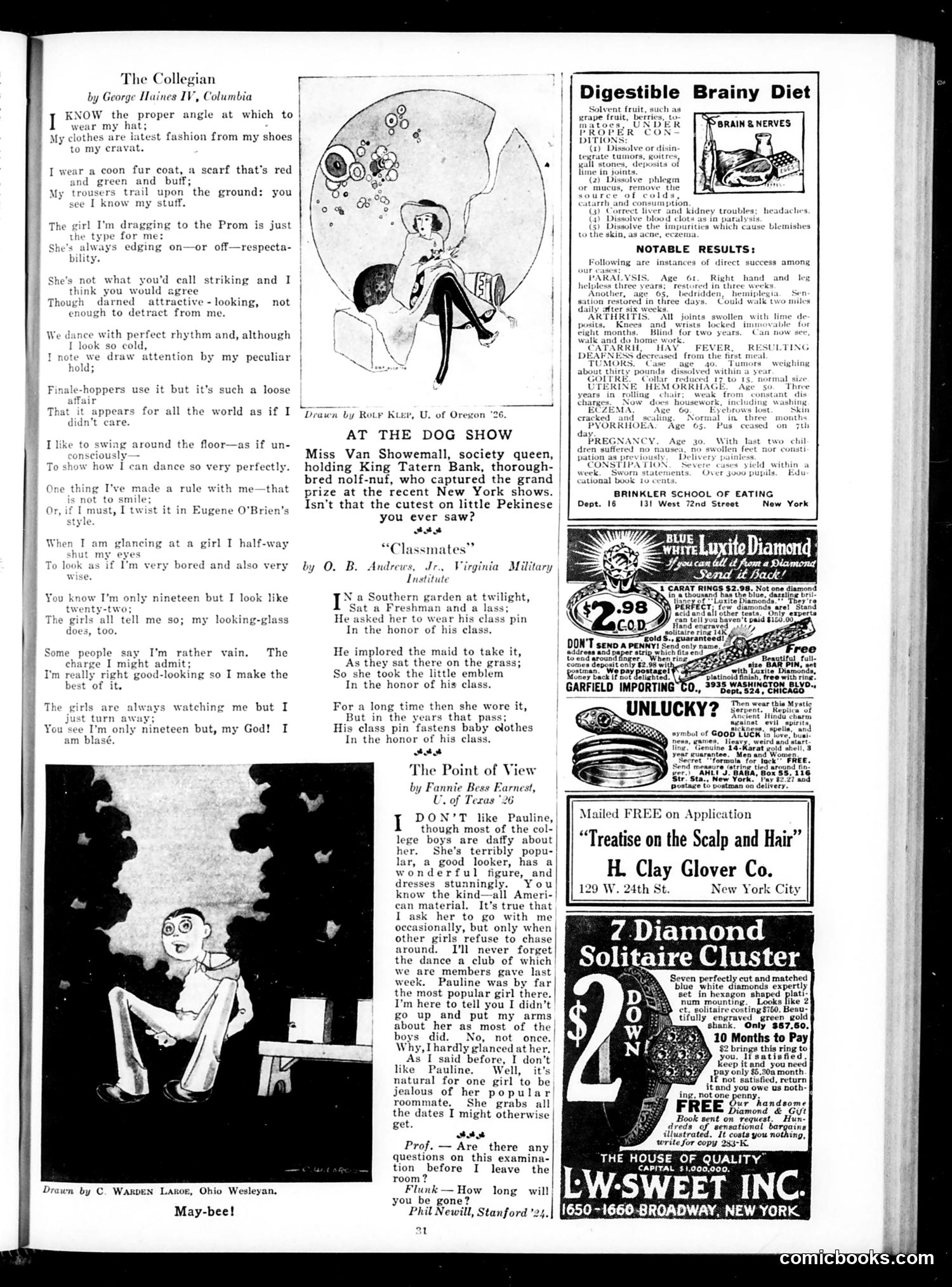
This page features satirical pieces about college life from the mid-1920s. The main poem, "The Collegian" by a Columbia student, mocks the vanity and self-absorption of a wealthy undergraduate—he obsesses over his fashionable appearance ("coon fur coat"), dancing ability, and good looks, repeatedly insisting he's "only nineteen" but looks older. The satire targets the superficiality and narcissism of the Jazz Age college set. The accompanying cartoon "May-bee" (bottom left) visually reinforces this theme, showing a self-satisfied young man. Secondary pieces include "At the Dog Show" (a society gossip item about a Pekingese), "Classmates" (a melancholic poem about a college girl's lost romance), and "The Point of View" (satirizing female jealousy among roommates). The page is dominated by period advertisements for jewelry, hair treatments, and correspondence schools—typical of 1920s magazines.
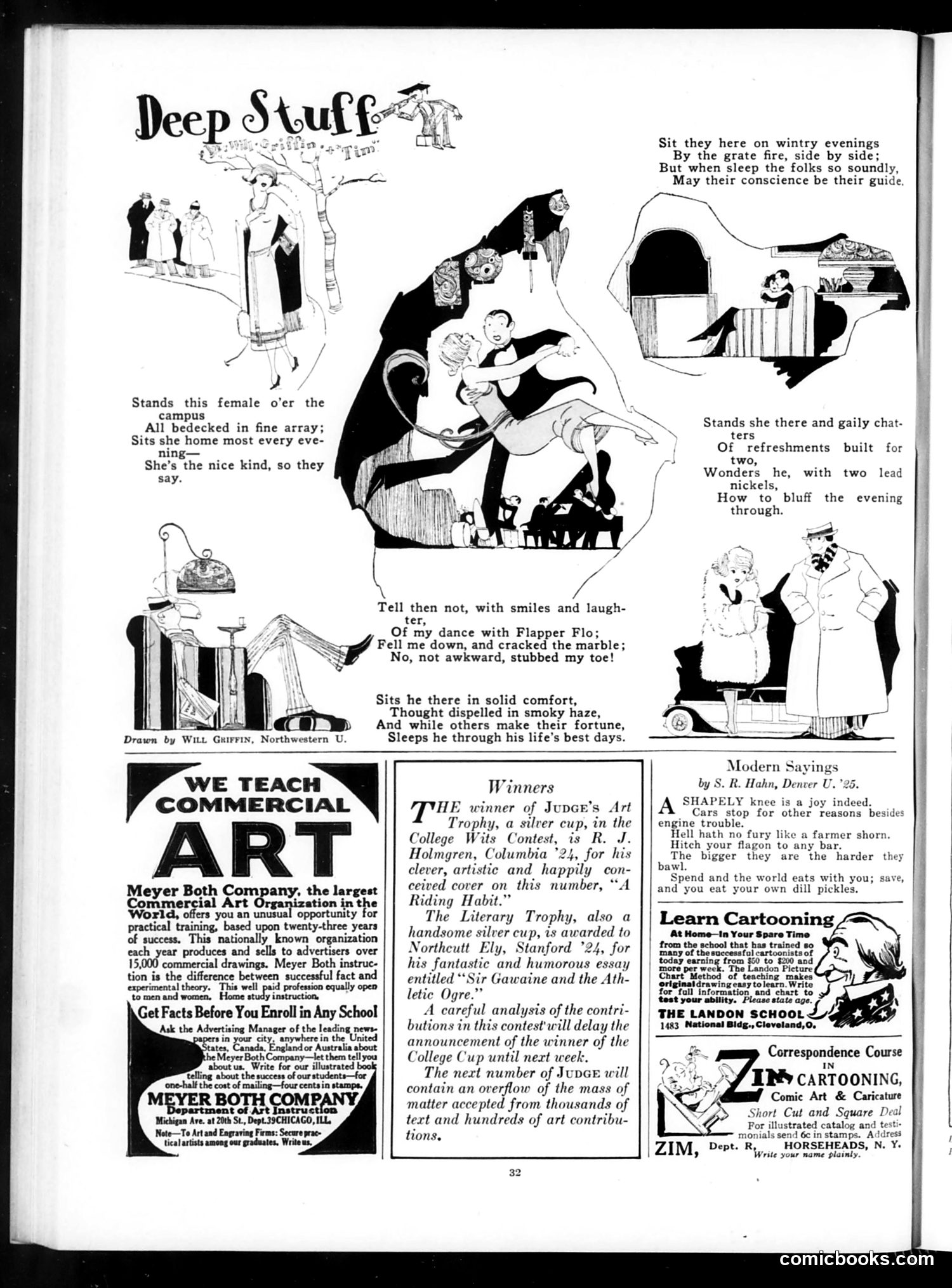
This illustrated poem satirizes contrasting social behaviors of young people in the 1920s. The main cartoon depicts a couple at a dance—likely referencing "Flapper Flo," the modern young woman celebrated in the poem's opening. The surrounding vignettes show the hypocrisy of "respectable" society: elderly couples appear virtuous by the fire, yet the poem suggests their conscience should guide them (implying questionable past behavior). Meanwhile, young people openly court and flirt, while older men like the one shown sitting in "solid comfort" sleep through life's opportunities, perhaps representing outdated masculine passivity. The "Modern Sayings" section reinforces 1920s themes—celebrating shapely knees (flappers), automobiles, and spending versus saving, reflecting post-WWI cultural shifts toward female visibility, consumerism, and youth rebellion against Victorian restraint. The satire critiques both generational hypocrisy and changing social mores.
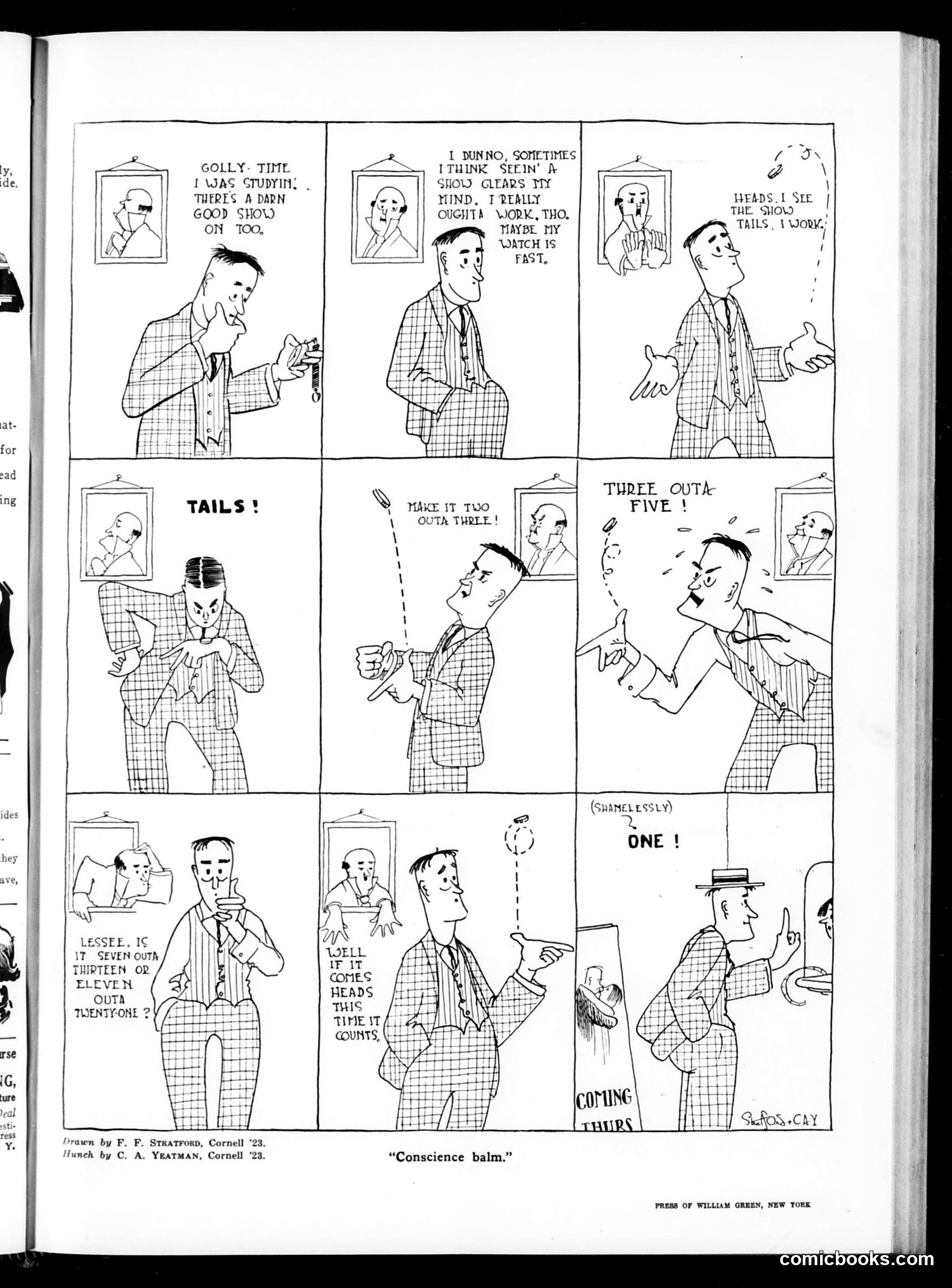
This comic satirizes a man's weak rationalization for procrastination. A student or worker repeatedly claims he should study or work, but instead attends a show. To resolve his guilt, he uses increasingly absurd methods—coin flips and mathematical games ("make it two outa three," "three outa five")—to justify his choice, always landing on "go see the show." The humor lies in the transparent self-deception: he's not genuinely leaving the decision to chance; he's manipulating the game to reach his predetermined preference. The phrase "conscience balm" (the title) refers to these flimsy mental tricks people use to soothe guilt about procrastination or shirking responsibility. The comic captures a timeless human weakness: using pseudo-rational excuses to rationalize doing what we want rather than what we should do.
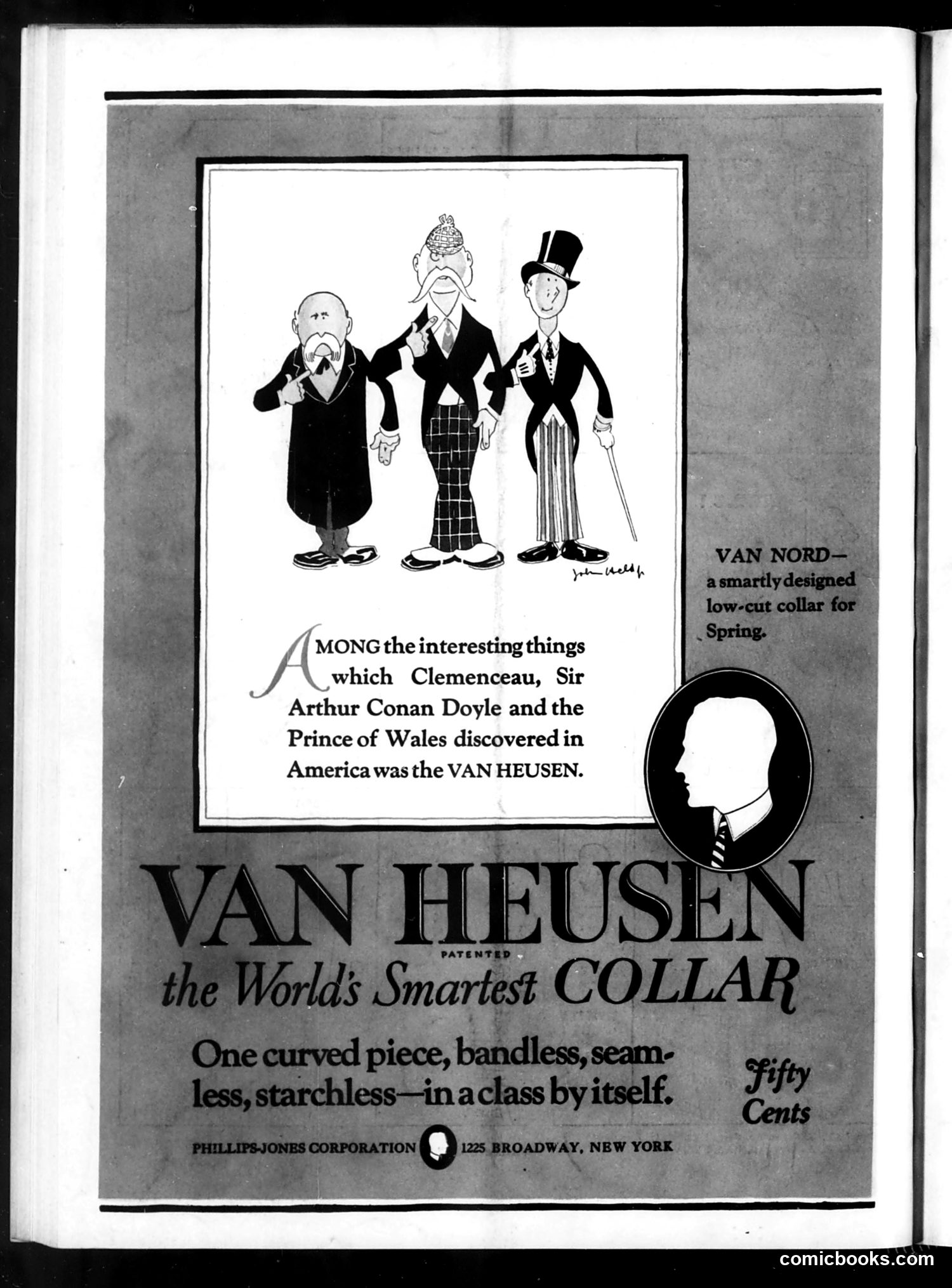
This is primarily a **product advertisement**, not political satire. It promotes Van Heusen collars by referencing three famous figures who allegedly "discovered" them during visits to America: **Georges Clemenceau** (French Premier), **Sir Arthur Conan Doyle** (author), and the **Prince of Wales**. The cartoon depicts these three men in caricature form, emphasizing their distinctive appearances. The ad's joke suggests that even distinguished international visitors found this American collar noteworthy. The advertisement emphasizes the collar's innovative design: "one curved piece, bandless, seamless, starchless." This appears to be genuinely novel for the era—a practical improvement over traditional collars requiring separate starching and fastening. The price of fifty cents and the publisher's New York address confirm this is a commercial advertisement rather than editorial content.