
A complete issue · 36 pages · 1923
Judge — March 17, 1923
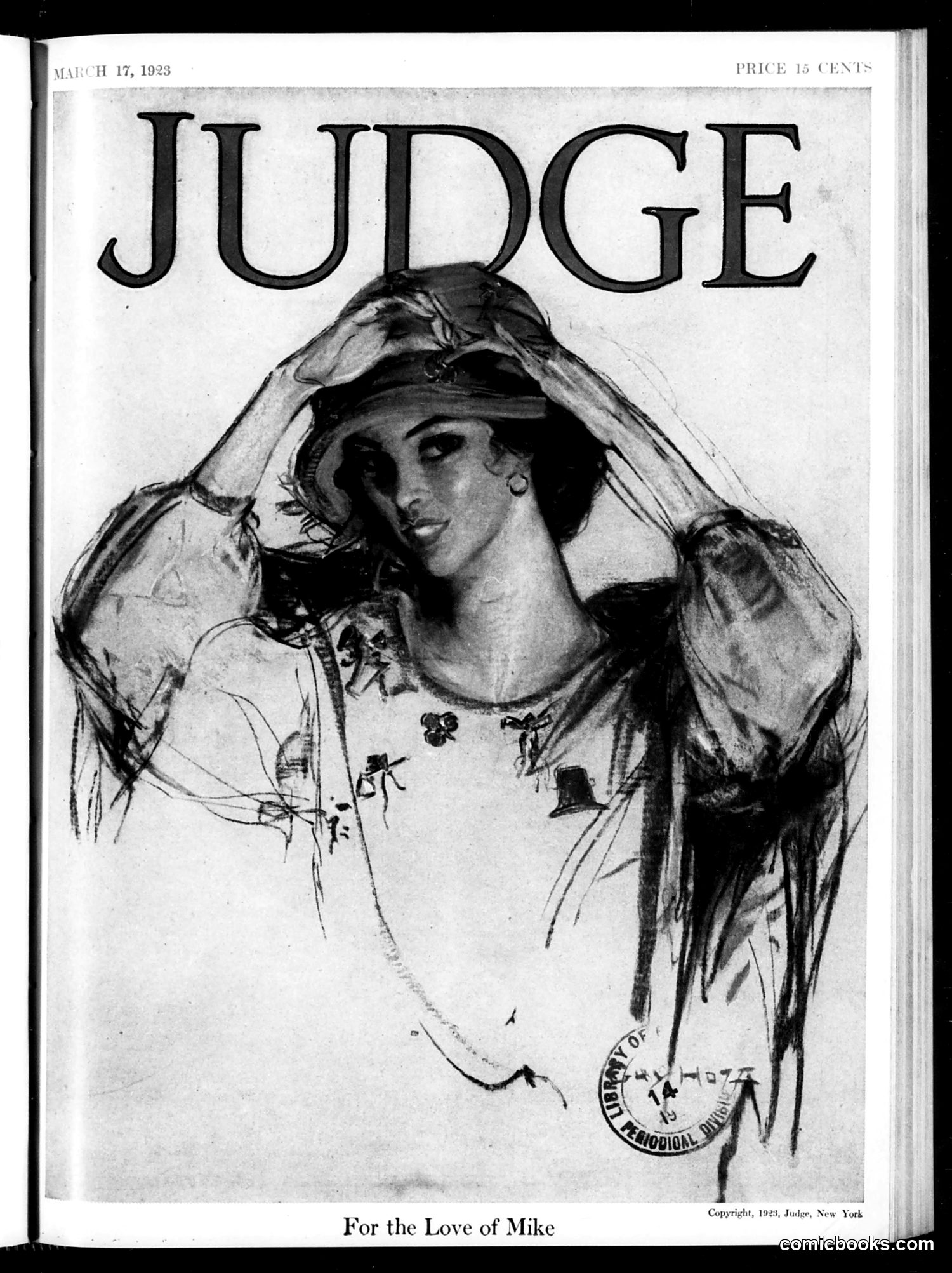
This is the cover of *Judge* magazine from March 17, 1923. The caption reads "For the Love of Mike," a common colloquial expression of the era meaning "for goodness sake." The illustration shows a woman in 1920s attire (cloche hat, loose-fitting dress with decorative details) adjusting her hat with a wistful or contemplative expression. The sketch style is romantic rather than overtly satirical. Without additional context or text identifying the specific reference, the cartoon's precise satirical target is unclear. It may reference a contemporary romantic scandal, popular song, or social commentary about women's fashion and dating customs of the Jazz Age era, but the image alone doesn't definitively establish which. The aesthetic suggests commentary on modern femininity or romance rather than politics.
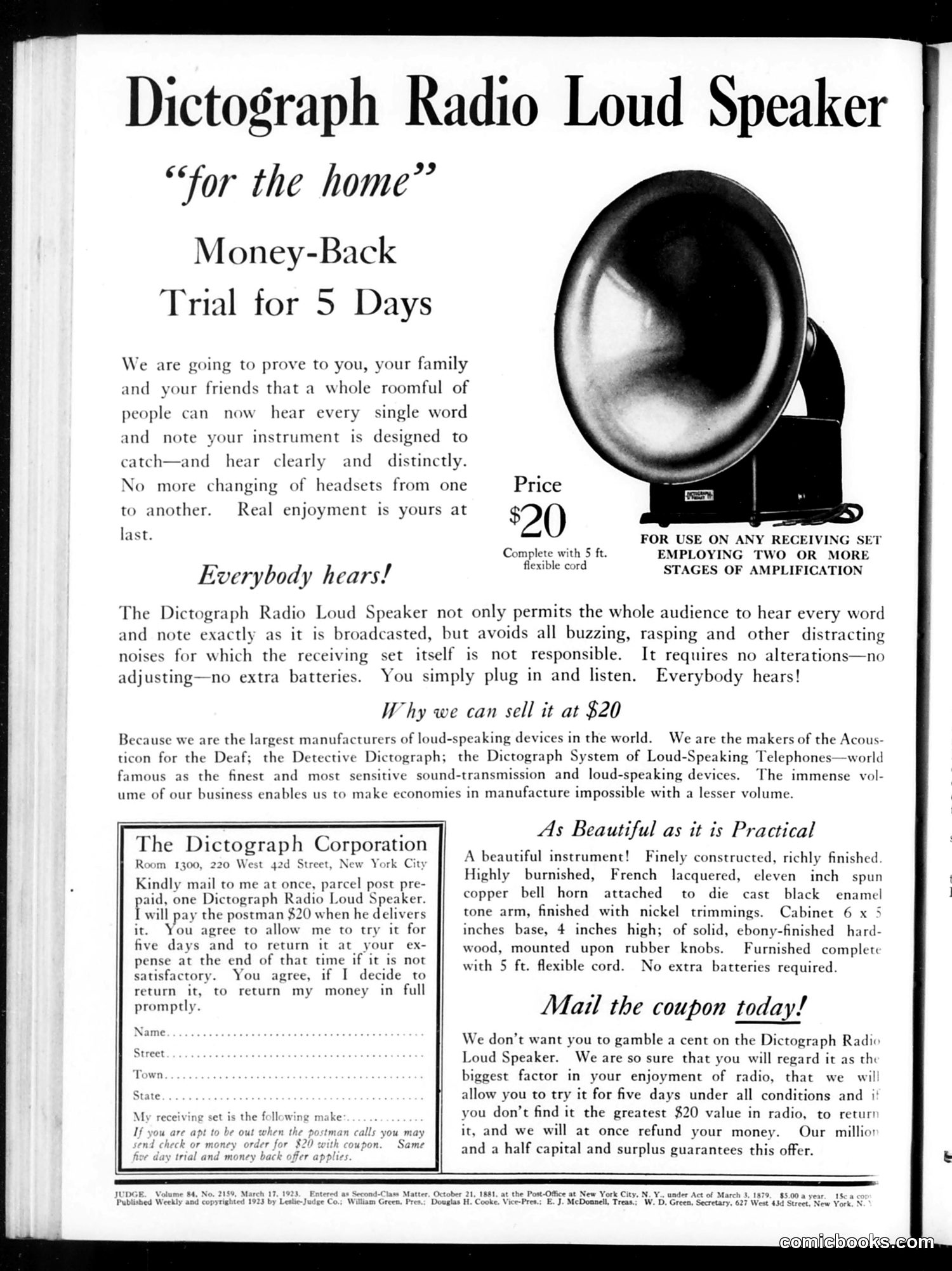
This page is **primarily advertising, not satire or political commentary**. It's a full-page advertisement for the Dictograph Radio Loud Speaker, priced at $20, marketed "for the home." The ad emphasizes practical benefits: the device allows an entire room to hear radio broadcasts clearly without headset-switching. It appeals to family entertainment and promises quality manufacturing credentials (Acousticon for the Deaf, Detective Dictograph systems). The coupon mechanism offers a 5-day money-back trial, positioning this as a risk-free purchase. The language stresses accessibility and reliability—"Everybody hears!"—reflecting early 1920s radio adoption when amplification technology was still novel for domestic use. There is no political cartoon or satirical content visible on this page.
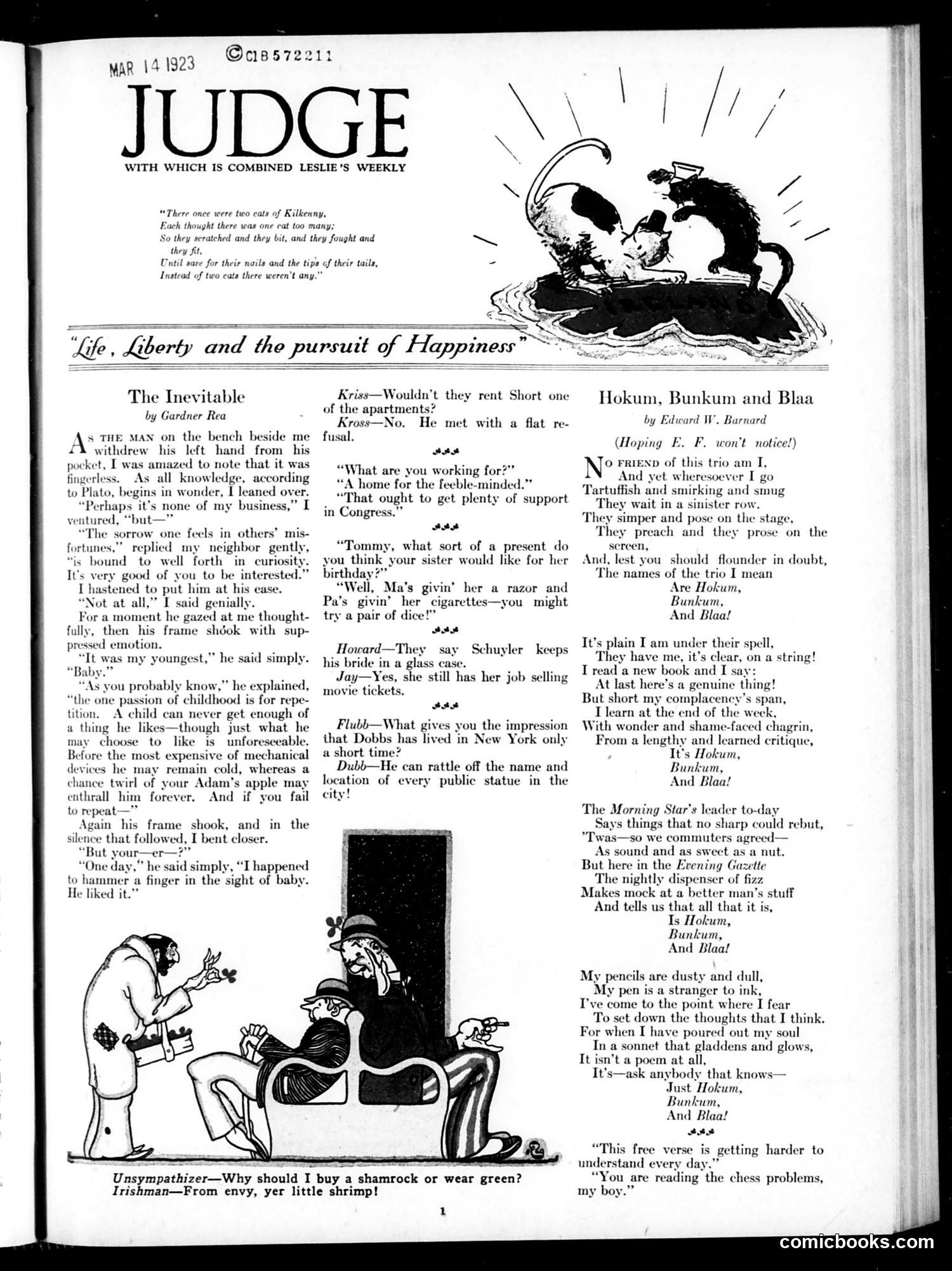
The main cartoon titled "Unsympathizer" depicts an Irishman refusing to buy a shamrock or wear green for St. Patrick's Day, claiming he won't participate "from envy, yer little shrimp!" The joke satirizes Irish-American ethnic pride and holiday observance, suggesting reluctance to participate in traditional Irish identity markers. The page also contains literary content including Edward W. Barnard's poem "Hokum, Bunkum and Blaa," which repeatedly uses those three words as a refrain—apparently mocking or lampooning something the author considers nonsensical or fraudulent, though the specific target remains unclear from this excerpt alone. The overall tone suggests satire directed at contemporary social pretenses and false sentiment.
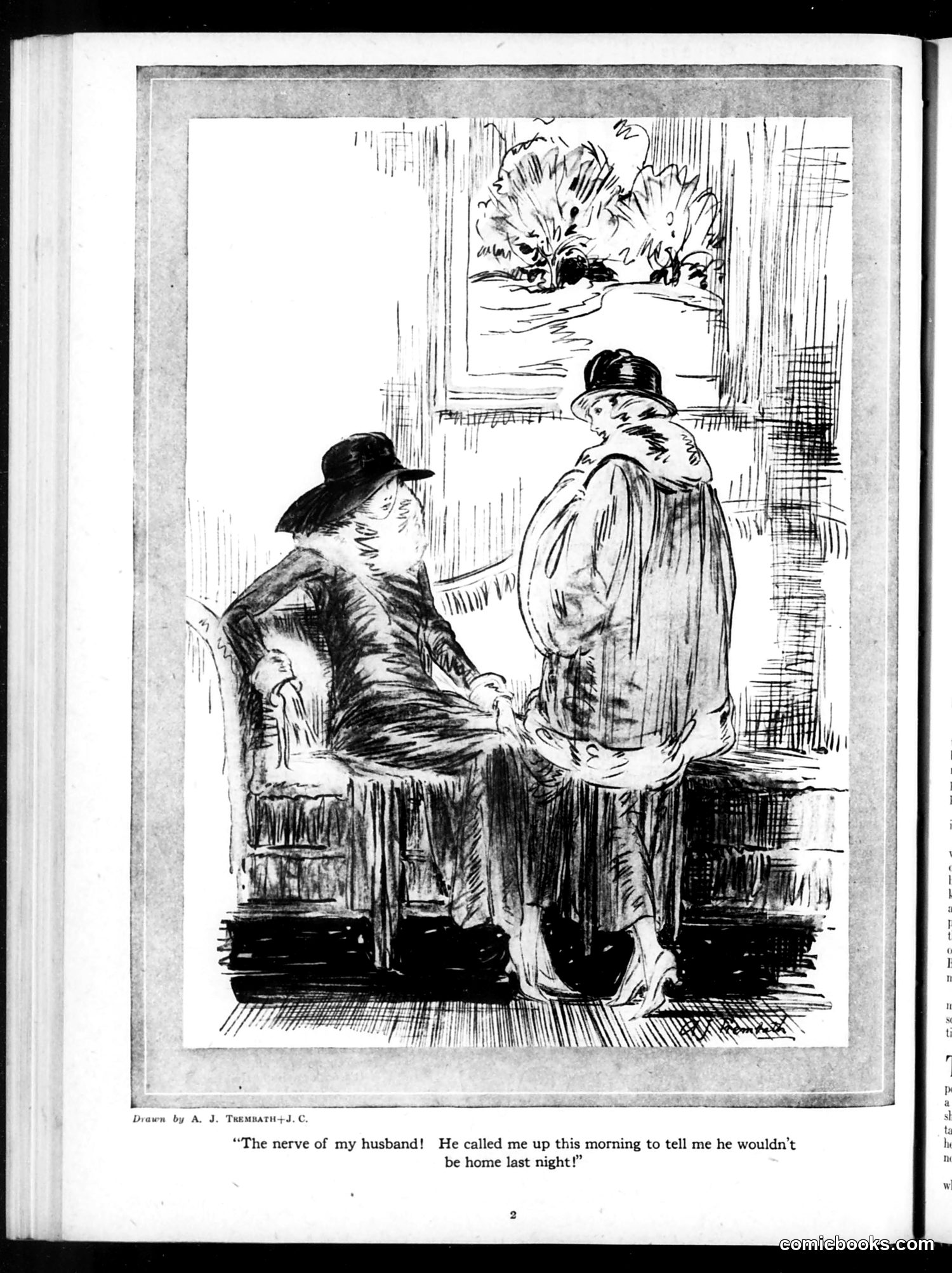
This illustration depicts a domestic scene with two women in conversation by a window. The caption reads: "The nerve of my husband! He called me up this morning to tell me he wouldn't be home last night!" The humor relies on the absurdity of the husband's timing—calling *after* he was already absent to announce his absence. This satirizes poor communication and the excuses husbands might make for staying out, while also mocking the wife's indignation at receiving advance notice after the fact rather than beforehand. The cartoon captures early 20th-century anxieties about marital trust and domestic life. It's a gentle, domestic humor piece rather than political satire—typical of Judge magazine's social comedy content, which often featured middle-class relationship mishaps and the foibles of modern married life.
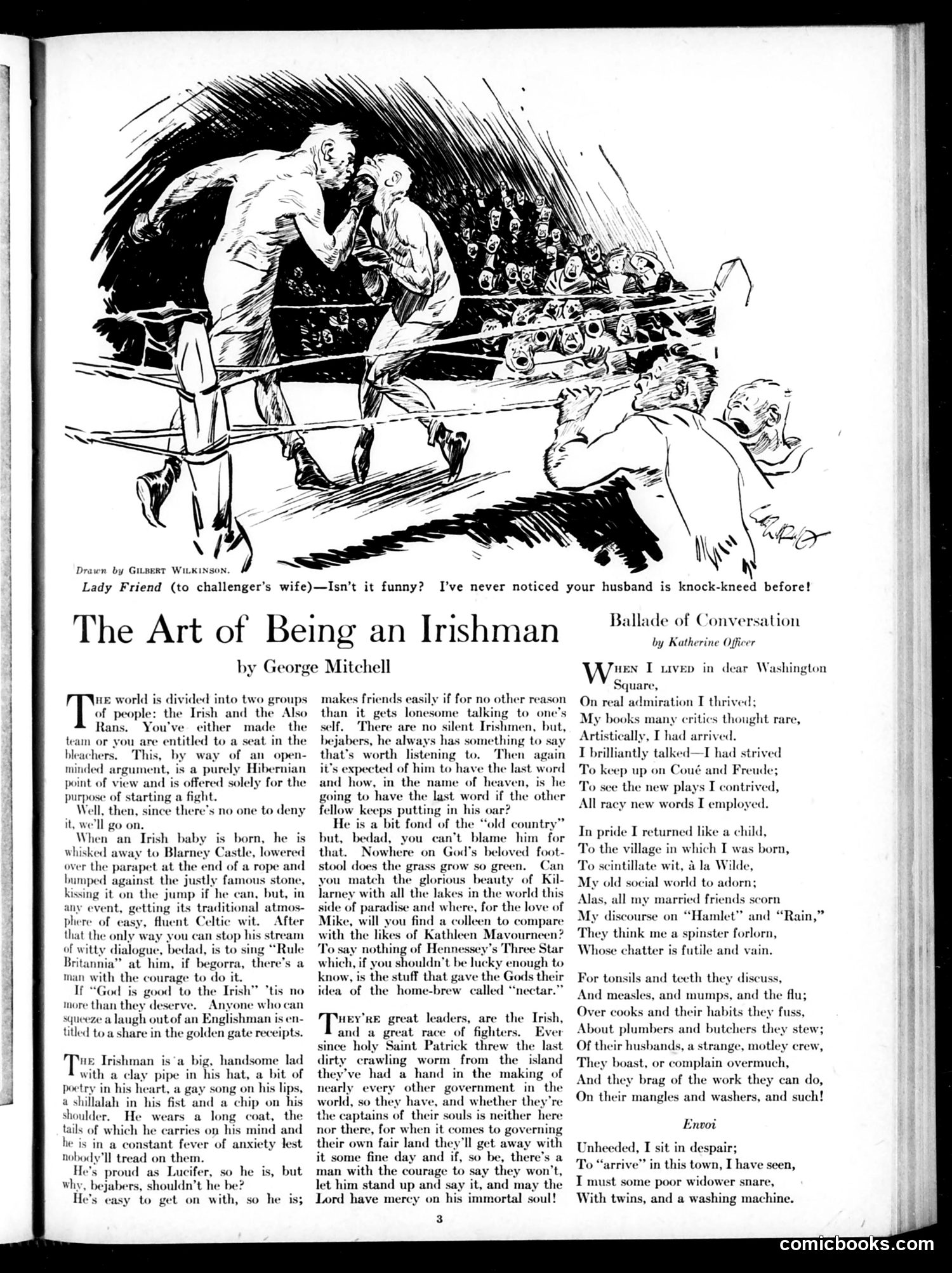
**The Cartoon:** This boxing match illustration by Gilbert Wilkinson satirizes Irish stereotypes. The caption quotes a society woman noting the challenger's wife is surprised her husband is "knock-kneed"—a physical defect. The cartoon depicts Irish boxers in a ring, with spectators crowded behind, playing on period caricatures of Irish immigrants as fighters and laborers. **The Articles:** "The Art of Being an Irishman" by George Mitchell humorously catalogs Irish stereotypes: their talkativeness, drinking habits ("Rule Britannia"), fighting prowess, and supposed inability to govern. The piece uses mock-admiring language while reinforcing derisive period attitudes toward Irish Americans. "Ballade of Conversation" satirizes women's social chatter about domestic trivialities. The content reflects late 19th/early 20th-century Anglo-Protestant prejudice against Irish immigrants.
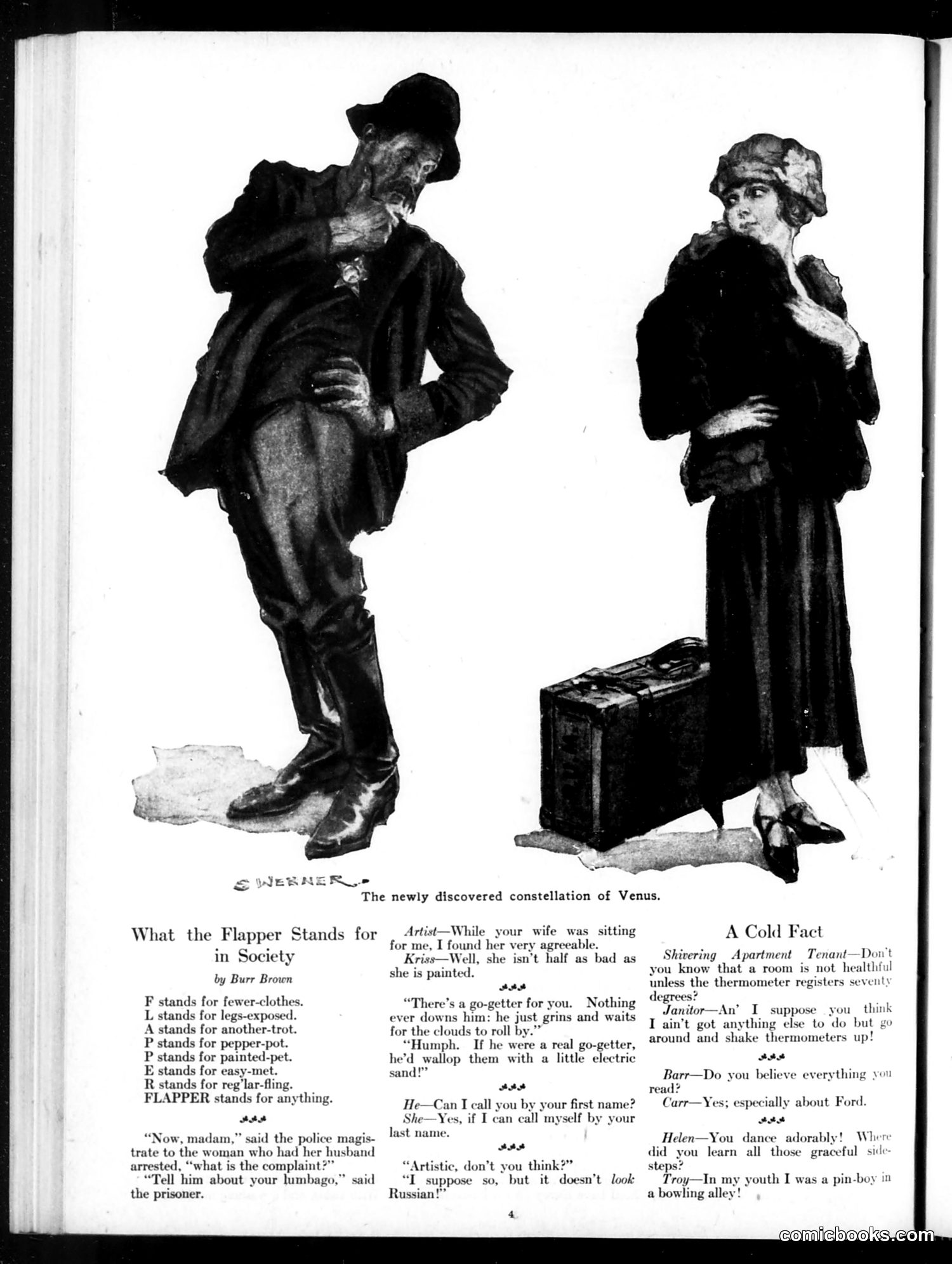
This page contains social humor rather than political cartoons. The top illustration, titled "The newly discovered constellation of Venus," shows a man and woman with luggage in what appears to be a travel or departure scenario—likely satirizing romantic entanglements or infidelity among the leisure class. Below are several humor columns: **"What the Flapper Stands for"** by Burr Brown uses "FLAPPER" as an acronym mocking 1920s young women (fast, legs-exposed, ankles-adorned, etc.). The remaining jokes mock contemporary social types: a go-getter husband, overly-familiar acquaintances, and pretentious dancers. The humor targets Jazz Age social behaviors and manners—typical of Judge's focus on satirizing urban middle and upper-class society during the 1920s rather than explicit political commentary.
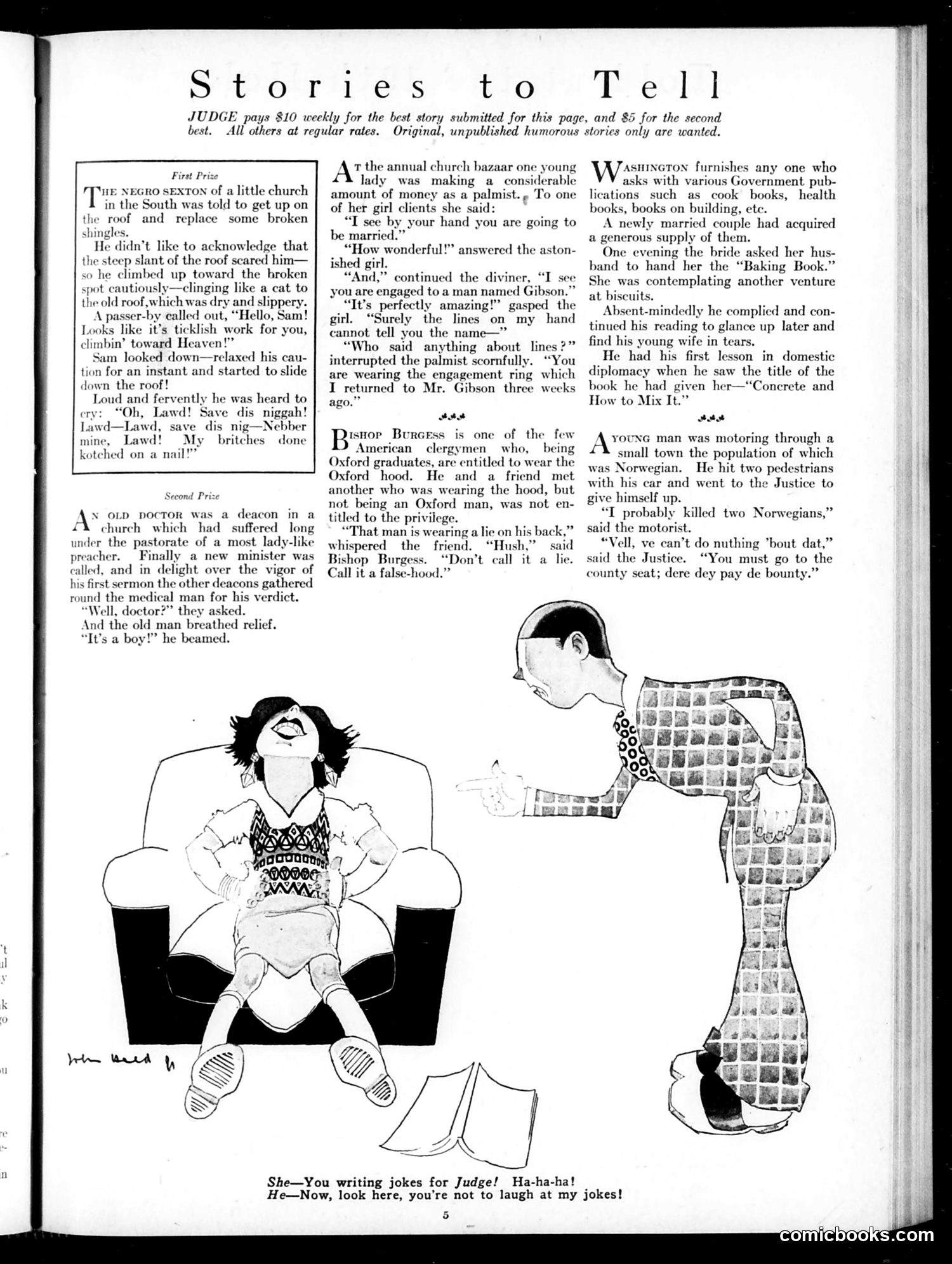
This page from *Judge* magazine contains humorous short stories reflecting early 20th-century American attitudes and stereotypes. The **first-prize story** uses racist dialect and minstrel-show humor, depicting a Black church sexton fearfully climbing a roof. The "joke" relies on offensive stereotyping and dialect humor common to that era. The **second-prize story** plays on a preacher's vigor, with a doctor calling the new minister "a boy"—praising masculine strength after a "lady-like" predecessor. The **additional stories** are gentler: a palmist caught in a lie when a woman's engagement ring disproves her "reading"; a wordplay joke about Bishop Burgess distinguishing between a "lie" and a "false-hood" (hood); newlyweds and a concrete-mixing handbook; and crude ethnic humor about Norwegians, where a justice claims killed pedestrians warrant payment ("bounty"). The cartoons supplement these narratives. Throughout, the humor relies heavily on ethnic/racial stereotypes, class assumptions, and domestic gender roles typical of early-20th-century American satire.
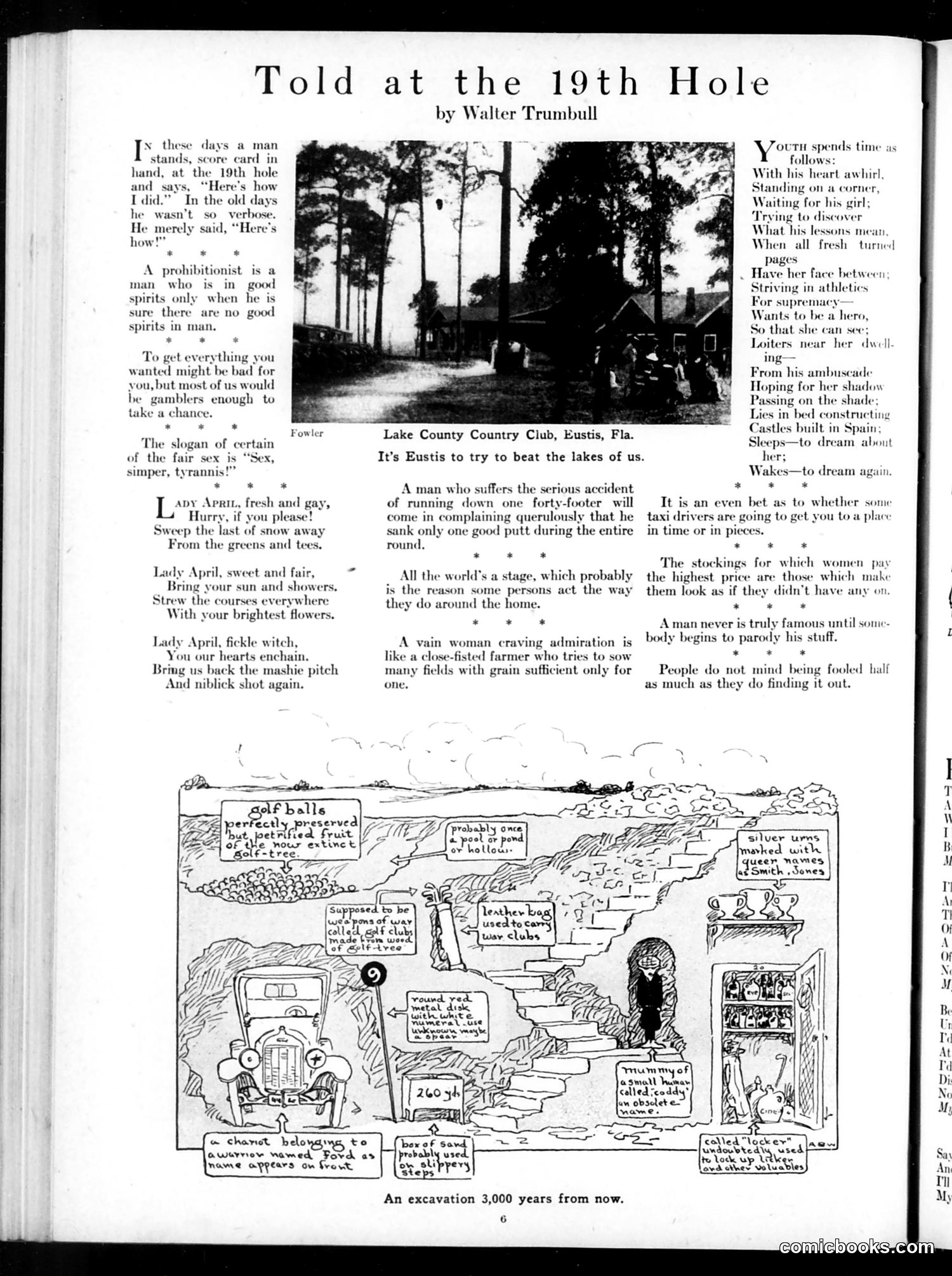
This page contains humorous golf-club observations by Walter Trumbull alongside a satirical cartoon imagining an archaeological excavation 3,000 years in the future. **The quips** mock contemporary social attitudes: prohibitionists (timely given Prohibition's implementation), verbose golfers, and vain women. References to "mashie" and "niblick" signal golf-specific humor for the magazine's affluent readership. **The bottom cartoon** is the page's central satire. It depicts future archaeologists excavating 20th-century artifacts—an automobile, golf clubs, stockings, a movie theater—completely misinterpreting them as ancient religious or utilitarian objects. A "Ford" is labeled a "chariot"; golf clubs become "implements"; a movie theater becomes a "temple." **The joke**: This mocks contemporary materialism and consumer culture by imagining future scholars studying mundane modern objects with absurd reverence, suggesting our everyday possessions lack deeper meaning. It's also gentle satire on archaeological speculation itself.
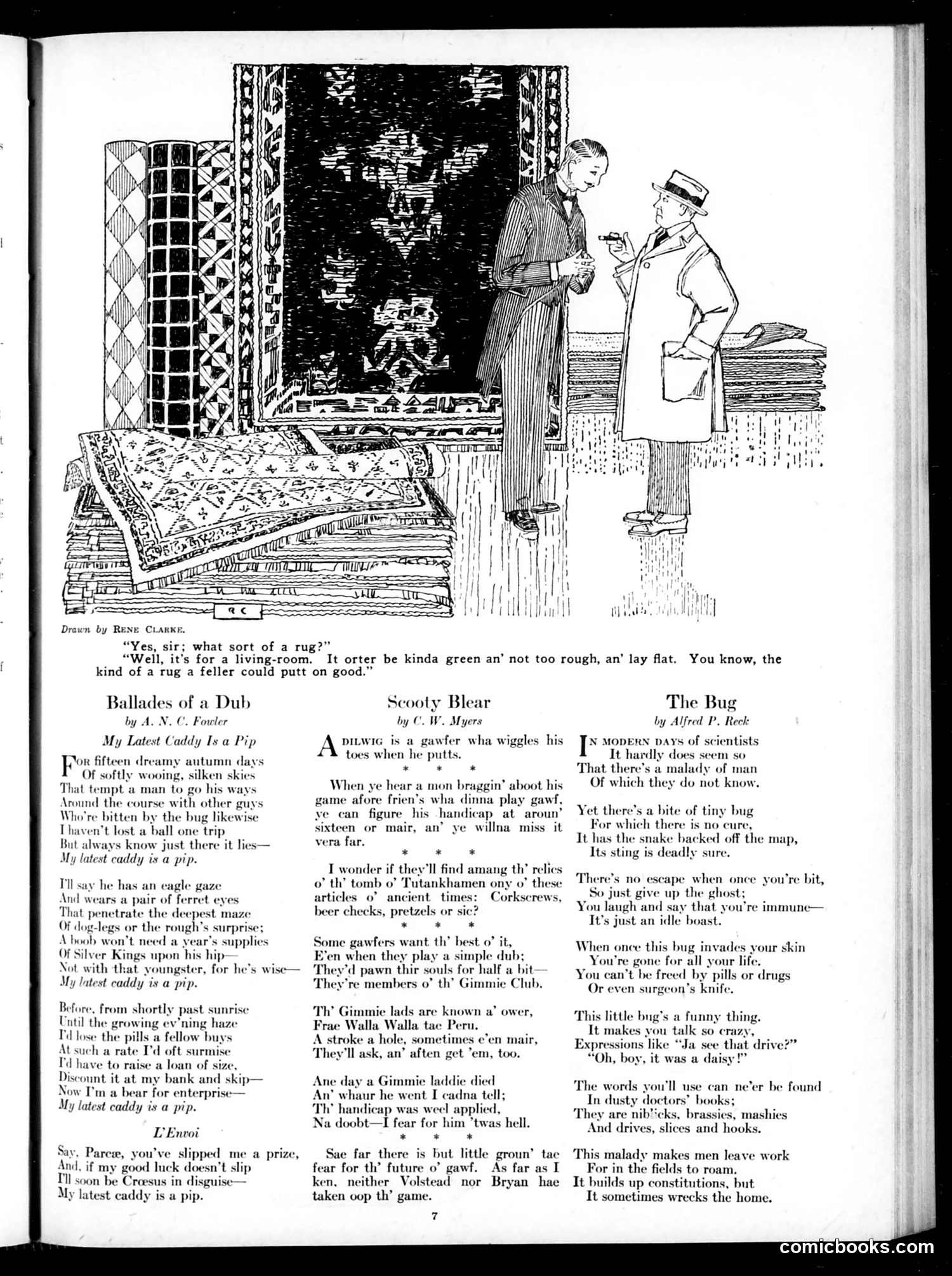
The cartoon depicts a salesman and customer discussing a rug's suitability for a living room—a mundane commercial interaction used as visual framing for the page's literary content below. The three poems that follow are all about golf, a major leisure activity for American men in the early 20th century. They satirize golf culture through different angles: - **"Ballades of a Dub"** praises an excellent caddy in romantic verse form, mocking golfers' obsession with the sport - **"Scooty Blear"** (in Scottish dialect) ridicules golfers who exaggerate their abilities and beg for easy scoring ("gimmies") - **"The Bug"** personifies golf addiction as an incurable disease that consumes men's time, money, and domestic peace—humorously suggesting it "wrecks the home" The satire targets golf's grip on American male culture: the obsessive spending, boastfulness, and how the sport disrupts family life. The "bug" metaphor equates golf fever with actual illness, suggesting it's an epidemic among the leisure class.
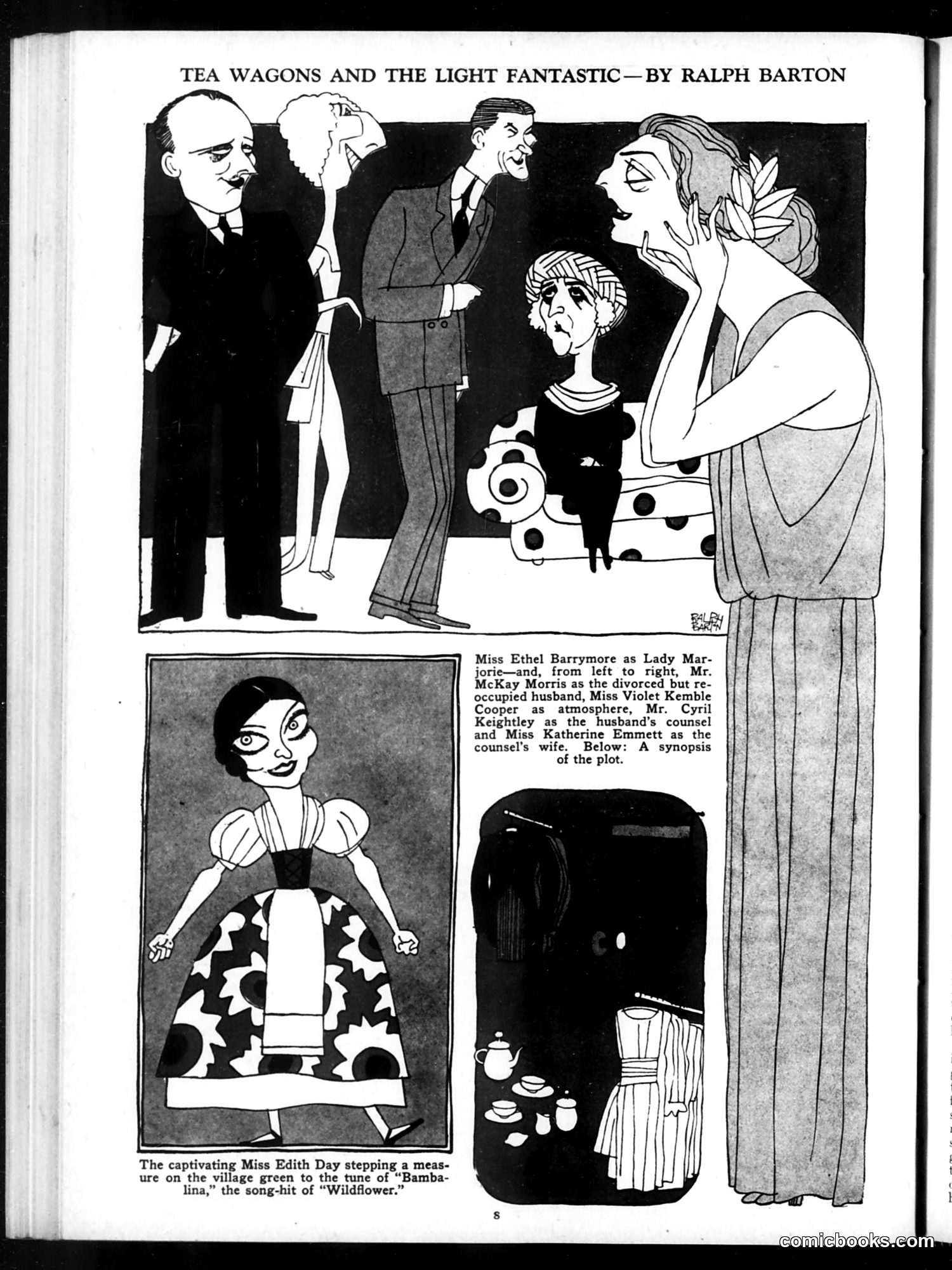
This page features Ralph Barton's theatrical illustration commentary on two Broadway productions. The top cartoon depicts a scene from a play starring prominent actress Ethel Barrymore as "Lady Marjorie," showing domestic drama involving divorce and legal counsel—suggesting marital discord comedy typical of 1920s theater. The lower illustrations promote two musicals: one featuring Edith Day dancing to "Bambalina" from *Wildflower*. The stylized caricature of Day emphasizes exaggerated features common in period illustrations. The satire appears gentle—poking fun at theatrical pretension and romantic entanglement plots rather than attacking specific figures. "Tea wagons" likely references drawing-room comedy conventions of the era. This is essentially theatrical promotion and social commentary wrapped in Judge magazine's signature illustrated format, celebrating Broadway's popular entertainments to contemporary readers.
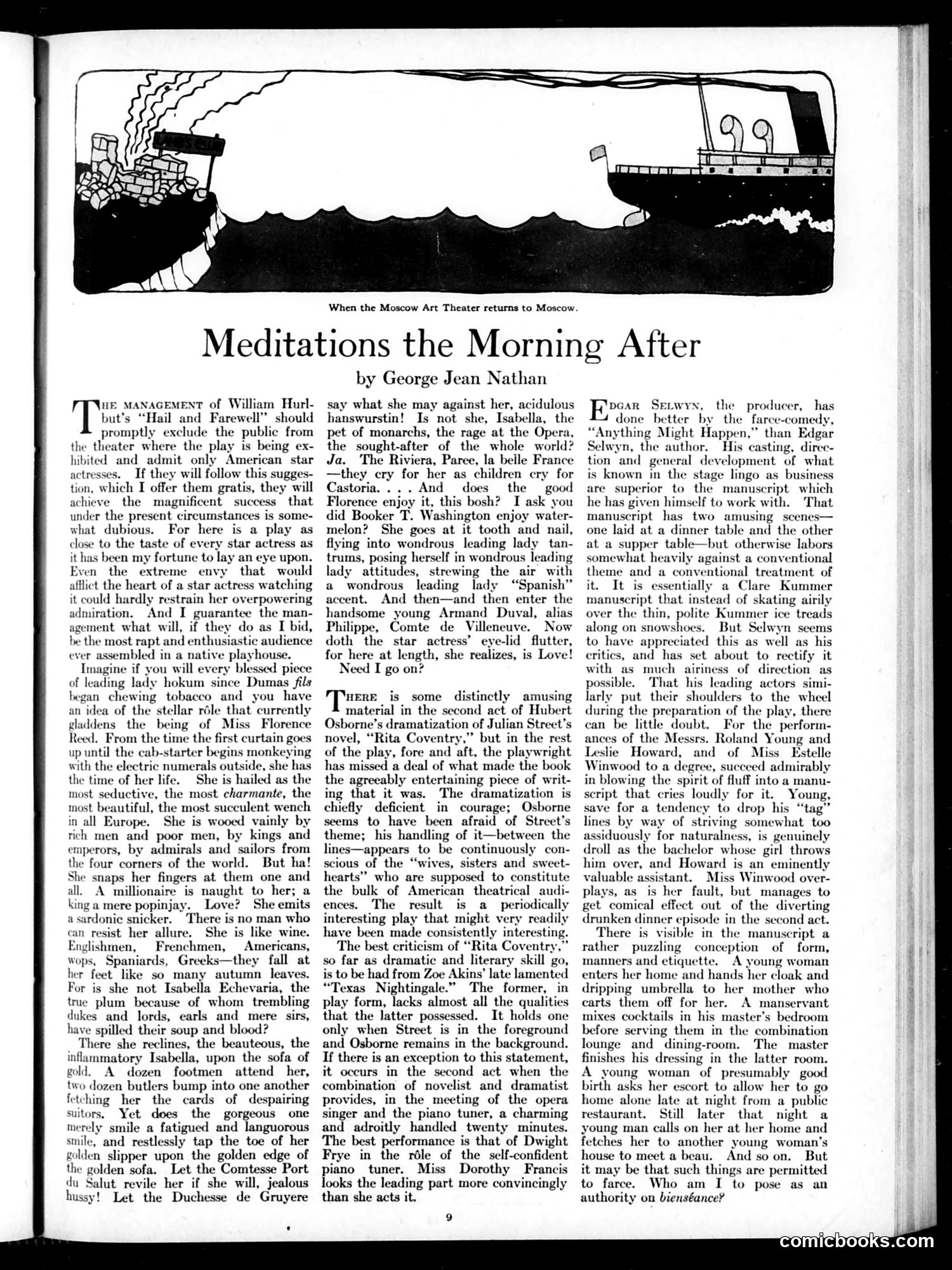
This page is primarily **literary criticism** rather than political satire. George Jean Nathan reviews stage productions, not political figures or events. The illustrated header shows **two ships passing at sea**, captioned "When the Moscow Art Theater returns to Moscow"—likely a wry visual joke about theatrical comings and goings. Nathan's main review mocks **Florence Reed's performance** in William Hurlbut's play "Hail and Farewell." He satirizes the tired conventions of melodramatic leading-lady roles: the beautiful woman showered with attention from powerful men (kings, dukes, admirals), who affects languorous indifference until a suitable romantic hero arrives. Nathan uses exaggerated language ("charmante," "inflammatory Isabella") to ridicule both the overwrought character and Reed's hammy performance. The second review critiques Hubert Osborne's stage adaptation of Julian Street's novel "Rita Coventry," faulting its dramatic timidity. **The satire targets theatrical clichés and performers' reliance on hokum**, not politics or current events.
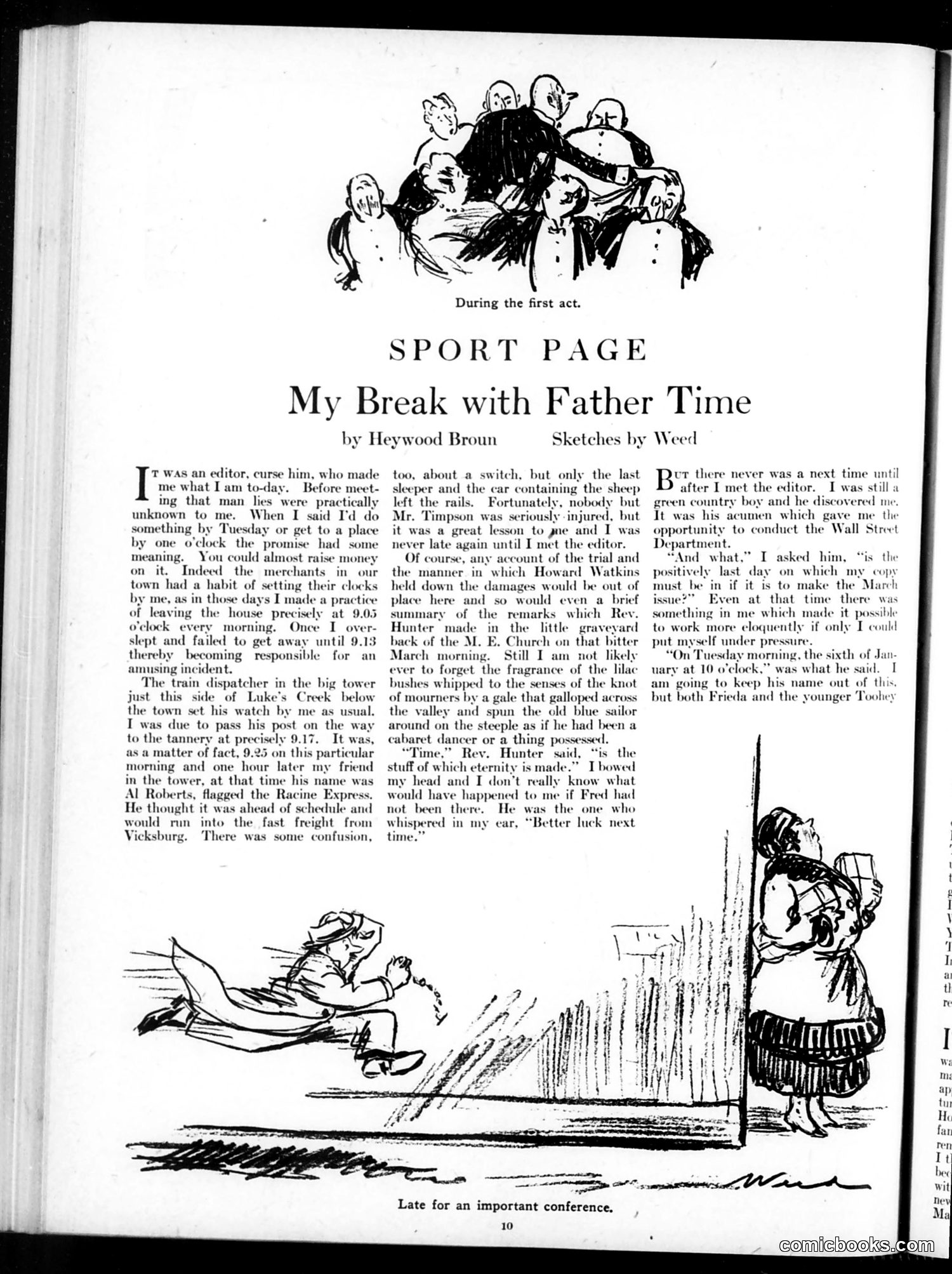
This is a humorous sports column by Heywood Broun about chronic lateness. The narrator describes how an editor shaped his character by demanding punctuality—specifically, requiring copy by "Tuesday morning, the sixth of January at 10 o'clock." The accompanying sketches illustrate the joke: one shows a man frantically running, the other depicts someone arriving late to "an important conference." The satire targets the narrator's inability to meet deadlines despite understanding their importance. Broun uses self-deprecating humor to explore how authority figures (the editor as "father time") attempt to instill discipline, yet the protagonist remains perpetually tardy. The "My Break with Father Time" title puns on relationship breakups, suggesting the narrator has abandoned punctuality. For modern readers, this reflects early 20th-century workplace culture where newspaper deadlines were absolute and editor-writer relationships were contentious, often personally antagonistic rather than merely professional.
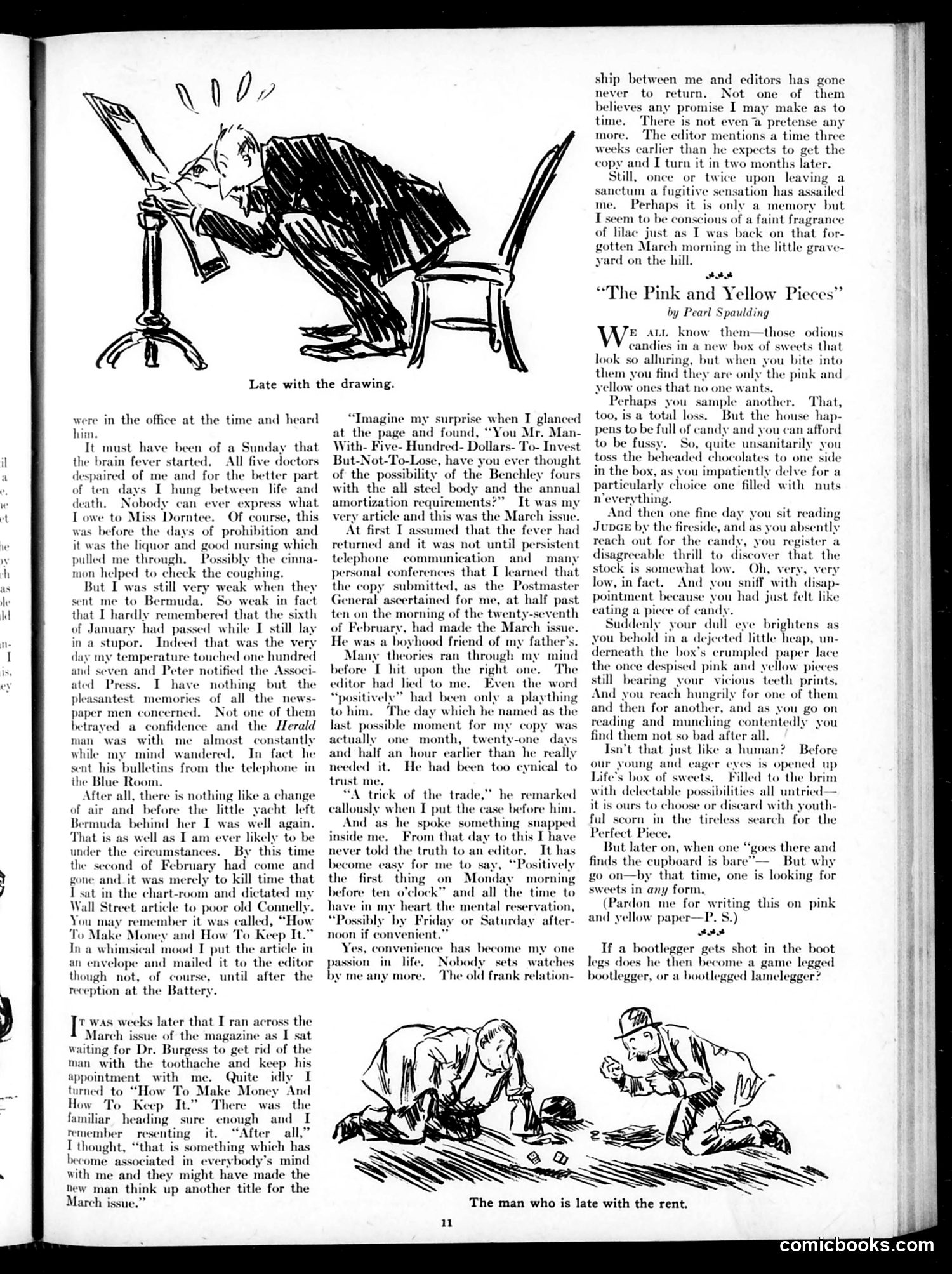
This page contains two distinct pieces from Judge magazine: **Upper Section - "Late with the drawing"**: A sketch showing a harried artist at work, illustrating the article's theme of missed deadlines. The cartoon complements the accompanying essay. **Main Article - "The Pink and Yellow Pieces" by Pearl Spaulding**: A personal essay about the author's frustration with candy boxes that contain only unwanted flavors. The deeper satire becomes apparent in the second half: the author uses this trivial complaint as a metaphor for **broken promises and lost trust in professional relationships**—specifically with magazine editors. The article reveals how a deadline mix-up destroyed the author's faith in editorial honesty. After being assured a submission would appear "positively" by a certain date, it ran earlier than promised. The editor's dismissal of this as "a trick of the trade" embittered the author permanently, leading them to never trust editor promises again. **The satire**: Judge critiques the casual dishonesty and unreliability of magazine publishing practices of the era, where deadline promises were treated as meaningless conventions rather than commitments.
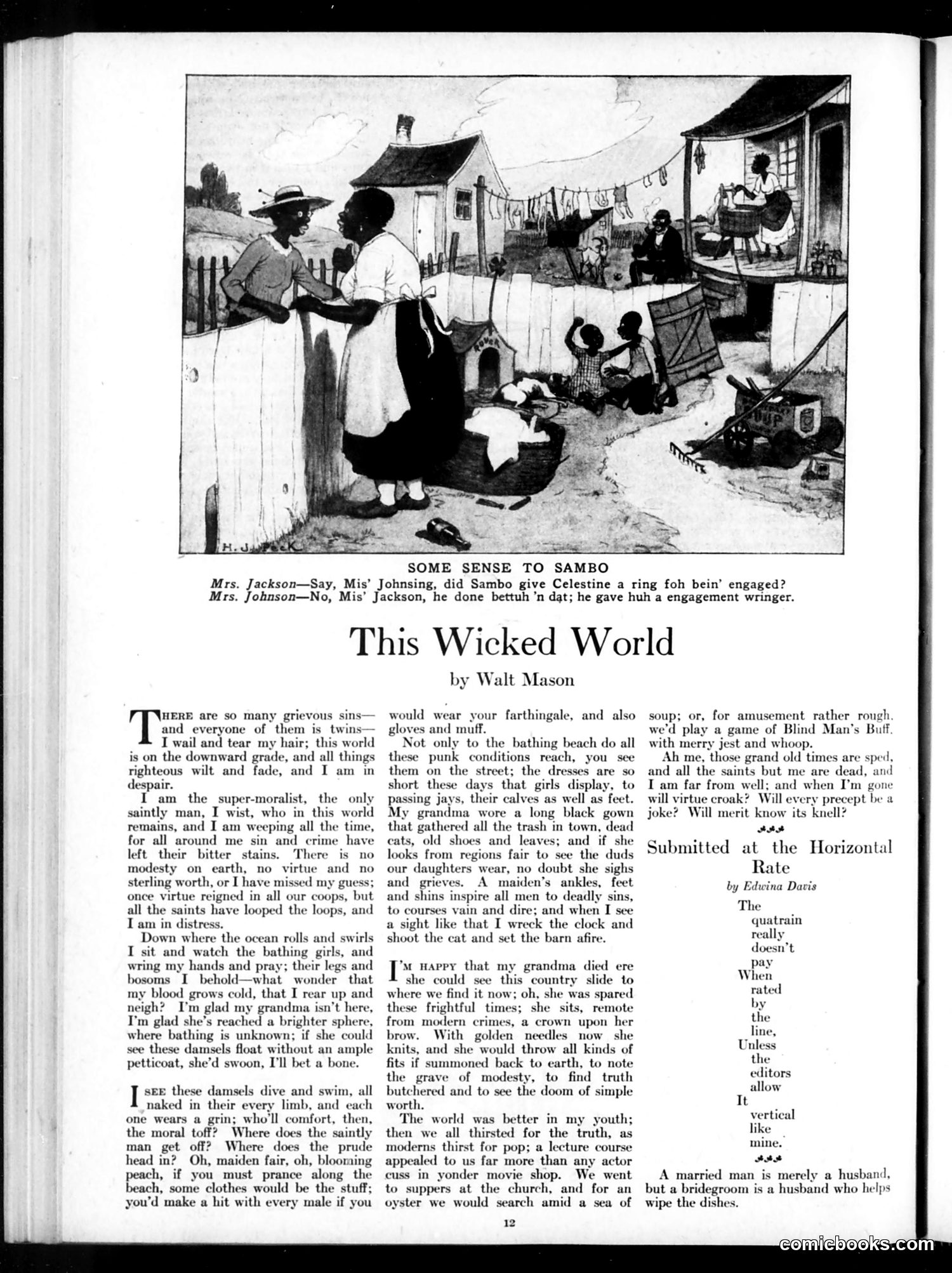
The page contains two satirical pieces mocking social hypocrisy: **"Some Sense to Sambo"** (top): A crude racial caricature dialogue using dialect, depicting Black characters. The "joke" relies on a pun: instead of an engagement ring, "Sambo" gave his fiancée a wringer (a laundry tool)—implying poor Black communities couldn't afford proper gifts. **"This Wicked World" by Walt Mason** (main text): A lengthy poem satirizing prudish moralists who obsess over modern women's "immodesty"—shorter skirts exposing ankles and calves. The speaker is a hypocritical "super-moralist" who claims moral outrage while voyeuristically watching bathing women. Mason ridicules nostalgia for stricter Victorian dress codes, presenting the character's hand-wringing as absurd overreaction to normal social change. The secondary piece **"Submitted at the Horizontal Rate"** is a meta-joke about poetry payment rates. The content reflects 1910s-era debates over women's fashion and changing social mores, using racist imagery alongside satire of outdated prudishness.
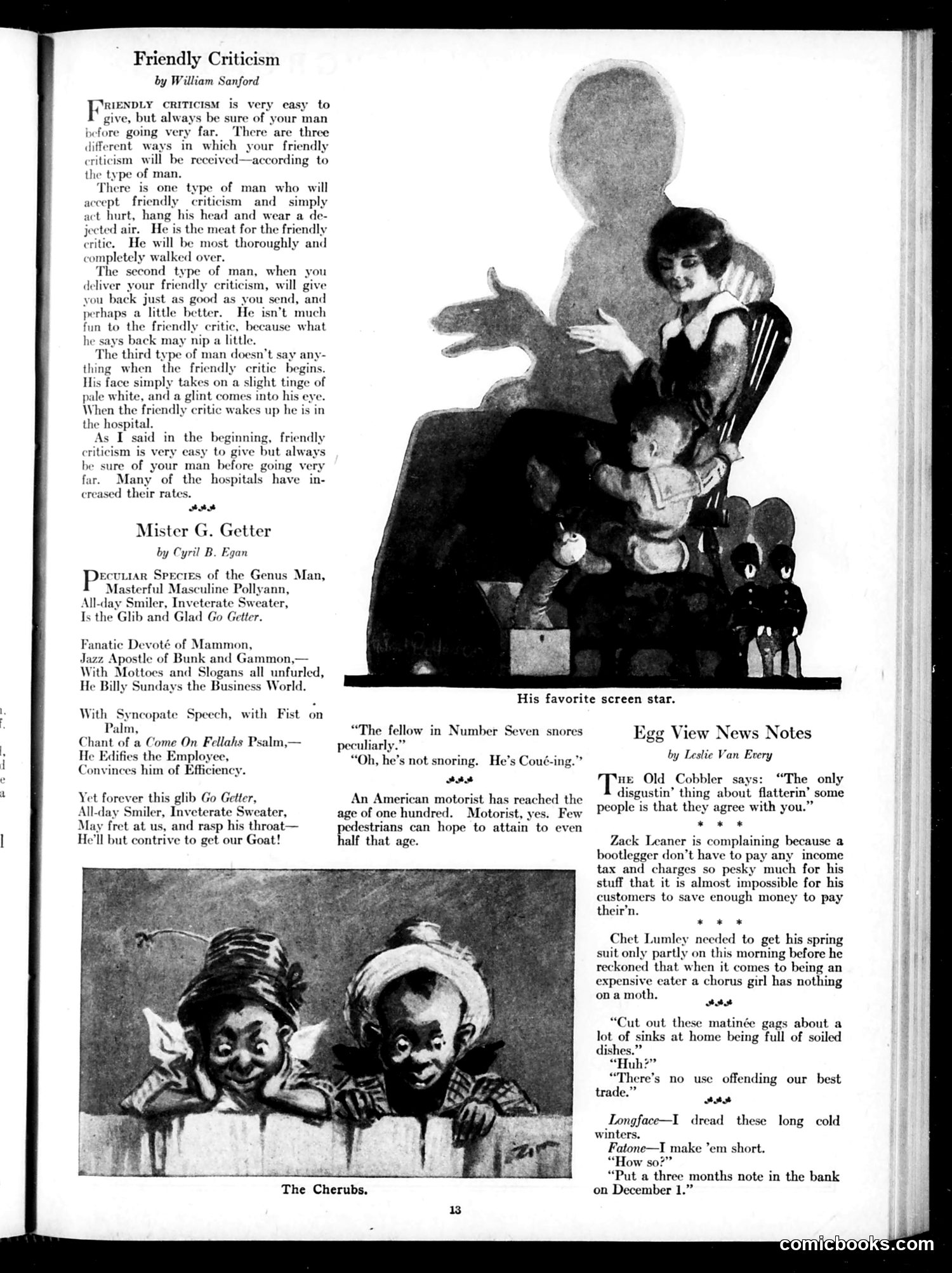
**"Friendly Criticism"** by William Sanford presents three male archetypes and their reactions to unsolicited advice. The satire warns that criticizing the wrong "type of man" can backfire dangerously—the third type, who silently accepts criticism with a meaningful glance, will hospitalize the critic. This reflects early 20th-century masculine honor culture where perceived disrespect warranted violence. **"Mister G. Getter"** by Cyril B. Egan satirizes the "go-getter" businessman—a hustler who motivates employees through slick motivational speech and empty slogans ("Come On Fellahs"). The poem mocks his relentless cheerfulness and manipulative charm while suggesting he ultimately provokes genuine anger ("get our Goat"). The **"Egg View News Notes"** contains brief observational jokes about bootleggers evading taxes, expensive chorus girls, and a financial scheme using post-dated checks. The photographs show period screen entertainment and cherub-like figures, likely supporting the entertainment-focused content typical of Judge magazine.
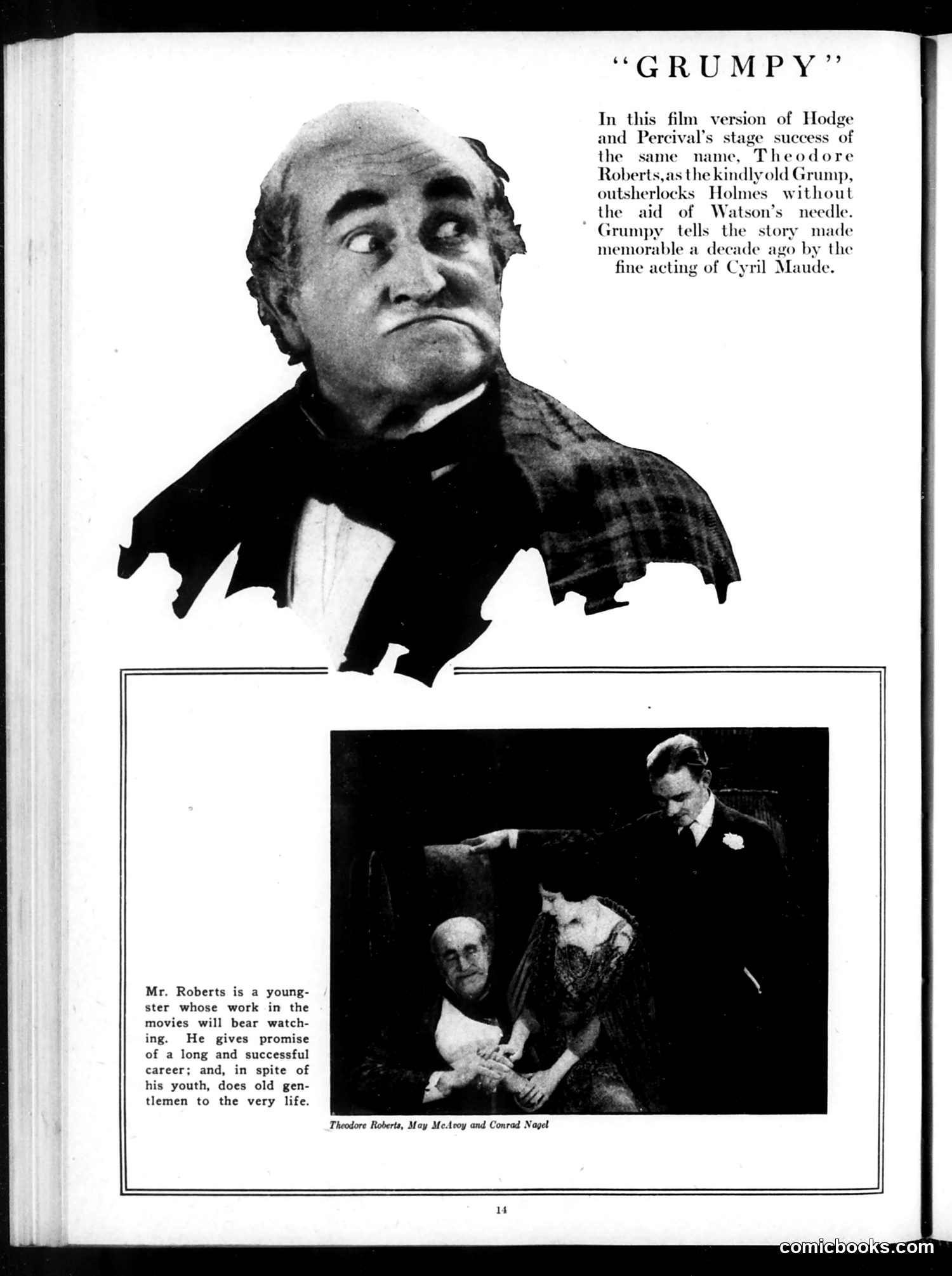
This page reviews a silent film adaptation of the stage play "Grumpy," featuring actor Theodore Roberts in the title role. The text praises Roberts's performance as an elderly character, noting his ability to play "old gentlemen" convincingly despite his youth. The phrase "outsherlocks Holmes without the aid of Watson's needle" is a contemporary reference joke—comparing Roberts's detective-like prowess in the film to Sherlock Holmes, while sarcastically noting Holmes's famous cocaine use ("Watson's needle"). The review credits the original play to Hodge and Percival, and references Cyril Maude's acclaimed stage performance from a decade prior. The lower photograph shows Roberts with co-stars May McAvoy and Conrad Nagel in a scene from the film.
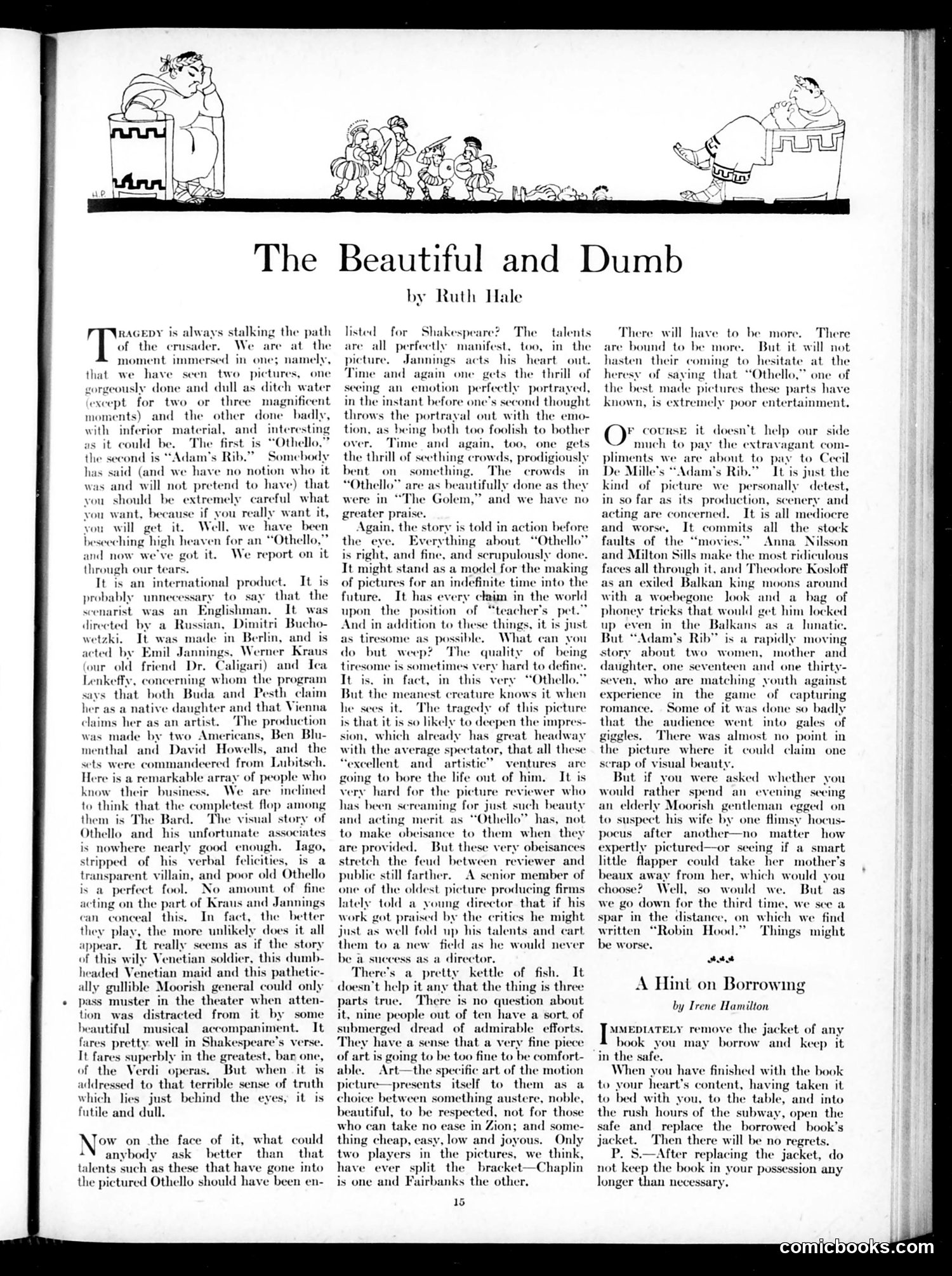
This is a film review, not a political cartoon. Hale critiques a 1922 international production of *Othello* directed by Russian Dimitri Buchowetzki, starring Emil Jannings and Werner Kraus. **The Satire's Point:** Hale's title captures her paradox: despite assembling world-class talent (international directors, acclaimed actors, meticulous craftsmanship, and stunning visual storytelling), the film is utterly *boring*. She argues that Shakespeare's plot—dependent on theater's spectacle and Verdi's operatic music—collapses when stripped bare onscreen. The "dumb" refers not to the filmmakers but to the story itself: Iago is transparently villainous, Othello impossibly credulous, and Desdemona pathetically gullible. **The Joke:** Excellence in execution cannot salvage fundamentally tedious material. Hale worries this "teacher's pet" film will bore audiences away from art cinema itself—a prescient concern about how prestige adaptations can backfire.
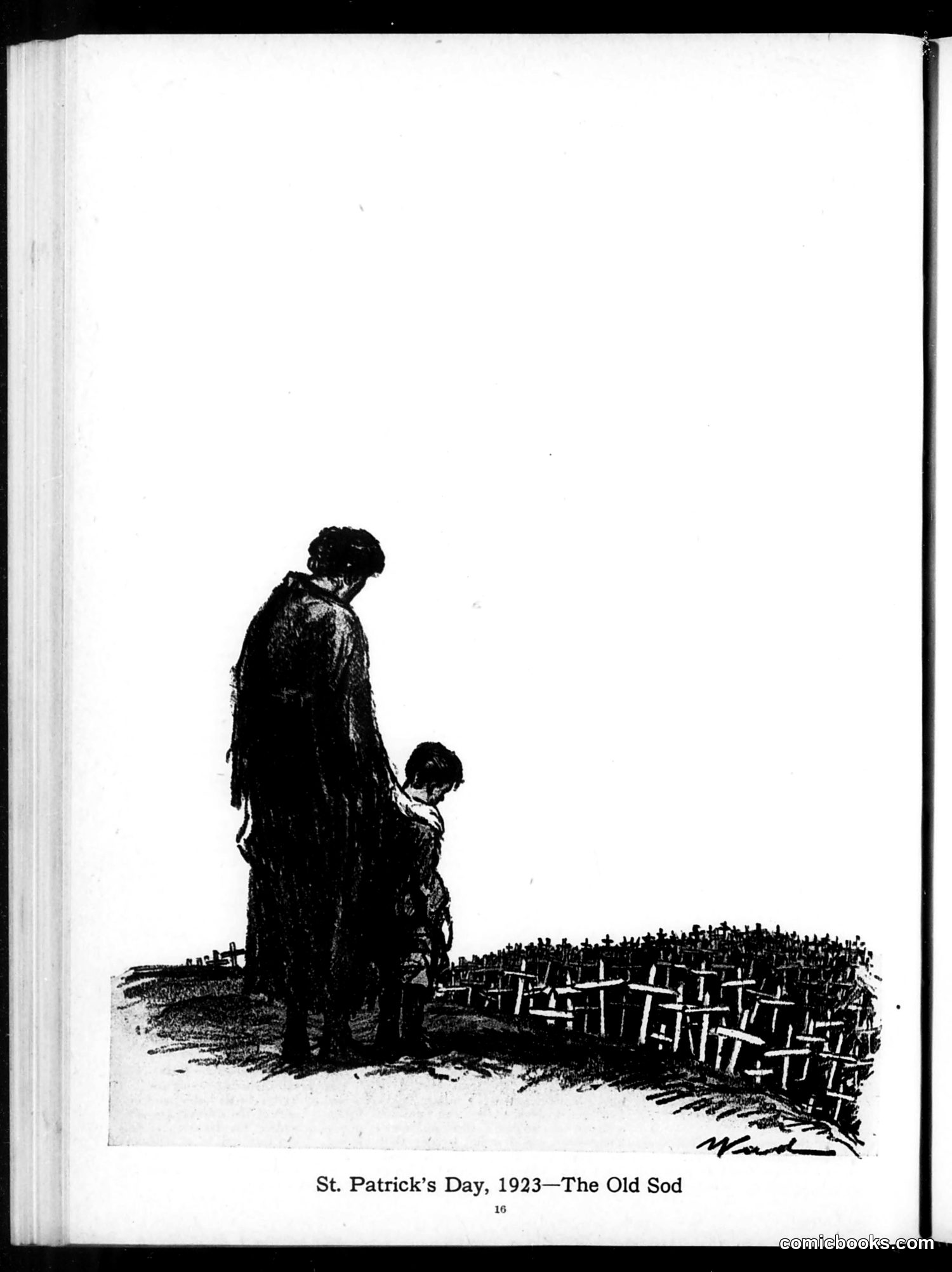
This black and white illustration shows an adult and child standing before a military cemetery filled with white crosses. The title references St. Patrick's Day and "the Old Sod" (Ireland). The cartoon likely commemorates Irish soldiers killed in World War I, which ended in 1918. The image suggests Irish sacrifice in that war—a poignant memorial appropriate for St. Patrick's Day. The composition—an adult and child contemplating rows of graves—evokes themes of loss, remembrance, and the generational impact of war. The "Old Sod" reference doubles as wordplay: literal Irish soil, and figurative reference to the old country. The work appears to be social commentary on war's human cost, particularly as it affected Irish communities.
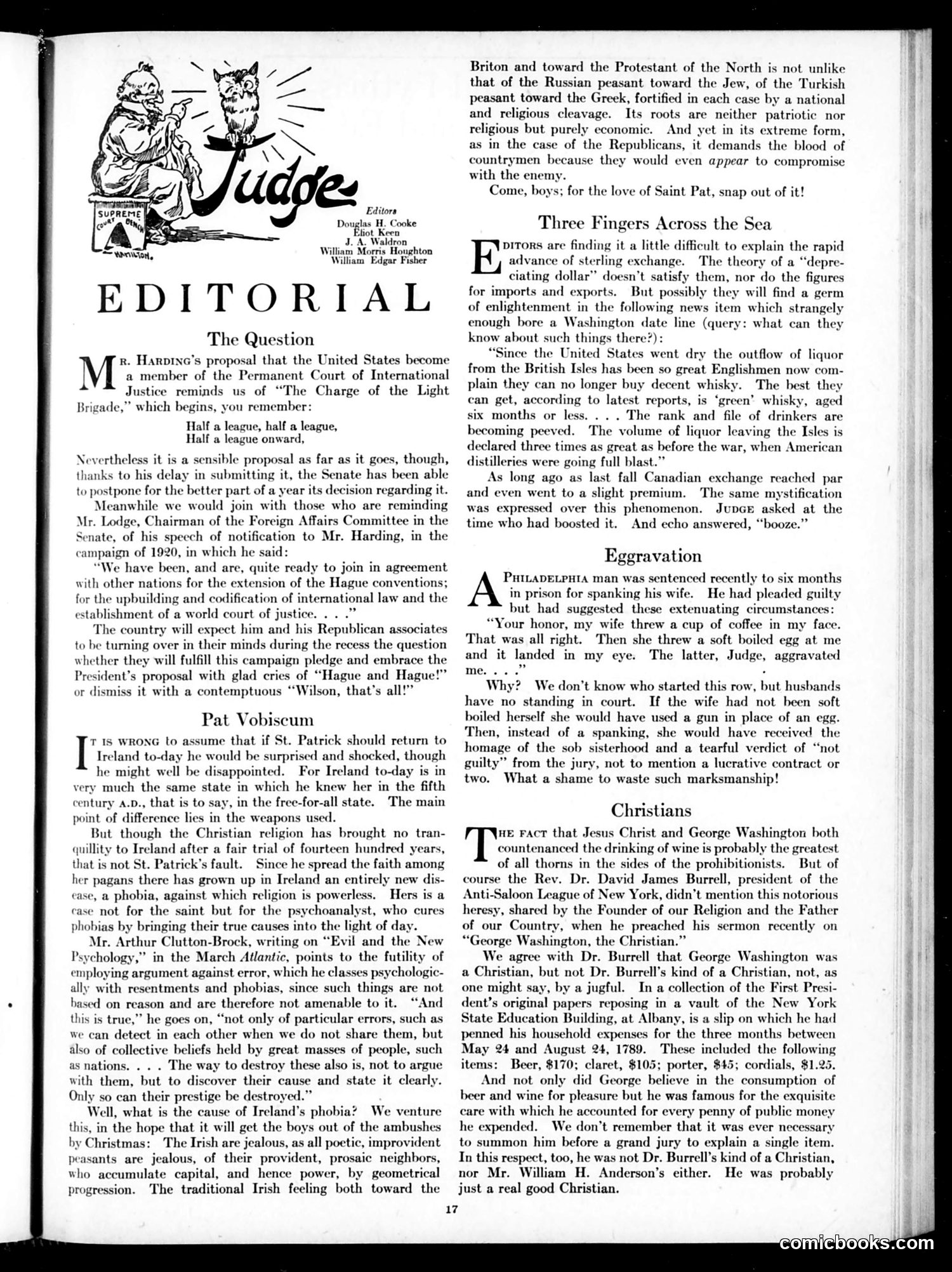
This editorial page from *Judge* magazine contains three satirical pieces addressing early 1920s American politics and social issues: **"The Question"** mocks Republican Senator Henry Lodge for opposing President Harding's proposal to join the International Court of Justice, despite Lodge's own 1920 campaign promises supporting such international cooperation. The satire suggests Lodge will dismiss the idea with contempt. **"Pat Vobiscum"** uses St. Patrick as a framing device to critique Irish violence and sectarian conflict. The author argues Ireland's troubles stem not from religion but from economic jealousy—peasants resenting wealthier Protestant neighbors—similar to antisemitic or anti-Greek prejudices elsewhere. This reflects contemporary American frustration with Irish independence violence. **The cartoon** (top left) depicts a demonic or mischievous figure labeled "Judge" with a cat, likely the magazine's mascot representing satirical commentary. The remaining articles address Prohibition's effects on liquor smuggling and George Washington's drinking habits, used to mock temperance advocates' selective morality.
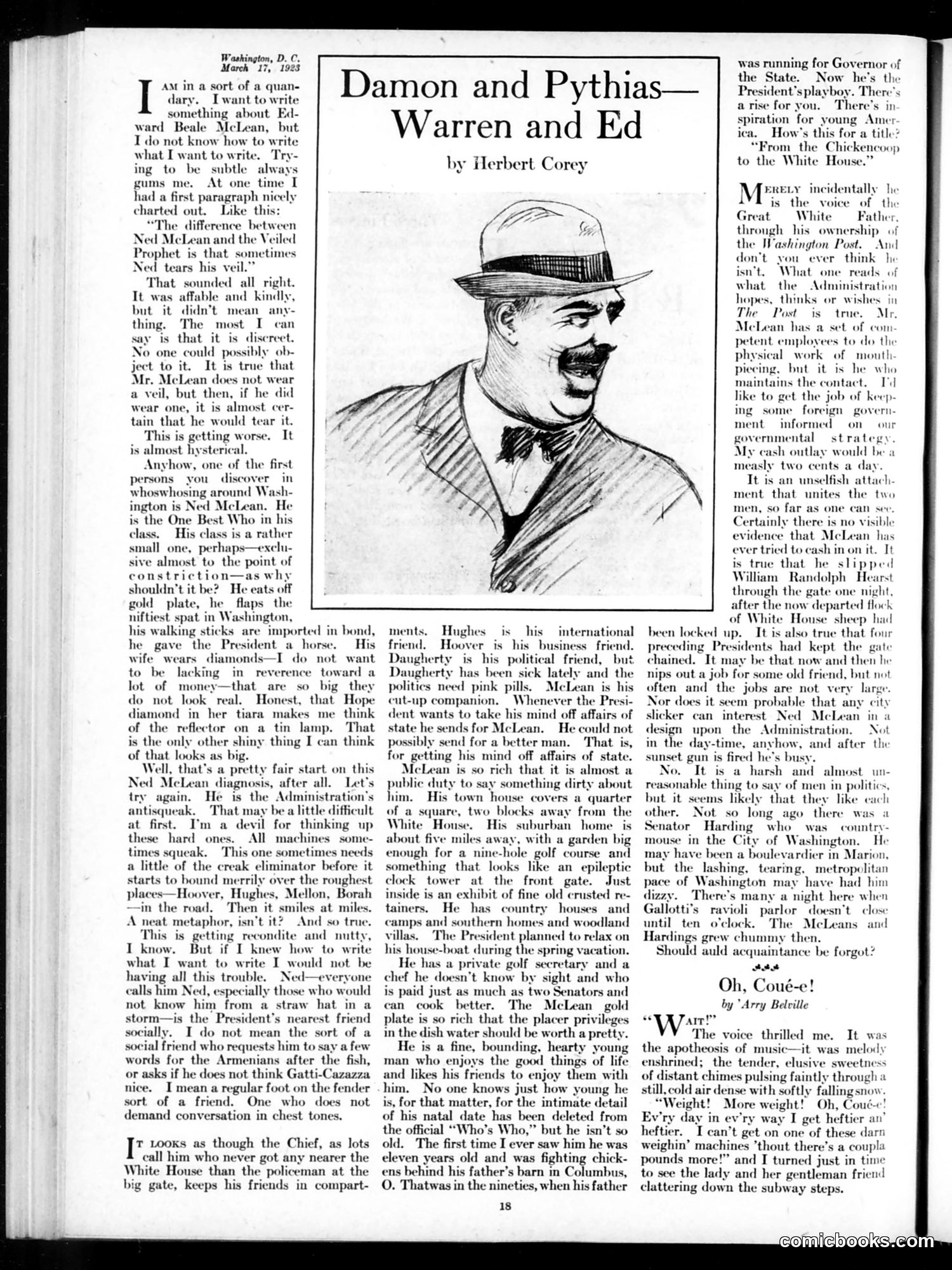
This Herbert Corey article satirizes **Edward Beale McLean**, a wealthy Washington socialite and newspaper heir, and his relationship with President **Warren G. Harding** (referred to as "Warren" and "the Chief"). The satirical point: McLean epitomizes Washington excess—he owns vast estates, eats off gold plate, gives the President horses, and is so rich his possessions seem unreal (his wife's Hope diamond compared to a tin lamp reflector). The "Damon and Pythias" reference invokes the classical friendship ideal, ironically contrasting it with McLean's transactional companionship with Harding. Corey portrays McLean as the Administration's "antisqueak"—he smooths over political friction by being available to the President for relaxation and distraction. The article criticizes how wealthy friends gain influence through social access rather than merit, while appearing to mock the absurd privilege these connections represent in 1920s Washington politics.
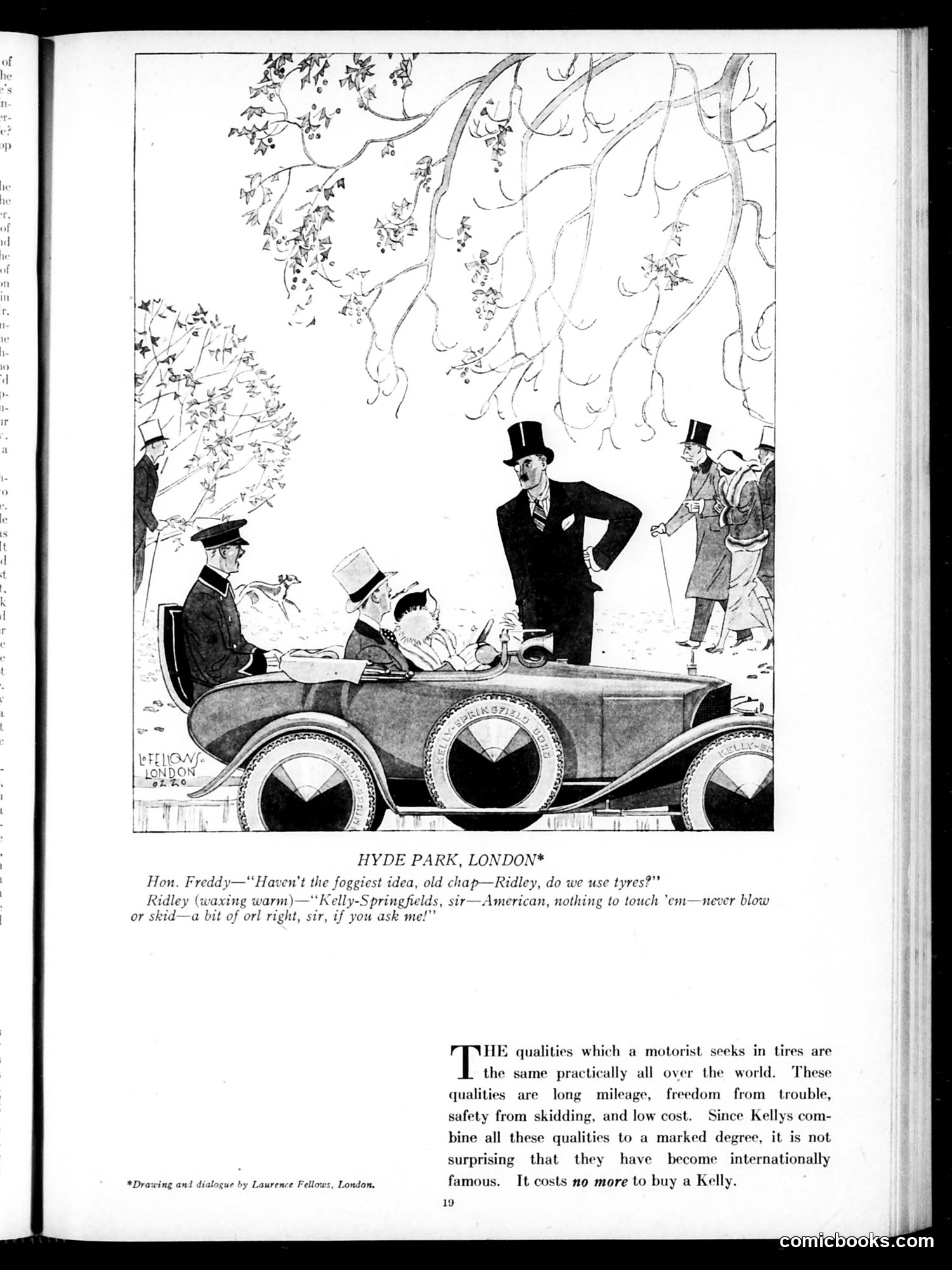
This is **advertising content disguised as satire**, drawn by Laurence Fellows for Judge magazine. The cartoon depicts upper-class British gentlemen in an automobile discussing tires. "Hon. Freddy" asks naively about tyres, while "Ridley" enthusiastically endorses "Kelly-Springfields"—American tires—claiming they never blow or skid and are superior to British alternatives. The joke's target is unclear from the image alone, but the satire appears to mock British gentlemen for their ignorance about automobiles (a relatively new technology) and their deference to American products. The text below explicitly abandons satire to pitch Kelly tires' superiority. This represents **native advertising**: using humor and social commentary to sell a product while appearing to critique British class pretension or technological backwardness. The irony is that the "satirical" critique ultimately serves to promote American manufacturing.
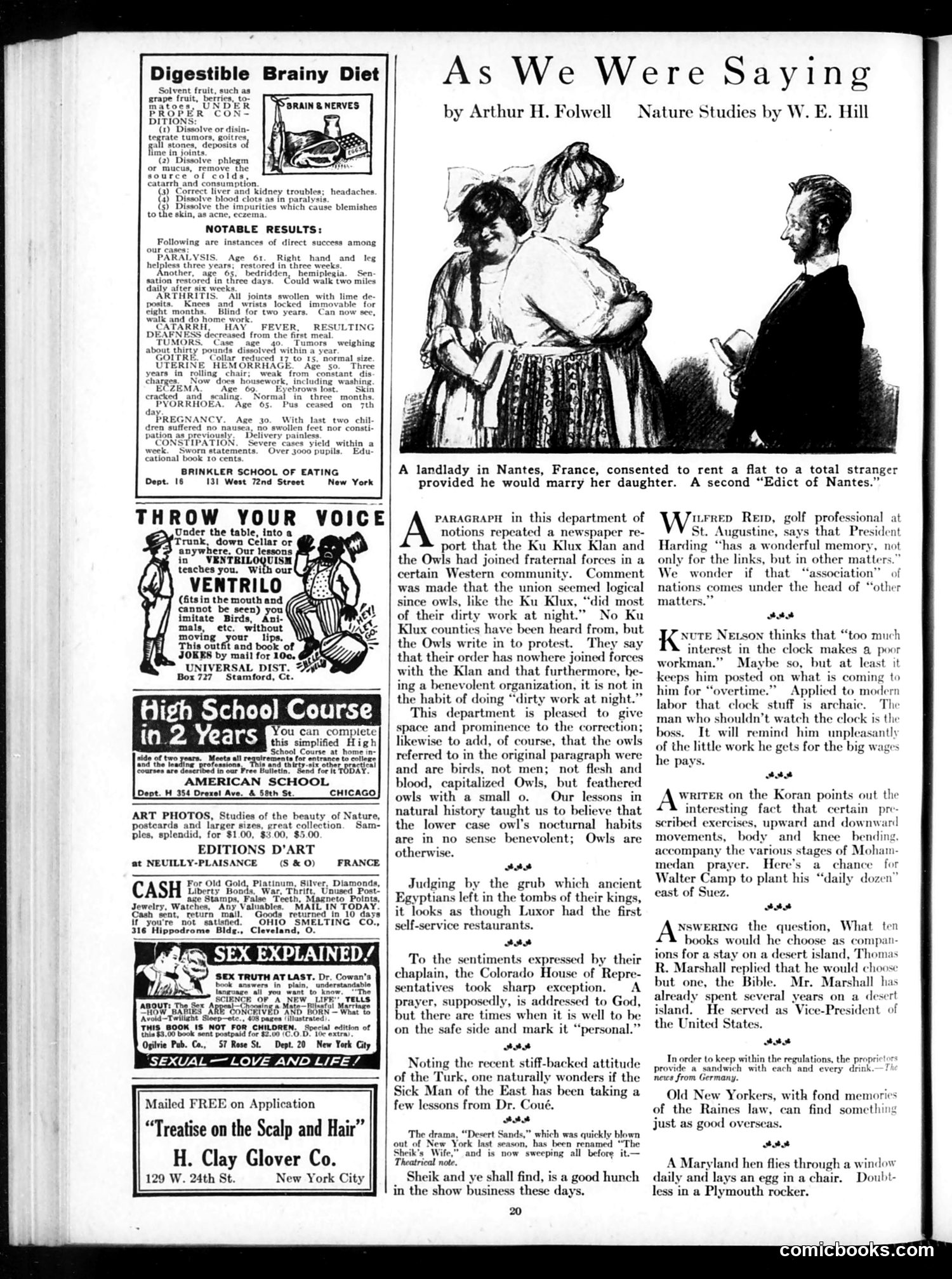
This page contains a satirical column with several brief social observations: **The Ku Klux Klan/Owls reference**: The magazine previously joked that the Klan and an organization called "the Owls" made logical partners since both did "dirty work at night." The Owls organization protested, clarifying they're benevolent and hadn't joined the Klan. The columnist humorously resolves this by noting the original reference was to actual owls (lowercase), not the fraternal organization—a tongue-in-cheek correction that simultaneously mocks the Klan's nocturnal activities. **Other brief items** satirize ancient Egypt, a Colorado House prayer controversy, and various social observations. The humor relies on readers understanding the Klan's contemporary notoriety and violent nighttime activities, making the "dirty work at night" comparison a pointed contemporary political jab at a real organization. This suggests the magazine's audience expected frank social criticism about organized racism.
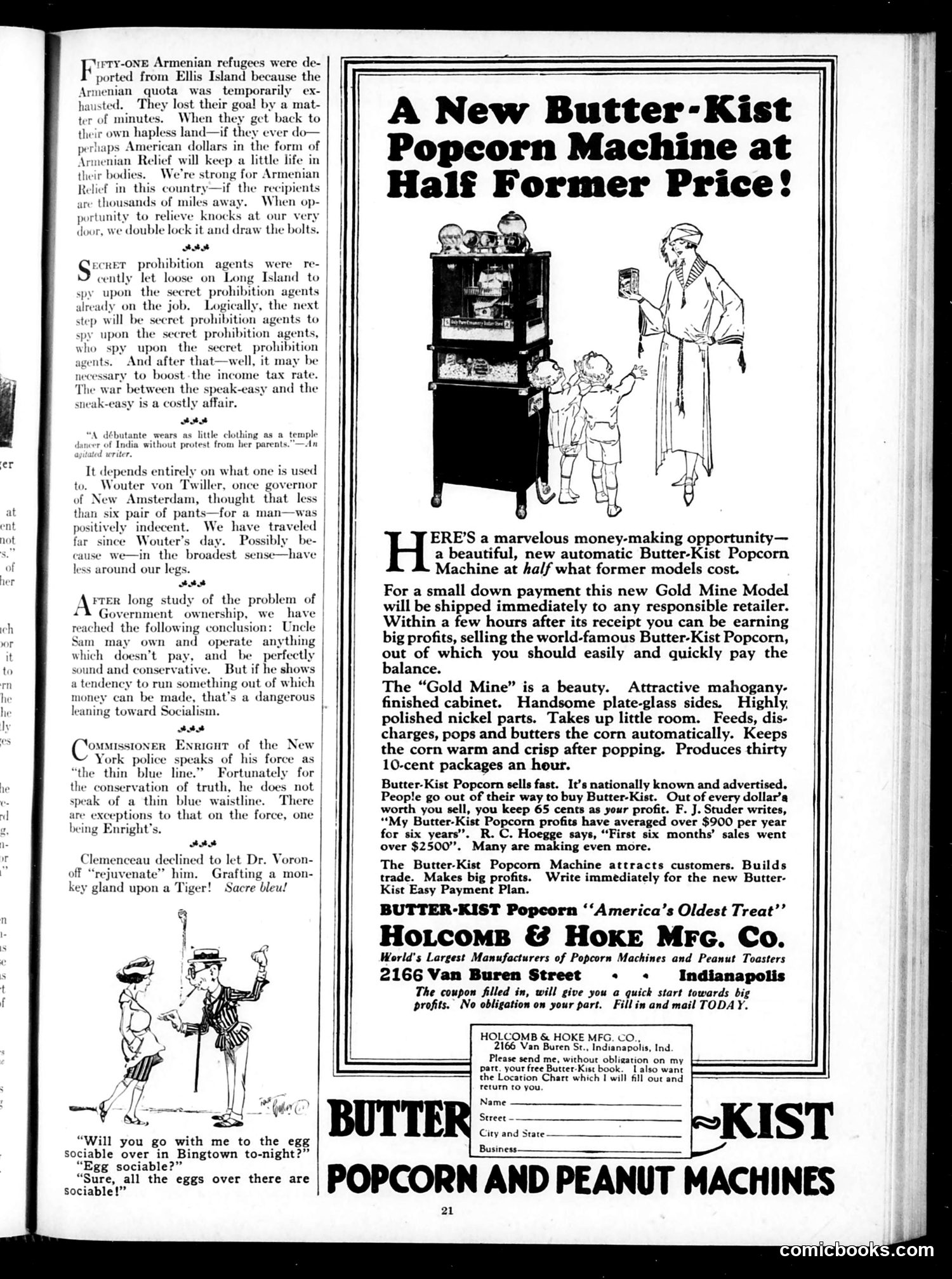
This page combines satirical articles with advertising. The cartoons/commentary critique American hypocrisy and bureaucratic absurdity: **Armenian Refugees cartoon**: Mocks the U.S. for rejecting Armenian refugees at Ellis Island while claiming to support Armenian Relief abroad. The satire: Americans are generous to distant suffering but heartless to those literally at their door. **Prohibition agents joke**: Ridicules the cascading bureaucracy of Prohibition enforcement—secret agents spying on secret agents spying on secret agents. The satire points to the absurd, self-perpetuating nature of the policy. **"Egg sociable" pun**: A political jab calling socialists "eggs" (likely slang), joking that sociable eggs at a gathering would be redundant since "all the eggs" are already sociable—mocking socialist organizing. The **large Butter-Kist Popcorn Machine advertisement** dominates the right side, typical of Judge's revenue model. It's not satirical content but a commercial appeal to entrepreneurs seeking quick profits from vending machines. Overall, the page reflects post-WWI American concerns: immigration restrictions, Prohibition enforcement, and rising socialism—wrapped in sardonic humor.
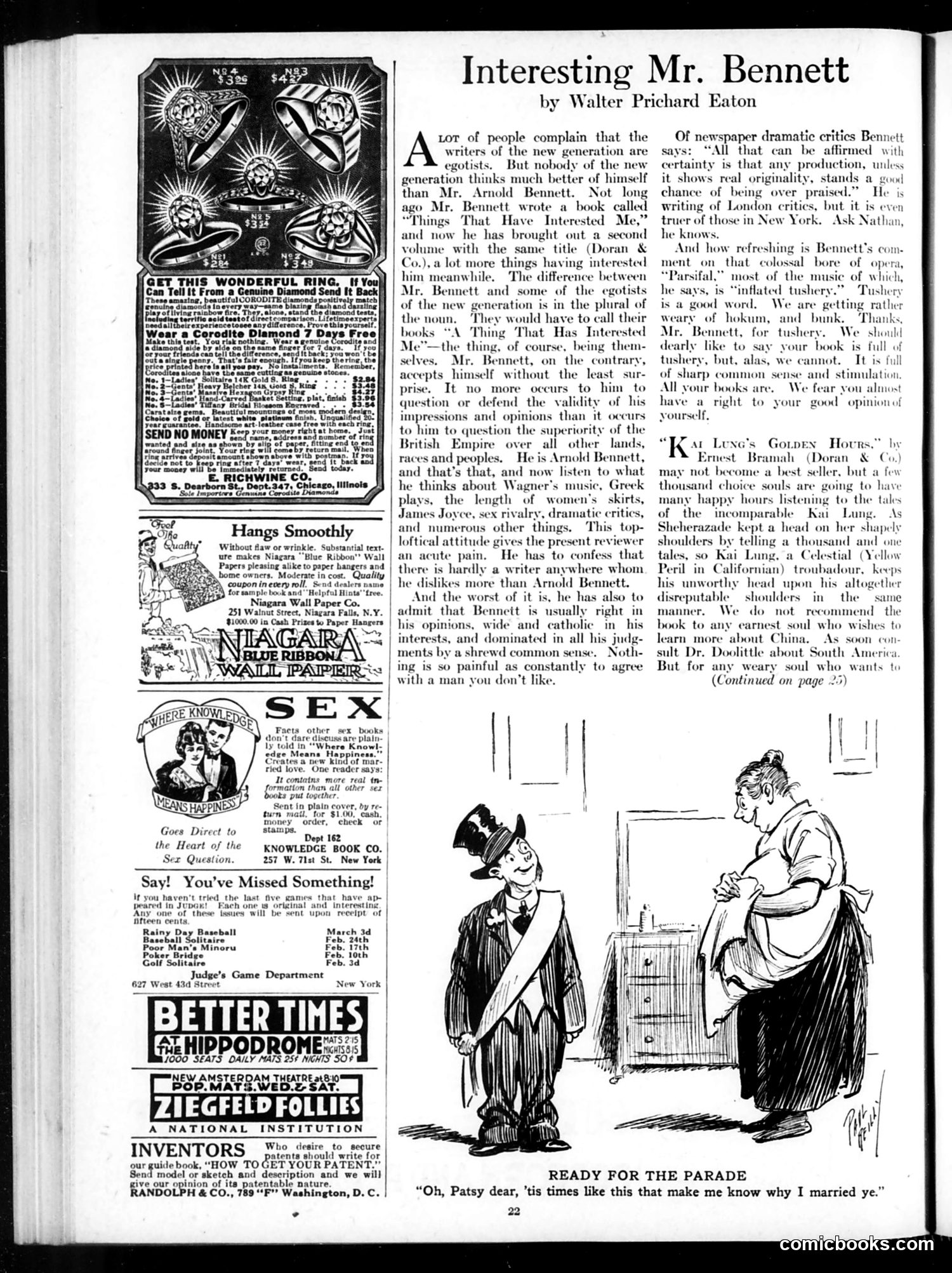
This page consists primarily of a book review by Walter Prichard Eaton of Arnold Bennett's autobiography "Things That Have Interested Me," Volume 2. The review satirizes Bennett's famous egotism: Eaton jokes that unlike other self-centered new writers who would title their work "A Thing That Has Interested Me," Bennett confidently uses the plural because he assumes everything interests him. The review is backhanded praise—Eaton admits disliking Bennett personally yet concedes he's "usually right in his opinions." Eaton quotes Bennett's sharp critiques of Wagner, dramatic critics, and opera (calling Parsifal's music "inflated tushery"), agreeing with his assessments while resenting Bennett's arrogant certainty. The page also contains period advertisements (for wall paper, books on sex, theater tickets, and patent services) and a cartoon captioned "Ready for the Parade" showing a man and woman, with her saying the parade reminds her why she married him—likely domestic satire typical of Judge magazine.
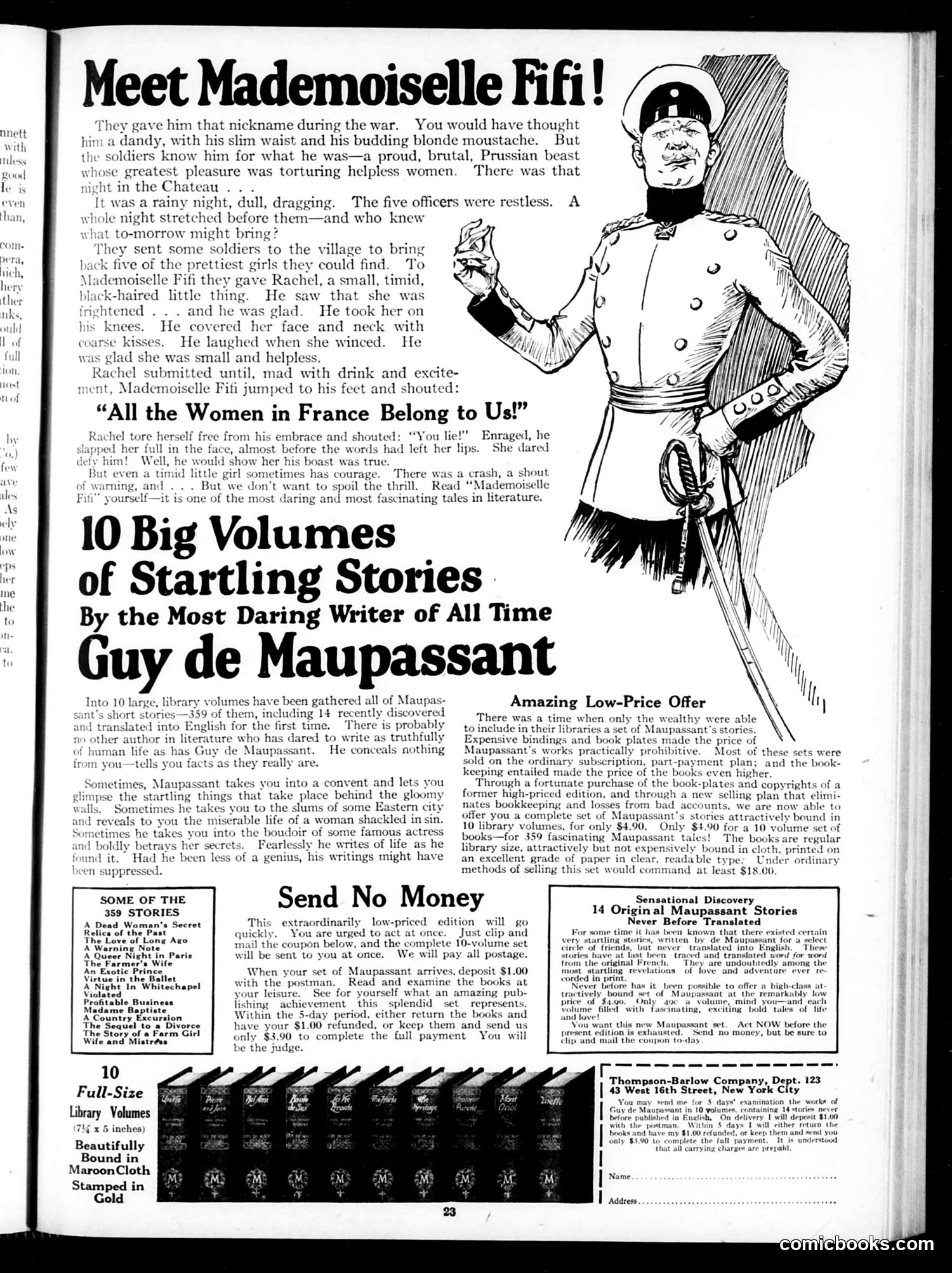
This is primarily a **book advertisement** rather than a political cartoon. It promotes a 10-volume collection of Guy de Maupassant short stories. The illustration depicts "Mademoiselle Fifi," the villain protagonist from Maupassant's famous short story (likely written during or about the Franco-Prussian War). The caricature shows a sneering Prussian military officer in uniform—identified by his spiked helmet and arrogant demeanor. The text describes him as a brutal soldier who took pleasure in tormenting helpless women. The advertisement uses this provocative literary reference to entice readers: the story involves a German officer's attempted assault on a French woman, her resistance, and implied violent consequences ("There was a crash, a shout of warning..."). The sales pitch emphasizes Maupassant's daring realism and willingness to write about taboo subjects—seduction, prostitution, convent life—positioning the collection as sophisticated yet affordably priced ($4.90 for all 10 volumes). The anti-German sentiment reflects post-WWI attitudes in American popular magazines.
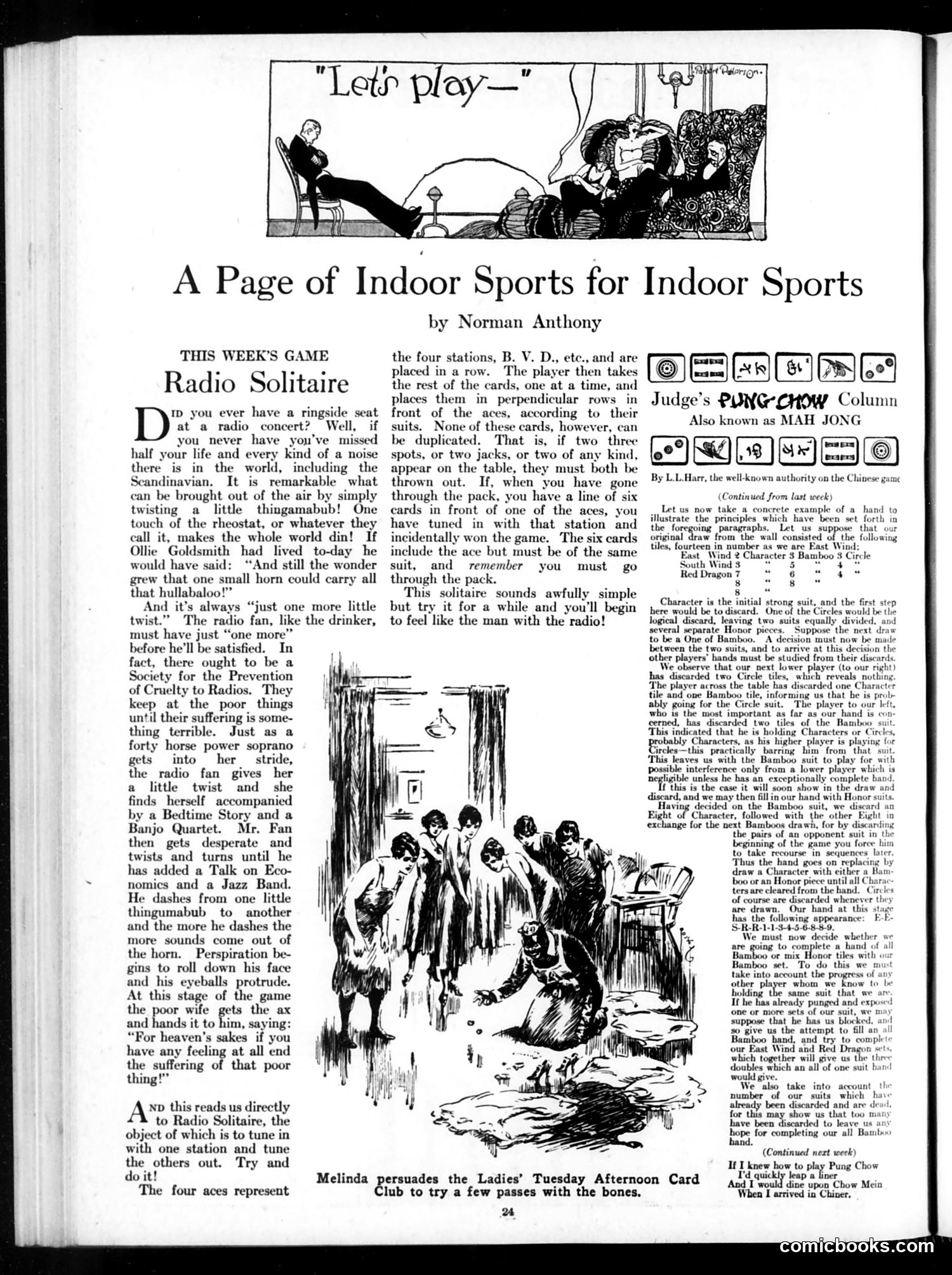
This page satirizes the obsessive behavior of 1920s radio enthusiasts. The main article mocks radio fans who compulsively twist dials, chasing multiple stations simultaneously—creating cacophonous noise that torments their families. The humor compares radio addiction to alcoholism ("one more" before satisfaction). The accompanying game, "Radio Solitaire," is a card-based parody where four aces represent radio stations (B.V.D. and others—likely brand advertisements). Players must isolate one station, mirroring the futile struggle actual radio users faced tuning in clearly. The illustration shows people gathered around a radio, presumably suffering through the chaotic experience. The satire critiques both radio technology's novelty and the obsessive personality it encouraged—a common concern in early broadcasting era media commentary.
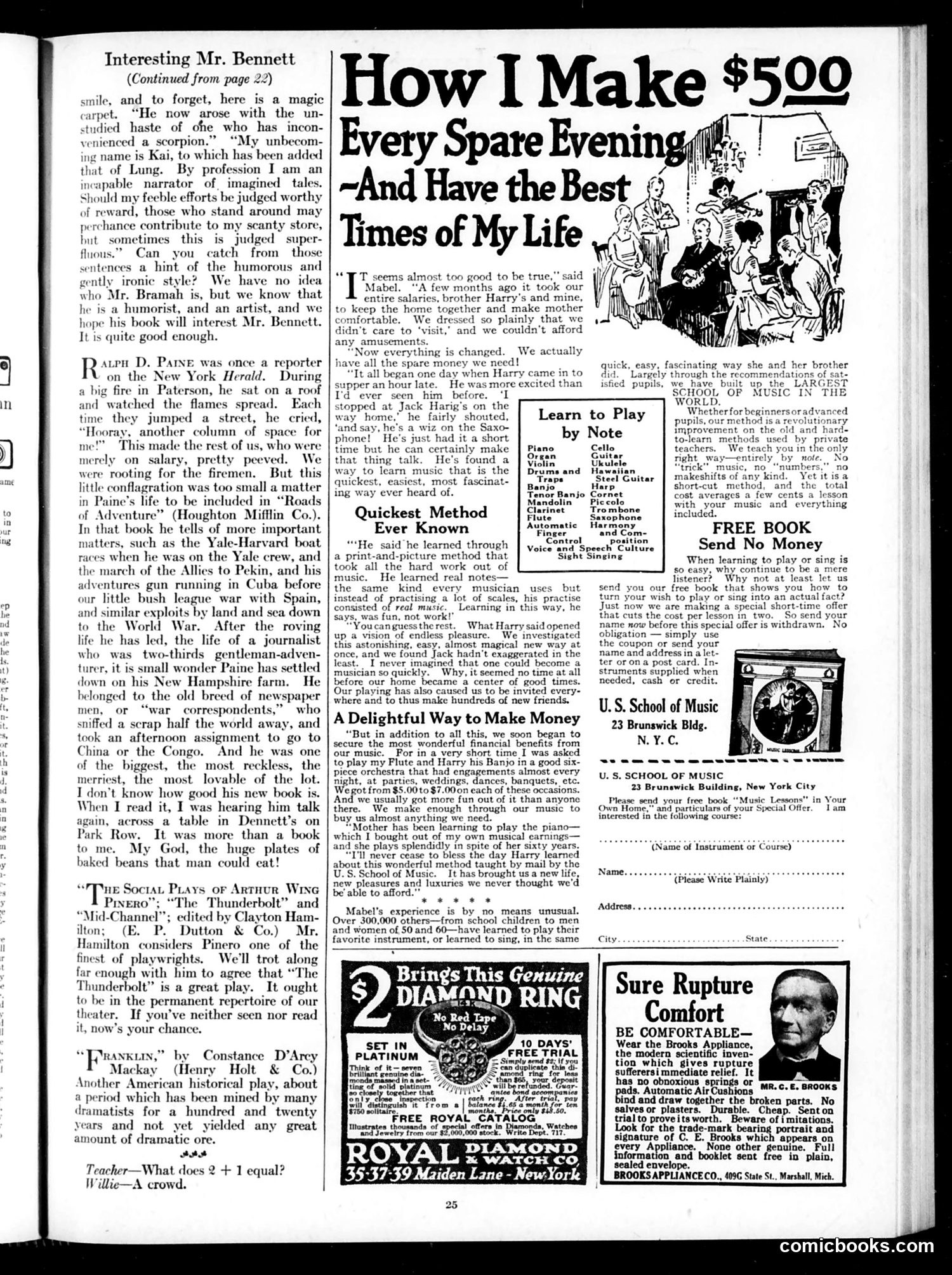
This page primarily contains **literary reviews and advertisements** rather than political satire. The main content discusses books by authors like Ernest Bramah and Ralph D. Paine, with brief biographical anecdotes about their colorful lives as journalists and adventurers. The featured article, "How I Make $500 Every Spare Evening," is a **music instruction advertisement** for the U.S. School of Music. It presents a testimonial from "Mabel" claiming financial transformation through learning saxophone via their correspondence course—a common direct-mail marketing pitch of the era. The humor appears mild: a brief teacher-student joke ("What does 2+1 equal? A crowd") and passing commentary on literary styles. The page reflects **early 20th-century magazine conventions**, mixing editorial content with full-page ads for music lessons, diamond rings, and medical devices (a rupture appliance). Nothing here constitutes political cartoon or significant satire—it's primarily a **commercial publication showcasing consumer products alongside book reviews**.
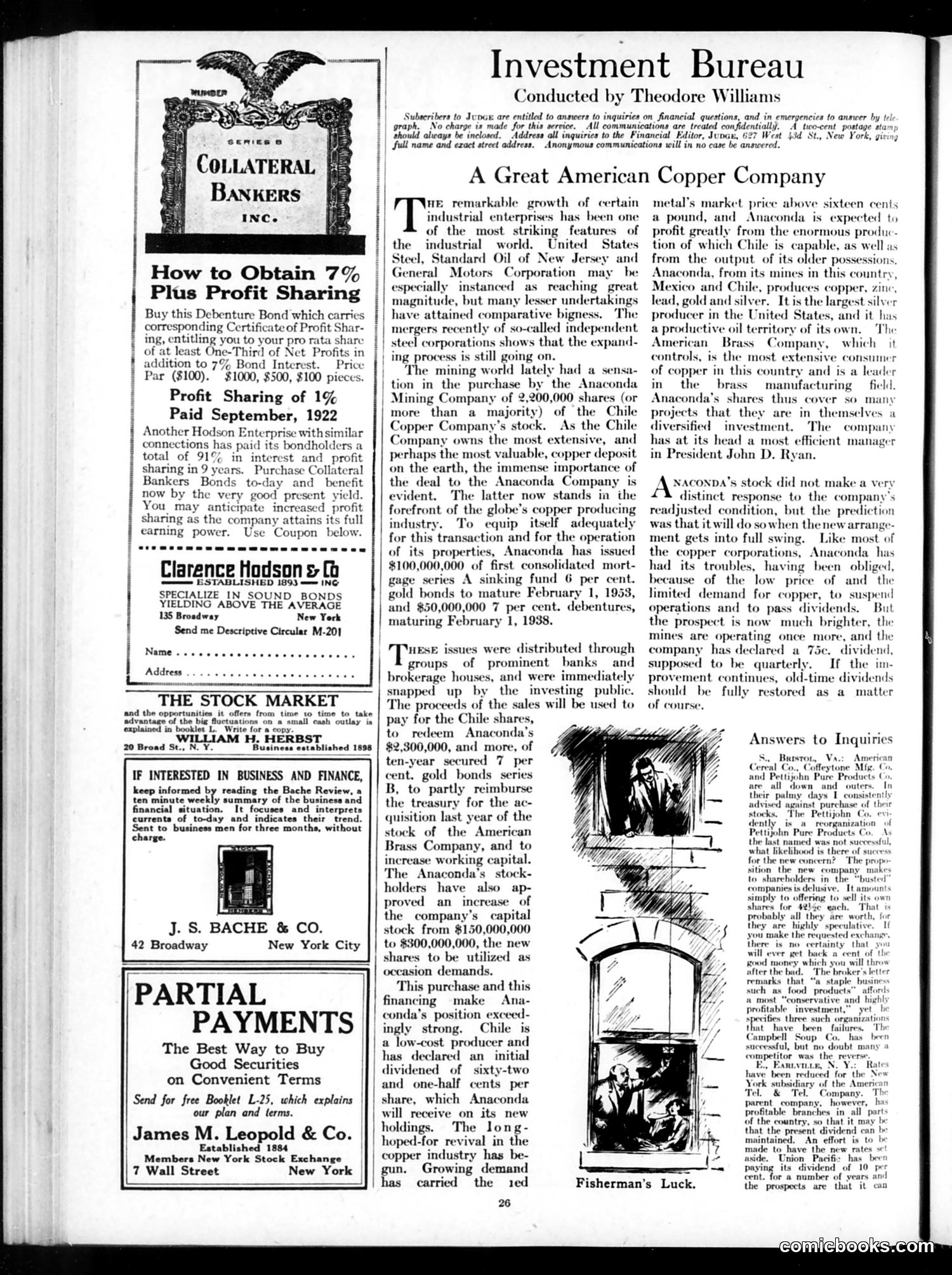
This page is primarily **financial advertising and investment advice**, not political satire. Multiple brokerage firms and investment banks (Collateral Bankers Inc., Clarence Hodson & Co., J.S. Bache & Co., James M. Leopold & Co.) promote various bonds and securities to readers. The main article discusses **Anaconda Copper Company's acquisition of Chile Copper**, a significant industrial consolidation of the era. The text emphasizes this as evidence of ongoing American corporate growth and merger activity. The two illustrations labeled "Fisherman's Luck" appear to be generic decorative vignettes showing people fishing—unrelated to the financial content and likely simply filling page space. This is a **business-focused magazine page** aimed at investors, with no discernible political commentary or satirical intent visible in either text or images.
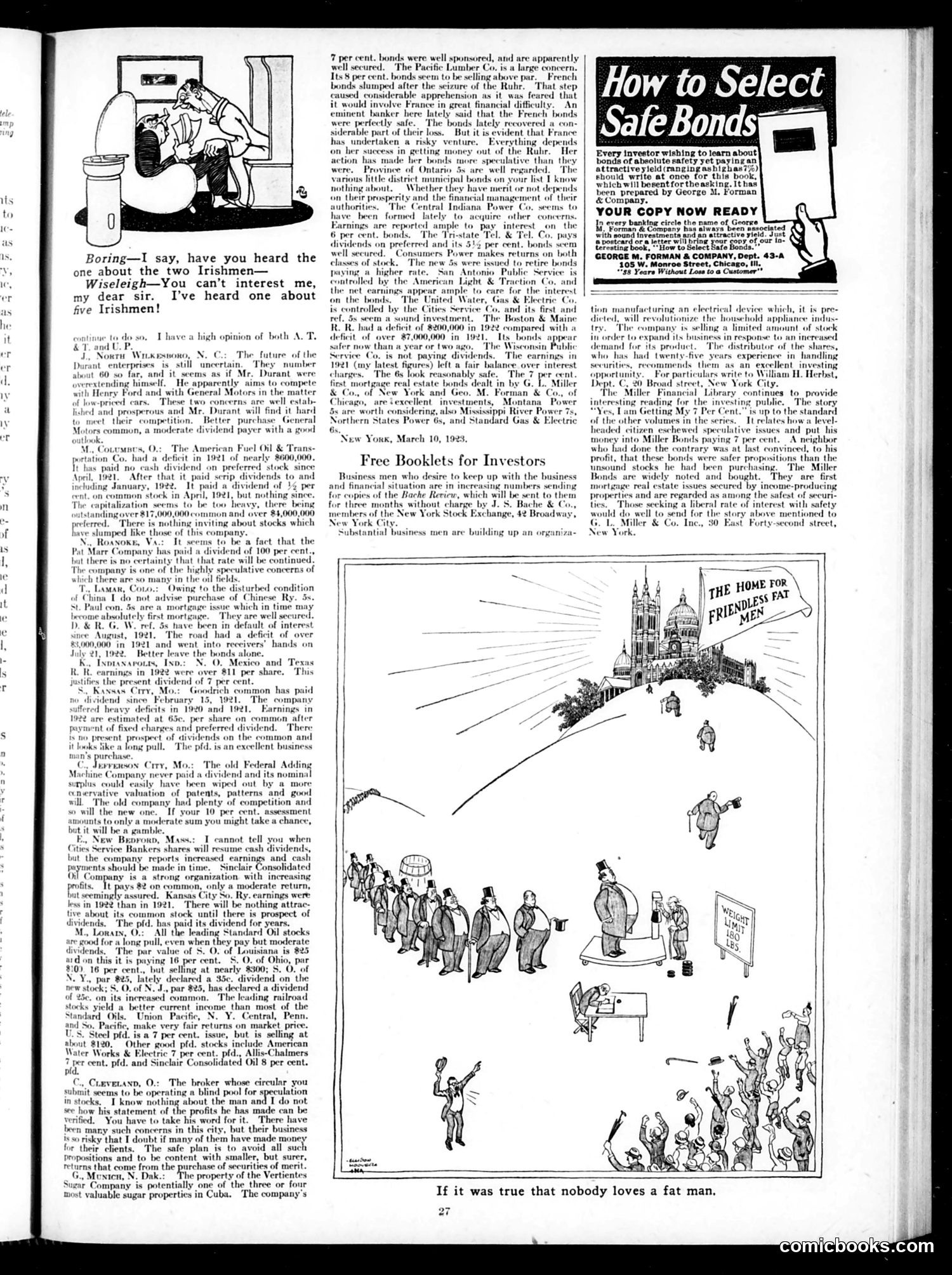
This page consists primarily of **financial advice columns** rather than political cartoons. The main content features reader questions about bond and stock investments, with expert responses addressing concerns about various companies' financial health. The only cartoon appears at bottom right: **"The Home for Friendless Fat Men"** — a satirical illustration showing a procession of overweight men approaching a large institutional building. The caption reads "If it was true that nobody loves a fat man," presenting body-shaming humor typical of 1920s-era satire. The top section includes a brief conversational joke about Irish stereotypes (the "two Irishmen" setup), which was common comedy fodder in this period. The bulk of the page reflects **post-WWI economic concerns** — readers seeking guidance on railroad bonds, industrial stocks, and municipal securities, with advisors evaluating financial stability amid uncertain economic conditions of the early 1920s.
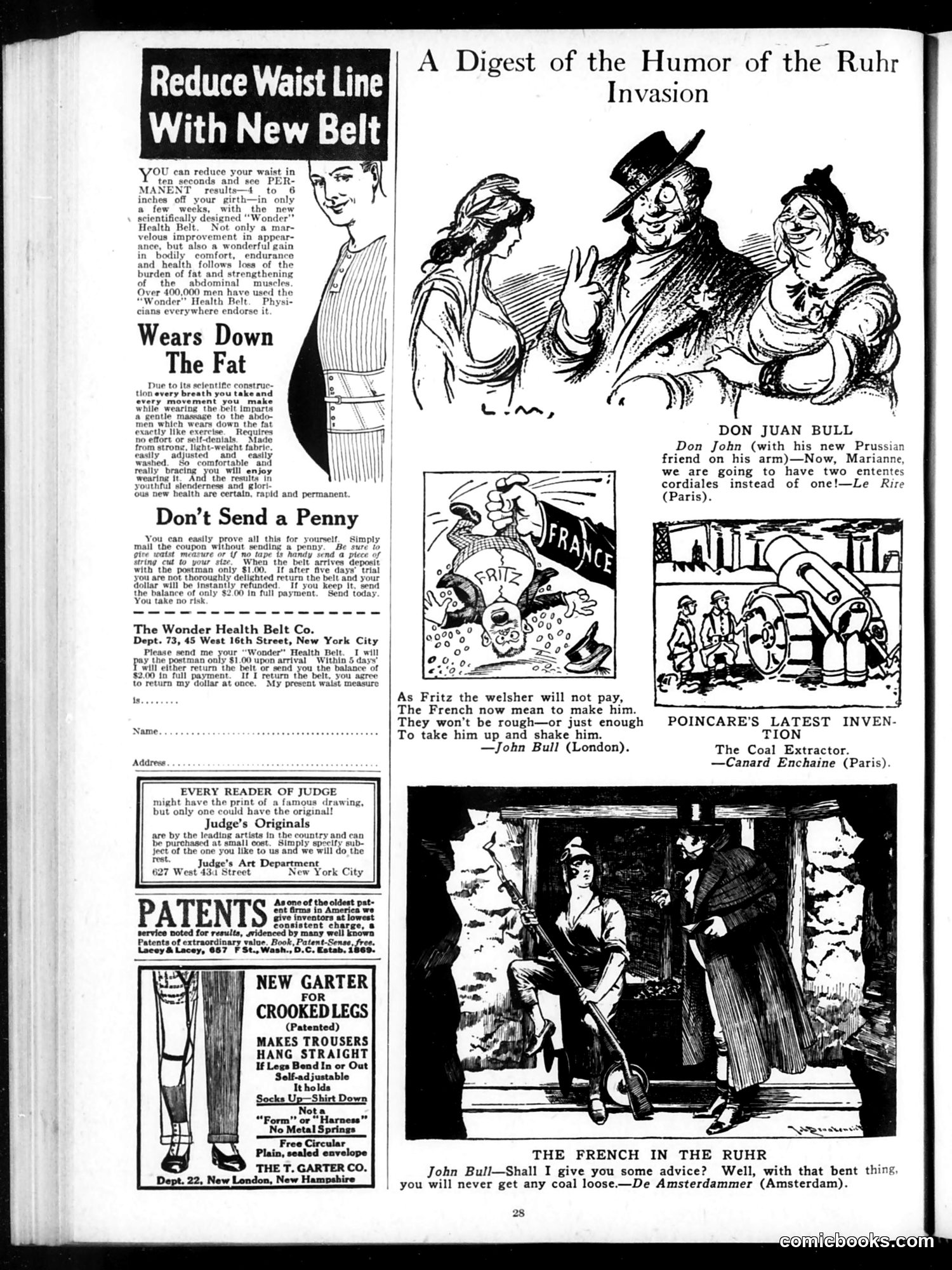
This page contains satirical cartoons about the French occupation of Germany's Ruhr industrial region, a real historical event following World War I when France seized the Ruhr to extract coal and resources as reparations after Germany defaulted on payments. **Key cartoons:** 1. **"Don Juan Bull"**: Britain ("John Bull") sarcastically welcomes France's aggressive occupation, mocking the supposed "friendly understanding" between allies. 2. **"Coal Extractor"**: French Premier Poincaré's extraction methods are ridiculed as ineffective and crude. 3. **"The French in the Ruhr"**: Britain advises France their harsh tactics won't successfully extract coal—suggesting the occupation is counterproductive. The cartoons mock French aggression toward defeated Germany while positioning Britain as the wiser observer. The humor relies on readers' knowledge of contemporary Franco-German tensions and post-war reparations disputes.
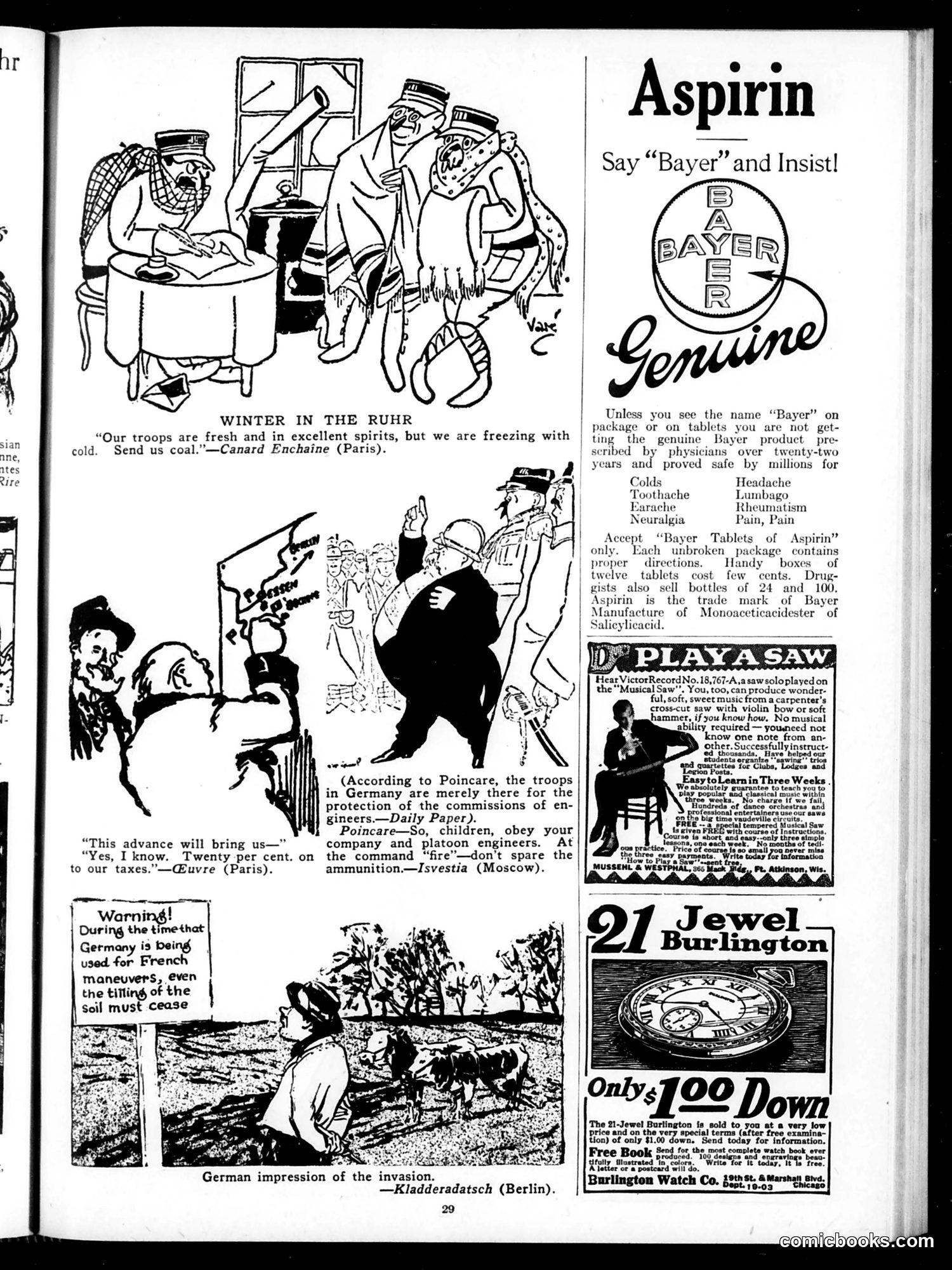
This page contains WWI-era satirical cartoons about the French military occupation of Germany's Ruhr region, plus period advertisements. The political cartoons mock the post-war French occupation by presenting contrasting perspectives: French soldiers complain about freezing and expect tax increases from conquered territory; German sources sarcastically claim the occupation is merely for "engineering protection" while French General Poincaré cynically orders troops to "not spare ammunition." The humor targets French imperial overreach and the hypocrisy of occupation justifications. The cartoons are sourced from international papers (Paris, Berlin, Moscow), suggesting this was a globally-discussed geopolitical moment—likely the 1923 Ruhr occupation following German reparation defaults. The advertisements (Aspirin, Musical Saw instruction, Burlington Watch) are typical period commercial content, unrelated to the political content.
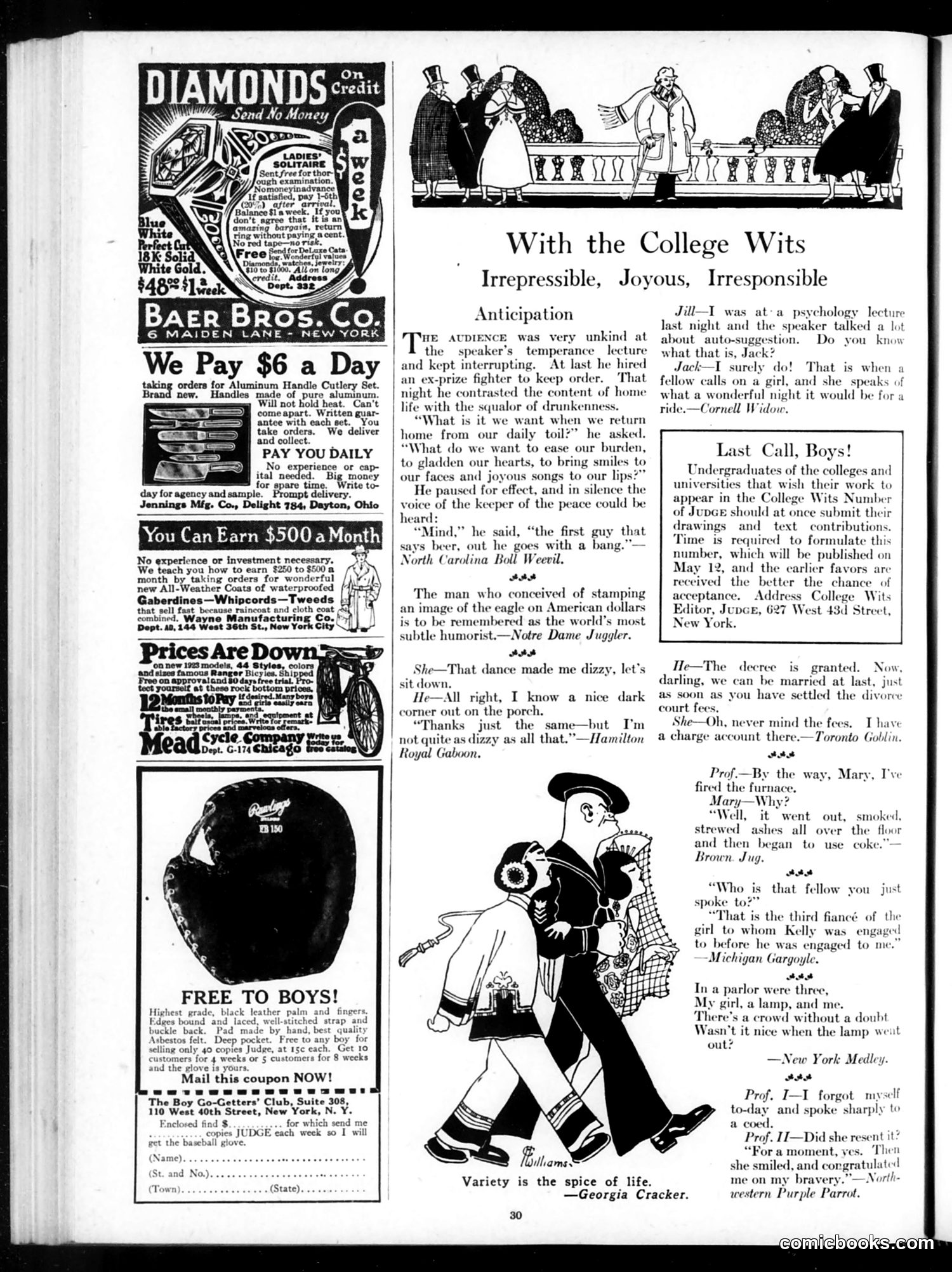
This page is primarily **advertising and humor content** aimed at young readers and college students, circa 1910s-1920s. The main feature is a college humor section with brief jokes submitted by undergraduates. These jokes play on contemporary campus social situations: a psychology lecture misunderstanding, a temperance speaker interrupted by a hired "peace-keeper," and dating/relationship confusion. The humor reflects period anxieties about courtship formality and romantic entanglements. The cartoon (by Williams, visible signature) depicts a sailor and woman dancing—light social satire with no political content. The page is dominated by **classified advertisements** promoting work-from-home schemes ("Earn $500/Month"), a diamond retailer, and notably a free baseball glove offer for boys who sell Judge subscriptions. These ads targeted working-class youth and the economically struggling—reflecting Depression-era or post-war economic conditions where such offers seemed genuinely appealing. The editorial callout "Last Call, Boys!" solicits college contributions for Judge's upcoming college humor issue, positioning the magazine as a platform for undergraduate wit.
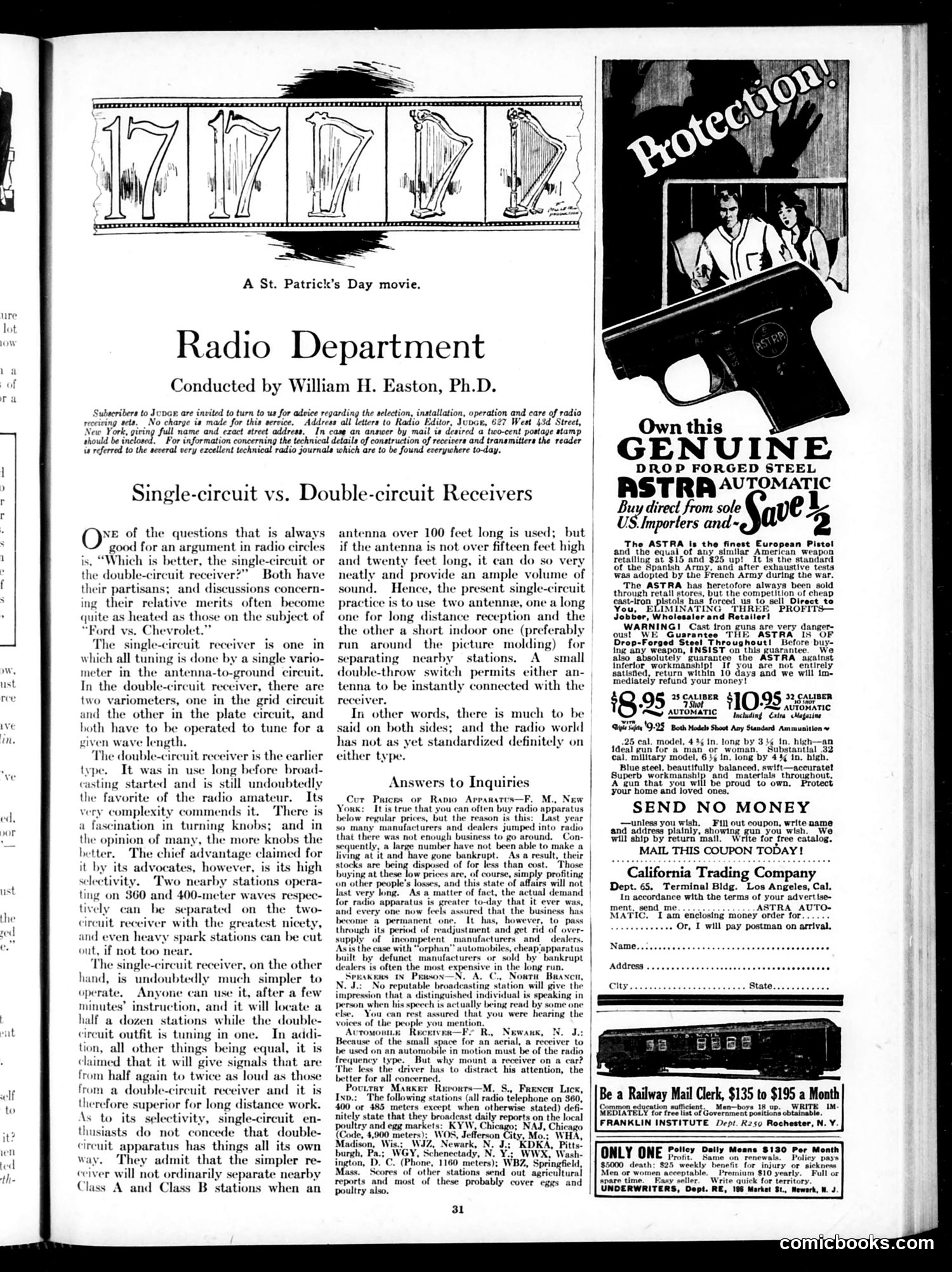
This page is primarily **educational content and advertising**, not political satire. The main feature is a technical radio column by William H. Easton discussing receiver design—comparing "single-circuit vs. double-circuit receivers" for radio enthusiasts. The only visual humor appears at the top: a small film strip labeled "A St. Patrick's Day movie" showing sequential numbered frames (17-17-17, etc.), which is a visual pun suggesting Irish drinking stereotypes. The page is dominated by practical advice for radio hobbyists, Q&A about radio equipment pricing, and period advertisements, including a prominent ad for an "Astra Automatic" handgun emphasizing "Protection!" **Context for modern readers:** This reflects 1920s America's fascination with radio technology as a hobby, before broadcasting became standardized. The page assumes readers are tinkering with homemade receivers—a common leisure activity of the era.
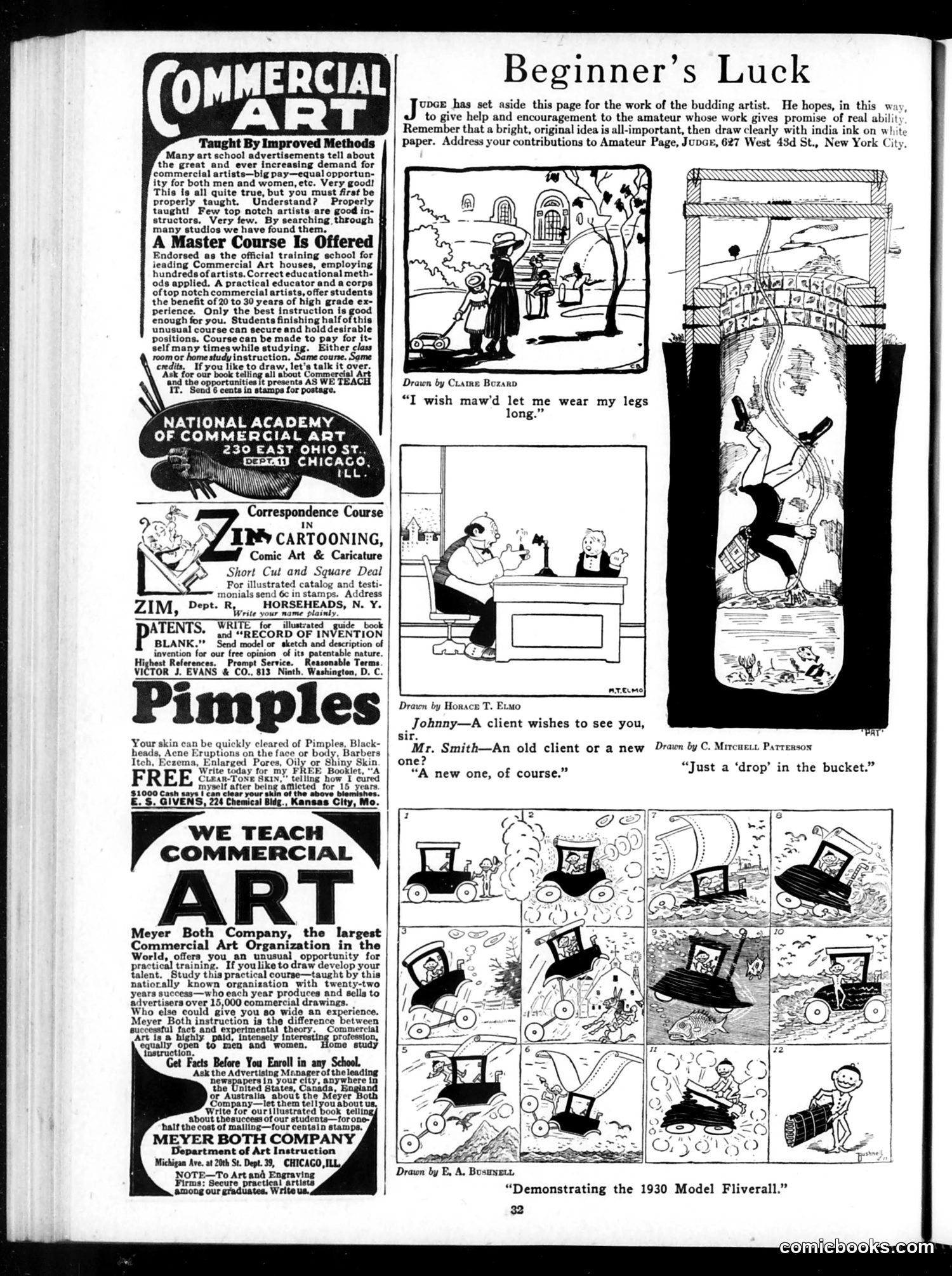
This page showcases amateur cartoons submitted to *Judge*'s "Beginner's Luck" section, designed to encourage young artists. The four cartoon submissions include: 1. **"I wish maw'd let me wear my legs long"** — A child's complaint about being made to wear short pants, a relatable childhood grievance. 2. **A domestic scene** — A businessman tells his assistant that an old client is waiting, but the punchline hinges on which type of client (old vs. new) one prefers professionally. 3. **"Just a 'drop' in the bucket"** — A visual pun showing someone literally dropping water into a bucket, interpreting the idiom literally. 4. **"Demonstrating the 1930 Model Fliver"** — A Ford Model T sequence humorously depicting a broken-down car falling apart during a demonstration, satirizing cheap automobiles. The bulk of the page comprises advertisements for commercial art schools, reflecting 1930s job training opportunities.
This is not a satirical cartoon but rather a **full-page advertisement** disguised as editorial content—a common practice in early-20th-century magazines like *Judge*. The "Allied Merke Institute" promotes the "Thermocap Treatment," a purported baldness cure using heat stimulation. The text claims hair loss results from dormant (not dead) roots that can be reactivated through special heating apparatus. **The satire is implicit**: *Judge* readers would recognize this as a send-up of dubious medical claims and mail-order cure-alls that proliferated in the era. The testimonials ("Marvelous Increase in Growth," "Absolutely Wonderful") and the promise of expensive European treatments now available cheaply at home are classic huckster tactics. The page mocks both the gullibility of bald men desperate for solutions and the snake-oil industry marketing to their insecurity—a satirical commentary on American consumer culture and medical fraud, even if presented as straight advertising.
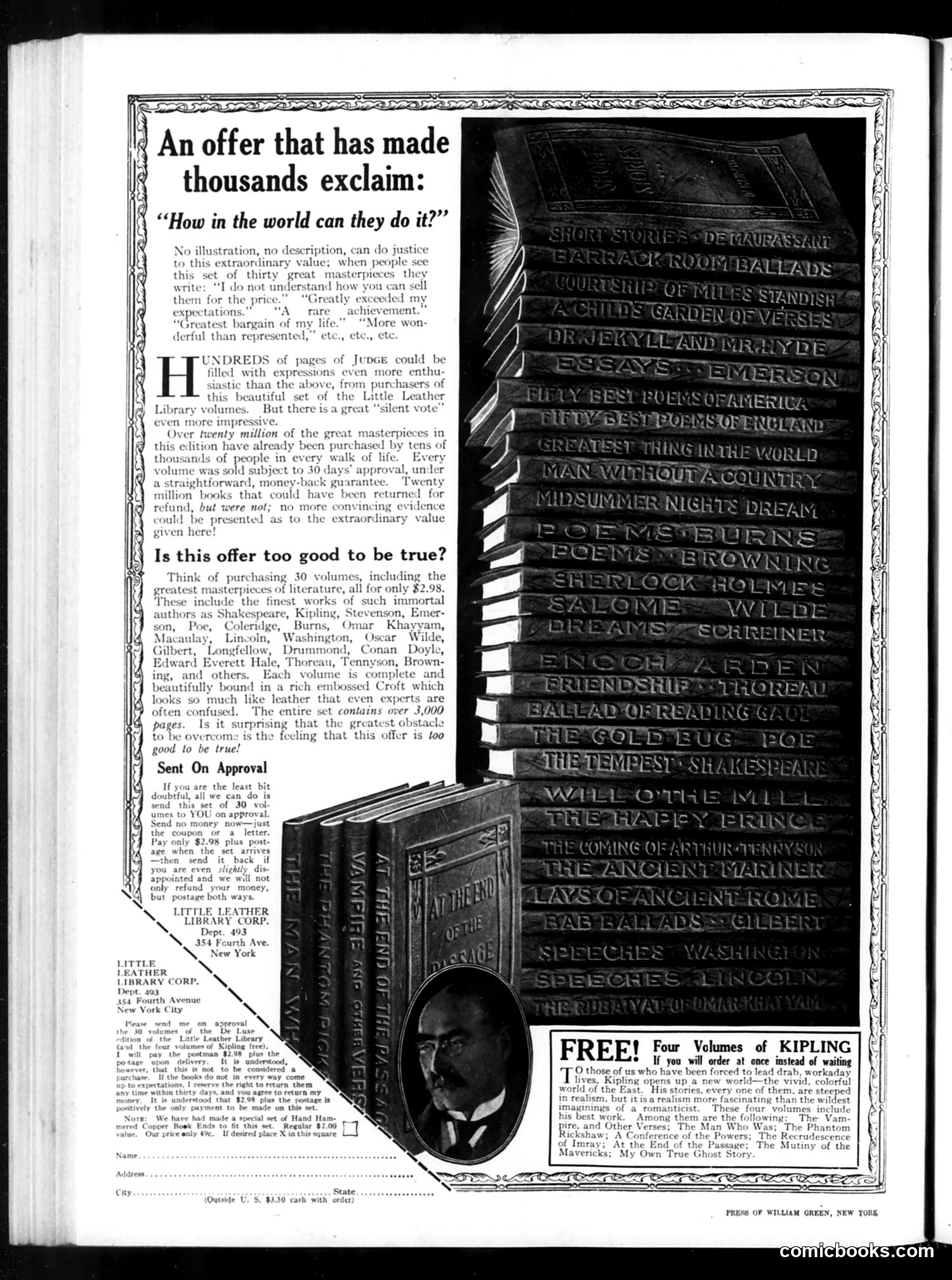
This page is primarily **advertising, not satire or political commentary**. It promotes the Little Leather Library Corp.'s collection of classic literature—30 volumes of works by Shakespeare, Kipling, Poe, Burns, and others—for $2.98. The advertisement uses rhetorical framing ("How in the world can they do it?") and testimonials to emphasize the offer's extraordinary value. The phrase "Is this offer too good to be true?" addresses customer skepticism directly, then counters it by citing 20 million books sold under a money-back guarantee. The sidebar offers four free Kipling volumes as an incentive to order immediately. The elaborate decorative border and dramatic book imagery are period advertising design conventions meant to convey quality and prestige. There is **no political or social satire here**—this is straightforward direct-mail marketing designed to appear in Judge magazine, likely because Judge's educated readership would appreciate affordable access to literary classics.