
Judge, 1923-03-17 · page 11 of 36
Judge — March 17, 1923 — page 11: what you’re looking at
What you’re looking at
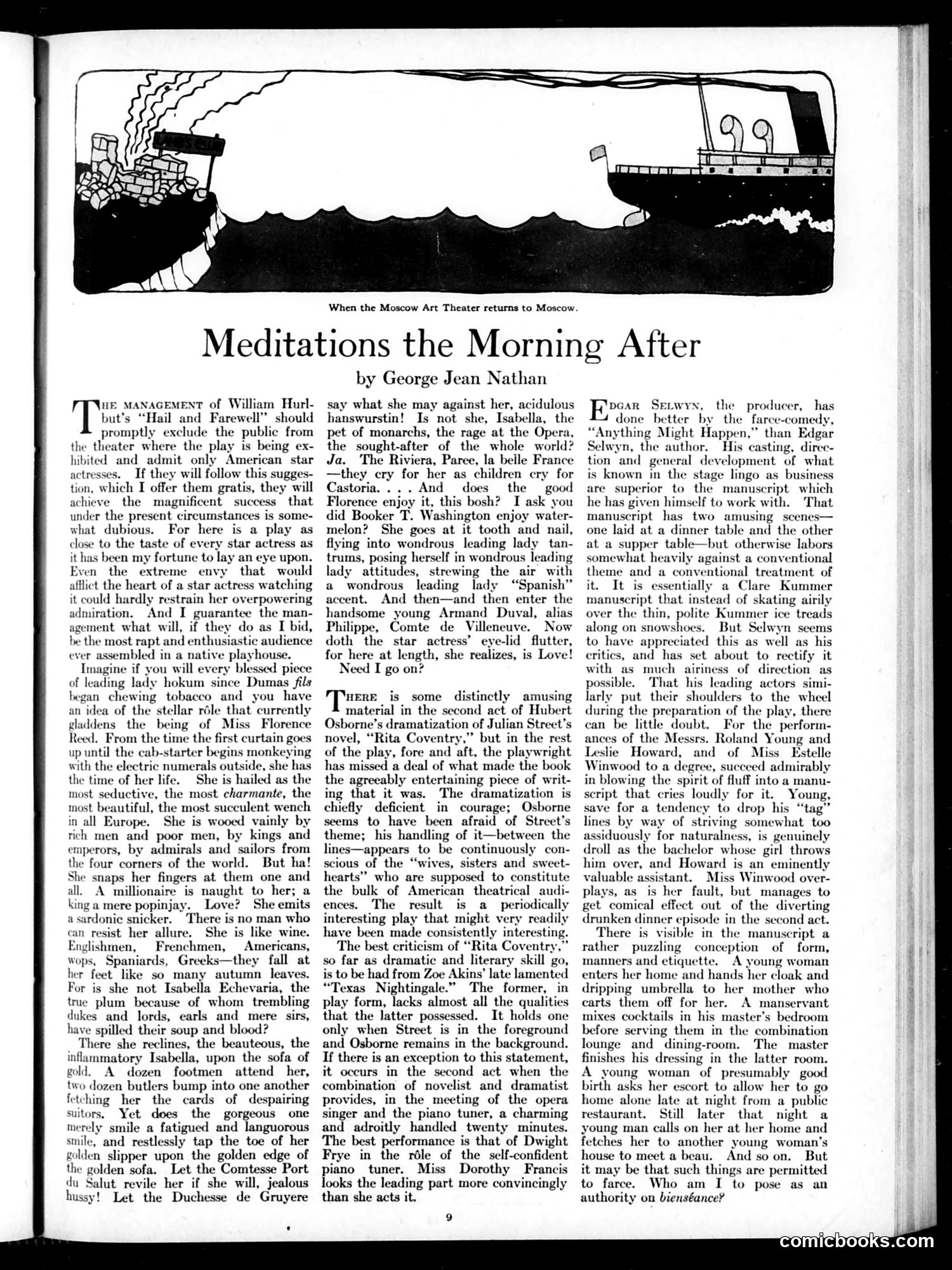
This page is primarily **literary criticism** rather than political satire. George Jean Nathan reviews stage productions, not political figures or events. The illustrated header shows **two ships passing at sea**, captioned "When the Moscow Art Theater returns to Moscow"—likely a wry visual joke about theatrical comings and goings. Nathan's main review mocks **Florence Reed's performance** in William Hurlbut's play "Hail and Farewell." He satirizes the tired conventions of melodramatic leading-lady roles: the beautiful woman showered with attention from powerful men (kings, dukes, admirals), who affects languorous indifference until a suitable romantic hero arrives. Nathan uses exaggerated language ("charmante," "inflammatory Isabella") to ridicule both the overwrought character and Reed's hammy performance. The second review critiques Hubert Osborne's stage adaptation of Julian Street's novel "Rita Coventry," faulting its dramatic timidity. **The satire targets theatrical clichés and performers' reliance on hokum**, not politics or current events.
📄 Transcribed text from this page (OCR, searchable)
Machine-transcribed from the original scan — historical spelling and the odd misread are preserved.
HE MANAGEMENT of William Hurl- Ties ‘Hail and Farewell” should promptly exclude the public from the theater where the play is being ex- hibited and admit only American star actresses. If they will follow this sugges- tion, which I offer them gratis i achieve the magnificent succ that under the present circumstances is some- what dubious. For here is a play as close to the taste of every star actress as it has been my fortune to lay an eye upon. Even the extreme envy that would afflict the heart of a star actress watching it could hardly restrain her overpowering admiration. And I guarantee the man- agement what will, if they do as I bid, jastic audience house. ine if you will every blessed piece of leading lady hokum since Dumas fils began chewing tobacco and you have an idea of the st t currently gladdens the b Florence Reed. From the time the first curtain goes up until the cab-starter begins monkeying with the electric numerals outside, she has the time of her life. She is hailed as the most seductive, the most charmante, the most beautiful, the most succulent wench in all Europe. She is wooed vainly by rich men and poor men, by kings and emperors, by admirals and sailors from the four corners of the world. But ha! She snaps her fingers at them one and all. A millionaire is naught to her; a king a mere popinjay. Lo She emits asardonic snicker. There is no man who can resist her allure. She is like wine. Englishmen Frenchmen, _ Americans, wops, Sp: ‘ds, Greel they fall at her feet like so many autumn leaves. For is she not Isabella Echevaria, the true plum because of whom trembling dukes and lords, earls and mere sirs, have spilled their soup and blood? There she reclines, the beauteous, the inflammatory Isabella, upon the sofa of gold. A dozen footmen attend her, two dozen butlers bump into one another fetching her the cards of despairing suitors. Yet does the gorgeous one merely smile a fatigued and languorous smile, and restlessly tap the toe of her golden slipper upon the golden edge of the golden sofa. Let the Comtesse Port du Salut revile her if she will, jealous hussy! Let the Duchesse de Gruyere be the most rapt and enth ssembled in a native p! When the Moscow Art Theater returns to Moscow. Meditations the Morning After by George Jean Nathan say what she may against her, acidulous hanswurstin! Is not she, Isabella, the pet of monarchs, the rage at the Opera, the sought-after of the whole world? Ja. The Riviera, Paree, la beile France —they cry for her as children cry for Castori ..And_ does the — good Florence enjoy it, this bosh? I ask you did Booker T. Washington enjoy water- melon? She goes at it tooth and nail, flying into wondrous leading lady tan- trums, posing herself in wondrous leading lady attitudes, strewing the air w a wondrous leading lady “Span accent. And then—and then enter the handsome young Armand Duval, alias Philippe, Comte de Villeneuve. Now doth the star actre eye-lid flutter, for here at length, she realizes, is Love! Need I go on? HERE is some material in the distinctly amusing cond act of Hubert Osborne’s dramatization of Julian Street’s novel, “Rita Coventry,” but in the rest of the play, fore and aft, the playwright has missed a deal of what made the book the agreeably entertaining piece of writ- that it was. The dramatization is chiefly in courage; Osborne seems to have been afraid of Street's theme; his handling of it—between the lines—appears to be continuously con- scious of the “wives, sisters and sweet- hearts” who are supposed to constitute the bulk of American theatrical audi- ences. The result is a_ periodically interesting play that might very readily have been made consistently interesting. The best criticism of “Rita Coventry,” so far as dramatic and literary skill go, is to be had from Zoe Akins’ late lamented “Texas Nightingale.” The former, in play form, lacks almost all the qualities that the latter possessed. It holds one only when Street in the foreground and Osborne remains in the background. If there is an exception to this statement, it occurs in the second act when the combination of novelist and dramatist provides, in the meeting of the opera singer and the piano tuner, a charming and adroitly handled twenty minutes. The best performance is that of Dwight Frye in the role of the self-confident piano tuner. Miss Dorothy Francis looks the leading part more convincingly than she acts it. 9 Fue Setwyn, the producer, has done better by the farce-comedy, “Anything Might Happen,” than Edgar Selwyn, the author. His casting, dircc- tion and general development of what is known in the stage lingo as business are superior to the manuscript. which given himself to work with. That ipt has two amusing scenes— id at a dinner table and the other at a supper table—but otherwise labors somewhat heavily against a conventional theme and a con itional treatment of it. It is essentially a Clare Kummer manuscript that instead of skating airily over the thin, polite Kummer ice treads along on snowshoes. But Se 1 seems ave appreciated this as we and has set about to rectify as much airiness of direction possible. That his leading actors simi- larly put their shoulders to the wheel during the preparation of the play, there can be little doubt. For the perform- ances of the Messrs. Roland Young and Leslie Howard, and of Miss Winwood to a degree, succeed admirably in blowing the spiri script that cries loudly for it. oung, save for a tendency to drop his “tag” lines by way of striving somewhat too assiduously for naturalness, is genuinely droll as the bachelor whose girl throws , and Howard is an eminently ant. Miss Winwood over- is her fault, but manages to get comical effect out of the diverting drunken dinner episode in the second act. There is visible in the manuscript a rather puzzling conception of form, manners and etiquette. A young woman enters her home and hands her cloak and dripping umbrella to her mother who carts them off for her. A manservant tails in his master’s bedroom rving them in the combination lounge and dining-room. The master finishes his dressing in the latter room. A young woman of presumably good birth asks her escort to allow her to go home alone late at night from a public restaurant. Still later that night a young man calls on her at her home and fetches her to another young woman’s house to meet a beau. And so on. But it may be that such things are permitted to farce. Who am I to pose as an authority on bienséance?