
Judge, 1923-03-17 · page 12 of 36
Judge — March 17, 1923 — page 12: what you’re looking at
What you’re looking at
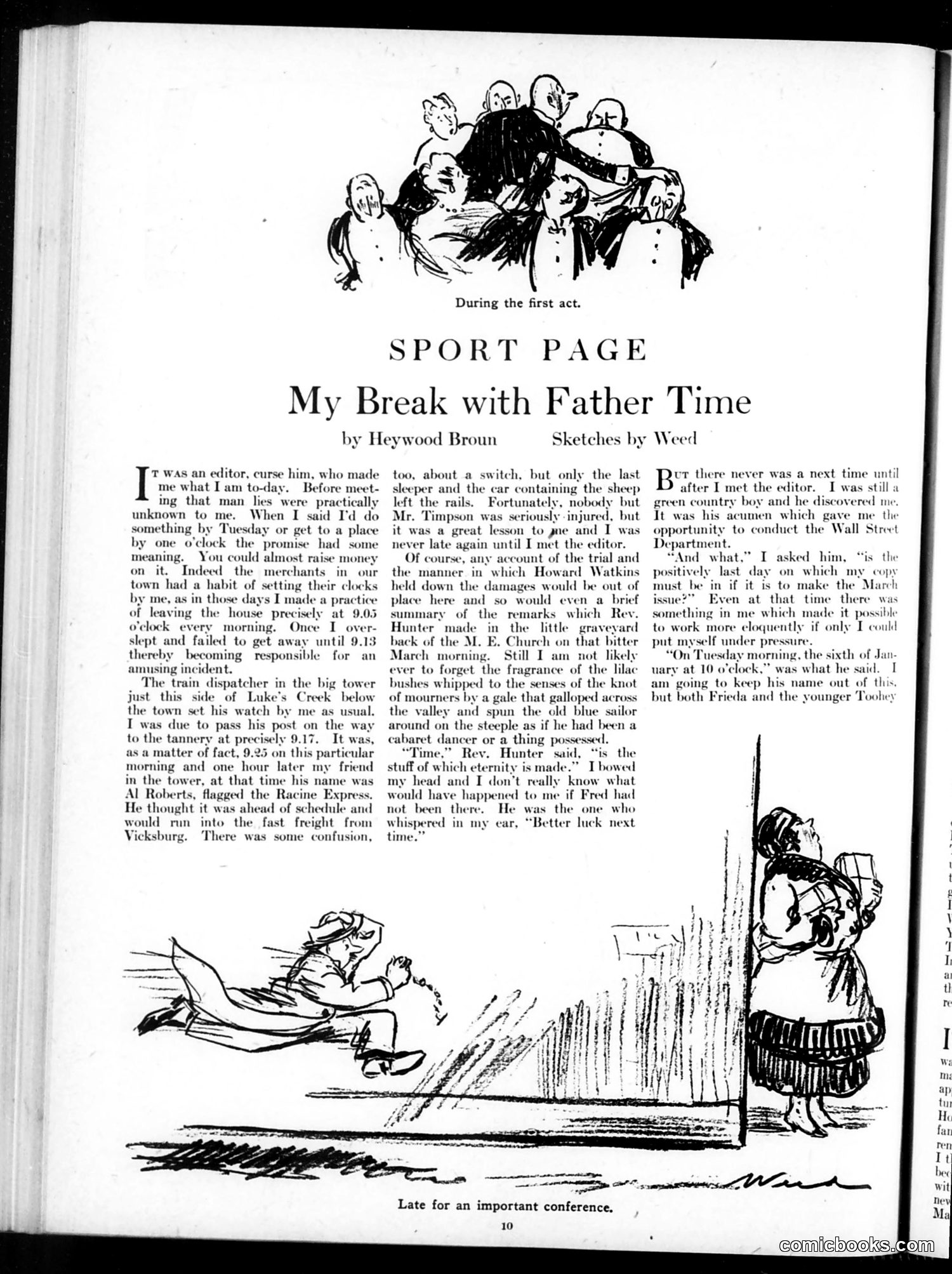
This is a humorous sports column by Heywood Broun about chronic lateness. The narrator describes how an editor shaped his character by demanding punctuality—specifically, requiring copy by "Tuesday morning, the sixth of January at 10 o'clock." The accompanying sketches illustrate the joke: one shows a man frantically running, the other depicts someone arriving late to "an important conference." The satire targets the narrator's inability to meet deadlines despite understanding their importance. Broun uses self-deprecating humor to explore how authority figures (the editor as "father time") attempt to instill discipline, yet the protagonist remains perpetually tardy. The "My Break with Father Time" title puns on relationship breakups, suggesting the narrator has abandoned punctuality. For modern readers, this reflects early 20th-century workplace culture where newspaper deadlines were absolute and editor-writer relationships were contentious, often personally antagonistic rather than merely professional.
📄 Transcribed text from this page (OCR, searchable)
Machine-transcribed from the original scan — historical spelling and the odd misread are preserved.
During the first act. SPORT PAGE My Break with Father Time by Heywood Broun Sketches by too, about a switch, but only the ar containing the sheep rtunately, nobody but T Was an editor, curse him, who made me what I am to-day. ing that man lies were practically When I said I'd do something by Tuesday or get to a place » o'clock the promi: You could almost raise money sleeper and. the ©: left the rails. unknown to me. the manner in which Howard Watkins held down the damages would be out of place here and so would even a brief abit of setting their clocks se day's I made a practice of leaving the house precisely at. { o'clock every morning. slept and failed to get away until 9. becoming responsible little graveyard M. E. Church on that bitter } Still I am not likely ever to forget the fragrance of the lilac bushes whipped to the senses of the knot of mourners by a gale that galloped across the valley and spun the old blue sailor around on the steeple as if he had been a sr or a thing poss rch morning. The train dispatcher in the big tower of Luke's Creek the town set his watch by me as usual. I was due to pass his post on the way to the tannery at preci as a matter of fact, 9.2. ala morning and one hour later my friend er, at that time his n: Al Roberts, flagged the R. He thought it was al stuff of which eternity is mad my head and I don’t really know what would have happened to me if Fred had He was the one who whispered in my ear, “Better luck next not been the! st freight from There was some confusion, Weed B" there never was a next time until after I met the editor. I was still a green country boy and he discovered me It was his acumen which gave me the opportunity to conduct the Wall Street rtment. And what,” I asked him, “is the positively last ¢ on which my copy must be in if it is to make the March issue?” E that time there was something in me which made it possible to work more eloquently if only I could put myself under pressure. “On Tuesday morning, the sixth of J uary at 10 o'clock,” was what he said am going to keep his name out but both Frieda and the younger Toohey Late for an important conference, comichookscom