
Judge, 1923-03-17 · page 5 of 36
Judge — March 17, 1923 — page 5: what you’re looking at
What you’re looking at
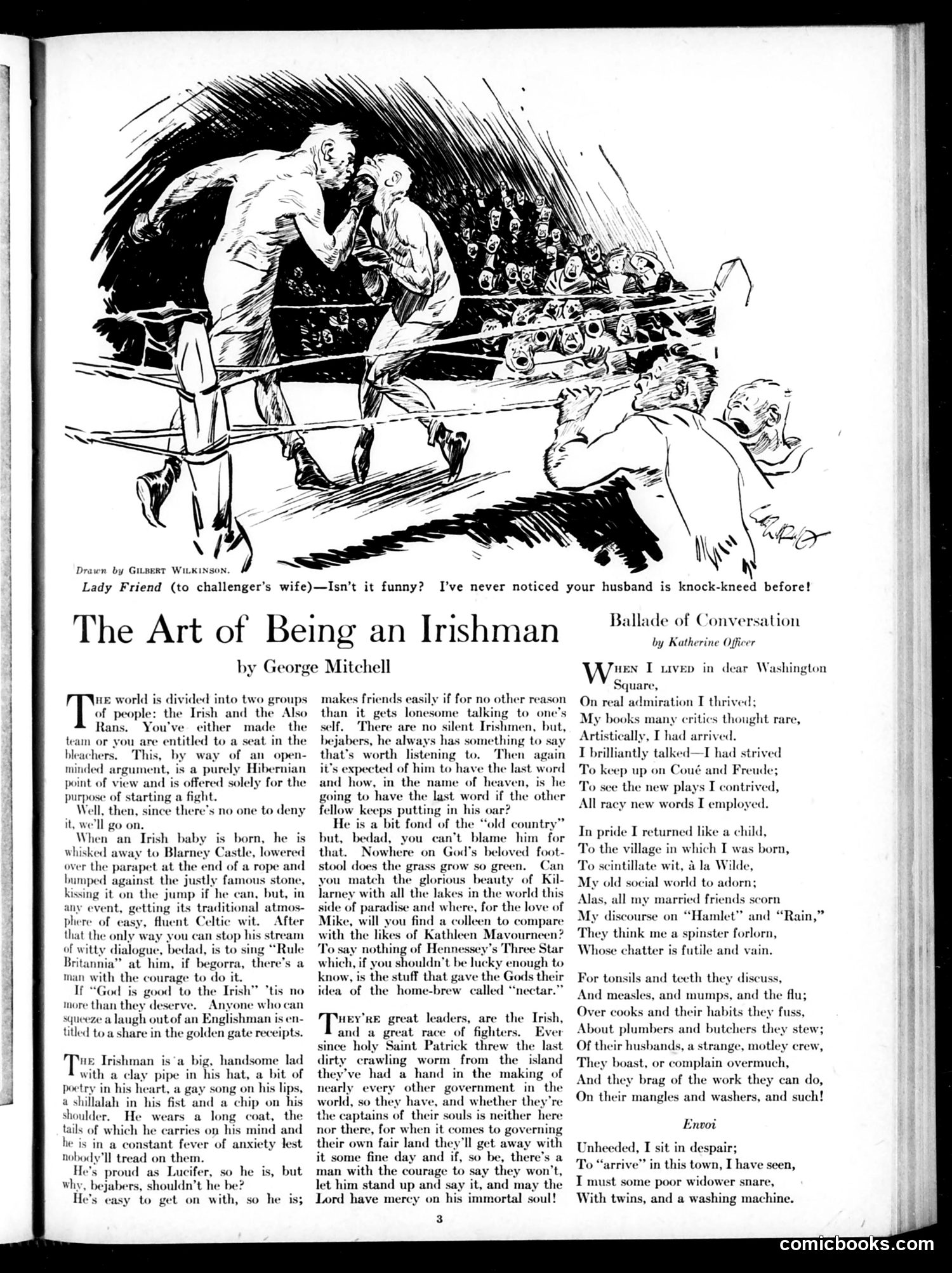
**The Cartoon:** This boxing match illustration by Gilbert Wilkinson satirizes Irish stereotypes. The caption quotes a society woman noting the challenger's wife is surprised her husband is "knock-kneed"—a physical defect. The cartoon depicts Irish boxers in a ring, with spectators crowded behind, playing on period caricatures of Irish immigrants as fighters and laborers. **The Articles:** "The Art of Being an Irishman" by George Mitchell humorously catalogs Irish stereotypes: their talkativeness, drinking habits ("Rule Britannia"), fighting prowess, and supposed inability to govern. The piece uses mock-admiring language while reinforcing derisive period attitudes toward Irish Americans. "Ballade of Conversation" satirizes women's social chatter about domestic trivialities. The content reflects late 19th/early 20th-century Anglo-Protestant prejudice against Irish immigrants.
📄 Transcribed text from this page (OCR, searchable)
Machine-transcribed from the original scan — historical spelling and the odd misread are preserved.
\f Drawn by GILBERT WILKINSON. Lady Friend (to challenger’s wife)—Isn’t it funny? The Art of Being an Irishman by George Mitchell ne world is divided into two groups T: people: the Irish and the Also Rans. You've either ma the team or you are entitled to a seat in the bleachers. This, by way of an open- minded argument, is a purely Hibernian point of view and is offered solely for the purpose of starting a fight. Well, then, since there's no one to deny it, we'll go on. When an Irish baby is born, he is whisked away to Blarney Castle, lowered over the parapet at the end of a rope and bumpec nst the justly famous stone kissing it on the jump if he ean, but, in any event, getting its traditional atmos- phere of fluent Celtic wit. After ou can stop his stream d, is to sing “Rule begorra, there's a i age to do it. “God is good to the Irish” "tis no more than they deserve. Anyone who can squeeze a laugh outof an Englishman is en- titled toa share in the golden gate receipts. Tr Irishman is’a big, handsome lad with a clay pipe in his hat, a bit of poetry in his heart, song on his lips, a shillalah in his fist and a chip on his shoulder. He wears a long coat, the tails of which he carries op his mind and ie is in a constant fever of anxiety lest nobody'll tread on them. He's proud as Lucifer, so he is, but why, bejabers, shouldn’t he be? He’s easy to get on with, so he is; makes fric sily if for no other reason than it gets lonesome talking to one’s self. There are no silent Irishmen, but, j s has something to say that’s worth listening to. Then ag it’s expected of him to have the | and how, in the name of heaven going to have the last word if the other fellow keeps putting in his oar? : bit fond of the “old country” but, 1, you can’t blame him for that. Nowhere on God's beloved foot- stool does the g y so green, Can you match the glorious beauty of Kil- larney with all the lakes in the world this side of paradise and where, for the love of Mike, will you find a colleen to compare with the likes of Kathleen Mavourneen? ‘To say nothing of Hennes Three Star which, if you shouldn't be lucky enough to know, is the stuff that gave ods their idea of the home-brew called “nectar.” HEY'RE great leaders, are the Irish, race of fighters. Ever t Patrick threw the last wling worm from the island had a hand in the making of world, so they have, and whether they're the captains of their souls is neither here nor there, for when it comes to governi their own fair land they'll get away it some fine day and if, so be, the man with the courage to say they let him stand up and it, and may the Lord have mercy on his immortal soul! 3 I’ve never noticed your husband is knock-kneed before! Ballade of Conversation by Katherine Officer wes T uivep in dear Washington Square, On real admiration T thri My books many critics thought rare, Artistically, I had arrived. I brilliantly talked—I had strived To keep up on Coué and Freude; To see the new plays I contrived, All racy new words I employed. In pride I returned like a child, To the village in which T was born, To scintillate wit, & la Wilde, My old social world to adorn; Alas, all my married friends scorn My discourse on “Hamlet” and “Rain,” They think me a spinster forlorn, Whose chatter is futile and vain. nd the flu; Over cooks and their habits they fuss, and mumps, About plumbers and butchers the Of their husbands, a strange, motle They boast, or complain overmuc And they brag of the work the On their mangles and washers, and such! Envoi Unheeded, I To “arriv seen, I must some poor widower snare, With twins, and a washing machine. it in despair; in this town, I hav comicbooks.com