
Judge, 1923-03-17 · page 17 of 36
Judge — March 17, 1923 — page 17: what you’re looking at
What you’re looking at
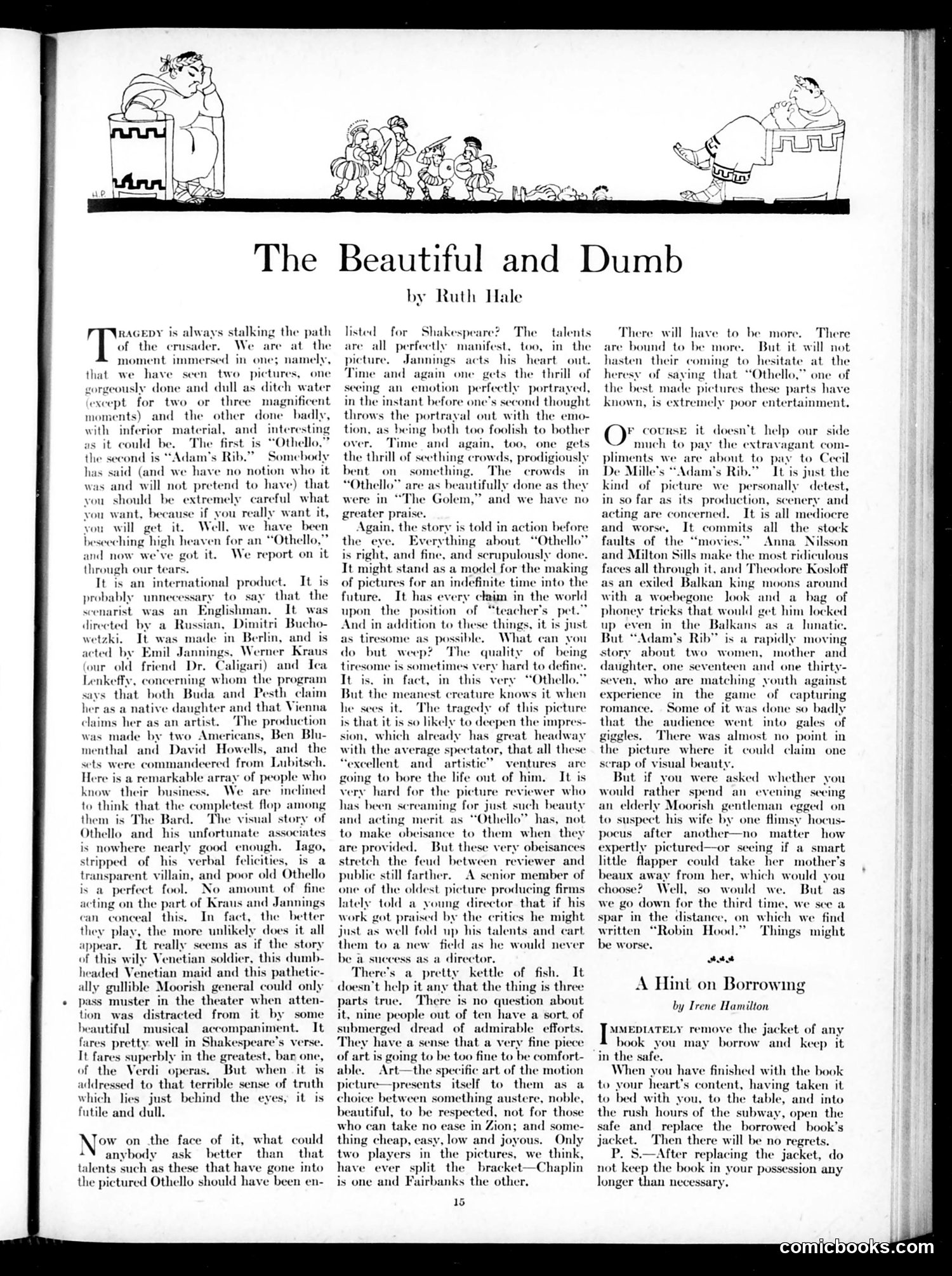
This is a film review, not a political cartoon. Hale critiques a 1922 international production of *Othello* directed by Russian Dimitri Buchowetzki, starring Emil Jannings and Werner Kraus. **The Satire's Point:** Hale's title captures her paradox: despite assembling world-class talent (international directors, acclaimed actors, meticulous craftsmanship, and stunning visual storytelling), the film is utterly *boring*. She argues that Shakespeare's plot—dependent on theater's spectacle and Verdi's operatic music—collapses when stripped bare onscreen. The "dumb" refers not to the filmmakers but to the story itself: Iago is transparently villainous, Othello impossibly credulous, and Desdemona pathetically gullible. **The Joke:** Excellence in execution cannot salvage fundamentally tedious material. Hale worries this "teacher's pet" film will bore audiences away from art cinema itself—a prescient concern about how prestige adaptations can backfire.
📄 Transcribed text from this page (OCR, searchable)
Machine-transcribed from the original scan — historical spelling and the odd misread are preserved.
The Beautiful and Dumb RAGEDY is always stalking the path of the crusader. We are at the moment immersed in one; namely, that we have two pictures, one gorgeously done and dull as ditch water except. for two or three magnificent moments) and the other done badly, with inferior materi and_ interesting as it could be, The first is “Othello,” the second is “Adam's Rib.” Somebody has said (and we have no notion who it was and will not pretend to have) that you should be extremely careful) what you want, because if you really want it, you will get it. Well, we have been beseeching high heaven for an “Othello,” and now we've got it. We report on it through our tears. It is an international product. ry to say that the ist was an Englishman. It was sted by a Russian, Dimitri Bucho- wetzki. It was made in Berlin, and is acted by Emil Jannings, Werner Kraus our old friend Dr. Caligari) and Tea Lenkeffy, concerning whom the progi says that both Buda and Pesth clai her as a native daughter and that Vienna claims her as an artist. The production was made by two Americans, Ben Blu- menthal and David Howells, and the sets were commandeered from Lubitsch, Here is a remarkable array of people who know their business. We are inclined to think that the completest flop among them is The . The visual story of Othello and his unfortunate is nowhere nearly good ecnoug! stripped of his verbal fel is a transparent villain, and poor old Othello is a perfect No amount. of fine acting on the part of Kraus and Jannings al this. In fact, the better y, the more unlikely does it all appear. It really seems as if the story of this wily Venetian soldier, this dum headed Venetian maid and this pathe ally gullible Moorish general could only pass muster in the theater when atten- tion was distracted from it by some beautiful mu: ecompaniment. It fares pretty well in § e's Verse. It fi superbly in the greatest, bar one, of the Verdi operas. when it is addressed of truth which lies just behind the eyes, it is futile and dull. seen It is assoc Sut Tow on the face of it, what could +N anybody ask better than that talents such as these that have gone into the pictured Othello should have been en- Ruth Hale listed for Shakespe The talents are all perfectly manifest, too, in. the picture. Jannings acts his heart out. Time and again one gets the thrill of seeing an emotion perfectly portrayed, in the instant before one’s second thought throws the portrayal out with the emo- tion, as being both too foolish to bother over. Time and again, too, one gets the thrill of seething crowds, prodigiously bent on something. The crowds in “Othello” are as beautifully done as they were in “The Golem,” and we have no greater praise. Again, the story is told in action before the eye. Everything about “Othello” is right, and fine, and scrupulously done. It might stand as a model for the making of pictures for an indefinite time into the future. It has every claim in the world upon. the position of “teacher's pet. And in addition to these things, it is just as tiresome as possible. What can you do but weep? The quality. of being tiresome is sometimes very hard to define. Tt is, in fact, in this very “Othello.” But the meanest creature knows it when he sees it. The tragedy of this picture is that it is so likely to deepen the impres- sion, which already has great headway with the average spec r, that all these “excellent and artist ventures are going to bore the life out of him. It is very hard for the picture reviewer who has been screaming for just such beauty 1 acting merit as “Othello” has, not to make obeisance to them when they are provided. But these very obeisances stretch the feud between reviewer and public still farther. A senior member of one of the oldest picture producing firms lately told a young director that if his work got praised by the critics he might just as wel 1 up his talents and new field would never as a director. There's a pretty kettle of fish. It doesn’t help it any that the thing is three parts true. There is no question about it, nine people out of ten ha sort. of submerged dread of admirable efforts. They have a sense that a very fine piece of art is going to be too fine to be comfort- able. Art—the specific art of the motion picture—presents itself to them as a choice between something austere, noble, beautiful, to be re: spected, not for those who can ; and some- thing « vous. Only two players in’ the pictures, we think, have ever split the bracket—Chaplin is one and Fairbanks the other. as he eap, easy, low and jc 15 to be more. There But it will not There will have are bound to be more. hasten their coming to hesitate at the heresy of that “Othello,” one of the best made pictures these parts have known, is extremely poor entertainment. Or course it doesn’t help our side much to pay the extravagant com- pliments we are about to pay to Cecil De Mille’s “Adam's Rib.” It is just the kind of picture we personally detest, in so far as its production, scenery and ting are concerned. It i mediocre id worse. It commits all the stock faults of the “movies.” Anna Nilsson and Milton Sills make the most ridiculous all through it, and Theodore Kosloft led Balkan king moons around woebegone look and a bag of tricks that would get him locked up even in the Balkans as a hinatie. But “Adam's Rib” is a rapidly moving bout two women, mother and datghiter one seventeen and one thir seven, who are matching youth against experience in the game of capturing romance. Some of it was done so badly the audience went into gales of es. There was almost no point in picture where it could claim one gi the scrap of visual beauty. But if you were asked whether you would rather spend an evening seeing an elderly Moorish gentleman egged on to suspect his wife by one flimsy hocus- pocus after another—no matter how expertly pictured—or seeing if a smart little flapper could take her mother’s beaux from her, which would you choose? Well, so would we. But as we go down for the third ti we see a spar in the distance, on which we find written “Robin Hood.” Things might be worse. erry A Hint on Borrowmg by Irene Hamilton EDIATELY remove the jacket of any book you may borrow and keep it in the safe. When you have finished with the book to your heart’s content, having taken it to bed with you, to the table, and into the rush hours of the subway, open the fe and replace the borrowed book’s Then there will be no regrets. After replacing the jacket, do not kee p the book in your possession any longer than necessary,