
A complete issue · 36 pages · 1923
Judge — March 10, 1923
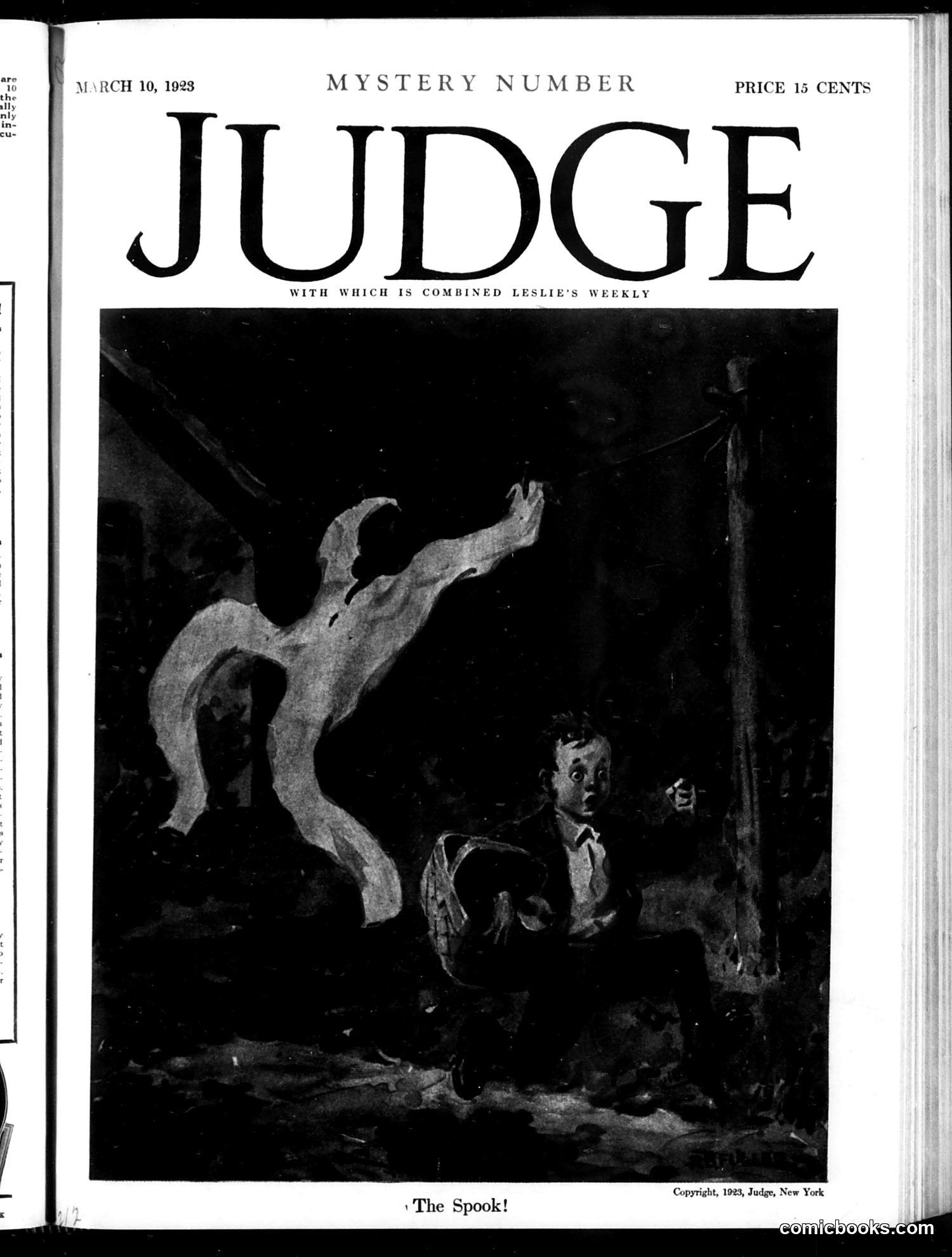
This is the cover illustration for a "Mystery Number" issue of Judge magazine. The image depicts a ghostly, translucent white figure looming menacingly over a frightened boy in what appears to be a dark, confined space—likely a basement or cellar. The cartoon plays on the classic American tradition of ghost stories and supernatural pranks, particularly the practice of scaring children with ghost costumes. The "spook" refers to both the literal ghost figure and the playful mischief of someone in costume attempting to frighten others. This appears to be promotional artwork for the issue's mystery-themed content rather than political satire. The dramatic lighting and composition emphasize the horror/thriller aesthetic popular in 1920s entertainment.
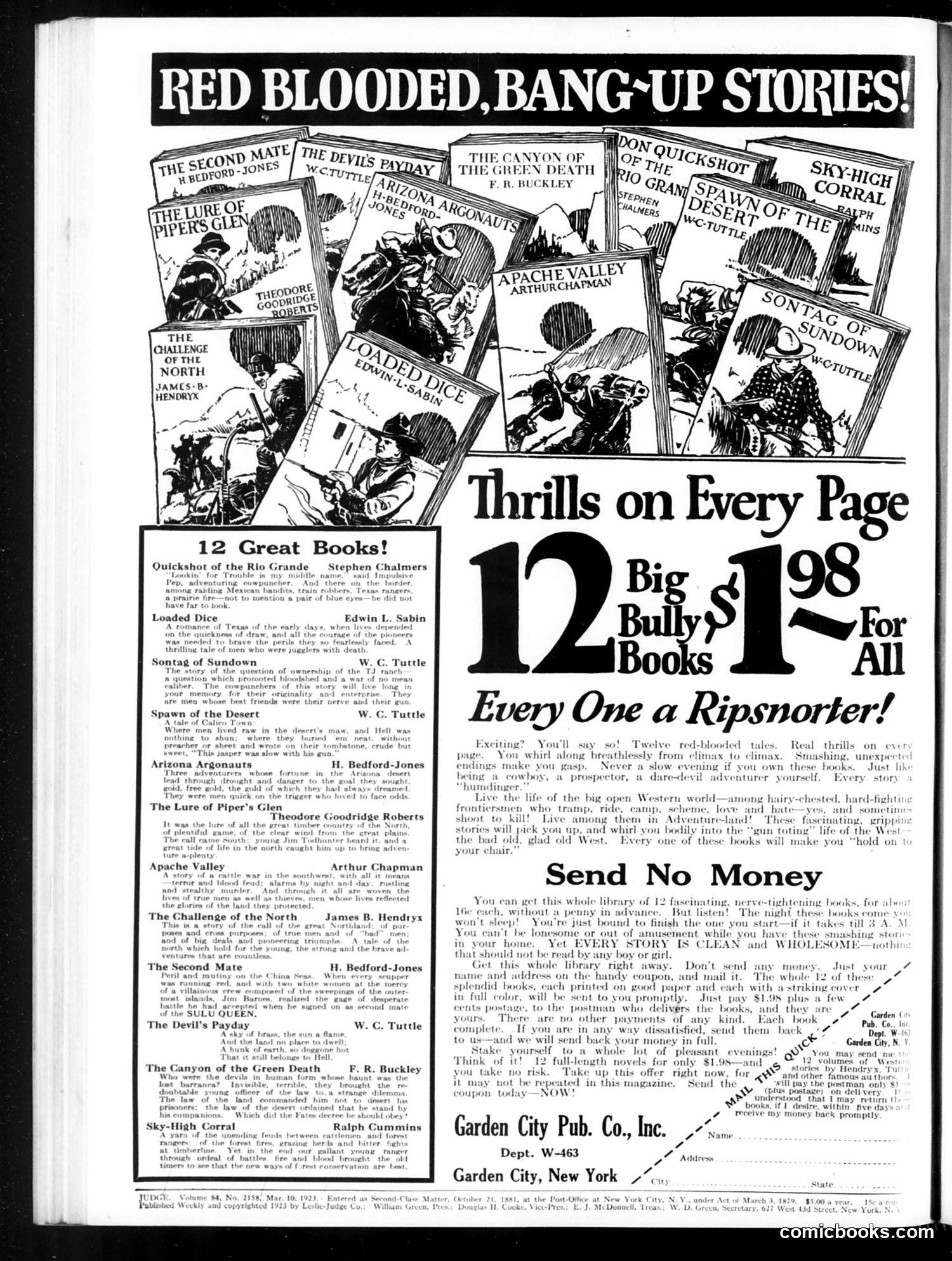
This page is **primarily an advertisement**, not political satire. It promotes a mail-order book collection from Garden City Publishing Company. The ad offers "12 Big Bully Books" for $1.98, marketing Western and adventure novels by authors like W.C. Tuttle, Edwin L. Sabin, and H. Bedford-Jones. The phrase "Red Blooded, Bang-Up Stories" and "Thrills on Every Page" reflects early 20th-century masculine marketing—appealing to readers seeking action-packed adventure tales. The centered text emphasizes "Send No Money," a common mail-order sales tactic promising risk-free home delivery. This appears in *Judge* magazine (dated March 19, 1921), which mixed satirical content with commercial advertising. The "12 Great Books" list with plot summaries uses period language ("ripsporter") to entice buyers, but contains no political commentary or satire—it's straightforward product marketing.
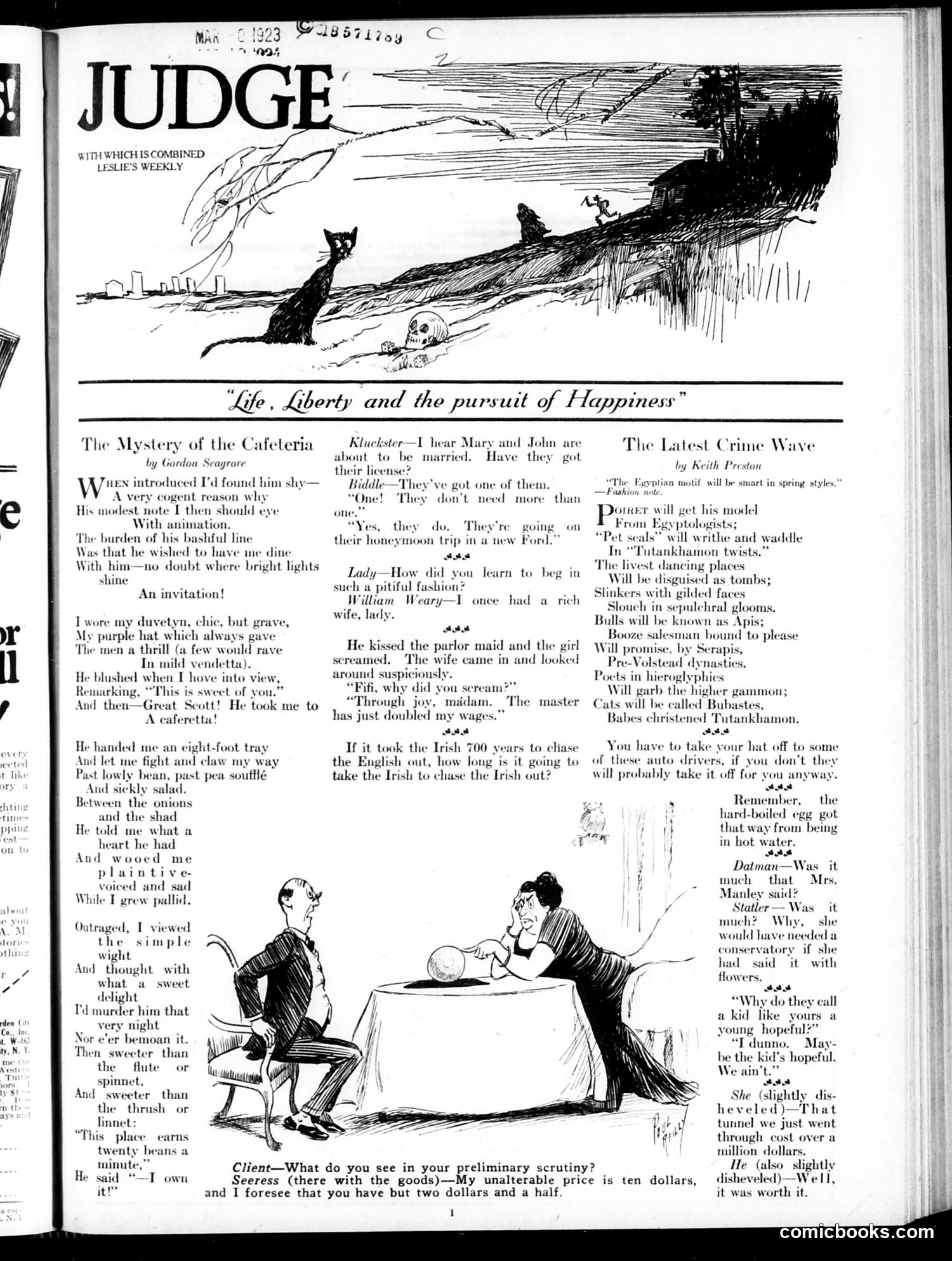
This page from Judge magazine (dated March 1923) contains satirical poetry and humor pieces rather than political cartoons. **"The Mystery of the Cafeteria"** is a poem about a shy man invited to dinner who becomes awkward and destructive—ultimately destroying the host's property. The humor relies on physical comedy and social embarrassment. **"The Latest Crime Wave"** lists absurdist predictions about future fashion and social trends (Egyptian styles, "Pet seals," disguised dancing places, renamed animals), mocking both modernity and urban anxieties. The central illustration shows a fortune teller with a crystal ball, depicting a common 1920s entertainment/superstition. Overall, the page represents typical Judge magazine content: light satirical commentary on contemporary manners, fashion, and social anxieties rather than serious political commentary.
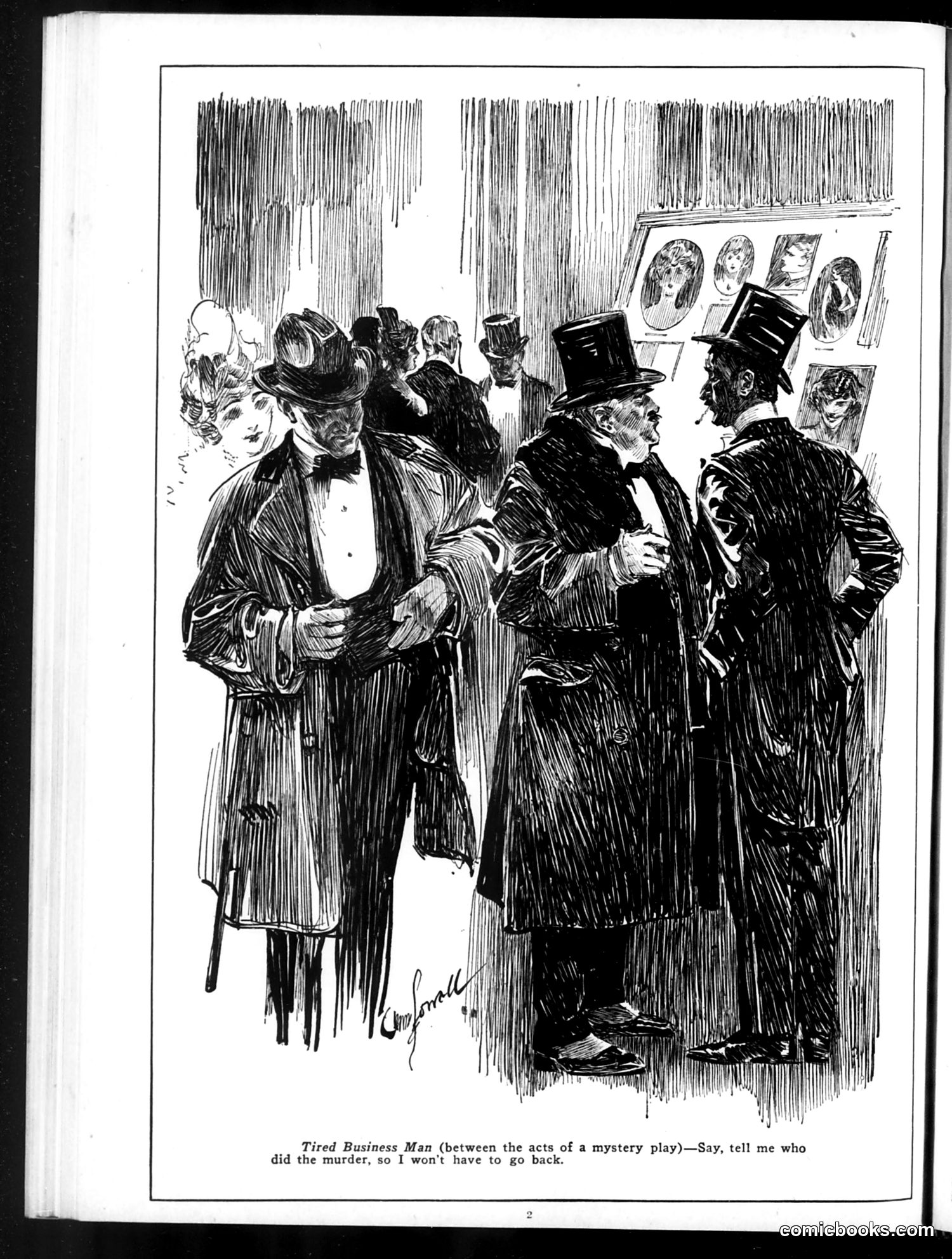
This is a satirical cartoon from *Judge* magazine depicting a scene at what appears to be a theater or gallery (note the portraits on the wall). The caption reads: "Tired Business Man (between the acts of a mystery play)—Say, tell me who did the murder, so I won't have to go back." The joke plays on the exhaustion of working men seeking entertainment. Rather than enjoying the suspense of a mystery play, the protagonist is so fatigued he wants the ending spoiled so he can leave early and rest. The cartoon satirizes the grueling pace of American business life, suggesting that even leisure activities feel like obligations to overworked men who prioritize sleep over entertainment. The well-dressed audience members represent the urban professional class of the era.
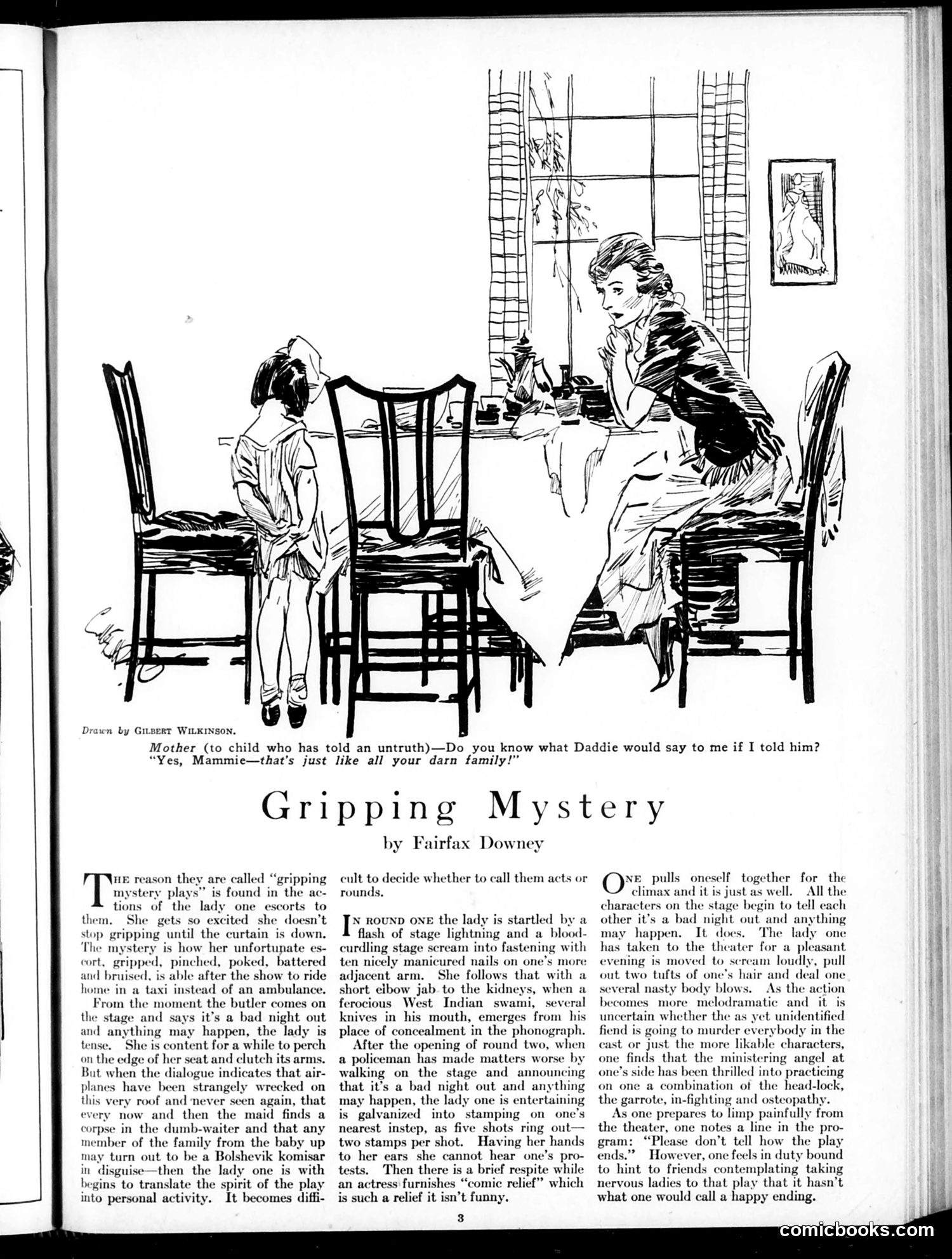
This page features an illustration by Gilbert Wilkinson accompanying a short story by Fairfax Downey about theatrical "gripping mysteries"—stage plays designed to startle and frighten audiences. The cartoon shows two women in what appears to be a dressing room or backstage area. The dialogue reveals a domestic humor angle: a mother warns her daughter that if she tells an untruth, "Daddie would say to me if I told him" that "that's just like all your darn family!" The accompanying article explains how these mystery plays work—using sudden stage lighting, bloodcurdling screams, and physical violence (described as "nasty blow blows") to create theatrical tension and uncertainty about which character might be the villain. It's satire on popular melodramatic entertainment of the era.
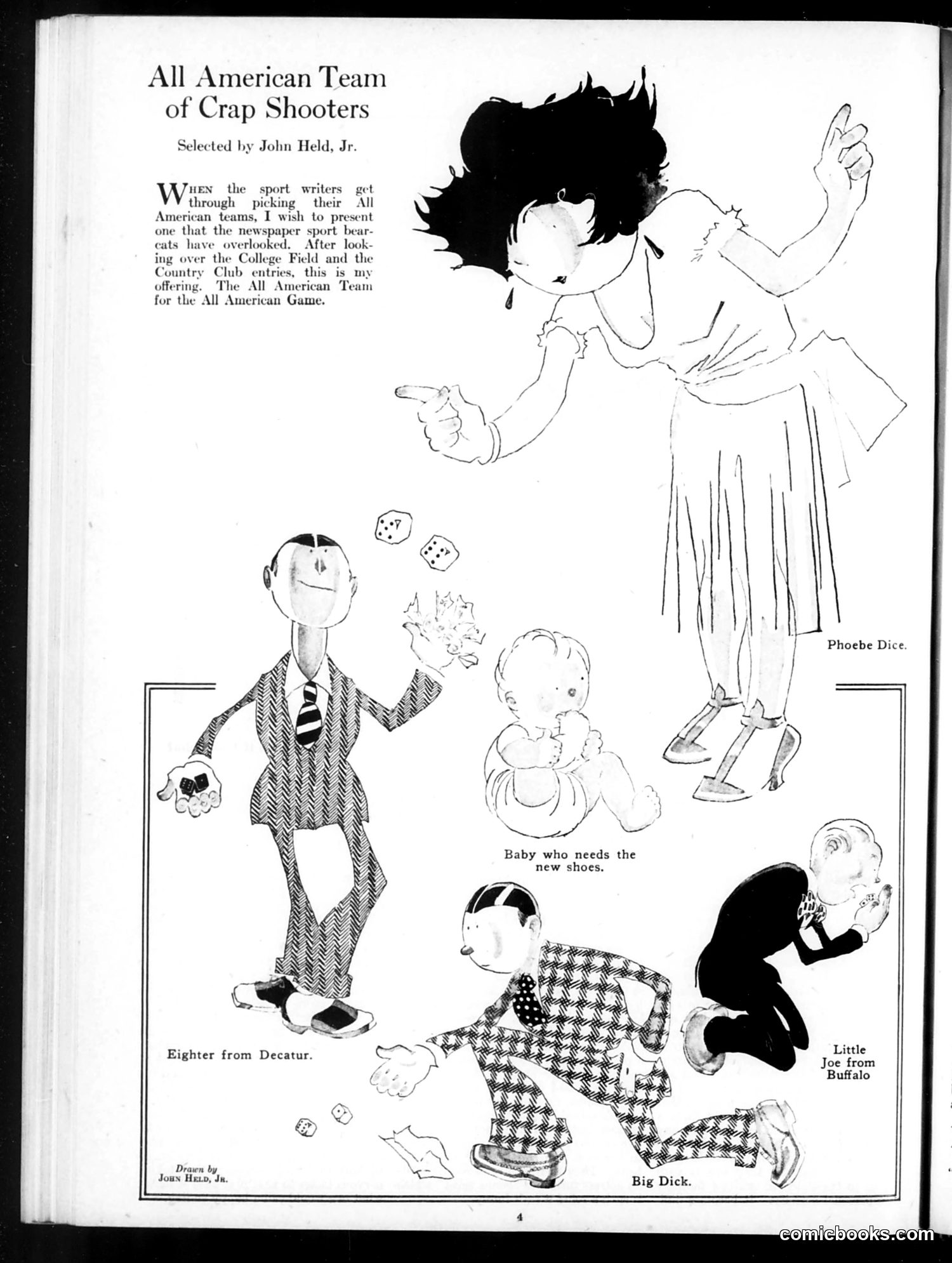
This page satirizes crap shooting (dice gambling) through caricatured "All American" shooters selected by John Held, Jr., a prominent Judge cartoonist. The joke uses names as double meanings: - **"Eighter from Decatur"** — a craps dice call, depicted as a thin man in striped suit rolling dice - **"Phoebe Dice"** — female figure (pun on "Phoebe") - **"Baby who needs the new shoes"** — literal baby character - **"Big Dick"** and **"Little Joe from Buffalo"** — both actual craps terminology The satire mocks how pervasive dice gambling was in American culture by pretending these generic gambling terms were actual notable "athletes" worthy of an All-American team. It's social commentary on the prevalence of gambling, presented as absurdist humor typical of 1920s Judge magazine.
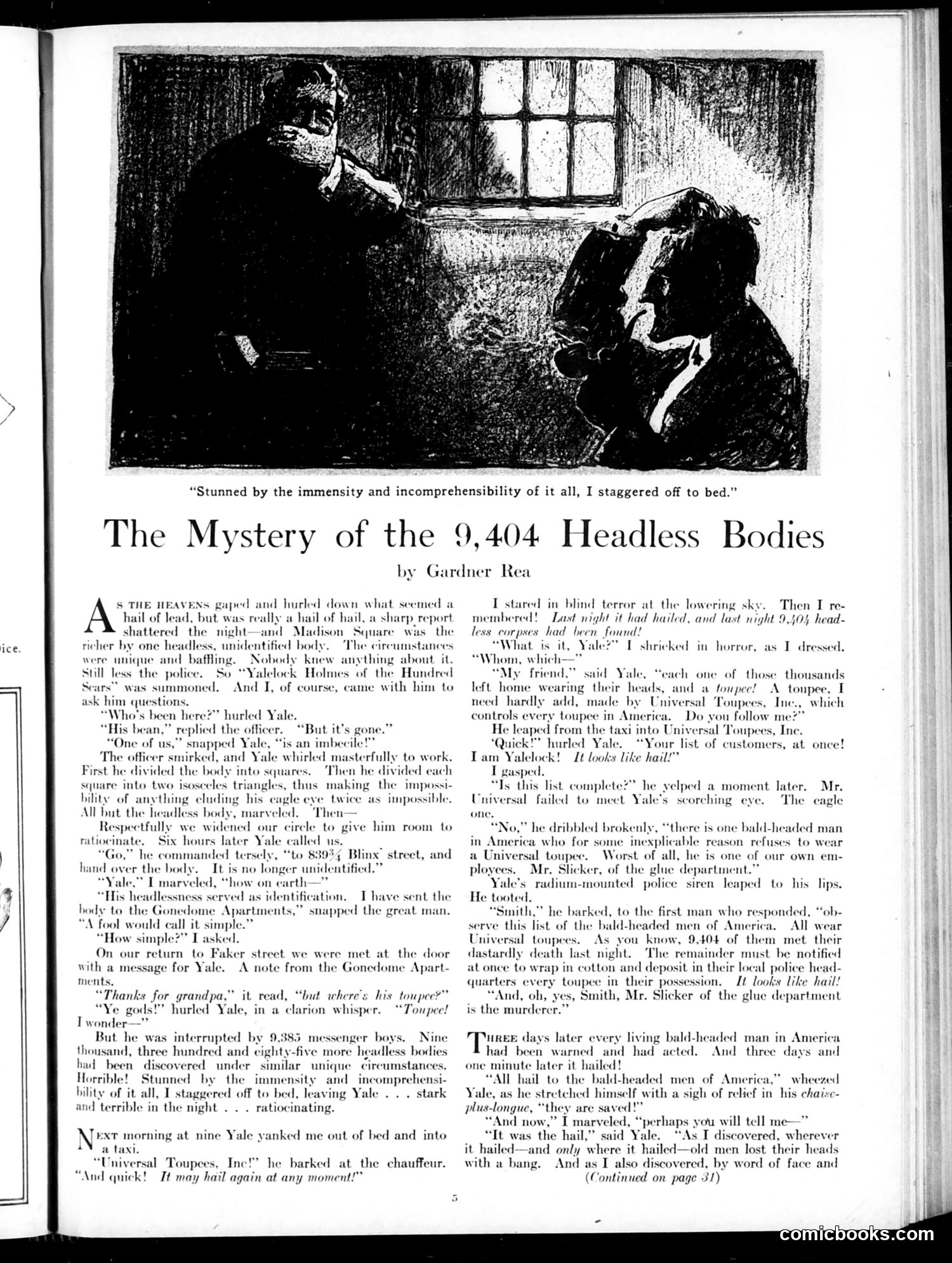
This is a satirical detective parody featuring "Yalelock" (a play on Sherlock Holmes). The story mocks both detective fiction conventions and early 20th-century corporate monopolies. **The satire:** A mysterious epidemic of 9,404 headless bodies all wear toupees from "Universal Toupees, Inc."—a company that controls every toupee in America. The detective's absurd logic (dividing bodies into triangles) and the absurdist plot (identifying a body by its *missing* toupee) ridicule overcomplicated detective stories. **The point:** The story satirizes corporate monopolies by suggesting Universal Toupees' stranglehold on the market is so complete that one bald man refusing to wear their product becomes a murder suspect. The "haildeath" motif reinforces the melodramatic absurdity. This appears to be social commentary on American corporate consolidation using humor and parody rather than direct criticism.
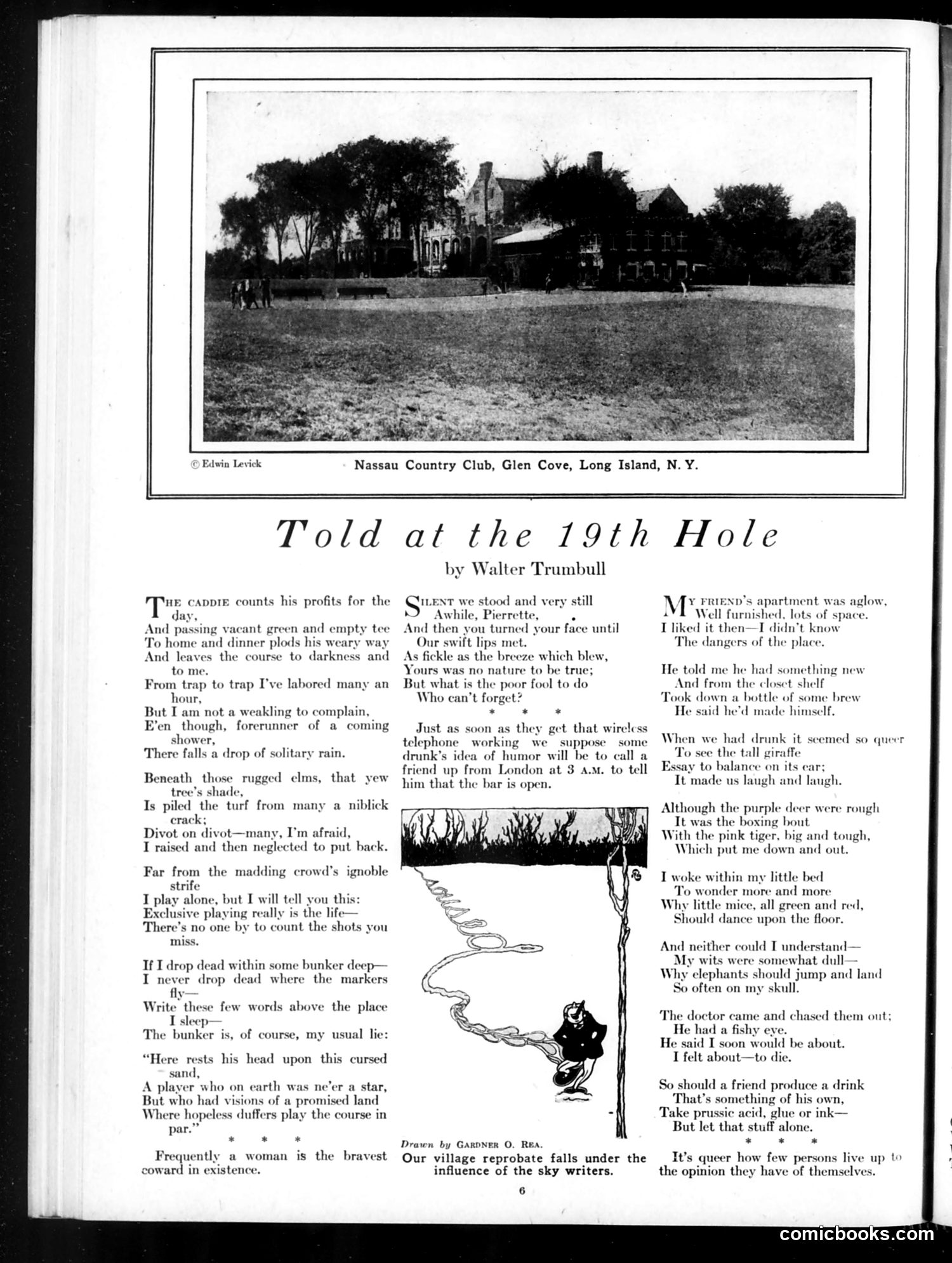
This page presents three humorous pieces for an educated, country-club audience. The main feature is Walter Trumbull's poem "Told at the 19th Hole"—the 19th hole being the clubhouse bar where golfers gather after playing. The poem, set at Nassau Country Club on Long Island, uses mock-elevated language (echoing Gray's "Elegy") to satirize a mediocre golfer's self-aware excuses: he plays alone to hide bad shots, leaves divots unmended, and admits he'll never achieve par. The secondary pieces mock contemporary anxieties: wireless telephone technology enabling drunk calls at 3 AM, and "sky writers" (early aerial advertising). A third poem humorously describes hallucinations from homemade bootleg alcohol during Prohibition—green mice, pink tigers, purple deer—suggesting the dangers of amateur distilling. The cartoon by Gardner Rea illustrates the bootleg alcohol theme. Overall, the page targets upper-class leisure pursuits, modern technology, and Prohibition-era problems with genial satire.
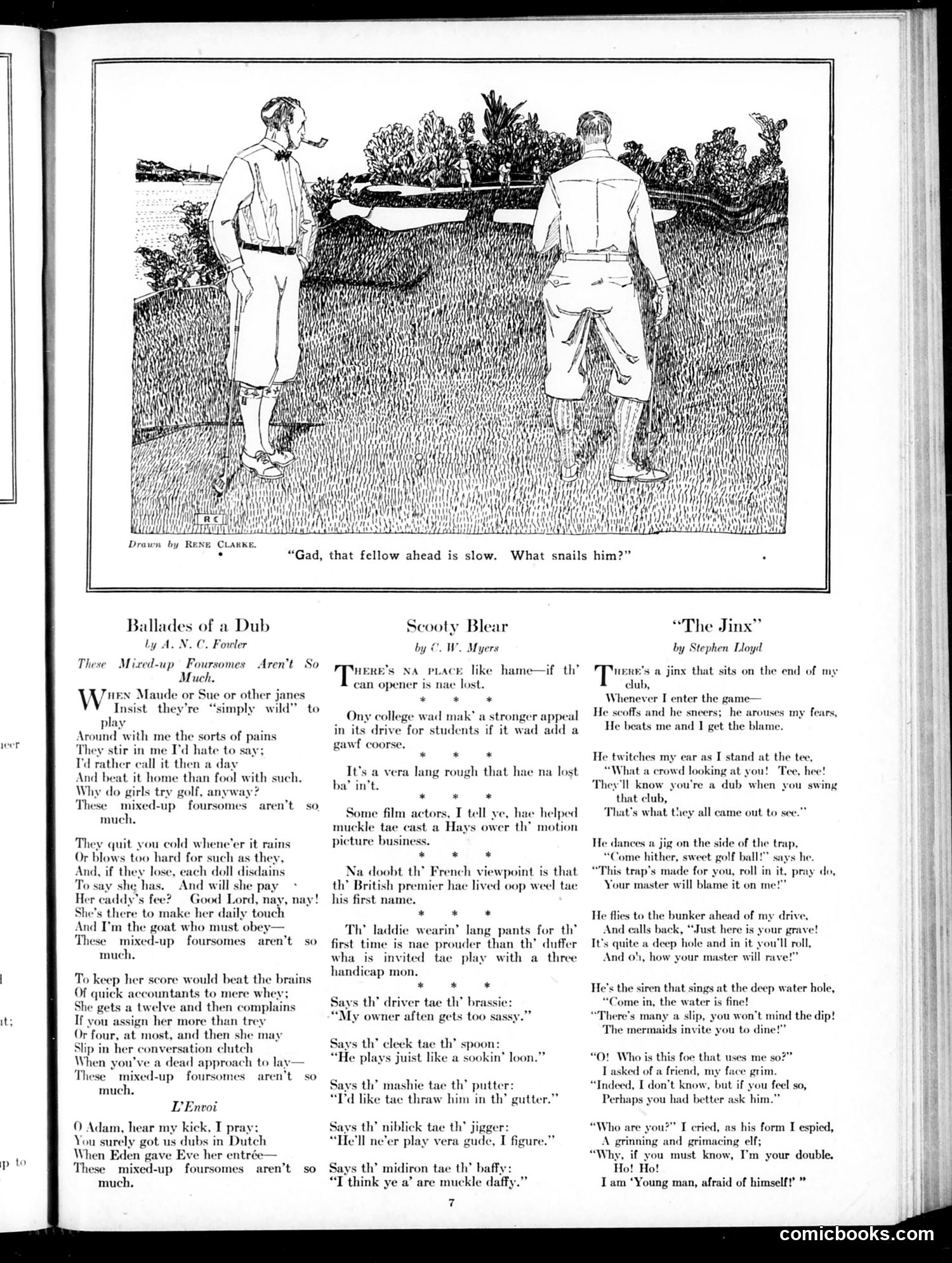
This page satirizes early 20th-century golf culture through three pieces about the sport's frustrations and social dynamics. **The cartoon** (drawn by René Clarke) depicts two golfers on a course, with the caption "Gad, that fellow ahead is slow. What snails him?"—mocking the irritation of slow play, a timeless golf complaint. **"Ballades of a Dub"** ridicules women golfers as unreliable and poorly-skilled ("mixed-up foursomes"), complaining they quit in bad weather, cheat on scorekeeping, and lack commitment—reflecting the era's dismissive attitudes toward female athletes. **"Scooty Blear"** uses Scottish dialect for mild golf humor about equipment, pretension (new long pants), and film actors' involvement in golf. **"The Jinx"** personifies the golfer's internal saboteur—self-doubt manifested as a mocking demon—capturing golf's psychological torment in whimsical verse. Together, these pieces reflect how golf had become a significant leisure activity and social concern by this period, treated with both affection and exasperation by Judge's readers.
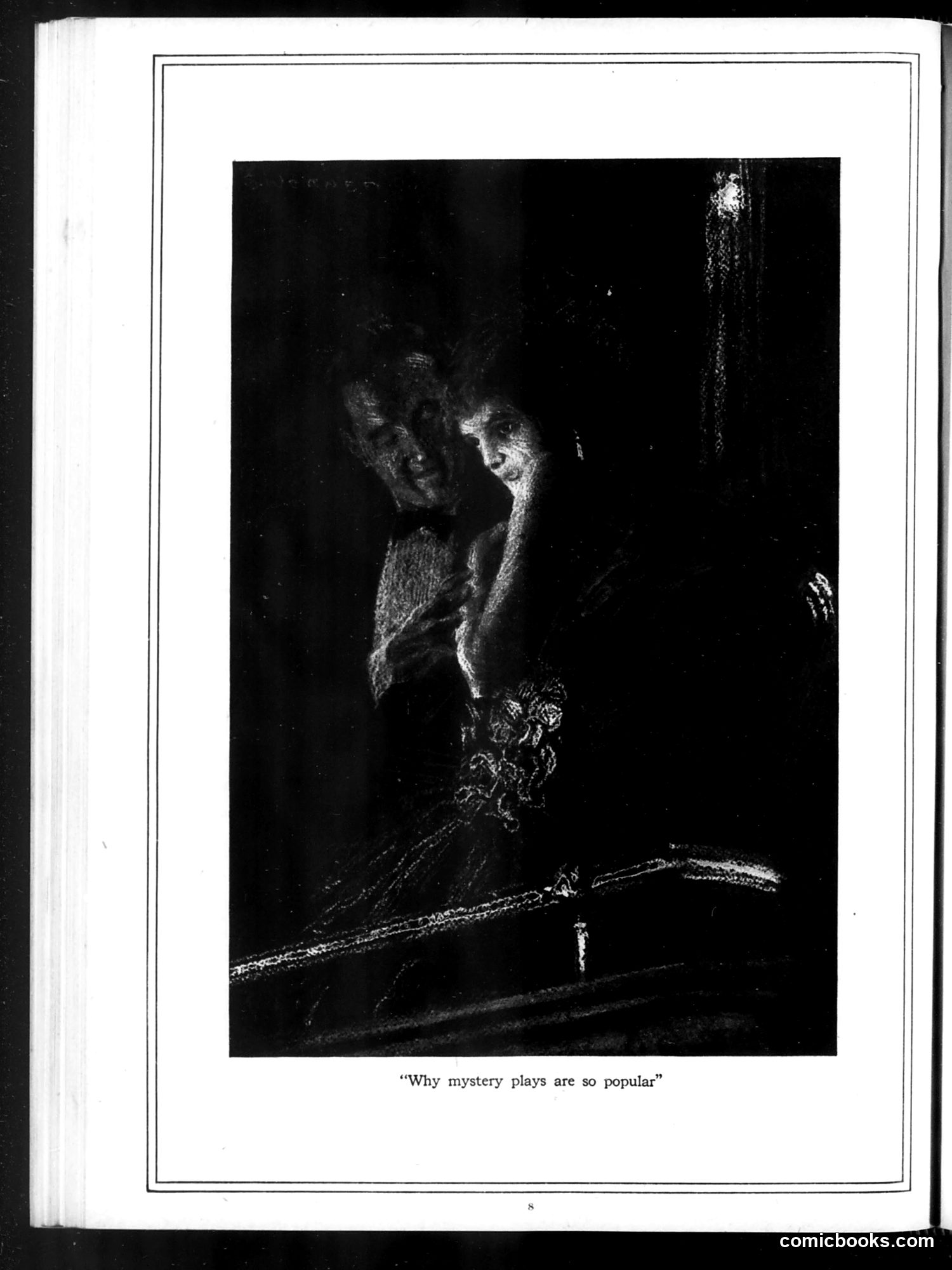
This appears to be a satirical cartoon from *Judge* magazine commenting on the popularity of mystery theater productions. The image shows two figures in dramatic shadow/silhouette against a dark background, their faces partially obscured or rendered mysteriously—a visual pun on the caption's subject. The satire works on two levels: First, it humorously suggests that mystery plays are popular *because* audiences can't see or understand what's happening on stage (the figures are literally hard to make out). Second, it may be mocking contemporary mystery drama as obscure or poorly lit theatrical productions. Without additional context about the magazine's publication date, I cannot identify the specific figures or reference particular theatrical productions of that era. The joke relies on the visual obscurity matching the genre being satirized.
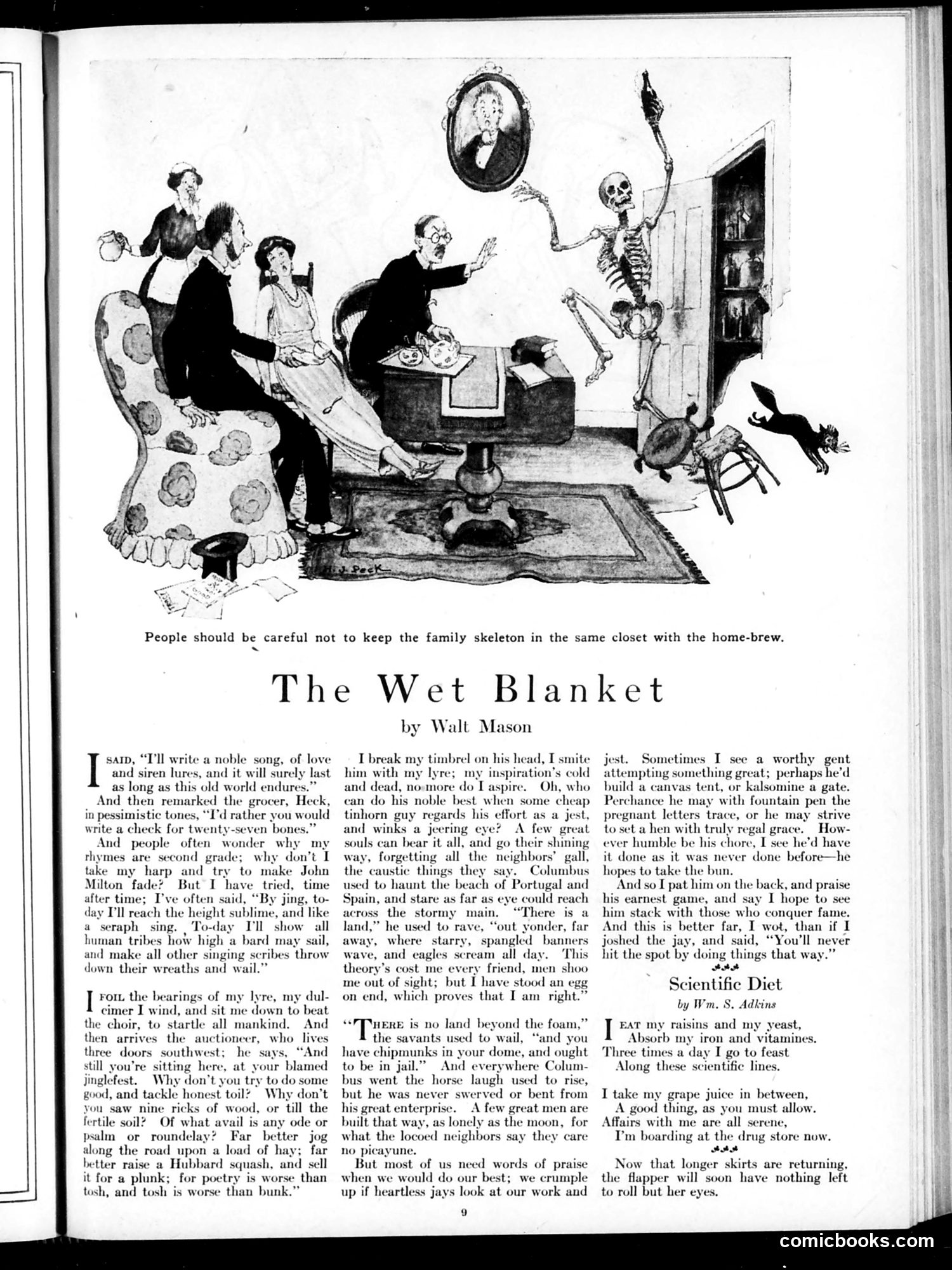
This page contains a poem satirizing people who discourage artists and dreamers. The cartoon at top depicts a domestic scene where a skeleton (representing creative death or failure) is being held up by a skeletal figure while family members react with dismay—illustrating the caption's warning against keeping "the family skeleton in the same closet with the home-brew" (domestic shame alongside hidden alcohol, relevant during Prohibition era). The poem itself mocks practical-minded neighbors and auctioneers who dismiss the poet's artistic ambitions as worthless, comparing him unfavorably to Columbus. The satire targets those who crush others' aspirations with skepticism and ridicule—the "wet blankets" of the title. The secondary content includes a humorous diet column and a quip about flappers' shorter skirts returning, suggesting their hemlines will again rise.
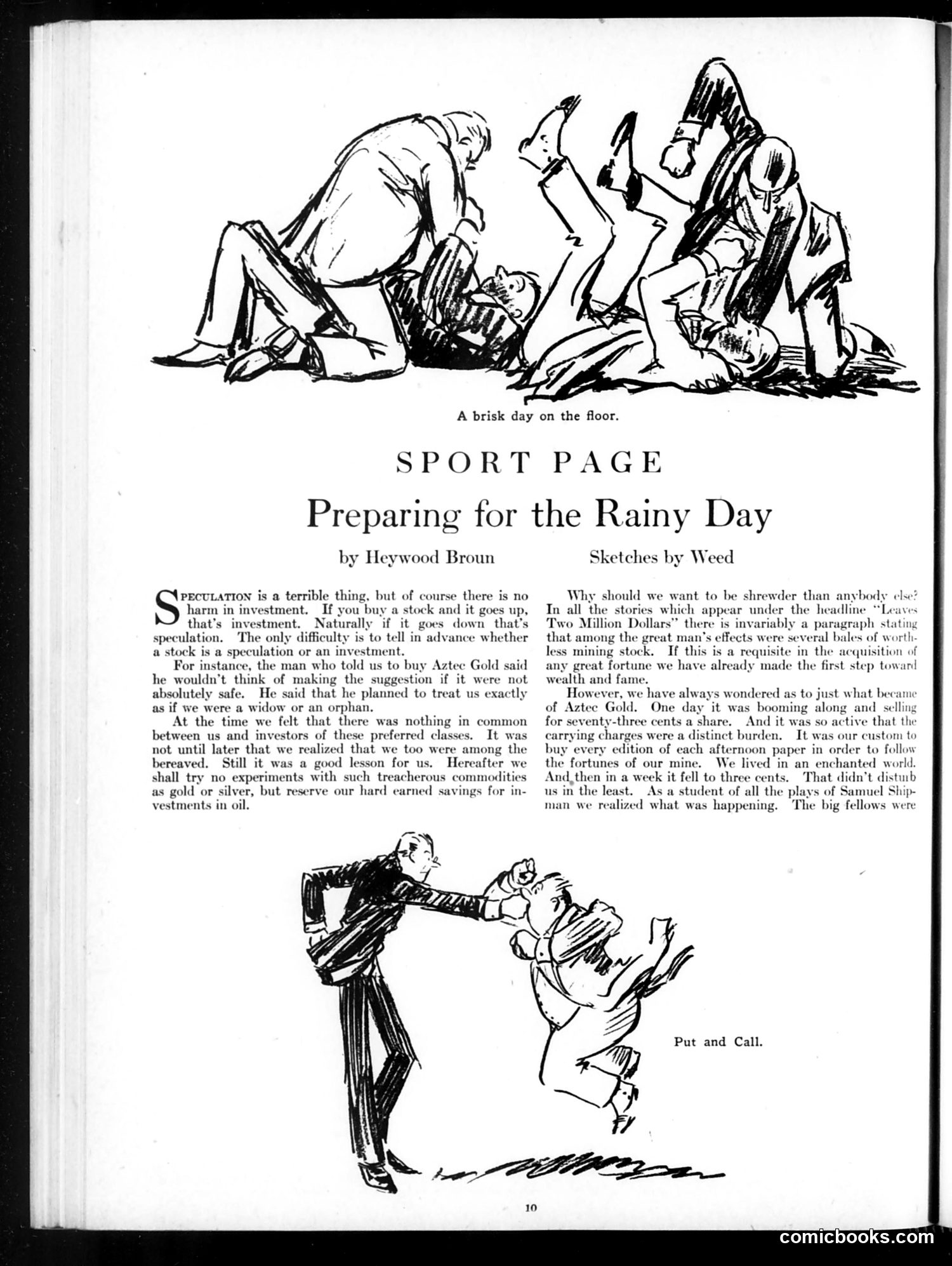
This is a satirical article by Heywood Broun mocking stock market speculation during what appears to be the early 20th century (likely pre-1929 crash era). **The satire targets:** - Investor naiveté: The author describes being sold worthless stocks like "Aztec Gold" by con artists who claim safety while treating investors "as if we were a widow or an orphan" - Semantic dishonesty: The distinction between "investment" (stocks that go up) and "speculation" (stocks that go down) is purely retroactive—impossible to distinguish beforehand - Gullible readers: The author admits following mining stock prices obsessively through afternoon papers, even as the share price crashed from 73 cents to 3 cents **The cartoons** (by "Weed") illustrate frivolous financial activity: "A brisk day on the floor" shows stock exchange chaos, while "Put and Call" depicts option trading as physical comedy—the whole enterprise presented as absurd theater rather than legitimate investment. The piece warns readers against speculative traps dressed up as safe investments.
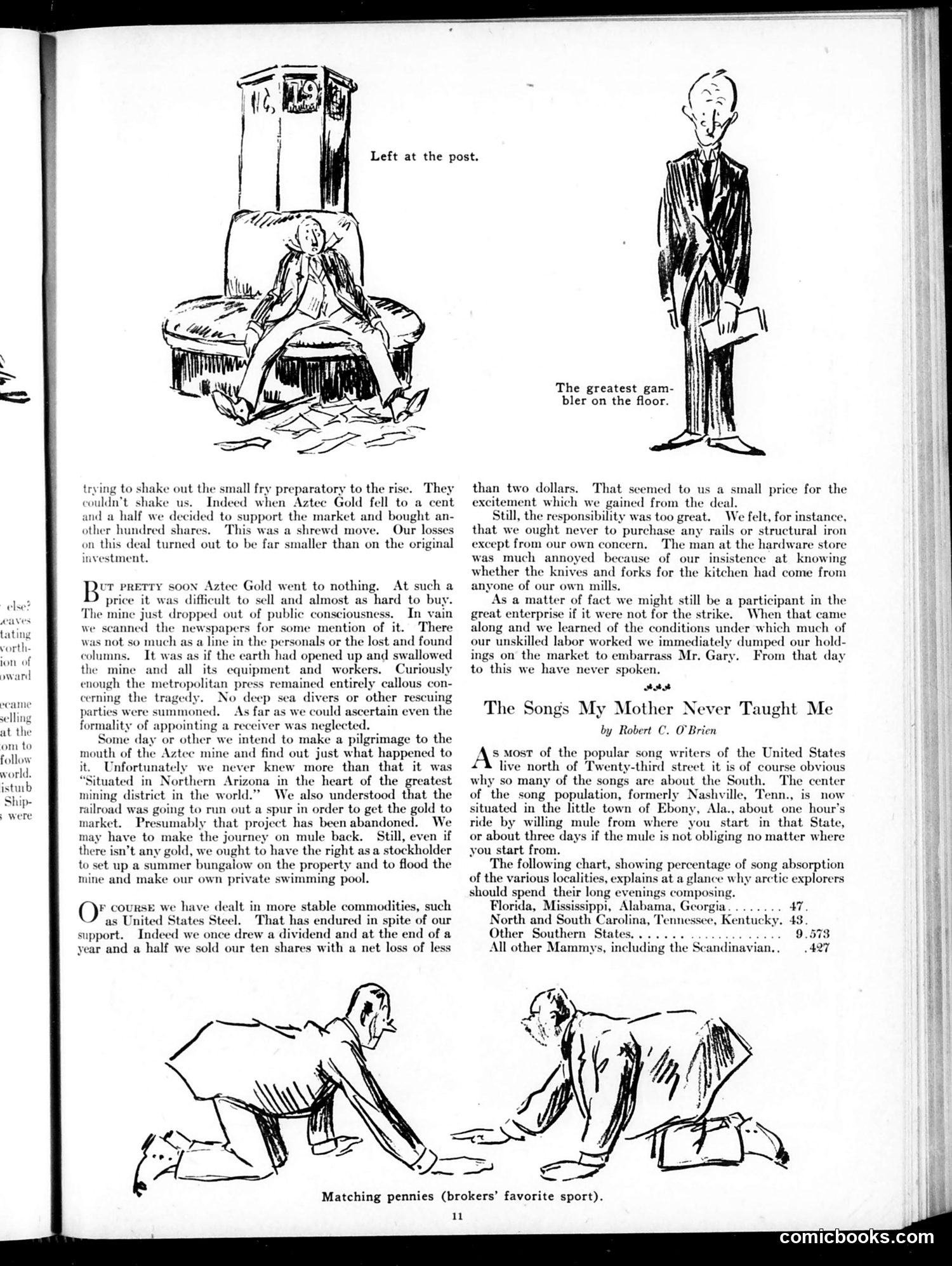
This page contains two distinct pieces of financial and cultural satire: **"Aztec Gold" Stock Story (top):** A first-person account mocking speculative investing and market manipulation. The narrator describes buying stock in a fraudulent or worthless mining company in Northern Arizona, losing money despite attempts to "support the market." The satire targets both naive investors and wealthy speculators who dabble in stocks without real knowledge. The accompanying cartoons—"Left at the post" and "The greatest gambler on the floor"—ridicule stock market participants as failures or reckless gamblers. **"The Songs My Mother Never Taught Me" (bottom):** Robert C. O'Brien satirizes Tin Pan Alley songwriters living in New York who obsessively write about the American South despite never experiencing it. A statistical chart "proves" Southern songs dominate popular music, mocking both the artificial sentimentality of commercial songwriting and possibly the Northern exploitation of Southern cultural imagery. The "brokers' favorite sport" cartoon depicts penny-matching as frivolous gambling. Both pieces ridicule financial speculation and artificial commercialism in Gilded Age America.
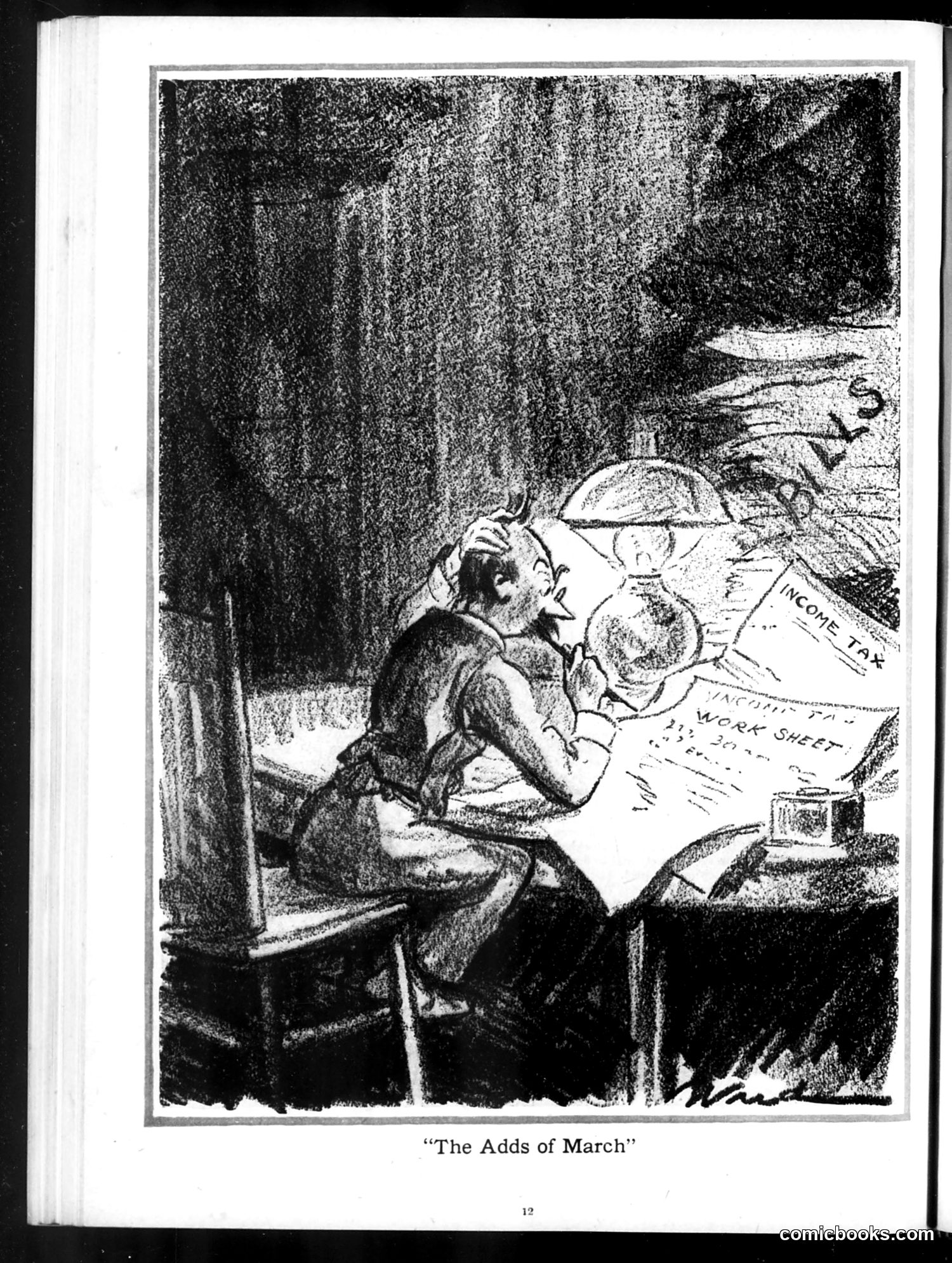
This cartoon satirizes tax season burden. A harried man sits at a desk surrounded by papers labeled "INCOME TAX" and "WORK SHEET," looking distressed as he attempts calculations. Visible in the background are what appear to be spheres or planets, possibly representing the astronomical figures of his tax burden. The title puns on Shakespeare's "Ides of March" (the fateful date in *Julius Caesar*), substituting "Adds" to reference the addition and arithmetic demands of filing taxes. The cartoon mocks the complexity and stress of income tax preparation, presenting it as an overwhelming, almost cosmic burden on ordinary citizens. This reflects early 20th-century American frustration with federal income tax requirements.
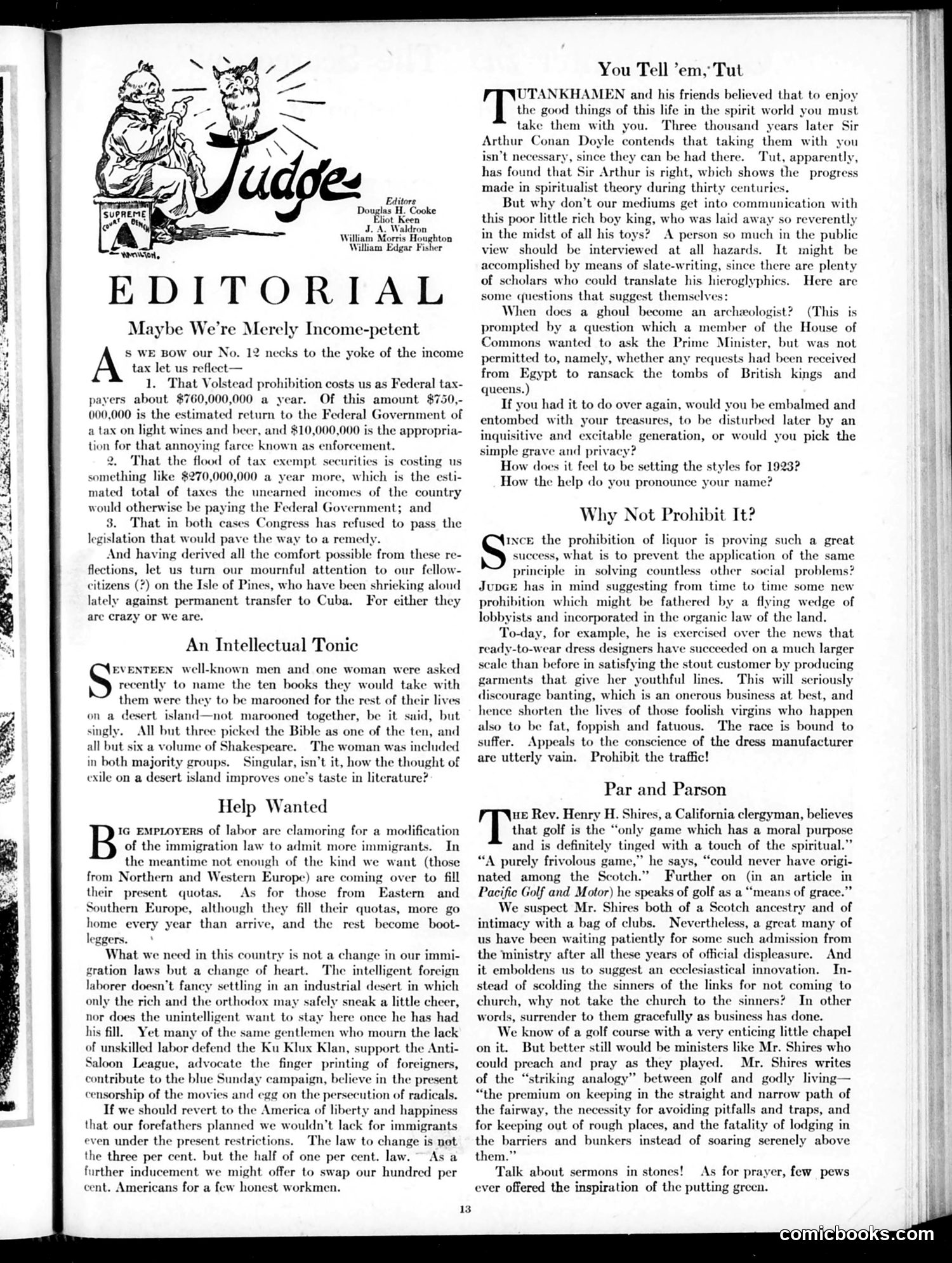
This editorial page from Judge magazine satirizes American political and social issues of the Prohibition era (likely early 1920s). **The main cartoon** at top left depicts "Tut" (Tutankhamen, the Egyptian pharaoh whose tomb was famously discovered in 1922). The accompanying article mocks spiritualists' claims about the afterlife, contrasting ancient Egyptian beliefs about taking possessions into the spirit world with modern spiritualist claims—suggesting mediums should contact King Tut if they're so capable. **The editorials** attack: - The income tax burden, particularly costs of enforcing Prohibition ($760M annually) - Congress's refusal to tax tax-exempt securities - Immigration policy contradictions: employers want cheap labor but support the Ku Klux Klan, Anti-Saloon League, and Sunday closing laws—conditions discouraging immigrant settlement - A desert-island book survey revealing people's hypocrisy about cultural taste The underlying theme: American society claims values it doesn't practice, and taxation supports enforcement of unpopular laws.
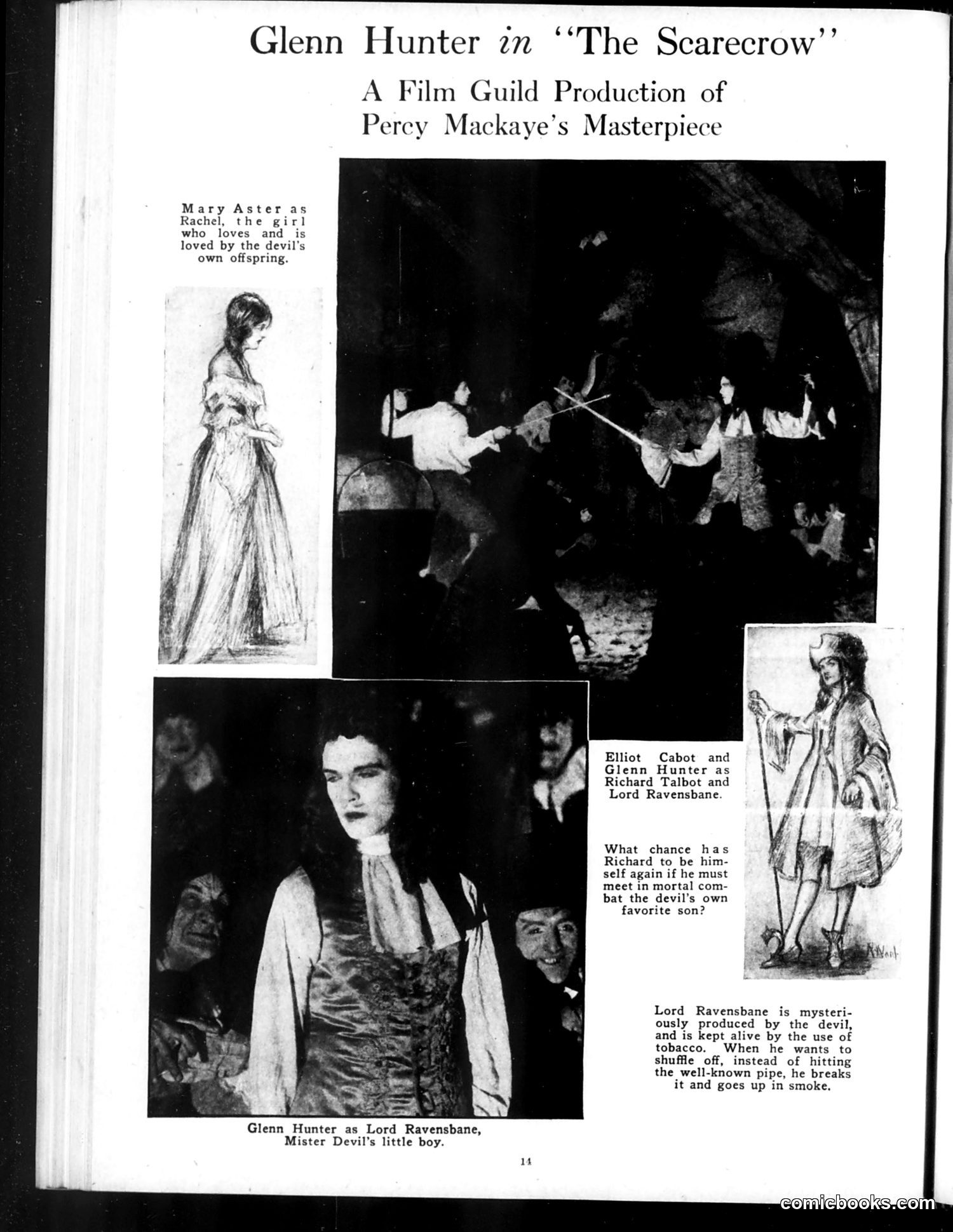
This is a **film advertisement/promotion page**, not satire. It publicizes "The Scarecrow," a 1920s Film Guild production based on Percy Mackaye's play, starring Glenn Hunter and Mary Aster. The page includes: - Character sketches (costume designs) - Plot descriptions of the supernatural melodrama - Photographs from the film showing scenes and actors - Story details about Lord Ravensbane, a devil-created character kept alive by tobacco who vanishes in smoke when his pipe breaks The humor appears incidental—the absurd premise (a devil's son sustained by smoking) rather than deliberate satire. This is promotional material designed to entice Judge magazine readers to see the film, not to mock political figures or social issues.
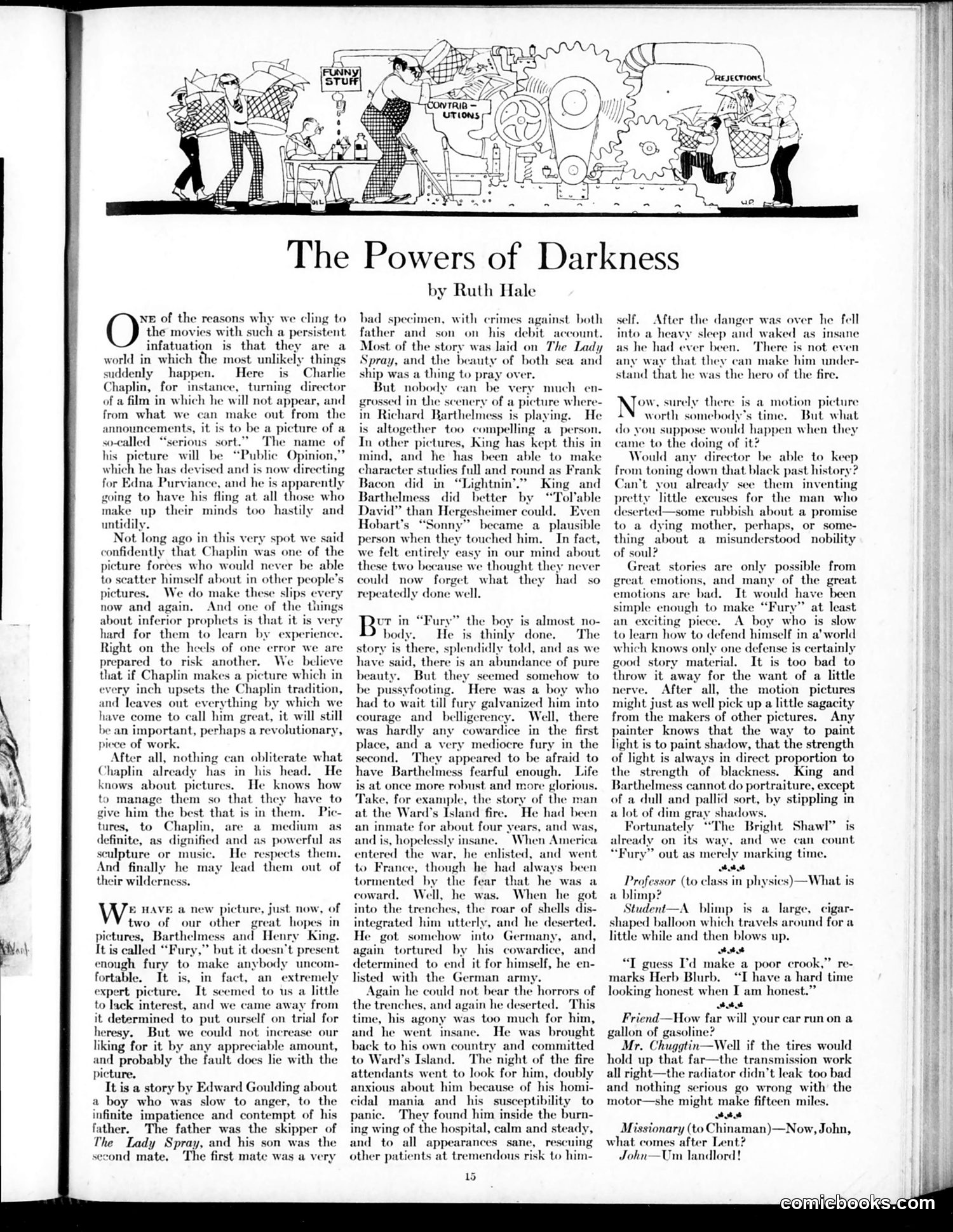
This page is primarily a **film criticism article** by Ruth Hale reviewing contemporary movies, not a political cartoon. The decorative header illustration shows figures in a factory/machinery setting but serves as generic framing, not satire. The content discusses three films: 1. **"Public Opinion"** — Chaplin's directorial venture without himself acting, which the critic finds potentially revolutionary despite breaking his established formula. 2. **"Fury"** — A film starring Richard Barthelmess and directed by Henry King, which the critic finds technically expert but emotionally restrained. The article criticizes the director for being "afraid to have Barthelmess fearful enough," suggesting the film lacks dramatic intensity despite strong source material. The critic argues that great films require genuine emotion and risk-taking, not cautious filmmaking. This is straightforward entertainment journalism, not political satire.
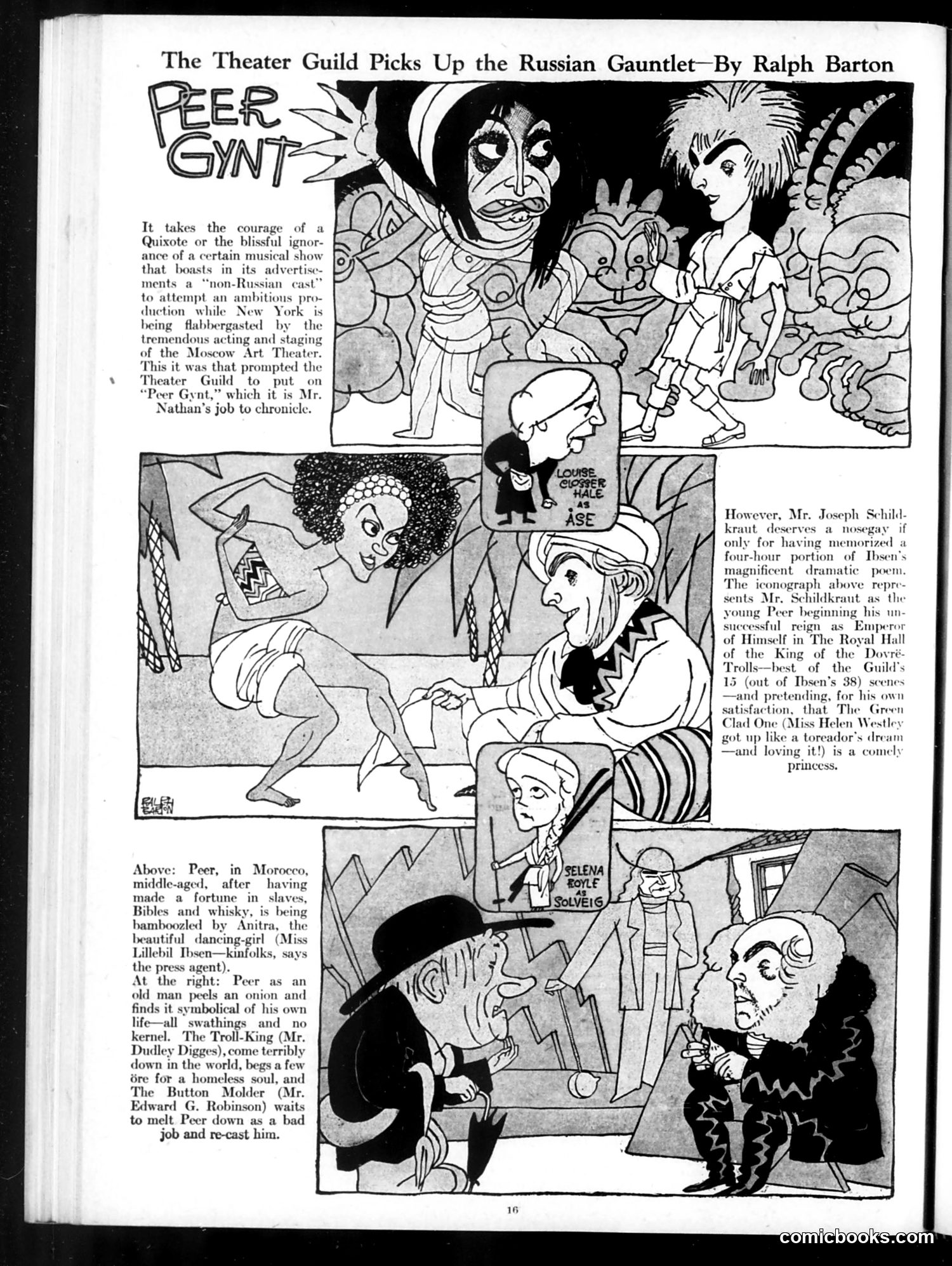
This page satirizes the Theater Guild's ambitious 1923 production of Ibsen's *Peer Gynt*, starring Joseph Schildkraut. The cartoon's title references the cultural moment: American theater was being dominated by Russian productions and companies, creating intense competition. By mounting this demanding Norwegian classic with a non-Russian cast, the Guild was boldly challenging that dominance—hence "picking up the gauntlet." Ralph Barton's illustrations mock the play's sprawling scope and melodramatic elements: Peer's various incarnations (the bamboozled businessman, the peeling-onion existentialist, the deluded troll-kingdom emperor) showcase the production's ambition and absurdity. The humor partly celebrates Schildkraut's feat of memorizing such an enormous role, while gently poking fun at the Guild's theatrical audacity in competing against the fashionable Russian theater scene.
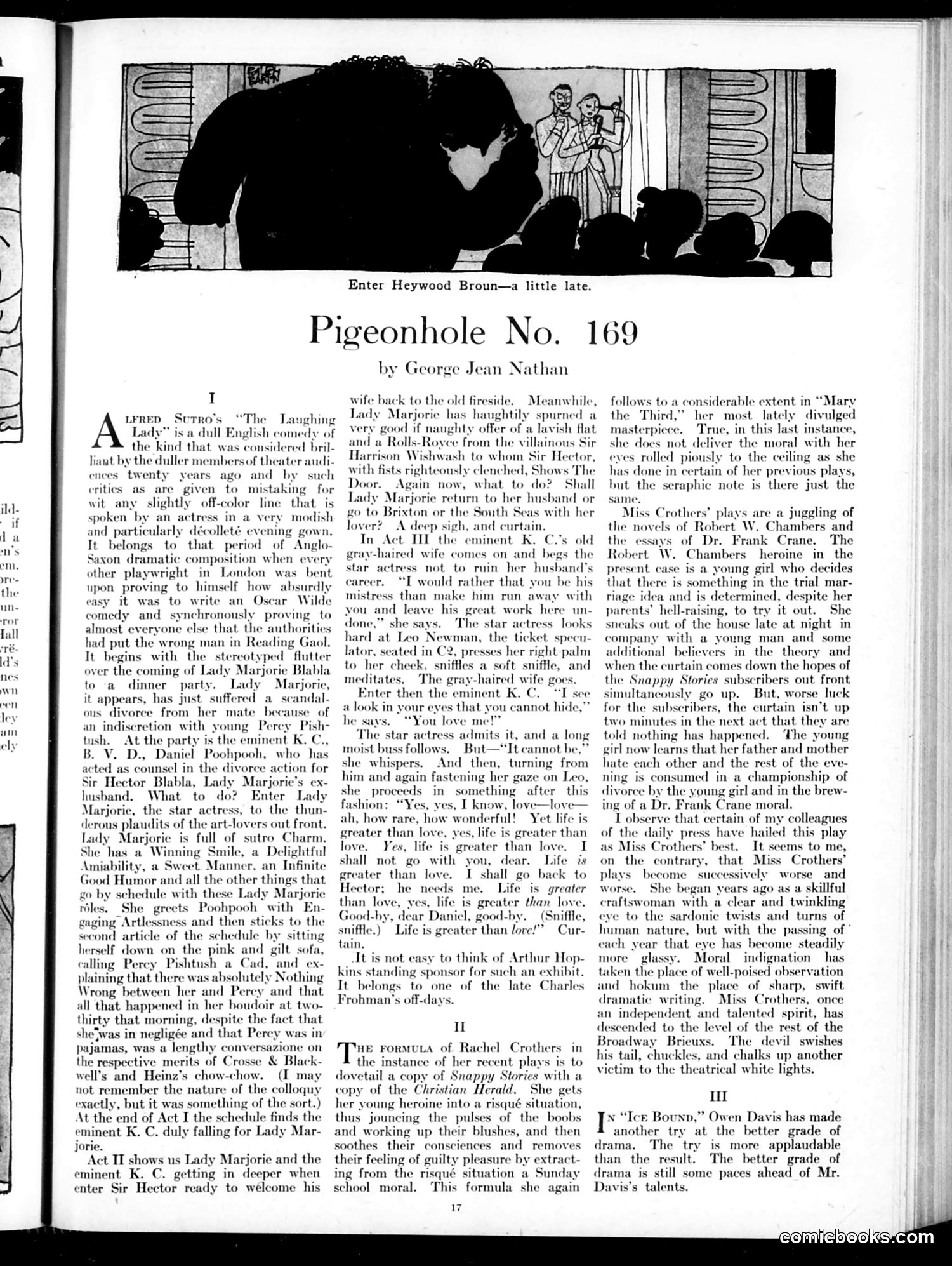
This is drama criticism by George Jean Nathan reviewing "The Laughing Lady," a mediocre English comedy. The silhouetted cartoon above shows an actor (likely the portly Heywood Broun, a famous theater critic, entering late—the caption's joke) witnessing a melodramatic stage scene. Nathan mocks the play's tired conventions: contrived domestic scandal, stock characters with ridiculous names (Poohpooh, Pishtush), and hackneyed dialogue about love versus duty. The plot—a society woman caught between her husband, a lawyer, and a lover—exemplifies what Nathan sees as derivative pseudo-Wilde drivel from an outdated theatrical era. The criticism targets both the play's formulaic sentimentality and audiences who applaud such work. Nathan's sarcastic tone and absurdist character names emphasize how predictable and uninspired the production is—precisely the kind of "dull English comedy" that depends on pretty actresses in fashionable gowns rather than genuine wit.
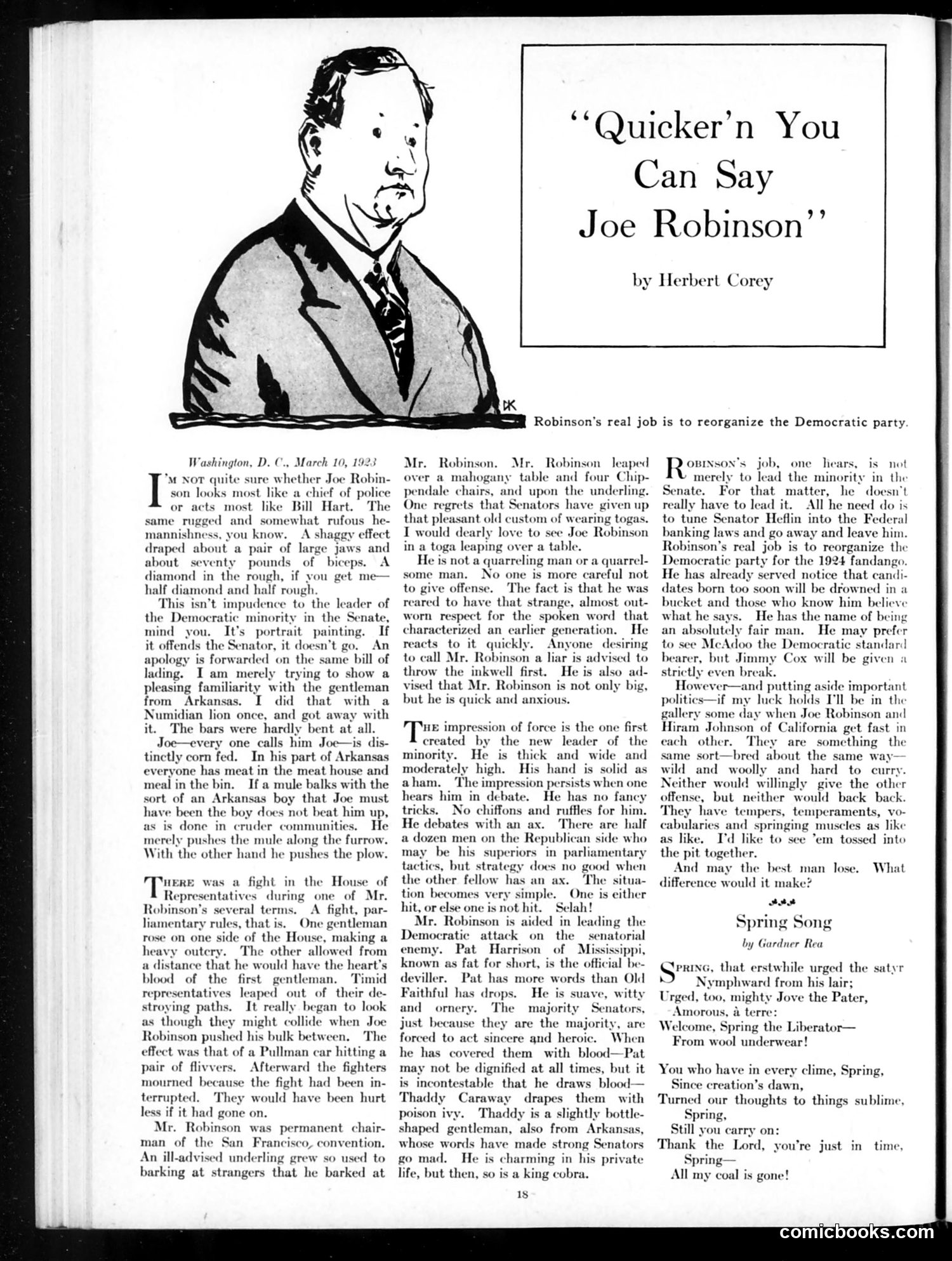
This March 1923 *Judge* article profiles **Senator Joe Robinson of Arkansas**, the new Democratic minority leader. The caricature emphasizes his physical bulk and rural toughness—comparing him to Western actor Bill Hart and describing him as "corn fed" from Arkansas. **The satire's point:** Robinson's real political job is reorganizing the struggling Democratic party, yet Corey dwells on Robinson's physical prowess and quick temper. The anecdotes—leaping over mahogany tables, nearly fighting colleagues—stress his bluntness and force over political subtlety. He "debates with an ax" rather than parliamentary finesse. **The subtext:** Corey presents Robinson as an effective but crude political operator. His lack of "fancy tricks" and rhetorical flourishes contrasts with more sophisticated senators. The headline's phrase "Quicker'n you can say" suggests his reputation for swift, physical reactions rather than calculated strategy. This reflects 1920s anxiety about whether rural Democratic leaders could modernize a fractured party post-Wilson era.
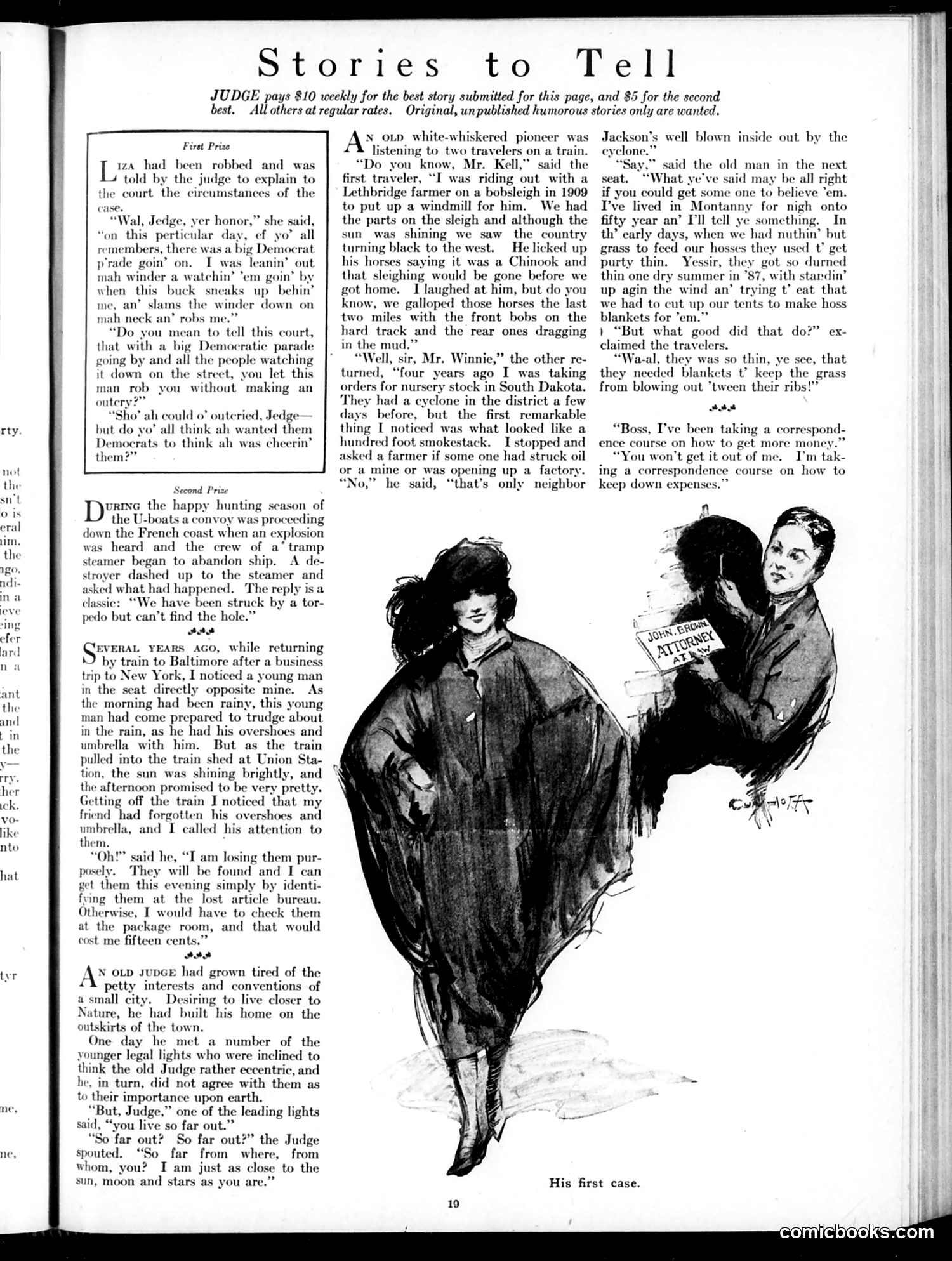
This page presents three humorous short stories competing for publication prizes ($10 for first place, $5 for second). The **first-prize story** uses dialect humor to satirize Democratic politics. A rural woman explains to a judge why she didn't cry out when robbed during a Democratic parade—she didn't want onlookers to think she was cheering for Democrats. The joke mocks both Democratic rallies and rural Southern attitudes toward them. The **second-prize story** is a classic wartime joke: during WWI U-boat attacks, a ship's crew abandons vessel after being struck by a torpedo, but tells rescuers they "can't find the hole"—absurdist humor about wartime chaos. The **illustration** labeled "His first case" shows a young lawyer with an older woman client—likely accompanying one of the stories about a legal matter, though the specific connection is unclear from the visible text. The remaining story concerns unlikely weather events (a Chinook wind, a cyclone), showcasing tall-tale humor typical of American frontier narratives.
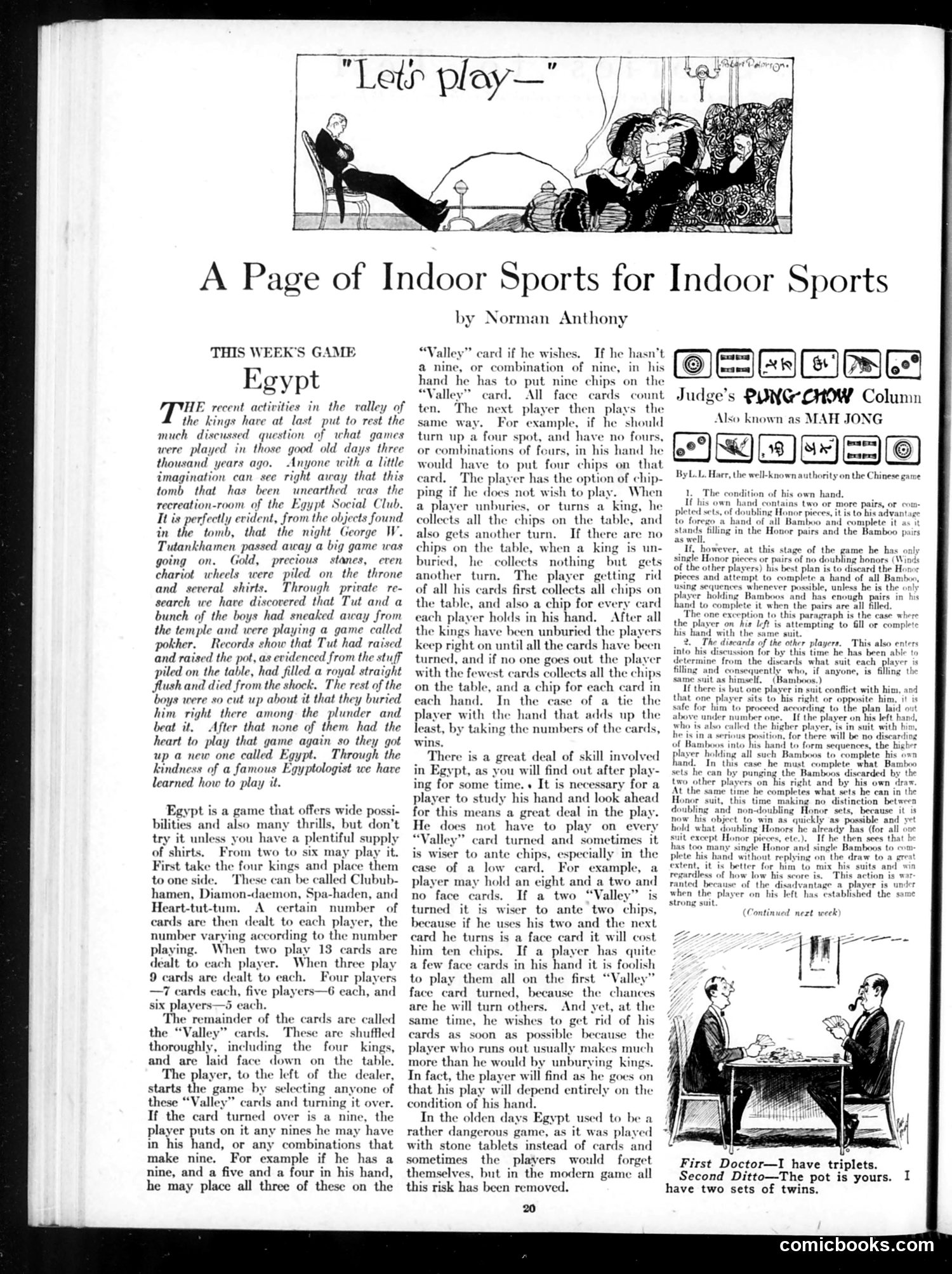
This page satirizes King Tutankhamen's tomb discovery (1922), a major archaeological sensation. The humor imagines "Tut" died during an ancient poker game, prompting his friends to invent a new card game called "Egypt" to replace it. The joke operates on several levels: it anachronistically applies modern gambling culture to ancient Egypt, treats a real historical discovery as a humorous artifact, and uses the Egyptologist's "findings" to justify elaborate card-game rules. The cartoon at top shows leisure-class gentlemen at leisure, representing the "indoor sports" theme. The satire gently mocks both contemporary obsession with the tomb discovery and the frivolous pursuits of wealthy Americans. By framing Egypt as mere entertainment derived from archaeology, Judge ridicules superficial engagement with historical events—treating serious ancient culture as fodder for parlor games. The detailed game rules emphasize the absurdity: real card mechanics dressed up in mock-Egyptological language.
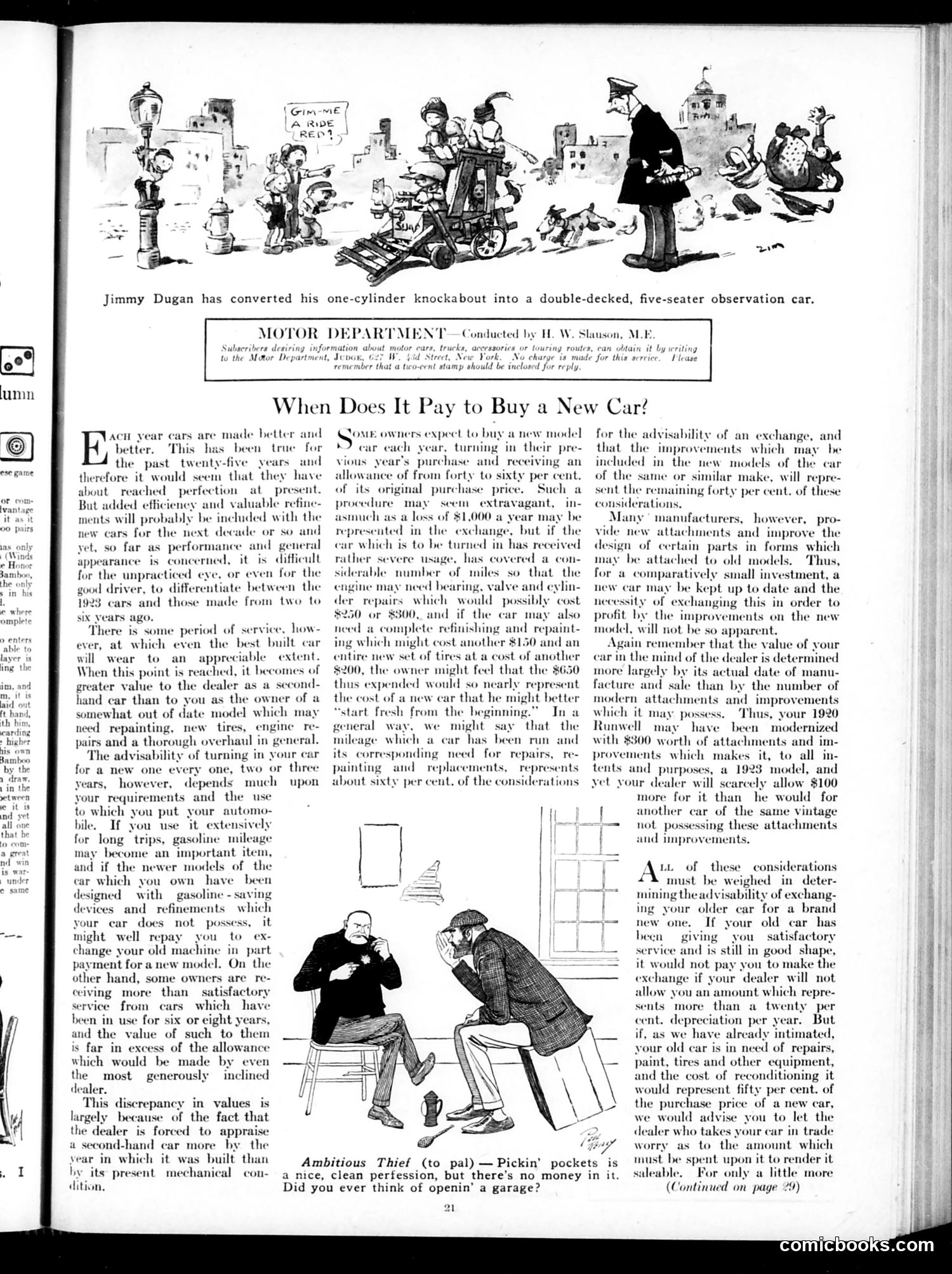
**Top Cartoon:** A satirical sketch showing Jimmy Dugan displaying his converted "one-cylinder knockabout" automobile, now modified into an elaborate "double-decked, five-seater observation car." The exaggerated contraption, crowded with passengers and absurd additions, mocks the era's automobile enthusiasm and amateur tinkering culture. **Bottom Cartoon:** Two figures sitting on chairs labeled as "Ambitious Thief" and his pal. The thief comments that picking pockets is lucrative work but unprofitable—then sarcastically suggests his friend consider "openin' a garage" instead. This is dark humor implying that running a garage/auto repair shop is equally (or more) dishonest than petty theft. **Main Article:** "When Does It Pay to Buy a New Car?" discusses the practical economics of vehicle ownership—depreciation, repair costs, and trade-in values. The satire suggests that auto dealers' and mechanics' profits rival criminal enterprise, reflecting public skepticism about the emerging automobile industry.
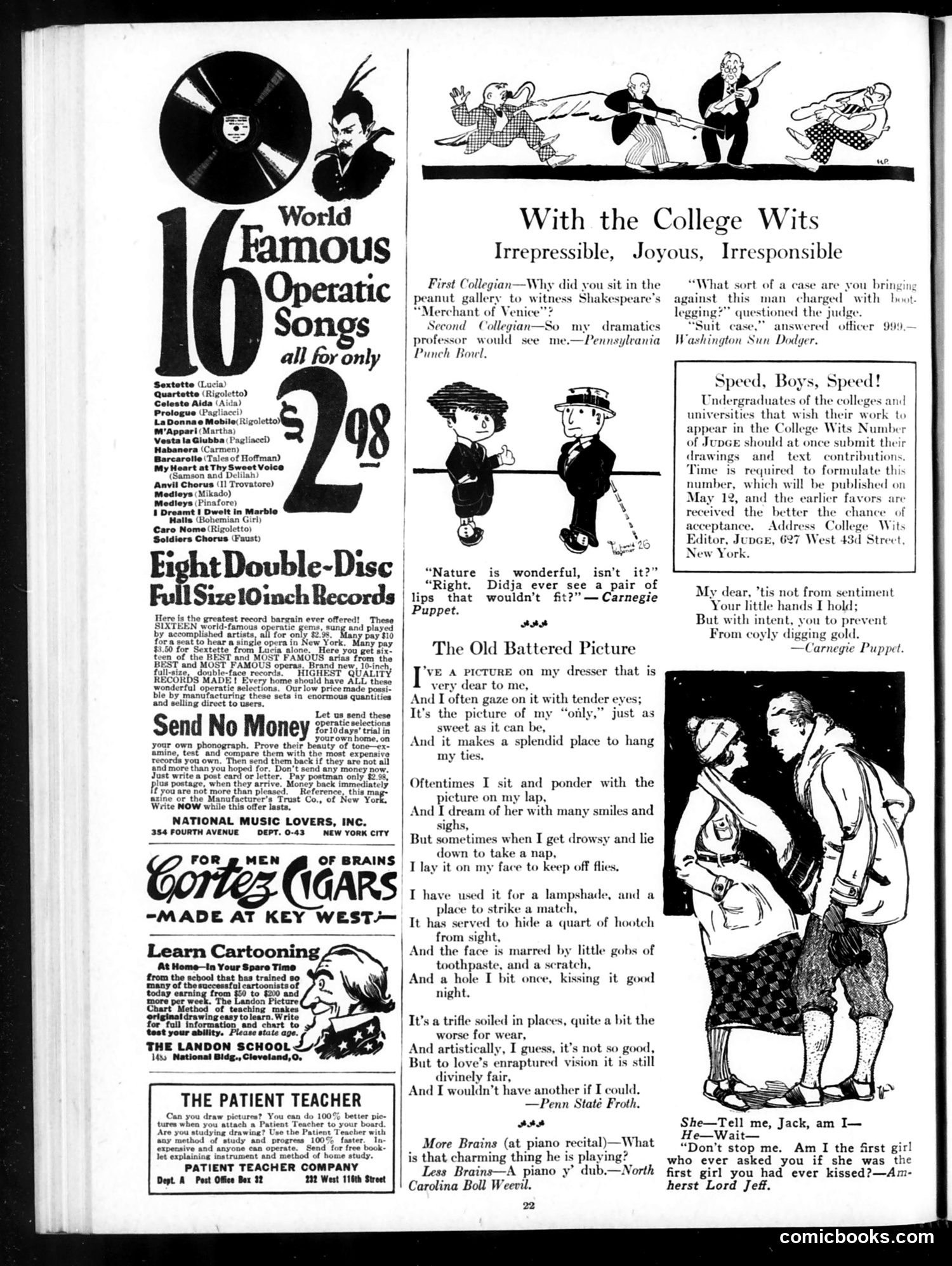
This page features **light collegiate humor** typical of Judge magazine's "College Wits" section. The main content includes: **"With the College Wits"** — A humor column presenting brief jokes and anecdotes from university students, labeled "Irrepressible, Joyous, Irresponsible." The jokes target familiar college stereotypes: students sitting in theater balconies to impress professors, and crude physical humor about romantic photographs. **"The Old Battered Picture"** — A sentimental poem about a cherished photograph of a sweetheart, undermined by the reveal that the speaker uses it for practical purposes (lampshade, fly-swatter, hiding alcohol). This satirizes the contrast between romantic idealization and practical reality—a common theme in humor of this era. **"More Brains"** — A brief joke playing on intelligence levels. The page is primarily **entertainment content** rather than political satire. The surrounding advertisements (opera records, cigars, cartooning lessons) target educated male readers. The humor reflects 1920s college culture and attitudes toward romance and prohibition-era drinking.
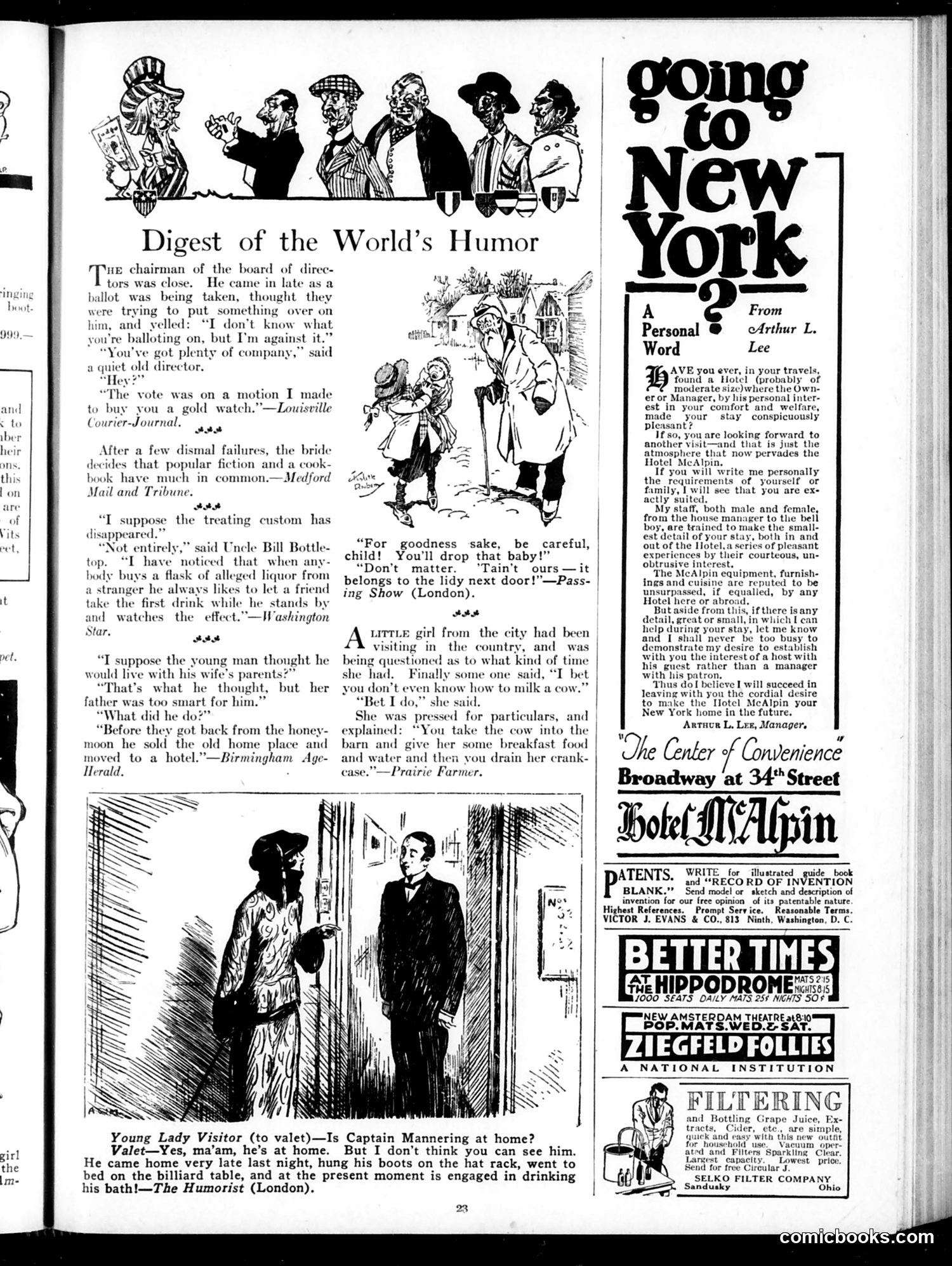
This page from *Judge* contains several short humorous anecdotes and advertisements, typical of early 20th-century satirical magazines. **The humor pieces** mock everyday social situations: a corporate board member reflexively opposing motions, a newlywed bride comparing cooking to fiction, and a drunk Captain Mannering arriving home in absurd disarray (boots on hat rack, sleeping on billiard table, drinking his bathwater). These jokes rely on physical comedy and character types recognizable to contemporary readers. **The main advertisement** is for the Hotel McAlpin, with manager Arthur L. Lee promising personalized service—a selling point suggesting luxury hotels were competing on attentiveness rather than amenities. **The cartoon** (bottom left) depicts a valet explaining the Captain's whereabouts to a visiting woman, the humor deriving from the valet's deadpan delivery of increasingly ridiculous details. The page reflects pre-Prohibition-era drinking culture and depicts class dynamics between servants and upper-class patrons as comedy fodder.
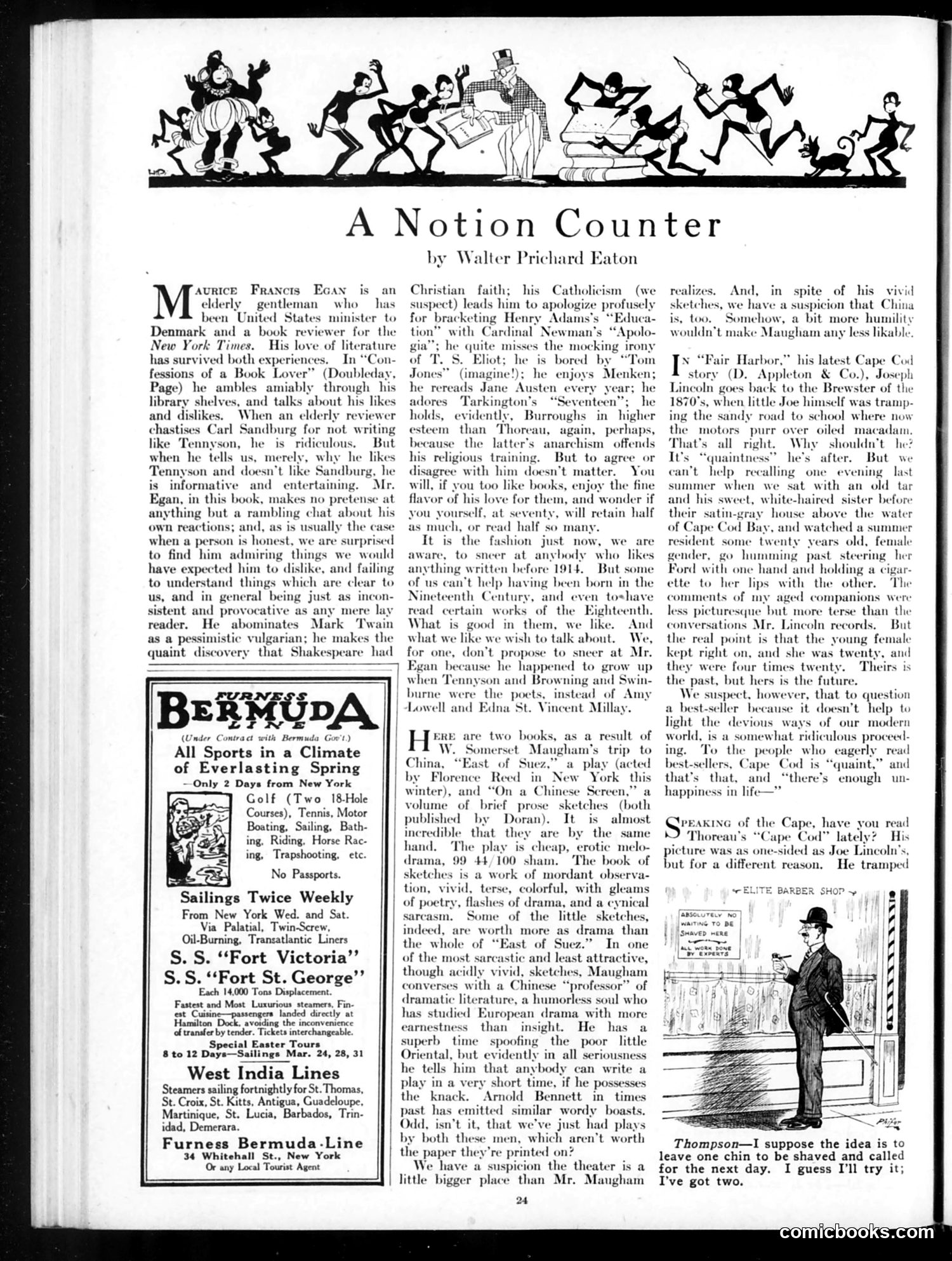
This page is primarily a **book review essay** by Walter Prichard Eaton, not a political cartoon. The small illustration on the right shows a man reading newspapers/documents—a generic image of literary criticism rather than satire. The essay defends Maurice Francis Egan, an elderly former U.S. minister and book reviewer, against implicit criticism for his old-fashioned literary tastes. Eaton argues that Egan's honest, rambling reflections on literature—praising Victorian poets like Tennyson and Browning, disliking Mark Twain—remain valuable despite being unfashionable. The satire is **gentle generational critique**: Eaton mocks the contemporary fashion of dismissing all pre-1914 literature as obsolete, defending readers who enjoyed classical works simply because they were born before modernism. The "notion counter" title suggests Egan's essays are collections of personal thoughts rather than authoritative criticism. The page also contains **travel advertisements** for Bermuda and Caribbean steamship lines.
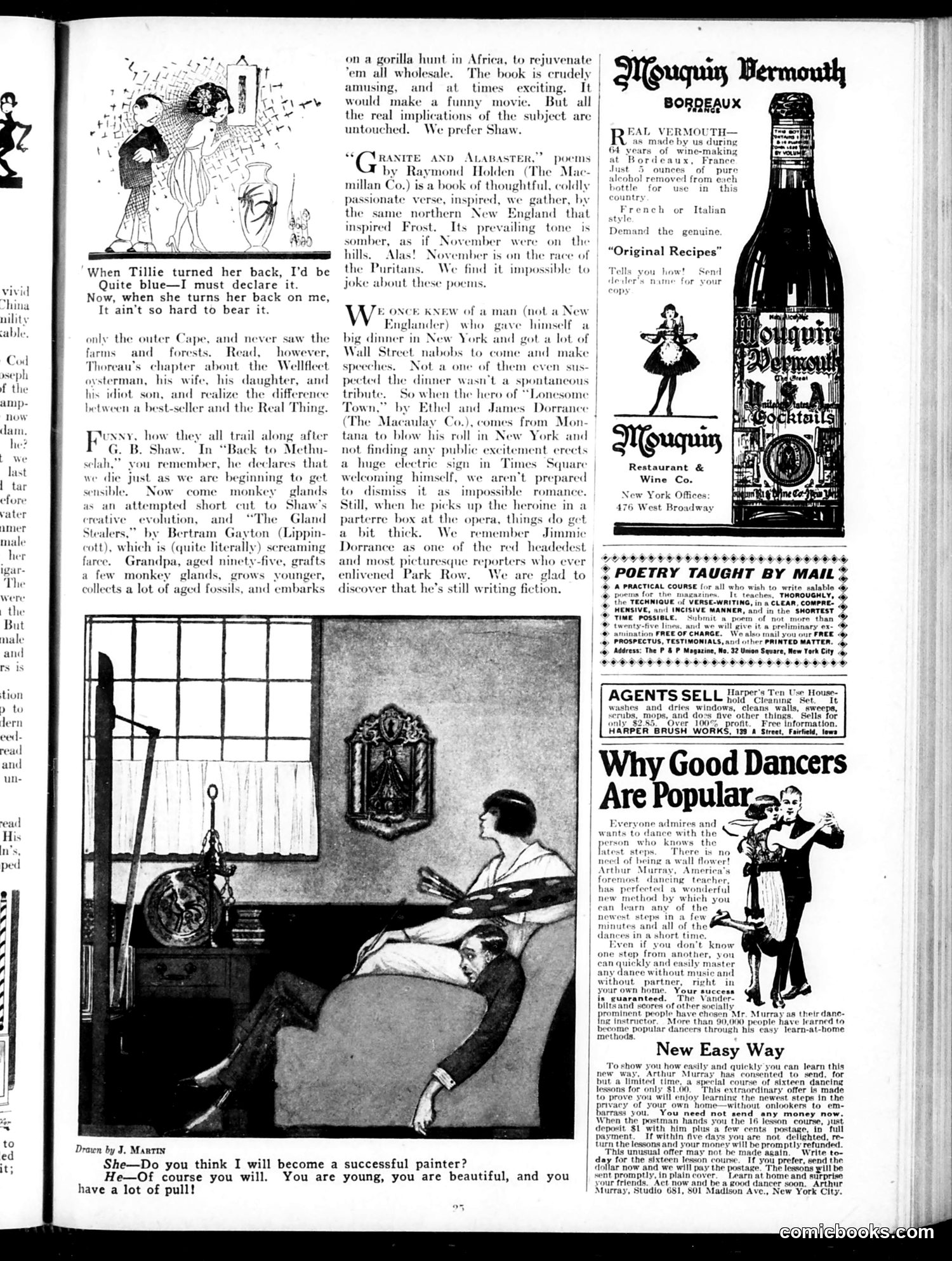
This page contains a humorous illustration captioned by J. Martis depicting a flirtation scenario. A woman asks a man if she'll become a successful painter; he replies she will because she's "young," "beautiful," and has "a lot of pull"—a period phrase meaning social influence or connections. The joke satirizes how success in arts and society often depends on attractiveness and social connections rather than talent, mocking both the superficiality of romantic flattery and the gatekeeping of artistic professions. The page also features book reviews discussing literary works and several advertisements (Mouquin vermouth, dance instruction, poetry courses, and cleaning brushes), typical of Judge's mixed editorial-advertising format. The reviews discuss contemporary novels with some satirical commentary on American literary trends and society.
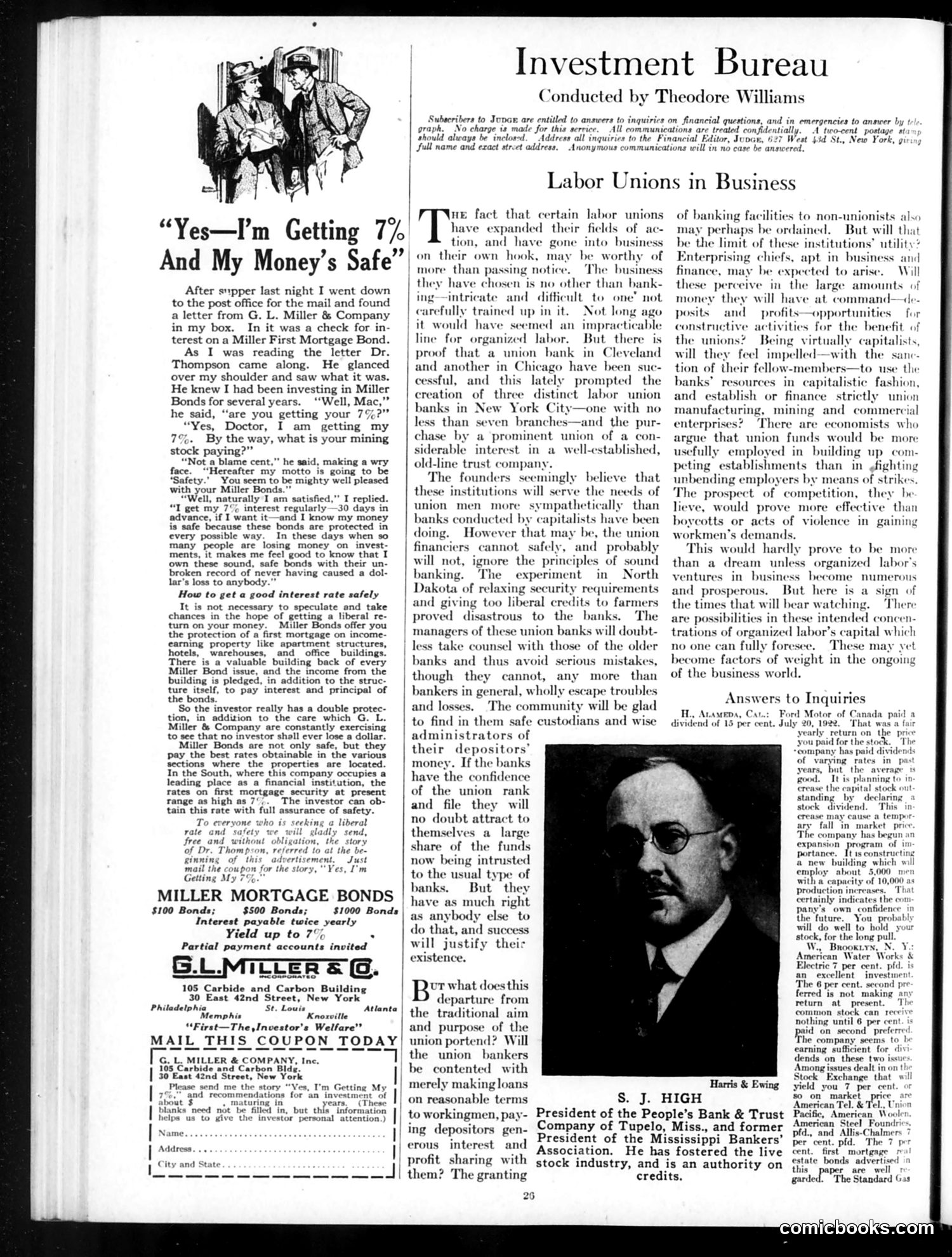
This page is primarily **advertising disguised as editorial content**. The cartoon and accompanying story promote Miller Mortgage Bonds by presenting a fictional dialogue between satisfied investor and skeptical doctor. **The Satire:** The humor targets speculation-fever and risky investments popular in the pre-1929 era. The doctor's mining stock yields "not a blame cent," while the conservative bondholder enjoys steady 7% returns. The implicit joke mocks those chasing get-rich-quick schemes rather than safe, reliable investments. **The Message:** Miller Bonds are positioned as the "sensible" alternative—backed by actual real estate (apartments, hotels, warehouses), not speculation. The repeated emphasis on "safety" and "never having caused a dollar's loss" suggests widespread anxiety about investment security. **Context:** This reflects early 20th-century finance before SEC regulation (1934). First-mortgage bonds on income property were considered legitimately safe investments compared to mining stocks or railroad speculation. The adjoining "Labor Unions in Business" column critiques union banks entering commercial enterprise—suggesting organized labor's economic expansion concerned establishment observers.
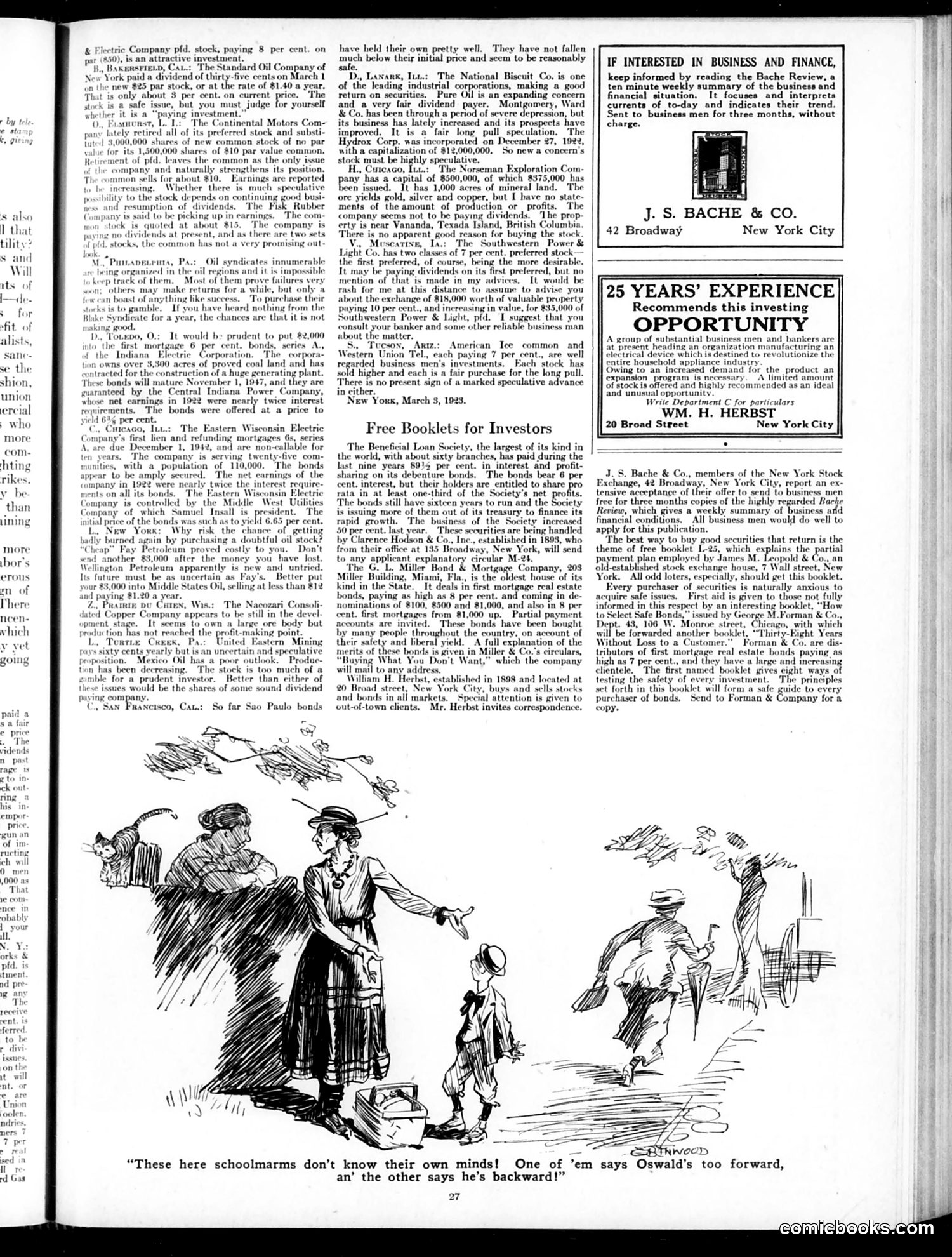
This page mixes financial advice with a political cartoon. The main illustration by Cesare (visible signature) depicts a scene with poorly dressed figures—appearing to represent working-class or immigrant "schoolmarms" (teachers)—being directed by well-dressed authority figures, suggesting confusion or manipulation of the ignorant masses. The caption's joke—"One of 'em says Oswald's too forward, an' the other says he's backward!"—satirizes political disagreement, likely referencing contemporary political divisions. "Oswald" appears to reference a contemporary political figure (unclear which without additional context). The surrounding text comprises investment advice and corporate analyses, reflecting Judge's dual purpose as both satirical commentary and financial guidance for affluent readers. This juxtaposition—mocking working-class confusion while offering investment tips—reflects the magazine's audience: educated, wealthy businessmen observing the "lower classes" with bemused superiority. The overall message: ordinary people are intellectually incapable; trust experts (and invest accordingly).
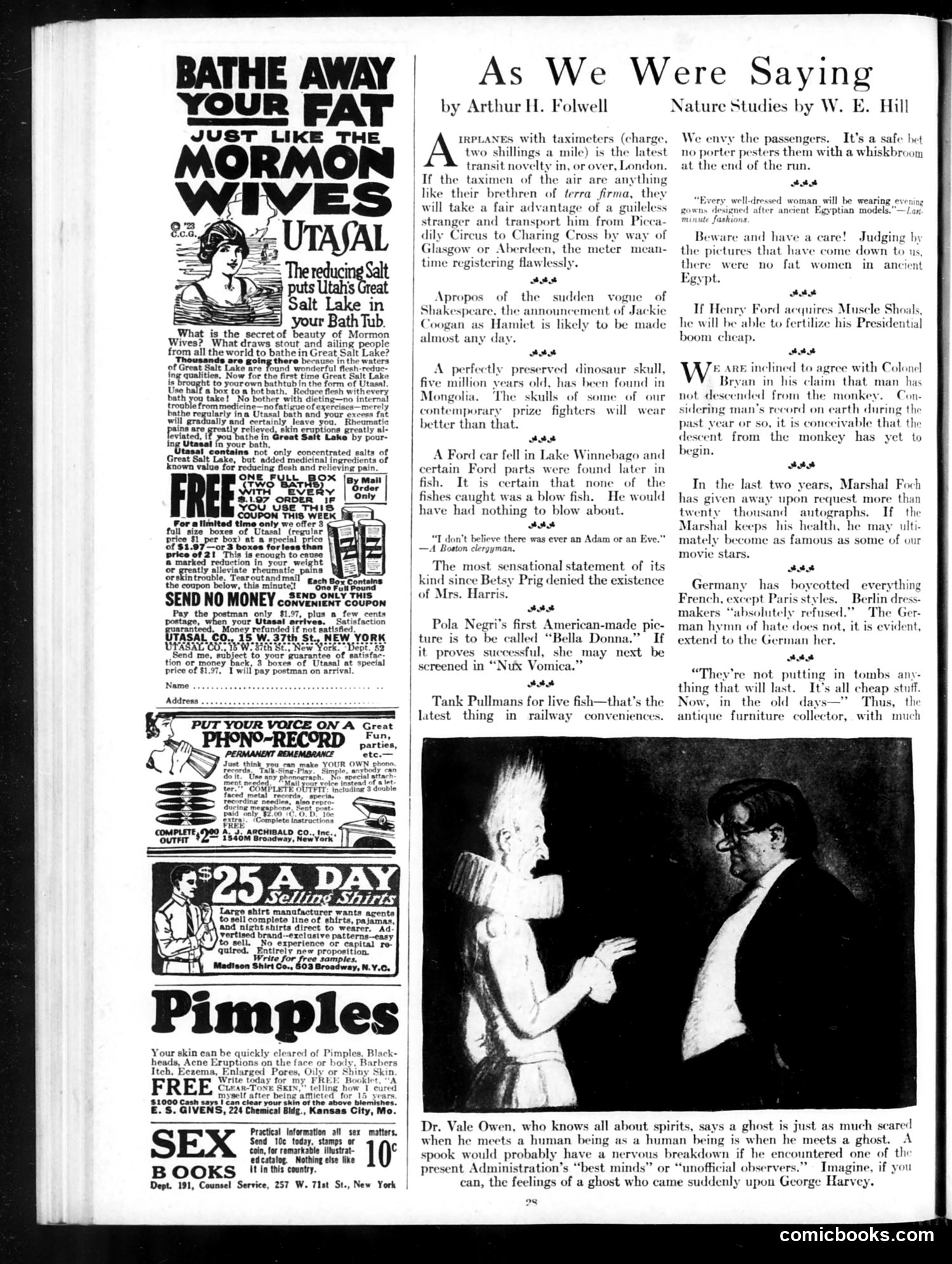
This page mixes advertisements with satirical commentary typical of early 20th-century Judge magazine. **The Cartoon/Advertisement:** The large left section advertises "Utasal," a Great Salt Lake bath product promising weight loss. It humorously invokes "Mormon Wives" as evidence of the product's effectiveness—a cultural stereotype about polygamy and physical appearance. The satire plays on period anxieties about obesity and pseudoscientific health remedies. **"As We Were Saying" Column:** Arthur H. Folwell's brief satirical observations mock contemporary absurdities: - London taxicabs with meters (referencing taxi drivers' dishonesty) - Jackie Coogan cast as Hamlet (likely mocking child actors in serious roles) - A dinosaur skull discovery contrasted with modern "prize fighters'" intelligence - A Ford car in a lake—joking that fish wouldn't be "blow fish" (unproven slang) The column targets modern conveniences, casting trends, and technology's pretensions through wry one-liners. The bottom right photo and caption reference spiritualism discussions. **Overall:** Typical Judge content—mixing dubious product pitches with cultural satire aimed at educated readers who'd recognize the references.
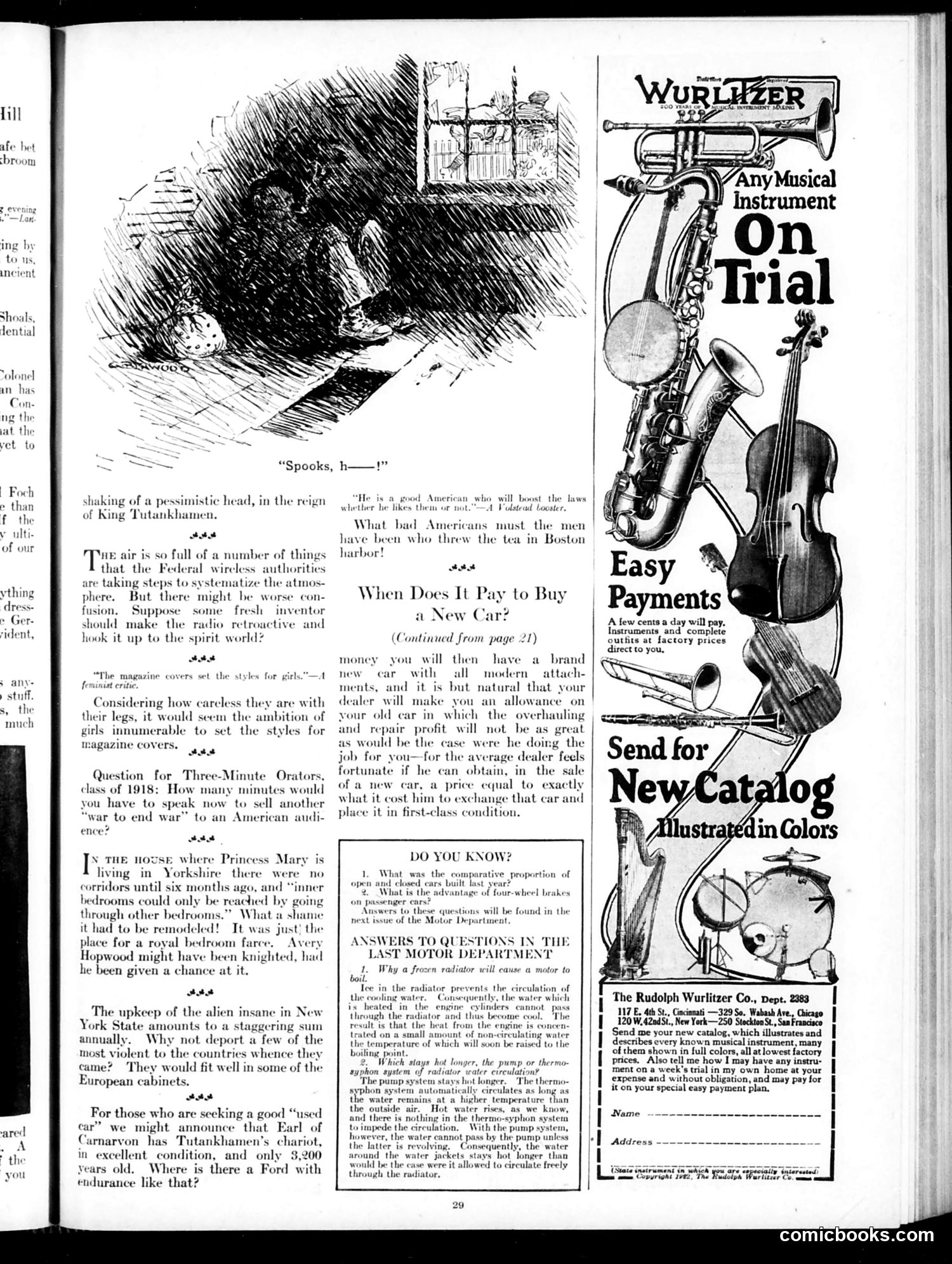
This page contains several satirical pieces typical of Judge's post-WWI era content, plus advertisements. **The Cartoons/Humor:** The left side features a sketch labeled "Spooks, h—!" depicting a ghost, likely referencing spiritualism's popularity during the 1920s. The accompanying text jokes that if wireless authorities could regulate the atmosphere, someone might make it "retroactive" and connect it to the spirit world—satirizing both wireless regulation enthusiasm and the era's fascination with séances. Other brief satirical pieces mock: - Magazine cover culture and women's fashion obsessions - The futility of anti-war rhetoric (asking how to sell another "war to end war") - Tutankhamen's tomb discovery (recently opened 1922), joking that the Earl of Carnarvon owns his chariot—a contemporary reference to King Tut's artifacts - Immigration policy regarding institutionalized aliens **The Advertisements:** The right side features Wurlitzer musical instruments advertising trial purchases with easy payments—standard commercial content. The satire reflects 1920s American preoccupations: modernization, consumer culture, and recent historical events.
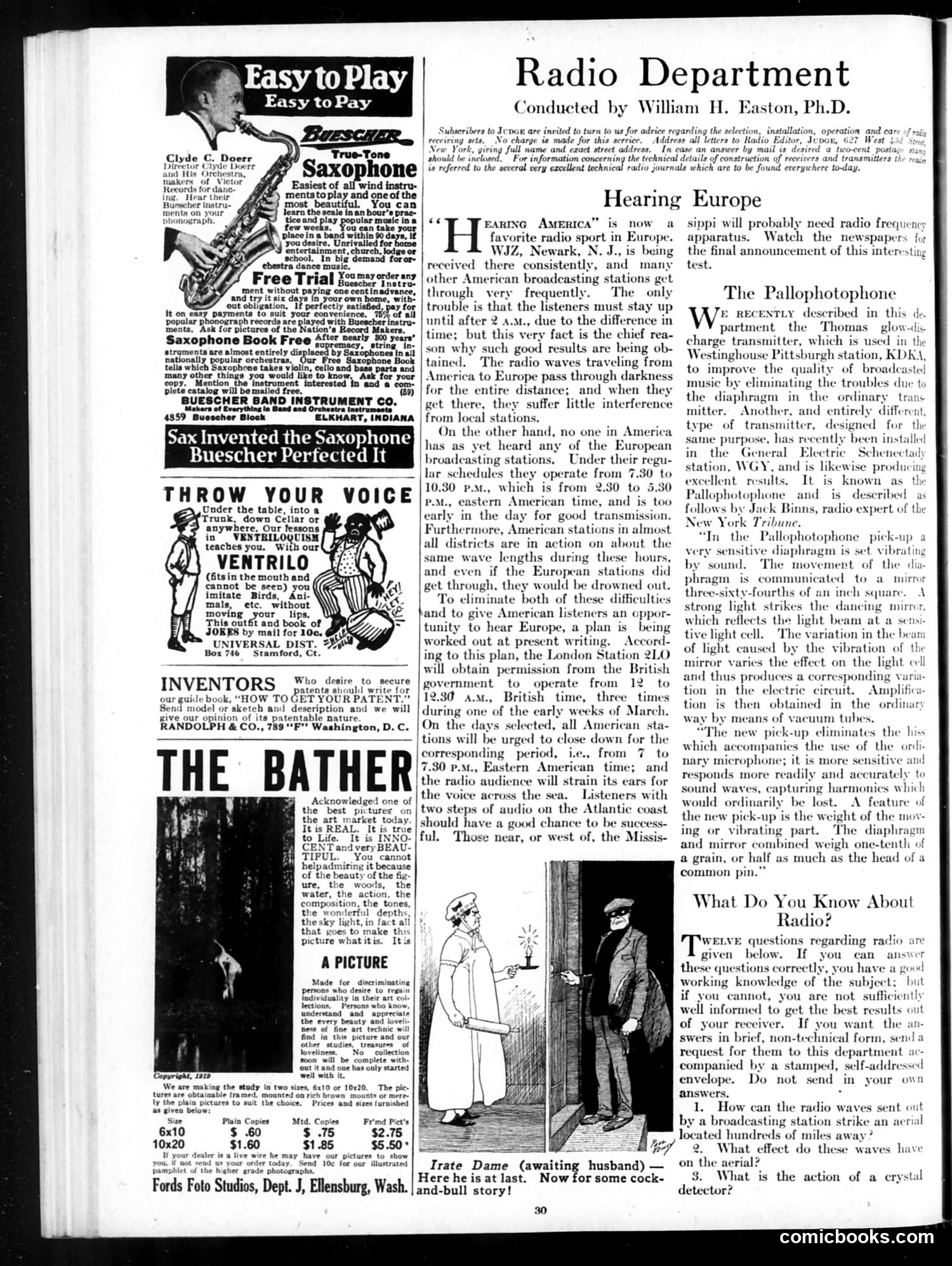
This page mixes advertisements with educational radio content. The dominant visual is "The Bather," a classical nude art study being sold as framed prints—marketed as legitimate fine art ("INNOCENT and very BEAUTIFUL") to prospective buyers. The **Radio Department** section, by William H. Easton, Ph.D., addresses early 1920s radio reception. It explains why Americans can hear European broadcasts from WJZ Newark but Europeans struggle hearing American stations—Europeans must listen after 2 a.m. due to time differences, while American stations broadcast on overlapping frequencies during European evening hours, causing interference. The surrounding advertisements promote musical instruments (saxophones), ventriloquism kits, and patent services—typical early-20th-century magazine fare targeting hobbyists and entrepreneurs.
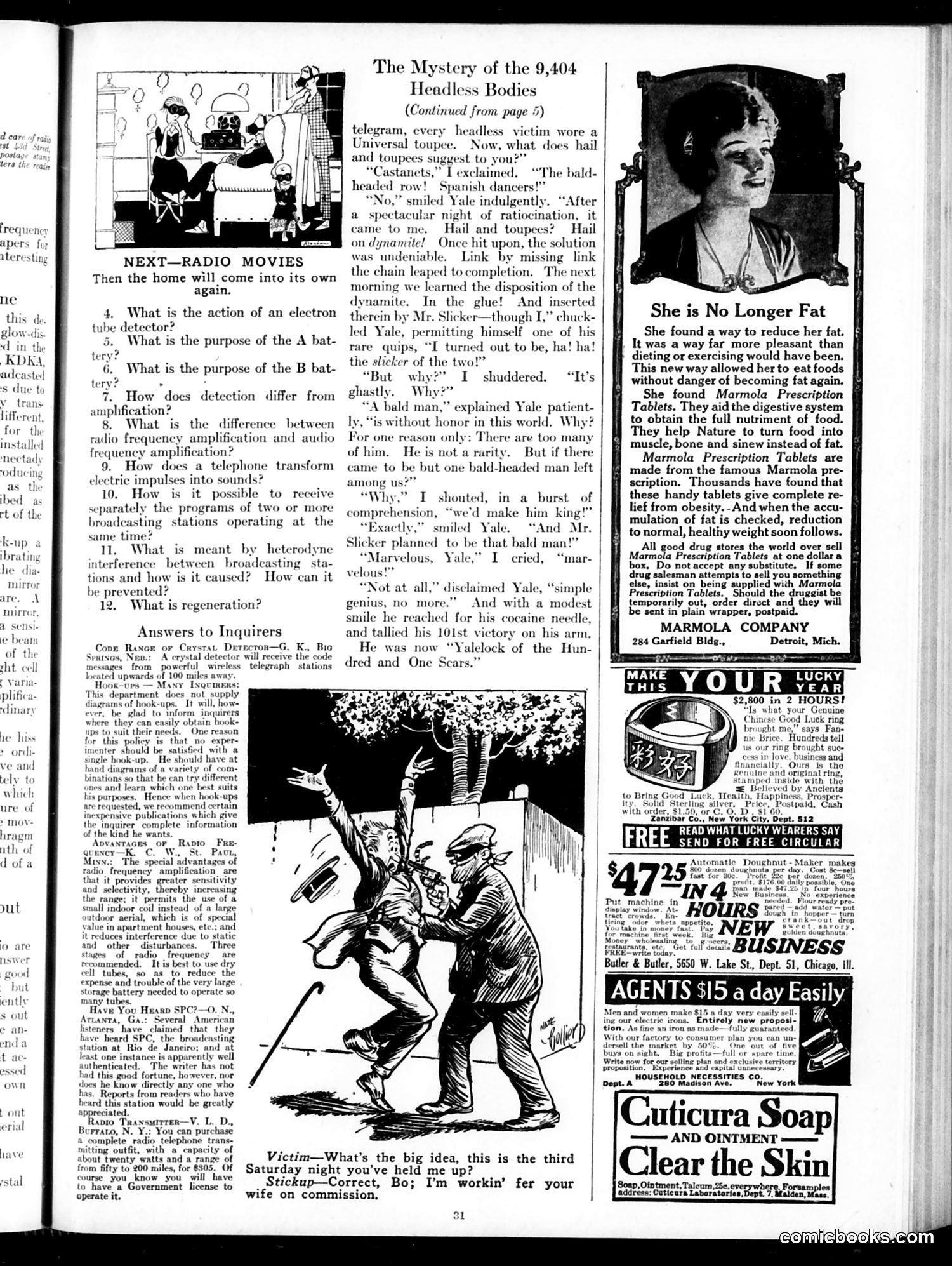
This page from Judge magazine contains several unrelated elements typical of a satirical periodical from the early radio era (appears to be 1920s): **Main Mystery Story:** "The Mystery of the 9,404 Headless Bodies" is a serialized fiction piece. The dialogue suggests a detective yarn involving clues about "hail and toupees" leading to a criminal plot—likely a pulp-fiction parody common to the magazine. **Radio Jokes Section:** Educational Q&A mocking the confusing new technology of radio, poking fun at readers struggling to understand electron tubes, batteries, and frequency amplification. **Cartoons:** The lower cartoon depicts a mugger explaining he's robbing the same victim three times because he's "working for your wife on commission"—likely satirizing women's economic dependence or predatory credit schemes of the era. **Advertisements:** Weight-loss pills and radio-building kits represent common 1920s marketing targeting both anxieties and new technological enthusiasm. The satire targets emerging consumer culture, public confusion about technology, and economic/gender dynamics of the period.
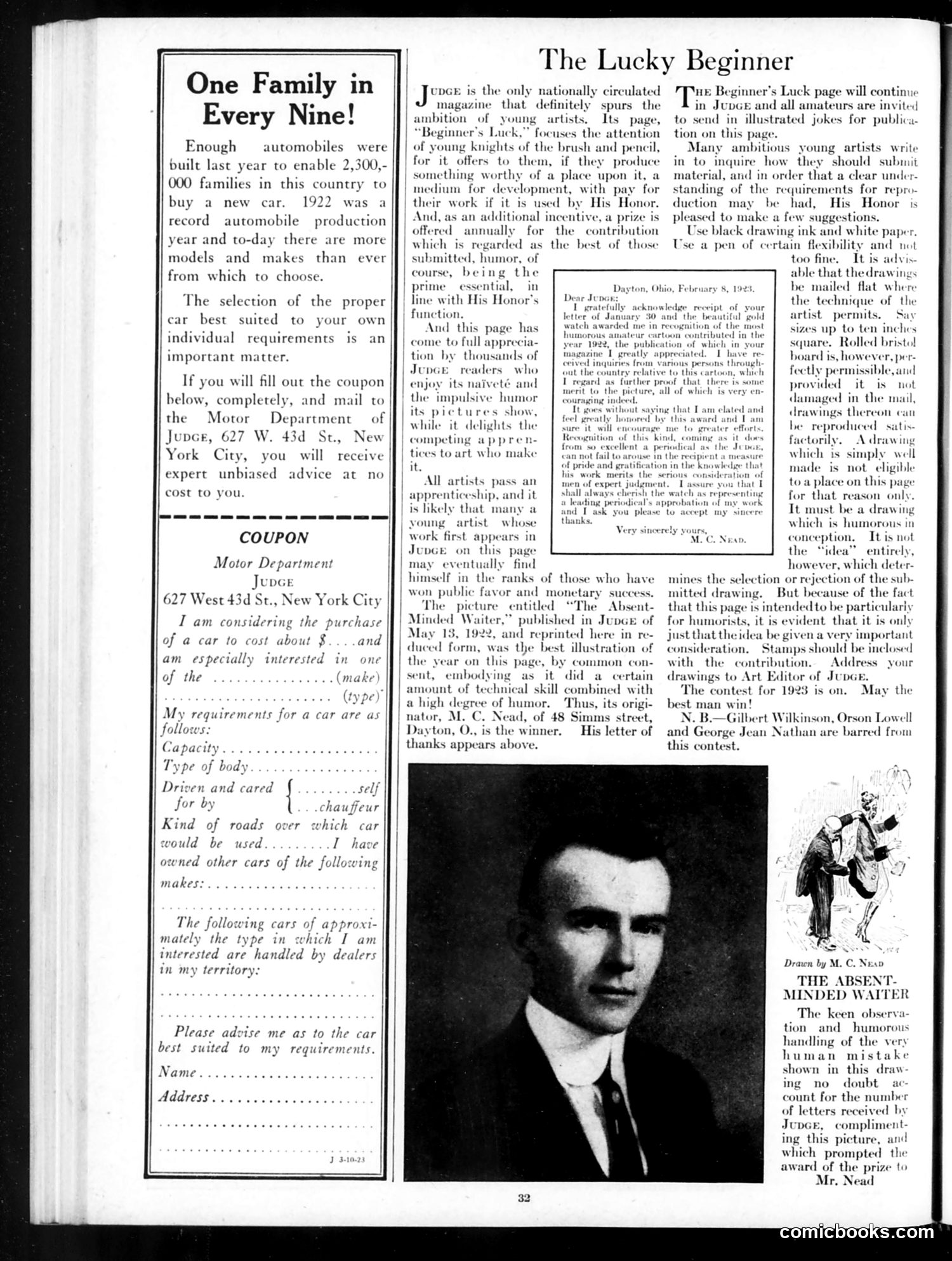
This page promotes Judge magazine's "Beginner's Luck" feature, which encourages young artists to submit humorous drawings for publication and annual prizes. The main content explains submission guidelines to aspiring cartoonists. The featured winning illustration, "The Absent-Minded Waiter," was drawn by M.C. Nead of Dayton, Ohio, and selected as the best contribution of the year. His letter of thanks is reproduced above his portrait photograph. The left side contains an automobile advertisement coupon—typical of 1920s Judge content—inviting readers to request car-buying advice from the Motor Department. The satire here is gentle: Judge positions itself as a supporter of young artistic talent while maintaining rigorous standards (drawings must be humorous *and* technically skilled). The page represents how magazines like Judge functioned as both entertainment and a practical launching pad for aspiring illustrators and cartoonists.
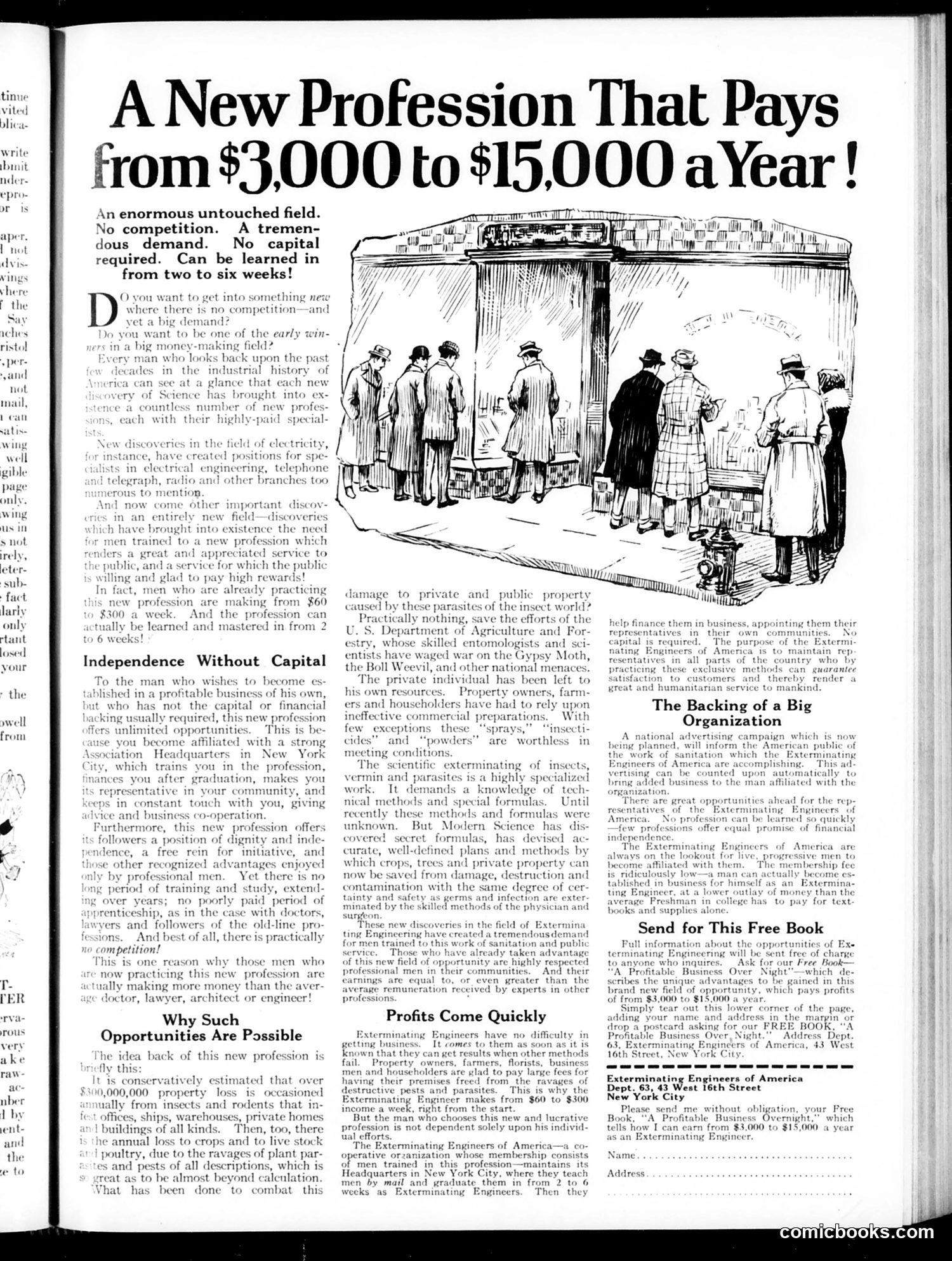
This is primarily an **advertisement disguised as editorial content**, promoting a career in pest extermination (specifically, "Exterminating Engineers"). The accompanying cartoon shows well-dressed clients consulting with an exterminator about insect infestations. The satire is subtle: Judge presents this as a "new profession" offering independence and wealth ($3,000-$15,000 annually—substantial for the era) with minimal training required. The pitch emphasizes that it's an "untouched field" with "no competition." The humor lies in the **aggressive sales language** applied to pest control. The text earnestly describes exterminating insects as a specialized science requiring knowledge, while simultaneously promoting it as an easily-learned money-making scheme requiring only 2-6 weeks of training. The underlying joke: Judge is gently mocking both the profession's inflated self-importance and the American tendency to package mundane work with grandiose language and promises of quick wealth. By treating bug-killing as a dignified "profession," the magazine satirizes contemporary get-rich-quick schemes and occupational pretension.
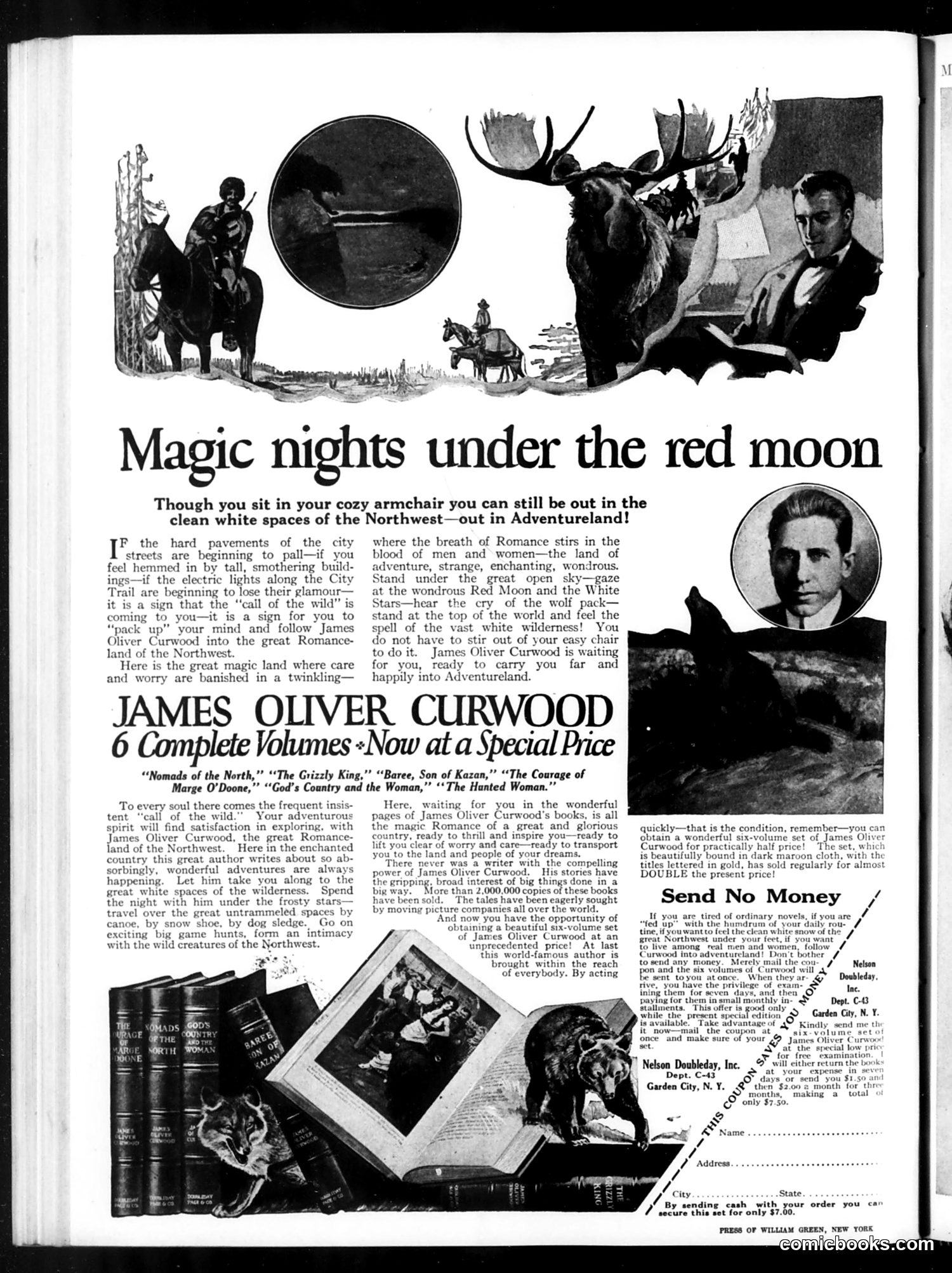
This is primarily a book advertisement, not a political cartoon. It promotes a six-volume collection of James Oliver Curwood's adventure novels set in the Canadian Northwest. The "satire" is gentle marketing rhetoric: the ad appeals to urban readers feeling trapped by city life ("hard pavements," "tall, smothering buildings") and promises escape into romantic wilderness adventure through Curwood's stories. The imagery—wolves, moose, indigenous people, frontier scenes—romanticizes the North as an exotic escape. The call-to-action uses urgency ("acting quickly") and affordability (half-price at $7.00, or payment plans available) to convince readers they can vicariously experience wilderness adventure from their armchair. This reflects early 20th-century popular fascination with frontier adventure fiction and the cultural anxiety about modern urban life being spiritually suffocating. The ad positions reading as a form of psychological escape.