
Judge, 1923-03-10 · page 5 of 36
Judge — March 10, 1923 — page 5: what you’re looking at
What you’re looking at
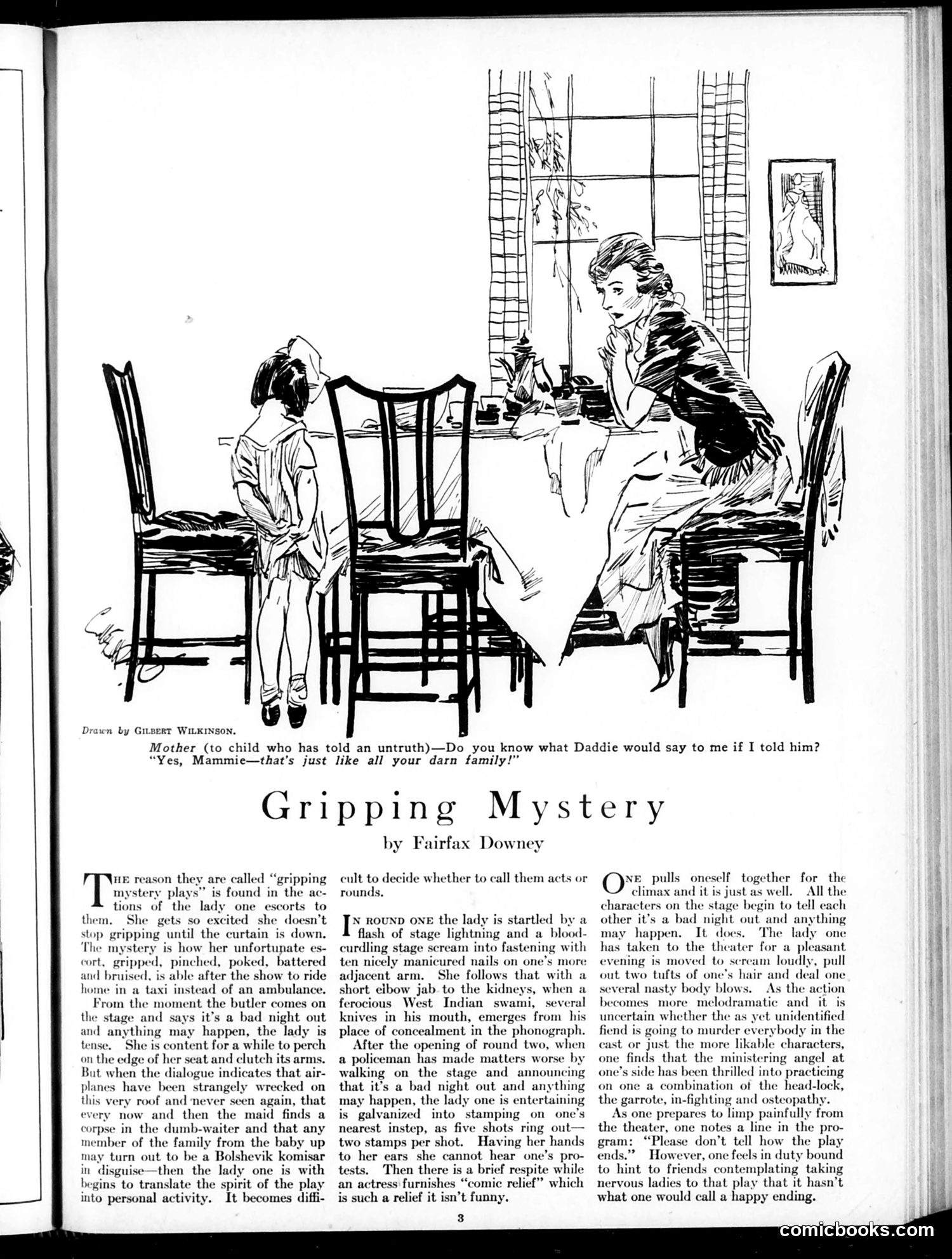
This page features an illustration by Gilbert Wilkinson accompanying a short story by Fairfax Downey about theatrical "gripping mysteries"—stage plays designed to startle and frighten audiences. The cartoon shows two women in what appears to be a dressing room or backstage area. The dialogue reveals a domestic humor angle: a mother warns her daughter that if she tells an untruth, "Daddie would say to me if I told him" that "that's just like all your darn family!" The accompanying article explains how these mystery plays work—using sudden stage lighting, bloodcurdling screams, and physical violence (described as "nasty blow blows") to create theatrical tension and uncertainty about which character might be the villain. It's satire on popular melodramatic entertainment of the era.
📄 Transcribed text from this page (OCR, searchable)
Machine-transcribed from the original scan — historical spelling and the odd misread are preserved.
Drawn by GiLpert WILKINSON. Mother (to child who has told an untruth)—Do you know what Daddie would say to me if I told him? “Yes, Mammie—that’s just like all your darn family!” Gripping Mystery HE reason they are called “gripping stery plays” is found in the ac. tions of the lady one escorts to them, She gets so excited she doesn’t stop gripping until the curtain is down, The mystery is how her unfortunate es- cort, gripped, pinched, poked, battered and bruised, is able after t how to ride home in a taxi instead of an ambulance. From the moment the butler comes on the stage and says it’s a bad night out and anything may happen, the lady is tense. She is content for a while to perch on the edge of her seat and clutch its arms. But when the dialogue indicates that air- planes have been strangely wrecked on this very roof and never seen again, that every now and then the maid finds a corpse in the dumb-waiter and that any member of the family from the baby up may turn out to be a Bolshevik komisar in disguise—then the lady one is with begins to translate the spirit of the play into personal activity. It becomes diffi- by Fairfax Downey cult to decide whether to call them acts or rounds. N ROUND ONE the lady is startled by a flash of stage lightning and a blood- curdling stage scream into fastening with ten nicely manicured nails on one’s more adjacent arm. She follows that with a short elbow jab to the kic s, when a ferocious West Indian swami, several knives in his mouth, emerges from his place of concealment in the phonograph. After the opening of round two, when a policeman has made matters worse by walking on the stage and announcing that it’s a bad night out and anything may happen, the lady one is entertaining is galvanized into stamping on one’s nearest instep, as five shots ring out— two stamps per shot. Having her hands to her ears she cannot hear one’s pro- tests. Then there brief respite while an actress furnishes “comic relief” which is such a relief it isn’t funny. 3 O E pulls oneself together for the climax and it is just as well. All the characters on the stage begin to tell each other it’s a bad night out and anything may happen. It does. The lady one has taken to the theater for a pleasant evening is moved to scream loudly, pull out two tufts of one’s hair and deal one several nasty body blows. As the action becomes more melodramatic and it is uncertain whether the as yet unidentified fiend is going to murder everybody in the cast or just the more likable characters, one finds that the ministering angel at one’s side has been thrilled into practicing on one a combination of the head-lock, the garrote, in-fighting and osteopathy. As one prepares to limp painfully from the theater, one notes a line in the pro- gram: “Please don’t tell how the play However, one feels in duty bound to hint to friends contemplating taking nervous ladies to that play that it hasn’t what one would call a happy ending.