
Judge, 1923-03-10 · page 15 of 36
Judge — March 10, 1923 — page 15: what you’re looking at
What you’re looking at
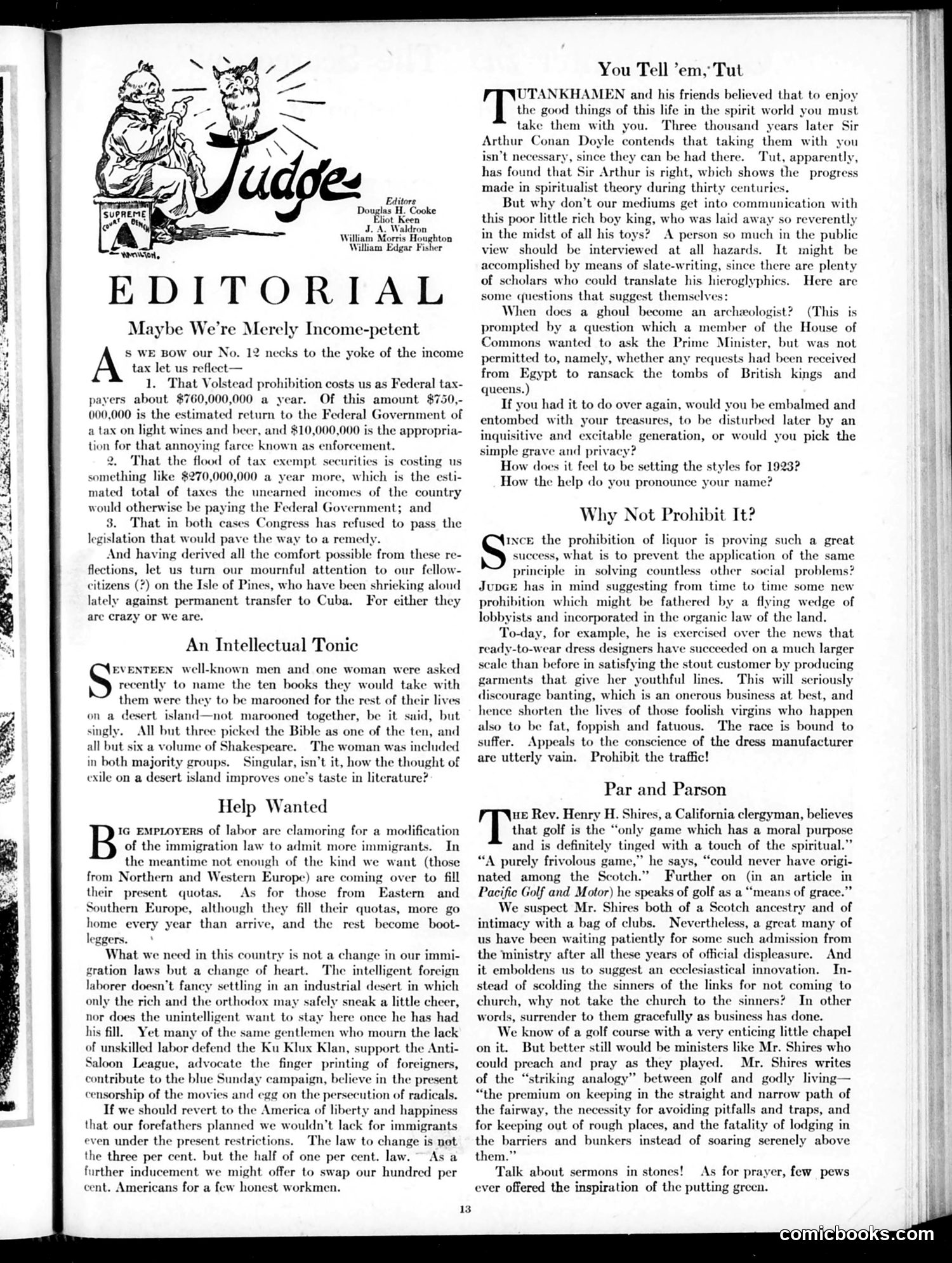
This editorial page from Judge magazine satirizes American political and social issues of the Prohibition era (likely early 1920s). **The main cartoon** at top left depicts "Tut" (Tutankhamen, the Egyptian pharaoh whose tomb was famously discovered in 1922). The accompanying article mocks spiritualists' claims about the afterlife, contrasting ancient Egyptian beliefs about taking possessions into the spirit world with modern spiritualist claims—suggesting mediums should contact King Tut if they're so capable. **The editorials** attack: - The income tax burden, particularly costs of enforcing Prohibition ($760M annually) - Congress's refusal to tax tax-exempt securities - Immigration policy contradictions: employers want cheap labor but support the Ku Klux Klan, Anti-Saloon League, and Sunday closing laws—conditions discouraging immigrant settlement - A desert-island book survey revealing people's hypocrisy about cultural taste The underlying theme: American society claims values it doesn't practice, and taxation supports enforcement of unpopular laws.
📄 Transcribed text from this page (OCR, searchable)
Machine-transcribed from the original scan — historical spelling and the odd misread are preserved.
Editors Douglas H. Cooke Eliot Keen J. A, Waldron William Morris Houghton William Edgar Fisher EDITORIAL Maybe We’re Merely Income-petent WE Bow our No. 12 necks to the yoke of the income tax let us reflect— 1. That Volstead prohibition costs us as Federal tax- payers about $760,000,000 a year. Of this amount $750,- 000,000 is the estimated return to the Federal Government of a tax on light wines and beer, and $10,000,000 is the appropria- tion for that annoying farce known as enforcement. 2. That the flood of t <empt securiti costing us something like $270,000,000. ar more, Which is the esti- mated total of taxes the unearned incomes of the country would otherwise be paying the Federal Government; and 3. That in both cases Congress has refused to pass the legislation that would pave the way to a remedy. And having derived all the comfort possible from these re- flectior let us turn our mournful attention to our fellow- citizens (?) on the Isle of Pines, who have been shrieking aloud lately against permanent transfer to Cuba. For either they are Crazy or We are. An Intellectual Tonic S VENTEEN well-known men and one woman were asked recently to name the ten books they would take with them were they to be marooned for the rest of their lives on a desert island—not marooned together, be it said, but singly. All but three picked the Bible as one of the ten, and all but si volume of Shakespeare. The woman was included in both majority groups. Singular, isn’t it, how the thought of exile on a desert island improves one’s taste in literature? Help Wanted 1G EMPLOYERS of labor are clamoring for a modification B of the immigration law to admit more immigrants. In the meantime not enough of the kind we want (those from Northern and Western Europe) are coming over to fill their present quotas. As for those from Eastern and Southern Europe, although they fill their quotas, more go home every year than arrive, and the rest become boot- leggers. What we need in this country is not a change in our immi- gration laws but a change of heart. The intelligent foreign laborer doesn’t fancy settling in an industrial desert in which only the rich and the orthodox may safely sneak a little cheer, nor does the unintelligent want to stay here once he has had his fill. Yet many of the same gentlemen who mourn the lack of unskilled labor defend the Ku Klux Klan, support the Anti- Saloon League, advocate the finger printing of foreigne contribute to the blue Sunday campaign, believe in the present censorship of the movies and egg on the persecution of radicals. If we should revert to the America of liberty and happiness that our forefathers planned we wouldn't lack for immigrants even under the present restrictions. The law to change is not the three per cent. but the half of one per cent. law. As a further inducement we might offer to swap our hundred per cent. Americans for a few honest workmen. 13 You Tell ’em, Tut ike ood things a and his friends believed that to enjoy the good things of this life in the spirit world you must take them with you. Three thousand years later Sir Arthur Conan Doyle contends that taking them with you isn’t necessary, since they can be had there. Tut, apparently has found that Sir Arthur is right, which shows the progr made in spiritualist theory during thirty centuries. But why don’t our mediums get into communication with this poor little rich boy king, who was laid a © reverently in the midst of all hi A person so much in the public view should be interviewed at all hazards. It might be accomplished by means of slate-writing, since there are plenty of scholars who could translate his hieroglyphics. Here are some questions that suggest themselves: When does a ghoul become an archeologist? (This is prompted by a question which a member of the House of Commons wanted to ask the Prime Minister, but was not permitted to, namely, whether any requests had been received from Egypt to ransack the tombs of British kings and queens.) If you had it to do over again, would you be embalmed and entombed with your treasures, to be disturbed later by an inqu e and excitable generation, or would you pick the simple grave and privacy? How does it feel to be setting the styles for 1923? How the help do you pronounce your name? Why Not Prohibit It? ince the prohibition of liquor is proving such a great success, what is to prevent the application of the same principle in solving countless other social problems? JupGe has in mind suggesting from time to time some new prohibition which might be fathered by a flying wedge of lobbyists and incorporated in the organic law of the land. To-day, for example, he is exercised over the news that ready-to-wear dress designers have succeeded on a much larger scale than before in satisfying the stout customer by producing garments that give her youthful lines. This will seriously discourage banting, which is an onerous business at best, and hence shorten the lives of those foolish virgins who happen also to be fat, foppish and fatuous. The race is bound to suffer. Appeals to the conscience of the dress manufacturer are utterly vain. Prohibit the traffic! Par and Parson Ti Rev. Henry H. Shires, a California clergyman, believes that golf is the “only game which has a moral purpose and is definitely tinged with a touch of the spiritua “A purely frivolous game,” he says, “could never have origi- nated among the Scotch.” Further on (in an article in Pacific Golf and Motor) he speaks of golf as a “means of grace.” We suspect Mr. Shires both of a Scotch ancestry and of intimacy with a bag of clubs. Nevertheless, a great many of us have been waiting patiently for some such admission from the ministry after all these years of official displeasure. And it emboldens us to suggest an ecclesiastical innovation. In- stead of scolding the sinners of the links for not coming to church, why not take the church to the sinners? In other words, surrender to them gracefully as business has done. We know of a golf course with a very enticing little chapel on it. But better still would be ministers like Mr. Shires who could preach and pray as they played. Mr. Shires writes of the “striking analogy” between golf and godly living— “the premium on keeping in the straight and narrow path of the fairway, the necessity for avoiding pitfalls and traps, and for keeping out of rough places, and the fatality of lodging in the barriers and bunkers instead of soaring serenely above them.” Talk about sermons in stones! As for prayer, few pews ever offered the inspiration of the putting green.