
Judge, 1923-03-10 · page 19 of 36
Judge — March 10, 1923 — page 19: what you’re looking at
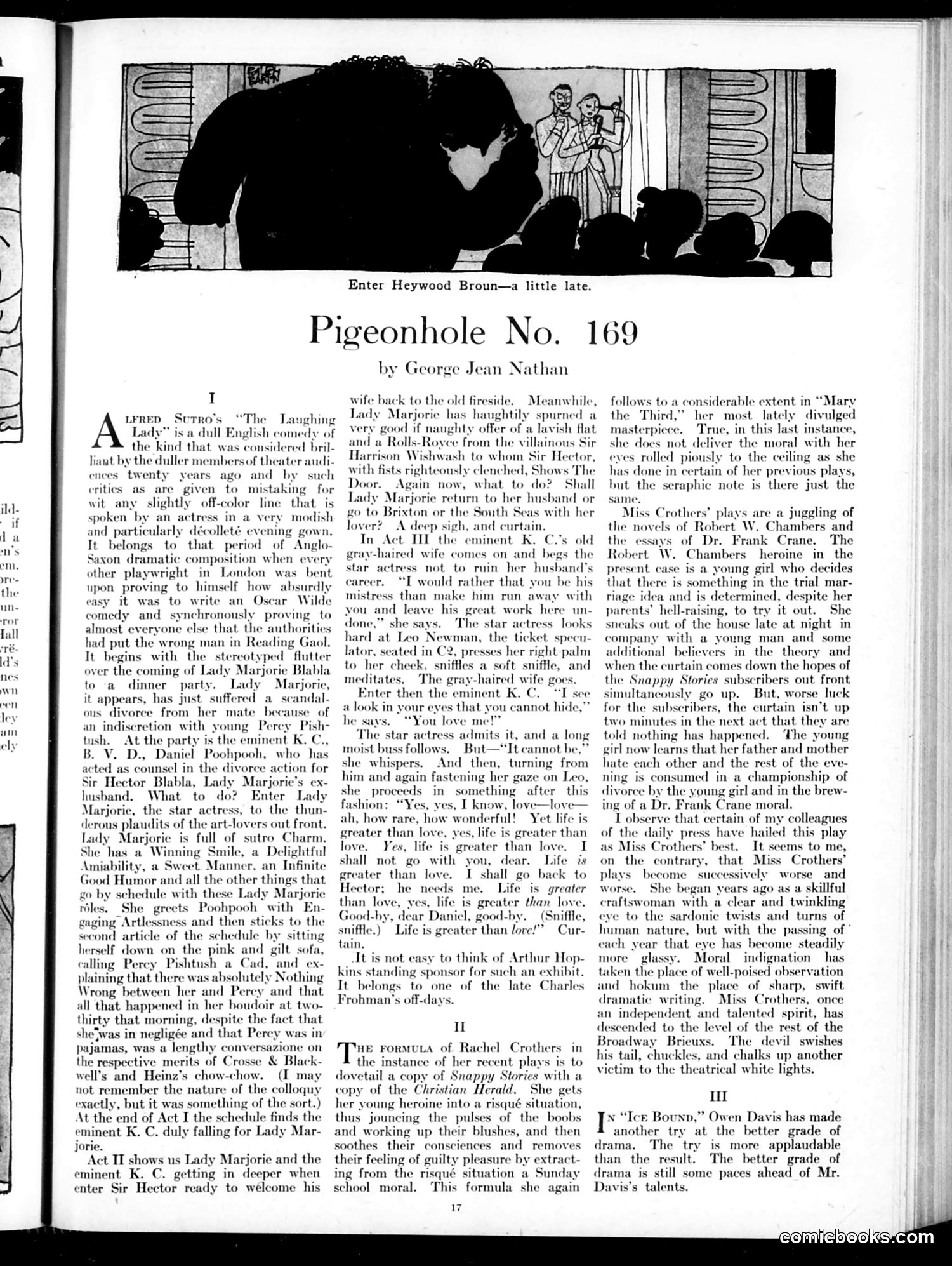
What you’re looking at
This is drama criticism by George Jean Nathan reviewing "The Laughing Lady," a mediocre English comedy. The silhouetted cartoon above shows an actor (likely the portly Heywood Broun, a famous theater critic, entering late—the caption's joke) witnessing a melodramatic stage scene. Nathan mocks the play's tired conventions: contrived domestic scandal, stock characters with ridiculous names (Poohpooh, Pishtush), and hackneyed dialogue about love versus duty. The plot—a society woman caught between her husband, a lawyer, and a lover—exemplifies what Nathan sees as derivative pseudo-Wilde drivel from an outdated theatrical era. The criticism targets both the play's formulaic sentimentality and audiences who applaud such work. Nathan's sarcastic tone and absurdist character names emphasize how predictable and uninspired the production is—precisely the kind of "dull English comedy" that depends on pretty actresses in fashionable gowns rather than genuine wit.
📄 Transcribed text from this page (OCR, searchable)
Machine-transcribed from the original scan — historical spelling and the odd misread are preserved.
Enter Heywood Broun—a little late. Pigeonhole No. 169 I FRED) Sutro’s “The Laughing Lady” is a dull English comedy of the kind that was considered bril- liaut by the duller membersof theater audi- cnees twenty years ago and by such critics as are given to mistaking for wit any slightly off-color line that is spoken by an actress in a very modish and particularly décolleté evening gown. It belongs to that period of Anglo- Saxon dramatic composition when every other playwright in London was bent upon proving to himself how absurdly easy it was to write an Oscar Wilde comedy and synchronously proving to almost everyone else that the authorities had put the wrong man in Reading Gaol. It begins with the stereotyped flutter over the coming of Lady Marjorie Blabla to a dinner party. Lady Marjorie, it appears, has just suffered a scandal- ous divorce from her mate because of an indiscretion with young Percy Pish- tush. At the party is the eminent K. C., B. V. D., Daniel Poohpooh, who has acted as counsel in the divorce action for Sir Hector Blabla, Lady Marjorie’s ex- husband. What to do? Enter Lady Marjorie, the star actress, to the thun- derous plaudits of the art-lovers out front. Lady Marjorie is full of sutro Charm, She has a Winning Smile, a Delightful Amiability, a Sweet. Manner, an Infinite Good Humor and all the other things that go by schedule with these dy Marjorie She greets Poohpooh | with En- ing Artlessness and then sticks to the second article of the schedule by sittin herself down on the pink and gilt s calling Perey Pishtush a 1, and ex- plaining that there was absolutely Nothing Wrong between her and Percy and that all that happened in her boudoir at two- thirty that morning, despite the at in negligée and that Percy was in a lengthy © i pective merits of Crosse well’s and Heinz’s chow-chow. (I may not remember the nature of the colloquy exactly, but it was something of the sort.) At the end of Act I the schedule finds the eminent K. C. duly falling for Lady Mar- jorie. Act II shows us Lady Marjorie and the eminent K. C. getting in deeper when enter Sir Hector ready to wélcome his by George Jean Nathan wife back to the old fire Meanwhile, Lady Marjorie has ha y spurned a very good if naughty offer of a lavish flat and a Rolls-Royce from the villainous Sir Harrison Wishwash to whom Sir Hector, with fists righteously clenched, Shows The Door. Again now, what to do? Shall Lady Marjorie return to her husband or go to Brixton or the South Seas with her lover? A deep sigh, and curtain. In Act TIT the eminent K. C.’s old ay-haired wife comes on and begs the actress not to ruin her husband's career. “I would rather that you be his mistress than make him run away with work here un- actress looks hard at Leo Newman, the ticket specu- lator, seated in C2, presses her right palm to her cheek, sniffles a soft sniffle, and meditates. The gray-haired wife goes. Enter then the eminent K. C. “I a look in your eyes that you cannot hid he says. ou love me!” The star actress admits it, and a long moist buss follows. But—*It cannot be,” she whispers. And then, turning from him and again fastening her gaze on Leo, she proce in something after this fashion: ‘Yes, yes, I know, love—love— ah, how rare, how wonderful! Yet life is greater than love, yes, life is greater than love. Yes, life is greater than love. I shall not go with you, dear. Life is er than love. I shall go back to r; he needs me. Life is greater than love, yes, life is greater than love. Good-by r Daniel, good-by. (Sniffle, sniffle.) Life is greater than lore!” Cur- tain. It is not easy to think of Arthur Hop- kins standing sponsor for such an exhibit. It belongs to one of the late Charles Frohman’s off-days. II Te ForMULA of. Rachel Crothers in the instance of her recent plays is to dovetail a copy of Snappy Stories with a copy of the Christian Herald. She gets her young heroine into a risqué situation, thus jouncing the pulses of the boobs and working up their blushes, and then soothes their consciences and removes their feeling of guilty pleasure | act- ing from the risqué situation a Sunday school moral. This formula she again 7 a considerable extent in “Mary the Third,” her most lately divulged masterpiece. ‘True, in this last instance, she does not deliver the moral with her eyes rolled piously to the ceiling as she has done in certain of her previous plays, but the seraphic note is there just. the same. Miss Crothers’ plays are a juggling of the novels of Robert W. Chambers and the essays of Dr. Frank Crane, The Robert W. Chambers heroine in the present case is a young girl who decides that there is something in the trial mar- riage idea and is determined, despite her parents’ hell-raising, to try it out. She sneaks out of the house late at night in company with a young man and some additional believers in the theory and when the curtain comes down the hopes of the Snappy Stories subscribers out front simultancously go up. But, worse luck for the subscribers, the curtain isn’t up two minutes in the next act that they are told nothing has happened. The young girl now learns that her father and mother hate each other and the rest of the eve- ning is consumed in a championship of divorce by the young girl and in the brew- ing of a Dr. Frank Crane moral. I observe that certain of my colleagues of the daily press have hailed this as Miss Crothers’ best. It seems to on the contrary, that Miss Crothers’ plays become successively worse and worse. She began years ago as a skillful craftswoman with a clear and twinkling eye to the sardonic twists and turns of human nature, but with the passing of cach year that eye has become steadily more glassy. Moral indignation has taken the place of well-poised observation and hokum the place of sharp, swift dramatic writing. Miss Crothers, once an independent and talented spirit, has descended to the level of the rest of the Broadway Brieuxs. The devil sv his tail, chuckles, and chalks up ar victim to the theatrical white lights. follows t ther il Ice Bounp,” Owen Davis has made nother try at the better grade of ma. The try is more applaudable than the result. The better grade of drama is still some paces ahead of Mr. Dav talents.