
Judge, 1923-03-10 · page 17 of 36
Judge — March 10, 1923 — page 17: what you’re looking at
What you’re looking at
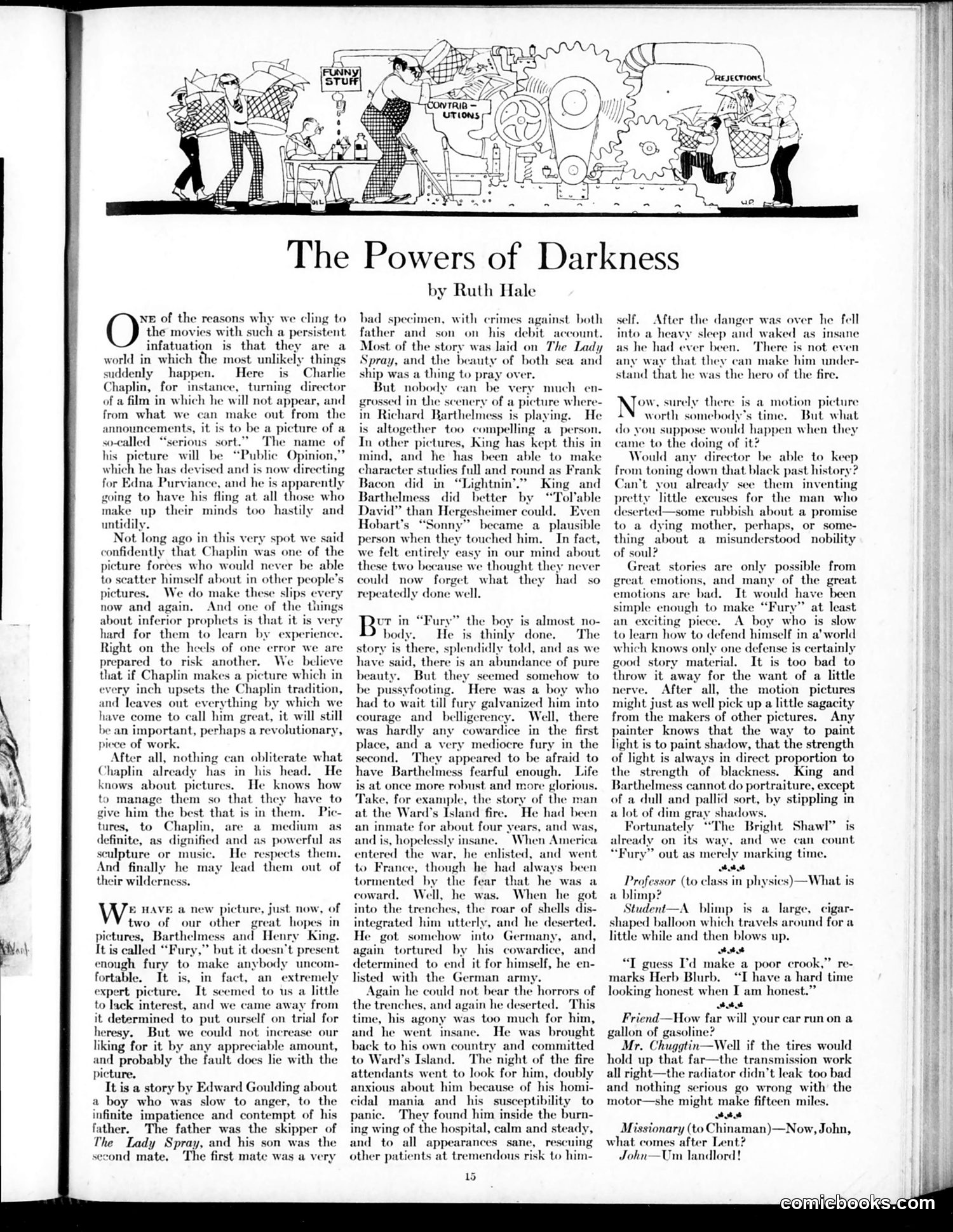
This page is primarily a **film criticism article** by Ruth Hale reviewing contemporary movies, not a political cartoon. The decorative header illustration shows figures in a factory/machinery setting but serves as generic framing, not satire. The content discusses three films: 1. **"Public Opinion"** — Chaplin's directorial venture without himself acting, which the critic finds potentially revolutionary despite breaking his established formula. 2. **"Fury"** — A film starring Richard Barthelmess and directed by Henry King, which the critic finds technically expert but emotionally restrained. The article criticizes the director for being "afraid to have Barthelmess fearful enough," suggesting the film lacks dramatic intensity despite strong source material. The critic argues that great films require genuine emotion and risk-taking, not cautious filmmaking. This is straightforward entertainment journalism, not political satire.
📄 Transcribed text from this page (OCR, searchable)
Machine-transcribed from the original scan — historical spelling and the odd misread are preserved.
NE of the reasons why we cling to O the movies with such a persistent infatuation is that they are a world in which the most unlil hings suddenly happen. Here Charlie Chaplin, for instance, turning director of a film in which he will not appear, and from what we make out from the announceme’ it is to be a picture of a so-called “serious sort.” The name of his picture will be “Public Opinion,” which he has devised and is now directing for Edna Purviance, and he is apparently going to have his fling at all those who make up their minds too hastily and untidily. Not long ago in this very spot we said confidently that Chaplin was one of the picture forees who would never be able to seatter himself about in other people pictures. We do make these slips ¢ now and again. And one of the things about inferior prophets is that it is very hard for them to learn by experience. Right on the heels of one error we are prepared to risk another. We beli that if Chaplin makes a picture which in every inch upsets the Chaplin tradition, and leaves out everything by which we have come to call him great, it will still be an important, perhaps a revolutionary, piece of work. After all, nothing can obliterate what Chaplin already has in his head. He knows about pictures. He knows how to manage them so that they have to in them. Pic a medium ¢ as dignified and as powerful a or music. He respects them, Hy he may lead them out of their wilderness. W: HAVE a new picture, just now, of two of our other great hopes in pictures, Barthelmess and Henry King. It is called “Fury,” but it doesn’t present, enough fury to make anybody uncom- fortable. It is, in fact, an extremely expert picture. It seemed to us a little to lack interest, and we came away from it determined to put ourself on trial for heresy, But we could not increase our liking for it by any appreciable amount, and probably the fault does lie with the picture, It is a story by Edward Goulding about a boy who was slow to anger, to the infinite impatience and contempt of his father. The father was the skipper of The Lady Spray, and his son was the second mate, The first mate was a very by Ruth Hale had specimen, with crimes father and son on his debit Most of the story was laid on The Lad; Spray, and the beauty of both sea and ship a thing to pray over. But nobody can be very much en- grossed in the scenery of a picture where- in Richard Barthelmess is playing. He is altogether too compelling ‘a person. In other pictures, King has kept this in mind, and he been able to make character studies full and round as Frank King and Barthelmess did better by “Tol’able David” t Hergesheimer could. Even Hobart's “Sonny” became a plausible person when they touched him. In fact, we felt entirely easy in our mind about these two because we thought they never could now forget’ what they had so repeatedly done well. Bacon did in “Lightnin’.” ury” the boy is almost no- ly. He is thinly done. The story is there, splendidly told, and as we have said, there is an abundance of pure beaut, But they seemed somehow to be pussyfooting. Here was a boy who had to wait till fury galvanized him into courage and belligerency. Well, there was hardly any dice in the first place, and a iocre fury in the second, The ppeared to be afraid to ave Barthelmess fearful enough. Life t once more robust and more glorious. for example, the story of the man He had been Take, at the Ward's Island fire. an inmate for about four and is, hopelessly ins: entered the war, he enlisted, and went to France, though he had alw been tormented by the fear that he was a coward, Well, he When he got into the trenches, the roar of shells dis- integrated him utterly, and he d He got somehow into’ Germany again tortured by his cowardice, and determined to end it for himself, he en- listed with the German arm A he could not bear the horrors of in he deserted. This time, his ago too much for him, and he went insane. He was brought back to his own country and committed to Ward’s Island. The night of the fire attendants went to look for him, doubly anxious about him because of his homi- mania and his susceptibility to panic. They found him inside the burn- ing wing of the hospital, calm and steady, and to all appe: sane, rescuing other patients at tremendous risk to him- When Ame shes, and age 1b Powers of Darkness self. After the danger was over he fell into a heavy sleep and waked as insane as he had ever been. There is not even any way that they can make him under- stand that he was the hero of the fire. N: surely there is a motion picture worth somebody's time. But what do you suppose would happen when they eto the doing of it? Would any director be able to keep from toning down that black past Can't you already see them inventi fs pretty little e s for the man who Jeserted—some rubbish about a promise to a dying mother, perhaps, or some- thing about a misunderstood nobility of soul? Great stories are only possible from great emotions, and many of the great emotions are bad. It would have been simple enough to make “Fury” at least an exciting piece. A boy who is slow to learn how to defend himself in a’ world which knows only one defense is certainly good story material. It is too bad to throw it away for the want of a little nerve. After all, the motion pictures might just as well pick up a little sagacity from the makers of other pictures. Any painter knows that the way to paint light is to paint shadow, that the strength of light is always in direct proportion to the strength of blackr King and Barthelmess cannot do portraiture, except of a dull and pallid sort, by stippling in a lot of dim gray shadows. Fortunately “The Bright rl Iready on its way, and we can. count ury” out as merely marking time. cy lass in physics) —What is Professor (to cla Student—A blimp is a large, cigar- shaped balloon which travels around for a little while and then blows up. Reed “T guess I'd make a poor crook,” marks Herb Blurb. have a hard time looking honest when T am hon was Friend—How far will your car runon a gallon of gasoline? Mr. Chuggtin—Well if the tires would hold up that far—the transmission work all right—the radiator didn’t leak too bad and nothing serious go wrong with the motor—she might make fifteen miles. ry Missionary (to Chinaman)—Now, John, what comes after Lent? John—Um landlord!