
A complete issue · 36 pages · 1922
Judge — October 14, 1922
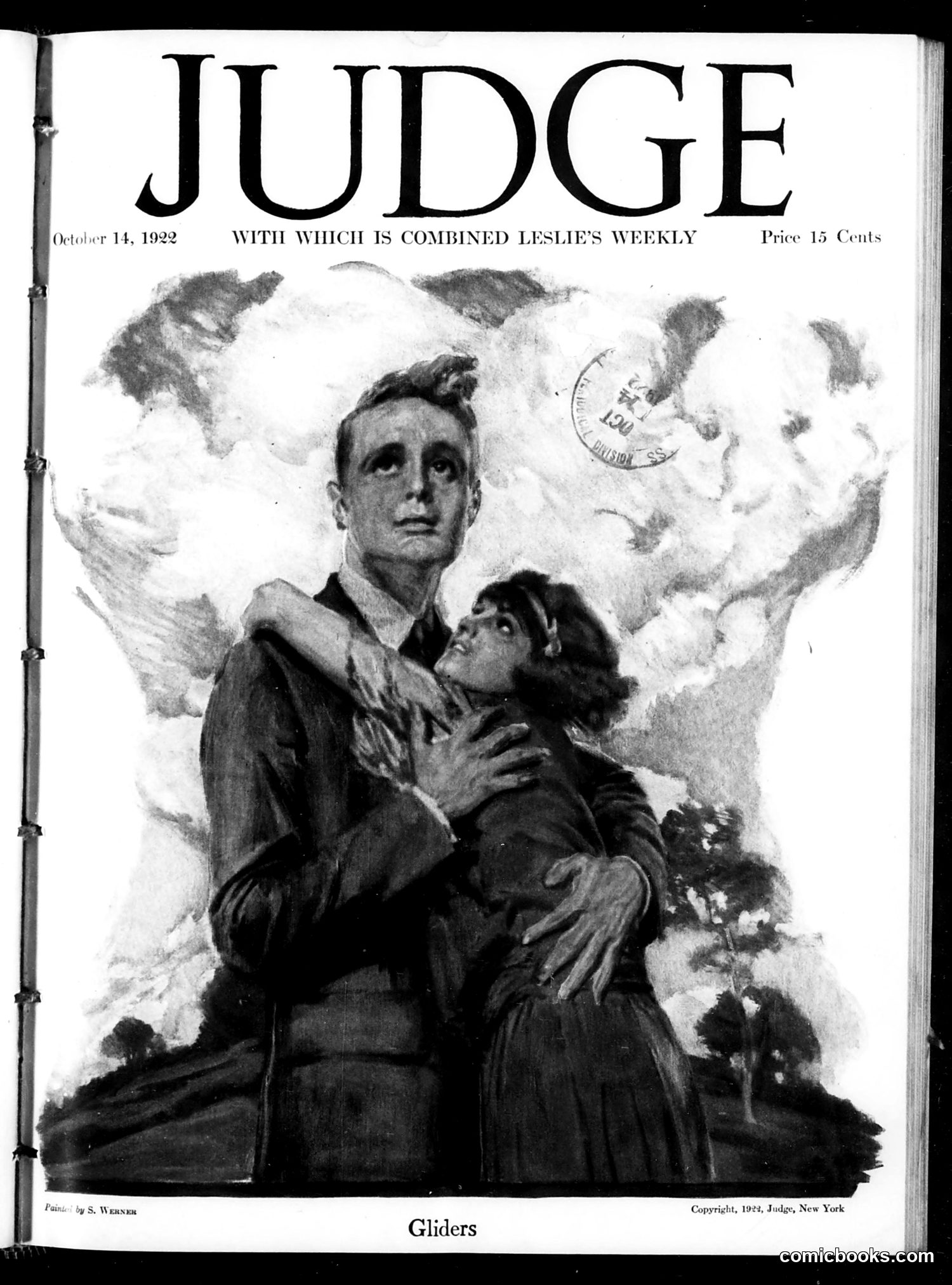
This cover illustrates the early aviation craze of the 1920s, specifically the sport of gliding. The image shows a man and woman gazing upward together against a dramatic cloudy sky, suggesting romantic aspiration or longing. The title "Gliders" likely refers both literally to the aircraft and figuratively to the couple as social "gliders"—people navigating society. The romantic imagery reflects how aviation captured the public imagination during this era, symbolizing modernity, freedom, and progress. The satire probably comments on how aviation enthusiasm, then novel and thrilling, became a fashionable pursuit among the wealthy and socially ambitious—a way to literally and figuratively "rise" in society. The couple's upward gaze represents both romantic idealism and social aspiration.
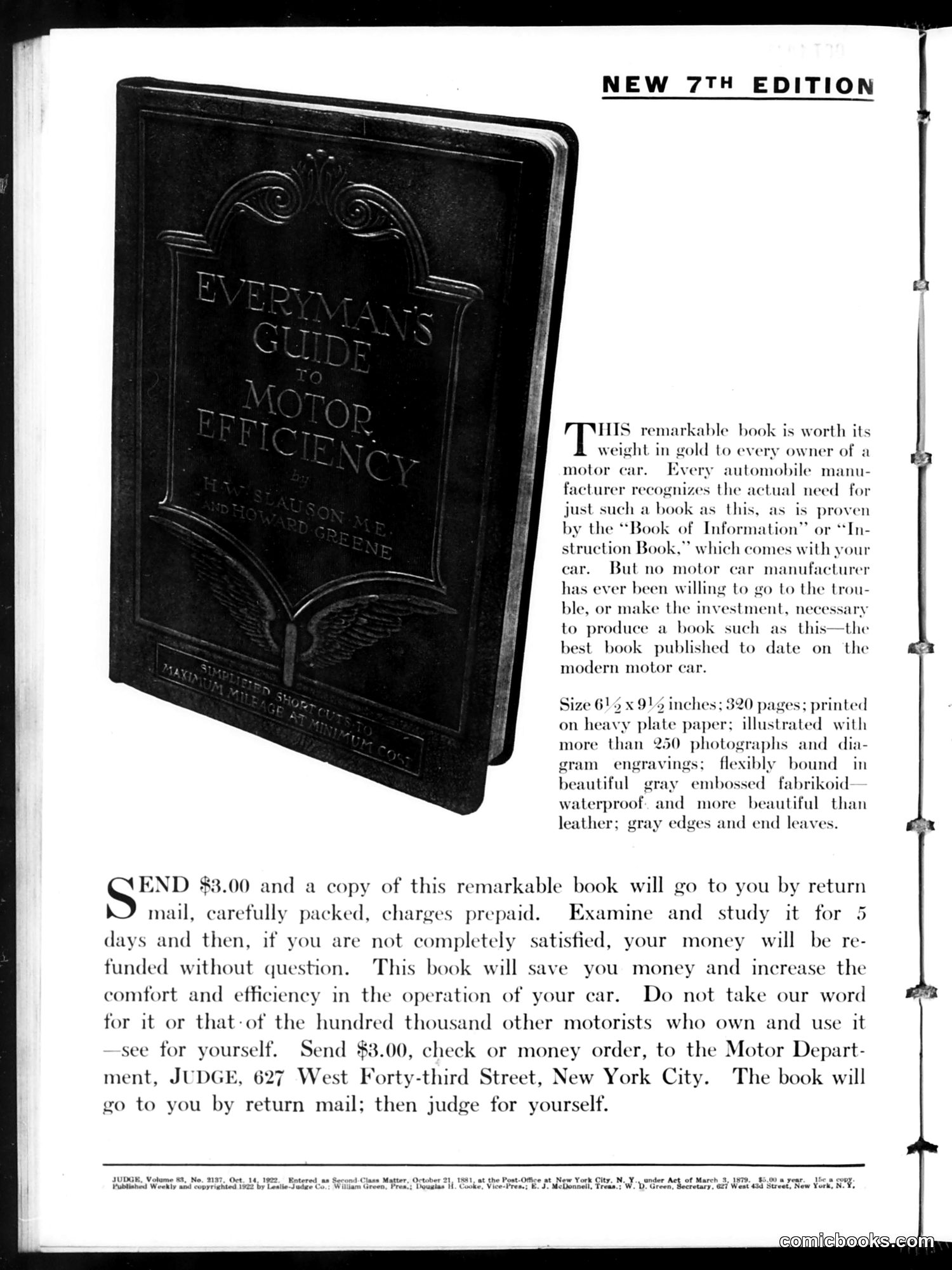
This page is **primarily an advertisement**, not a cartoon or satirical content. It promotes "Everyman's Guide to Motor Efficiency," a 320-page instructional book about automobile operation and maintenance published in the 7th edition. The ad emphasizes the book's value to car owners, claiming no automobile manufacturer had previously invested in producing such comprehensive guidance. It highlights the physical specifications (6½ x 9½ inches, over 250 photographs) and binding quality. The sales pitch offers a $3.00 purchase with a five-day money-back guarantee, positioning the book as money-saving and practical. The advertiser is the Motor Department at Judge magazine, located at 627 West 43rd Street, New York City. This reflects early 20th-century consumer culture around automobiles, which were still relatively new technology requiring owner education.
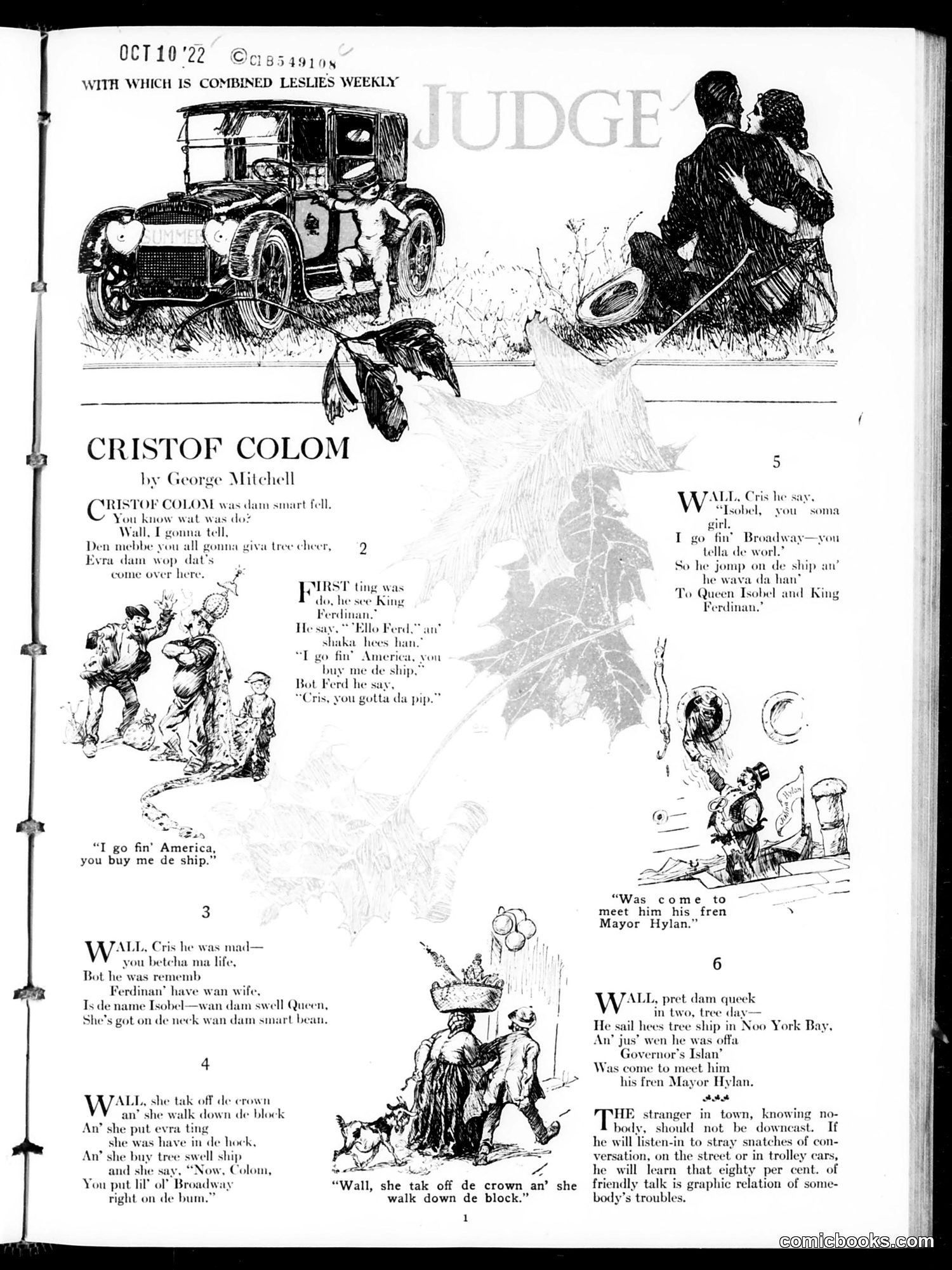
This is a humorous dialect poem about Christopher Columbus, written in exaggerated immigrant/working-class speech patterns. The narrative follows Cristof Colom's journey from Europe to America, depicting him boasting to a woman named Isabel about his voyage and plans to go to Broadway. The satire appears to mock both Columbus's historical legend and contemporary immigrant experiences in early 1920s America. By rendering Columbus's story in vernacular speech typical of new arrivals, Mitchell suggests parallels between Columbus "discovering" America and modern immigrants arriving seeking prosperity ("go fin' Broadway"). The accompanying illustrations show comic character interactions, emphasizing the comedic, irreverent tone toward a traditionally heroic historical figure.
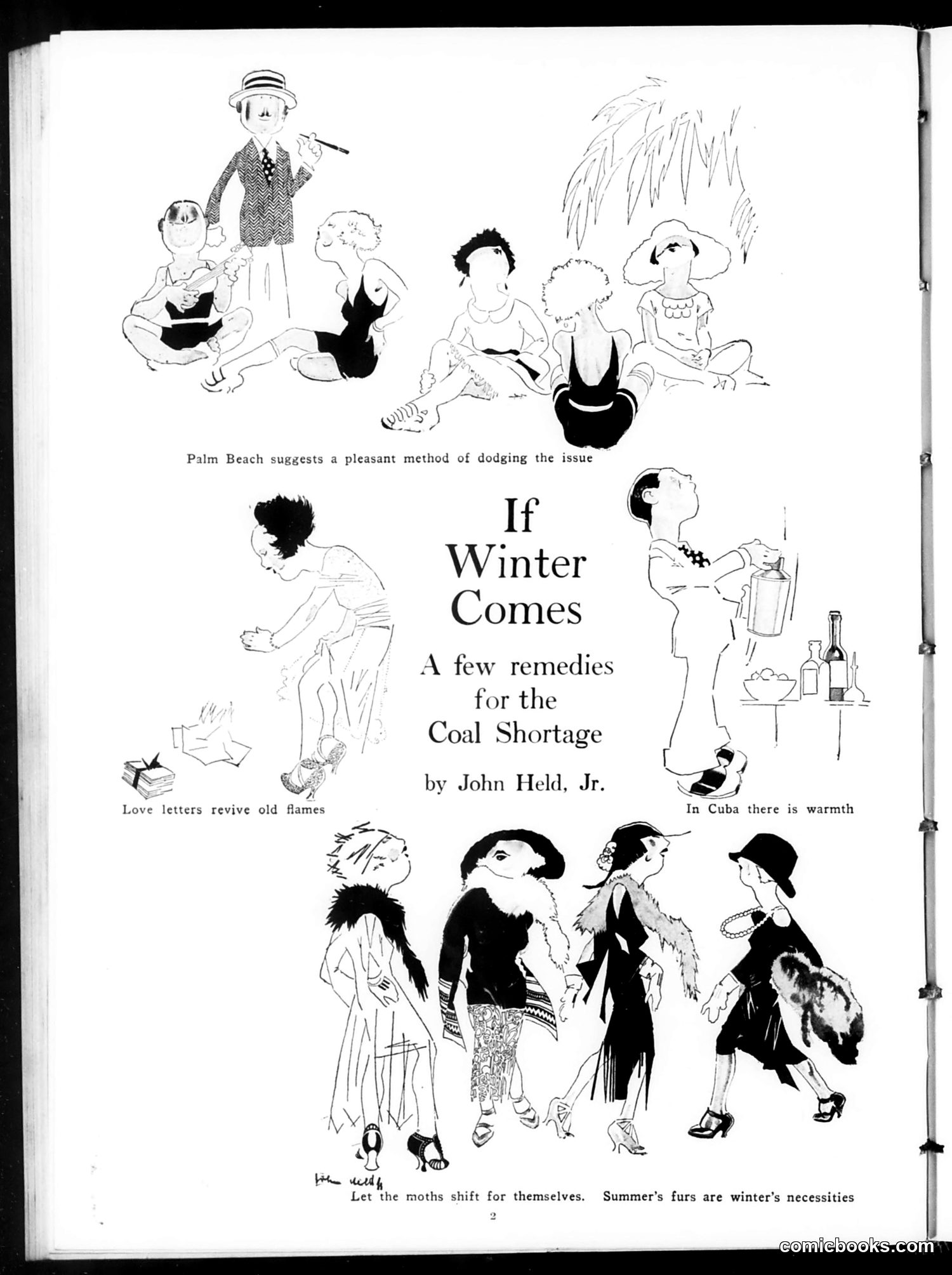
This satirical piece by John Held, Jr. addresses a historical coal shortage (likely WWI-era or early 1920s). The cartoons mock frivolous solutions wealthy people proposed instead of addressing the actual fuel crisis: - **Palm Beach vacation**: Escape to warmth rather than conserve fuel - **Love letters**: Rekindle passion for warmth (romantic fiction as substitute heating) - **Cuba travel**: Flee to tropical climates - **Alcohol/supplies**: Hoard provisions and alcohol - **Fur coats**: Use fashion rather than fuel for warmth - **Moths eating furs**: The joke's punchline—suggesting moths naturally "recycle" summer furs into winter necessities The satire criticizes privileged classes' impractical responses to a serious resource crisis, favoring escapism and luxury over collective sacrifice or real solutions.
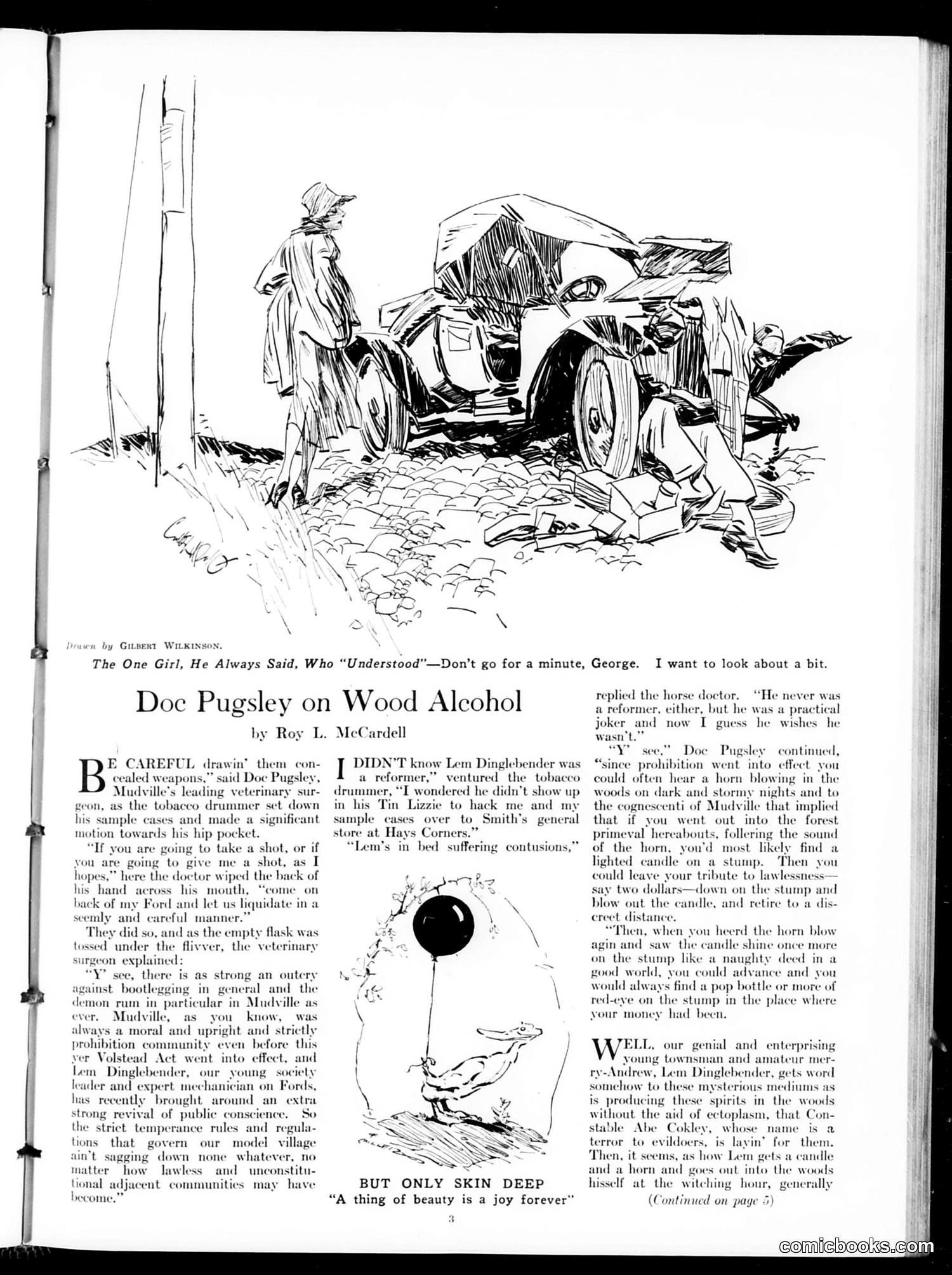
This is a satirical story by Roy L. McCardell illustrated by Gilbert Wilkinson. The narrative concerns Doc Pugsley, apparently a rural veterinarian and practical joker, who discovers that Lem Dinglebender—described as a society leader and prohibitionist reformer—has been secretly producing and selling spirits ("wood alcohol") in the forest despite publicly advocating temperance. The satire targets the hypocrisy of Prohibition-era "dry" advocates who privately violated their own moral positions. The cartoon depicts characters investigating Dinglebender's illegal operation, while the accompanying illustration shows a candle-lit stump supposedly marking the hidden still location. The story mocks both bootleggers and sanctimonious reformers.
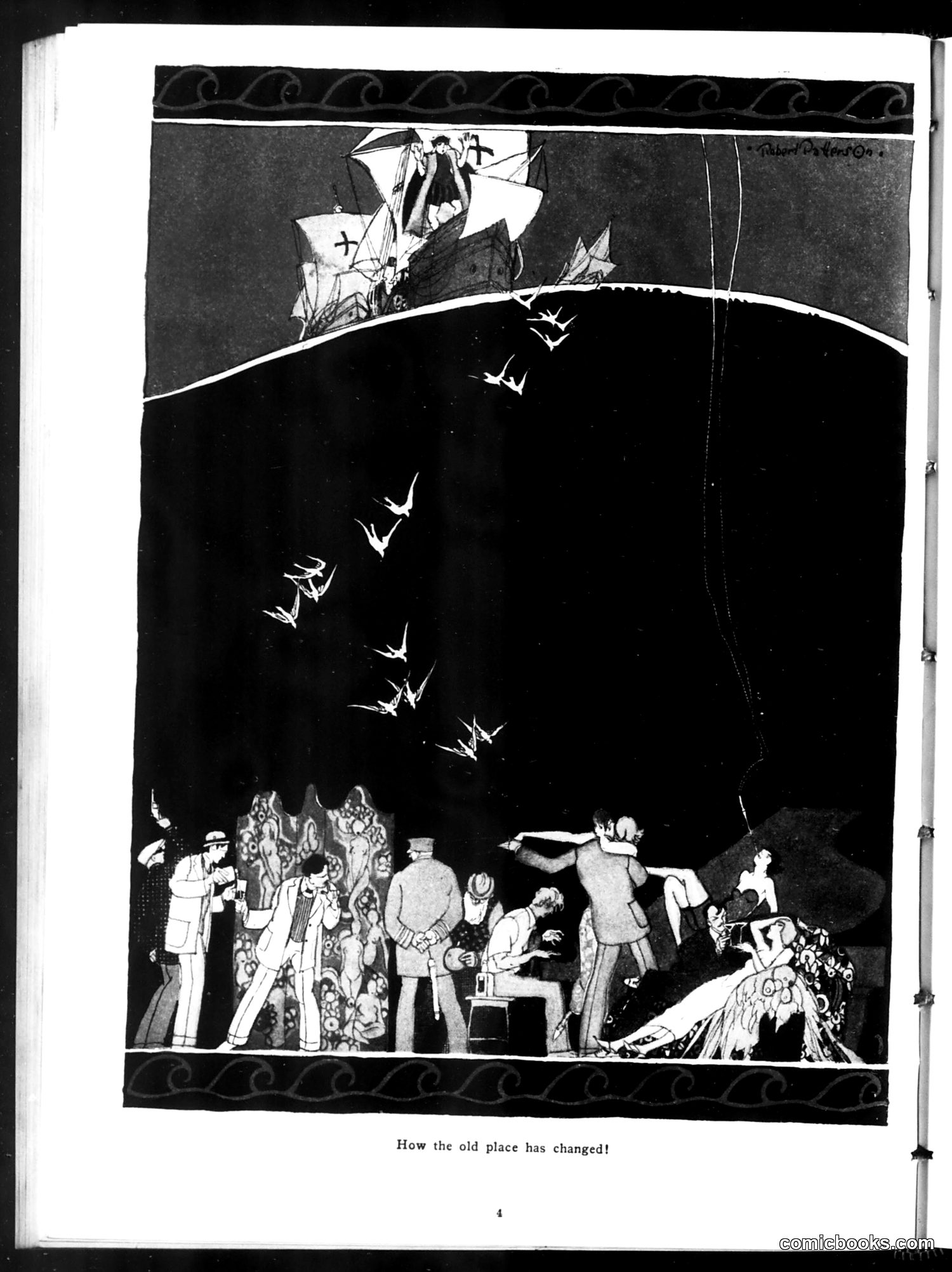
This satirical cartoon contrasts two eras of a location, captioned "How the old place has changed!" The **upper half** shows sailing ships with crosses (likely representing early Christian exploration or colonization), positioned above a dark void. The **lower half** depicts a modern scene with well-dressed figures in 1920s attire engaged in what appears to be revelry or excess—some dancing, drinking, or in casual poses. The contrast suggests moral or social decline. The satire likely critiques how a place of historical/religious significance has transformed into one of vice and indulgence. Without dating information visible, the specific location remains unclear, though the juxtaposition of colonial/religious origins against Jazz Age decadence was a common Judge magazine theme criticizing modern American society's departure from traditional values.
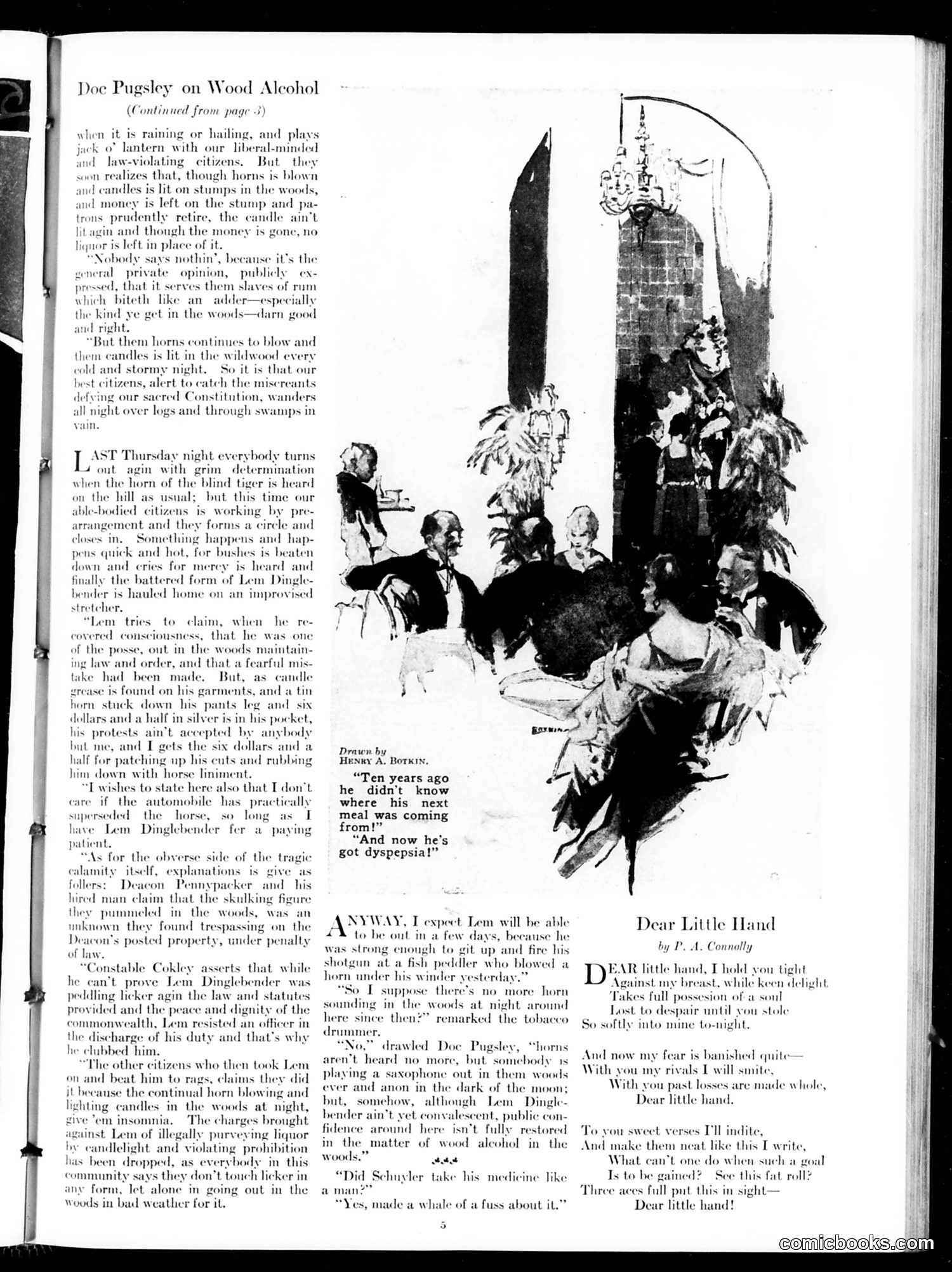
This satirical piece mocks Prohibition enforcement hypocrisy. During Prohibition (1920-1933), illegal "blind tigers" (speakeasies) operated in woods, marked by horns and candles. "Respectable" citizens claim to police these operations but actually patronize them—leaving money on stumps, taking their cut. The cartoon depicts the brutal beating of Lem Dinglebender, a small-time bootlegger caught in this charade. Various parties offer contradictory excuses: a posse claims self-defense; constables cite law enforcement; vigilantes blame insomnia from the noise. All explanations are clearly fabricated. The satire's point: Prohibition creates corruption where law-abiding citizens become de facto criminals and hypocrites. The saxophone replacing the horn at story's end suggests the scheme simply continues unchanged—the system is fundamentally broken.
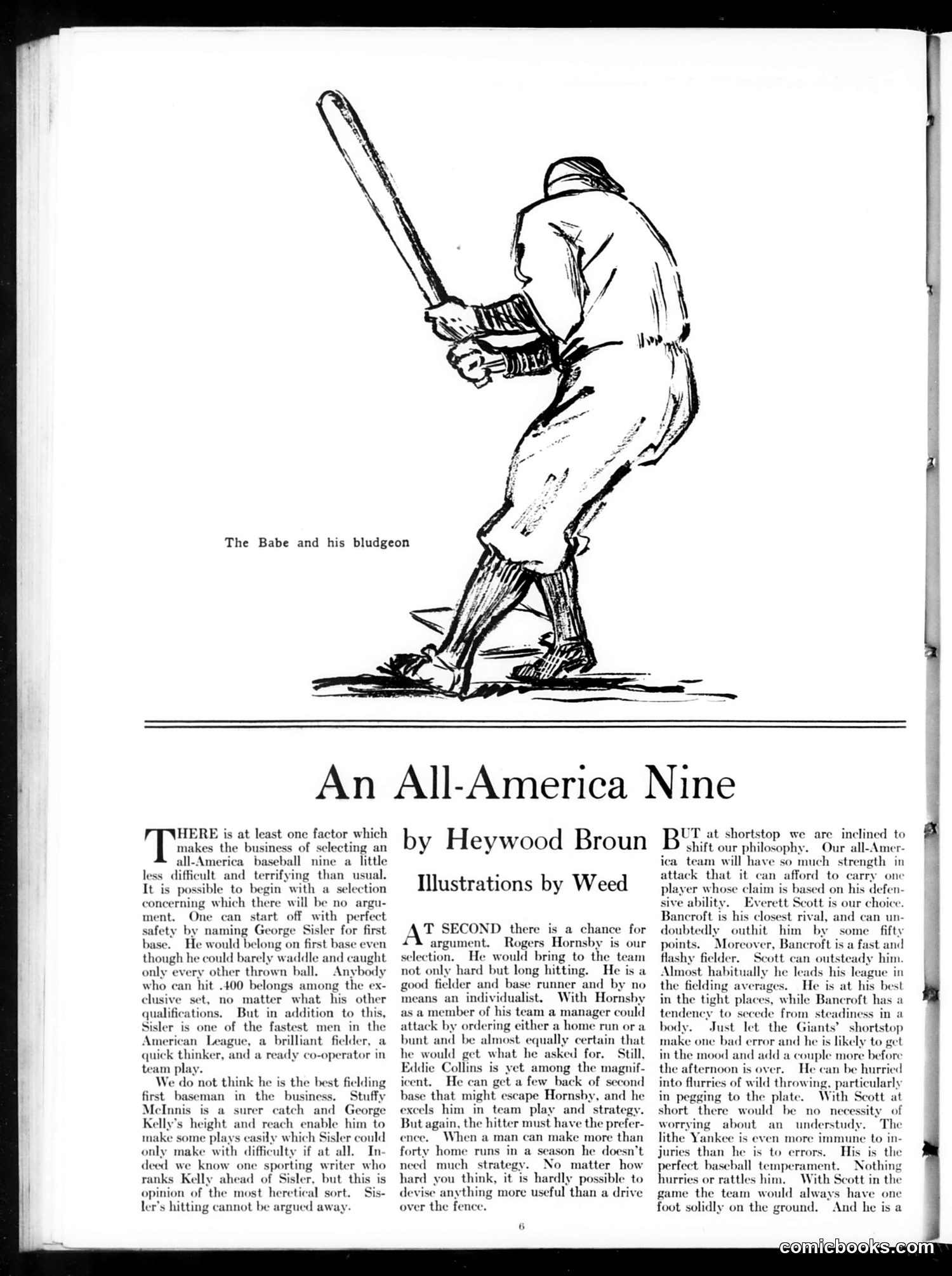
This article selects the best baseball players for an all-star team. The illustration shows "The Babe and his bludgeon"—a reference to **Babe Ruth**, whose nickname and massive home-run hitting power are captured in the crude bat depicted. The article discusses selecting first baseman **George Sisler** (praised for batting .400), second baseman **Rogers Hornsby** (a powerful hitter), and shortstop **Everett Scott** (valued for defensive consistency). It also mentions competitors like **Eddie Collins**, **Stuffy McInnis**, **George Kelly**, and **Bancroft**. The piece humorously weighs hitting prowess against fielding ability, ultimately prioritizing power hitters—particularly Hornsby's 40+ home runs per season. The tone is playful sports commentary, typical of 1920s baseball journalism when Ruth was revolutionizing the game with home-run hitting.
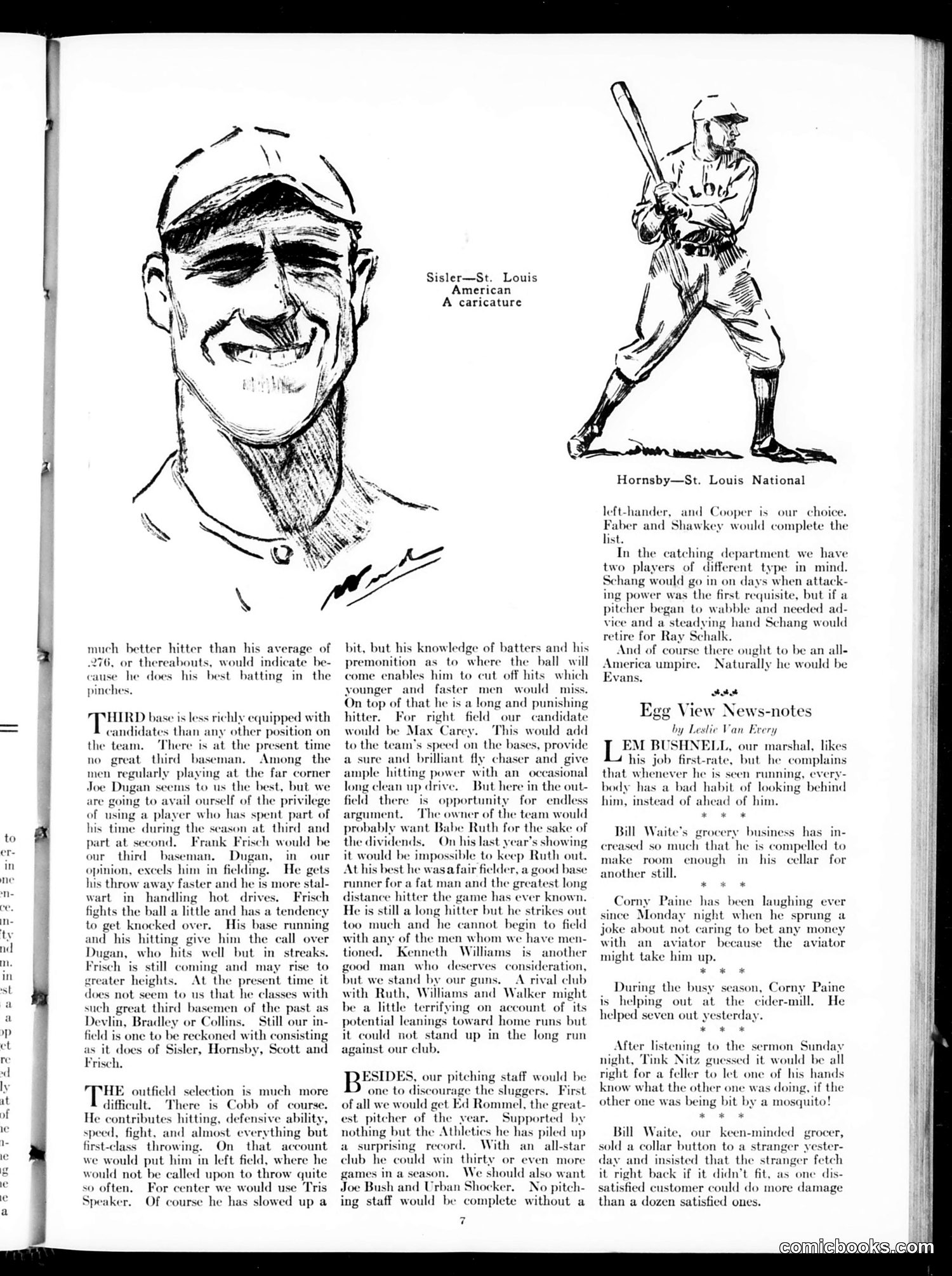
This is a sports editorial selecting an all-star baseball team from 1920s players. The page features a caricature of **Sisler** (likely George Sisler of the St. Louis Americans) and an illustration of **Hornsby** (Rogers Hornsby, St. Louis Nationals). The text proposes an ideal lineup, championing players like **Cobb**, **Speaker**, and **Max Carey** while debating whether to include **Babe Ruth**—acknowledging his extraordinary power but criticizing his defensive abilities and strikeouts. The author argues Ruth's long-distance hitting, while impressive, doesn't outweigh team balance. The satire isn't explicitly political; rather, it's *sports commentary* masquerading as serious analysis. The condescending dismissal of Ruth ("the greatest long distance hitter the game has ever known" but ultimately flawed) and the detailed justifications for seemingly arbitrary choices reflect early 20th-century baseball debate—treating player selection like a serious managerial decision while avoiding the obvious star power Ruth represented.
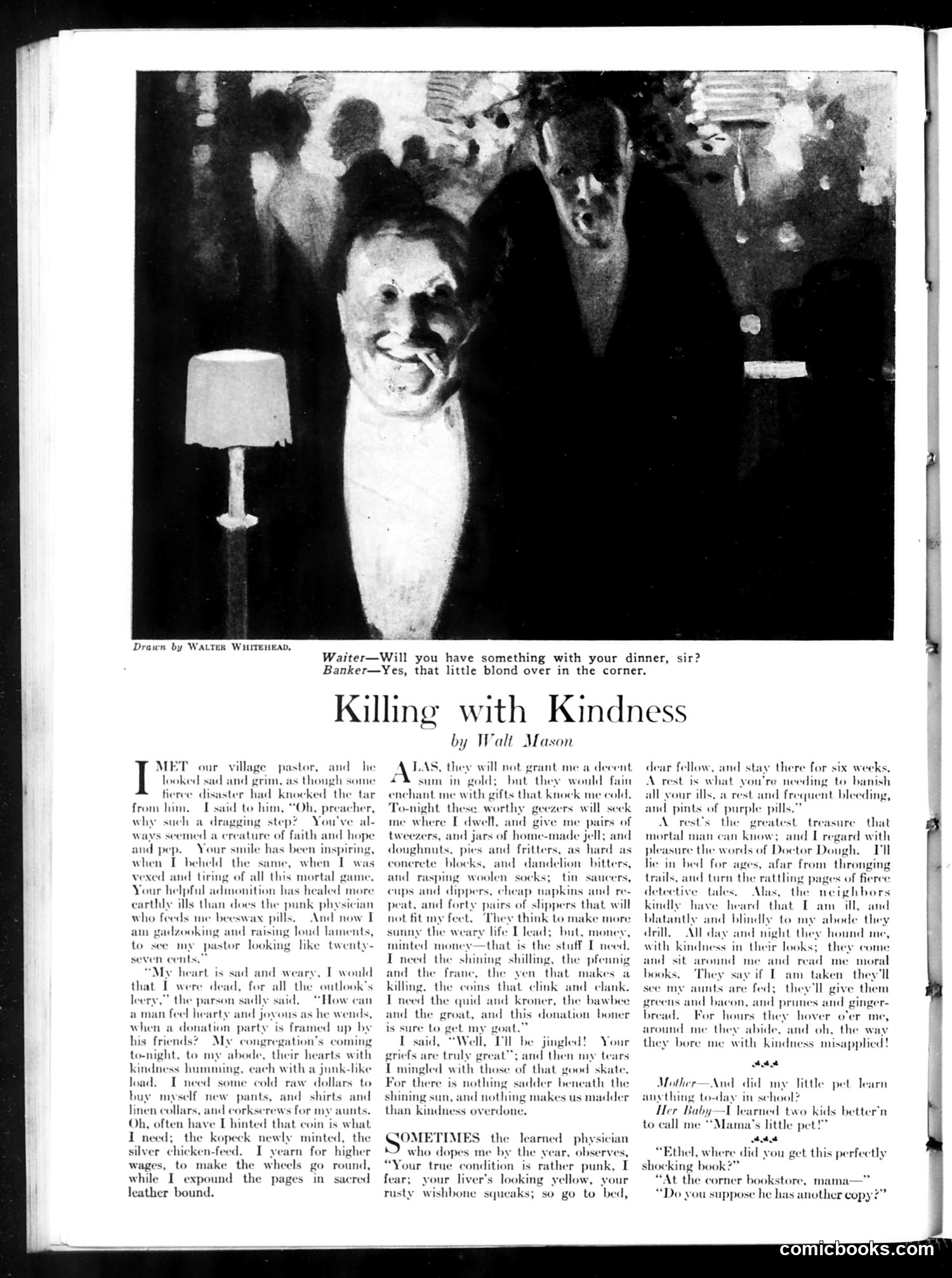
This story by Walt Mason satirizes how excessive, misguided charity can be burdensome rather than helpful. The village pastor is exhausted not by poverty, but by his congregation's "kindness"—they plan to shower him with useless gifts (slippers that don't fit, cheap trinkets, homemade food) when what he actually needs is money for wages and necessities. The satire extends to other scenarios: a doctor prescribing bed rest to an ill banker, whose concerned friends then relentlessly visit, reading moral books and hovering—"kindness misapplied." The cartoon's crude joke (banker eyeing a young woman, asking the waiter for "that little blond") provides dark counterpoint: while the pastor suffers from suffocating benevolence, baser desires go unpunished. Mason's point: genuine help requires listening to what people *actually need*, not imposing what donors *want to give*. Performative charity and nosiness dressed as concern can harm more than help.
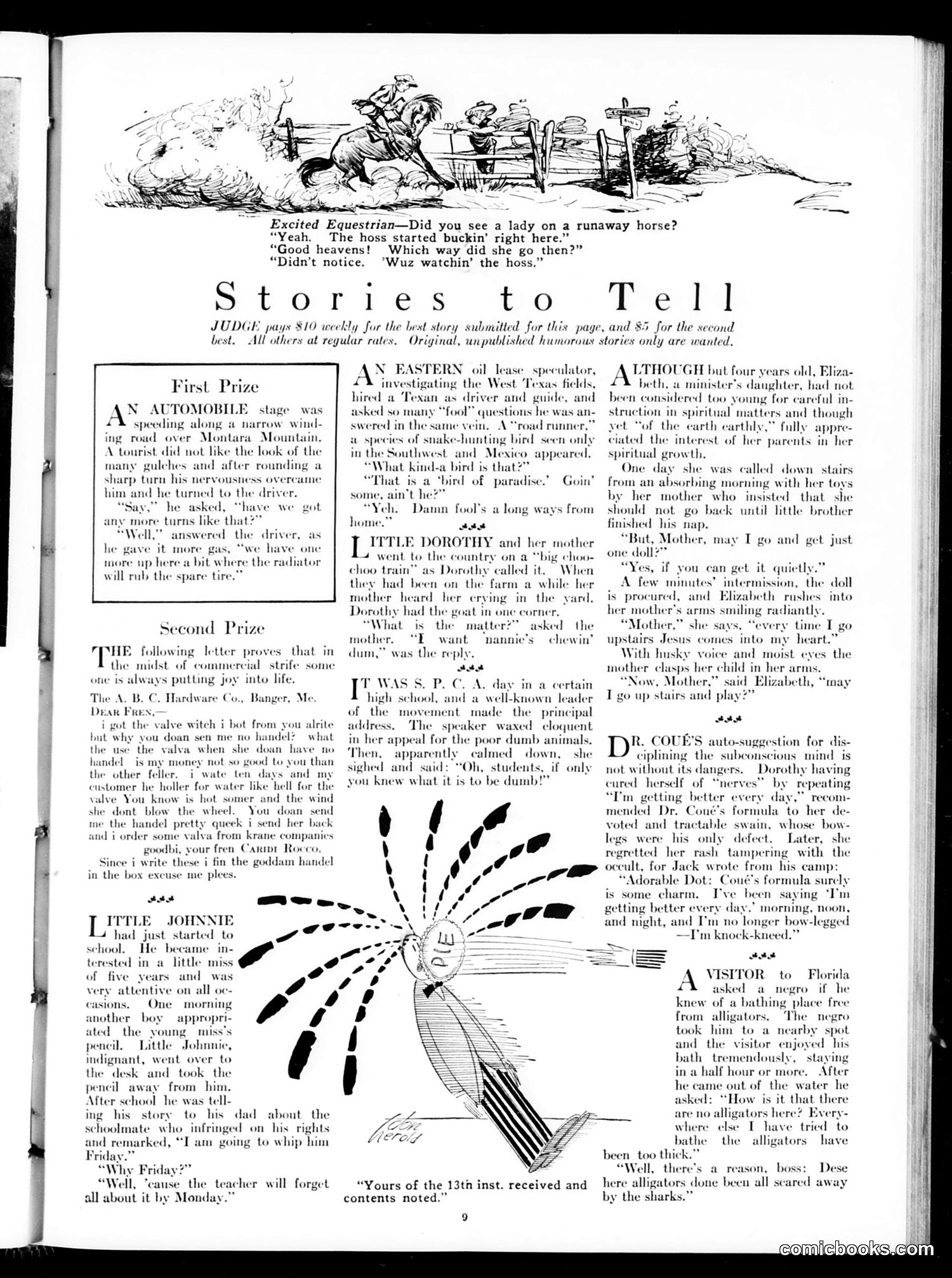
This is a "Stories to Tell" submissions page from Judge magazine, featuring humorous anecdotes and a satirical cartoon about a runaway horse incident. **The cartoon**: A mounted woman has bolted on a horse. A bystander asks a man watching what happened; the man replies he was watching the horse, not the lady—a joke about distracted male attention and propriety norms of the era. **The stories** include period humor: an oil speculator annoyed by a Texan's deadpan answers about wildlife; a nervous tourist on a winding mountain road; a child's misunderstanding about a goat eating gum; and a hardware company's charming apology letter (with broken English) after sending a valve without its handle. The page reflects early 20th-century American values: rural/frontier stereotypes, sentimental domestic narratives, and gentle mockery of commerce and urban anxieties. The "S.P.C.A. day" story satirizes performative animal welfare activism.
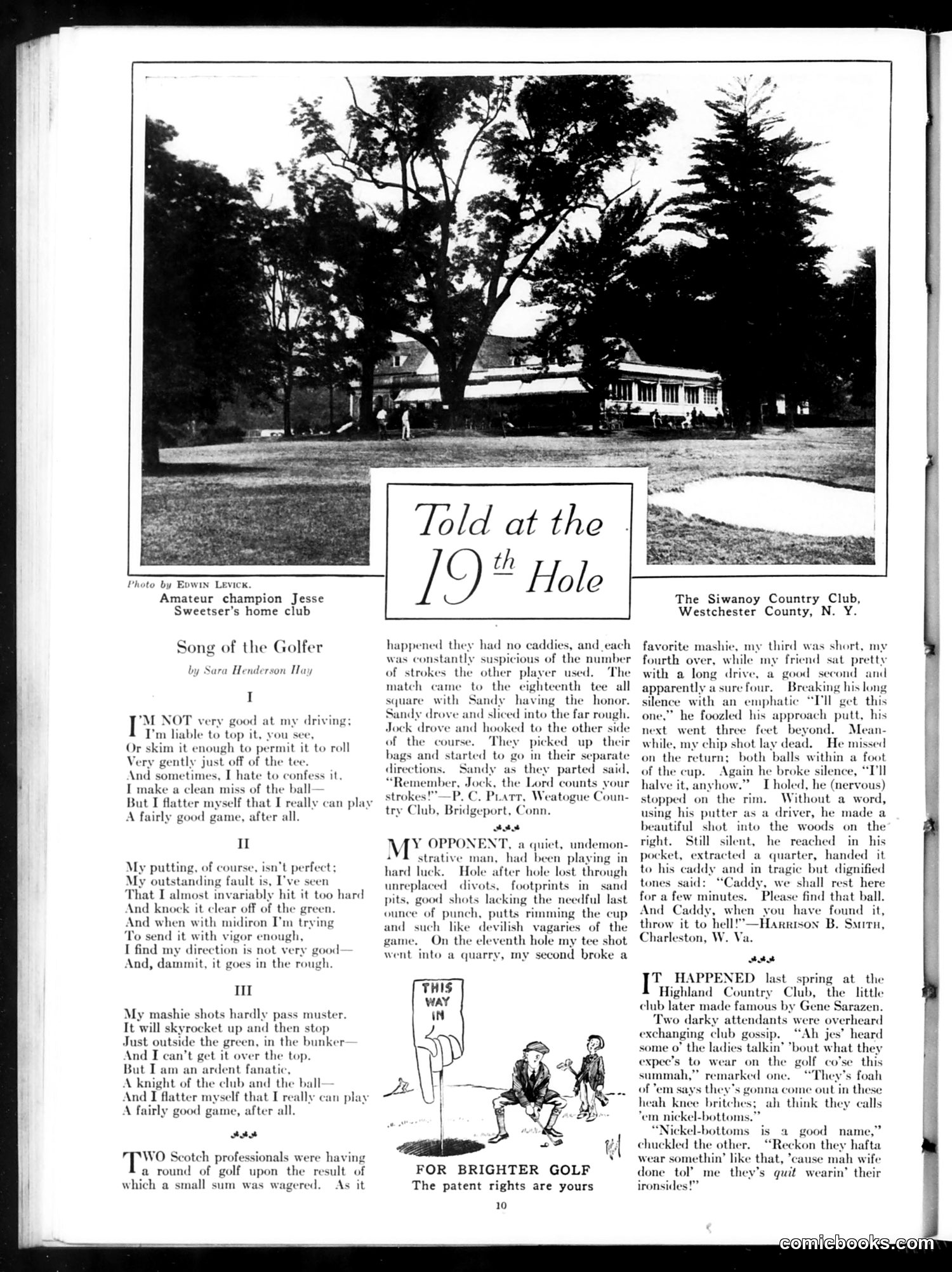
This page from *Judge* contains golf-themed humor pieces rather than political cartoons. The main content includes: **"Song of the Golfer"** — A poem by Sara Henderson Hay satirizing amateur golfers' self-deceptions about their skills. The speaker admits to poor driving, mishits, and erratic play while claiming to be "an ardent fanatic" who plays "a fairly good game." **Three anecdotes** set at country clubs (featuring real amateur champion Jesse Sweetser's club) depicting golf etiquette and gamesmanship among wealthy players. The stories emphasize competitive tension, rule disputes, and emotional reactions to poor play. **A dialect humor piece** featuring Black attendants at Highland Country Club gossiping about female golfers wearing "nickel-bottoms" (knee-length shorts)—a contemporary fashion reference mocking women's emerging golf attire. The humor reflects 1920s country-club culture, male competitive anxiety, and period-appropriate racial stereotyping. The overall tone celebrates golf culture while gently mocking players' obsessions and vanities.
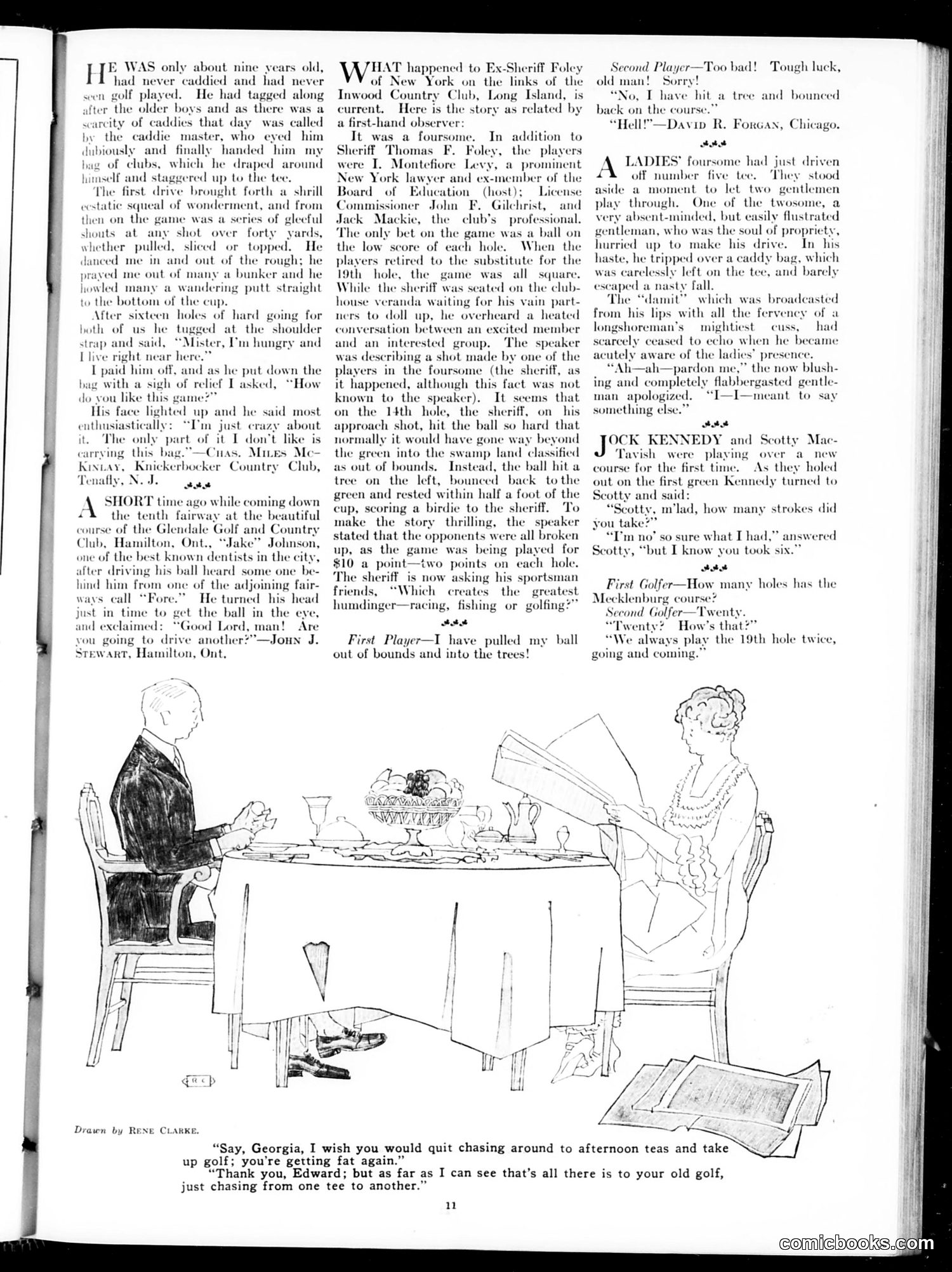
This page from *Judge* contains three golf anecdotes presented as humorous social commentary on the sport's growing popularity in early 20th-century America. **The Stories:** 1. A nine-year-old caddie's honest assessment that he loves golf except for "carrying this bag"—satirizing the gap between players' enjoyment and laborers' burden. 2. An ex-Sheriff Foley's lucky shot where his ball hits a tree and bounces perfectly onto the green for a birdie. The irony: bystanders marvel at the "skill" while the shot was purely accidental, mocking both gullible observers and the luck involved in golf. 3. A humorous setup about an absentminded gentleman's etiquette during a ladies' foursome. **The Cartoon** (by Rene Clarke) depicts an elaborate formal tea service, likely illustrating the leisure-class pretensions surrounding golf clubs—these were exclusive social venues where afternoon teas mattered as much as the game itself. The satire targets golf's rapid adoption among the wealthy as simultaneously amusing and somewhat absurd.
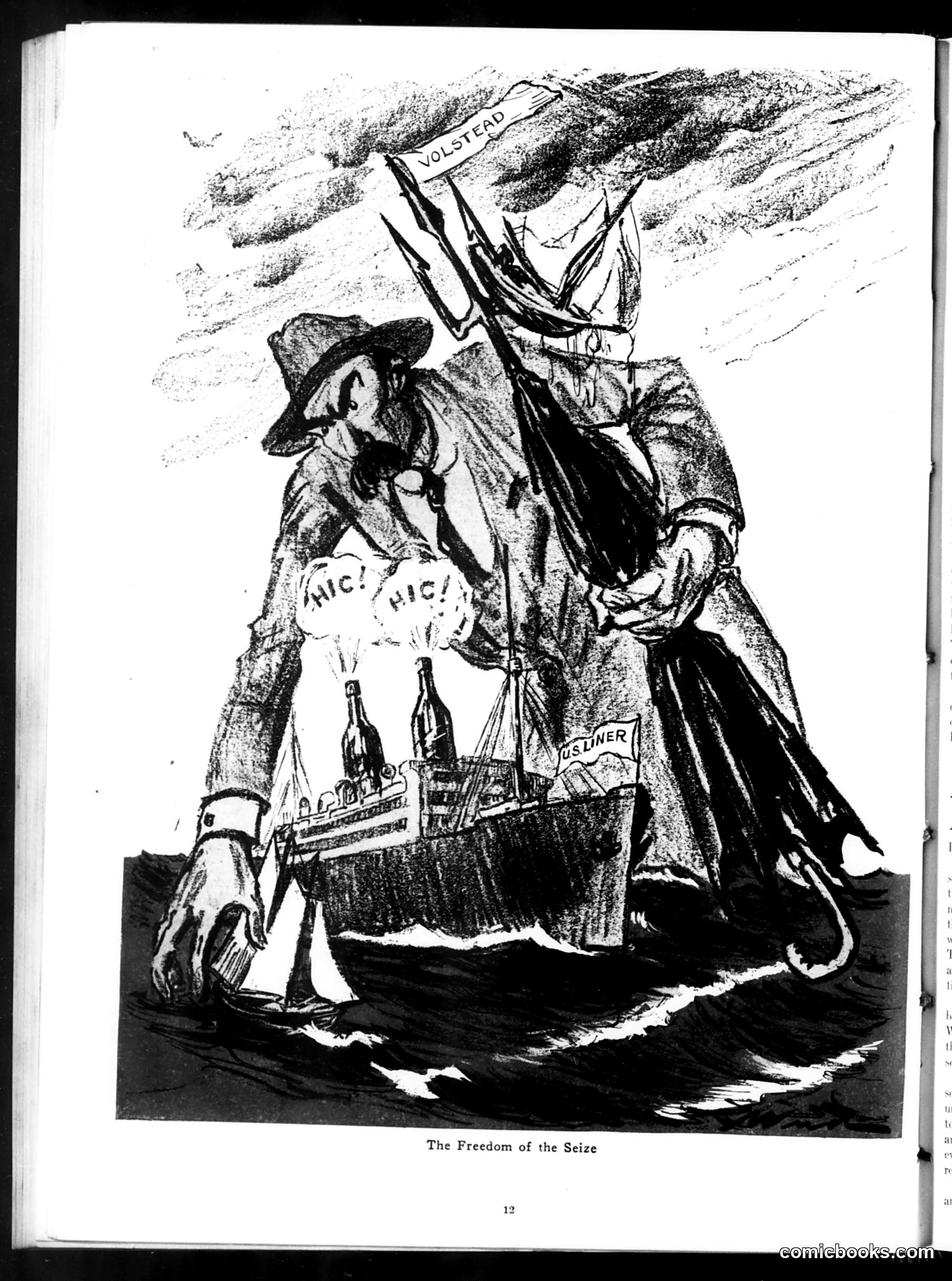
This political cartoon satirizes American merchant shipping interests during a period of international trade tension. The central figure appears to be Uncle Sam or an American businessman, depicted as a merchant laden with cargo (visible wine bottles labeled "COSTINER" and other goods). He holds a trident marked "VOLSTEAD," referencing the Volstead Act that enforced Prohibition. The cartoon's title plays on "freedom of the seas"—a diplomatic principle protecting neutral shipping. The satire suggests that American merchants exploited Prohibition-era regulations to seize contraband goods from vessels, framing profit-driven seizures as patriotic enforcement. The figure's laden pockets and smug expression mock the hypocrisy of claiming legal authority while personally profiting from confiscated cargo.
This editorial page from Judge magazine (likely early 1920s) contains two satirical pieces: **"Scrapping, But Not of Battleships"** critiques the failure of post-WWI disarmament efforts. A Washington conference promised to reduce naval warfare, but treaties remain unratified by France and Italy. The author sarcastically notes that instead of scrapping battleships, the world now confronts new tensions (the "Near East" fermenting—likely Turkish upheaval). The joke: countries prepared grandly for peace but accomplished nothing. **"Bachelors of Brains"** satirizes a fictional college president who wishes only intellectual elites would attend. The cartoon depicts Dartmouth's campus filled with famous American figures (Lincoln, Twain, Whitman, Ford, Edison, Wright) behaving outrageously—spitting tobacco, drinking from flasks, making noise. The satire argues that brilliant minds without moral character create chaos. The point: raw intelligence without breeding or discipline is worthless in an educational institution. Both pieces reflect post-war anxiety about American institutions' capacity to manage social change.
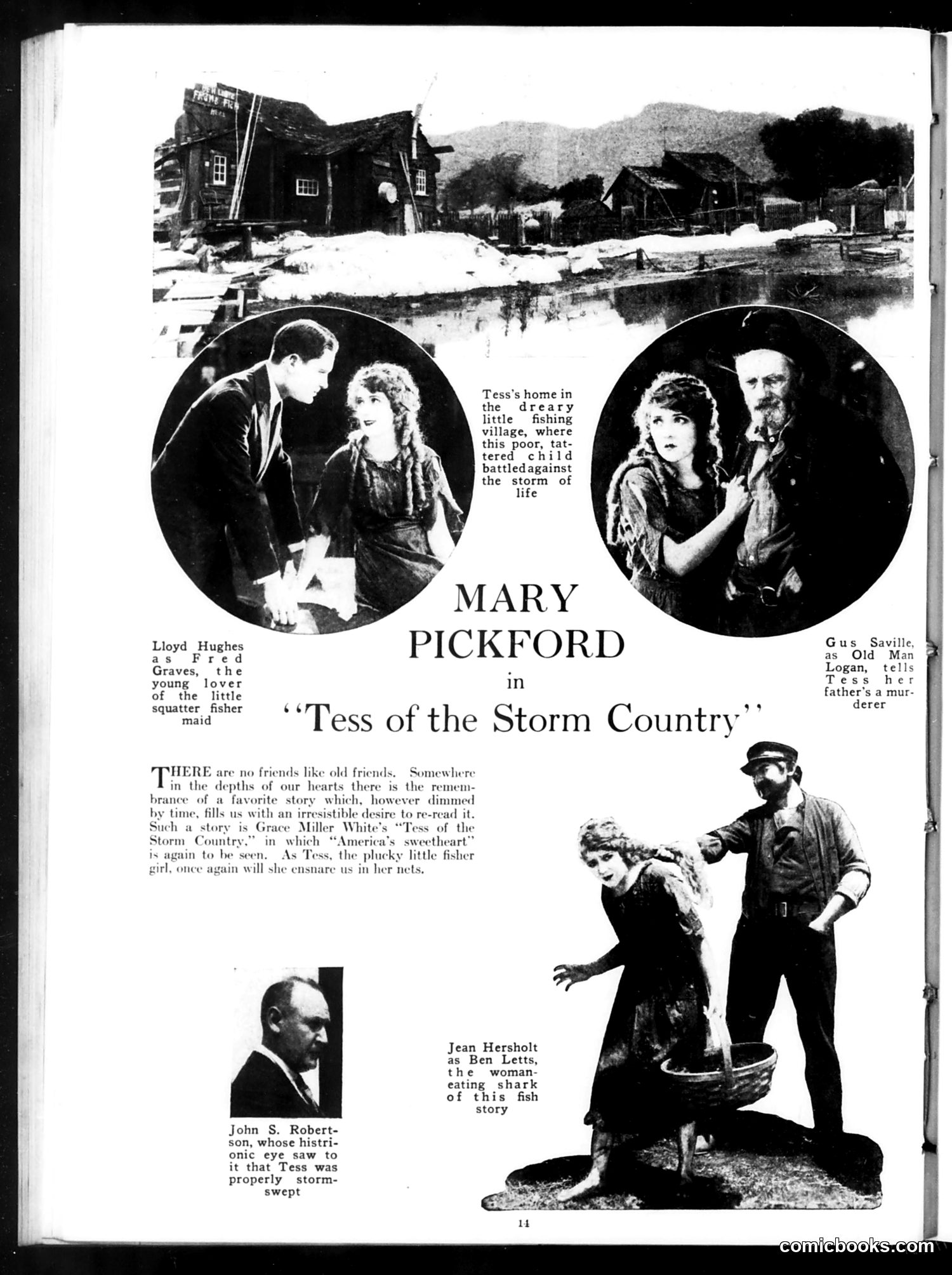
This page promotes a Mary Pickford film adaptation of Grace Miller White's novel. It's not satire but rather a studio advertisement in *Judge* magazine. The content identifies the cast: Pickford as "Tess," a poor fisher-girl protagonist; Lloyd Hughes as a young man; Gus Saville and Jean Hersholt as supporting characters (a "woman-eating shark" villain and father figure). Director John S. Robertson receives credit for ensuring authentic "storm-swept" production values. The text nostalgically frames the story as a beloved classic audiences wish to revisit, emphasizing Pickford's star power ("America's sweetheart"). The atmospheric background photograph shows a fishing village setting establishing the story's humble, dramatic milieu. This represents early Hollywood's practice of advertising films through magazine spreads featuring cast photos and plot summaries rather than satirical commentary.
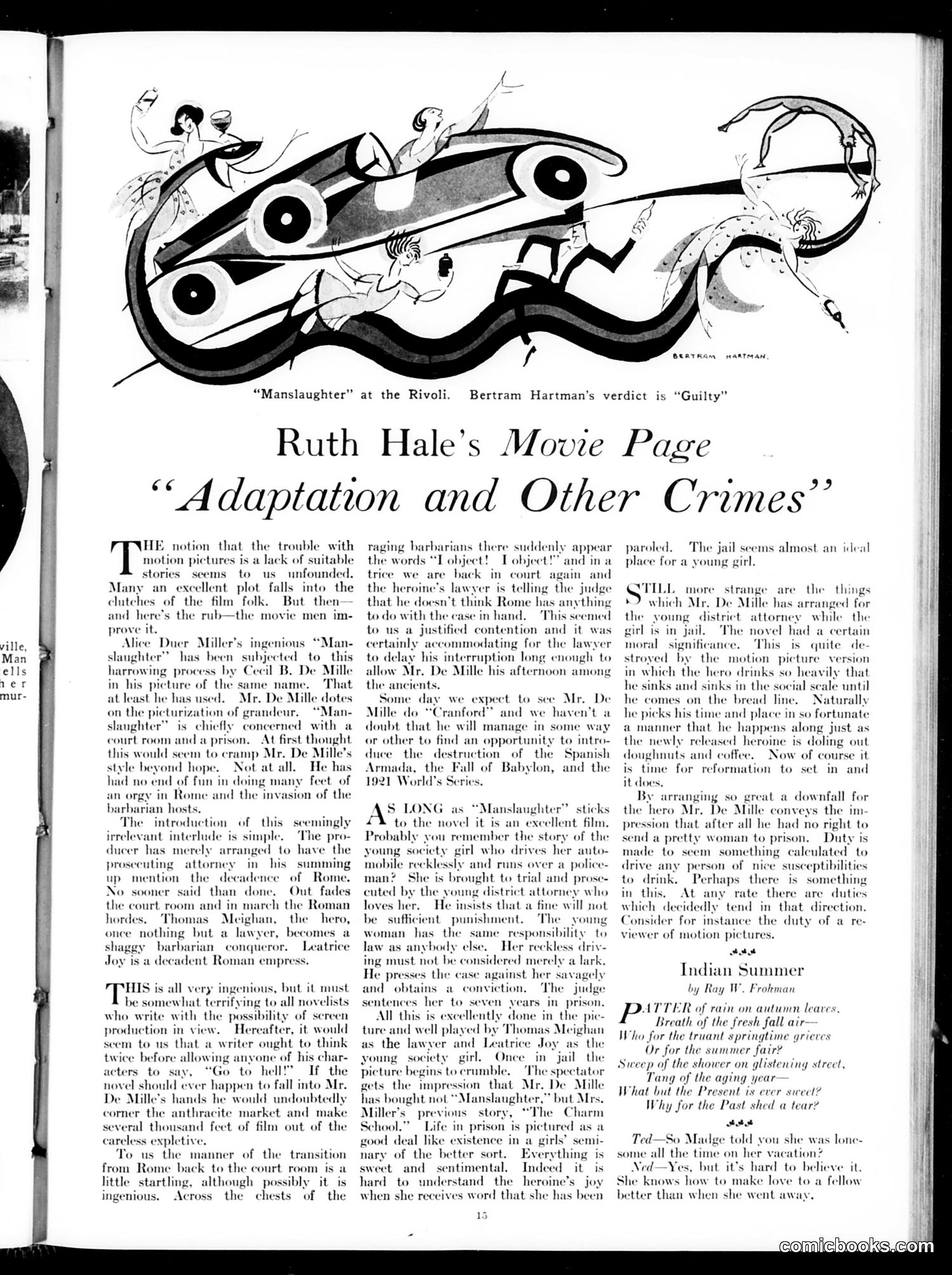
This is a film review by Bertram Hartman critiquing Cecil B. DeMille's adaptation of Alice Duer Miller's novel "Manslaughter." The cartoon above shows the story being stretched and distorted—literally—to accommodate DeMille's tendency toward elaborate, unnecessary spectacle. Hartman's complaint: DeMille inserted irrelevant Roman conquest sequences into a straightforward courtroom drama about a reckless driver prosecuted by a lawyer she loves. A simple mention of Rome's "decadence" prompted DeMille to film entire scenes of barbarian invasions and Roman empresses, absurdly transporting the characters into historical pageantry unrelated to the plot. The satire targets Hollywood's adaptation practices—how filmmakers pillage literary sources, inserting grandiose visual spectacles that undermine the original story. Hartman warns novelists that any casual reference to exotic locations risks DeMille transforming their intimate dramas into bloated epics, even jokingly suggesting he'd somehow work in "the Fall of Babylon" and the "1921 World's Series" into any screenplay.
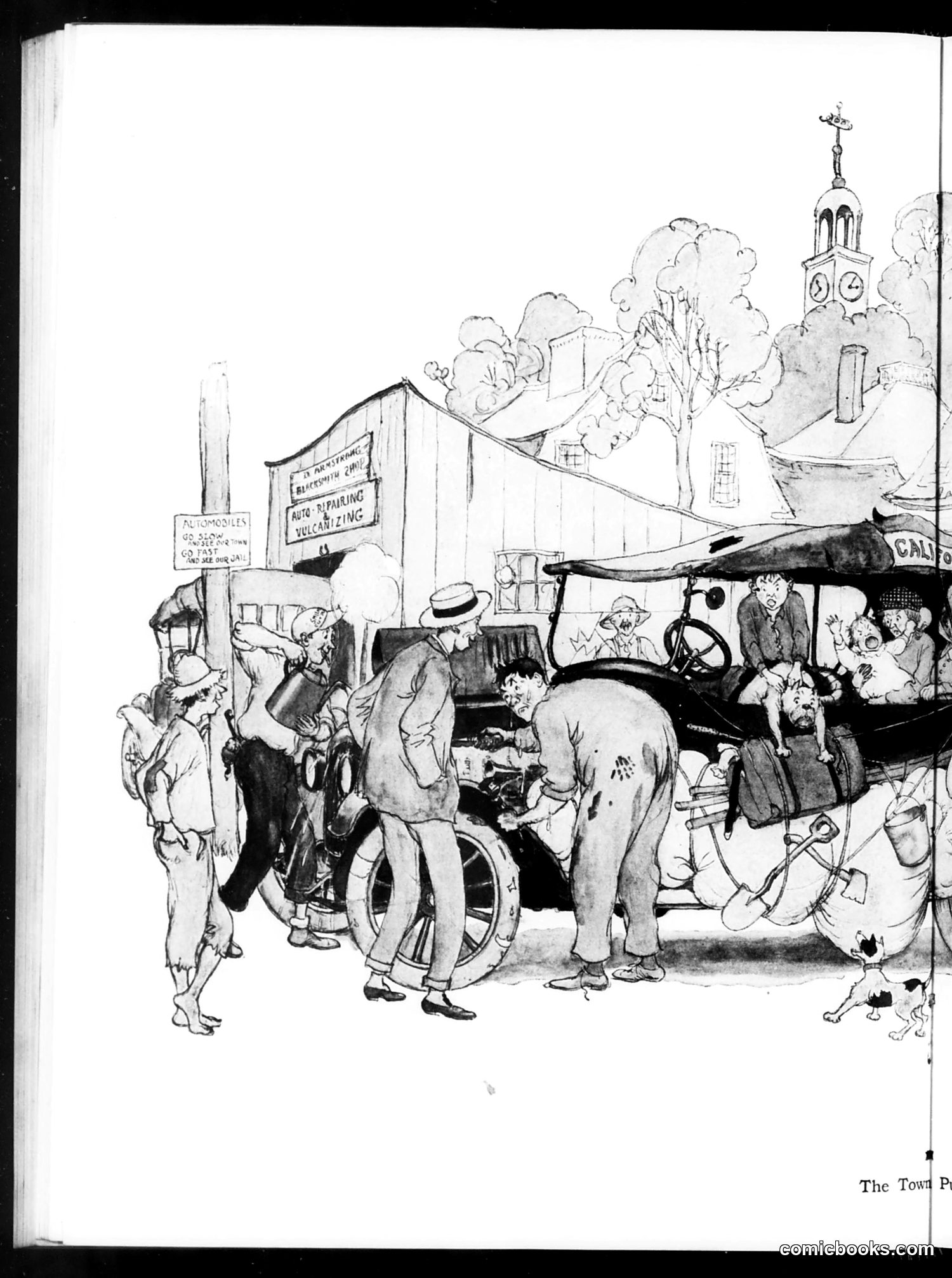
This appears to be a satirical illustration from *Judge* magazine depicting a chaotic street scene centered on automobiles and early automotive commerce. The drawing shows multiple figures examining or conducting business around early motor vehicles, with visible signage referencing "AUTO REPAIRING" and "AUTO PAINTING." The satire likely mocks the rapid commercialization and confusion surrounding the early automobile industry—the proliferation of hastily-established auto repair shops and services competing for customers in what appears to be a town setting (note the church steeple in background). The crowded, somewhat disorderly composition suggests satire about unregulated automotive businesses or the public's scramble to engage with this new technology. However, without legible text or clearer context, the specific targets remain unclear.
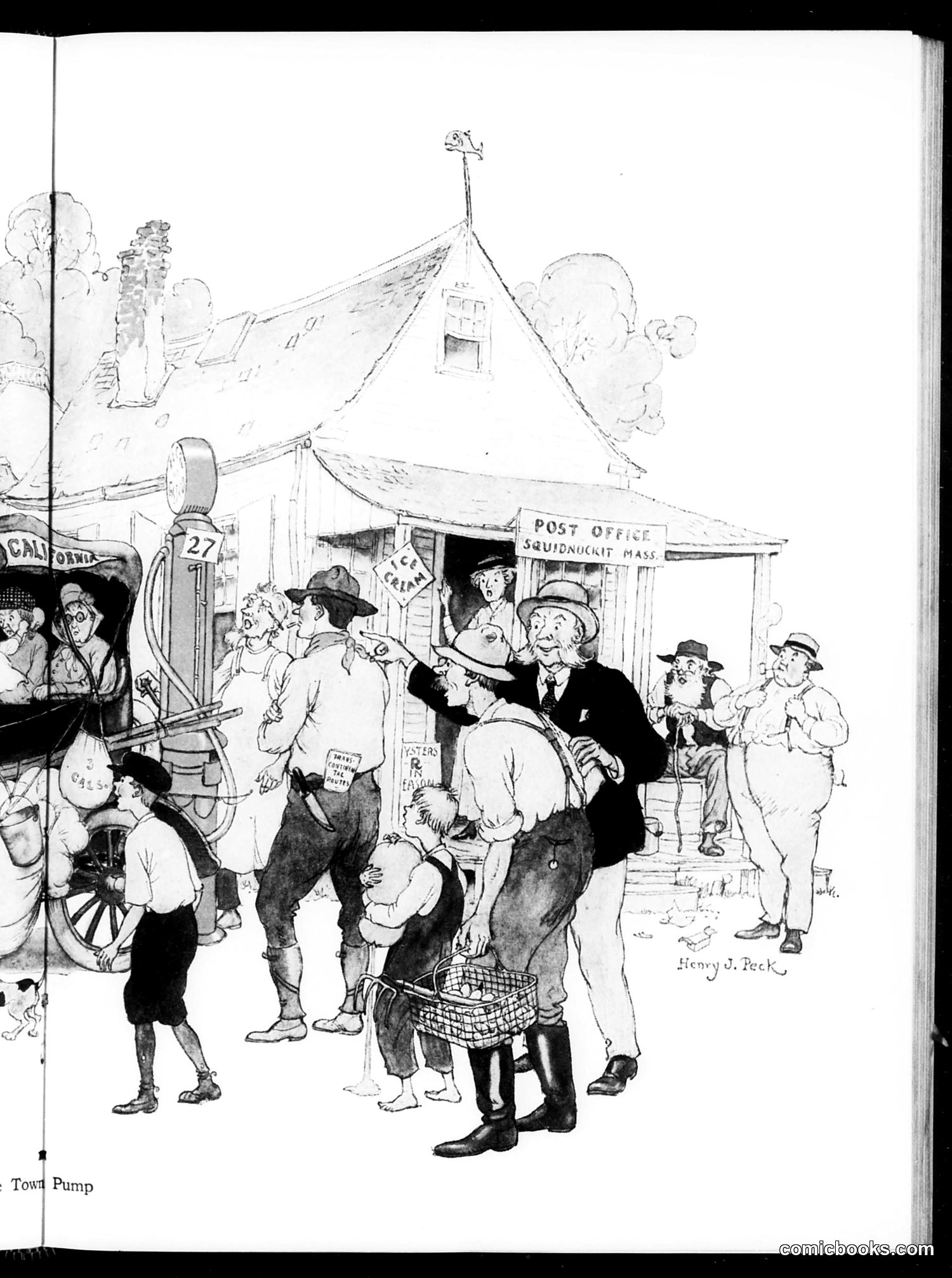
This cartoon by Henry J. Peck depicts a scene at the "Post Office, Squidnocket Mass." (a fictional town). A well-dressed man in a suit and hat—likely representing a government official or politician—stands outside a makeshift post office building, surrounded by townspeople holding signs that read "VOTES FOR" (partially visible). The satire appears to criticize **political patronage and vote-buying**: the official is distributing something (unclear if mail, money, or favors) to constituents in exchange for their political support. The ramshackle, temporary nature of the post office building suggests incompetence or neglect in rural infrastructure. This reflects Progressive Era concerns about corruption in government appointments and the misuse of federal positions for political gain rather than public service.
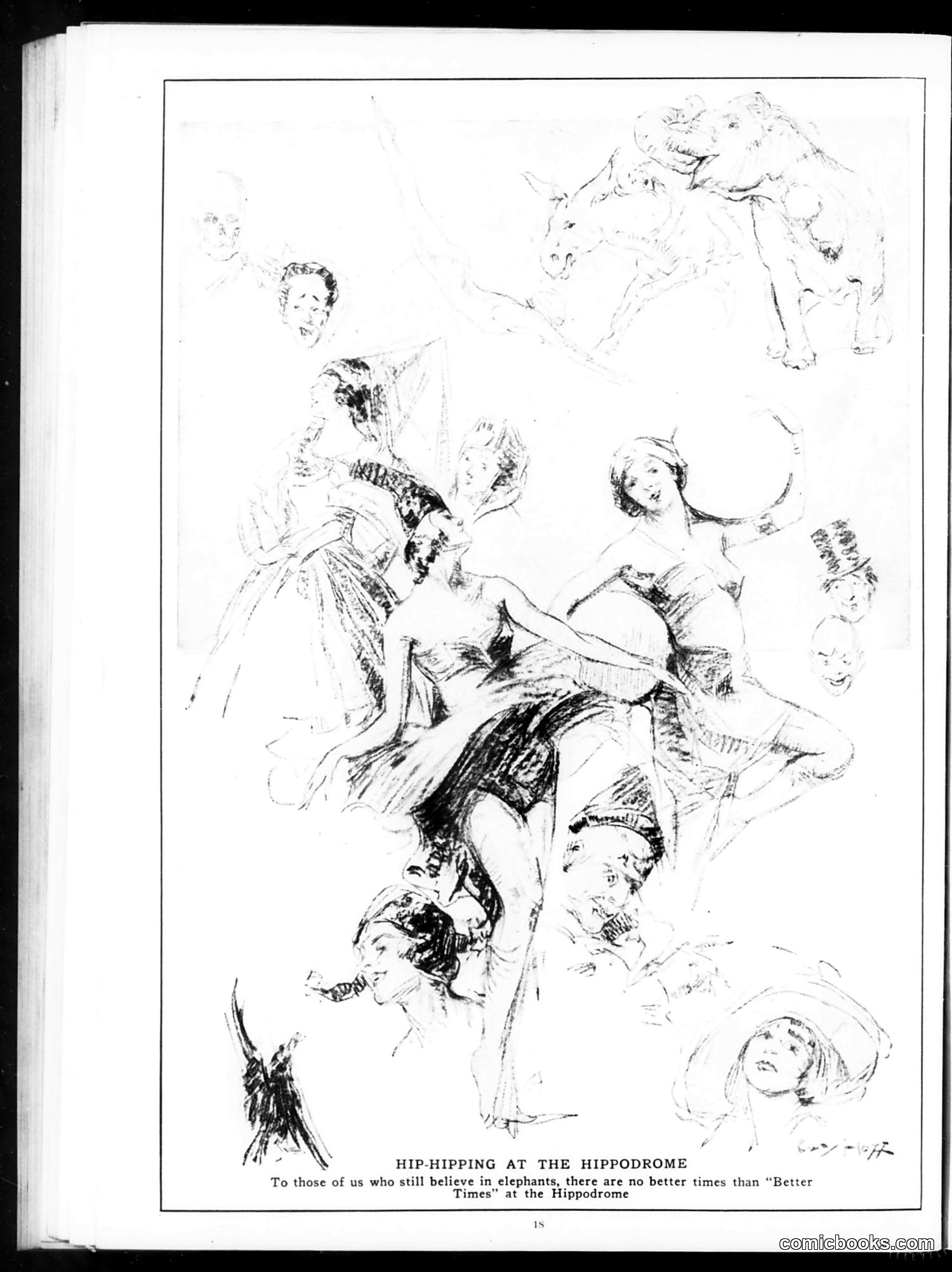
This satirical cartoon mocks the fashionable leisure activities of the wealthy at the Hippodrome, a popular New York entertainment venue. The sketch depicts elegantly dressed socialites engaged in frivolous "hip-hipping" (an early 20th-century dance craze). The caption's ironic reference to "Better Times" suggests social commentary on wealth disparity—while the privileged class enjoys expensive entertainment and dancing, ordinary Americans may be struggling. The phrase "those of us who still believe in elephants" appears to be a puzzling reference, possibly alluding to the Hippodrome's famous elephant performances or using "elephant" as coded language for something else. The overall tone critiques the disconnect between elite entertainment and broader economic realities.
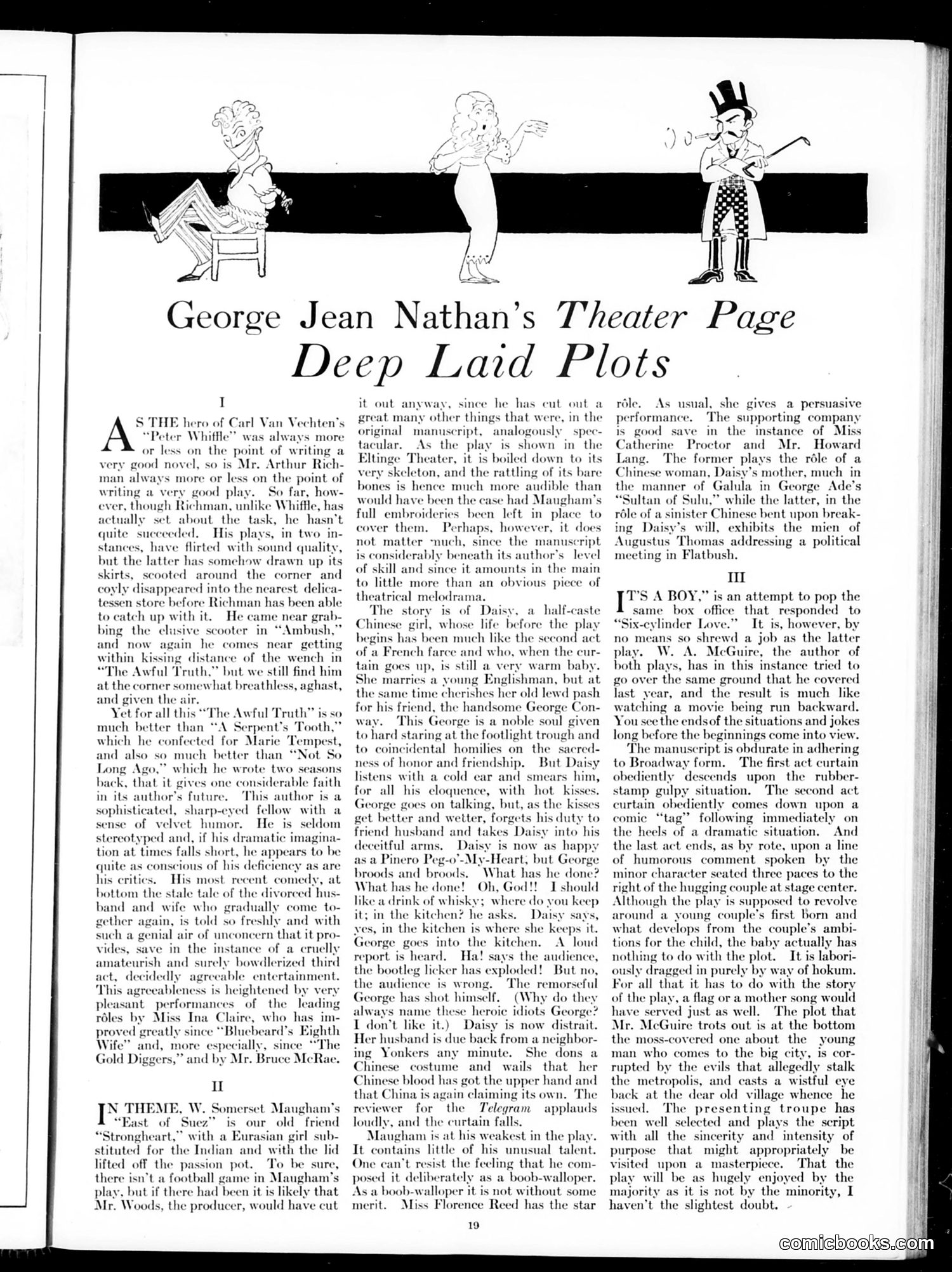
This is a theater criticism column reviewing contemporary plays. The illustrated header shows three theatrical characters in exaggerated poses—typical of Judge magazine's satirical visual style. Nathan critiques Arthur Richman's play "The Awful Truth," praising its sophisticated humor and Ina Claire's performance while noting Richman consistently falls short of genuine dramatic excellence. He compares Richman to a character perpetually on the verge of writing something good but never quite succeeding. The second section reviews W. Somerset Maugham's "East of Suez," criticizing it as melodramatic. The plot involves Daisy, a half-Chinese woman, who marries an Englishman but pursues his friend George. Nathan mocks the overwrought moral anguish ("Oh, God!!") and suggests the play's emotional excess stems from heavy editing that removed Maugham's original spectacle. The satire targets both playwrights' shortcomings and theatrical pretension of the era.
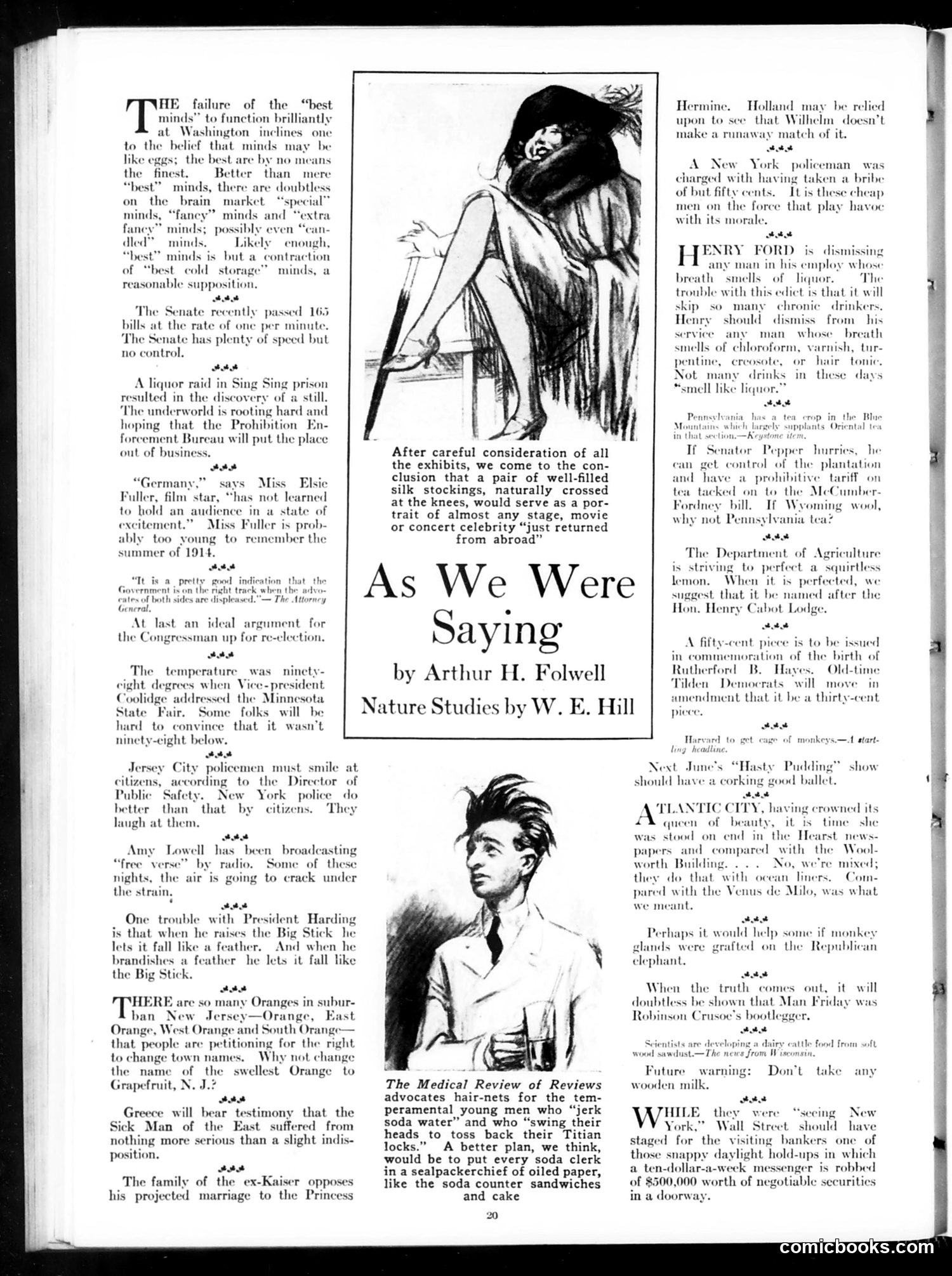
This page contains brief satirical observations on contemporary 1920s American politics and society, rather than sequential cartoons. Key targets include: **Political figures and policies:** - President Harding: mocked for ineffectual leadership ("raises the Big Stick...lets it fall like a feather") - Vice President Coolidge: satirized for speaking in extreme heat - Senator Pepper: criticized regarding tariff and tea production - The U.S. Senate: ridiculed for passing 165 bills in one session with "plenty of speed but no control" **Social issues:** - Prohibition enforcement (referenced via Sing Sing prison still discovery) - Henry Ford's anti-alcohol employment policies - Police corruption (Jersey City, New York) **Cultural references:** - Film actress Elsie Fuller - Amy Lowell's broadcasting The illustrations show a woman in fashionable dress and a man's profile portrait, likely accompanying celebrity commentary. The satire assumes readers familiar with contemporary politicians and scandals.
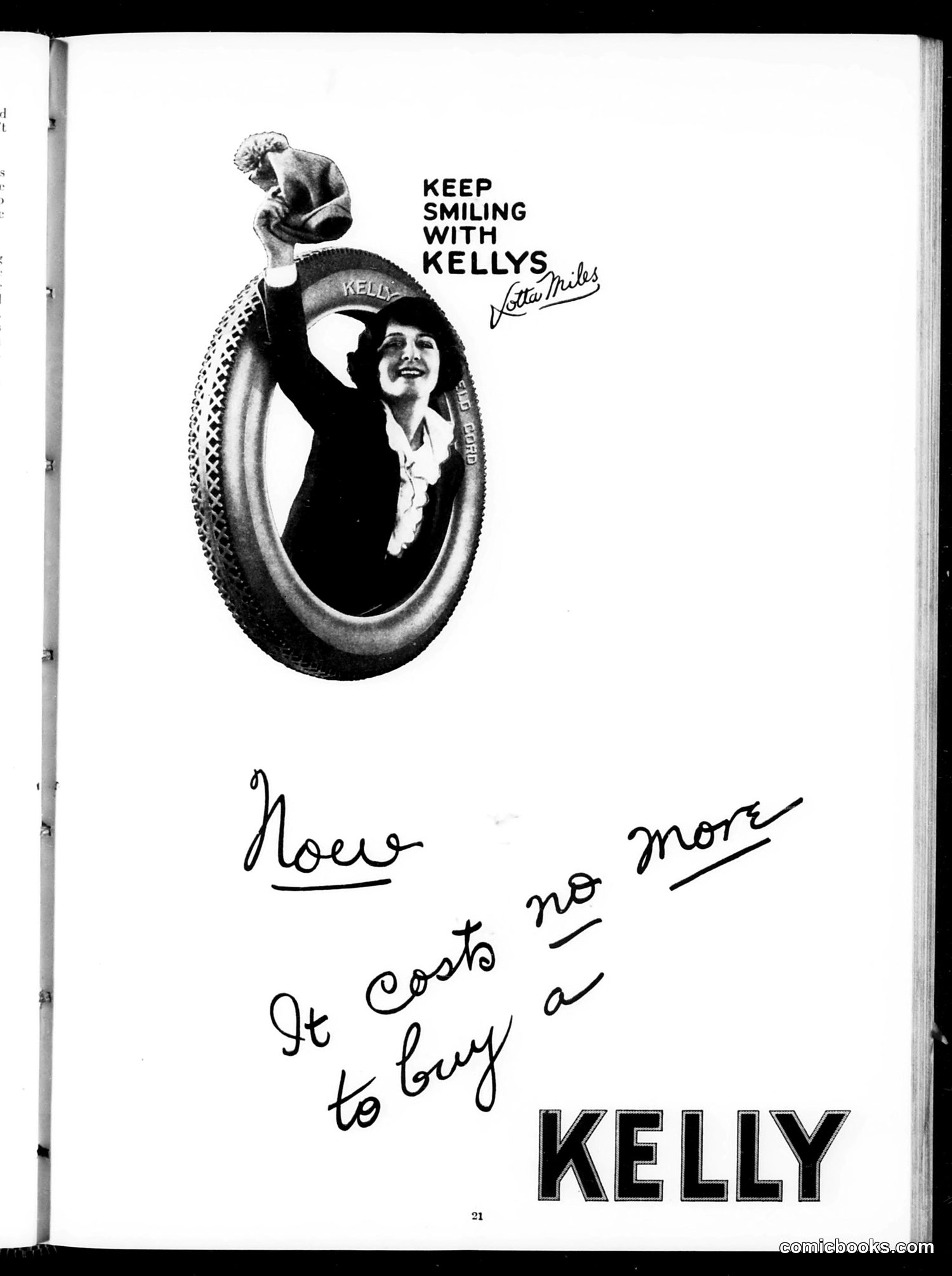
This is a **Kelly brand tire advertisement**, not political satire. The page features a woman posed inside a large tire, smiling and adjusting her hat. A small monkey or ape sits atop the tire. The tagline reads "Keep smiling with Kellys" and includes the sales pitch "Now it costs no more to buy or" Kelly (text appears cut off). The advertisement uses the then-common advertising strategy of combining an attractive woman with an animal character to create a memorable, whimsical image designed to appeal to consumers. The "keep smiling" message suggests Kelly tires are reliable and affordable—conveying that purchasing them is a source of happiness. This represents typical early-to-mid 20th century American product advertising rather than political commentary.
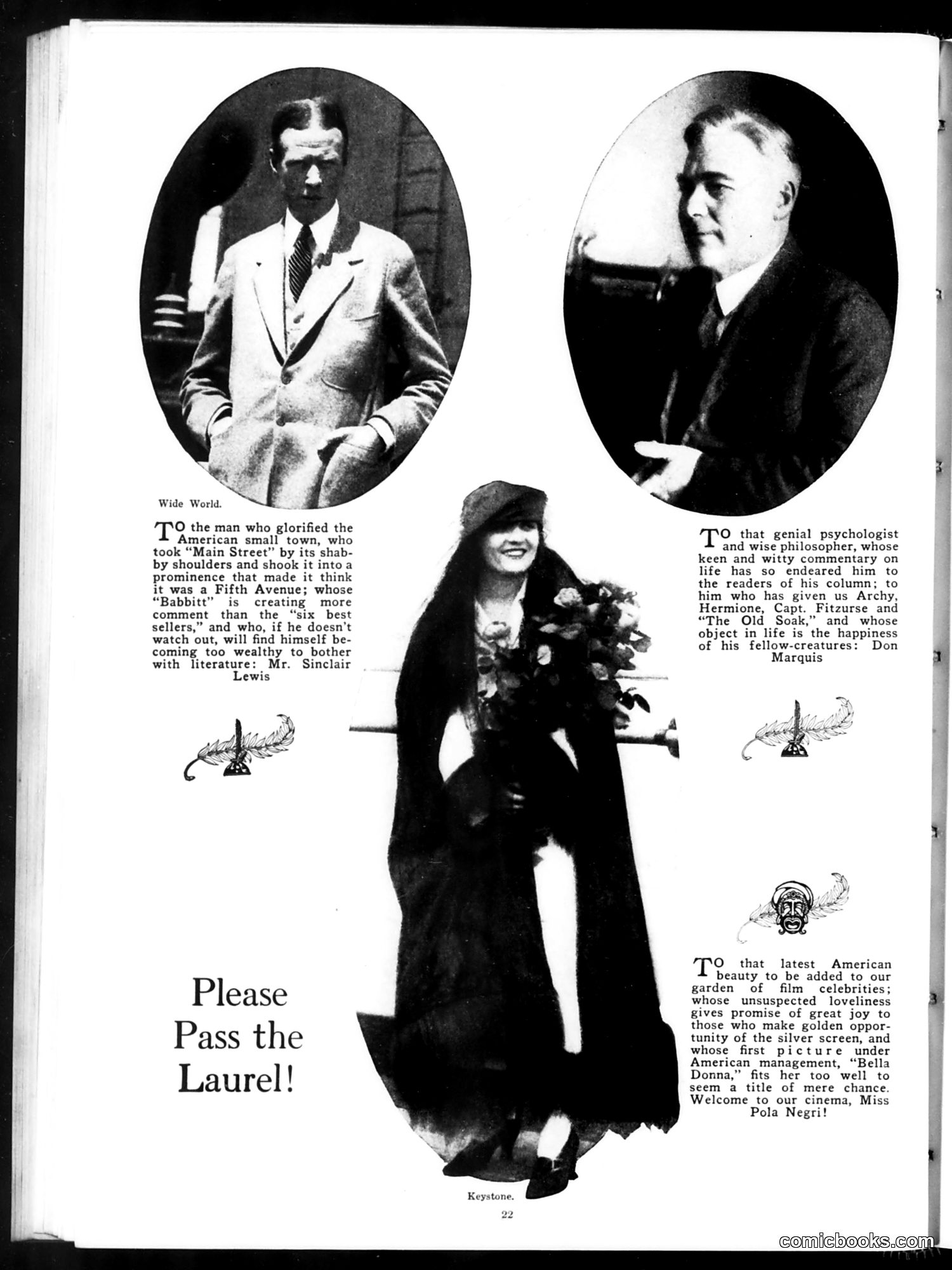
This page celebrates three American cultural figures circa the early 1920s. **Sinclair Lewis** (top left) is praised for his novels "Main Street" and "Babbitt," which satirized American small-town life and materialism—the satire here notes he's becoming so wealthy from writing *about* shallow materialism that he risks becoming the very thing he critiques. **Don Marquis** (top right) is honored as a witty columnist and creator of literary characters including Archy (a cockroach). The reference to "The Old Soak" suggests his popular humorous writings. **Pola Negri** (center, holding a megaphone) is welcomed as a new film star, with her debut "Bella Donna" noted as surprisingly fitting for her talents. Negri was a Polish-American actress entering Hollywood prominence. The "Please Pass the Laurel!" heading frames these as contemporary achievers deserving recognition—essentially Judge's endorsement of notable American cultural contributors of the moment.
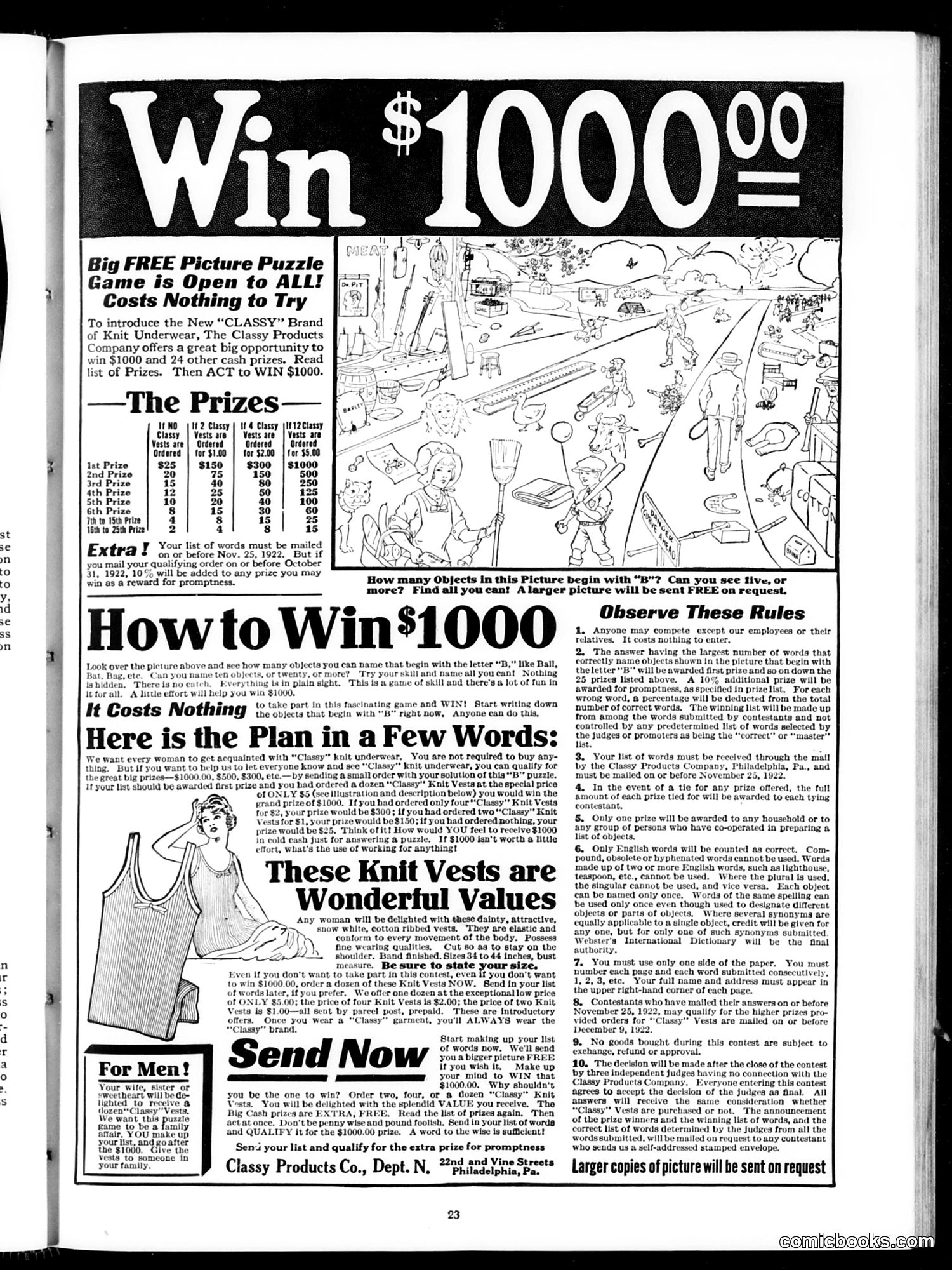
This is primarily a **commercial advertisement**, not political satire. It's a contest promoting "Classy" brand knit underwear (women's cotton vests), disguised as a puzzle game. The marketing hook: Participants solve a "B" word picture puzzle (naming objects beginning with "B") to qualify for cash prizes up to $1,000. However, **the real incentive is purchasing the product**—buyers receive bonus prize money. Someone who buys twelve vests for $5 and wins first place receives $1,000; those buying nothing only win $25. The illustration shows a domestic kitchen/home scene cluttered with objects, typical of 1920s puzzle contests. There's also a small illustration of a woman modeling the ribbed cotton vest. **The satire** (minimal here) is gentle: the ad pretends the puzzle is the main event while the actual goal is normalizing mail-order undergarment purchases. The phrase "Why shouldn't you be the one to win?" uses psychological pressure to encourage spending. This reflects 1920s mail-order marketing tactics and women's consumer culture of that era.
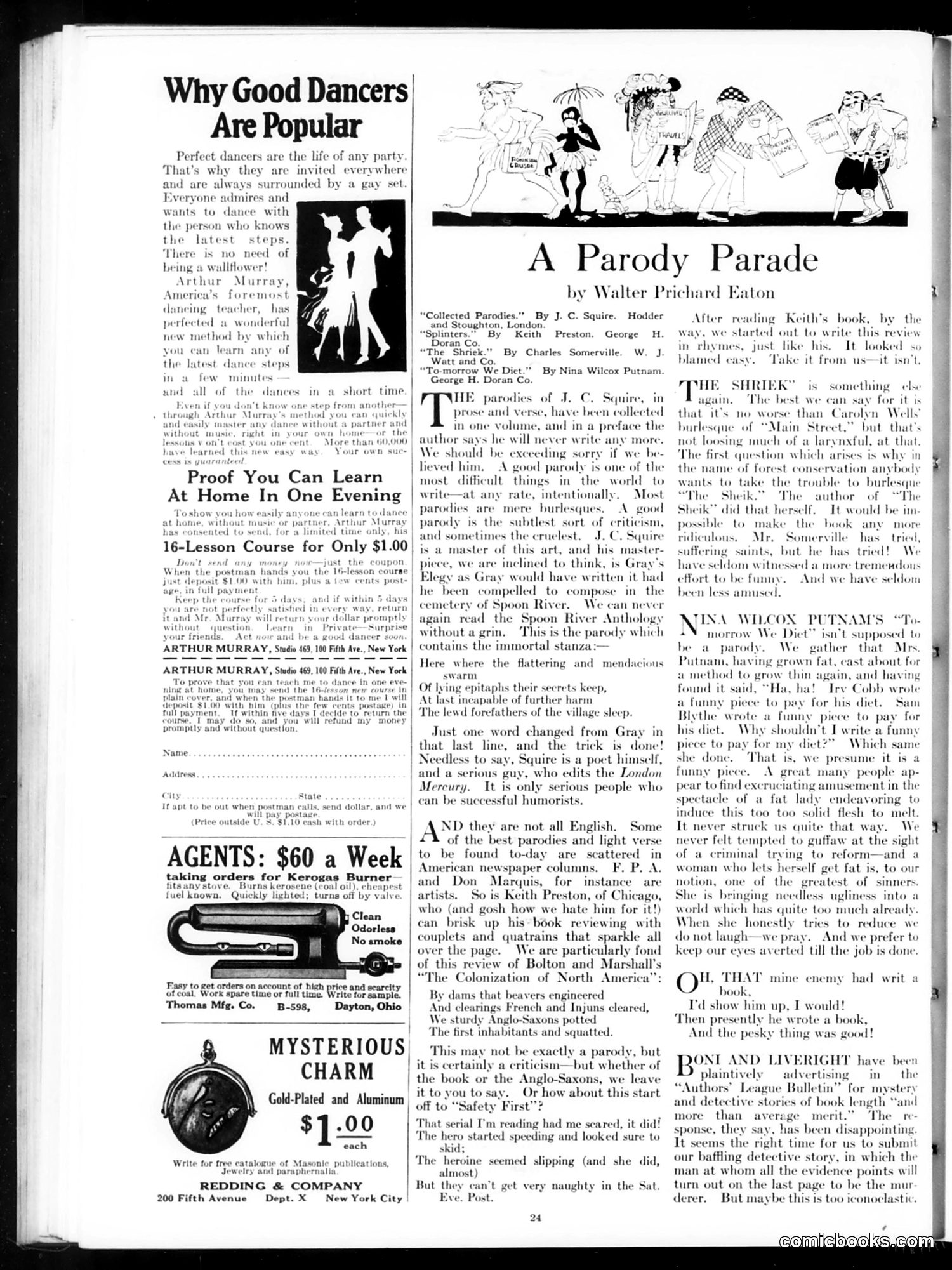
This page reviews a collection of literary parodies by J.C. Squire and discusses contemporary parody writing. The main article examines what makes effective parodies, distinguishing between true parody (subtle criticism) and mere burlesque (crude mockery). The reviewer praises Squire's work, particularly his "Gray's Elegy as Gray Would Have Written It" set in Spoon River Cemetery—a clever inversion of Thomas Gray's famous poem. However, the critique becomes increasingly dismissive of other contemporary parodies, including Nina Wilcox Putnam's "To-morrow We Diet" and Charles Somerville's burlesque of Sinclair Lewis's "Main Street." The satire's point: most popular parodies fail as actual criticism—they're lazy jokes rather than witty commentary. The reviewer suggests that Putnam and others are simply using parody as gimmicky humor, missing the intellectual rigor required for genuine literary satire. This reflects Judge's stance that good parody demands craftsmanship, not just surface-level mockery.
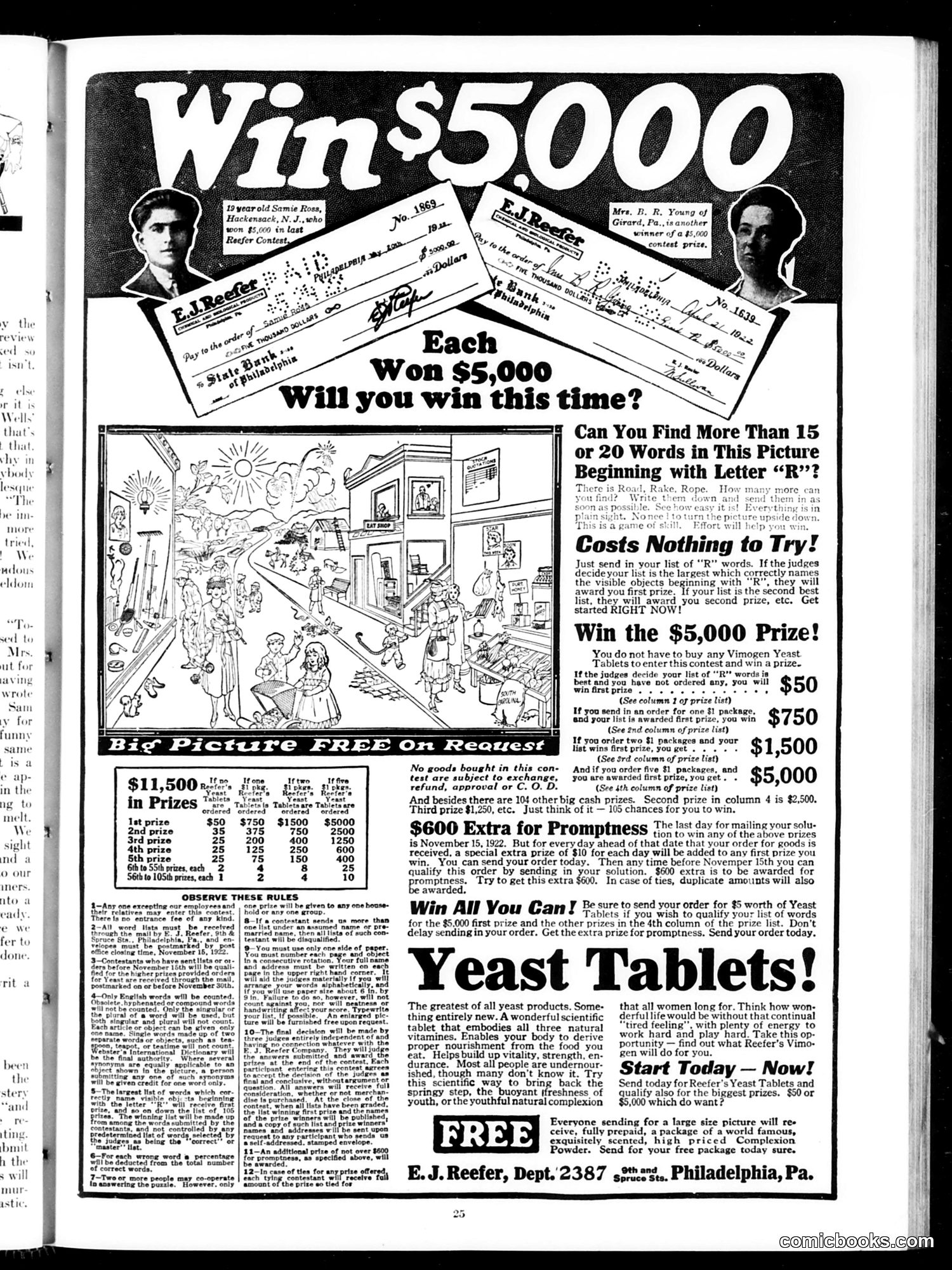
This page is primarily a **commercial advertisement** for Reefer's Vimogen Yeast Tablets disguised as a contest, rather than political satire. ## The Contest Premise The ad promotes a word-search competition where participants find words beginning with "R" in a busy household illustration. Winners receive cash prizes up to $5,000—but the catch is that entrants must purchase Vimogen Yeast Tablets to qualify, despite claims that "You do not have to buy any Vimogen Yeast Tablets to enter." ## The Satire/Critique The page satirizes **dubious mail-order marketing practices** common in the 1920s. The contest structure is deliberately confusing, with escalating prize tiers that actually require product purchases—contradicting the stated "free to enter" claim. The fine print and complex rules exemplify predatory advertising aimed at ordinary people seeking easy money during economically uncertain times. ## Historical Context This reflects genuine consumer vulnerability to such schemes in the early 20th century, before modern advertising regulations. The "scientific tablet" claims about vitamines typify how manufacturers made unproven health assertions.
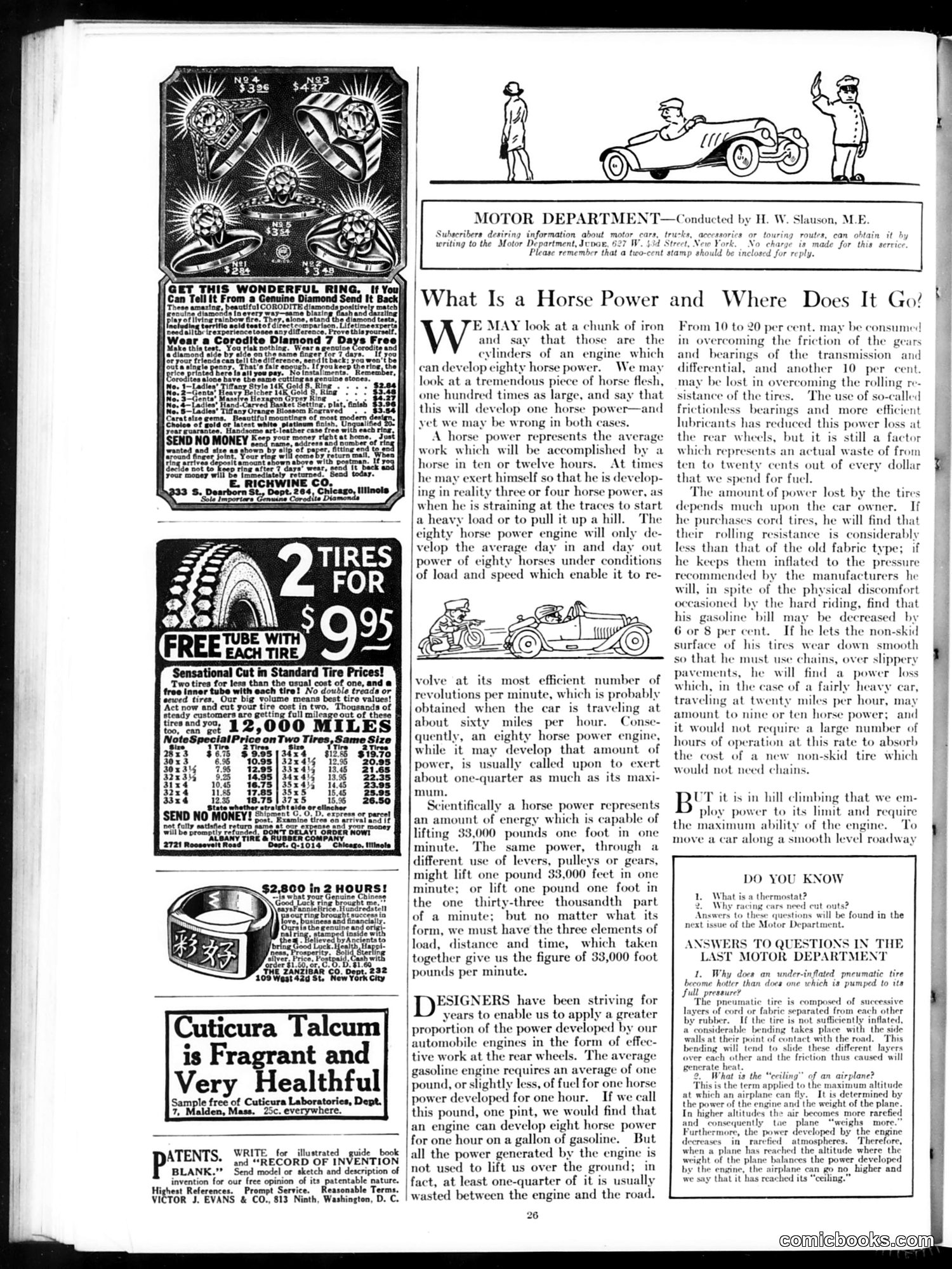
This page is primarily an educational article about automobile engines, not political satire. The "Motor Department" column, conducted by H.W. Slauson, explains horsepower to readers in practical terms. The article uses an extended analogy comparing an iron engine chunk to a horse, noting both may be misunderstood. It then explains scientifically that one horsepower can lift 33,000 pounds one foot per minute—a technical standard that applies regardless of mechanical form. The practical focus addresses where engine power is lost: roughly 10-20% to transmission friction, 10% to tire rolling resistance, and additional losses to tire wear depending on maintenance. The article advises readers that proper tire inflation and cord tires can reduce fuel consumption by 6-8%. The surrounding advertisements (Cuticura Talc, tire sales, patent services, diamond rings) are typical Judge magazine commercial content, not editorial commentary.
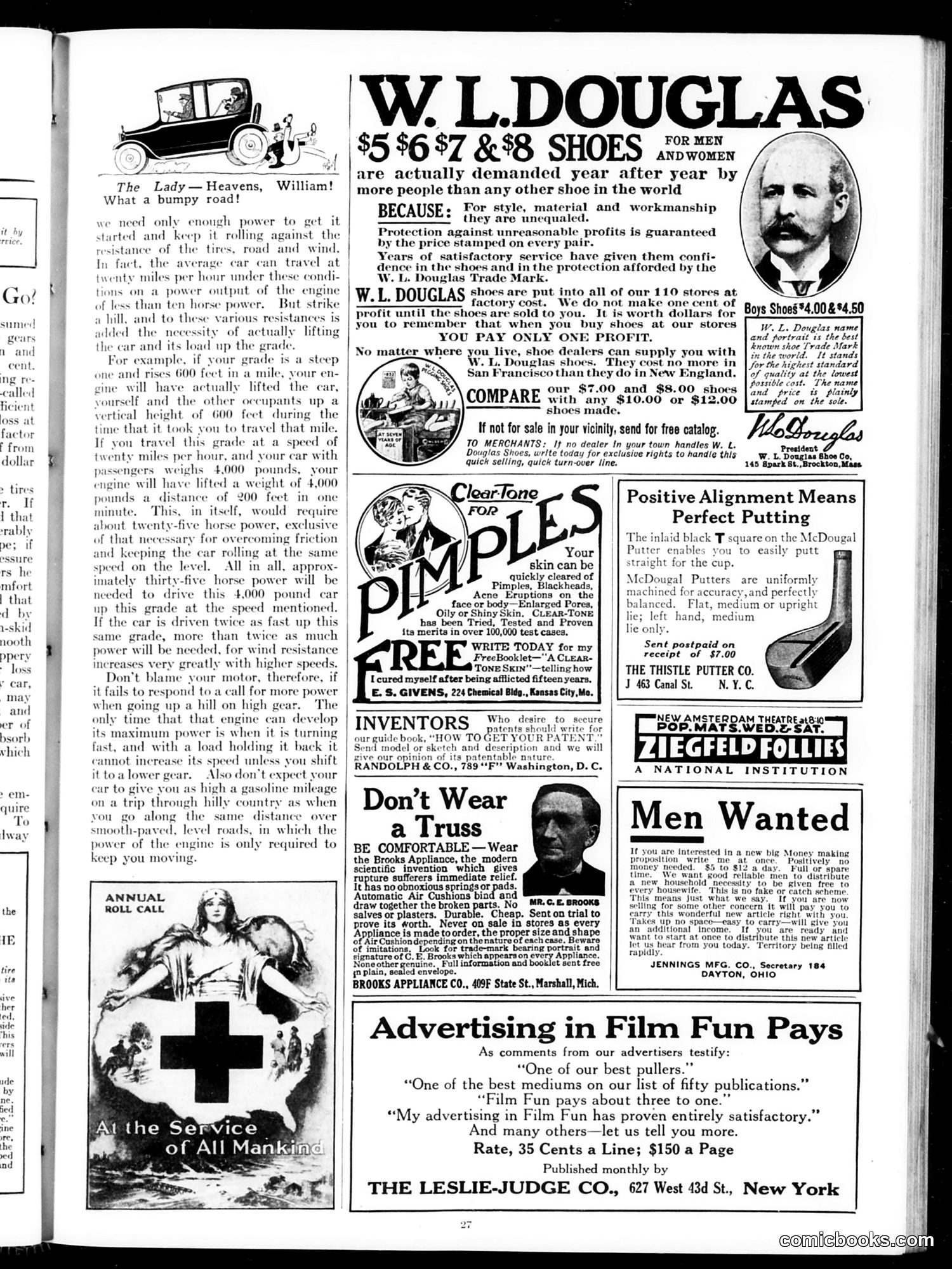
This page is primarily **advertising**, not political satire. The dominant content is a W.L. Douglas shoe advertisement featuring the company founder's portrait and sales pitch about shoe quality and factory-direct pricing—a major retail strategy of the era. The smaller editorial cartoons are largely indecipherable without clearer images, though "The Lady—Heavens, William! What a bumpy road!" appears to be domestic humor about vehicle roughness. The page includes typical early-20th-century classified ads: a Brooks Appliance truss ad, a patent-securing service, employment recruitment ("Men Wanted"), and a notice about Film Fun magazine advertising rates. **No clear political commentary is evident.** The content reflects early 1900s consumer culture: concerns about product quality, factory profit-sharing as marketing, and various industrial/medical products marketed to middle-class readers. The Douglas shoe advertisement's emphasis on standardized pricing across locations suggests growing concerns about fair retail practices and manufacturer control during this period of industrial capitalism.
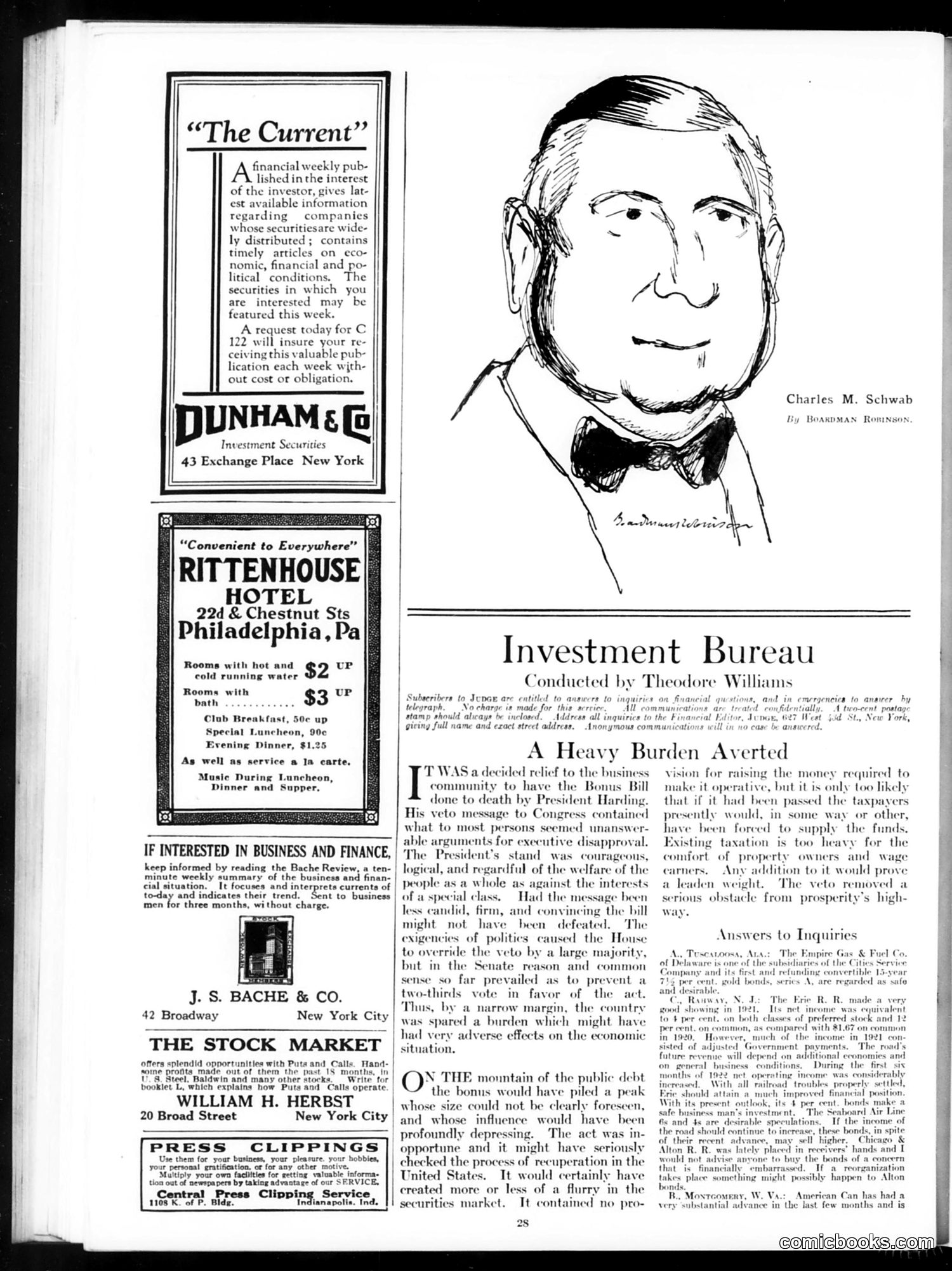
This page is primarily **advertisements and financial content**, not political satire. The main feature is a portrait of **Charles M. Schwab** (steel industrialist), credited to illustrator Boardman Robinson. The "Investment Bureau" column by Theodore Williams discusses **President Harding's veto of the Bonus Bill** — legislation to pay veterans a cash bonus. The writer *praises* Harding's veto, arguing the bonus would have created unsustainable public debt and damaged economic recovery. The article portrays this as a narrow escape: the House overrode the veto, but the Senate upheld it. **Context for moderns**: This reflects post-WWI tensions over veteran benefits. The "Bonus Bill" (actually passed in 1924 despite this opposition) was deeply controversial—conservatives feared its cost; veterans felt entitled to compensation. The surrounding ads for investment firms, hotels, and stock services indicate this was a financial/business publication aimed at investors—not primarily a satirical magazine despite Judge's usual format.
This page is primarily **advertising**, not satirical editorial content. The dominant feature is a large advertisement for G.L. Miller & Company, a bond and mortgage investment firm announcing their new New York office at 30 East 42nd Street. The small cartoon visible in the left column appears to show figures in what looks like a **financial or business scene**, though the image quality makes specific identification difficult. The page's main content addresses **investor confidence** in Miller Bonds, emphasizing their expansion from Southern markets to nationwide offerings. The advertisement explicitly invites readers—described as "customer, friend and reader of JUDGE"—to request informational booklets titled "Creating Good Investments" and "What People Say About Miller Bonds." The remaining text consists of financial advice columns answering reader questions about stock dividends and investment recommendations. This represents **Judge's revenue model**: selling advertising space to financial services companies while maintaining the magazine's satirical editorial voice elsewhere.
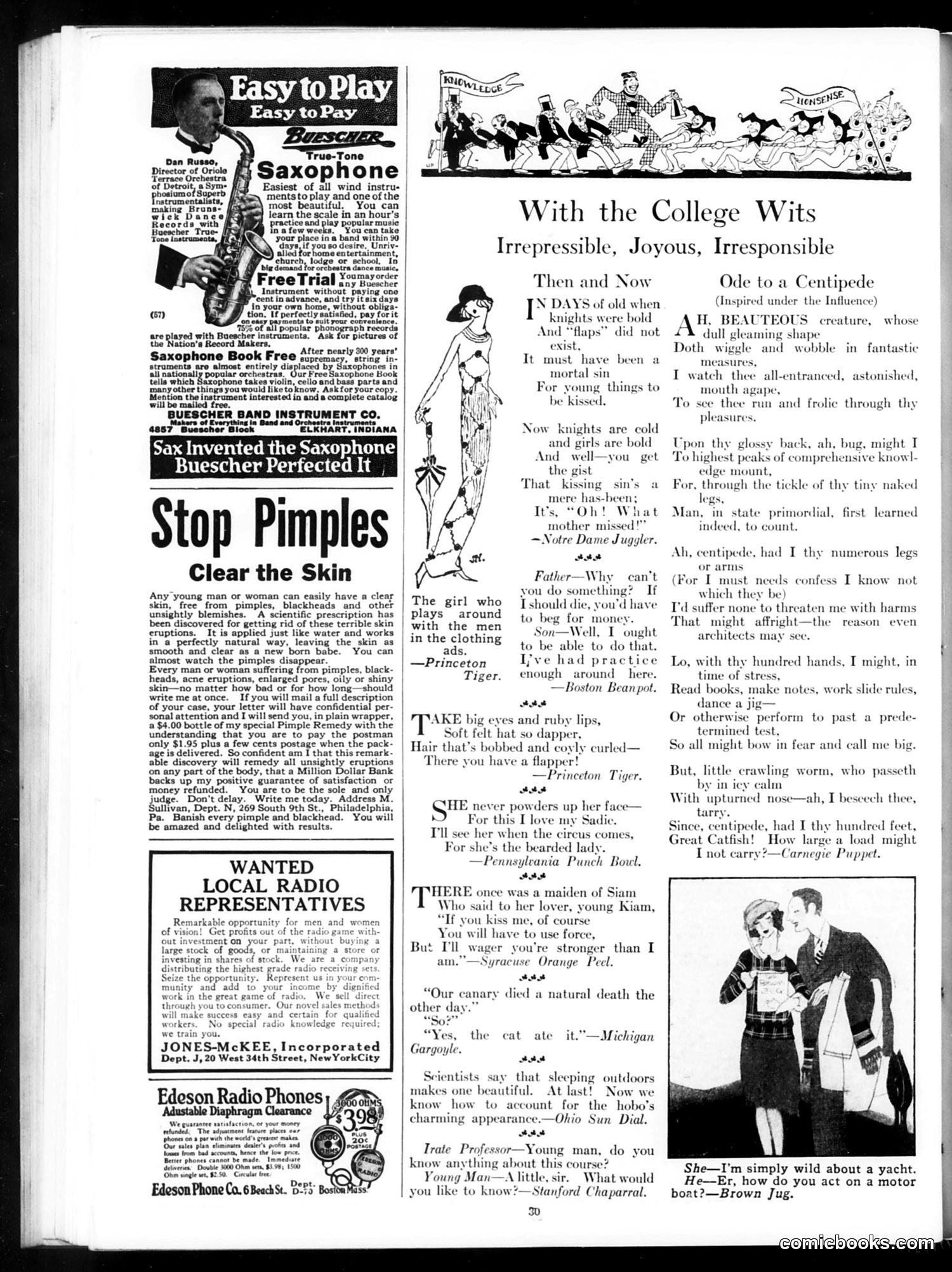
This page is primarily **advertising and humorous verse**, not political satire. The main content includes: **Advertisements:** Saxophone lessons, pimple-clearing cream, and radio sales positions occupy significant space—typical 1920s classified advertising. **"With the College Wits":** The right side contains lighthearted college humor poetry mocking dating customs and the "flapper" era. References to "knights," "kissing," and modern girls' behavior reflect 1920s generational anxiety about changing courtship norms. Jokes about young men's laziness ("If I should die, you'd have to beg") and physical appearance (bobbed hair, makeup) are typical period humor. **The satire is social, not political:** The verses gently mock contemporary youth culture—the contrast between "old days" propriety and modern boldness, flapper fashion and behavior, and romantic expectations. No specific political figures or events are referenced. This represents Judge magazine's lighter, entertainment-focused content rather than its typically sharper political commentary.
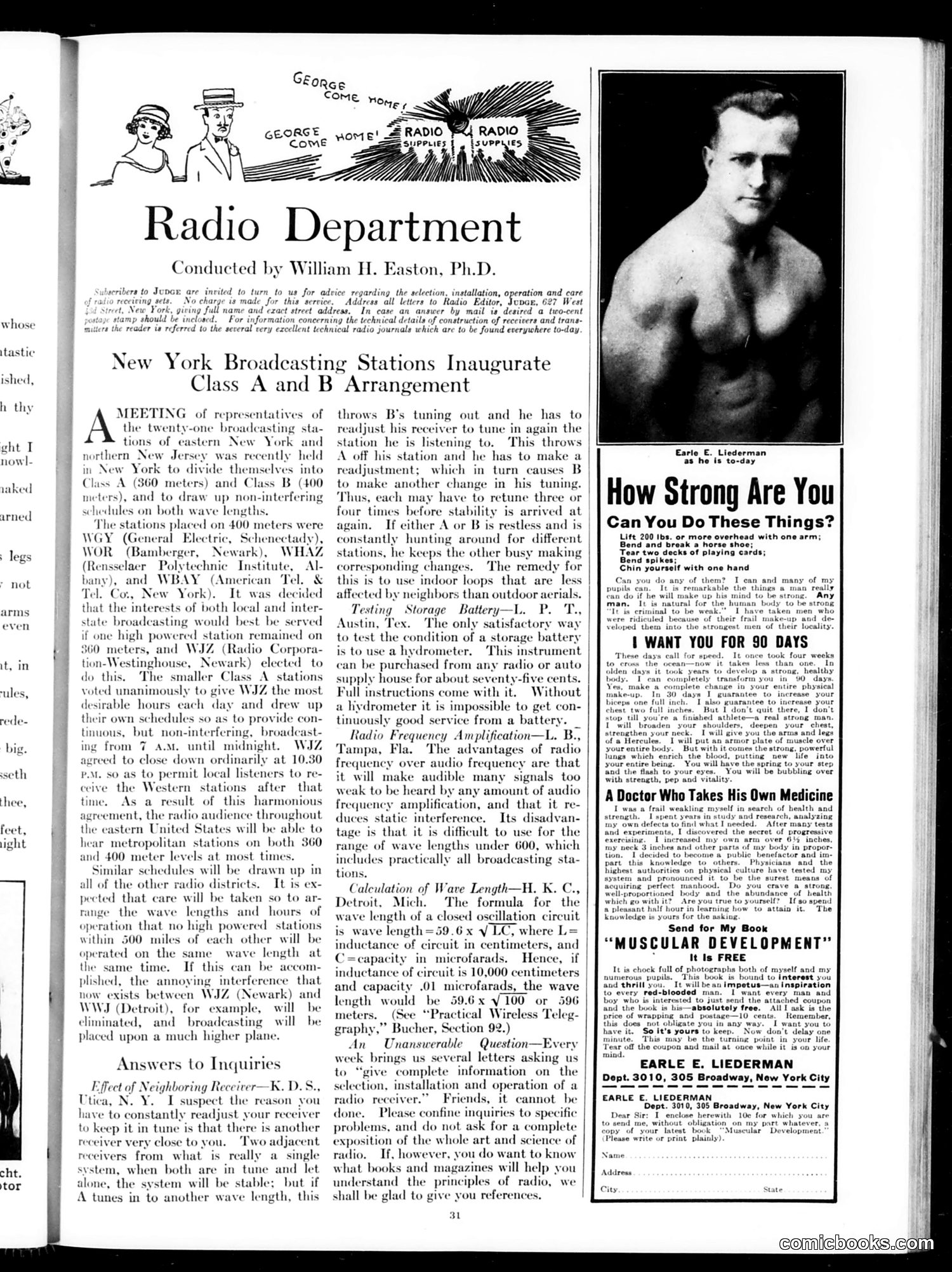
This page from *Judge* magazine consists primarily of **technical radio content**, not satire. The main section is the "Radio Department" column addressing early 1920s broadcasting issues. The top cartoon shows a domestic scene with "George, come home!" — appearing to reference how radio was drawing men away from home, a common social concern of the era when radio was novel entertainment. The substantive content describes **New York radio stations organizing into Class A and B broadcast arrangements** to reduce interference — a real technical problem when many stations operated on limited frequencies. Station callsigns like WGY, WJZ, and WOR are identified. The right side features **advertisement content** (strength-testing claims and a "Send My Book" offer), typical of *Judge*'s revenue model. **Modern context**: This reflects early radio's technical growing pains and regulatory efforts before the FCC (established 1934) standardized broadcasting.
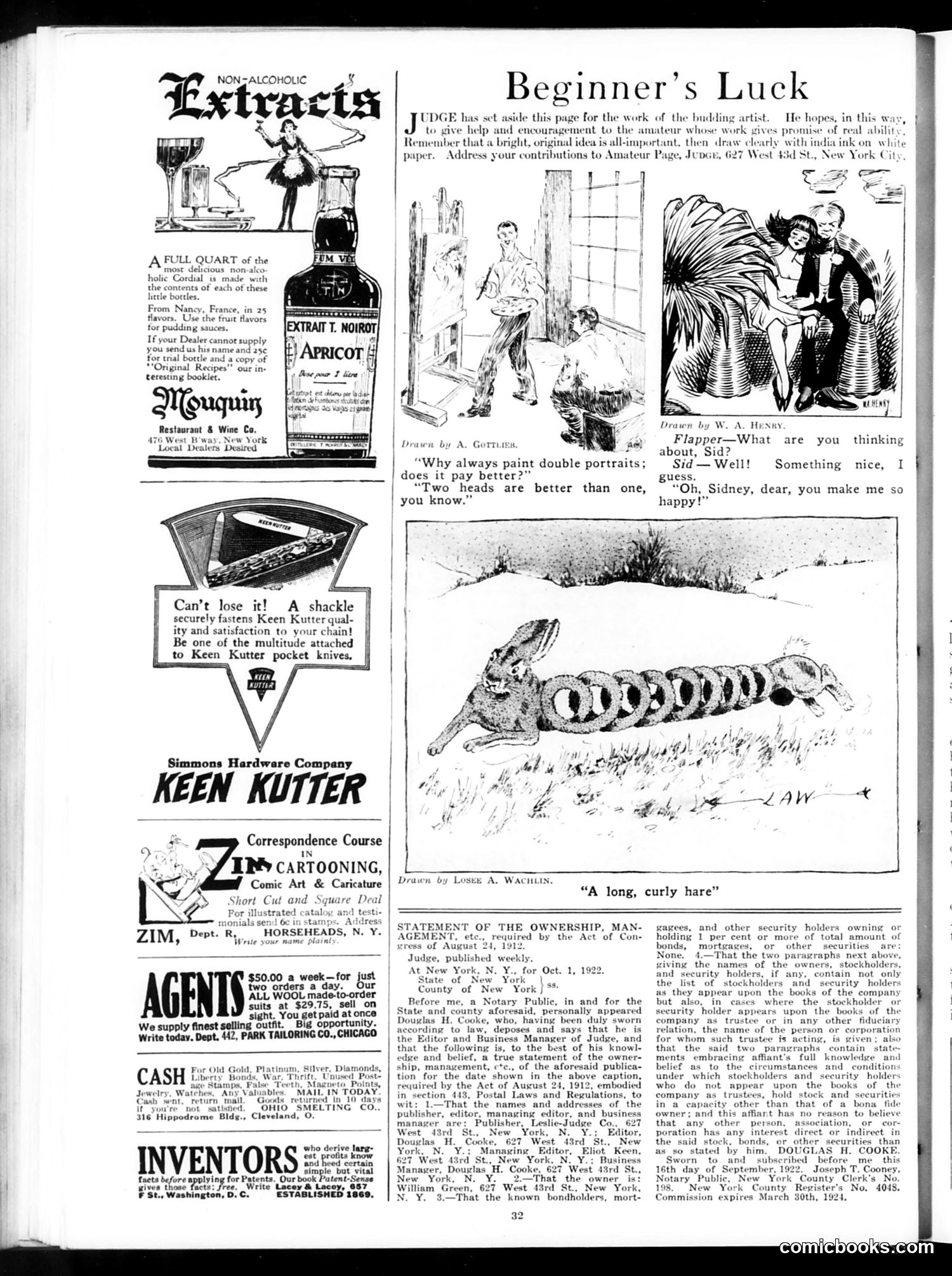
This is primarily an **advertising and submissions page** for Judge magazine's amateur cartoonist section. The main content includes: **"Beginner's Luck" Section:** Judge invited amateur artists to submit original cartoon ideas. The page shows three sample cartoons—two humorous domestic scenes and one drawing of a "long, curly hare" (a rabbit). These exemplify the type of work encouraged from budding artists. **Key Cartoon:** The "flapper" drawing depicts a 1920s young woman in fashionable dress discussing something romantic with a young man named Sidney—typical Jazz Age courtship humor targeting contemporary youth culture. **Surrounding Content:** The page is heavily laden with period advertisements (Keen Kutter knives, correspondence cartooning courses, tailoring services, patent assistance) and a legal ownership statement required by postal regulations. **Historical Context:** This reflects 1920s magazine culture encouraging reader participation while monetizing through advertising.
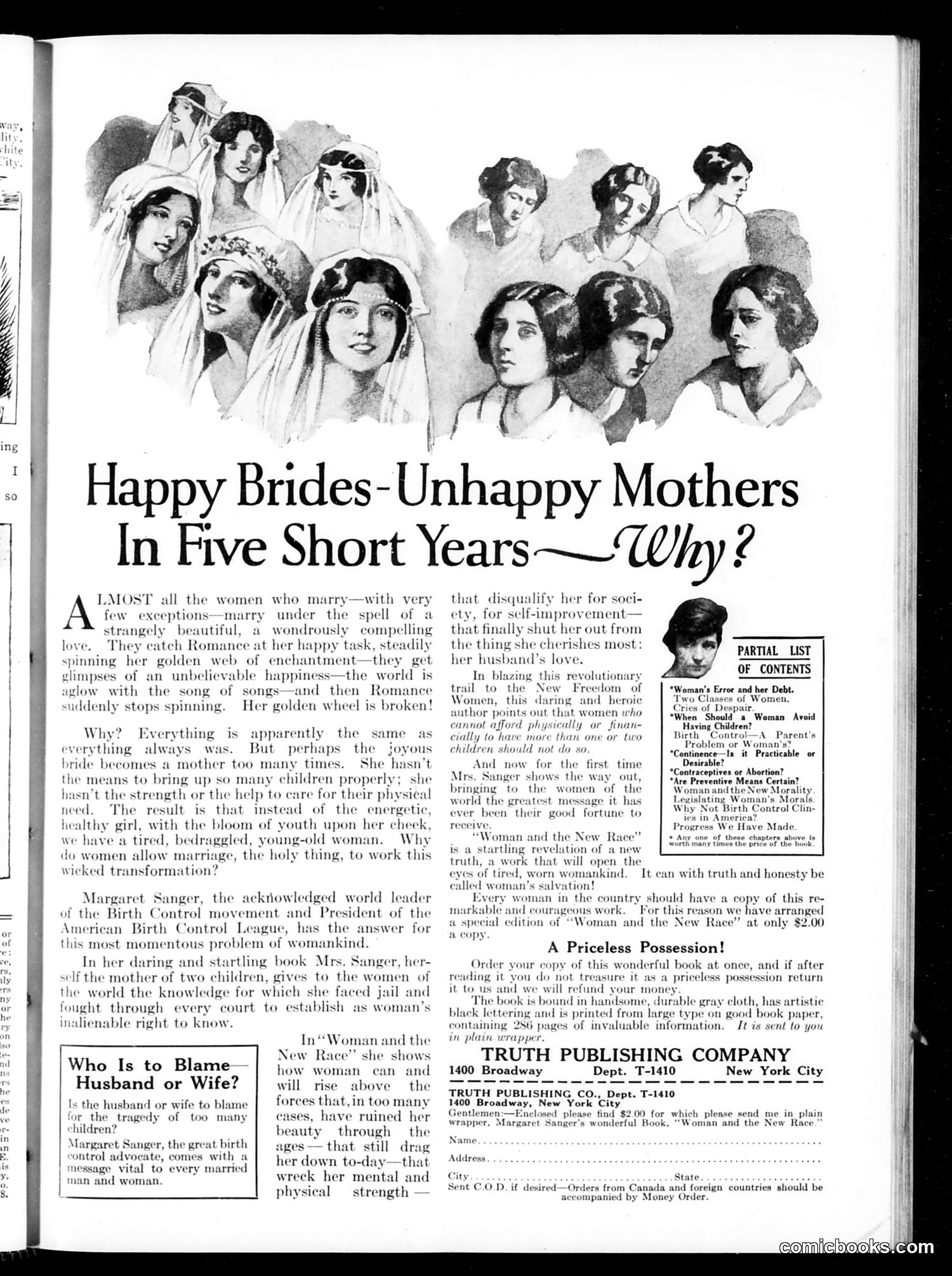
This page advertises Margaret Sanger's birth control book *Woman and the New Race* through a satirical article. The illustrated heading shows young brides transforming into exhausted, aged mothers within five years. The article's premise: marriages begin romantically but deteriorate when women bear too many children without adequate resources or support. The result is physical and mental deterioration—women become "tired, bedraggled, young-old woman." The satire targets not women but the social system forcing them into this cycle. Sanger, the actual birth control advocate, is presented as offering the solution: access to contraception so women can space pregnancies and preserve their health, beauty, and marital happiness. The "Who Is to Blame—Husband or Wife?" sidebar suggests the real culprit is neither spouse individually but systemic poverty and lack of reproductive choice. This 1920s text advocates for birth control access as women's liberation—a radical position then, as contraception was legally restricted.
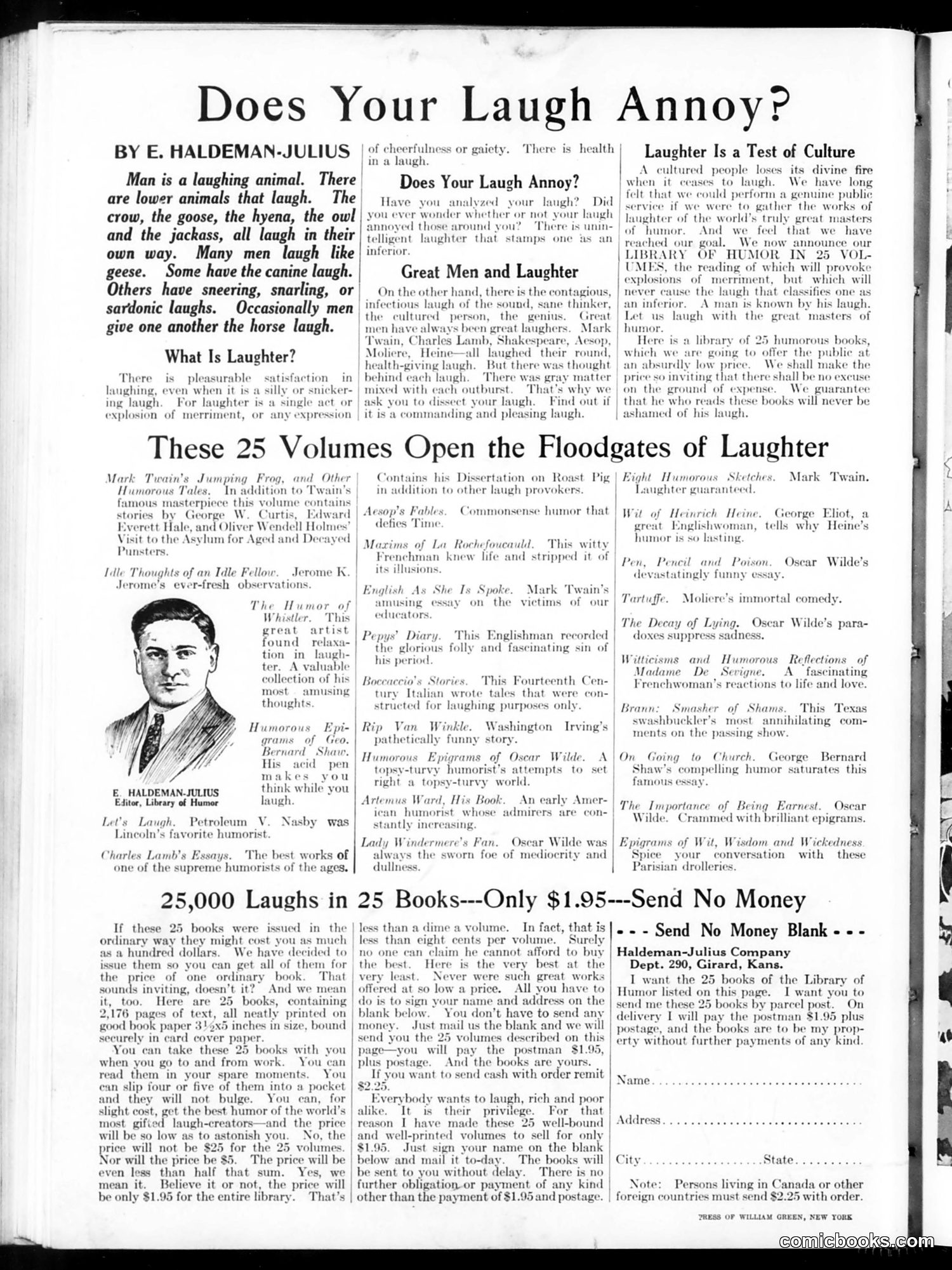
This page is primarily **advertising** for a mail-order book collection, not political satire. E. Haldeman-Julius, a real publisher, promotes his "Library of Humor in 25 Volumes" through an editorial essay arguing that cultured people can be judged by their laugh. The argument is essentially: different laughs signal different character types (geese-like, canine, sardonic). "Great men" like Mark Twain and Oscar Wilde laughed intelligently, demonstrating refinement. By reading these 25 volumes of classic humor writers—Twain, Wilde, Jerome K. Jerome, Charles Lamb—readers can cultivate a "cultured" laugh and avoid sounding inferior. The sketch of Haldeman-Julius himself appears as author credibility. This reflects early 20th-century ideas linking humor appreciation to social class and education. The offer of 25 books for $1.95 was genuinely inexpensive for the era, making "cultured" humor accessible to ordinary readers. **No political cartoon or satire appears here**—it's a straightforward (if snobbish) commercial pitch dressed as cultural advice.