
Judge, 1922-10-14 · page 33 of 36
Judge — October 14, 1922 — page 33: what you’re looking at
What you’re looking at
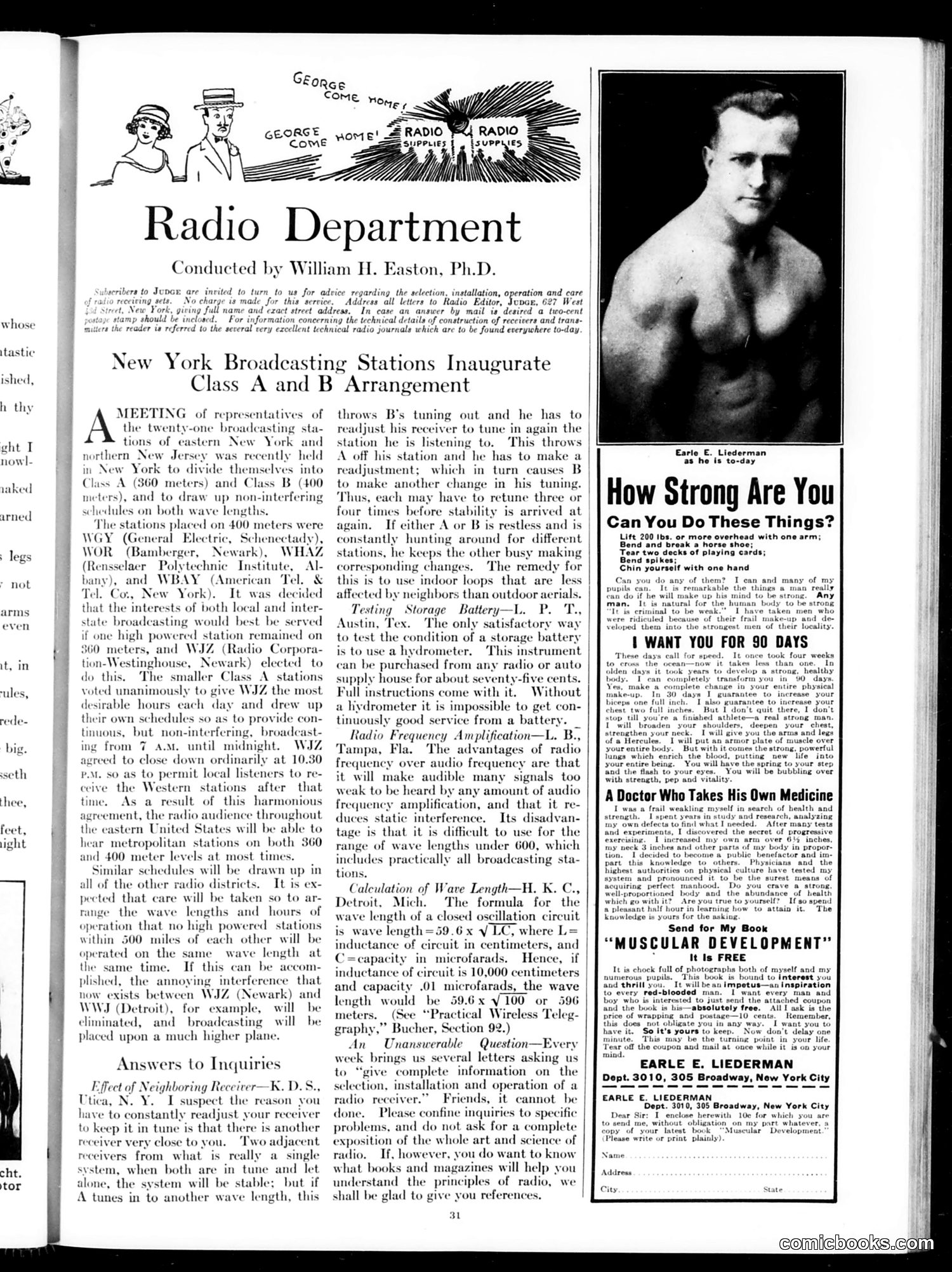
This page from *Judge* magazine consists primarily of **technical radio content**, not satire. The main section is the "Radio Department" column addressing early 1920s broadcasting issues. The top cartoon shows a domestic scene with "George, come home!" — appearing to reference how radio was drawing men away from home, a common social concern of the era when radio was novel entertainment. The substantive content describes **New York radio stations organizing into Class A and B broadcast arrangements** to reduce interference — a real technical problem when many stations operated on limited frequencies. Station callsigns like WGY, WJZ, and WOR are identified. The right side features **advertisement content** (strength-testing claims and a "Send My Book" offer), typical of *Judge*'s revenue model. **Modern context**: This reflects early radio's technical growing pains and regulatory efforts before the FCC (established 1934) standardized broadcasting.
📄 Transcribed text from this page (OCR, searchable)
Machine-transcribed from the original scan — historical spelling and the odd misread are preserved.
whose itastic ished, h thy ght I nowl- raked urned not arms even cht. tor asc GEorce Sone —— t GEORGE. wore! = am Radio Donartment Conducted by William H. Easton, Ph.D. are invited to tur scribers to June de for this service For inform to us for advice ezact street address. concerning the technical drtails of construction of receivers and trans- reader is referred to the several tery excellent technical radio journals which are to be found everywhere to-day. regarding the selection. installation, operation and care Address all letters to Radio Editor, Jupae, 627 West In case an answer by mail is desired a tweo-cent New York Broadcasting Stations Inaugurate Class A and B Arrangement MEETING of representatives of the twenty-one broadcasting sta- tions of eastern New York and northern New J ‘y was recently held in New York to divide themselves into Class A (360 meters) and Class B (400 meters), and to draw up non-interfer' schedules on both wave lengths. The ions placed on 400 meters were WGY (General Electric, Schenectady), WOR (Bamberger, Newark), WHAZ (Rensselaer Polytechnic Institute, Al- bany), and W BAY (American Tel. & Tel. Cor, York). It was decided that the interests of both local and inter- state broadcasting would best be served if one high powered station remained on 360 meters, and WJZ (Radio Corpora- tion-Westinghouse, Newark) elected to do this. The smaller Class A stations voted unanimously to give WJZ the most desirable hours > and drew up their own schedules so as to provide con- tinuous, but non-interfering, broadcast- ing from 7 A.M. until midnight. WJZ agreed to close down ordinarily at 10.30 P.M. so as to permit local listeners to re- the Western stations after that ceive time. As a result of this harmonious ement, the radio audience throughout istern United States will be able to r metropolitan stations on both 360 and 400 meter levels at most times. Similar schedules will be drawn up in all of the other radio districts. It is ex- pected that care will be taken so to ar- ra the wave lengths and hours of operation that no high powered. stations within 500 miles of each other will be operated on the same wave length at the same time. If this can be plished, the annoying interferen now exists between W, WWJ (Detroit), for « will eliminated, and broade will placed upon a much higher plane. accom- » that rk) and be he Answers to Inquiries _ Effect of Neighboring Receiver—K. D. N.Y. I suspect the ri ou have to constantly readjust your receiver to keep it in tune is that there is another iver very close to you. ‘Two adjacent ers from what is really a_ single system, when both are in tune and let alone, the system will be stable; but if A tunes in to another wave length, this throws B's tuning out and he readjust his receiver to tune in again the station he is listening to. This throws A off his station and he has to make a readjustment; which in turn causes B to make another change in his tuning. ‘Thus, each may have to retune three or four times before stability is arrived at If either A or B is restless and is constacily hunting around for different | stations, he keeps the other busy making | corresponding changes. ‘The remedy for this is to use indoor loops that are less affected by neighbors than outdoor aerials. Testing Storage Battery—L. P._ TT. Austin, Tex. The only satisfactory way to test the condition of a storage battery is to use a hydrometer. ‘This instrument can be purchased from any radio or auto supply house for about seventy-five cents. Full instructions come with it. Without a hydrometer it is impossible to get con- tinuously good service from a battery. Amplification—L. I mpa, Fla. The advantages of radio frequency over audio frequency are that it will make audible many signals too weak to be heard by any amount of audio frequency amplification, and that it re- duces static interference. Its disadvan- tage is that it is difficult to use for the range of wave lengths under 600, which includes practically all broadcasting sta- tions. Calculation of Wave Length—H. K. C., Detroit, Mich. The formu for the wave length of a closed oscillation cireuit is wave length=59.6 x y LC, where L= inductance of circuit in centimeters, and apacity in microfarads. |} if inductance of circuit is 10,000 centimeters and capacity .01 microfarads, the wave length would be ix ¥ 100 or 596 meters. an I Wireless Teleg- graphy,” Bucher, Section 92.) An Unanswerable Question—Every Radio Frequenc week brings us several letters asking us to complete information on. the radio receiv . it cannot done. problems, and do not exposition of the whe ra If, however, you do want to know what books and magazines will help you understand the principles of radio, we shall be glad to give you references. k for a complete science of BL Please confine inquiries to specific | has to | and operation of a | Earle an as he is to-day How Strong Are You Can You Do These Things? Lift 200 Ibs. or more overhead with one arm; Be hoi of playing cards; with one hand T can and many of my a man really of them? 4 dee rongest men of their lucality I WANT You FOR 90 DAYS body’ ok four weeks muscle over will put'an arm trong, powerful But with it cou h with strength, pep and vitality A Doctor Who Takes His Own Medicine I was a frail weakling myself in sea ap! knowledge is yours If so spend attain it. The jor the asking Send for My Book “MUSCULAR DEVELOPMENT” ff the coupon a: Now don't delay EARLE E. LIEDERMAN Dept. 3010, 305 Broadw: New York City EARLE E. LIEDERMAN Dept Address City - 3010, 305 Broadway, New York City I enclose herewith 10e for which you are on my part what ‘Muscular’ Develop comichooks.