
Judge, 1922-10-14 · page 21 of 36
Judge — October 14, 1922 — page 21: what you’re looking at
What you’re looking at
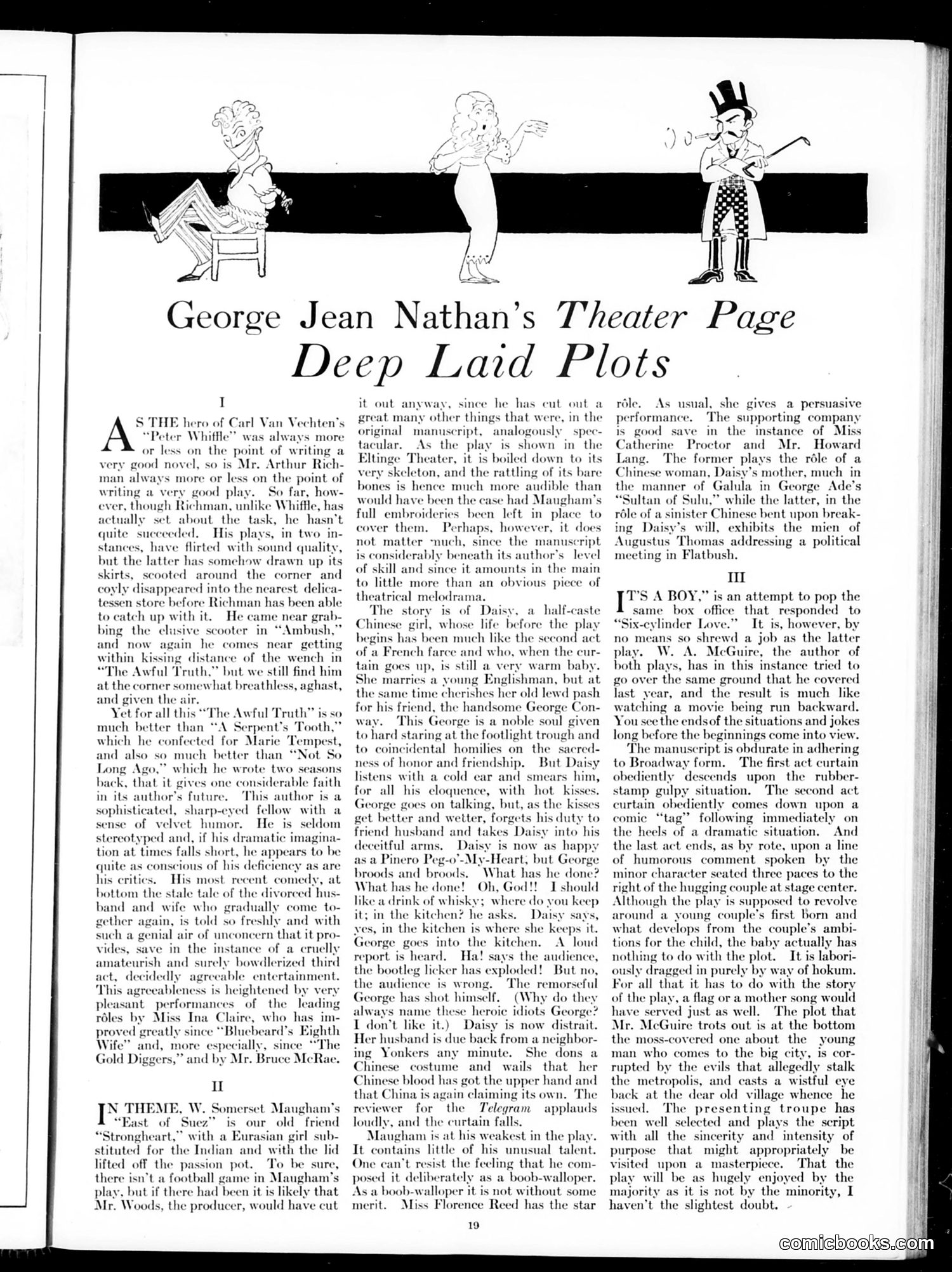
This is a theater criticism column reviewing contemporary plays. The illustrated header shows three theatrical characters in exaggerated poses—typical of Judge magazine's satirical visual style. Nathan critiques Arthur Richman's play "The Awful Truth," praising its sophisticated humor and Ina Claire's performance while noting Richman consistently falls short of genuine dramatic excellence. He compares Richman to a character perpetually on the verge of writing something good but never quite succeeding. The second section reviews W. Somerset Maugham's "East of Suez," criticizing it as melodramatic. The plot involves Daisy, a half-Chinese woman, who marries an Englishman but pursues his friend George. Nathan mocks the overwrought moral anguish ("Oh, God!!") and suggests the play's emotional excess stems from heavy editing that removed Maugham's original spectacle. The satire targets both playwrights' shortcomings and theatrical pretension of the era.
📄 Transcribed text from this page (OCR, searchable)
Machine-transcribed from the original scan — historical spelling and the odd misread are preserved.
I S THE hero of Carl Van Vechten’s “Peter Whiffle” was always more or less on the point of writing a very good novel, so is Mr. Arthur Rich- man always more or less on the point of writing a very good play. » far, how- ever, though Richman, unlike Whiffle, has actually about the task, he hasn't quite succeeded. His plays, in two in- stances, have flirted with Sound quality, but the latter has somehow drawn up its skirts, scooted around the corner and coyly disappeared into the nearest de tessen store before Richman has been able to catch up with it. He came near gr: bing the clusive scooter in “Ambush, and now again he comes near getting ithin kissing distance of the wench in “The Awful Truth,” but we still find him at the corner somewhat breathless, aghast, and given the air. Yet for all this “The Awful Truth” much better than “A Serpent's Tooth,” which he confected for Marie Tempest, also so much better than ‘Not So which he wrote two seasons faith is so and Long Ago,” hack, that it gives one considerable in its author's future. ‘This author is a sophisticated, sharp-cyed fellow with a sense of velvet humor. He is seldom stereotyped and, if his dramatic imagina- tion at times falls short, he quite as conscious of his defici his critics. His most recent. comedy bottom the stale tale of the divorced hus- band and wife who ly come to- sthe n, is told so freshly and with such a genial air of unconcern that it pro- vides, save in the instance of a cruelly nateurish and surely bowdlerized third t, decidedly agreeable entertainment. This agreeableness is heightened by very ant performances. of the lea y Miss Ina Claire, who has im- greatly since “Blucheard’s Eighth ind, more especially, since “The gers,” and by Mr. Bruce McRae. Il is out ald. friend with a Eurasian girl sub- th the lid lifted off the passion pot. To be sure, there isn’t a football game in Maugham’s play, but if there had been it is likely that Strongheart,” stituted for the Indian and Mr. Woods, the producer, would have cut George Jean Nathan’s Theater Page Deep Laid Plots it out anyway, since he has cut out a great many other things that were, in the original manuscript, analogously spec- tacular, As the play is shown in. the Eltinge Theater, it is boiled down to its very skeleton, and the rattling of its bare bones is hence much more audible than would have been the case had Maugham’s full embroideries been left in place to cover them. Perhaps, however, it does not matter ‘nuch, since the manuscript is considerably beneath its author's of skill and since it amounts in the main to little more than an obvious piece of theatrical melodrama. The story is of Daisy, a half-caste Chinese girl, whose life before the play begins has been much like the second act of a French farce and who, when the cur- tain goes up, is still a very warm baby. She marries lishman, but at the same time ¢ he rishes her old lewd pash for his friend, the handsome George Con- This George is a noble soul given to hard staring at the footlight trough and to coincidental homilies on the sacred- ness of honor and friendship. But Daisy listens with a cold ear and smears him, for all his eloquence, with hot kisses. Ge goes on talking, but, as the kisses get better and wetter, forgets his duty to friend husband and takes Daisy into his sitful arms. Daisy is now as ha asa Pinero Peg-o’-My-Heart, but Georg broods and broo What has he done? What has he done!) Oh, God!!_ I should like a drink of whisky; where do you keep ; in the kitchen? he asks. Daisy says, in the kitchen is where she keeps it. sorge goes into the kitchen. A. loud report is heard. Ha! s the audience, the bootleg licker has exploded! But no, the audience is wrong. The remorseful George has shot himself. do they always name these hero eorge? I don’t like it.) Daisy is now distrait. Her husband is due back from a neighbor- ing Yonkers any minute. She dons a Chinese costume and wails that her Chinese blood has got the upper hand and that China is again claiming its own. The reviewer for the Telegram applauds », and the curtain falls. am is at his weakest in the play. ns little of his unusual talent. ant resist the feeling that he com- posed it deliberately as a boob-walloper. As a boob-walloper it is not without some merit. Miss Florence Reed has the star 19 As usual, she a persuasive The supporting company role, performanc is good save in the instance of Miss Catherine Proctor and Mr. Howard Lang. The former plays the réle of a Chinese woman, Daisy’s mother, much in the manner of Galula in George Ade’s “Sultan of Sulu,” while the latter, in the role of a sinister Chinese bent upon break- ing Daisy’s will, exhibits the mien of Augustus Thomas addressing a political meeting in Flatbush. Il 5 A BOY,” is an attempt to pop the me box office that. responded to “Six- cylinder Love.” It is, however, by job as the latter ire, the author of both siey , has in this instance tried to go over the same ground that he cov last year, and the result is much like watching a movie being run backward. You see the endsof the situations and jokes long before the beginnings come into view. ‘The manuscript is obdurate in adhering to Broadway form. The first act curtain obediently descends upon the rubber- stamp gulpy situation. The second act curtain obediently comes down upon a comic “tag” following immediately on the heels of a dramatic situation. And the last act ends, as by rote, upon a line of humorous comment spoken by the minor character seated three paces to the right of the hugging couple at stage center. Although the play is supposed to revolve around a young couple's first born and what develops from the couple’s ambi- tions for the child, the baby actu, has pela to do with the apo a thee cra mother aonamould ed just as well. ‘The plot that McGuire trots out is at the bottom young Mr. the moss-covered one about the man who comes to the big ¢ rupted by the evils that allege the metropol 1 wistful eye back at the de age whence he issued. ‘The presenting troupe has been well selected and p with all the sincerity and’ inter purpose that might appropriately visited upon a masterpiece. be That the play will be as hugely enjoyed by the majority as it is not by the minority, 1 haven't the slightest doubt. comichooks.