
Judge, 1922-10-14 · page 17 of 36
Judge — October 14, 1922 — page 17: what you’re looking at
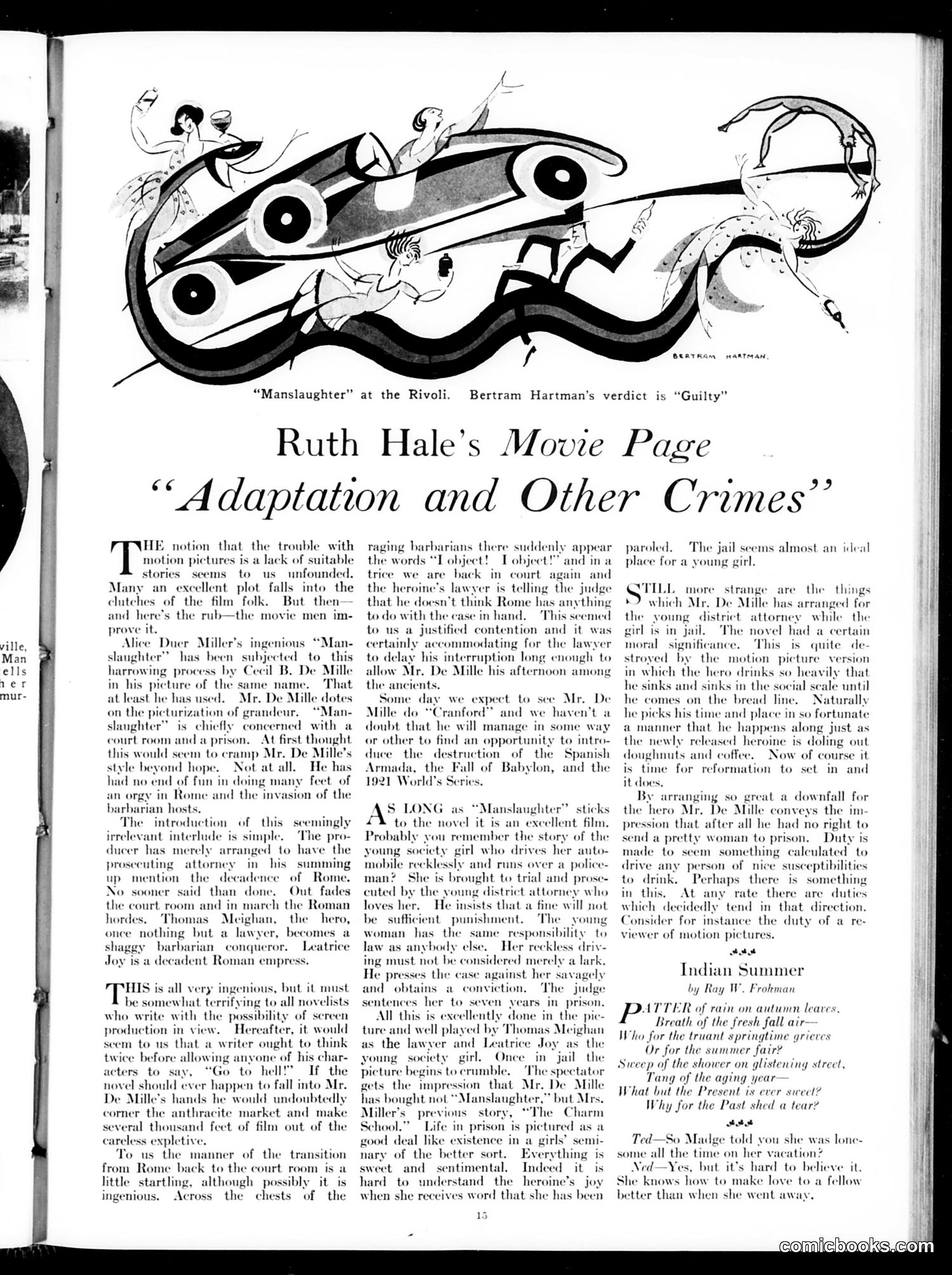
What you’re looking at
This is a film review by Bertram Hartman critiquing Cecil B. DeMille's adaptation of Alice Duer Miller's novel "Manslaughter." The cartoon above shows the story being stretched and distorted—literally—to accommodate DeMille's tendency toward elaborate, unnecessary spectacle. Hartman's complaint: DeMille inserted irrelevant Roman conquest sequences into a straightforward courtroom drama about a reckless driver prosecuted by a lawyer she loves. A simple mention of Rome's "decadence" prompted DeMille to film entire scenes of barbarian invasions and Roman empresses, absurdly transporting the characters into historical pageantry unrelated to the plot. The satire targets Hollywood's adaptation practices—how filmmakers pillage literary sources, inserting grandiose visual spectacles that undermine the original story. Hartman warns novelists that any casual reference to exotic locations risks DeMille transforming their intimate dramas into bloated epics, even jokingly suggesting he'd somehow work in "the Fall of Babylon" and the "1921 World's Series" into any screenplay.
📄 Transcribed text from this page (OCR, searchable)
Machine-transcribed from the original scan — historical spelling and the odd misread are preserved.
“Manslaughter” Ruth Hale’s at the Rivoli. Bertram Hartman’s verdict is BERTRAM HARTMAN, “Guilty” Vovie Page “Adaptation and Other Crimes” HE notion that the trouble with motion pictures is a lack of suitable stories seems to us unfounded. Many an excellent plot falls into the clutches of the film folk. But then and here’s the rub—the movie men im- prove it. Alice Duer Miller's ingenious “Man- slaughter” has been subjected to this harrowing process by Cecil B. De Mille in his picture of the same name. That at least he has used. Mr. De Mille dotes on the picturization of grandeur, “*Man- ghter” is chiefly concerned with a court room and a prison, At first thought this would seem to cramp Mr. De Mille’s style beyond hope. Not at all. He has had no end of fun in doing many feet of n Rome and the invasion of the hosts. introduction irrelevant interlude of this seemingly is simple. ‘The pro- ducer has merely arranged to have the prosecuting attorney in’ his summing up mention the decadence of Rome. No sooner said than done. Out fades the court room and in march the Roman hordes. Thomas Meighan, the hero, once nothing but a lawyer, becom shaggy barbarian conqueror. Leatri Joy is a decadent Roman empress. if Dat is all very ingenious, but it must be somewhat terrifying to all novelists who write with the possibility of screen production in view. Hereafter, it would scem to us that a writer ought to think twice before allowing anyone of his char- acters to say, “Go to hell!” If the novel should ever happen to fall into Mr. De Mille’s hands he would undoubtedly corner the anthracite market and make several thousand feet of film out of the less expletive. To us the manner of the transition from Rome back to the court room is a little tling, although possibly it is ingenious. Across the chests of the raging barbarians there suddenly appear the words “I object! L object!” and ina trice we ack in’ court in and the heroine’s lawyer is telling the judge that he doesn’t think Rome has anything to do with the case in hand. This seemed to us a justified contention and it was certainly accommodating for the lawyer to delay his interruption long enough to allow Mr. De Mille his afternoon among the ancients. Some day we expect to see Mr. De Mille do “Cranford” and we haven't a doubt that he will manage in some way or other to find an opportunity to intro- the destruction of the Spanish a, the Fall of Babylon, and the 1921 World’s Series. “Manslaughter” sticks ‘lit is an excellent film. Probably you remember the story of the young society girl who drives her auto- mobile recklessly and runs over a police- man? She is brought to trial and prose- cuted by the young district attorney who loves He insists that a fine will not be sufficient’ punishment. The young woman has the same responsibility to law as anybody else. Her reckless driv- ing must not be considered merely a lark. He presses the case inst her savagely and obtains a conviction. The judge sentences her to seven years in prison. All this is excellently done in the pic- ture and well pl F as the lawyer and Leatrice young society girl One picture begins to crumble. gets the impression that Mr. has bought not “Manslaughter,” but Mrs. Miller's previous story, “The Charm School.” Life in prison is pictured as a good deal like existence in a girls’ semi- nary of the better sort. Everything is sweet and sentimenta hard to understand the heroine's joy when she receives word that she has been S LONG as in ‘Theshed De Mille 15 ‘The jail seems almost an ideal parc or a young girl. place STILL more strange are the things ‘9 which Mr. De Mille has arranged for the young district: attorney while the girl is in jail, The novel had a certain moral significance. This is quite de stroyed by the motion picture version in which the hero drinks so heavily that he sinks and sinks in the social scale until he comes on the bread line. Naturally he picks his time and place in so fortunate a manner that he happens along just as the newly released heroine is doling out doughnuts and Now of course it is time for reformation to set in and it does. By arranging so great a downfall for the hero Mr. De Mille conveys the im pression that after all he had no right to send a pretty woman to prison. Duty is made to seem something calculated to drive any person of nice susceptibilities to drink. Perhaps there is something in this. At any rate there are duties which decidedly tend in that direction. Consider for instance the duty of a re- viewer of motion pictures. tt Indian Summer by Ray W. Frokman ATTER of rain on autumn leaves, Breath of the fresh fall air- Who for the truant springtime grieves Or for the summer fair? Sweep of the shower on glistening street, Tang of the aging year What but the Present is ever sweet? Why for the Past shed a tear? tot Ted—So Madge told you she was lone- some all the time on her r Ned—Yes, but it’s hard to believe it. She knows how to make love to a fellow better than when she went away. ation?