
A complete issue · 36 pages · 1922
Judge — August 5, 1922
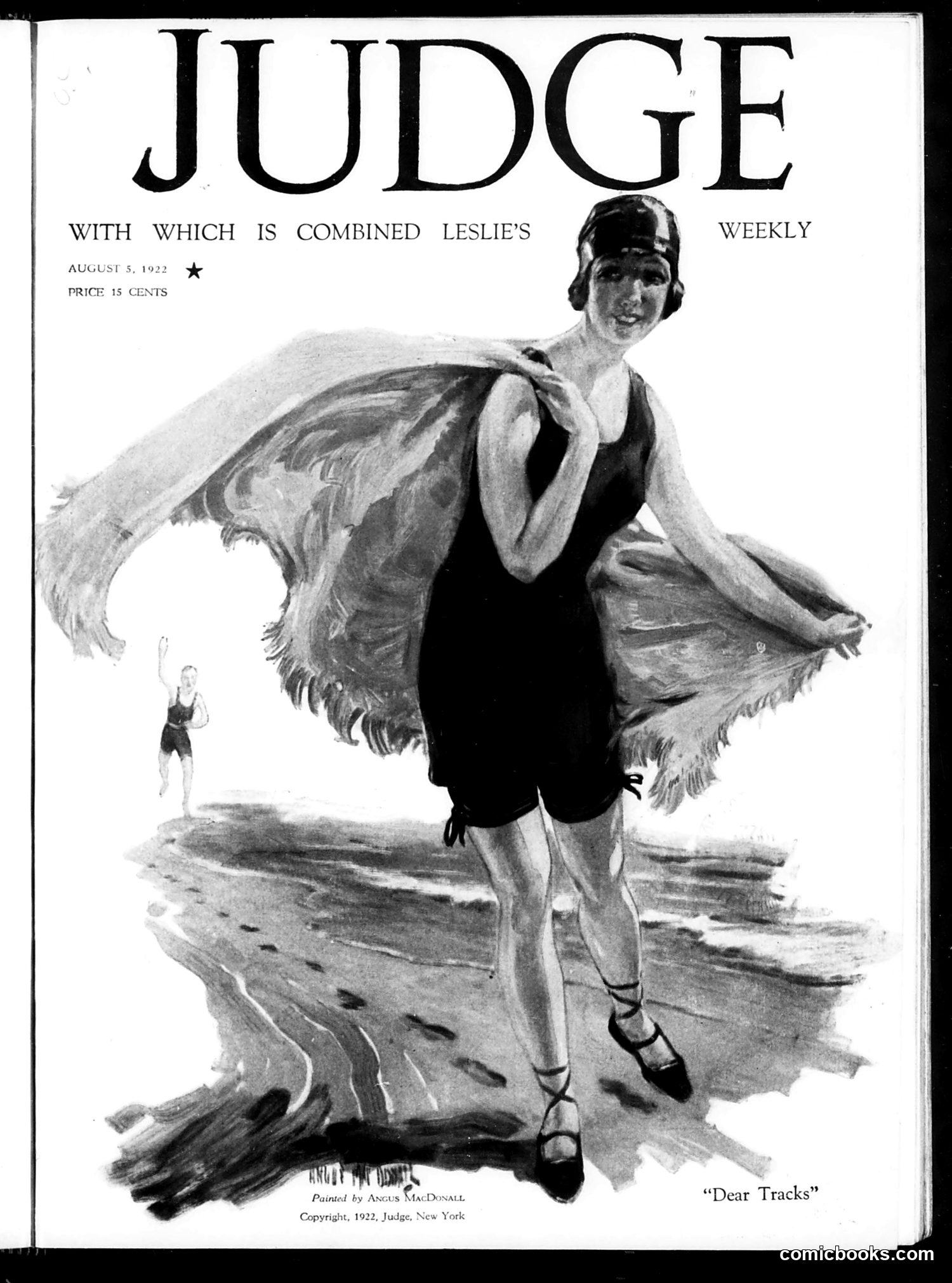
This cover illustration, titled "Dear Tracks," depicts a woman in a bathing suit on a beach, with her footprints visible in the sand behind her. A small male figure appears in the background. The satire likely references 1920s anxieties about women's changing social roles and fashion. The title "Dear Tracks" suggests a playful pun—her visible footprints represent women "making their mark" or gaining independence during the Jazz Age, when shorter hemlines, bobbed hair, and beach culture were considered scandalous. The work appears to comment on societal concern about women's increasing public visibility and freedom. The artist, Agnes MacDonall, presents this as humor for Judge's audience, reflecting period tensions around gender roles and women's liberation during the post-WWI era.
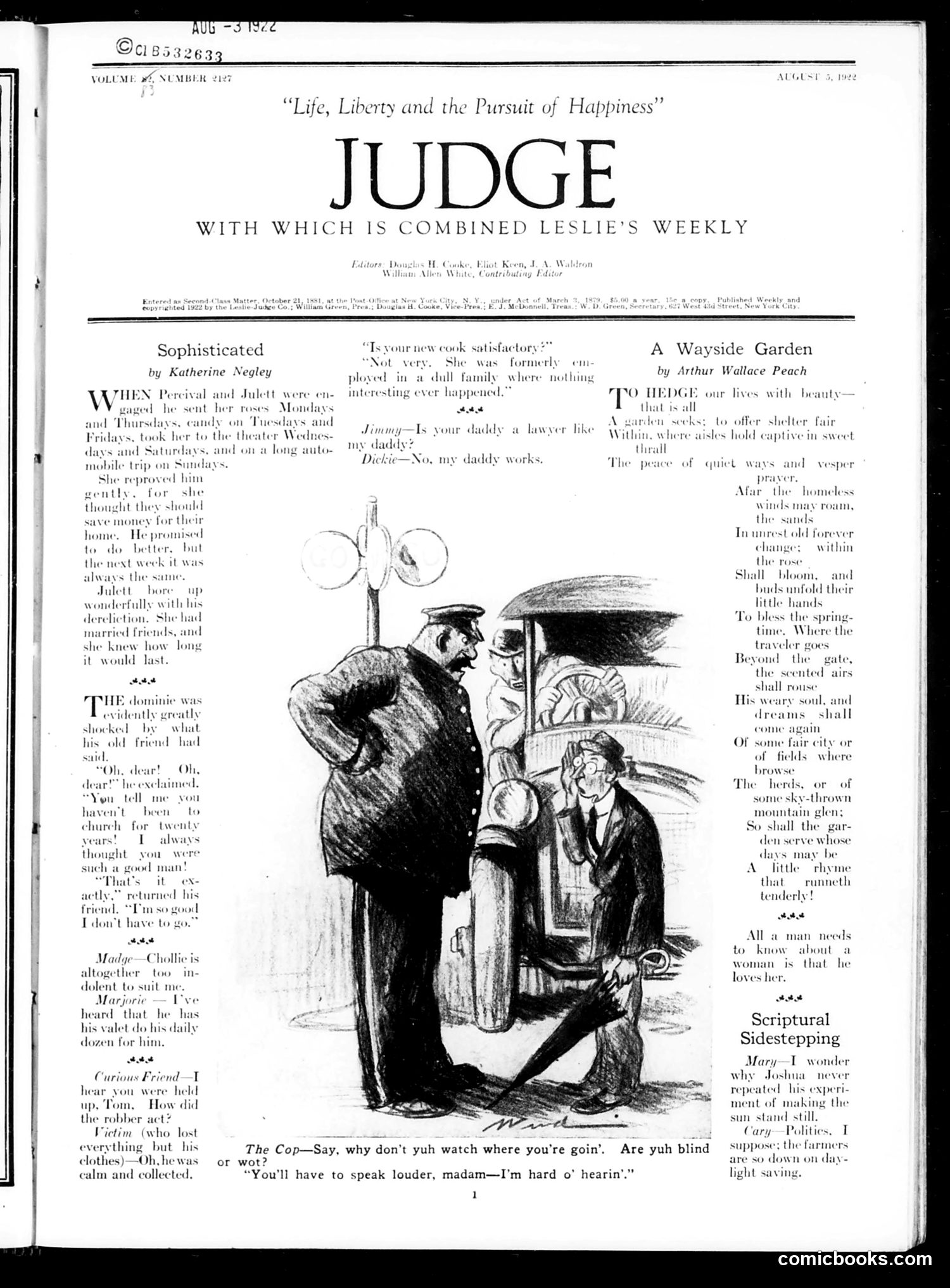
The central cartoon depicts a police officer stopping a woman with a bicycle, demanding she watch where she's going. The officer appears hard of hearing, requiring her to "speak louder." This appears to be social satire about police authority and urban traffic safety—a newly relevant concern as automobiles and bicycles became common. The surrounding text pieces ("Sophisticated," "A Wayside Garden," "Scriptural Sidestepping") are short humorous stories typical of Judge's format, addressing domestic life and relationships rather than political issues. The overall page represents Judge's blend of visual humor and satirical commentary on everyday American life rather than partisan politics. The bicycle incident likely mocks both police incompetence and the challenges of modern urban navigation in the early 1920s.
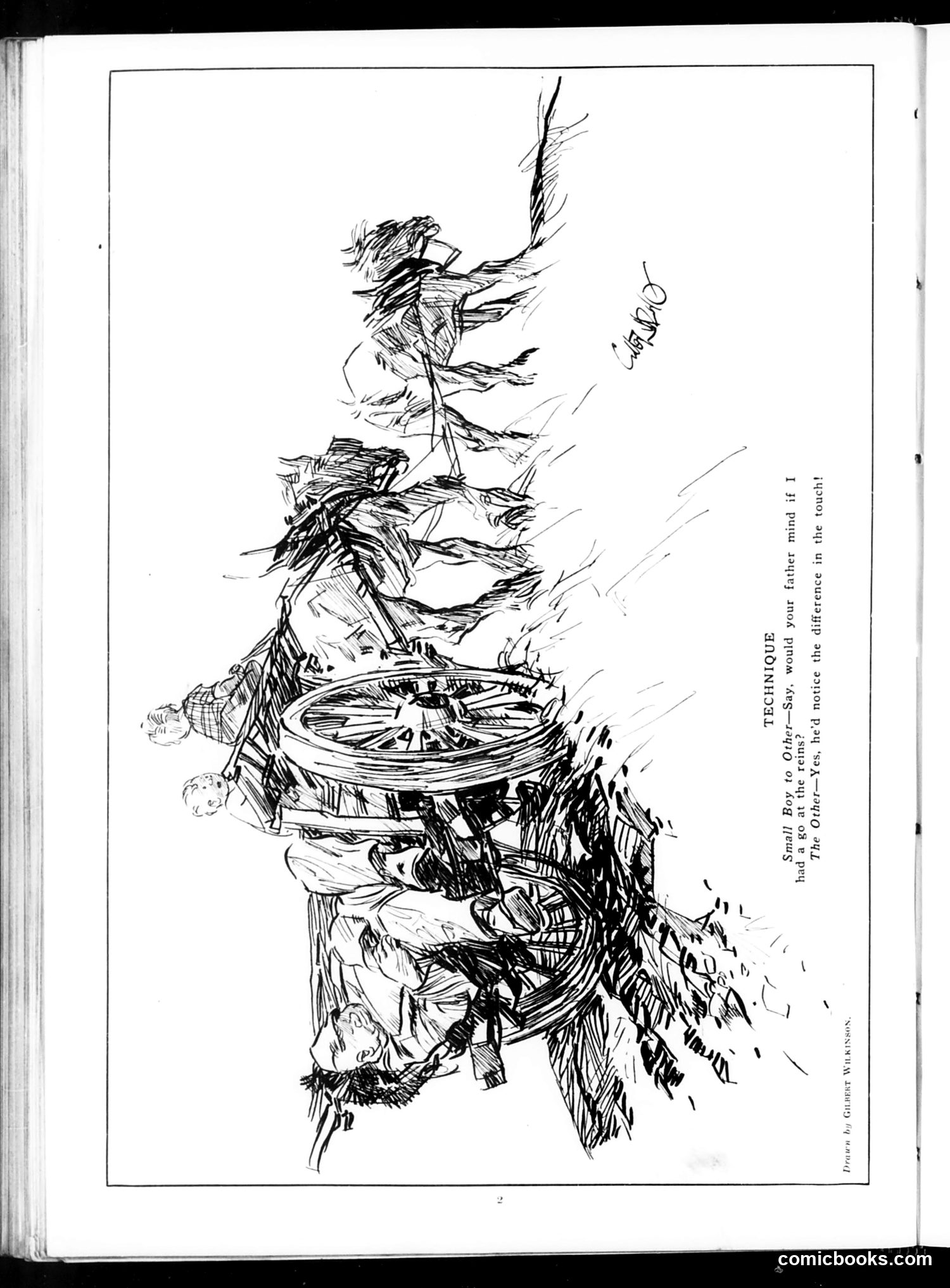
The caption reads "TECHNIQUE" and references "Smith Boy to Officer—Say, would a sewer rather mind if I spit in his mouth? The Officer—Sh, be notice the difference in the touch!" This appears to be a satirical cartoon mocking police conduct or brutality. The joke seems to hinge on the contrast between a crude action (spitting) and what the officer calls "technique"—suggesting the officer is experienced at committing such acts and wouldn't notice the difference. The satire critiques police violence or misconduct, implying that officers habitually engage in such behavior that minor variations wouldn't register as abnormal to them. The sketch style and Judge magazine context indicate this is early 20th-century American social commentary, likely targeting corrupt or abusive law enforcement practices.
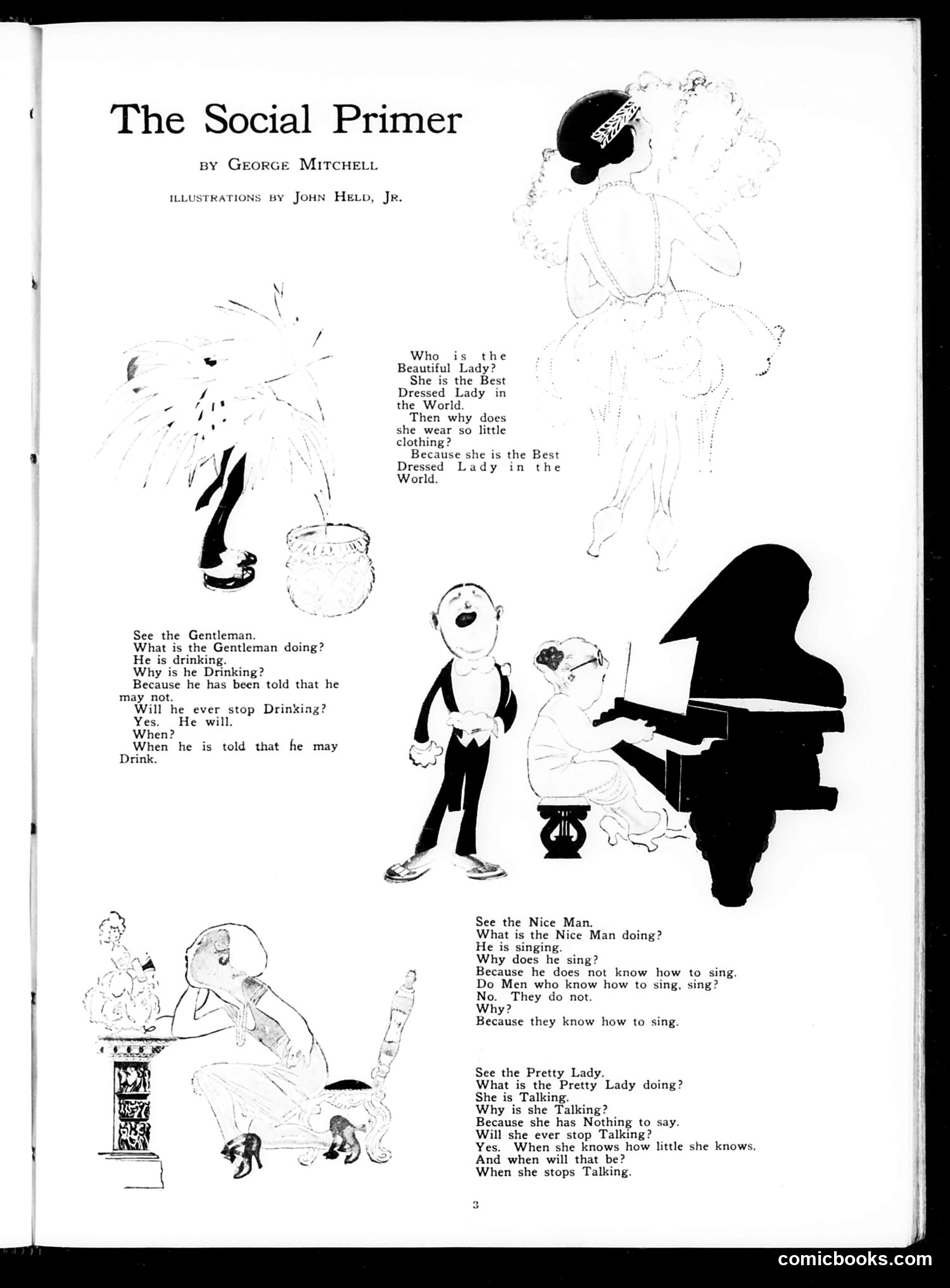
This is a satirical instructional piece mocking social conventions and gender stereotypes of the early 20th century. The "primer" format humorously teaches readers about high society through crude question-and-answer lessons. The satire targets: - **The "Beautiful Lady"**: Mocked for wearing minimal clothing despite being "Best Dressed," implying wealthy women's fashion is paradoxically revealing - **The Gentleman**: Portrayed as a habitual drunk who drinks because he's told he may—absurdist logic about male excess - **The Nice Man**: Criticized for singing poorly, suggesting educated men lack actual talent - **The Pretty Lady**: Ridiculed for talking incessantly about nothing, reducing women to vapid chatter The crude illustrations and condescending "teaching" format amplify the mockery of upper-class pretension and gender-based character flaws. It's social commentary disguised as children's instruction.
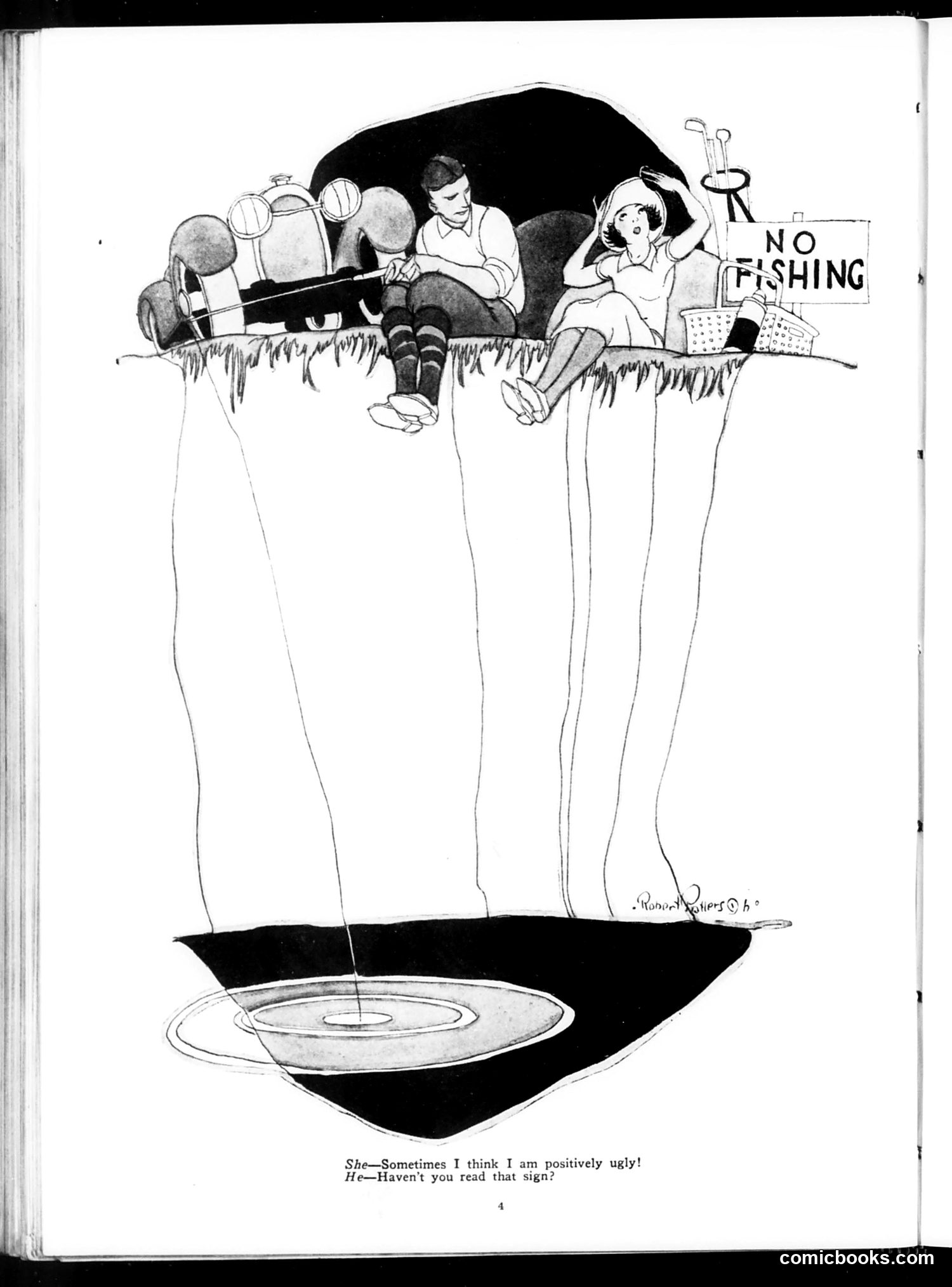
This cartoon illustrates a domestic scene with social commentary about appearance and attractiveness. A couple sits fishing from a precarious perch suspended high above water. The woman expresses self-doubt about her physical appearance ("Sometimes I think I am positively ugly!"), while the man dismissively responds by pointing to the "NO FISHING" sign nearby. The satire appears to target the man's obliviousness or indifference to his companion's emotional needs. Rather than reassuring her, he deflects to practical concerns—violating posted regulations. The cartoon mocks typical masculine behavior: the failure to provide emotional support and the tendency to prioritize rules or logistics over relationship dynamics. The dramatic height and precarious positioning may emphasize the relationship's fragility.
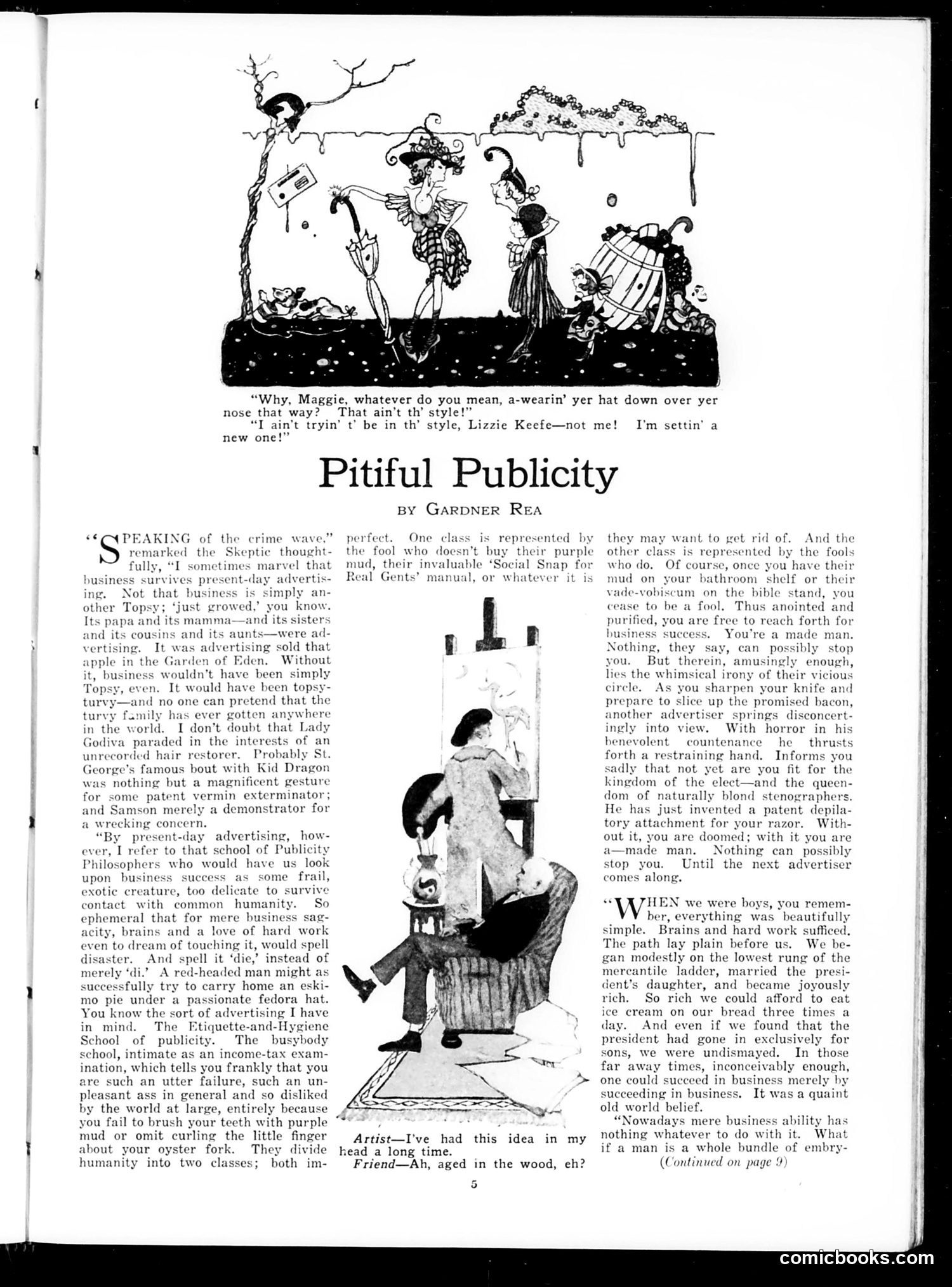
This article satirizes aggressive early-20th-century advertising that exploited consumer insecurity. The author distinguishes between legitimate advertising (which built business) and the "Etiquette-and-Hygiene School of publicity"—manipulative ads claiming products are *essential* for social acceptance. The cartoon at top depicts working-class women discussing fashion; one wears her hat low, rejecting style conformity. This introduces the article's theme: advertisers deliberately making people feel inadequate to sell solutions. Rea's main target is the advertising industry's circular logic: buy Product A to become respectable, then Product B (a new "patent depilatory attachment") immediately announces you're still unfit without it. He argues this differs from honest business—it's psychological manipulation disguised as advice, creating perpetual inadequacy. The article reflects 1920s anxieties about mass marketing's manipulative power over ordinary people's self-image and purchasing habits.
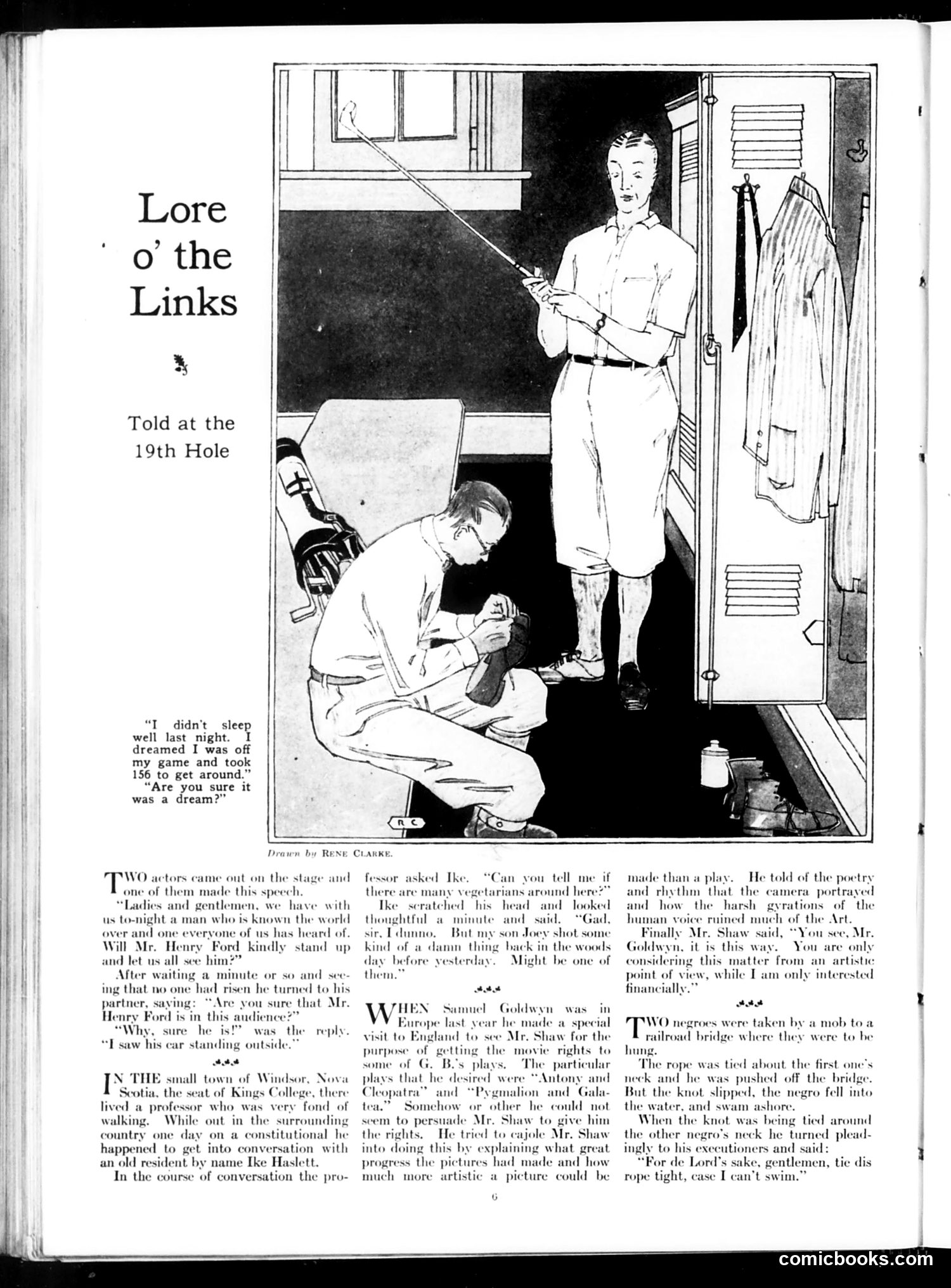
This page contains three humorous anecdotes presented as stories told by golfers at the 19th hole (the clubhouse). The jokes rely on: 1. **Henry Ford anecdote**: A speaker fails to recognize Ford in the audience, then learns Ford's car is outside. The joke is that Ford's automobile is more recognizable than Ford himself—commentary on Ford's fame via mass production rather than personal celebrity. 2. **Nova Scotia professor story**: A local resident's vague response about "vegetarians" (unclear in context) supposedly referring to something his son shot—humor from rural ignorance or deliberate evasion. 3. **Samuel Goldwyn/George Bernard Shaw anecdote**: Shaw dismisses Goldwyn's artistic arguments about cinema by claiming he only cares about money, not art. This satirizes both the filmmaker's pretentious aesthetic justifications and Shaw's candid materialism. 4. **Final dark joke**: Two lynching victims, one unable to swim—gallows humor with racist content reflecting period attitudes. The cartoon illustration shows a couple in what appears to be a bedroom or dressing room, likely depicting one of these stories visually.
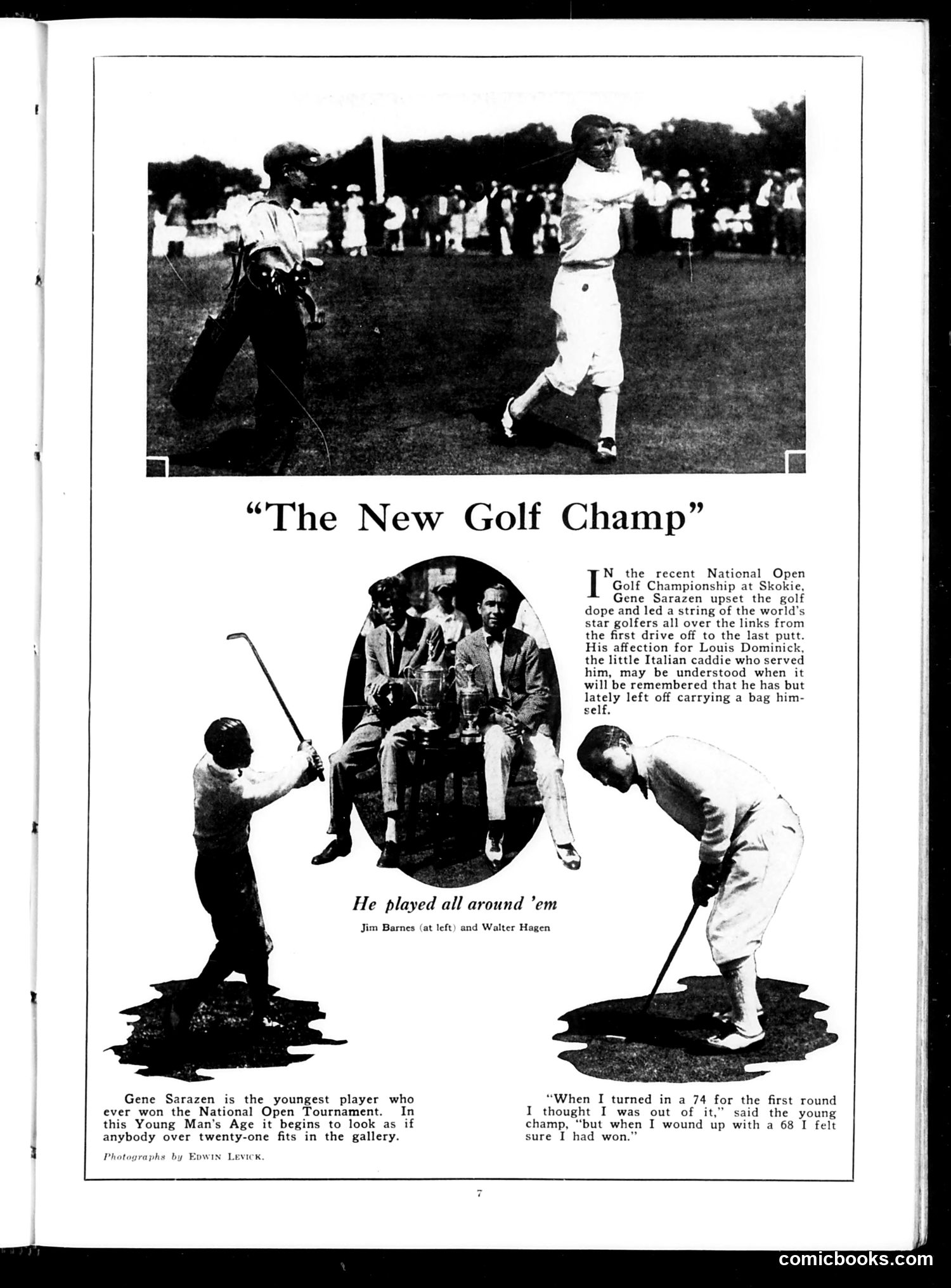
This article celebrates Gene Sarazen's upset victory at the National Open Golf Championship at Skokie. The satire centers on Sarazen's youth and humble origins: he recently worked as a caddie (bag-carrier) himself, now competing against established stars like Jim Barnes and Walter Hagen. The joke is that Sarazen's inexperience became an advantage—he didn't know enough to be intimidated by the "golf dope" (expert predictions). His affection for his caddie, Louis Dominick (also Italian), reflects his recent working-class background. The caption "He played all around 'em" emphasizes he outperformed the established champions. The piece gently mocks how a young outsider from the working class could defeat prestigious, seasoned professionals—a notable achievement in 1920s professional golf when the sport was gaining mainstream popularity.
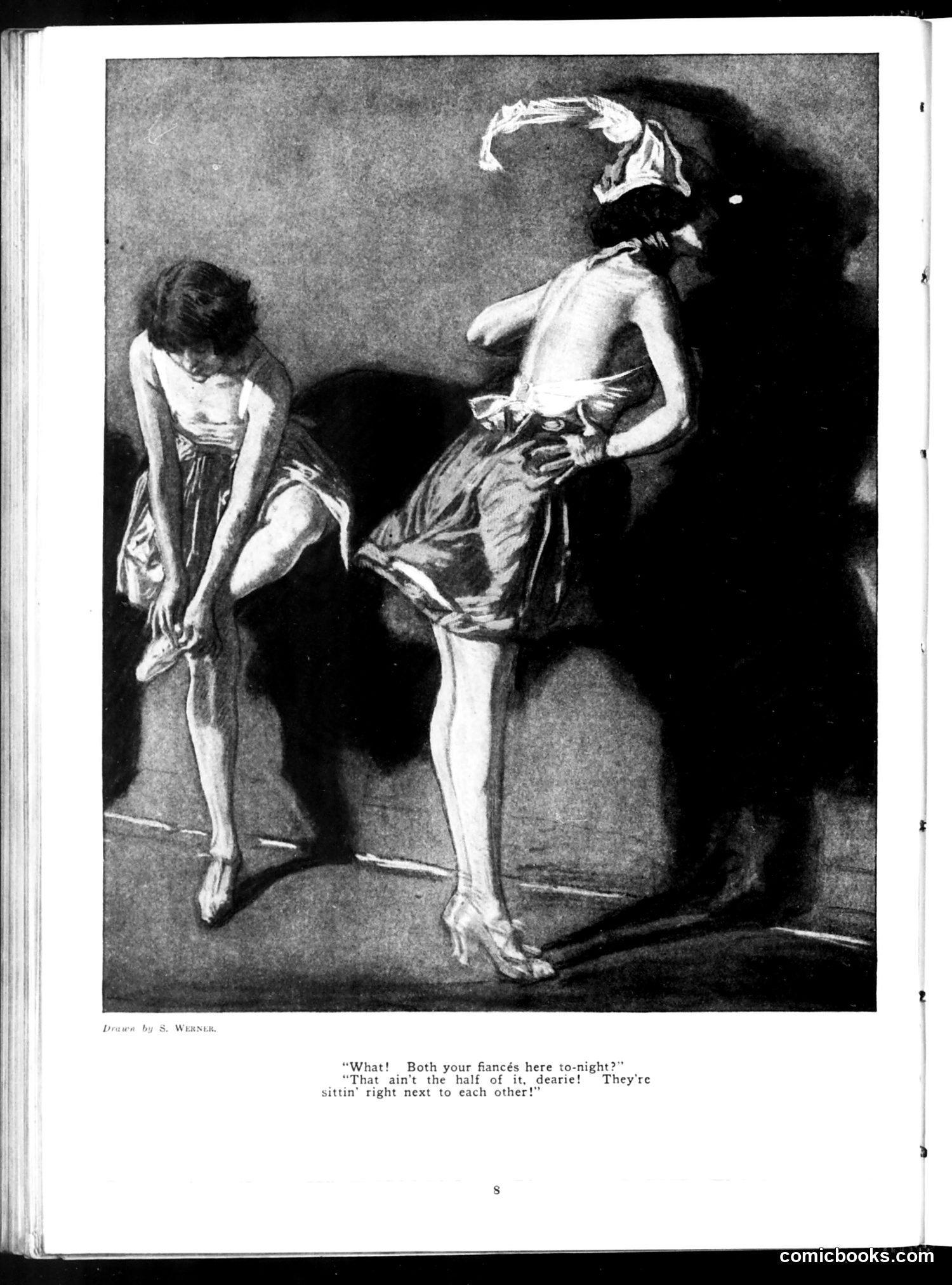
This is a satirical cartoon drawn by S. Werner, likely from the early 20th century. It depicts two women in an intimate pose, with the dialogue implying infidelity. One woman boasts that both her fiancés are present at an event, seated next to each other—suggesting the audacity or comedy of having multiple romantic partners simultaneously without them knowing. The satire targets what appears to be loose morality or romantic deception among women of the era. The humor relies on the shock value of a woman openly admitting to multiple engagements and the absurdity of the situation. This reflects period attitudes toward women's fidelity and reflects Judge magazine's typical approach to satirizing social behavior and gender relations of its time.
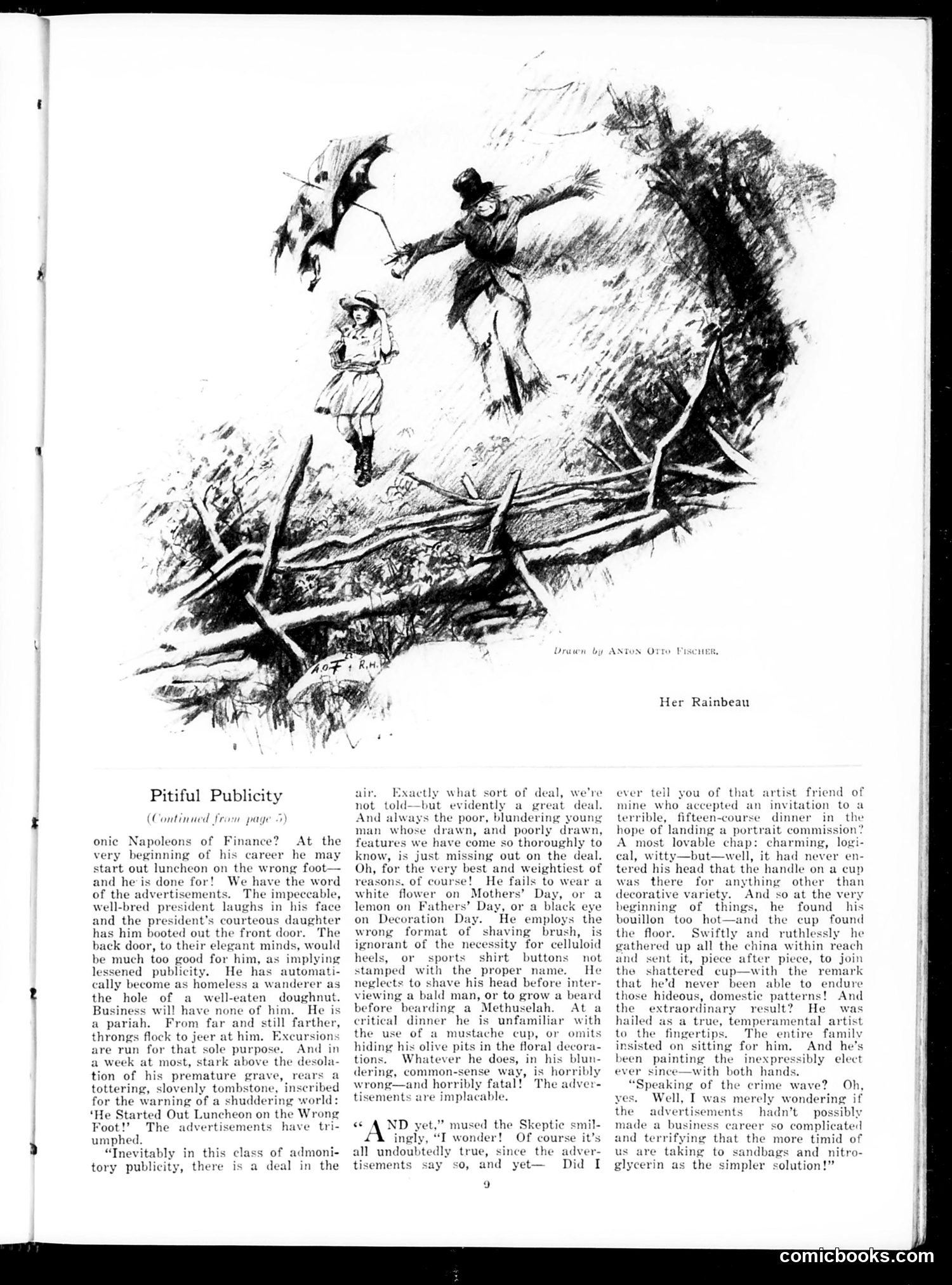
This page satirizes **advertising's exaggerated fearmongering**—specifically the genre of "cautionary ads" that threaten social or professional ruin over trivial etiquette mistakes. The text mocks advertisements that claim a single misstep (wearing the wrong shaving brush, improper table manners, wrong flower on a holiday) will destroy a man's career and social standing, making him a pariah. The author ridicules this as absurd propaganda. The illustration shows a scarecrow-like figure with outstretched arms amid rural debris, labeled "Her Rainbeau"—a visual pun suggesting romantic prospects ruined by social failure. The "Skeptic" character rebuts the ads' logic by telling a true story: an artist who *deliberately* violated etiquette (dropping soup cups) and was celebrated as charmingly eccentric, gaining portrait commissions. The satire concludes darkly: if ads have made respectable life so impossibly complicated, perhaps crime becomes the simpler option. The target: **manipulative advertising using anxiety and shame to sell products.**
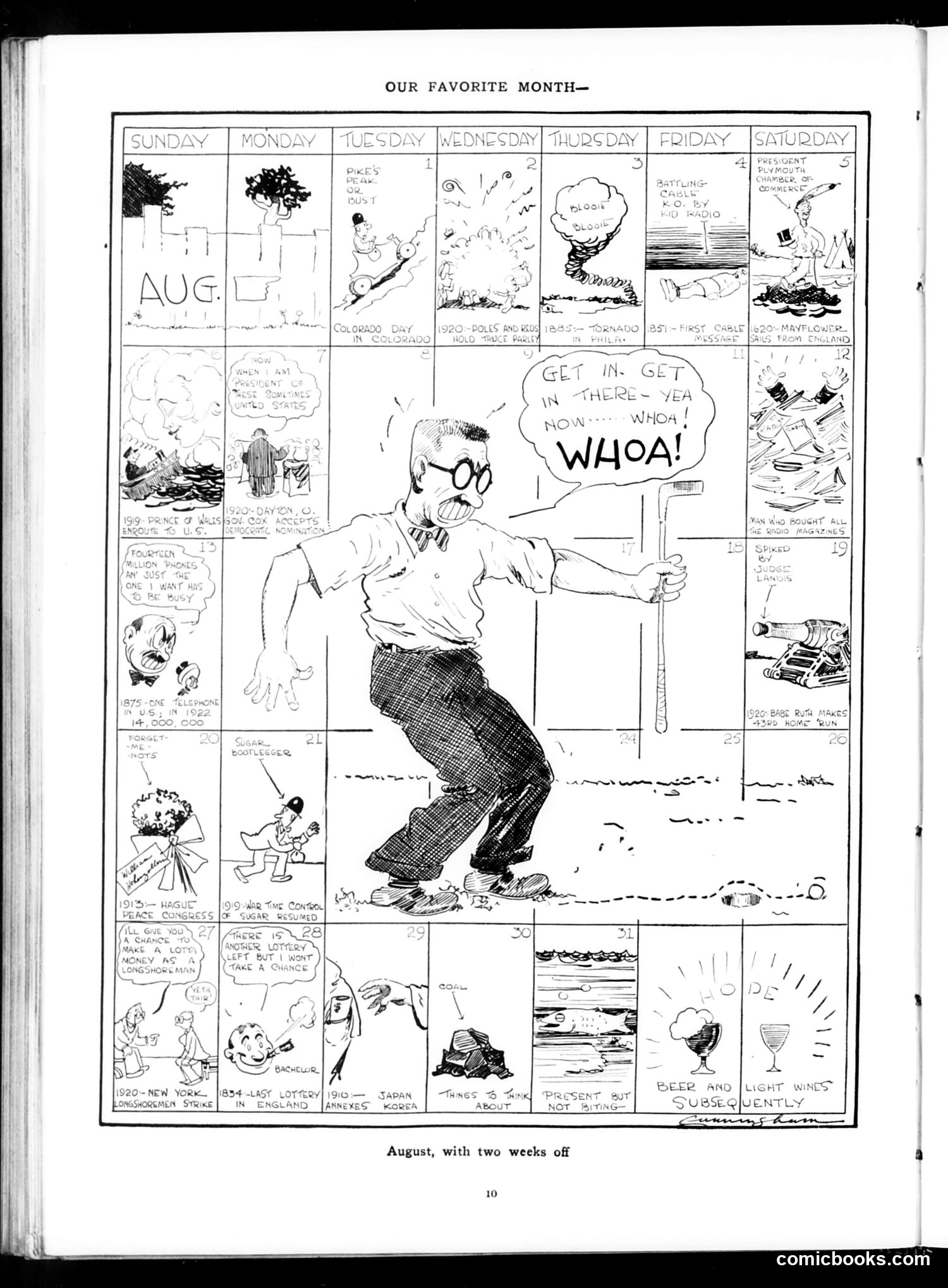
This is a calendar-style comic strip for August featuring a central figure—a rotund man in glasses and casual attire—bursting with excitement about time off. The seven-day grid contains historical vignettes (marked with years like 1492, 1620, 1776, etc.) referencing significant American historical events. The main joke centers on the contrast between America's momentous history and the modern working person's primary concern: vacation. The figure's exuberant "WHOA!" and gesture suggest August represents escape from routine, while the historical panels humorously underscore that previous generations accomplished great things—Columbus, Pilgrims, independence—whereas contemporary people simply want two weeks away. It's gentle social satire about American leisure priorities versus historical gravitas, typical of Judge magazine's urbane humor for middle-class readers.
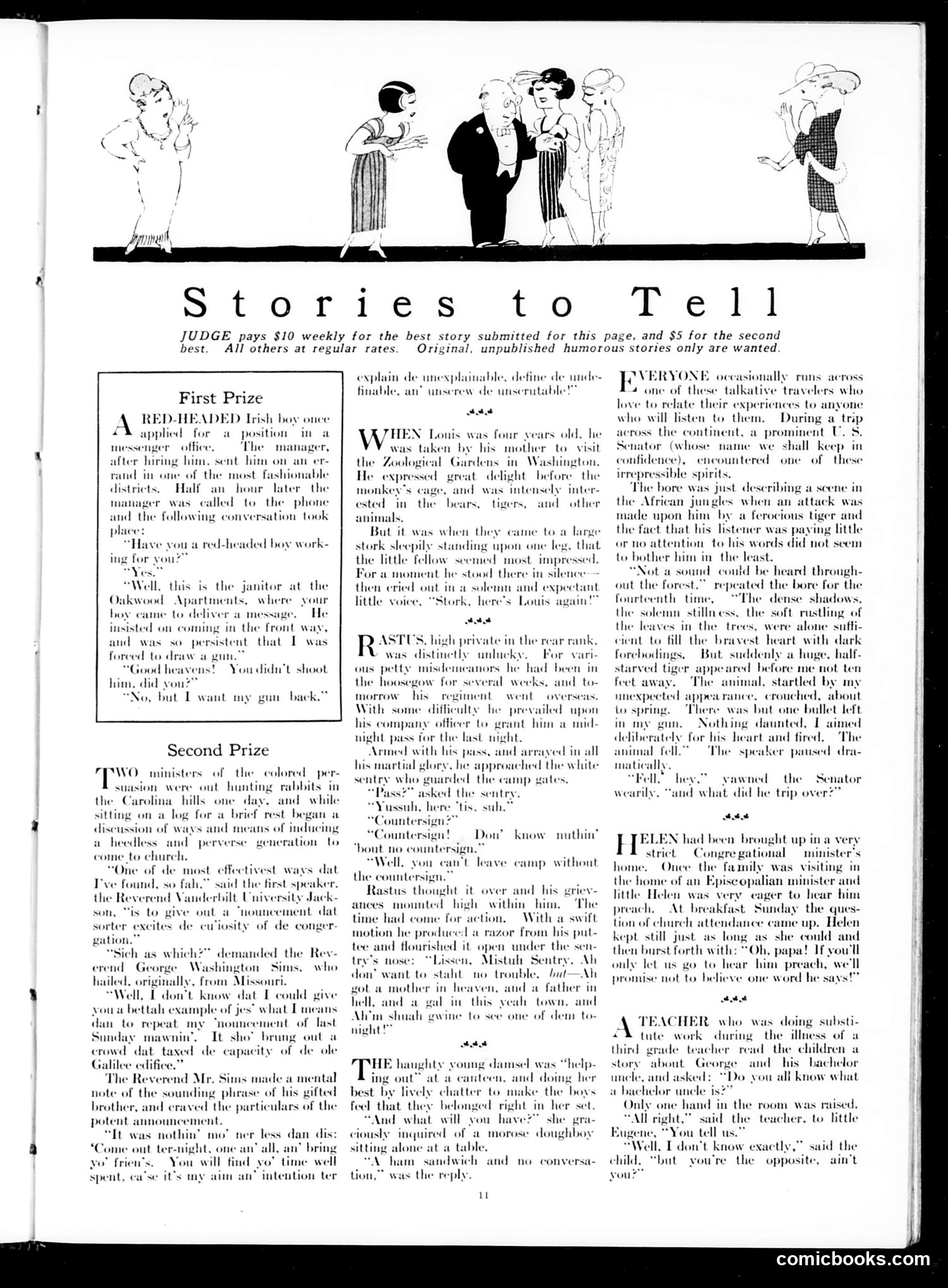
This page from *Judge* magazine presents humorous stories rather than political cartoons. The content reflects early 20th-century American social attitudes: **The stories mock**: - **Irish immigrants**: The "red-headed Irish boy" narrative perpetuates ethnic stereotypes about working-class Irish messengers as crude and violent (wanting "his gun back"). - **African Americans**: Two stories employ heavy racial dialect and caricature Black characters—a minister using malapropisms ("unserew de unserutable") and a soldier named "Rastus" brandishing a razor, invoking violent racial stereotypes. - **Class hierarchies**: Doormen and servants enforcing social boundaries against lower-class intruders. The humor derives from ethnic/racial caricature and stereotyping common to the era. Modern readers should recognize these as period artifacts reflecting deeply offensive social prejudices that were considered acceptable entertainment in early American magazines, not endorse the views they express.
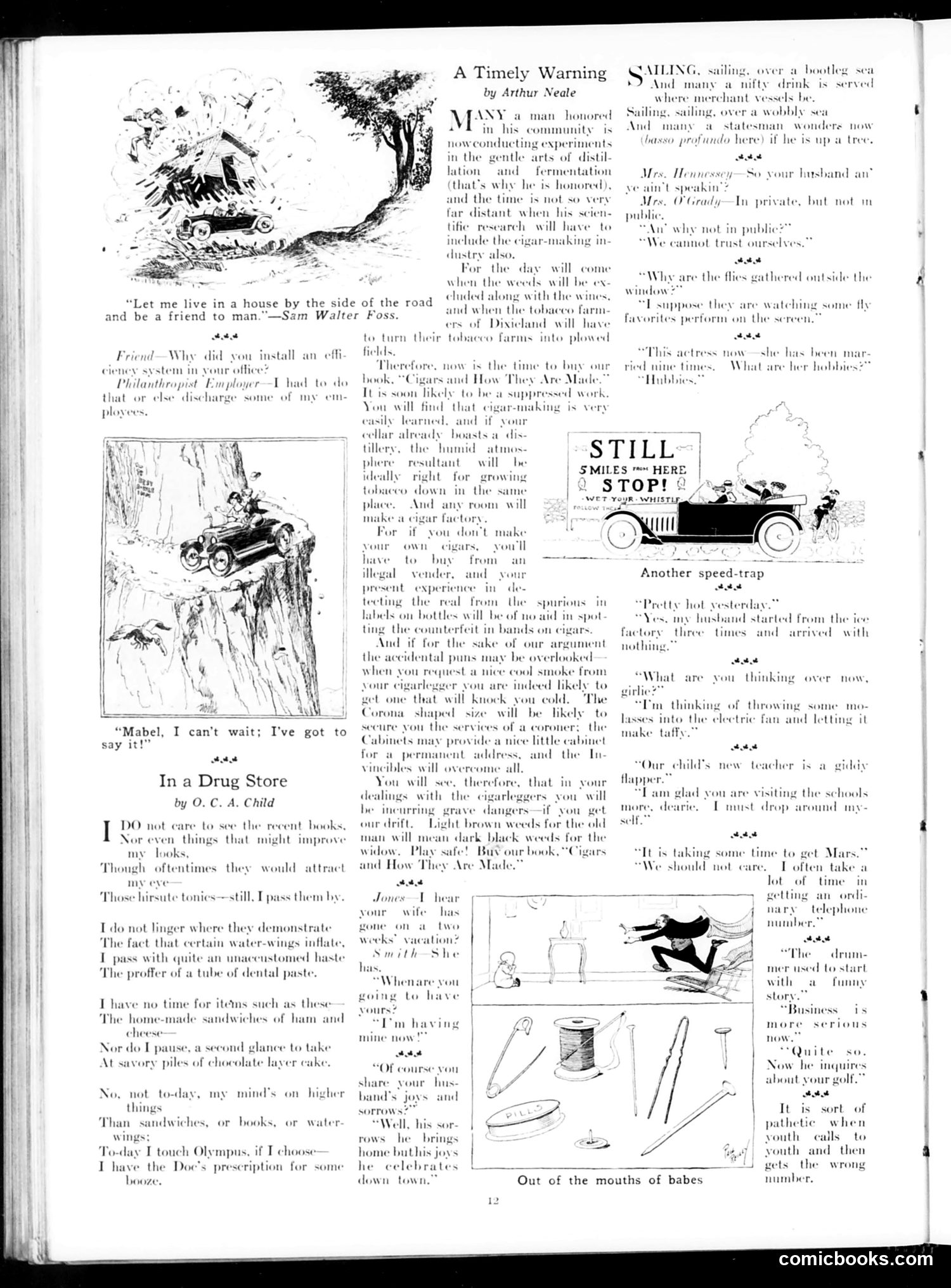
This Judge magazine page contains satirical commentary on Prohibition-era concerns and social behavior. **"A Timely Warning"** satirizes wealthy men conducting illegal home distillation and cigar-making, suggesting they'll eventually need to hide tobacco production too. It's promoting a book on cigar-making as legitimate preparation before Prohibition extends to tobacco—a humorous warning about expanding alcohol restrictions. **"In a Drug Store"** depicts someone at a pharmacy tempted by various products (sandwiches, water-wings, dental paste) but resisting to obtain a doctor's prescription for alcohol, likely suggesting people obtained liquor through medical prescriptions, a legal loophole during Prohibition. **The sailing and domestic dialogue snippets** reference bootleg alcohol ("bootleg sea") and marital tensions, common Prohibition-era themes. The "speed-trap" cartoon appears unrelated to this page's alcohol focus. Overall, the page satirizes how Prohibition drove ordinary citizens toward illegal activity and creative workarounds, treating the violation of alcohol laws as commonplace middle-class behavior.
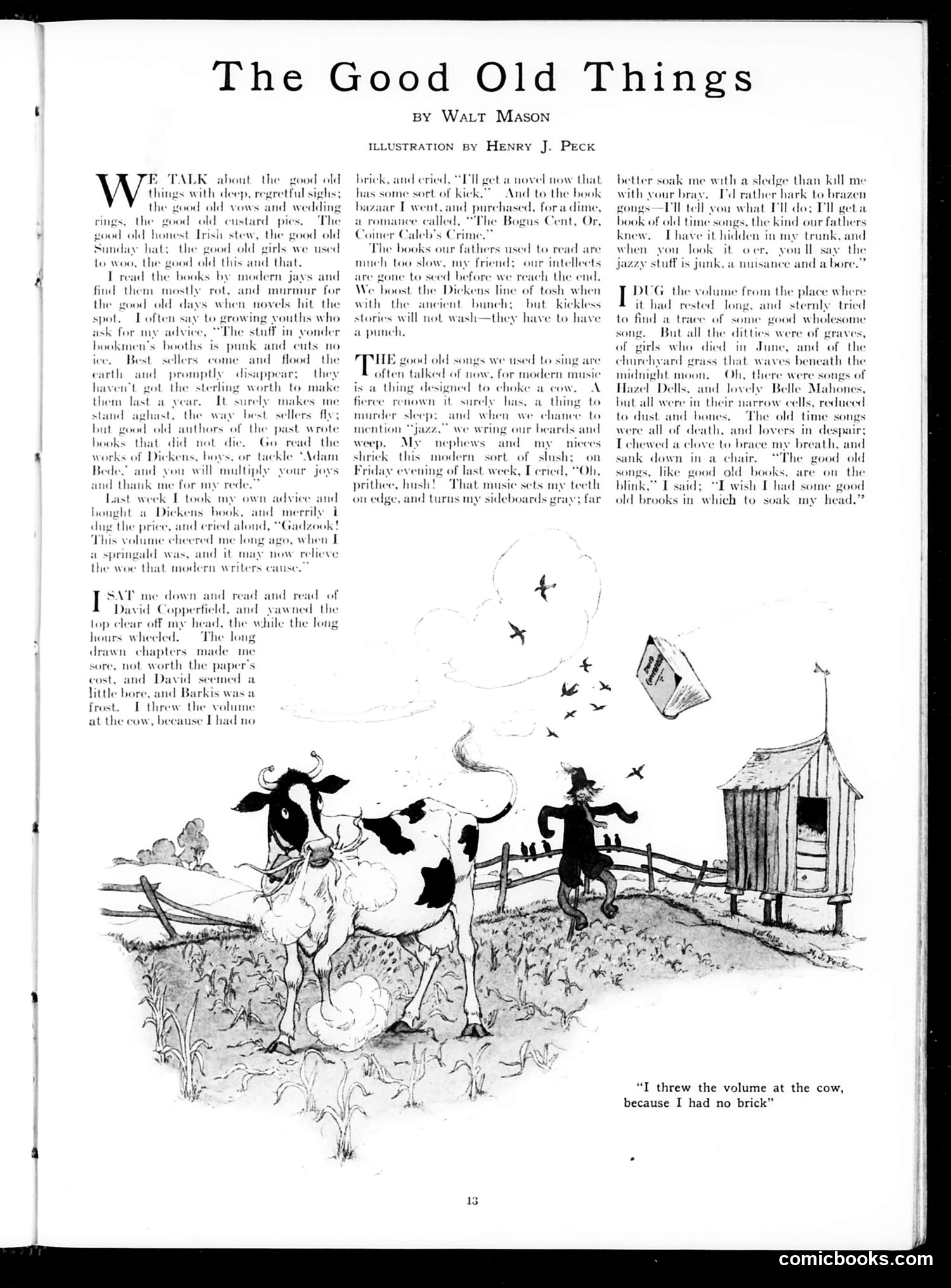
This is a humorous essay with accompanying cartoon by Walt Mason, illustrated by Henry J. Peck. The piece satirizes the common human tendency to romanticize the past while dismissing the present. The narrator complains that modern novels, music, and culture are inferior to "the good old things." To prove his point, he retrieves an old Dickens novel expecting to be delighted—but finds it tedious, full of slow chapters and boring characters. He then digs up old-fashioned songs, expecting wholesome nostalgia, only to discover they're depressing dirges about death and graves. The cartoon illustrates the final irony: frustrated by both "old" and "new," the narrator throws the book at a cow in exasperation. The joke targets readers' own nostalgic biases—our selective memory makes the past seem better than it actually was. Mason suggests that complaining about modern times while idealizing history is foolish; both eras have merit and drawbacks.
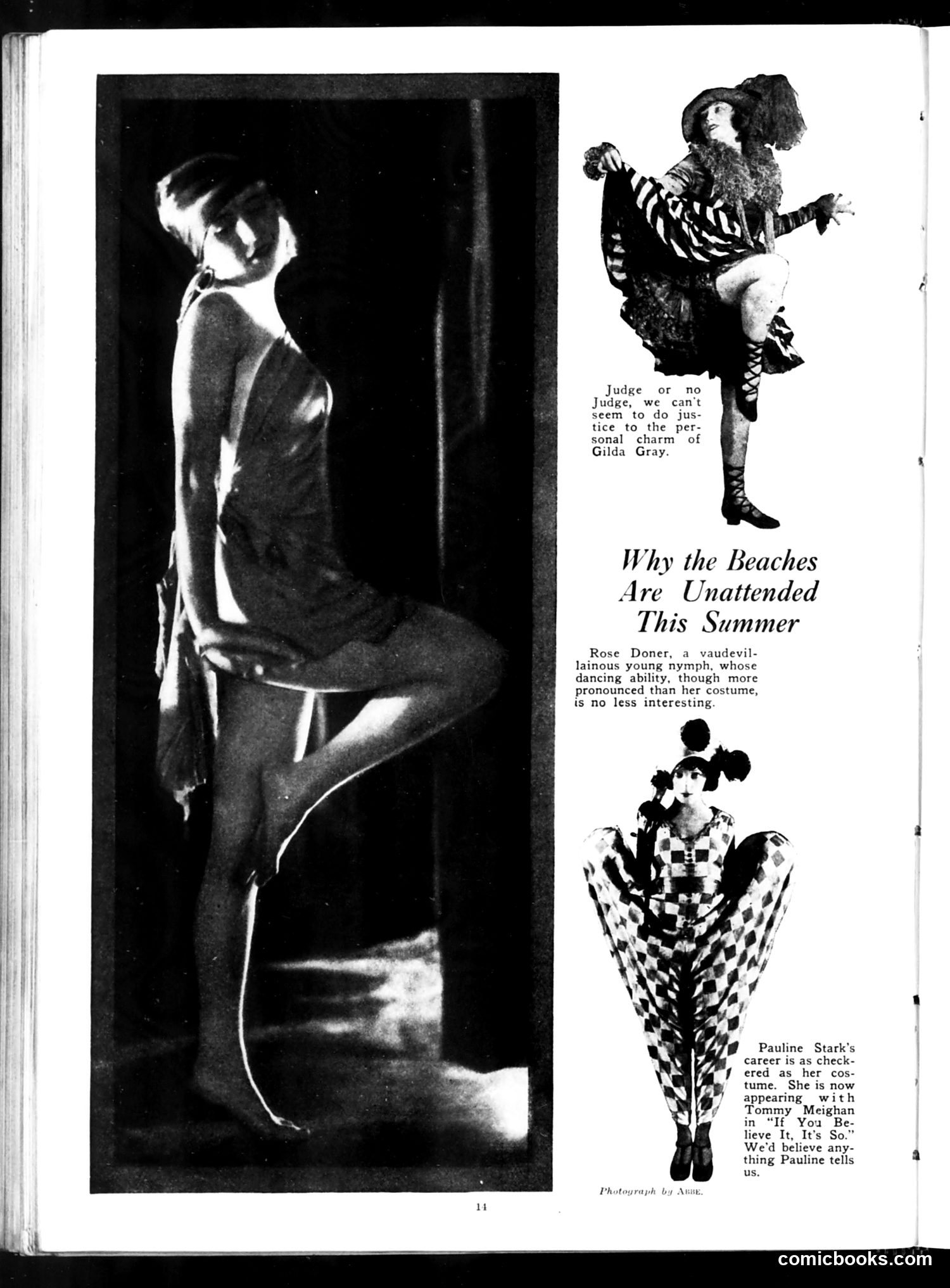
This page from *Judge* magazine satirizes the absence of beachgoers during summer by attributing it to the distraction of popular female entertainers. The headline "Why the Beaches Are Unattended This Summer" is a tongue-in-cheek explanation: men are staying home to watch vaudeville and film performances instead of going to the beach. Three performers are featured: 1. **Gilda Gray** — described as possessing "personal charm" (the text notes her appeal transcends her costume) 2. **Rose Doner** — a vaudeville dancer whose "dancing ability" is emphasized as "more pronounced than her costume" (a cheeky reference to revealing costumes) 3. **Pauline Stark** — appearing in the film "If You Believe It, It's So" with Tommy Meighan The satire plays on 1920s anxieties about modern entertainment drawing audiences away from outdoor leisure. The photography emphasizes these performers' physical appeal and theatrical presentation, illustrating why they might keep men indoors rather than at beaches.
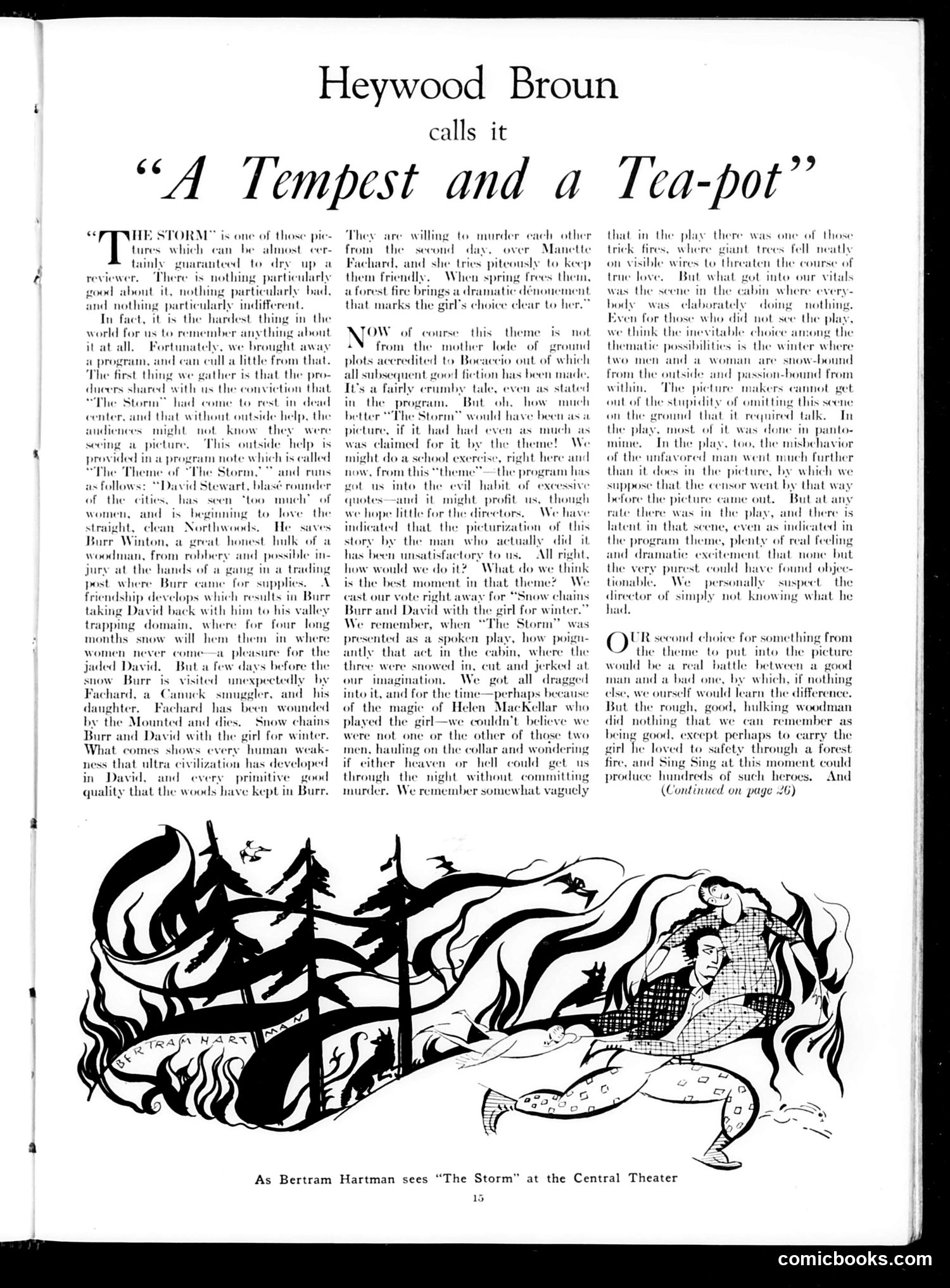
This page reviews a film adaptation of "The Storm," comparing it unfavorably to the original stage play. Critic Heywood Broun argues the movie is forgettable and dramatically inert—so bland he needs the program notes to remember what happened. The satire targets the film's failure to capture the play's emotional intensity. Broun contrasts the stage version's compelling cabin scene (where three snowed-in characters face moral crisis) with the film's tedious rendition of the same moment—where "everybody elaborately doing nothing" drains all tension. The illustration shows Bertram Hartman's perspective: a man watching the film while flames consume a cabin on screen, suggesting the movie's artificial melodrama (visible wires pulling down trees) versus authentic human drama. Broun's point: Hollywood's heavy-handed storytelling and technical contrivances cannot match theater's psychological power and intimacy.
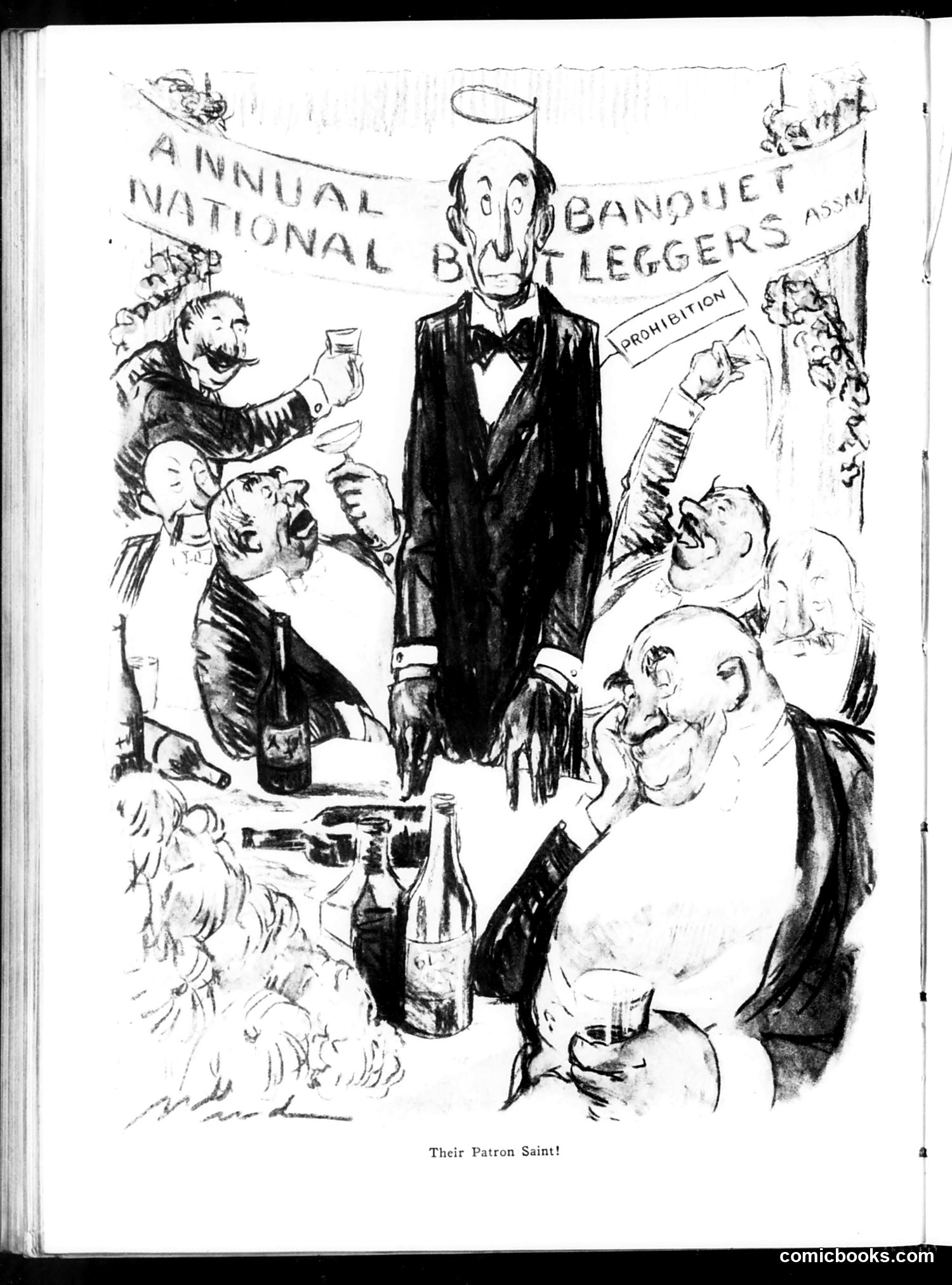
This political cartoon satirizes the relationship between the liquor industry and financial institutions during Prohibition. The tall, skeletal figure in formal dress at the center appears to represent a banker or wealthy financier serving as the "patron saint" of bootleggers and speakeasy operators gathered around him. The text references "Annual National Banque Leggers" and "Prohibition," indicating the cartoon mocks how banks profited from illegal alcohol trade despite Prohibition laws. The figures surrounding the central character—holding bottles and glasses—represent bootleggers or underground liquor dealers. The satire suggests financial elites hypocritically enabled criminal enterprises while publicly supporting or appearing neutral on Prohibition, positioning themselves as patrons of illegal activity.
This is William Allen White's editorial defending the symbiotic relationship between American newspapers and department stores. White argues that neither institution could have flourished without the other—department store advertising funded newspapers' growth, while newspaper circulation gave stores access to customers. The piece responds to contemporary criticism that advertisers "control the press." White dismisses this as gossip, claiming control is instead exercised through social pressure (country clubs, shared friendships among the wealthy) rather than crude advertiser manipulation. He frames this 40-year partnership as mutually beneficial civic cooperation. The page also includes brief satirical items: mocking a minister (John Roach Straton) attacking college professors for teaching modern biblical scholarship; and a joke about calling a mosquito-eating bird by a French name rather than English. The editorials reflect early 20th-century concerns about press independence and advertising's influence—issues still relevant today.
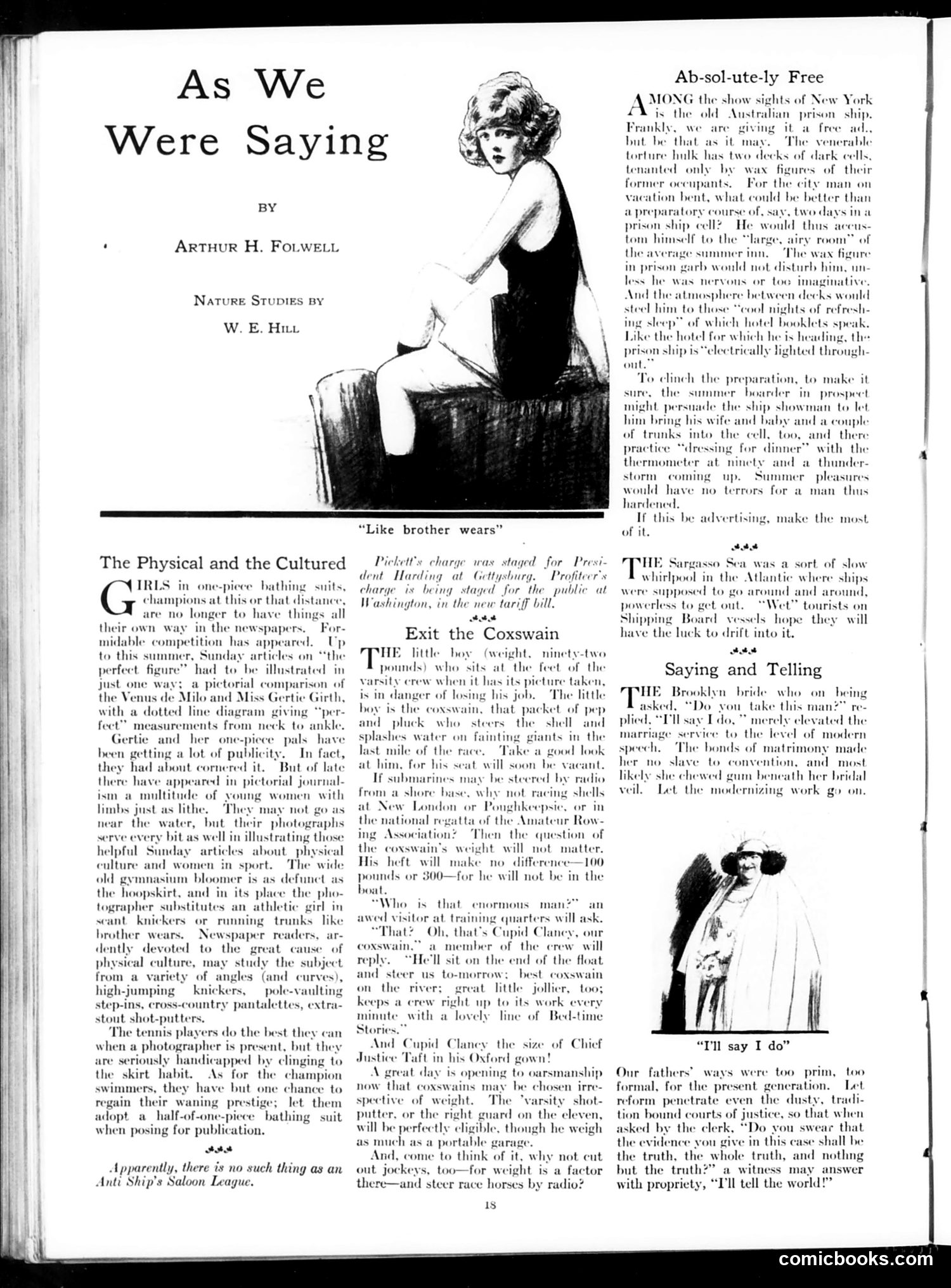
This page from Judge satirizes early 1920s American culture through multiple pieces. **"As We Were Saying"** (main article) mocks the media's obsession with photographing athletic women. The satire targets how newspapers have replaced traditional "perfect figure" comparisons (Venus de Milo) with endless photos of female athletes in revealing sportswear—not for genuine interest in physical culture, but as cheap visual content. The critique suggests this represents a shift in what publications prioritize for readership. **"Exit the Coxswain"** jokes about emerging radio-control technology. It absurdly suggests that if the military can steer submarines by radio, rowing teams should do the same with their shells, eliminating the need for lightweight coxswains. This allows anyone—even heavyweights like Chief Justice Taft or football players—to serve. The satire mocks both technological utopianism and the absurd logical extensions people propose for new inventions. The illustrations show fashionable women in athletic wear, reflecting the article's subject matter about the changing depiction of female physicality in mass media.
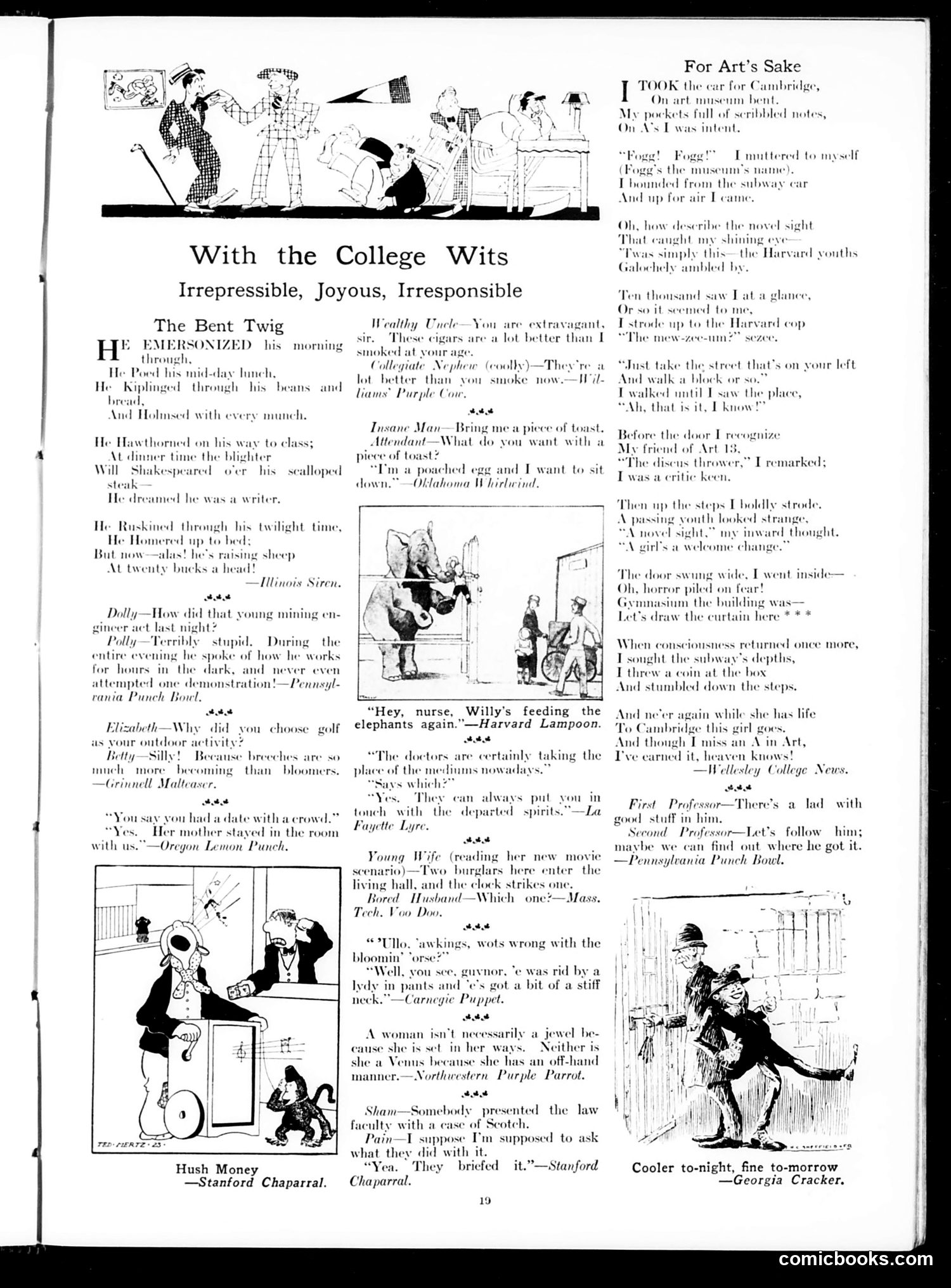
This page from *Judge* magazine collects humorous short jokes and verses from various college newspapers, reflecting early 20th-century collegiate humor. The central poem "For Art's Sake" narrates a narrator's visit to Harvard's art museum, playing on the pretension of cultural tourism—they arrive at a gymnasium instead, creating comedic anticlimax. The surrounding jokes target college stereotypes: wealthy uncles funding extravagant nephews, absent-minded professors, and romantic mishaps. References include specific colleges (Harvard, Wellesley, Stanford) and their newspapers, indicating this was national collegiate humor shared across institutions. The cartoons (one showing "Hush Money") depict domesticated husbands and financial disputes—common satirical targets of the era. Overall, the page mocks academic pretension, youth excess, and the gap between intellectual aspiration and mundane reality—themes that resonated with *Judge*'s educated, middle-class readership.
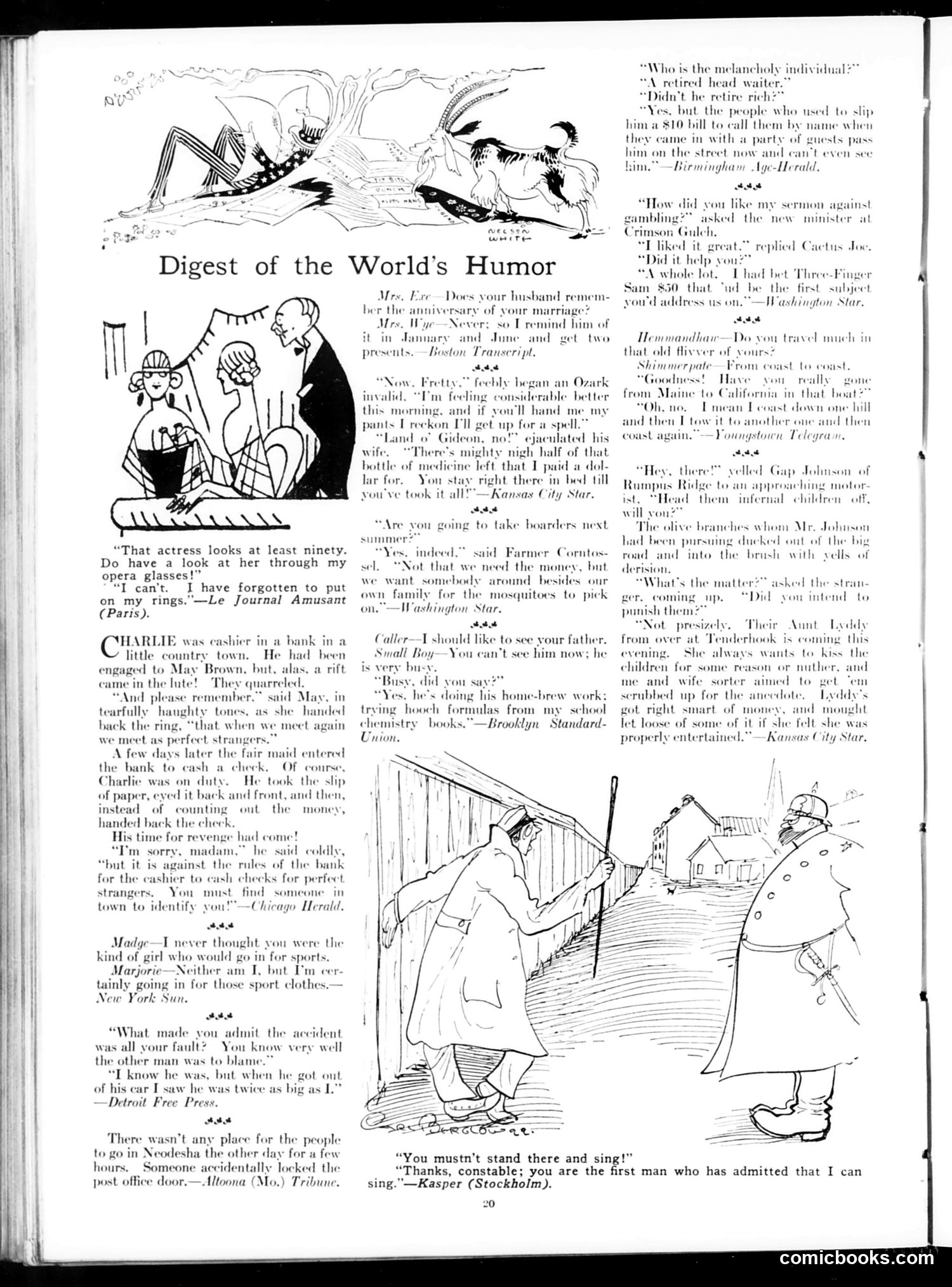
This page collects brief humorous anecdotes from newspapers worldwide, a common Judge feature. The cartoons and jokes reflect early 20th-century social attitudes: **Left cartoon**: A bank cashier refuses to cash a check for his ex-fiancée, invoking rules requiring identification from "perfect strangers"—a petty revenge for their broken engagement. The joke satirizes both romantic spite and bureaucratic rigidity. **Right cartoon**: Shows someone fishing in what appears to be a flooded area, likely illustrating small-town misadventure or incompetence. The accompanying jokes cover domestic life, rural characters (Ozark invalids, farmers), and social pretense (an actress using opera glasses to hide her age; a woman buying "sport clothes" without playing sports). "Home-brew" references Prohibition-era bootlegging. The tone is gently mocking of middle-class hypocrisy, rural simplicity, and marital dynamics—typical Judge satire of the era.
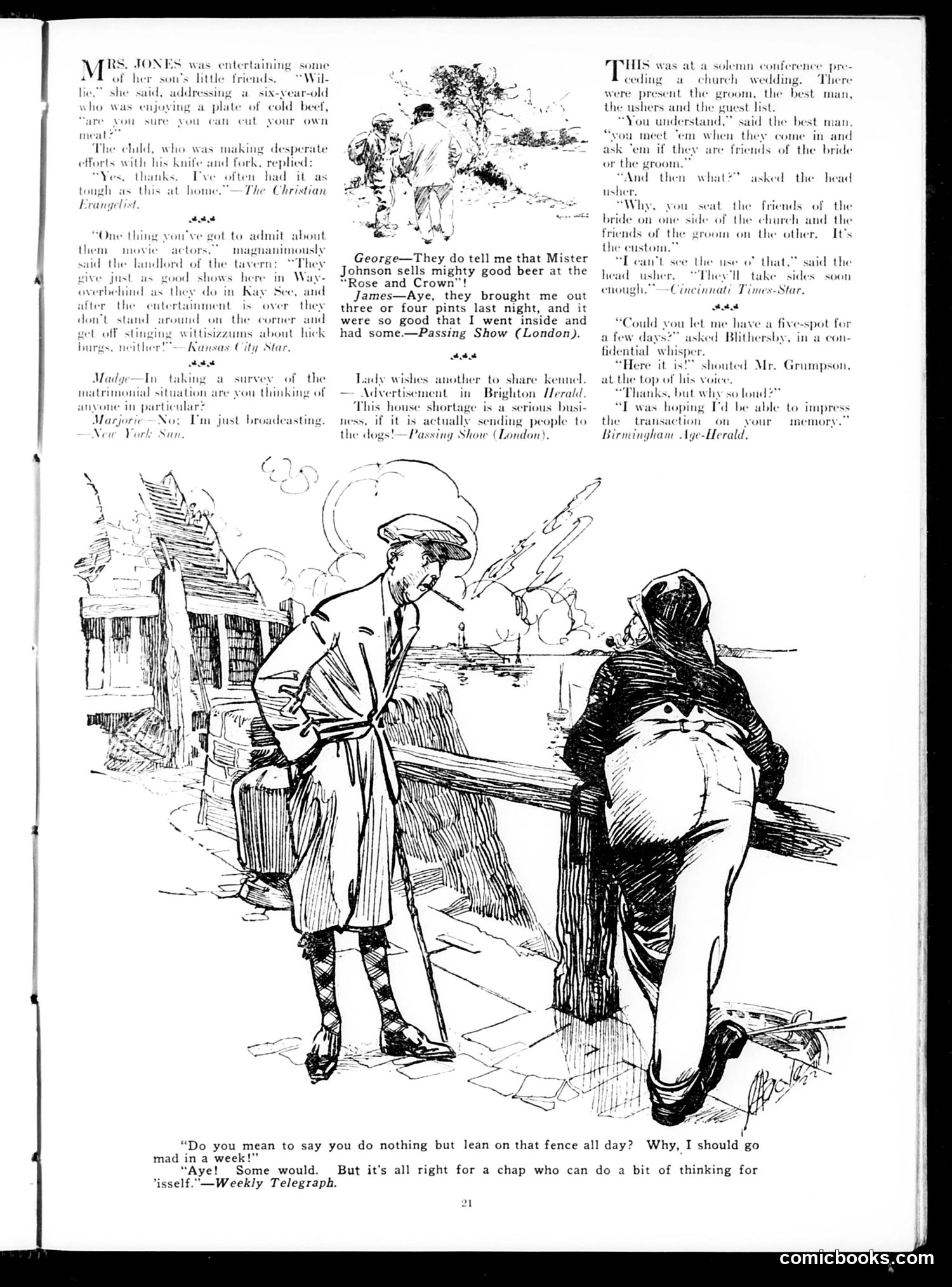
This page collects several brief humorous anecdotes typical of early-20th-century satirical magazines: **Main cartoon (bottom):** A well-dressed man confronts a working-class figure leaning on a fence, demanding why he does nothing but loaf. The worker's response—that "it's all right for a chap who can do a bit of thinking for 'isself"—satirizes class attitudes. The joke mocks the assumption that manual laborers must constantly appear busy, while those who appear idle are presumed to be "thinking." **Text vignettes** include gentle social humor: - A child's modern manners at dinner - Movie actors' behavior in small towns - Housing shortage (people living in kennels) - Wedding etiquette confusion - A loud creditor trying to embarrass a borrower into remembering a debt The overall tone reflects *Judge's* satirical approach: poking fun at pretension, class distinctions, and social conventions through everyday scenarios. Nothing here is explicitly political—it's domestic social satire aimed at middle-class readers.
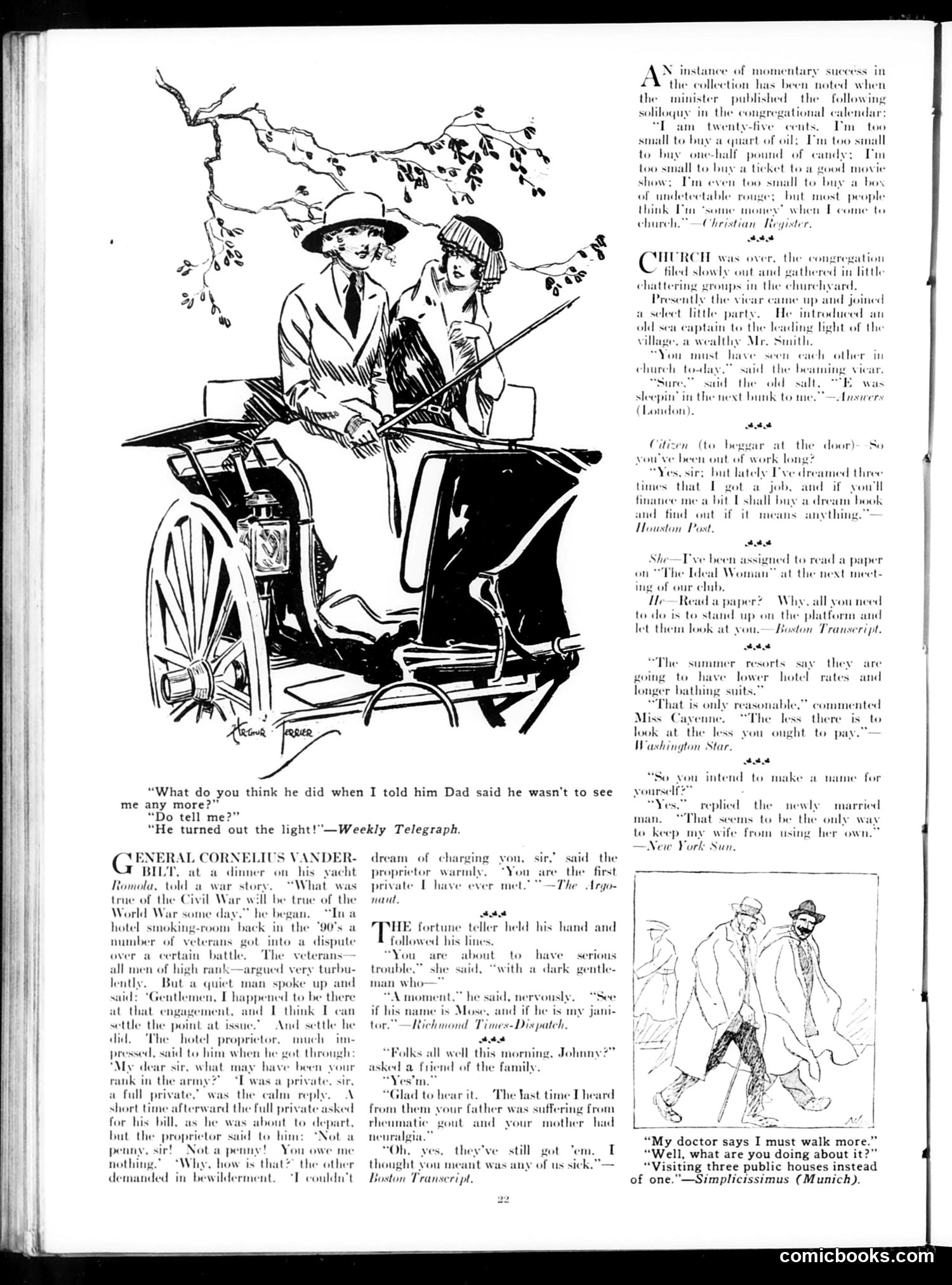
This page contains multiple short humorous anecdotes typical of early 20th-century satirical magazines, along with two illustrations. **Main Cartoon (top left):** Shows a young couple in a motorcar. The caption jokes about a father forbidding his daughter from seeing a suitor, who responds by "turning out the light"—a euphemism for sexual intimacy. The humor reflects anxieties about unsupervised automobile dating and youth autonomy. **General Vanderbilt Story:** A lengthy anecdote about a Civil War veteran's humility—a wealthy general disguised himself as a private soldier at dinner to settle a dispute, then refused payment for his meal. The story celebrates humble virtue among the upper classes. **Other Jokes:** Brief items satirizing social pretension (church attendance, hotel expenses, fortune telling, family health), women's intellectual capacity, unemployment, and working-class drinking habits. **Bottom Illustration:** Shows three men walking, referencing a joke about doctor's orders to "walk more" being satisfied by visiting pubs instead of exercise. The page reflects period concerns: class distinctions, courtship propriety, health fads, and modest social commentary rather than hard political satire.
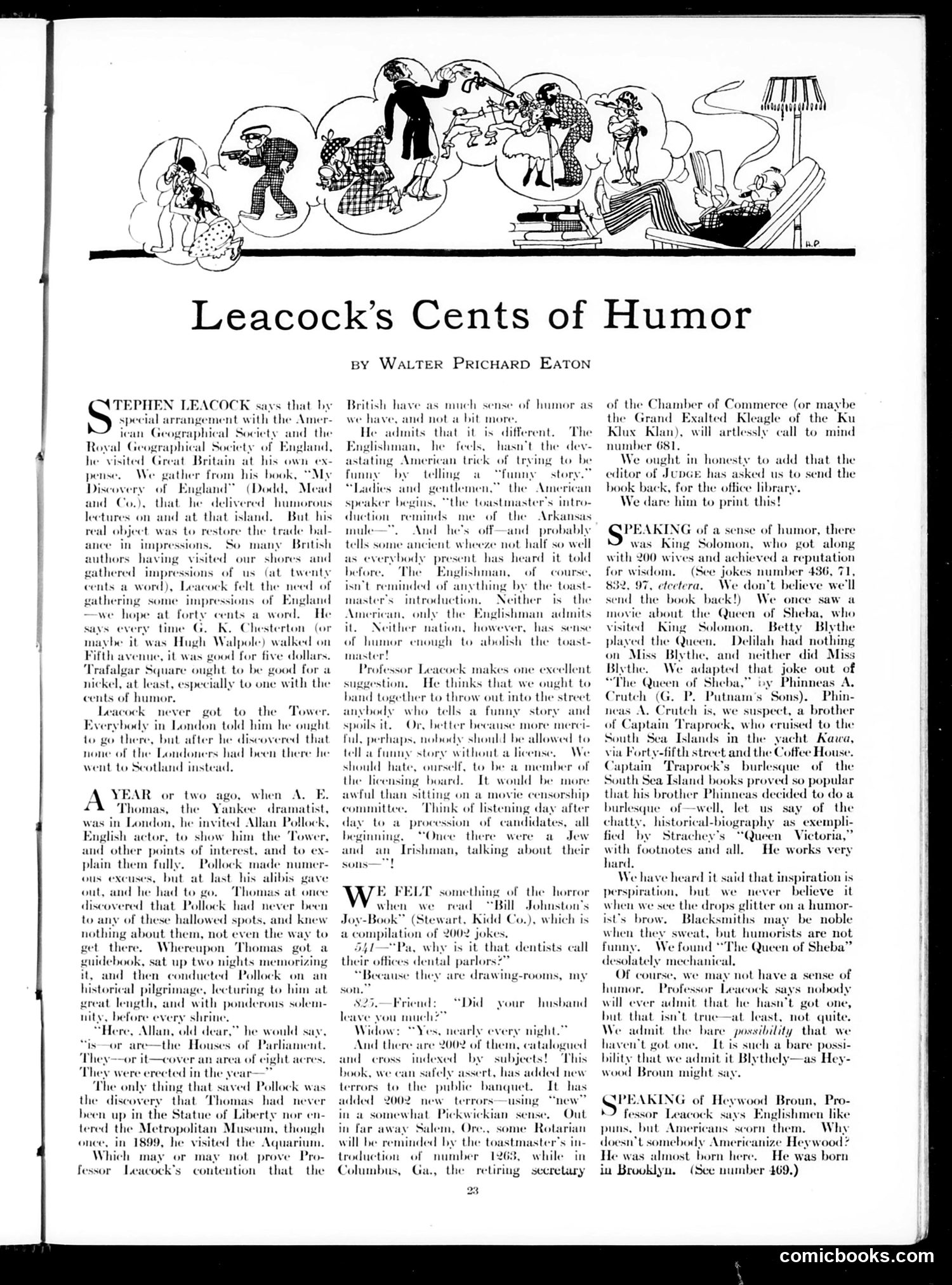
This page is a humorous essay about Stephen Leacock, a Canadian humorist who visited England and wrote "My Discovery of England." The article contrasts British and American approaches to humor. **Key points:** - **Leacock's premise**: He charged Americans twenty cents per word for his impressions of Britain, reversing the pattern of British authors profiting from American observations. - **The satire**: The piece mocks Americans' reliance on pre-packaged "funny stories" at formal events (particularly at toastmasters' dinners), versus British wit, which is more subtle and natural. - **The anecdote about Pollock**: An English actor pretended knowledge of London landmarks he'd never visited, exposing how people fake expertise. - **The joke compilation**: Reference to a 2,002-joke collection illustrates the author's critique—Americans mechanically recycle jokes rather than creating genuine humor. **Bottom line**: Judge is satirizing American humor culture as forced and commercial, contrasting it with supposedly more sophisticated British sensibilities. The humor is self-aware—mocking both American crudeness and British pretension.
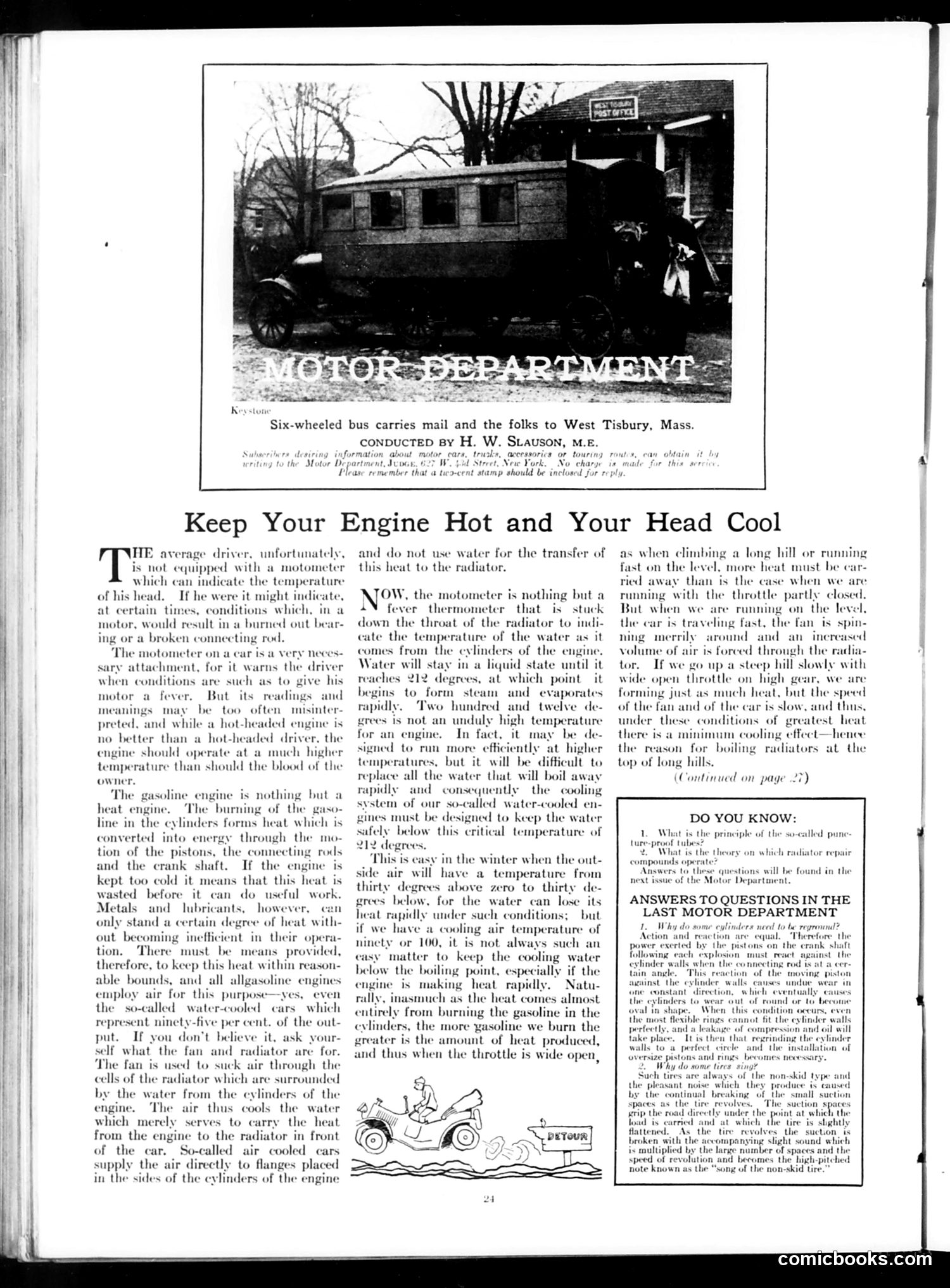
This page from *Judge* magazine contains **no political cartoon or satire**. Instead, it features practical automotive advice titled "Keep Your Engine Hot and Your Head Cool." The content is a straightforward technical article explaining motorcar engine cooling systems to early automobile drivers. It discusses: - **Motometers** (engine temperature gauges) and their importance - **Water-cooling mechanics**: how engines generate heat that must be transferred via radiators - **Safe operating temperatures**: engines run best around 212°F, not dangerously cold - **Common driver mistakes**: improper throttle use on hills reduces cooling efficiency The only illustration is a photograph of a six-wheeled bus operated by H.W. Slauson in West Tisbury, Massachusetts, used as a mail carrier. This appears to be educational content for the growing number of car owners unfamiliar with engine mechanics—a practical service article rather than satirical commentary.
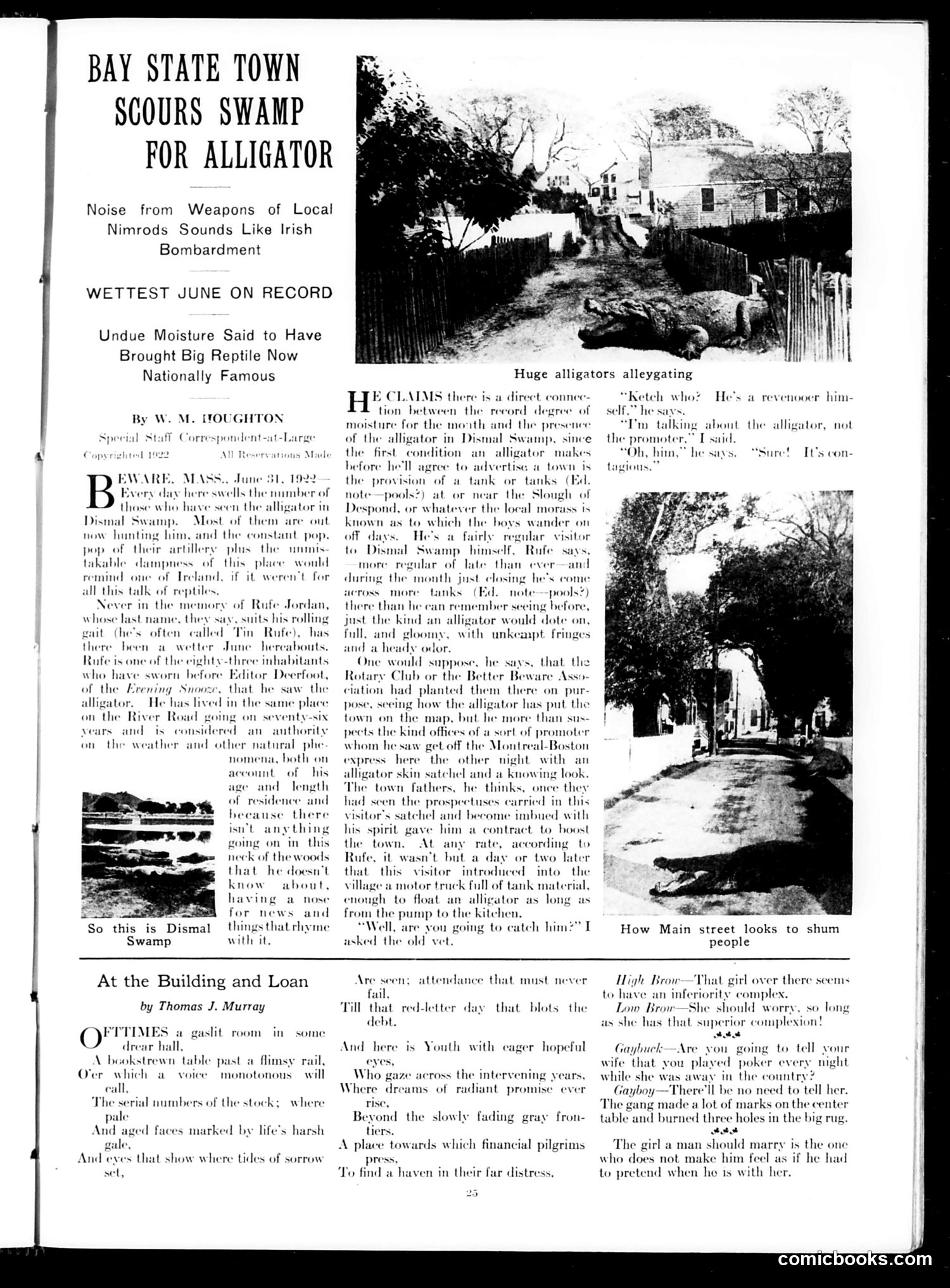
This page contains two separate pieces of satirical content: **"Bay State Town Scours Swamp for Alligator"** is a humorous news story about Beware, Massachusetts, where residents claim an alligator has appeared in Dismal Swamp. The satire mocks small-town boosterism—the story suggests a promoter deliberately introduced the alligator (via motor truck from Montreal-Boston express) to put the town "on the map" and attract tourists. The joke targets how desperately small towns exploit any novelty for publicity. The town's eighty inhabitants have sworn they've seen it; the satire lies in this collective delusion serving commercial interests. **"At the Building and Loan"** is a sentimental poem about a financial institution's modest office, where hopeful borrowers seek loans to build better futures. It's largely earnest rather than satirical—celebrating working-class aspiration and financial institutions' role in enabling dreams. The accompanying photographs show the actual Dismal Swamp and Main Street, grounding the absurd alligator narrative in real place-documentation.
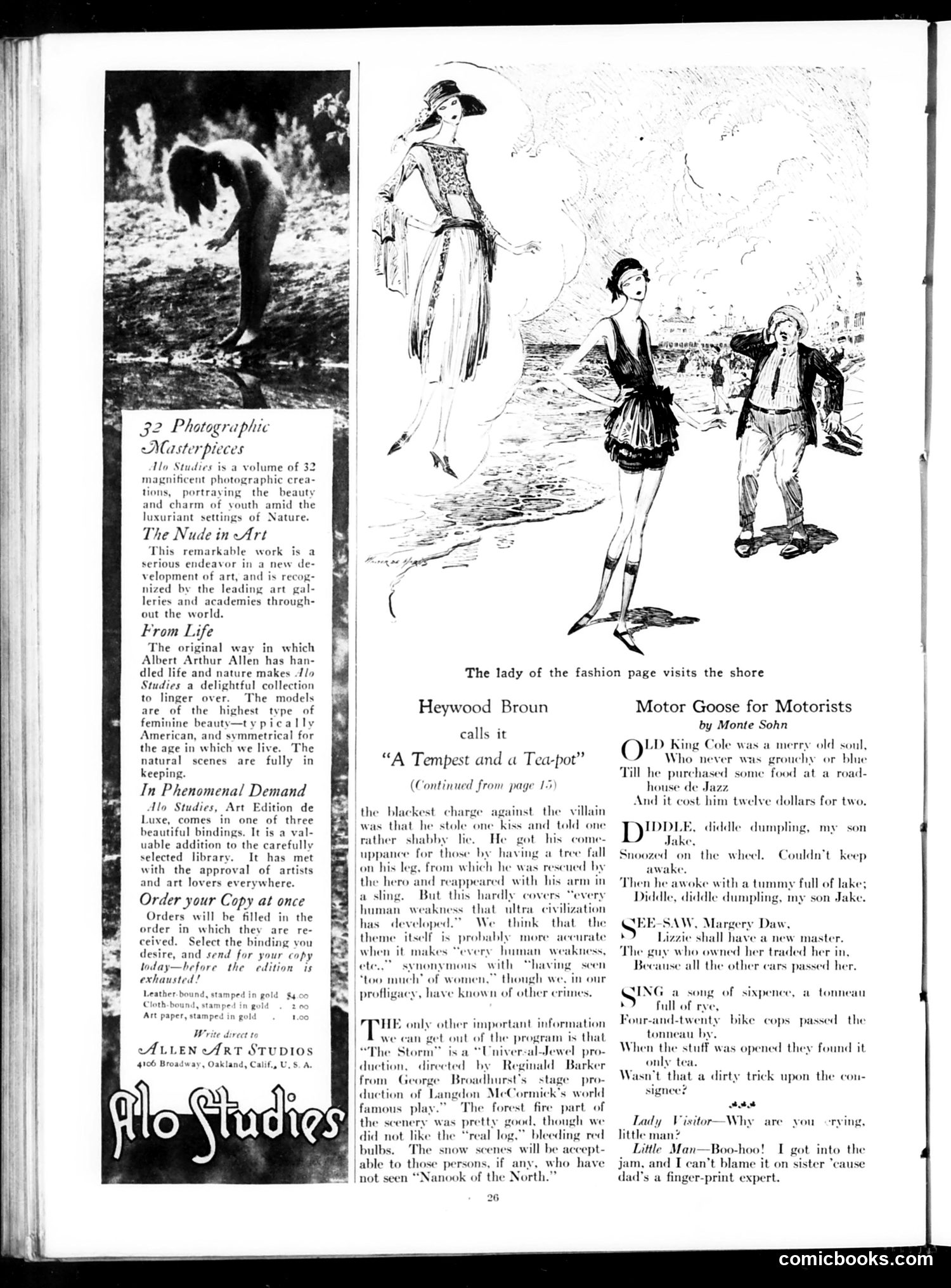
This page contains two distinct sections: **Left side:** Advertisement for "Alo Studies," a book of artistic photographs of nude models by Albert Arthur Allen, marketed as fine art and distributed through Allen Art Studios in Oakland, California. **Right side:** Two satirical pieces: 1. **"A Tempest and a Tea-pot"** by Heywood Broun—a theater review critiquing a Universal-Jewel film adaptation of George Broadhurst's play "The Storm," arguing the plot's moral stakes are understated. 2. **"Motor Goose for Motorists"** by Monte Sohn—humorous verse parodies of nursery rhymes featuring early automotive and Prohibition-era themes: drunk driving ("Snoozed on the wheel"), police traffic stops, and bootlegging (hidden tea instead of alcohol). The "Motor Goose" satirizes 1920s car culture and Prohibition enforcement in contemporary, comedic fashion.
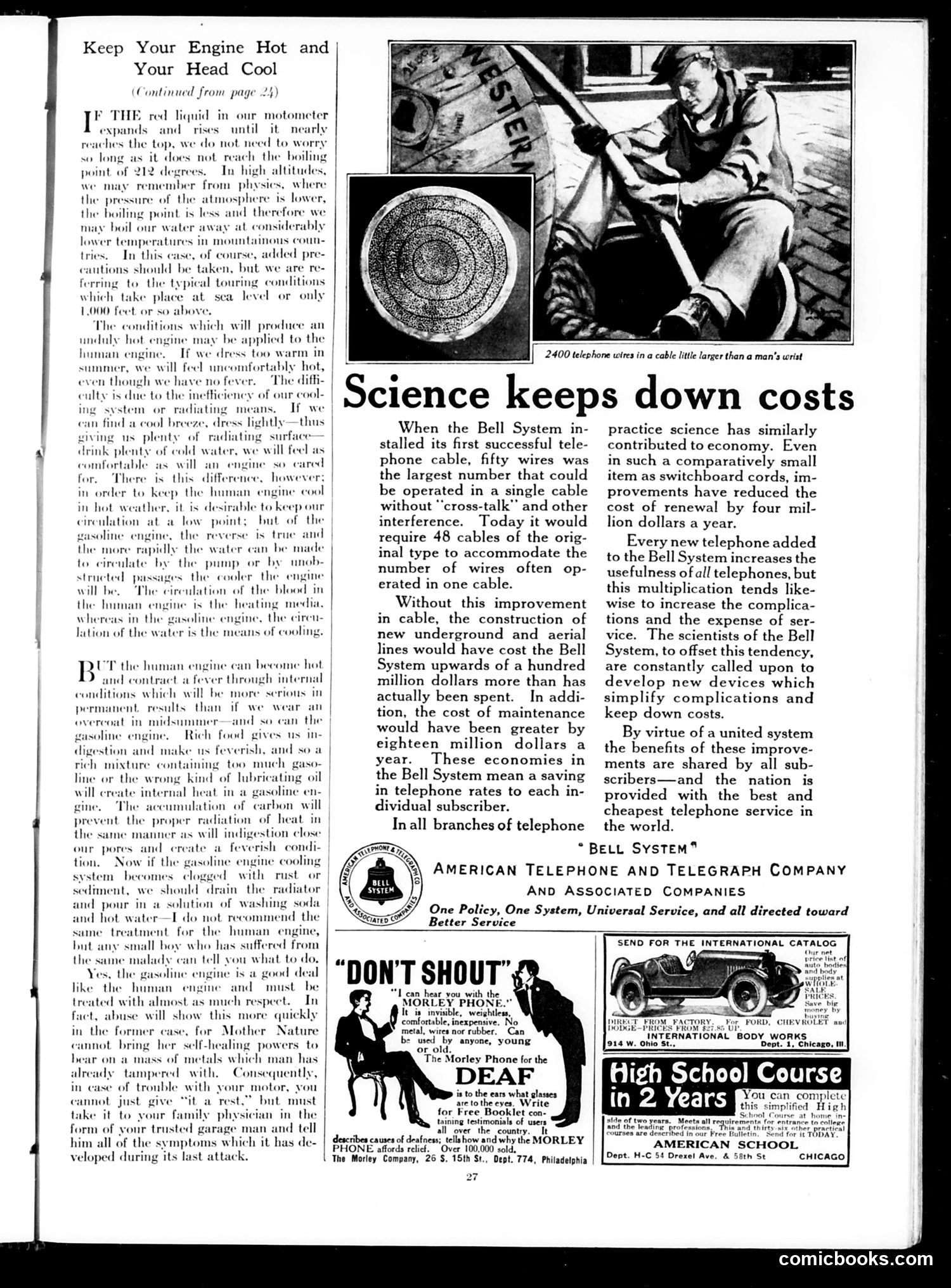
This page is primarily **educational and promotional advertising** rather than political satire. The main article compares human and gasoline engine cooling systems as a mechanical analogy—explaining that both require proper circulation and temperature management. The detailed text draws parallels: just as the human body regulates heat through blood circulation and perspiration, engines need water circulation and radiators. The accompanying illustrations show a thermometer and a person checking an engine, supporting this instructional purpose. Below the main article are **commercial advertisements**, including one for the Bell System (American Telephone and Telegraph Company) promoting technological advances in telephone cable efficiency—boasting that modern cables can handle 2,400 wires where earlier versions handled only 50. Additional ads advertise a Morley Phone for the deaf, a high school correspondence course, and an International body works auto catalog. This page reflects early 20th-century Judge magazine's mix of humor, practical education, and advertising revenue rather than pointed political commentary.
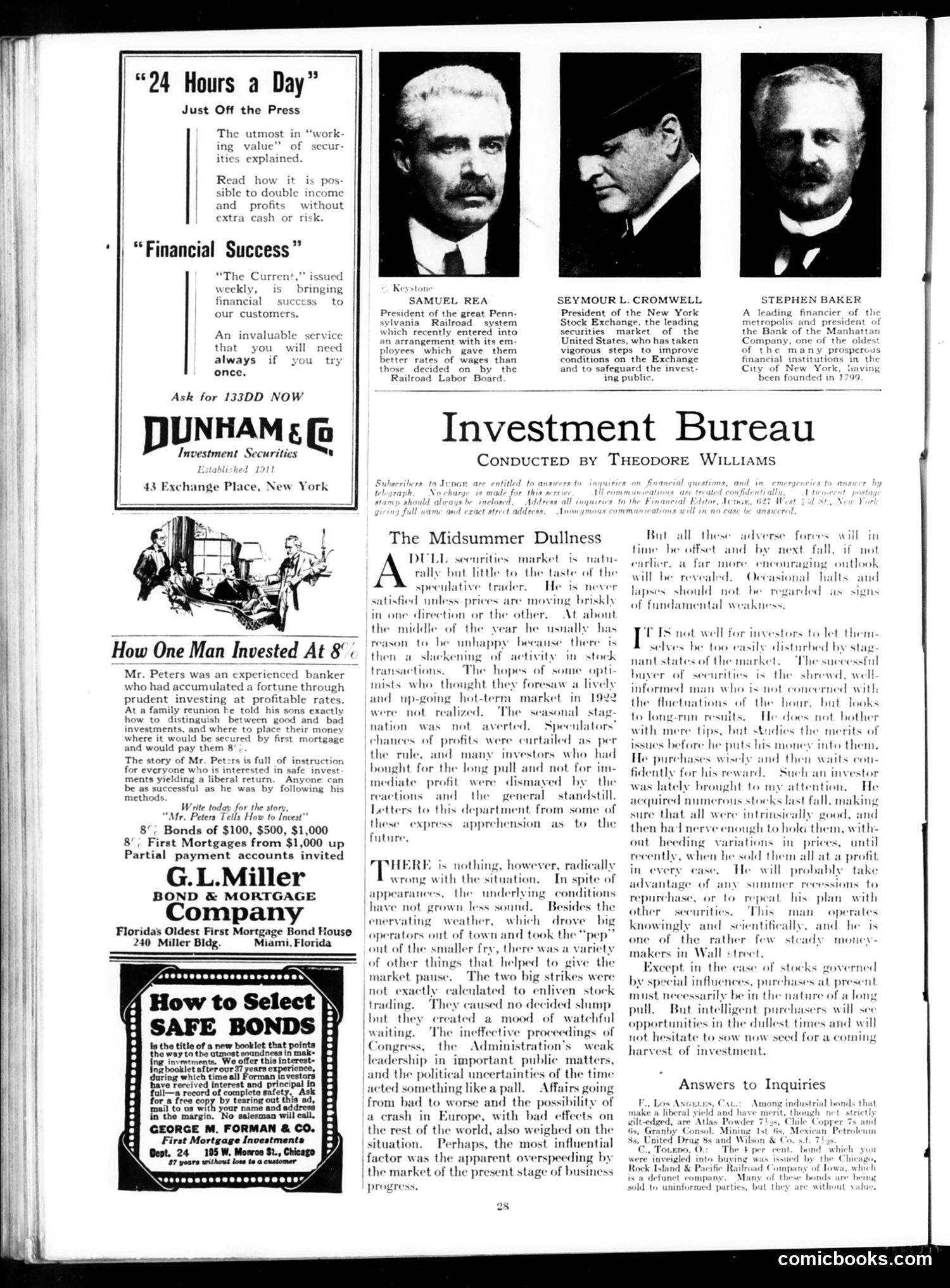
This is primarily a **financial services advertisement page** from Judge magazine, not satirical editorial content. The page promotes various investment and mortgage companies through testimonials and advertorials. The three photographs show prominent **financial figures of the era**: Samuel Rea (Pennsylvania Railroad president), Seymour L. Cromwell (New York Stock Exchange president), and Stephen Baker (described as a leading financier). They're presented as credible authorities endorsing sound investment practices. The main article, "The Midsummer Dullness," discusses the **summer slowdown in securities trading**—a normal market phenomenon—and reassures investors that underlying conditions remain sound despite reduced activity and recent labor strikes. The surrounding ads (Dunham & Co., G.L. Miller Bond Company, George M. Forman & Co.) emphasize **safety and conservative returns** (8% bonds, first mortgages), reflecting early 1920s investment marketing that stressed security over speculation. **Context for modern readers**: This predates the 1929 crash; these "safe" investment pitches would prove tragically ironic within years.
This page is primarily **advertising and financial advice**, not political satire. The main content consists of: 1. **Stock market tips and investment advice** from J.S. Bache & Co. and William H. Herbst, discussing railroad bonds, industrial stocks, and dividend opportunities—typical financial journalism of the 1920s era. 2. **A chiropractic advertisement** from the Universal Chiropractors Association (Davenport, Iowa) defending their profession against medical skepticism. The headline "Truth Courts the Light But Error Shuns It" suggests chiropractors were positioning themselves as scientifically legitimate against established medicine's dismissal of them. 3. **Sex education book advertisement** from Knowledge Book Co., offering discreet mail-order information. The page reflects 1920s concerns: investment opportunities, the emerging chiropractic profession's credibility struggles, and cautious attitudes toward sex education. There are no significant political cartoons or satirical targets visible—this is a commercial publication page.
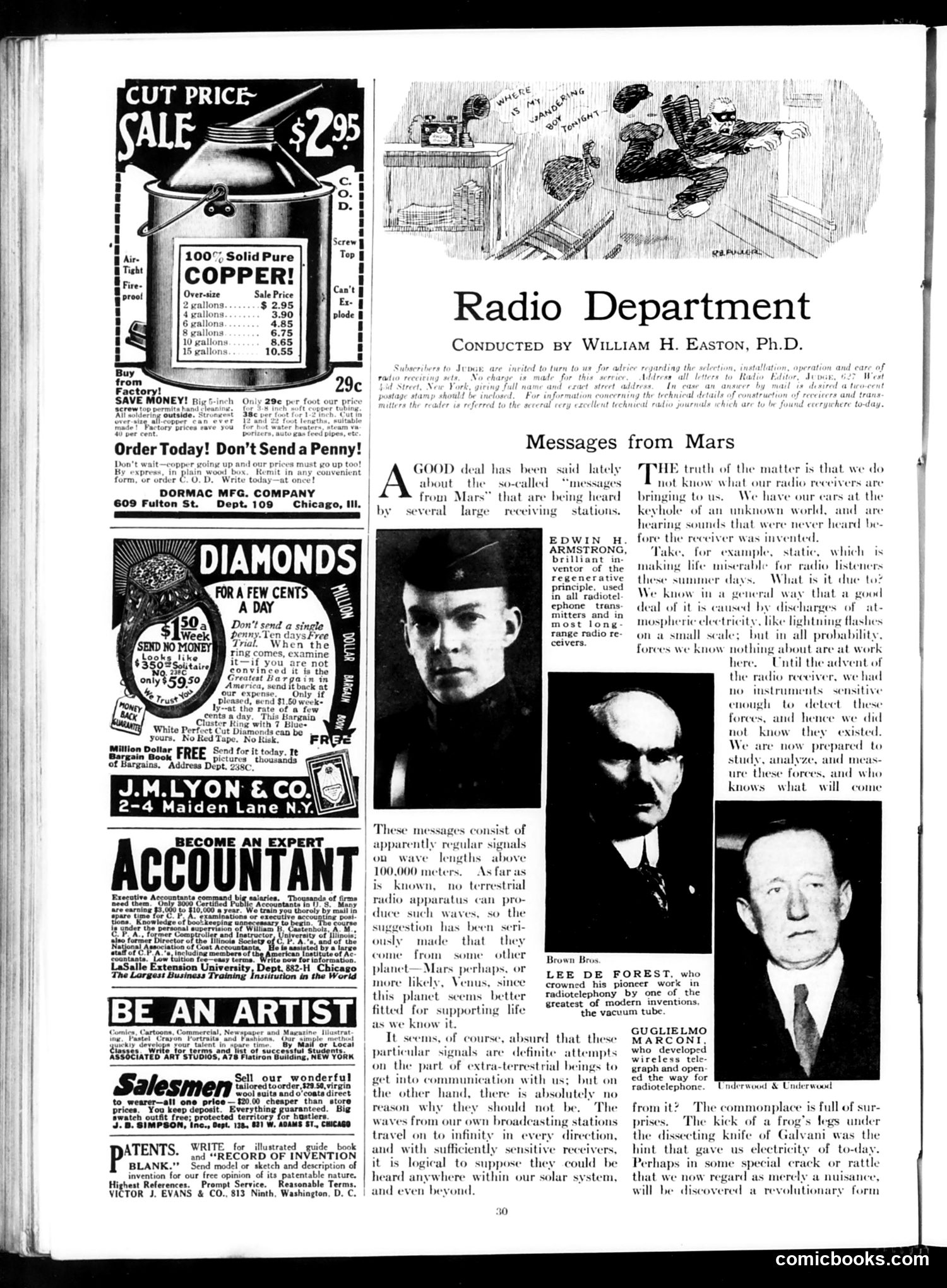
This page's main content is a **Radio Department column discussing alleged radio signals from Mars**, conducted by William H. Easton, Ph.D. The column presents two perspectives: excitement about "messages from Mars" reportedly received by large stations, versus scientific skepticism. The accompanying photographs show three radio pioneers—**Edwin H. Armstrong**, **Lee de Forest** (credited with inventing the vacuum tube), and **Guglielmo Marconi**—establishing authority on the topic. The satire's point: The column gently mocks public credulity about extraterrestrial signals while acknowledging scientists genuinely cannot explain all atmospheric radio interference. Easton uses historical examples (Galvani's frog experiments) to argue that dismissing unexplained phenomena as "mere nuisance" may be shortsighted—though he stops short of endorsing Martian contact. The humor lies in the tension between scientific caution and popular wonder during radio's early, mysterious era, when the technology itself seemed almost miraculous.
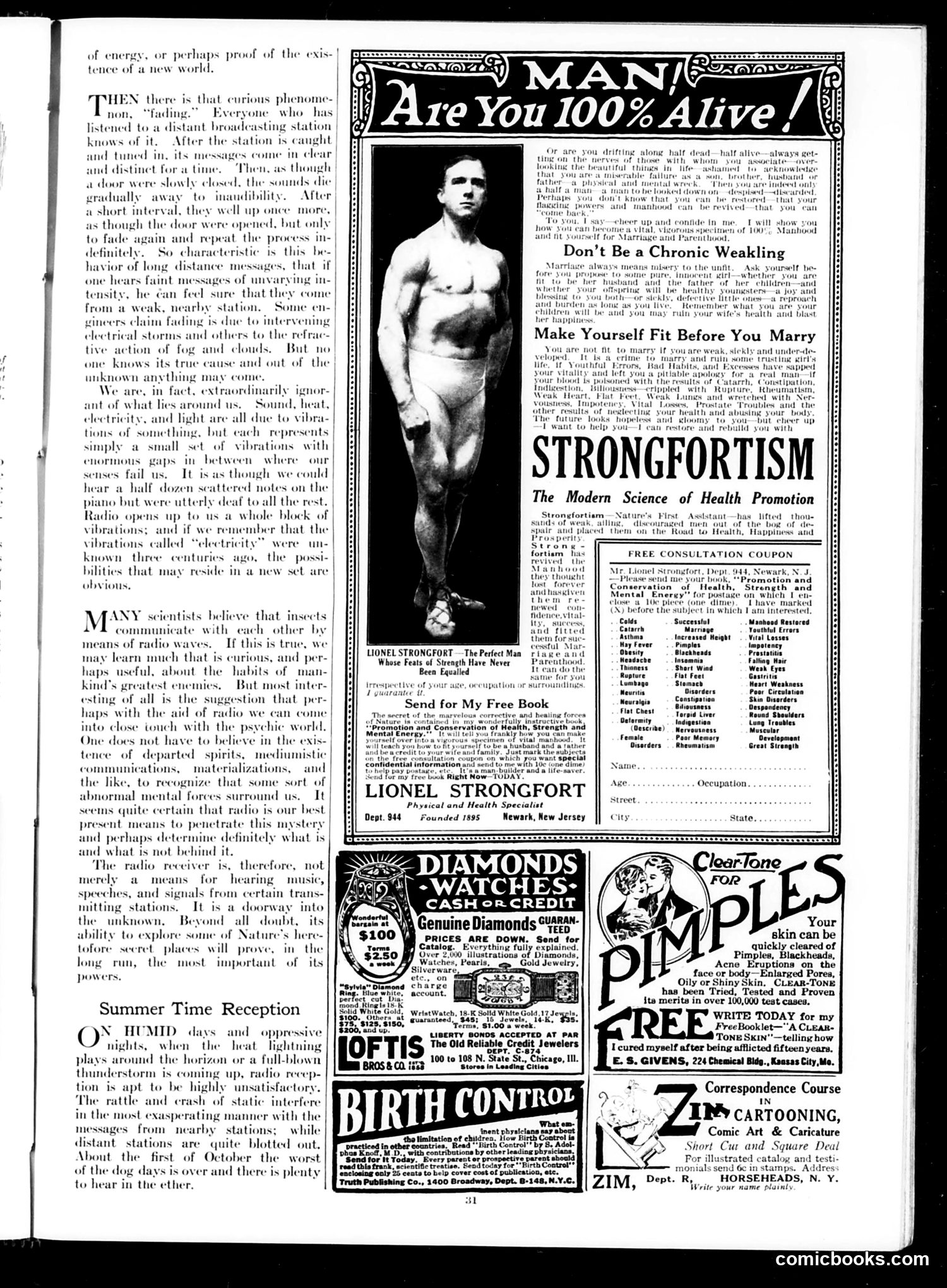
This page is primarily **advertising**, not editorial cartoons. The dominant content is a recruitment ad for "Strongfortism," a mail-order physical-fitness and health program promoted by "Lionel Strongfort." **The central appeal:** The shirtless male physique photo advertises bodybuilding/health transformation services. The headline "Are You 100% Alive?" and surrounding text (advising readers not to be "weaklings," to "make yourself fit before you marry") target anxieties about masculinity and marriageability—common in early-20th-century advertising. **Context for modern readers:** This reflects period obsessions with "scientific" self-improvement through mail-order courses. The language about being "a failure as a husband and father" if unhealthy exploits fears about male inadequacy. Strongfort promises to restore "mental energy" and vigorous manhood. The page's article text discusses radio reception's mysterious "fading" phenomenon and speculates about insect communication and psychic contact via radio—period pseudoscience fascination. The ads below (diamonds, birth control, skin cream) are typical period classified advertising.
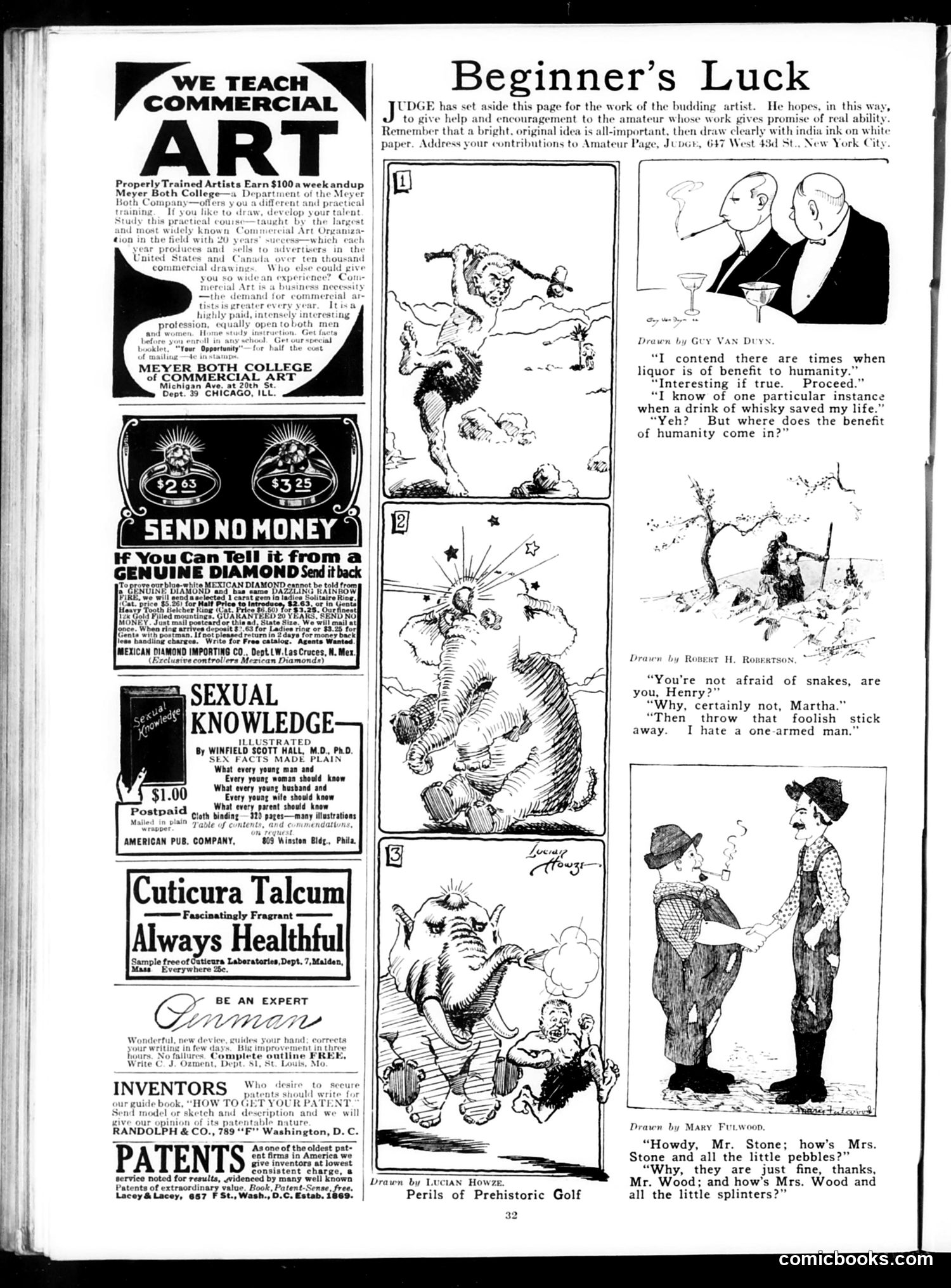
This page features Judge's amateur comics section, showcasing four brief humorous strips by aspiring artists competing for publication. **Panel 1** (Van Duys): Two men debate whether liquor benefits humanity. One claims whisky saved his life; the other asks where humanity's benefit lies—a straightforward temperance-era joke questioning alcohol's social value. **Panel 2** (Robertson): A couple discusses snakes. Henry claims fearlessness, but Martha reveals his real phobia: one-armed men—absurdist humor playing on unexpected contradictions. **Panel 3** (Fulwood): A wood-themed pun: Mr. and Mrs. Stone discuss their "pebbles" while Mr. Wood asks about Mrs. Wood's "splinters"—wordplay treating couples' children as natural extensions of their surnames. **Panel 4** (Howze): Prehistoric humans play golf, with a caveman hitting a ball at another character—simple anachronistic humor. The page itself is primarily **advertising** (art schools, diamonds, patent services, sexual education books), with these amateur cartoons occupying secondary space as Judge's encouragement to budding artists.
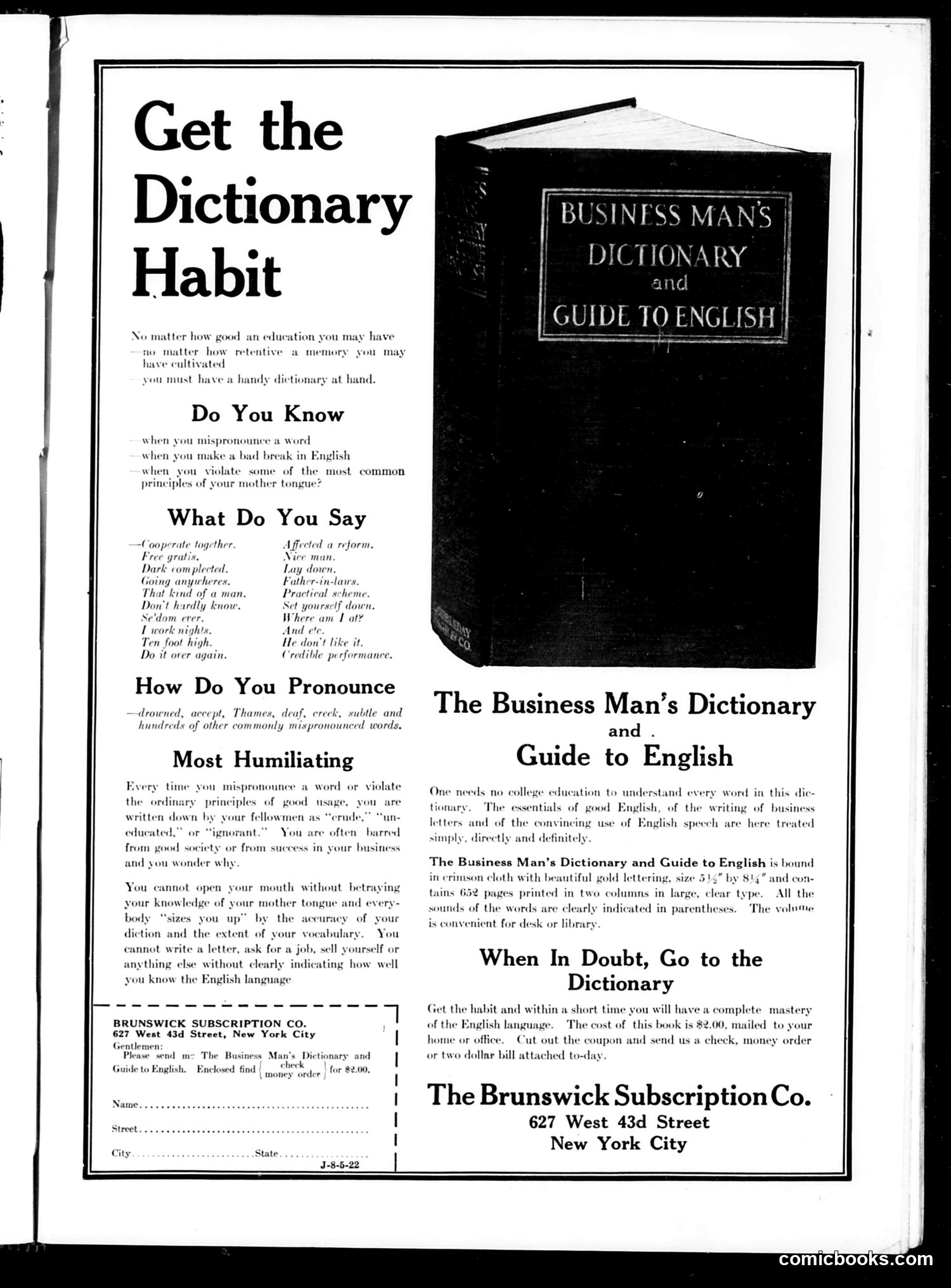
This is **not a cartoon or satirical content** — it's a full-page advertisement for *The Business Man's Dictionary and Guide to English*, published by Brunswick Subscription Co. The ad uses social anxiety as its selling point. It argues that mispronouncing words or using poor grammar immediately marks someone as uneducated or unfit for business success, regardless of actual competence. The "Do You Know," "What Do You Say," and "How Do You Pronounce" sections list common errors (e.g., "cooperate together," "free gratis," "where am I at?") to make readers feel inadequate. The underlying message reflects early 20th-century class anxiety: proper English speech is presented as essential social currency. Business success depends on linguistic correctness. The dictionary costs $2.00 and fits conveniently on a desk — positioning it as an affordable fix for professional ambition. This reflects genuine period concerns about language standardization and social mobility through proper speech.
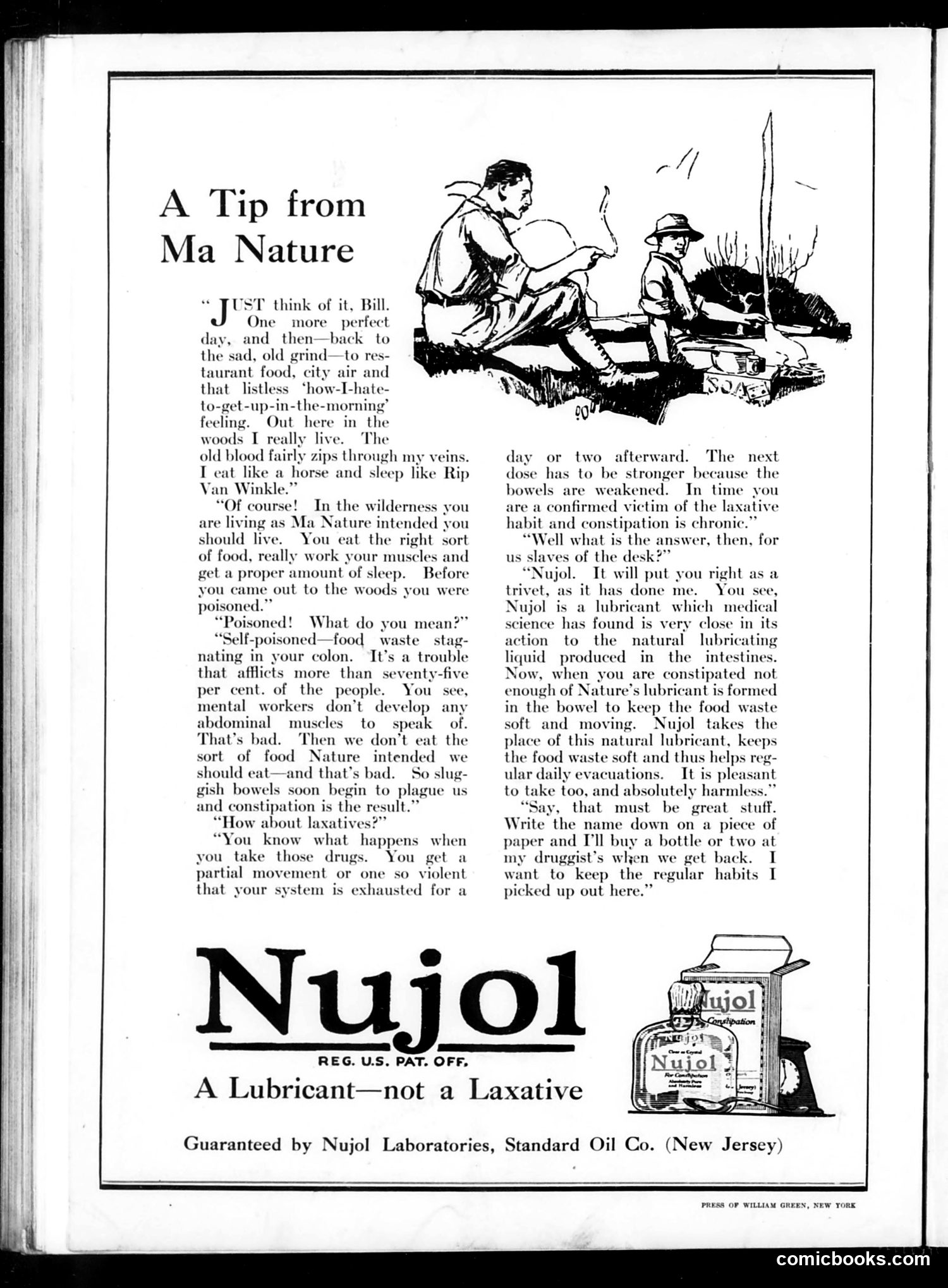
This is primarily **a Nujol advertisement disguised as editorial content** in Judge magazine. Two men camping in the woods discuss digestive health—one extolling nature's benefits, the other explaining why modern desk workers suffer constipation. The "satire" is mild: the cartoon mocks sedentary urban life and poor diet, contrasting it with outdoor vitality. The pitch follows: laxatives are habit-forming and dangerous, but Nujol (a mineral oil product by Standard Oil) works like the body's natural intestinal lubricant—hence "not a laxative." The illustration shows two figures in wilderness camping gear, reinforcing the "Ma Nature" theme. This represents early 20th-century **advertorial content**—blending lifestyle messaging with product promotion. The digestive health anxiety it exploits was common in the era, when constipation remedies were heavily marketed. No specific political figures or events are referenced; it's pure commercial persuasion wrapped in editorial clothing.