
Judge, 1922-08-05 · page 17 of 36
Judge — August 5, 1922 — page 17: what you’re looking at
What you’re looking at
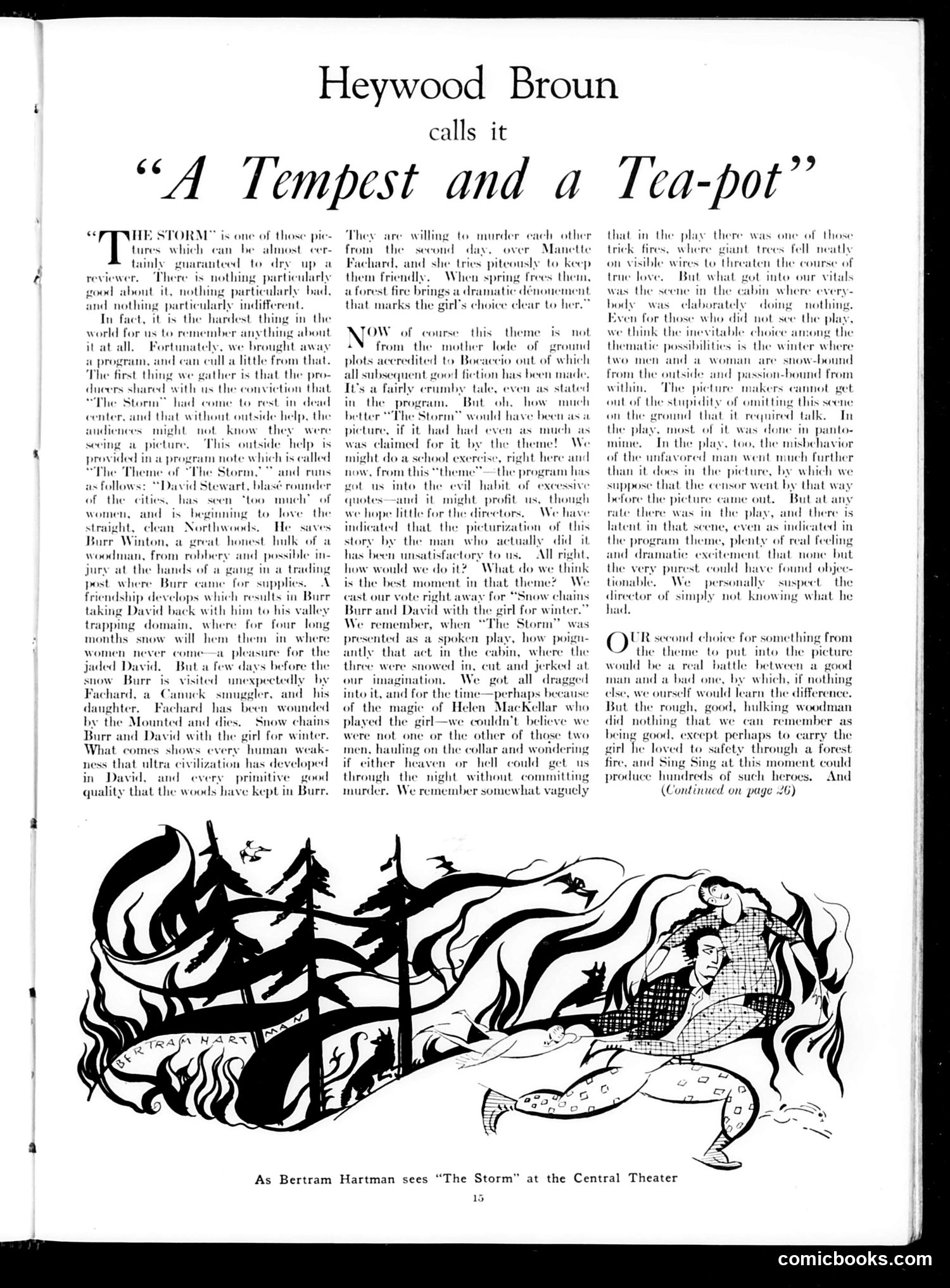
This page reviews a film adaptation of "The Storm," comparing it unfavorably to the original stage play. Critic Heywood Broun argues the movie is forgettable and dramatically inert—so bland he needs the program notes to remember what happened. The satire targets the film's failure to capture the play's emotional intensity. Broun contrasts the stage version's compelling cabin scene (where three snowed-in characters face moral crisis) with the film's tedious rendition of the same moment—where "everybody elaborately doing nothing" drains all tension. The illustration shows Bertram Hartman's perspective: a man watching the film while flames consume a cabin on screen, suggesting the movie's artificial melodrama (visible wires pulling down trees) versus authentic human drama. Broun's point: Hollywood's heavy-handed storytelling and technical contrivances cannot match theater's psychological power and intimacy.
📄 Transcribed text from this page (OCR, searchable)
Machine-transcribed from the original scan — historical spelling and the odd misread are preserved.
Heywood Broun calls it “A Tempest and a Tea-pot” "Th 2 STORM™ is one of those pic- tures which can be almost. cer- tainly guaranteed to dry up a There is nothing particularly nothing particularly bad, and nothing particularly indifferent. In fact, it is the hardest thing inthe world for us to remember anything about itatall. Fortunately, we brought away a program, and ean cull a little from that. The first thing we gather is that the pro- ducers shared with us the conviction that “The Storm” had come to rest in dead center, and that withont outside help, t audienc might not Know they seeing a picture. This outside ‘help is provided ina program note which is called “The Theme of “The Storm,” and runs as follows: “David Stewart, blasé rounder of the cities, has seen oO omuch’ of women, and is beginning to love the straight. clean Northwoods. He saves Burr Winton, a mest hulk of a woodman, from robbery and. possible in- jury at the hands of a gang in a trading post where Burr came for supplies. friendship develops which results in Burr taking David back with him to his valley trapping domain, where for four long months snow will hem = them in’ where women never come—a pleasure for the jaded David. But a few days before the snow Burr is. visited unexpectedly by reviewer, good about were Fachard, a Canuck smuggler, and his daughter. Fachard has been wounded by the Mounted and dies. Snow chains Burr and David with the girl for winter. What comes shows every human weak- ness that ultra civilization has developed in David, and every. primitive good quality that the woods have kept in Burr. As Bertram Hartman sees ch other the second day. over Manette 1, and she tries piteously to keep lv. When spring frees them, brings a dramatic dénonement They are willing to murder from that marks the girl’s choice clear to he TOW of course this theme is not 4 from the mother lode of ground plots accredited to Bocaccio out of which all subsequent good fiction has been made. It’s a fairly crumby tale, even as stated in the But how much better * would have been as it picture, if it had had even as much as was claimed for it by the theme! We might do a school exe right here and now, from this “theme” —the program has us into the evil habit quotes—and it might: profit’ us, though we hope little for the dir We have indicated that the picturization of this story by the man who actually did it has been unsatisfactory to us. All right, how would we do it? What do we think is the best moment in that theme cast our vote right away Burr and David with th We remember, when “The Storm” presented as a spoken play, how poign- antly that act in the cabin, where the three were snowed in, cut and jerked at our imagination. We got all d. into it, and for the time—perhaps beci of the magic of Helen MacKellar who played the girl—we couldn't believe we were not one or the other of those two men, hauling on the collar and wondering if either heaven or hell could get us through the night: without committing murder. We remember somewhat vaguely of excessivi got ors. was that in the play there was one of those trick fires, where giant trees fell neatly on visible wires to threaten the course of true Jove. But what got into our vits was the scene in the cabin where every- hocdy elaborately doing nothing. Ey ‘. we think the inevitable choice among the thematic possibilities is the winter where two men and a woman are snow-bound from the outside and passion-bound from within. The picture makers cannot get out of the stupidity of omitting this scene on the ground that it required talk. In the play, most of it was done in panto- mime. In the play. too, the misbehavior of the unfavored man went much further than it does in the picture, by which we suppose that the censor went by that way before the picture came out. But at any rate there was in the play, and there is latent in that scene, even as indicated in the program theme, plenty of real fecling and dramatic excitement that none but the very purest could have found objec- tionable. We personally suspect. ‘the director of simply not knowing what he had. Wats 1 for those who did not sce the pl ¢ UR second choice for something from the theme to put into the picture would be a real battle between a good man and a bad one, by which, if nothing else, we ourself would learn the differenc But the rough, good, hulking woodn did nothing that we can remember being good, except. perhaps to carry the girl he loved to safety through a forest fire, and Sing Sing at this moment could produce hundreds of such heroes. And (Continued on page 26) “The Storm” at the Central Theater 15 comicbooks.com