
Judge, 1922-08-05 · page 25 of 36
Judge — August 5, 1922 — page 25: what you’re looking at
What you’re looking at
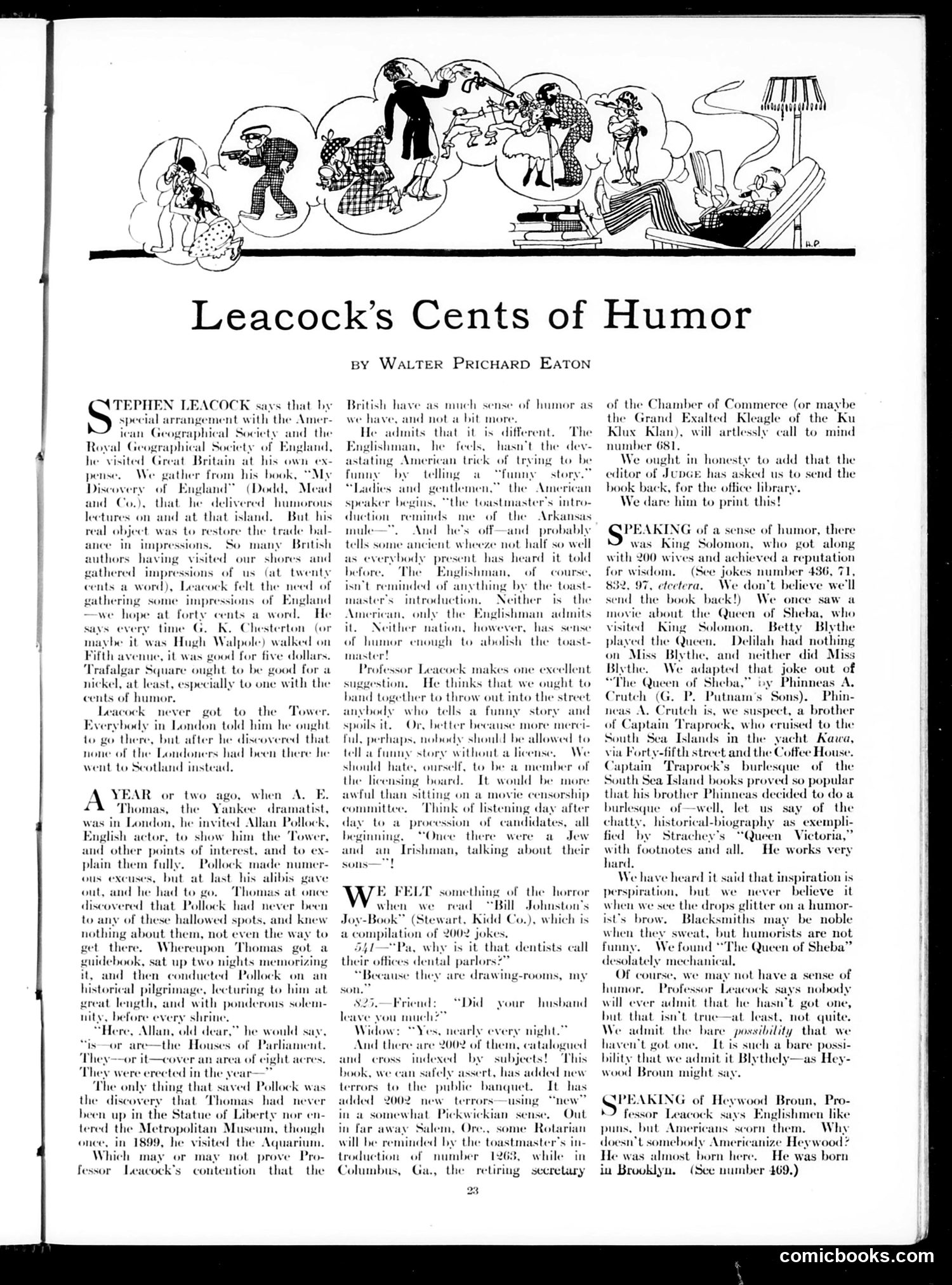
This page is a humorous essay about Stephen Leacock, a Canadian humorist who visited England and wrote "My Discovery of England." The article contrasts British and American approaches to humor. **Key points:** - **Leacock's premise**: He charged Americans twenty cents per word for his impressions of Britain, reversing the pattern of British authors profiting from American observations. - **The satire**: The piece mocks Americans' reliance on pre-packaged "funny stories" at formal events (particularly at toastmasters' dinners), versus British wit, which is more subtle and natural. - **The anecdote about Pollock**: An English actor pretended knowledge of London landmarks he'd never visited, exposing how people fake expertise. - **The joke compilation**: Reference to a 2,002-joke collection illustrates the author's critique—Americans mechanically recycle jokes rather than creating genuine humor. **Bottom line**: Judge is satirizing American humor culture as forced and commercial, contrasting it with supposedly more sophisticated British sensibilities. The humor is self-aware—mocking both American crudeness and British pretension.
📄 Transcribed text from this page (OCR, searchable)
Machine-transcribed from the original scan — historical spelling and the odd misread are preserved.
Leacock’s Cents of Humor ular 1 Gee ingement with the . ; phical Society and the Royal Geographical Society of England, he visited at Britain at his own ex- pense, We gather from his book, “My Discovery of England’ (Dodd, Mead and Co.), that he delivered humorous ‘tures on and at that island. But his bject was to restore the trade bal- ice in impressions, So many British authors having visited our shores and gathered impressions of us (at twenty cents a word), Leacock felt the need of gathering some impressions of England —we hope at forty cents a word. He SUys eV time G. K. Chesterton maybe it was Hugh Walpole) walked on fth avenue, it was good for five dollars. ur Square ought to be good for a nickel, at least, especially to one with the cents of hume Leacock never got to the Tower. Everybody in London told him he ought but after he discovered that been there he (or to go there, none of the Londoners had went to Scotland instead. YEAR or two ago, when A. E. homas, the Yankee dramatist, was in London, he invited Allan Polloets English actor, to show him the Tower, and other points of interest, and to ex- plain them fully. Pollock made numer- ous excuses, but at t his alibis gave out, and he had to go. Thomas at once discovered that: Pollock had never been to any of these hallowed spots, and knew nothing about them, not even the way to get there. Whereupon Thomas got a guidebook, sat up two nights memorizing it, and then conducted Pollock on an historical pilgrim: lecturing to him at great Tength, and with ponderous sole y shrine. n, old dear,” he would say. the Houses of Parliament. -or it—cover an f eight ac They were erected in th ; ‘The only thing that saved Pollock was the discovery that Thomas had never heen up in the Statue of Liberty nor en- te the Metropolitan Museum, though once, in 1899, he visited the Aquarium Which may or may not prove fessor Leacock’s contention that the BY WALTER PRICHARD EATON he have as much sense of humor as . and not a bit more. admits that it is different. The shinan, he feds, hasn't, tie dey astating American trick of trying to be funny by telling a “funny story.” “Ladies and gentlemen,” the At speaker begins, “the toastimaster’s intro- duction reminds me of the Ar mule And he's off—and probably tells some ancient wheeze not half so well as everybody present has heard it told Briti introduction. Neither is the only the Englishman admits nation, however, has sense of humor cnough to abolish the toast- maste Professor Leacock makes one excellent stion, He thinks that we ought to nd together to throw out into the street anybody who tells a funny story and spoils it. Or, better because more merci- ful, perhaps, nobody: should be allowed to tell a funny story without a license, We should hate, ourself, to be a member of the licensing board. It would be more awful than sitting on a movie censorship Think of listening « or ssion of candidates, all there were a Jew talking about their committee. to a pr nning. 1 Trishman, nce sons E FELT something of the horror when we read “Bill Johnston's Joy-Book” (Stewart, Kidd Co.), which is a compilation of 2002 jokes. why is it that dentists call autal parlors?” they are drawing-rooms, my: “Because “Did your husband Widow: * y night. And the and ; his book, we can safely assert, has added new terrors to the public banquet. It has: added 2002) new terr using “new” in a somewhat Pickwickian sense. Out in far away Salem, Ore. some Rotaria will be reminded by the toastmaste troduction number 126 while in Columbus, Ga., the retiri secretary nearly eve Cross 23 of the Chamber of Commerce (or maybe the Grand Exalted Kleagle of the Ku Klux Klan), will artlessly call to mind number 681, We ought in honesty to add that the editor of JupGE has asked us to send the book back, for the office library. We dare him to print this! SPE AKING of a sense of humor, there was King Solomon, who got along with 200 wives and achieved a reputation (See jokes number 436, 71, 32, 97, etcetera, We don’t believe we'll de the book back!) We once saw a movie about the Queen of Sheba, who visited King Solomon, Betty Blythe played the Queen, Delilah had nothing on Miss Blythe, and neither did Miss Blythe. We pted that joke out of “The Queen of Sheba,” P) Crutch (G. P. Putnam's Sons). Phi neas A. Crutch is, we suspect, a brother of Captain Traprock, who cruised to the South Sea Islands in the yacht Kawa, via Forty-fifth street and the Coffee House. Captain. Traprock’s) burlesque of the South Sea Island books proved so popular that his brother Phinneas decided to do a burlesque of—well, let us say of the chatty, historical-biography as. exempli fied by Strachey’s “Queen Victori with footnotes and all. He works very for wisdom. heard it said that inspiration is 1, but we never believe it when we sce the drops glitter on a humor- Blacksmiths may be noble when they sweat, but humorists are not funny. We found “The Queen of Sheba” desolately mechanical, Of course, We may not hay humor, Professor Leacock s will ever admit that he n't got one, but that isn’t trae least, not quite. We admit the bare possibility that: we haven't got one. It is such a bare possi- bility that we admit it Blythely—as Hey- wood Broun might say. ist’s brow. sense of ys nobody SPEAKING of Heywood Broun, Pro- fessor Leacock says Englishmen li pins, but Americans sconi:thems: “WHY doesn’t somebody Americanize Heywood? He was almost born he: He was born in Brooklyn. (See number 469.) comicbooks.com