
Judge, 1922-08-05 · page 8 of 36
Judge — August 5, 1922 — page 8: what you’re looking at
What you’re looking at
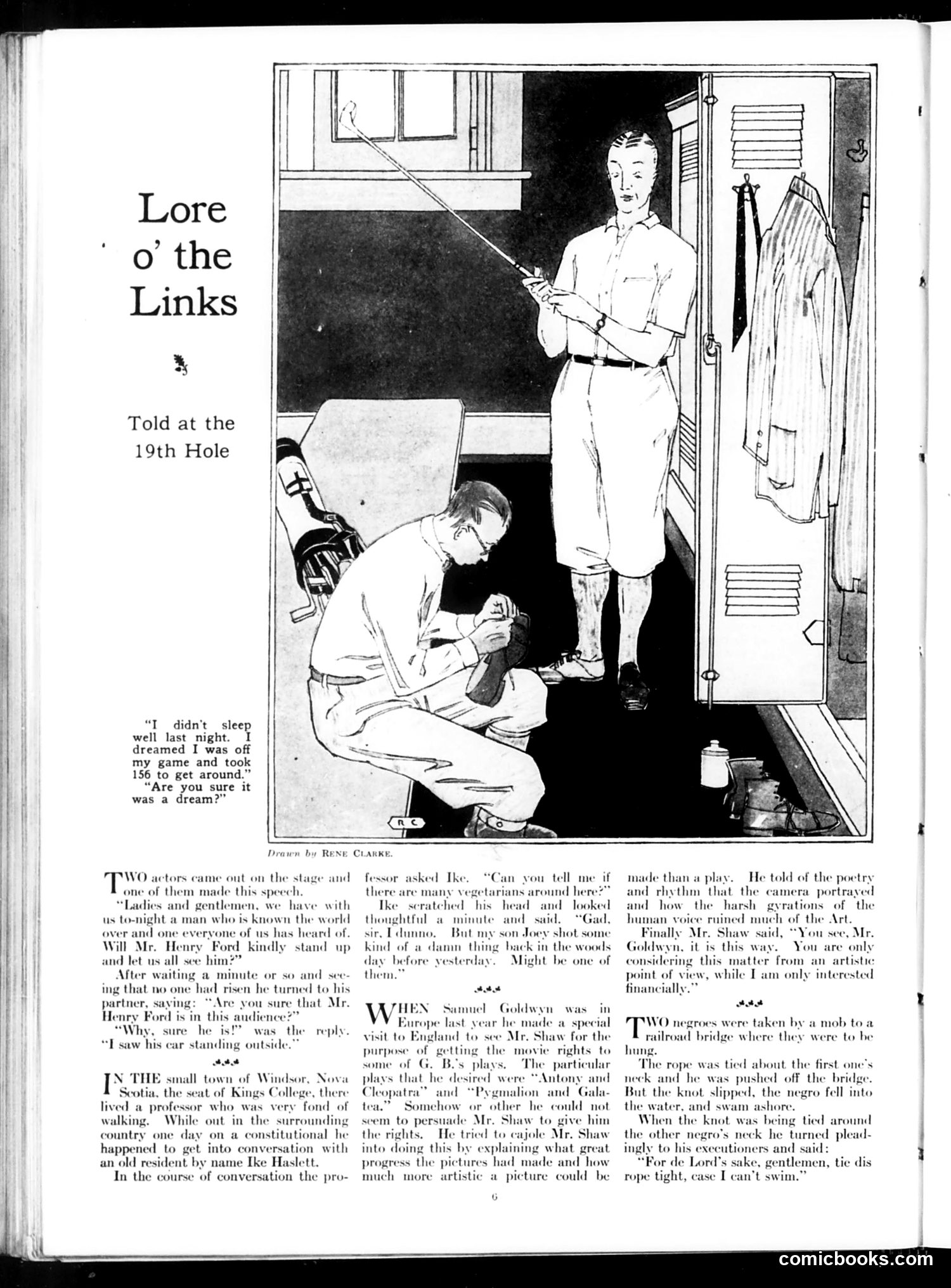
This page contains three humorous anecdotes presented as stories told by golfers at the 19th hole (the clubhouse). The jokes rely on: 1. **Henry Ford anecdote**: A speaker fails to recognize Ford in the audience, then learns Ford's car is outside. The joke is that Ford's automobile is more recognizable than Ford himself—commentary on Ford's fame via mass production rather than personal celebrity. 2. **Nova Scotia professor story**: A local resident's vague response about "vegetarians" (unclear in context) supposedly referring to something his son shot—humor from rural ignorance or deliberate evasion. 3. **Samuel Goldwyn/George Bernard Shaw anecdote**: Shaw dismisses Goldwyn's artistic arguments about cinema by claiming he only cares about money, not art. This satirizes both the filmmaker's pretentious aesthetic justifications and Shaw's candid materialism. 4. **Final dark joke**: Two lynching victims, one unable to swim—gallows humor with racist content reflecting period attitudes. The cartoon illustration shows a couple in what appears to be a bedroom or dressing room, likely depicting one of these stories visually.
📄 Transcribed text from this page (OCR, searchable)
Machine-transcribed from the original scan — historical spelling and the odd misread are preserved.
Lore ‘ o the Links & Told at the 19th Hole “I didn't sleep well last night. I dreamed I was off my game and took 156 to get around.” “Are you sure it was a dream?” ame out on the s one of them made this speech, ‘Ladies and gentlemen, we have with us to-night who is known the world over and one everyone of us has heard of Will Mr. Henry Ford kindly stand up and let us all see him?” After waiting a minute or so and sec ing that no one had risen he turned to his saying: “Are you sure that Mr. y Ford is in this audience?” Why, sure he is!” was the reply. “T saw his car standing outside.” ree N THE small town of Windsor, Nova Scotia, the seat of Kings College, there lived a professor who was very fond of walking. While out in the surrounding country one day on a constitutional he happened to get into conversation with an old resident by name Ike Haslett. In the course of conversation the pro- you tell me if ns around here? and Ik many ve seratched his head thoughtful) a minute and F 1, sir, Edunno, But my 1 Joey shot some kind of a damn thin k in the woods day before yesterday Might be one of them.” ttt WIEN Samucl Goldwyn was in Europe last year he made a special Sngland to see Mr. Shaw for the tting the movie rights to some of G. B.'s plays. The particular plays that he desired were “Antony and Cleopatra” and “Pygmalion and Gala- tea.” Somehow or other he could not seem to persuade Mr. Shaw to give him the ts. He tried to cajole Mr. Shaw into d his by explaining what great progress the pictures had made and how much more artistic a picture could be visit to purpose of made than a play. He told of the poetry and rhythm that the camera portrayed and how the harsh gyrations of | the human voice ruined much of the Art. Finally Mr. Shaw said, Goldwyn, it is this considering this matter from an artistie point of view, while Iam only interested financially.” tt rope was tied about. the first one’s neck and he was pushed off the bridge. But the knot slipped, the negro fell into the water, and swam ashore. When the knot was being tied around the other negro’s neck he turned plead- ingly to his executioners and said: “For de Lord’s sake, gentlemen, tie dis rope tight, case I can’t swim.” comicbooks.com