
A complete issue · 32 pages · 1921
Judge — April 16, 1921
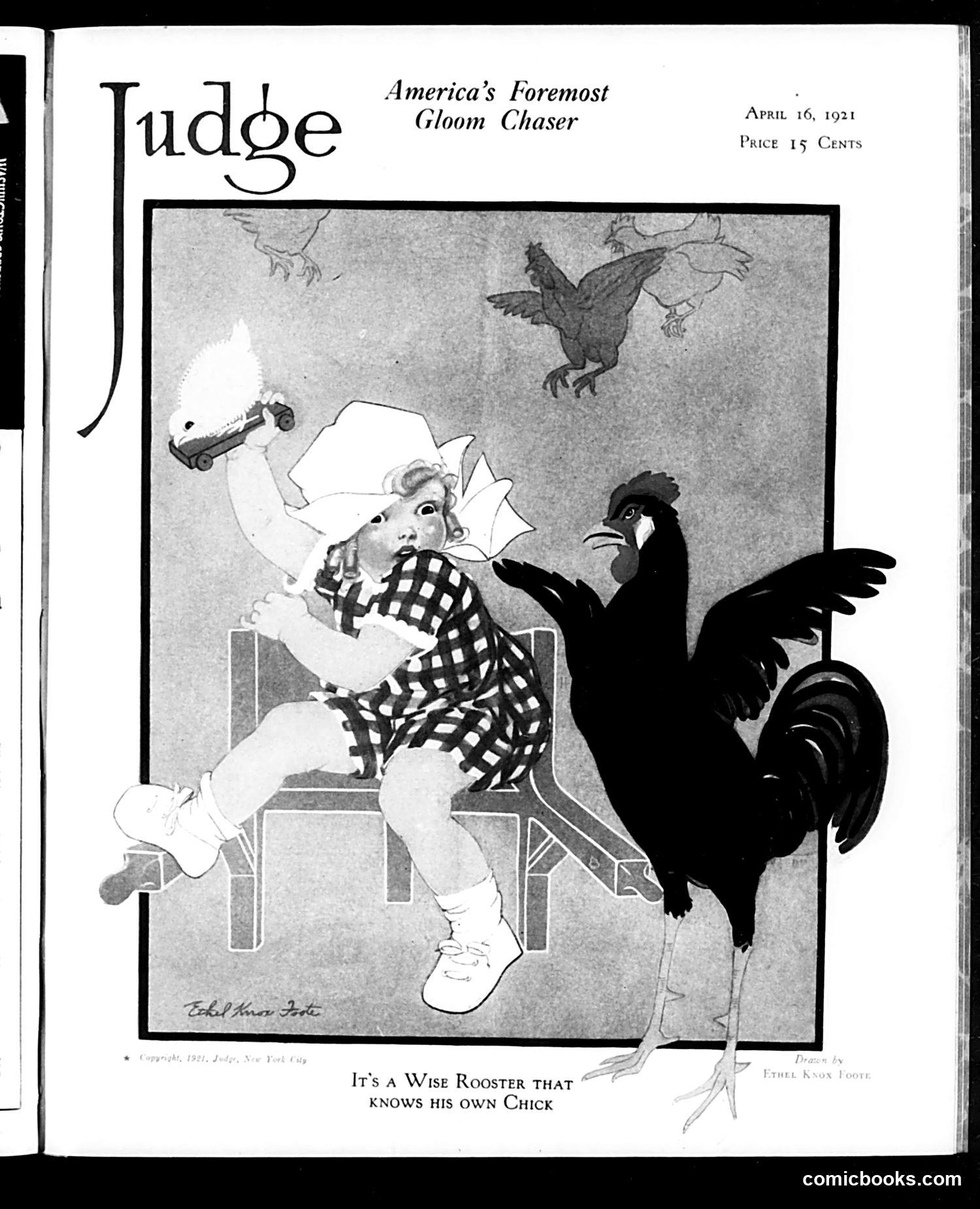
This satirical cover illustrates the caption "It's a Wise Rooster that knows his own Chick." The image shows a baby in checkered clothing sitting in a chair, holding a toy automobile and appearing delighted, while a large rooster stands beside the chair gesturing protectively or possessively toward the child. The joke plays on the phrase "knowing one's own chick" (offspring), suggesting paternity uncertainty. The rooster's presence implies questions about the child's actual parentage—a common satirical theme about infidelity or illegitimacy in early 20th-century humor. The proverb format adds irony, suggesting that determining true paternity requires unusual wisdom. The artwork is credited to Ethel Knox Foote.
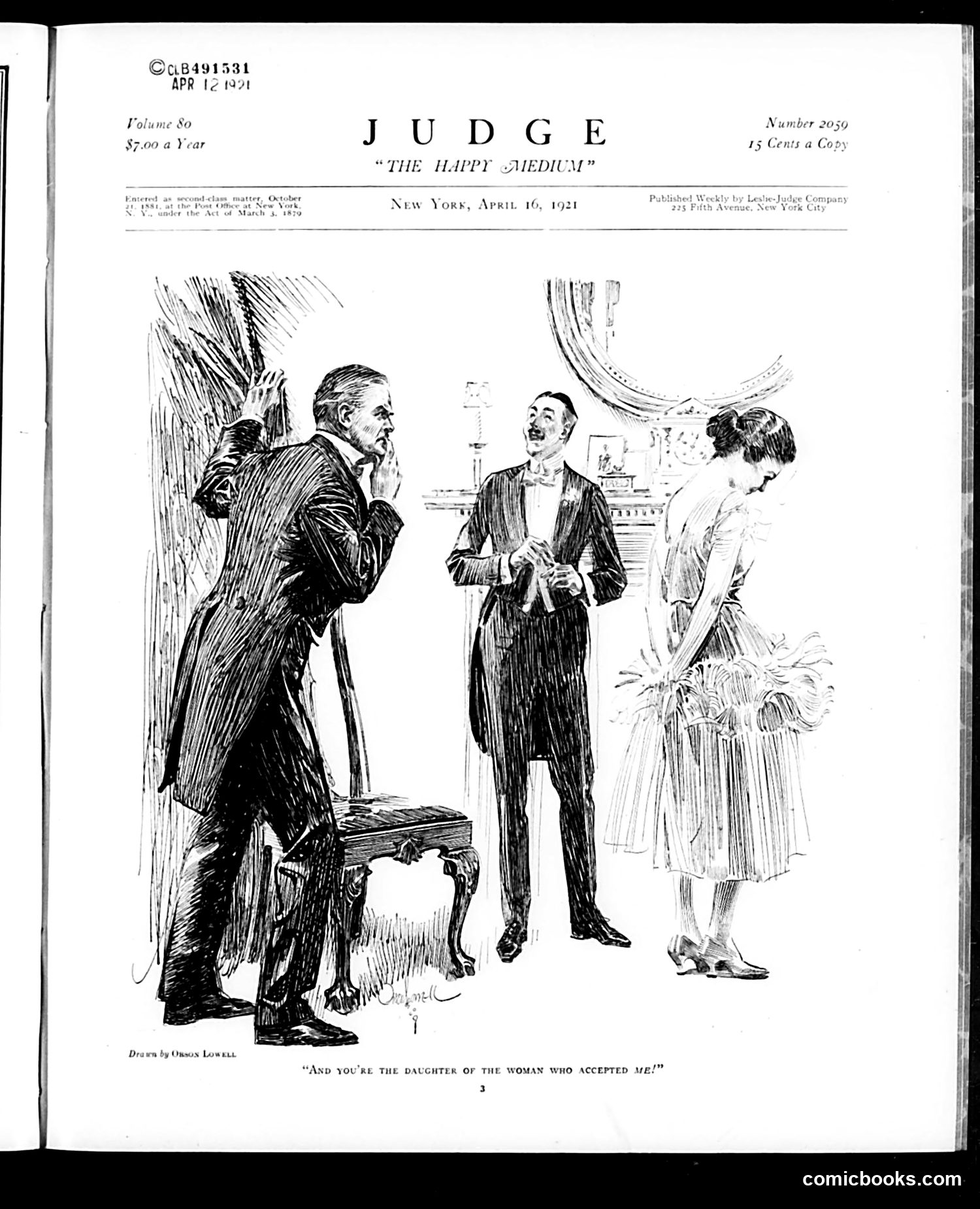
This cartoon depicts a domestic scene with three figures: a man in a suit confronting another man while a woman observes. The caption reads: "AND YOU'RE THE DAUGHTER OF THE WOMAN WHO ACCEPTED ME!" The joke appears to be a generational quip about marriage and acceptance. The man on the left seems to be discovering or commenting on the paternity of the younger person in the center, connecting them to "the woman who accepted" him—likely meaning a woman who accepted his marriage proposal years earlier. This is social satire about familial relationships and the long-term consequences of matrimonial choices. The specific historical or political context remains unclear without additional page context, but it's typical of Judge's domestic humor from the early 1920s.
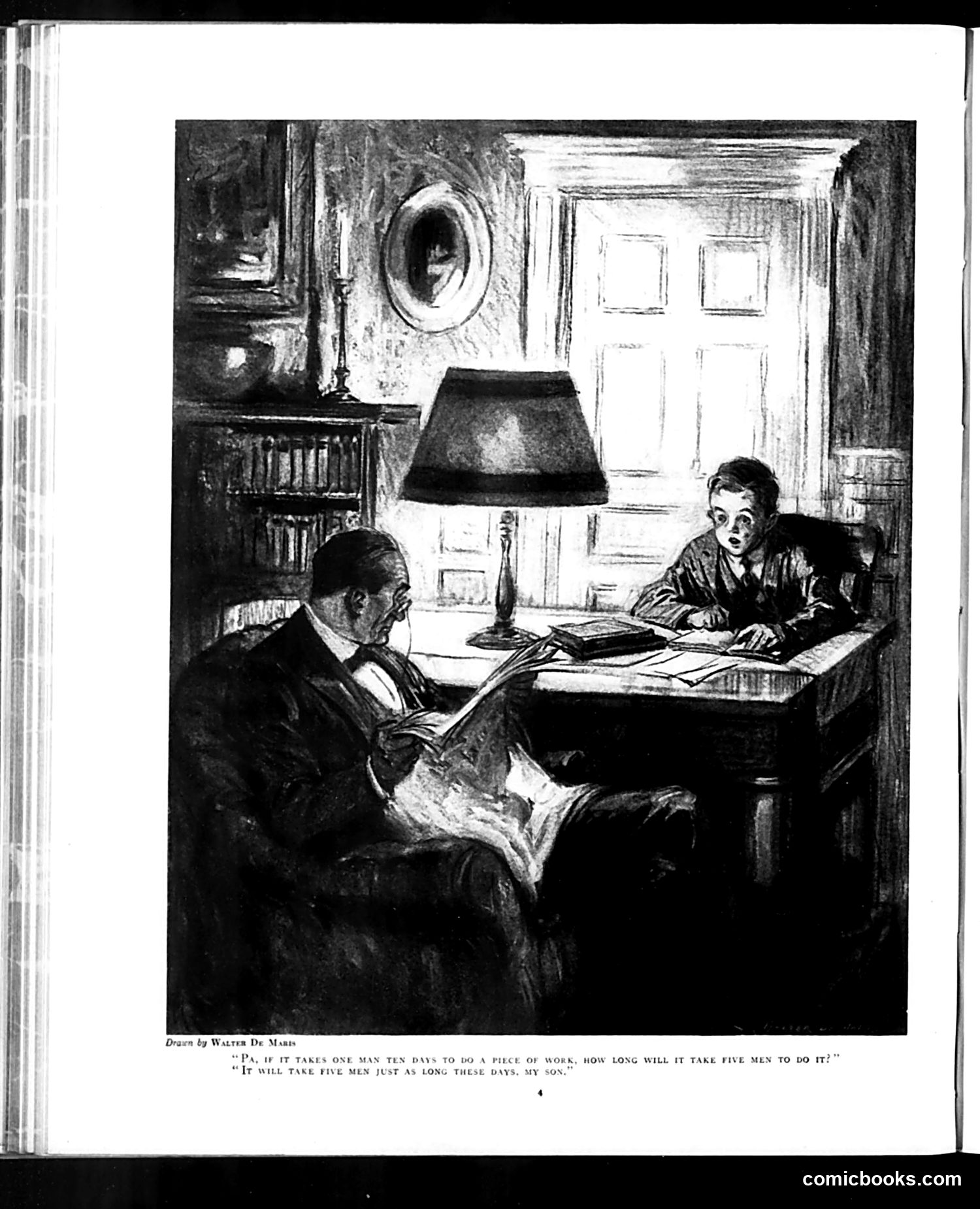
This illustration by Waiter De Maus depicts a domestic scene with a father and son at a desk. The caption presents a math problem about work productivity: "Pa, if it takes one man ten days to do a piece of work, how long will it take five men to do it?" The father responds, "It will take five men just as long these days, my son." The satire targets **labor inefficiency and worker productivity**, likely referencing early 20th-century concerns about workplace management. The joke suggests that having more workers doesn't actually speed up completion—a critique either of poor labor practices, worker laziness, or overstaffing. This reflects common period anxieties about industrial efficiency and the rational organization of work.
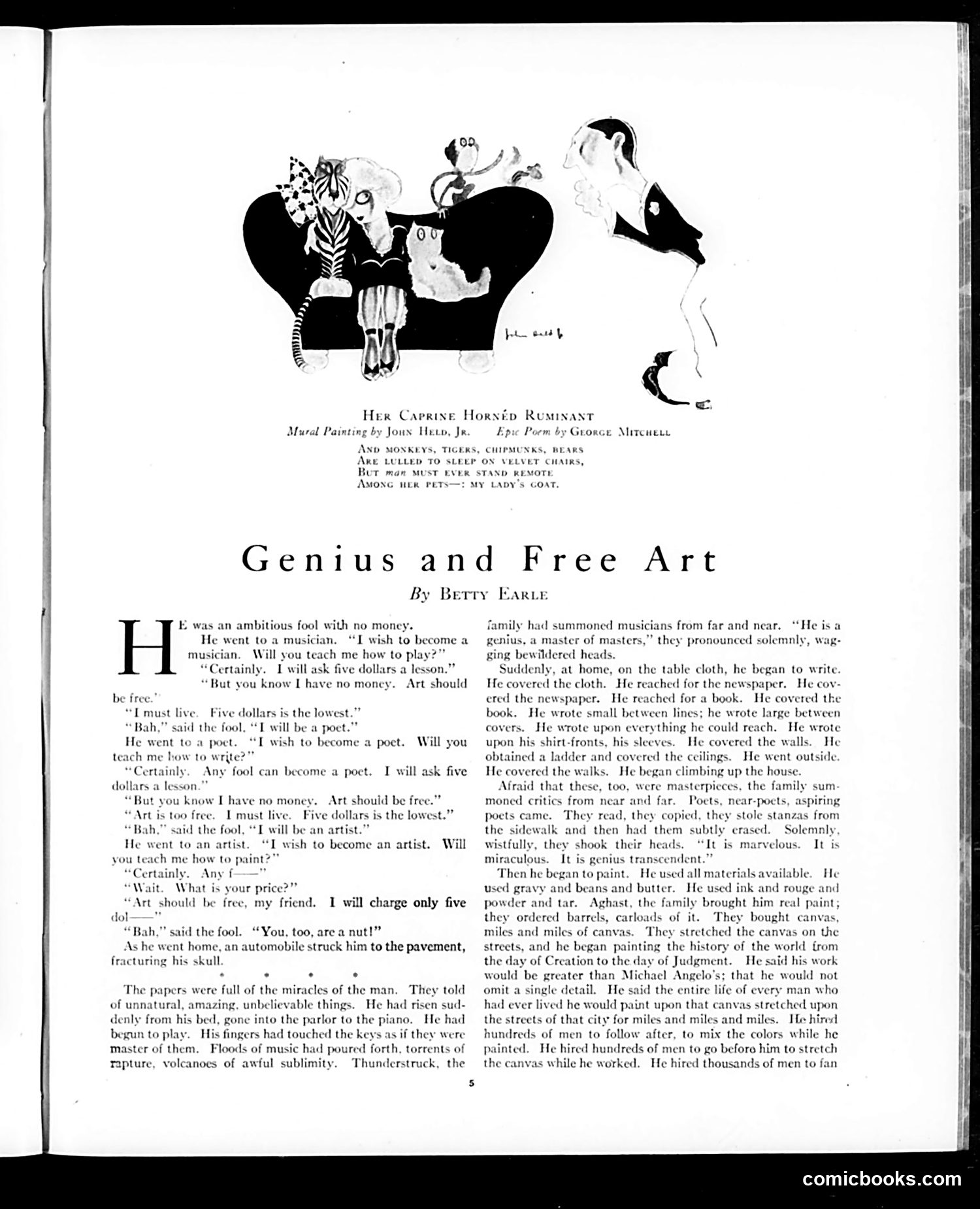
**The Cartoon:** "Her Caprine Horsed Ruminant" depicts a woman seated on an elaborate couch surrounded by exotic animals (monkeys, tigers, chipmunks, bears). A fashionably dressed man observes from the right. **The Satire:** This appears to mock wealthy women's excessive indulgence in exotic pet collections—a status symbol among the wealthy. The absurd menagerie suggests ridicule of conspicuous consumption and the impracticality of keeping wild animals as house pets. **"Genius and Free Art"** below is a separate humorous story about an impoverished but ambitious young man who refuses to pay for instruction, insisting "art should be free," then hires hundreds of workers and materials to create massive paintings—a comedic contradiction of his stated principles about cost. Both pieces satirize American attitudes toward wealth, ambition, and the arts.
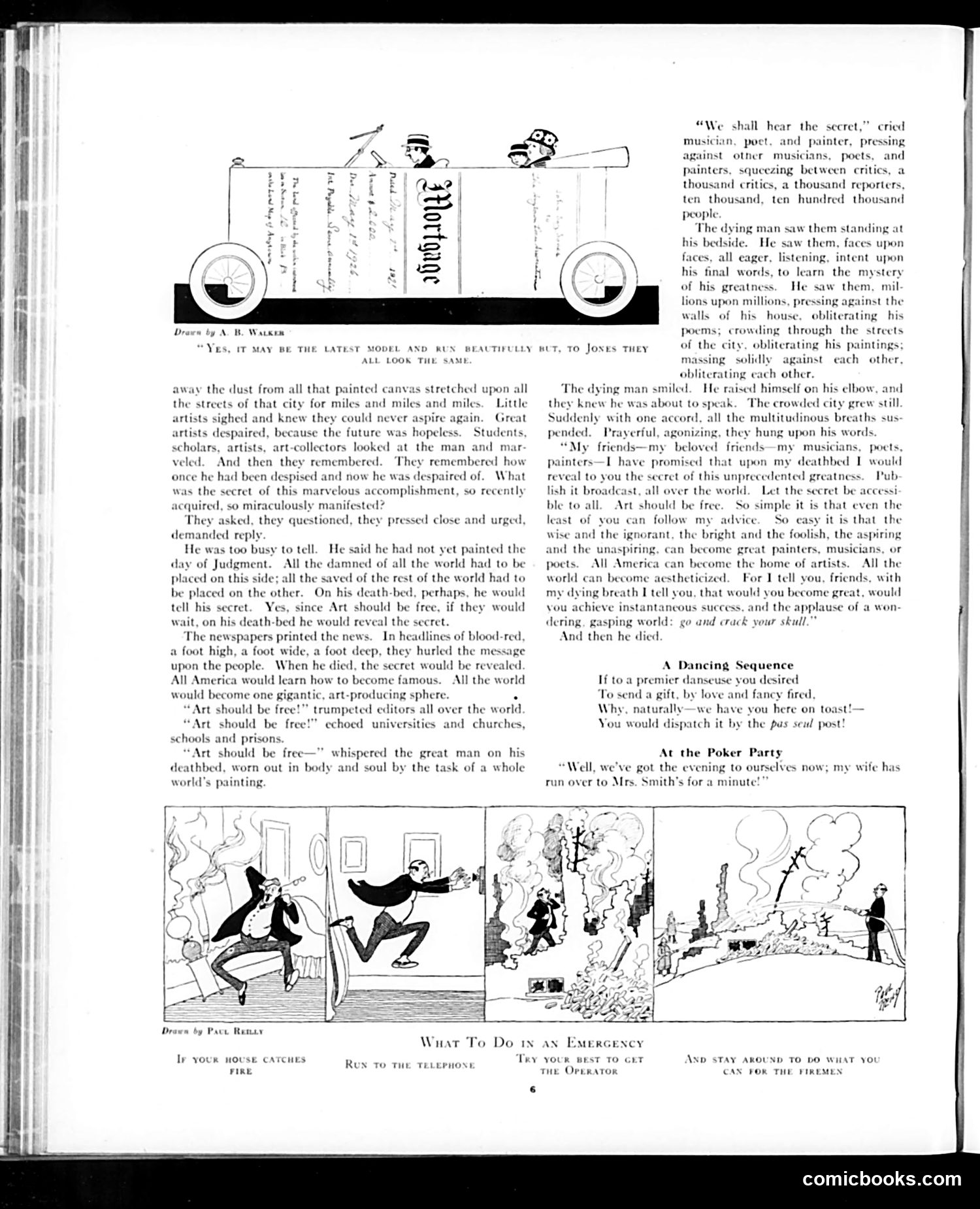
The top illustration, captioned "Yes, it may be the latest model and run beautifully but, to Jones they all look the same," satirizes wealthy industrialists' indifference to consumer goods despite their expense. The dying man's deathbed scene references a common narrative trope—the artist reveals his "secret" of greatness before death, proclaiming "Art should be free!" This critiques both the commercialization of art and the pretension of wealthy patrons. The lower section, "A Dancing Sequence" and "What to Do in an Emergency," are comic strips offering absurdist humor about social situations and fire safety—typical Judge filler content. The overall page satirizes class disparities, artistic patronage, and consumer culture in early 20th-century America, with particular focus on wealthy industrialists' disconnection from ordinary concerns.
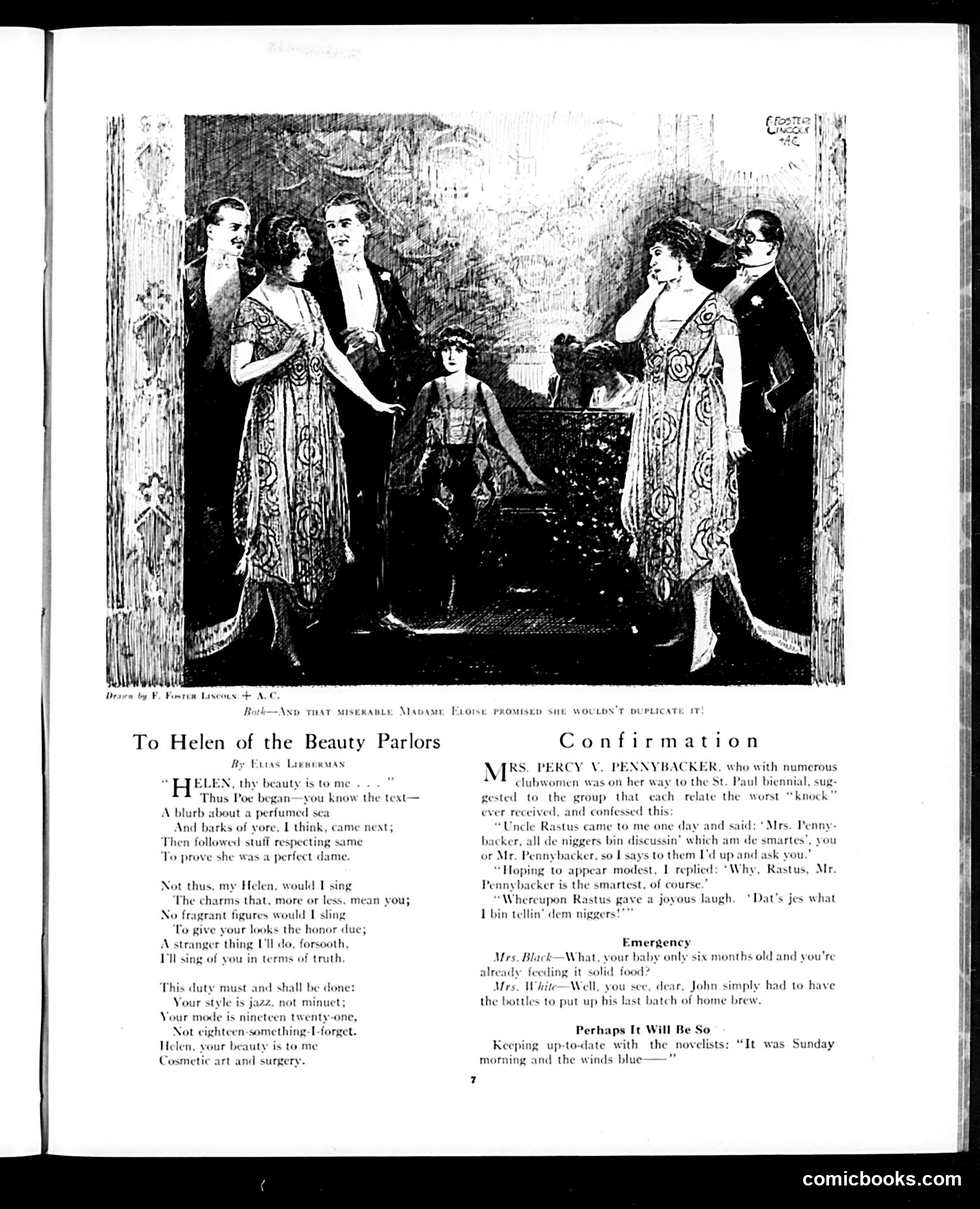
The page contains three separate satirical pieces: **"To Helen of the Beauty Parlors"** parodies Edgar Allan Poe's romantic poem "To Helen," contrasting Poe's idealized beauty with modern 1920s women who rely on cosmetic surgery and artificial enhancement rather than natural beauty. **"Confirmation"** mocks Mrs. Percy V. Pennybacker through a racist anecdote featuring offensive dialect. The "joke" hinges on a Black servant ("Uncle Rastus") supposedly asking Mrs. Pennybacker whether she or her husband is smarter—implying vanity undermines her modesty when she chooses herself. This reflects early 20th-century racist humor common in mainstream publications. **"Emergency"** and **"Perhaps It Will Be So"** are brief comic vignettes: one about feeding solid food to an infant (unclear context), the other mocking novelists' clichéd writing ("the winds blue"). The illustration depicts an elegant social scene, likely related to the beauty parlor satire. Overall, the page reflects period attitudes toward women's vanity, beauty standards, and deeply offensive racial stereotypes considered acceptable in 1920s satirical magazines.
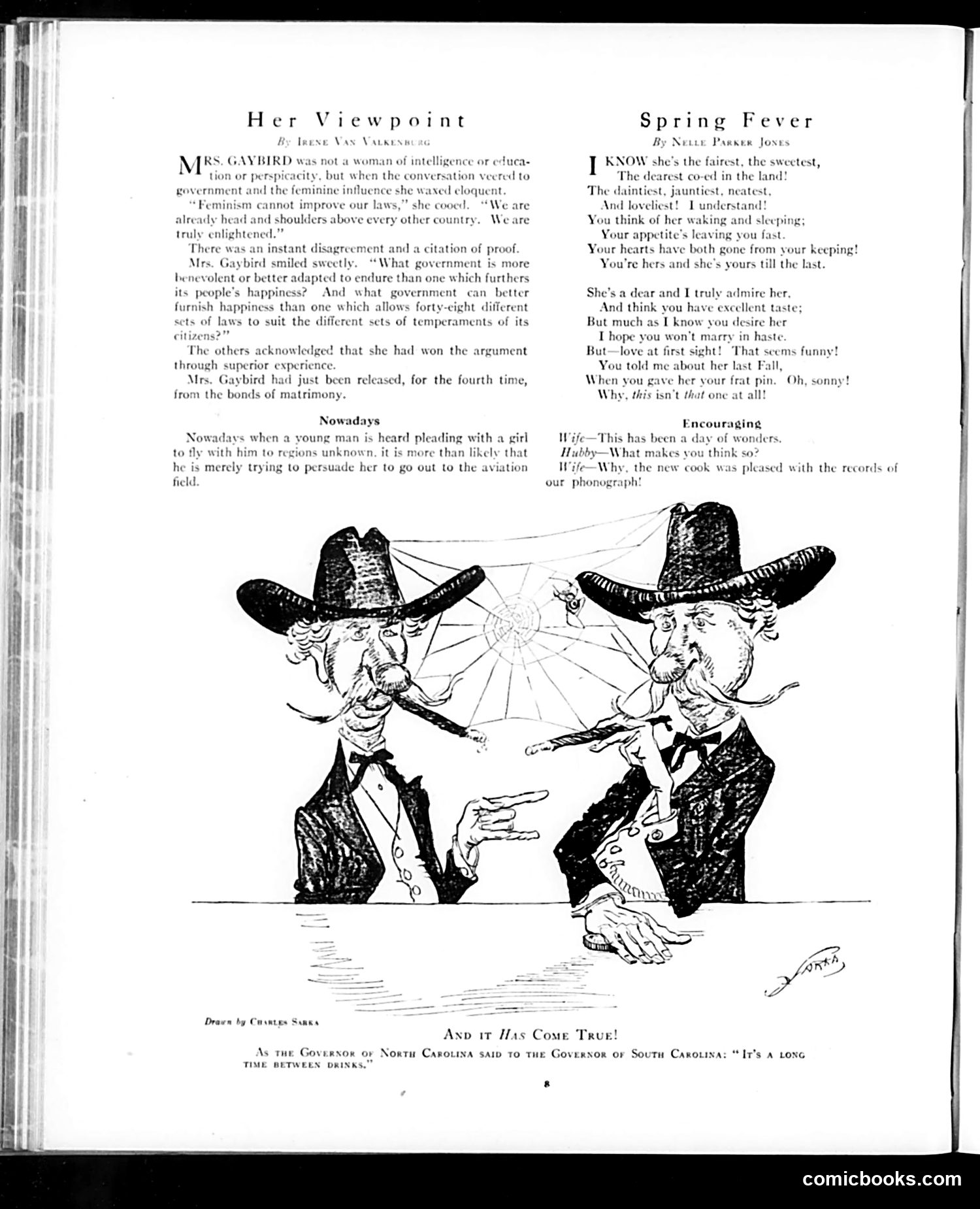
This page contains three separate satirical pieces mocking early 20th-century American social conventions. **"Her Viewpoint"** ridicules Mrs. Gaybird, a woman who argues American democracy is superior because it allows "forty-eight different sets of laws" (one per state)—yet she's been divorced four times, suggesting her confidence in the system is unearned and her judgment poor. **"Nowadays"** briefly satirizes young men using aviation as a pretext to court women, playing on contemporary anxieties about aviation as a daring, morally questionable activity. **"Spring Fever"** mocks a young man's romantic inconsistency: he's rhapsodizing about a new girl, but his father notes this is a *different* girl from the one he championed last fall. The humor depends on recognizing the fickle nature of youthful infatuation. The bottom cartoon (drawn by Charles Sarka) illustrates a joke about Southern hospitality—referencing the famous quote about time between drinks. The overall theme: satirizing American social hypocrisy and romantic/marital folly.
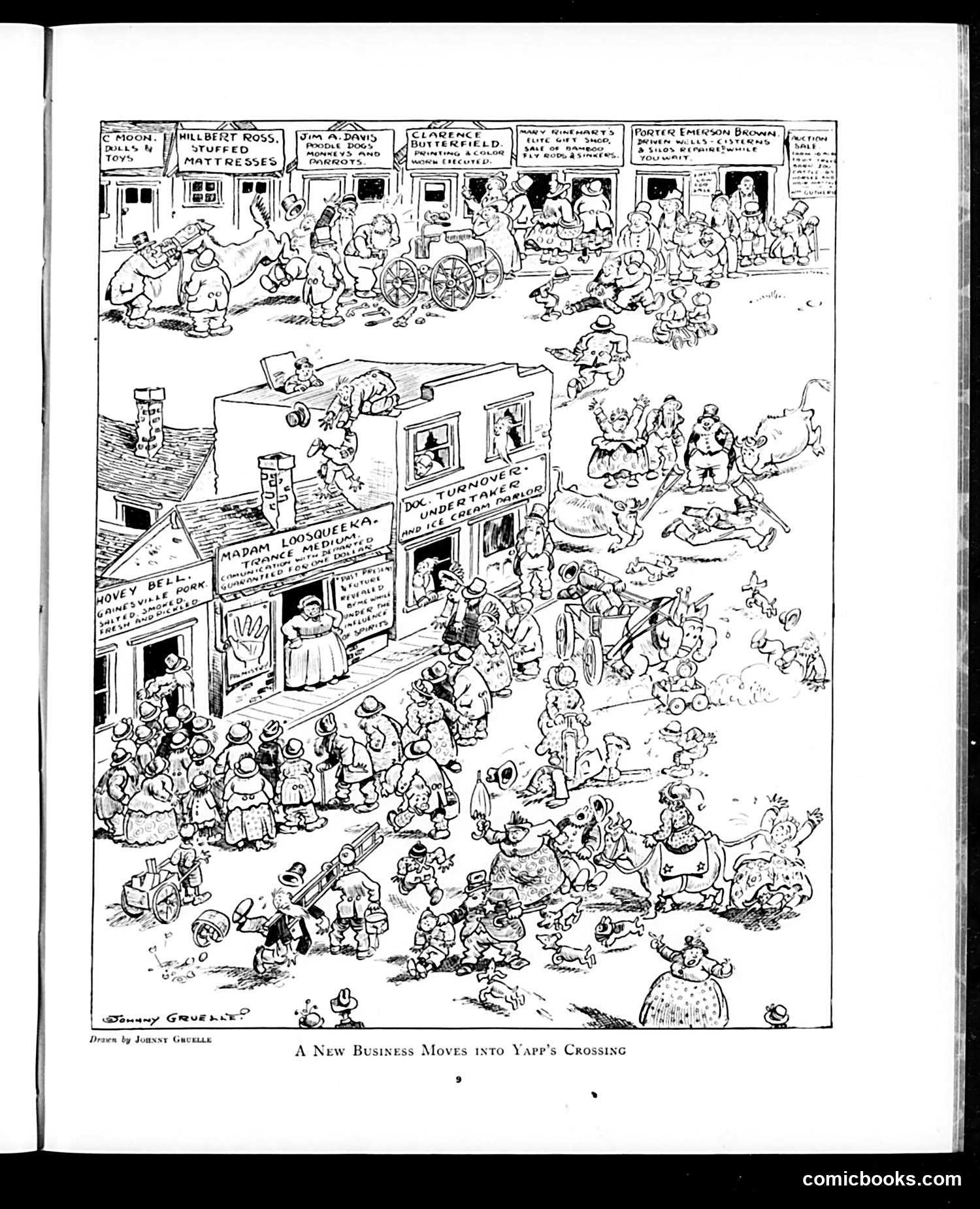
This is a satirical cartoon by Johnny Gruelle depicting the arrival of new commercial enterprises to a rural crossroads community. The upper panels advertise various businesses—stuffed mattresses, poodle dogs, a butterfield, and other establishments—suggesting rapid commercialization of previously quiet areas. The main illustration shows chaos as these new businesses arrive simultaneously, overwhelming the small village. Crowds swarm around competing vendors and their operations, creating disorder and congestion. The satire targets the disruption caused by uncontrolled commercial development in rural America—the clash between traditional small-town life and aggressive new business expansion. The cartoon mocks how such ventures descend upon quiet communities, transforming them into chaotic marketplaces while locals struggle to adapt to the sudden upheaval.
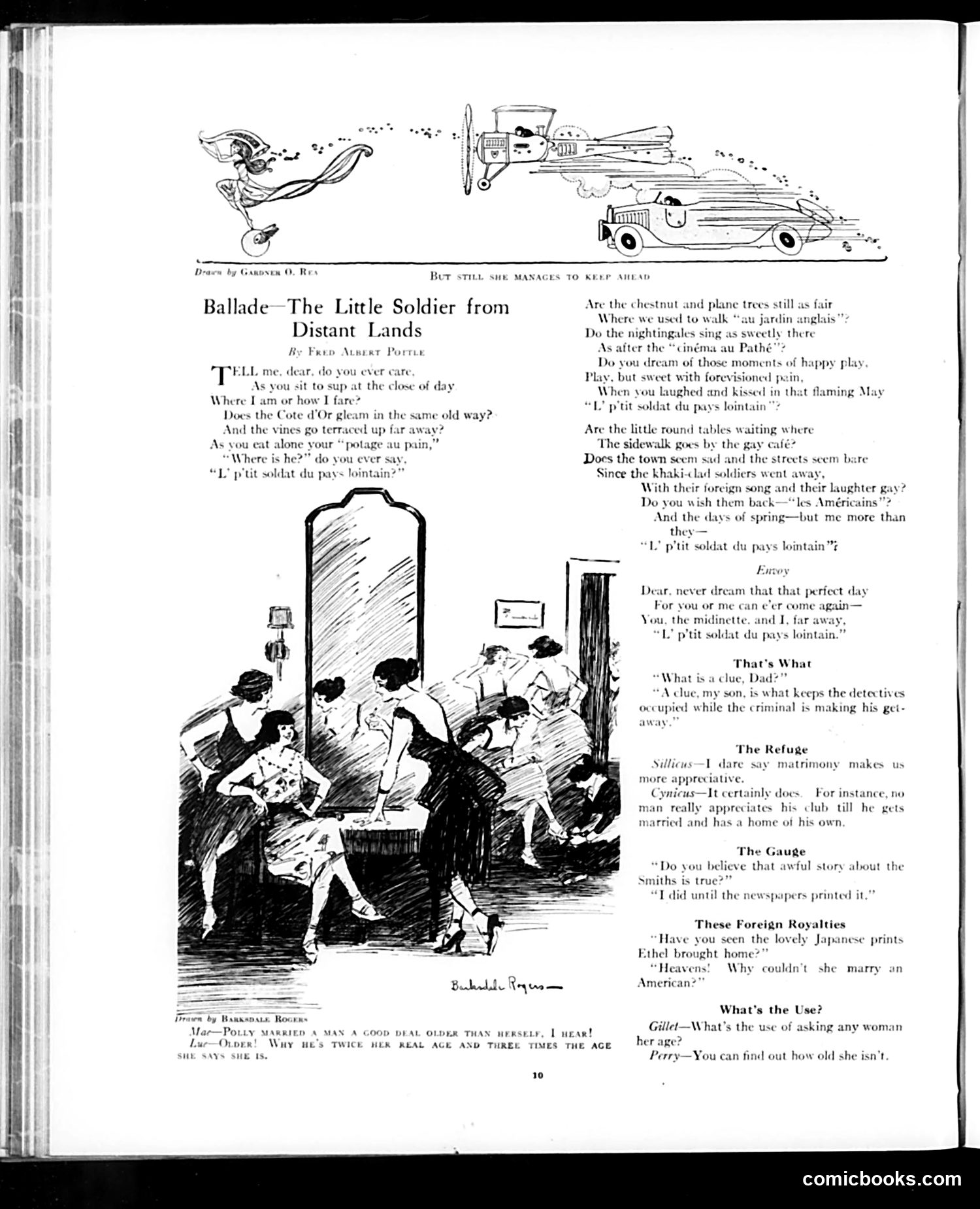
This page contains satirical poetry and humor pieces typical of early 20th-century American magazines. The main poem, "Ballade—The Little Soldier from Distant Lands," appears to reference American soldiers stationed abroad (likely WWI era, given references to "khaki-clad soldiers" and "les Américains"). The verses nostalgically address a French woman asking about her absent lover—a foreign soldier—while noting she now misses even the Americans who've departed. The repeated refrain "L' p'tit soldat du pays lointain" (the little soldier from a distant land) emphasizes this theme of wartime separation and romantic loss. The shorter humor pieces below—brief jokes about marriage, detectives, Japanese prints, and women's ages—represent typical magazine filler content mocking contemporary social conventions and gender dynamics. The illustration shows period figures in casual poses, consistent with the nostalgic, romantic tone of the poetry.
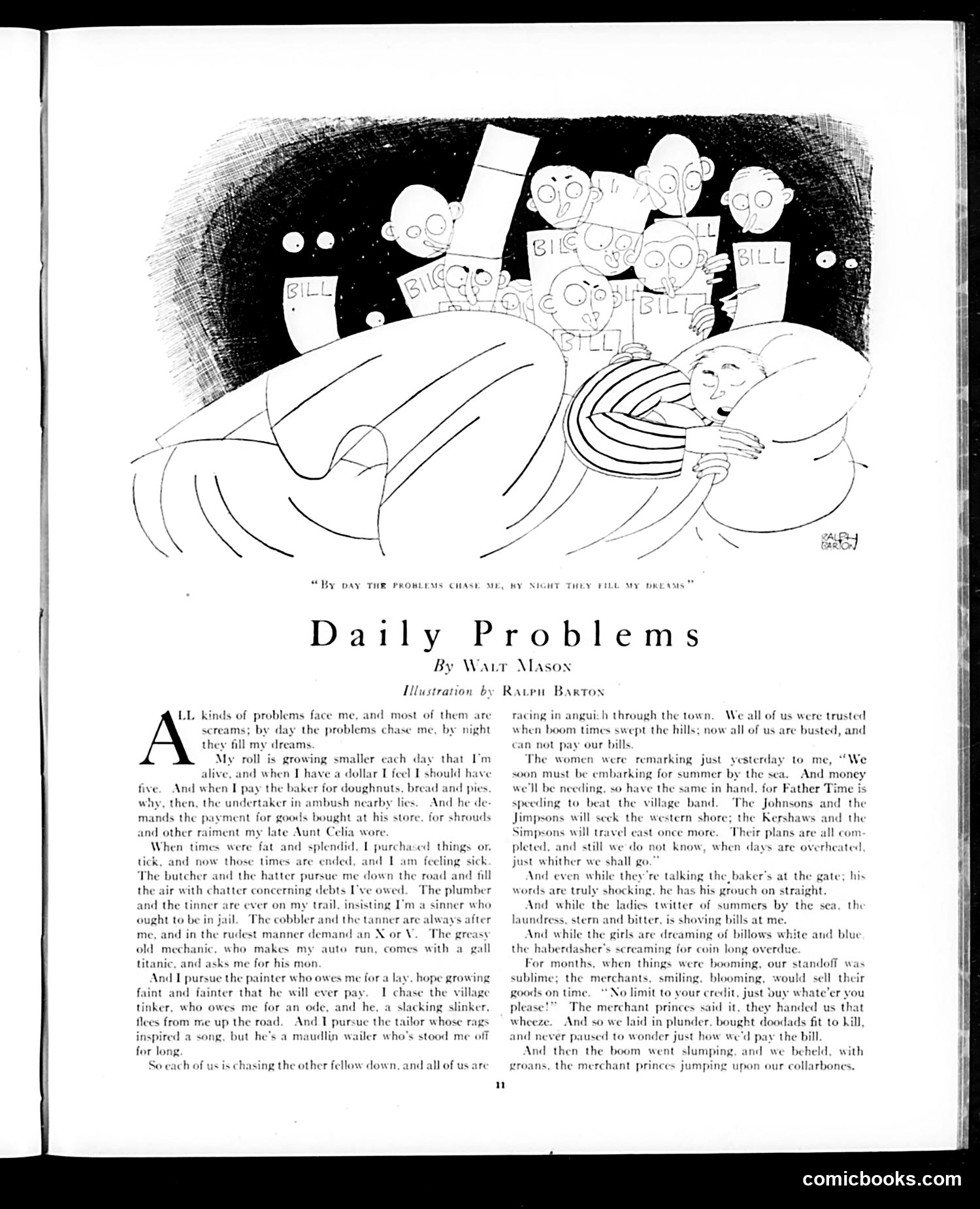
This is a satirical piece about the post-boom economic collapse, likely from the 1920s recession or early Depression era. The illustration shows a man in bed surrounded by creditors' faces emerging from darkness, labeled "BILL"—a visual metaphor for debt haunting him day and night. The text's narrator describes a cascading financial nightmare: during prosperous times, merchants freely extended credit ("No limit to your credit"). Now that "the boom went slumping," he's simultaneously chased by multiple creditors—baker, butcher, plumber, tailor, mechanic—all demanding payment. The irony is that he, in turn, chases others who owe him money (a painter, tinker). The satire targets both the recklessness of easy credit during boom times and the brutal consequences of economic collapse. It captures a common experience: an entire interconnected community trapped in a chain of unpaid debts with no escape, where everyone is simultaneously creditor and debtor. The piece critiques the merchant class for enabling unsustainable consumption.
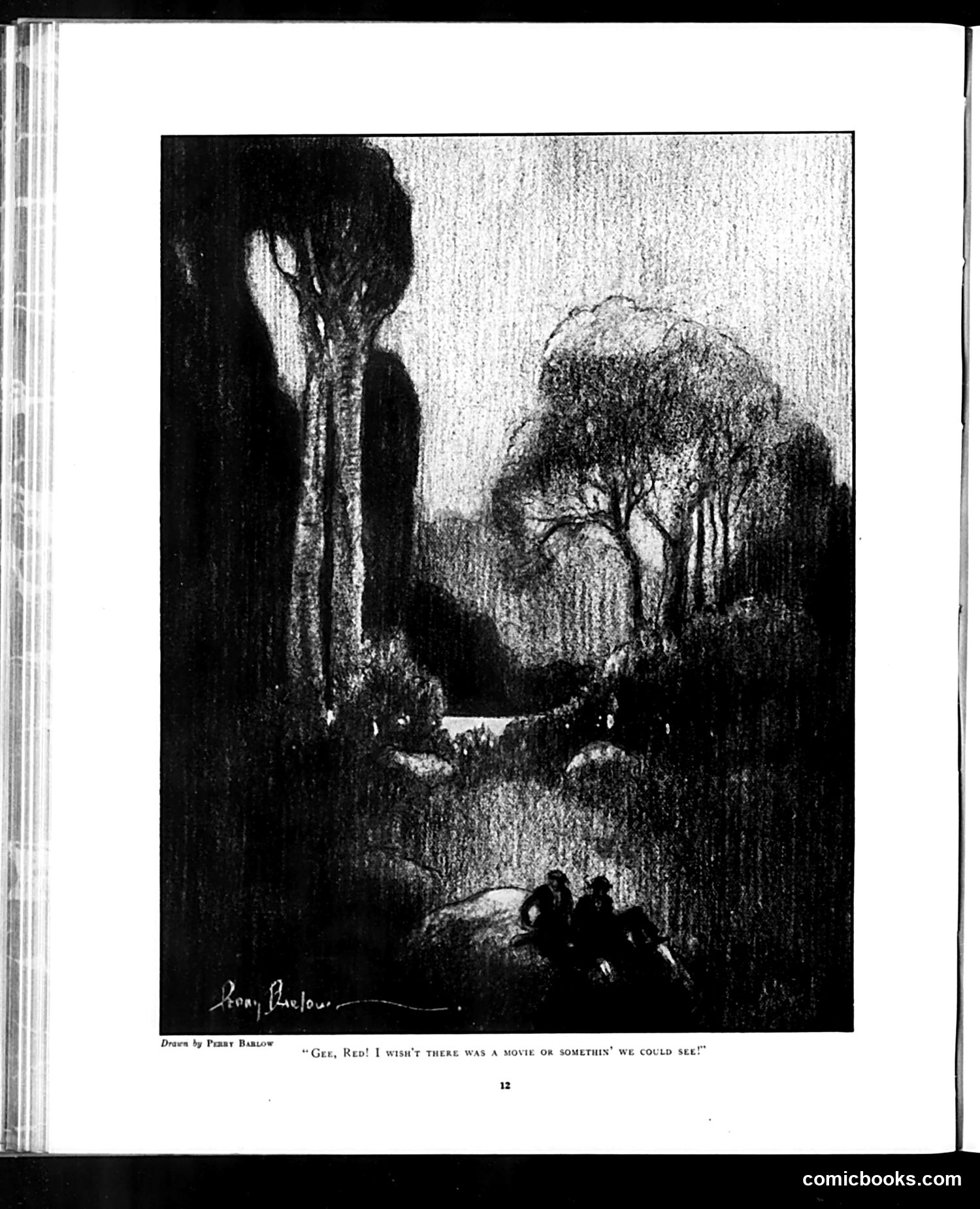
This cartoon by Penny Barlow depicts two figures in a dark, atmospheric landscape with tall trees and what appears to be a moonlit or stormy sky. One figure says to another (addressed as "Red"): "Gee, Red! I wish there was a movie or somethin' we could see!" The satire appears to critique the limited entertainment options available, likely during a specific era when movies were becoming popular but weren't universally accessible. The rural or isolated setting suggests the complaint is about lack of cultural amenities in certain areas. The melancholic, somewhat Gothic visual style reinforces the sense of isolation and boredom the characters experience. Without knowing the exact publication date, the precise historical context remains unclear, though it likely comments on entertainment disparities between urban and rural America.
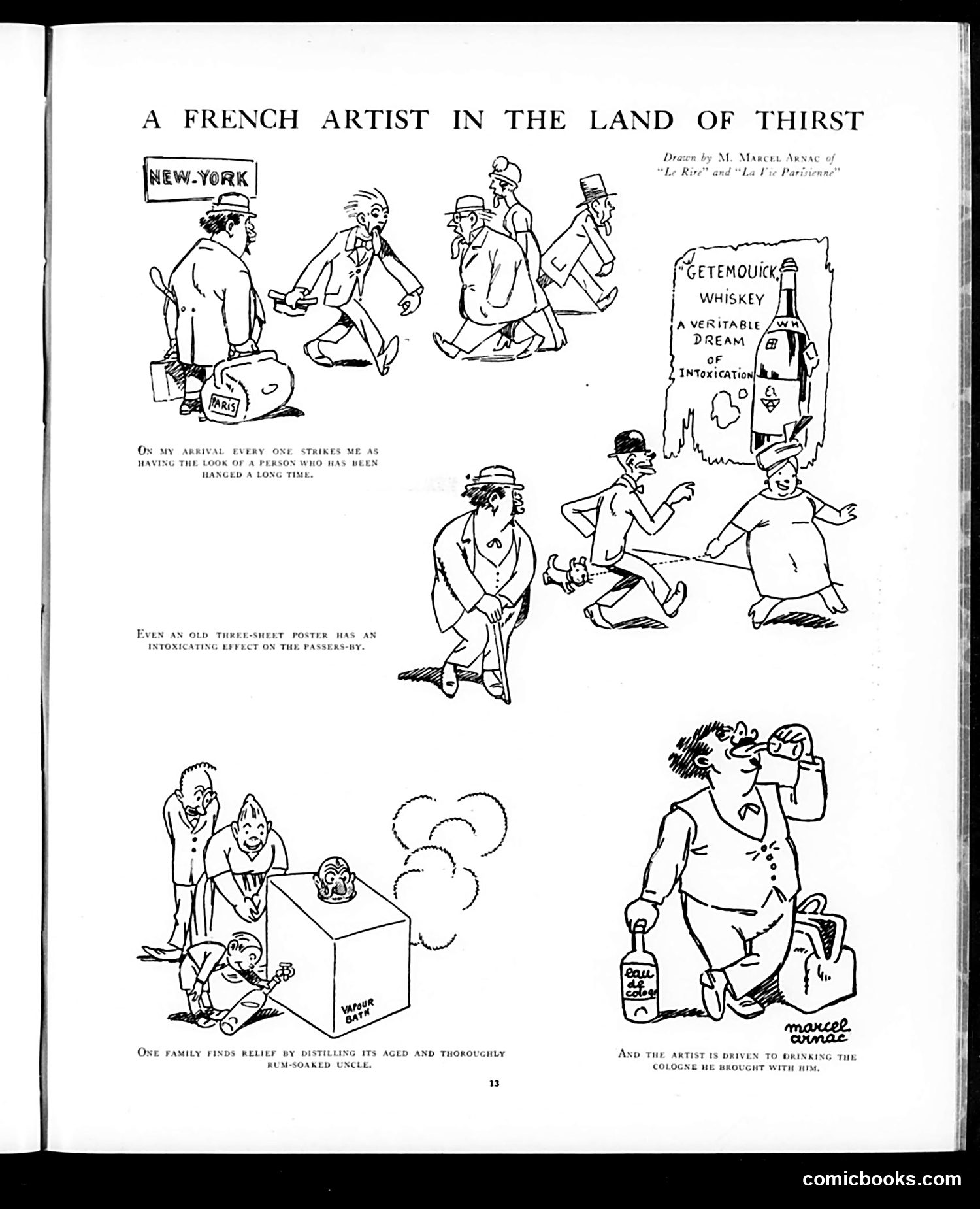
This satirical cartoon by M. Marcel Arnac mocks Prohibition-era America through the eyes of a visiting French artist. The title "Land of Thirst" references the alcohol ban then in effect. The narrative follows the Frenchman's bewildered observations: Americans appear gaunt and desperate ("every one strikes me as having the look of a person who has been hanged a long time"). He encounters wild behavior—people distilling homemade spirits, a family making bootleg liquor from an "Uncle," and citizens desperately seeking alcohol. The final panel shows him driven to drink the cologne he brought, suggesting American Prohibition has made even this unthinkable. The satire targets Prohibition's failure and the resulting social chaos, presenting American society as absurdly desperate compared to France's wine culture. The exaggerated caricatures emphasize the cartoon's mocking European perspective on American moral legislation.
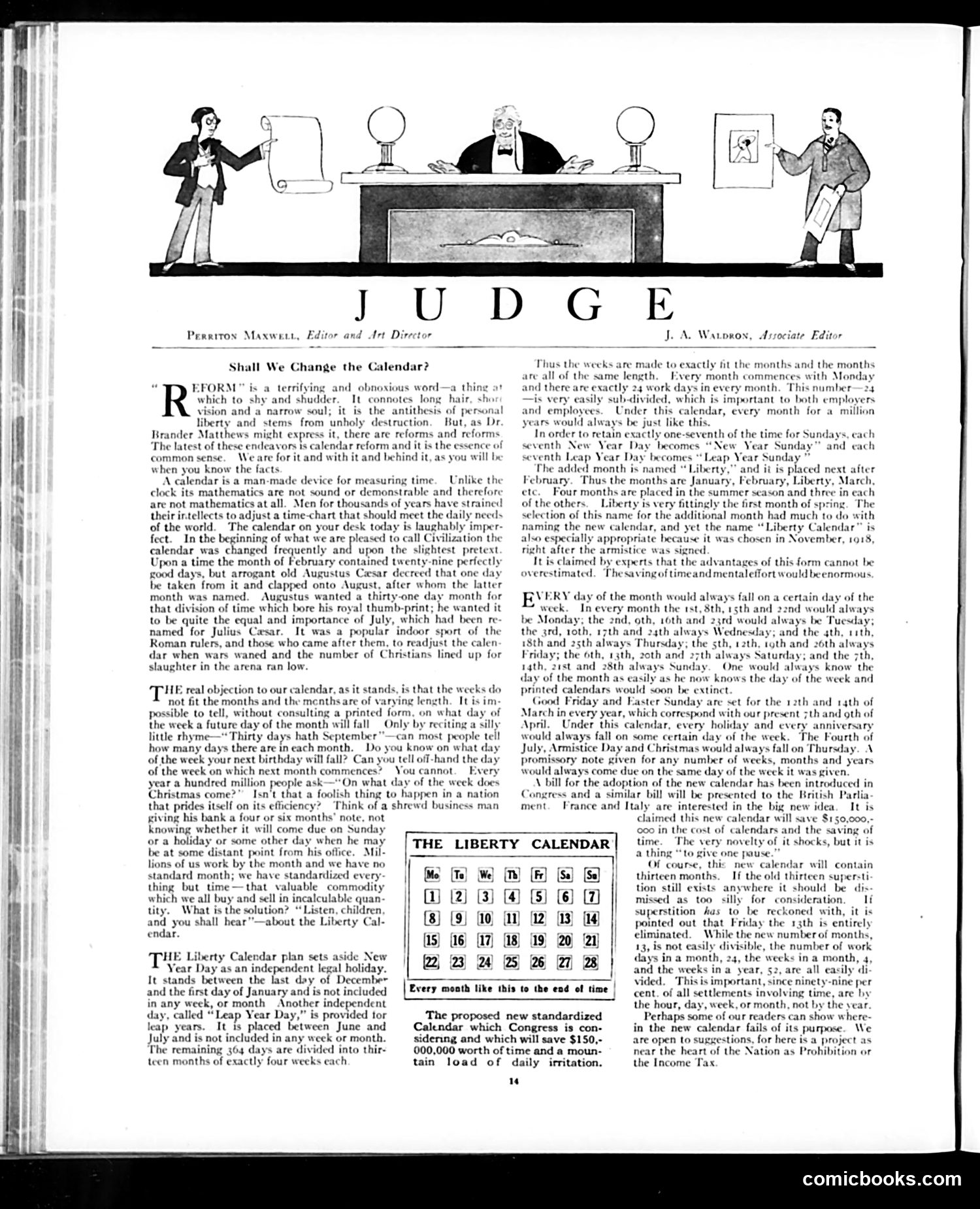
This editorial cartoon advocates for calendar reform—specifically, the "Liberty Calendar" proposal discussed in Congress around 1918-1919. The judge figure presides over the debate, flanked by two men presenting arguments. The text argues the current Gregorian calendar is mathematically flawed: months vary in length, weeks don't align consistently with months, and people can't easily calculate what day of the week future dates fall on. The reform proposes standardizing all months to 28 days (four equal weeks), eliminating the calendar calculation problem entirely. The new calendar would add a 13th month called "Liberty" (placed after February), chosen because the reform was adopted shortly after the 1918 Armistice. The proposal claimed to save $150,000,000 in time-related inefficiencies. While framed as rational modernization, this was actually controversial ecclesiastical and commercial territory. The cartoon's title "Judge" (the magistrate figure) lends authority to what was essentially speculative reform advocacy during the post-WWI optimism era.
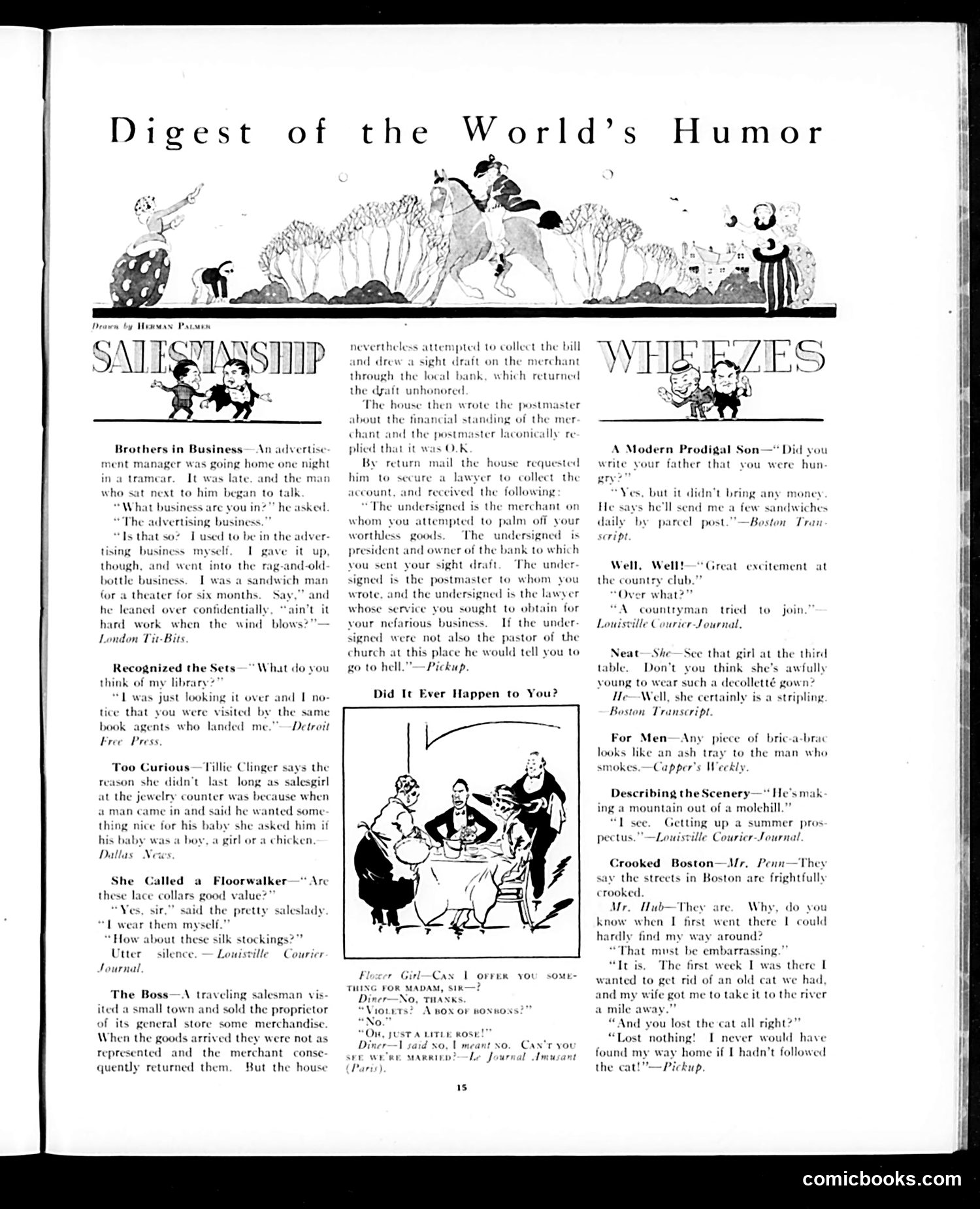
This page from *Judge* (a major American satirical magazine) collects brief humor pieces—short jokes and anecdotes rather than political cartoons. The content satirizes early 20th-century American business culture and social manners. **Key targets of satire:** - **Advertising/salesmen**: Multiple jokes mock advertising professionals and door-to-door salesmen as shifty or delusional (the "sandwich man" claiming advertising was hard work) - **Consumer culture**: A jewelry salesgirl asks if a baby is a "girl or chicken," mocking wealthy customers' pretensions - **Small-town dysfunction**: The final story's traveling salesman encounters a small-town banker who is simultaneously merchant, postmaster, lawyer, and pastor—satirizing rural America's lack of professional specialization - **Gender dynamics**: A woman asks about "decolletté" fashion; another asks for a lawyer husband's approval **The humor relies on:** - Incongruity and wordplay - Class observations (wealth, business failure, rural vs. urban) - Professional absurdity No specific political figures or dated events appear visible. This represents *Judge*'s typical content: social observation humor targeting American business practices and middle-class pretensions.
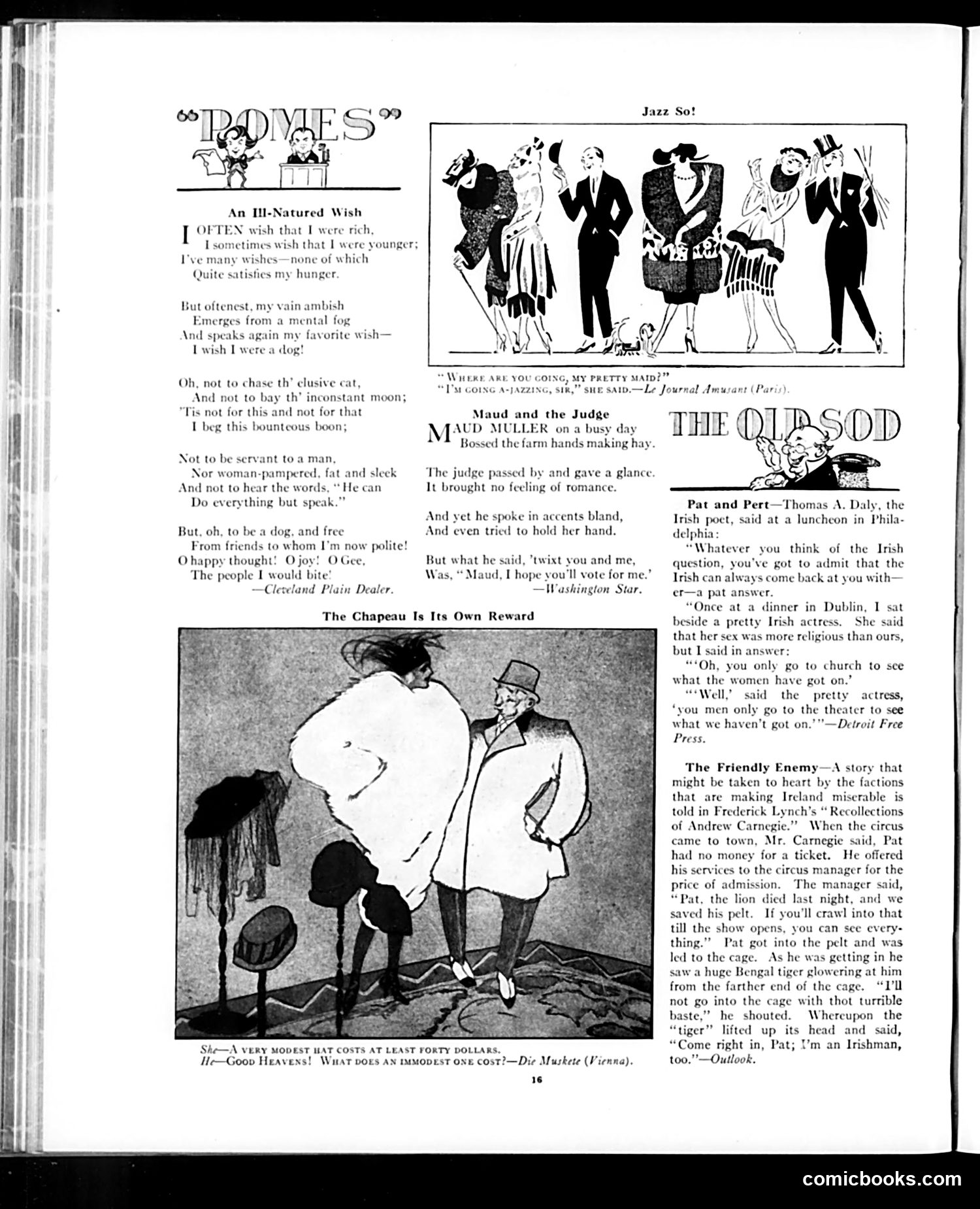
This page contains several humor pieces typical of early 20th-century American satire: **"An Ill-Natured Wish"** — A poem expressing the desire to be a dog, specifically to escape social obligations and bite annoying acquaintances. The joke satirizes civilized restraint and social hypocrisy. **"Jazz So!"** — A cartoon showing flapper-era women in fashionable dress. The caption references "jazzing" (dancing to jazz music), mocking the emerging jazz age and modern youth culture as frivolous. **"Maud and the Judge"** — A brief anecdote where a judge tries courting a farm girl romantically, but his actual request is for her vote, satirizing politicians' self-interested flattery during election season. **"The Chapeau Is Its Own Reward"** — A cartoon about expensive hats. The joke plays on the idea that an immodest/revealing hat might cost even more than a modest one—satirizing women's fashion spending habits. **"Pat and Pert"** and **"The Friendly Enemy"** — Irish-themed humor pieces featuring wordplay and stereotypical Irish characters, popular in period American magazines.
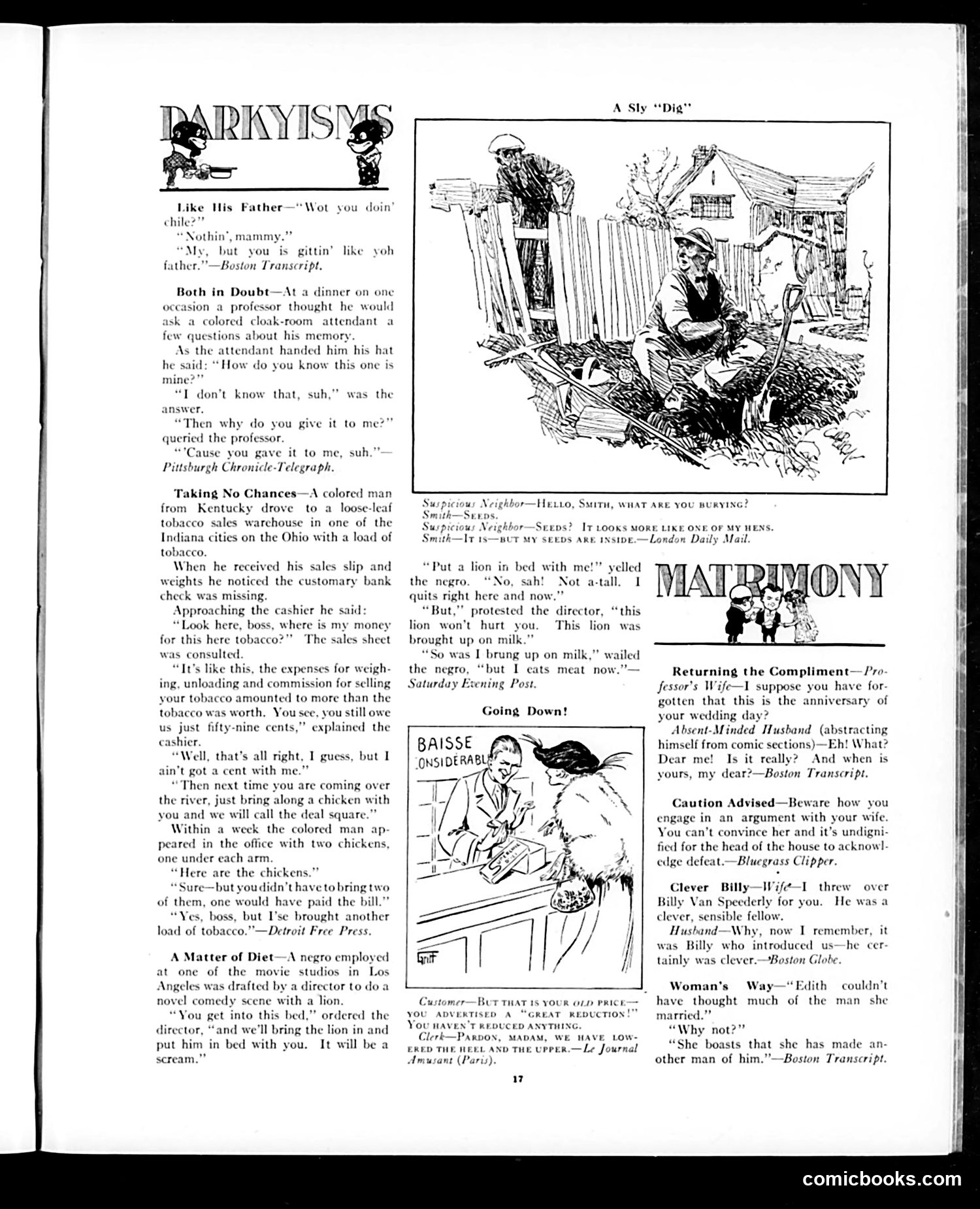
This page from *Judge* magazine contains racist humor stereotyping Black Americans, typical of early 20th-century satirical publications. The sketches use exaggerated dialect and depict Black characters in subservient or comedic situations: **"Like His Father"** mocks a Black child's dialect and behavior. **"Both in Doubt"** presents a cloak-room attendant unable to identify a hat—playing on racist stereotypes about Black intelligence. **"Taking No Chances"** shows a tobacco salesman from Kentucky and a cashier; the humor derives from the character's poor understanding of business transactions and subsequent payment in chickens rather than currency. **"A Matter of Diet"** depicts a Black movie extra refusing to share a bed with a lion, with the punchline mocking his claimed preference for meat over milk—crude racial caricature humor. The remaining content includes unrelated marriage and domestic humor. The entire "Darkyisms" section exemplifies the casual, normalized racism in American entertainment of this era, presenting dehumanizing stereotypes as comedy.
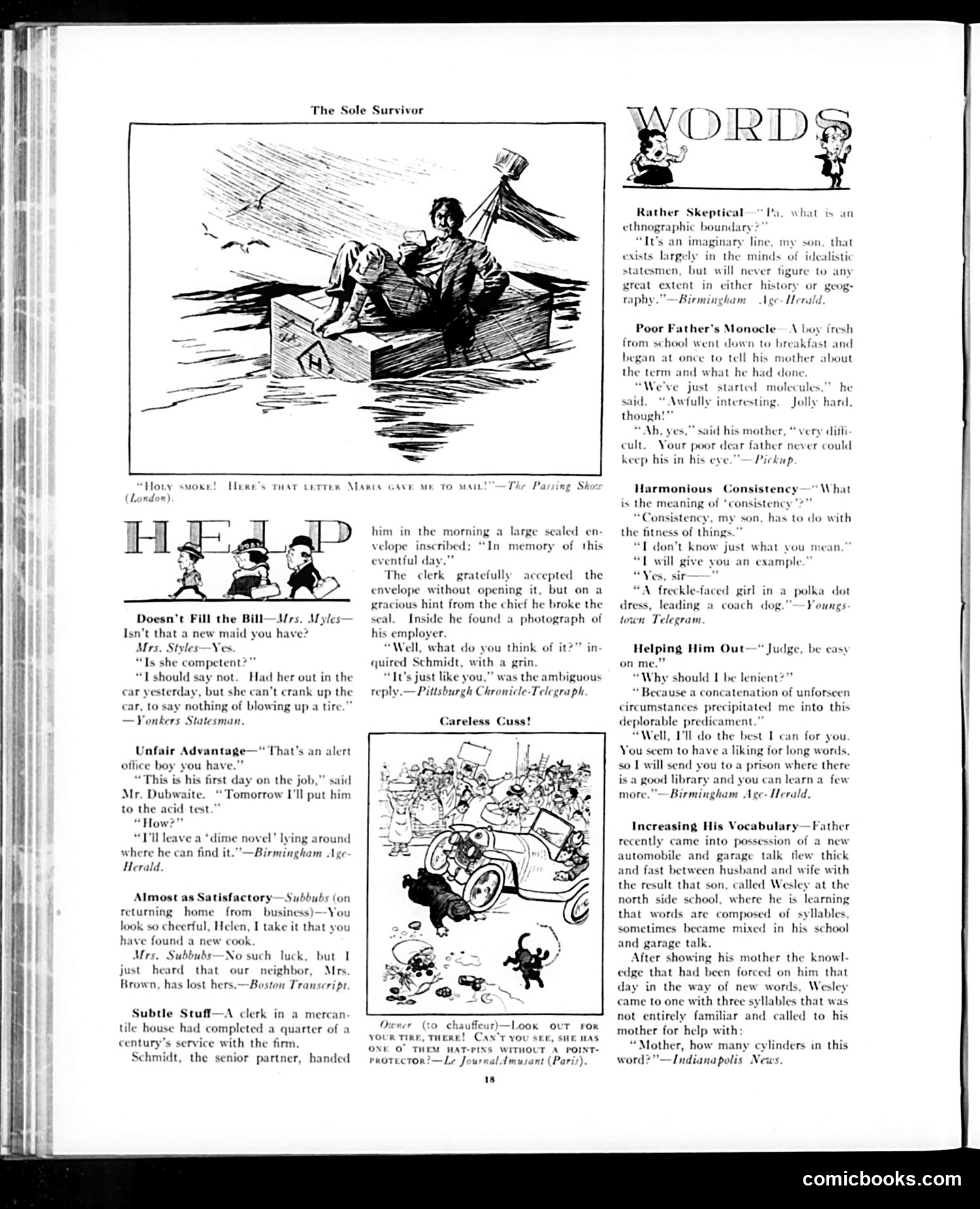
This page from *Judge* magazine presents early 20th-century domestic humor sketches. The title cartoon depicts a man and woman in a sinking boat—appearing to be "the sole survivor" of a shipwreck or disaster, a dark joke about marriage survival. The surrounding anecdotes satirize contemporary American life: incompetent servants, office hierarchies, marital dynamics, and social pretension. One joke mocks a 25-year employee receiving only his boss's photograph as a reward. Another plays on a schoolboy confusing scientific terminology ("molecules" and "monocle"). The final piece, "Increasing His Vocabulary," humorously depicts a child mixing automotive jargon with formal speech, asking his mother how many "cylinders" are in a word—reflecting early automobile culture's invasion of household language. The humor relies on class observations, linguistic confusion, and the gap between Victorian propriety and modern commercial life. These are gentle, domestic satires typical of *Judge*'s middle-class audience.
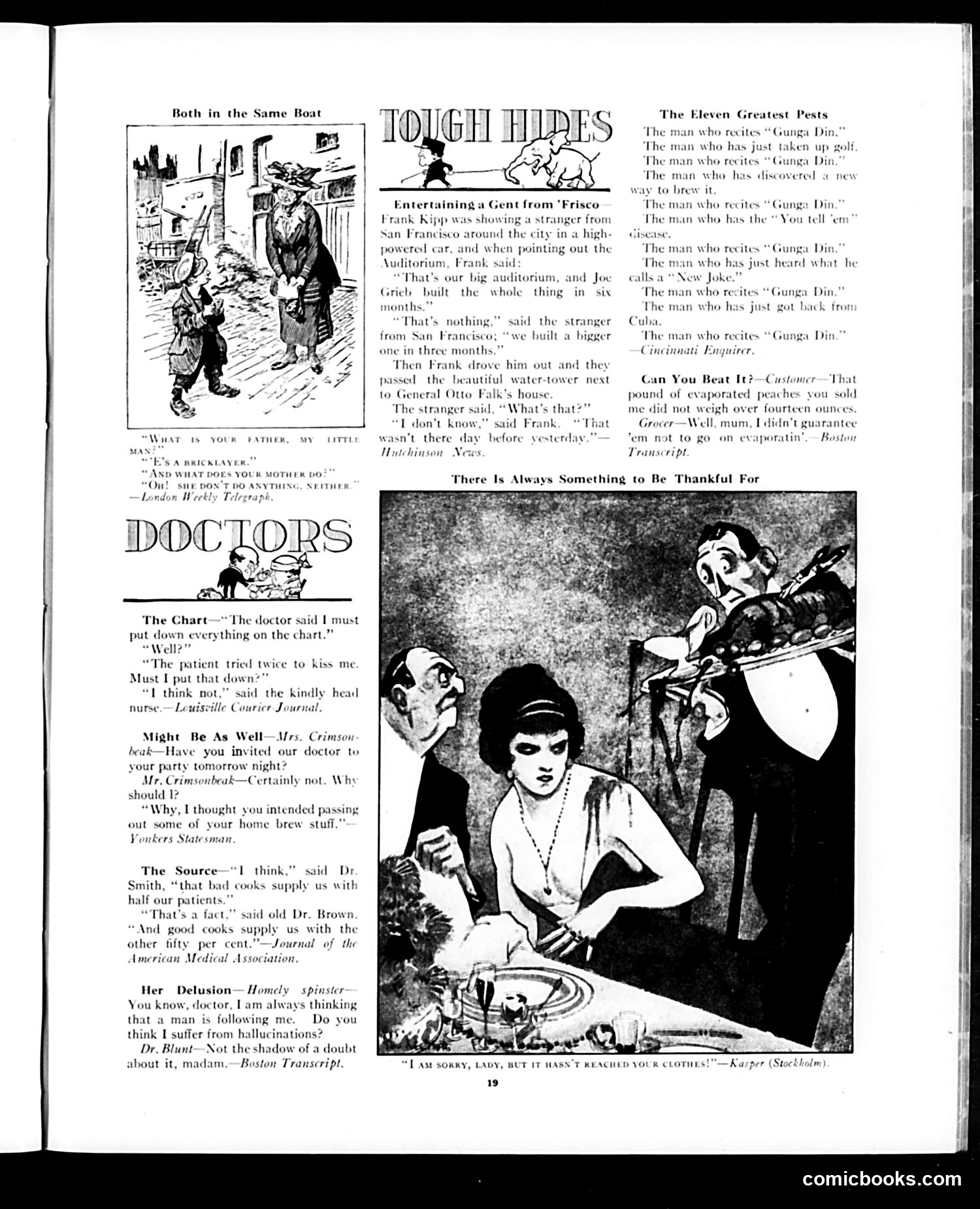
This page contains several brief humorous anecdotes typical of early 20th-century satirical magazines: **"Both in the Same Boat"** jokes about class: a bricklayer's child reports both parents are unemployed—a Depression-era social commentary. **"The Eleven Greatest Pests"** is a recurring complaint list mocking people who constantly recite Kipling's "Gunga Din" (then wildly popular), those taking up golf as a fad, and people bragging about Cuba—likely post-Spanish American War tourism. **"Doctors" section** contains gentle workplace humor about medical charts, home-brewed alcohol (Prohibition-era reference in the "home brew" joke), and a quip about homely women's delusions—offensive by modern standards. **The large illustration** shows a film or theater production scene with dramatic lighting, captioned about clothes not reaching someone—appears to be a movie still or theatrical comedy moment rather than political satire. The page emphasizes contemporary fads, employment anxiety, and Prohibition-era references typical of Judge's 1920s content.
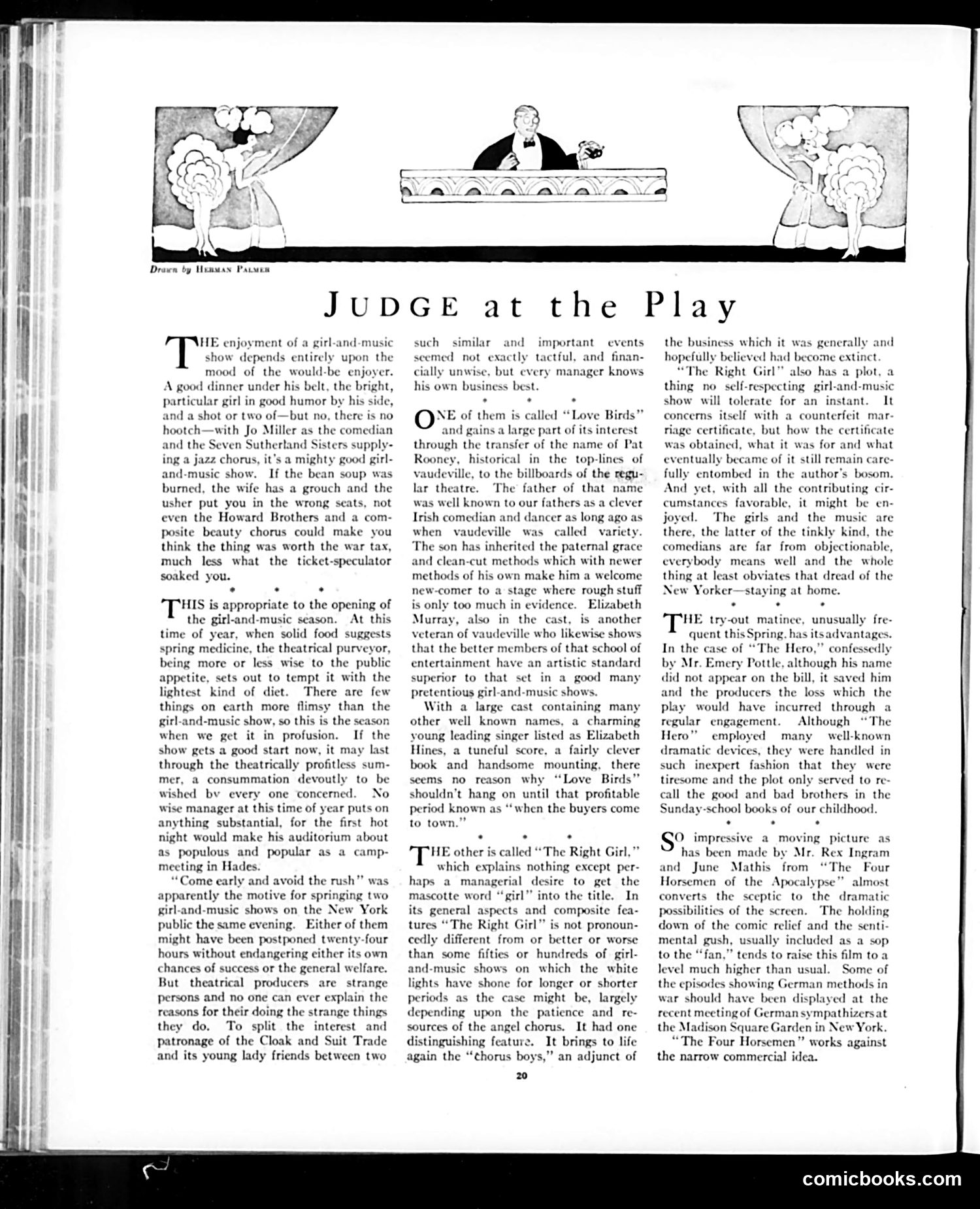
This is a theater review article, not a political cartoon. The decorative header illustration shows a judge overseeing two showgirls—a visual pun on "Judge at the Play." The article critiques two girl-and-music shows opening simultaneously on Broadway. It praises "Love Birds," which benefits from the famous Rooney name (Pat Rooney, descended from vaudeville performers) and features Elizabeth Murray and Elizabeth Hines. The writer considers it well-constructed with superior entertainment standards. The other show, "The Right Girl," receives dismissive treatment—the critic can't explain what makes it distinctive and compares it unfavorably to countless similar productions. The satire targets theatrical producers' illogical business decisions: opening competing shows the same night splits audiences unnecessarily. The broader point critiques lightweight "girl-and-music" shows as seasonal filler entertainment, dependent entirely on audience mood and conditions rather than artistic merit.
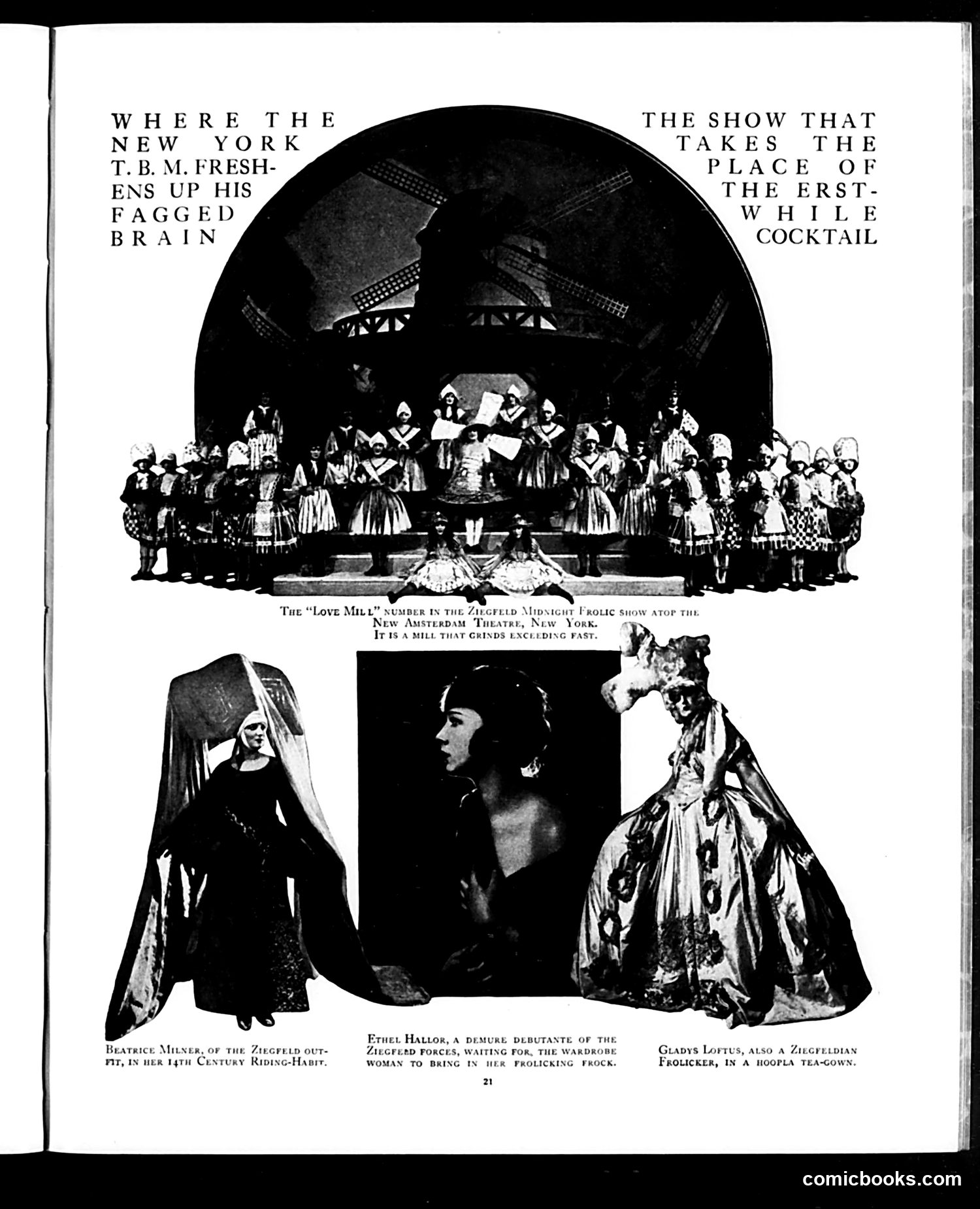
This page satirizes the "Ziegfeld Follies," the famous Broadway revue known for elaborate staging and scantily-clad chorus girls. The headline mocks New York's T.B. Martin (a theater figure) as intellectually "fagged" (exhausted), suggesting the Follies replace serious culture with frivolous entertainment—here replacing the cocktail hour rather than a proper show. The three costume portraits below ridicule the Follies' performers and pretensions. The captions identify them as "Ziegfeld out-fit" dancers in absurdly ornate historical costumes (14th-century riding habit, elaborate tea gown). The satire suggests these showgirls are merely costumed spectacles, not serious performers, and that the Follies represent mindless, garish entertainment for the leisure class—a commentary on Jazz Age excess and the perceived decline of theatrical sophistication.
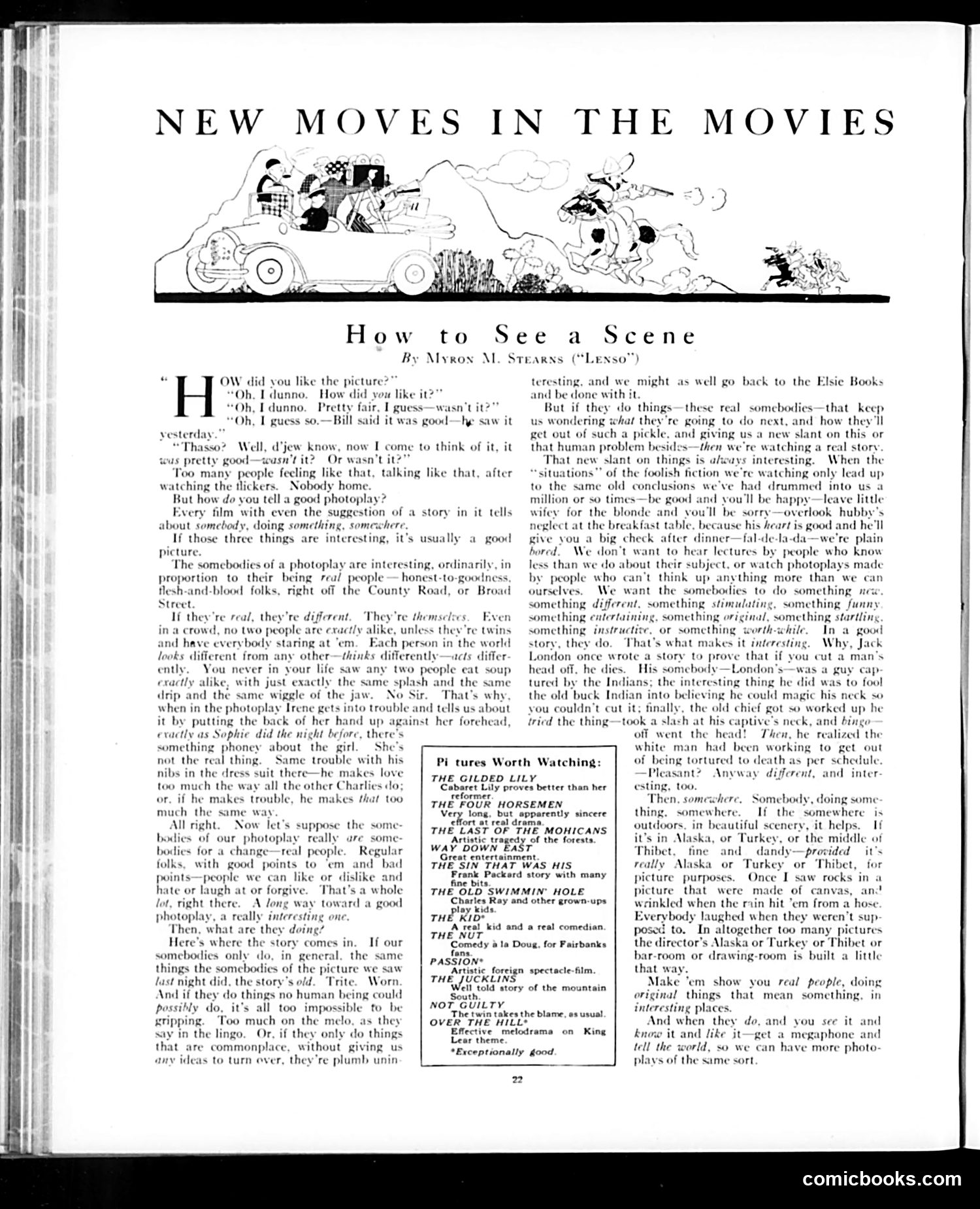
This is a film criticism essay by Myron M. Stearns ("Lenso"), not primarily satire or political commentary. The author critiques moviegoers' passive consumption of films, using a dialogue showing people who can't articulate why they liked (or didn't like) a picture. Stearns argues that quality photoplays require **real characters** behaving authentically—people with distinct personalities and flaws, not stock types or impossibly heroic figures. The essay mocks melodramatic clichés ("leave little wifey for the blonde and you'll be sorry") and demands stories that offer **new perspectives on human problems** rather than recycled morality. The accompanying illustration shows chaotic moviegoing scenes—audiences in cars and crowds, emphasizing the casual, thoughtless nature of film consumption Stearns critiques. The page concludes with "Pictures Worth Watching," listing films like *The Gilded Lily* and *The Four Horsemen*, suggesting better alternatives to mindless entertainment.
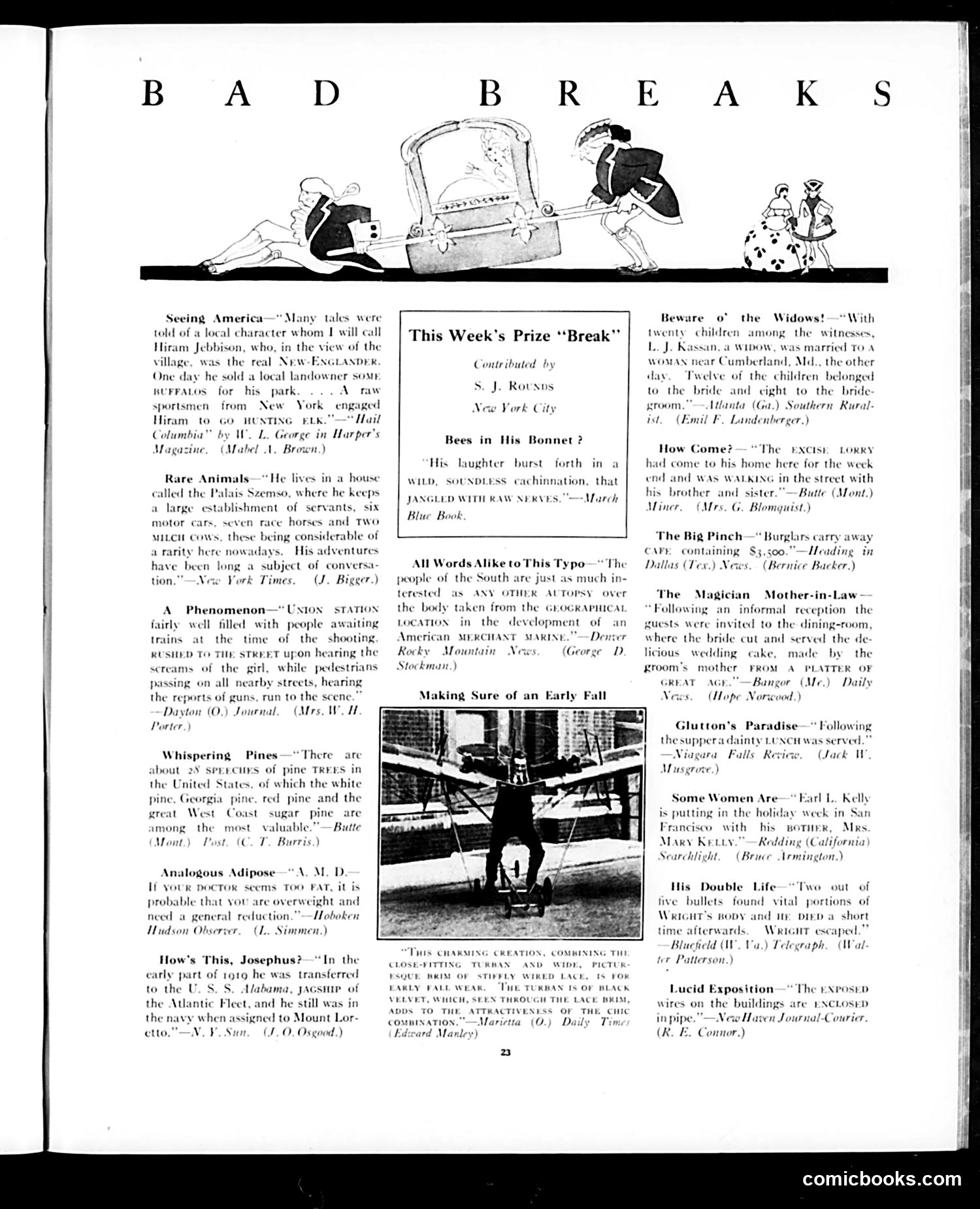
This page from *Judge* magazine showcases "Bad Breaks"—humorous typographical errors and awkward phrasings culled from newspapers. The central cartoon depicts a woman in early 1900s dress struggling with an oversized hat while two figures pull it apart, illustrating the fashion absurdity being mocked. The "breaks" are unintentional comedy: newspapers accidentally wrote that a widow had "twenty children among the witnesses" at her wedding (confusing family counts), that "burglars carry away" a specific sum, and that someone was "walking with his brother and sister" during a Prohibition raid. The satire targets journalistic carelessness rather than politics. Each clipping credits the original newspaper and contributor, suggesting *Judge* positioned itself as a corrective, humorous arbiter of public discourse—gently mocking the press's everyday blunders while maintaining a tone of superiority. The fashion cartoon adds visual humor to complement the textual gaffes.
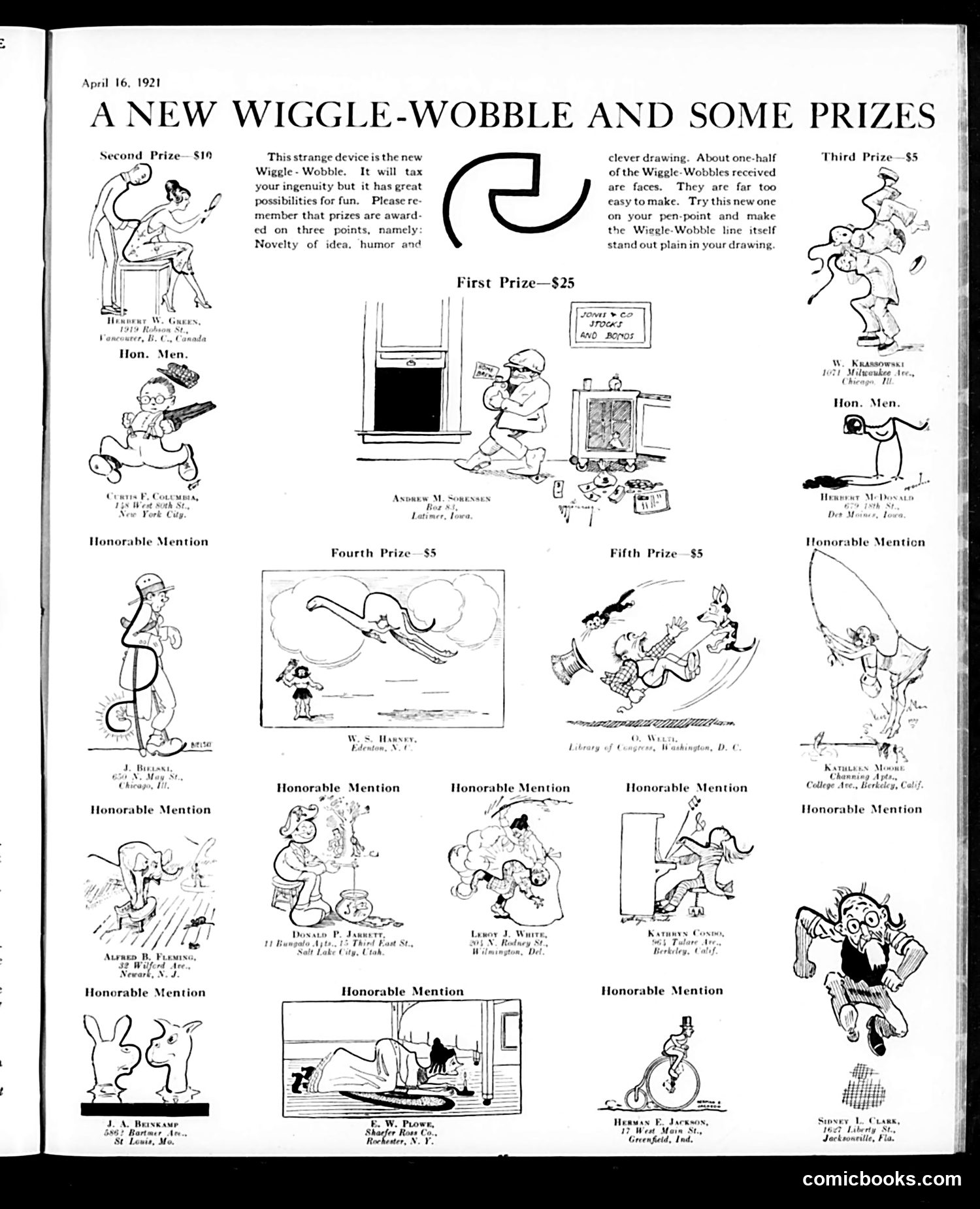
This page announces a drawing competition in *Judge* magazine for April 16, 1921. The "Wiggle-Wobble" was a parlor game or artistic exercise where contestants drew continuous lines that formed recognizable images—the curved line shown at top center demonstrates the concept. The magazine solicited entries judged on three criteria: novelty of idea, humor, and clever drawing. Prizes ranged from $25 (first) to $5 (third), with honorable mentions. The editors note that roughly half the submissions were faces, which they found too simplistic, encouraging contestants to challenge themselves with the pen-line technique itself. The page displays winning and honorable-mention entries from various contributors across North America, showing diverse interpretations of the wiggle-wobble format—mostly humorous character drawings and everyday scenes rendered through single continuous lines.
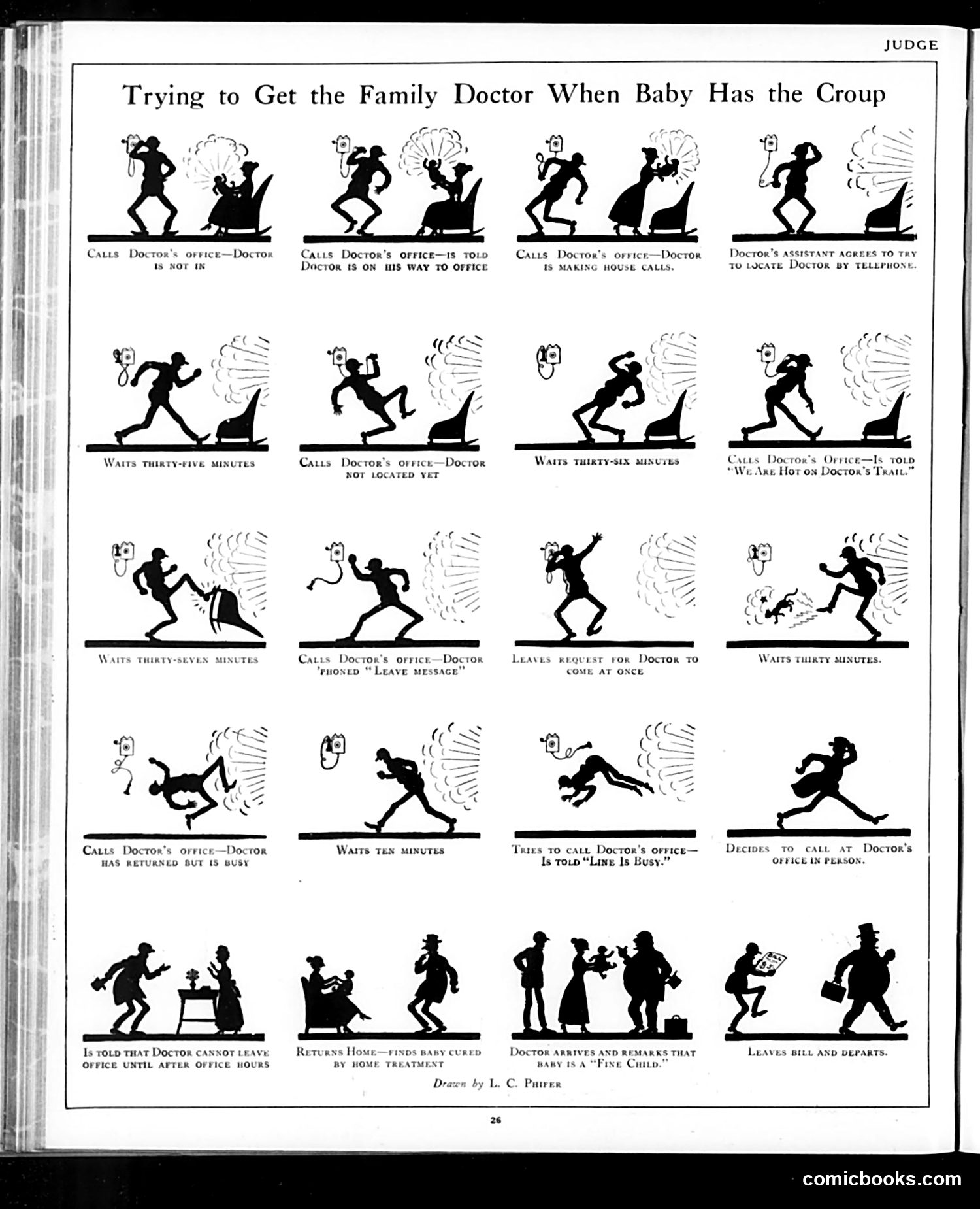
This comic strip satirizes the frustrations of accessing a doctor in what appears to be the early 20th century. A desperate parent tries repeatedly to reach their family doctor after their baby develops croup (a respiratory illness), encountering a series of obstacles: the doctor isn't in, is on house calls, is busy, his line is busy, his office staff can't locate him. The parent waits escalating periods, tries multiple contact methods, eventually visits in person—only to have the doctor arrive home, dismiss the illness as minor ("a fine child"), and leave an expensive bill anyway. The satire targets doctors' inaccessibility, high fees relative to actual help provided, and the gap between urgent patient need and physician availability. The exaggerated, frantic running figures emphasize the parent's mounting desperation against bureaucratic obstacles.
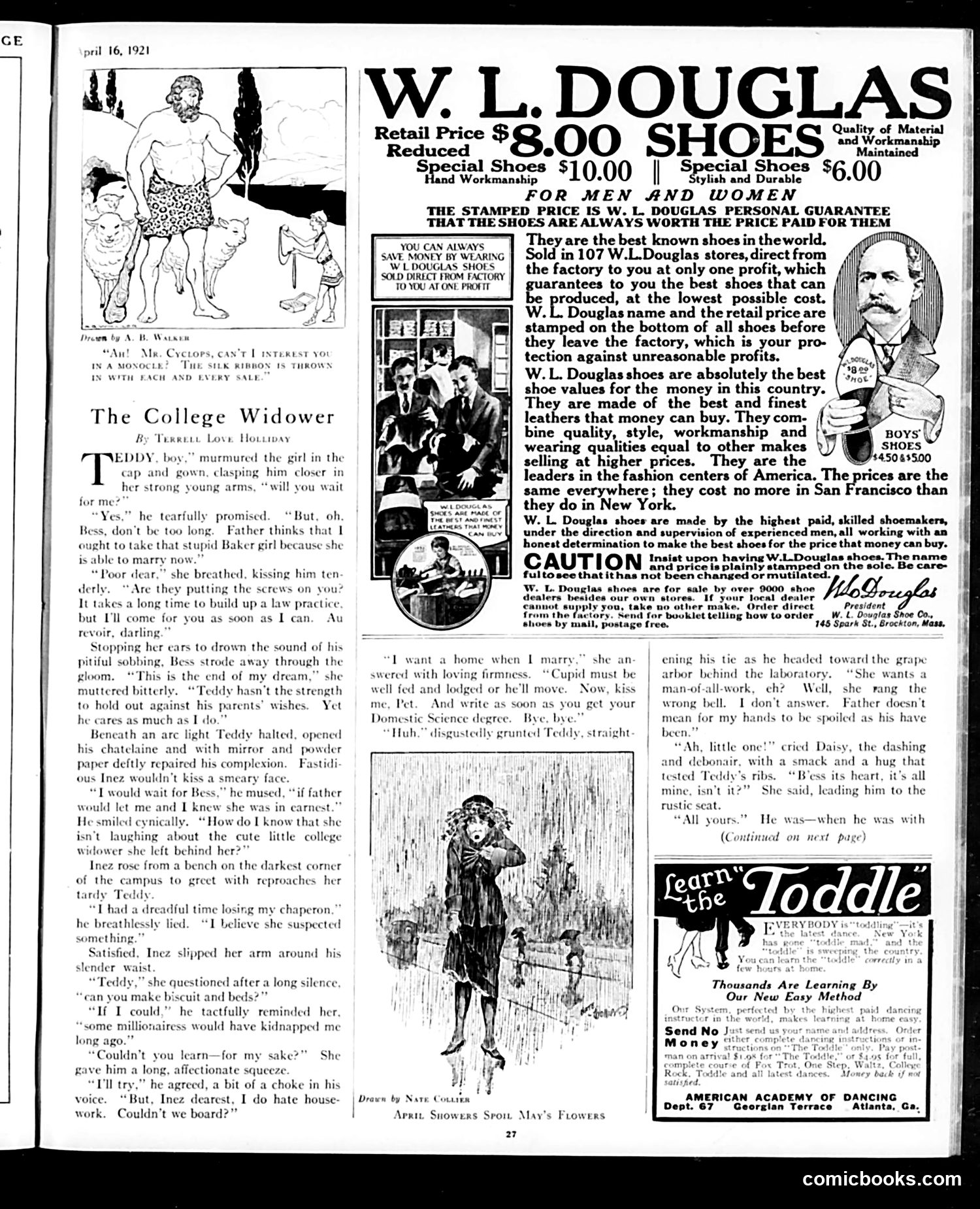
This story satirizes the conflict between romantic love and practical economic reality among young educated people in 1921. **The Setup:** Teddy, a law student, and his girlfriend Bess (who appears to be studying domestic science) promise eternal love. However, Teddy's father pressures him to marry Baker instead—a wealthier girl who can support his legal practice. **The Satire's Point:** The story mocks both the sentiment of young lovers and the mercenary calculations of parents. Teddy romanticizes poverty and struggle with Bess, but immediately abandons those ideals when financial pressure arrives. The title "College Widower" suggests a pattern of broken engagements among educated young men forced to choose between love and financial security. **Social Context:** Post-WWI America saw tension between traditional romantic ideals and the economic demands of building professional careers. Young men couldn't afford to marry without financial backing, making marriages transactional despite declarations of love. The story's cynicism reflects 1921 attitudes toward marriage as an economic arrangement disguised as romance.
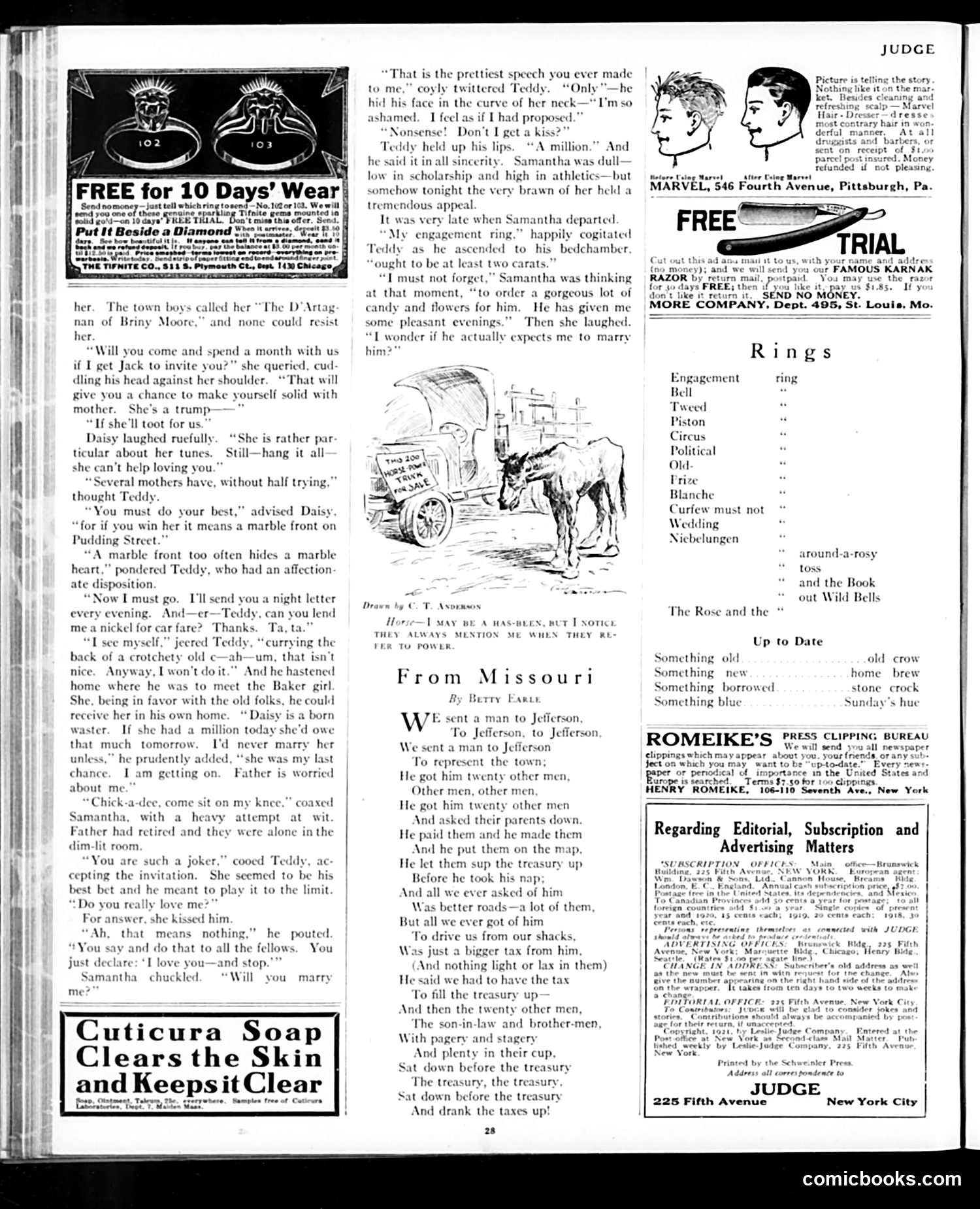
This page contains a romantic short story titled "Judge" (author unclear) and a political poem "From Missouri" by Betty Earle. **The main story** depicts a young man named Teddy juggling romantic interests with multiple women (Daisy and Samantha), each believing he's proposed to her. The satire mocks his shallow opportunism—he pursues Daisy for her family's wealth ("marble front on Pudding Street") while playing up to Samantha for her physical appeal. Both women are equally calculating, expecting gifts rather than genuine affection. **"From Missouri"** is political satire about government corruption. It describes sending a representative to Jefferson (Missouri's capital) who brings twenty companions, squanders the treasury, and repays constituents only with higher taxes and evictions ("drive us from our shacks"). The repetitive structure emphasizes the citizens' powerlessness against corrupt officials. Both pieces satirize early-20th-century American greed and self-interest—romantic and political alike.
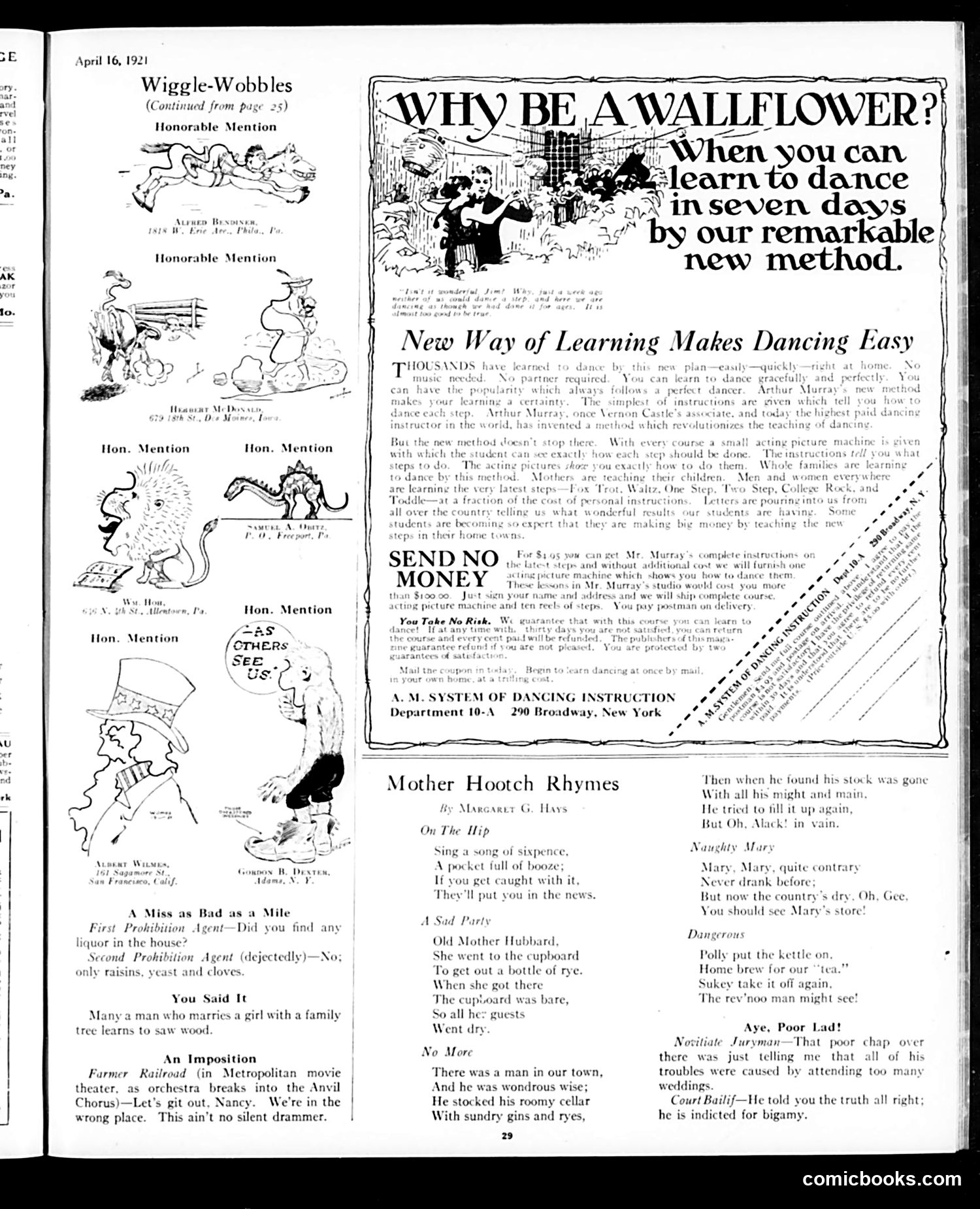
This page reflects American life under Prohibition (1920-1933). The left side contains "Wiggle-Wobbles"—humorous cartoon vignettes with captions. Notable examples mock Prohibition enforcement: two agents search a house finding only "raisins, yeast and cloves" (ingredients for illegal home alcohol production), and a farmer complains a movie theater's Anvil Chorus is too loud—he wants silent films. The right side features "Mother Hootch Rhymes," satirical poems mocking Prohibition's ineffectiveness. Characters like "Old Mother Hubbard" and "Naughty Mary" reference empty liquor cupboards and home-brewed "tea." One verse celebrates a man who wisely stockpiled alcohol before the ban. The humor consistently targets Prohibition's failure: citizens still obtained alcohol through illegal means, and enforcement proved futile. The page also advertises a dance instruction course—unrelated to the satirical content but typical of 1921 magazine advertising.
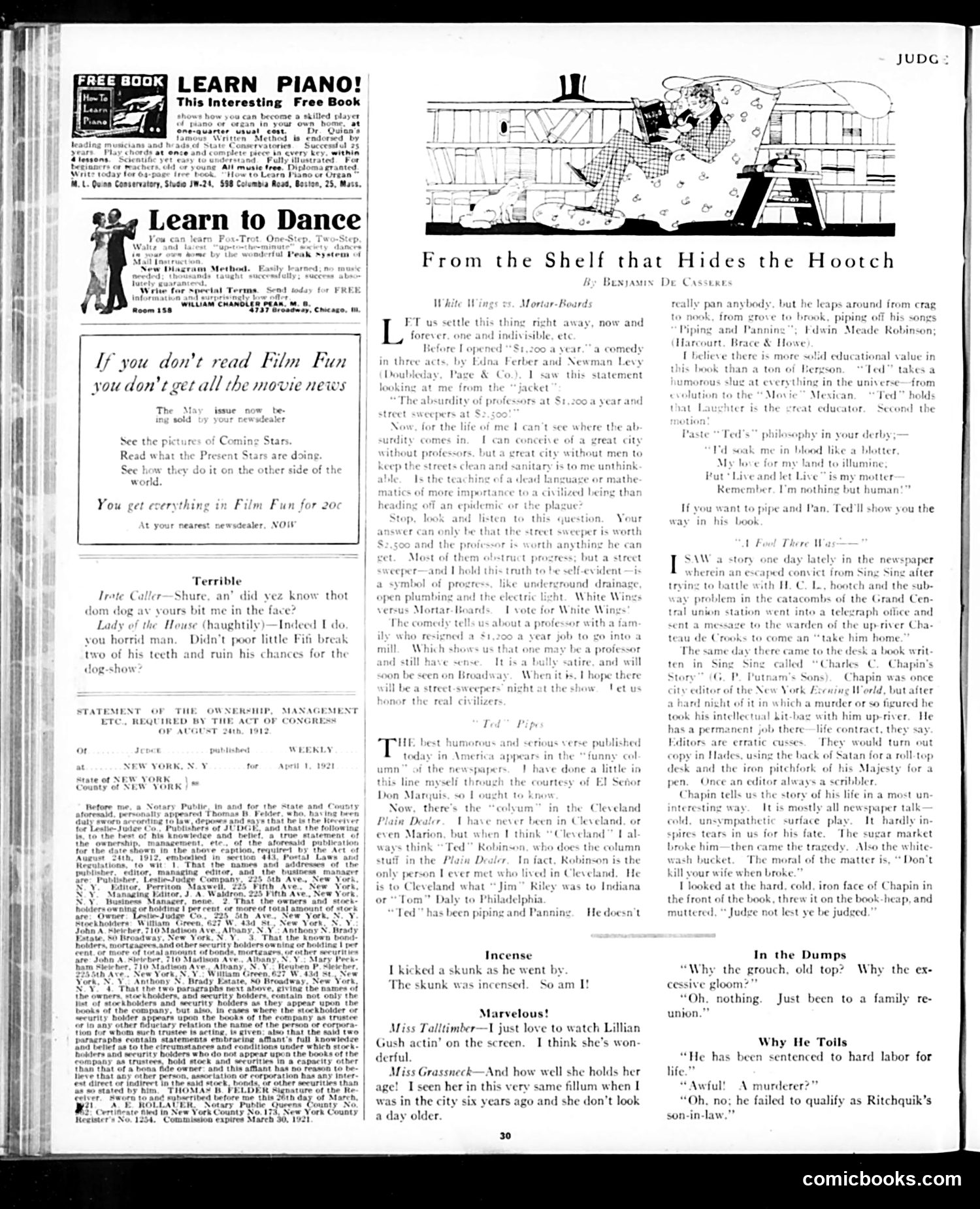
This page from Judge (April 1, 1921) is primarily **advertising and miscellaneous content** rather than political satire. The main cartoon, "From the Shelf that Hides the Hootch," depicts a figure leaping around a liquor cabinet, referencing **Prohibition-era bootlegging**—the "hootch" (illegal alcohol) hidden on domestic shelves was a common speakeasy joke during the 1920s alcohol ban. The page includes book advertisements, a "Learn to Dance" notice, and short humorous anecdotes. The small jokes at bottom—"Incense," "Marvelous," "In the Dumps," "Why He Toils"—are mild puns and social commentary typical of period magazines, touching on family troubles and hard labor rather than specific politics. The statement of ownership identifies Judge as published in New York, indicating it reached an urban, literate audience enjoying light satire on contemporary life and social customs.
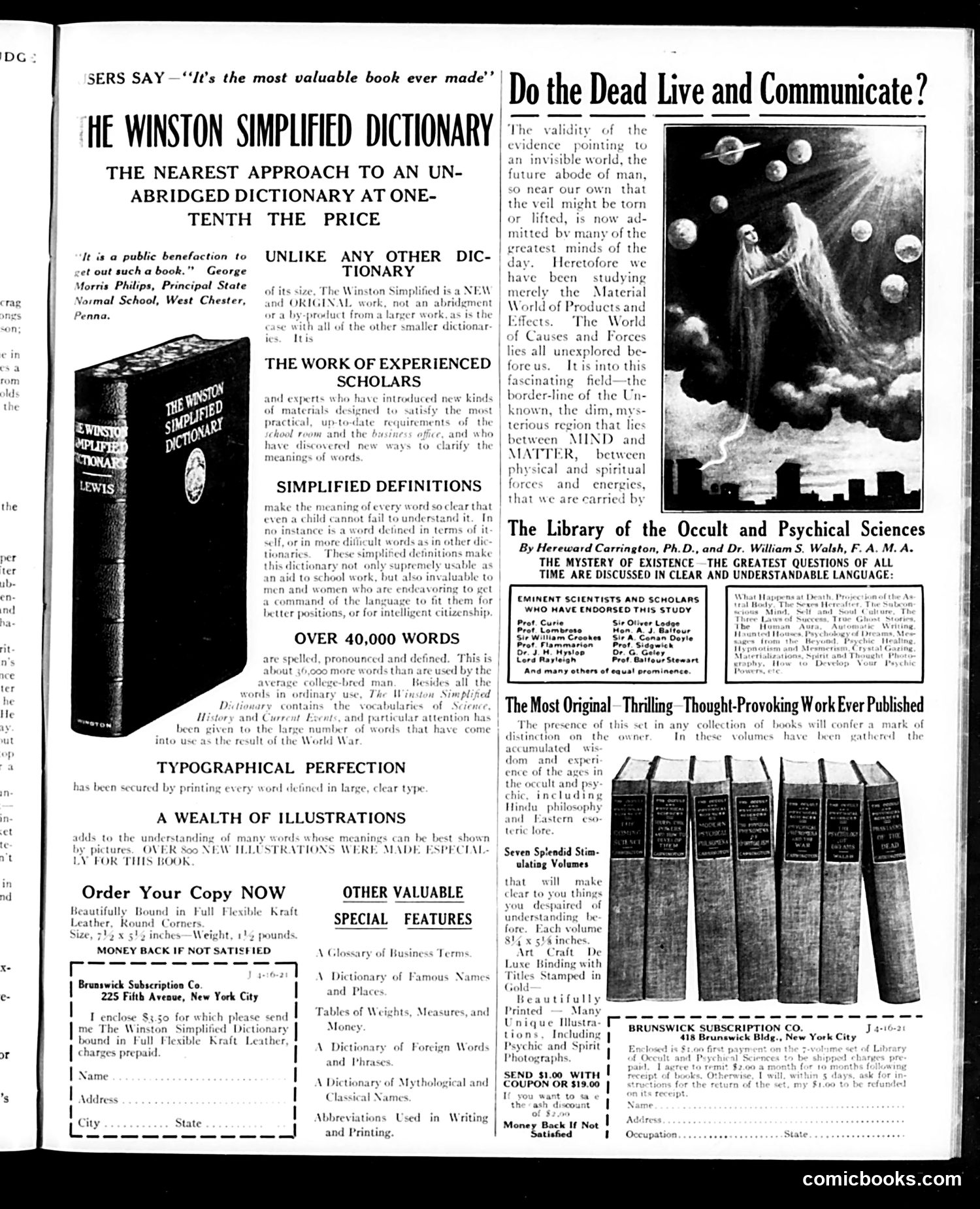
This page is primarily **advertising rather than satire**. It contains two major product advertisements: 1. **The Winston Simplified Dictionary** — marketed as an affordable alternative to unabridged dictionaries, emphasizing its 40,000 words, clear typography, and 500+ illustrations. The endorsement from a school principal suggests educational value. 2. **The Library of the Occult and Psychical Sciences** — a seven-volume set addressing spiritualism and the afterlife. The header "Do the Dead Live and Communicate?" and references to "invisible world," "MIND and MATTER," and spirit photography reflect early 20th-century popular fascination with spiritualism and psychic phenomena. Both advertisements target educated, curious readers interested in expanding knowledge. The spiritualism content is notable: this reflects genuine contemporary interest in occultism, not satire—spiritualism was a serious pseudoscientific movement of the era. No identifiable political figures, caricatures, or satirical commentary appear on this page.
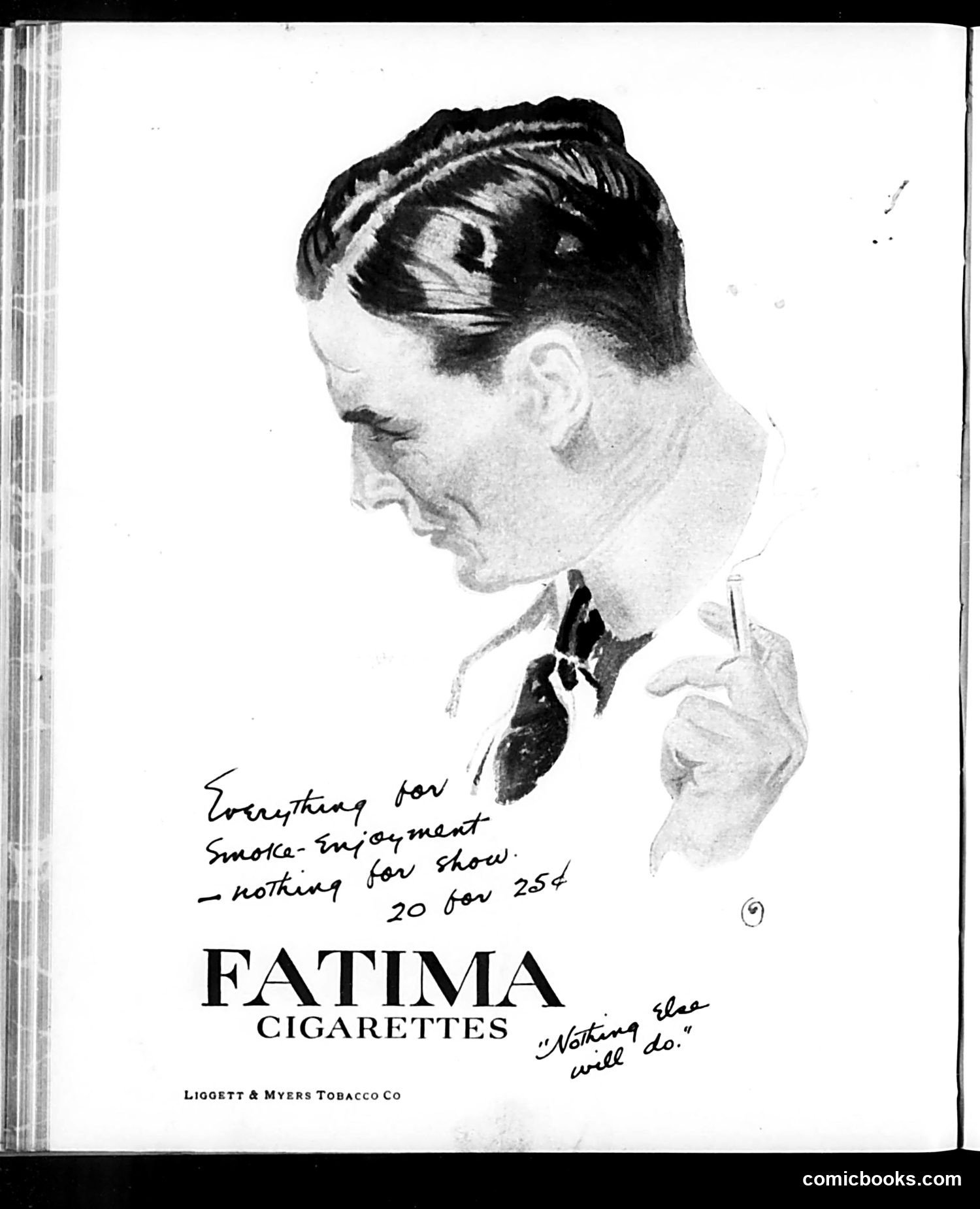
This is a **cigarette advertisement**, not a political cartoon. It features a caricatured male profile with exaggerated features—prominent nose and chin—depicted in a satirical drawing style typical of Judge magazine's aesthetic. The handwritten text reads: "Everything for Smoke enjoyment—nothing for show. 20 for 25¢" and "Nothing else will do." The ad promotes Fatima cigarettes by Liggett & Myers Tobacco Co., emphasizing value and practicality over status. The caricature style suggests the advertisement targets working-class consumers who prioritize affordability and function rather than prestige. This represents early 20th-century tobacco advertising before health warnings, when cigarettes were marketed as everyday consumer goods.