
Judge, 1921-04-16 · page 14 of 32
Judge — April 16, 1921 — page 14: what you’re looking at
What you’re looking at
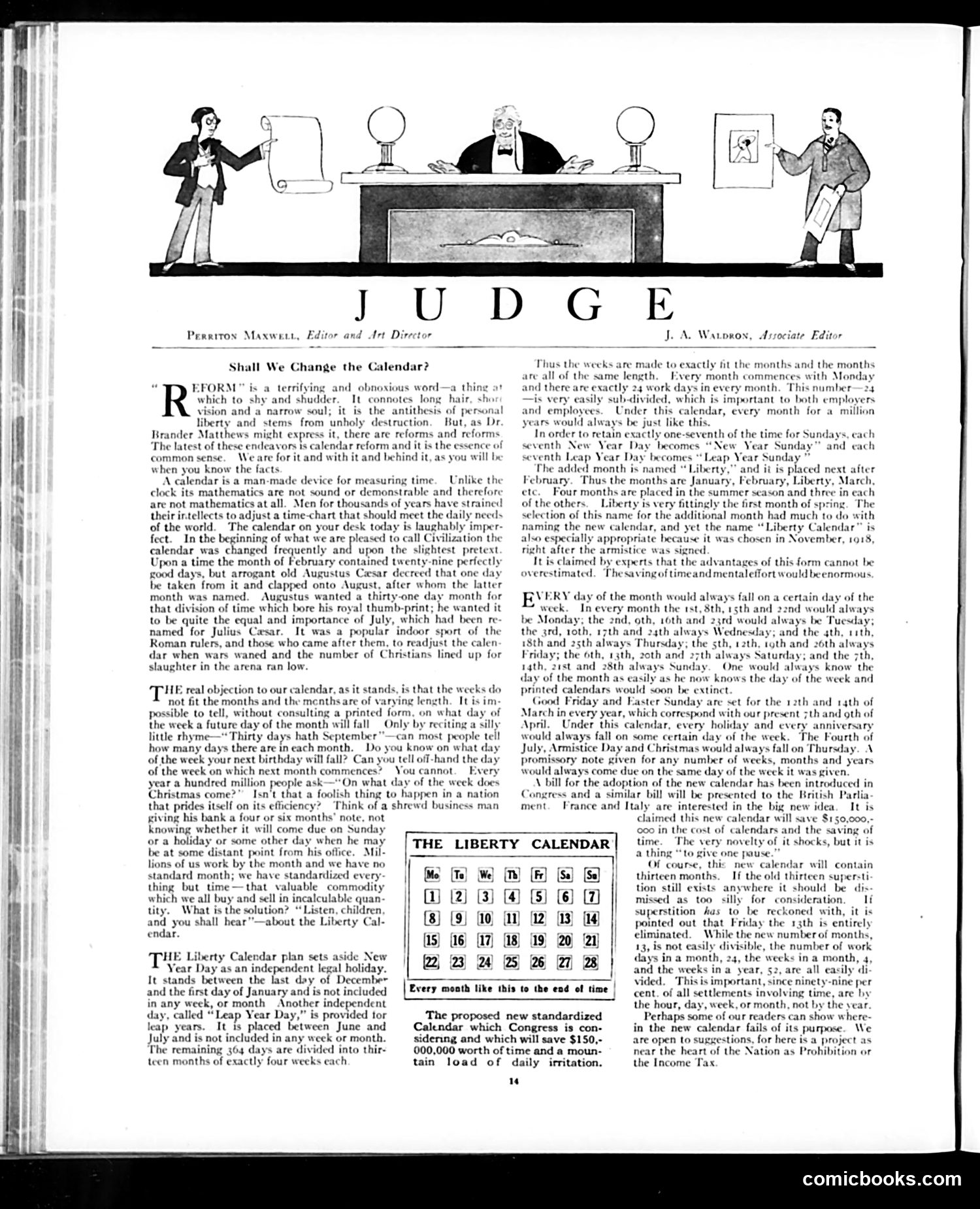
This editorial cartoon advocates for calendar reform—specifically, the "Liberty Calendar" proposal discussed in Congress around 1918-1919. The judge figure presides over the debate, flanked by two men presenting arguments. The text argues the current Gregorian calendar is mathematically flawed: months vary in length, weeks don't align consistently with months, and people can't easily calculate what day of the week future dates fall on. The reform proposes standardizing all months to 28 days (four equal weeks), eliminating the calendar calculation problem entirely. The new calendar would add a 13th month called "Liberty" (placed after February), chosen because the reform was adopted shortly after the 1918 Armistice. The proposal claimed to save $150,000,000 in time-related inefficiencies. While framed as rational modernization, this was actually controversial ecclesiastical and commercial territory. The cartoon's title "Judge" (the magistrate figure) lends authority to what was essentially speculative reform advocacy during the post-WWI optimism era.
📄 Transcribed text from this page (OCR, searchable)
Machine-transcribed from the original scan — historical spelling and the odd misread are preserved.
——— 7 Sa ae Perriton Maxwett, Shall We Change the Calendar? EFORM™” is a terrifying and obnoxious word—a thi: which to shy and shudder. It connotes long hair, vision and a narrow soul; it is the antithesis of personal liberty and stems from unholy destruction. But, as Dr Brander Matthews might express it, there are reforms and reforms The latest of these endeavors ts calendar reform and it is the essence of common sense. We are for it and with it and behind it, as you will be when you know the facts. A calendar is a man-made device for measuring time. Unlike the clock its mathematics are not sound or demonstrable and therefore are not mathematics at all. Men for thousands of years have strained their intellects to adjust a time-chart that should meet the daily needs of the world. The calendar on your desk today is laughably imper- fect. In the beginning of what we are pleased to call Civilization the calendar was changed frequently and upon the slightest pretext Upon a time the month of February contained twenty-nine perfectly good days, but arrogant old Augustus Cwesar decreed that one day be taken from it and clapped onto August, after whom the latter month was named. Augustus wanted a thirty-one day month {c that division of time which bore his royal thumb-print; he wanted it to be quite the equal and importance of July, which had been re- named for Julius Casar. It was a popular indoor sport of the Roman rulers, and those who came after them, to readjust the calen dar when wars waned and the number of Christians lined up for slaughter in the arena ran low. THE real objection to our calendar, as it stands, is that the weeks do not fit the months and the menthsare of varying length. It is im- possible to tell, without consulting a printed form. on what day of the week a future day of the month will fall Only by reciting a silly little rhyme—" Thirty days hath September—can most people tell how many days there are in each month. Do you know on what day of the week your next birthday will fall? Can you tell off-hand the day of the week on which next month commences? You cannot. Ever year a hundred million people ask—""On what day of the week doe Christmas come?” Isn't that a foolish thing to happen in a nation that prides itself on its efficiency? ‘Think of a shrewd business man giving his bank a four or six months’ note, not knowing whether it will come due on Sund: J. AL Warpros, Associate Editor Thus the weeks are made to exactly fit the months and the months are all of the same length. Every month commences with Monday and there are exactly 24 work days in every month. This number—2 -is very easily sub-divided, which is important to both employers and employees. Under this calendar, every month for a million years would always be just like this. In order to retain exactly one-seventh of the time for Sundays, cach seventh New Year Day becomes “New Year Sunday” and each seventh Leap Year Day becomes “Leap Year Sunday The added month is named “Liberty,” and it is placed next after February. Thus the months are January, February, Liberty, March, etc. Four months are placed in the summer season and three in cach of the others. _ Liberty is very fittingly the first month of spring. The selection of this name for the additional month had much to do with naming the new calendar, and yet the name “Liberty Calendar” is also especially appropriate because it was chosen in November, 1018, right after the armistice was signed It is claimed by experts that the advantages of this form cannot be overestimated. Thesavingof timeand mentaleffort would beenormous VERY day of the month would always fall on a certain day of th week. In every month the ist, 8th, 15th and 22nd would alway be Monday; the 2nd, oth, 16th and 23rd would always be Tuesday; the 3rd, roth, 17th and 24th always Wednesday; and the th, 11th, 18th and 25th always Thursday; the sth, 12th, 1gth and 26th always Friday; the oth, 13th, 20th and’ 27th always Saturday; and the 7th, 14th, 21st and 28th always Sunday. One would always know the day of the month as easily as he now knows the day of the week and printed calendars would soon be extinct Good Friday and Faster Sunday are set for the 12th and 14th of March in every year, which correspond with our present 7th and oth of April. Under this calendar, every holiday and every anniversary would always fall on some certain day of the week. The Fourth of July, Armistice Day and Christmas would always fall on Thursday. .\ promissory note given for any number of weeks, months and years would always come due on the same day of the week it was given. \ bill for the adoption of the new calendar has been introduced in Congress and a similar bill will be presented to the British Parlia ment. France and Italy are interested in the big new idea. It is claimed this new calendar will save $150,000,- y 00 in the cost of calendars and the saving of or a holiday or some other day when he may [THE LIBERTY CALENDAR] time. The very novelty of it shocks, but it is be at some distant point from his office. Mil- a thing “to give one pause lions of us work by the month and we have no a | Of course, t new calendar will contain standard month; we have standardized every- || (Me. [Te] [We] {Tb} [Fr] [Sa] [Se] thirteen months. If the old thirteen supersti thing but time—that valuable commodity tion still exists anywhere it should be dis which we all buy and sell in incalculable quan- || (1) [2] [3] (4) (5) (6) (7) | missed as too silly for consideration. Ii tity. What is the solution? “Listen, children, | endar. ‘HE Liberty Calendar plan sets aside New Year Day as an independent legal holiday. and you shall hear”—about the Liberty Cal: | (8) (9) (10) {an} [12 (13) (04) 23) (24) (25) 26 a eB days in a month, superstition kas to be reckoned with, it is pointed out that Friday the 13th is entirely {16 {17} (18) 119) 20) (21) eliminated. While the new number of months, 13, is not easily divisible, the number of work 4, the weeks in a month, 4, ] and the weeks in a year, 52, are all easily di It stands between the last day of December and the first day of January and is not included in any week, or month Another independent day, called “Leap Year Day,” is provided tor Every month like this to the end ef time | The proposed new standardized vided. This is important, since ninety-nine per cent. of all settlements involving time, are by the hour, day, week, or month, not by the year Perhaps some of our readers can show where- leap years. It is placed between June and Calendar which Congress is con- _in the new calendar fails of its purpose. We July and is not included in any week or month. _ sidering and which will save $150,- are open to suggestions, for here is a project as The remaining 364 days are divided into thir- 000,000 worth of time and a moun- _near the heart of the Nation as Prohibition or “ teen months of exactly four weeks each tain load of daily irritation. the Income Tax. comicbooks.com