
Judge, 1921-04-16 · page 20 of 32
Judge — April 16, 1921 — page 20: what you’re looking at
What you’re looking at
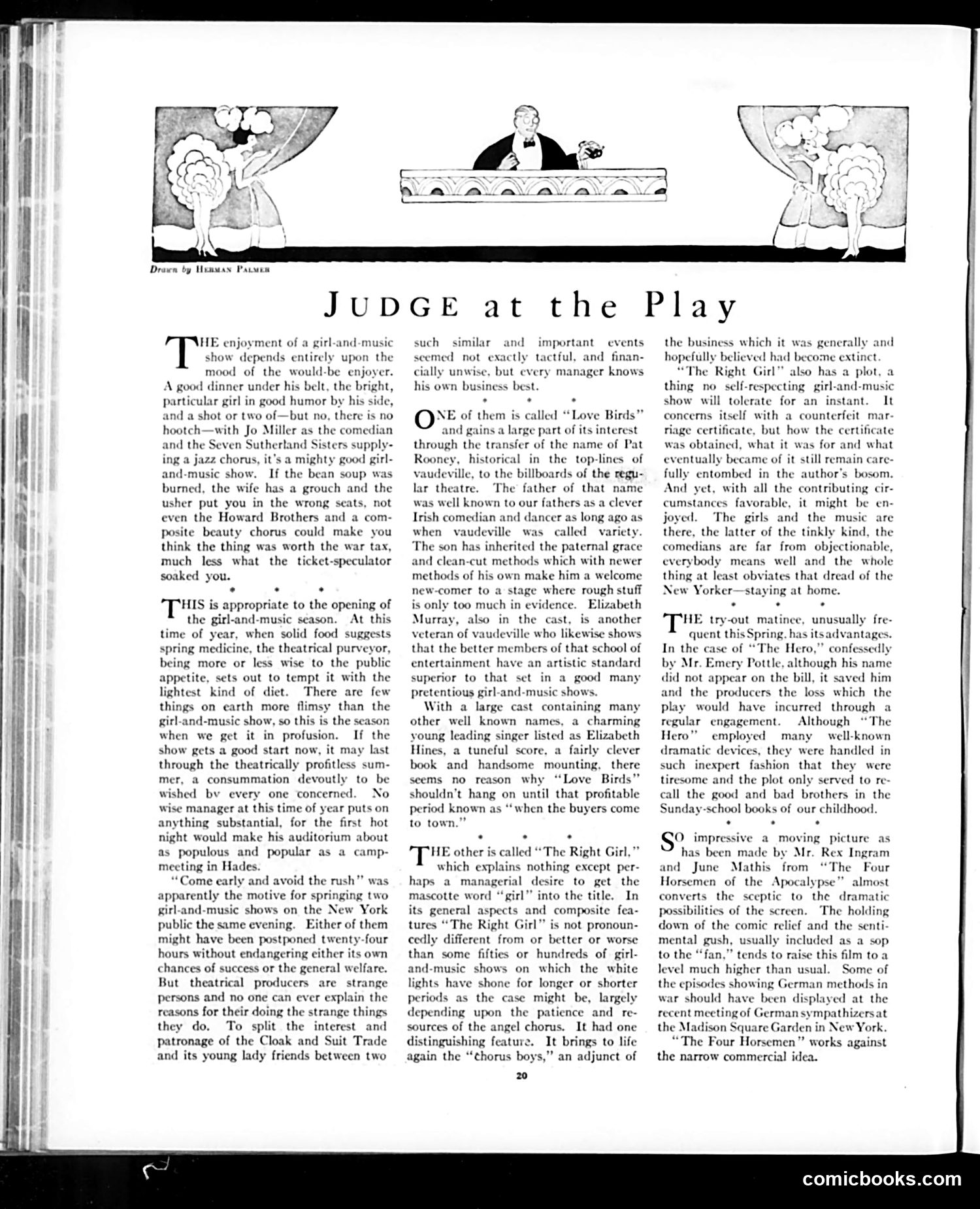
This is a theater review article, not a political cartoon. The decorative header illustration shows a judge overseeing two showgirls—a visual pun on "Judge at the Play." The article critiques two girl-and-music shows opening simultaneously on Broadway. It praises "Love Birds," which benefits from the famous Rooney name (Pat Rooney, descended from vaudeville performers) and features Elizabeth Murray and Elizabeth Hines. The writer considers it well-constructed with superior entertainment standards. The other show, "The Right Girl," receives dismissive treatment—the critic can't explain what makes it distinctive and compares it unfavorably to countless similar productions. The satire targets theatrical producers' illogical business decisions: opening competing shows the same night splits audiences unnecessarily. The broader point critiques lightweight "girl-and-music" shows as seasonal filler entertainment, dependent entirely on audience mood and conditions rather than artistic merit.
📄 Transcribed text from this page (OCR, searchable)
Machine-transcribed from the original scan — historical spelling and the odd misread are preserved.
Liebe pt ly _ JUDGE at the Play Drawn by Henuas HE enjoyment of a girl-and-music show depends entirely upon the mood of the would-be enjoyer. A good dinner under his belt, the bright, particular girl in good humor by his side, and a shot or two of—but no, there is no hootch—with Jo Miller as the comedian and the Seven Sutherland Sisters supply- ing a jazz chorus, it’s a mighty good girl- and-music show. If the bean soup was burned, the wife has a grouch and the usher put you in the wrong seats, not even the Howard Brothers and a com- posite beauty chorus could make you think the thing was worth the war tax, much less what the ticket-speculator soaked you. ‘Tis is appropriate to the opening of the girl-and-music season. At this time of year, when solid food suggests spring medicine, the theatrical purveyor, being more or less wise to the public appetite, sets out to tempt it with the lightest kind of diet. There are few things on earth more flimsy than the girl-and-music show, so this is the season when we get it in profusion. If the show gets a good start now, it may last through the theatrically profitless sum- mer, a consummation devoutly to be wished by every one concerned. No wise manager at this time of year puts on anything substantial, for the first hot night would make his auditorium about as populous and popular as a camp- meeting in Hades. “Come early and avoid the rush” was apparently the motive for springing two girl-and-music shows on the New York public the same evening. Either of them might have been postponed twenty-four hours without endangering either its own chances of success or the general welfare. But theatrical producers are strange persons and no one can ever explain the reasons for their doing the strange things they do. To split the interest and patronage of the Cloak and Suit Trade and its young lady friends between two such similar and important events scemed not exactly tactful, and finan- cially unwise, but every manager knows his own business best. NE of them is called “Love Birds” and gains a large part of its interest through the transfer of the name of Pat Rooney, historical in the top-lines of vaudeville, to the billboards of the regu- lar theatre. The father of that name was well known to our fathers as a clever Irish comedian and dancer as long ago as when vaudeville was called variety. he son has inherited the paternal grace and clean-cut methods which with newer methods of his own make him a welcome new-comer to a stage where rough stuff is only too much in evidence. Elizabeth Murray, also in the cast, is another veteran of vaudeville who likewise shows that the better members of that school of entertainment have an artistic standard superior to that set in a good many pretentious girl-and-music shows. With a large cast containing many other well known names, a charming young leading singer listed as Elizabeth Hines, a tuneful score, a fairly clever book and handsome mounting, there seems no reason why “Love Birds” shouldn’t hang on until that profitable period known as “when the buyers come to town.” HE other is called “The Right Girl,” which explains nothing except per- haps a managerial desire to get the mascotte word “‘girl” into the title. In its general aspects and composite fea- tures “The Right Girl” is not pronoun- cedly different from or better or worse than some fifties or hundreds of girl- and-music shows on which the white lights have shone for longer or shorter periods as the case might be, largely depending upon the patience and re- sources of the angel chorus. It had one distinguishing feature. It brings to life again the “¢horus boys,” an adjunct of 20 the business which it was generally and hopefully believed had become extinct “The Right Girl” also has a plot, thing no self-respecting girl-and-music show will tolerate for an instant. It concerns itself with a counterfeit mar- riage certificate, but how the certificate was obtained, what it was for and what eventually became of it still remain care- fully entombed in the author's bosom. And , With all the contributing cir- cumstances favorable, it might be en- joyed. The girls and the music are there, the latter of the tinkly kind, the comedians are far from objectionable, everybody means well and the whole thing at least obviates that dread of the New Yorker—staying at home. HE try-out matinee, unusually fre- quent this Spring. has itsad In the case of “The Hero, y by Mr. Emery Pottle, although his name did not appear on the bill, it saved him and the producers the loss which the play would have incurred through a regular engagement. Although “The Hero” employed = many well-known dramatic devices, they were handled in such inexpert fashion that they were tiresome and the plot only served to re- call the good and bad brothers in the Sunday-school books of our childhood. confess O impressive a moving picture as has been made by Mr. Rex Ingram and June Mathis from ‘The Four Horsemen of the Apocalypse’ almost converts the sceptic to the dramatic possibilities of the screen. The holding down of the comic relief and the senti- mental gush, usually included as a sop to the “fan,” tends to raise this film toa level much higher than usual. Some of the episodes showing German methods in war should have been displayed at the recent meeting of German sympathizersat the Madison Square Garden in New York. “The Four Horsemen” works against the narrow commercial idea. comicbooks.com