
Judge, 1921-04-16 · page 5 of 32
Judge — April 16, 1921 — page 5: what you’re looking at
What you’re looking at
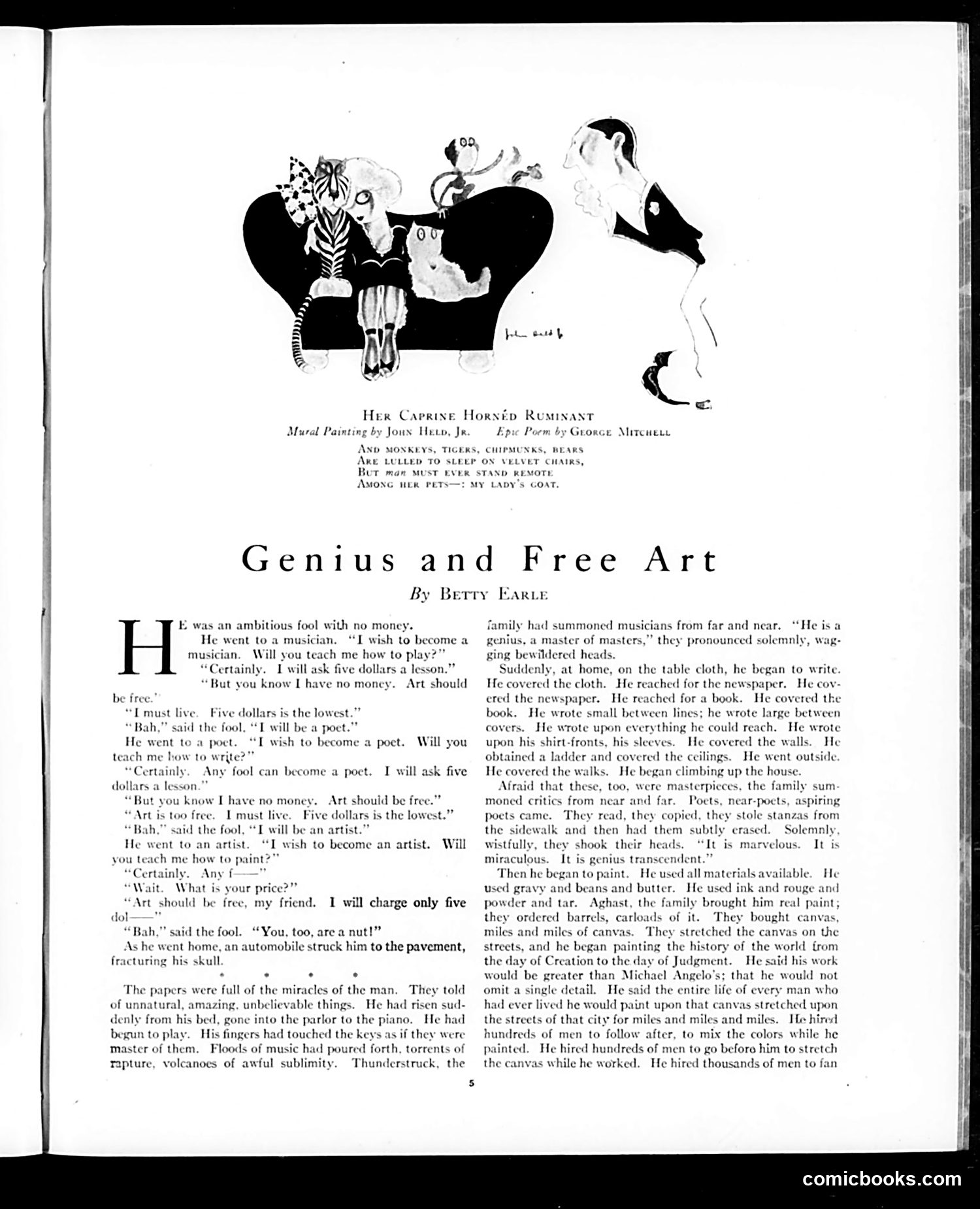
**The Cartoon:** "Her Caprine Horsed Ruminant" depicts a woman seated on an elaborate couch surrounded by exotic animals (monkeys, tigers, chipmunks, bears). A fashionably dressed man observes from the right. **The Satire:** This appears to mock wealthy women's excessive indulgence in exotic pet collections—a status symbol among the wealthy. The absurd menagerie suggests ridicule of conspicuous consumption and the impracticality of keeping wild animals as house pets. **"Genius and Free Art"** below is a separate humorous story about an impoverished but ambitious young man who refuses to pay for instruction, insisting "art should be free," then hires hundreds of workers and materials to create massive paintings—a comedic contradiction of his stated principles about cost. Both pieces satirize American attitudes toward wealth, ambition, and the arts.
📄 Transcribed text from this page (OCR, searchable)
Machine-transcribed from the original scan — historical spelling and the odd misread are preserved.
Her Caprine Horxép Ruminan Mural Painting by Jous Hern, Jr AND MONKEYS, TIGERS, € mb: orce Muircwene Epic Po MUNKS, BEARS ARE LULLED TO SLEEP ON VELVET CHAIRS, STAND KEMOTI But man must AMONG WERK PETS EVER : My LADY'S GOAT Genius and Free Art By Berry Farce E was an ambitious fool with no money. He went to a musician. “I wish to become a Will you teach me how to play?” 1 will ask five dollars a lesson.” Art should musician. “Certainly. “But you know I have no moncy. be free “LT must live. Five dollars is the lowest.” “Bah,” said the fool, “I will be a poet. He went to a poct. “I wish to become a poct. teach me how to write?” “Certainly. Any fool can become a poet. dollars a lesson “But you know I have no money. Art should be free.” “Art is te I must live. Five dollars is the lowest. “Bah,” said the fool, “I will be an artist.” He went to an artist. “I wish to become an artist. you teach me how to paint?” “Certainly. Any f—" “Wait. What is your price “Art should be free, my friend. I will charge only five Will you I will ask five free Will “Bah,” said the fool. ‘You, too, are a nut!” As he went home, an automobile struck him to the pavement, fracturing his skull The papers were full of the miracles of the man. They told of unnatural, amazing, unbelievable things. He had risen sud- denly from his bed, gone into the parlor to the piano. He had begun to play. His fingers had touched the keys as if they were master of them. Floods of music had poured forth, torrents of rapture, volcanocs of awful sublimity. Thunderstruck, the family had summoned musicians from far and near. “He is a genius, a master of masters,” they pronounced solemnly, wag- ging bewildered heads. Suddenly, at home, on the table cloth, he began to write He covered the cloth. He reached for the newspaper. He cov- ered the newspaper. He reached for a book. He covered the book, He wrote small between lines; he wrote large between covers. He wrote upon everything he could reach. He wrote upon his shirt-fronts, his sleeves. He covered the walls. He obtained a ladder and covered the ceilings. He went outside He covered the walks. He began climbing up the house. AMraid that these, too, were masterpieces, the family sum. Poets, near-poets, aspiring poets came. They read, they copied, they stole stanzas from the sidewalk and then had them subtly erased. Solemnly wistfully, they shook their heads. “It is marvelous. It is miraculous. It is genius transcendent.” Then he began to paint. He used all materials available. He used gravy and beans and butter. He used ink and rouge and powder and tar. Aghast, the family brought him real paint; they ordered barrels, carloads of it. They bought canvas, miles and miles of canvas. They stretched the canvas on the streets, and he began painting the history of the world from the day of Creation to the day of Judgment. He said his work would be greater than Michael Angelo’s; that he would not omit a single detail. He said the entire life of every man who had ever lived he would paint upon that canvas stretched upon the streets of that city for miles and miles and miles. He hired hundreds of men to follow after, to mix the colors while he ainted. He hired hundreds of men to go before him to stretch the canvas while he worked. He hired thousands of men to fan moned critics from near and far. comicbooks.com